





1. Introduction
Across cultures, time can be represented in various ways, such as using the spatial representations of water clocks, hourglasses, calendars, etc. (Sinha et al., Reference Sinha, Sinha, Zinken and Sampaio2011). Time can also be indicated by natural and biological phenomena, such as the crowing of cocks, the location of the sun, the duration of burning of an incense stick, etc.
In addition to cultural artefacts, humans also use language creatively to express time. For example, time can simply be marked by a tense system or lexical words. Some additional linguistic devices such as tense markers, aspectual verbs, and temporal connectives can also be used to express more complex temporal relations (e.g., “The man married three times before he met his ideal lover.”). Furthermore, language can communicate a sequence of events by using an order of mention that reflects the order in which events occurred. For example, in Caesar’s “Veni, Vidi, Vici” ‘I came, I saw, I conquered’, the order of elements in the utterance mirrors the temporal sequence of events.
However, the precise mechanisms involved in temporal expressions of time vary across languages and modalities. For example, unlike English, some languages, such as Mandarin and Chinese Sign Language (CSL), do not have a tense system. Furthermore, in contrast to spoken languages in which the expression of time largely depends on speech, temporal expressions in sign languages predominantly rely on hand and body movements. Sign language users employ various elements including lexical items, specific markers such as “not yet finished”, pointing, hand holding, facial expressions, and body movements to visually position time in space (Sinte, Reference Sinte, Meurant, Sinte, Van Herreweghe and Vermeerbergen2013). The differences in temporal expressions between spoken and signed languages also reveal a great variety of complex mechanisms.
In line with embodied cognition theories proposing that conceptual representations are largely grounded in sensorimotor experiences (Glenberg & Kaschak, Reference Glenberg and Kaschak2002), some cognitive linguists hold the view that the conceptualization of time can be ‘embodied’ (Lakoff & Johnson, Reference Lakoff and Johnson1980; Santiago et al., Reference Santiago, Lupáñez, Pérez and Funes2007), and that representations are activated and often instantiated in the form of gestures (Hostetter & Alibali, Reference Hostetter and Alibali2008). In other words, the way one conceptualizes time may be revealed by such manual movements. For instance, an increasing number of studies on speakers’ temporal gestures have shown that across cultures and languages people conceptualize time differently (e.g., Casasanto & Jasmin, Reference Casasanto and Jasmin2012; Cooperrider and Núñez, Reference Cooperrider and Núñez2009; Gu, Mol et al., Reference Gu, Mol, Hoetjes and Swerts2017; Gu, Zheng et al., Reference Gu, Zheng and Swerts2019a; Kita et al., Reference Kita, Danziger, Stolz and Gattis2001; Le Guen & Pool Balam, Reference Le Guen and Pool Balam2012; Núñez & Sweetser, Reference Núñez and Sweetser2006; Sullivan & Bui, Reference Sullivan and Bui2016; Valenzuela & Carrión, Reference Valenzuela and Carrión2020).
As for signs, the mechanisms employed for temporal expressions can be basically divided into three types. First, the use of a timeline is an unavoidable starting point in any description of temporal marking (Sinte, Reference Sinte, Meurant, Sinte, Van Herreweghe and Vermeerbergen2013). For instance, British Sign Language (BSL) users can point backwards to refer to the past and sign towards the front to indicate the future (Brennan, Reference Brennan, Kyle and Woll1983; Sutton-Spence & Woll, Reference Sutton-Spence and Woll1999). This front–back timeline is very common and has been documented in sign languages in America, Argentina, Australia, Belgium, Demark, France, Italy, Nigeria (Hausa), the Netherlands, Quebec, Russia, Spain, etc. (e.g., Burkova et al., Reference Burkova, Filimonova, Kimmelman, Kopylova and Semushina2018; Engberg-Pedersen, Reference Engberg-Pedersen1993; Johnston & Schembri, Reference Johnston and Schembri2007; Maeder & Loncke, Reference Maeder and Loncke1996; Massone, Reference Massone, Brennan, Ahlgren and Bergman1994; Pereiro & Soneira, Reference Pereiro and Soneira2004; Pizzuto et al., Reference Pizzuto, Cameracanna, Corazza, Volterra and Simone1995; Schmaling, Reference Schmaling2000; Schermer & Koolhof, Reference Schermer, Koolhof, Siegmund and Vollhaber1990; Sinte, Reference Sinte, Meurant, Sinte, Van Herreweghe and Vermeerbergen2013). Second, almost all sign languages have lexicalized signs such as morning, month, etc. to express time, whereas the form of a sign for a given concept can vary greatly across sign languages. And third, signers may use other sources such as non-manuals to convey time. For example, verbal inflection is claimed to be used for tense marking in American Sign Language (ASL), BSL, and Italian Sign Language (Friedman, Reference Friedman1975; Sutton-Spence & Woll, Reference Thompson, Longacre and Shopen1999; Zucchi, Reference Zucchi2009).
To date, only a few studies have looked at temporal expressions in sign languages based on naturalistic data (e.g., Johnston & Schembri, Reference Johnston and Schembri2007; Nilsson, Reference Nilsson2016). For example, Pereiro and Soneira (Reference Pereiro and Soneira2004) conducted an interesting study on temporal expressions in Spanish Sign Language, but they used written Spanish to elicit signs and their results were based on only two deaf informants. We may question whether test designs and findings in studies characterized by relatively low ecological validity can be generalized to real-life situations.
Furthermore, studies on the use of manual modalities to convey time have mostly focused on the movement/placement of whole hands, rather than zooming in on the details of finger functions. Fingers are naturally connected to the palms of the hands, which are essential elements in both gestures and sign languages. On the one hand, they are often regarded as part of the whole handshape that forms the internal parameters in sign language phonology (Brentari, Reference Brentari1998). On the other hand, fingers themselves can form independent expressions, either through iconic gestures co-occurring with speech or signing forms in sign languages (e.g., extending one finger to indicate the number ‘1’ or using ‘number gestures’ to indicate quantities). Such a form–meaning relation has been taken for granted in sign language research. However, the intrinsic connection between finger representations, number, and time is often neglected, even though it may provide a better understanding of the link between cognitive maps across domains.
In the current study, we did not focus on timelines or non-manual movements but were interested in the relationship between fingers and time expressions in Chinese Sign Language (CSL). Specifically, we looked closely at expressions of time through finger configurations (e.g., finger shapes in ASL), as well as the arrangements of fingers in ordering and listing sequential events. We also briefly discuss the relationship between sign language numbers and time in fingers. Different from spoken English, the study of a non-Western signed language (i.e., CSL) provides a unique opportunity to further understand time mechanisms in a language that differs in typology and modality.
Crucially, we conducted a corpus-based study in which a large sample of deaf signers’ naturalistic interactions were recorded. In contrast to elicitation materials, naturalistic data are more authentic and reliable. They can also offer a ‘visible’ context to differentiate form and function. Particularly, a linguistic form can have different functions in different contexts, and naturalistic data from the corpus can help us nail down the functions of one form and its relations. Additionally, a large corpus offers a lot of key information that cannot be approached otherwise, such as distribution, frequency, and some social linguistic information that may affect language production, such as age, gender, etc. (Johnston, Reference Johnston2010). Based on the results from corpus descriptions, we aim to find factors that shape CSL finger-time representations and explain how they may reveal a signer’s mind.
1.1. Digital, numeral incorporation, and points-to-fingers
Despite the limited literature on the relationship between fingers and time, existing studies show that there are three forms of finger representations of time in sign languages: digital, numeral incorporation, and points-to-fingers.
First, ‘digital’ can mean either fingers or numbers. Quite often, finger representations of numbers can be used for temporal purposes, e.g., in CSL the calendar time ‘1957’ is signed by the number signs 1–9–5–7 in sequence. When a form of fingers for time originates from ‘numbers’, Zeshan (Reference Zeshan2015) calls it ‘digital’; here, we adopt her term to refer to those finger representations of time that are identical to finger representations of numbers. Digital is prevalent in all types of sign languages, from large urban sign languages (e.g., ASL, Japanese Sign Language; Sagara, Reference Sagara2014) to small-scale village sign languages (Zeshan & De Vos, Reference Zeshan and De Vos2012; Zeshan et al., Reference Zeshan, Escobedo Delgado, Dikyuva, Panda and De Vos2013), an emergent language (Nicaraguan Sign Language; Kocab et al., Reference Kocab, Senghas and Snedeker2016), and ad hoc communication between signers without shared language (Zeshan, Reference Zeshan2015). Unsurprisingly, the use of numbers to convey time information between signers who have no shared language may lead to confusion as arrangements of fingers can differ (Zeshan, Reference Zeshan2015).
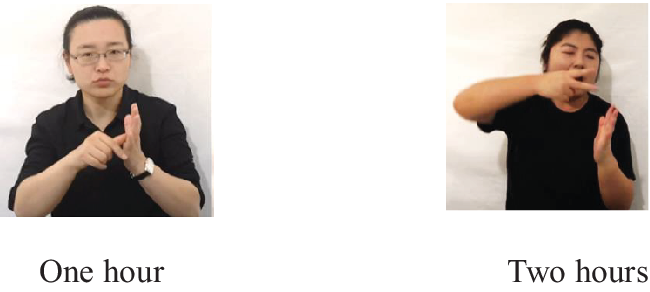
Second, ‘numeral incorporation for time’ means that a number is incorporated into a handshape, a classifier, or a pronoun of a sign (see Steinbach, Reference Steinbach, Pfau, Steinbach and Woll2012, for a review) to express time. For example, as Figure 1 shows, expressions for the number of hours combine a digital sign with a sign for a time unit, here ‘hour’. Such finger forms of time are common across sign languages, especially for time units such as hours, weeks, months, days, and years, though choices of forms can differ across languages. After examining data from 21 sign languages, Zeshan and Sagara (Reference Zeshan and Sagara2016) observed that the most frequent paradigms of numeral incorporation for time are signs for time units, calendric terms, and school grades.
Examples of using numeral incorporation to quantify ‘hours’.
Third, the form of ‘points-to-fingers’ is defined as using the fingers of one hand to represent a set of depicted items, while using the other hand to point to the finger representing the target item (Kocab et al., Reference Kocab, Senghas and Snedeker2016). It has various functions such as counting (fingers are spread) and enumeration (unbending fingers when the hand is initially a fist) (Sagara, Reference Sagara2014), in which fingers are used to make conceptual associations with various entities (Liddell, Reference Liddell2003). Extended or bent fingers can be visual representations of entities. Importantly, points-to-fingers can be used to express sequential time.
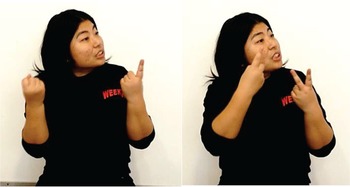
Another type of signs that are similar to ‘points-to-fingers’ is often referred to as the ‘list buoys’ in sign language research, but the fingers are optional for pointing at. The handshapes of list buoys are similar to those of number signs from one to five. List buoys can be static or sequentially built, but only sequentially-built list buoys serve the purpose of keeping track of referents that are either introduced in a chronological/logical order or simply in the order in which they come into the signer’s mind (Nilsson, Reference Nilsson, Vermeerbergen, Leeson and Crasborn2007). In this respect, sequentially-built list buoys are similar to points-to-fingers, which can be used for listing and enumeration. As shown in Figure 2, the left hand (non-dominant hand) holds up a number sign for one, and later another number sign for two, while the right hand is used for describing events. However, the use of points-to-fingers or list buoys is rarely documented in sign language or gesture research, except for a brief mention of such a phenomenon (Kocab et al., Reference Kocab, Senghas and Snedeker2016; Wang, Reference Wang2009; Zheng, Reference Zheng2009).
Sequentially built list buoys

Interestingly, Pereiro and Soneira (Reference Pereiro and Soneira2004) reported one case of representation of time similar to points-to-fingers in Spanish Sign Language. As Figure 3 shows, the non-dominant hand is placed horizontally to represent a pocket calendar, and the extended four fingers represent the calendar time in sequence, with each finger, including and below the index finger, representing one week in a month (in the picture it refers to the third week of a month). They argue that such a representation is both iconic and regular, and can be regarded as a classifier. However, the configuration of the right hand is not typical pointing (using the middle rather than the index finger), and the form itself has the meaning of ‘a specific day’. Given that the authors give only a sporadic description using one example, it is unclear as to how systematic such a representation can be.
A specific day in the third week (Pereiro & Soneira, Reference Pereiro and Soneira2004; picture reproduced with permission of John Benjamins).

1.2. Finger-time representations in CSL
CSL is one of the most widely used sign languages, being unified with many variants or dialects across mainland China (Chen & Gong, Reference Chen and Gong2020; Lin, Reference Lin2021). As for time expressions, digital and numeral incorporation also appear in CSL, such as calendar time, weekday, year, month, etc. (Wang, Reference Wang2009; Zheng, Reference Zheng2009); see Figure 1.
According to a survey, Wang (Reference Wang2009) roughly identified points-to-fingers temporal signs in CSL for the first time, which were glossed in Mandarin as “第一” ‘the first’, “首先” ‘at first’, “其次” ‘secondly’, and “再次” ‘thirdly’. However, all the data collected by Wang were elicited from written orthography. It is still not clear how signers use these forms in their natural daily conversation, and what their function, distribution, and frequency are at the discourse level. Furthermore, Wang did not make any distinctions between different mechanisms in finger-time representations or explore the relationship between them.
Against this background, the present corpus-based study aims to provide a better understanding of this under-studied topic by investigating finger representations of time in Chinese Sign Language. We ask two research questions:
-
1. How do CSL signers make use of fingers to systematically represent time expressions via digital, numeral incorporation, and points-to-fingers in naturalistic interaction?
-
2. What can finger-time representations reveal about CSL users’ conceptualization of time?
2. Methodology
2.1. Chinese Sign Language corpus (Southern China Variant, 2016–)
The Shanghai Chinese Sign Language corpus is the first to document Chinese deaf signers’ life stories, as well as their natural use of the Shanghai variant of CSL (henceforth CSL as default). Free conversations between deaf people were videotaped, with themes mainly ranging from their personal growth, school education, and work to health, hospital visits, travelling, etc. To make the conversation as natural as possible, we asked experienced deaf interviewers to conduct interviews at a signer’s home or in a public place (e.g., park). So far, more than 100 deaf participants have participated in the study, which amounts to about a 60-hour video archive. The ages of the signers range from 20 to 98 years, but are mainly between 30 and 70. The glosses and Mandarin translations of signs are still being coded in ELAN (Lausberg & Sloetjes, Reference Lausberg and Sloetjes2009) by deaf experts.
2.2. Participants in the current study
The study has obtained ethical approval from the local university. We studied 63 deaf signers (31 females and 32 males) in the corpus. Their mean age was 63.4 years old (range 25–96). Their average education level was between middle and high school (M=1.62, where 2=high school). Eighteen participants were born deaf, 13 participants became deaf before the age of 3, and the remaining 32 became deaf from 3 onwards. Their mean CSL proficiency was 6.49 (SD=1.4, a 10-point scale), as assessed by two native CSL experts. The expert assessment was very strict as they used themselves as a reference. The mean score of CSL proficiency did not appear to be high but signers’ temporal expressions were correct as confirmed by a post hoc check with the experts.
2.3. Coding of finger-time expressions
Time in CSL can be expressed in various ways, such as using timelines, iconicity, or numeral incorporations (Lin & Gu, unpublished observations). Since in the current paper our focus was on finger representations, we did not include temporal forms that made use of the whole hands or ‘handshapes’. For example, we did not focus on the CSL sign for ‘past’, which was signed by moving the whole hand along the sagittal line above the shoulder towards the back, but were more interested in finger forms in signs like ‘the day before yesterday’, which was signed with the index and middle fingers to indicate two days (moving backwards).
Based on corpus glosses for signs and their Mandarin translations, we added further annotations of finger-time representations by going through each annotated video. Then, we coded finger arrangements and incorporation, points-to-fingers, and finger patterns as discourse markers (for more details see below). Two deaf experts participated in the coding and double-checked the annotations to make them consistent, thus guaranteeing the quality of annotation. In total, there were 2,296 occurrences of finger-time expressions.
2.4. Annotation of finger arrangements and incorporation
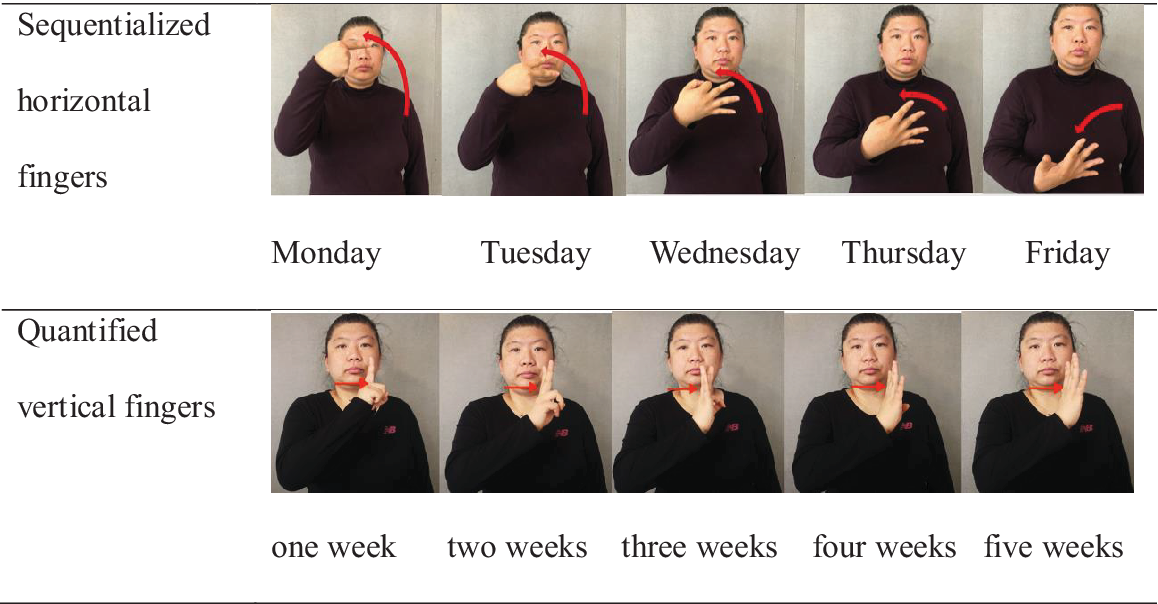
In both digital and numeral incorporation, we identified that there were both horizontal and vertical finger arrangements, which can roughly correspond to ordinal and cardinal number expressions. In particular, horizontal and vertical finger arrangements for numeral incorporations were further defined as ‘sequentialized horizontal fingers’ and ‘quantified vertical fingers’, respectively. For example, as shown in Figure 4, weekdays in CSL are represented by horizontal fingers, incorporating placement of the armpit and quantification of a time unit. In contrast, the number of weeks is expressed with vertical fingers around the mouth area.
Comparison of numeral incorporations of sequentialized horizontal and quantified vertical fingers.
We used the abbreviation F to stand for finger(s) and 1, 2, 3, 4, and 5 to code the thumb, index finger, middle finger, ring finger, and little finger, respectively. For example, F12 means that the thumb and index finger were extended. Furthermore, for digital and numeral incorporation (but not for points-to-fingers), we differentiated two types of placements of fingers to distinguish their directional difference: normal finger-number representation with fingers extended vertically, which was coded as ‘VF’, and horizontal fingers that denoted ordinal numbers in CSL, which was coded as ‘HF’. For example, HF12 means that the thumb and index finger were placed horizontally. As for points-to-fingers, we used a circle over the relevant number to denote the finger being pointed at. For example, F①2 means that the thumb and index finger were extended, and the thumb was pointed at, whereas F①②③ means that the thumb, index, and middle fingers were naturally extended together, and were pointed at in turn from the thumb to the middle finger.
We used English words in small capitals to gloss signs in this paper. ix is the abbreviation for ‘index’. ix-1, ix-2, and ix-3 indicate pointing to the signer, addressee and the other, respectively. We use ^ to conjoin parts of a compound, such as hear^not, and use ‘ ’ to refer to a concept rather than a sign, such as ‘second’ in contrast to small capital second. +++ are used to refer to repetitions of a sign for 3 times or above. For illustration purposes, we used still images, video excerpts to represent annotated sentences where each still image corresponded to one sign. However, for a compound sign we used two still images. Given the space limit, we usually only give one example for each paradigm.
3. Results
We identified three major mechanisms of finger-time representations: (1) digital series, (2) numeral incorporation finger series, and (3) points-to-fingers series. The forms of finger arrangements can be further divided into two subtypes according to finger orientation (vertical or horizontal). Table 1 presents an overview of finger-time expressions and their frequency. Additionally, at the discourse level, we found that patterned finger signs could be used as discourse markers for sequential events (see Table 3). The results are further described in more detail below.
An overview of finger-time representations and their frequency
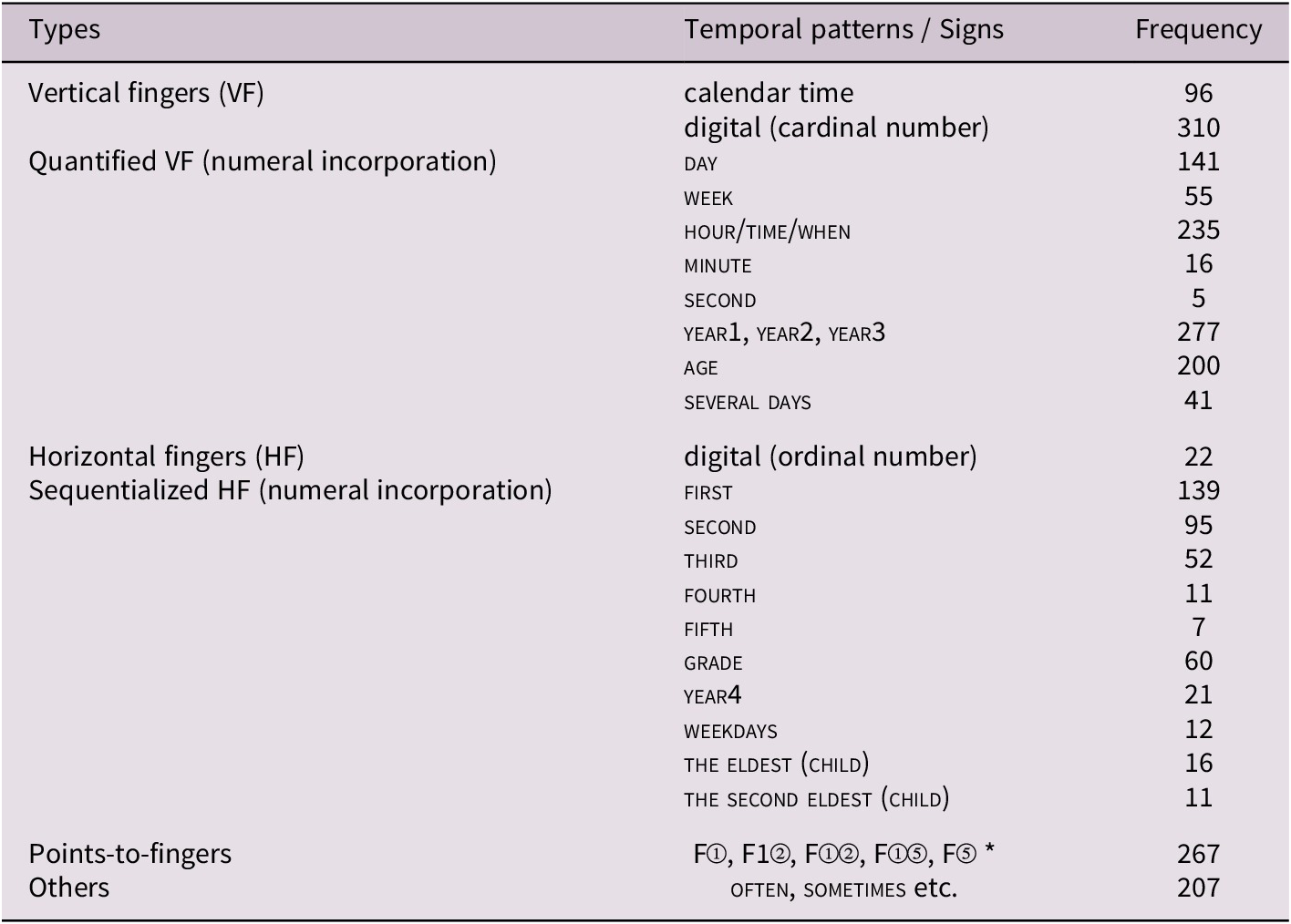
Note: *See details in Table 2.
3.1. Vertical fingers and quantified vertical fingers
Our data showed that CSL deaf signers often used a simple digit (one hand) for a time expression. Their fingers were placed in space without any other parameters, neither a placement nor a movement. For example, when one signer asked how old another signer was, the answer was simply a number sign for ‘23’ (combining the vertical digits 2 and 3). Additionally, vertical fingers were also used to express calendar years.
However, on other occasions, vertical fingers were incorporated according to the context (numeral incorporation). Specifically, they were quantified by a combination of a digital configuration and a placement movement, with the digit representing the quantification and the placement representing the time concept. As listed in Table 1, the use of numeral incorporation to express time units such as ‘second’, ‘minute’, ‘hour’, ‘day’, ‘month’, etc. was common in CSL conversation.
3.2. Horizontal fingers and sequentialized horizontal fingers
In contrast to vertical fingers that were often used to express time (406 cases), horizontal fingers alone were rarely used for such a purpose (22 cases). Instead, they were more likely to occur in an incorporated form (numeral incorporation; 424 occurrences). Basically, such incorporated horizontal fingers were used for ordering or ranking expressions, like first, second and third. It was noticed that when ranking expressions, the frequency decreased for larger ordinal numbers. This is plausible as they (e.g., fifth) are used less often in ordering or ranking compared to the widely used first. Additionally, horizontal fingers can convey the order of time such as weekdays (monday to friday; Figure 2).
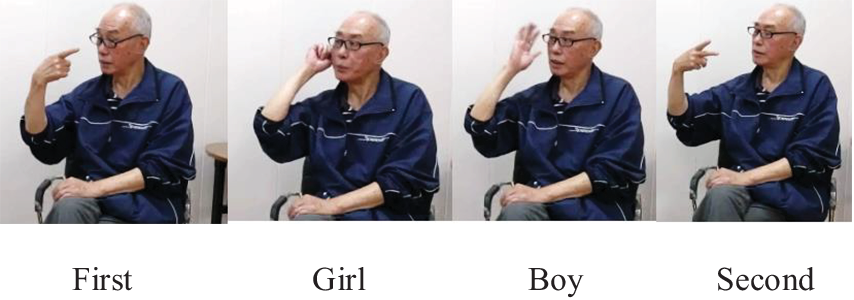
Interestingly, horizontal fingers, in particular, can be used to express the ordering of children or a kinship system. For example, extending the index finger horizontally (HF2) means the first child of a family, whereas extending the index and middle finger (HF23) means the second child in the family (Figure 5). Such a ranking can naturally be used to map the ordering of age.
Literal translation: ‘(my) first child is a girl; the second is a boy.’
3.3. Points-to-fingers for time
Distinct from numeral incorporation, the use of points-to-fingers to express time involves an interaction of fingers between both hands. The non-dominant hand (usually the left) is used as an ‘object’ and selected fingers extend naturally, which will be pointed at by a finger of the dominant hand (often the right, but not limited to the index finger). The action of pointing generally involves touching, hitting, and even pinching.
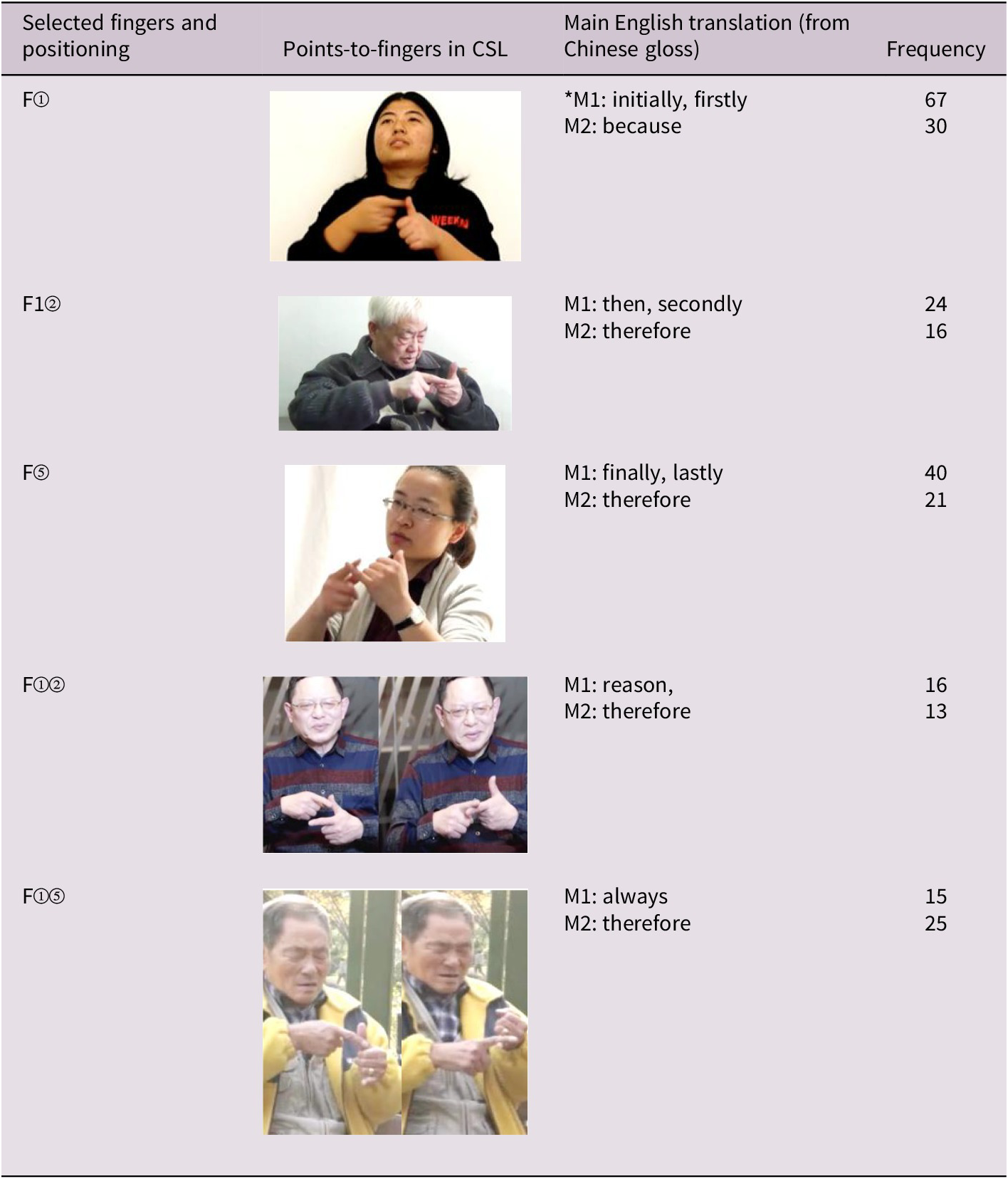
After analyzing all points-to-finger signs, we found that their meaning depended on three important aspects: (1) the number of fingers extended by the non-dominant hand; (2) the specific finger(s) that was (were) pointed at; and (3) the order of pointing actions by the dominant hand. Particularly for the third one, if more than one finger was pointed at, the first one represented an event that preceded other events that were represented by subsequent pointed fingers. For example, when only an extended thumb was pointed at, it would denote ‘the first’ (F①; Table 2). However, if both thumb and index fingers were extended, but only the index finger was pointed at, it had the meaning of ‘secondly/then’ or ‘therefore’ in CSL (F1②; Table 2). In fact, in points-to-fingers, the fingers were ordered as a whole, and the action of pointing was equivalent to picking up an ordered value to map to a relevant sequential event.
Main CSL temporal connectives using fingers
Note: *M = meaning.
Interestingly, we found that some points-to-fingers have been lexicalized and become temporal connectives in CSL, and different points-to-fingers were often used together to string together a discourse in signers’ conversation. Table 2 summarizes the main points-to-fingers signs in our data (F①, F1②, F①②, F①⑤, F⑤), which function like temporal connectives. They were similar in form as all fingers were placed horizontally. As shown in Table 2, the thumb, index, and little (pinky) fingers are involved in forming temporal connectives; the regularities for their labor of division are further discussed below, respectively.
3.3.1. Points-to-thumb
The most frequent finger (digit) to be pointed at was the thumb (N = 97), which was glossed as at first “首先”, first(ly) “先”, first time “第一次”, or because “因为”. As shown from the meaning of its gloss, such a sign usually had two functions. First, the majority of points-to-thumb signs were used as temporal connectives to express the beginning of an event (69%, 67 times, examples 1a–1d). Its position was often at sentence-initial or between the subject and the predicate, and it always occurred before the verb.

Stills from signs in example (1a).

Second, we found that the points-to-thumb sign could denote a sequence of cause and effect in an event relation (30 instances in our sample), which functioned like adverbs of reason with the meaning of ‘because’. It gives an explanation of an event that has happened, and the clause can precede or follow the main clause. As shown in example (1e), a signer explained that because her mother, as well as her older brother, had got diabetes, she felt that she needed to take some precautions.

3.3.2. Points-to-index
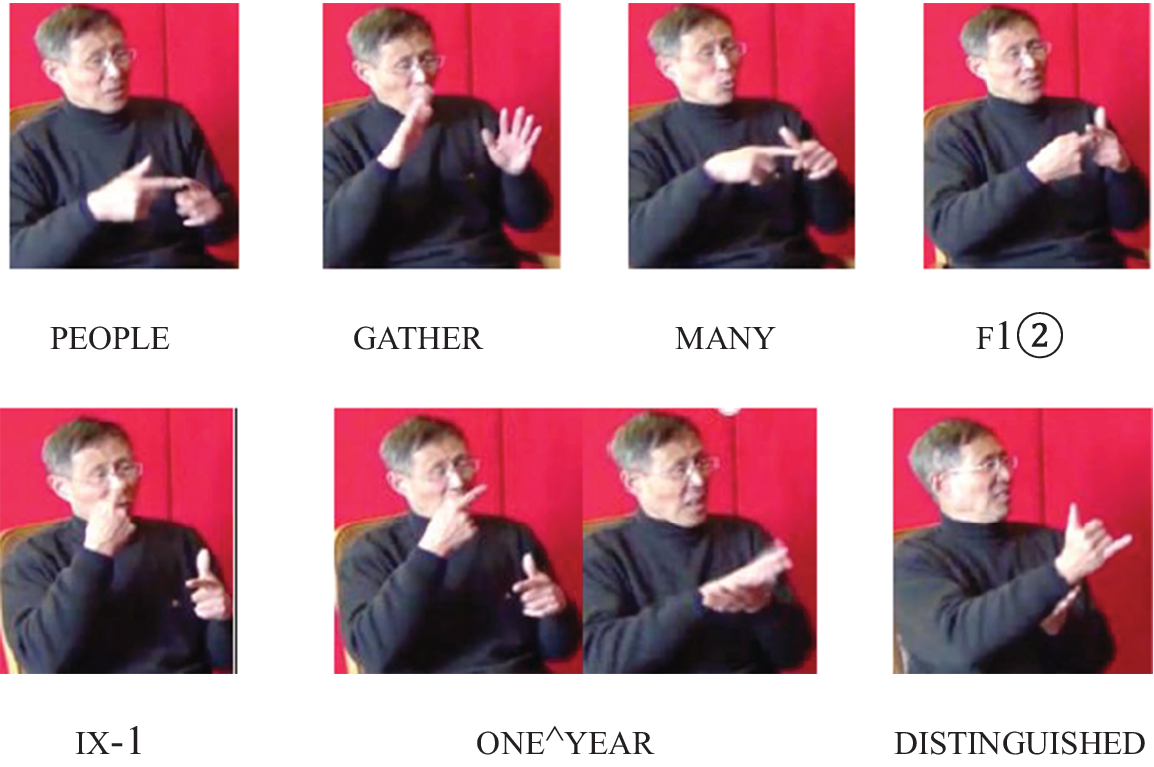
Note that points-to-index involves the extension of both the thumb and index fingers, with only the latter being pointed at while the thumb is backgrounded, as captured by the annotation F1②. It mainly had two functions: the main function was to refer to an event that would follow (‘then’ or ‘secondly’), which presupposed the appearance of F① ‘firstly’ as shown in example (2a). It could also appear alone to denote ‘lastly’ (example 2b). The other function, as shown in example (2c), was to be used as a causal connective to express an ‘effect’, which appeared less frequently than the case of the main function.
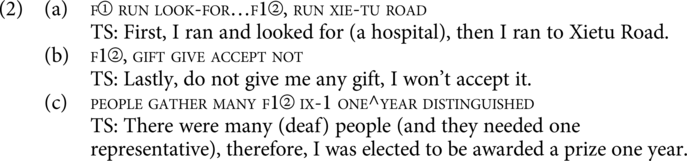
Stills from signs in example (2c).
3.3.3. Points-to-pinky/little
Points-to-pinky/little can be used as both a temporal adverb like ‘finally’ (40 times, see example 3a) or an adverbial expression for cause and effect, like ‘as a result’ (21/61 times; example 3b).

Stills from signs in example (3a).
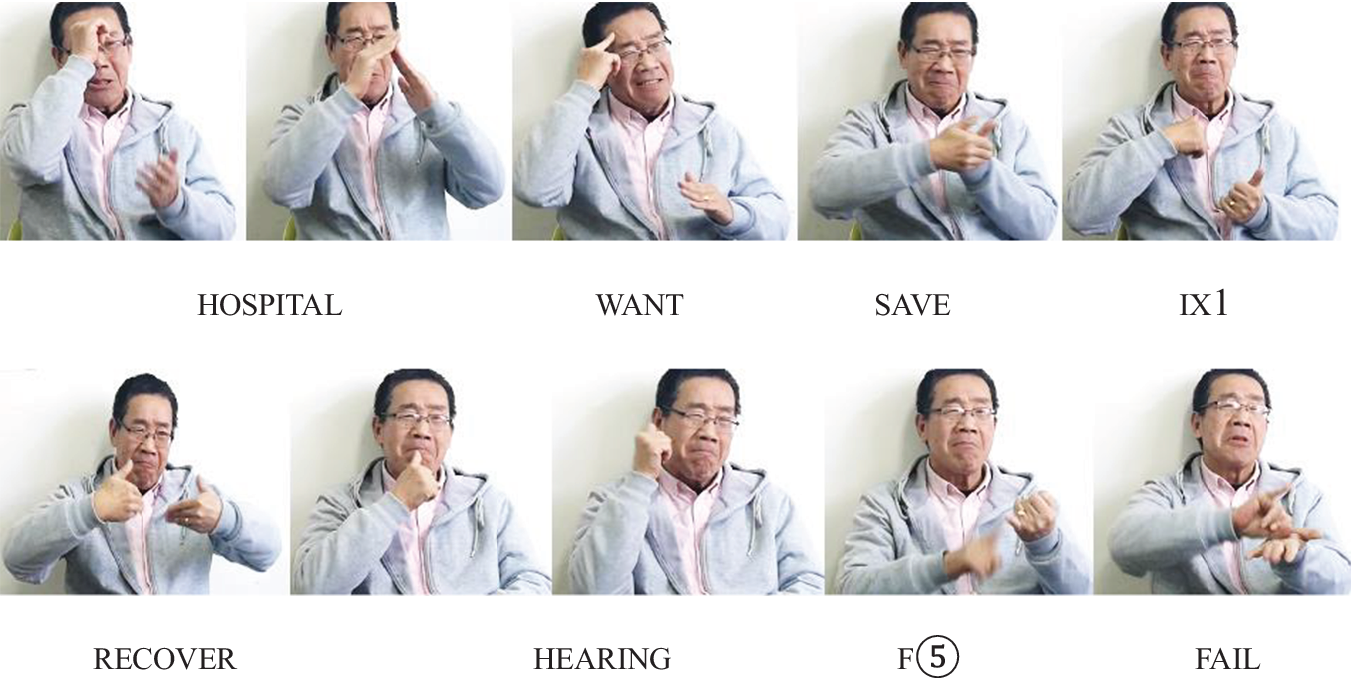
Stills from signs in example (3b).

3.3.4. Points-to-fingers (PTF) compound (involving two pointing actions)
As observed from the data, when extending two fingers and pointing at both of them, signers always produced fixed forms as instantiated by two signs: F①② (pointing to the thumb and index finger) and F①⑤ (pointing to the thumb and little finger). In both cases the thumb was involved to express the effect of an event, being a resultative adverbialFootnote 1 (examples 4a, 4b, and 4c). Slightly different, they can also function as a noun, as shown in example (4d).

Stills from signs in example (4c).

Stills from signs in example (4d).
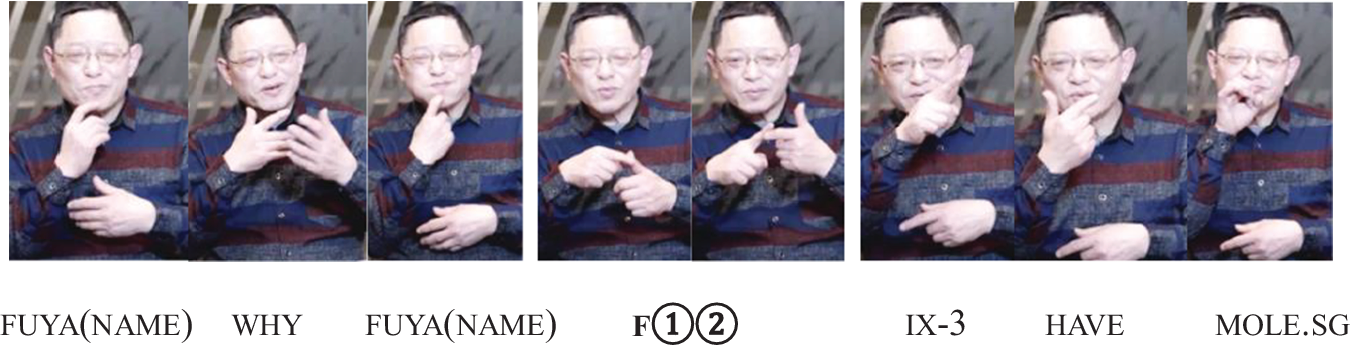
As we can see, it is very clear that points-to-fingers can have two main functions. First, it is used as a temporal connective to mark sequential time, where the thumb is a marker for the beginning of an event, and other fingers or finger compositions express the following temporal sequence. Second, points-to-fingers can be used to express a cause-and-effect relationship, in which the thumb is the marker for expressing a cause, and other fingers or finger compositions are markers for denoting consequential information. However, actually, some types of finger expressions in CSL are often used in groups to string together a conversation. Such expressions can be regarded as discourse markers as they combine sentences or utterances.
3.3.5. Points-to-fingers (PTF) at the discourse level
Apart from the lexicalized forms of points-to-fingers described above, PTF can form ad hoc patterns to express sequential order in a broader context across sentences at the discourse level. The rules for such points-to-fingers are patterned as follows.
Discourse-level points-to-fingers seem to form a unified pattern, though sometimes loosely. While the use of points-to-fingers as connectives within a sentence is fully lexicalized in CSL, some forms of discourse PTF (e.g., pointing to the middle or ring finger) cannot be used independently. The meaning of an individual PTF is relative to its position in the whole finger arrangement. A key factor is which finger is pointed at initially, as pointing to subsequent fingers will usually not jump to a non-neighboring finger (e.g., neither from the thumb to the ring finger, nor from the middle finger to the thumb, etc.). We identified three patterns of discourse-level points-to-fingers: (a) starting from the thumb; (b) starting from the index finger; and (c) starting from the little finger (Table 3).
Patterned finger signs for enumeration and time-sequencing in discourse
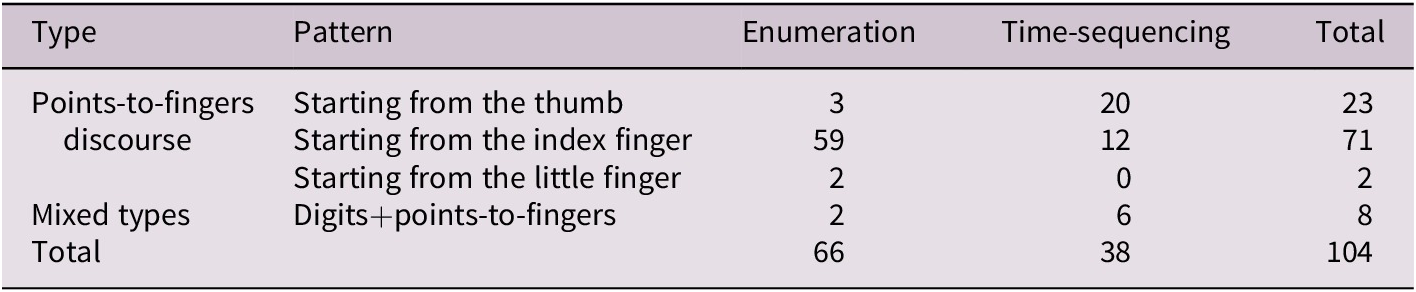
The use of points-to-fingers discourse has two main functions: simple enumeration and time-sequencing. The former is involved in the action of counting and listing. The latter makes a list of sequential events based on the order of time. The first finger to be pointed at is often mapped to the initial temporal sequence. As shown in Table 3, for either function, there is a preferred form to be used.
When discourse level points-to-fingers began with the thumb (F①, F1②, F12③, etc.), these signs were mostly used in time-sequencing (87%, or 20 out of 23 instances) rather than enumeration (13%). By contrast, when points-to-fingers had a pattern of beginning with the index finger, they were more often used for enumeration (83% vs. 17%). If the points-to-fingers had a pattern of starting with the little finger, the pointing would go from the little finger to the ring, middle, and index finger and finally the thumb. Such a pattern was rare and only existed for expressing enumeration (2 cases).
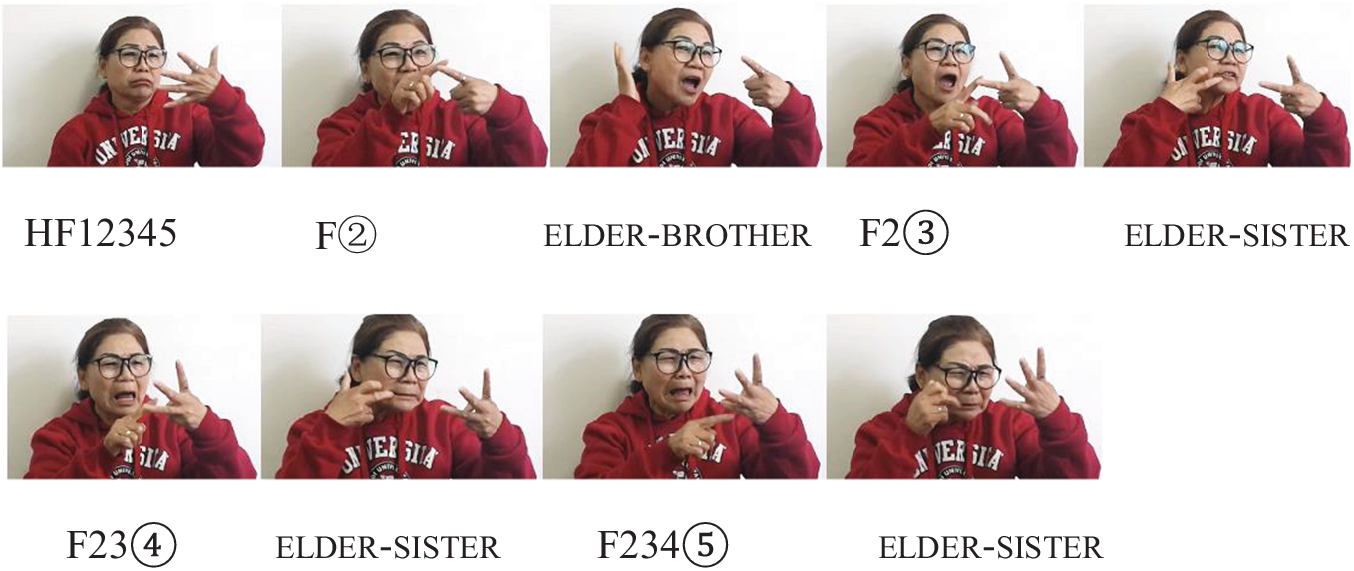
Furthermore, the pattern of points-to-fingers beginning with the index finger was the most frequently used form at the discourse level. It mainly strung together discourse in a stable pattern: F②, F2③, F23④, F234⑤, etc. (example 5a). We noticed that when the finger that was pointed at was placed horizontally, the use of points-to-fingers was likely to mark a temporal sequence rather than listing. Interestingly, the use of points-to-fingers could only ‘list’ or ‘sequence’ up to five items/events at a time. Beyond five, CSL would have to resort to a number sign. For example, when a signer talked about the six courses offered in a deaf school, the signer first pointed to the index finger to refer to the course ‘Mandarin’, then to the middle, ring and little fingers for ‘math’, ‘politics’, and ‘geography’, respectively, and then to the thumb (F①2345) for the fifth course ‘history’. The sixth course, ‘physics’, however, was not expressed with a points-to-fingers sign but with a number sign for six (example 5b).

Stills from signs in example (5a).
3.3.6. Mixed type
Points-to-fingers can be mixed with digitals to place time in order, and one pattern of signs can be embedded in another. For example, in example 6, the first pattern is formed by mixing the points-to-fingers with horizontal fingers (digitals). A points-to-fingers sign f① was combined with horizontal fingers hf2 and hf23 to form two compounds (f①^hf2 and f①^hf23), thus marking the temporal sequences of two operations. The second pattern, using f① and f2③ to indicate ‘drinking too much’ and ‘sleeping too late’, functioned as pure listing buoys. Surprisingly, an atypical form of f34⑤ (pinching rather than pointing at the little finger) was used to refer to the third operation that was connected to the two mixed compounds above.

Stills from signs in example (6).

4. Discussion
We have described three types of finger representations of time: digitals, numeral incorporation, and points-to-fingers. Digitals and numeral incorporation are two important mechanisms to express time concepts, where vertical and horizontal finger arrangements are respectively used to express time units and ordered time. Pointing to a finger is the primary building block of temporal connectives. Specifically, there is a system of lexicalized finger configurations of time expressions in CSL, in which three fingers (thumb, index, and pinky) can be pointed at as temporal connectives: pointing to the thumb is a grammaticalized form to express the initial stage of events or an order, pointing to the index finger means ‘following’ or ‘secondly’, and pointing to the little finger refers to the meaning of ‘lastly’ or ‘finally’. Additionally, CSL adopts similar linguistic forms in sequential time and adverbs of reason (cause and effect between events). Finally, at the discourse level, we discover some fixed patterns of finger arrangements to string sentences together in an ordered way, serving two different but inter-connected functions (i.e., enumerating and sequencing). Enumerating is irrelevant to temporal expressions, whereas sequencing involves temporal ordering. It is likely that sequencing derived from the shared mechanism of enumeration, in which sequencing is part of listing but not vice versa.
4.1. Points-to-fingers, time, and causal reasoning
Pointing to fingers is the realization of metaphorical finger mappings in language. Why do CSL signers point to their fingers? Because it is a vital way of extracting value from their fingers, such as values for number and time. Such a mental process is further reinforced in practice, over time, when signers repeatedly use their fingers to refer to time units or temporal sequences or order events in daily life.
Interestingly, CSL adopts similar linguistic forms to express sequential time and cause and effect between events (e.g., Table 2), while many spoken languages use different words. For example, unlike CSL, English uses ‘because’ and ‘so’ etc. to express a cause-and-effect relationship between events, but ‘firstly’, ‘then’, ‘finally’, and ‘in the end’ to mark a sequential relationship. Given that CSL is a very young language, in which functional words are limited and still under development, it is not impossible that shared forms are the result of the grammaticalization of points-to-fingers forms. Alternatively, they may be driven by the modality restrictions of sign languages: expressions of different meanings rely heavily on finger configurations, but the simple finger forms are so limited that they may be shared. However, this doesn’t seem to be the case for other sign languages given that these words are not signed with shared forms in BSL.
Thus, the phenomenon of using shared forms between time and adverbs of reason raises a fundamental question as to the relationship between time and causal reasoning. Thompson and Longacre (Reference Thompson, Longacre and Shopen2007) discuss how there is a close relationship between temporal and reason clauses, where cause and effect is inferred. From a developmental perspective, Tillman et al. (Reference Tillman, Tulagan, Sullivan, Denison, Mack, Xu and Armstrong2020) show that both time and causal connectives appear very early in children’s language acquisition, and they help children to understand the world. We propose that the CSL cause- and-effect relationship is based on the conceptualization of time, which is fundamental to our cognitive ability to differentiate cause (which happened earlier) from effect (which will happen later). Thus, cause and effect can be regarded as a special type of temporal sequence. Our data suggest that both temporal and causal words can share the same linguistic forms through lexicalized points-to-fingers signs in CSL. It also enriches the theory of conceptual metaphors as fingers can be a shared source domain of various fundamental abstract concepts such as number, time (Pitt & Casasanto, Reference Pitt and Casasanto2020; Woodin & Winter, Reference Woodin and Winter2018), and a cause-and-effect relationship.
4.2. Relationship between fingers, number, and time in sign language
The advantage of human hands is that they provide a natural linkage between fingers, numbers, and time as they are naturally available and cognitively utilizable. Fingers are important parts of our hands and can be used as convenient tools for metaphorical conceptualization (e.g., Bender & Beller, Reference Bender and Beller2012). In CSL the use of digital and numeral incorporation in finger-time mappings shows a close correspondence between expressions for numbers and time through finger configurations. For example, vertical fingers can be used to express cardinal numbers, and quantify events and time, whereas horizontal fingers can be used to represent ordinal numbers, the order of events, and sequential time. When fingers are used for the expression of time units, signers can make use of number signs to indicate quantities. This is also found in gestures, as in many cultures number fingers are iconic, so that the number of fingers held up (or down) corresponds to the quantity meant (Pika et al., Reference Pika, Nicoladis and Marentette2009). It is worth mentioning that number gestures in Chinese culture are highly conventionalized, but hearing Chinese (unlike CSL signers) use vertical fingers to express both cardinal and ordinal numbers (one to five) and they are unlikely to use horizontal fingers for number expressions.
Furthermore, in a more advanced way, CSL signers can map the ordering of time to the arrangement of fingers and sequence events by using different fingers. Such finger arrangements are not random but have an internal sequential order, which is the foundation for derived lexical signs, such as points-to-thumb means ‘at first’. In particular, ordinal time in CSL is represented by different horizontal digitals (different fingers placed top down with fingertips oriented horizontally). Such finger arrangements give rise to two visual interpretations: each finger represents both a numerical value and a positional value on a vertical axis, whereby the number of fingers increases from above to below. The uppermost finger (the thumb or index finger when the thumb is bent) maps to an earlier time, and a finger positioned lower (the lowest is the pinky) maps to a later time. Interestingly, we find that CSL signers never start points-to-fingers from the pinky finger, but always from the thumb or index finger. For ordinal time, they almost always start from the thumb. Thus, different from time units that derive from the numerical values of fingers, sequential time is derived from the ordinal values of fingers, which reflects both the internal arrangement of the fingers and vertical spatial–temporal mappings.
Interestingly, internal vertical space–time mappings in finger arrangements are also shown in rankings of age in CSL, which cannot escape time. For example, when a signer described the birth of children in a family, he said that the eldest was born first / the earliest, whereas the younger ones were born secondly and even later (example 5a). Furthermore, CSL linguistically makes use of the thumb, index, middle, and little fingers (combined with placement near to the face) to represent family epithets. As shown in Figure 14, ‘Dad’ is signed by putting the thumb over the mouth, while ‘Mum’ is signed with the ‘index finger’ in the same place. The signing of the middle finger over the chin means the older ones of the same generation (regardless of gender), while the little finger is used to denote a ‘younger sibling’. Of course, apart from possible temporal mappings, such choices of fingers for different epithets may also be influenced by kinship hierarchy and the status of people in culture.
Finger signs for core family members.

All these internal vertical space–time mappings in finger arrangements are consistent with the salient general vertical timeline in CSL, whereby the future is signed downwards (Gu, Zheng et al., Reference Gu, Zheng and Swerts2019b; Wu & Li, Reference Wu and Li2012). Lin and Gu (unpublished observations) reported that the signs for future or after have been lexicalized, and CSL signers predominately map future-related concepts or later sequences towards a below position. If points-to-fingers are local spatial temporal metaphors, they must comply with the general vertical timeline so that the concept of early and late time is mapped to the ordering of fingers accordingly, with the thumb uppermost for the earliest, then the index and middle fingers, and finally the pinky finger for the latest.
4.3. What shapes CSL finger representations of time?
Based on the results of this corpus study, we believe that the use of various patterns of finger representations for time in CSL is an interactive outcome of body and culture. Apart from the natural linkage between fingers, numbers, and time, this way of expressing time in finger arrangements is also culturally motivated. Chinese people have a long history of being a hierarchical society, and Chinese civilization respects orders, tradition, and elders (e.g., Gu, Zheng et al., Reference Gu, Zheng and Swerts2019a). These cultural values are so deeply rooted that they may map to conceptualizations of space, events, and body. Interestingly, fingers in Chinese culture are considered to have different statuses and roles. The thumb is the most important one, as it is detached (‘outstanding’) from the other four fingers, being the biggest, best, and ‘first’ one, as if it is the ‘head’ of a fist. The little finger, however, is the smallest and often considered the most trivial, and sometimes the ‘last and least’ one. Such conceptions can also be found in spoken Mandarin (examples 7a, 7b), and are also evident in Chinese gestures (e.g., thumb up / little finger up).

Despite the fact that hearing people can also use points-to-fingers to sequence time in their gestures (an example is shown in the supplementary materials available at <http://di.org/10.1017/langcog.2021.22>), the forms of PTF in a sign language are more constrained. Crucially, conventionalized mappings of order to certain fingers are not always obvious and systematic in spoken languages or gestures, as spoken languages mainly rely on audio media and gestures are optional in the speaking community. By contrast, in CSL, such temporal or ordinal representations are both bodily grounded to fingers. Mappings are closely linked and have penetrated the CSL linguistic system, thus the use of ‘points-to-fingers’ has become the source of a series of temporal connectives, and have further evolved to become cause-and-effect connectives. Especially, the use of horizontal digitals / numeral incorporation and points-to-fingers to express sequence time implies an internal vertical space–time mapping, with an earlier event mapped to a finger placed above (e.g., the thumb or index finger) and a later event mapping to a finger placed below (e.g., the little finger). In short, the use of fingers to express temporal order and event sequences in CSL is both systematic and powerful. Such a mechanism may be culture-specific, as CSL signers share the vertical timeline as well as relevant metaphors with hearing Chinese, while English people have no such metaphors in either hearing or BSL or ASL.
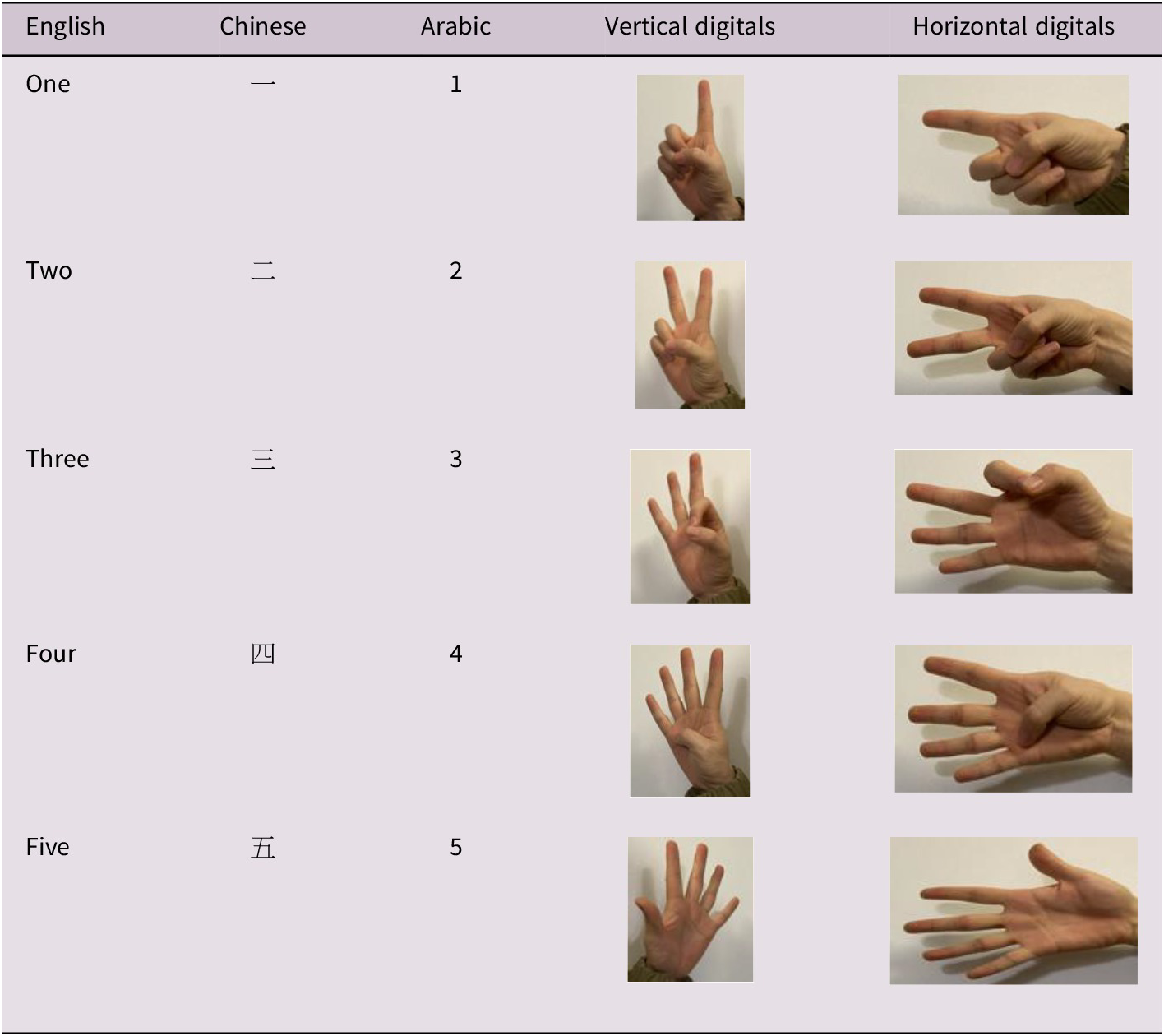
Our study shows for the first time that signers can make use of horizontal fingers (both digitals and numeral incorporation) to express sequential time systematically. To the best of our knowledge, this has not been documented in other sign languages. Such usage in CSL may be affected by Chinese writing culture. On the one hand, the Chinese writing direction in the past went from top to bottom, and the characters above always preceded words below. This spatial representation may be mapped to horizontal digitals for expressions of sequential time. On the other hand, the Mandarin number characters 一 ‘one’, 二 ‘two’ and 三 ‘three’ have great iconicity. In Mandarin, the initial character 第/dì is often (but not necessarily) added before a number character to denote an ordinal number such as 第一 ‘dì-yī, firstly, No. 1’, 第二 ‘dì-èr, secondly, No. 2’, and 第三 ‘dì-sān, thirdly, No. 3’. The form of ‘dì’ can be regarded as a prefix, which originates from the meaning of ‘to rank, ranking’ (Wang, Reference Wang2015). Such Chinese number characters were predominantly used, even in Chinese math books, until the first half of the twentieth century when Arabic numbers became popular (Yan, Reference Yan1957). The horizontal digitals in CSL may derive from Chinese number characters, as there is a close resemblance between finger forms and Chinese number characters at least for the first three numbers (Table 4). Nevertheless, our study is based on a linguistic description of CSL, how exactly CSL signers mentally map number and time into a vertical line (e.g., larger numbers go downwards) awaits further psycholinguistic experiments.
Number in writing and CSL
5. Conclusion
In this paper we have provided some first insights into the systematic use of finger configurations, including digital, numeral incorporation, and points-to-fingers, to express time in CSL naturalistic data. Our study shows that CSL relies heavily on finger representations that are powerful tools for metaphorical conceptualization. There are inter-connections between finger representations, numbers, ordering, time, and cause-and-effect reasoning. In short, fingers are a blessing for human beings in helping us to figure out, or finger out, some fundamental concepts. They are deeply embodied, biologically and culturally shaped, and have become an indispensable part of the sign language system.
Acknowledgements
This work is supported by grants from the Ministry of Education, China, via Humanities and Social Sciences Research (20YJC740027), and “the Fundamental Research Funds for the Central Universities-Innovative Research Team of Shanghai International Studies University” (No.2020114052) to HL, and supported by grants from The Netherlands Organization for Scientific Research, via NWO Promoties in de Geesteswetenschappen (322-89-007) and NWO Rubicon (019.182SG.023) to YG. We thank Yingjie Ni, Huan Sheng, and our deaf participants for their help with this study.
Supplementary Materials
To view supplementary material for this article, please visit http://doi.org/10.1017/langcog.2021.22.
The datasheet and supplement for this study can be found at <https://osf.io/92w4t/?view_only=56e026ca4f444c6fbb338e56555528f3>.



 Open access

