




Introduction
After the first recognised pulse of occupation of the Americas, around 15 000–14 000 cal BP (e.g. Prates et al. Reference Prates, Politis and Pérez2020; Sutter Reference Sutter2021), scattered human settlements are observed in diverse environments and territories by 12 000–11 000 cal BP (Méndez Melgar Reference Méndez Melgar2013; Prates et al. Reference Prates, Politis and Steele2013; Rademaker et al. Reference Rademaker2014; Capriles et al. Reference Capriles2016; Dillehay et al. Reference Dillehay2017; López-Mendoza et al. Reference López Mendoza2023). Understanding the gradual occupation of these previously empty or newly settled territories is crucial (Kelly Reference Kelly, Rockman and Steele2003; Rockman Reference Rockman, Rockman and Steele2003; Gillespie Reference Gillespie2007). As populations learned to navigate local landscapes and adapted to diverse environmental challenges unique cultural geographies were created (Borrero Reference Borrero2015). To fully understand these, it is critical to examine humans’ engagement with resources and places, as well as their mobility patterns.
Although there is evidence for human activity in the Andes from the Terminal Pleistocene to the Early Holocene (c. 12 000–10 000 cal BP), our understanding of the processes of occupation is inconsistent across regions. For instance, adaptation to high-altitude Andean environments has been extensively studied (Rademaker et al. Reference Rademaker2014; Capriles et al. Reference Capriles2016; Borrero & Santoro Reference Borrero and Santoro2022; López et al. Reference López2022), yet a focus on isolated sites in more southerly sectors of the Andes fragments the wider synthesis of findings (Marsh et al. Reference Marsh, Cortegoso and Castro2016). This knowledge gap impacts our understanding of regional and macroregional occupation processes, particularly as Andean environments change markedly south of 29°S. Unlike the puna and altiplano found to the north, the southern Andes feature Mediterranean biomes with fertile east-west river valleys that serve as natural corridors between the coast and the high Andes.
In the inland territories of north-central Chile and central-western Argentina (28°–31°S), a few isolated early occupation sites have been identified but these are not the result of systematic large-scale surveys (Ampuero & Rivera Reference Ampuero and Rivera1971; Gambier Reference Gambier1985; García et al. Reference Garcia, Zárate and Páez1999; Marsh et al. Reference Marsh, Cortegoso and Castro2016; excepting Grasset et al. Reference Grasset, Nuevo-Delauney, Álvarez, Maldonado and Méndez2021). Here, we discuss three sites of human occupation that date from the Terminal Pleistocene–Early Holocene period in inland areas of north-central Chile (Figure 1). Two of these sites were identified through an extensive regional survey conducted in the Elqui and Hurtado valleys (29°–30°S), while the third one was excavated some decades ago (Ampuero & Rivera Reference Ampuero and Rivera1971). Data from radiocarbon dating, site placement and contextual information allow us to build an approach to understanding the use of space during this period, from the management of resources to the navigation of inland environments. Our results highlight initial engagement with the local coastline and the role of rock shelters in shaping the cultural geography of the area. By comparing our findings with those from neighbouring regions, we discuss the timing and characteristics of this early occupation and the significance of rock shelters as landmarks in this process.
Research zone showing surveyed areas (bright red) and the location of the archaeological sites (figure by authors).

Study area and palaeoenvironmental conditions
North-central Chile is a semi-arid region that serves as a transitional zone between the hyper-arid Atacama Desert to the north and the Mediterranean valleys of central Chile. The area has a dry oceanic Mediterranean climate, characterised by dry summers and winter rains, and features narrow east-west river valleys that originate in the high Andes and flow into the Pacific Ocean. These valleys are flanked by spurs extending from the Andean foothills, forming expansive, highly arid interfluvial areas. Ravines connect the valleys and interfluvial regions, facilitating north-south movement. The vegetation mainly consists of sclerophyll shrublands with altitudinal variability that are also populated by species of cacti. Presently, the local fauna is dominated by foxes (Lycalopex sp.), various rodent species and, less commonly, guanacos (Lama guanicoe), though faunal diversity was likely greater during the Terminal Pleistocene–Early Holocene with megafauna present in the landscape until at least 11 000 cal BP (Méndez et al. Reference Méndez2020).
Geologically, this region is characterised by hydrothermal alterations that provide fine-grained rocks accessible in ravines and interfluvial territories.
Late Pleistocene environmental conditions were more humid than today, with glacial advances between 17 000 and 12 000 BP (Riquelme et al. Reference Riquelme, Rojas, Aguilar and Flores2011; Zech et al. Reference Zech, Terrizzano, García-Morabito, Velt and Zech2017) fuelled by a strengthening of the South American Summer Monsoon (CAPE event, Quade et al. Reference Quade2008). The climate became progressively drier c. 11 200 cal BP, although an expansion of wetlands has been proposed for 10 500 to 9200 cal BP (Maldonado et al. Reference Maldonado, Méndez, Ugalde, Jackson, Seguel and Latorre2010; Méndez et al. Reference Méndez2018).
The earliest archaeological sites identified in this region are located along its southern coastline. These occupations, dated to around 13 000 cal BP, correspond to groups who foraged for Pleistocene megafauna; one inland site has been identified as a source of lithic resources (Jackson et al. Reference Jackson, Méndez, Seguel, Maldonado and Vargas2007; Méndez et al. Reference Méndez2018). After an initial wave of occupation, recurrent human occupation is recognised in the region around 12 000–11 000 cal BP, associated with the appearance of the Huentelauquén Cultural Complex on the coast and characterised by stemmed projectile points and geometric lithic artefacts (Jackson et al. Reference Jackson, Maldonado, Carré, Seguel and Vialou2011a; Méndez Melgar Reference Méndez Melgar2013). Finds indicate coastal adaptation based on a system of residential mobility. As a result of drier conditions, by 10 000 cal BP these groups started to venture inland, diversifying their adaptive strategies to obtain resources from the inland environment (Jackson & Méndez Reference Jackson and Méndez2005; López et al. Reference López2022).
Little is known about early occupation of the inland regions of north-central Chile. San Pedro Viejo de Pichasca rock shelter (SPVP), excavated between the 1940s and 1970s, has served as the benchmark for characterising human occupation in this region, covering the time span from 11 000–2000 cal BP (Escudero et al. Reference Escudero, Davila, Villela, Troncoso, Méndez and López2016). In the neighbouring valley of Combarbalá, occupation levels at La Olla Rockshelter have been dated to between 10 000 and 9000 cal BP, while other open-air sites are associated with this timeframe on the basis of lithic typology (Grasset et al. Reference Grasset, Nuevo-Delauney, Álvarez, Maldonado and Méndez2021).
In central Chile, aside from at the well-documented Terminal Pleistocene site of Tagua Tagua (Montané Reference Montané1968; Núñez et al. Reference Núñez1994), evidence for early inland occupation is limited. Only two isolated rock shelters with initial dates around 12 000 cal BP have been identified: Caverna Piuquenes (Stehberg et al. Reference Stehberg2012) and El Manzano-1 (Cornejo & Saavedra Reference Cornejo and Saavedra2003). Isolated early occupation sites have also been identified in central-western Argentina at ARQ-18 (29°S) and Agua de la Cueva (32°S), both dated to c. 10 000 cal BP (García et al. Reference Garcia, Zárate and Páez1999; Marsh et al. Reference Marsh, Cortegoso and Castro2016). In San Juan, Argentina (31°S), potential early occupations are noted in rock shelters, though these have not been radiocarbon dated (Gambier Reference Gambier1985).
New records from the Terminal Pleistocene–Early Holocene
Systematic survey of more than 200km2 of the Elqui and Limarí river basins and the interfluvial zone between them has covered geoforms that include ravines, slopes, hills and fluvial terraces both inside and outside of the primary drainages (Troncoso et al. Reference Troncoso2016). Identification of more than 100 archaeological sites within this area permitted a systematic programme of excavations and radiocarbon dating. To date, 21 sites with evidence of hunter-gatherer occupation (mainly rock shelters) have been excavated, obtaining about 110 radiocarbon dates. Three rock shelters with occupations from the Terminal Pleistocene–Early Holocene have been identified; results from the excavation of two of these sites (Cumpa and Humo Corral) are included here, while the third is the aforementioned SPVP (Ampuero & Rivera Reference Ampuero and Rivera1971) (Figure 1). We carried out stratigraphic excavations and obtained radiocarbon dates for Cumpa and Humo Corral (Table 1, Figure 2) and dated stored materials from SPVP, which did not return dates for the Terminal Pleistocene/Early Holocene.
Pleistocene-Holocene transition radiocarbon dates, calibrated using OxCal 4.4 and the ShCal20 curve (Bronk Ramsey & Lee Reference Bronk Ramsey and Lee2013; Hogg et al. Reference Hogg2020).

SU: stratigraphic unit. *Taken from Ampuero and Rivera (Reference Ampuero and Rivera1971).
Calibrated radiocarbon ages for each archaeological site (figure by authors).

The three sites are situated along a north-south corridor formed of interconnecting ravines. Cumpa and Humo Corral are located tens of kilometres outside of the Elqui River Valley, in interfluvial ravines. In contrast, SPVP is situated in a ravine adjacent to the Hurtado River Valley. Although all three sites occupy semi-arid environments, SPVP enjoys quick and easy access to the bottom of the Hurtado River Valley, where more abundant vegetation is currently observed.
Consideration of the morphology and function of lithic artefacts allows an understanding of reduction processes (Andrefsky Reference Andrefsky1998) and the quality of raw materials (Aragón & Franco Reference Aragon and Franco1997). Zooarchaeological and malacological analyses centre on the taxonomic and anatomical identification of specimens and their natural and cultural taphonomy (Grayson Reference Grayson1984; Lyman Reference Lyman1994; Cuenca-Solana et al. Reference Cuenca-Solana, Manca, Romagnoli and Campmas2022). At Cumpa, 11 litres of sediment from the deepest archaeological stratum were floated and organic material underwent taxonomic identification (after Pardo & Pizarro Reference Pardo and Pizarro2013).
Cumpa
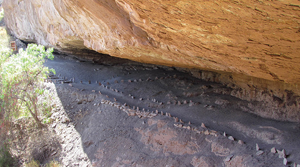
This is an extensive rock shelter with a vestibular area of nearly 200m2 (Figure 3). The site lies in the interfluvial area between the Elqui and Limarí valleys at 1180masl (metres above sea level), not far from a secondary, north-south ravine that is an ideal route for intra-regional movement. A nearby outcrop of the Los Elquinos Formation provides siliceous rocks of good and regular quality for knapping, in various shades of grey (Pineda & Emparán Reference Pineda and Emparán2006).
View of Cumpa (left) and plan (top right) and profile (bottom right) drawings of the rock shelter (figure by authors).

An area of 7.75m2 was excavated, covering both the vestibular area (5.25m2) and open spaces on the slope (2.5m2). Although there is evidence for recent occupation (into the twentieth/twenty-first centuries) and the pedoturbating action of rodents, a well-ordered stratigraphic sequence without major disturbances can be identified, from which 17 radiocarbon dates were obtained. These data show recurrent human occupation from the Terminal Pleistocene to the first half of the Late Holocene.
Two units were excavated in the outer sector of the rock shelter, revealing 14 layers of ash in 0.7m of deposit (Figure 4). The ash layers can be distinguished by their colour and compaction and are interpreted as the result of cleaning after burning events inside the rock shelter. Six radiocarbon dates were obtained from the lower levels of these units, indicating human occupation between 11 967 and 11 170 cal BP (Figure 2). These dates appear to concentrate around two points (11 947–11 631 cal BP and 11 248–11 152 cal BP), possibly reflecting two periods of occupation. While one sample falls between these two groupings (D-AMS 040339), the resolution of the calibration is low (11 620–11 246 cal BP).
Stratigraphic profiles from Cumpa and Humo Corral (figure by authors).

Although an ordered succession of stratigraphic layers (n = 11) was identified within the rock shelter, no radiocarbon dates were obtained for the 12 000–11 000 cal BP section of the sequence due to the limited amount of recoverable organic material in the relevant layers. Cultural artefacts associated with the early occupation feature a high frequency of by-products from bifacial knapping, primarily from high-quality siliceous rocks. These rocks can be found at the nearby outcrop, as well as at other locations within a 5km radius. While siliceous rocks predominate in the lithic assemblage, good-quality basalts are also well-represented and primarily associated with the creation of bifacially knapped instruments. Of the catalogued artefacts (n = 25), one was identified as a bifacially knapped instrument (biface), with the remainder classified into informal categories produced by marginal knapping, such as rabots (a form of scraper, n = 5) and flakes with extractions (n = 19) (Figures 5 & 6). Both siliceous rocks and basalts display intermediate and advanced stages of formal bifacial instrument production, including retouching. Given the presence of multiple quarries (defined as quarries based on the evidence of prehistoric quarrying activity) in the surrounding interfluvial area, both types of materials could have been sourced locally. The production sequence indicates a link between Cumpa and other locations where initial crafting and some discard activities occurred. Basalts reveal a full sequence of production and discard for low-cost, informal pieces, but bifacial instruments appear to have primarily been crafted on-site before being transported for use elsewhere.
Quantification of lithics from Cumpa (A) and Humo Corral (B) (figure by authors).

Lithic scrapers from Cumpa (figure by authors).

The faunal assemblage (number of identified specimens (NISP) = 1278) includes remains of indeterminate mammals, guanacos (Lama guanicoe), indeterminate canids (Canidae), grey fox (Lycalopex griseus), indeterminate rodents (Rodentia), chinchillas (Chinchilla sp.), chinchilla rats (Abrocoma sp.), birds and other indeterminate taxa. For guanacos, the minimum number of individuals was calculated as one adult. Minimum animal units analysis (%MAU) reveals a higher frequency of cranial and femoral remains, with the appendicular skeleton (limbs) being more prevalent than the axial.
Only archaeobotanical remains from wild species were identified, including non-carbonised seeds from Echinopsis and Copiapoa, members of the Cactaceae (cactus) family, and carbonised and non-carbonised seeds from Fabaceae, a family of various edible plants. These resources are prevalent in the region and were regularly exploited in pre-Hispanic times.
Additionally, 24 malacological specimens originating from the Pacific coast were recovered and identified as mussels (Choromytilus chorus, n = 22, two of which show signs of use; Figure 7) and sea snails (one specimen each of Concholepas concholepas and Diloma nigerrimum).
Shell tool from Cumpa. Scale bar is 50mm (photograph by authors).

Humo corral
The site consists of a small rock shelter with a vestibular area not exceeding 10m2 (Figure 8). It is situated in an interfluvial region north of the Elqui Valley, at an elevation of 480masl. The shelter is located on a slope where the Las Marquesas ravine intersects with a minor tributary. This ravine serves as an effective north-south corridor.
View of Humo Corral (left, note tyre marks for scale) and plan (top right) and profile (bottom right) drawings of the rock shelter (figure by authors).

We conducted excavations covering 2m2 in the vestibular zone of the rock shelter and identified a stratigraphic sequence comprising 10 layers, reaching a depth of 0.45m (Figure 4). These layers are formed of ash and charcoal, indicative of localised burning events (hearth fires). Ongoing human and rodent activities in the vicinity have led to alterations to both the site and its immediate surroundings.
Radiocarbon dating yields three age estimates for the site, spanning from the Terminal Pleistocene to the Late Holocene. However, low stratigraphic integrity at the site means these dates are not in sequential order, complicating efforts to delineate an early occupation phase. Despite this, the earliest obtained date aligns with the initial occupation of the Cumpa site, located 35 linear kilometres away. This early date was derived from a charcoal sample associated with a localised burning event just a few centimetres above the original floor level.
Cultural material at the site is scarce. The lithic material (n = 56) mainly consists of lithic debris related to the terminal stages of biface production on silex (consistent with an origin of the Las Marquesas Formation (Pineda & Emparán Reference Pineda and Emparán2006)) and the retouching of points. Debris related to the initial processing of quartz, basalts and andesite is also recognised. Zooarchaeological material (NISP = 782) includes the remains of mammals, guanacos, canids, marsupials (Thylamys elegans), rodents (Octodontidae, Cricetidae, Chinchillidae and Abrocoma sp.), birds, anurous amphibians (Calyptocephalella gayi), reptiles (Liolaemus sp.), indeterminate taxa and bony fish (Osteichthyes). As at Cumpa, there is a presence of malacological remains from the Pacific coast, particularly Prisogaster niger (n = 1) and Choromytilus chorus (n = 16), with three of the latter bearing striations caused by use.
The above suggests the site mainly served logistical needs related to short-term occupation, likely for preparing hunting and butchering tools.
San Pedro Viejo de Pichasca (SPVP)
SPVP is an extensive rock shelter with a vestibular area of almost 500m2 (Figure 9), located in a small secondary ravine close to the Hurtado River Valley at an altitude of around 1020masl. The position of the site gives it good visibility over the neighbouring river valley and, although it does not lie directly on a natural corridor of north-south movement, the north-south-orientated Pichasca ravine is just 2km away.
Views of San Pedro Viejo de Pichasca rock shelter (photographs by authors).

The site was completely excavated between 1940 and 1980; four stratigraphic units were identified in a deposit of 1.10m and an early date was obtained from the base of the deposit (9920 ± 110 BP) (Ampuero & Rivera Reference Ampuero and Rivera1971: 65). However, a review of excavation photographs suggests that the reported stratigraphic definition is inadequate by current standards and does not adequately reflect profile complexity. Seven new dates on excavated material are assignable to the Mid- and Late Holocene, suggesting that early occupation is poorly represented at this site.
Ampuero and Rivera (Reference Ampuero and Rivera1971) argue that early occupation at SPVP featured a lithic industry focused primarily on triangular and stemmed projectile points, as well as other stone tools such as scrapers and knives. These artefacts, crafted from siliceous rocks and basalts, predominantly feature bifacial elements and show intermediate to advanced stages in the production sequence.
Land mammal exploitation is evident from the remains of guanacos, huemul/taruca (Hippocamelus sp.), deer (Cervidae), rodents (Ctenomys sp. and Lagidium sp.), Culpeo fox (Lycalopex culpaeus), unidentified cats (Felidae) and birds (Casamiquela Reference Casamiquela1975). Malacological remains from the Pacific indicate contact with coastal areas (Ampuero & Rivera Reference Ampuero and Rivera1971).
Discussion
Understanding of early occupation in many inland areas of the Andes remains limited, underscoring the need for further research into regional contexts and patterns (Marsh et al. Reference Marsh, Cortegoso and Castro2016; Grasset et al. Reference Grasset, Nuevo-Delauney, Álvarez, Maldonado and Méndez2021). Our work provides new evidence of Terminal Pleistocene–Early Holocene occupations. While stratigraphic disturbance at Humo Corral and the low spatial coverage of excavations at Cumpa are not ideal, the use of a regional approach, a battery of radiocarbon dating, generalisations from material contexts, and negative evidence from a regional survey allows us to discuss some general spatial trends in early human occupation in north-central Chile. Early inland occupation in the surveyed area is rare, consistent with a pattern of territory exploration and colonisation (Borrero Reference Borrero1989–1990, Reference Borrero2015). While the absence of open-air sites may be due to taphonomic bias, quarries and lithic workshops are identified in the region (although these lack datable material culture). The frequent occurrence of early human sites in rock shelters—both here and in adjacent regions—suggests the suitability of these natural features both for human habitation and as protective environments for archaeological remains.
Our findings reveal a specific pattern of human occupation in this territory, characterised by the use of rock shelters and strategic proximity to lithic material sources and north-south mobility routes. While river valleys have traditionally been emphasised as natural transit corridors between the coast and the Andes (Jackson Reference Jackson1998; Kelly Reference Kelly, Rockman and Steele2003), our data underscore the significance of inland ravines as conduits for inter-valley movement, confirming the importance of interfluvial spaces.
Lithic industries at the three sites examined here exhibit an integrated yet varied use of the landscape. Cumpa and SPVP demonstrate longer lithic production sequences, more diverse material contexts and larger vestibular areas. While Cumpa and SPVP are situated on open hillsides, the proximity of Humo Corral to a ravine makes this site more vulnerable to catastrophic events, especially in a context of higher precipitation. These distinctions suggest that even in the initial phases of territorial occupation, human groups selected larger rock shelters offering protection, quick access to raw materials and inter-regional routes. Accordingly, Cumpa and SPVP could be considered residential sites, while Humo Corral seems to be oriented towards limited activities. The presence of mainly terminal stages of lithic production on local raw material in Cumpa and SPVP implies the existence of other logistical sites for lithic provisioning.
Radiocarbon dating and recovered data suggest that occupation of each site was likely short and sporadic, aligning with expectations for early territorial occupation characterised by the transient use of sites (Kelly & Todd Reference Kelly and Todd1988; Borrero Reference Borrero2015). Early occupations leveraged unique places, such as rock shelters, for their functional benefits and recognisability within the landscape, aiding colonisation and territorial occupation (Kelly & Todd Reference Kelly and Todd1988). Contrary to the suggestion that the largest and best rock shelters might not have been initially occupied, our case study shows that both Cumpa and SPVP are prime rock shelters within the region. This could point to either unknown earlier occupations or a rapid learning process about the landscape. The proximity of these three sites to good-quality lithic quarries further underscores their importance in early regional settlement structuring.
In economic terms, groups occupying the three sites primarily focused on exploiting mammals, notably camelids. The absence of megafaunal remains indicates an economic shift from the earliest occupation sites identified in coastal and neighbouring areas (Méndez Melgar Reference Méndez Melgar2013). The recovery of botanical remains also points to the utilisation of locally sourced, non-domesticated resources.
Malacological remains present in all examined contexts, especially at Cumpa, indicate early circuits of coastal-inland human mobility and environmental integration. Although the presence of seashell remains could be considered limited evidence to confirm this coastal-inland human movement, the recurrence of these materials in the excavated contexts, along with the low human population density during the Late Pleistocene/Early Holocene, support the idea that these resources were transported inland by human groups moving between coastal and inland regions, rather than through inter-regional exchanges between different groups. The presence of stemmed projectile points and seashell at archaeological sites from the coast, inland and the eastern slope of the Andes support the hypothesis of a seasonal coast-to-inland mobility system by Huentelauquén coastal groups (Jackson & Mendez Reference Jackson and Méndez2005; Jackson et al. Reference Jackson, Maldonado, Carré, Seguel and Vialou2011a, Reference Jackson, Méndez and Escudero2011b; López et al. Reference López2022). Although the use of coastal resources by Huentelauquen groups began around 12 000–11 600 cal BP (Jackson et al. Reference Jackson, Maldonado, Carré, Seguel and Vialou2011a), the coastal-inland movement of these resources was previously estimated to after 10 000 cal BP. Our results push this timeline back to around 11 200 cal BP, potentially marking the dawn of this mobility system in the region. Botanical remains from Cumpa further suggest a seasonal use of the rock shelter, likely during spring and summer, consistent with coastal-inland mobility models (Jackson et al. Reference Jackson, Maldonado, Carré, Seguel and Vialou2011a).
This mobility system involved not just the transfer of malacological resources but potentially also seaweed, as evidenced by the presence of Diloma sp. and Prisogaster niger, both sea snails that adhere to seaweeds as a food supply. Use-wear on Choromytilus chorus shell indicates a dual purpose as food and as artefacts.
Our result points to an early system of coastal-inland movement, closely aligned with the Huentelauquen Cultural Complex—the first evidence of coastal adaptation in north-central Chile. This system involved extensive circuits of movement, corroborated by the short-term, sporadic occupation of inland rock shelters, and the exploitation of both inland and coastal resources. An integrated use of the environment by these early groups, as well as the local particularities of its landscapes, can be recognised. The recurrence of bifaces in these early contexts (Jackson et al. Reference Jackson, Maldonado, Carré, Seguel and Vialou2011a; Grasset et al. Reference Grasset, Nuevo-Delauney, Álvarez, Maldonado and Méndez2021) is coherent with the versatility of regional occupation.
Our findings suggest an orthogonal utilisation of the regional landscape, combining north-south interfluvial movement with east-west seasonal connections between coast and interior. This versatility aligns with the ideas of Canon and Meltzer (Reference Cannon and Meltzer2008, Reference Cannon and Meltzer2022), who propose that early American occupations were shaped by the environmental structure of a territory and the spatial distribution of resources, both biotic and abiotic, rather than simply the availability of prey (against Kelly & Todd Reference Kelly and Todd1988). Our data support this by showing a wide-spectrum use of resources—from lithic raw materials and plants to coastal resources like seaweed and shells. Furthermore, the varied settlement pattern illustrates spatial differences in activities among the studied sites. This supports Canon and Meltzer's (Reference Cannon and Meltzer2022) emphasis on the importance of place—a point in space with a suite of biotic and abiotic resources—in shaping early human occupation of the Americas.
No other sites from neighbouring areas of north-central Chile provide evidence for inland human occupation between 12 000 and 11 000 cal BP, but the same regional trends in occupation can be observed at later sites. The use of rock shelters near natural corridors, quarries and workshops, the presence of coastal resources and guanacos bones, and the recurrence of bifaces despite a low frequency of lithic assemblages all suggest short durations of occupation. These data fit with a 12 000–11 000 cal BP inception of a process of inland occupation that subsequently, but slowly, filled up this territory, covering the highlands near 10 000 cal BP (Cortegoso et al. Reference Cortegoso, Duran and Gasco2014; Méndez et al. Reference Méndez2018; López Mendoza et al. Reference López Mendoza2023). The use of rock shelters as sites for early occupation of the Andes is not confined to the highlands but may be observed more broadly in inland areas (Osorio et al. Reference Osorio2017; Loyola et al. Reference Loyola, Núñez and Cartajena2019; López Mendoza et al. Reference López Mendoza2023).
Three key aspects emerge from this macro-regional perspective. First, the material assemblages and the thin, sparse stratigraphy of rock shelter deposits suggest short-term occupation of early inland sites, the locations of which—near macro-regional routeways—is consistent with territorial exploration and a highly mobile settlement system. Second, while the earliest occupation sites in north-central Chile are near lagoons and focus on megafauna exploitation, later sites, such as those in our study, are oriented toward exploiting modern fauna like camelids; this shift is observed more broadly across the Chile-Argentina Andean region around 10 000 cal BP. Finally, the transition in faunal focus corresponds with an increased human presence in the archaeological record of the region, interpreted as a gradual, initial ‘filling up’ of various territories (Méndez et al. Reference Méndez2015).
In summary, the evidence shows that lagoon-based megafauna exploitation and rock shelter-based modern fauna exploitation were coeval around 12 000 cal BP, as seen in Central Chile (Cornejo & Saavedra Reference Cornejo and Saavedra2003). This corresponds with a more extensive human network in the archaeological record, reflecting a slow but initial occupation of various territories.
Conclusions
Understanding the spatial strategies employed by early populations of the Americas is key in comprehending colonisation processes, historical landscape formation and social histories (Rockman Reference Rockman, Rockman and Steele2003; Gillespie Reference Gillespie2007; Borrero Reference Borrero2015). While the scarce material recovered by our study and the stratigraphic disturbance affecting sites limit our interpretation of these early contexts, the spatial trends are apparent at a regional scale. The significance of rock shelters increased around 12 000 cal BP, coinciding with changes in the exploitation of landscapes by early hunter-gatherer populations. This aligns with broader theories regarding the gradual learning of local environments and the pivotal role of specific places in the colonisation process (Cannon & Meltzer Reference Cannon and Meltzer2008, Reference Cannon and Meltzer2022; Borrero Reference Borrero2015).
Rock shelters served as both key infrastructure and significant locales in the process of inland colonisation, offering refuges suitable for various activities. Their spatial distribution contributed to the creation of a functionally integrated cultural geography, serving as critical elements in the learning process of new, sparsely populated territories. Furthermore, rock shelters acted as identifiable landmarks in largely unexplored territories, facilitating the transmission of information and the exploration of new areas, thus constituting key sites within a context of colonisation and the occupation of new spaces (Kelly Reference Kelly, Rockman and Steele2003; Borrero Reference Borrero2015).
Acknowledgements
We are grateful to the peer reviewers for their suggestions that have improved our work.
Funding statement
This research was funded by ANID-Fondecyt 1200276.


 Open access

