

First, let us pose two fundamental questions: is it legitimate to speak of a ‘Generation of the ‘Thirties’ in the visual arts as we customarily do of literature? And in what ways may the Greek naive painter from Lesbos, Theophilos Hadjimichail (1870?-1934), be associated with that generation’s artistic ambience and pursuits?
Evgenios Matthiopoulos, one of the most systematic researchers of this period, gives a negative answer to the first question: for him, the term ‘Generation of the Thirties’ is applicable in the field of literature but not in that of the visual arts. As to the second question, for Matthiopoulos, the inclusion of Theophilos in the Generation of the Thirties is, to say the least, ‘paradoxical’.Footnote 1 But in art history, as in all disciplines, historical terms are, for the most part, mere conventions. Few artistic groups have called themselves by the name by which they became famous in later times, and the same applies to entire periods. For example, Baroque was of course an unknown word in the seventeenth century. Consequently, are we allowed to talk about Baroque in our own time?
In my view, yes, we can and in fact must. For the rejection of old terms, especially without the documented proposal of new ones which might be historically more appropriate, may make it difficult to define common ground for scientific discussion and creates difficulties in education. This does not mean, of course, that we should not enquire into the origins of historical labels.
On the contrary, such an enquiry can teach us much about the ideological context of scientific metalanguage. However, the elimination of old terms is a slow process not at all like a ‘sudden death’: non-functional terms are bound to fall into disuse at some point anyway. The term ‘Generation of the Thirties’ still seems to be fiercely resistant. So, for the time being, let us go along with the term so as better to understand its artistic and ideological structure and goals, rather than forcibly eradicate it from our sight. As for Theophilos, let us include him here, not of course as a member of an informal group of young Greek intellectuals particularly active during the interwar period, by which time when Theophilos was no longer alive, but as a vital reference, as an inspiring figure that served as a model of a ‘naïf’ painter which maintains, in a spontaneous, even in a ‘natural way’, so the argument goes, its inextricable links with the last remnants of an unsullied popular artistic expression rooted deep in the Byzantine artistic tradition.
Two issues will be addressed here. First, we shall attempt to uncover certain little-known sources of Theophilos’ painting that reveal his familiarity with a different kind of popular iconography, one that fuses scholarly elements with a truly modern attitude. Here, popular iconography seems to be conceptualized in contemporary terms ranging from colour lithography in advertisements to photography. Secondly, it will be argued that it is precisely this contradictory relationship between past and present, latent in Theophilos’ painting, that made an impression on the young intellectuals of the Generation of the Thirties, transcending the myth of the unbroken continuity between ancient, Byzantine, and modern Hellenism that can indeed be found in his work, and which supposedly constitutes the essence of his art. If the strange art of Theophilos was so appealing to the exponents of the informal group of young intellectuals of the 1930s generation, it is because similar tensions, contradictions, and discontinuities mark their own artistic production.
The case of Fotis Kontoglou (1895-1965), an admirer of Theophilos sometimes seen as a prominent member of Generation of the Thirties, is characteristic. Kontoglou’s career, as Nicos Hadjinicolaou has pointed out, is indeed ‘full of regressions and contradictions’.Footnote 2 Although Kontoglou proposed Byzantine painting as the supreme model for the artists of his time, in some of his works influences from the artists of the Neue Sachlichkeit ‒especially Otto Dix‒ can easily be identified.Footnote 3 In some other paintings of the same period, such as The Vale of Tears (H Κοιλάδα του Κλαυθμώνος, 1930) the imitation of the Byzantine style coexists ‘with an almost pointilliste technique, even if the painter claimed to reject the adoption of any technical innovation’.Footnote 4 Similar tensions can be detected in some paintings of Nikos Engonopoulos (1907-85), another prominent artist (and poet) of the Generation of the Thirties in whose work influences from French Surrealism and Byzantine painting coexist.Footnote 5 In short, what the Generation of the Thirties came to discover in Theophilos is perhaps less his Greekness than his modernity – or at least his Greekness as seen through the lens of a peripheral modernity.
Although the term ‘peripheral’ suggests a contradictory ‘urge for incorporation and resistance’Footnote 6, the concept ‒far more complex than a simple reproduction of the centre-periphery dualism‒ ‘continues to be relevant, as a starting point’.Footnote 7 The distinction proposed by Antonis Kotidis between a metropolitan and a regional reception of modernity is still a useful one. As the main features of modernity, at least as ‘raw material’Footnote 8, were dictated by the metropolitan centres, even notions such as Greekness, which the intellectuals of the Generation of the Thirties understood in peripheral terms as local, were in fact closely related to wider phenomena that clearly transcended national boundaries. Indeed, Theophilos’ Greekness was ‘discovered’ in Volos in 1928 by another member of the Generation of the Thirties exponent, George Gounaropoulos (1889-1977), precisely because he was aware of the wave of ‘discoveries’ that brought to light artists with similar characteristics during the 1920s in Europe and especially in Paris, where Gounaropoulos had been living since 1919.Footnote 9 Thus, in terms of a peripheral locality, Greekness ‘paradoxically connects Greece with Europe’, as a cultural center of modernity, rather than ‘disconnects it from Europe’.Footnote 10
The material that will be presented here is the ‘trunk’ of Theophilos, that is, a big wooden box, a traditional cassone taken by his brother Panagiotis after the painter’s death (Fig. 1).
Theophilos’ ‘trunk’ Ⓒ Embiricos Collection/Agra Publications.

I have dealt elsewhere with its contentFootnote 11 and here elaborate on it, using newly new published material. My conclusion owes much to the scrupulous research of the art historian Maria MoschouFootnote 12, who has identified the prototypes of Theophilos’ Notebook contained in the trunk. Maria Moschou also very carefully studied the cultural and educational context of the artist’s native Lesbos during the first decades of the twentieth century. I am happy that her results confirm my initial presuppositions.
‘Among his meagre baggage lies his treasure: The trunk with the lithographs and all sorts of images that he uses as his models’, wrote Kitsos Makris in 1960.Footnote 13 Makris had devoted a whole book to Theophilos’ painting as early as 1939.Footnote 14
The first reference to the trunk, which the Greek surrealist poet Andreas Embiricos (1901-75) acquired in 1935 is recorded in the piece ‘Surrealist art. Theophilos’, published in the Lesbos satirical newspaper Τρίβολος Footnote 15 over the signature of Το Αγκίλι (perhaps a pen name of the painter Takis Eleftheriadis).Footnote 16 In 1947 George Seferis (1900-71) published a description of the contents of the trunk, on the occasion of the exhibition of 53 works by Theophilos at the British Council in Athens: this inaugurated what has rightly been called by the Greek art historian Nicos HadjinikolaouFootnote 17 ‘the second discovery’ of Theophilos:
Vernacular, trivial, cheap books … and his own precious gallery: illustrated postcards… chromolithographs …[and]… along with them…a thick and battered notebook (δευτέρι) made of pieces of the cheapest paper, [it is the so-called Notebook, Το σημειωματάριο] where he copies from books and newspapers… Footnote 18
Two photographs of this trunk and a ‘collage’ of pages from the Notebook were published in the album of Theophilos’ works issued by the Commercial Bank of Greece in 1965 edited by the painter Yannis Tsarouchis (1910-89).Footnote 19 Odysseus Elytis (1911-1996) also makes a reference to the trunk, along with a detailed description of the Notebook’s content, in his book on Theophilos published in 1973.Footnote 20 Elytis was able to inspect the Notebook closely, no doubt because of his friendship with the trunk’s owner, Andreas Embiricos.
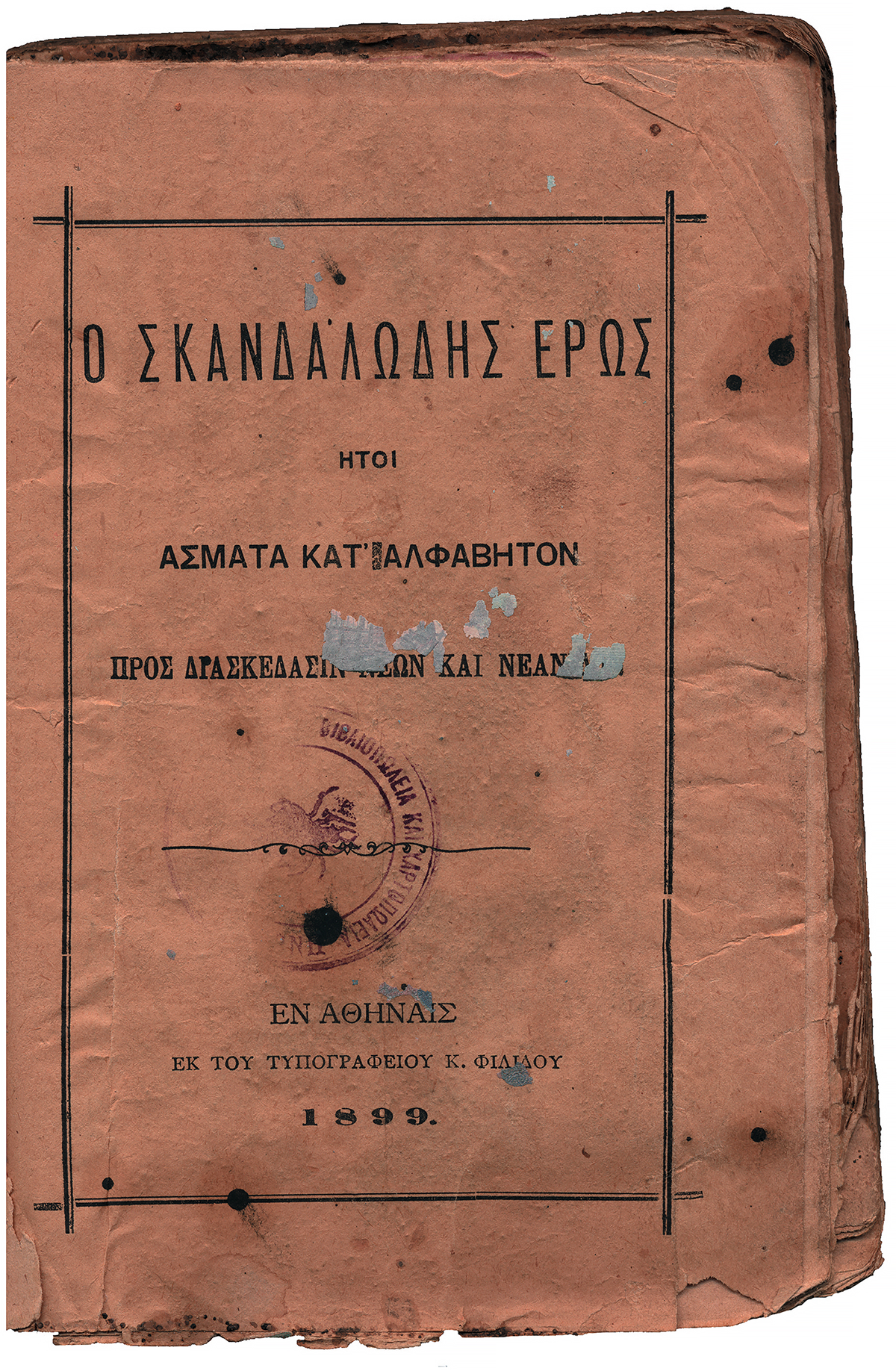
The printed pages and images, to begin with, constitute a first category of material. We find book covers and page fragments from volumes containing popular poetry such as the ‘canticles in alphabetical order’ (άσματα κατ’ αλφάβητον) (Fig. 2) under the general title The Scandalous Eros, printed in Athens in 1899; or the comparable The Vigilant Lover.
O Σκανδαλώδης Έρως, Athens 1899, Ⓒ Embiricos Collection/Agra Publications.
These coexist with random pages put together from illustrated books of ancient history and mythology. There is also an abundance of all kinds of engravings and lithographs: advertisements for miraculous medicines, such as the ‘Pink Pills’Footnote 21, a series of images of ‘mass consumption’ (Fig. 3) and excerpts from the lives of heroes of the Greek Revolution – surprisingly, any Byzantine-type representation is absent. There are also photographs, mainly of ζεϊμπέκηδες (Zeybekler)Footnote 22 the valiant rebels who lived in armed groups in the mountains of western Anatolia from the late seventeenth to the early twentieth century and became a type of popular hero which Theophilos would often celebrate in paint.
A Young Girl, Ⓒ Embiricos Collection/Agra Publications.

The ‘soft pornography’ of the 1930s ‒ here legitimized as an image by explicit reference to the myth of Pygmalion Footnote 23 – was transformed by Theophilos into a portrait of Phidias, where the emphasis on the shadow-lit contours of the volumes must be linked to Theophilos’ attempt to adapt to the more ‘artful’ style that his collaboration with Tériade (Stratis Eleftheriades, 1897-1983) apparently dictated.
Theophilos’ illustrated Notebook presents a different kind of interest. Here, the painter copies hundreds of pages of text from many different sources: narratives about Homer, Homeric rhapsodies, short biographies of mythological and historical figures. At the same time, he copies the images of the originals, usually engravings representing statues held in the great museums of the world. The fact that Theophilos’ painting is derived, even if only in part, from disparate sources is an indication of an obvious need of popular art to reframe its boundaries through the fusing of new stimuli in the first decades of the twentieth century. And such a process, as we shall see, cannot be simply the product of a naïve and totally innocent gaze or be taken as a ‘natural’ attitude towards received patterns.
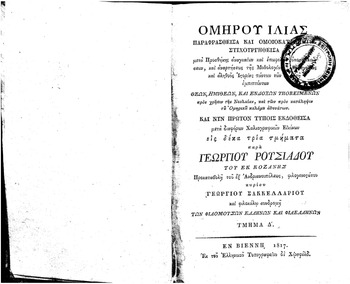
Thanks to the research of Maria Moschou we are now able to identify the sources of that antiquarian iconography.Footnote 24 The first part of Theophilos’ Notebook is a copy from the first volume of the Iliad translated by Georgios Rousiades (Vienna 1817) (Fig. 4).
Georgios Rousiades, Ὁμήρου Ἰλιάς, Vienna 1817.
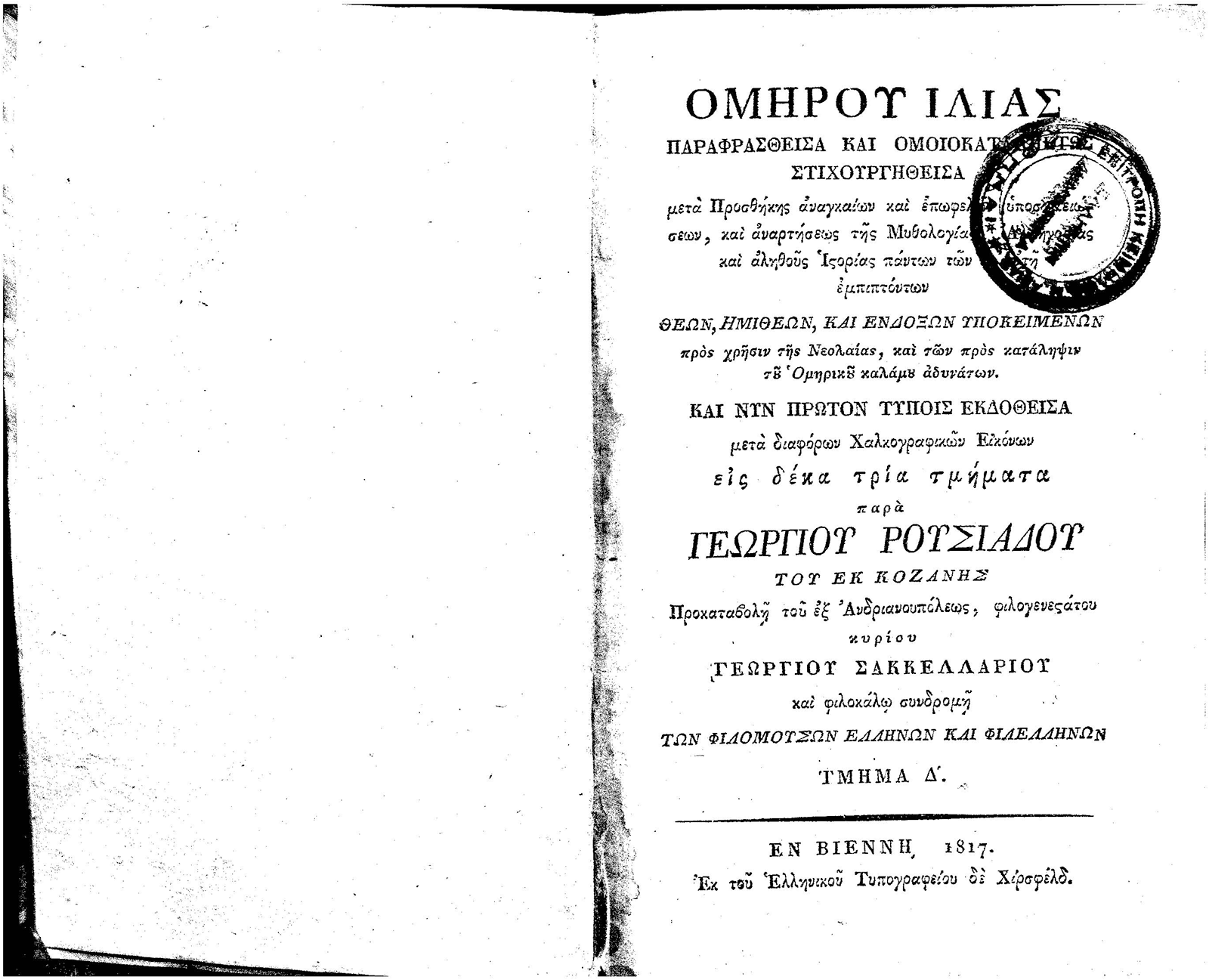
Τhis was the first metrical modern Greek translation of the Iliad in the nineteenth century and we may speculate about its use as a textbook even in primary schools of the period, and probably later, when after the foundation of the new Greek state the cultivation of ancient literature and philology were prized. In the pages of the text, Theophilos inserts two pages with pasted images copied from the edition. One of them illustrates the episode ‘Ulysses bearing the daughter of Chryses, Priest of Apollo’.Footnote 25 These are copies of ‘engraved images’ accompanying the corresponding entries of the mythological appendix to volume 1 of Rousiades’ Iliad.
A more extensive part of the manuscript is also based on a scholarly model. That is the Ἑλλάς. Βίος τῶν Ἀρχαίων Ἑλλήνων. Κατὰ τὸ Γερμανικὸν τοῡ Ἰακώβου Φάλκε [Hellas. Life of the Ancient Greeks. According to the German work of Jacob Falke]. Athens, 1887. The edition is a translation by N. G. Politis of the first section of the de luxe volume by Jakob von Falke, Hellas und Rom. Eine Culturgeschichte des classischen Alterthums (Stuttgart, W. Spemann, 1880).Footnote 26
In comparison with the copy made from the Iliad, the artist here seems to have handled both the text and the complex typographical conventions with much greater ease. Theophilos systematically attempts to recompose the arrangement of images and text especially in the pages taken from Falke, he includes on the same page images from different pages of the original text. While copying a large part of the text and omitting the images, he incorporates some of them into other parts of the manuscript which contain texts of diverse origins but with related antiquarian content. Theophilos seems to be aware that his attempt to reconstruct text and images requires a familiarity with the printed book.Footnote 27
‘These are all the skills of a self-taught Greek, an innocent student of the senses who, in a society educated in European universities and sensitive only to Raphael and his imitators, managed to purify and give plastic expression to our true personality’, Elytis wrote as late as 1973.Footnote 28 When we have noted how Theophilos handles the material in his trunk, Elytis’ comment seems simplistic or even a distortion. Yet Elytis’ attitude toward Theophilos is typical of the way that the painter was perceived by the Generation of the Thirties: as an innocent and totally uneducated naïf painter, connected only by instinct to the traditional sources of his ancestral, indigenous culture. The trunk poses a more complex question: what is the real intellectual background of the painter from Lesbos? The environment in which Theophilos was formed and acted has now been systematically studied, starting from his childhood years. Theophilos was active in places of considerable urban development (Lesbos, Smyrna, Volos). The development of the school network was remarkable and in tune with urbanization, especially in Ottoman-ruled Lesbos during the second half of the nineteenth century. The organization of education was based on the model of the independent modern Greek state, with an emphasis on classical education at the expense of scientific and technical skills and the prevalence of a linguistic code (katharevousa) alien to the vernacular dimotiki. The years between 1867 and 1884 represent the most strictly orientated period towards classicism.Footnote 29
If we accept the unconfirmed information from official records that Theophilos went to school in Lesbos, then his education is to be placed in the late 1870s, when primary school education lasted four years. Based on the above observations resulting from the study of the material in the trunk, should we perhaps reconsider the received view that Theophilos left school in the third grade of elementary school? It is very difficult to take a position on that issue, for lack of evidence. The tradition of an illiterate Theophilos seems too strong to be challenged. And for the first-born son of a cobbler with many children, the compulsory payment of a registration fee and the cost of materials (paper, chalk, notebooks) for a pupil, even in primary school, must also be taken into account.Footnote 30
So let us accept that Theophilos was indeed illiterate. From this assumption, however, a slightly different question arises: What does illiterate mean at the time that Theophilos was active? Is a man of this level of formal education capable of copying words from texts? One might think that Theophilos is copying mechanically through a developed capacity for ‘instantaneous visual memory’ which is characteristic of visual artists. That is, he could be treating the text as an image, as a mere visual stimulus, without understanding the content of the narrative. We are now certain that this is not the case. The flow of his writing suggests that the copying is not done tentatively mot à mot, and the kind of errors indicate familiarity with the written word. As Maria Moschou has shown, Theophilos, for the most part, carefully copies unusual words (ναυβάται, φ. 90r), while in the copying of familiar words or phrases there are occasional oversights (παιδίον [sic] τῆς μάχης, φ. 98r), but also corrections (ἐδοξάσθησαν τὰ ἑλληνικὰ ὅπλα, φ. 93v, for ἐδόξασαν in the original text, p. 26).Footnote 31 These remarks indicate some knowledge of school grammar.
Theophilos does not mechanically copy this demanding text. Even when he copies from Rousiades’ Iliad the painter uses small letters for the titles of the text instead of the capitals in the original and adds captions to some images. It seems that he maintains an active relationship between word and image that contradicts the notion that he performs a merely instinctive treatment of his painted and written surfaces. Rather, Theophilos engages in a controlled process of creation in different phases (the same is implied by pictures that seem to have been pasted onto the pages after the text has been written). Throughout the manuscript, punctuation marks are often placed at the top of or to the right of capital letters, and sometimes in words that begin with a capital letter, while the letter that follows is also capitalized. These features occur regardless of the typographical conventions of the original texts.Footnote 32
So what was the educational level of Theophilos? I think that, to bypass the impasse, we have to treat the issue from a different perspective: maybe we should take a look not only at the formal but the informal education of the time. Perhaps the level of literacy of the common people in Theophilos’ time, regardless of their formal connection to some educational institution, was rather higher than we think.
Perhaps, too, the liturgical books of the Orthodox Church and other scholarly sources known to have been used in education were material familiar to a wider community of people; and under certain conditions, the distinction between scholarly and popular culture may have been far from absolute. According to Stavroula Likiardopoulou-Kontara,Footnote 33 who has made a careful study of the educational system of the period, the formal knowledge provided in schools at the time was thin and of low quality. Additionally, a significant number of pupils, even in the lower grade, left school either in the middle of the year or after attending a few classes ‒ seemingly, that was the case with Theophilos. But, strangely, at the same time, Theophilos was capable of using the placement of accents above or to the right of capital letters that is typical of nineteenth-century (and earlier) scholarly editions. Most notably, the placement of accents to the right of capital letters and the use of a second capital letter next to the original ‒ which Theophilos also masters‒ is a typographical feature of the liturgical books of the Orthodox Church, as Maria Moschou has notedFootnote 34
In short, and in spite of the claims by the typically affluent members of the Generation of the Thirties, Theophilos was perhaps neither devoid of scholarly knowledge nor instinctively reliant exclusively on Byzantine or post-Byzantine traditions. Theophilos seems to have been in contact with certain learned print sources which he was able to navigate, while he was also interested in the current daily life of his time, the iconography of popular readings and even advertisements or post cards. In short, what makes his painting alive and dynamic is the coexistence of a traditional visual language fertilized by a mixture of scholarly references and everyday images of his own social and cultural environment.
And here perhaps something else should be added. Despite their emphasis on an unsullied and unbroken tradition, the young intellectuals of the 1930s were capable of recognizing the value of Theophilos’ painting not because of their familiarity with traditional art but quite the contrary: they recognized the value of tradition because they were hyper-modern. They discovered the lux ex oriente through their contact with the values of occidental, and especially French, modernism.
Although it is true that Theophilos’ naïf art is related to well established cultural traditions, common to the unified oriental provinces of the Ottoman Empire is the modernist emphasis on the anti-academic features of Theophilos’ visual language that fertilized the reception of his painting in the interwar period. Consequently, it was not the ambience of the rural cultures of the Balkans, Anatolia or the Middle East that fuelled the debate, but the industrial milieu of the Western European nations ‒ France in particular. In fact, as Evgenios Matthiopoulos has amply documented, in the interwar years ‘the very constitution of the field of art and its structures tended to be organized or adapted in accordance with the rules of art critical, intellectual and scientific paradigms, and of course of stylistic models from France […]. From Paris, then, the Athenians received not only modern trends, but more generally, the quarrels that agitated them.’.Footnote 35 And this is certainly no accident. As early as 1911, Eleftherios Venizelos, who was to win that year’s election, described France as a ‘bright lighthouse’ in the effort of modernization of the Greek State both politically and militarily. And George Theotokas (1905-66), considered as founder of Generation of the Thirties in the field of letters, modelled his cultural vision on the basis of ‘the French paradigm of European civilization’. In a 1938 letter to the essayist Julien Benda, he does not hesitate to describe France as ‘the Athens of the contemporary World’Footnote 36. This is why, just as often, in the history of the reception of Theophilos’ work, the reference to the unsullied tradition of which he is considered the natural bearer coexists with modernist criteria, especially in reference to specific French painters: ‘His colour surfaces […] show the clarity and intensity of the fauves. And often […] they recall the best paintings of Bonnard’, Elytis would write.Footnote 37
‘These are the same elements used by Western painting after Impressionism while trying to secure its autonomy through absolutely painterly means’, Tsarouchis would emphasize.Footnote 38 The French art critic and an ardent propagandist of cubism Maurice Raynal, more detached from the Greek environment, had already commented in 1936 on the connection of Theophilos with the art of his own time: ‘It is this, that allowed Theophilos to miraculously rediscover the intentions of a Cézanne, a Matisse, a Bonnard and even a Dufy.’Footnote 39
It is Elytis, not primarily a visual artist, who would sum up in 1947, in a moment of disarming honesty, the way Theophilos was perceived by the Generation of the 1930s:
A generation of young painters […] sees in the uneducated Wanderer painter of Mytilene, Theophilos, the bearer of a genuine painterly feeling. But this generation […] does not turn a blind eye. At the same time, they have their eyes on Europe where Cézanne, after intense research, creates a new foundation for visual expression. His reaction to dissolution and his return, from another path, to form gives birth to the preconditions of Cubism. A heroic era as it has been called, and not without reason, for the visual arts begins.Footnote 40
Seferis moves along the same lines, linking the field of literature. As he declared in 1937, Makriyannis, the illiterate hero of the Greek Revolution, ‘it to be considered, like Theophilos in painting, as one of the greatest prose writers of the last hundred years’.Footnote 41 It is very significant that some years later, Seferis describes Makriyannis ‒the ‘Greek’ par excellence‒ in unambiguously modernist terms: Makriyannis is allegedly possessed by an ‘urge for expression’ that ‘annihilates all difficulties’.Footnote 42
In short, the Generation of the Thirties is able to conceive the notion of Greekness in this way because it looks towards Europe, and especially towards France. This is how they discover Theophilos: his simplistic idiom is Greek because it can be associated with the heroic era not only of Makriyannis but also of Cézanne. But this is the perspective of the 1930s generation, not of Theophilos. The remnants of his trunk show that Theophilos, if he had known Cézanne, would probably have remained indifferent to his painting, because he would have found it not too modern but perhaps outdated, and in any case outside his own interests. Theophilos preferred to collect advertising clippings like the ‘Pink Pills’ that cured all pain, newspaper photographs and letterheads, mixed with references to the Cnidian Venus and to the beautiful daughter of the priest Chryses who caused the mad rage between Achilles and Agamemnon. Perhaps, the aesthetics of collage were closer to what he was interested in, something that the intellectuals of the 1930s would have found difficult to imagine and even more difficult to accept.Footnote 43
And perhaps, if he had met Picasso, Theophilos would have said to him something similar to what Douanier Rousseau (1844-1910) (often seen as the French analogue of Theophilos) declared to the proponent of Cubism (of whom the painter from Mytilene knew nothing). When in 1908 Picasso organized at the Bateau-Lavoir the famous banquet in honor of Rousseau, the naïf painter confided to him ‘[Cher Picasso]. Nous sommes les deux plus grands peintres de notre temps: vous dans le genre égyptien, moi dans le genre moderne.’ You and I’, said Henri Rousseau, sincerely addressing his host Pablo Picasso, ‘are the two most important artists of the age – you in the Egyptian style, and I in the modern.’.Footnote 44 Theophilos, I believe, would certainly agree.
Nikos Daskalothanasis is Professor of Modern and Contemporary Art History in the Department of Theory and History of Art, Athens School of Fine Arts. He has published (in Greek), among other studies, Art History, the Birth of a New Discipline: from the 19th to the 20th century (Athens, Agra 2013). He has translated and edited Le Lai d’Aristote or Aristotle and Phyllis (Athens, Agra 2018). He is the author of Art History: the western world from prehistory to the present day. Painting-sculpture-architecture (Athens, Utopia 2023) and Modern Art (Athens, Agra 2024). He is the editor of the peer-reviewed academic journal Ιστορία της τέχνης (Art History): https://istoriatechnisinfo.wordpress.com/. His research interests include art historiography as well as art theory and art history from the mid-nineteenth century to the present.



 Open access

