

Introduction
Throughout the Middle Ages, the versicle Benedicamus Domino was sung at the end of many of the Office Hours and sometimes also at the end of Mass.Footnote 1 The melodies to which the versicle was sung were commonly borrowed from elsewhere in the chant repertory, often derived from the melismas and melismatic passages of responsories and kyries.Footnote 2 Far from being static, the musicalization of the Benedicamus Domino versicle remained a vibrant tradition throughout the medieval period. The versicle attracted elaboration through the addition of new texts set to these pre-existing melodies – called prosulas – which survive from the first written traces of the Benedicamus Domino tradition.Footnote 3 The same melody could be sung with different texts, and some melodies became particularly popular, like the melismas ‘flos filius eius’ (borrowed from the responsory Stirps iesse virgam) and ‘clementiam’ (borrowed from the responsory Qui cum audissent).Footnote 4 The borrowed melodies themselves could be rearranged, creating new melodies to be sung with new texts, like Puer nobis nascitur. Footnote 5
BENEDICAMUS in laude ihesu is one of the many Benedicamus Domino prosulas that circulated in the Middle Ages.Footnote 6 Praising Jesus and his mother Mary, the newly created text is sung to a pre-existing melisma that accompanies the words ‘flos filius eius’ within the responsory Stirps iesse virgam produxit for the Nativity of the Virgin.Footnote 7 BENEDICAMUS in laude ihesu circulated from around the early fourteenth century to (at least) the seventeenth century in Italy, the German-speaking area (today’s Germany, Austria, Czech Republic, and Switzerland), the Low Countries, and northern France, as well as Spain and possibly Croatia. The core text of the prosula reads as follows (based on the spelling of Brussels 1870):
Benedicamus in laude ihesu qui sue matri marie benedixit in eternum domino
(‘Let us forever bless with our praise the Lord Jesus, who blessed his mother.’)Footnote 8
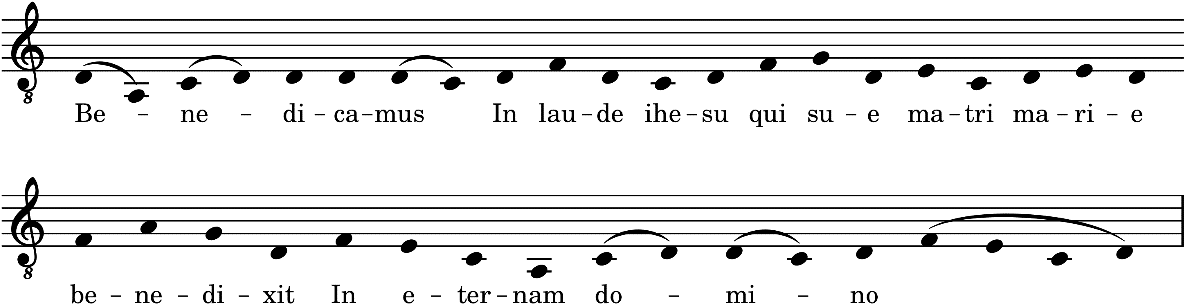
There are slight musical and textual variants across the many copies of BENEDICAMUS in laude ihesu – for example, transposition (while retaining modal identity), short melismas, or additions of final words – but these do not complicate the identity of the prosula. Example 1 exemplifies the monophonic version from Milan P 43 sup, a fourteenth-century addition to a commentary on Ovid’s Metamorphoses written in the second half of the thirteenth century (discussed further below).
Transcription of BENEDICAMUS in laude ihesu from Milan P 43 sup, fol. 146r.
BENEDICAMUS in laude ihesu is much less well-known in current scholarship than other popular Benedicamus Domino prosulas that circulated at the same time, from the fourteenth to the seventeenth century. Yet, I have identified forty-eight musically notated sources of BENEDICAMUS in laude ihesu, as listed in Appendix A. This list, based on searches in search engines, manuscript catalogues, and on manuscript analysis, greatly expands the known source base for this prosula and makes them accessible without having to repeat catalogue surveys. Even if there is no claim at exhaustivity, the forty-eight sources, combined with related liturgical sources listed in Appendix B, transmit precious information on the performance contexts of BENEDICAMUS in laude ihesu and, by virtue of their sheer number, they can be considered as representative of the diversity of practices through time and space of this popular prosula.
There is an extensive literature on prosulas. Some of the most convincing recent studies have focused on the ways in which prosulas produce interconnected layers of meaning between their parent chants and the preoccupations of the communities which created them.Footnote 9 However, the text of the widely disseminated prosula BENEDICAMUS in laude ihesu is very generic and does not present any specific poetic peculiarities. Rather, the short text seems to fulfil a utilitarian function, highlighting the Marian connection of the original melody in a very straightforward way, and without determining a specific liturgical or historical context for the performance of the prosula. As such, the genre of BENEDICAMUS in laude ihesu may not be the most productive lens of investigation. A more productive approach comes from the numerous polyphonic elaborations of this chant.
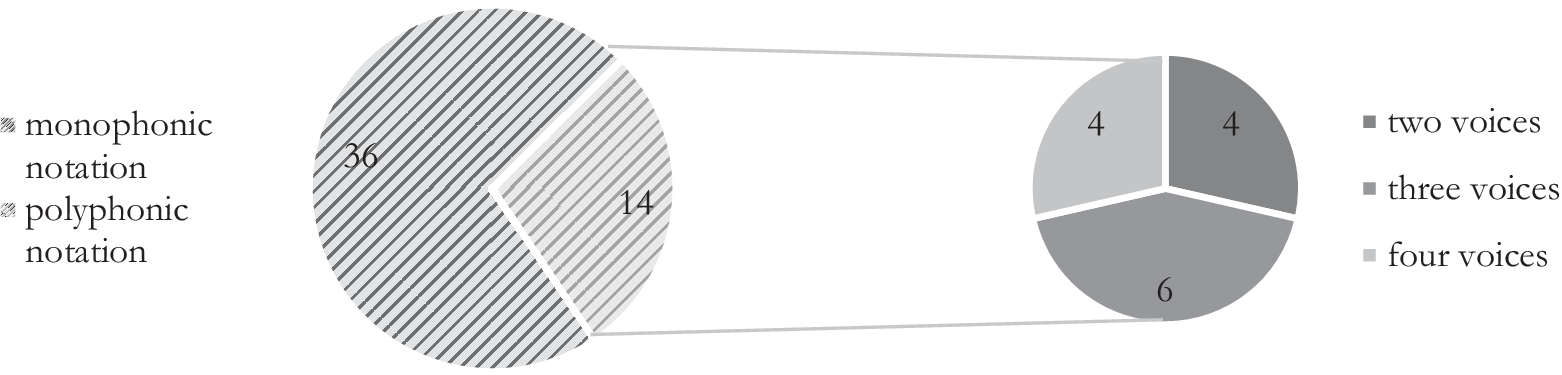
Among the fifty musically notated records of the prosula (Florence 472 and Trent 91 transmit two settings each), thirty-six are notated monophonically and fourteen polyphonically (for two, three, and four voices; see Table 1 and Figure 1). This proportion is intriguing, because it is much higher than that of other directly comparable prosulas. For example, BENEDICAMUS flori orto is also a Benedicamus Domino prosula that uses the ‘flos filius eius’ melisma. In contrast to BENEDICAMUS in laude ihesu, it is transmitted in at least twenty-two sources, of which only one is notated polyphonically, and another possibly prepared for polyphonic notation.Footnote 10 Furthermore, the fourteen settings of BENEDICAMUS in laude ihesu transmitted with polyphonic notation each present a unique elaboration of the chant melody, including two by the named composers Jacob Obrecht (1457/8–before 1505) and Adrian Willaert (c. 1490–1562). The large number of polyphonic elaborations and the unusually high proportion of sources that contain a polyphonic setting of this chant pose a historical question that requires explanation and makes the study of these polyphonic settings particularly relevant. This article aims to provide that explanation by investigating the historical contexts that might explain the numerous and unique elaborations. I will first analyse the functions of the monophonic versions of the prosula before providing a brief overview of the musical characteristics employed in the notated polyphonic elaborations. This will serve as a basis from which to interrogate the contexts in which these strikingly independent elaborations get tied up.
BENEDICAMUS in laude ihesu with polyphonic notation (ordered by number of notated voices)
| Manuscript, folio | Number of notated voices | Type of source | Date of the source |
|---|---|---|---|
| Berlin 190, fol. 59r | 2 voices | Songbook | 15th cent., end (c. 1480) |
| Erfurt 44, fol. 38r | 2 voices | Miscellaneous (music theory, liturgical chants) | 14th cent., first half |
| Stari Grad s.s., fols. 196v–197r | 2 voices | Miscellaneous (prayers, liturgical chants) | 15th cent.–16th cent. | Addition from 15th cent., end (1497–1501) |
| Verona DCXC, fol. 41r | 2 voices | Liturgical manuscript (hymns, antiphons) | 15th cent., end – 16th cent., beginning |
| Florence 472, fol. 23v | 3 voices | Miscellaneous (music treatises, chants, laudes) | 15th cent. |
| Munich 14274, fols. 54v–55r | 3 voices | Manuscript of sacred polyphony | 15th cent., middle (1440–50) |
| Paris 16664, fols. 96v–97r | 3 voices | Miscellaneous (music treatises, songs) | 16th cent., beginning |
| Trent 91, fol. 60v | 3 voices | Manuscript of sacred polyphony | 15th cent., second half (1460–80) |
| Trent 91, fol. 60v | 3 voices | Manuscript of sacred polyphony | 15th cent., second half (1460–80) |
| Trent 92, fol. 119r | 3 voices | Manuscript of sacred polyphony | 15th cent., first half (1430–45) |
| Florence 472, fol. 23r | 4 voices | Miscellaneous (music treatises, chants, laudes) | 15th cent. |
| Munich 52, fols. 252v–253r | 4 voices | Choirbook of sacred polyphony | 16th cent., beginning (c. 1523) |
| Segovia s.s., fol. 91v | 4 voices | Manuscript of polyphony | 16th cent., beginning (1500–03) |
| W1123, p. 18 | 4 voices | Polyphony for Vespers and Compline | 16th cent., middle (1555) |
Number of voices of notated records of BENEDICAMUS in laude ihesu.
Functions of BENEDICAMUS in laude ihesu
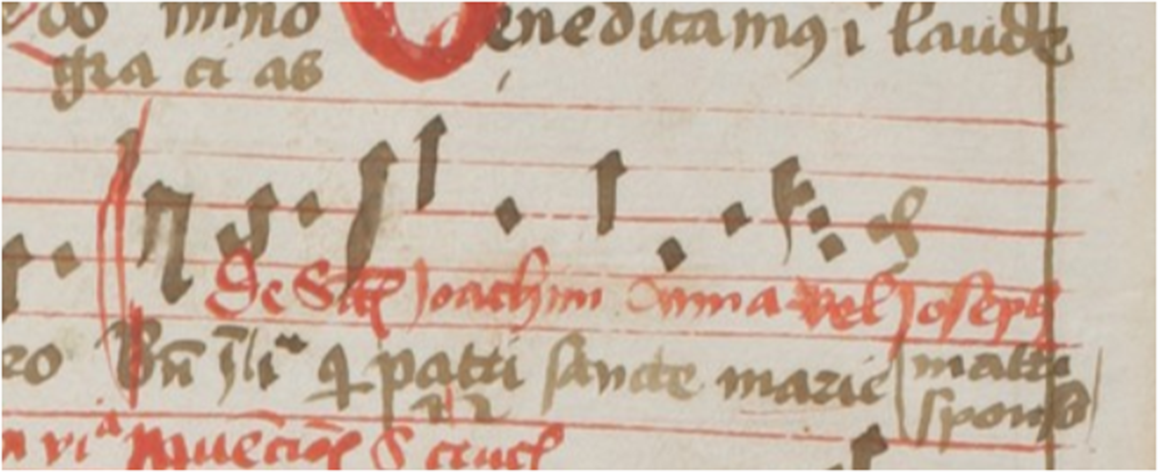
When present, the liturgical prescriptions and the rubrics prescribing the occasions on which to perform the prosula indicate that the primary function of BENEDICAMUS in laude ihesu was to conclude the Office Hours, as a substitute to the untroped Benedicamus Domino chant. More specifically, it was sung on various Marian feasts, as attested in the all-encompassing rubric ‘ad processione[m] In omnibus festis marie virginis’ (‘at the processions of all feasts for the Virgin Mary’) in Sankt Gallen 546 (fol. 375v). This same manuscript confirms that the prosula was also used to celebrate persons related to Mary, since the source explicitly lists several textual alternatives: ‘Benedicamus in laude Joachim/Anna/Joseph qui patri/matri/sponsum sancte marie benedixit in eternum domino sit laus deo’ (Sankt Gallen 546, fol. 375v, emphasize mine; Figure 2).
Sankt Gallen 546, fol. 375v (excerpt). St. Gallen, Stiftsbibliothek, Cod. Sang. 546: Joachim Cuontz: sequentiary of St. Gall / Troper with ‘Hufnagelnotation’ <https://www.e-codices.unifr.ch/en/list/one/csg/0546> (CC BY-NC 4.0).
The prosula could be sung on other feasts of various ranks. For instance, in Klosterneuburg, it concluded Second Vespers at the feast of medium rank (‘medium festum’) for Saint Stephen Protomartyr,Footnote 11 while in the Seckau monastery, it was sung at Lauds on Holy Innocents’ Day, ranked as a ‘feria tertia’.Footnote 12 Table 2 provides more examples of the varied liturgical uses for BENEDICAMUS in laude ihesu. The instructions about the occasions on which to perform BENEDICAMUS in laude ihesu presented here thus demonstrate a great flexibility in its liturgical use.
Sources with specification of liturgical occasions (alphabetically ordered according to manuscript abbreviation)
| Manuscript, folio | Liturgical occasion for the singing of BENEDICAMUS in laude ihesu |
|---|---|
| Augsburg II.2.8o 13, fol. 153r | [rubric] ‘De beata Virgine’ |
| Berlin 190, fol. 59r | [contextual evidence] it could have been a concluding chant for a service of suffrages for a Marian feast a |
| Berlin 40562, fol. 143v | [rubric] ‘De domina’ |
| Bologna 18, final folio (unnumbered), recto | [rubric] ‘De domina duplex maius’ |
| Bologna 2893, fol. 405r | [rubric] ‘In solempnitatibus beate marie’ |
| Erlangen 464, fol. 33v | [contextual evidence] The prosula is added in a short series of three chants dedicated to the Virgin Mary (the antiphons Alma redemptoris materi and Nigra sum sed Formosa and a short polyphonic piece, Omnes gaudemus) as is clear both from the textual contents of the pieces and from two accompanying rubrics. Therefore, it is likely that the trope was intended to be sung on a Marian feast. |
| Florence 472, fols. 23r and 23v | [rubric] ‘Duplex maioris’ |
| Graz 1566, various | For all feasts related to Mary, as well as Circumcision, Christmas, Epiphany, and the Saint Innocents. |
| Klosterneuburg 1014, various | Circumcision of Jesus (Lauds), Christmas (Vespers, Lauds, Second Vespers), Saint Stephan Protomartyr (Second Vespers), Saint Stephan the Evangelist (Lauds), Epiphany (Second Vespers), Nativity of Mary (Vespers, Lauds), Conception of Mary (First Vespers, Lauds), Commemoration of Mary (‘per adventum domini’ and ‘infra festum nativitatis domini et purificationem’; Vespers, Lauds). |
| Köln 1161, fol. 129r | [contextual evidence] Marian feast (it is added after two Marian antiphons, Hec est dies quam fecit and Ave stella matutina). |
| Munich 14073, various Munich 14183, various Munich 14428, various |
Vigil of Christmas, Epiphany, Purification of Mary, Annunciation of Mary, Assumption, Nativity of Mary, feast of the Martyrs, Saint Emmeram, feast of All Saints |
| Munich 100, fol. 249v | [rubric] ‘De beata virgine maria’ However, the prologue explains that the songs of this section have been compiled for the Nativity of Christ. The trope therefore may have been used during Christmas time. |
| Prague VII G 16, fol. 191r | [contextual evidence] It was certainly sung in a procession, possibly on a Marian feast, perhaps on the Purification b |
| Prague XIII E 14b, fol. 210v | [rubric] ‘de corporis christi’ |
| Prague XVI A 18, fol. 79r | [contextual evidence] it was certainly sung in a procession, possibly on a Marian feast, perhaps on the Purification c |
| Sankt Gallen 1262, p. 126 | Vigil of the night before Christmas, Vigil of Annunciation |
| Segovia s.s., fol. 91v | A context of performance for this piece – though not for the manuscript – may have been both as a concluding chant for Vespers on Marian feasts, as well as to end Lof services (sung daily in many churches of the Low Countries, not liturgical but generally build around Marian antiphons). d |
| Stari Grad s.s., fols. 196v–197r | [rubric] ‘De domina.’ e |
| Verona DCXC | [rubric] ‘In festis maioribus duplicibus’ |
| Vyšší Brod s.s., unnumbered folio | [rubric] ‘De beata virgine’ |
| W1123, p. 18 | [index] First Vespers of Marian feasts |
| Zurich 58, fol. 56r | [rubric] ‘De beata virgine Marie’ f |
| Zurich C 101, fol. 156r | [rubric] ‘In summis de beata virgine primum [Benedicamus Domino]’ |
a Mertens and Van der Poel, Het liederenhandschrift Berlijn 190, 32.
b Hana Vlhová-Wörner, ‘Benedicamus Domino tropes in the monastery of Benedictine nuns at St George’s, Prague’, Early Music, 50 (2023), 419–34, doi:10.1093/em/caac053.
c Vlhová-Wörner, ‘Benedicamus Domino tropes in the monastery of Benedictine nuns at St George’s, Prague’.
d Bloxam, ‘The Late Medieval Composer as Cleric’, 32.
e Kustura, ‘Primjeri Jednostavnog Liturgijskog Višeglasja Iz Hrvatske U Europskom Kontekstu’, 17.
f Cristina Hospenthal, ‘Beobachtungen zu den Ite Missa Est im Tropenbestand der Handschriften aus dem Kloster Rheinau’, Schweizer Jahrbuch für Musikwissenschaft, 10 (1990), 11–31 (p. 19).
Three manuscripts point towards contexts for the use of the prosula that were not directly liturgical. BENEDICAMUS in laude ihesu is copied on a four-line staff among additions at the end of a commentary on the Metamorphoses by Ovid (Milan P 43 sup, Example 1), commonly referred to as the Vulgate Commentary in literary studies. The Vulgate Commentary is an anonymous commentary composed around 1250 in northern France, perhaps around Orléans, and was widely disseminated during the late thirteenth and early fourteenth centuries.Footnote 13 Like other commentaries on Ovid’s Metamorphoses, the Vulgate Commentary was intended for use in the classroom, in a pedagogical way which Nicolette Zeeman describes as ‘diverse, expatiatory, and even witty, the residue of a highly interactive, oral classroom culture’.Footnote 14
The Vulgate Commentary transmitted in Milan P 43 sup is written in two contemporary French hands of the mid- to late thirteenth century, one copying Ovid’s poem, the second the commentary.Footnote 15 BENEDICAMUS in laude ihesu is the only piece of music in the entire manuscript and the other additions that surround it that are related to the main text (further notes in Latin on the Metamorphoses) or are entirely independent (medical notes in Latin, a short text in prose in northern French, about two protagonists, Jehan and Marion). The intended audience of the musical addition remains unknown, however: the text script is similar to the short prose in northern French, but very different from the other hands. At the minimum, the person who added BENEDICAMUS in laude ihesu owned this copy of the glossed Metamorphoses, which indicates a learned context, perhaps that of a school master interested in what Coulson describes as a commentary showing a ‘literary sensitivity rare among late medieval commentators on Ovid’.Footnote 16 Nonetheless, some of the musical notes have been erased and emended, presumably by the same hand, which indicates a knowledge of the prosula and a desire for its correctness.Footnote 17 This may suggest that the prosula was copied in Milan P 43 sup by a schoolboy as part of his training.
Also curious is the use of the text of the prosula as a colophon in a mid-fifteenth-century copy of the second part of St Augustine’s De civitate Dei (Oxford 226, from north-eastern Italy).Footnote 18 While the use of the words ‘Benedicamus Domino’ or ‘Deo Gratias’ as a colophon is quite common throughout the Middle Ages, the inscription of an entire prosula is less so. Here, BENEDICAMUS in laude ihesu may have had a more general devotional function; for instance, as a prayer outside the canonical hours during which it is usually sung. This may explain why the prosula is also found on an empty folio in Innsbruck 398 (fifteenth century, south Germany or Tirol). There, the prosula is added with two other Benedicamus Domino prosulas: BENEDICAMUS eterno patri and BENEDICAMUS regi polorum. Footnote 19 None of them is notated and their later addition in an otherwise unnotated book of prayers may confirm that BENEDICAMUS in laude ihesu, as well as the two other prosulas, could have a devotional function outside the liturgy.Footnote 20 The flexibility visible in the use of this widespread prosula is also found in the way it receives musical elaborations in its polyphonic transmissions.
Diversity of Musical Elaborations
This section provides an overview of the main musical characteristics of the fourteen elaborations of BENEDICAMUS in laude ihesu written in polyphony. Its purpose is to outline the diversity of the musical materials. More detailed study of the individual pieces themselves will come in the following sections.
Regardless of the time and place, the fourteen polyphonic elaborations of BENEDICAMUS in laude ihesu share a compositional technique: one voice carries the prosula melody against new musical material in one or several additional voices, all voices singing the same text. Beyond this, however, the settings each employ various techniques to elaborate the prosula in unique ways. The main musical characteristics of these settings are summarized in Table 3.
Main musical characteristic of the polyphonic versions of BENEDICAMUS in laude ihesu (chronological order of the sources)
| Source | Prosula melody as tenor | Music notation | Contrary motion | Parallel motion | Imitative counterpoint | Melismatic (three notes or more per syllable) |
Main cadences | ||||||
|---|---|---|---|---|---|---|---|---|---|---|---|---|---|
| Undecorated | Decorated | Unmeasured | Measured | ||||||||||
| Erfurt 44 14th cent., first half Germany, Church of the Holy Sepulchre, Leonhardskloster in Aachen (?) |
x | black square notation | x | x | 4 | 5 | 8 | ||||||
| Florence 472 15th cent. Italy, Tuscany, Franciscan monastery Franciscan (?) |
x | white square notation | x | x | 3 | 5 | 8 | ||||||
| Munich 14274 15th cent., middle (1430–41) Germany, Regensburg, St Emmeram monastery (male). Benedictine |
x | black and white mensural notations | x | x | x | 1 | 5 | ||||||
| Trent 92 15th cent., first half (1430–45) Addition Switzerland/France, Basel–Strasbourg region |
x | white mensural notation | x | x | x | 8 | |||||||
| Trent 91 15th cent., second half (1460–80) Italy, Trent |
x | white mensural notation | x | 1 | 8 | ||||||||
| Berlin 190 15th cent., end (c. 1480) Netherlands, Female Augustinian community (Windesheim or Sion) |
x | Hufnagelschrift | x | 1 | 4 | 5 | |||||||
| Verona DCXC 15th cent., end–16th cent., beginning Italy |
x | black square notation | x | 1 | |||||||||
| Paris 16664 16th cent., beginning France, Low Countries (copied) Later in Italy (?) |
x | white mensural notation | x | 4 | 8 | ||||||||
| Segovia s.s. 16th cent., beginning (1500–03) Spain, Castile, Segovia (?), humanist environement |
x | white mensural notation | x | x | 3 | 5 | 8 | ||||||
| Munich 52 16th cent., beginning (c. 1510) Germany, Munich, court chapel of Wilhelm IV, Duke of Bavaria |
x | x | white mensural notation | x | x | 3 | 5 | 8 | |||||
| W1123 1555 (first print) Italy, Venice, Church of San Marco |
x | white mensural notation | x | 3 | 4 | 8 | |||||||
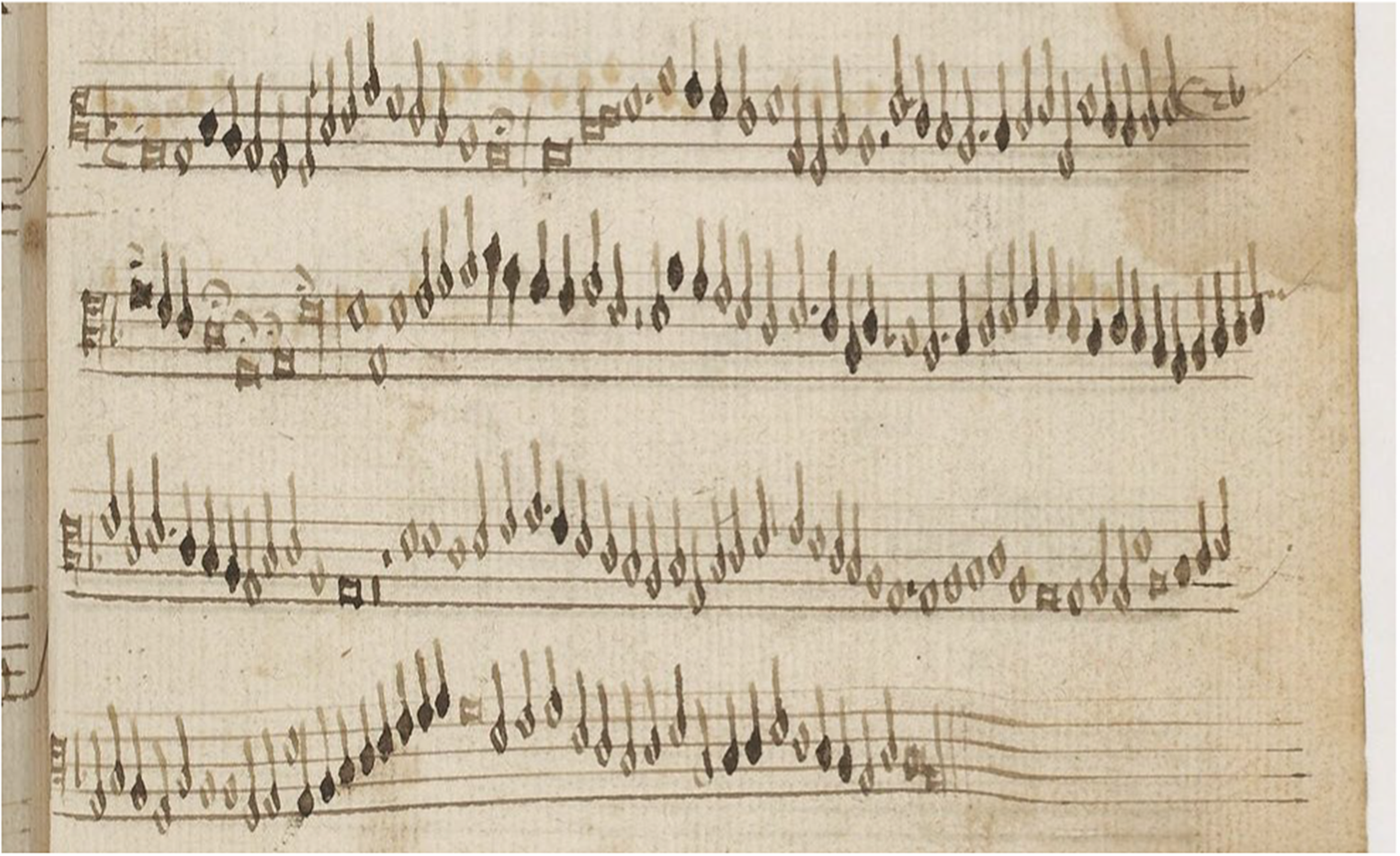
Table 3 shows that prosula melody is itself the locus of various elaborations. For instance, in the Bavarian source Munich 14274 (c. 1430–41), the melody is decorated at cadences, while it is undecorated in the bassus of Munich 52 (c. 1510, also from Bavaria), but it is used as a motivic material in the three upper voices. By contrast, the three-voice setting in Paris 16664, copied in the Low Countries at the beginning of the sixteenth century, elaborates on the original prosula melody to the extent that it is barely recognizable (Figure 3).Footnote 21
Tenor voice of BENEDICAMUS in laude ihesu from Paris 16664, fol. 97r. Paris, Bibliothèque nationale de France, ms lat. 16664, fol. 97r (excerpt).
The notated polyphony is either measured or unmeasured, with no correlation to the time or place, or to the type of counterpoint employed. Indeed, while the two latest sources (Munich 52 and W1123) show a more pronounced taste for imitative counterpoint, the beginning of the sixteenth century also witnessed elaborations of the prosula with contrary and parallel motions (Segovia s.s., composed by Jacob Obrecht – see below). Furthermore, Table 3 shows clearly that there is no correlation between the use of melismas (versus note-against-note counterpoint) and the time or place of the settings’ composition. Finally, and perhaps unsurprisingly, until the sixteenth century, the intervals on the main cadences are unisons, fourths, fifths, or octaves, while the last three sources of Table 3 also feature thirds.
The overall observation is one of a desire for polyphonic elaborations widely shared between different places. This desire took shape in practice through a wide range of compositional techniques which blurs genre distinctions in the polyphonic tradition. Various types of elaborations and of ways of notating it in writing happened at the same type, with no clear sense of stylistic evolution over time or based on geographical origin or provenance. This points to continued interest in the elaboration of this prosula not only over a long timeframe (from the 1300–50s to 1555) and a wide geographical area (Spain, Italy, France, the Low Countries, Germany), but also, and especially, in very different contexts. The analysis of these contexts and the reasons behind the choice of one polyphonic technique over another are the subject of the following three sections.
Liturgical Contexts
Among the twelve sources transmitting BENEDICAMUS in laude ihesu with polyphonic notation, four of them have a known liturgical context of performance, either very specific (such as W1123, containing music for Vespers and Compline composed for the church of San Marco in Venice) or more general (Erfurt 44, liturgical music for a church of the Holy Sepulchre in Germany). In what follows, I will use this knowledge to investigate if, and how, the context of performance influences the type of polyphony. For the sake of convenience, Table 4 summarizes brief information on the four sources.
Sources with a known liturgical context
| Manuscript, folio | Number of notated voices | Date of the source | Provenance | Type of source |
|---|---|---|---|---|
| Erfurt 44, fol. 38r | 2 voices | 14th cent., first half | Germany, Church of the Holy Sepulchre, Leonhardskloster in Aachen (?) | Miscellaneous (music theory, liturgical chants) |
| Munich 14274, fols. 54v–55r | 3 voices | 15th cent., middle (1440–50) | Germany, Regensburg, St Emmeram monastery (male). Benedictine | Manuscript of sacred polyphony |
| Munich 52, fols. 252v–253r | 4 voices | 16th cent., beginning (c. 1523) | Germany, Munich, court chapel of Wilhelm IV, Duke of Bavaria (1493–1550) | Choirbook of sacred polyphony |
| W1123, p. 18 | 4 voices | 16th cent., middle (1555) | Italy, Venice, San Marco | Polyphony for Vespers and Compline |
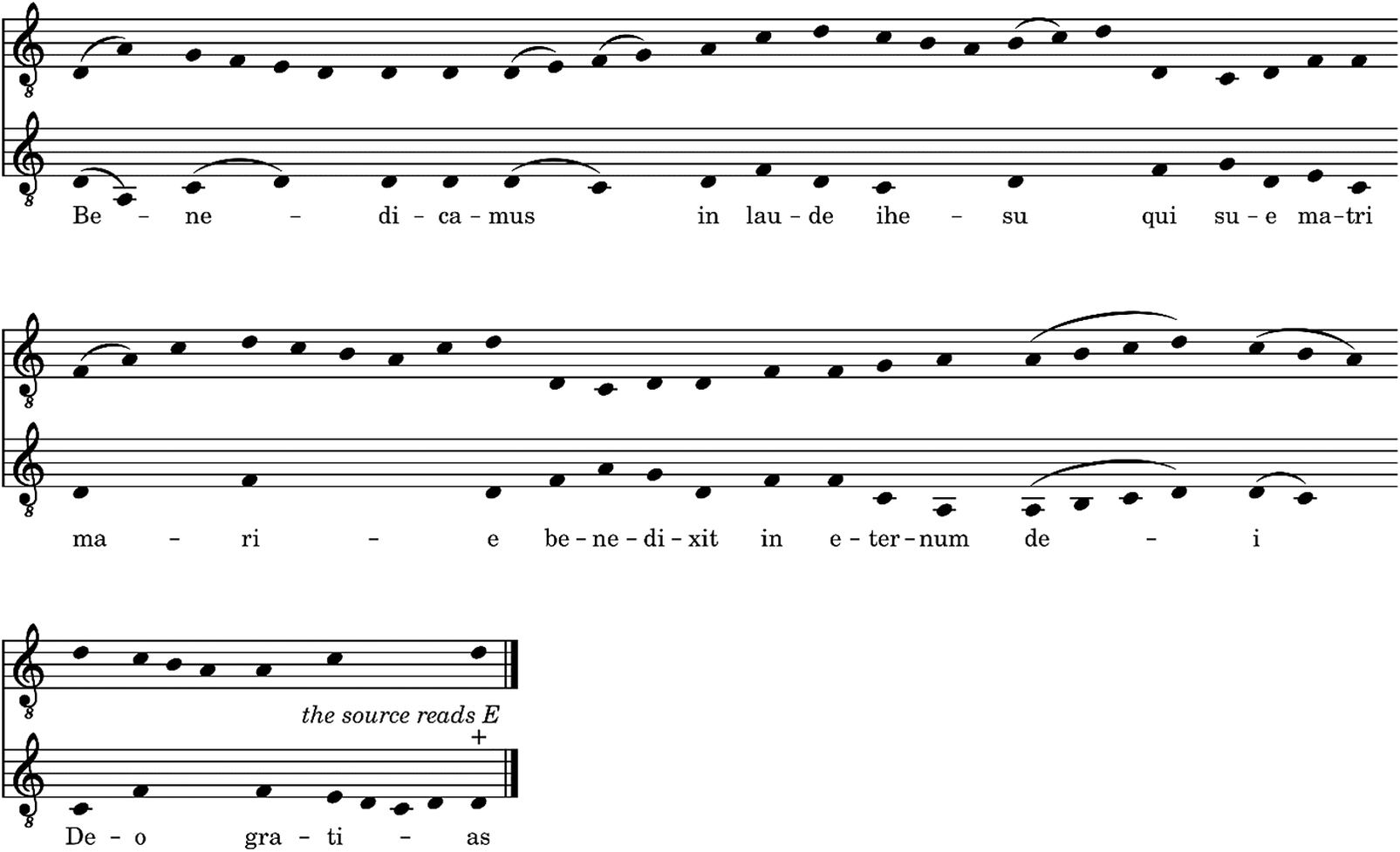
The manuscript Segovia was copied in the first half of the fifteenth century and originates from a church of the Holy Sepulchre (perhaps the Leonhardskloster in Aachen).Footnote 22 It contains music theory treatises as well as chants for the Mass and for the Offices, including a two-voice elaboration of BENEDICAMUS in laude ihesu. The lower voice carries the ‘flos filius eius’ melody, against an added voice that moves essentially in contrary motions with several melismas (Example 2). The setting contains several dissonances (e.g., on ‘ma-tri’, ‘de-i’, or ‘De-o’) which are not untypical for this kind of simple polyphonic elaboration. They are also present in the other polyphonic pieces found in Erfurt 44. Indeed, the polyphony for BENEDICAMUS in laude ihesu is copied alongside other polyphonic and monophonic Office chants, some of which are accompanied by rubrics specifying their position in the liturgical year. In such a context, it seems evident that to the users of Erfurt 44, BENEDICAMUS in laude ihesu had a liturgical function, with its polyphony providing a simple melodic embellishment to conclude the Office Hours.Footnote 23
Transcription of BENEDICAMUS in laude ihesu from Erfurt 44, fol. 38r.
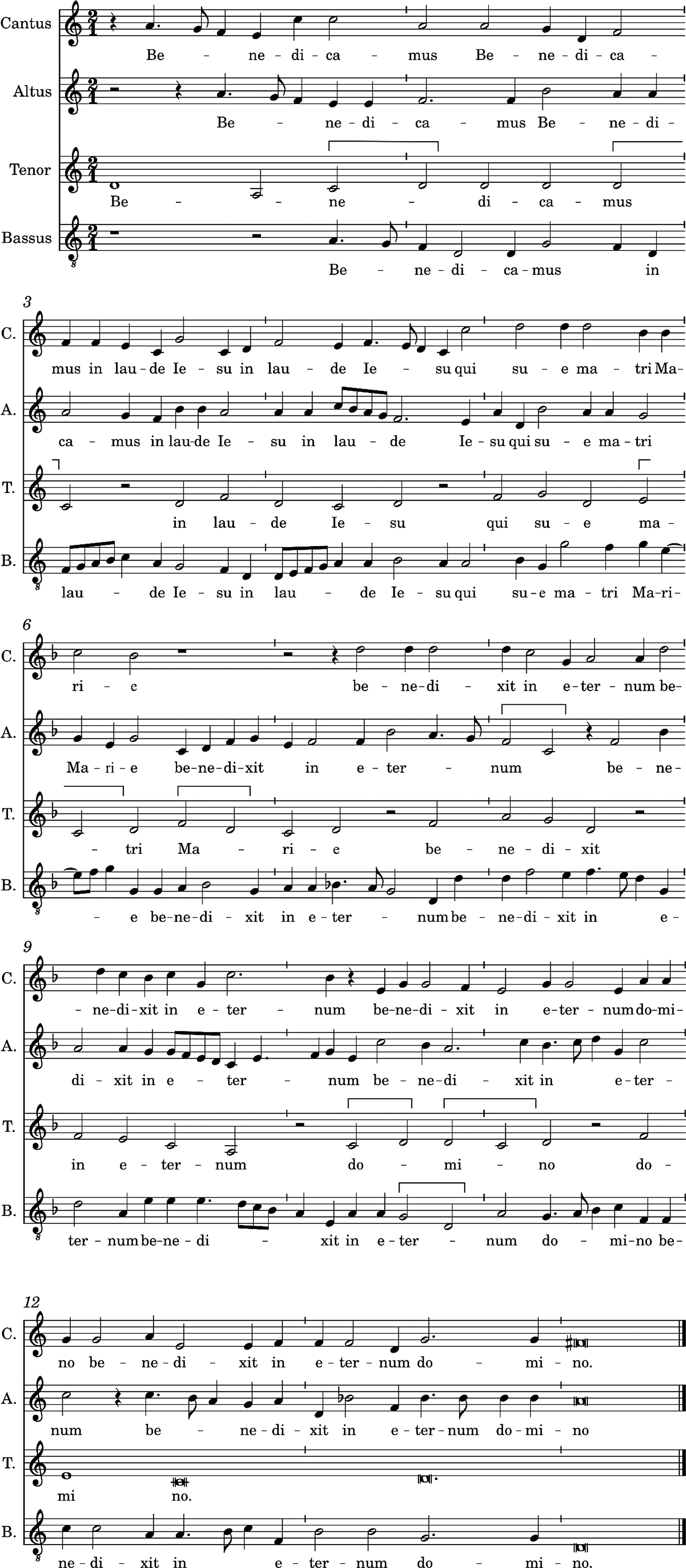
Other locations required longer musical elaborations, as evident in the setting by Adrian Willaert composed for the Venetian church of San Marco (W1123). The setting is printed as part of a collection of sacred songs composed by Willaert for Vespers and Compline, with hymns, antiphons, and Benedicamus Domino chants, all for four voices. The collection was first printed in 1555 by Antonio Gardano in Venice and had two later reprints, in 1561 (W1124) and 1571 (W1125). The ‘index psalmorum’ of the 1571 edition lists the pieces according to their liturgical place and feast. BENEDICAMUS in laude ihesu is indexed below ‘Vespro secondo della Madonna’, indicating that it was intended to be used to conclude the Second Vespers on Marian feasts. Moreover, by the time of the first print, Willaert had already been working as maestro di cappella for the church of San Marco in Venice for twenty-eight years, and the whole collection of sacred chants, including BENEDICAMUS in laude ihesu, was intended to be sung there.Footnote 24 The musical choices made to set this prosula into polyphony at once reflect the musical skills of Willaert – which were already established in at least the Low Countries, France, and Italy before his appointment at San Marco – and respond to the expectations of Willaert’s prestigious role as maestro di cappella at San Marco. Indeed, the Venetian Doge had a ‘deliberate program meant to bring Venice to a position of leadership in the arts and architecture’, to which Willaert undoubtedly contributed with his musical compositions.Footnote 25 This contribution is also visible in BENEDICAMUS in laude ihesu: the unadorned chant melody is carried by the tenor in semibreves against the many shorter note values (minims and semiminims), syncopations, and imitations between the three other voices, which fulfil the musical flamboyance that was desired by the Venetian procurators, and indeed achieved by Willaert (see the transcription in Example 3).
Transcription of BENEDICAMUS in laude ihesu from W1123, p. 18.
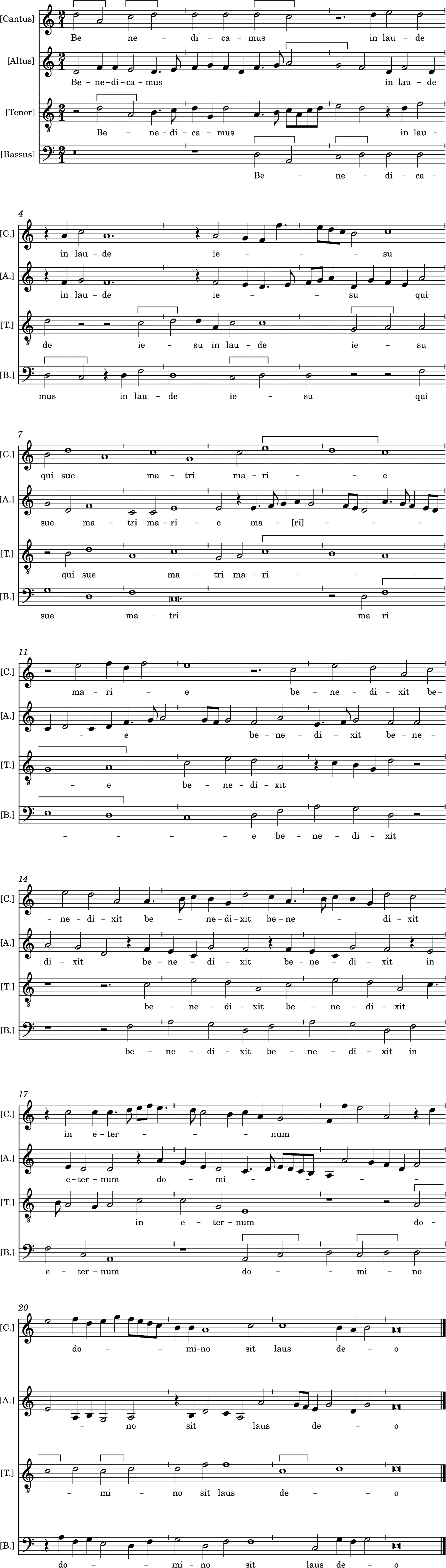
Similar to Willaert’s setting, the prosula melody of BENEDICAMUS in laude ihesu found in Munich 52 (Bavarian court, c. 1523) is presented in semibreves against the comparatively shorter note values of the other three voices (minims and semiminims). Contrary to Willaert’s setting, though, the prosula serves as motivic material to compose the other three voices, and it sounds like the original ‘flos filius eius’ melody has been musically decorated in all voices and arranged in an imitative counterpoint with many syncopations (see the transcription in Example 4). Here, too, the resulting florid composition reflects the musical preferences of a liturgical context in which the addition of polyphony was highly desired. The choirbook Munich 52 is attached to the court chapel of Wilhelm IV, duke of Bavaria (r. 1508–50), who strove to consolidate his power against both the Habsburgs and the Reformation.Footnote 26 As Birgit Lodes has showed, this was achieved, in particular, through the establishment of a court chapel and the creation of a ‘splendidly adorned liturgy’, which included Mass and Ordinary settings, as well as Proper settings, among which Vespers were particularly important.Footnote 27 Moreover, David Crook has noted that only the Mass and Vespers were celebrated on a regular basis.Footnote 28 The new polyphonic elaboration of BENEDICAMUS in laude ihesu found in Munich 52 was part of this desire to have unique and grand music for Vespers at the ducal court.
Transcription of BENEDICAMUS in laude ihesu from Munich 52, fols. 252v–253r.
Moving away from lavish contexts, Munich 14274 is a manuscript of sacred polyphonic music, composed of thirteen quires, collected by Herman Pötzlinger between c. 1430 and 1441 (the music itself was composed between 1400 and 1440).Footnote 29 Herman Pötzlinger (c. 1420–69) was a priest, schoolmaster, and bibliophile, who spent time studying or working in (among others) Vienna, Leipzig, and at the Sankt Emmeram monastery near Regensburg.Footnote 30 The main part of the manuscript was copied between 1439 and 1440, most likely while Pötzlinger was in Vienna. From the late 1440s, he is found in Regensburg and was rector scolarum of the monastic school of the Bavarian monastery between 1450 and 1452. It is unclear whether the music copied in Munich 14274 was used in the monastery church at all. Ian Rumbold and Peter Wright have convincingly hypothesized that the book fell into practical obsolescence following the Melk reform of Sankt Emmeram in 1452 (the time when the thirteen quires of Munich 14274 were bound), which forbid the singing of polyphony. But Rumbold and Wright have also observed that the quires do show signs of use in performance (e.g., ‘wear in the corners of folios, as well as the frequent correction of errors’Footnote 31), and they also argued that ‘the combination of boys, schoolmaster and assistant would then have provided not just a viable, but an ideal combination of voices for the performance of most polyphonic music from this period’. Moreover, they have demonstrated that not only was Pötzlinger involved in the training of boys in the schoolroom and in their singing in the liturgy of the monastery church, but he also participated himself in this liturgy.Footnote 32 This investigation suggests a plausible use of the music transmitted in Munich 14274 in a performance context at Sankt Emmeram, either as part of training boys in singing, or in a liturgical context.Footnote 33
In this manuscript, BENEDICAMUS in laude ihesu is transmitted in a three-voice setting, with two voices copied in black mensural notation at fol. 54v and a third one added on the following recto in white mensural notation. In spite of the difference of musical notation, the text hand suggests that the third voice is a relatively contemporary addition. The prosula melody is set in the upper voice and is decorated at the cadences. As summarized in Table 3, the three voices move both in contrary or parallel motions and the counterpoint is not particularly melismatic. The main cadences, musically well defined by rests in the upper voice and in the contratenor, against a semibreve in the tenor, are always on perfect consonances (unisons, fourths, fifths, octaves); see also the transcription in Example 5. The resulting musical style is much simpler than the very florid composition by Willaert or the imitative counterpoint and the play on the original ‘flos filius eius’ melody found in Munich 52. It is, however, more florid than the setting of Erfurt 44, even in its two-voice version, and shows a higher degree of compositional intentionality which can perhaps be explained by the possible use of this music before 1452, that is, as part of training boys in singing, or in a liturgical context associated with a school monastery.
Transcription of BENEDICAMUS in laude ihesu from Munich 14274, fols. 54v–55r.
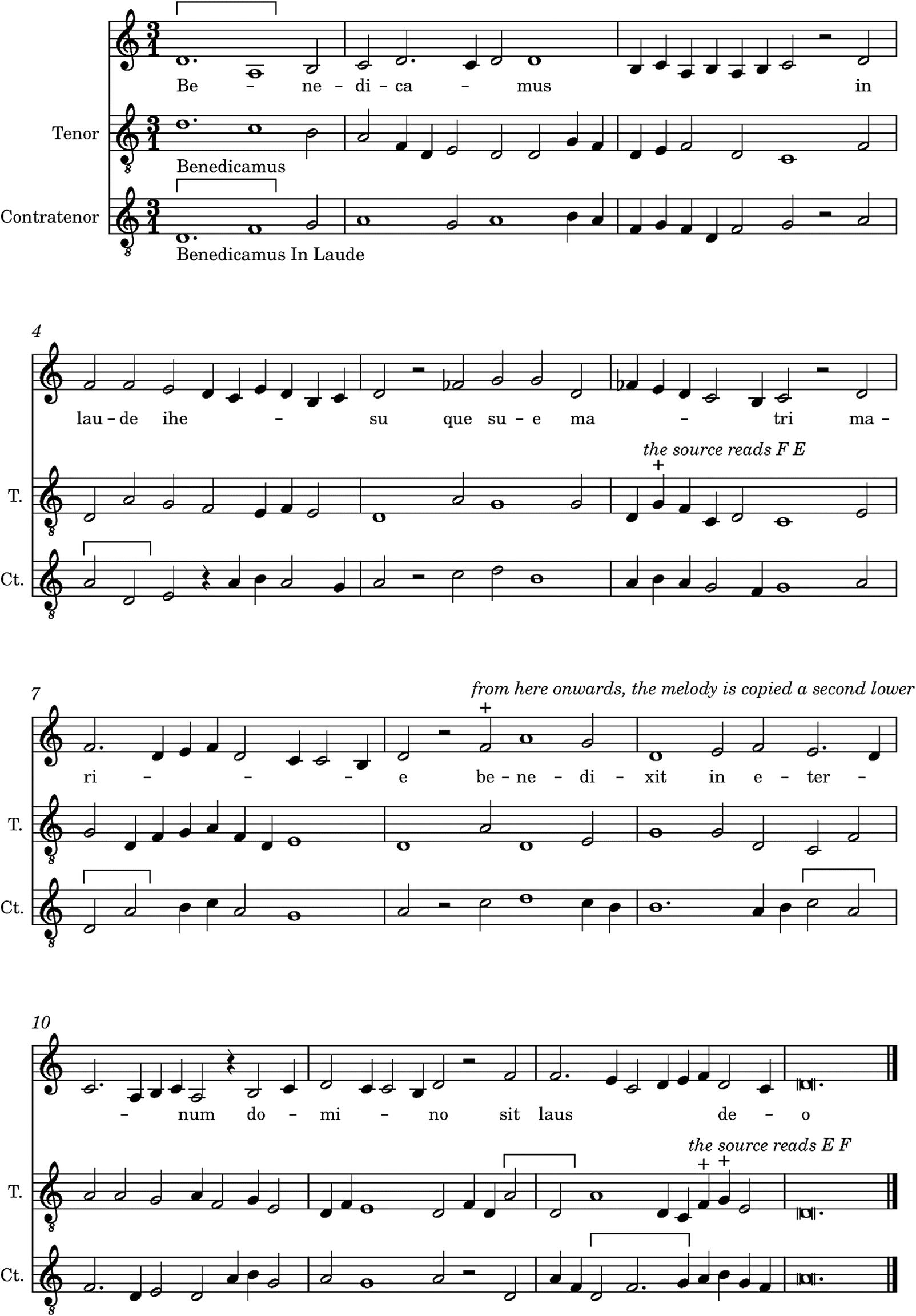
This section has illustrated how the liturgical context of performance could influence the types of musical elaborations that were desired or seen as most appropriate. The simpler polyphonic style of Erfurt 44 suggests that the polyphonic elaboration was strictly functional in the sense that it did not seem to have served a purpose beyond embellishing the conclusion of the Offices. By contrast, Munich 52 transmits music for a ducal court chapel for which the ‘solemn and splendidly adorned liturgy became a potent political tool’.Footnote 34 In Venice, the church of San Marco, including the high quality of the music performed there, was part of the Doge and the government’s desire to show the city’s ‘piety, splendour, and power’ and to ‘reassert the primacy of Venice in all things’.Footnote 35 Finally, the musical elaboration of BENEDICAMUS in laude ihesu found in Munich 14274 reflects the interest of a ‘modest intellectual’, Herman Pötzlinger, who had no social or academic pretensions,Footnote 36 as well as the type of polyphonic embellishments which could have been desired in the liturgy of the monastery of Sankt Emmeram.Footnote 37 In addition, these observations reveal that the prosula BENEDICAMUS in laude ihesu was musically elaborated and the new compositions written down for the liturgy of very different social and economical contexts. More generally, the different contexts highlighted here impacted not only the polyphony that was desired, but also the polyphony that was possible, a thread which I explore in the following section.
Intended and Available Performers
W1123 is very useful for explaining how the available performers impact the choice of elaborations, due to the richness of the surviving sources from the Venetian church of San Marco. Archival documents show that the number of available singers in the chapel move from sixteen adults at Willaert’s arrival as maestro di cappella in San Marco in 1527, to twenty-five adults and two boys at his death in 1562. As Giulio Ongaro speculates, ‘the influence of Willaert as a mentor and teacher of the first class might have been a draw for many of the musicians’, since during Willaert’s tenure, the lists of singers employed at the chapel included an increasing number of skilled musicians.Footnote 38 This, of course, allowed for more florid compositions and more diversity in terms of voice ranges, counterpoint, and rhythms.
While having a group of skilled singers at a given institution can be an impulse for more complex forms of polyphony, the general trend tends in the contrary direction: when an institution wants its liturgy to display power, splendour, and piety, it will seek specifically to hire more skilled musicians. For instance, in a document dated from 1403, six ducal counsellors order that ‘good singers’ should be hired in the church of San Marco, because it contributes to ‘the honour and fame’ of the Venetian Republic.Footnote 39 As far as can be assumed from the polyphonic elaborations of BENEDICAMUS in laude ihesu, the desire for a splendidly adorned liturgy created the need for skilled singers, rather than the contrary (skilled singers creating the need for a splendidly adorned liturgy).
Conversely, when the context of performance is unknown to us, the type of polyphony can shed light on who could have performed a specific version of BENEDICAMUS in laude, something particularly valuable for understanding curious pieces such as the musical setting by Jacob Obrecht (1457/8–1505), uniquely transmitted in Segovia s.s. The four-voice setting by the renown Flemish composer stands out for its relative simplicity compared with the polyphonic style of his other compositions.Footnote 40 The chant melody carried by the highest voice is undecorated, while the other three voices harmonize it homorhythmically and use long note-values (breves). One exception is a short passage during which the second cantus and the lowest voice especially sing more complex rhythms with changes of mensuration (bars 31–35, i.e., only six bars for a setting composed of forty-eight bars).Footnote 41 Jennifer Bloxam suggested that these musical characteristics could indicate that the prosula was elaborated for and sung by choirboys with the lowest voice perhaps sung by the choirmaster, Obrecht, therefore ‘anchoring the harmony and guiding the young singers through the coloration and changes of mensuration’.Footnote 42
This would not be surprising given the fact that the prosula BENEDICAMUS in laude ihesu was frequently sung by children, as the following examples, from three different religious communities, illustrate:
Benedictine monastery of Sankt Gallen (1583):
Abbas desuper orationem canit, pueri Benedicamus in laude Jesu. Chorus respondet redeundo ad chorum. Deo dicamus.
(The abbot sings the prayer above, the boys [sing] Benedicamus in laude ihesu. The choir, returning to the choir, responds Deo dicamus.)Footnote 43
Benedictine monastery of Sankt Emmeram (1435):
Duo pueri cantant Benedicamus in laude ihesu.
(Two boys sing Benedicamus in laude ihesu.)Footnote 44
Illustre Lieve Vrouwe Broederschap at ’s-Hertogenbosch (c. 1479):
ende daer na, twee choraelen [singhen] benedicamus in laude
(and after that, two schoolboys [sing] Benedicamus in laude)Footnote 45
Similarly, the monophonic BENEDICAMUS in laude ihesu transmitted in Munich 100 (often known under its former shelfmark, 2° Cod. ms. 156) is copied as part of an addition to the main corpus of the manuscript, which is prefaced by Johannes von Perchausen, closely associated with the Benedictine monastery of Moosburg.Footnote 46 In this preface, it seems that Johannes conceived the added songs to be sung by children during Christmas time, when he writes: ‘these songs by the new little clerks, as if from the mouth of infants and suckling children’ (‘hiis cancionibus a novellis clericulis, quasi ex ore infancium et lactencium’).Footnote 47 Furthermore, as discussed earlier, Milan P 43 sup was probably used in a school context, and also contains the monophonic version of BENEDICAMUS in laude ihesu added at the end.Footnote 48 Such potential uses of the prosula by schoolboys and such liturgical prescriptions may explain the choice of a specific technique of elaboration over another, as the four-voice setting by Jacob Obrecht perhaps indicate (Segovia s.s.).
Devotional Expression: the Contrafact Ave celestis regina of Berlin 190 (c. 1480)
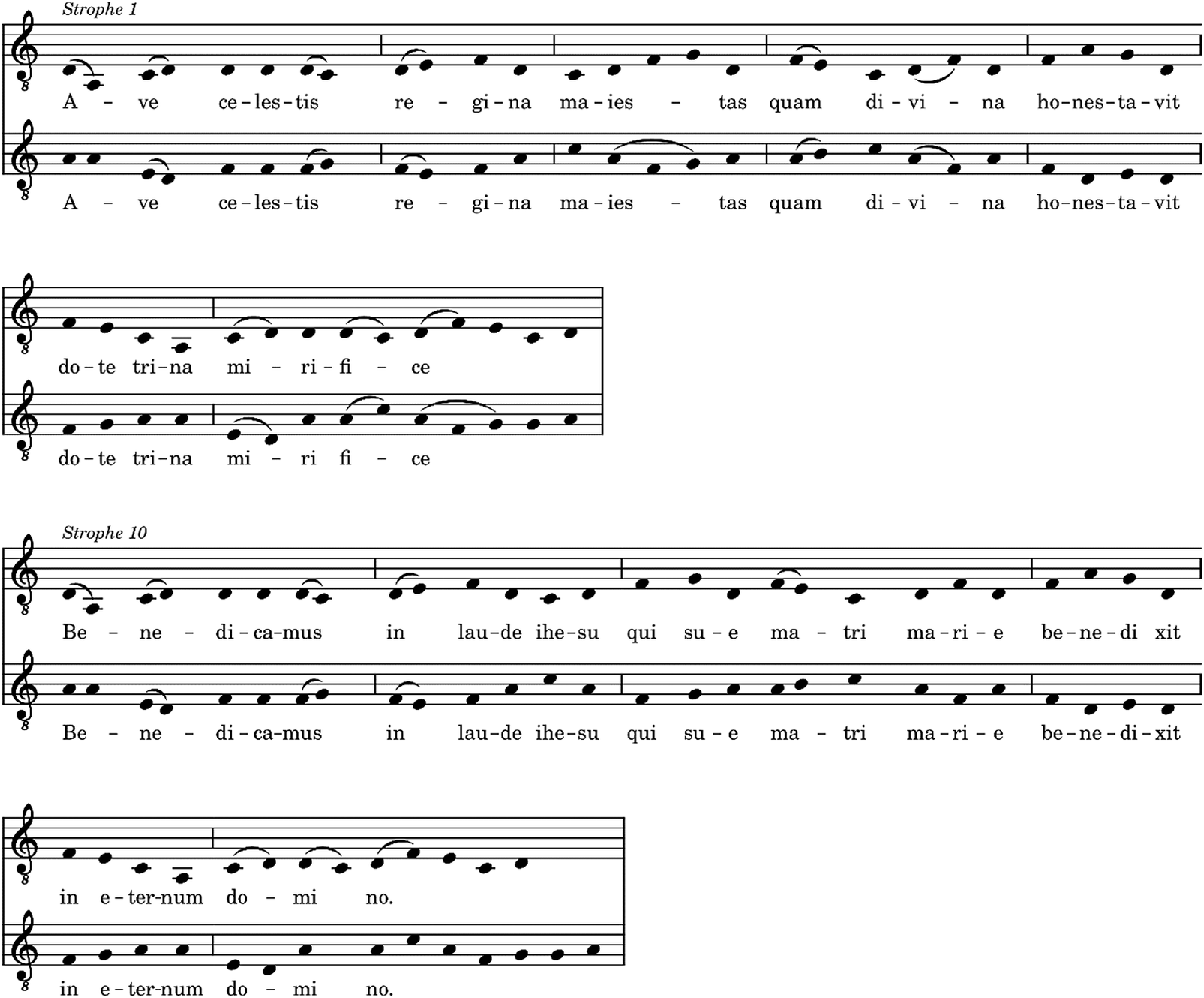
The desire for elaboration of a widespread prosula was not limited to its music. Indeed, Berlin 190 not only transmits a unique additional musical voice, but also a new additional text. Nine stanzas have been newly composed on the ‘flos filius eius’ melisma, and the prosula text BENEDICAMUS in laude ihesu is the tenth and final stanza of the song thus created. This last stanza somehow contrasts with the rest of the poem. The nine additional stanzas all have the same syllable count (8+8+8+4), follow the same pattern of versification, and are distributed in a similar way over the ‘flos filius eius’ melisma. By contrast, the prosula text has a slightly different placement of its syllables over the melody (see Example 6), and it is clearly a prose text, with no particular poetic elements. The text is reproduced and translated in Table 5.Footnote 49
First and final strophe of Ave celestis regina from Berlin 190.
Text and translation of Ave celestis regina of Berlin 190
| Strophe | Verse | Original text | Translation |
|---|---|---|---|
| 1 | 1 | Ave celestis regina maiestas quam divina honestavit dote trina mirifice |
Hail the queen of heaven, whom divine majesty wonderfully honoured with a threefold gift. |
| 2 | 5 | Angelorum rex sanctorum tuorum virtute morum provocatus vulneratus venit in te |
The king of the holy angels, called forth by the virtue of your character, came to you wounded. |
| 3 | 10 | Tu laus patrum prophetarum tu multarum scripturarum glosa fulgens corda mulcens dulcedine |
You, the praise of the prophets and of the fathers, you, the shining key to many scriptures, the heart soothing by its sweetness. |
| 4 | 15 | Clausam portam non apertam permeatam sed seratam te descripsit sicut vidit ezechiel |
Ezechiel described you as he saw you, a closed door that remains unopened, traversed but still fastened. |
| 5 | 20 | Rubus ardens non crematus a vidente perscrutatus partituram castam puram te cecinit |
The bush which burned but was not consumed was examined by the prophet and sung of your chaste and pure birth. |
| 6 | Arens virga novo flore madens vellus celi rore gedeonis miro more te respicit |
The dry rod putting forth a new flower, Gideon’s fleece wetted by the dew of heaven, anticipate you in a remarkable way. |
|
| 7 | 25 | Per te hester mardocheum salvat iustum rex iudeum et suspendit aman reum pro scelere |
Through you, Esther, the king saved Mordecai, the righteous jew, and hanged Haman, who was answerable for his crime. |
| 8 | 30 | Elationem holofernis per pugionem iudith prosternis molientem iuda gentem disperdere |
With Judith’s dagger, you overthrew the elation of Holofernes, who worked to ruin the tribe of Judah. |
| 9 | 35 | Summi regis coronata mater clemens dulcis grata esto nobis advocata virgo pia |
O sweet, merciful Mary, crowned mother of the highest king, be for us an advocate, o pious virgin. |
| 10 | 40 | Benedicamus in laude ihesu qui sue matri marie benedixit in eternum domino |
Let us forever bless with our praise the Lord Jesus, who blessed his mother. |
The manuscript Berlin 190 was copied by several hands around 1480 in north or west Netherlands. In the most comprehensive study of the manuscript to date, Thom Mertens and Dieuwke van der Poel suggested that it originated from a female community, perhaps affiliated to the Chapter of Windesheim or to the Chapter of Sion, two Augustinian chapters inscribed in the religious movement of the Devotio moderna. Footnote 50
The musical setting of BENEDICAMUS in laude ihesu found in Berlin 190 (hereafter referred to as Ave celestis regina – from the song’s incipit) is typical of polyphonic pieces from this movement in several respects. First, the melody is not invented but is rather a well-known model (that of BENEDICAMUS in laude ihesu). Contrafacts, while practised everywhere and in many different medieval contexts, were particularly beloved to craft Devotio moderna songs, as these songs were composed for and by the common people, hence the need for well-known melodies to set new Latin texts.Footnote 51 Another typical aspect is that the original melody is a drawn from a liturgical context.Footnote 52 Finally, the counterpoint, note-against-note and syllabic, places the emphasis on the intelligibility of the text.Footnote 53 Example 6 illustrates this point with the texts of the first and final strophes.Footnote 54
The intelligibility of the texts was a central concern in the Devotio moderna, especially in monastic contexts such as the Chapters of Windesheim or Sion, and in particular when the texts had to be sung aloud. This was a generally shared concern in medieval monastic contexts, in which, in the words of Bernard of Clairvaux, the melody ‘should never obscure the sense of the words, but enhance them’ (‘cantus ipse […] sensum litterae non evacuet, sed fecundet’).Footnote 55 In explaining the simplicity of the musical setting, it is also crucial to remember that Devotio moderna songs could have been sung either aloud (alone or in a group), or silently, ‘in the heart’, pushing the music into the background of the text.Footnote 56
The text of Ave celestis regina is truly Marian in character and follows a very logical progression. Starting with a salutation to Mary, strophes 1 and 2 present Mary with an emphasis on the qualities for which she was chosen as the Mother of Jesus (her ‘divine majesty’ (l. 2) and the ‘virtue of [her] character’ (l. 5)). Strophe 3 introduces the more specific topic of the song, that is, Mary as ‘the shining key [intended as ‘explanation’] to many scriptures’. As if to exemplify the third strophe, strophes 4 to 8 each refers to a different episode from the Old Testament (respectively, Ezechiel, Exodus, Judges, Esther, and Judith). The strophes state more or less directly how Mary sheds light on these episodes, how she is the ‘shining key’ to understanding them. For instance, strophe 5 directly quotes the qualities of Mary’s birth (‘chaste and pure’, l. 20). By contrast, in strophe 8, Mary is only suggested in the verb (‘you overthrew’, ‘prosternis’, l. 31), which in turn only implies the presence of Mary in Judith’s actions. Finally, strophe 9 is a more straightforward intercessory prayer to Mary before turning to a general concluding prayer, in the words of the prosula BENEDICAMUS in laude ihesu (strophe 10).
The progression of the examples given in strophes 4 to 8 deserves special attention. As mentioned, each of these strophes deals with a specific biblical event in which Mary was somehow present, going from very concrete qualities (chastity, pure birth), to why these qualities are important (they made her suitable to be designated as the Mother of Jesus (strophe 6)), before giving two examples of women who were considered as prototypes of Mary in the medieval Christian tradition. The text therefore moves from an external depiction of Mary (e.g., how Ezechiel saw her, how the bush sung of her) to events not performed directly by Mary, but which can be explained through the ‘virtue of [Mary’s] character’ (l. 6). With such a construction, the text invites a reflexion not only on the virtues of Mary, or on the biblical episodes mentioned in the various strophes, but also, and more importantly, on why and how these virtues are essential. In sum, the text invites its singer(s), and possibly its listener(s), to imitate the Virgin Mary, a crucial aspect of the female devotion of the Devotio moderna. Footnote 57 The imitation of Mary was made possible through spiritual exercises, or meditation, in which songs such as Ave celestis regina played an important role.Footnote 58 Indeed, through its text, the song invites a meditation on the events narrated and on how one can emulate women such as Esther or Judith. This, in turn, influenced how the music was developed.
According to Johannes Mauburnus (1460–1501), an Augustinian canon at the monastery of Saint Agnietenberg (Chapter of Windesheim), music had two functions in the context of meditation. On the one hand, music served to stir up the mind, in which case, the same melody had to be sung repeatedly.Footnote 59 On the other hand, music helped overcome inactivity during meditation. Mauburnus suggests some rhythmic verses to be sung to the melodies of Pange lingua or Crux fidelis, ‘sweetly in the heart or in the mouth when you are feeling too sluggish to meditate’.Footnote 60 Mauburnus’s view on music and meditation, which is representative of the Devotio moderna views, helps us to understand the repetitive character of the music and the simplicity of the polyphony of Ave regina celestis, against its rich textual content: music in this case was functional; it was a tool, an aid for a meditative attitude which aimed at the imitation of the Virgin Mary.Footnote 61
Circulation
As mentioned earlier, two of the three voices transmitted in Munich 14274 are found in another manuscript, Trent 92. This unique concordance of a polyphonic elaboration of BENEDICAMUS in laude ihesu is the topic of the final section of this study.
Munich 14274 has been described earlier, but it is useful to mention again the following elements for the sake of clarity. Munich 14274 is a manuscript of sacred polyphonic music in which thirteen quires were bound at around 1452, the same time as when the use of the music probably fell into practical obsolescence. The music was collected between around 1430 and 1441 by Herman Pötzlinger, who spent a couple of years as the schoolmaster of the monastery church of Sankt Emmeram, a Benedictine imperial abbey near Regensburg, and who also ended his life as a priest there. In Munich 14274, BENEDICAMUS in laude ihesu is transmitted in a three-voice setting, with two voices copied in black mensural notation at fol. 54v and a third one, the contratenor, added on the following recto in white mensural notation. The cantus and the tenor copied at fol. 54v contain a lot of emendations and the end of the cantus (from ‘benedixit’ onwards) is copied a second lower than it should be for the counterpoint to work.
These two voices are also found, with errors, in Trent 92. It is a manuscript of sacred polyphonic music, composed of at least three original manuscripts, copied by several hands around 1430–1445.Footnote 62 BENEDICAMUS in laude ihesu is preserved in the first part of Trent 92, which may have been copied in the region of Basel-Strasbourg for the use of the chapel of the Duke of Savoy Amédée VIII (antipope Felix V).Footnote 63 There, the prosula is a contemporary addition on empty line staves at the end of fol. 119r. The addition fits the surrounding sacred, and specifically Marian, contents of this part of the book. Two voices are notated in white mensural notation, with the ‘flos filius eius’ melisma carried in the upper voice.
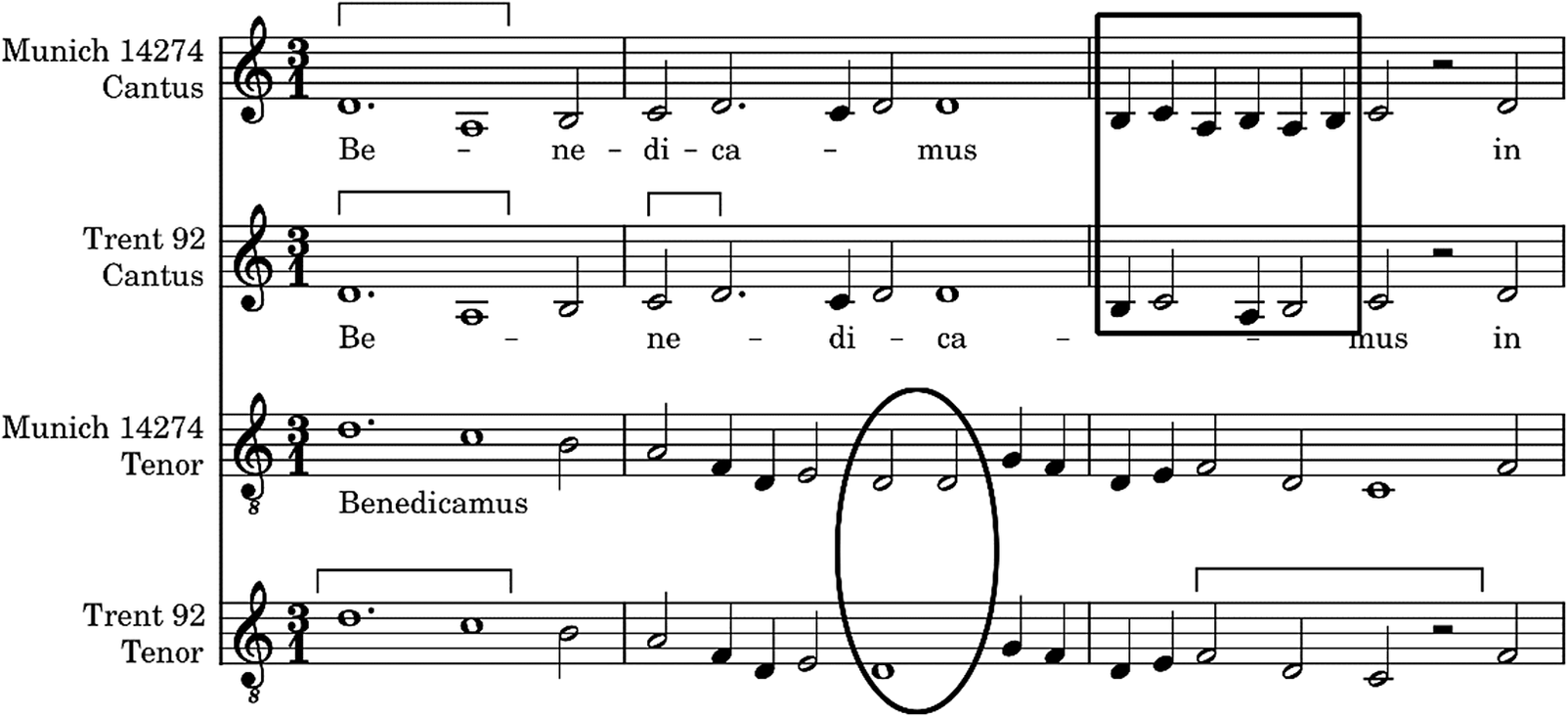
Munich 14274 and Trent 92 are therefore contemporary sources transmitting a similar repertoire. The number of concordant pieces between the two manuscripts is, however, quite small: thirty-three, against a total number of 320 (Munich 14274) and 223 (Trent 92) pieces. Tom Ward compared the thirty-three concordances and observed that ‘the degree of similarity between the versions of individual works varies from near identity to great differences’.Footnote 64 On the one hand, the cantus and tenor of BENEDICAMUS in laude ihesu tend towards the near identity. Copying mistakes notwithstanding, the voices are indeed almost identical. The differences are either related to scribal practices (e.g., a breve in Trent 92 is copied as two semibreves in Munich 14274), or occur occasionally at cadences, with the cantus of Munich 14274 slightly more decorated than the cantus of Trent 92 (Example 7).
Differences between Munich 14274 and Trent 92.
On the other hand, the addition of an entire new voice in Munich 14274 certainly is a great difference from Trent 92. Based on his comparison of the concordances between the two sources, Ward convincingly defines the relationship between the two manuscripts as ‘indirect […] with a number of intermediate sources’ – to which I suggest adding oral sources of transmission.Footnote 65 Thus, did the third voice in Munich 14274 come from another manuscript that is now lost or unidentified? Or was it composed by someone from Sankt Emmeram who decided to record it in writing on the empty staves at the bottom of fol. 55r? Conversely, did the scribe of Trent 92 know this voice but decided not to include it in this manuscript? On the other hand, it is possible that the setting had an entirely different circulation route, now lost. More importantly, the differences in the related variants of BENEDICAMUS in laude ihesu in Trent 92 and Munich 14274 demonstrate that even when the settings themselves may have circulated between places, they were subjected to local elaborations and adjustments. This desire for local adjustments is further supported by the fact that the added contratenor in Munich 14274 is musically correct (and thus did not require emendations, contrary to the cantus and tenor voices) and by the fact the unique voice in Munich 14274 is the one that has been added. These copying observations point towards a musical awareness related to a desire for local or personal adjustments, worth putting down in writing.
Conclusion
This study has presented a new and much expanded list of forty-eight sources transmitting the prosula BENEDICAMUS in laude ihesu with music notations. These sources span the fourteenth to seventeenth centuries and come from a wide European area (Italy, the German-speaking area, the Low Countries, and northern France, as well as Spain and possibly Croatia). They also illustrate the diversity of liturgical contexts in which this prosula was used and set into polyphony.
This source base of the prosula contain fourteen polyphonic elaborations of BENEDICAMUS in laude ihesu, distributed over twelve sources. Only one setting is concordant between two of these sources. As mentioned in the introduction, this is a remarkable percentage of unique polyphonic elaborations in comparison with other Benedicamus Domino prosulas, such as BENEDICAMUS flori orto. The aim of this study was to investigate the historical contexts that can explain the extreme diversity of musical settings of BENEDICAMUS in laude ihesu.
The investigation has shown that the diversity of musical elaborations is grounded in (1) a desire for polyphonic elaborations shared by very diverse groups of people, and (2) compositional techniques shared over the entire timeframe and geographical distribution under consideration in this study. Nonetheless, the shared techniques were worked out differently to produce local individual and unique musical instantiations, which demonstrates that it was of more interest to a community to have its own way of singing this prosula than to absorb another community’s practices.Footnote 66 Finally, this study has explored some of the ways in which the historical contexts within which polyphonic settings of BENEDICAMUS in laude ihesu were produced, and has demonstrated how these historical contexts shaped the ways in which the shared compositional techniques were deployed and expressed in the production of these unique settings.
Appendix Sources
The folio given situates where BENEDICAMUS in laude ihesu is written in the source.
When the prosula has music notation, the number of voice(s) is indicated after the folio number. A question mark (?) indicates that I have no information about the nature of the copy of Benedicamus in laude ihesu (e.g., it has not been possible to consult the source and the catalogue does not give detailed information).
A Sources of BENEDICAMUS in laude ihesu with Music Notation (alphabetical order of the abbreviations)
| Augsburg II.2.8 o 13 | Augsburg, Universitätsbiblibliothek Cod. II.2.8° 13 16th cent., end (1586) | Germany | Kirchheim am Ries (?), Cistercian (?) Chant book | fol. 153r | 1 voice |
| Augsburg III.1.8 o 57 | Augsburg, Universitätsbiblibliothek Cod. III.1.8° 57 16th cent., end (1586) | Germany | Kirchheim am Ries (?), Cistercian (?) Cantionale | fols. 64r–65r | 1 voice |
| Aveiro s.s. | Aveiro, Museu de Aveiro, Mosteiro de Jesus s.s. 16th cent. (?) | Addition from 17th cent. (?) | Aveiro (?), Mosteiro de Jesus (?) Chant book (?) | s.s. | 1 voice |
| Berlin 190 | Berlin, Staatsbibliothek zu Berlin – Preußischer Kulturbesitz Ms. germ. oct. 190 15th cent., end (c. 1480) | Netherlands, Female Augustinian community (Windesheim or Sion) Songbook | fol. 59r | 2 voices http://resolver.staatsbibliothek–berlin.de/SBB0000E2B500000000 |
| Berlin 40562 | Berlin, Staatsbibliothek zu Berlin – Preußischer Kulturbesitz Mus. 40562 14th cent., end–15th cent. | Italy, Dominican Psalter | fols. 143v–144r | 1 voice |
| Berlin 40563 | Berlin, Staatsbibliothek zu Berlin – Preußischer Kulturbesitz Mus. 40563 14th cent., end–15th cent. | Italy, Dominican Psalter | fol. 190r–v | 1 voice |
| Berlin 40610 | Berlin, Staatsbibliothek zu Berlin – Preußischer Kulturbesitz Mus. 40610 (Wernigerode, Fürstl. Stolbergische Bibl., Cod. Zb 11) 15th cent. | Germany Book of prayers | fol. 46v| 1 voice |
| Berlin 554 | Berlin, Staatsbibliothek zu Berlin – Preußischer Kulturbesitz Ham. 554 14th cent.–15th cent. | Italy, Venice Psalter | fols. 274r–275v | 1 voice |
| Bologna lit. 18 | Bologna, Conservatorio di Musica Giovan Battista Martini Lit. 18 (Cod. 135) 16th cent. | Italy (?) Chant book | final folio (unnumbered), recto | 1 voice |
| Bologna 2893 | Bologna, Biblioteca Universitaria 2893 14th cent.–15th cent. | Italy (?) Chant book | fol. 405r | 1 voice |
| Brussels 1870 | Brussels, KBR 1870 14th cent., middle (1348) | Addition | Italy, Venice Capitularium and collectarium | fol. 2v | 1 voice https://www.idemdatabase.org/items/show/289 |
| Brussels 4767 | Brussels, KBR 4767 16th cent., middle (1542) | Netherlands, Utrecht (diocese) Gradual | fol. 19v (?) |
| Brussels 4860 | Brussels, KBR 4860 16th cent., first quarter | Netherlands, Utrecht (city) Processional | (?) |
| Brussels II 2631 | Brussels, KBR II 2631 16th cent. | Netherlands, Dordrecht, Clarissen or Tertiary convent (female) Songbook | fol. 62r | 1 voice https://opac.kbr.be/LIBRARY/doc/SYRACUSE/10704726 |
| Eichstätt 84 | Eichstätt, Universitätsbibliothek Eichstätt–Ingolstadt 84 15th cent., middle (1455) | Addition | Bohemia–Moravia Psalter | fol. 261v | 1 voice https://nbn–resolving.org/urn:nbn:de:bvb:824–cod–st–84–8 |
| Erfurt 44 | Erfurt, Universitätsbibliothek Erfurt CA 8° 44 14th cent., first half | Germany, Church of the Holy Sepulchre, Leonhardskloster in Aachen (?) Miscellaneous (music theory, liturgical chants) | fol. 38r | 2 voices https://dhb.thulb.uni–jena.de/receive/ufb_cbu_00022931 |
| Erlangen 464 | Erlangen, Universitätsbibliothek Erlangen–Nürnberg 464 15th cent. | Germany, Heilsbronn monastery (male). Cistercian Gradual | fol. 33v | 1 voice https://nbn–resolving.org/urn:nbn:de:bvb:29–bv041628984–7 |
| Florence 472 | Florence, Biblioteca Nazionale Centrale Mediceo Palatino 472 15th cent. | Italy, Tuscany, Franciscan monastery Franciscan (?) Miscellaneous (music treatises, chants, laudes) | fol. 23r–v | 4 and 3 voices |
| Köln 1161 | Köln, Erzbischöfliche Diözesan– und Dombibliothek 1161 12th cent., first half (1125) | Addition from 14th cent., first half (c. 1337) (?) | Germany, Cologne, abbey of Saint Mechtern (renamed Saint Apern in 1477) (female) (?). Cistercian Antiphoner | fol. 129r | 1 voice https://nbn–resolving.org/urn:nbn:de:hbz:kn28–3–1584 |
| Leiden 2777 | Leiden, Leiden University Libraries BPL 2777 16th cent., middle (1562) | Netherlands, Oegstgeest, Parish church Choirbook | fol. 71r–v | 1 voice http://hdl.handle.net/1887.1/item:3161835 |
| Milan P 43 sup | Milan, Biblioteca Ambrosiana P 43 sup 13th cent., second half | Addition from 14th, first half (?) | northern France Ovidius, Metamorphosis, glossed | fol. 146r | 1 voice http://213.21.172.25/0b02da82800c49d5 |
| Munich 100 | Munich, Universitätsbibliothek Cim. 100 (= 2° Cod. ms. 156) 14th cent., second half (1360) | Germany, Bayern, Kloster Moosburger (male). Benedictine Gradual | fol. 249v | 1 voice https://nbn–resolving.org/urn:nbn:de:bvb:19–epub–11079–1 |
| Munich 14274 | Munich, Bayerische Staatsbibliothek clm 14274 15th cent., middle (1430–1441) | Germany, Regensburg, St Emmeram monastery (male). Benedictine Manuscript of sacred polyphony | fols. 54v–55r | 3 voices https://mdz–nbn–resolving.de/details:bsb00001643 |
| Munich 52 | Munich, Bayerische Staatsbibliothek mus.ms. 52 16th cent., beginning (c. 1523) | Germany, Munich, court chapel of Wilhelm IV, Duke of Bavaria (1493–1550) Choirbook of sacred polyphony | fols. 252v–253r | 4 voices https://mdz–nbn–resolving.de/details:bsb00079129 |
| Neustift 139 | Neustift/Novacella, Augustiner–Chorherrenstift Cod. 139 15th cent., end (c. 1495) | Austria, Neustift (?), Novacella Abbey (?) (male). Augustinian Gradual and antiphoner | fol. 222v | 1 voice https://manuscripta.at/diglit/IT5000–139/0001 |
| Paris 16664 | Paris, Bibliothèque nationale de France latin 16664 16th cent., beginning | France, Low Countries (copied) Later in Italy (?) Miscellaneous (music treatises, songs) | fols. 96v–97r | 3 voices http://archivesetmanuscrits.bnf.fr/ark:/12148/cc77085p |
| Parma 3597 | Parma, Biblioteca Palatina 3597 15th cent., beginning (?) | Italy Gradual | fol. 11r | 1 voice https://www.diamm.ac.uk/sources/1240/#/ (excerpts) |
| Prague VII G 16 | Prague, Národní knihovna VII G 16 14th cent., beginning | Czech Republic, Prague, St George’s monastery (female). Benedictine Processional | fol. 191r | 1 voice https://www.manuscriptorium.com/apps/index.php?direct=record&pid=AIPDIG–NKCR__VII_G_16____10V51WE–cs |
| Prague XIII E 14b | Prague, Národní knihovna XIII E 14b 12th cent., second half | Addition from 17th cent. | Czech Republic, Prague, St George’s monastery (female). Benedictine Psalter | fol. 210v | 1 voice https://www.manuscriptorium.com/apps/index.php?direct=record&pid=AIPDIG–NKCR__XIII_E_14B__3C9XIG7–cs |
| Prague XVI A 18 | Prague, Národní knihovna XVI A 18 14th cent., middle (1350) | Czech Republic, Prague, St George’s monastery (female). Benedictine Psalter | fol. 79r | 1 voice https://www.manuscriptorium.com/apps/index.php?direct=record&pid=AIPDIG–NMP___XVI_A_18____1W6DDX6–cs |
| Salzburg 28 B 8 | Salzburg, Benediktinenstift Nonnberg, Bibliothek 28 B 8 16th cent. | Austria, Salzburg, Nonnberg monastery (female). Benedictine Processional | fol. 71r (?) |
| Sankt Gallen 392 | St Gallen, Stiftsbibliothek Cod. Sang. 392 15th cent., first quarter Switzerland, St Gall abbey (male). Benedictine (?) Antiphonary | fol. 70r–v | 1 voice https://www.e–codices.unifr.ch/en/list/one/csg/0392 |
| Sankt Gallen 448 | St Gallen, Stiftsbibliothek Cod. Sang. 448 15th cent., second half (1432–1446) | Switzerland, St Gall abbey (male). Benedictine Ordinarius | p. 43 | 1 voice https://www.e–codices.unifr.ch/de/list/one/csg/0448 |
| Sankt Gallen 546 | St Gallen, Stiftsbibliothek Cod. Sang. 546 16th cent., first quarter (1507–1514) | Switzerland, St Gall abbey (male). Benedictine Sequentiary and troper | fol. 375v | 1 voice https://www.e–codices.unifr.ch/fr/list/one/csg/0546 |
| Segovia s.s. | Segovia, Archivo Capitular de la Catedral s.s. 16th cent., beginning (1500–1503) | Spain, Castile, Segovia (?), humanist environment Manuscript of polyphony | fol. 91v | 4 voices http://www.goldbergstiftung.org/en/cancionero–de–segovia/ |
| Siena F VII 20 | Siena, Biblioteca Comunale degli Intronati F.VII.20 15th cent. | Italy (?) Antiphoner | fol. 32v | 1 voice |
| Stari Grad s.s. | Hvar, Stari Grad s.s. 15th cent.–16th cent. | Addition from 15th cent., end (1497–1501) | Croatia, Samostan Dominikanaca (male). Benedictine (?), Istria (?) Miscellaneous (prayers, liturgical chants) | fols. 196v–197r | 2 voices |
| Trent 91 | Trent, Museo Provinciale d’Arte ms 1378 [91] 15th cent., second half (1460–1480) | Italy, Trent Manuscript of sacred polyphony | fol. 60v | two settings of 3 voices each https://www.cultura.trentino.it/Patrimonio–on–line/Manoscritti–musicali–trentini–del–400/SfogliaCodici.aspx?Codice=Tr91 |
| Trent 92 | Trent, Museo Provinciale d’Arte ms 1379 [92] 15th cent., first half (1430–1445) | Addition | Switzerland/France, Basel–Strasbourg region Manuscript of sacred polyphony | fol. 119r | 3 voices https://www.cultura.trentino.it/Patrimonio–on–line/Manoscritti–musicali–trentini–del–400/SfogliaCodici.aspx?Codice=Tr92 |
| Utrecht 24 | Utrecht, Museum Catharijneconvent BMH 24 16th cent., first half | Netherlands (?), Leiden (?), female monastery (?), Augustinian (?) Antiphonary | fol. 266v (?) |
| Vatican 552 | Vatican, Biblioteca Apostolica Vaticana, Pal. lat. 552 15th cent. | Germany, Heidelberg (?), University (?) Responsorium | fol. 104r–v | 1 voice https://doi.org/10.11588/diglit.14034 |
| Venice Z. 160 | Venice, Biblioteca Nazionale Marciana ms lat. Z. 160 14th cent.–15th cent., beginning | Italy Breviary | fol. 250r | 1 voice |
| Verona DCXC | Verona, Biblioteca Capitolare di Verona DCXC 15th cent., end–16th cent., beginning | Italy Liturgical manuscript (hymns, antiphons) | fol. 41r | 2 voices |
| Vyšší Brod s.s. | Vyšší Brod, Stiftsbibliothek unidentified manuscript (pictures from the Bruno–Stäblein–Archiv in Würzburg) 15th or 16th cent. (?) Liturgical book (?) | unnumbered folio | 1 voice |
| W1123 | Munich, Bayerische Staatsbibliothek 4 Mus.pr. 175#Beibd.10 16th cent., middle (1555) | Italy, Venice, San Marco Polyphony for Vespers and Compline | p. 18 | 4 voices https://mdz–nbn–resolving.de/details:bsb00087006 |
| Zurich 58 | Zürich, Zentralbibliothek Rheinau 58 15th cent. | Germany, Kloster Rheinau (male). Benedictine Directorium | fol. 56r | 1 voice |
| Zurich C 101 | Zürich, Zentralbibliothek C 101 15th cent., second half (c. 1470) | Switzerland, copied by Gallus Kemli Miscellaneous (material gathered by Gallus Kemli) | fol. 156r–v | 1 voice https://www.e–codices.unifr.ch/de/list/one/zbz/C0101 |
| Zwickau 18 | Zwickau, Ratsschulbibliothek ms. 18 (olim. Mus. 119.1, Ms. CXIX 1) 16th cent., beginning (c. 1520) | Germany Antiphoner, sacred songs | fol. 17r | 1 voice |
B Related Liturgical Documents that Mention BENEDICAMUS in laude ihesu (alphabetical order of the abbreviations)
| BHIC 1232, Inv. No. 477 | ’s–Hertogenbosch, Brabants historisch informatie centrum 1232, Inv. No. 477 15th cent., end (c. 1479) | Netherlands, ’s–Hertogenbosch, Illustre Lieve Vrouwe Broederschap Charter of confraternity https://proxy.archieven.nl/235/B3B4D7DFBF6147CA8D9F7BD0B9797AAF |
| Graz 1566 | Graz, Universitätsbibliothek Hs. 1566 16th cent., end (c. 1595–1600) | Austria, Seckau monastery (male). Augustinian Ordinarius | various folios https://resolver.obvsg.at/urn:nbn:at:at–ubg:2–30262 |
| Innsbruck 398 | Innsbruck, Tiroler Landeskonservatorium, Bibliothek Hs. 398 15th cent. | South Germany or Tirol Book of prayers | fol. 6r |
| Klosterneuburg 1014 | Klosterneuburg, Augustiner–Chorherrenstift Cod. 1014 16th cent., first quarter | Austria, Klosterneuburg (male). Augustinian Ordinarius | various folios https://manuscripta.at/diglit/AT5000–1014 |
| Munich 14073 | Munich, Bayerische Staatsbibliothek clm 14073 15th cent., middle (1444) | Germany, Regensburg, St Emmeram monastery (male). Benedictine Ordinarius | various folios https://mdz–nbn–resolving.de/details:bsb00035172 |
| Munich 14183 | Munich, Bayerische Staatsbibliothek clm 14183 15th cent., first half (1435–1436) | Germany, Regensburg, St Emmeram monastery (male). Benedictine Ordinarius | various folios https://mdz–nbn–resolving.de/details:bsb00046471 |
| Munich 14428 | Munich, Bayerische Staatsbibliothek clm 14428 15th cent., first half (1435) | Germany, Regensburg, St Emmeram monastery (male). Benedictine Ordinarius | various folios https://mdz–nbn–resolving.de/details:bsb00019069 |
| Oxford 226 | Oxford, Bodleian Libraries Canon. Pat. Lat. 226 15th cent., middle | Italy, north–east St Augustine | Colophon |
| Sankt Gallen 1262 | St Gallen, Stiftsbibliothek Cod. Sang. 1262 16th cent., second half (1583) | Switzerland, St Gall abbey (male). Benedictine Directorium | p. 126 https://www.e–codices.unifr.ch/fr/list/one/csg/1262 |
| Sankt Gallen 692 | St Gallen, Stiftsbibliothek Cod. Sang. 692 15th cent., second half (1466–1476) | Switzerland, St Gall abbey (male). Benedictine Miscellaneous (liturgical and devotional material gathered by Gallus Kemli) | p. 315 https://www.e–codices.ch/en/list/one/csg/0692 |


 Open access

