




Pilots the Captain at his hands doth pray,
His Ships as far as India to guide:
Assuring him they shall with ample pay,
For all their pains therein be satisfy’de.
The Moore consents; but still the poyson lay,
Close, where it was, invenoming his side:
For, had he pow’r of blasting with his breath,
Instead of Pilots, he would give him death.
- Camões, Os Lusíadas, Canto I, 70 (tr. R. Fanshawe).Footnote 1
Introduction
The purpose of this compact and deliberately schematic essay is to offer a retelling and reinterpretation of the circumstances of the emergence of the Portuguese overseas empire in the fifteenth and early sixteenth centuries. It is not based on the discovery of new primary materials or fresh research in the multiple archives of the time in both European and non-European languages, for which the present author is already known in the field.Footnote 2 Rather, the strategy here is that of a ‘think piece,’ and will be to consider together the histories of different parts of the world as a way to redistribute agency, so that the creation of the Portuguese empire does not appear as the singular effort of Portuguese and Iberian (or even European) actors.Footnote 3 This is a necessary corrective because of the continued efforts by many Iberian historians (including some of those claiming to do history otherwise) to efface other histories and processes in their devotion to a form of methodological navel-gazing. This is in turn the consequence of a profoundly Eurocentric view of history that entrenched itself in the course of the twentieth century, both among conservative and so-called ‘progressive’ historians (such as the school of Vitorino Magalhães Godinho), further exacerbated by the overall failure to create real specialists in the study of the medieval and early modern Islamic world or even Asia more generally in Portugal.Footnote 4 It may be remarked that in this respect Spain has fared much better because of the existence there of a strong tradition in Islamic studies, with a serious level of both philological and archival investment.Footnote 5 What will hopefully emerge from this exercise in reinterpretation is a different understanding of how and why the Portuguese were able to construct an overseas empire in the decades leading up to 1520.
Historians have long struggled with the history of fifteenth-century Eurasia, in an effort to characterize this period in general terms. The major reorientations caused by Mongol expansion in the late twelfth and early thirteenth centuries had eventually led to the consolidation of a complex inter-state system, combining elements of trade, warfare, religious exchange, and acculturation. Mongol successor states of the post-Chinggis Khan period stretched from the Sea of Japan to the Mediterranean and engaged in complex relations with the Muslim states of northern India, and the trading republics of Italy. The gradual dissolution of most of this Mongol system then occurred in the fourteenth century, with the emergence in its place of new entities in China, Central Asia, and Iran.Footnote 6 But this was equally a century of a dramatic demographic collapse, in an extended period running from the 1330s to the early 1370s. One part of this collapse had long been attributed to the Black Death, an interpretation that can still be sustained in regard to the Mediterranean and western Europe. Elsewhere, in late Mongol-era China for example, there was undoubtedly a marked fall in population, but its causes seem to have been far more extended and varied than the direct effects of the plague and its aftermath. The reduction of population appears to have begun already in the course of the thirteenth century; adjusted census figures are now taken to posit a population of 124 million in 1210 CE, shrinking to 75 million in 1290, and then rallying slightly to 90 million by 1341. The decades from 1341 to 1391 are then thought to have produced some further shocks with a reduced population of 75 million again emerging by the latter date. This overall picture is taken by a recent historical demographer of China to generally reflect “the upheavals of the Song-Yuan and Yuan-Ming transitions.”Footnote 7
Given the uncertain quality of medieval demographic data, it is difficult to make statements at any level of precision concerning what happened to the populations of various other regions of Eurasia. It was long believed that the best estimates concerned western Europe, whereas little could be said with assurance regarding North Africa, West Asia, or South Asia. The European population was taken to be around 57 million in 1250, expanding to 70 million by 1300, and 74 million in 1340 (on the eve of the Black Death). Thereafter, a major decline (variously estimated at between 25 and 33%) was thought to have brought the overall population down to about 52 million in 1400, with the fifteenth century then being characterized as a period of slow and uneven recovery. However, the alternative aggregate estimates of demographer Ole J. Benedictow have attempted more recently to pose a major challenge to these numbers, arguing instead for a collapse from a population of 80 million in around 1340 to a mere 28 million two decades later, implying that over two-thirds of the European population rapidly perished at this time from the Black Death and its “secondary effects.”Footnote 8 These ambitious new estimates have in turn been the subject of much debate and increasing scepticism from both historians and environmental scientists, but it remains clear that the major demographic decline of the decades from 1340 to 1400 did not take place across the board. There were considerable variations between rural and urban areas, and in the timing and location of the waves of mortality. While it is obvious that each one of the major polities of western Europe was somewhat affected at this time, it cannot be sustained that the fourteenth century demographic crisis simply ended a Malthusian regime of “positive checks” in Europe once and for all and replaced it with a modern one.
Nothing is known with great clarity about what happened to most other areas in Eurasia over the same period. Estimates accepted by some macro-historians would have us believe that the population of South Asia rapidly fell from 107 million in 1340 CE to 74 million at the end of the fourteenth century, but there is in fact no convincing evidence in contemporary sources (whether narrative or otherwise) of devastating plague epidemics during the rule of the Tughluqs and their immediate successors. As a consequence, we cannot rule out the possibility that some areas like South Asia, insular Southeast Asia, and sub-Saharan Africa remained relatively insulated from the demographic crisis of the mid-fourteenth century.Footnote 9 The case of Egypt and the Maghreb is different, for here the evidence for the presence of plague is quite clear in the late 1340s, with concomitant effects in the case of Mamluk Egypt on the agrarian economy of the Nile valley. However, unlike their Europeanist counterparts, historians of the Islamic Mediterranean have rarely been tempted by hypotheses which attempt to link the shock of the Black Death to long-term structural changes that emerged in those societies from this time onwards.Footnote 10
That said, it would seem likely that there was some relationship between the great demographic crisis outlined above and the most important political change in Eurasia in the second half of the fourteenth century, namely the creation in Central Asia of the empire of Amir Timur (known in Europe as Tamerlane).Footnote 11 Timur’s early years are difficult to trace in a convincing manner, though we know that he was a Barlas Turk who operated within the section of the broad Mongol dispensation known as the Ulus Chaghatay.Footnote 12 Unlike many of the competing warlords of the time, he was not himself a Chinggisid descendant and thus could not count on this prestigious lineage to shore up his claims even though he drew heavily on Mongol precedents and institutional forms. Timur emerged from obscurity into prominence in around 1360, when he was probably already in his mid-twenties. For about a decade, he then struggled against powerful rivals and was eventually able in 1369 to eliminate his chief opponent, Sultan Husain Qara’unas. The next year, 1370, was the one in which Timur’s preeminent position was broadly confirmed in the Chaghatay context and he also married into a Chinggisid lineage. From this point on, he began a process of expansion in widening circles, shifting alliances episodically, and eliminating one rival clan after another, or bringing them under his authority. Perhaps the most long-drawn-out of these conflicts was with Toqtamysh of the Mongol Blue Horde (and later the Golden Horde), who Timur first supported and then turned against. This particular struggle drew him much beyond the northwestern fringes of his core area of control, and would only end in 1395, with a decisive victory for Timur at Terek River.Footnote 13
But the conqueror’s profile is also marked by his appetite for movement, and his capacity to shift from one front of activity to another, while managing his logistics with a remarkable competence. In the 1380s, Timur also had begun his campaigns in the Iranian plateau, taking the eastern city of Herat in 1381 and intensifying his attacks on western Iran and Iraq in the latter half of that decade. In the following generations, Herat would become a very significant node in the Timurid system, as its centre of gravity moved southwards. In the 1390s, campaigns against Iran resumed, in particular during an intensive five-year period beginning in 1392, which included the capture of Baghdad in 1393 from its Jalayarid ruler, Sultan Ahmad, who fled for a time to Cairo.Footnote 14 Thereafter, Timur launched a campaign on Delhi and the weakened Tughluq Sultanate in 1398 and defeated the Tughluqs in a relatively brief but bloody campaign, precipitating the end of the dynasty without however incorporating northern India into his domains. In Spring 1399, he then turned his attention to the south-west, with attacks on the Mamluks and the newly emergent power of the Ottomans, who had formed a defensive alliance after the fall of Baghdad in 1393. Timur’s campaigns against the Mamluks in Syria were undoubtedly aided by the turbulence surrounding the succession of the Mamluk Sultan Barquq (r. 1382-89; 1390-99), the first of the Circassian Mamluk rulers of Egypt.Footnote 15 After his successes in Syria, Timur then turned the brunt of his power on the Ottomans, defeating and capturing Sultan Bayezid near Ankara in July 1402. It was in this period, which turned out to be the last phase of his life, that Timur sought out diplomatic alliances with some of the western European powers, sending feelers out to Venice, Genoa, Aragon, and Castile, but also to Henry IV of England and Charles VI of France.Footnote 16 Several of these rulers, for whom Timur was a relatively unknown quantity, seem to have shown some enthusiasm because of their distaste for both the Mamluks and the Ottomans, though the emergent possibilities were cut short by his unexpected death at Otrar in February 1405. A phase of instability then followed before his son Mirza Shahrukh was able to take affairs somewhat in hand, eventually building diplomatic relations with Ming China and South Asia, as well as more uneasily with the Mamluks.
A curious, if minor episode, is known to have occurred in 1401 when Timur was in the process of besieging the Mamluk stronghold of Damascus. The great Maghrebi intellectual and historian Ibn Khaldun (1332-1406) found himself at this very time in the besieged city, as we learn from his account. He had spent some time in Cairo under the protection of Sultan Barquq and thereafter had moved on to Damascus. In an autobiographical section of his historical chronicle, the Kitab al-‘Ibar, Ibn Khaldun states that Timur sought him out and that as a consequence he was lowered from the walls of the citadel in order to visit the conqueror’s camp.Footnote 17 An interpreter was needed for the conversations that ensued since Ibn Khaldun did not speak Turkish and Timur’s conversational Arabic was not up to measure. It turned out that despite his relative lack of formal education, Timur was in fact quite well informed on a variety of matters, so that the discussion ranged far and wide, from the Arabic historiographical tradition to some of Ibn Khaldun’s own theories of how states rose and fell. What is of particular interest is Timur’s close interest in the geography of the Maghreb, the difference between coastal and interior regions, and the relative importance of a number of ports and cities such as Tangier and Sabta (Ceuta). The discussion concluded with Timur apparently saying: “This does not satisfy me. I would like you to write me a description of the whole region of the Maghrib – including its distant as well as its near parts, its mountains and its rivers, its villages and its cities – in such a detailed manner that it’s as if I can see it with my own eyes.” It leaves one wondering whether, having reached the eastern Mediterranean, Timur’s ambitions might eventually have extended as far as Morocco. We are also aware that not long after this interview, Ibn Khaldun wrote an account of Timur and his conquests for one of the rulers of the Maghreb, either the Marinids of Fez or the Hafsids of Tunis.
So far as we can discern, Portugal did not feature in this intriguing conversation between Timur and Ibn Khaldun, nor was the Portuguese ruler Dom João I (r. 1385-1433) among those whom Timur targeted in his wide-ranging diplomatic offensive of the early fifteenth century. Within ten years of Timur’s death in 1405, however, things had taken a different turn, catapulting Portugal, and the Portuguese into a position of greater significance. Control over the Straits of Gibraltar had long been a bone of contention between powers to the north and the south of the western Mediterranean and remained so as the Reconquista proceeded.Footnote 18 The emergence of the Marinid dynasty in North Africa in the mid-thirteenth century from under the shadow of the Almohads sharpened certain aspects of this contest, as they began a counter-offensive against the Christian Iberian powers by establishing footholds in the Iberian Peninsula and building a complex alliance with the Nasrids of Granada. The completion of the Portuguese conquest of the Algarve in 1249, and the consequent southward ‘closure’ of their territorial aggrandizement, meant that they were initially not at the forefront of matters. The Portuguese rulers did however participate periodically in the fourteenth-century campaigns against the Marinids, notably at the battle of Río Salado (1340), which put paid to their ambitions north of the Strait. In the latter half of the fourteenth century, Marinid power and naval strength distinctly weakened, and it was this fact that eventually permitted the Portuguese to launch their successful assault on Sabta (Ceuta) in August 1415, after a sizeable fleet had been assembled over a period of time.Footnote 19 Despite some uncertainty as to what would be done with this new conquest, the Portuguese Crown eventually decided to retain it rather than treat it as an ephemeral object of a raiding expedition.Footnote 20 This foothold gained in the Dar al-Islam thus became, over the course of the fifteenth century, the symbolic point of departure for a Portuguese empire that had multiple dimensions, including the settlement of uninhabited islands (the Madeira, Azores, and other Atlantic archipelagos), the exploitation of the trans-Saharan trade and the Atlantic slave-trade, and finally, the opening of the route to the Indian Ocean and the discovery of Brazil.
The incapacity of the Marinids and their allies and subordinates both to resist the attack on Ceuta and to mount an effective riposte, as had been done on the earlier occasion of Alfonso X’s attack on Salé in 1260, points to significant issues in the interior of that polity.Footnote 21 Their poorly executed counterattack and siege in August 1419 was quite easily defeated by the Portuguese of the Ceuta garrison. The problems of the Marinids had arguably begun from around 1358, after the killing of the ruler Abu ‘Inan Faris by his own vizier. It has been suggested that this was “the revenge of the old tribal oligarchy, which thereafter increased its hold on matters of state through a system characterised by the weakness of the sultan’s role and the establishment of strong family solidarities around the viziers, who were able to maintain their grip on power by virtue of a network of nepotism and patronage.”Footnote 22 In the four decades from 1358 to 1398, as many as thirteen rulers sat the throne, often for very brief periods. By the time of the succession of Abu Sa‘id ‘Usman (r. ca. 1398-1420), the polity had fragmented and royal power had been hollowed out to a large extent. In part, this was a reaction of the oligarchy of Marinid shaikhs to the ambitious centralizing programme of Sultan Abu’l Hasan and his son Abu ‘Inan, who had wished to reform and tighten the fiscal system, by redistributing resources and thereby creating a new social elite. It may also be that the impact of the Black Death on the population and agriculture in the mid-fourteenth century rendered the efficient implementation of such reforms particularly difficult, since this period was also characterized by the move into the central plateau of recalcitrant nomadic groups from the southern fringes of the Marinid domains. The post-1358 turmoil was further exacerbated by the external interference in Moroccan politics of both the Castilians and the Nasrids of Granada, who played off some members of the Marinid royal family against others in the multiple succession struggles that characterized these decades, even providing military support to various parties. The extended twilight of the Marinids would eventually see the emergence into power of their erstwhile supporters, the Banu Wattas, whose prestige was enhanced when one of their number, the vizier Abu Zakariya Yahya al-Wattasi successfully resisted a Portuguese attack on Tangier in 1437 and took the Portuguese prince Dom Fernando captive.Footnote 23 Nevertheless, the somewhat fragile Wattasid polity was unable in the medium term to resist Portuguese military pressure, as can be seen from the further extension of Portuguese conquests along the coast during the second half of the fifteenth century, to sites such as al-Qasr al-Saghir (Alcácer-Ceguer), Tangier, and Asilah (Arzila). The unsystematic character of these Portuguese projects, which have been termed “erratic” and “totally disconnected from any consistent strategic rationale,” has been underlined by some modern analysts.Footnote 24 But they did play a role in giving the restive Portuguese aristocracy an overseas playground to send their sons to cut their teeth in campaigns. It was only in the sixteenth century that the tide would eventually turn against the Portuguese, with the emergence and consolidation of the power of the Sa‘di dynasty.
Portuguese military expeditions and activities in fifteenth-century Morocco were the subject of an emerging historiography, in which writers like Gomes Eanes de Zurara and João Álvares exalted the religious and providentialist aspects of the struggle against Muslim opponents.Footnote 25 On the side of their opponents in the Maghreb, it seems clear that calls to jihad also played a significant ideological role and became an integral part of Marinid claims to legitimacy. But there is also little doubt that economic motives played a part in the matter, namely access to African gold from the trans-Saharan trade as well as wheat from Dukkala and other regions, even if the profitability of the whole affair from the Portuguese Crown’s point of view always remained uncertain. It is both unnecessary and anachronistic for the historian to choose between these explanatory options. At the same time, a consideration of the “variable geometry of international relations” (to revisit a famous phrase of Fernand Braudel) allows us to understand that the Portuguese were not necessarily masters of the rhythms of their own empire. Their agency was heavily constrained by other historical processes and the opportunities that these either created or closed off. The example of the Maghreb already allows us to perceive this complexity, which will be further developed in the following sections.
In the preceding pages, we have rapidly surveyed the situation in the western Islamic lands and their relationship to the early stirrings of Portuguese empire-building. The situation in the central Islamic lands during the first half of the fifteenth century was, if anything, even more complex. On the death of Timur in 1405, the question of succession over the vast territories he had brought under his control remained ambiguous. The Chinggisid Mongol tradition leaned in the direction of appanaging, as had happened in the thirteenth century, eventually producing a multiplicity of states. But this was not what emerged in the Timurid case. Rather, a central power gradually emerged in the form of Shahrukh Mirza (d. 1447), the youngest of Timur’s sons, who faced and overcame serious challenges from his nephews Khalil Sultan and Iskandar Mirza, as also from the emergent Turkoman power of the Qara-quyunlu. The extended period of Shahrukh’s rule has only begun to attract the full attention of historians, despite the rich narrative historical materials that are available, including those produced under his patronage. The relentless expansionist drive that had characterized the reign of his father was abandoned by him, particularly with regard to the western salient, but also to the east and south. In turn, this permitted the emergence of more stable inter-state and diplomatic relations, as we see in the case of Ming China and the post-Tughluq Sultanates in India. To the west, it led to the creation, at least for a time, of a triangular system involving three ‘super-powers’ – the Timurids, Ottomans, and Mamluks – with a series of smaller entities operating in their interstices. This system was eventually manipulated to the advantage of the Ottomans, who emerged from their defeat and humiliation by Timur at Ankara in 1402 to become the rising power in the eastern Mediterranean after their capture of Constantinople/Istanbul in May 1453.
From the viewpoint of Italy and the Iberian Peninsula, however, the real focus of their interest in the later fourteenth and fifteenth centuries was the Mamluk Sultanate centred on Cairo.Footnote 26 This fascination stemmed from two sources: first, Mamluk control over the Holy Land and pilgrimage sites such as Jerusalem and Bethlehem; and second, the fact that a sizeable proportion of the pepper and spice trade from Asia passed into Europe via ports such as Alexandria in Egypt and Beirut and Tripoli in Syria, which came under Mamluk control from the late thirteenth century. The agrarian economy that the early Mamluks inherited from the Ayyubids was a prosperous one, producing both food and non-food crops, notably flax and raw cotton, which also supplied the textile industry. A reasonably clear picture of this economy is available to us from the Rawk al-Nasiri, a cadastral survey that was carried out in the 1310s and 1320s, with the intention of reforming the distribution of fiscal resources (especially the regime of iqta‘) that had obtained until that date. Based on these materials, scholars have estimated the population of Egypt at this time to have been of the order of four million (or a little higher), largely made up of peasants, but also with some important urban nodes, including Cairo, Alexandria, and other centres in Palestine and Syria such as Jerusalem, Damascus, Aleppo, and Beirut. Cairo, which towered over its competitors, itself may have had a population of around 500,000 at this time, thus comprising over 10% of the Egyptian population. The brutal plague epidemics of 1348-50, as well as the further waves that followed, clearly had a highly significant impact on both the urban and the rural society and economy though there is still little consensus on the extent of this impact.Footnote 27 In one version, grain production in Egypt fell from 38.3 million ardabbs (each measuring 165 litres) in the 1310s to roughly a quarter of that amount by the early sixteenth century, as a consequence of depopulation, displacement, as well as the destruction and decay of irrigation infrastructure.Footnote 28 Even if such quantitative estimates have been met with a fair degree of scepticism, historians agree that the Mamluk fiscal economy was in a poor way by the early fifteenth century, a fact further exacerbated by the absence of new conquests and territorial expansion.
This in turn led to the emergence of a form of Mamluk ‘decline literature,’ set out at great length by writers like the celebrated chronicler Taqi al-Din al-Maqrizi (d. 1442). Born in Cairo to a family of Syrian origin, al-Maqrizi had no great admiration for the upstart Mamluks as a regime. But it was particularly the Circassian Mamluks of the post-1382 period who were the targets of his barbs, and he portrayed them as corrupt, incompetent, and malevolent. While agreeing that periodic flood and droughts were a part of a natural cycle for an agrarian economy that depended on the Nile, he nevertheless believed that a thoughtful administration would have found the means to mitigate these effects rather than allowing them to fester, leading to the immiseration of common folk.Footnote 29 These themes were then carried forward by his disciple, the chronicler Ibn Taghribirdi (d. 1470), who continued to view the Egypt of his time as a society in the grip of decline. While these views are valuable in their own right as the well-informed critique of a regime, they need to be nuanced for our purposes, especially when it comes to their analysis of both causes and symptoms of crisis, such as the debasement of coinage. It should also be remarked that in contrast to the unremitting doom and gloom of these chroniclers, the first half of the fifteenth century and more generally the half-century from 1412 to 1461 was in fact marked by a relative political stability, in which four rulers sat the throne for extended periods. All of these rulers, so-called al-Zahiri Mamluks, emerged from the household of Sultan Barquq and may as a consequence have possessed a certain commonality of training and worldview. Of these Sultans, the one who has attracted the most sustained attention is Barsbay (r. 1422-38), for reasons that will become clear.
When the Circassian Mamluks of the late fourteenth century took stock of their depleted resources, they would have quickly realized the limited room they had for manoeuvre. Neither the prebends that were given to the military elite nor the tax-free grants to divines and ‘ulama’ (in the form of waqf) could be summarily withdrawn without significant consequences, which a fledgling dispensation – already short on political credit – could ill afford. A new fiscal target thus seems to have emerged, namely the transit trade between the worlds of the Indian Ocean and the Mediterranean. This trade had a long history, and its principal actors also tended to change from one period to another. In terms of composition in the east-west direction, its main commodities were pepper from Kerala (and to a lesser extent Southeast Asia), cinnamon and ginger, and finally the high-value spices originating in the Moluccas, that is cloves, nutmeg, and mace. These goods arrived via two routes, those of the Persian Gulf and the Red Sea. In the former case, they passed via the kingdom of Hurmuz into Iraq, and eventually crossed overland into Syria to arrive through Aleppo and Damascus to the Levantine port-cities, with a secondary route leading via the Caucasus to the ports of the Black Sea. In the instance of the Red Sea, the transit took place in the fourteenth century through the Rasulid kingdom in Yemen and its port of Aden, and then made its way to Alexandria, with the additional difficulty of the wind system of the upper Red Sea to be overcome. This required either transshipment at the port of Tur on the Sinai Peninsula, or transport to Aydhab and Suakin on the African coast of the Red Sea, and then to the Nile valley, where goods were then taken downriver to Cairo by boat, and from there to Alexandria, the main port for dealings with the Europeans. The latter option, via the Nile River system, increasingly became difficult in the fifteenth century, leading to the reinforcement of the former.
There has been much debate on the extent of European pepper and spice imports prior to the opening of the all-sea route to the Indian Ocean in 1498. At the end of a scholarly exchange with Eliyahu Ashtor in the 1970s and 1980s, Christopher Wake (Table 1) offered the following revised figures for the imports by the Republic of Venice in around 1400.Footnote 30
Venetian Pepper and Spice Imports, 1394-1405 (Annual Average, Libri Sottili and Tonnes)
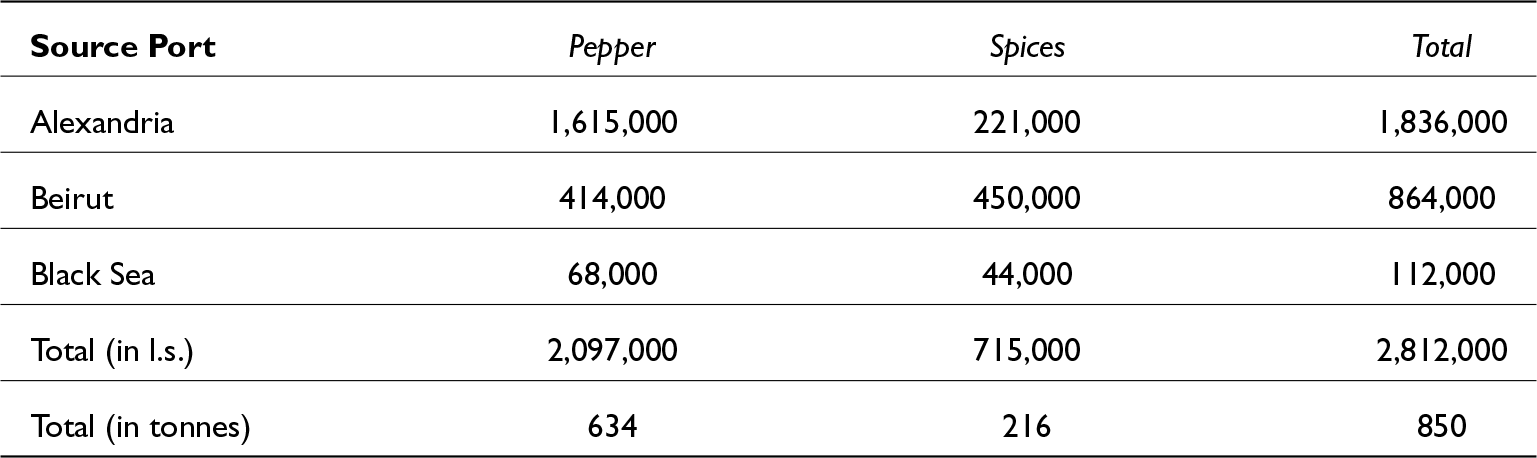
Table 1 Long description
The table measures annual average imports of pepper and spices by Venice from 1394 to 1405, expressed in Libri Sottili (l.s.) and tonnes. Alexandria was the largest source port, contributing 1,615,000 l.s. of pepper and 221,000 l.s. of spices, totaling 1,836,000 l.s. Beirut followed with 864,000 l.s., while the Black Sea contributed the least with 112,000 l.s. Overall, the total imports amounted to 2,812,000 l.s. and 850 tonnes. The data highlights Alexandria's dominance in Venetian spice trade during this period, with Beirut and the Black Sea playing smaller roles. The conversion to tonnes provides a physical measure of the imports, emphasizing the substantial volume of trade.
Source: C.H.H. Wake, “The Volume of European Spice Imports at the Beginning and End of the XVth Century,” Journal of European Economic History, Vol. 15, No. 3 (1986), pp. 621-35.
He also suggested, following Ashtor, that the two other main carriers of pepper and spices, the Genoese and Catalans, together accounted for around 400 tonnes of pepper a year, as well as a quantity of other spices estimated at between 250 and 340 tonnes. At least three aspects of these data are worth remarking. The first is that the theory of a massive decline in Genoese trade to the eastern Mediterranean and Black Sea after 1350, and a consequent turn to conquest in areas like Corsica, seems partially unfounded. While the Venetians had certainly outstripped them in the pepper and spice trade, they had not entirely vanquished their Italian rivals. Secondly, it may be noted that the relative profile of Alexandria and Beirut was quite different; the former dominated the pepper trade by far, while the latter held its own in regard to the other spices. A third point that is worth mentioning is the continued presence of the Black Sea as a point of supply, and we must imagine that the actual amounts of pepper and spices traded there must have exceeded what was exported from those ports to the western Mediterranean.
This trade, as noted above, represented an opportunity for a Mamluk Sultanate whose treasury was in penury and its administration became the object of a fiscal reform from the 1420s. As John Meloy writes:
If imperial activity is taken as a sign of a state’s vitality, however, the reign of the Mamluk Sultan al-Ashraf Barsbay (r. 1422-38/825-41) stands out as an interlude of concerted initiative in a time of depleted resources. Although Barsbay was not able to reinvigorate the Sultanate’s economy, he consolidated the new political order of the Circassians, established by his predecessors, and, to the extent that he was able to expand Cairo’s imperial power to Cyprus and the Hijaz, he overcame the limitation of reduced agricultural and industrial wealth. These apparently contradictory tendencies of imperial ambition and economic stagnation require that we adopt a more nuanced view of Barsbay’s rule (…). Although the agricultural sector had been hit hard by demographic decline caused by the plague, the trade in spices, and pepper in particular, constituted a vital part of the Mamluk economy.Footnote 31
As noted above, Barsbay’s activities were on two fronts. On the one hand, he wished to better defend his Mediterranean coast, especially Alexandria and its environs, from attacks. This was arguably a long-term response to the trauma of the “crusading” attack on Alexandria by Peter I of Cyprus in 1365, but also of subsequent raids on both Alexandria and Beirut by a number of European nations as well as freelancers. This led the Sultan to overcome the reticence of some of his elite, build up his naval forces and eventually to launch a set of expeditions against Cyprus, defeating and carrying off its Lusignan ruler to Cairo in 1426 and reducing the island to the status of a dependency. This also put paid to the challenge posed by the port of Famagusta as an entrepot that would challenge the ports under Mamluk control on the mainland. But equally important was the intervention in the pepper and spice trade. Maritime merchants from India, and especially Kerala, had for some time been unhappy with the manner in which the Rasulids managed trade at Aden. They thus seized the opportunity in the 1430s to bypass the Yemeni port, instead entering the Red Sea and anchoring on a regular basis at Jiddah. In this matter the ringleader appears to have been a certain Nakhuda Ibrahim al-Kalikuti, based in Kerala. This move suited the Mamluk regime very well, as they had been experimenting with a series of measures from the mid-1420s to gain a firmer grip on the spice trade. These policies were never based on an embrace of ideas of free trade and hence they were bound to create issues both for local and foreign merchants. From the later Fatimid and Ayyubid periods, a somewhat enigmatic group of merchants styled the Karimi had come to play a prominent role in the eastward trade, while the carrying trade to Europe was largely in the hands of Christian merchants (with a limited Jewish participation after 1300). It has been possible to identify several dozen individuals who belonged to the Karimi group, and it becomes clear that their importance grew over the fourteenth century under the first Mamluk dispensation. As they enriched themselves and became something of a merchant oligarchy, they were also called upon to lend money to the Mamluks at moments of crisis, such as the irruption of Timur in Syria. Among the great Karimi figures of the period of transition to the Circassian Mamluks was Burhan al-Din al-Mahalli (d. 1403), but we can also count a number of other figures from that time.
In the early fifteenth century, matters took a definite turn against Karimi interests. In a letter written from Alexandria in 1410, Lluís Sirvent, a factor of the Datini firm from Prato, made the following observation to his principal: “You should be aware, sir, that this land is deserted, because no Moorish merchant does anything here; and if some Moorish merchant pursues some affair, they seize it and force their goods on him; and if the goods that they give him are worth 100 besants, he is obliged to pay 150. On the other hand, the Sultan goes about eliminating them day after day, and it is for this reason that no Moorish merchant wishes to engage in anything.”Footnote 32 This was written at the time of the Sultan Nasir al-Din Faraj, but they signal the beginnings of a process that was taken further under Sultans al-Mu’ayyad Shaikh (r. 1412-21) and Barsbay. From about 1425, the latter ruler began to experiment with a variety of policies, involving embargoes, forced sales, protectionism, and monopolies, targeting pepper and spices, but also sugar, textiles, and even foodstuff. This has sometimes led to his characterization in modern historiography as an oriental despot par excellence, quite capable of killing the trading goose that laid the golden eggs. More recent analyses, as noted above, have considerably nuanced this picture. They point to the crucial role played by a set of agents such as the Sultan’s personal merchant Shaikh ‘Ali al-Gilani, the majordomo Aqbugha al-Jamali, and above all the Ethiopian-origin eunuch Jawhar al-Qunuqba’i (d. 1440), who served as financial intendant (khazindar). The new policies implemented by them led eventually to the emergence of a new group of men, the Khwajas, who progressively took the place once occupied by the Karimi.
There nevertheless remained difficulties to be resolved, notably in the Hijaz and Jiddah, which had now become the key southern node of Cairo’s ambitions. The Mamluk Sultan’s regime was forced here into a compromise, partly because its military hold over the region was insufficient, and partly for commercial reasons. This led Barsbay and his agents to arrive at an arrangement with Sharif Barakat ibn Hasan (r. 1425-55), in which the former oversaw matters in Jiddah to a large extent, while the latter was left to control the holy cities and the hinterland. It also permitted the emergence in Mecca of a powerful new group of merchants, whose profiles are visible in biographical dictionaries as well as the chronicles maintained by the Banu Fahd family and others. The analysis by Richard Mortel of these materials reveals that these men consolidated their position over the course of the fifteenth century and were usually first- or second-generation migrants to the Hijaz from diverse areas including Iran, Syria, and Yemen. They too were known by the title of Khwaja, but unlike their counterparts in the Mamluk heartland, they were for the most part not attached to the state apparatus, though they could occasionally become the shahbandars of Jiddah. Rather, men like ‘Abd al-Qadir al-Maliki (d. 1462), Mustafa al-Rumi (d. 1470), and Ibrahim ibn al-Zaman (d. 1512) manipulated complicated networks of trade and information, that extended into the eastern Mediterranean on the one hand and the ports of the Indian Ocean on the other. Mortel concludes: “Not a few merchants were able to amass large fortunes, principally as a result of their activities in commerce, which often included more or less frequent journeys to diverse regions, especially India, the source of much of the merchandise carried by this trade”.Footnote 33 Since the Mamluk governor at Jiddah was unable to control their activities, or domesticate them, periodic conflicts broke out, and in these situations the Sharifs were called upon to mediate with varying degrees of success. On arriving in southwestern India in around 1500, the Portuguese would encounter the agents of these Khwajas operating in ports such as Calicut and Kannur, or more rarely come into contact with the magnates themselves.
The emergence of Jiddah in the mid-1430s as the key node of the India trade thus helped consolidate a new southern regime, one distinct from the Aden-centred system operated by the Karimis in the fourteenth century. However, Barbay’s successor Jaqmaq (d. 1453) was unable to manage an equally successful transition in the pepper- and spice-trading regime in the Mediterranean for much of his reign. The closely argued work of Francisco Apellániz points to the difficulties in finding a solution, given the recalcitrance and inflexibility of various parties, as can be seen in repeated treaty negotiations between the Mamluks and Italian states.Footnote 34 It was only around 1450 that a new regime (which Apellániz terms the “système de stocks d’épices”) was discreetly put into place, by which the Venetians above all became in a sense the guarantors of the stability of the Sultan’s finances through their assured purchases. Since the Genoese, and their Massaria, were far less systematic than the Venetians in their organization of both shipping and investment, their role in the trade diminished in the second half of the fifteenth century, even though it did not entirely disappear. As for the Aragonese, it has been noted that “between 1442 and 1462 there was an average of five journeys to Alexandria and Rhodes per year,” but that this rhythm could not be kept up. In the last decades of the fifteenth century, direct shipping to the Mamluk ports from Catalonia seems to have largely dried up and the “German pilgrim Felix Faber found the Catalans’ fonduq in Alexandria virtually deserted in 1483.”Footnote 35 The Cottino, the Venetian merchant guild for trade in the Levant, thus came ever more to dominate the high ground once the crisis of the years 1447-49 had been overcome and the new system put into place.
Moreover, the difficulty for newcomers of breaking into this trading system over the course of the fifteenth century is nicely encapsulated by the case of the French. To begin with, it was necessary for them to overcome the recent memories of the raids by Maréchal Boucicaut and his Franco-Genoese fleet on Tripoli and Beirut in 1403, redolent as they were of the French crusading enterprises of the previous century. Nevertheless, in the early 1430s, attempts were made to establish trading links on a new footing by the upstart merchant and royal argentier, Jacques Coeur, who appears to have been able to make contact with the court of Sultan Barsbay. Coeur sailed to Alexandria and then Beirut, but also made his way on an exploratory sortie to Damascus in the interior. Consolidating his position in Montpellier and its port, and subsequently Marseille, Coeur was able to mobilize some merchants of Languedoc (as also possibly some Catalan support) for his operations in the later 1430s and 1440s. Through his nephew by marriage, Jean de Village, he was also able to obtain more extensive privileges for the French in Alexandria in 1447, leading to an exchange of letters between Sultan Jaqmaq and Charles VII. Coeur also built contacts with the Hospitaller Knights at Rhodes, acting as their intermediary in dealings with the Mamluks.Footnote 36 However, his own fall from grace and trial meant that the matter had to be abandoned for a time, with the new Venetian-Mamluk commercial entente of 1450 also rendering matters difficult, and the fall of Constantinople/Istanbul to the Ottomans in 1453 diverting attention away from the Levantine trade to more warlike projects. Coeur himself ended his life as an exile on the island of Chios in 1454, profiting from the extensive links he had built with the Genoese trading elite. The French would return briefly to the charge in 1481, under Louis XI, who sought opinions from the main cities and their trading bourgeoisie on the possibility of creating a commercial company for trade with the Levant. At the same time, he made use of the remnants of Jacques Coeur’s operation to send a couple of vessels to Alexandria, carrying a letter and commercial proposals for Sultan Qa’it Bay. But the French cities threw a wet blanket on the whole affair, arguing that they were in no position to finance such a risky and costly enterprise.Footnote 37 When the matter was brought up again in the 1490s, the powerful Lyon merchants made it clear that they far preferred to have pepper and spices brought into France from Italy over the Alps. They argued that the merchants from Languedoc ran operations that were costly and inefficient, because they lacked the necessary expertise. As historian Richard Gascon put the matter: “The superiority of the Venetians and Genoese was obvious in comparison to such weaknesses. They had a perfect knowledge of the Levant markets, Cairo, Beirut, or Damascus; their establishments, the fondigues [funduqs] where twelve to sixteen representatives were permanently resident, allowed them to purchase at the best time.”Footnote 38 However overstated this view of Italian commercial omniscience was, the myth served its purpose.
This French angle allows us greater clarity on why, through the fifteenth century, the Portuguese had so few commercial or political contacts with the Mamluks. The Portuguese were, first of all, not a properly Mediterranean power, even though their North African conquests gradually gave them such a profile after 1415. To the extent we can gather, Portuguese ships in the fifteenth century rarely if ever sailed east of Italy.Footnote 39 Further, the Infante Dom Henrique who came to control most of the official overseas initiatives after 1430 does not seem to have been particularly interested in the eastern Mediterranean and concentrated his efforts in zones further to the west. The prince’s older brother, the Infante Dom Pedro, who had spent time crusading on the Hungarian-Ottoman frontier, may had a better sense of this eastern geography, further aided by his strong Catalan connections, but he does not appear to have pursued any projects arising out of this.Footnote 40 Through the long and tortuous reign of Dom Afonso V (r. 1438-81), aggressive policies were certainly pursued with respect to the Maghreb where several attacks were mounted, settlements seized, and sizeable sums of money spent. However, the only known contact the Portuguese sovereign had with the Mamluks was in 1454, when he despatched two Muslims from Lisbon’s mouraria to Cairo in order to threaten the Mamluk Sultan Inal with reprisals against his own Muslims subjects if the Christians residing in Jerusalem were not better treated.Footnote 41
It is thus not easy to arrive at a clear conclusion on how well informed the Portuguese were in 1470 or 1480 regarding the Muslim polities of the eastern Mediterranean, let alone those beyond. Their knowledge would have come from three levels of sources: a first textual level, made up of works like Marco Polo’s account (of which Dom Pedro possessed a copy), other works in Italian and Latin, or perhaps even Clavijo’s narrative of his embassy to Timur; a second epistolary level, made of letters exchanged between merchants, or sent by pilgrims to the Holy Land to their families; and finally, an oral level of near-subterranean knowledge, including that carried by mariners and traders who knew the eastern Mediterranean world, which we can only guess at for the most part. As we well know, no one in the fifteenth-century Iberian world actually had access to a text like Ibn Battuta’s Rihla, which would have been worth its weight in gold, since it painted a panorama extending all the way from the Maghreb via the Arabian Peninsula, and the Persian Gulf, to the India of the Tughluq Sultanate, and then beyond to the South China Sea.Footnote 42 Even the armchair work produced in the Mamluk chancery by al-Qalqashandi (1355-1418) would have stood them in good stead.Footnote 43 Had the knowledge that existed among the Cairene elites been available to their counterparts in Portugal, many of the misunderstandings that prevailed at the time of the voyages of Vasco da Gama and Pedro Álvares Cabral regarding the political and religious landscape of maritime Asia would have been avoided. But the Mediterranean remained a segmented space in this respect. Though several Portuguese would have enrolled among the Hospitaller Knights of Rhodes in the course of the fifteenth century, they were clearly not enough of a conduit of information between the eastern and western ends of the Mediterranean. When Dom Afonso V wrote to the Venetian Republic in the mid-1450s proposing a joint crusade for the reconquest of Istanbul, we are left to wonder how well he had been advised about the logistics.Footnote 44 This information famine explains the mission sent out by Dom João II in 1487 of Pêro da Covilhã and Afonso de Paiva to the Indian Ocean via the Mamluk Sultanate.Footnote 45 The vagaries of this mission meant that it was unable to fulfil its task in time, leaving Gama poorly informed in 1498 of the real political geography of Asia and East Africa, including the real situation of the so-called kingdom of ‘Prester John.’Footnote 46 It is to this geography and its consequences that we will turn in the third and final section of this essay.
The two halves of the fifteenth century were in many ways completely contrasting periods in the politics of Islamic Eurasia. The first half was largely concerned with attempts to prolong Timur’s heritage against fissiparous tendencies, a process that also saw the Timurid political system shifting its centre southward in the direction of Iran and Khorasan.Footnote 47 Furthermore, the absence of a strong Timurid threat from the west equally permitted the survival of the Ming dynasty in the turbulent decades after the death of the Yongle emperor in 1424. These decades have sometimes been portrayed as part of a global economic crisis that affected China, though the evidence in favour of this view remains somewhat problematic.Footnote 48 On the contrary, it is clear that in the 1450s and 1460s, the Ming dynasty faced a series of extremely important military and political challenges, including the humiliating defeat and capture of the Yingzong emperor by the Oirat Mongol ruler Esen in 1449, and an attempted coup in August 1461, during the same emperor’s second reign.Footnote 49 Thereafter, the period of rule of the emperor Chenghua (1464-87), would also be characterized by a series of administrative problems, including several uprisings by non-Han minorities in the southwest regions and the extended Jingxiang rebellion from 1465 to 1476. Far greater political and administrative stability was only achieved only towards the end of the century when the period of emperor Hongzhi (r. 1498-1505) witnessed significant reforms. Having survived its difficult beginnings in the late fourteenth century and then gone through a phase of optimistic expansion in the first third of the fifteenth century, it may thus be said that during much of the remainder of the fifteenth century, the Ming rulers managed somehow to muddle through. In the absence of clear demographic data for the period, it is difficult to track population trends; however, the overall population seems to have more than doubled over two centuries, from 75 million in 1391 to about 173 million in 1580. This denser population was used to intensify agriculture and advance artisanal production, but it was not the motor for westward expansion, as would happen later under the Qing.Footnote 50
In Central Asia and the regions immediately to the south and southwest, the death of Timur in 1405 was the occasion for a civil war among his heirs, who proposed not only their own candidacies but different dynastic theories of politics. The two chief rivals were Timur’s son Mirza Shahrukh, who eventually triumphed, and Shahrukh’s charismatic nephew Mirza Iskandar (d. 1415) who had controlled a good part of the Iranian plateau. In the short term, Shahrukh proved to be the shrewder politician and outmanoeuvred Iskandar, but he then espoused a form of political structure that encouraged the proliferation of rival Timurid lines and centres of power.Footnote 51 By the time of his death at Rayy in March 1447, several generations of Mirzas (as these direct descendants were called) could be found, with no clear hierarchy between them. In 1449, Shahrukh’s son and successor Ulugh Beg was killed, and there then followed a fierce struggle between different groupings of Timurids, with the additional intervention of other Chinggisid princes such as Abu’l Khair Khan. For a time, the most prominent figure who dominated in the melee was Abu Sa‘id Mirza, a third-generation descendant of Timur born in Herat. But he was eventually unable to consolidate power.
The second half of the fifteenth century therefore saw the creation of a quite different political geography from the pre-1447 period. With a fragmented Timurid dispensation, and a vulnerable Mamluk polity, the space was opened for the Ottomans to consolidate their power, with their capture of Istanbul in 1453 under Sultan Mehmed making an important symbolic statement. But it also permitted the assertion of power by the Turkoman Aq-quyunlu group, which had initially emerged in the fourteenth century and been Timur’s allies in his campaigns in Syria and Anatolia in the last years of his life.Footnote 52 Led by Qara ‘Usman (d. 1435), this clan confederation claiming descent from the legendary Oguz Khan continued to be allied to Mirza Shahrukh and thereby managed in the period between 1420 and 1435 to make substantial gains in Armenia, Diyarbakir, and neighbouring regions, often at the cost of the Mamluks and their allies. There then followed a period of about fifteen years when their star was on the wane, only to re-emerge in the early 1450s under the ruler Uzun Hasan (d. 1478), the grandson of Qara ‘Usman. For about a quarter century, Uzun Hasan played a major role in the politics of south-west Asia, with domains eventually running from Erzurum and Tiflis to the Persian Gulf. After consolidating his control over Iraq and Iran, he incorporated Persian officials and scribes into his administrative structure, making the transition from a conquest polity to a structure with both fiscal reach and diplomatic outreach. Already in the early 1460s, he had come to the attention of Venice as a potential partner in their desire to check the growing power of the Ottomans, and the Serenissima then proceeded to exchange envoys with the Aq-quyunlu until the mid-1470s.Footnote 53 Some of the Venetians who made the journey to Iran, such as Giosafat Barbaro and Ambrogio Contarini left behind accounts of Uzun Hasan, and in Contarini’s case the text of his Viaggio was even printed in 1486. In the late 1460s, Uzun Hasan enjoyed notable military successes, first with the defeat and death of Jahanshah Qara-quyunlu in 1467, and then with his defeat and the killing of Abu Sa‘id Mirza in 1469.Footnote 54 Four years later, however, he was unable to repeat the same success against the Ottoman Sultan Mehmed, suffering instead a significant loss at Otlukbeli in 1473 after promised Venetian military and logistical aid failed to materialize. After his death in 1478, Uzun Hasan’s son Ya‘qub struggled to hold the polity together, and tried to promote an ambitious fiscal reform in 1489.Footnote 55 His sudden and mysterious death in 1490 created a power vacuum, opening the way in the early sixteenth century for the Safavid dynasty that would rule Iran for the next two centuries and more.
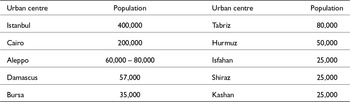
It is unclear the extent to which the Venetians shared their hard-won political and commercial intelligence on the Aq-qoyunlu with their European neighbours and rivals in the 1460s and 1470s. In any event, the Aq-qoyunlu were never seen as an object of interest in their own right, but only because they provided a potential counterweight to the Ottomans (and in some measure to the Mamluks). If ‘Babylon,’ the Mamluk Sultanate, had incarnated the Islamic threat in the fourteenth and early fifteenth centuries, that role was increasingly usurped by the ‘Turk,’ who was officially identified as the principal threat to Christendom by Pope Pius II in the 1450s.Footnote 56 The successful rebuilding by Sultan Mehmed and his successors of the urban allure of Istanbul, which had been left by the Byzantines in a somewhat dilapidated state in 1453, only made this a more pressing need, because the Genoese for example, were quite happy to continue their trading operations there.Footnote 57 Indeed, by the early sixteenth century, Istanbul was clearly the largest urban centre in the Middle East by some distance, thus creating its own force field in the eastern Mediterranean (See Table 2) This is also visible in the reinforcement of trade routes between Damascus and the Levant and the Black Sea, passing through centres such as Bursa and Istanbul.Footnote 58
Major Urban Centres in the Middle East, ca. 1520
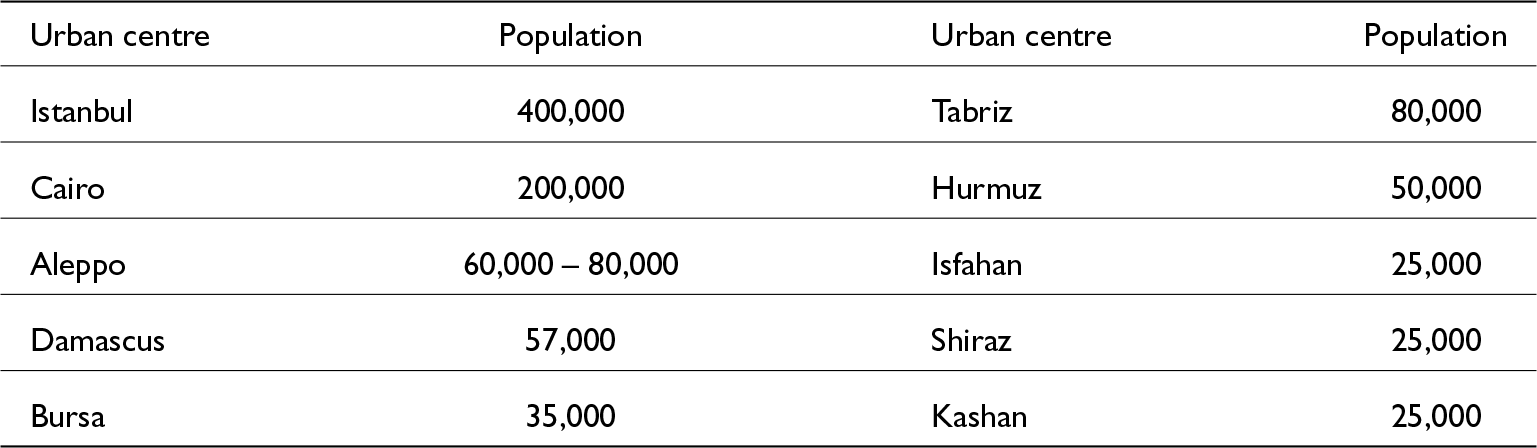
Table 2 Long description
The table compares populations of major urban centers in the Middle East around 1520. Istanbul had the highest population at 400,000, followed by Cairo with 200,000. Aleppo's population ranged between 60,000 and 80,000, while Tabriz had 80,000. Smaller centers like Isfahan, Shiraz, and Kashan each had 25,000. The data suggests significant population disparities among these cities, with Istanbul being a major hub. Population estimates for Aleppo vary, indicating possible uncertainties in historical records.
Source: Jean Aubin, “Chiffres de population urbaine en Iran occidental autour de 1500,” Moyen Orient & Océan Indien, Vol. 3 (1986): pp. 37-54; André Raymond, “The Population of Aleppo in the Sixteenth and Seventeenth Centuries according to Ottoman Census Documents,” International Journal of Middle East Studies, Vol. 16, No. 4 (1984), pp. 447-60.
But maritime Asia held its own charms, especially for those interested in the pepper and spice trade. The reality was, moreover, that whoever controlled Iraq and the Iranian plateau also provided an important point of passage into Islamic South Asia. This had been the case with Mirza Shahrukh and the Timurids and it remained so with the Aq-quyunlu.Footnote 59 By the middle decades of the fifteenth century, South Asia was composed of a patchwork of larger and smaller states, many of them deriving from the Delhi Sultanate that had been founded around 1200. The three most important of these from the viewpoint of the western Indian Ocean were Gujarat, the Bahmani Sultanate, and Vijayanagara. The latter two states had both emerged around the same time, in the mid-fourteenth century, and maintained an uneasy balance-of-force based on regular frontier warfare. Both had sizeable coasts and controlled a number of ports, the Bahmanis in south Gujarat and the Konkan and Vijayanagara in Kanara, which maintained trading links across the western Indian Ocean. The third state, Muzaffarid Gujarat, came into its own around 1400 and became a crucial player in oceanic trade in the fifteenth century, thanks to its powerful merchant fleet and sophisticated mercantile community. Gujarati merchants equally played a key role in maritime Southeast Asia, where they were present above all in the Melaka Sultanate, but also in Sumatran ports like Pasai and Pidir, and the trading centres of the Javanese north coast (or pasisir). In politico-diplomatic terms, the Bahmanis and Gujarat both maintained relations with the Mamluks in Cairo, and the Bahmanis also had dealings with the Aq-quyunlu rulers. Further south from Vijayanagara on the west coast of India, Muslims were present not as rulers but as merchants and cultivators. This was in Kerala, the heart of the Indian pepper trade, where ports like Kollam and Calicut had long maintained a relationship, first with Aden and then with Jiddah. But it was an area of small polities, comparable in size and power to those of maritime Southeast Asia, rather than to large states like the Bahmani Sultanate and Vijayanagara, each with millions of inhabitants.
The Portuguese entered the western Indian Ocean via the Cape Route in 1498 and their first decade there was a mixed affair, of some successes mixed with a few important failures. In some years at least, they were able to send back appreciable cargoes of pepper and spices, at times as much as 900-1,000 tonnes of pepper per annum, and reasonable quantities of ginger and cinnamon (though not of high-value Moluccan spices).Footnote 60 It was the next decade, from 1508 to 1518, when they really made inroads in terms of both trade and settlement, so that by the death of Dom Manuel in December 1521, the enterprise later termed the Estado da Índia had quite distinct contours extending from the Swahili coast of East Africa all the way to Southeast Asia. Most of the crucial gains made by the Portuguese – Goa, Melaka, Hurmuz, Chaul – were against Muslim adversaries and the question certainly arises of how and why this happened. It is likely that most of the Muslim states of the western Indian Ocean littoral did not initially have a clear view of the extent of Portuguese ambitions and saw them primarily as violent intruders in the pepper and spice trade from Southeast Asia and Kerala to the Red Sea and Persian Gulf. The attacks by Cabral on Kerala ports in 1500, and then by Vasco da Gama and his fleet on shipping in 1502-03 confirmed this impression. Gama’s destruction in October 1502 of the Miri, a ship returning from Jiddah to Calicut on which the principal merchant was the Cairene Jawhar al-Faqih, would have set off alarm bells in the Hadramaut, the Hijaz, and eventually Egypt and Syria, and when combined with the corsair activities of his uncles, the Sodré brothers, triggered a Mamluk military reaction in the form of a fleet led from the Red Sea by the Kurdish admiral Amir Husain.Footnote 61 This fleet, which had been prepared from 1505, eventually left Jiddah for the Indian Ocean in August-September 1507.
We do not possess chancery documents to know what precisely the instructions for Amir Husain were. Since there were regular trading links between Dabhol (in the Konkan), and Khambayat (in Gujarat) on the one hand, and Jiddah in the Red Sea on the other, it seems reasonable to suppose that the Mamluk regime would have had been aware of the political changes in western India since the 1490s. The most important of these was the rapid disintegration of the Bahmani Sultanate under Sultan Mahmud Shah, who had come to the throne in 1482, not long after the disastrous execution of the charismatic Iranian vizier Khwaja Mahmud Gawan. In the preceding decades, Gawan had been a powerful figure with connections into the Iranian world as well as the Hijaz and Mamluk Egypt. He had followed aggressive policies against the Bahmanis’ southern neighbours in Vijayanagara, and also led an eastward expansion with ambitions of dominating peninsular India.Footnote 62 From the 1490s, however, a process of fission began, as several important Bahmani warlords began to set up their own autonomous territorial regimes. The most important of these were Ahmad Nizam al-Mulk Bahri and Yusuf ‘Adil Khan, who were to create what would eventually become the Sultanates of Ahmadnagar and Bijapur. It was thus the good fortune of the Portuguese to enter into the region at precisely this moment of transition, both in western India and the Iranian plateau.
The vicissitudes of Amir Husain’s fleet are well-known. In an initial phase, he was able to attract the support of a Gujarati fleet from Diu, sent to him by the powerful governor of that port Malik Ayaz; he also was supported by several armed Mappila Muslim vessels from Kerala, in particular from the vicinity of Calicut. With this combined force, he thus successfully engaged a Portuguese fleet in the port of Chaul in March 1508, in the process killing the viceroy’s son Dom Lourenço de Almeida and taking a number of prisoners. Thereafter, he returned to the protection of Diu, believing himself to be well situated from a tactical viewpoint. But this was not the case in reality. Over the course of his dealings with Amir Husain, Malik Ayaz had become increasingly alarmed, seeing the overbearing admiral as a real threat to his own position. He thus began secret negotiations with the Portuguese viceroy Dom Francisco de Almeida, who had started sailing up the west coast from Cochin with the intention of engaging the Mamluk fleet. When the naval combat actually began in February 1509, Ayaz abandoned Amir Husain to his fate, leading to a victory for the Portuguese. The admiral was somehow able to escape, make his way on land, and eventually returned to Cairo where he was able with some difficulty to reestablish his credibility. Had these erstwhile allies not fallen out, the battle might have had another outcome.
It is important therefore to underline that the military superiority of the Portuguese in the context of the western Indian Ocean was not always decisive. An intriguing instance of this comes from 1510, with Afonso de Albuquerque’s first major, and in many ways career-defining, conquest of Goa.Footnote 63 This well-located but relatively minor port was at this point under the control of Bijapur. However, Albuquerque had come to learn from his informants such as the Honawar-based corsair Timayya that it was poorly defended, and that Yusuf ‘Adil Khan (the “Sabaio” in Portuguese vocabulary) had recently died leaving the local administrators in a fragile financial situation. He was thus able to accomplish an easy and opportunistic conquest in February 1510, overcoming minor resistance over two days. However, it became unclear whether the ‘Adil Khan was really dead or merely gravely ill. The Bijapur forces managed at any rate to launch a counter-offensive some months later in May, under the formal leadership of Yusuf’s young son Isma‘il, but more likely under the instructions of the regent Kamil Khan Dakhni. Unable to resist the siege by the general Fulad Khan, the Portuguese were obliged to mark a painful and long-drawn-out maritime retreat to their main outposts in Kerala. Albuquerque had apparently hoped for support from the neighbouring Sultanate of Ahmadnagar, but none was forthcoming. After gathering their forces, the Portuguese then launched their own counterattack in November 1510, this time encountering stiffer resistance, including from some Venetians and Genoese in the garrison. In spite of this, the chaotic succession politics of the time – in which Kamil Khan was at loggerheads with Yusuf’s widow Punji Khatun – ensured that the emergent Bijapur Sultanate was simply unable to bring enough military resources to bear on Goa. Over the next two years, the Bijapur armies returned to the charge, but by this time the Portuguese were too well entrenched. The Deccan-based chronicler Muhammad Qasim Firishta would produce a bland version of the episode many decades later.
[Kamil Khan] also made peace with the Europeans, who, after the retreat of Yusuf ‘Adil Shah, had besieged Goa, and regained possession by giving large bribes to the governor. This event occurred on the accession of the infant King, and it was finally agreed that the Europeans should retain Goa, on condition of their not molesting the other towns and districts on the seacoast. Accordingly, since that time the Portuguese have kept possession of Goa, and observing the treaty, have not made any farther encroachments on the ‘Adil Shahi territory.Footnote 64
In reality, the Portuguese managed to expand the territory of Goa into Bardes and Salcete, once again taking advantage of a disputed succession in Bijapur in the 1530s and 1540s. In that instance, tactical acuity was shown not only by the aggressive governors but the captains of Goa.
The success of the Portuguese in the Indian Ocean in the years up to 1515 can thus be attributed to a number of factors, but by the same token we must also consider the instances in which they failed. The aspect of military and technological superiority is of course crucial, both on sea and in the use of firearms. However, these were not always determining. They worked best when the Portuguese attacked poorly defended port cities belonging to small states with limited resources, less so when the ports were located in sizeable political systems. Nowhere did they translate into major territorial conquests, as happened with the Spaniards in the Americas after 1520. Their failures, such as that of Albuquerque in Hurmuz in 1506-07 and Aden in 1513, were due to poor planning but also because they were outmanoeuvred tactically. But their principal advantage in this initial phase was that the situation in Iran and the Deccan was one of considerable turmoil and instability. In the last five or six years of Dom Manuel’s reign, the conjuncture turned against them. Some of this was a consequence of overstretch and excessive ambition, leading to defeats such as that at Mamora in Morocco in August 1515. As Maria Augusta Lima Cruz has written:
The choice of location for the construction of the fortress permitted the Muslim forces, led by Moulay En-Naser, brother of the ruler of Fez, to control the mouth of the river, cutting it off from the sea and thus having the Portuguese expeditionary force at their mercy. The situation became impossible leading to the rapid flight of the invaders and degenerated into a real disaster. It is estimated that 4,000 Portuguese died there. Tens of ships and a great deal of artillery and munitions were lost. According to Damião de Góis, it was the greatest loss in terms of men and munitions that the King Dom Manuel I suffered during his entire reign. The defeat at Mamora profoundly damaged the prestige of the Portuguese in Morocco, affecting their relations with their allied Muslim tribes. As Pierre Cenival has stressed, ‘they knew from now on that Portuguese arms could be defeated and that they were incapable of efficiently defending the Portuguese vassals in the event of an attack by the ruler of Fez on their territories.’ Worse still, this defeat revived Muslim resistance against the Christian invaders.Footnote 65
In sum, with this engagement, the Moroccan forces of the Wattasids showed a greater tactical understanding of the use of firearms than they had earlier, and thus brought an end to a series of Portuguese conquests in the area that had begun with Agadir and Mogador a decade earlier. The reversal, taken together with other significant failures and losses, and growing reticence in the court regarding the overall direction of Albuquerque’s policies, meant that Dom Manuel’s plans to mount a campaign to retake the Holy Land had to be rethought.Footnote 66 This loss of imperial momentum would be carried over into the 1520s, and would only be exacerbated by new challenges such as the Magellan-Elcano voyage of circumnavigation.
Conclusion
The Portuguese overseas enterprise had a long and rather uncertain gestation from the time of the conquest of Ceuta in 1415, a fact that a predominantly nationalist historiography has been reluctant to acknowledge.Footnote 67 The standard narratives of the emergence and consolidation of the Portuguese overseas empire stress the importance in the process of empire-building of the two reigns of Dom João II (1481-95), and his cousin Dom Manuel (1495-1521). These reigns had followed on the long and rather up-and-down rule of Dom Afonso V (1438-81), which was characterized by a debilitating political rivalry with Castile on the one hand, and much tergiversation on the overseas front on the other.Footnote 68 Though the colonization of the Atlantic islands and the intervention in Morocco had preceded this period, as indeed had the progressive exploration of coastal West Africa by the agents of the Infante Dom Henrique and his heirs, it was in the decades from 1480 to 1520 that the Portuguese first laid claim to Brazil and also entered the waters of the Indian Ocean. One way to approach the foundation of the empire is thus in terms of the evolution of an ‘expansionist strategy,’ in which ideological factors were largely tempered by the constraints posed by an inter-state European context, notably the rivalries with Castile, Aragon, and the Italian city-states.Footnote 69 Such a view could consider various aspects of these intra-European rivalries, including the mobility of trading and political elites, the marriages and alliances between the different royal houses, as well as factors such as the growing pressure to expel both Jews and Muslims from Iberia. Italians could play the role either of spoilers or of collaborators, both interfering and participating in the overseas enterprises of both the major Iberian powers.
In this essay, I have proposed a different point of departure, namely one that stresses the frequently circumstantial and opportunistic character of Portuguese expansion. Painting on a large canvas of the transformation of Eurasian geopolitics after the death of Amir Timur (1405), my emphasis has been on the complex play of forces in the Sunni inter-state system, especially between the Mamluks, Timurids, and Ottomans, but also involving other polities such as the Aq-quyunlu, the Muzaffarids (in Gujarat), and the Bahmanis (in the Deccan).Footnote 70 After about 1450, and the visible decline of the Timurids, the main axis of conflict became that between the Mamluks and the Ottomans.Footnote 71 The reign of Dom Manuel saw a decisive resolution of this struggle, with the crushing defeat of the Mamluks by the Ottomans in 1516-17, which came as a real surprise to most western European observers.Footnote 72 The Portuguese may have inadvertently played a role in this defeat by weakening Mamluk finances through their intervention in the spice trade, but it would be unwise to attribute too large a place to them, in view of the many structural weaknesses that had rendered the Mamluk political system vulnerable. On the other hand, subsequent Portuguese consolidation in the western Indian Ocean was facilitated by the decline of the Mamluks, and later Ottoman attempts to gain some ground through expeditions and interventions in that maritime space in the 1530s and 1540s only had a limited success. At the same time, the Ottomans could not consolidate their supremacy over the world of Sunni Islam in a definitive way because of the emergence of a fresh Timurid challenge in South Asia from the 1520s onwards. This new political factor, stemming from the defeat of the Lodis by Zahir-ud-Din Muhammad Babur, would have a significant impact on the Portuguese Estado da Índia, and pose a real constraint to its further expansion after 1560.Footnote 73 Portuguese strategies in the western Indian Ocean and the Indian subcontinent thereafter were frequently defensive in nature, and they concentrated their expansive ambitions far more in Southeast Asia. But that, we might rightly say, is another story.
Acknowledgements
I am grateful to Niall Atkinson, Malika Dekkiche, Jorge Flores, Giuseppe Marcocci and José Pedro Paiva for comments and help with different aspects of this essay. All translations are mine, unless otherwise stated.

 Open access

