


The Constitution of the United States created one of the world’s first true representative democracies: a system of government in which the legislative branch is to reflect the will of the people. Generations of political scientists have debated how well the US Congress approximates this ideal. Critics of Congress today list any number of maladies that allegedly prevent the institution from representing the popular will: malapportionment and gerrymandering, voter ignorance, veto politics, polarization, interest groups, economic inequality, and the tendency of parties to focus on their electoral base rather than appealing to the wider public.Footnote 1 These forces reputedly prevent Congress from representing the public will.
Through all the laments about Congress, however, almost no scholarship has taken on the basic empirical question: How often does Congress make decisions that a majority of people support? Empirical research on representation begins with Warren Miller and Donald Stokes (Reference Miller and Stokes1963), who studied the association between the views of individual representatives and their constituents, or dyadic representation. In his critique of Miller and Stokes, Weissberg (Reference Weissberg1978) suggested that the collective decision of Congress could be in line with the nation, even if each legislator does not represent their constituents dyadically. Monroe (Reference Monroe1979) offered an early attempt to connect national support for specific issues to the passage of legislation. But in the years since Monroe’s study, empirical research has shifted from collective representation and has focused mainly on either dyadic representation (e.g., Ansolabehere, Snyder, and Stewart Reference Ansolabehere, Snyder and Stewart2001; Canes-Wrone and Kistner Reference Canes-Wrone and Kistner2022; Clinton Reference Clinton2006; Lax, Phillips, and Zelizer Reference Lax, Phillips and Zelizer2019), the dynamics of opinion change and policy (e.g., Erikson, Mackuen, and Stimson Reference Erikson, Mackuen and Stimson2002; Page and Shapiro Reference Page and Shapiro1983), or unequal representation by class (e.g., Gilens Reference Gilens2012; Miler Reference Miler2018). These influential studies and the subsequent literature do not, however, gauge how often congressional decisions reflect what the majority of people want and under what conditions Congress represents national opinion.
We address these questions directly by drawing on an intensive 20-year survey project, the Cooperative Congressional Election Study (CCES; shortened to CES in 2020). The CCES was designed in 2005 with the aim of measuring collective representation and dyadic representation. Each year the CCES surveyed tens of thousands of Americans and asked, among other topics, their views on five to seven important bills before Congress that year. Over the course of two decades, the study has asked Americans whether they support or oppose 103 key bills on the congressional agenda.
The issues examined here reflect some of the most important decisions that the US Congress faced in the first quarter of the twenty-first century. They include national debates over healthcare, taxes, wages, infrastructure spending, the funding and size of the government, gun control, foreign trade, civil rights of women and LGBTQ individuals, and abortion. They also reflect the range of possible outcomes in the legislative process. Most of these bills ultimately received a vote on the floor of the House and the Senate, but many did not because they were blocked by the party leadership or were never taken up in one chamber. These key bills overlap substantially with other lists of important legislative decisions (Curry and Lee Reference Curry and Lee2020; Mayhew Reference Mayhew1991). They are certainly atypical of the many thousands of mundane and obscure decisions that Congress makes about the management of government, such as personnel decisions and real estate transactions. Instead, they reflect important and salient issues at the time.
How often did Congress agree with the will of the people on these important decisions? The answer: 55%. We define successful collective representation as Congress either passing a popular bill or defeating an unpopular one. By this metric, 55% of these 103 issues were collective representational successes. Likewise, Congress ran contrary to national opinion on 45% of these issues, either by defeating a popular bill or passing an unpopular one. We also speculate that this quantitative measure of success would appear even higher if we could include issues and policies that were not surveyed, because uncontroversial issues are rarely polled and less likely to be revisited by Congress.
Yet, representation is not a tally on a ledger: it is a process through which collective decisions are made about what laws a nation will or will not have. It rests on the election of those who will represent a constituency and on the accountability of those people for the decisions they make. The measure of collective representation helps us understand what that process yields. It also provides a lens on the process itself.
The CCES allows us to analyze the factors and circumstances that shape collective representation. The electoral institutions, especially the configuration of House and Senate districts, do not account for representational failures. Rather, legislative institutions—especially the bicameral structure of Congress, the parties, and the nature of the issues themselves—are the main obstacles to majority rule. That is especially true when control of government is divided between the two parties or when the public is divided along party lines in its support for a bill. The Constitution of the United States set up the House to reflect popular will through direct and frequent elections. The Senate, with longer terms and staggered elections, was to be more insulated from the public.Footnote 2 As we will show, the likelihood that a bill passes the House corresponds to the level of public support for the bill, but the likelihood that the Senate passes a bill is unrelated to public support. The fate of bills in the Senate, and only in the Senate, depends on the division between the parties on the issue: more divisive bills have a much lower likelihood of Senate passage. Moreover, nearly half the issues under study fail to receive even a roll-call vote in a requisite chamber, and those cases occur overwhelmingly in the Senate.
A closer examination of the legislative histories of the 103 key issues studied by the CCES reveals the variations in context and circumstances that contribute to representational failure. The type of issue, the level of support, unified or divided party control, the degree of party polarization, and the possibility of a filibuster all factor into understanding representational success and failure. For example, foreign relations and legislation designed to address the 2008–9 economic crisis stand out as examples when Congress passed bills that the nation opposed. Far more common are when popular bills, such as gun control, fail to pass. Some divisive issues pass the Senate, but since 2009 that only occurred when majority parties could circumvent the filibuster or had enough votes to break one. The US legislative process can often frustrate popular rule.
One might hope that, on the big decisions, the US Congress would side with the majority of the public more than 55% of the time. The US system, however, is more than a simple plebiscite. The Constitutional Convention created a complex bicameral system insulated from direct popular rule. It designed a bicameral legislature that embodied different forms of representation to provide “a defense of the people against their own temporary errors and delusions” (Federalist 63). In this system it is difficult to pass a popular law in Congress. Typically, there must be an alignment of public support, party support, and the willingness of both chambers of Congress to move forward. But it is even more difficult to pass an unpopular law. The US system does not give the majority free rein, but it has an even stronger bias against unpopular ideas. That feature of the US system shapes collective representation.
Measuring Representation
We unite two traditions in the study of Congress and representation. One tradition examines how members of Congress make laws. This vein of inquiry includes the large literature that studies legislative veto points and whether legislators can enact their priorities into laws (Binder Reference Binder1999, Reference Binder2003; Curry and Lee Reference Curry and Lee2020; Mayhew Reference Mayhew1991). These approaches do not consider public opinion, so there is often no measure of how popular each of these priorities was.
A second tradition relies on survey data to measure public attitudes. Caughey and Warshaw (Reference Caughey and Warshaw2022), Gilens (Reference Gilens2012), Gilens and Page (Reference Gilens and Page2014), Lax and Phillips (Reference Lax and Phillips2012), and Stimson (Reference Stimson2015) use survey data to study the relationship between mass opinion and policy enactment in Congress (or state legislatures). Some of these studies link public survey data, such as polls conducted by media firms, to policy changes. Others relate trends in national opinion to the trends in laws that Congress passes. These accounts do not investigate the veto points inside the legislature systematically.
In this article, we link specific policy proposals to public opinion on that policy and trace how the House and Senate dealt with each proposal. This linkage between the survey and the legislative history allows us to measure whether a majority of the public supported the bill, whether the people who identified with each party supported the bill, the support for the bills in each constituency, and the decisions that the legislature made about the bill.
Definition of Representational Success
The core concept in this study is representational success and failure. It is the empirical measure of majority rule. Representational success equals instances in which a majority of people wanted a bill and Congress passed it, plus instances in which a majority of people did not want a bill and Congress rejected it. This notion of representational success has been called “congruence,” “substantive representation,” or simply “fit” (Jacobs and Shapiro Reference Jacobs and Shapiro2000; Lax and Phillips Reference Lax and Phillips2012; Sabl Reference Sabl2015). We revert to Weissberg’s original terminology.
Importantly, representational success is not equivalent to passing bills. Success depends on what Congress decides and on what people want. If a bill is unpopular, then defeating the bill is a representational success, and passing such a bill would be a representational failure.
Clearly, a success defined in this way is not necessarily a normatively good policy. Popular politics can produce both good and bad policies. We take public opinion to be, as Sabl (Reference Sabl2015, 356) put it, “imperfect but presumptively legitimate.” Our goal is to show how Congress achieves collective representation, if at all: How do the forces of majoritarianism face up to an institutional structure that contains both majoritarian and counter-majoritarian components? By using the quantitative measure of success as an organizing concept and by scrutinizing departures from theoretical predictions using legislative case studies, we can highlight the nuances in what congressional representation entails.
Case Selection
We study the twenty-first-century Congress from 2006 to 2022. Gilens (Reference Gilens2012), Erikson, Mackuen, and Stimson (Reference Erikson, Mackuen and Stimson2002), and Mayhew (Reference Mayhew2011) all ended their data collection in 2006. This study starts, in both time and scope, where these studies stopped.
There are good reasons to expect that a new sort of legislative politics set in around 2006. The late twentieth century was an era of strong incumbency advantages and party realignments in Congress. The twenty-first century has seen the rise of party voting in the electorate, polarization between the parties, and strong party leaders, especially Nancy Pelosi (D-CA) and Mitch McConnell (R-KY), who led their own parties in the House and Senate, respectively, for the entirety of our study period. Their tenures are widely viewed as transformative and partisan.Footnote 3 The dynamics of lawmaking and polarization deserve an updated analysis in this modern Congress.
We use the Cooperative Election Study Common Content from 2006 to 2023 to measure public opinion during this time period. Each year’s CCES sample is matched to census demographics and is close to a representative sample of the adult US population. There are approximately 20,000 respondents in each odd year and 60,000 in each even year.
Each year the principal investigators of the CCES selected five to seven of the most salient and important bills under consideration by Congress, based on reporting in Congressional Quarterly (CQ) Weekly Reports, the New York Times, and the Washington Post, as well as the Key Votes selected by CQ, the AFL-CIO, and the Chamber of Commerce. CQ defines their Key Vote criteria as whether the vote addresses “a matter of major controversy,” “a matter of presidential or political power,” and “a matter of potentially great impact on the nation and the lives of Americans.” In this article we examine the 103 narrower questions about actual policy decisions that Congress faced around each year of the study.Footnote 4
Not all of the important bills in a Congress would have come up for a vote in the summer, when the survey questions are written. The CCES is then fielded in October through November of each year. Most of the bills chosen in the summer either had already been voted on in at least one chamber or would eventually be voted on. About 75% of our issues are or eventually become identified as CQ Key Votes, which is published by CQ after the conclusion of each calendar year. Other scholars use the bills that do receive a vote to study dyadic representation on roll-call votes (Ansolabehere and Kuriwaki Reference Ansolabehere and Kuriwaki2022; Cayton and Dawkins Reference Cayton and Dawkins2022).
Accordingly, most of the 103 bills received a vote in at least one chamber, but a few received a vote in neither and many failed to get a vote in a requisite chamber. This is a positive aspect of our research design, because it allows us to see what happened to the issues that never reach the floor. Ignoring these issues could bias our conclusions. For instance, our study includes the unpopular budget bill that House Speaker Paul Ryan pushed through his chamber in 2014. The Senate did not even bother to take a vote on Speaker Ryan’s budget, but that bill was central to the standoff that nearly led the United States to default on its debt. We study the Senate’s inaction as an outcome in itself.
Scope: The Decision Agenda
All studies of representation are shaped by the scope of issues and bills under consideration. Mayhew (Reference Mayhew1991)’s list of important legislation is a study of passed bills. The discipline’s most common measure of congressional behavior, NOMINATE scores, only uses information from non-unanimous floor votes. Binder (Reference Binder1999)’s gridlock agenda relies on what the editorial board at the New York Times decides to comment on, and Mayhew (Reference Mayhew2000) collects two centuries of public actions as documented by historians. Mayhew (Reference Mayhew2011) relies on what presidents declare as their agenda, whereas Curry and Lee (Reference Curry and Lee2020) rely on what the Democratic or Republican Parties publicly declare as their platform. Survey-based studies like ours rely on what pollsters deem worth asking. Sometimes, policies with quite substantial impacts glide through Congress without becoming controversial in the media or catching the attention of a pollster (Curry, Lee, and Oldham Reference Curry, Lee and Oldham2024). The selection of issues to be studied can skew the inferences we draw (Barabas Reference Barabas2016).
The 103 decisions in this study consist of salient issues before Congress on the legislative agenda. Our case selection approximates what Kingdon (Reference Kingdon1984, 4, 175) calls the decision agenda: a small set of issues that are “up for an active decision.” These 103 decisions are a small subset of all issues that Congress, as a legislative institution, explicitly considers, which Cobb and Elder (Reference Cobb and Elder1972) call the institutional agenda.
The decision agenda is not a neutral or random set of issues. It encompasses important problems, such as financial crises and wars, to which Congress must respond. Many of these issues are “really getting hot” in the media (Kingdon Reference Kingdon1984, 175). The decision agenda also reflects the agendas of the two political parties, especially the majority party. Issues are chosen strategically. Legislators introduce bills that are either designed to receive bipartisan and bicameral support (Curry and Lee Reference Curry and Lee2020) or to take positions on issues that emphasize their differences with the other party (Lee Reference Lee2016).Footnote 5
Two comparisons provide insight into the nature of these 103 bills. First, how do they compare to the set of all bills on which there were roll-call votes? The NOMINATE scaling procedure estimates a midpoint between the proposal being voted on and the status quo it was proposed to replace. The votes we selected were in fact quite representative of the set of all roll-call votes on this dimension (appendix A).
Second, how do they compare to lists of important legislative decisions based on retrospective studies? We compared the set of bills on the CCES to Mayhew’s list of important legislation and Curry and Lee’s list of majority priorities (Curry and Lee Reference Curry and Lee2020; Mayhew Reference Mayhew1991). There was considerable overlap of the CCES bills with the superset of bills in Mayhew’s and Curry and Lee’s lists. In fact, we found that the disagreement in our list versus the two other lists was about the same as the disagreement between the Mayhew list and the Curry–Lee list.Footnote 6 Mayhew’s list does not include bills that never passed (which we capture); Curry and Lee’s list does not include priorities that the majority party chose to hide, issues raised by the minority party, Supreme Court nominations, and external events thrust onto the agenda (all of which we capture). Mayhew’s list includes several laws of substantive importance that passed without controversy (for which no public polling exists), and Curry and Lee’s list includes issues around executive reform, veteran’s affairs, and opioids that are not covered in our 103 issues. These comparisons suggest that the issues in the CCES are fairly representative both of significant legislation and of the thousands of bills on which roll-call votes are taken.
Perhaps the biggest concern about bias comes from nondecisions: bills, for example, that never make it onto the decision agenda, or issues for which bills were never introduced. As a practical matter, it is difficult to study nondecisions, because they tend to reflect nonsalient issues about which there is little polling.Footnote 7
We speculate that if there were polls on all issues that Congress faces, the level of collective representation would likely be higher than what we find here. Consider the set of all issues before Congress. First, there are salient, controversial issues. These are well represented in this study. Second, there are nonsalient yet widely unpopular issues. The unpopularity of these issues means that no member of Congress or party will likely carry water for them. The lack of decisions makes these representational successes.
Third, there are nonsalient, noncontroversial, yet popular issues. This is the routine business for Congress, such as noncontroversial nominations, grants-in-aid, most budget authorizations, and appropriations for member’s constituencies (Grimmer Reference Grimmer2013; Rosenstiel Reference Rosenstiel2023). Others are issues that Congress has already settled, such as the repeal of Prohibition or requiring food to be sold with standardized nutrition labels. The existing law is popular, and there is no need to take action. Pollsters rarely ask about these issues today because they have become uncontroversial.Footnote 8 The lack of legislative action simply continues an already popular policy.
Finally, there are nonsalient yet controversial issues. These are concerns and conflicts that do not rise to the decision agenda. Arnold (Reference Arnold1992) argues that such issues may be precisely the ones where narrow interests win over the national interest. Some of these decisions would be popular and some not. It is unknown how big each of these categories is. Taking these four categories of issues together, however, suggests that lack of a decision may reflect popular opinion far more often than not.
The focus of this analysis, as with most of the research on representation, is on the issues immediately before the Congress: the decision agenda.
Asking about Bills
The CCES asks survey questions about specific legislative proposals. This helps minimize measurement error in two ways. First, the survey responses are likely clearer because the issue is unambiguously defined or framed.Footnote 9 Second, there is a tighter link between the survey question wording and the content of a specific bill. This is a major difference between roll-call questions on the CCES and studies that rely on media polls (Gilens Reference Gilens2012; Monroe Reference Monroe1979; Page and Shapiro Reference Page and Shapiro1983). The questions asked by media polls are often not tied to a specific legislative bill and frame the policy in vague or generic terms. The CCES questions are more closely matched to the actual bills under consideration and thus permit a stronger connection between preferences and the congressional decision.
The CCES questions are worded to explain the policy in the bill as concisely and as objectively as possible. They intentionally do not contain explicit partisan cues but describe the policy proposals in the legislation (Hill and Huber Reference Hill and Gregory2019). For example, the question wording for the Tax Cuts and Jobs Act (TCJA) does not mention the Republican Party and describes the five types of taxes it will change and by how much. It does not refer to the bill by its name, the TCJA, but simply starts this way: “Would you support or oppose a tax bill that does all of the following?”Footnote 10 Most of the questions ask for a binary, yes or no answer. Respondents can skip the question if they wish, but in practice only 1–2% do. The question wording for each issue is provided in appendix B.
Some bills are complex bundles of policies. The TCJA, for example, included tax cuts for corporations, tax cuts for different household and individual earnings brackets, and caps on various tax deductions, such as for state and local taxes. The final bill was an up-or-down vote on the package. The CCES asked separate questions about corporate tax rates, individual or household tax rates, and limits on deductions; it then asked a separate question about the entire package. When we compare how survey respondents answer yes/no questions about a policy bundle to how they respond to individual provisions, they behave in much the same way that members of Congress might behave. Some support the package, even though they do not support everything in it.Footnote 11
Legislative Outcomes
The final piece of this picture is the outcome in Congress. We consulted the Congressional Record, GovTrack.us, Voteview, and other contemporaneous journalistic coverage to determine whether there was a roll-call vote on each issue. Because questions are written based on bills in their late or final stage, it is straightforward to match most CCES questions to a bill or a vote. Some cases, especially when legislators change part of a bill late in the process, are judgment calls, however.Footnote 12
Representation tacitly comes with an assumption about time. Our unit of analysis is a bill (or issue) in each two-year Congress. We assume that legislators represent their districts now, rather than in the future. We discuss the possibility of representing future electorates later in the article. Some issues come before multiple Congresses under different bill numbers, and each is counted separately.
A further complication in constructing what actually happened in Congress is the increasing use of bundles or omnibus bills (Sinclair Reference Sinclair2012). A form of strategic bundling occurs when an unrelated provision is attached to a general bill or when multiple bills are logrolled into one bill so that it passes. For example, the House majority in 2014 greenlighted the unpopular spending of taxpayer dollars to assist Syrian rebels in fighting ISIS by attaching the provision to the overall appropriations bill. Such ambiguity poses a problem for using roll-call votes as a measure of dyadic representation, but it is not a problem for our focus on collective representation. We code whether Congress passes certain pieces of policy through whatever legislative vehicle.
One final issue in tracking legislative outcomes concerns the decisions of other institutions, especially the president and the Supreme Court. Presidents may veto laws or intervene in legislation in other ways. The Supreme Court can overturn laws or make decisions that affect ongoing legislative decisions. Only one of the issues in our dataset was vetoed by the president: the repeal of the Affordable Care Act in 2015. In two other cases, decisions by the executive and judicial branches altered the course of legislation. The Transpacific Partnership in 2016, the largest trade deal the United States would have signed at that time, was never ratified in Congress because President Obama did not send the final agreement in time for a vote.Footnote 13 In 2014 the Supreme Court decided Burwell v. Hobby Lobby, exempting religious organizations from the contraceptive policies in the Affordable Care Act. That made moot a bill pushed by Senate Republicans that year. Except for these three examples, the ultimate fate of the legislation lay entirely in the hands of the House and Senate.
Summary Statistics
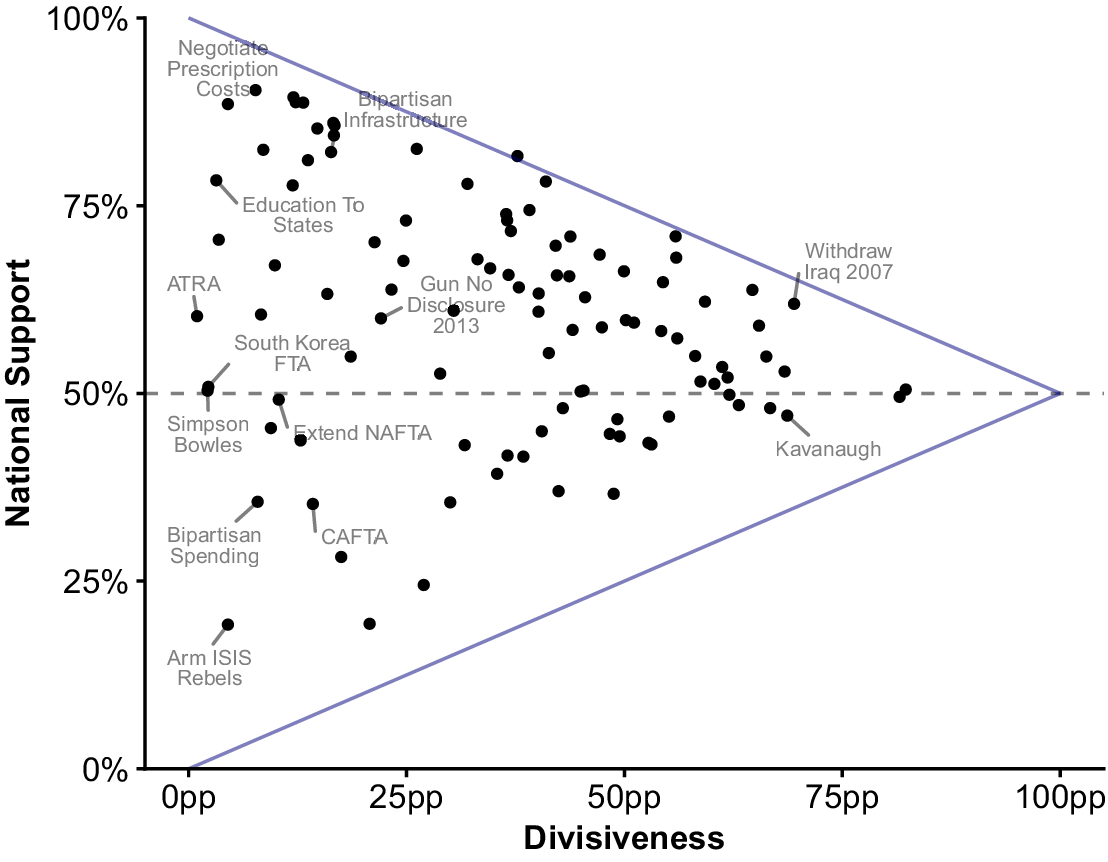
A key indicator in our analysis is the national support for the items on the decision agenda. These determine representational success and failure. The national support for an issue is simply the proportion of our sample that supports each issue. Figure 1 shows the spread of national support on the vertical axis. Among the most popular issues in our dataset are the proposal to let the government negotiate prescription drug prices (89%) and the bipartisan infrastructure act (82%). Among the least popular are Speaker Ryan’s 2014 budget proposal (19%) and arming ISIS rebels (19%).
Issues by National Support and Divisiveness
Note: The divisiveness measure is constructed by the absolute difference between the support among Democratic respondents and Republican respondents. Illustrative issues are labeled. The blue lines show the mathematical bounds of national support if Republicans and Democrats are the same size and the opinion of Independents is at the middle of the two groups.

The decision agenda tends to be popular. The average issue had the backing of 60% of the public. Seventy percent of our 103 issues had the support of the majority of the public. The tendency for the decision agenda to be popular may be a reflection of frequent elections. The majority party, especially in the House, has just won a national election, controls the agenda, and is incentivized to carry through on its policy platform (Sulkin Reference Sulkin2011). We return to this point when we examine collective representation in the House.
Representational success is defined as a simple function of popular support and legislative outcomes. Representational success for issue i is a binary variable, a yes or a no:
 $$ {\displaystyle \begin{array}{l}{\mathrm{Success}}_i=\mathrm{Issue}\ \mathrm{is}\ \mathrm{popular}\hskip0.55em {\mathrm{and}\ \mathrm{pass}\mathrm{es}}_i\\ {}\hskip6.8em +\mathrm{Issue}\ \mathrm{is}\ \mathrm{unpopular}\ \mathrm{and}\ \mathrm{does}\ \;{\mathrm{not}\ \mathrm{pass}}_i,\end{array}} $$
where popularity is determined by whether the national support of the issue is above 50%. The mean of this binary variable across all issues is our measure of collective representation.
Our analysis also considers the role of polarization in the electorate. We examine one measure of this phenomenon, the gap between Republican and Democratic partisan identifiers on the issue, which we call divisiveness. We define this as the absolute difference between the proportion of Republican-identifying respondents and Democratic-identifying respondents who support the issue,
 $$ {\mathrm{D}\mathrm{ivisiveness}}_i=\mid {X}_i^{\mathrm{R}}-{X}_i^{\mathrm{D}}\mid, $$
where $ {X}_i^{\mathrm{R}} $
is the proportion of Republican respondents who support the issue and
$ {X}_i^{\mathrm{R}} $
is the proportion of Republican respondents who support the issue and $ {X}_i^{\mathrm{D}} $
is that among Democrats. Divisiveness ranges from 70 to 80 points (e.g., Impeachment of Donald Trump and Withdrawal from Iraq) to essentially 0 (e.g., one or two percentage points for the 2012 Compromise Tax Bill, the South Korea Free Trade, and the Simpson-Bowles Budget bill). We call issues divisive if this gap between Democrats and Republicans is relatively high (the top 40%) and not divisive if the gap is low (the bottom 40%). This measure of divisiveness is defined at the issue level and does not depend on there being a roll-call vote.Footnote
14
$ {X}_i^{\mathrm{D}} $
is that among Democrats. Divisiveness ranges from 70 to 80 points (e.g., Impeachment of Donald Trump and Withdrawal from Iraq) to essentially 0 (e.g., one or two percentage points for the 2012 Compromise Tax Bill, the South Korea Free Trade, and the Simpson-Bowles Budget bill). We call issues divisive if this gap between Democrats and Republicans is relatively high (the top 40%) and not divisive if the gap is low (the bottom 40%). This measure of divisiveness is defined at the issue level and does not depend on there being a roll-call vote.Footnote
14
National support and divisiveness are related. Figure 1 shows the divisiveness of each issue on the horizontal axis. The blue line shows a mathematical limit to the national support of an issue for a given level of divisiveness. Because Republican and Democratic identifiers are equally large and Independents’ support almost always lies in between the two groups, divisive issues are never overwhelmingly popular or unpopular with the nation. That is the first indication of the implications of polarization for collective representation.
Collective Representational Success
The democratic norm carries with it the expectation that majorities will rule. Against that norm we evaluate each congressional decision.
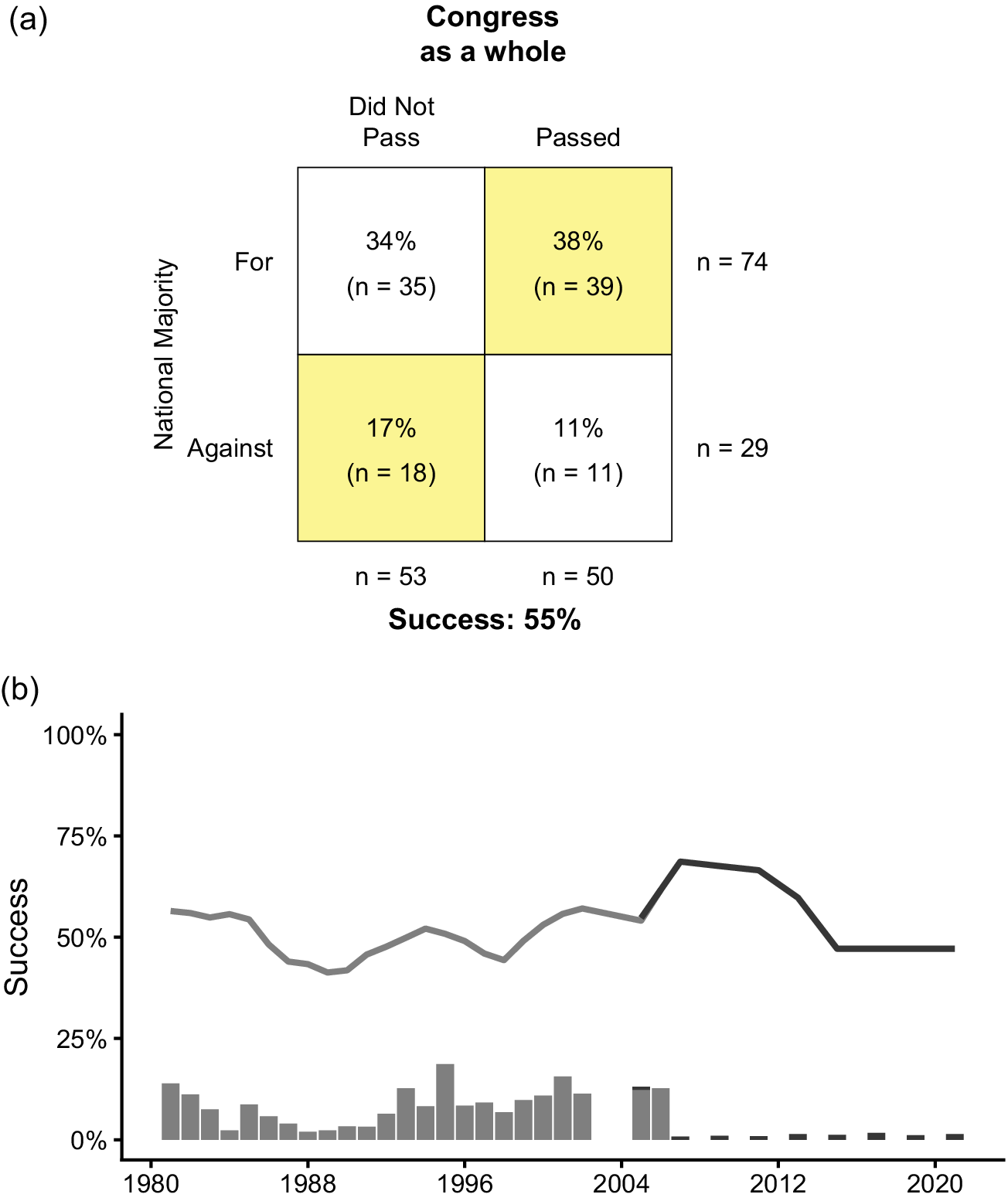
Figure 2 offers two views of collective representation, a static view and a dynamic one. The static view, shown on the left in 2a, pools all of the cases in our sample, ignoring trends or year-to-year variations. The dynamic view, shown on the right in 2b, measures the degree of collective representation in all bills in a given Congress (two-year period) using the CCES and Gilens data.
Representational Success
Note: In (a), cases include all 103 issues or bills, and “passed” indicates it passed in both chambers, unless the issue is a Senate-only confirmation vote. In (b), gray lines and bars come from Gilens (Reference Gilens2012); black lines and bars are our data. The line shows a four-year running average of representational success, defined as the final legislative outcome being congruent with the majority opinion. Year-averages are centered around the year the question is asked. Histograms show the relative sample size of questions (ibid) and policies tied to a bill per congressional session (our data) to indicate the coverage of the sample.

Consider, first, the static view. How often does Congress make decisions in line with the majority of people? Figure 2a presents the relationship between the level of public support for a bill and the outcomes of congressional decisions in tabular form. The columns of the table indicate whether Congress passed the bill or did not. In our sample, 49% of the bills passed the requisite chambers to become law. The rows indicate whether a majority of people supported the bill or did not: 71% of all bills were supported by a majority of people.
The relationship between public support and legislative decisions allows us to determine how much collective representation occurred. Instances of representational success are cases in which either (i) a majority of people supported the bill and Congress passed it or (ii) a majority of people opposed the bill and Congress did not pass it (equation (1)). About 38% of bills are cases in which a majority was for a bill, and it got through the requisite chambers (case i). Another 17% of bills are cases where a majority of people opposed the bill, and it died in one or both of the chambers (case ii). Combined, these cases result in a 55% rate of successful collective representation.
One concern is that these results are based on survey samples and naturally have some sampling error. The traditional sampling uncertainty in national support is small, with 95% confidence intervals around plus or minus half a percentage point. Even still, we allow for uncertainty in our estimates by replacing the binary distinction of popularity in equation (1) with the estimated probability that a majority supports the bill.Footnote 15 The intuition is that if the point estimate of public opinion on an issue is a bare majority such as 50.001%, we would like to give it around a 0.50 probability that the majority actually prefers it, rather than a 1. We find that all our subsequent results are robust to this coding.
Now consider, second, the dynamic perspective. We extended our collective representation measure back to 1981 by using data from Gilens (Reference Gilens2012), who collected public opinion on actionable policy items from the periods 1981–2002 and 2005–6. Unlike our data, the Gilens data are not linked to congressional bills so it does not reveal how each chamber dealt with each proposal. However, it does include enough information for us to compute representational success in the aggregate.Footnote 16 Figure 2b shows the trend in successful collective representation from 1981 to 2022 using the Gilens data for the first 20 years and CCES data for the second 20 years. Over the past 40 years, representational success hovered around 40% to 60%. If anything, the measure was higher in the 2000s than in the 1980s.
The Senate as Gatekeeper
For a popular bill to become a representational success, it must pass not only in one chamber but in two, the House and the Senate. Defeat can come at many different junctures in the legislative process, but the Senate is often thought to be the larger obstacle to collective representation.
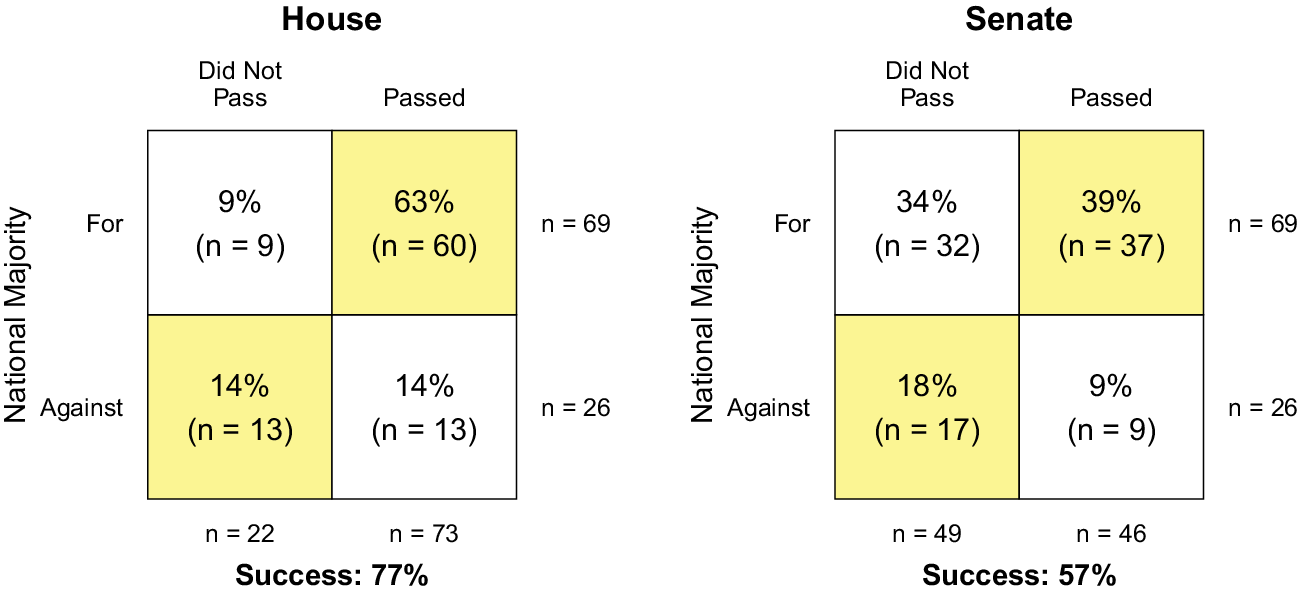
That indeed appears to be the case. In figure 3, we decompose the previous figure by comparing passage rates in each chamber evaluated against national support.Footnote 17 Consider the House of Representatives shown in the left panel. There are 69 issues that are supported by a majority of the nation. The House passed 60 (87%) of these. There are 26 issues that the nation opposed, and the House rejected 13 (50%). Combining these forms of representational success, the House made decisions that agreed with the majority of people on 73 of 95 bills that both chambers could have considered. In other words, successful collective representation occurred on 77% of these bills.
Differences in Representational Success by Chamber
Note: See figure 2. This figure limits the analysis to 95 issues that require both House and Senate approval.

This number is quite remarkable. Lengthy literatures describe the institutional impediments to collective representation, including committee vetoes, party agenda control, and gerrymandering of districts. Even still, the House aligns with the national majority 77% of the time on our measure. This is not to say that the scholars of committees and parties are wrong. Rather, they may have missed the important incentive that political leaders face. As Mayhew famously argued, the institutions of the House are created with electoral aims. Individual legislators want to remain in power; so too does the majority party. A reasonable strategy for the leadership of the majority party is to manage the congressional agenda to consist of bills that the party wants and that a majority of people want.
The Senate, shown in the right panel of figure 3, offers quite a different picture. Of the 69 bills supported by a majority of the nation, the Senate only passed 37 (or 54%). Recall that the House, by contrast, passed 87% of these same bills. The Senate, then, is a major obstacle to passing popular legislation. The Senate does block unpopular bills too. Of the 26 bills opposed by the majority of the public, the Senate rejected 17 (65%). Combining these two forms of representational success, the Senate made decisions that aligned with the public in only 57% of the bills.
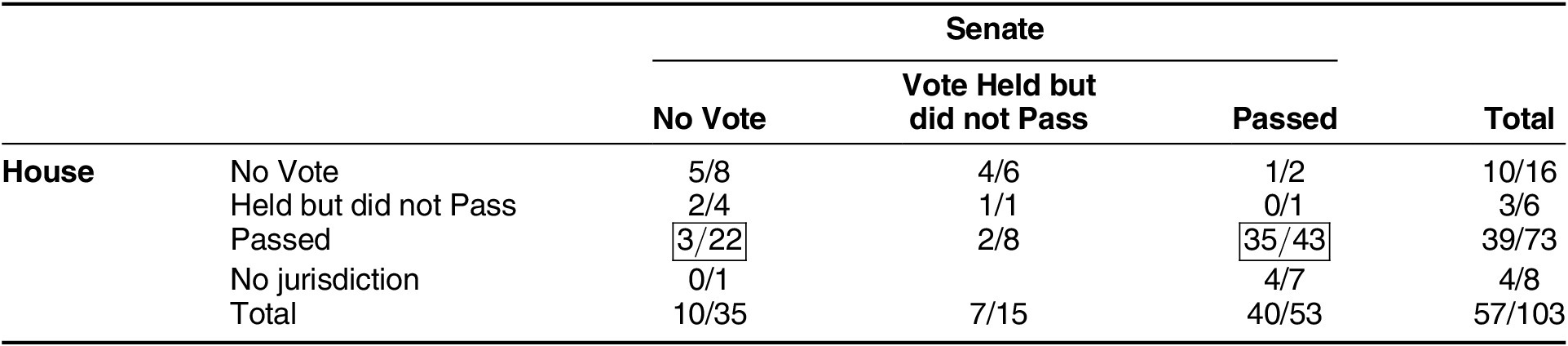
To see the bicameral nature of the legislative process more clearly, consider how each bill was decided in the House and the Senate. Table 1 shows whether each chamber of Congress held a floor vote, and if it did, whether the chamber passed the bill. The rows of the table correspond to the actions taken by the House, and the columns correspond to the actions taken by the Senate. We can see exactly how much of the difference in passage rates is due to bills not reaching the floor and how the two chambers jointly act on a given bill. Each cell of the table presents the number of cases of representational success as a fraction of the total number of cases in that cell. For example, the first cell of the table indicates that 8 of the 103 bills were cases in which neither the House nor the Senate held a roll-call vote. Of these eight bills, five were instances in which the majority of people opposed the bill (representational success), and three were instances in which the majority supported the bill (representational failure).
Success by House and Senate Action

Note: Cells are of the format “m/n” to indicate that there were $ n $
bills in that cell and m of them were representational successes. Only issues where both chambers had jurisdiction are included (i.e., we exclude Senate confirmations). The two most populated cells are highlighted by a border.
$ n $
bills in that cell and m of them were representational successes. Only issues where both chambers had jurisdiction are included (i.e., we exclude Senate confirmations). The two most populated cells are highlighted by a border.
Two-thirds of our cases fall into one of two cells. In the most populated bottom-right cell, 43 issues pass both chambers, and 35 of them are in line with the national majority. In the second-most populated cell, 22 issues pass the House but never get a vote in the Senate. Three of the 22 Senate inactions are representational successes in which the House sends an unpopular bill to the Senate and the Senate rejects it. Far more commonly, Senate inaction leads to representational failure. Overall, nearly half of the issues we study do not pass because of a lack of a recorded vote (16 + 35 − 8 = 43).Footnote 18 Sometimes, the Senate passes laws that the House vetoes, but this happens much less often. The prevalence of such inaction by the Senate has nontrivial methodological implications. Work that relies on floor-based measures such as NOMINATE would miss all these unheld votes.
How can we account for Senate inaction? What predicts whether the House says yes and the Senate says no? A natural suspect is the Senate’s own supermajority requirements. Senate leaders squeeze dozens of votes into precious floor time by an internal device called unanimous consent agreements, but a single rank-and-file senator can threaten to block that procedure. And 40 senators can sustain a filibuster on most legislation. These two internal rules mean that, in practice, votes of both parties’ senators are needed to pass most legislation in the Senate. Only in the Senate does the majority find minority pushback difficult to surmount (Smith Reference Smith2014).
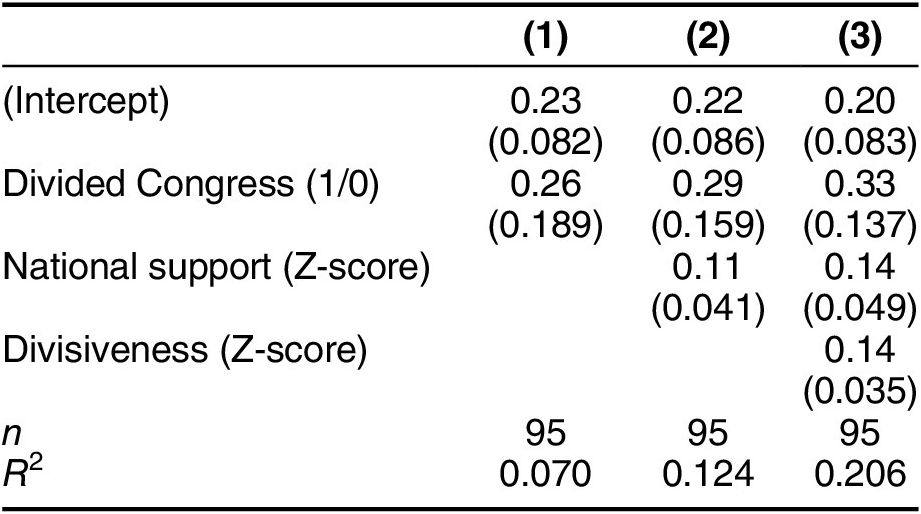
We estimated a regression predicting an issue falling into that outcome. Specifically, we estimated a linear probability model with time-clustered standard errors of the form
 $$ {Z}_i={\displaystyle \begin{array}{l}{\beta}_0+{\beta}_1\left({X}_i^{\ast}\right)+{\beta}_2\left({\mathrm{Divisiveness}}_i^{\ast}\right)\\ {}+\hskip2px {\beta}_3\left({\mathrm{Divided}\ \mathrm{Congress}}_{t\left[i\right]}\right)+{\varepsilon}_{it}\end{array}} $$
where $ {Z}_i=1 $
if issue
$ {Z}_i=1 $
if issue $ i $
is both passed in the House and not passed in the Senate (and 0 otherwise),
$ i $
is both passed in the House and not passed in the Senate (and 0 otherwise), $ {X}_i $
is the national support of the issue, Divisiveness follows equation (2), Divided Congress is an indicator for whether the House and Senate in congressional session
$ {X}_i $
is the national support of the issue, Divisiveness follows equation (2), Divided Congress is an indicator for whether the House and Senate in congressional session $ t $
are held by different parties, and an asterisk indicates Z-score standardization to zero mean and unit variance for ease of interpretation. We expect that popular issues will be passed by the House, that issues with high divisiveness will languish in the Senate, and that the two chambers will reach different conclusions when different parties hold a majority.
$ t $
are held by different parties, and an asterisk indicates Z-score standardization to zero mean and unit variance for ease of interpretation. We expect that popular issues will be passed by the House, that issues with high divisiveness will languish in the Senate, and that the two chambers will reach different conclusions when different parties hold a majority.
We find results consistent with these expectations (table 2). In a unified Congress, the House says yes and the Senate says no 23% of the time (column 1). A one-standard deviation increase in an issue’s national support is associated with a 14-point increase in that event, and a one-standard deviation increase in divisiveness increases the likelihood by a similar number (column 3). Divided Congress, national support, and divisiveness explain about 20% of the total variation. Popular and divisive issues proposed under a divided government are the most likely type of issues to languish in the Senate.
Issues that Pass in the House and Fail in the Senate

Note: Outcome is 1 if the bill passed the House and died in the Senate; 0 otherwise. Each column is an OLS regression with standard errors clustered by Congress shown in parentheses.
Three findings thus far merit emphasis. First, in 55% of the issues studied, Congress did what a majority of people wanted it to do. That is the rate of collective representation in the contemporary Congress. Analysis of the 1981–2022 policies from Gilens (Reference Gilens2012) shows similar levels of representation despite differences in scope. Second, the Senate appears to be the larger obstacle to majority rule in the Congress. The Senate only aligns with majority opinion on 57% of our decision agenda, and the Senate’s defeat of popular legislation accounts for most of the misalignment between the House and Senate. Third, one correlate of Senate inaction is the partisan divisiveness of the issue, as measured by where the party bases stand. However, this quantitative regression only explains a fraction of the total variation in representational success.
Popularity and Divisiveness, and the Fate of Bills
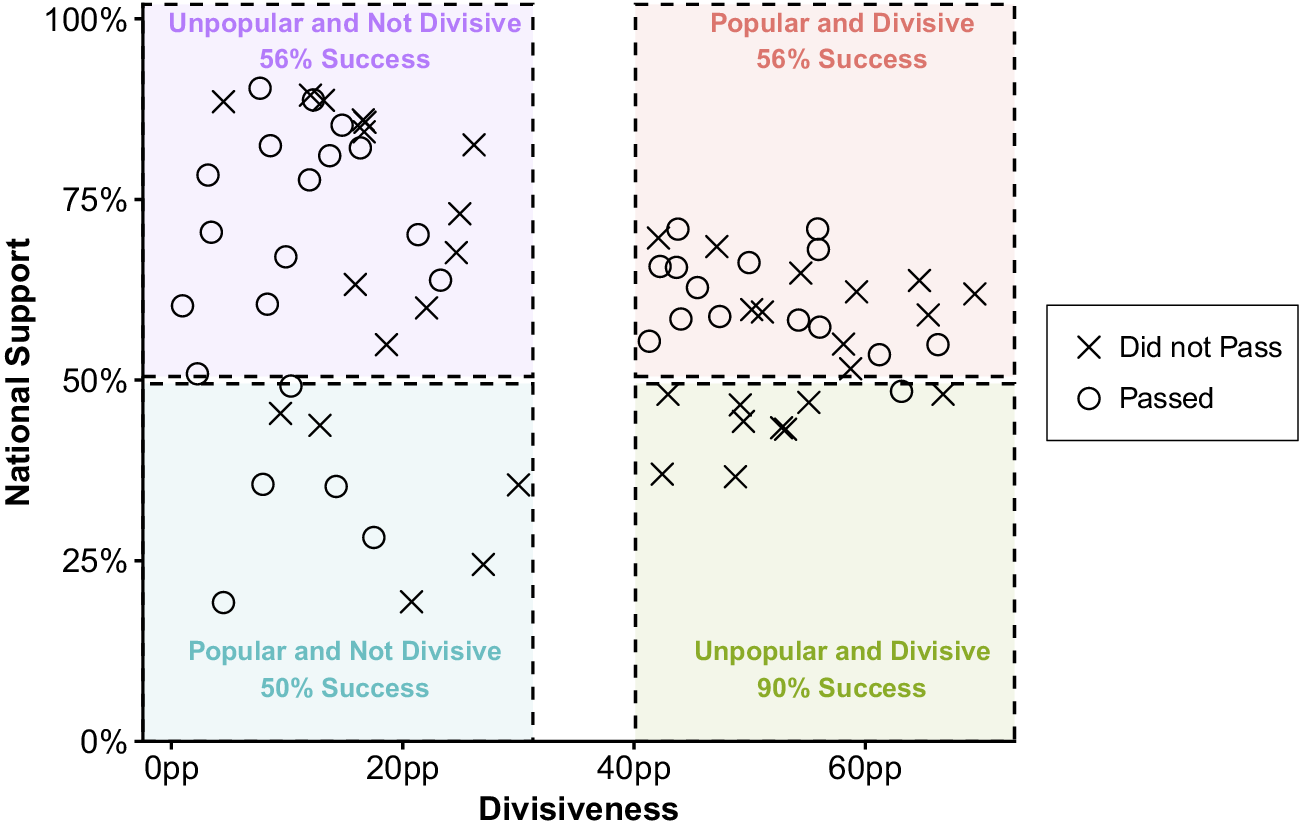
Clearly, popularity and divisiveness predict what bills tend to get through the House and the Senate. The exact conditions, however, are nuanced. To see this, consider four circumstances based on whether a bill is popular and whether it is divisive in the public.
We divided our issues into four categories: popular and divisive, unpopular and divisive, unpopular and not divisive, and popular and not divisive.Footnote 19 Figure 4 reproduces figure 1 but colors issues by this 2-by-2 classification and also marks each issue by its ultimate passage.
Popularity, Divisiveness, and Passage
Note: Issues that have borderline levels of support and in the middle quintile of divisiveness are excluded.

Three of the four quadrants have passage rates that are quite similar to each other. The regression model in our previous section might predict that issues that are both popular and not divisive will become representational successes, but this top-left quadrant has a 44% failure rate. Similarly, our quantitative model would predict that popular and divisive issues would fail, but they actually pass more than half the time. This led us to examine the legislative histories of each quadrant more closely. We start with popular and divisive issues and proceed clockwise.
Popular and Divisive Issues
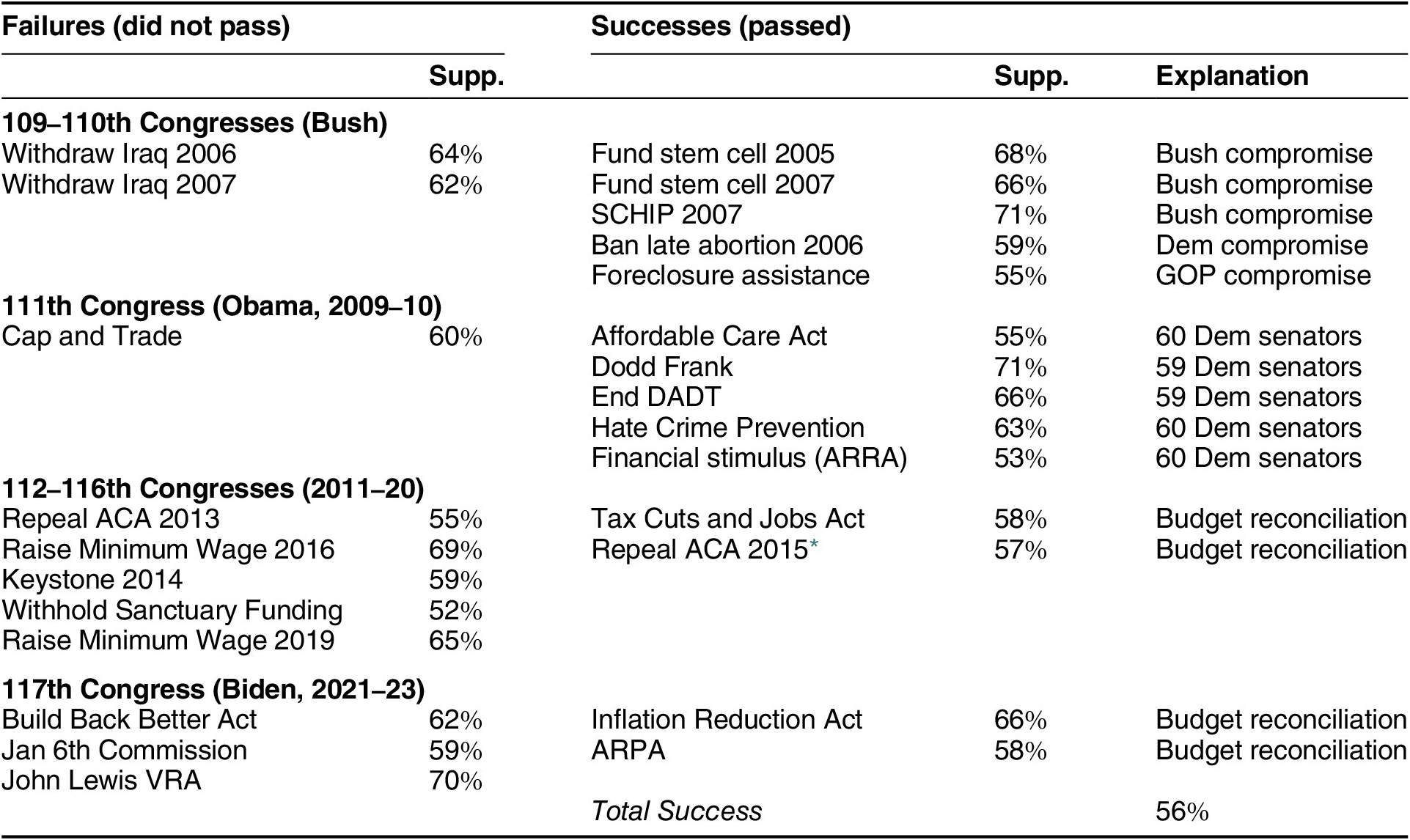
Among the 25 issues that are popular and divisive (top-right quadrant of figure 4), more than half pass and thus become representational success. What explains the unexpected degree of passage in this subset of issues?
An examination of the bills in the data reveals that all of the unexpected results can be attributed to one of three ways in which Congress can, at times, bypass the Senate’s supermajority requirement. Table 3 separates these popular and divisive issues by their ultimate outcome: failure (i.e., no passage) on the left column and unexpected success (i.e., passage) on the right column. An explanatory note accompanies the entries in the right column.
The Fate of Popular and Divisive Issues

Note: Issues are divided by Congress and then into those that did not pass (left) and those that did pass (right). The Supp. columns indicate national support.
* One issue, the ACA repeal in 2015, passed in Congress but was promptly vetoed by President Obama.
All of the counter-expectation results after 2011 are due to special exceptions to the filibuster, known as budget reconciliation. The Congressional Budget Act of 1974 stipulated that bills introduced to meet final budget resolutions are only granted limited time for debate on the floor and are not subject to a Senate filibuster. Budget reconciliation can only be used sparingly because it must be tied to a budget resolution.Footnote 20 Using this route, the 2017 Tax Cuts and Jobs Act, supported by 58% of the public (but only supported by 38% of Democratic respondents), passed the Senate over the objection of all 48 Democratic senators. A Democratic Congress passed the Inflation Reduction Act over the objection of all 50 Republicans in 2022, again under budget reconciliation. Negotiations over what goes into reconciliation are a major part of Senate politics (Reynolds Reference Reynolds2017; Valelly Reference Valelly, Jenkins and Patashnik2016). Intraparty disagreements can still doom such attempts.
The second time the Senate passed divisive bills was during the 111th Congress, when Democrats had a filibuster-proof majority for some time. The six most popular issues under this Congress were all divisive. However, Senate Democrats managed to pass all but one of these issues, largely because they secured 60 seats mid-session, from June 2009 when Al Franken (D-MN) was seated until January 2010 when Scott Brown (R) won the Massachusetts seat. The signature example of this was the Affordable Care Act. There were exceptions: Senate Democrats could not pass the Cap and Trade environmental bill that passed by the House because of internal objections within the conference. They also passed at least three major bills with just enough Republican senators to reach 60 votes.Footnote 21 In this short window, the majority prevailed in this Congress largely because they had enough members to overcome the filibuster.
The third time the Senate passed divisive bills was during George W. Bush’s second term. He compromised on Republican priorities, including the Democrat-backed funding of stem cell research that angered pro-life Republicans (but was popular overall) and an expansion of the State Children’s Insurance Program (also popular overall). The bipartisan maneuvering by Bush is consistent with the analysis in Gilens (Reference Gilens2012, chap. 7), which found that Bush’s tenure was one of the high points of representational success in his timespan.
These exceptions, then, effectively prove the rule: the Senate filibuster is a major barrier to majority rule. The 111th Congress under Obama’s first term is the only time since 1976 that a single party held a filibuster-proof majority, and that is precisely the high point of representational success in figure 2b. The only other way popular and divisive issues got through the Senate in the post-Bush era was through skirting the filibuster through a carve-out.
Unpopular and Divisive Issues
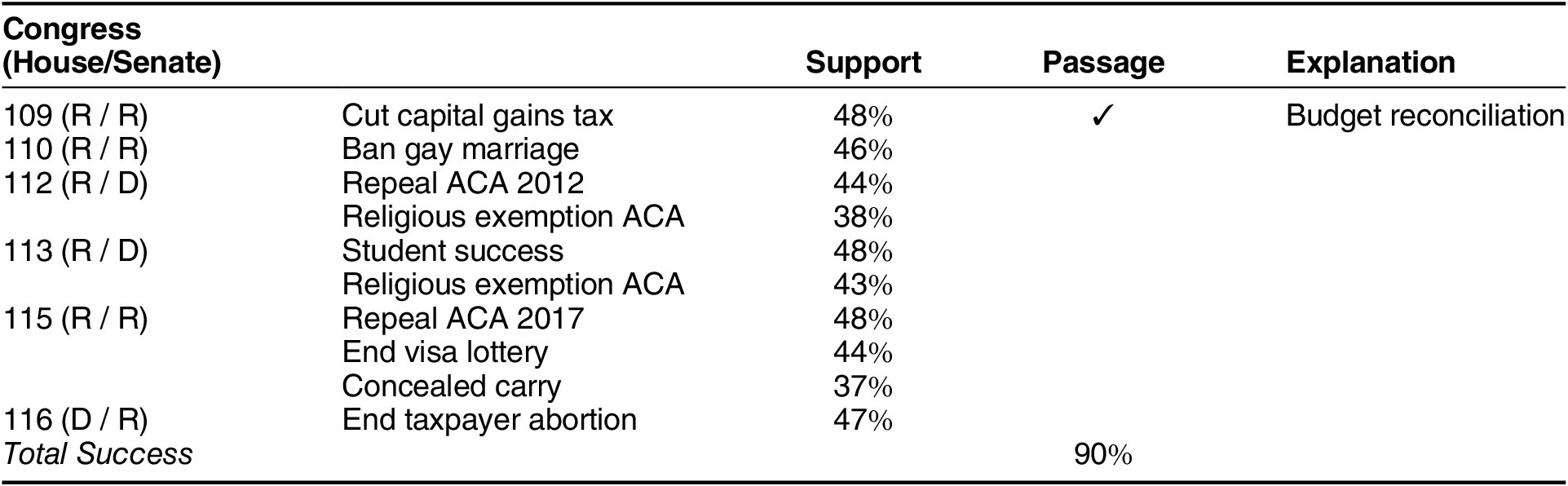
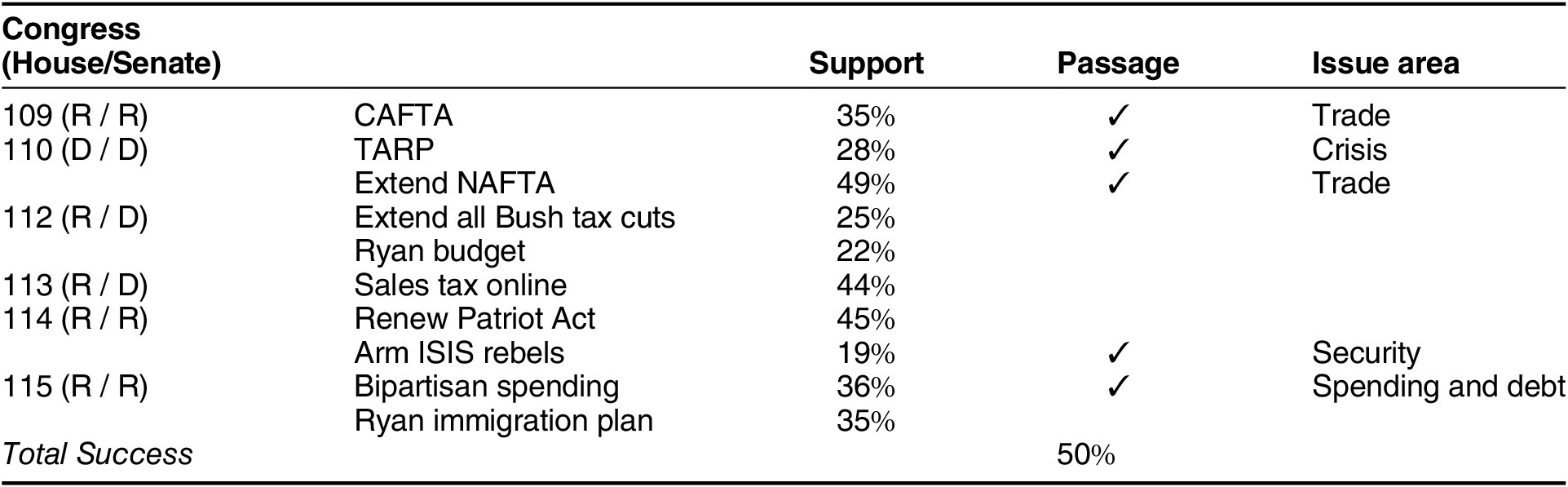
The Senate is a formidable roadblock for popular issues, but the same conservative tendencies of its rules can facilitate representation when the issue is unpopular. Ten issues in our dataset were highly divisive but were opposed by the majority of the nation as a whole, due to tepid support by independents and opposition party members. Table 4 enumerates each one in chronological order.
The Fate of Unpopular and Divisive Issues

Note: The Congress column lists the party control of the House and then the Senate. Support indicates national support.
One striking commonality in these unpopular and divisive issues is that they are all Republican-led. This is likely not a coincidence or an artifact of biased question wording. Hacker and Pierson (Reference Hacker and Pierson2020) demonstrate that the issues in the Republican party agenda during this time were relatively unpopular. Yet, they enjoyed majority support among Republican voters when Republicans held a majority in at least one chamber.
Nine of these ten divisive and unpopular issues failed to pass and are thus counted as representational successes. In all nine cases, either the Senate refused to take up the bill (as in the move to repeal the ACA in 2012), or it voted the bill down (as in the repeal of the ACA in 2017). The one time the Senate let an unpopular policy pass was when budget reconciliation was invoked. In 2006, Republicans passed a cut to the capital gains tax (supported by 48% of the public) with budget reconciliation over the objection of 41 Democratic senators. This is the one time in our data when budget reconciliation was used to pass an unpopular policy. The Senate’s aversion to divisive bills acts as a double-edged sword. It blocks both popular bills (representational failure) and unpopular ones (representational success).
Unpopular and Not Divisive Issues
Turning clockwise on figure 4, we examine issues that are both unpopular and not divisive. These are issues that both party bases do not like. It includes 10 issues covering free trade, tax cuts, and budget expenditures (table 5). The ex ante prediction here is unclear. We expect the House to vote down unpopular bills, but the lack of a partisan divide means that it is more likely to pass in the Senate.
The Fate of Unpopular and Not Divisive Issues

Note: Congress column lists the party control of the House and then the Senate. Support indicates national support.
The representational success rate of these unpopular and not divisive issues is a coin toss at 50%. That is, both chambers of Congress passed half of these unpopular issues despite public opposition: a free trade deal, committing US military abroad to the Middle East, assistance to Wall Street executives in 2008 to stop a financial meltdown, and a bipartisan budget logroll in Trump’s first term that would have added $120 billion to the budget. In the other half of cases, one or both chambers of Congress blocked the bill. It does appear that many of the issues in this quadrant are issues of diplomacy, war, and crisis, a theme to which we return.
Popular and Not Divisive Issues
The final quadrant, popular and not divisive issues, should be the easiest path to representational success. These are issues that both Democratic and Republican voters prefer to the status quo.
Some of these issues sail through after committee deliberation: the Violence against Women’s Act and Sanctions against Iran are prominent examples. Two of the Biden administration’s most explicitly bipartisan bills also fall into this category: the 2021 infrastructure bill and the modest gun control bill in 2022 following the Uvalde school shooting. However, 56% is not much better than a coin toss.
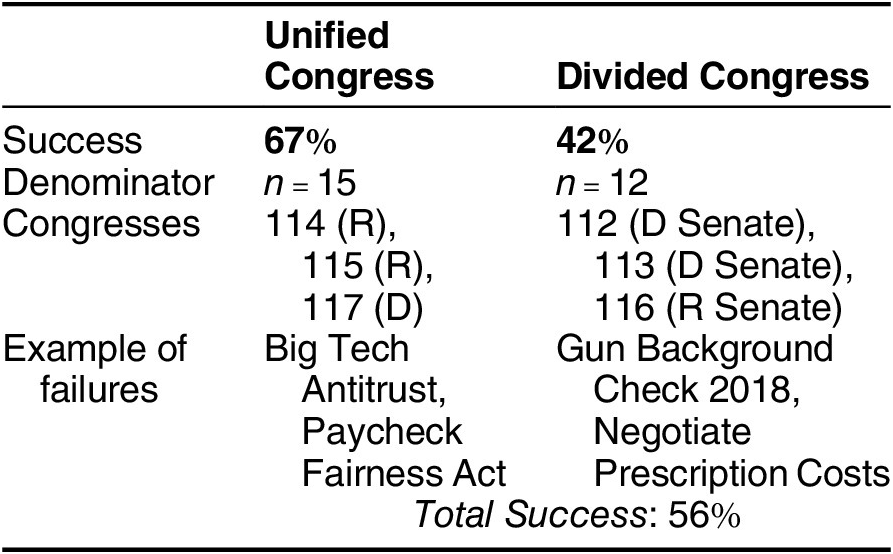
One contextual factor that clearly correlates with success in this subset of popular and not divisive issues is simply whether the control of the two chambers is divided. Table 6 takes these 27 issues and compares the representational success rate when the same party held the majority in both chambers to when Republicans and Democrats held different majorities. Close to two-thirds of these issues in unified Congresses became a representational success compared to only 4 in 10 of those in divided Congresses. Divided government has more explanatory power than other potential explanations. This finding is consistent with Binder (Reference Binder1999)’s analysis of congressional enactments from 1953 to 1996.
The Fate of Popular and Not Divisive Issues

There were two phases of a divided Congress in our timespan. First, from 2011 to 2014, Democrats held the Senate (and the White House), and Republicans held a majority in the House. Democrats in the Senate routinely blocked bills passed by the Republican House, including the Keystone pipeline and a ban on late-term abortion. Republicans won unified control of the House and Senate in the 2014 election.
Second, from 2019 to 2021, Democrats held the House, and Republicans held the Senate and the White House. This Congress was the only time in which Pelosi and McConnell were simultaneously leaders of the majority. Ten bills in the CCES were supported by the majority of Americans at this time. Several of the Democrat-led issues that came from the House this session were popular with Republican voters. Bills to require a background check for purchasing a gun, to allow negotiation of prescription drug prices, and to mandate equal pay for men and women were supported by more than 90% of Democratic voters and 80% of Republican voters. The other bills coming from the House during this time were polarizing. Regardless of their level of divisiveness, nine of the ten issues passed the House but died in the Senate, including President Trump’s first impeachment. The exception was the CARES Act, a response to the COVID crisis in March 2020 that passed the House and Senate overwhelmingly.
Issues that are popular and do not divide the parties do rise to the agenda for one reason or another, but divided government treats them differently. A situation of dueling chambers led by different majority parties is generally bad news for representational success for such seemingly uncontroversial issues.
Reasons for Collective Representation Failure
The literature on representation offers many reasons why collective representation could fail. We examine three important hypotheses here.
Senate Malapportionment
Perhaps the most widely noted electoral obstacle to representation is the malapportionment of the Senate. Dahl (Reference Dahl2003) identified the Senate as one of the nation’s least democratic institutions. That criticism remains relevant today (Levitsky and Ziblatt Reference Levitsky and Ziblatt2023). Members of Congress see national opinion filtered through the lenses of their own electoral constituencies. The unequal representation of state populations in the Senate might skew legislative decisions in the direction of whichever party or ideology is disproportionately concentrated in smaller states.
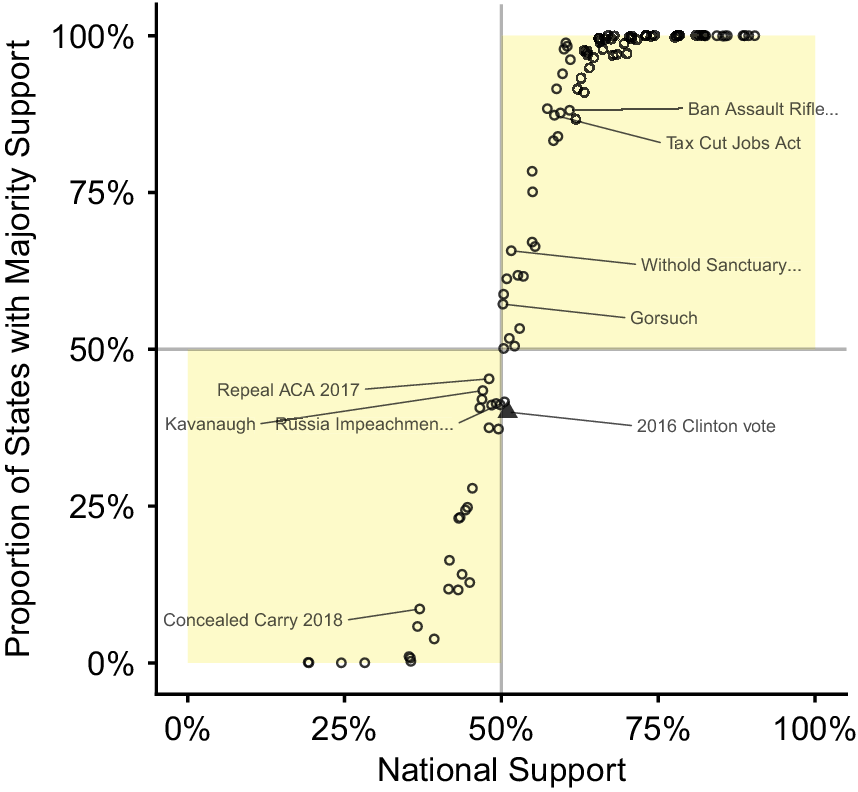
We test this claim by measuring how states aggregate national opinion. For each bill, we computed the national support for each issue and the proportion of states in which the majority of a state’s constituents support the issue.Footnote 22 The relationship between these, shown in figure 5, is the seats–votes curve, but for issues. We provide a summary of this methodology in appendix A.
The Limited Consequence of Senate Malapportionment
Note: Each circle is an issue. The black triangle represents the popular vote and states won by Hilary Clinton in 2016, for comparison.

Issues that are popular nationally almost always have the backing of a majority of states. Similarly, issues that are unpopular nationally almost always lack such support. Another feature of this seats–votes curve for issues is that it is highly majoritarian. Whichever side has the most support nationally (in favor or against the bill) is magnified by the states, as shown by the steep slope in figure 5. In this respect, we find weak evidence that the electoral system itself aggregates people’s issue preferences in a way that biases the Senate away from national majorities.
The aggregation of issues is distinct from the aggregation of partisan election results. The triangle in figure 5 represents the equivalent seats and votes in the 2016 presidential election, in which Hillary Clinton won 51% of the two-party popular vote but won majorities in only 40% of the 50 states. There is bias against Democrats in the electoral seats–votes curve of several percentage points that might create an indirect distortion by favoring one party over the other (Mayhew Reference Mayhew2011). However, public opinion in small states must be sufficiently different from that in large states for malapportionment to distort collective representation, and our findings suggest that such differences are relatively small.Footnote 23
This finding complicates the common way political scientists have assessed the representational harms of Senate malapportionment. The malapportionment hypothesis is that the decisions the Senate reaches would be different if it represented population, rather than states. The seats–votes curve indicates that may not be the case.
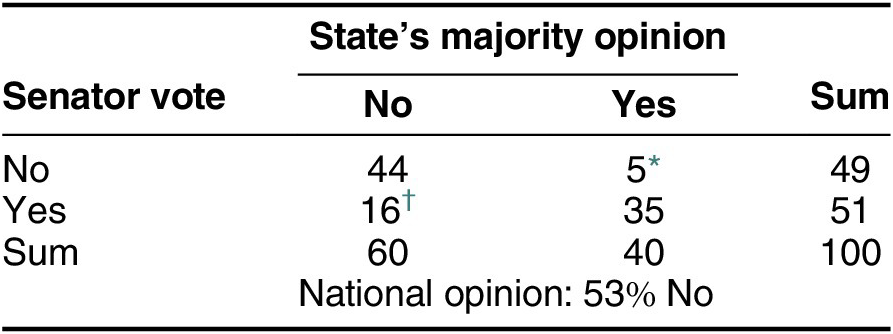
The vote to confirm Brett Kavanaugh to the Supreme Court gives an illustrative example (table 7). Other analyses of this case argue that this was a consequence of malapportionment (Johnson and Miller Reference Johnson and Miller2023). The usual method for such analyses is to weight each senator’s vote according to state population (Eidelson Reference Eidelson2013; Evans Reference Evans2025; Johnson and Miller Reference Johnson and Miller2023). On this vote, 51 of 100 senators voted yes, even though their states collectively represented only 44% of the country. However, in this example, the states actually magnify the public opposition to Kavanaugh from 53% against to 60% against.
Malapportionment and Roll-Call Voting: The Kavanaugh Vote

Note: An illustrative example of public opinion and roll-call votes for the issue of appointing Brett Kavanaugh to the Supreme Court.
* Jones (D-AL), Donnelly (D-IN), McCaskill (D-MO), Tester (D-MT), Heitkamp (D-ND).
† Sullivan (R-AK), Flake (R-AZ), Kyl (R-AZ), Gardner (R-CO), Rubio (R-FL), Perdue (R-GA), Isakson (R-GA), Collins (R-ME), Burr (R-NC), Tillis (R-NC), Heller (R-NV), Portman (R-OH), Toomey (R-PA), Cornyn (R-TX), Cruz (R-TX), Johnson (R-WI).
The problem with the usual method is that weighting each senator’s votes conflates the preferences of the population in the states with the actions of the senators. Weighting public opinion by the state’s voting power shows no incongruence between the opinion of states and the opinion of the nation. Rather, the violations of representation are at the dyadic level. Sixteen Republican senators, many from large states, voted against their constituents by voting no. Five Democratic senators also voted against their constituents by voting yes—incidentally, all five would go on to lose reelection.
Malapportionment does have distortionary effects in the legislature, elevating the power of small-state senators in congressional logrolling (Lee and Oppenheimer Reference Lee and Oppenheimer1999). However, its effect on representational success is not as obvious.
Domestic vs. Foreign Policy
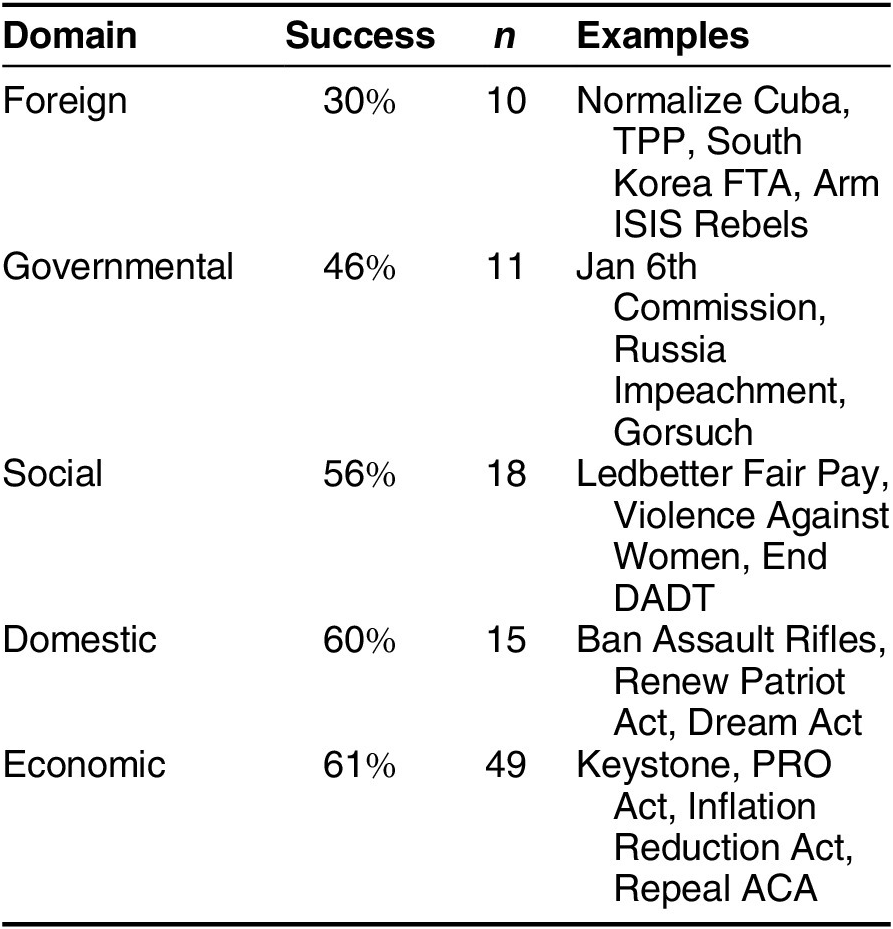
A second important claim about the context within which collective representation succeeds and fails is that the nature of the issue matters. In their classic study, Miller and Stokes (Reference Miller and Stokes1963) compared civil rights, domestic economic policy, and foreign affairs, finding that the degree of dyadic representation between representatives and their voters was the highest for civil rights and the lowest for foreign affairs. Subsequent work has focused on this distinction. We classified issues into foreign, economic, social (e.g., abortion), other domestic, and governmental (e.g., appointments, internal rules) issues to test whether the nature of the issues matters (table 8).
Foreign and Domestic Policy

Foreign policy is, indeed, a domain with high rates of representational failure. The important foreign issues on the decision agenda were nationally unpopular. Many of the unpopular and not divisive issues in table 5 are foreign policy issues and financial or fiscal crises. Nonetheless, many of these bills passed, resulting in a low rate of representational success of 30%.
Foreign policy may, however, be the domain in which the trustee model of representation is most active. Considerable expertise and secure information are required to navigate international relations, and Congress often defers to the president, even when doing so runs against the opinion of its constituents. Foreign policy does help explain a number of representational failures, but it is not a primary explanation of representational failures because nine in ten of the issues we study are in domestic policy.
The most common domain is domestic economics. It is the arena of legislation in which one might expect high rates of representational failure, because affluent people are thought to have disproportionate influence (Bartels Reference Bartels2016; Gilens and Page Reference Gilens and Page2014; Hacker and Pierson Reference Hacker and Pierson2020; Witko et al. Reference Witko, Morgan, Kelly and Enns2021; but also see Brunner, Ross, and Washington Reference Brunner, Ross and Washington2013; Lax, Phillips, and Zelizer Reference Lax, Phillips and Zelizer2019). Only a handful of the bills in our dataset benefit the exclusively wealthy, however, and most benefit a wide range of interests: they cannot be coded as clearly benefiting narrow interests or wide interests. The power of narrow financial interests may be best evaluated by studying the agenda setting and logrolling process (Hacker and Pierson Reference Hacker and Pierson2010; Witko et al. Reference Witko, Morgan, Kelly and Enns2021). Somewhat surprisingly given the literature, economic issues have the highest rate of representational success.
Anticipating Future Opinion
A third possible explanation for our findings is time. Public opinion about a bill may evolve as people learn about an issue or experience the effects of a law. For their part, politicians may respond to public opinion not only today but also in the future (Arnold Reference Arnold1992; Canes-Wrone, Herron, and Shotts Reference Canes-Wrone, Herron and Shotts2001). Mansbridge (Reference Mansbridge2003) calls this anticipatory representation. For this argument to explain the deviations from collective representation that we observe, it must be the case that (i) opinion shifts considerably over time and (ii) congressional decisions align more strongly with future opinion than with current opinion.
The CCES does capture dynamic shifts in the agenda because some issues persist on the decision agenda for multiple Congresses. Raising the minimum wage and the ACA repeal, for example, are each featured four times as separate issues in our data. As an empirical matter, few of the issues polled on the CCES for multiple years exhibit strong overtime shifts in popularity (appendix A). Hopkins (Reference Hopkins2023) shows that public opinion on the ACA did not change even after the rollout of the policy’s benefits and was rarely moved by experiments that framed the policy one way or the other. This is consistent with other studies of public opinion over time, which show that national opinion tends to be highly stable and shifts only moderately and in predictable ways (Page and Shapiro Reference Page and Shapiro1992; Stimson Reference Stimson2015). It seems unlikely, then, that future opinion differs sufficiently and on a large enough number of issues from current opinion to explain most of the failures of representation.
Do congressional decisions align more with future opinion than with contemporary opinion? Answering that question requires a much more complex study than even the CCES can afford. The case of the bill to repeal the ACA, however, is instructive. Repeal of the ACA was considered in four Congresses from 2011 to 2019. Support for repeal fluctuated over time. A majority of people opposed repealing the ACA in 2012, and the repeal bill did not pass the 112th Congress (a representational success). By 2014, repeal had gained support nationally and was favored by 55% of the public, but Congress did not pass it (a representational failure). Repeal remained popular in the 114th Congress, and the House and Senate passed it (a representational success). President Obama, however, vetoed the repeal bill. Following the 2016 election, with unified Republican control of Congress and the White House, support for repeal finally began to wane (Hopkins Reference Hopkins2023). Congress again failed to pass the repeal bill, but by then repeal was unpopular (a success). Based on contemporaneous opinion, there are three instances of representational success and one of failure.
Theories of anticipatory representation rest on assumptions about legislators’ time horizon. Congressional scholars usually assume legislators look ahead to the next election (Arnold Reference Arnold1992). On that metric, the rejection of repeal in the 112th Congress was a representational failure because opinion shifted in the coming year in favor of repeal. Likewise, the decision to reject repeal in the 113th would be considered a representational failure because repeal remained popular through 2016. And the passage of repeal in the 114th Congress would be a representational failure because opinion swung in opposition to repeal in the following Congress. Only the rejection of repeal in the 115th Congress would be considered successful anticipatory representation, because in 2017 and years since a majority has opposed repeal of the ACA. An alternative perspective takes a much longer time horizon. Since 2017, majority opinion has consistently opposed repeal of the ACA. Taking that as the long-run opinion, there are three instances of successful representation of future opinion (112, 113, and 115), the same number as with the contemporaneous opinion.
Political scientists are early in the exploration of time and representation. This is clearly a fruitful area for inquiry, but it involves fuller development of the theory and will bring new complications in data collection and research design greater even than those tackled by the CCES.
Conclusion
Collective representation expresses how well Congress, as a collective body, decides on issues where collective decision making is difficult. It may be impossible for one legislator to represent 400,000 people, Weissberg (Reference Weissberg1978, 547) conjectured, but it may “be possible for 435 legislators to represent more accurately the opinions of 220,000,000 citizens.” Whether they do is an important gauge of how representation works in American democracy. We have offered one of the few systematic empirical studies of collective representation in Congress and the first such effort to describe the twenty-first-century Congress.
On 103 key decisions that Congress faced over the past two decades, the House and the Senate sided with the majority public opinion on 55%. To many, the 55 percent figure falls far short of a democratic ideal. One would hope that in a democratic society, the legislative branch would vote with the majority of the public nearly all of the time. Yet, the US Congress aligns with the people on only half of these legislative proposals.
Alternatively, viewed through the lens of the US Constitution, 55% seems like quite a strong showing. Separation of powers, bicameralism, and a system of checks and balances make for a legislative process with many points at which a bill can be blocked. Madison advocated for national majorities to set policy but acknowledged that short election cycles would enable capture by a momentary majority (Weiner Reference Weiner2012). The Federalists argued that Congress should be designed not only to reflect the popular will but also to be a deliberative body. Those arguments were reflected in a House and a Senate that would encourage a multiplicity of claims to representing the people (Garsten Reference Garsten, Shapiro, Stokes, Wood and Kirshner2010). Any law would have to satisfy a majority of people and a majority of states; it would have to be approved by whatever coalition or party governed the House as well as a different coalition governing the Senate; it would have to go through two different legislative processes and face scrutiny from different sets of legislators. Issues that can pass all the hurdles of the legislative process, then, perhaps have a stronger claim to representing the public will.
In fact, that is exactly what happens. Consider the bills that made it through the congressional maze and passed the House and the Senate. With the exception of one presidential veto, all of these bills became laws. Four in every five—80%—of these laws had the support of the majority of the nation (table 1). The end result of this complicated legislative process, then, is a set of laws that are widely supported by the nation.
This result gives rise to a puzzle. How can 55% of the bills be instances of successful collective representation, while the majority of people supports 80% of bills that were passed? The answer lies with the bias against unpopular and divisive legislation built into electoral and legislative institutions. In this respect the US Senate serves important and, we think, underappreciated functions. It blocks bills that are highly divisive. Many of these bills were passed by the House and supported by a majority of the public, so the Senate contributes more to representational failures than the House on our measure. But a bill that is highly divisive can never be overwhelmingly popular (or unpopular).Footnote 24 The upper chamber, because it is more insulated from party swings in elections, can serve as a counterweight to the majority party in the House. The Senate has also created internal rules that require the minority party to pass most legislation. As a result, bills that do not have bipartisan appeal face high hurdles. That check is essential when an issue splits the nation along partisan lines or is outright unpopular. The end result is that the laws that Congress does pass tend to be both popular and not divisive.
Supplementary material
To view supplementary material for this article, please visit http://doi.org/10.1017/S1537592725101916.
Acknowledgments
We thank Sarah Binder, Mia Costa, Anthony Fowler, Justin Grimmer, Jacob Hacker, William Howell, Kim Moxley, Rob Oldham, Jon Rogowski, Lynn Vavreck, Chris Warshaw, Adam Zelizer, three anonymous reviewers, participants in the Yale ISPS workshop, the Chicago Harris American Politics Conference, APSA, and seminar participants at George Washington University, Columbia University, and University of North Carolina Chapel Hill for their comments and suggestions on earlier versions of this article. We thank Sarah Binder for suggesting Kingdon’s terminology to describe the agenda. We thank Emma Nye and Samad Hakani for research assistance.
Data Availability
Data and code to reproduce the findings in this article are available in Dataverse (Ansolabehere and Kuriwaki Reference Ansolabehere and Kuriwaki2025, https://doi.org/10.7910/DVN/E0AWRD).




 Open access

