

Introduction
High courts employ legalistic writing, procedures, and symbols to shape public acceptance of their decisions and institutional legitimacy (Black et al., Reference Black, Owens, Wedeking and Wohlfarth2016; Gibson, Lodge and Woodson, Reference Gibson, Lodge and Woodson2014). As part of their public affairs management, courts carefully determine the content of political information that is delivered to citizens. For example, the United States Supreme Court (USSC) only allows for transcripts and audio recordings of oral hearings, rather than video or photos.
USSC justices are notably resistant to allow cameras into the court and view the lack of media involvement in proceedings as necessary to maintain public legitimacy (Tong, Reference Tong2006). On the other hand, the US Congress regularly introduces legislation that claims media coverage in courtrooms is important for transparency and public awareness.Footnote 1 Though the policy debate over the use of cameras is strongly contested, there is little evidence to suggest that audio or video recordings are more detrimental to high courts’ legitimacy than written transcripts.
To test whether informing the public of high court proceedings via text, audio, or video shapes judicial legitimacy, we conduct survey experiments with samples from the United States and United Kingdom. We select these countries so we can gather insights from a context that uses video to understand a context that does not, while being able to experimentally manipulate the medium through which respondents are exposed to court proceedings.
We find that the method of delivery is not associated with evaluations of high court legitimacy in the manner that we expect for either country. We show that these null effects hold even when varying the judge’s emotional intonation and depictions of the judge’s politics. Our results demonstrate how information about judicial behavior impacts the public’s attitudes toward high courts, contributing a new perspective to existing scholarship regarding individuals’ reactions to viewing judicial proceedings (Black et al., Reference Black, Johnson, Owens and Wedeking2024; Cann and Goelzhauser, Reference Cann and Goelzhauser2024). Overall, the evidence speaks to the role that oral proceedings play in courts (Johnson, Reference Johnson2004), the role of politicians and media cues in shaping judicial attitudes (Hitt and Searles, Reference Hitt and Searles2018; Rogowski and Stone, Reference Rogowski and Stone2021), as well as the dynamics of court legitimacy (Gibson and Nelson, Reference Gibson and Nelson2014).
Court legitimacy and audio–visual information
Courts often transmit information to the broader public about their decision-making process, such as minutes and transcripts of the proceedings or written summaries of case outcomes. For instance, the USSC provides written transcripts and audio recordings of oral proceedings for the public, while the the Supreme Court of the United Kingdom (UKSC) provides video streaming. We focus specifically on three modes of transmission: text, audio, and video. We anticipate that different technological mediums provide different information to the public, and that this may be associated with different attitudes toward the court.
For their part, judges are highly attentive to the impact that their behavior has on how the public and other political actors perceive courts. This stems from an institutional dependence on legitimacy as a source of power (Gibson and Nelson, Reference Gibson and Nelson2014) and the constraints that other branches of government place on courts (Clark, Reference Clark2010; Graham, Reference Graham, Howard, Randazzo and Reid2023). Judges strategically craft opinions with an eye toward how they will be viewed by other judges (Corley, Collins and Calvin, Reference Corley, Paul M. and Calvin2011) and external actors (Black et al., Reference Black, Owens, Wedeking and Wohlfarth2016; Hanretty, Reference Hanretty2020).
We know these efforts matter; the public is responsive to the public-facing actions of judges (Krewson, Reference Krewson2019). Further, people react to depictions of judicial behavior by the media and politicians (Hitt and Searles, Reference Hitt and Searles2018; Rogowski and Stone, Reference Rogowski and Stone2021). Specifically, individuals exhibit a preference for fair decision-making procedures (Baird and Gangl, Reference Baird and Gangl2006), legalistic judicial behavior (Gibson and Caldeira, Reference Gibson and Caldeira2009; Krewson and Schroedel, Reference Krewson and Schroedel2020; Rivero and Stone, Reference Rivero and Stone2025), and principled rather than political depictions of judges (Hitt and Searles, Reference Hitt and Searles2018). When the public views decisions from the court as political rather than legalistic, support for decisions and perceptions of fairness decline (Magalhães et al., Reference Magalhães, Skiple, Pereira, Arnesen and Bentsen2023). Similarly, “sensational” news coverage is associated with less long-term support compared with “sober” coverage (Johnston and Bartels, Reference Johnston and Bartels2010).
In comparison to text, we know that vocal pitch contains important signals about politics. From the perspective of political actors, “vocal pitch is consistent with legislators’ issue commitments” (Dietrich, Hayes & O’Brien, Reference Dietrich, Hayes and O’Brien2019, 958), and vocal pitch is predictive of judges’ voting behavior (Dietrich, Enos and Sen, Reference Dietrich, Enos and Sen2019). From the perspective of the general public, people are typically perceptive to the sentiment conveyed in auditory political messages in ways that they are not when reading text (Cochrane et al., Reference Cochrane, Rheault, Godbout, Whyte, Wong and Borwein2022). Thus, we expect that when holding the issue and context constant, individuals exposed to the audio of court proceedings will receive stronger political and weaker legalistic cues, which may lower their evaluation of the institution.Footnote 2
H1: In comparison to respondents who read transcripts of court proceedings, respondents who listen to court proceedings should grant courts less legitimacy.
We anticipate that video, because it includes audio with visual cues, provides additional information that may impact individuals’ perceptions of court proceedings and legitimacy. Some of this additional information may positively increase evaluations. Judicial symbols can increase acceptance of disagreeable court decisions (Gibson et al., Reference Gibson, Lodge and Woodson2014), and these types of symbols can appear in visual media. For instance, attending oral argument proceedings can increase evaluations of legitimacy (Cann and Goelzhauser, Reference Cann and Goelzhauser2024).
However, additional information that conveys contentious or political (as opposed to legalistic) behavior may decrease evaluations. Experimentally, Black et al. (Reference Black, Johnson, Owens and Wedeking2024) assess how the transmission of oral arguments from US state supreme courts via audio versus video shapes evaluations of court legitimacy. The authors find evidence that dynamic camera angles (rather than static) increase participants’ perceived legitimacy when they view neutral (i.e., noncontentious) proceedings. Further, respondents perceive courts as less legitimate when they view contentious material in comparison to neutral content. Relatedly, contentious video clips can lower evaluations of individual judges when compared with audio (Black et al., Reference Black, Owens, Johnson and Wedeking2023). Taken together, we hypothesize:
H2: In comparison to respondents who listen to court proceedings, respondents who watch court proceedings should be more likely to grant courts legitimacy if those proceedings are neutral.
H3: In comparison to respondents who listen to court proceedings, respondents who watch court proceedings should be less likely to grant courts legitimacy if those proceedings are contentious.
We also expect that political factors associated with courts may alter the effect of court hearings on perceptions of legitimacy. If individuals view courts as political, this perception can shape evaluations of judicial behavior and legitimacy. First, as we mention earlier, the mere presence of political information can lead the public to offer lower evaluations of courts. Second, we know that partisan cues (Rogowski and Stone, Reference Rogowski and Stone2021), agreement with decisions (Badas, Reference Badas2016; Clark et al., Reference Clark, Paluck, Westwood, Sen, Malhotra and Jessee2024; Strother and Gadarian, Reference Strother and Gadarian2022), and perceptions of one’s own political alignment with a court (Bartels and Johnston, Reference Bartels and Johnston2013; Christenson and Glick, Reference Christenson and Glick2015) impact evaluations of judges and court legitimacy. This leads us to expect:
H4: In comparison to respondents who do not receive information on the political sentiment expressed in the proceedings, respondents who do receive political information should be less likely to grant courts legitimacy.
H5: In comparison to respondents who agree with the political sentiment expressed in the proceedings, respondents who do not agree with the political sentiment should be less likely to grant courts legitimacy.
In sum, we expect that the audio of court proceedings will be negatively associated with evaluations of legitimacy, but visual cues may help negate these adverse sentiments toward the courts if the context is not contentious. We also anticipate that political information about the proceedings will be negatively associated with granting courts more legitimacy, particularly information that does not align with individuals’ political preferences.
Research design
We fielded online survey experiments in the UK and US to assess whether consuming information about court proceedings via text, audio, or video differentially impacts legitimacy evaluations. The survey was conducted by the international polling firm Dynata, which provides an actively managed crowdsourced panel.Footnote 3 The two samples were constructed using quotas by age, gender, and region derived from census data to ensure that the sample margins match those in the target populations. We conduct our analyses on the 5,290 respondents who provided responses to all of our outcome questions (2,587 in the UK and 2,703 in the US).
We selected these countries because the two high courts are similar on a number of important dimensions; they both share a high degree of public awareness (Garoupa and Magalhães, Reference Garoupa and Magalhães2020), have relatively high levels of public trust (Hansen, Reference Hansen2017), have a shared common law legal tradition and language of operation, and routinely make significant constitutional law decisions (Graham and Russell, Reference Graham, Russell, Graham and Russell2025). Also, contextual factors, including political alignment and adherence to legal norms, shape evaluations of USSC legitimacy (Christenson and Glick, Reference Christenson and Glick2015; Krewson and Schroedel, Reference Krewson and Schroedel2023). As such, we have a reason to believe our treatments may plausibly impact legitimacy.
Our incorporation of the UK into our research design allows us to test how video information shapes individual evaluations of a high court, as the UKSC provides video of their proceedings. Originally, the explicit objective of the UKSC to provide video of court proceedings was similar to advocates’ goals in the US; to make the Court’s proceedings “more accessible to the public” (Ministry of Justice, 2012, 9). Now, the consensus of the UKSC is that providing video of oral proceedings is “an intelligent approach to communication… [which] can help to promote public understanding of our work” (Lord Reed, Reference Reed2019, 15). We hope, therefore, to elaborate on the practical consequences of cameras in the courtroom in both the UK context and beyond.
It is nonetheless important to acknowledge the differences between the two courts (and legal systems). These include a more limited scope of power for the UKSC than USSC, such as a lack of judicial review over legal conclusions and only over the legal process (Graham, Reference Graham2024), as well as the newer status of the UKSC since it was created in 2009 (Cowie and Torrance, Reference Cowie and Torrance2024, 5). It is possible that respondents in the US might react differently to the same experimental stimuli than in the UK (e.g., respondents might have hardened attitudes about the USSC due to its age). With these differences in mind, we constructed our experimental treatments with an eye toward comparability across countries.
Our experimental manipulations were embedded in an online survey and presented participants with one recent statement made by a justice of the high court during oral proceedings. Participants were told that they will be given an excerpt from the proceedings of a recent case before the USSC or the UKSC.Footnote 4 The instructions that respondents viewed are presented in Figure 1.
Flow and content of survey experiment.

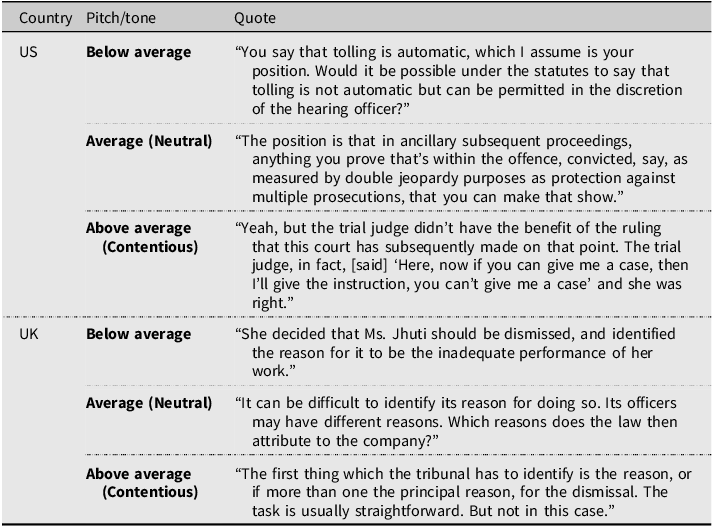
We chose audio/video excerpts from real-world cases that range in length from 10 to 15 seconds because respondents might react differently if we used hypothetical proceedings. For each high court, we selected passages from the same speaker to hold their identity constant. Specifically, we chose male speakers (Justice Kennedy for the US and Lord Wilson for the UK) for comparability and to limit the potential effect of judge gender (Kaslovsky, Rogowski and Stone, Reference Kaslovsky, Rogowski and Stone2021). To isolate the effect that neutral and contentious pitch has on court evaluations, we chose clips without clear ideological or political content and selected quotes that used as many neutral words as possible to minimize differences across treatments, which we confirm through sentiment text analysis (Feuerriegel and Proellochs, Reference Feuerriegel and Proellochs2023).Footnote 5 We also selected UKSC video clips that used a stable camera angle focused on the justice speaking. The full text of the excerpts by tone for each country is provided in Table 1.
Quotes from justice during oral proceedings by tone and country

Three portions of the experimental content were randomized. First, Americans were randomly assigned to receive the oral proceedings in either text or audio form, while Brits received the text, audio, or video of the court proceedings. Second, the content of the treatment varied based on the expressed political sentiments of the justice in the case [liberal; not specified; conservative]. We did this to ensure our ideological information mirrors how the news media or politicians often frame court proceedings (e.g., Collins and Eshbaugh-Soha, Reference Collins and Eshbaugh-Soha2019).Footnote 6 To avoid the impact of respondents’ political views, we purposefully (1) chose case excerpts that were relatively apolitical and (2) did not provide respondents with information on how the case was resolved.
Third, to convey realism in our experiments, we wanted these messages to represent the language tones that are regularly expressed in court proceedings. Specifically, we followed Dietrich, Enos, and Sen (Reference Dietrich, Enos and Sen2019, SM5-SM6) by measuring a given justice’s baseline pitch (“average”/neutral), as well as two standard deviations from that baseline pitch, using Praat (Weenink and Boersma, Reference Weenink and Boersma2018). This serves as our distinction for “below average” and “above average” (contentious) pitch. Then, after individuals consumed the information about the oral proceedings, we measured how aware respondents were to the experimental task by asking an open-ended attention check (Ziegler, Reference Ziegler2022).
Next, participants expressed the degree to which they support the high court by answering a battery of questions designed to reflect commonly used measures of long-term court legitimacy (Gibson, Caldeira and Spence, Reference Gibson, Caldeira and Spence2003). The six outcome questions are presented in Figure 1. The order in which the outcomes were presented is randomized. We also randomized the scale order to avoid systematic scale ordering effects (Yan and Keusch, Reference Yan and Keusch2015).
From our outcome questions, we created an additive index for court legitimacy in which higher values denote greater legitimacy. As such, outcomes that detract support from a court (i.e., “If the [USSC; UKSC] started making a lot of decisions that most people disagree with, it might be better to do away with the Supreme Court altogether”) are scaled from 1 for Agree to 5 for Disagree, while outcomes that extend support (i.e., “The [USSC; UKSC] can usually be trusted to make decisions that are right for the country as a whole”) are scaled from 1 for Disagree to 5 for Agree. The index ranges from 6 to 30 with a mean of 17.7 and standard deviation of 4.4. We include analysis of the individual outcomes that comprise the additive scale in the Supplementary Materials. The disaggregation of our additive scale does not change our statistical or substantive conclusions.
Finally, respondents provided posttreatment information regarding their political preferences and their knowledge of the court since respondents should be aware of a court in order to form legitimacy preferences (Gibson, Pereira and Ziegler, Reference Gibson, Pereira and Ziegler2017). We asked respondents these items posttreatment to avoid priming participants to respond based on their personal characteristics and preferences (Klar, Leeper and Robison, Reference Klar, Leeper and Robison2020, 58). The Supplementary Materials include an extended description of the survey experiment, including question wording, examples of the experimental treatments, as well as additional information detailing the two samples.
We made a number of design choices that provide leverage to test our specific hypotheses, yet it is important to consider how these decisions bear upon the generalizability and external validity of our results. First, given the nature of the UKSC video clips, judges were presented in formal attire (but not robes) and at a ground-level platform (rather than a dais). In this way, the treatment that Brits received is different from the proceedings that Americans could be exposed to from the USSC (Gibson et al., Reference Gibson, Lodge and Woodson2014) or US state supreme courts (Black et al., Reference Black, Johnson, Owens and Wedeking2024).
Second, we chose quotes from two male justices, one in each country. Research illustrates that judges’ descriptive characteristics, such as gender and race, shape the content of oral arguments (Feldman and Gill, Reference Feldman and Gill2019) and how the public evaluates judges (Kaslovsky et al., Reference Kaslovsky, Rogowski and Stone2021). Our setup does not allow us to assess differences by these traits.
Third, the clips we selected were relatively short in length (our audio/video segments range from 10 to 15 seconds). This setup is meant to reflect the often cursory nature of media coverage of the courts (e.g., Slotnick and Segal, Reference Slotnick and Segal1998; Wedeking and Zilis, Reference Wedeking and Zilis2026). However, it provides weaker treatments than studies that use longer video clips (Black et al., Reference Black, Johnson, Owens and Wedeking2024) or physical attendance at proceedings (Cann and Goelzhauser, Reference Cann and Goelzhauser2024) and does not allow us to test the impact of more detailed coverage of oral argument.
Finally, our experimental treatments did not provide respondents with contextual case information, hot-button political issues, or cues directly attributed to non-judicial elites. The presence of these factors may shape respondents’ reactions. For instance, stronger political cues in video proceedings might send a stronger signal of contentiousness. Future work should assess how other experimental setups might shape our findings. In light of these design choices, we now present the results of our survey experiments to assess how informing respondents about court proceedings through different mediums influenced their perceptions of judicial legitimacy.
Results
First, we test our hypothesis that the mean support among participants who listened to the proceedings is less than the mean response of participants that read the transcript. Figure 2a shows that in the pooled sample from both countries, participants grant essentially the same amount of legitimacy to courts regardless of how they receive information about the proceedings (via text or audio). In other words, we do not find evidence that respondents who listen to court proceedings grant less legitimacy in comparison to respondents who read proceedings ( $H_0: \overline {y}_{Audio} \geq \overline {y}_{Text}$
,
$H_0: \overline {y}_{Audio} \geq \overline {y}_{Text}$
, $H_A: \overline {y}_{Audio} \lt \overline {y}_{Text}$
, y = total sample, α = 0.05).
$H_A: \overline {y}_{Audio} \lt \overline {y}_{Text}$
, y = total sample, α = 0.05).
Next, we test our second hypothesis that viewing the proceedings helps retain court legitimacy, as long as those proceedings are neutral. Figure 2b displays the mean response of the additive index between the audio and video treatment groups among British participants. We find that when the proceedings are neutral, respondents who watch court proceedings are not more likely to grant the UKSC legitimacy in comparison to respondents who listen to the court ( $H_0: \overline {x}_{Video|Neutral} \leq \overline {x}_{Audio|Neutral}$
,
$H_0: \overline {x}_{Video|Neutral} \leq \overline {x}_{Audio|Neutral}$
, $H_A: \overline {x}_{Video|Neutral} \gt \overline {x}_{Audio|Neutral}$
, x = UK sample, α = 0.05).
$H_A: \overline {x}_{Video|Neutral} \gt \overline {x}_{Audio|Neutral}$
, x = UK sample, α = 0.05).
Group means by treatment condition.
Notes: Group means by treatment condition displayed with 95% confidence intervals. Additive index outcomes are standardized, higher values indicate greater court support. Panels present alternative hypotheses, the absolute difference in means, and p-values.

Third, we investigate whether respondents who watch court proceedings, in comparison to respondents who listen to court proceedings, are less likely to grant courts legitimacy if those proceedings are viewed as contentious (“above average” tone). Figure 2c does not indicate that contentious segments of oral hearings impact perceptions of legitimacy. We do not find evidence that when a judge uses a contentious tone, the mean support for the court of respondents who watch the proceedings is less than the mean of the participants who listen ( $H_0: \overline {x}_{Video|Contentious} \geq \overline {x}_{Audio|Contentious}$
,
$H_0: \overline {x}_{Video|Contentious} \geq \overline {x}_{Audio|Contentious}$
, $H_A: \overline {x}_{Video|Contentious} \lt \overline {x}_{Audio|Contentious}$
, x = UK sample, α = 0.05).
$H_A: \overline {x}_{Video|Contentious} \lt \overline {x}_{Audio|Contentious}$
, x = UK sample, α = 0.05).
Finally, we may anticipate a negative effect on legitimacy if the proceedings are viewed as political. However, we can see in Figure 2d that in comparison to respondents who do not receive information on the political sentiment expressed by the justice, respondents who do receive information about the political sentiments of the justice are not less likely to grant courts legitimacy ( $H_0: \overline {y}_{{\rm Neutral}} \leq \overline {y}_{{\rm {Politicized\ Decision}}}$
,
$H_0: \overline {y}_{{\rm Neutral}} \leq \overline {y}_{{\rm {Politicized\ Decision}}}$
, $H_A: \overline {y}_{{\rm Neutral}} \gt \overline {y}_{{\rm {Politicized\ Decision}}}$
, y = total sample, α = 0.05).Footnote
7
Also, Figure 2e highlights we do not find evidence that respondents who do not agree with the political sentiment expressed by the justice, in comparison to respondents who agree, are less likely to grant courts legitimacy (
$H_A: \overline {y}_{{\rm Neutral}} \gt \overline {y}_{{\rm {Politicized\ Decision}}}$
, y = total sample, α = 0.05).Footnote
7
Also, Figure 2e highlights we do not find evidence that respondents who do not agree with the political sentiment expressed by the justice, in comparison to respondents who agree, are less likely to grant courts legitimacy ( $H_0: \overline {y}_{{\rm Political\ Agree}} \leq \overline {y}_{{\rm Political\ Disagree}}$
,
$H_0: \overline {y}_{{\rm Political\ Agree}} \leq \overline {y}_{{\rm Political\ Disagree}}$
, $H_A: \overline {y}_{{\rm Political\ Agree}} \gt \overline {y}_{{\rm Political\ Disagree}}$
, y = total sample, α = 0.05). These results stand in contrast to work illustrating a link between political views and legitimacy (Badas, Reference Badas2016; Clark et al., Reference Clark, Paluck, Westwood, Sen, Malhotra and Jessee2024; Rogowski and Stone, Reference Rogowski and Stone2021; Strother and Gadarian, Reference Strother and Gadarian2022) and are more in line with scholarship highlighting the resilience of legitimacy to political cues (Gibson and Nelson, Reference Gibson and Nelson2014).
$H_A: \overline {y}_{{\rm Political\ Agree}} \gt \overline {y}_{{\rm Political\ Disagree}}$
, y = total sample, α = 0.05). These results stand in contrast to work illustrating a link between political views and legitimacy (Badas, Reference Badas2016; Clark et al., Reference Clark, Paluck, Westwood, Sen, Malhotra and Jessee2024; Rogowski and Stone, Reference Rogowski and Stone2021; Strother and Gadarian, Reference Strother and Gadarian2022) and are more in line with scholarship highlighting the resilience of legitimacy to political cues (Gibson and Nelson, Reference Gibson and Nelson2014).
Thus far, we have failed to reject any of our null hypotheses, which only indicates insufficient evidence to confirm an effect (Gill, Reference Gill1999). This does not necessarily constitute proof that an effect is negligible or nonexistent. To address this limitation, we “must also show that the data are inconsistent with meaningful effects” (Rainey, Reference Rainey2014, 1085). Consequently, in the Supplementary Materials, we construct 90% confidence intervals around the differences between group means and draw upon previous scholarship (Black et al., Reference Black, Johnson, Owens and Wedeking2024) to define what serves as substantively unimportant effect sizes in our context (McCaskey and Rainey, Reference McCaskey and Rainey2015). From this analysis, we conclude that our results are suggestive of substantively small effects if they do exist. Finally, to ensure the stability of our results, we conduct additional analyses in the Supplementary Materials, including regressions that control for respondent characteristics as well as models that limit our sample to attentive and knowledgeable respondents. In total, the results remain substantively and statistically similar, further suggesting that the mode of delivery does not appear to be associated with the perceived legitimacy of high court proceedings.
Conclusion
We employ survey experiments in the UK and US to investigate whether the medium through which court proceedings are transmitted to the public has an impact on high court evaluations. Across both countries, we find minimal differences in how individuals evaluate judicial legitimacy as a function of the technological presentation of the court proceedings. We also find no clear evidence that the provision of political information about the proceedings conditions these evaluations.
Our findings add a new perspective to explain how exposure to court proceedings is related to judicial evaluations. Under the conditions we study – brief exposure to proceedings without extensive contextual case information – the public’s evaluations of courts appear largely unresponsive to the mode of information transmission. We, nevertheless, recommend caution in considering how our results bear upon current political debates. There are reasons beyond legitimacy concerns to be cautious of cameras in the courtroom, such as their impact on courtroom behavior or privacy (Marder, Reference Marder2012). Further, there are a number of other dimensions regarding public information and court legitimacy that we do not assess.
First, our experimental treatments did not clarify the political issues at stake in the case. While a large portion of the cases that high courts deliberate are not politically salient, respondents may have more intense reactions when confronted with higher-profile topics (Badas, Reference Badas2016; Clark et al., Reference Clark, Paluck, Westwood, Sen, Malhotra and Jessee2024). Further, though our respondents received a cue about the judge’s ideological sentiment in the case, we did not provide contextual information from prominent elites (e.g., presidents or legislators) that can polarize partisans (Rogowski and Stone, Reference Rogowski and Stone2021). Future research should investigate how other experimental designs (e.g., more salient political issues, clear contextual information, additional elite signals, or the type of questions or statements the judge delivers) impact the role of politics in participants’ reactions to proceedings. Likewise, longer exposure to proceedings (we use excerpts up to 15 seconds), variation in the presentation of judges and courtrooms (e.g., robes as opposed to suits), or descriptive traits of judges (which we held constant) and litigants (which we did not focus on), as well as treatments directly attributed to the media (Hitt and Searles, Reference Hitt and Searles2018), may lead to different evaluations across the modes of information transmission.
Supplementary material
The supplementary material for this article can be found at https://doi.org/10.1017/XPS.2026.10030.
Data availability
The data, code, and any additional materials required to replicate all analyses in this article are available at the Journal of Experimental Political Science Dataverse within the Harvard Dataverse Network, at https://doi.org/10.7910/DVN/5TSY1H (Stone and Ziegler, Reference Stone and Ziegler2026).
Acknowledgments
We thank Michael Bechtel for helpful feedback and support. This project was supported in part by funding from the ECONtribute at the University of Cologne and the Arts and Social Sciences Benefactions Fund at Trinity College Dublin.
Competing interests
The authors have no conflicting or competing interests to report.
Funding
This project was supported in part by funding from the ECONtribute at the University of Cologne, as well as the Arts and Social Sciences Benefactions Fund at Trinity College Dublin.
Ethics statement
This study was approved by the IRB at Trinity College Dublin. Our research adheres to APSA’s Principles and Guidance for Human Subjects Research. Please see Supplementary Materials Section SMI.2 for more details.



 Open access

