





1. Introduction
In many applications of engineering design, engineers must be able to manage sociotechnical elements of a design process to be successful (Leydens & Lucena Reference Leydens and Lucena2017; Burleson et al. Reference Burleson, Herrera, Toyama and Sienko2023). How engineers collect and interpret sociotechnical data shapes all stages of design, including early stages in which problem spaces are explored and defined, design requirements are specified, initial solution concepts are generated – stages that often set trajectories for project success or failure (Khurana & Rosenthal Reference Khurana and Rosenthal1998).
The ways in which engineers engage with the sociotechnical aspects of design are shaped by positionality (Morgan et al. Reference Morgan, Davis and López2020), defined as how an individual’s multiple identities (e.g., age, professional position, national origin) influence their perspectives in a given context (Alcoff Reference Alcoff1988). In engineering design, projects and career paths emphasizing social impact are increasingly popular among engineering students (Smith et al. Reference Smith, Tran and Compston2020) and present distinct sociotechnical challenges. Often described using terms such as humanitarian, sustainable, or justice-oriented, and including work such as product and infrastructure design for low-income contexts or equitable design in high-income settings, these approaches are referred to here as “design-for-social-good.”
Engineering design-for-social-good often places designers in direct engagement with complex and unfamiliar social dynamics in which designers frequently hold privileged identities compared to presumed users or beneficiaries (Nieusma & Riley Reference Nieusma and Riley2010), making consideration of positionality particularly important in this context. In engineering design-for-social-good work, insufficient attention to positionality has been shown to result in limited consideration of assumptions, power and privilege in decision-making (Fox et al. Reference Fox, Lim, Hirsch and Rosner2020; Delaine et al. Reference Delaine, Nabrit, Harris, Nabrit, Ratcliff and Penn-Nabrit2023), and can ultimately contribute to project failure (Mazzurco & Jesiek Reference Mazzurco and Jesiek2014; Nieusma & Riley Reference Nieusma and Riley2010; Wood & Mattson Reference Wood and Mattson2016). In addition, such limitations may not only waste resources but also reinforce existing social inequities (Leydens & Lucena Reference Leydens and Lucena2017). Even when they do not lead to outright failure, incomplete consideration of positionality may still result in suboptimal outcomes. Without adequate consideration of positionality, designers cannot fully recognize and understand broader design problem contexts, diverse stakeholder perspectives or power dynamics within design teams and among stakeholders; nor can they account for the effects of their own values and biases on design decisions. Despite the importance of positionality in engineering design-for-social-good and beyond, training often lacks emphasis on sociotechnical concepts related to positionality (Cech Reference Cech and Lucena2013; Sienko et al. Reference Sienko, Young, Kaufmann, Obed, Danso and Opare-Addo2018; Kim et al. Reference Kim, Campbell, Nguyen, Taraban, Reible and Na2019; Lousberg et al. Reference Lousberg, Rooij, Jansen, van Dooren, Heintz and van der Zaag2020; Loweth et al. Reference Loweth, Daly, Liu and Sienko2020) and its implications for design practice (Walji et al. Reference Walji, Sheridan, Kinnear, Irish and Foster2020). In addition, how engineering designers conceptualize and account for positionality in design processes remains underexplored (Walji et al. Reference Walji, Sheridan, Kinnear, Irish and Foster2020).
Given these gaps, characterizing how engineers conceptualize and learn about positionality is a necessary step toward integrating it with more traditional design skills and technical engineering science. To address this, we interviewed students and practitioners about their conceptions of positionality and how they learn to engage with it in design contexts. As the early stages of design, and engineering design-for-social-good in particular, require heightened attention to positionality, we focus on these conditions in this exploratory study. Our goals are to support the integration of positionality into engineering design and training by developing an understanding of (1) how engineers’ conceptions of positionality relate to existing theory and documented effects in the literature and (2) how engineers learn about positionality and its implications for design.
2. Background
2.1. Identity
Identity theory describes identities as internalized meanings that shape how an individual connects to social functions or positions (Stryker & Burke Reference Stryker and Burke2000; Burke & Stets Reference Burke and Stets2022). Identities can include not only commonly recognized demographic categories like race, ethnicity, gender, sex, or age but also myriad other categories such as national origin, political affiliation, personality traits, education, professional position, all of which may shape interactions with others (Liu & Hinds Reference Liu, Hinds, Plattner, Meinel and Leifer2012; Jacobson & Mustafa Reference Jacobson and Mustafa2019; Tien Reference Tien2019; Chou Reference Chou2020).
An individual’s overall identity comprises multiple identities organized in dynamic hierarchies that depend on context, becoming more or less likely to guide attitudes or behavior depending on the strength of social ties and emotional investments associated with those identities (Stryker & Burke Reference Stryker and Burke2000). In the case of a university professor, for example, “engineering professor” may be a more salient identity when on campus, while “younger sibling” or “parent” may be more salient in family settings. In addition, identities can be assigned to an individual by themselves or by others, who may or may not assign the same meanings (Deschamps & Devos Reference Deschamps and Devos1998). An identity may also be conceptualized as social, grouping people together, or personal, distinguishing an individual from others within a group, and may remain static or change across time and contexts (Deschamps & Devos Reference Deschamps and Devos1998). As an example, an athlete’s team membership may be a social identity, while their standing or skillsets that distinguish them from other team members would be a personal identity; one that may change over time as they develop as an athlete.
Identity overlaps with related concepts like personal attributes, affiliations, and social or professional roles but is distinct in that it reflects a meaningful aspect of who or what a person is in a given context (Deschamps & Devos Reference Deschamps and Devos1998). For example, a person’s hair color or level of extroversion may be considered attributes and professional position may be considered a role, but these factors may or may not be meaningful to how a person conceptualizes themselves or how others conceptualize them in a given context.
A complete list of the 23 identity types used to support data collection, adapted from the Social Identity Wheel (2022), is provided in Appendix B. We acknowledge that this framework simplifies aspects of social identity theory (e.g., Stryker & Burke Reference Stryker and Burke2000); however, it is well suited for eliciting practical reflection from participants with limited formal exposure to identity theory. In this study, the Social Identity Wheel was used as a pedagogical scaffold to prompt reflection and discussion, rather than as a theoretical model of identity formation. Example identity types are shown in Table 1.
Examples of types of identities
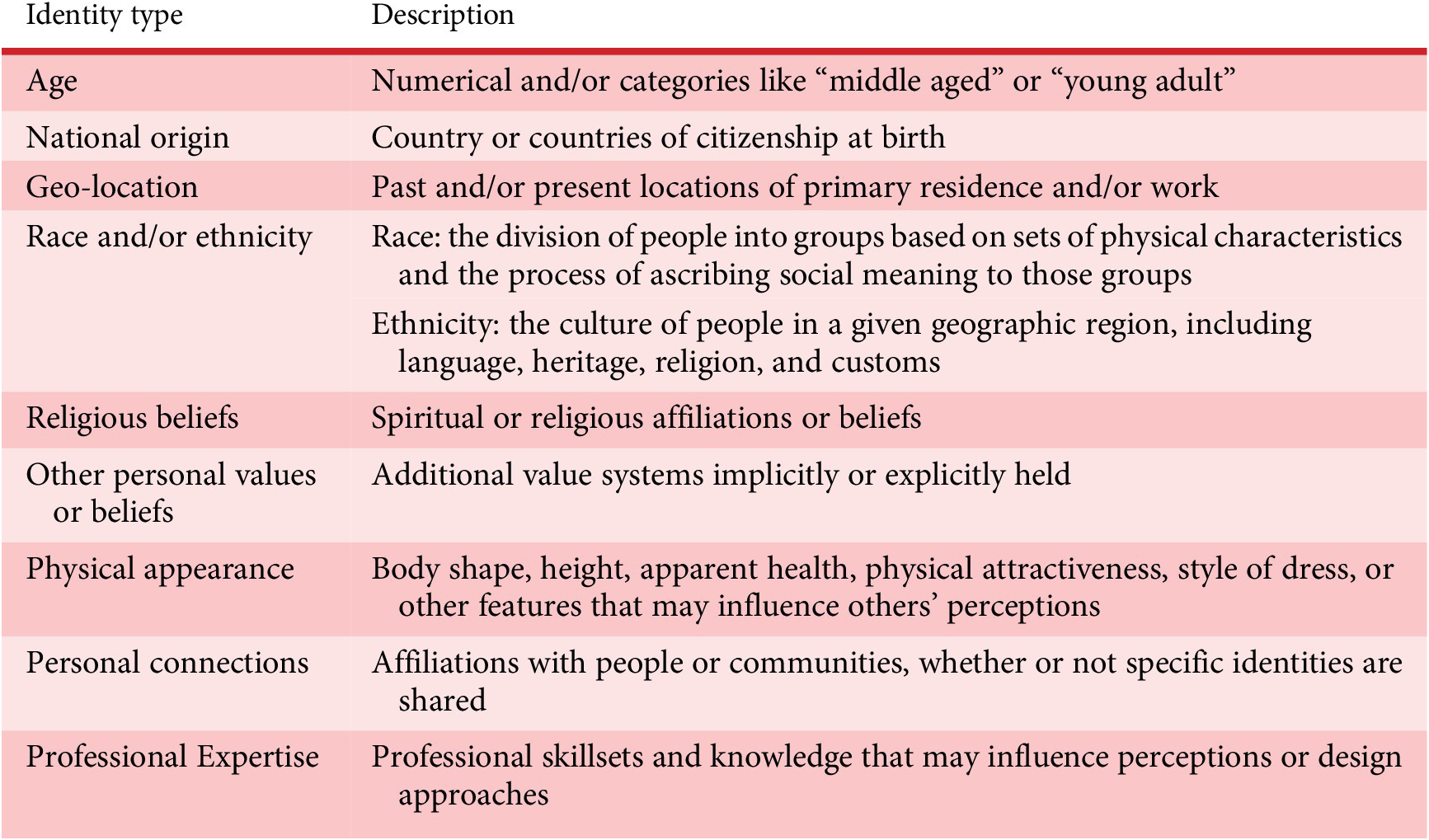
Table 1. Long description
The table has two columns. The left column lists identity types in this order from top to bottom: Age, National origin, Geo-location, Race and/or ethnicity, Religious beliefs, Other personal values or beliefs, Physical appearance, Personal connections, Professional Expertise. The right column provides descriptions for each. Age is described as numerical and or categories like middle aged or young adult. National origin is defined as country or countries of citizenship at birth. Geo-location refers to past and or present locations of primary residence and or work. Race and or ethnicity is split into two rows: Race is the division of people into groups based on sets of physical characteristics and the process of ascribing social meaning to those groups. Ethnicity is the culture of people in a given geographic region, including language, heritage, religion, and customs. Religious beliefs are spiritual or religious affiliations or beliefs. Other personal values or beliefs are additional value systems implicitly or explicitly held. Physical appearance includes body shape, height, apparent health, physical attractiveness, style of dress, or other features that may influence others’ perceptions. Personal connections are affiliations with people or communities, whether or not specific identities are shared. Professional Expertise is professional skillsets and knowledge that may influence perceptions or design approaches.
Earlier theories of identity describe identity formation as a neutral process (e.g., Stryker, Reference Stryker1980). Subsequent research, however, demonstrates that identity formation is shaped by power asymmetries. Both the assignment of identities and their meanings for individuals and others are disproportionately influenced by dominant social groups. Dominant or privileged groups hold greater power and flexibility in defining and assigning meaning to their own identities and those of others, while marginalized groups face structural constraints on whose meanings are recognized and validated (Schwalbe & Mason-Schrock Reference Schwalbe and Mason-Schrock1996; Ridgeway Reference Ridgeway2014). In addition, social systems also unevenly distribute power, including status, legitimacy, and recognition, across social identities (Collins Reference Collins2022; Schimpf et al. Reference Schimpf, Swenson and Burris2024). Critical perspectives from social sciences and design justice highlight that the ways in which identities are assigned produce distinct, intersectional experiences of social advantage and disadvantage (Crenshaw Reference Crenshaw and Maschke2013; Costanza-Chock, 2020; Schimpf et al. Reference Schimpf, Swenson and Burris2024).
2.2. Positionality
Positionality differs from identity in that positionality is not assigned to or by an individual, but instead shapes interactions between individuals based on their perceptions of identities within a given context (Alcoff Reference Alcoff1988). Positionality can be characterized in several ways. It is relational, in that the positionality of an individual depends on attitudes toward the identities assigned to individuals they engage with (Alcoff Reference Alcoff1988; Milner Reference Milner2007; Secules et al. Reference Secules, McCall, Mejia, Beebe, Masters, Sánchez-Peña and Svyantek2021). Positionality is also contextual and changes in different conditions or environments (Milner Reference Milner2007; Secules Reference Secules, McCall, Mejia, Beebe, Masters, Sánchez-Peña and Svyantek2021). In addition, positionality is intersectional: the combination of an individual’s identities does not operate as a simple sum, but produces unique dynamics that can reinforce existing social norms, including inequities (Secules Reference Secules, McCall, Mejia, Beebe, Masters, Sánchez-Peña and Svyantek2021). Taken together, these characteristics make positionality complex and difficult to fully anticipate, given the multiple identities involved, the variability in how identities are perceived by others (Alcoff Reference Alcoff2005) and its inherently dynamic nature (Merriam et al. Reference Merriam, Johnson-Bailey, Lee, Kee, Ntseane and Muhamad2001).
Positionality is often compared to or conflated with bias, prejudice or other similar concepts. Positionality refers to how identities and context shape perspectives and may have positive, negative or neutral effects on interactions. Bias and prejudice describe systematic distortions in perspectives or judgment that tend to produce unfair or inaccurate outcomes (Haraway Reference Haraway1988; Fiske Reference Fiske, Gilbert, Fiske and Lindzey1998; Collins Reference Collins2022). For example, in everyday interactions, individuals interpret and ascribe identities to others, and these perceptions shape relational dynamics through positionality. These behaviors often lead to effective social interactions unless they are influenced by bias or prejudice.
Similarly, positionality is often compared to perspective, which has been defined in social research as a “lens or viewpoint that shapes how phenomena are seen and interpreted” (Crotty Reference Crotty1998). Perspective may be thought of as a result or part of positionality, but may not include the implication that it is driven by underlying identities. The concept of positionality, in contrast, implies that the reasons behind a perspective are intrinsically driven by individuals’ identities, contexts and relationships (Merriam et al. Reference Merriam, Johnson-Bailey, Lee, Kee, Ntseane and Muhamad2001).
2.3. Positionality in engineering and design
Positionality is fundamental in the planning and execution of a design process (Fox et al. Reference Fox, Lim, Hirsch and Rosner2020; Walji et al. Reference Walji, Sheridan, Kinnear, Irish and Foster2020) and shapes design activities and outcomes. Research has described difficulties faced by engineering designers in defining, comprehending and accounting for positionalities (Merriam et al. Reference Merriam, Johnson-Bailey, Lee, Kee, Ntseane and Muhamad2001). In practice, engineering designers often assume that good intentions are sufficient to overcome gaps in their understanding of the influence of positionality on conceptions of design-for-social-good (Leydens & Lucena Reference Leydens and Lucena2017). However, reflective awareness of positionality is necessary for effective sociotechnical design practice, particularly in relation to (1) intrapersonal dynamics, (2) interpersonal dynamics and (3) contextual factors in design. Otherwise, engineering designers are likely to waste resources and/or do harm to intended project beneficiaries (Leydens & Lucena Reference Leydens and Lucena2017).
Research has demonstrated that engineering designers must recognize and effectively account for contextual factors, including broad structural, historical and cultural dimensions of design problems (Burleson et al. Reference Burleson, Sienko and Toyama2020, Reference Burleson, Herrera, Toyama and Sienko2023; Wood & Mattson Reference Wood and Mattson2016), as well as often privileged power dynamics between themselves and other stakeholders (Fox et al. Reference Fox, Lim, Hirsch and Rosner2020; Witmer Reference Witmer2020), both of which are shaped by an engineering designer’s positionality. Similarly, uninformed or biased attitudes toward stakeholders and contextual factors in engineering designer work, often arising from limited understanding of positionality, can negatively affect interpersonal interactions among engineers and other stakeholders (Morgan et al. Reference Morgan, Davis and López2020; Wood & Mattson Reference Wood and Mattson2016). Engineers may also undervalue the design-relevant knowledge and expertise of partner communities (Butoliya Reference Butoliya2018). For example, community–academic partnerships require explicit attention to power, roles, communication and recognition of community expertise, as early design decisions may otherwise prioritize university or student goals over those of partner communities (Delaine et al. Reference Delaine, Nabrit, Harris, Nabrit, Ratcliff and Penn-Nabrit2023). In addition, intrapersonal reflection is necessary for engineering designers to account for the roles of their identities and motivations (Chou Reference Chou2020), as well as their assumptions, values and biases in design approaches and stakeholder relationships (Walji et al. Reference Walji, Sheridan, Kinnear, Irish and Foster2020). Without such reflection, engineers may prioritize technical over sociotechnical aspects of design projects (Riley Reference Riley2008; Moses et al. Reference Moses, Pakravan and MacCarty2019). Figure 1 summarizes how positionality affects design. In this model, an engineering designer interprets contextual, interpersonal and intrapersonal aspects of a design environment and may, to varying degrees, develop awareness of their own positionalities, preconceptions and biases. This reflective awareness then informs how information from the design environment is integrated into design approaches.
The roles of positionality in engineering design.
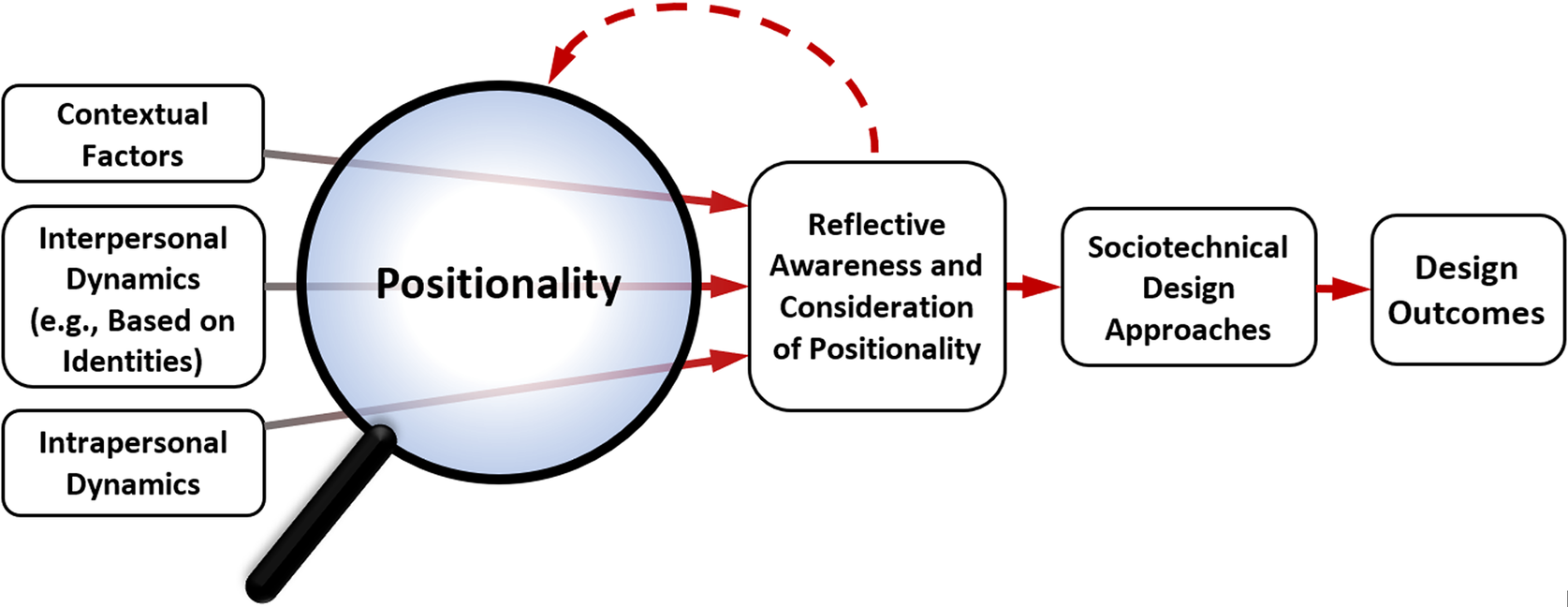
Figure 1. Long description
On the left, three stacked rectangles labeled Contextual Factors, Interpersonal Dynamics open parenthesis e.g., Based on Identities close parenthesis, and Intrapersonal Dynamics each have arrows pointing right into a central magnifying glass labeled Positionality. From Positionality, a rightward arrow leads to a rectangle labeled Reflective Awareness and Consideration of Positionality. Another rightward arrow connects to Sociotechnical Design Approaches, followed by a final arrow to Design Outcomes. A dashed arrow loops from Reflective Awareness and Consideration of Positionality back to Positionality, indicating feedback.
The literature documents numerous cases in which insufficient attention to positionality has resulted in adverse outcomes in both professional and student design-for-social-good projects, although it is often addressed implicitly or under different terminology. One case described the design of backdoor wheelchair access ramps in the United States that allowed entry but physically separated users from those who could enter through the front door of the same building, thereby perpetuating rather than alleviating the marginalization of users with disabilities (Nieusma Reference Nieusma2004). Another case described an international development project in which US student and faculty engineering designers realized, after project completion, that they had inadvertently projected their own cultural, economic and political norms, as well as an engineering preference for physical product–based solutions, onto local contexts and partners in Nicaragua, resulting in project failure, damaged trust and wasted time and resources for Nicaraguan partners (Nieusma & Riley Reference Nieusma and Riley2010).
The widely documented failure of the One Laptop per Child initiative to achieve its intended outcomes offers another example of neglecting positionality in design-for-social-good. Engineering and program designers have been criticized for projecting assumptions rooted in their own cultural and socioeconomic identities, leading to insufficient attention to local contexts and, in turn, to laptops that were neither reliably functional nor well aligned with the educational needs of their intended users (Warschauer & Ames Reference Warschauer and Ames2010).
Outside of engineering design literature, insufficient attention to positionality has been shown to render “social good” interventions ineffective or to perpetuate, rather than alleviate, systemic injustices. Examples include academic research and interventions for social justice (Pasque et al. Reference Pasque, Patton, Gayles, Gooden, Henfield, Milner, Peters and Stewart2022), social business strategy design and market-based approaches to poverty alleviation (London & Anupindi Reference London and Anupindi2012; London & Jäger Reference London and Jäger2019) and international development program design (Warschauer & Ames Reference Warschauer and Ames2010).
Strategies developed in other design domains, such as research design, may inform approaches for developing awareness and consideration of positionality in engineering design. Such strategies have been called for in engineering design literature (e.g., Shermadou & Delaine Reference Shermadou and Delaine2022), as formal training in positionality is not typically included in engineering education. For example, Milner’s (Reference Milner2007) framework for holistic consideration of self, others and context suggests that researchers systematically ask “why” and “how do I know” to surface and challenge the assumptions and biases embedded in design decisions.
Although existing literature highlights multiple ways in which positionality matters in design, few studies explicitly examine identity or positionality in engineering design, and none have directly investigated the overall influence of positionality on engineering design, as represented in Figure 1. How identities combine to shape engineering designers’ positionalities, how designers conceptualize and integrate positionality into their work and how engineers develop these conceptions over time remain underexplored.
3. Methods
The first aim of this study was to investigate how engineering designers conceptualized positionality in design-for-social-good work and to compare their conceptions with theoretical accounts and documented effects of positionality in the literature. The second aim was to understand how engineers learn about positionality and respond to exposure to related training materials and reflective activities. Although data collection included introductory terminology and concepts related to positionality, the research design was observational in intent, focusing on participants’ interpretations and responses. The training materials were used as a probe of interpretations rather than as an implemented or evaluated intervention. Our research was driven by the following questions and subquestions:
-
1. In what ways do engineering designers conceptualize positionality in early-stage design-for-social-good work?
-
a. How do conceptions compare across participants with different identities?
-
b. How do conceptions compare to descriptions of positionality in literature?
-
-
2. How do engineering designers describe the development of their conceptions of positionality in their life and work?
-
3. How do engineering designers react to exposure to terms, definitions and reflection exercises from a positionality training tool used during data collection in this study?
3.1. Participants
Ten undergraduate engineering student designers were recruited from design-for-social-good-focused, co-curricular design programs at the University of Michigan, and 10 engineering design practitioners who had worked on design-for-social-good projects were recruited from the authors’ professional networks. Practitioner participants were required to have at least three years of professional design experience to distinguish them from student participants in terms of professional experience. Purposive, disproportionate sampling was used to ensure that participants with a range of identities and personal and professional experiences were included, as is recommended by Bernard et al. (Reference Bernard, Wutich and Ryan2016) for exploration of previously unstudied phenomena. Related research on service learning suggests that individuals’ identities and life experiences shape their relationships with concepts related to positionality (Winans-Solis Reference Winans-Solis2014). For this reason, sampling primarily from dominant engineering populations (i.e., White and/or male participants) may have limited the range of perspectives captured in relation to positionality. The sample was therefore evenly split between engineering practitioners and students to increase the diversity of engineering design contexts represented in this study. The overall sample size of 20 is consistent with recommendations for qualitative interview-based research (Hennink & Kaiser Reference Hennink and Kaiser2022). Related interview-based studies of engineering designer conceptions have used similar sample sizes (e.g., Burleson et al. Reference Burleson, Herrera, Toyama and Sienko2023). General participant demographic information for student and practitioner participants are listed in Appendix A. To preserve participant anonymity, additional demographic information is reported in aggregate below. Regarding student participant demographics:
-
• Six of the 10 student participants identified as non-White or of mixed race/ethnicity.
-
• Three identified as LGBTQ+.
-
• Two were first-generation immigrants from a non-Western country; two were second-generation immigrants with one or more parents from a non-Western country; and two were born and raised in a non-Western country and were in the United States for their university education.
Regarding practitioner participant demographics:
-
• Eight of the 10 practitioner participants identified as non-White or of mixed race/ethnicity.
-
• Three participants were first- or second-generation immigrants to the United States from non-Western countries, and two were born, raised and currently working in non-Western countries.
-
• All participants identified as practicing engineering designers (n = 8) and industrial designers (n = 2) engaged in the development of technical products or systems.
The University of Michigan Institutional Review Board reviewed and granted an exemption to this study. Consent was obtained from each participant prior to participation in the study.
3.2. Data collection
During individual 75-minute video call sessions with a researcher, participants (1) were presented with a document containing key definitions and concepts to ensure comparable preparation regardless of prior knowledge (Appendix B); (2) engaged in a writing activity reflecting on the potential roles of their own and stakeholders’ positionalities in a prior design-for-social-good experience and (3) participated in a semistructured interview to debrief and expand on conceptions reported in the writing activity.
Research protocols for student and practitioner participants were nearly identical, with minor adjustments to the wording of some interview questions to better reflect academic and industry design contexts, respectively. A brief document summarizing key definitions and concepts was presented to participants for approximately 5 minutes by a researcher at the start of each video call. We recognize that providing participants with definitions and concepts has the potential to shape their responses. In pilot testing with three graduate student engineering designers, however, many participants did not have the language to discuss positionality consistently or effectively within the limited time available during data collection. We decided that, in this exploratory study, introducing terminology that is not commonly used in engineering would likely facilitate participants’ reflections and responses. The characterization of engineers’ understanding of positionality in this work may support the design of more controlled studies in the future.
After reviewing the document with definitions and concepts, participants were prompted in the writing activity to describe one or more design decisions from a single past or ongoing design-for-social-good project, as well as ways in which identities and positionalities may have influenced those design activities. Participants were asked to write for 5–10 minutes to allow sufficient time to recall and organize their thoughts and were encouraged to refer to the definitions document while writing, if desired. Writing was completed in a shared electronic document that was also visible to the researcher.
The 60-minute semistructured interview was conducted after participants completed their written responses. The interview was grounded in participants’ conceptions expressed during the writing activity, beginning with questions related to the specific design experience described by each participant and then expanding to broader, more general conceptions of positionality. The data-collection protocol included questions about participants’ conceptions of positionality during the selected design activity and in general (e.g., questions 1–3 below), as well as questions about participants’ reactions to the writing exercise and interview process (e.g., questions 4 and 5 below):
-
1. Can you think of a time when differences in identity between you and another stakeholder affected your early-stage design work?
-
2. Which of your identities do you think had the greatest effect on how other stakeholders perceived you as an engineering designer?
-
3. Are there any other important ways your positionality may have come into play that we have not talked about yet?
-
4. Can you describe your reaction to writing and talking about your positionality as an engineering designer today, whether it was positive, negative or neutral?
-
5. In what ways was participating in this research surprising to you, if any?
To support validity, the development of the writing activity and interview protocols was guided by (1) socially focused design literature describing interactions among identity, stakeholders and problem context (Parkinson Reference Parkinson2009; Nieusma & Riley Reference Nieusma and Riley2010; Deardorff Reference Deardorff2011; Burleson et al. Reference Burleson, Sienko and Toyama2020; Social Identity Wheel 2022), (2) the Developmental Model of Intercultural Maturity (King & Baxter Magolda Reference King and Baxter Magolda2005), which has been shown to be an effective framework for interview instruments in higher education (Deardorff Reference Deardorff2011; Perez et al. Reference Perez, Shim, King and Magolda2015; Soria & Troisi Reference Soria and Troisi2014) and (3) critical theories of intersectionality and systemic inequality based on identity (Ladson-Billings Reference Ladson-Billings, Apple, Au and Gandin2009; Crenshaw Reference Crenshaw and Maschke2013), which have been used effectively in critical, qualitative engineering identity research (Dietz et al. Reference Dietz, McCray and Douglas2019). The protocol was further piloted and refined with two graduate students prior to data collection.
In addition, the development of the research protocol was guided by a design-based research (DBR) philosophy (Anderson & Shattuck Reference Anderson and Shattuck2012), which emphasizes iteration, practitioner input, and the codevelopment of interventions alongside scholarly inquiry. The writing activity and supporting materials were codeveloped with a prototype educational tool that included similar prompts and explanatory content. Both the educational tool and the writing activity were iteratively refined throughout the course of the study. Specifically, additions and clarifications were made to the list of identities provided to participants and to wording of prompts, as opportunities for improvement were identified during data collection. These refinements were also incorporated into the parallel development of the prototype educational tool.
Although iterative changes during data collection may reduce strict procedural consistency, such consistency was not the primary goal of this qualitative, exploratory study, which instead prioritized depth of understanding. Results from the first five student participants are reported in a separate publication (Moses et al. Reference Moses, Daly, Handley and Sienko2024). Any resulting differences between data from the first five and subsequent 15 participants are expected to be small relative to variation in perspectives across individual participants.
3.3. Data analysis
Interview recordings were transcribed and de-identified, and the data were analyzed inductively to characterize how participants related to positionality. Inductive analysis, described by Creswell and Creswell (Reference Creswell and Creswell2017) as the development of emergent patterns of meaning rather than the assignment of predetermined codes or themes, was applied to identify themes not explicitly discussed in existing literature. Themes were identified iteratively, following Patton (Reference Patton2014), to allow for an understanding of the data to develop as transcripts were reviewed multiple times. Student and practitioner data were analyzed separately, but using a shared list of themes. Theme development was supported by a synthesis of literature related to positionality in engineering design (e.g., Cech Reference Cech2014; Deardorff Reference Deardorff2011; Leydens & Lucena Reference Leydens and Lucena2017; Passow & Passow Reference Passow and Passow2017; Soria & Troisi Reference Soria and Troisi2014) used to inform the data-collection protocol. Whole transcripts were used as units of analysis, such that only the presence or absence of themes was counted per transcript to avoid ambiguity in interpreting the frequency with which participants discussed specific conceptions. To support reliability, all transcripts were reviewed by two researchers. The first author reviewed all transcripts and the third and fourth authors each reviewed five student and five practitioner transcripts. Themes were developed until consensus was reached among all three reviewers, and interpretive discrepancies were resolved through discussion.
We did not attempt to evaluate the overall maturity or quality of participants’ design approaches or outcomes as it was not clear that these could be accurately evaluated with the available data. Similarly, we did not distinguish among the cognitive, intrapersonal and interpersonal domains of participants’ conceptions described by the Developmental Model of Intercultural Maturity (King & Baxter Magolda Reference King and Baxter Magolda2005), as cognitive reactions are not necessarily measurable with the interview protocol we used, nor was the distinction between intra- and interpersonal attitudes and behaviors a focus of this study.
3.4. Researcher positionality
We acknowledge that the identities, perspectives and positionalities of the research team have meaningful impact on this study. We do not claim to fully or objectively interpret all perspectives shared by participants, nor that the data we collected provide an exhaustive account of participants’ perceptions. Instead, with our collective experiences and identities in mind, we sought to provide a useful characterization of participant perspectives that may support the development of inclusive design, design education and future research on positionality in design, including work conducted by teams with complementary identities and expertise.
All authors have experience working in socially focused design research, education and/or practice. While the team brings first-hand experience with how engineering designers work, think and learn across a variety of design-for-social-good contexts, it represents a limited range of identities and perspectives, with potential implications for the design and execution of this study. Four of the authors are White, Western and do not share many of the minoritized identities held by some participants. Three authors are women from South Asia who share some, but not all, of the minoritized identities represented in the participant groups. Additionally, while each author has first-hand experience with design-for-social-good projects and contexts, the team does not share many of the lived experiences associated with less privileged or oppressed identities of stakeholder groups in low-income countries discussed by participants. As the first author conducted data collection, it is likely that his identities and presentation influenced what participants chose to share. We also acknowledge that much of the literature used to support our analysis was produced by scholars with similar identities to those of the research team, introducing an additional limitation in the representation of diverse perspectives.
4. Findings
Themes developed with respect to our research questions are reported here. The number of participants whose responses aligned with each theme is provided to give an approximate sense of the prevalence of themes among student participants, practitioner participants and overall, but these counts are not meant to quantify the relative importance of themes. Additional research would be required to support characterization of the perceived importance or relative impact of themes related to design work, designers and other stakeholders. The findings are grouped by research question, with the first section corresponding to RQ1 on participant conceptions, the second to RQ2 on the development of participant conceptions and the third to RQ3 on reactions to the introduction of terminology and reflection on positionality.
4.1. Participant conceptions of positionality in early-stage design-for-social-good work
Regarding our first research question on how engineering designers conceptualize positionality in early-stage design-for-social-good work, participants reported a range of conceptions about the role of positionality within engineering design. Findings related to this research question are organized into themes identified by the letters A–F, with quotes from participants provided as illustrative examples. Most participants described the importance of the positionalities of stakeholders and engineering designers across design activities, as well as the potential to improve design processes through increased, strategic consideration of positionality. At the same time, participants acknowledged difficulty in conceptualizing and articulating the implications of positionality in engineering design. They reported that considering positionality is often done implicitly and in ways that are limited by a lack of explicit language, design strategies or skills. In general, while practitioner participants reported some themes more often than student participants, both groups reported similar conceptions of the roles of positionality in design. However, some student participants also described stereotyped understandings of positionality related to their own or others’ identities.
4.1.1. Positionality conception (A): conceptions of positionality are critical to the early stages of design-for-social-good
When asked to discuss how identities and positionalities do or do not affect their work, all 10 practitioner participants explicitly described positionality as critical in their design processes, while 8 of 10 student participants shared similar sentiments. For example, Practitioner Participant 5 reported that:
[Positionality] is a fundamental backbone of anything you deliver. Being aware of it affects the quality of your work a lot.
When asked how positionality is most important in their work, several participants identified its impacts as most pronounced in early-stage design activities related to problem identification and definition. For example:
Always at the beginning of the project: the project scope, the alternatives that you present as feasible alternatives… I don’t think you can get much more fundamental than that. I think your positionality affects how you connect, how you present those, what you present and how you really define your problem. (Practitioner Participant 6)
Others also described positionality as playing a foundational role in how an engineering designer views and positions themselves within a design system, as exemplified in the following excerpt from Practitioner Participant 5:
From identifying and defining the problem [to] all of the engagement [with stakeholders]: knowing who you are, with whom you work, and where you work is quite key.
Two student participants reported that they had not explicitly considered positionality as a part of design work before. For example, when asked about the ways in which identities or positionalities might be relevant or irrelevant in their work, Student Participant 3 said:
We don’t spend a lot of time … we don’t plan a lot for that.
4.1.2. Positionality conception (B): positionality is complex in engineering design-for-social-good
Four practitioner participants and one student participant discussed how stakeholder identities and resulting positionalities can have complex impacts in design-for-social-good that are too numerous and dynamic to fully understand or predict. For example, Practitioner Participant 6 said:
If I had to be honest with myself. Probably every time I make a decision [positionality is relevant]. I think when I was thinking through these [types of identities], it was easy to pick off the low hanging fruit [i.e., more commonly conceptualized identities] but I would say that they all probably affect everything.
Similarly, Practitioner Participant 3 discussed the dynamic nature of identities and resulting positionalities as contributing to the complexity of positionality in design-for-social-good:
Identities are very much in flux in time, let alone between people. So, it’s really important to both acknowledge what your different identities are that you’re bringing in, and there’s probably a like “sub” in the word positionality because – I don’t know how to use it properly – but to acknowledge your different identities and biases that you might have going in.
4.1.3. Positionality conception (C): inadequate consideration of positionality is a source of problems in early-stage design-for-social-good
Ten practitioner participants and seven student participants reported that inadequate consideration of positionality can cause problems in design-for-social-good. For example, Student Participant 1 explained how she connected prior design project failures to poor awareness of positionalities associated with the educational and socioeconomic identities of previous team members:
I’ve seen what happens when you forget [to account for positionality in design], because I think that happened on our team in the past, and we can see it very clearly in the [failed] design. I think that the [educational identity] of students where we want to learn new things probably played a large factor in [these poor design decisions], as well as socioeconomic status; maybe just not thinking of “they can’t afford this.” That’s the problem with us being college students. We also want experience. That’s partially why we join these design teams to begin with, and I don’t want to say it’s greed, but they want to have a cooler engineering project and start using all these cool materials and just make decisions for [themselves]…
Other participants described similar design project failures or limitations in connection with poor awareness of positionality, such as Practitioner Participant 1, who described a colleague who was rigid in his design philosophy based on his unchallenged perceptions of what technology was or was not appropriate for a low-income context:
So, when I was designing the [project for a low-income country] there was a White guy living in [the project country] working for us, and … he wanted everything to be cheap and said anything that has a PCB would be too much. I’m like, okay … China could manufacture like a thousand for 20 bucks for you. Right now, everyone in the communities you’re advocating for has a cell phone, which is like, you know, one of the most advanced PCBs. You’ve got to find the middle ground.
4.1.4. Positionality conception (D): conceptions of positionality shape intrapersonal, interpersonal and contextual aspects of design-for-social-good
Participants discussed a variety of ways in which positionalities can affect (a) interpretation of design context, (b) interpersonal relationships and (c) intrapersonal reflections on design activities. Nine practitioners discussed intrapersonal implications of positionality, while all ten discussed implications related to interpersonal relations and the assessment and interpretation of design context. In comparison, student participants discussed intrapersonal (n = 6), interpersonal (n = 9) and contextual (n = 8) implications of positionality slightly less often, with greater emphasis on interpersonal relationships within design teams.
Practitioner Participant 6 summarized her conception of the importance of positionality for intrapersonal processes in design as follows:
I don’t really feel like you can make a decision without inserting your personal beliefs and values. I think that’s something that’s just unavoidable. And I would say that is especially true when you are doing quote unquote “design for good.”
As an example of intrapersonal implications of positionality, Student Participant 4 described the potential impact of their team’s identities on their positionalities and design approaches:
We’ve grown up in the United States, but [my design team and I are] all children of immigrants… So, we tried to bridge a lot of gaps that I think other designers might not have with differing [non-immigrant] identities. Or, conversely, we could have completely forgotten about plenty of things as a result of our very similar identities.
Practitioner Participant 9’s discussion exemplified practitioner conceptions of the interpersonal implications of positionality in his design-for-social-good work. Specifically, he described how stakeholders’ positionalities toward him are shaped by his socioeconomic status and regional origin:
I’m working with people from other socioeconomic contexts … I’m from the capital [of a] very centralized country. So, when I go to other parts, I’m from one side [and stakeholders have] a lot of thoughts about that, right? I think it’s important. I try to bring my personal skills to show that … I know the street. I know how to talk with people and start to get their confidence.
Student Participant 4 shared similar experiences related to positionalities within design teams:
Oftentimes I’ve been working with mostly white men of the same age – who did not listen to me. They kind of refuse to acknowledge my perspective in a lot of engineering situations. I was one of the only people of color in the classroom, and one of like 3 women, so that led to a lot of experiences… I’d have to really push to be heard in any sort of situation, regardless of my experience.
With respect to the interpretation of contextual factors, Practitioner Participant 5 described engaging with stakeholders in new contexts as a way to explore and understand his positionality relative to different organizations, cultures and national contexts:
So, since I moved a lot between organizations and countries and cultures, I tend to quickly include other stakeholders to see how my positionality is in the physical area or in the company that I am [working], because it always influences my outcome.
4.1.5. Positionality conception (E): conceptions of which identities are most salient to engineering designers in social good work vary
Participants identified a range of their own identities as most relevant to their positionalities in design work, including (a) meritocratic views of engineering designer identity, (b) expanded views incorporating personality traits and (c) more holistic or intersectional perspectives. For example, one practitioner participant and three student participants described educational credentials and technical skillsets as the most important aspects of their identities as engineering designers, as exemplified by Practitioner Participant 2:
Professional expertise. That is where I draw credibility.
Three of the four participants who expressed this view held majority identities in engineering populations (i.e., cisgender men with majority racial identities), while the fourth emphasized the primacy of educational and technical identities in the context of cultural norms or family expectations.
Two practitioner participants and one student participant, representing a mix of minority and majority identities in engineering populations, described aspects of their personalities as the identities that most strongly underpinned their positionalities in design:
It’s tempting to go for professional expertise or professional connections [as most important]. But I strongly feel that personality traits are more important, because I think they are a bit the foundation of everything. (Practitioner Participant 5)
Six practitioner participants and six student participants, all of whom held minority identities in engineering populations, described multiple distinct categories of identity as most important, or declined to prioritize specific identities and instead emphasized their overall identities:
I think that everyone is all of these things. And I don’t want someone just to see me as a woman, or an engineer or the fact that I can’t run very far … you know what I mean? I don’t necessarily want to be in a box. I think my hope would be that people would understand that we’re kind of all very complex. (Practitioner Participant 6)
In addition, a small number of stereotyped positionalities toward stakeholders’ or designers’ own identities were reported by two student participants. Student Participant 3’s discussion of perceived limitations related to her identities is shown as an example:
For example, Americans can be the team leader for this kind of event. But as [an international student], I can’t. I can only be the team member… Americans are good at this, and they can make friends very fast, I think. But for me, and other [people from my country], they are more willing to do things. So, the leader asks us to do things, and we will do it very efficiently.
4.1.6. Positionality conception (F): conceptions of positionality are implicit and constrained by available language in design-for-social-good
Five practitioner participants and six student participants expressed difficulty explicitly conceptualizing positionality in design due to the implicit nature of the concept. Practitioner Participant 6 summarized the implicitness of her awareness of positionality in design as follows:
I try to be aware of it, but I can’t say that I would think about it day to day. I think I mostly think about it when I come to a tougher decision … I should say I’m aware of it, but I’m not conscious of it. Right?
Similarly, five practitioner participants and one student participant discussed limitations in available language for relevant concepts as affecting their consideration of positionality in design. For example, Practitioner Participant 3 reported that:
The idea of positionality is very new to me. I wouldn’t say surprising, but it’s something I’m still trying to come up with a spot in my brain for … where does this word exist? Right now, it’s in between identity and biases, and how a person’s life and actions kind of crosses that line and intermingles.
In addition, participants described using a variety of terms to articulate concepts related to positionality. For example, when asked what language they use in their own reflective processes, Practitioner Participant 1 said:
I usually use context… It’s just your biases. It could be good or bad. But it’s bias.
Practitioner Participant 7 also reflected on the potential political connotations of language related to identity and positionality in design, noting that different terms may carry different, and potentially charged, meanings for engineering designers or other stakeholders.
Identity and positionality are more neutral, inclusive ways of saying accessible and inclusive, I think. Accessible and inclusive are kind of “hot,” you know – politically correct – and people kind of shy away from them. So, I appreciate that language specifically. It lowers the stakes I find, and is a different way of welcoming people in, which I appreciate.
4.2. Development of participants’ conceptions of positionality in design-for-social-good
Regarding our second research question on how engineering designers described (a) the development of their conceptions of positionality in early-stage design-for-social-good work, and (b) their reactions to using a positionality exploration and training tool, participants identified exposure to difference as the driver of the development of their conceptions of positionality. However, many also acknowledged difficulty and described learning about the implications of positionality in design as an ongoing process. Participants further described the data-collection activities in this study as a form of exposure to these concepts.
4.2.1. Development of conceptions of positionality (A): exposure to different contexts and identities is foundational to engineers’ development of conceptions about positionality in design-for-social-good
Participants across experience levels and identities described learning about positionality and its implications in design as being facilitated by exposure to people with different identities and to diverse design contexts. Nineteen of twenty participants (all 10 practitioner participants and 9 of 10 student participants) described developing their conceptions of positionality in design-for-social-good through exposure to differences in their personal lives, formal education and/or design-for-social-good work. Practitioner Participants 3 and 6 summarized the importance of exposure as follows:
Exposure is the bottom, bottom, bottom line. (Practitioner Participant 3)
If I could sum it up, it would be exposure, you know, exposure outside of my bubble at the core of it. The more people you meet and meeting people who are more of a global majority than what I might be typically exposed to… and especially socioeconomic differences. (Practitioner Participant 6)
Ten participants (six practitioner participants and four student participants), nine of whom reported cisgender, heterosexual male and/or White European or American identities, described learning the most about positionality through exposure to different people and ideas during formal education. For example:
[College] was when [I started learning about] all the different ways that people are wronged in the world, and I didn’t really care until then, because I didn’t really know. Since then, I’ve thought more and more about identity. (Practitioner Participant 3)
In college I feel like I found myself in like really diverse groups, especially in the [global design ethics] class … I was the only straight white male in the class of like 35. I was often called out things isolated behaviors, and like it wasn’t like an overly accusatory but kind of like a hey, like that’s not a super appropriate joke like, why don’t we backtrack on that? I think that was a really good space. (Practitioner Participant 4)
Other participants (two practitioner participants and six student participants, distinct from the 10 participants described above), all of whom identified as non-White, female and/or LGBTQ+, consistently described learning the most about positionality through life experiences outside of formal education or design contexts, often in ways that directly related to their own minoritized identities.
I personally already have that attitude [that positionality is important in design] because my family’s from [a low-income country], and I’ve had experience working with the clinics there and I know the lack of resources that they have. (Student Participant 1)
4.2.2. Development of conceptions of positionality (B): learning about the implications of positionality in design processes is often implicit and difficult, but valuable in early-stage engineering design-for-social-good
Five practitioner participants and one student participant described difficulties in their own processes of learning about and more explicitly incorporating the implications of positionality in design. Practitioner Participant 6 expressed this sentiment while describing her own learning process regarding positionality in design and more broadly:
I’m going through my own learning process of how to identify my positionality, and so for now I would say I have some of these feelings about some of these [concepts related to identity and positionality], but I don’t know that I would necessarily have had the words or the organization in my head if I wasn’t … really being intentional about unpacking that.
Practitioner Participant 4 also emphasized the difficulty of understanding one’s own positionality:
I would say that [positionality] can never fully be understood … you do a lot of hard work and have a lot of deep conversations to really understand your positionality.
Seven practitioner participants and five student participants also described the value of more explicit consideration of positionality in their design practices. For example, Practitioner Participant 3 reported:
I think it definitely would have added value [to discuss implications of identity and positionality more explicitly] … if you talk about your biases upfront in the design process, it’s easy to both acknowledge them if they’re bad or incorporate them if they’re good in terms of serving your end customer.
4.2.3. Participants are generally receptive to exposure to terminology and structured tools for reflection on positionality in design-for-social-good
Participants generally reported that exposure to positionality training tool content during data collection, including language related to positionality and identities, as well as guided reflection on positionality in design, was useful in developing their understanding. Most participants (10 practitioner participants and 6 student participants) indicated that they would not have independently generated, or were not previously familiar with, all the identity types presented during data collection. For example, Practitioner Participant 6 said:
I would have come up with, for example, age, [national] origin, language, race, gender, sex, sexual orientation … I hate to say this, but some of the more obvious ones. I don’t think I would have thought about physical appearance. I don’t think I would have thought about personality traits, personal interests – some of those items. […] If I’m being honest, I probably would have come up with like 6 of them [out of the 23 categories provided].
Five practitioner participants and three student participants explicitly volunteered that they learned about positionality in design through participation in the data-collection activities (participants were not directly prompted to report learning outcomes). For example:
Now I think, just from this session, I get that positionality could be a big factor in design processes. … That [includes all] identity types. (Practitioner Participant 2)
To be honest, this project I told you about … I feel weird that when I was designing, I never thought about an identity type or positionalities. Yes, I am learning in this interview. (Practitioner Participant 9)
In contrast, two student participants reported that they did not learn from participation in the data-collection activities, but noted that exposure to these concepts and materials would likely be valuable for their peers. For example, Student Participant 1 said:
I personally … think about these things all the time. But for someone that may not think of all these things all the time, I’m sure that it might be useful. But I am always in my head like ninety-five percent of the time – I’ve already thought about this.
The two student participants who expressed limited personal value in participation also acknowledged that they would not have independently connected all the identity types presented in the data-collection materials to design. This suggests that, while they perceived greater benefit for others, their own conceptions and skills related to positionality could also be further developed through structured engagement.
5. Discussion
Participants consistently described positionality in early-stage engineering design-for-social-good as both fundamentally important and difficult to clearly define. Participants described their understanding of positionality as developing primarily through exposure to different people and contexts across their personal, educational and professional experiences. They also viewed the language and guided reflection provided by the positionality training tool as helpful in making these experiences more explicit.
5.1. Conceptions of positionality in early-stage design-for-social-good work: positionality is fundamental but often implicit and difficult to account for
Although five practitioner and six student participants explicitly reported difficulty expressing conceptions of positionality, most participants showed some unfamiliarity with the language or concepts. Nevertheless, student and practitioner participants generally demonstrated awareness of positionality, its complexity and its potential implications in design-for-social-good work. Eight students and all ten practitioners reported that positionality is critical in engineering design-for-social-good work. Participants also demonstrated breadth in their conceptions of intrapersonal, interpersonal and contextual implications of positionality, with all three elements touched on by 9 out of 10 practitioners and 6 out of 10 students. However, the language used to describe these conceptions may be complex, and some engineers may use positionality-related terms differently. For example, Practitioner Participant 7 discussed how words such as identity, positionality, inclusion and diversity may be used to discuss related concepts yet carry different political connotations for different people. While our data suggest that some engineers have an awareness of positionality in design-for-social-good work that may not have been explicitly described in previous research (e.g., Leydens & Lucena Reference Leydens and Lucena2017; Walji et al. Reference Walji, Sheridan, Kinnear, Irish and Foster2020), this study also shows that engineers do not necessarily have the language to easily demonstrate their conceptions of positionality to researchers, design project stakeholders or to one another in the same way they do for technical engineering considerations. It is not clear how levels of awareness held by engineers affect the quality of design approaches, and our data do not necessarily allow for more detailed discussion of the implications of participant conceptions of intrapersonal, interpersonal and contextual aspects of positionality in design-for-social-good work, which may be a topic for further study. These limitations and complexities in engineers’ available vocabulary reinforce the importance of considering design-for-social-good work as a multidimensional, holistic practice that extends beyond predominately technical conceptions of engineering design (i.e., Cech Reference Cech and Lucena2013).
These findings also reflect somewhat broader and more nuanced conceptions reported by practitioners compared to students. Some students tended to discuss positionality in terms of educational contexts, such as team dynamics, rather than broader implications related to other stakeholders and the intrapersonal reflection more often discussed by practitioners. Differences between student and practitioner abilities may be smaller than in other early-stage design competencies described in previous research, however, such as prototyping strategies (e.g., Deininger et al. Reference Deininger, Daly, Sienko and Lee2017, Reference Deininger, Daly, Sienko, Lee and Kaufmann2019). Differences between student and practitioner conceptions may be explained by practitioners’ greater personal and professional experience with different people and contexts, while similarities between the two groups may reflect learning from life experiences prior to engineering education, which may be less typical for other engineering skills.
Across participants, there was little discussion of specific strategies to account for elements of positionality in early-stage, engineering design-for-social-good work, and no participant articulated holistic strategies for explicitly accounting for each of the impacts of positionality they described as relevant to design-for-social-good work. Similarly, some participants (three students and one practitioner) emphasized professional expertise or position as defining their identities when participating in design-for-social-good work, suggesting potentially narrow or hierarchical conceptions. These conceptions may shape positionalities in ways that reinforce privileged power dynamics between designers and other stakeholders and suggest limited practice applying intrapersonal reflective skills to design-for-social-good work, as has been described in previous research (e.g., Leydens & Lucena Reference Leydens and Lucena2017). These findings highlight the opportunity for further exploration and development of strategies to account for positionality in engineering design-for-social-good work.
5.2. Development of conceptions of positionality in early-stage design-for-social-good work: exposure to different people and contexts drives learning about positionality
In response to questions about how participants arrived at their understanding of positionality, exposure to different contexts and identities through work, formal education and/or other life experiences was consistently identified as driving the development of understanding about positionality in design across participants. Lived experience, defined as a “research subject’s human experiences, choices, and options and how those factors influence one’s perception of knowledge” (Boylorn Reference Boylorn and Given2008), has been shown to shape conceptions of positionality through established theories connecting learning to exposure to different ideas and contexts (Astin Reference Astin1999; Korthagen Reference Korthagen2010). This finding also aligns with studies on intercultural (Sánchez-Parkinson et al. Reference Sánchez-Parkinson, Moses, Burleson, Daly, Holloway, Conger, Sienko and Meadows2023) and international (Özkan et al. Reference Özkan, Davis, Davis, Deters and Murzi2024) student projects, which found students who had practiced engineering design in other contexts were more likely to consider different perspectives and contexts in their work.
In addition, participant identities appeared to play a meaningful role in conceptions of positionality. The eight practitioner and seven student participants who discussed impacts of more than one of their own identities in design-for-social-good work held one or more identities that are underrepresented in engineering populations, indicating that awareness of their own identities may come from personal experiences rather than professional work or formal education. This finding aligns with research demonstrating how engagement with the social implications of different identities is not optional for those with minoritized identities (Ladson-Billings Reference Ladson-Billings, Apple, Au and Gandin2009). Many of these same participants also explicitly discussed learning about the implications of positionality in design through life experiences outside of education or work. In contrast, only participants with majority identities in engineering contexts (i.e., cisgender, heterosexual males) reported formal education as the primary venue where they learned about the implications of positionality in design, as well as an explicit lack of exposure to different identities and contexts prior to university experiences. A similar lack of exposure to difference was also demonstrated in previous research on engineering students with privileged identities (Eastman et al. Reference Eastman, Miles and Yerrick2019).
How specific types of training, experiences, identities or lived experiences may contribute to the quality of an individual engineering designer’s conceptions of positionality in design-for-social-good work is beyond the scope of this study and warrants further exploration. Future research may also explore specific differences between the implications of ascribed versus acquired identities, or between conceptions held by student, professional or other engineering demographics in more detail. Although exposure to differences may generally support the development of conceptions of positionality, there may also be cases where poorly scaffolded or negative experiences lead to regressive or biased conceptions, as has been shown in studies of international student experiences (e.g., Mu et al. Reference Mu, Berka, Erickson and Pérez-Ibáñez2022; Davis et al. Reference Davis, Holloman, Deters and Knight2023). For this reason, future research and educational interventions should proceed with intentional consideration of both positive and negative outcomes. Similarly, the data collected in this study do not allow us to correlate conceptions of positionality with specific biases or the quality of design processes or outcomes, nor to determine how different modes of learning about positionality may affect design approaches. Previous research has shown that greater awareness of individual differences and concepts related to positionality may result in more empathetic and effective design approaches (e.g., Walther et al. Reference Walther, Miller and Sochacka2017; Lunn et al. Reference Lunn, Bell-Huff and LeDoux2022), and that multiple modes of engagement with new concepts can improve learning outcomes (Astin Reference Astin1999).
5.3. Exposure to language and reflective prompts related to positionality
When asked about their reactions to the definitions and reflective activities presented during data collection, participants reported partial familiarity with concepts and terms, as well as learning from participation in this study. While many participants could name a subset of commonly recognized identity categories, most participants (10 practitioners and 6 students) reported that they could not independently name most or all of the identity types presented during the study. In addition, five practitioners and three students volunteered that they had learned from participation in the study without prompting, even though the study was not explicitly framed as an intervention. This suggests that modest or preliminary reflective engagements over short periods of time can influence how engineers conceive of positionality, including engineers who already have at least a foundational awareness of positionality in design and an intrinsic interest in participating in a study on positionality in design-for-social-good work. In addition, participants who reported limited personal learning still acknowledged gaps in their ability to connect some identity dimensions to design practice, indicating that general awareness of positionality does not necessarily translate into applied reflexivity in design.
These findings reinforce that the development of conceptions of positionality in design-for-social-good work is neither an automatic result of engineering training nor professional engineering experience, supporting other researchers’ calls for intentionally structuring sociotechnical skills into engineering education and practice rather than assuming such skills will emerge organically (Costanza-Chock, 2020). Participants’ relatively open attitude toward structured exposure to terminology and reflective tools during data collection further reinforce the potential value of exposing engineers to language and tools that support the development of conceptions of positionality in design-for-social-good work and more broadly.
5.4. Limitations
This study is limited to data from a single reflection activity and interview, which may not have captured the full depth of participant conceptions. In addition, participants were not necessarily familiar with the language used to discuss positionality, which may have limited their ability to articulate their conceptions. While we do not claim transferability of our findings across engineering populations, we acknowledge that our recruitment methods likely attracted participants who were intrinsically motivated to reflect on and share conceptions of positionality, and whose conceptions may differ from those of broader engineering student and practitioner populations. It is also possible that some engineering students or practitioners who did not participate are less likely to be interested in or willing to engage with concepts related to positionality, as has been found in a study of the role of privileged identities in engineers’ conceptions (Eastman et al. Reference Eastman, Miles and Yerrick2019). Finally, the identities of the researchers involved may have influenced the information participants were willing or unwilling to share.
5.5. Implications for design training, practice and research
This study demonstrates that even engineering designers who are intrinsically motivated to consider implications of positionality in their design-for-social-good work do not necessarily have the strategies or language to do so explicitly or in ways that can be easily communicated to design team members and other project stakeholders. Three student and five practitioner participants volunteered that they learned something new about positionality in design-for-social-good work through the data-collection activities of this study, which included the presentation of defined terminology and a list of possible types of identities (presented in Appendix B). These findings indicate that familiarization with language related to positionality, as well as with the breadth of designer and stakeholder identity types likely to be relevant in engineering design-for-social-good work, can provide engineering designers with structure to think about identity and positionality more explicitly and effectively.
We recommend that language and concepts used in engineering education and professional training be clearly defined and connected to established concepts in relevant literature (e.g., engineering design and critical literature), as well as defined alongside related terms (bias, worldview, mindset, intuitive judgment, empathy, etc.) to offer the most value to engineering designers. Similarly, in future research related to conceptions of positionality among engineering populations, language used or introduced to participants should be intentional and selected with the understanding that participants may have dissimilar or limited vocabularies with which to respond to data-collection methods. In addition, inconsistency in the use of language related to positionality in existing engineering literature suggests that future study design and publication would benefit from the more explicit use of clearly defined and referenced terminology to support clarity and comparable understanding across studies.
The clear impact of different life experiences resulting from participants’ own identities on learning about the implications of positionality for design-for-social-good work also suggests that, within engineering populations, there are likely to be substantial differences in conceptions, as has been described more generally by Riley (Reference Riley2008). Unlike technical skills that are taught and evaluated to relatively consistent standards, training on awareness and consideration of positionality in design-for-social-good work would likely need to account for engineering designers’ lived experiences and identities, their abilities to account for positionality in engineering design and their motivation and willingness to engage with positionality as a part of engineering design. This implies that effective training would likely need to be adapted to the needs and abilities of learners, as well as to the instructors and the dynamics between instructors and students.
In addition, for many engineering students engaged in design-for-social-good work, especially those with more privileged and/or majority identities, their most meaningful exposure to different types of identities and perspectives up to that point in their lives may come during their university education (Eastman et al. Reference Eastman, Miles and Yerrick2019). Several practitioner participants (e.g., Practitioner Participant 4) cited discussions with peers with diverse identities, perspectives and academic majors during their undergraduate education as driving their own reflection and learning about positionality. This makes undergraduate engineering experiences a key opportunity for intentional support of students’ learning about the implications of positionality in engineering design before they begin professional work. Engineering programs should build reflective, sociotechnical skills by providing students with concepts, terminology and opportunities to reflect on positionality and related concepts before, during and after project experiences. These skills are likely to be broadly applicable and beneficial, and may not be explicitly taught or reinforced in professional environments. Greater awareness of positionality among engineering student populations may also help mitigate well-documented challenges related to recruitment (Ohland et al. Reference Ohland, Brawner, Camacho, Layton, Long, Lord and Wasburn2011), persistence (Chang et al. Reference Chang, Sharkness, Hurtado and Newman2014) and discriminatory experiences (Joshi Reference Joshi2014) experienced by students with minoritized identities in engineering and other STEM programs.
6. Conclusion
This study presents conceptions of positionality held by student and practitioner engineering designers engaged in design-for-social-good work, and explores how these conceptions of positionality may develop. Findings characterize how engineers’ limited training and conceptual fluency with positionality constrain design-for-social-good efforts. Specifically, participants reported (1) a perception that positionality has fundamental importance in shaping design activities, especially in early stages; (2) positionality is difficult to conceptualize and lacks consistent, explicit language in engineering contexts and (3) exposure to different identities and contexts through work, education or personal life builds understanding of the implications of positionality in design.
These results highlight the gap between technically focused, positivistic engineering curricula and cultures and the need for more strategic and intentional consideration of positionality in design practice and education. Based on the data-collection activities conducted in this study, we recommend that engineering training include: (1) explicit language and definitions related to identity types and positionality in design; and (2) prompts that encourage individual reflection and discussions among engineering designers and with stakeholders regarding experiences and implications of positionality.
To build upon these findings, future research may include observational, survey-based or other methods to collect data on engineering design behavior, data collection and analysis by researchers with different identities and the evaluation of specific strategies for training on the implications of positionality in design and related design outcomes. While this study focuses on early stages of design-for-social-good work where differences in identities among engineering designers and other stakeholders are likely to be more visible and frequently encountered, effective consideration of positionality has the potential to benefit design outcomes, engineering designers and other stakeholders across engineering design applications.
Acknowledgments
This research was supported by funding from Integrative Systems + Design at the University of Michigan. The authors would like to thank the participants, as well as the Daly and Sienko research groups, for their input and support in developing and executing this study.
Appendix A. Participant Demographics
Student participant demographics
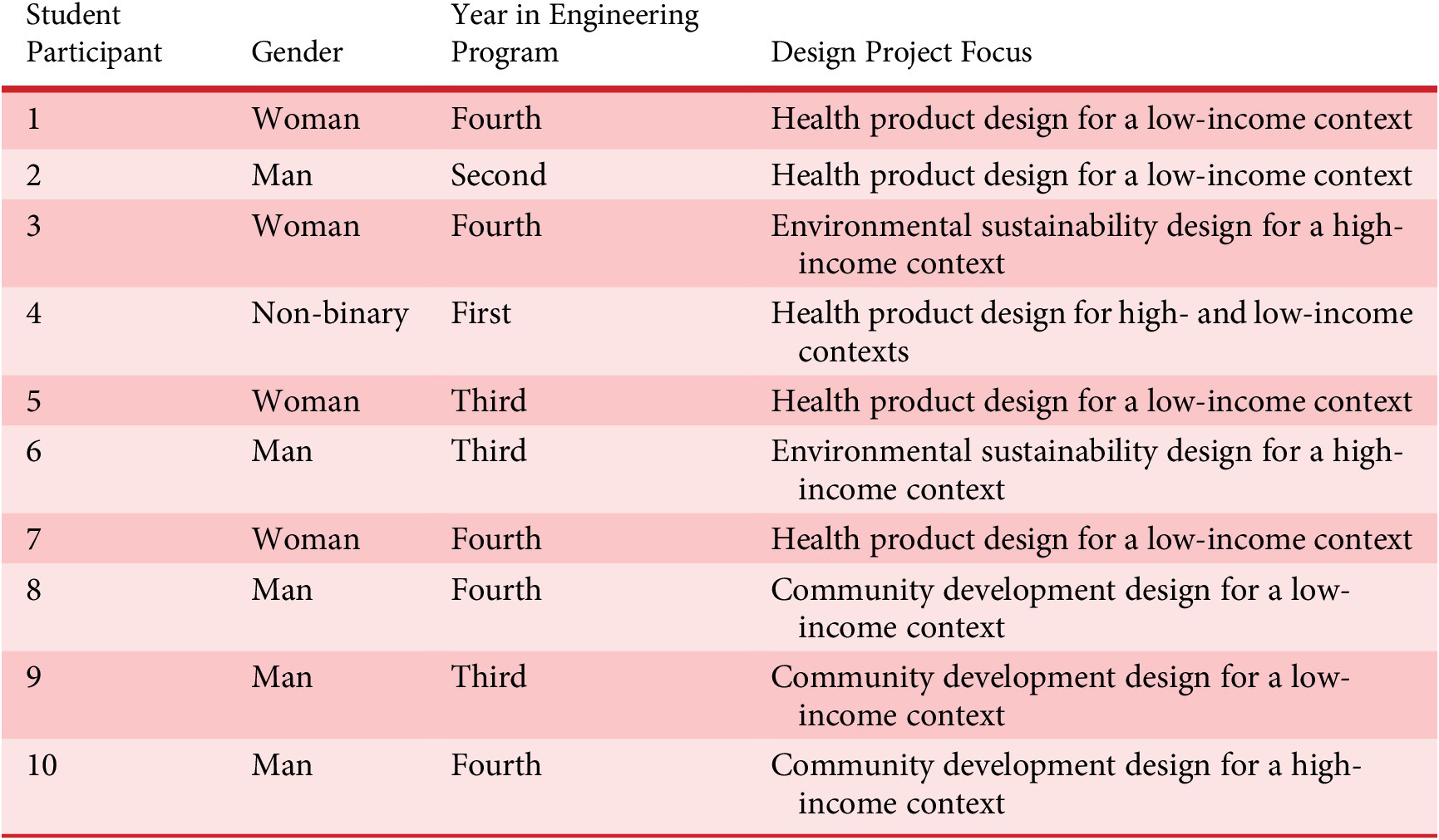
Table A1 Long description
The table begins with four column headers: Student Participant, Gender, Year in Engineering Program, and Design Project Focus. Each row details one participant. Participant 1 is a woman in her fourth year focusing on health product design for a low-income context. Participant 2 is a man in his second year with the same project focus. Participant 3 is a woman in her fourth year working on environmental sustainability design for a high-income context. Participant 4 is non-binary in their first year, focusing on health product design for both high- and low-income contexts. Participant 5 is a woman in her third year working on health product design for a low-income context. Participant 6 is a man in his third year focusing on environmental sustainability design for a high-income context. Participant 7 is a woman in her fourth year working on health product design for a low-income context. Participant 8 is a man in his fourth year focusing on community development design for a low-income context. Participant 9 is a man in his third year working on community development design for a low-income context. Participant 10 is a man in his fourth year focusing on community development design for a high-income context. The table shows a predominance of health product design projects for low-income contexts and a mix of genders and years.
Practitioner participant demographics
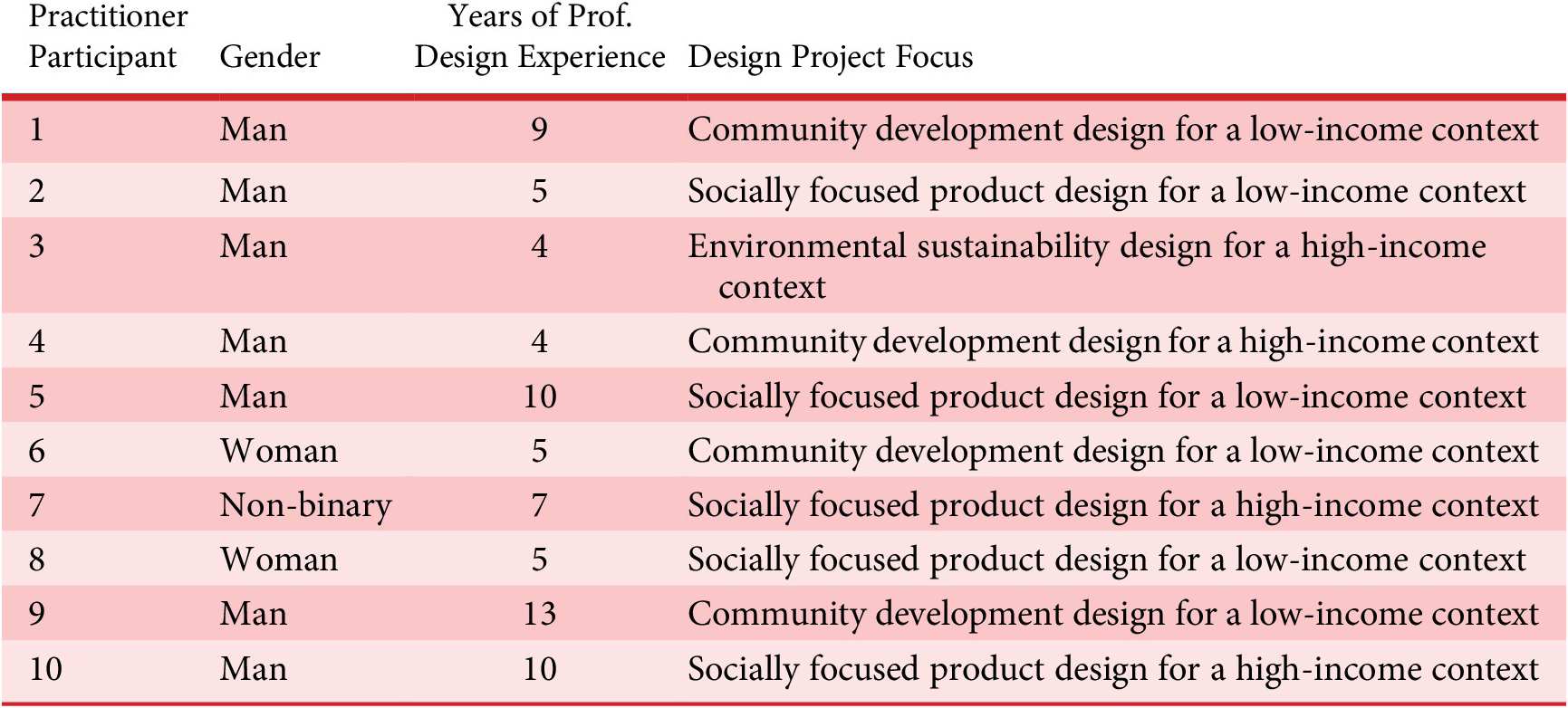
Table A2 Long description
The table begins with four columns labeled Practitioner Participant, Gender, Years of Prof. Design Experience, and Design Project Focus. Participant 1 is a man with 9 years of experience focused on community development design for a low-income context. Participant 2 is a man with 5 years of experience focused on socially focused product design for a low-income context. Participant 3 is a man with 4 years of experience focused on environmental sustainability design for a high-income context. Participant 4 is a man with 4 years of experience focused on community development design for a high-income context. Participant 5 is a man with 10 years of experience focused on socially focused product design for a low-income context. Participant 6 is a woman with 5 years of experience focused on community development design for a low-income context. Participant 7 is non-binary with 7 years of experience focused on socially focused product design for a high-income context. Participant 8 is a woman with 5 years of experience focused on socially focused product design for a low-income context. Participant 9 is a man with 13 years of experience focused on community development design for a low-income context. Participant 10 is a man with 10 years of experience focused on socially focused product design for a high-income context.
Appendix B: Prototype Positionality Training Tool
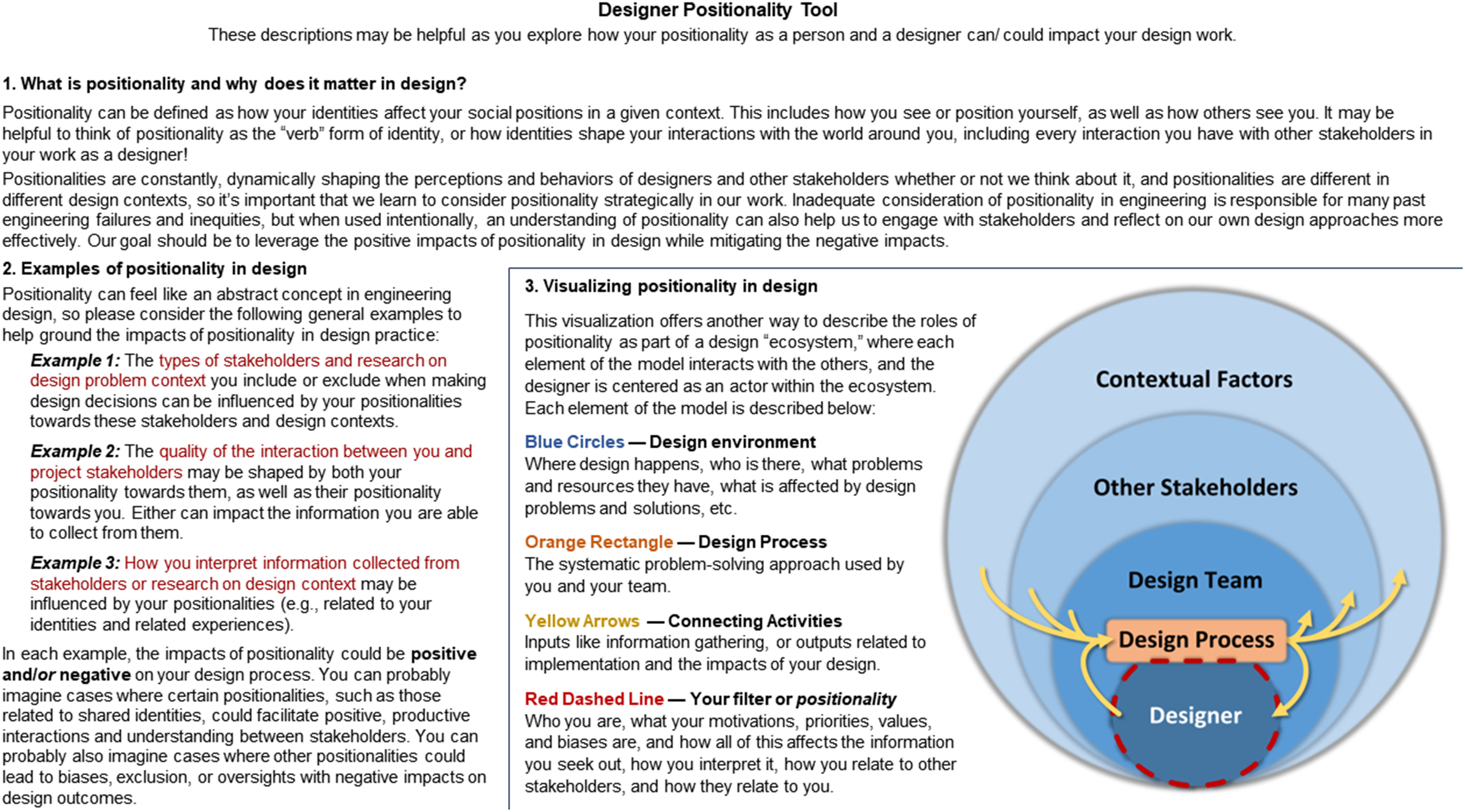
Figure B1 Long description
At the center is a blue circle labeled Designer, surrounded by a red dashed line representing ‘Your filter or positionality.’ The next outward layer is an orange circle labeled Design Process, overlaid by an orange rectangle indicating the design process as a systematic problem-solving approach. Yellow arrows extend from the design process, labeled Connecting Activities, representing outputs related to implementation and impacts on the system. Surrounding this is a blue circle labeled Design Team, then a larger blue circle labeled Other Stakeholders, and finally the outermost blue circle labeled Contextual Factors. The legend at left explains that the red dashed line is your filter or positionality, the orange rectangle is the design process, and yellow arrows are connecting activities. The diagram visually maps how the designer’s position and actions influence and are influenced by the design process, team, stakeholders, and broader context.
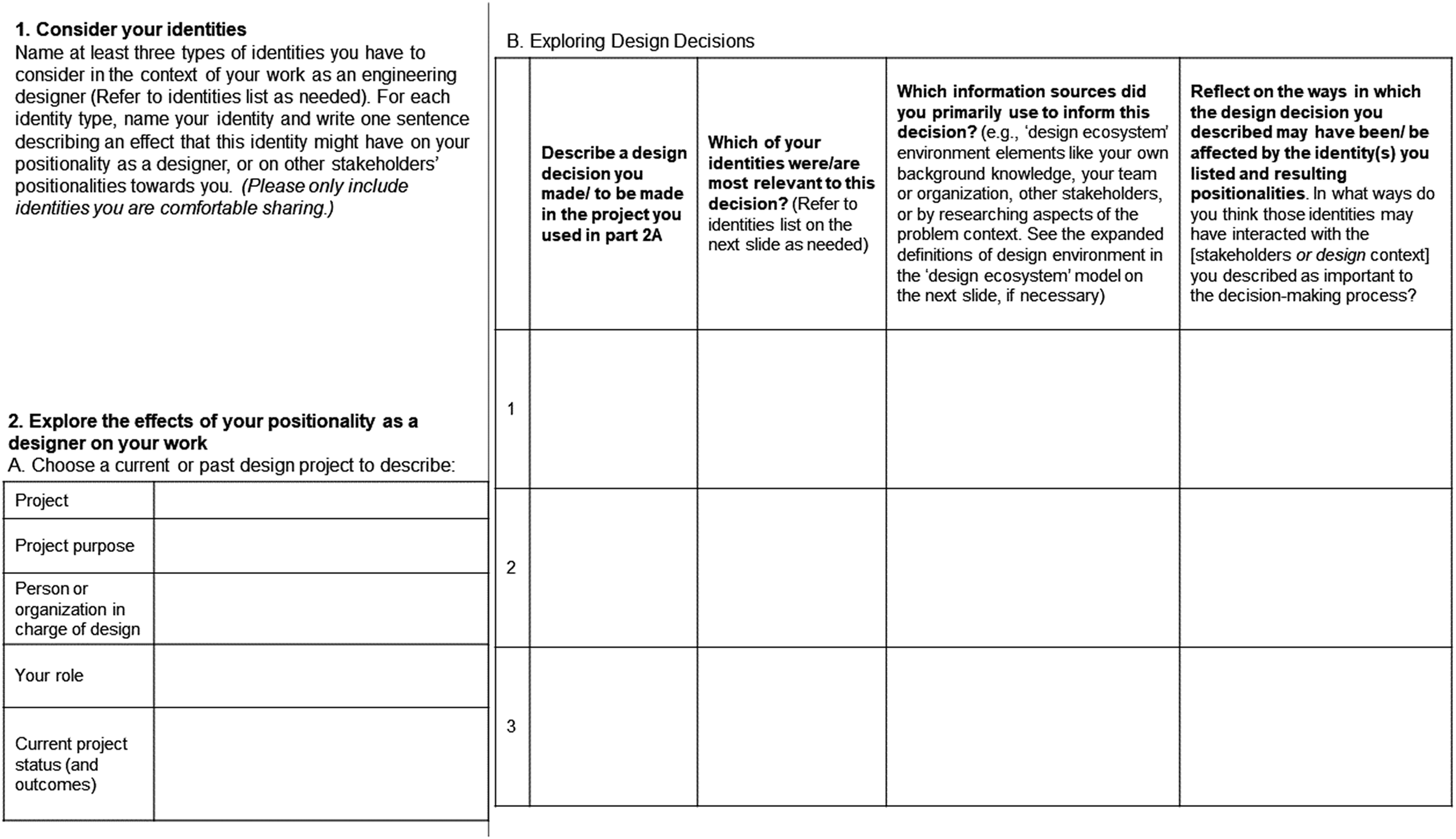
Figure B2 Long description
On the left, section 1 asks users to list at least three identities relevant to their work as engineering designers and describe their effects on positionality. Section 2 prompts users to select a current or past design project, then fill in project name, purpose, person or organization in charge, their role, and current status or outcomes. On the right, section B is a four-column table with three numbered rows. The columns are labeled: ‘Describe a design decision you made/to be made in the project you used in part 2A,’ ‘Which of your identities were/are most relevant to this decision,’ ‘Which information sources did you primarily use to inform this decision,’ and ‘Reflect on the ways in which the design decision you described may have been/be affected by the identity(s) you listed and resulting positionalities.’ Each row is blank for user input.
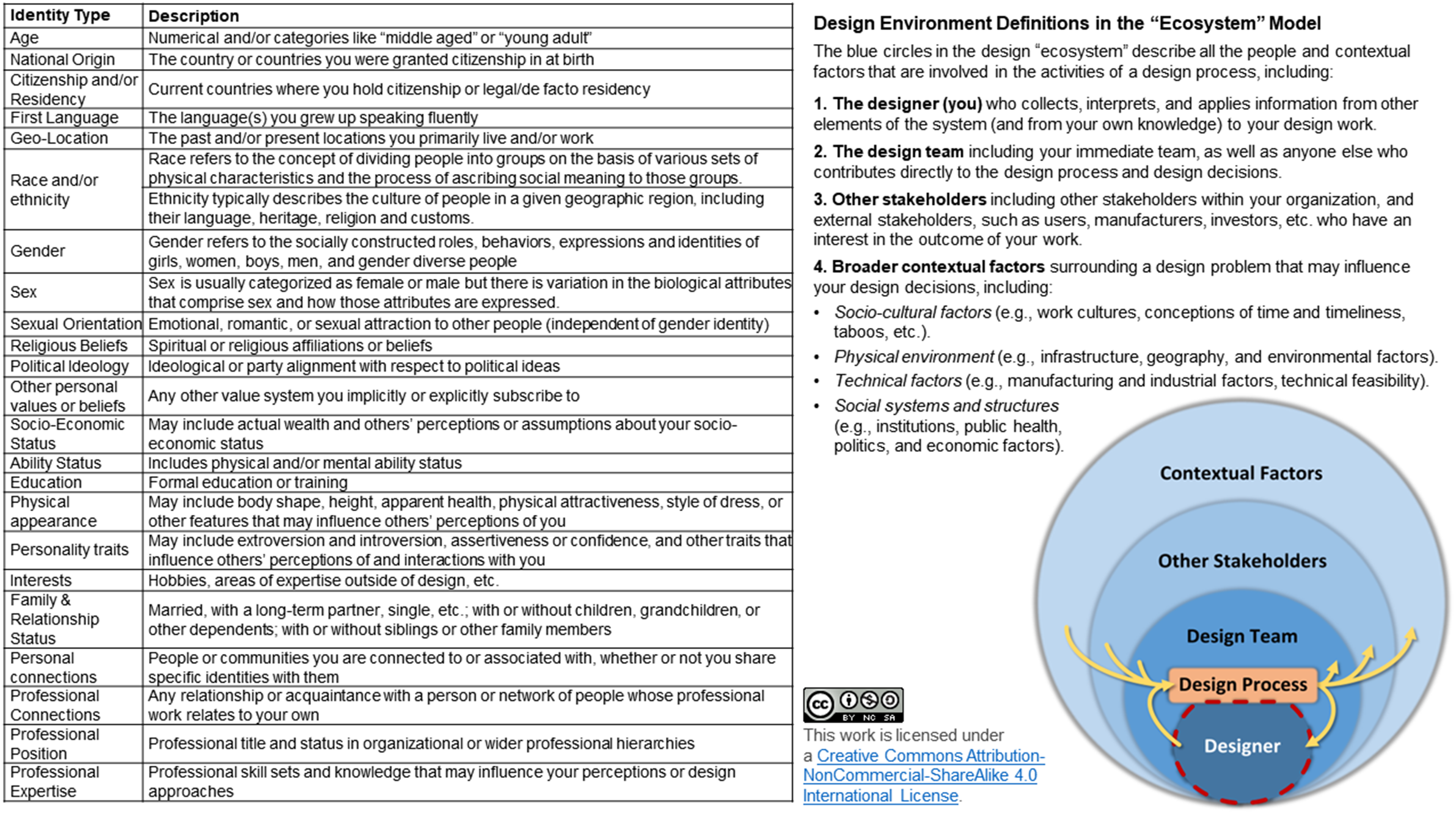
Figure B3 Long description
On the left, a table lists identity types in the first column and their definitions in the second, including age, national origin, citizenship, first language, geo-location, race or ethnicity, gender, sex, sexual orientation, religious beliefs, political ideology, personal values, socio-economic status, ability status, education, personality traits, family and relationships, employment status, and expertise. Each row provides a concise explanation, such as age being numerical categories, and gender as socially constructed roles. On the right, a circular diagram is anchored at the center with Designer, surrounded by Design Process, then Design Team, Other Stakeholders, and the outermost Contextual Factors. Four bullet points explain the roles of designer, design team, other stakeholders, and broader contextual factors, which include socio-cultural, physical, technical, and social systems. The diagram visually represents the layered influence of these groups and factors on the design process.
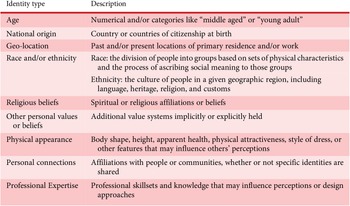
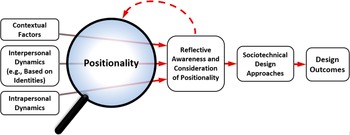
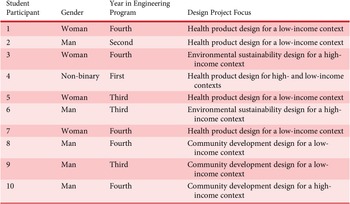
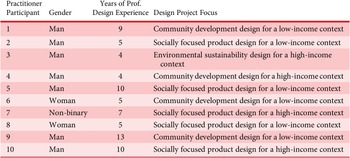
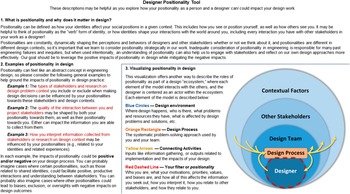
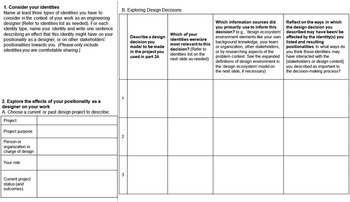
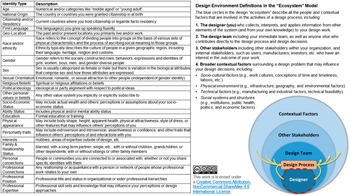

 Open access

