

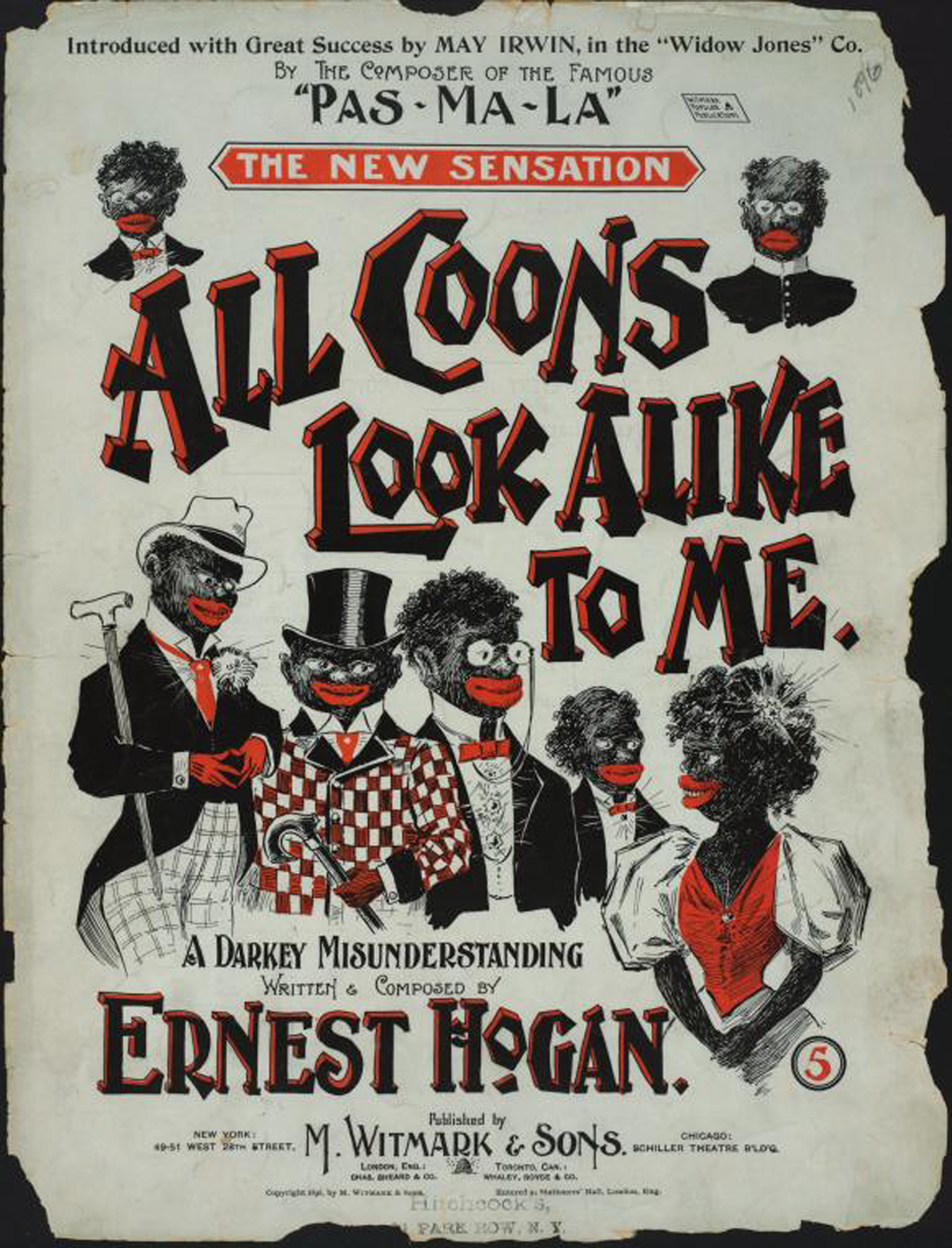
The biggest hit of 1896, like so many popular songs that came before and after it, is a story of romantic betrayal. Unlike most pop songs, however, this one galvanized a wave of uproar that altered the racial politics and economics of the modern music industry. In the opening verse, the narrator despairs that his “honey gal,” a woman named “Lucy Janey Stubbles,” will sleep with any Black man because, as she explains to him in the song's refrain (which also gives the song its indelible title): “All coons [sic] look alike to me.”Footnote 1 The lyrics of the song describe Lucy as avaricious and undiscerning, intent on leaving her man for another beau who “spends his money free” and lavishes her with material goods. The sheet music cover (Figure 1) illustrates the narrative, which it describes as a “darkey misunderstanding,” through caricature: The men, each a variation of the foppish dandy, display a sartorial elegance that is undermined by the grotesque, overdrawn red lips of the nineteenth-century blackface minstrel stage.Footnote 2 They are appraised by a Black woman, implied to be the “honey gal” described in the song, whose elegant dress likewise communicates a Victorian femininity. She is styled as a Gibson Girl—the narrow-waisted feminine ideal of the turn-of-the-twentieth-century New Woman, illustrated here with a tiny waist and puff sleeves that highlight her ample bosom, long neck, and hair piled high in a bouffant decorated with a sparkling pin. Like the putative male caricatures, however, her unvariegated dark skin tone and exaggerated red lips—which stand out prominently on an otherwise black-ink lithograph—mark her as a masculinized figure whose face is incompatible with her conventionally feminine body. The sheet music cover suggests that “all coons” who attempt to distinguish themselves through such sartorial self-fashioning are bound for mockery and failure.
“All Coons Look Alike To Me.” Published by M. Witmark & Sons, 1896. Music Division, The New York Public Library Digital Collections.
The fact that “All Coons Look Alike To Me” was authored by Hogan, one of the earliest Black Broadway stars and an originator of the ragtime genre, was subject to much scrutiny in the Black press.Footnote 3 For some critics, the song's Black authorship suggested an irony to its caricatures of blackness implicit in the semidistinct visages of the lithograph and in the song's lyrics. This irony may have been obvious to contemporary Black audiences and even performed with a subversive wink by Black artists. Others dismissed the song as an uncritical reproduction of stereotypes that reinscribed the racist logic of Jim Crow society, increasing threats of harm and violence to African American communities in the form of “street-level racist taunting.”Footnote 4 Still others argued that the “coon song” genre, as a continuation of the minstrel show tradition, inherited the ambivalent mixture of appreciation and mockery—or what cultural historian Eric Lott later dubbed “love and theft”—that characterized antebellum blackface minstrelsy.Footnote 5 The diversity of these debates was best summarized in the Indianapolis Freeman in 1911: “The origin of ragtime and coon songs has taken up as much space as the race problem. Every writer has a different view and backs it up with a good argument.”Footnote 6
Musicologists and cultural studies scholars have examined the harmful stereotypes of Black men in “All Coons Look Alike To Me,” but their analyses have yet to center the song's caricature of the Black woman.Footnote 7 I contend that she warrants a closer look, not least because accounting for her point of view as addressed in the song's title, “All Coons Look Alike To Me,” lays bare the complexity of identity and representation at work in the “coon song” genre: The speaker referenced in the title (“me”) could alternatively represent the songwriter (Hogan), the singer (usually a white woman, sometimes in blackface), the (presumably white) audience hearing the piece performed live or (more rarely) through a sound recording, or the amateur music makers who purchased the sheet music to perform the song at home. Although the “coon song” genre naturalized the oddity of white women “shouting,” often from a Black male protagonist's narrative point of view, about Black life and romance, it is a Black woman who vocalizes the title line within the context of the song. This article attends to the portrayal of Black women characters in “coon songs,” focusing on Black women's performances within the “coon song” genre.
Although the word “coon” began to circulate in popular music in the early 1880s, major song publishing houses did not begin advertising “coon songs” in earnest until the mid-1890s, when the veritable craze began. The term “coon song” generally referred to a ragtime song, often written in “Negro” dialect, that depicted scenes of purported Black life. Romantic scenes between Black men and women were especially popular content for “coon songs.” As Sam Dennison has shown, the narrative between Lucy Janey Stubbles and her jilted lover in “All Coons Look Alike To Me” became “the model for many subsequent songs on the black male–female relationship.”Footnote 8 Following Hogan's success with “All Coon's Look Alike To Me” and its predecessor “La Pas Ma La,” “coon songs” remained wildly popular for the next decade; at least 600 were published as sheet music in the 1890s alone, and several of these sold millions of copies.Footnote 9 The phenomenon continued until the burgeoning Jazz Age of the early 1920s, when some of the most popular “coon songs” like “(Won't You Come Home) Bill Bailey?” became jazz standards.
Existing surveys of “coon songs” reveal trends in the genre's musical characteristics and recurring stereotypes. According to historian James H. Dormon's analysis of approximately 100 of the most popular “coon songs” of the 1890s, “coon song” caricatures diverged from the conventional figures of the antebellum minstrel show, such as the happy-go-lucky “darky” (or Jim Crow) and malapropism-prone “dandy” (or Zip Coon), who had previously been “essentially unthreatening” to white audiences.Footnote 10 The Black male characters in turn-of-the-twentieth-century “coon songs” were still comic but much more violent, often described as “razor-wielding savages” who haunted the urban environment or as ultra-aggressive “bullies” who perpetuated intraracial crime and brutalized their women.Footnote 11 May Irwin, one of the most well-known “coon shouters” at the turn of the twentieth century, was particularly popular for her specialty “bully” songs that amplified the violent characterization of Black men.Footnote 12 There are hints of this tendency in “All Coons Look Alike To Me”: The protagonist, likening Lucy Janey Stubbles’ rejection to a form of “abuse,” expresses his “desp'rate” intentions to try to “win [his] sweet thing” back if he lucks into some money, and warns that he will “get dang'rous” if she rejects him again. These threats trade on white cultural assumptions that linked Black masculinity with violence. Dormon argues that this characterization worked to justify and reaffirm a system of Black subjugation and Jim Crow segregation, aesthetically reinforcing the overwhelming brutality of what historian Rayford W. Logan has called “the nadir” of Black American history.Footnote 13
This article asks: How might the period's negative portrayal of Black masculinity have impacted cultural perceptions of Black womanhood? Much of the existing scholarship on the performers who popularized “coon songs” has focused on white women; indeed, white women were the most well known for their renditions of “coon songs” and were often dubbed “coon shouters” after their style of robust vocal delivery.Footnote 14 Many were self-proclaimed “negro specialists” who, like the white minstrels of the nineteenth-century minstrel show, claimed to have studied so-called authentic Black performance in order to replicate it on stage.Footnote 15 However, as Lynn Abbott and Doug Seroff show, in addition to the white men and women who first recorded “All Coons Look Alike to Me” and the Black male performers who were quick to parody Hogan's song, there also existed a “forgotten legion of early-1900s African American female coon shouters,” including classic female blues vocalists Bessie Smith and Gertrude “Ma” Rainey, who were called “up-to-date coon shouters” in the press.Footnote 16 Abbott and Seroff also name Carrie Hall, Bessie Gillam, and Rosa Scott as a few of these now-forgotten Black women “coon shouters” of the turn of the twentieth century. In a similar vein, Jayna Brown has noted how the “coon song” performances of Belle Davis and Stella Wiley, both Black women stage artists, have received little acknowledgment from scholars.Footnote 17 Brown, Abbott, and Seroff have correctly diagnosed the lack of an extensive examination of the roles that Black women played as interpreters of this song repertoire. This article further investigates the history of Black women as caricatures within this repertoire and as musical interpreters of “coon songs” with a focus on their vocal stylings and performance contexts.
My analysis is enabled by a Tin Pan Alley publishing convention of including photographs that advertised the composer(s), author(s), and/or performer(s) of “coon songs” on sheet music covers.Footnote 18 Such details are not often otherwise documented in written criticism, revealing information about Black women who popularized “coon songs” that are not available elsewhere. Surveying “coon song” sheet music covers also calls our attention to the importance of performance practice—not only who performed these songs, but whose renditions were successful and, potentially, why they were popular. The extant archive of “coon song” sheet music is thus representative of what performance studies scholar Diana Taylor has described as the archive and the repertoire working in tandem: Evaluating the textual archive of “coon song” sheet music as a repertoire recognizes how this material was performed and appropriated in diverse ways that “transforms choreographies of meaning.”Footnote 19 Although these performances themselves are “ephemeral, nonreproducible [acts of] knowledge,” it is possible to trace the way that different artists performed—sung, danced, talked, joked, “shouted”—these songs, and to theorize what they meant to the artists who performed them and to the audiences who heard them.Footnote 20 Each “coon shouter” therefore brought an individual approach to the repertoire, making a case study approach to this material beneficial.
To this end, I focus on the career of the Black cakewalker Dora Dean (1872–1949), examining a sample of “coon songs” with illustrated portraits or photographs of Dean on the cover, which indicates that she popularized each song through a successful rendition of it. My survey of this material interrogates the particular and peculiar racial caricatures that appear throughout Dean's repertoire, which I identify as the “honey gal” and its variants, the “wench” and the “jezebel.” I evaluate these caricatures within Dean's known repertoire against the backdrop of her reception history, interrogating reviews of Dean's performances in newspapers and periodicals dating from the height of her career (ca. 1896–1914). As this reception history reveals, Dean performed her “coon songs” using novelty performance techniques like talk-singing and by incorporating European exotica. I argue that these techniques commented on the original meanings of the genre's caricatures of Black womanhood and romance. At times, however, they also rendered Dean's performances of “coon songs” illegible to audiences who associated “coon songs” and “coon shouting” with white women's performance contexts and with the genre's roots in blackface minstrelsy. Ultimately, my analysis aims to reshape our understanding of Dean's career and of the “coon song” genre, considering Dean to be representative of the phenomenon of Black women's “coon shouting” while also challenging assumptions about the genre and its aesthetics.
Dora Dean, “The Sweetest Gal You Ever Seen”
Dora Dean was born in Kentucky to a formerly enslaved mother around 1872.Footnote 21 In 1889, Dean was hired as a “statue girl” to pose and show off her curvaceous figure in Sam T. Jack's The Creole Show (1890–97), the touring burlesque show now considered to be a transitional show between the minstrel show and the vaudeville revue.Footnote 22 The Creole Show featured a traditional tripartite minstrel show format, including the first part's semicircle of performers surrounding an interlocutor, but it departed from convention by including Black women in its performing forces and by featuring Florence Hines, famous for her male impersonations, as the interlocutor.Footnote 23 It was the first show to include a chorus of beautiful women, which would become a staple of musical comedies and revues in the early twentieth century. It was among the novelty of Black female minstrels and chorus girls of The Creole Show that Dean received her earliest stage training. The Creole Show also introduced her to Charles E. Johnson, who played a minstrel endman, and the two were married in 1893. The pair then began to perform as a dance team and soon popularized the cakewalk, performing the dance first in the United States and then across Europe.Footnote 24 In Marshall and Jean Stearns’ pioneering oral history of U.S. American vernacular dance, the authors describe Johnson and Dean as “class acts” who first “established the roles of the genteel Negro couple on the American stage—the courtly gentleman and the gracious lady.”Footnote 25 In a more literal sense, the “class acts” were famous for their performances of class and respectability, both on- and off-stage. Johnson and Dean were particularly well known for performing the cakewalk in formal wear—Johnson in tuxedoes and colorful dress suits, and Dean wearing full evening gowns reported to cost $1000 each.Footnote 26 Their manner of costuming was imitated by other Broadway stars.Footnote 27
The visual, rather than the sonic, thus predominates in Johnson and Dean's reception and in secondary sources addressing the pair's legacy. A close examination of contemporary reviews of their performances nevertheless reveals that they were also known to incorporate popular vocal music, including “coon songs,” into their act. What I am interested in examining is how the ways they were seen informed audiences’ ways of hearing race, gender, and sexuality in their performances. Viewed as two complementary mediums of performance, Johnson and Dean's sophisticated costuming and their singing of “coon songs” both involved adapting or signifyin(g) on tropes of blackness.Footnote 28 For white artists at the turn of the twentieth century, performing in elegant formal wear was a way to demonstrate sophistication and set oneself apart from the so-called lowbrow forms of comedy; for Black performers, however, this same type of sartorial presentation also called forth the old stereotype of the overdressed “dandy” who failed to mask his ignorance with gaudy clothes. This mockery was also frequently expressed in many “coon songs”—recall, for instance, the narrative that played out in “All Coons Look Alike To Me.” The minstrel “dandy” did not have an exact female equivalent, but viewing Dean's formal wear as costuming allows us to see parallels between her performance of Black femininity and the history of white men performing in the blackface and drag as Black women characters on the minstrel stage. Just as dressing in formal wear could be interpreted as a critique of blackface minstrelsy, Johnson and Dean's costuming also emphasized the persistence of minstrel tropes and stereotypes.
These tensions come to the fore in the song “Dora Dean” (1897), a “coon song” written in Dean's honor. With words and music by Bert Williams, it was marketed as “the greatest coon song ever written!”Footnote 29 The song describes Dora Dean as the epitome of Southern gentility: “Way down in Lou'siana,” Dean “goes to church on Sunday,” keeps a spotless home, and even wins an impromptu cakewalking contest. These traits make her so desirable that the male protagonist declares his intentions to “marry sweet Dora Dean” next Sunday morning. Musically, the song is fairly straightforward, pivoting between a chromatic verse in E minor and a lightly syncopated chorus in the relative major key. In terms of “coon songs” conventions, “Dora Dean” is remarkably free of violence and grotesquerie, although it does feature stereotypical figures like “old Aunt Dinah” in the Southern homestead. The song's dialect, syncopated melody, and description of cakewalking are also all stereotypes of Black cultural expression, but it depicts Dean as a character rather than as in caricature, describing her as a model of respectable Black womanhood.Footnote 30
The chorus of the published sheet music declares that Dean is “the sweetest gal you ever seen.” This is a change from the original lyrics, however, which stated that Dean was “the hottest thing you ever seen.”Footnote 31 This phrase was the subject of a copyright infringement lawsuit brought by Broder and Schlam, the publishers of “Dora Dean,” against the Zeno Mauvais Music Company. Broder and Schlam claimed that the defendant's song, “Ma Angeline,” which was also marketed as the “greatest coon song of the age,” had pirated the melody of “Dora Dean.”Footnote 32 Although the court determined that the melody of “Ma Angeline” was indeed pirated, the case was ultimately dismissed because the court found the word “hottest” in the original lyrics to be “immoral”—“hot” apparently meaning “lustful, lewd, [and] lecherous” when applied to a woman—that prevented the song from being protected under copyright laws.Footnote 33 This backstory highlights the metaphoric relationship between so-called hot music and Black women themselves: Both were ineligible for protection under the law because of imputed indecency. For Black women, this was based on enduring myths, created to justify sexual conquest during slavery, that characterized their nature as immoral and promiscuous.
The copyright infringement case is not only interesting (especially because both songs were authored by Black men who composed “colored melodies”), but it is also particularly relevant to an analysis of Dora Dean's “coon song” performances because of the specific details present in the plaintiff's defense. According to one report on the trial, the plaintiff argued that the term “hottest” had a different meaning depending on the race of the listener. Calling a woman “hot,” he claimed, “has no obscene or vulgar meaning, and simply means ‘grand,’ ‘brilliant,’ or… it means with the colored people the same as the expression ‘She's out of sight’ does with some white people.”Footnote 34 It is possible that the plaintiff's defense of the term “hottest” was an excuse invented in an attempt to take advantage of the judge's ignorance of Black colloquial expressions. Nevertheless, I wonder if it does not also point to the multiple ways that this repertoire was indeed interpreted by different artists and audiences. The terms of popular music were debated and contested by contemporary listeners; concepts viewed as “lewd” in one space might be seen as “grand” in another, and Dean could indeed turn from “sweet” to “hot” depending on the performance context. In other words, within the “Dora Dean” copyright lawsuit there is an acknowledgment of the malleability of musical meaning through performance. Although race- and gender-based stereotypes in “coon songs” were recognized as conventions of the ragtime vocal music genre, this does not mean that all (Black) performers simply accepted them; nor were their performances necessarily uncritical reproductions of such stereotypes. Paying specific attention to Black women's performance contexts reveals an opportunity for negotiating musical and cultural meaning than has often gone unacknowledged. Although the “honey gal” of “All Coons Look Alike To Me” and the “sweet gal” of “Dora Dean” appear to have similar titles, to categorize them as the same type of caricature would ignore key differences in their characterization of Black womanhood. These differences may not have been legible to the court during the “Dora Dean” lawsuit or to other white audiences and performers, but they may have been important to Black audiences and performers working to expand the limits of acceptable performance mediums and forms of representation available to them. The capaciousness of the stereotypes of Black femininity, circumscribed as they were, informs my analysis of Dean's “coon song” repertoire, which does not hold concepts of “lewdness” and “respectability,” or of “low class” and “high class,” as binaries. Rather, I consider the paradoxes of stereotype as a spectrum in which these figures could represent various qualities of Black womanhood recognized by turn-of-the-twentieth-century audiences depending on the specific song, artist, and performance context.
The “Gal,” the “Wench,” and the “Jezebel”: Caricatures of Black Women in the “Coon Song” Genre
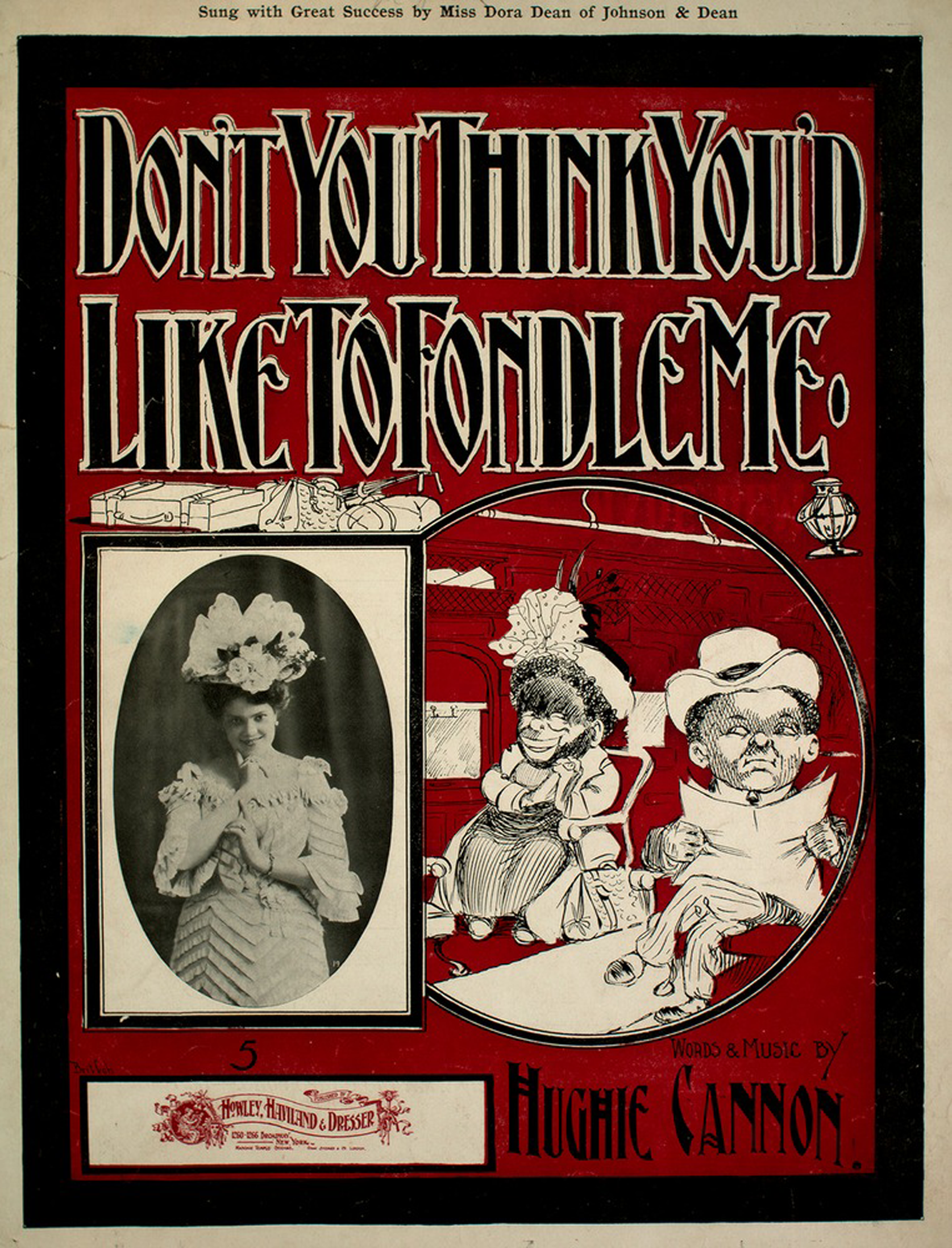
A survey of Dean's known repertoire reveals that she popularized several “coon songs” that describe Black women as overly sexual and avaricious—a seeming departure from Dean and Johnson's respectable “class act” reputation. Many of these songs pathologize Black women asserting sexual agency by representing them in caricature. One example appears in the song “Don't You Think You'd Like to Fondle Me?,” published in 1900.Footnote 35 The cover indicates that it was “sung with great success by Miss Dora Dean of Johnson & Dean,” and includes a photo inset of Dean, outfitted in a frilly dress and ornate hat, gazing forward with her hand posed evaluatively under her chin (Figure 2). Dean's portrait appears next to a lithograph of a Black man and woman seated on a train, meant to be an illustration of the narrative presented by the song's protagonist who must fend off the unwanted advances of a “big fat wench” who asks him, in the chorus, “Don't you think you'd like to fondle me?” The outrageous scenario continues in the second verse: The man attends a musical show and, to his surprise, the “same wench” from the train is the star of the production. She sings “dat same old tune” that she'd sung on the train, which turns out to be the chorus that we've heard once before: “Don't you think you'd like to fondle me?”
“Don't You Think You'd Like To Fondle Me?” Published by Howley, Haviland & Dresser, 1900. The Lester S. Levey Sheet Music Collection, Johns Hopkins Sheridan Libraries Digital Collections.
The musical form of the song invites us to contemplate the flexibility of “coon songs” in live performance contexts. The verses of the song follow the male protagonist's first-person point of view, but the chorus ventriloquizes the Black woman's performance of a song within the larger song—in effect, moving to a second-person point of view that invites “you,” the listener, to fondle “me,” the singer. Although there are no recordings of Dean performing this work (or any other), we can imagine that moving between the verse and chorus may have called for an immediate shift in tone and affect. Dean could have certainly played up the comedic aspects and outrageously sexual nature of the chorus, but the complex layering of signification in live performance also creates the possibility of an alternate hearing of the chorus as a serious invitation to regard her as a hypersexual “wench.” If, in the context of the minstrel show, a similar sentiment would have been performed by a white man in blackface and drag, the transgressive range of such a performance may have been limited by the comedic corporeal exaggeration of blackness and fatness. On the contrary, as Eric Lott proposes, such a grotesque portrayal of Black femaleness may also be proof of “white men's fear of female power,” even as this dramatization destabilized traditional gender categories.Footnote 36
In historian Katrina Thompson Moore's examination of the “wench” caricature in antebellum popular culture, she notes that “wench” performance had historically been “associated with some type of drag performance, and…it often applied to the mocking or degrading of Black women.”Footnote 37 The grotesque “wench” in “Don't You Think You'd Like to Fondle Me?” is described as “big,” “fat,” and “black,” a characterization that emphasizes how her undesirability is at odds with her sexual aggression and undiscerning promiscuity. The lithograph caricature of the Black woman further demonstrates the colorist bias that renders her undesirable for the Black man: Her skin is noticeably darker than his—an offense for women aspiring to Victorian ideals of femininity—and, unlike in many other “coon song” sheet music covers, she is the only figure represented in grotesque caricature. The “wench's” historical associations with male drag performance and her physical embodiment of blackness turn her attempts at promiscuity into a comedic point in the song, but they also speak to the ways that performances of Black gender and sexuality that fell outside the scope of Black respectability were masculinized and treated as deviant. Given Dean's image as a light-complexioned “class act” who performed in formal wear and without blackface makeup, her on-stage persona and off-stage reputation contrasted with the dark-skinned comic “wench” figure in the song. This piece therefore may have offered Dean an opportunity to intentionally bring out the incongruity between these two forms of Black femininity through her performance.
A generous reading of the sheet music cover would suggest that the photograph insert of Dean next to the “wench” caricature underscores the juxtaposition between gross racial stereotyping and a more realistic portrayal of Black womanhood. Another reading, however, might hold that the presentation of Dean's photograph next to the caricature suggests an equivalence between the two. These two opposing interpretations mirror long-standing debates about the possibilities for Black representation throughout the nineteenth century. Frederick Douglass, for instance, used daguerreotypes and formal portraits as tools to contest the grotesque caricatures of Black people frequently depicted in illustrations, which he argued were always already skewed by the cultural biases of the illustrators.Footnote 38 The photograph, he believed, was a more neutral technology able to capture how Black people appeared in real life with greater fidelity. When “coon song” sheet music cover featured both visual technologies, they challenge viewers to consider how Black visuality is constructed and performed in multiple registers.
What “Don't You Think You'd Like to Fondle Me” makes clear is that Black visuality and the myriad of connections between “coon songs” and blackface performance had the potential to shape the formal structure of the “coon song” repertoire. This is particularly evident in how the song frames the trope of the reveal, when the “same wench” reappears in the musical show. The opportunity for a grand comic reveal is built into the form of the song itself; this type of spectacular surprise was popular in performances of “coon songs.” For instance, famed “coon shouter” Sophie Tucker included a trick at the end of her shows: After a prolonged performance wearing blackface makeup and a costume that hid her skin, she would remove a single glove to reveal her white hand.Footnote 39 This reveal delighted audiences, as it confirmed that they had indeed heard a voice that sounded as if it could only be produced by a Black women coming out of a white woman's body.Footnote 40 Tucker herself claimed that her employment of “Negro dialect” was so realistic that she had difficulty convincing audiences that she was a “white girl.”Footnote 41
Unlike white artists’ performances of Black womanhood, Black women could not simply remove the racialized and gendered aspects of their character between songs. Dean could make a quick change from one raced and gendered stereotype to another (e.g., grotesque “wench” to promiscuous “jezebel”) but in doing so, she had to consider the stakes of her performance. In the words of performance studies scholar E. Patrick Johnson, the attributes of racist caricature “became ontologically fastened to the black female bodies onto which they were projected…[and] black women responded to this depiction of self in various and complicated ways.”Footnote 42 In “coon song” performances at the turn of the twentieth century, Black women could perform the visual and sonic markers of minstrel show-derived caricatures of Black women on-stage while embodying the very opposite in their everyday lives. This was the case with Dean, whose juxtaposition of her on- and off-stage personas could function to highlight the artificiality of stereotype—at least, for those audiences and listeners who could recognize it. Dean and other Black women artists walked a fine line as they attempted to maintain strict divisions between quotidian and staged performances of womanhood, for the consequences of being named a “wench” off-stage could be ruinous for one's career and reputation. The separation of these two spheres was a continuing source of anxiety for Black critics concerned with racial uplift and the politics of representation.
Racial passing was another popular theme in “coon songs” at the turn of the twentieth century, especially in reference to Black women who “turn their back on their race” in favor of pursuing the material goods and beauty associated with the dominant white culture. These women were characterized as “jezebels,” and they are even more ubiquitous in Dean's “coon song” repertoire than the “wench.” Although both character types are understood to be sexually promiscuous, the “wench's” unattractive physical appearance renders her more comic than threatening in the “coon song” repertoire. The “jezebel,” on the contrary, is marked by a deviant sexuality (Patricia Hill Collins calls her a “sexual freak”) that poses a threat to Black and white society alike, due to her physical attractiveness, lighter complexion, and possible ability to racially pass as white.Footnote 43
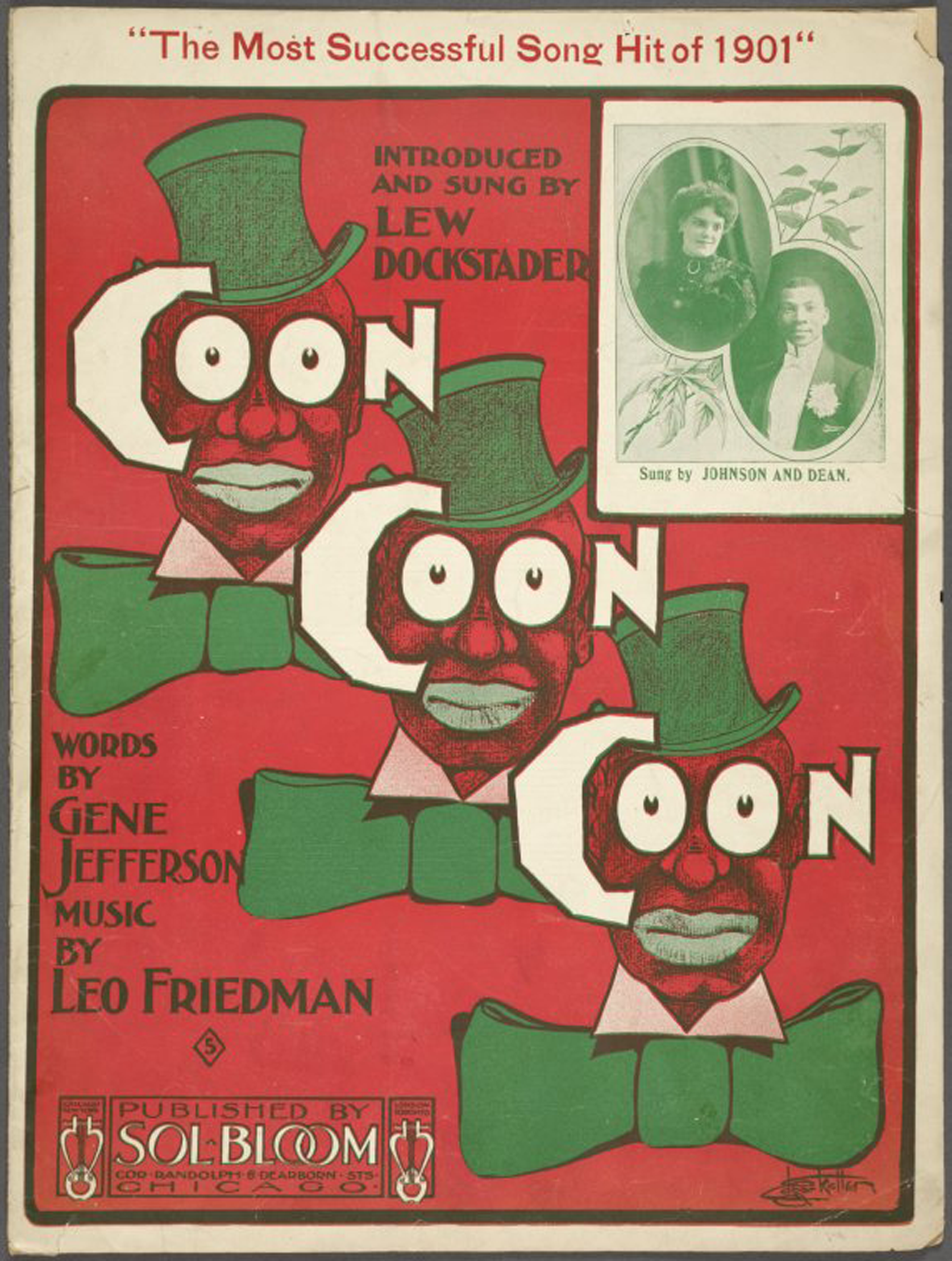
The issue of racial passing sets the backdrop for “Coon! Coon! Coon!,” marketed as “The Most Successful Song Hit of 1901.”Footnote 44 One version of the sheet music indicates that it was “introduced and sung by [white vaudevillian] Lew Dockstader,” but a photo inset on the another version of the same cover features portraits of Dean and Johnson (Figure 3). “Coon! Coon! Coon!” details the struggles of a Black man whose “gal” “took a notion against the colored race.” She demands that he “change [his] face” and rid himself of his “woolly” hair before she marries him. He gets “[his] face enameled” and “dress[es] up like a white man,” but his attempts to change races ultimately fail. On his way to meet her, he passes by two doves “making love at night” in a park; absurdly, the doves immediately spot his disguise and shout, “Look at the coon! Look at the coon!”Footnote 45 Defeated, he wails: “Coon! Coon! Coon! Morning, night, and noon, I wish I was a white man 'stead of a Coon! Coon! Coon!” Although the song is decidedly a comical lament, it speaks to the cultural value of white skin and the fantasy, promoted at least by white audiences, that Black people will never successfully “pass” as white—as well as the anxiety that they might succeed.
“Coon! Coon! Coon!” Published by Sol. Bloom, 1900. Music Division, The New York Public Library Digital Collections.
Although the Black women depicted in “coon songs” typically express their preferences for men with lighter skin tones, some songs in Dean's repertoire also expressed the opposite sentiment. One example appears in the 1898 hit “No Coon Can Come Too Black For Me,” which was also “sung with enormous success by Johnson and Dean.” The cover features a portrait of the couple strutting in full evening wear, posing as if captured mid-dance (Figure 4). The song is dedicated “to our friends, Williams & Walker, ‘The Two Real Coons,’” referencing the name of Bert Williams's and George Walker's famous vaudeville act.Footnote 46 It is also a rare example of a “coon song” presented from a woman's point of view; therefore, we might assume that Dean would have sung the song by herself, perhaps even turning to address her performance to Johnson at times instead of the audience.
“No Coon Can Come Too Black For Me.” Published by Howley, Haviland & Co., 1898. Music Division, The New York Public Library Digital Collections.
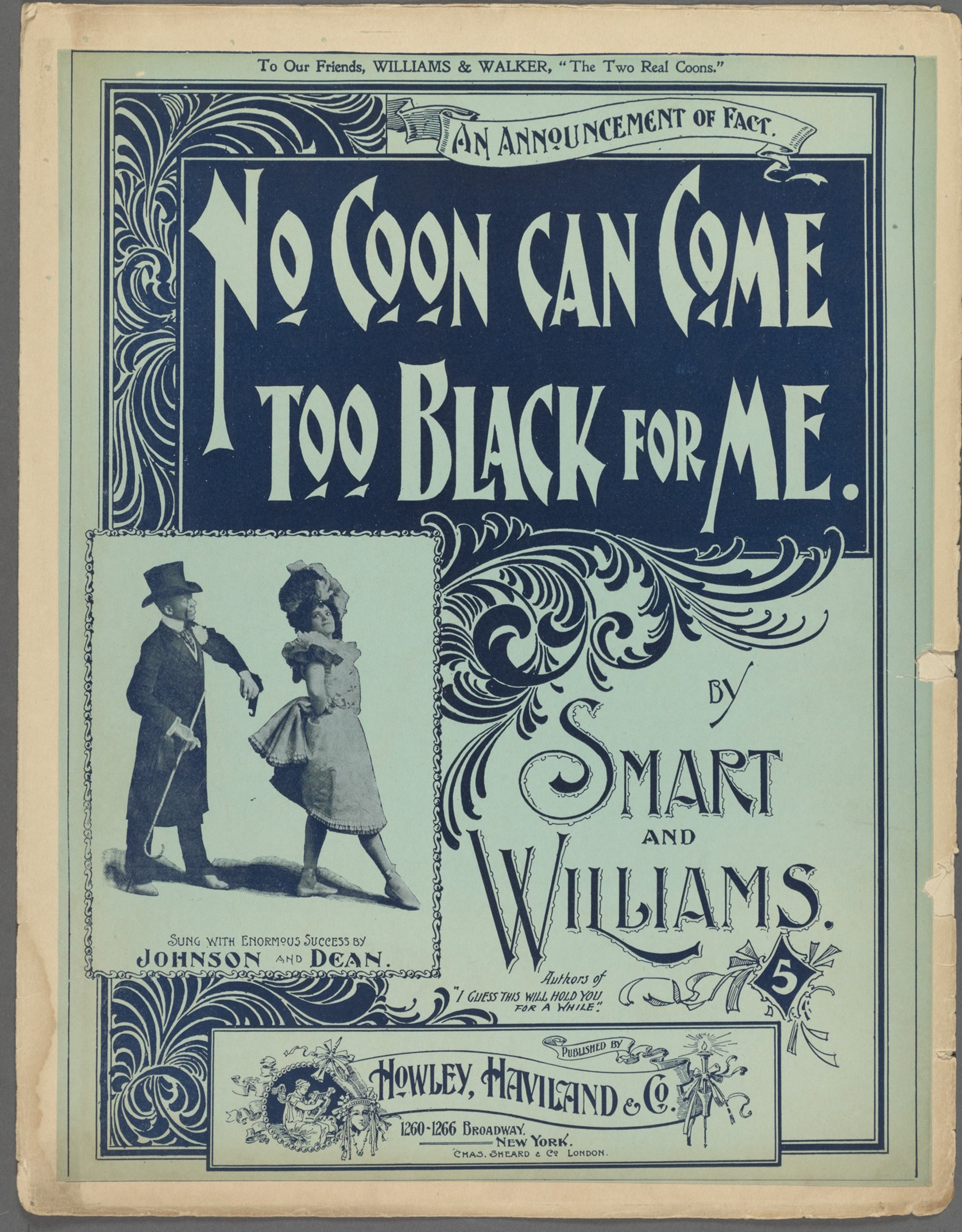
In “No Coon Can Come Too Black For Me,” the woman protagonist “fell in love with two real coons” (perhaps a sly reference to Williams and Walker), one “a pretty yaller man” and the other “a rale headed ankle faced freak” who was “black as he could be.” Although she prefers the lighter man's looks, she chooses to be with the darker of the two because he “pay[s] all [her] expense.” In the chorus she declares her love for “dark men's 'ciety” and claims that “no coon can come too black for me.” Nevertheless her choice does not come without consequences. In the second verse, she describes how the “yaller coon” swears that “he'll get revenge someday” if she refuses to marry him. She and her dark-skinned beau plan to “take his life” if he “don't compromise.” The two men fight for her love and her dark-complexioned man ultimately triumphs, leading us back to the catchy chorus that reaffirms the value of men's dark skin—as long as they continue to pay for their woman's expenses. Like Dean's other “coon songs,” this piece presents the Black woman as fundamentally rapacious. However, unlike the undiscerning promiscuity exhibited by the Black “wench” figures in “All Coons Look Alike To Me” and “Don't You Think You'd Like to Fondle Me?,” the figures in the two “coon songs” that center the theme of racial passing comment on Black men's complexion and the resulting impact on their desirability and Black women's class aspirations.
Perhaps a “coon song” seems a most unlikely staging ground for discussions of racial passing and what we now call colorism, which would soon emerge as dominant themes in African American literature and politics with the publishing of novels such as Pauline Hopkins’ Of One Blood: Or, The Hidden Self (1902–3), James Weldon Johnson's The Autobiography of an Ex-Colored Man (1912), and the numerous contributions of the Harlem Renaissance (c. 1920–30s). Nevertheless, it follows in the tradition of music theater and popular song that satirized, parodied, and critiqued contemporary politics. This form of theater had long been popular in the United States, from parodies of Shakespeare to eighteenth-century ballad opera and the nineteenth-century minstrel show.Footnote 47 Although the “coon song” repertoire was not a primary avenue for satire or cultural critique, it carried forward the impulse to focus on newsworthy figures and political issues. The “coon songs” Dean popularized center contemporary discussions among the Black leadership class of how to best represent the race, the debates of which were circulated in dedicated newspaper columns, periodicals, and speeches throughout the early twentieth century. This repertoire and its characterization of Black women produced meaning about Black womanhood that circulated within and beyond the audiences it was performed for.
Given the associations between lighter skin and a higher position in Black and white societies, it is no surprise that the Black romantic partners depicted in “coon songs” almost always choose a light-complexioned partner over a dark-complexioned one, unless the song is making a comedic or sarcastic gesture. Rarely do “coon songs” acknowledge the negative consequences of racial passing: Exile, alienation, and a separation from one's identity and community, as Allyson Hobbs reminds us.Footnote 48 Still, it is interesting that the tensions and debates over these issues were indeed played out in “coon songs,” and frequently at that. Both “Coon! Coon! Coon!” and “No Coon Can Come Too Black For Me” attempt to assuage audiences’ anxieties around racial passing, reassuring listeners that even when Black people actively aspire to “pass” as white, their attempts will ultimately fail due to an underlying racial essence that all Black people apparently shared.Footnote 49 For the Black women characters, this essence was expressed in their hypersexuality; for the Black male figures, it was usually expressed through violence. In both cases, the performance of stereotypes of Black gender and sexuality had lasting impacts on the politics of racial representation throughout the twentieth century, no doubt intensified once Black artists began performing these stereotypes themselves. Indeed, as theater scholar David Krasner notes, Black performance of stereotypes at the turn of the twentieth century contributed to the notion that “black writers, performers, and artists were capable of primitivism expressing a racial uniqueness that incorporated authenticity [and] untarnished amateurism,” which worked in tandem to “validat[e] the abilities and talents of African Americans, who were supposedly unencumbered by formal training.”Footnote 50
By giving credence to these stereotypes, Black performers found success in the entertainment industry even as they lost control over the commercialization of blackness within the industry. Depending on how different audiences interpreted a performance, it is possible that they might have reinscribed the negative stereotypes that the performers wished to unsettle. However, as Lisa B. Thompson argues, the alternative of maintaining a “culture of dissemblance and never directly address[ing] black women's sexuality” is equally troubling.Footnote 51 For Dean to perform this repertoire was for her to participate in meaning making in popular music and culture, even as she potentially authenticated the caricatures of Black womanhood through her performances of them. These tensions and their outcomes shape the following discussion about the instrumentality of “coon songs” and how Dean and other Black women could shape their meanings through performance.
Dean's Vocal Style and the Aesthetics of “Coon Shouting”
From the summer of 1903 to the fall of 1909, Johnson and Dean relocated to Europe and enjoyed several successful tours there. In October of 1909, Variety magazine published a critical review of their twelve-minute act at the American Theatre in New York, one of the first shows they put on after their return to the United States. The critic was not impressed with the European influence on Dean and Johnson's act:
Miss Dean has always been a good looking mulatto, with a figure unusual for a colored woman. Returning to New York, Miss Dean evidently believed she could sing a Hungarian song as a solo, accompanied by a Hungarian on the zither[…], and to appear in tights, a portion of the right leg between the knee and hip having a brown tint suggesting a fleshing for a colored woman. That display of form and color should have been left abroad, along with the solo, which was taken out of the act Monday night. Miss Dean's voice is not equal to a showy effort. Their forte is singing ‘coon’ songs and dancing.Footnote 52
The Variety critic's remarks raise key concerns with the changes that Dean and Johnson made to their act upon their return from Europe. The first is the issue of Dean's provocative dress that revealed a portion of her tight-clad thigh. Although displays of women's lower legs had become a staple and attraction of variety shows by this time, Dean's visible thigh had clearly offended the critic and therefore “should have been left abroad.” The second is the matter of their new repertoire, which contained at least one Hungarian song accompanied by a zither (an instrument likely unfamiliar to most New York audiences); their act may have included other songs that the duo had picked up in their travels on the continent. Not only was the repertoire strange and unfamiliar, but Dean's voice was also “not equal to showy effort” and unable to properly perform the Hungarian song, which led the duo to remove it from their lineup rather quickly. The critic preferred the act's “‘coon songs’ and dancing” to the new foreign repertoire and vocal stylings, advising them to “forge[t] all about Continental Europe adulation, [so] they will become once again the leaders among the colored mixed acts in vaudeville.”Footnote 53
Together, these comments demonstrate that the act's incorporation of European exotica did not align with expectations of Black performance style in the United States. The remarks also imply that Dean's performance of “coon songs” throughout the previous decade were less “showy”—a term that I interpret as referring to a comparative simplicity in Dean's vocal technique—than the new Hungarian solo piece. In my reading, these remarks underscore Dean's artistic agency, as demonstrated by her attempt to change the script of minstrel-derived comic song through the introduction of new forms of vocal repertoire to her act. Although the addition of the novelty Hungarian piece evidently did not last long, its very inclusion shows Dean's and Johnson's efforts to diversify their program, the reasons behind which we can only speculate. Perhaps they experienced certain liberties and performance opportunities in Europe that they'd lacked in the United States; many Black artists, from Josephine Baker to James Baldwin, would experience something similar in the century to come. Perhaps Dean and Johnson thought that U.S. American audiences would appreciate the piece of European exotica, only to find that audiences Stateside much preferred the “‘coon’ songs and dancing” that they'd so excelled at before their travels.Footnote 54 Whatever the case, it is clear that for some U.S. audiences, Black artists’ legibility was bounded by the lines of stereotype; to transgress these lines was to be pronounced a failure.
What determined if a rendition of a “coon song” was a success or a failure? Why was the performance of this repertoire referred to as “shouting” at all? Extant sound recordings provide some answers. They tell us, for instance, that singers were often accompanied by a band or an orchestra, that novelty sound effects like whistling or clapping were often added, and that “coon songs” were sometimes extended by the use of comic skits, banter, or interpolated jokes.Footnote 55 For example, an early recording of George Walker and Bert Williams singing “My Little Zulu Babe,” recorded for the Victor Talking Machine Company in 1901, includes wailing and cries that are not indicated in the printed sheet music of the song.Footnote 56 Nevertheless, it is not easy to make sweeping claims about how this repertoire was performed, or indeed, what it meant to “shout” it, given the variety of techniques present in recordings of “coon songs.” Listen, for instance, to recordings made by Ada Jones, a British “shouter” and one of the earliest white women vocalists to be recorded, or to those made by Belle Davis, a Black woman “shouter” who recorded three “coon songs” in London in 1902.Footnote 57 To my ear, one of the most striking features of these records is a lack of what I'd describe as shouting, which the Oxford English Dictionary defines as a “loud, vehement cry expressing joy, grief or pain, feat, triumph, warning, encouragement, etc.”Footnote 58 This definition links the dynamics of the singing voice to the expression of an emotion or call to action. Listening to early recordings of “coon songs,” the artists’ voices do indeed sound relatively loud; however, recording technology at the turn of the twentieth century was limited in its ability to document dynamic contrast or quiet sounds, which required vocalists to sing loudly in general, regardless of the genre. Due to the restricted dynamic range able to be captured by the period's recording technology, recordings of “coon shouters” from the early twentieth century offer limited information to researchers asking questions about the relative loudness or softness of “coon song” performances.Footnote 59
By most accounts, “coon shouting” was not necessarily a descriptor of vocal loudness but rather captured the pairing of a robust vocal dynamic with other novel vocal techniques. A 1930 article by the composer John J. Niles describes “coon shouting” as a “rasping on the voice” that incorporates “voice-breaks, slides and high, rasping, wails.”Footnote 60 According to Niles, a “coon shouter” sings at the high end of her range and often “wear[s] out her voice” due to the “speed, noise, voice-breaks, energy and inuendo [sic] in the singing of popular music and native blues.”Footnote 61 The similarities between this description and the elements present in Afro-diasporic musical practices sung or “shouted” by enslaved people, such as field hollers, ring shouts, and work songs, are key to understanding how “coon shouting” was heard vis-à-vis the history of chattel slavery.Footnote 62 In the aforementioned recordings of “coon songs” by Jones and Davis, such rasping sounds as described by Niles are not audible to my ear. Nor can I locate them, for instance, in a recording of May Irwin's “Bully Song” (1907), which emphasizes elocution in Irwin's vehement contralto style.Footnote 63 Surely, techniques such as rasping, wailing, and slides were emphasized in live performance; indeed, for a vocalist performing multiple songs in a show, night after night, emphasizing techniques like projection, energy, and robustness, a raspy quality may have been the natural result. What is most important about the bundle of vocal techniques known as “coon shouting” is how they mapped onto ideas about the so-called Black voice and shaped how audiences expected Black performers to sound. The tradition of white women “coon shouters” claiming to study Black culture and music in order to practice their craft demonstrates that the techniques Niles describes were imitating the way that Black voices supposedly sounded naturally, reproducing what audiences already recognized about the apparent authenticity of blackness. This process is demonstrative of what Matthew D. Morrison has termed “Blacksound,” the sonic legacy of blackface minstrelsy that accounts for “the ways in which blackness is ventriloquized as the arbiter of popular sound.”Footnote 64
How might Dean's voice have aligned with the aesthetics of “coon shouting” as described by Niles? Her voice was never recorded, so we must rely on written descriptions of her performance style. The Indianapolis Freeman, for example, described Dean as “a coon song singer and all that goes with it, and of the first water.”Footnote 65 During her tours with Johnson across Europe, their reception was overwhelmingly positive; in Germany, they successfully “initiated the German public into the peculiar poetry and motion of the American ‘coon song.’”Footnote 66 Throughout the era, Dean was advertised as a “Creole soubrette,” adopting a term frequently used in opera to refer to the archetype of a young, flirtatious soprano and its associated voice type.Footnote 67 However, writing one generation removed from Johnson and Dean, Marshall and Jean Stearns’ oral history of jazz dance suggests that “neither [Dean nor Johnson] could sing—they ‘talked’ their songs, whereas Johnson inserted an occasional dance and Dora ‘posed.’”Footnote 68 Such a statement has been echoed in secondary literature on Dean. Understanding Dean's vocal style as a form of stylized, musical speech rather than melodic singing, we arrive at a different possibility for what it meant to “shout” a “coon song” at the turn of the twentieth century. If she indeed “talked” her songs, Dean's style of vocal delivery may have departed from the typical “coon shouter” sound of wails and rasps and vocal breaks popularized by white women vocalists performing music theater. Instead, in her performances of “coon songs,” she likely deemphasized the melodic line of the music and instead centered on a clear and loud delivery of the lyrics and her corporeal performance of the narrative. The practice of “talking” a song was a novel but recognizable tactic, especially for comic songs—listen, for example, to a recording of Bert Williams performing his signature song “Nobody,” featuring his expressive, half-spoken style of vocal delivery.Footnote 69 Compare Williams's rendition to that of Arthur Collins, a white baritone recording artist who specialized in “coon songs.”Footnote 70 Collins's verses are fully sung, reserving the “talking” style (punctuated by the occasional chuckle) for the end of each questioning line. Collins's version was a success, but Williams's was a blockbuster-sized hit that became an inescapable force in his repertoire. As he lamented: “For seven whole years, I had to sing it. Month after month, I tried to drop it and sing something new, but I could get nothing to replace it, and the audiences seemed to want nothing else.”Footnote 71 The humorous pathos of the lyrics surely drove the popularity of “Nobody,” but so, too, did Williams's novelty vocal style, which was an integral part of his performance.
Williams's half-spoken vocal style is one point of reference; the “talking blues,” which emerged around this time, may be another. Folklorists have traced the talking blues back to “little-known Southern minstrel shows,” where performers were influenced by “the Negro practice of interpolating speech between or within the stanzas of a song.”Footnote 72 It is less likely that urban audiences in the Northern United States would have been familiar with this genre, unless it was brought to them by blues or minstrel performers who toured throughout the South, occupying the liminal spaces of the vaudeville, blues, and minstrel show stages. Daphne Brooks has recognized the “robust range of cross-generic singing styles” that circulated among these Black women, learned in part from observing white female “coon shouters” who were, in turn, mimicking other Black women's performances.Footnote 73 Somewhere between Williams's spoken style and the vaudeville blues is where we might locate Dean, whose vocal sound disrupted the chain of signification that Brooks names in “sonic blue(s)face performance”—white women mimicking Black women mimicking white women and so on, all the way back to the performance tactics of blackface minstrelsy—and challenged assumptions about Black authenticity and the sonic fidelity of blackness.Footnote 74
Ida Forsyne (1883–1983), a Black cakewalk dancer who toured Europe and popularized a trend of Russian dancing within the United States, described how she lost her voice working at a large theater in Coney Island: “It was all song-and-dance then—you'd sing a verse, then a chorus, and then dance a chorus—you'd have to yell your songs in those crowded clubs. I was like a coon shouter until my voice gave out, and I used to have a wonderful alto [voice].” After that, she began to perform the “coon song” repertoire “by sort of talking it.”Footnote 75 Clearly, the physical strain caused by putting a song across in a large and noisy venue, in addition to the aesthetic expectations “coon shouting”—vocal rasp, volume, and robustness—had a negative effect on Forsyne's vocal health. This was a fate shared by other “shouters” of the era. Dean's style of “talking” her songs, then, was at once considered as a “failure” of the voice and an essential aesthetic feature of “coon song” performance.
Conclusion: Dean's “Coon Songs” in Context
The trajectory of the “coon song” craze followed that of the tradition of blackface minstrelsy that proceeded it: Both originated as proto-ethnographic studies of Black life by white artists who reproduced their knowledge of Black culture through caricature, and when Black artists adopted the tradition—by necessity, it must be said, but also capitalizing on audiences’ desires for minstrel performance—they validated and naturalized the anti-Black stereotypes that white artists had created. As “coon songs” gained popularity at the turn of the twentieth century, Black critics expressed their concerns about how the genre profited from negative stereotypes of Black life and served to further fortify those negative images in the public imaginary, sometimes to violent ends. Ernest Hogan and George Walker were both apparently targeted during a race riot in August 1900 shortly after performing their respective shows in New York City's theater district. As reported in newspapers, Hogan had just finished a lively rendition of his song “All Coons Look Alike to Me” when, upon exiting the theater, the mob of 500 men chased him down Broadway in a “life and death race.”Footnote 76 Hogan eventually escaped the mob by ducking into a hotel; a police officer chased the mob away with a revolver.
This type of anecdote, which highlights the blurred lines between quotidian and staged performances of race and violence, would be echoed in the years to come. In January of 1909, an article in the Indianapolis Freeman titled “Coon Songs Must Go” reflected on the consequences of the “coon song” craze for Black performers and audiences over the previous decade. The author of the article did not necessarily take issue with the content of the songs themselves; rather, speaking about the popularity of “coon songs,” he explained that “colored men in general took no offense… and laughed as heartily on hearing a ‘coon’ song as the whites.” The real harm inflicted by “coon songs” had occurred when Black people were called “coon[s] outside of the opera house.” The Freeman critic recognized the educational potential of popular songs, lamenting the possibility that “a show goes to a country town—some low down, loud-mouth ‘coon shouter’ sings ‘Coon, Coon, Coon,’ or some other song that has plenty of ‘coon’ in it…Then the people, especially the children, are educated that a colored man is a ‘coon.’” The insidious nature of the “coon song,” then, was that it taught people to “have a bad opinion of good Negroes as well as bad Negroes.”Footnote 77 Taking note of the language of class bias here (e.g., “good” vs. “bad” Negroes), it is clear that the author's call for “coon songs” to immediately disappear was not only due to their derogatory stereotyping of Black people as violent, duplicitous, and promiscuous, but also because “coon songs” collapsed all Black people into one terrible category. Maintaining a legible separation between the two was key for Black community leaders who sought to uplift the race and reform the mass of Black migrants arriving to urban spaces from the rural South. According to this logic, not only did “coon songs” pose a danger to the Black artists who performed them; their anti-Black imagery had the potential to degrade the entire race. In the eyes of the Freeman critic, “coon songs” and the artists who “shouted” them were part of a larger problem of cultural production that diminished Black morality and undermined the Black nuclear family and, with it, the educative function of Black patriarchy.
Women who did not want to be defined by their repertoire had to ensure that their personal reputations maintained some distance from their performances of hypersexualized stereotypes. I would suggest that this is one reason that so many of them performed in husband–wife vaudeville duos.Footnote 78 We should not overlook Dean and Johnson's married status and the fact that they frequently performed “coon songs” together on stage. Indeed, although Dean often performed under the name “Miss Dean,” her marriage to Johnson was widely known and used in promotional materials for their act in order to emphasize the authenticity of the romantic and sexual dynamics described in the song lyrics. This is significant, given that most relationships portrayed in “coon songs” were so-called honey relationships in which unmarried Black men and women cohabitated. For these songs to be rendered by a Black husband and wife duo was to enter ambiguous territory that blurred the lines between the real and the artificial, marketing an authenticity of race and sexuality against the backdrop of minstrel-derived racial mockery. In doing so, they claimed what Black feminist theorist Ann duCille terms the “coupling convention,” the marriage trope conventionally coded as white and middle class that African American women novelists appropriated in the nineteenth and twentieth centuries in order to “reclaim and resexualize the black female body.”Footnote 79
Black performers of the “coon song” repertoire had to contend with cultural associations between ragtime and the immorality of urban spaces, which played into the common stereotyping of Black women as hypersexual “jezebels” in this repertoire. Aida Overton Walker, who also married her professional partner, George Walker, once commented on the stakes of Black artists performing in the theater:
Some of our so-called society people regard the Stage as a place to be ashamed of. Whenever it is my good fortune to meet such persons, I sympathize with them for I know they are ignorant as to what is really being done in their own behalf by members of the race on the Stage. In this age we are all fighting one problem—that is the color problem! I venture to think and dare to state that our profession does more toward the alleviation of color prejudice than any other profession among colored people. The fact of the matter is this, that we come in contact with more white people in a week than other professional colored people meet in a year and more than some meet in a whole decade.Footnote 80
For Dean, as for Overton Walker, the theater offered the opportunity to comment publicly on cultural conceptions of blackness and to shift white audiences’ opinions of Black personhood in subtle and subversive ways. The theater also carried with it a certain “shame” as a profession, which Black women acknowledged and attempted to refute using strategies like respectable costuming and moral authority offstage. Other women responded to these challenges by avoiding “coon songs” altogether. Abbie Mitchell, a soprano who toured with the Black Patti Troubadours and the Williams & Walker Company, shared her concerns with her future husband, the composer Will Marion Cook, during their first meeting. Cook asked Mitchell, who was auditioning for his production of Clorindy, or, the Origin of the Cakewalk (1898), if she knew any “Negro songs.” She replied that she only sang the “classics,” because “decent colored girls did not sing coon songs or ragtime.”Footnote 81 Mitchell's fear that her reputation as a respectable artist would be negatively impacted by her performance of “coon songs” brings us back to the relationship between “hot” music and immorality. Her concern was one that many Black women shared, not least because such a performance could potentially separate the Black “lady” from the “jezebel.” For Dean's performances of “coon songs” to be successful and not ruin her own reputation in the process, she had to reaffirm the apparent fact of the “jezebel's” existence while also simultaneously distancing herself from the stereotype. That Dean was aware of these tensions is evident in her straddling the line between available “honey gal” and respectable wife in the billing of her performances and in her sartorial presentation on sheet music covers.
At the height of the “coon song” craze, Black romantic and sexual desire as depicted in popular song was being articulated most often by white women, so it was no small feat to render these songs in a Black husband and wife duo. Indeed, for Black women to enter this contested space was to claim the right to self-representation, and in the process, to begin to reshape the look and sound of Black womanhood in popular culture within the United States and internationally. Throughout the “coon song” craze, white women “coon shouters” became famous, in part, by trading on their supposedly specialized knowledge of blackness and their ability to reproduce apparently authentic racialized vocal sounds. Black women's participation in the genre allowed them to intervene in these portrayals of Black life and vocal sound, subverting expectations for what Black womanhood should look and sound like. Although Dean's talking style of vocal delivery may have been born out of necessity and practicality, it also allowed her to maintain a division between her highly sexualized “coon song” repertoire and her “class act” reputation with Johnson. Extended vocal techniques like wailing, rasping, and sliding were associated with “hot” music like ragtime and the blues, as well as the hypersexualized spaces it was performed in. What Dean offered instead was a comparatively dispassionate rendition of the “hot” repertoire, which worked together with her elaborate costuming and dancing to create a novel type of “coon song” performance that allowed her to respond to specific challenges engendered by performing this repertoire that were racialized and gendered. Taken as a representative but not totalizing example of Black women's vocal practice at the turn of the twentieth century, Dean's “coon song” performances can help us better understand how artists aesthetically negotiated racist stereotypes of Black life and sound.
Acknowledgments
I am grateful to Jennifer Brody, Denise Gill, Heather Hadlock, and Nate Sloan for their thoughtful engagement with previous versions of this article. I also thank those who provided feedback on earlier stages of this research, which I presented at the annual meeting of the Society for American Music, Minneapolis, MN, March 2023, and at the annual meeting of the Society for Ethnomusicology, held jointly with the American Musicological Society and the Society for Music Theory, New Orleans, LA, November 2022.
Competing interests
None.
Elea Proctor is an assistant professor in the Department of African American and African Studies at The Ohio State University. She holds a PhD in musicology from Stanford University. Her current book project examines Black women and the blackface minstrelsy tradition.


 Open access

