

Implications
Community-based breeding programs are an attractive option to achieve genetic improvement of small ruminants in low-input systems. A clear methodological framework on how to design and implement community-based breeding programs ensures the technical feasibility of the programs. This paper provides evidence of measurable genetic gains and the contribution of community-based breeding programs to socioeconomic benefits for the rural poor.
Introduction
In developed countries and in high-input animal production systems, animal breeding has been traditionally supported by the state and implemented by well-organised national breeding programs. Data recording, provision of the recorded data to a data processing center, estimation of breeding values using complex statistical methods and central decisions about the use of male breeding animals are important elements of such breeding programs.
In developing countries, the required supportive infrastructure is largely unavailable, and attempts to replicate approaches that have been successful in developed countries have met with little success (Kosgey et al., Reference Kosgey, Baker, Udod and van Arendon2006). The most common approach implemented in many developing countries is centralised breeding schemes entirely managed and controlled by governments with minimal, if any, participation by farmers (Haile et al., Reference Haile, Hilali, Hassen, Lobo and Rischkowsky2018). These centralised schemes, usually a nucleus breeding unit established at a central station, are run by a government organisation attempting to undertake all or part of the complex processes and breeding strategy roles including data recording, genetic evaluation, selection, delivery of genetic change and feedback to farmers. Although well intended, these centralised schemes have failed to sustainably provide the desired genetic improvement to small holders (continuous provision of sufficient number and quality of improved males) and also failed to engage the participation of the end users in the process.
Another widely followed strategy has been the import of improved lines in the form of live animals, semen or embryos. These are usually crossbred with the local and ‘less productive’ breeds to upgrade them. In most cases, this is done without sufficient pretesting of the suitability and adaptability of the exotic breeds and their resulting crosses to local production systems or conditions, and with no clear strategy concerning what the final genotype would be. Genetic erosion of these local populations and breeds has occurred where indiscriminate crossbreeding with local populations has been practiced (Haile et al., Reference Haile, Hilali, Hassen, Lobo and Rischkowsky2018).
An alternative approach is a community-based breeding program (CBBP). Such programs consider the needs, views, decisions and active participation of farmers from inception through to implementation. Their success is based upon proper consideration of farmers’ breeding objectives, available infrastructure, participation and ownership (Sölkner et al., Reference Sölkner, Nakimbugwe and Valle-Zárate1998; Wurzinger et al., Reference Wurzinger, Sölkner and Iñiguez2011; Mueller et al., Reference Mueller, Rischkowsky, Haile, Philipsson, Mwai, Besbes, Valle Zárate, Tibbo, Mirkena, Duguma, Sölkner and Wurzinger2015; Haile et al., Reference Haile, Hilali, Hassen, Lobo and Rischkowsky2018).
The International Center for Agricultural Research in the Dry Areas, the International Livestock Research Institute and the University of Natural Resources and Life Sciences, in partnership with the Ethiopian national agricultural research system, have been implementing CBBPs in Ethiopia since 2009. Community-based breeding programs have also been implemented in Mexico and Argentina with goats, in Bolivia with llamas and in Uganda and Malawi with goats. However, the methodological framework for their implementation, genetic gains achieved and the socioeconomic impacts of such programs in Africa have not yet been reported.
This paper evaluates the success of three sheep CBBPs in Ethiopia – Bonga, Horro and Menz – using the following parameters: (1) growth and reproduction performance of Ethiopian sheep breeds within CBBPs, (2) genetic progress achieved in CBBPs and (3) socioeconomic impact of CBBPs on communities.
Material and methods
Description of the sites and breeds
The CBBPs were set up in three locations (Bonga, Horro and Menz) of Ethiopia, representing different production systems and agroecologies. Two pilot communities from each location were identified. Bonga is located in southwest Ethiopia about 460 km from Addis Ababa, with altitudes in the range of 1000 to 3400 m above sea level (masl). The mean maximum and minimum temperatures in Bonga are 24 and 12°C, respectively. The Bonga sheep breed is characterised by a wide and moderately long tail; both males and females are mostly polled, have long ears and short and smooth hair (Edea et al., Reference Edea, Haile, Tibbo, Sharma, Sölkner and Wurzinger2009). The breed is judged good for traits such as growth rate, meat quality, fattening potential, twinning rate and temperament (Edea et al., Reference Edea, Haile, Tibbo, Sharma, Sölkner and Wurzinger2009). The prominent farming system in the area is mixed crop–livestock production.
Horro is located in the western Ethiopian mid-highland region (1600 to 2800 masl) about 310 km from Addis Ababa. Horro is believed to be closer to the epicenter of the Horro sheep breeding tract. Horro sheep are fat-tailed hairy sheep with greater growth potential than other indigenous breeds in Ethiopia. Farming in the Horro area is dominated by mixed crop–livestock system (Edea et al., Reference Edea, Haile, Tibbo, Sharma, Sölkner and Wurzinger2009).
Menz is located in the Ethiopian highlands about 280 km north-east of Addis Ababa, with altitudes of 2700 to 3300 masl. The Menz area is considered the epicenter of distribution of the Menz breed. The Menz breed is one of the few coarse-woolled, fat-tailed sheep types, adapted to the high-altitude precipitous terrain characterised by scarcity of feed and low crop production due to extreme low temperatures and drought in the cool highlands. This is a hardy small breed which controls the level of internal parasite infection and is productive under low-input production circumstances of the degraded ecosystems (Getachew et al., Reference Getachew, Haile, Tibbo, Sharma, Sölkner and Wurzinger2010).
Methodological framework for establishment of community-based breeding program
Implementation of the sheep CBBPs in the three locations started in 2009 involving more than 8000 head of sheep. There were six communities in the three locations, with each community having an average of 60 households when the CBBPs started. The number of households remained the same in Horro and Menz, but more than doubled in the two communities in Bonga (149 and 151). A government research station was linked with each of the sites. Local enumerators were recruited for each community to undertake animal identification, data recording and day-to-day follow up of the breeding program. Indigenous knowledge of the communities was considered at each phase of the breeding program design and implementation. For example, the communities decided how rams were managed and how they were shared and used. The core of this program is to get community members working together in ram selection, management and use.
The whole community flock was pooled and treated as one flock, and two stages of selection were applied: initial screening when traditionally sales of immature young rams occur (4 to 6 months) and final selection for admission to breeding at 12 months. Selection at the first stage was based on adjusted 6-month weight of lambs and twinning rate of ewes (for Bonga and Horro). Yearling weight and conformation were also considered in the final selection. All young rams were collected at one central place in each community on an agreed screening date. Selection was then performed based on the estimated breeding values and an index constructed that involved more than one trait.
A breeding ram selection committee composed of 3 to 5 members elected by the community was involved in the selection. If, for example, 15 rams were to be selected from 100 candidates, 20 were preselected based on their breeding values and the committee ranked these, thus culling the last 5. The committee checked the conformation, coat color, presence or absence of horns, horn type, tail type and other criteria in their decision making. The number of rams to be selected depended on the number of ewes available for mating, with a male : female allocation ratio of 1 : 30, while accounting for the replacement rate required.
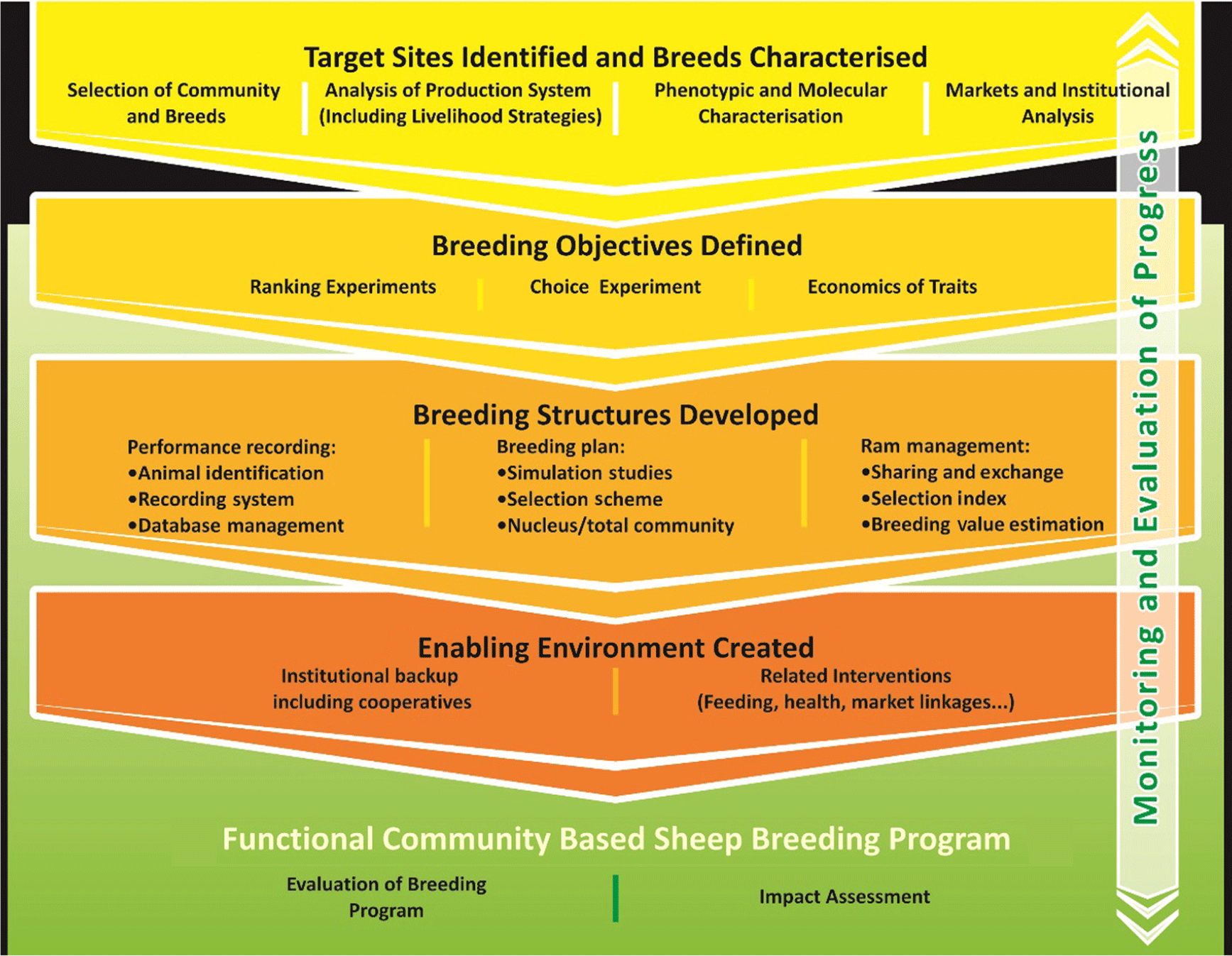
Setting up CBBPs follows the same basic steps and principles as that of conventional breeding programs (Figure 1). The major difference as detailed in Mueller et al. (Reference Mueller, Rischkowsky, Haile, Philipsson, Mwai, Besbes, Valle Zárate, Tibbo, Mirkena, Duguma, Sölkner and Wurzinger2015) is that unlike conventional breeding strategies, CBBPs use a participatory approach which involves the communities who keep the animals from the initial inception of the program to implementation and final ownership of the scheme.
Steps for setting up community-based breeding programs for sheep.
Data recording and analysis
Data recording formats to collect biological data from each household were developed. Data analysed included birth weight, 6-month weight and litter size. There were too few data for yearling weight to be included in the analysis.
Least squares analysis (SAS, 2002) was carried out to study performance of sheep and examine fixed effects. The fixed effects fitted for the weights were: (1) year of birth (10 classes, 2009 to 2018); (2) lambing season grouped into three classes based on the pattern of annual rainfall distribution in the area (November–February, dry period; June to October, wet season; and March to May, short rain season); (3) sex (two classes, male and female); and (4) birth type (three classes: single, twin and triple). A fixed effect model was fitted. The Tukey–Kramer test was used to separate least squares means with more than two levels.
The Average Information Restricted Maximum Likelihood method (AI-REML) of WOMBAT (Meyer, Reference Meyer2007), fitting univariate animal models for each trait, was used to estimate breeding values. For genetic correlations, a bivariate model was used. WOMBAT assesses whether an analysis has converged based on the following criteria: (1) a change in log L of <5 × 10⁻⁴, (2) a change in parameters of <10−8 and (3) a gradient vector norm <10−3.
Analysis model
 $$Y = X\beta + {Z_1}a + {Z_2}m + {Z_3}pe + e$$
where Y is a (N × 1) vector of observations; β is the vector of fixed effects of contemporary groups, birth type, birth year and sex of animal related to incidence matrix X; a is the vector of direct genetic effects related to incidence matrix Z 1; m is the vector of maternal genetic effects related to matrix Z 2; pe is the vector of maternal permanent environmental effects related to matrix Z 3; and e is the vector of random residuals.
The genetic trends were estimated by the weighted regression of the average breeding value of the animals on the year of birth. Inbreeding coefficients were derived from WOMBAT outputs.
The number of sires and dams available for the different breeds and traits varied considerably and was as expected for CBBPs. Rams available for birth weight were 544 for Bonga, 100 for Horro and 482 for Menz; and corresponding numbers of ewes were 3351, 2508 and 4293. The numbers for 6-month weight were much lower than for birth weight as the data size was smaller too. The numbers for Bonga, Horro and Menz were 214, 77 and 209 for rams, respectively; and correspondingly 1002, 949 and 1348 for ewes. Rams used for litter size in Bonga and Horro were 104 and 53, respectively, and corresponding numbers of ewes were 537 and 373.
Data from both primary and secondary sources were used for the socioeconomic evaluation. A survey was conducted to collect detailed primary data in two sheep breeding communities in each site, as well as in two sheep-keeping communities not involved in CBBP in each site for comparison purposes. Simple random sampling was used to draw 40 sample farmers from each of the participant and non-participant households and the survey was administered to a sample of 80 farmers in each of the breeding sites. This gave a total sample size of 240 farmers from the three sites. Participatory rural appraisals (PRAs), key informant interviews and informal discussions were also conducted to further understanding of the socioeconomic impact of the breeding programs in respective sites. Secondary data included biological data, publications and reports from the program.
Descriptive statistics were used to analyse primary data collected through the survey. Statistical significance tests were used to determine any significant variation between members of the breeding cooperatives and non-members, as well as within members of the cooperatives.
Results and discussion
Growth performances of sheep flocks
Growth and reproductive performances of sheep flocks in CBBPs have not previously been reported. Six-month weights in our study (21.60 ± 0.20, 16.5 ± 0.54 and 14.0 ± 0.04 kg for Bonga, Horro and Menz sheep, respectively; Table 1) were higher than corresponding results for the same breeds under station management conditions: 16.7 ± 0.20 (MoA, 2018), 14 ± 2.93 (MoA, Reference Haile, Hilali, Hassen, Lobo and Rischkowsky2018) and 10.7 ± 2.2 kg (Gizaw et al., Reference Gizaw, Lemma, Komen, Johan and Arendonk2007). This shows a clear improvement due to CBBPs. Growth performances from stations where selection and mating schemes are well structured and properly controlled are normally expected to be higher than conditions on-farm. However, we found that growth levels of lambs from CBBPs (on-farm) were higher than those reported from on-station conditions. Inferiority of the on-station growth of lambs could be assigned to two reasons. First, the perceived better feeding and management of sheep on-station does not necessarily happen and is influenced by many factors. Through repeated training and awareness in CBBPs, owners care for their animals and feed and manage them better than in the traditional smallholder system. Second, some stations, for example, Horro and Menz, were located out of the breeding tract of the populations. This may present an issue of genotype by environment interaction.
Least squares means (kg) for effects of birth season, lamb sex and birth type on birth weight (BWT) and 6-months weight (SMW) for Bonga, Horro and Menz sheep
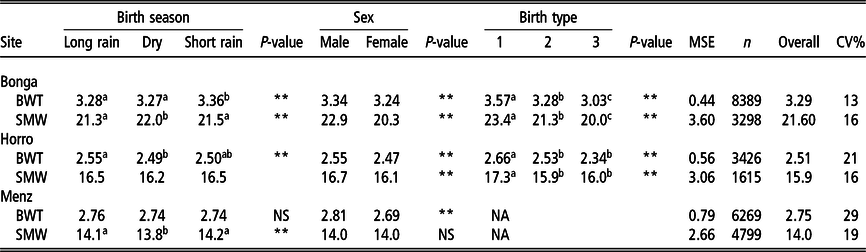
NA = not applicable; MSE = mean square error; N = number of observations; CV = coefficient of variation.
**P < 0.01; NS, P > 0.05.
a,b,cDifferent letters in the same row within effect represent statistical differences (P < 0.05).
Weight differences for the different sexes were all significant (P < 0.01) except for 6-month weight in Menz (Table 1). For both Bonga and Horro, the males were heavier than females at birth and at 6 months of age. In Menz, although males were heavier than females at birth, this difference was not significant (P > 0.05) at 6 months. Many reports in literature (e.g. Tibbo, Reference Tibbo2006; Saghi et al., Reference Saghi, Khadivi, Navidzadeh and Nikbakhti2007) concur with our observations that favor male sheep and could be related to inherent physiological variations.
Birth type had a significant effect (P < 0.01) on weights of all sheep (birth and 6-month weight). Single born lambs had greater weight at all ages than twins and triplets. Sheep in Menz give birth to singles in most cases and so this trait was not further considered for Menz.
Season of birth was also a significant source of variation for both birth and 6-month weight of sheep. In Bonga and Horro, weight was inferior in the long rainy season to those of the dry and short rainy seasons. Lambs born in the dry season in Horro had greater weight than those born in the wet season (P < 0.01). This was unexpected because more feed is believed to be available in the rainy seasons. Better feeding of ewes in the wet season might have resulted in greater birth weight of lambs in the dry season.
Genetic trends in growth performance and prolificacy
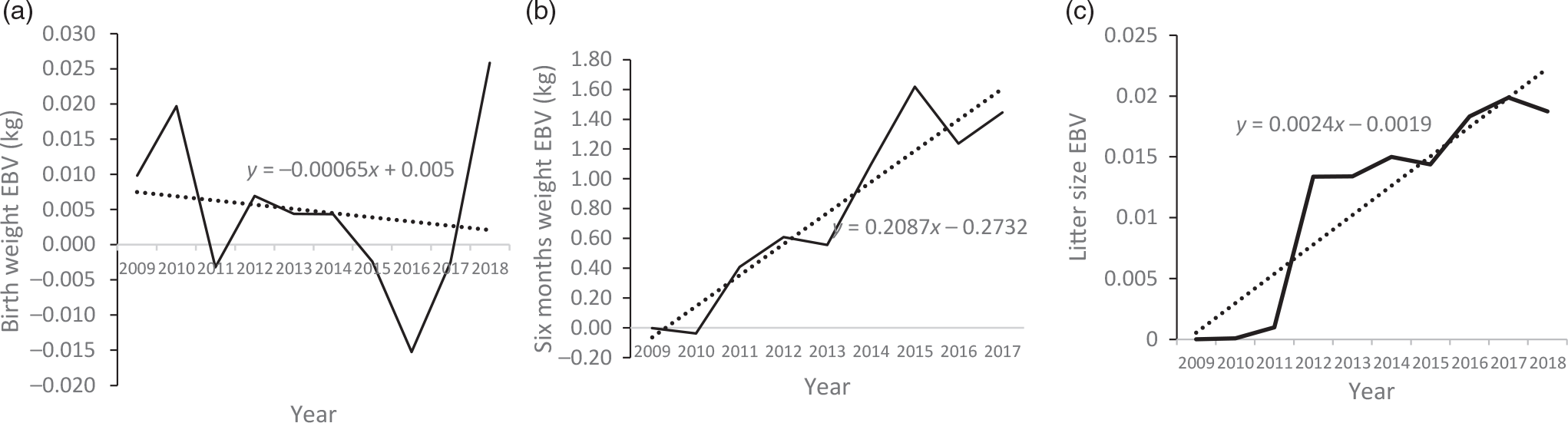
The birth weight of lambs did not improve over the years in Bonga and Horro sheep (Figures 2 and 3), but there was a significant increase in Menz (Figure 4). Considering that there was no direct selection for birth weight in the community flock, the increased weights in Menz could be due to correlated responses, which was not the case in Bonga and Horro. Lack of increase in birth weight in Bonga and Horro is particularly advantageous because improvement in this trait beyond a particular level may be associated with dystocia and loss of productivity. Thus, care should be taken when undertaking selection in growth traits. Many studies have shown weak correlations between birth weight and later weights (e.g. Gürsoy et al., Reference Gürsoy, Kirk, Cebeci, Pollot and Gabiña1995; Duguma et al., Reference Duguma, Schoeman, Cloete and Jordaan2002; Gizaw and Joshi, Reference Gizaw and Joshi2004). Therefore, selection for each trait could be affected independently of the others and selection for weaning weight or gain would not increase birth weight.
Genetic trend of estimated breeding values (EBV) for body weight at birth (a), 6 months of age (b) and litter size (c) in Bonga sheep.
Genetic trend of estimated breeding values (EBV) for body weight at birth (a), 6 months of age (b) and litter size in Horro sheep.
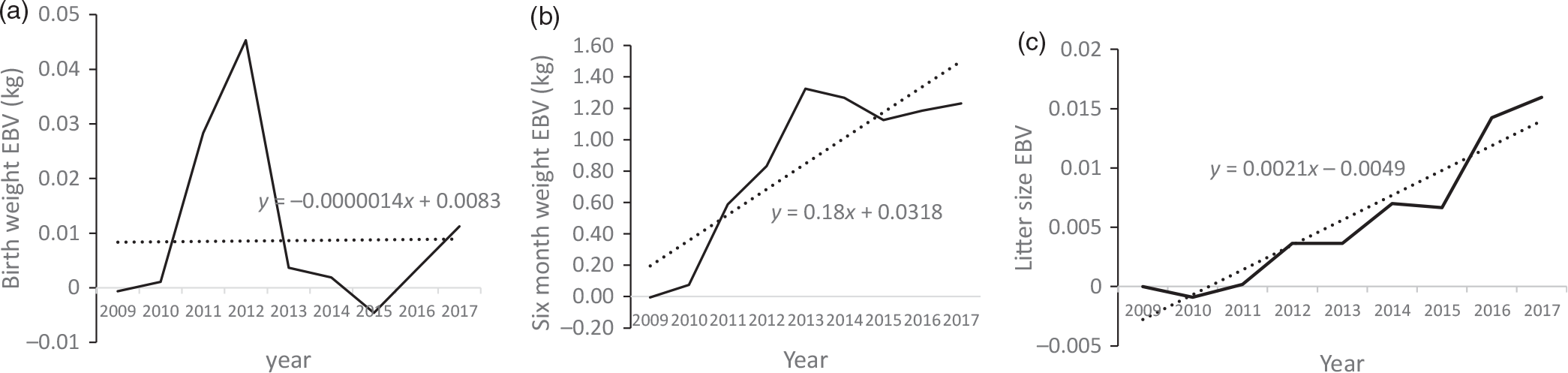
Genetic trend of estimated breeding values (EBV) for body weight at birth (left) and 6 months of age (right) in Menz sheep.

For all the three sites, 6-month weight, the major selection trait in our CBBPs, increased (P < 0.05) over the years (Figures 2, 3 and 4). In Bonga, the average increase was 0.21 ± 0.018 kg/year, followed by 0.18 ± 0.007 and 0.11 ± 0.003 kg/year in Horro and Menz, respectively. This is quite substantial for an on-farm situation. The increases were more pronounced in the larger Horro and Bonga breeds compared to the smaller Menz sheep.
Genetic responses in selective breeding experiments have been reported in many studies. For example, in an experiment set up to evaluate the response of Menz sheep to selection for yearling live weight, a substantial response was evident (Gizaw et al., Reference Gizaw, Lemma, Komen, Johan and Arendonk2007). Positive changes have also been reported for purebred Tsigai and improved Valachian and Lacaune sheep in the Slovak Republic (Oravcová and Peškovičová, Reference Oravcová and Peškovičová2008), for Lohi sheep of Pakistan (Javed et al., Reference Javed, Iram, Abdullah, Sattar and Akhtar2013) and for Malpura sheep of India (Arora et al., Reference Arora, Gowane, Prince and V2010). However, these reports all referred to on-station performance and there are no reports from on-farm, community managed flocks.
Prolificacy, defined as the number of lambs born per ewe lambing, is strongly influenced by management decisions and is of paramount economic importance. The genetic trend for prolificacy over the years in both Bonga and Horro flocks was positive and significant (P < 0.01; Figures 2 and 3). Given the low heritability of reproduction traits, genetic changes reported in literature are non-significant in most cases (Haile et al., Reference Haile, Hilali, Hassen, Lobo and Rischkowsky2018; Abdoli et al., Reference Abdoli, Zamani, Mirhoseini, Hossein-Zadeh and Almasi2019). However, our results, where prolificacy was one of the selection traits in both sites, indicated that positive trends were achieved in the cases that structured selection was implemented. Where resources, such as feed and water, permit improvement in prolificacy, substantial impact on sheep production could be expected. With new genomic tools, faster genetic gains and introgression of genes into new populations can be achieved. For this to happen, it is very important to investigate novel and known genomic regions affecting fertility/prolificacy in these populations. Previous studies identified causative genetic variants with major effects associated with reproductive traits linked to prolificacy, especially ovulation rates and litter size in sheep (Davis, Reference Davis2005). Most of these studies, which have identified the causative variants in three major prolificacy genes – GDF9, BMPR1B and BMP15 – located on ovine chromosomes 5, 6 and X (Davis, Reference Davis2005), respectively, involved Eurasian breeds of sheep. New variants are continually discovered in other breeds, suggesting variations between breeds (Lassoued et al., Reference Lassoued, Benkhlil, Woloszyn, Rejeb, Aouina, Rekik, Fabre and Bedhiaf-Romdhani2017). Therefore, we will investigate mutations for prolificacy in Bonga and Horro sheep breeds in the future.
Inbreeding, heritability and genetic correlation
One of the major challenges in smallholder sheep and goat management is the high risk of inbreeding because of smaller flock size and uncontrolled mating. The CBBPs aimed at reducing the effect of inbreeding through controlled mating, ram rotation and increase in flock size by bringing households who owned small flock sizes together.
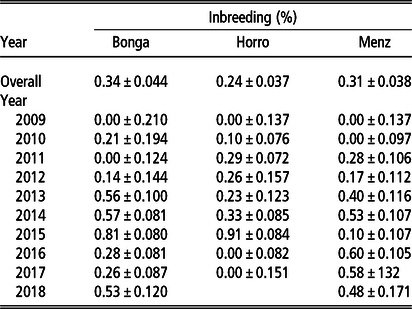
The estimated inbreeding coefficients we obtained (<1%; Table 2) confirmed our proposition that the levels recorded over years for all breeds were lower than the critical level of 6.25% (Li et al., Reference Li, Strandén, Tiirikka, Sevón-Aimonen and Kantanen2011). Many studies have reported higher inbreeding coefficients than ours: for example, MacKinnon (Reference MacKinnon2003) in a closed population of crossbred sheep (range 2.2 to 3.8%), Pedrosa et al. (Reference Pedrosa, Santana, Oliveira, Eler and Ferraz2010) in Santa Inês sheep of Brazil (2.33%) and Ghavi Hossein-Zadeh (Reference Ghavi Hossein-Zadeh2012) in Moghani sheep of Iran (2.93%). In our CBBPs, rams mated in one mating group for one year and were rotated to another. Additionally, rams remained in breeding for 2 years and were either sold as breeding animals to communities far from the CBBP sites or sold for slaughter. These measures assisted in reducing inbreeding coefficients; therefore, inbreeding is not an immediate concern. However, the inbreeding coefficient needs to be monitored continuously to prevent significant decrease in growth performance. It is also advisable that rams with the lowest relationship with ewes in the flock are used for mating to decrease the rate of inbreeding in the population.
Inbreeding level over years in Bonga, Horro and Menz sheep flocks
Heritability estimates, both additive and maternal, for birth and 6-month weight were moderate to high, except for Menz sheep which showed low heritability (Table 3). The moderate to high heritability estimates for growth traits indicate that sufficient additive genetic variance existed for these traits, which could be used for selection within the population as was done in our CBBPs. Heritability estimates for growth traits are generally moderate to high (Duguma et al., Reference Duguma, Schoeman, Cloete and Jordaan2002; Masood Tariq et al., Reference Masood Tariq, Ahmad Bajwa, Abbas, Waheed, Abbas Bokhari and Rafiq2010; Mekuriaw and Haile, Reference Mekuriaw and Haile2014). However, these previous reports, unlike ours, are all based on on-station management where environmental variances are expected to be minimal. Our favorable on-farm results, where larger environmental influences on growth performances are expected, are worthy of report and indicate the within-population genetic variability that could be exploited through selection. These populations had never experienced systematic selection before the setting up of the CBBPs; therefore, the high heritability indicates the high genetic variability expected in non-selected populations.
Genetic parameter estimates for birth weight (BWT), 6-months weight (SMW) and litter size for Bonga, Horro and Menz sheep flocks
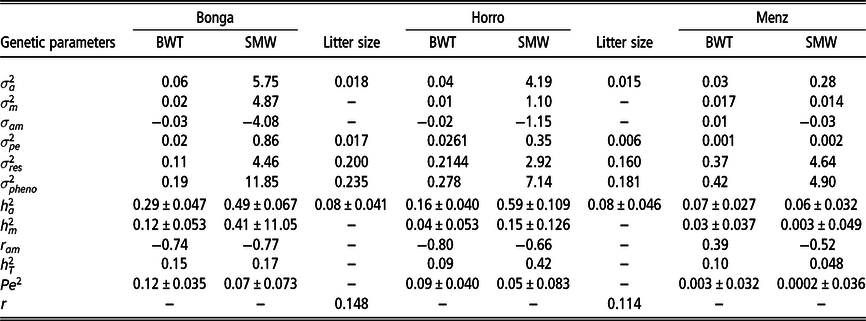
Direct heritability estimates for litter size were generally low for both Bonga (0.018) and Horro (0.015) sheep. Most reproduction traits, including litter size, have low heritability estimates (Rashidi et al., Reference Rashidi, Bishop and Matika2011; Haile et al., Reference Haile, Hilali, Hassen, Lobo and Rischkowsky2018). In other words, additive genetic effects have little effect on reproduction traits, but environmental and non-additive genetic effects have considerable influence. Low heritability indicates low possibility of achieving rapid genetic progress through phenotypic selection.
Genetic correlations between birth weight and 6-month weight were low in both Bonga (−0.058 ± 0.142) and Horro (0.131 ± 0.009) breeds. However, relatively high genetic correlation (0.450 ± 0.225) was observed in Menz sheep. As we previously alluded, increase in birth weight is not desirable in local populations. Therefore, in flocks where strong genetic relationships between birth weight and 6-month weight exist, other selection criteria should be sought if the objective is to increase 6-month weight or other traits without adversely affecting birth weight.
Socioeconomic impacts of community-based breeding program: income and consumption
The potential impact of the CBBP on market participation and sheep meat consumption of farmers was explored. Market participation of CBBP members measured by the number of sales per year was higher (P < 0.01) than for non-participants (Table 4). This could be attributed to the improved production and productivity of the flock kept by members of the CBBP, resulting in more sheep for sale.
Number of sheep sold and consumed, trend in consumption and mean annual income from sales of sheep during the last year by community-based breeding program members and non-members

USA Dollar 1 = Ethiopian Birr 27.25 in June 2018; CBBP = community-based breeding program.
Slaughtering sheep for household consumption was also more common (P < 0.01) among CBBP participants (Table 4). Similarly, this variation could be explained by improved performance. Discussion with members of CBBPs also revealed that farmers, particularly in Menz and Horro, usually slaughter sheep for consumption during important (religious) festivities. It is also important to consider the fact that initial selection of CBBP participants had favored better-off households because only farmers with a sheep flock size of four or more were considered for membership.
The majority of CBBP participants reported that consumption of mutton in the household had increased after introduction of the CBBP, but a considerable proportion of households showed no change in mutton consumption (Table 4). A possible explanation for increased mutton consumption is that the breeding program resulted in increased productivity and income from sheep production.
A comparison of annual mean income from sheep production revealed that participants in the CBBP earned Ethiopian Birr (ETB) 3100 per household per year on average, while non-participants earned ETB2486 (USD1 = ETB27.25 in June 2018) (Table 4). The difference between CBBP participants and non-participants was statistically significant in Bonga and Menz (P < 0.05) but not in Horro. It was also confirmed by the PRA work with CBBP participants that income from sheep keeping had improved. The positive impact of the CBBP on farmers’ incomes explains the huge interest of non-members in joining the breeding cooperatives. However, interpretation of the figures should be carefully considered because these income data were recorded from farmers’ memory recall. In the CBBPs, biological data were recorded but no financial records were kept.
In conclusion, the CBBPs were technically feasible to implement, economically rewarding as reflected in increased income and meat consumption and resulted in substantial genetic gain in biological traits. The level of inbreeding was within acceptable limits because of our managerial interventions. Therefore, where centralised breeding programs fail, we strongly recommend implementing CBBPs for sheep and goats, particularly in low-input systems like those of the Ethiopian highlands.
Acknowledgements
The authors thank the CGIAR Research Program (CRP) on Livestock and the donors supporting the program for funding this research. We are grateful for communities and staff of research and development agents who participated in data collection. A preliminary version of the research report was deposited on the ICARDA institutional repository (Haile et al., Reference Haile, Getachew and Rischkowsky2019; https://hdl.handle.net/20.500.11766/9696).
A. Haile 0000-0001-5914-0487
Declaration of interest
The authors declare that they have no conflicts of interest.
Ethics statement
ICARDA does not have ethics committee. However, this study is based on data collected from a breeding program and does not present any ethical concerns.
Software and data repository resources
The data used in this study are deposited in the ICARDA repository with permanent identifier http://hdl.handle.net/20.500.11766.1/PVA8NA. The license follows the CGIAR Open Access Open Data policy and implementation guidelines (http://hdl.handle.net/10947/4489) with an embargo of up to 12 months of completion of data collection or appropriate project milestone, or within 6 months of publication of the information products underpinned by that data.


 Open access

