





Over the past century, the green revolution contributed to major gains in nutrition, food security and poverty alleviation, by expanding our food systems – food production, distribution and storage(Reference Wik, Pingali and Brocai1). However, this process contributed to three major concurrent challenges. Firstly, new public health challenges emerged, including unhealthy dietary patterns and overconsumption of ultra-processed and animal-based products which have largely contributed to non-communicable diseases(Reference Roth, Abate and Abate2). Secondly, current food systems exert an unsustainable pressure on the planet, including being responsible for approximately 34 % of greenhouse gas (GHG) emissions and 70 % of freshwater withdrawals globally, contributing to climate change and water scarcity. Moreover, agriculture now stands as the primary driver of land-use change and biodiversity decline(Reference Benton, Bieg and Harwatt3). Thirdly, social inequities in food systems affect millions of smallholder farmers, especially in low- and middle-income countries, who sometimes face unfair trading conditions and poverty despite producing much of the world’s food(Reference Popkin4).
These interconnected and complex challenges require a multilevel and multi-sectoral transformation of our food systems. Policies aimed at influencing consumer behaviour and product reformulation have increasingly been implemented in various contexts(Reference Hyseni, Atkinson and Bromley5). Food labels are one of such policies and are designed to inform consumers about the implications of food consumption and encourage healthier and better choices. In response to the aforementioned challenges, food labelling has evolved to encompass aspects beyond just nutrition(Reference Downs, Ahmed and Fanzo6), including information on environmental sustainability, fair trade and animal welfare.
Nutrition food labels inform about the ingredients of packaged foods and help people follow dietary guidelines(7). They emerged as back-of-pack nutrition information; however, their effectiveness has been questioned as these are rarely used by consumers(Reference Grunert, Fernández-Celemín and Wills8). Front-of-pack (FOP) nutrition labels, which convey nutrition information on the front of food packaging in a simple way, are now commonly and effectively used to inform consumers about healthier food choices(Reference Roseman, Joung and Littlejohn9). FOP nutrition labels with interpretational aids (i.e. symbols, colours or letters) appear to be slightly more effective in driving consumers toward healthier choices(Reference Feteira-Santos, Fernandes and Virgolino10) than non-interpretative labels. Some well-known interpretative FOP labels are the UK’s traffic lights system, the French Nutri-Score, the Australian Health Star Rating system and certain warning labels such as the system implemented in Chile(Reference Temple11).
In parallel, but at a slower pace, environmental sustainability labels have emerged. Although there is no universal definition, environmental sustainability food labels generally inform about the impact of foods on the natural environment. In recent years, several environmental sustainability labelling schemes have been developed(Reference Stein and de Lima12), but their success in promoting ‘environmentally friendly’ food choices has been less studied(Reference Asioli, Aschemann-Witzel and Nayga13). These schemes can be classified in various ways, including the International Organisation for Standardisation typologies, such as Type I (eco-label), Type II (self-declared environmental claims) and Type III (environmental product declarations)(14). Examples include the French Eco-score, the Carbon footprint, the UK’s Eco impact label and various organic labels. Whether organic labels should be classified as pertaining to environmental sustainability has been debated(Reference Stein and de Lima12), but since the concept is commonly understood as promoting environmental protection, organic labels are considered as environmental sustainability labels in this work.
Social responsibility food labels, although not well-defined, can be understood as labels that ‘account for community investment, human rights and employee relations, environmental practices, and ethical conduct’ (Reference Park15). These labels usually provide added value to commodities produced by small-scale farmers in low- and middle-income countries. Well-known certification schemes include Fair Trade, Rainforest Alliance and the UTZ certification. While some studies indicate that consumers are Willingness to Pay (WTP) a premium for Fair Trade food products(Reference Konuk16), only a limited number of studies show a positive impact on real-life purchases and consumer choices(Reference Hainmueller, Hiscox and Sequeira17).
The complexity of the challenges and the often siloed approach to different types of labels has spurred growing interest in developing an integrated food label(18). We might call this a ‘planetary health food label’, that communicates a product’s overall impact across health, environmental and social dimensions. This label can, in theory, empower consumers to make choices that are better for both people and the planet. However, a significant barrier to designing such a comprehensive label is the disparate state of the evidence. While the science behind nutrition labelling is mature, a clear understanding of what makes environmental sustainability and social responsibility labels effective – or ineffective – is lacking. Before an integrated label can be considered, it is crucial to first systematically map the existing evidence for its less-understood components. Therefore, this study aimed to systematically review the evidence on the diversity, features and impacts of environmental sustainability and social responsibility FOP food labels on consumers’ choices and purchasing decisions. Based on the results, we briefly discuss the potential of an integrated food label that aims to inform about the nutrition, environmental sustainability and social responsibility aspects of food products.
Methods
Sources and search strategy
We conducted a systematic literature review to evaluate the features and impacts of environmental sustainability and social responsibility labels on consumers’ choices and purchases. We did not include nutrition food labels as they have been extensively analysed(Reference Croker, Packer and Russell19). The main search was conducted in May 2022 in three multidisciplinary databases: Medline, Web of Science (Core Collection) and Scopus. An updated search was conducted in July 2025 to capture the most recent literature.
The overall search strategy was as follows: ((‘food label*’ OR ‘nutrient* profiling system*’ OR ‘food score*’ OR ‘front of pack nutrition label*’ OR ‘food metric*’) AND (‘impact*’ OR ‘effective*’ OR ‘influence*’) AND [(sustainab* OR ‘land-use change*’ OR ‘water use’ OR ‘greenhouse gas*’ OR ‘environmental footprint’ OR ‘ecological footprint’ OR ‘food footprint’) OR (‘social justice’ OR ‘social responsibility’ OR ‘fairness’ OR ‘fairtrade’ OR ‘equity’ OR ‘livelihood*’)]). Specific keywords are presented in Table A1 in appendix. The keywords were defined as a result of a pre-process analysis of reading-related literature and identifying the most relevant terms, avoiding an ‘explosion’ of irrelevant articles.
To capture the most current evidence, articles included had to be published from 2000 to 2025, and no language restrictions were applied.
Study selection and data extraction
All identified references were uploaded to Ryyan platform (https://www.rayyan.ai/), where duplicates were removed. Titles and abstracts were screened by one researcher, and then two researchers independently reviewed the full texts based on the eligibility criteria (Table 1). Disagreements in the inclusion/exclusion of articles were discussed between the two researchers, which happened with two studies.
List of inclusion and exclusion criteria

A form was developed to extract data, which included information on country, research design and article type, target population, type of label assessed (i.e. nutrition, environmental sustainability or social responsibility), type of food assessed, outcome studied and main findings. Animal welfare studies were considered and classified as pertaining to environmental sustainability, following the ethical and social value consumers and institutions across the world currently place on this dimension(Reference Cox and Bridgers20).
An internal working protocol was developed prior to conducting the study; however, it was not published elsewhere.
Critical appraisal
Because of the multidisciplinary nature of this review, a variety of methodologies and methods were anticipated. Therefore, the QuADS tool was used to critically appraise the selected literature, which is used in systematic reviews of mixed or multi-method studies(Reference Harrison, Jones and Gardner21). All full texts included in the review were appraised independently by two researchers (JIG and YPS) to characterise the literature rather than select them for inclusion/exclusion and limit the potential findings. Studies that did not meet the inclusion criteria were not considered for critical appraisal.
Results
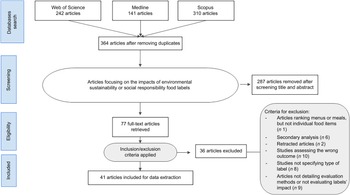
A total of 369 articles were identified in May 2022 and 324 in July 2025. Of these, 184 and 180 articles were retrieved after removing duplicates, respectively. After screening titles and abstracts, seventy-seven articles were included for full-text analysis, of which forty-one studies were included for data extraction (twenty-six from the original search in 2022 and fifteen from the update in 2025) (Figure 1).
PRISMA flowchart.

Most studies were conducted in European countries (n 27)(Reference Williams, Flannery and Patel22–Reference Maier48), in the USA (n 7)(Reference Costanigro, Deselnicu and McFadden49–Reference Taillie, Wolfson and Prestemon55). Three studies included more than one country(Reference Johnston, Roheim and Donath56–Reference Abdul Latip, Samsudin and Abdul Manap58), and one study was from each: China(Reference Johnston, Roheim and Donath56), Chile(Reference Fretes, Sepúlveda and Corvalán57), Malaysia(Reference Abdul Latip, Samsudin and Abdul Manap58) and Vietnam(Reference Nguyen59).
Methodologically, studies varied. Choice experiments (n 17)(Reference Apostolidis and McLeay23,Reference Banovic, Reinders and Claret24,Reference Scozzafava, Gerini and Boncinelli32,Reference Vlaeminck, Jiang and Vranken34,Reference de-Magistris and Gracia37,Reference Berden and Hung39–Reference Carlsson, Kataria and Lampi41,Reference Delpozo, Pons-Gómez and Besada43,Reference Duckworth, Randle and McGale44,Reference Jürkenbeck46,Reference Kaczorowska, Rejman and Halicka47,Reference Costanigro, Deselnicu and McFadden49,Reference De Marchi, Caputo and Nayga50,Reference Pink, Stylianou and Ling Lee52,Reference My, Demont and Van Loo60,Reference Tait, Saunders and Guenther61) and online questionnaires or surveys (n 10)(Reference Carlsson, Kataria and Lampi25,Reference Lamonaca, Cafarelli and Calculli28,Reference Marette30,Reference Weinrich, Franz and Spiller35,Reference Weinrich and Spiller36,Reference Fernández-Serrano, Tarancón and Bonet45,Reference Maier48,Reference Fretes, Sepúlveda and Corvalán57,Reference Abdul Latip, Samsudin and Abdul Manap58,Reference Sun, Wang and He62) were the most common study designs, with some studies conducting randomised trials and other experimental designs (n 11)(Reference De Bauw, De La Revilla and Poppe27,Reference Lazzarini, Zimmermann and Visschers29,Reference van der Waal, Folkvord and Azrout33,Reference Arrazat, Chambaron and Arvisenet38,Reference De Bauw, Peracaula Moner and Santa Cruz42,Reference Hallstein and Villas-Boas51,Reference Shaikh, Yamim and Werle54–Reference Johnston, Roheim and Donath56,Reference Paffarini, Torquati and Cecchini63,Reference Taillie, Chauvenet and Grummon64) , qualitative and mixed approaches (n 3)(Reference Williams, Flannery and Patel22,Reference Carrero, Valor and Díaz26,Reference Risius, Janssen and Hamm31) . Sampling and sample sizes also varied, commonly including online panel samples ranging from ∼100 to ∼3000 participants and generally quoting (or stratifying) for gender, age (> 18 years), education and region of living(Reference Arrazat, Chambaron and Arvisenet38,Reference Pink, Stylianou and Ling Lee52) . Non-panel studies generally included purposive samples, with unbalanced characteristics of participants (e.g. greater representation of women, people with higher education degree or socioeconomic status)(Reference van der Waal, Folkvord and Azrout33,Reference Carlsson, Kataria and Lampi41,Reference De Bauw, Peracaula Moner and Santa Cruz42,Reference Abdul Latip, Samsudin and Abdul Manap58) .
The food products evaluated included common types of meat (beef, pork, poultry), seafood, dairy, nuts, grains and processed foods. Some studies evaluated an individual product while others included multiple items, but no food group or product predominated over the others. Table 2 summarises the key findings of included articles and describes main characteristics of each study.
Summary of main characteristics of articles included in the review

EF, Environmental Footprint; ASC, Aquaculture Stewardship Council; RCT, Randomised controlled trial; EU-O, EU-organic; EVOO, Extra virgin olive oil; SI, sustainable irrigation; FOP, Front-of-pack;, BOP, back-of-pack; WTB, Willingness to buy; HENI, Health Nutrition Index.
The critical appraisal tool showed that most studies had clear aims and were grounded on sound theoretical concepts. In general, study designs adequately addressed the stated aims but information on sampling was lacking enough detail in several studies. Data collection and data analysis procedures were appropriate for most studies and were usually described in depth. Very few studies had any form of stakeholder engagement; the vast majority did not provide any details on this. Although most studies critically discussed strengths and limitations, some were rather general, and a few did not mention them at all. For detailed information, see Table A2 in the appendix.
Labels’ features
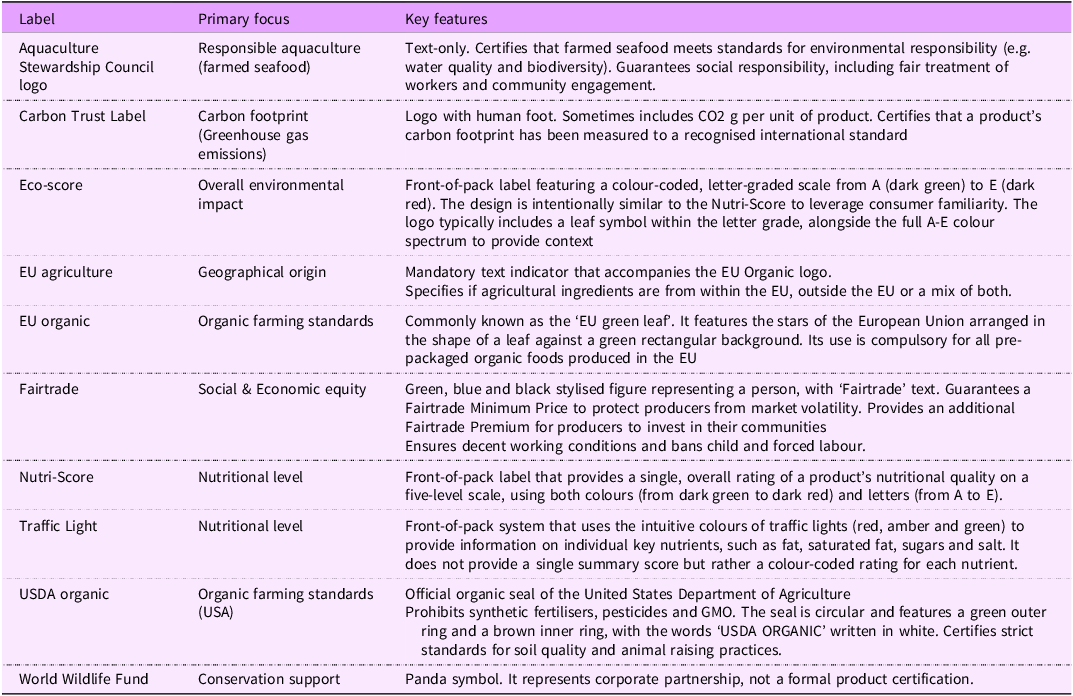
Studies assessed labels currently available in the market (n 20)(Reference Apostolidis and McLeay23,Reference Banovic, Reinders and Claret24,Reference De Bauw, De La Revilla and Poppe27,Reference Marette30,Reference Risius, Janssen and Hamm31,Reference Weinrich, Franz and Spiller35–Reference de-Magistris and Gracia37,Reference Berden and Hung39,Reference Büttner, Gassler and Teuber40,Reference Delpozo, Pons-Gómez and Besada43,Reference Jürkenbeck46,Reference Kaczorowska, Rejman and Halicka47,Reference Costanigro, Deselnicu and McFadden49,Reference De Marchi, Caputo and Nayga50,Reference Shaikh, Yamim and Werle54,Reference Taillie, Wolfson and Prestemon55,Reference Nguyen59,Reference My, Demont and Van Loo60,Reference Sun, Wang and He62) , and others analysed tailored or hypothetical labels (n 21) exclusively designed depending on the research aims(Reference Williams, Flannery and Patel22,Reference Carlsson, Kataria and Lampi25,Reference Carrero, Valor and Díaz26,Reference Lamonaca, Cafarelli and Calculli28,Reference Lazzarini, Zimmermann and Visschers29,Reference Scozzafava, Gerini and Boncinelli32–Reference Vlaeminck, Jiang and Vranken34,Reference Arrazat, Chambaron and Arvisenet38,Reference Carlsson, Kataria and Lampi41,Reference De Bauw, Peracaula Moner and Santa Cruz42,Reference Duckworth, Randle and McGale44,Reference Fernández-Serrano, Tarancón and Bonet45,Reference Maier48,Reference Hallstein and Villas-Boas51–Reference Taillie, Busey and Stoltze53,Reference Johnston, Roheim and Donath56–Reference Abdul Latip, Samsudin and Abdul Manap58,Reference Tait, Saunders and Guenther61) . The existing labelling schemes for environmental sustainability and social responsibility assessed were as follows: Eco-Score (n 7)(Reference De Bauw, De La Revilla and Poppe27,Reference Marette30,Reference Berden and Hung39,Reference Büttner, Gassler and Teuber40,Reference Jürkenbeck46,Reference Shaikh, Yamim and Werle54,Reference Taillie, Wolfson and Prestemon55) , EU organic (n 5)(Reference Apostolidis and McLeay23,Reference Risius, Janssen and Hamm31,Reference de-Magistris and Gracia37,Reference Delpozo, Pons-Gómez and Besada43,Reference Kaczorowska, Rejman and Halicka47) , Aquaculture Stewardship Council logo (n 2)(Reference Banovic, Reinders and Claret24,Reference Risius, Janssen and Hamm31) , Carbon Trust Label (n 2)(Reference Apostolidis and McLeay23,Reference De Marchi, Caputo and Nayga50) , EU agriculture (n 2)(Reference Apostolidis and McLeay23,Reference Banovic, Reinders and Claret24) , USDA organic (n 2)(Reference Costanigro, Deselnicu and McFadden49,Reference De Marchi, Caputo and Nayga50) , Fairtrade (n 1)(Reference Kaczorowska, Rejman and Halicka47), World Wildlife Fund (n 1)(Reference Risius, Janssen and Hamm31), some labels specific to certain countries, such as the Colorado Proud, rBST-free and Validus labels(Reference Costanigro, Deselnicu and McFadden49), and the German organic label, such as Organic Farmers’ Association and Naturland (Reference Risius, Janssen and Hamm31). Some studies also included well-known nutrition/health labels, such as the Traffic light (for nutrients) (n 3)(Reference Apostolidis and McLeay23,Reference Carlsson, Kataria and Lampi25,Reference Carlsson, Kataria and Lampi41) and Nutri-Score (n 3)(Reference De Bauw, De La Revilla and Poppe27,Reference Marette30,Reference Jürkenbeck46) , while some used various types of health claims (n 8)(Reference Banovic, Reinders and Claret24,Reference Lamonaca, Cafarelli and Calculli28,Reference Marette30,Reference Risius, Janssen and Hamm31,Reference van der Waal, Folkvord and Azrout33,Reference De Marchi, Caputo and Nayga50,Reference Pink, Stylianou and Ling Lee52,Reference Johnston, Roheim and Donath56) and/or environmental sustainability claims (n 6)(Reference Williams, Flannery and Patel22,Reference Duckworth, Randle and McGale44,Reference Maier48,Reference Johnston, Roheim and Donath56,Reference Abdul Latip, Samsudin and Abdul Manap58,Reference My, Demont and Van Loo60) for their research. The features of existing labelling and most assessed schemes are presented in Table 3.
Main features of the existing and most assessed labelling schemes in terms of nutritional, environmental sustainability and social responsibility domains
GMO, Genetically Modified Organism; EU, European Union; USDA, United States Department of Agriculture.
Regarding label features and their impacts, traffic light-style warning labels on food products have shown effectiveness, particularly with the red signal being especially persuasive in discouraging undesirable attributes of food items. The red colour heightened respondents’ inclination to avoid the most unfavourable levels of collective attributes such as climate impact or antibiotics use, potentially linked to loss aversion and negativity bias in consumer psychology, while the green colour strengthened preferences for healthiness(Reference Carlsson, Kataria and Lampi25,Reference Jürkenbeck46,Reference Johnston, Roheim and Donath56) . In Spain, a study found that carbon footprint labels garnered more attention when perceived as a hazard cue, especially when displayed in a red warning sign(Reference Carrero, Valor and Díaz26). Despite the success of warning labels in adequately signalling GHG attributes to consumers, the overall effect of those labels on purchasing intentions is mixed. Compared to other labels, one study showed that consumers derived a higher utility from the organic label and health labels/claims, ranking the Carbon Trust’s carbon footprint label in third place(Reference De Marchi, Caputo and Nayga50). Another study found that the impact of this carbon footprint label is secondary to price and fat labels on meat products(Reference Apostolidis and McLeay23). Yet, in two studies, carbon labelling had a strong positive influence on respondents’ WTP for various food products(Reference Pink, Stylianou and Ling Lee52,Reference Tait, Saunders and Guenther61) .
Labels’ impacts
In general, studies showed that environmental sustainability labels tend to have a positive outcome, eliciting a higher WTP, stated preference or product choice(Reference Carlsson, Kataria and Lampi25,Reference Weinrich and Spiller36,Reference de-Magistris and Gracia37,Reference Carlsson, Kataria and Lampi41,Reference Duckworth, Randle and McGale44,Reference Maier48–Reference Pink, Stylianou and Ling Lee52,Reference Johnston, Roheim and Donath56,Reference Nguyen59,Reference Tait, Saunders and Guenther61) . However, their effectiveness can vary by country, with some consumers in Italy showing less attention or willingness to pay a premium for carbon footprint certification compared to well-known labels like organic or protected designation of origin(Reference My, Demont and Van Loo60); consumers in Germany were not decisive for fish purchases(Reference Risius, Janssen and Hamm31), and a study in the Netherlands where an explanatory claim resulted in less sustainable food purchases for consumers with low environmental attitudes(Reference van der Waal, Folkvord and Azrout33).
‘Organic’ labels were consistently valued or preferred by consumers(Reference Lamonaca, Cafarelli and Calculli28,Reference Lazzarini, Zimmermann and Visschers29,Reference Delpozo, Pons-Gómez and Besada43,Reference De Marchi, Caputo and Nayga50,Reference Abdul Latip, Samsudin and Abdul Manap58) . However, consumers often ascribed qualities to these labels that they do not necessarily have. For example, products labelled organic were thought of as more environmentally friendly(Reference Lazzarini, Zimmermann and Visschers29), healthier or safer(Reference Lamonaca, Cafarelli and Calculli28), a phenomenon known as the ‘health halo effect’(Reference Lee, Shimizu and Kniffin65). One study assessing WTP found that organic labels were valued more highly than specific environmental sustainability labels, such as CO2 labels(Reference de-Magistris and Gracia37).
Consumers usually prefer additional information about the certification criteria and traceability of foods. A study in Vietnam that assessed the WTP of rice labelled with a local government-endorsed environmental sustainability label found that consumers were Willingness to Pay a 9 % price premium for certified rice, and this figure increased up to 33 % when incremental levels of information about the label were provided(Reference Nguyen59). Similarly, a study in Italy assessing preference for organic labelled v. conventional cow’s milk found that preference for the former was significant only when additional information about environmental sustainability was provided(Reference Scozzafava, Gerini and Boncinelli32). Similar results were seen in a study that evaluated WTP for foods with an animal welfare label in Germany(Reference Weinrich, Franz and Spiller35). Conversely, other studies highlight the potential for information overload or confusion when multiple, comprehensive labels are present. One study found that all-encompassing sustainable labels were not always the most effective, suggesting that detailed information about energy cost, carbon emissions and other attributes could overwhelm consumers, diminishing interpretation and influence on WTP(Reference Shaikh, Yamim and Werle54). Another study also reported a significant negative interaction (sub-additive effect) when three labels were combined(Reference My, Demont and Van Loo60).
Another important finding is that participants seem to prioritise the health benefits of food over its environmental sustainability attributes. This was reported in a study evaluating various types of meat products in the UK, where price and fat content labels had a larger impact on consumers’ choices than environmental sustainability labels(Reference Apostolidis and McLeay23), and in a study in the USA, where participants reported much lower intentions to change their food choices when presented a carbon footprint score v. a health nutrition index(Reference Pink, Stylianou and Ling Lee52).
Studies suggest a discrepancy between what people say they value and what they choose or buy. A systematic review assessing consumers’ preferences found that environmental and social responsibility attributes were ascribed a higher utility or rank to nutrition attributes in 17 studies, compared to nine where nutrition attributes were valued more highly(Reference Tobi, Harris and Rana66). This contrasts with the findings that displayed the Nutri-Score and Eco-Score labels at product level, which led to improved nutritional quality of food choices but did not reduce the environmental impact of these, despite the respondents reported having strongly relied on both scores for their choices(Reference De Bauw, Matthys and Poppe67). It also contrasts with a study in France, where purchasing intentions for pizza were significantly more sensitive to the Nutri-Score label than for the Eco-Score or a combination of the two called ‘Global Score’(Reference Marette30).
Animal welfare emerged as a very important topic for consumers. One study found that the price premiums for a green label compared with a red label were 52 % for healthiness, 64 % for both animal welfare and antibiotics and 20 % for climate impact(Reference Carlsson, Kataria and Lampi25). Another study in the USA assessing WTP for cow’s milk under various environmental sustainability labelling schemes showed that nearly all participants placed animal welfare at the top of their priority list(Reference Costanigro, Deselnicu and McFadden49). One study in Germany exclusively assessed WTP for an animal welfare label and found that consumers were Willingness to Pay more for pork products displaying this label, especially when an explanation of the label was provided(Reference Weinrich, Franz and Spiller35).
Real-life purchasing decisions seem to be scarcely evaluated. One study in Belgium evaluated the performance of an environmental sustainability ‘eco-label’ specially developed for the experiment. The label was preselected by participants of an online survey and then tested by looking at purchasing behaviour among consumers in a supermarket. Although the label was tested in a controlled environment under predefined experimental conditions, it increased the overall ‘eco-friendliness’ of the subjects’ food choices by about 5·3 % relative to the default label currently used in the market(Reference Vlaeminck, Jiang and Vranken34). Another study assessing real-life purchases was conducted in the USA and measured the impact of a ‘Fish Wise Advisory’, a traffic light label depicting the capture or production methods of seafood. The advisory led to a statistically significant 15·3 % decline in overall seafood sales and a statistically significant 34·9 % decline in the sale of yellow labelled seafood, but no significant difference in sales of green or red labelled seafood was found(Reference Hallstein and Villas-Boas51). Despite these real-life purchasing studies, new studies increasingly utilised more realistic settings, such as virtual reality supermarkets(Reference Arrazat, Chambaron and Arvisenet38) and university canteens(Reference Johnston, Roheim and Donath56), reinforcing findings on actual behaviour rather than just stated preferences.
Discussion
To the best of our knowledge, this is the first systematic review that identified the features and impacts of environmental sustainability and social responsibility food labels on consumers’ choices and purchasing decisions. The growing body of literature, particularly from 2022 to 2025, underscores the increasing global attention to these labelling schemes as tools for promoting sustainable diets. Also, the increasing number of studies from diverse geographical regions provides valuable context and suggests that the fundamental principles of label effectiveness may transcend specific cultural contexts, though specific label preferences and willingness to pay can vary significantly by country. However, there remain several challenges to comprehensively understand the effects of the impacts of environmental sustainability and social responsibility on food labels, especially due to the wide range of methodological approaches, study designs, and sampling and populations.
Overall, demographic factors such as age, gender and socioeconomic status can play a role in how consumers perceive, understand and respond to environmental sustainability and social responsibility food labels, though the specific effects can vary depending on the label type, product, and study context. Most of the included studies assessing gender differences show that women have higher WTP for foods with environmental sustainability labels than men. This aligns with the findings of a recent meta-analysis looking at WTP for short food supply chain products(Reference Mustapa and Kallas68). We did not find a clear pattern by age group; however, a review focusing on discrete choice experiments found that people up to 40 years old were more responsive to these labels compared to older individuals(Reference Bastounis, Buckell and Hartmann-Boyce69).
While consumers express positive attitudes and WTP for environmental sustainability labels, this sentiment does not consistently translate into real-life purchasing decisions or behaviour change. This discrepancy is recognised by environmental psychology and human behaviour research as a ‘value-action gap’ in environmental sustainability, where people’s stated concerns do not always align with their actions(Reference Blake70). Some studies revealed a higher preference for environmental sustainability and social responsibility labels over nutrition labels(Reference Carlsson, Kataria and Lampi41,Reference De Marchi, Caputo and Nayga50) , while others indicated a prioritisation of nutritional quality over environmental sustainability attributes(Reference Marette30,Reference Pink, Stylianou and Ling Lee52) , despite an expressed value for the latter(Reference De Bauw, Matthys and Poppe67). Evolutionary perspectives on cognition argue that this happens because humans apply heuristics, originally shaped to handle social exchange, on environmental impact issues(Reference Sörqvist and Langeborg71). Consequently, a misconception arises whereby sustainable choices can offset unsustainable ones, potentially influencing attitudes toward food labels. Additionally, social desirability bias, though minor in environmental psychology(Reference Vesely and Klöckner72), may play a substantial role in surveys regarding sustainable food consumption(Reference Cerri, Thøgersen and Testa73).
A consistent preference for foods displaying an organic label is observed, which could be an encouraging sign for global environmental sustainability, but has important nuances. Confusion exists surrounding the term ‘organic’ in labels, as these products are often ascribed a health halo by consumers(Reference Büttner, Gassler and Teuber40,Reference Delpozo, Pons-Gómez and Besada43,Reference Shaikh, Yamim and Werle54,Reference Lee, Shimizu and Kniffin65) despite limited evidence supporting higher health benefits(Reference Vigar, Myers and Oliver74). Moreover, there is no consensus whether organic truly means environmentally sustainable, considering that the same output of organic food requires more land than conventional agriculture (although it reduces fertiliser surplus and pesticide use)(Reference Muller, Schader and El-Hage Scialabba75). From the perspective of the Sustainable Development Goals, organic farming relates to several goals; however, the question remains as to whether a transition to a predominantly organic global food system is achievable and will it be able to feed a growing world population.
GHG or carbon footprint labels received little, but increasing attention in studies across this review, highlighting the potential mismatch between individual and global priorities, such as curbing carbon emissions to address climate change. Information related to GHG emissions and its relevance needs to be presented in a manner that is more effective to consumers to include this dimension in their choices.
Consumers place great importance on place of origin of food products(Reference Banovic, Reinders and Claret24,Reference Lazzarini, Zimmermann and Visschers29,Reference Risius, Janssen and Hamm31,Reference Duckworth, Randle and McGale44) . From the standpoint of GHG emissions, this is not the most important dimension, as research shows that, on average, between 1 % and 7 % of the GHG emissions of a given product derive from transportation(Reference Poore and Nemecek76). However, indicating the place of origin on a label could still have other relevant values, such as increasing the resilience of local production systems, and potentially, the preservation of biodiversity and less water use. These need to be explained in the labelling scheme, as consumers probably associate local products with traditional, ‘natural’ or small-scale low-impact production systems, even when this might not be the case.
According to this review, animal welfare is a top concern for consumers(Reference Carlsson, Kataria and Lampi25,Reference Scozzafava, Gerini and Boncinelli32,Reference Weinrich, Franz and Spiller35,Reference Costanigro, Deselnicu and McFadden49) , but not for global leaders. The Sustainable Development Goals fail to mention this dimension of environmental sustainability; however, its importance was recently recognised by the United Nations. Since people assign a high value to animal welfare, including this dimension in an integrated FOP food labelling system seems an important endeavour. Also, it is notable how prominent animal welfare is in this review and how issues of human welfare or social responsibility are barely considered. Studies assessing social responsibility dimensions were few and their findings were inconsistent across this review(Reference Kaczorowska, Rejman and Halicka47,Reference Costanigro, Deselnicu and McFadden49) , showing that more research is needed.
Achieving healthier, more environmentally sustainable, and socially responsible food choices through food labels often implies consumers changing their behaviours or preferences. Even though it is recognised that human behaviour change is complex and challenging, public policy often operates based on an information-deficit model, whereby it is assumed that if people are informed of the benefits or harms of certain food products, they will change their behaviours accordingly(Reference Kelly and Barker77). However, information alone and/or abundance of information is unlikely to change consumers’ eating habits(Reference Barker, Lawrence and Robinson78) and actually can be even more detrimental for facilitating choices(Reference Berden and Hung39,Reference De Bauw, Peracaula Moner and Santa Cruz42,Reference Abdul Latip, Samsudin and Abdul Manap58,Reference My, Demont and Van Loo60) .
A set of diverse approaches are needed to inform people about the food choices in terms of health, environmental sustainability and social responsibility concerns. Public policies need to consider well-planned and designed food labels along with other public measures, such as taxing sugar-sweetened beverages to improve health(Reference Teng, Jones and Mizdrak79), addressing overfishing by diverting subsidies from industrial fisheries(Reference Sumaila and Tai80) or reducing the marketing of unhealthy foods to children(Reference Taillie, Busey and Stoltze53), Additionally, factors like price and social norms influence food choices and should be taken into account when designing effective policies.
There is a growing need for improved food labelling that addresses the various impacts of food systems(Reference Brown, Harris and Potter81). However, studies suggest that using multiple nutrition or environmental sustainability labels on a product might lead to confusion and potentially negatively affect consumer preferences(Reference Berden and Hung39,Reference De Bauw, Peracaula Moner and Santa Cruz42,Reference Abdul Latip, Samsudin and Abdul Manap58,Reference My, Demont and Van Loo60,Reference Drugova, Curtis and Akhundjanov82) . Given these challenges, the development of a single integrated food label that considers nutrition, environmental sustainability and social responsibility could be a valuable tool for public health. Recent research shows that there is widespread public support for a universal ‘eco-label’ to be introduced to support better food choices, which also may address greenwashing concerns and issues of trust in governments current regulatory standards(83).
However, despite policymakers and stakeholders in the European Union advocating for a harmonised FOP system (i.e. Farm-to-Fork strategy), they have had difficulties in reaching an agreement(Reference Bottari and Mark-Herbert84). Although diverse food labels show similar results across countries, there is also an important gap in information regarding how FOP labels work across different population groups and cultures, particularly in low- and middle-income countries where evidence is more scarce and barriers related to governance and literacy may hinder the implementation of these labels(Reference Pettigrew, Coyle and McKenzie85).
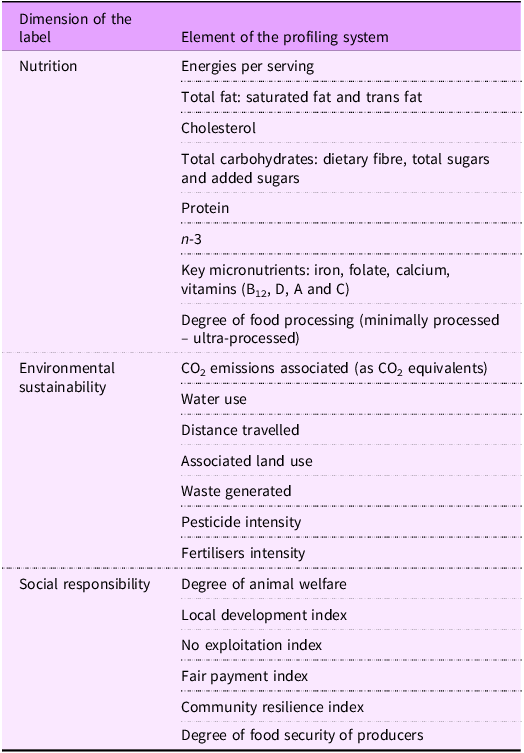
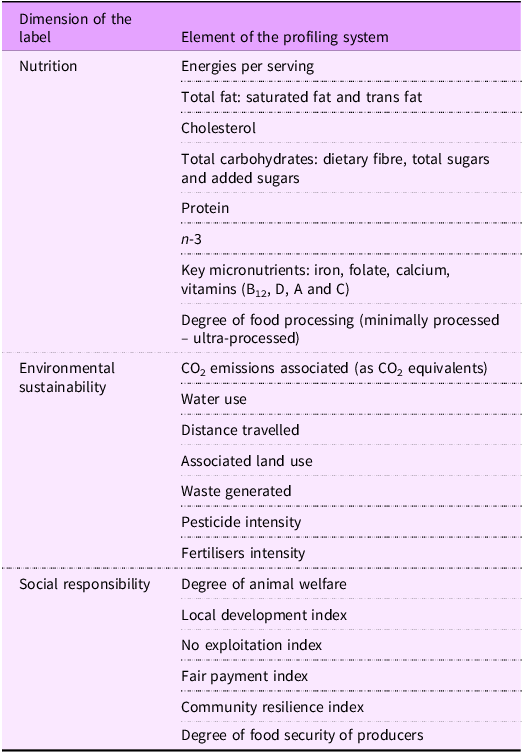
Overall, this review has shown that evidence on this topic is diverse, limited, geographically uneven, but growing. In this sense, several areas for future research and development can be drawn. First, a significant limitation in existing research is the lack of studies measuring real-life evaluations. Hypothetical choice experiments, while valuable, may not fully capture the complexity of real market situations. Therefore, there is a need for moving beyond stated preferences to assess real-life evaluations. Second, the sub-additive effects observed with multiple labels suggest that simply adding more information or certifications does not always lead to better outcomes, potentially confusing consumers. In this way, there is a need for addressing the impact of information overload and label combinations. Complementarily, the efficacy of labels is influenced by their design features, including whether they are interpretative or descriptive, nutrient-specific or summary scores, and use warning or positive indicators. Developing integrated food labels that encompass nutrition, environmental sustainability and social responsibility dimensions requires a series of potential elements for this integrated profiling system. Based on this review and previous research(Reference Feteira-Santos, Fernandes and Virgolino10,Reference Croker, Packer and Russell19,Reference De Bauw, De La Revilla and Poppe27) , Table 4 suggests, but not limits, the main the potential elements that could be included in such a profiling system.
Potential elements to include in the profiling system of an integrated planetary health food label encompassing nutrition, environmental sustainability and social responsibility dimensions
Limitations
This study has several limitations. The identified labels were not classified as endorsed by a government or by a private organisation, which is important since this relates to issues of trust and transparency, which have shown to be essential for labels to be truly impactful on consumers’ behaviours(Reference Brown, Harris and Potter81). Additionally, nutrition/health labelling studies were not actively searched for in this work because various systematic reviews have already been conducted and there is notoriously more evidence regarding this dimension(Reference Feteira-Santos, Fernandes and Virgolino10,Reference Croker, Packer and Russell19,Reference De Bauw, De La Revilla and Poppe27) . But still, valuable information may have been retrieved by including this element. Also, much of the literature about food labelling may be found in policy documents, government reports and other types of files from the ‘grey’ literature. This was explored in this work to inform the background and discussion, but a more systematic approach could have been employed.
Another limitation is related to the sample sizes and sampling techniques among the included studies. These samples ranged from ∼100 to ∼3000 participants, including random to purposive samples with unbalanced participants’ characteristics. This heterogeneity might affect the overall effects and should be considered in future studies. Additionally, the lack of articles that measured real-life evaluations is considered as a limitation. Overall, research should move beyond consumers’ stated preferences, to assess real-life purchasing behaviours and employ methods that more closely resemble how consumers interact with labels. Given the geographical distribution of articles, more studies should be conducted in low- and middle-income countries to identify what are the top concerns in those contexts and whether there is some universality as to how labels operate across the world. To build an integrated food label, a transdisciplinary approach is needed, which includes researchers, policymakers and users to find out what is the best way to proceed and achieve a labelling system that truly serves its purpose.
Conclusion
There is limited and mixed evidence evaluating the impacts of environmental sustainability and social responsibility on food labels. This systematic review highlights the complex and often inconsistent relationship between consumers’ attitudes toward environmental sustainability and social responsibility food labels and their actual purchasing behaviours. While environmental sustainability labels generally lead to positive outcomes, such as increased willingness to pay (WTP) and preference for labelled products, a significant ‘value-action gap’ persists. This gap, where consumers’ stated values do not align with their real-life choices, emphasises the need for a deeper understanding of the cognitive and psychological factors influencing food decisions. The strong preference for organic and animal welfare labels, despite potential misconceptions about their true environmental and health benefits, underscores the potential for ‘health halo’ effects to shape consumer perceptions.
The review also discusses the potential elements for an integrated ‘planetary health food label’, which is food labelling system that encompasses nutrition, environmental sustainability and social responsibility. Such a system could provide consumers with clear, consistent information and could help mitigate confusion caused by multiple labels. However, achieving consensus on a universal label remains challenging, and diverse approaches are required, including public measures and the influence of social norms, to foster healthier, more sustainable food systems.
Supplementary material
For supplementary material accompanying this paper visit https://doi.org/10.1017/S1368980026101979
Acknowledgements
We appreciate the support provided by UCL colleagues while the first author completed his postgraduate degree at the institution and carried out the bulk of the work included in this paper. We also appreciate the support provided by University of Washington.
Financial support
This study did not receive funding for its execution.
Competing interests
There are no conflicts of interest.
Authorship
Both authors significantly contributed to the work’s conception, design, data collection, data interpretation and analysis. Both authors participated in the writing or critical revision of the article in a manner sufficient to establish ownership of the intellectual content and read and approved the version of the manuscript being submitted.
Ethics of human subject participation
As this was a systematic review, this study did not involve primary data collection on human subjects.




 Open access

