




Introduction
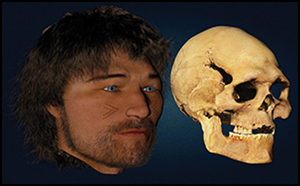
The Loschbour skeleton, recovered from the Grand Duchy of Luxembourg, has produced a Late Mesolithic genome that remains a benchmark for ancient DNA studies (Figure 1), and serves as a high-quality reference genome (approximately 22× sequencing depth) for the Western Hunter-Gatherer (hereafter WHG) population that lived in Europe before the arrival of the first farmers (Lazaridis et al. Reference Lazaridis2014). Little is known, however, about the genetic background of populations that inhabited the territory of Luxembourg over succeeding millennia (Valotteau et al. Reference Valotteau2016), despite a comparatively rich burial assemblage from rockshelters, caves and dolmen-like structures in the ‘Luxembourg sandstone area’, known as the Müllerthal in the east of the country (Figure 2).
A) The face of Loschbour Man reconstructed (Anubis/INRA); B) the original skeleton in the MNHN (photograph: F. Valotteau); C) reconstruction of the Late Mesolithic inhumation process (illustration: B. Clarys); D) photograph of the 1935 excavations at Loschbour (credit: Heuertz Reference Heuertz1969: fig. 80; © Société des naturalistes luxembourgeois).

Location of archaeological sites sampled for DNA (Luxembourg map: F. Valotteau/INRA). Key: ALW: Altwies-“Op dem Boesch”; BES: Berdorf-“Schnellert”, Gouffre St. Paul; GSB: Grotte St. Barbe; HEA: Heffingen-“Atsebach”; HES: Heffingen-“Schléd”; LOSCH: Heffingen-“Loschbour”; LUT: Dunstable Downs, Luton; MAN: Ernzen-“Manzenbaach”; MOES: Moesdorf Pettange; MULL: Müllerthal-“Schnellert”; OKA: Oetrange-“Kakert”; REM: Remerschen-“Schengen”; WKA: Waldbillig-“Karelslé”. Luxembourg sandstone indicated by dots.

A new project, initiated in 2021 with the support of the Institut National de Recherches Archéologiques (INRA), Luxembourg, aims to characterise later prehistoric population changes in the Rhine-Meuse catchment area using human skeletal remains recovered in Luxembourg over the past century. To date, 33 bone and teeth samples have been screened for ancient DNA in the Palaeogenetics Laboratory, JGU Mainz (https://palaeogenetics-mainz.de/), along a chronological transect from the Neolithic to the Iron Age.
Palaeogenetic analyses are ongoing (Figure 3), but initial screening results have established the good DNA preservation of many of the remains (15 samples had >10 per cent endogenous DNA content), allowing for deep, whole-genome shotgun sequencing, and eventually phasing and haplotype-based methods for demographic analysis. Two of the human samples were sequenced to >10×, 13 to approximately 1×, and two with low endogenous DNA content to >2× (on-target), using the Twist Bioscience 1.4M target enrichment assay. Systematic radiocarbon dating is being undertaken at the same time.
A) Prehistoric genomes from Luxembourg (in red) projected on a PCA of modern and ancient west Eurasians and Southwest Asian individuals; B) chronological distribution of directly dated genomes included in the project. Dates calibrated in OxCal v4.4.4, using the IntCal20 calibration curve (Reimer et al. Reference Reimer2020; Bronk Ramsey Reference Bronk Ramsey2021) (figure by Y. Diekmann and M. Brami).

Parallel societies or farming transition in the Müllerthal area? Loschbour and his descendants
Most prehistoric human remains from Luxembourg have been recovered in the Müllerthal (Figure 2), including the 8200-year-old Loschbour skeleton, discovered by Nicolas Thill in 1935. This region is characterised by deep river valleys lined by sandstone bluffs, dense tree cover, and a unique system of rockshelters and diaclase caves. Given the limited evidence for agriculture in the Müllerthal prior to Roman times, its use for burial activities during the Neolithic, Bronze and Iron Age remains enigmatic, although some caves and rockshelters show signs of occupation or symbolic activities in the form of deep, stratified sequences, hearths and artefact assemblages (Heuertz Reference Heuertz1969).
A key question for the current project is whether Late Mesolithic foragers inhabiting the region were displaced or absorbed by incoming farmers following the Neolithic Transition. Previous research in the Blätterhöhle Cave, roughly 200km to the north-east of our study area in Germany, has indicated that farmers and foragers lived side-by-side for centuries, with genetic signals of asymmetric admixture (Bollongino et al. Reference Bollongino2013; Lipson et al. Reference Lipson2017). While early third millennium BC genomes from the Müllerthal area cluster with European Neolithic farmers on a PCA, they also show a significant shift towards WHGs like Loschbour (Figure 3). Further research should clarify whether WHG ancestry in Luxembourg genomes exceeds expectations under a model of broader re-emergence at continental level of WHG ancestry in Middle and Late Neolithic genomes (Lipson et al. Reference Lipson2017). The rockshelter site of Atsebach (genomes labelled as ‘HEA’ on Figure 3), less than a kilometre from Loschbour, is a prime candidate for genomic analysis, having yielded several well-preserved inhumations, some dating back to the early third millennium BC.
The Rhine-Meuse corridor and the Beaker phenomenon in North-west Europe
Nested between France, Germany and Belgium on the Moselle River, Luxembourg has yielded prehistoric burials of international significance, notably the double Beaker-period grave of Altwies, in south Luxembourg, which resembles in layout the so-called ‘echinoid burial’ of Dunstable Downs, in south Bedfordshire, England. Collective graves were increasingly replaced during the third millennium BC by single pit graves, and characterised by repetitive burial assemblages, including the eponymous S-shaped beakers (Figure 4). Discovered in 2000 during rescue excavations on Highway A13 to Germany, the Altwies grave is one of two Late Neolithic burials cut into cultural deposits from an older Linearbandkeramik settlement (Le Brun-Ricalens et al. Reference Le Brun-Ricalens2001).
Altwies-“Op dem Boesch”; beaker associated with the adult-child burial (Le Brun-Ricalens et al. Reference Le Brun-Ricalens, Toussaint, Valotteau, Salanova and Tchérémissinoff2011: fig. 70; © Institut National de Recherches Archéologiques).

Grave 2, depicted in Figure 5, is thought to belong to a ‘mother’ and her ‘child’. Preliminary shallow sequencing of ancient DNA has confirmed the biological sex of the adult as female and the child as male. The grave is being re-examined within the wider European context of ‘steppe’ dispersals from a hypothetical core area in the Pontic-Caspian region. As with the two partial genomes from the Mondelange necropolis in the French Moselle area included in the study by Olalde and colleagues (Reference Olalde2018), the Altwies genomes have revealed high levels of ‘steppe-derived’ ancestry, suggesting that the Rhine-Meuse region experienced significant gene flow from populations further east (Figure 6). The presence of All-Over-Cord (AOC) Beakers in Britain has long been seen as an indication of a direct link, if not outright migration, from the Rhineland region, via the Low Countries (Harrison Reference Harrison1974). Such a hypothesis can now be tested using high-coverage ancient genomes from Luxembourg. The Beaker-period skeletons of Dunstable Downs, uncovered in 1887 (Smith Reference Smith1894), were sampled by the authors in Luton Museum in 2022, and DNA was successfully extracted.
Adult-child burials sampled for this project, Bell Beaker period: A) Altwies-‘‘Op dem Boesch’’, Luxembourg (Le Brun-Ricalens et al. Reference Le Brun-Ricalens, Toussaint, Valotteau, Salanova and Tchérémissinoff2011: fig. 71; © Institut National de Recherches Archéologiques); B) Dunstable Downs, Southern Bedfordshire, United Kingdom (Smith Reference Smith1894: frontispiece).

The Luxembourg Bell Beaker genomes modelled as a mixture of Western Hunter-Gatherers, Aegean farmers and Yamnaya steppe ancestry components with qpAdm (figure by Y. Diekmann).

Future work
Deeper sequencing of the human genomes from Dunstable Downs is expected to take place in 2023. Population genetic analyses of the ancient genomes are ongoing. Archaeological work is continuing in parallel to contextualise the results and test the hypotheses outlined in this article.
Acknowledgements
We thank Elise Naish and the Culture Trust Luton for their permission to sample skeletons from Dunstable Downs.
Funding statement
This work is funded by the Institut National de Recherches Archéologiques (INRA), Luxembourg.


 Open access

