




INTRODUCTION
In service of antiracism, sociolinguists have long investigated the intersection of race and language and its relation to broader systems of inequality and power structures. Such research has its roots in the 1960s US civil rights movement, and it has approached non-normative varieties of English with the intention of recognising them as systemised and therefore equal in status to mainstream US English (see Sato Reference Sato1984; Green Reference Green2002; Rickford & King Reference Rickford and King2016). Since the poststructural turn in the social sciences, linguists have also explored identity construction processes facilitated by linguistic practices (Bucholtz & Hall Reference Bucholtz and Hall2005), which has allowed scholars to examine the use of language as a means of racialisation (Chun Reference Chun2001; Chun & Lo Reference Chun, Lo and Bonvillain2016) and the concomitant maintenance of racial and linguistic ideologies and inequality (Barrett Reference Barrett2006; Subtirelu Reference Subtirelu2015; Hiramoto & Pua Reference Hiramoto and Pua2019). These works generally approach race and language ‘together rather than as discrete and unconnected social processes’ (Alim, Rickford, & Ball Reference Alim, Rickford and Ball2016:5) and has developed an understanding of the two as inextricably intertwined. Rosa & Flores (Reference Rosa and Flores2017) suggested the need for a ‘raciolinguistic perspective’ to begin problematising the naturalised relationship between race and language, and thus to resist racial boundaries and the broader structures of power that delineate them. They further introduced key components of the raciolinguistic perspective that support the critical decoupling of racial and linguistic categories.
Discussions on race and language have also worked to conceptualise linguistic difference (Irvine & Gal Reference Irvine, Gal and Kroskrity2000) to investigate how processes of linguistic differentiation that rely on the conflation of language and racial identities can be used to drive a wedge between dominant and minority ethnolinguistic groups. African American English (AAE) features significantly in my discussion of race and language in Singapore, and as earlier studies on AAE have shown, linguistic differentiation allowed for the aggrandising of a standard variety of American English at the expense of racialised varieties (Bonfiglio Reference Bonfiglio2002), racialisation through language (Chun Reference Chun2011; Newman & Wu Reference Newman and Wu2011), and the semiotic construction of racialised identities through the use of language as a resource (Barrett Reference Barrett and Myers-Scotton1998; Bucholtz Reference Bucholtz1999; Reyes Reference Reyes2005). Racial differentiation through language can be achieved through phonetic, syntactic, and discursive features that index (see Ochs Reference Ochs, Stigler, Shweder and Herdt1990, Reference Ochs1993 on identities and indexicality) and produce recognisable personhoods (Agha Reference Agha2007; Park Reference Park2014, Reference Park2021) that are reductive of racial minorities. Scholars working on such research have demonstrated how language can become a powerful semiotic resource to perpetuate harmful stereotypes and circulate discourses that contribute to one-dimensional impressions of racial minorities. These works problematise the initial racialisation of language, including the introduction of categories like AAE and General American English.
This article goes beyond the study of race and language in the US to focus on a case study in Singapore. As a response to a racist advertisement in Singapore, two Indian Singaporeans, Preeti and Subhas Nair, called out the mistreatment of racial minorities in a rap video they released on Facebook. The video was later heavily criticised by the public and the state, and the Nairs eventually took it down at the request of the Singapore authorities. Using the incident as a case study, I align the approach of this article with Rosa & Flores's (Reference Rosa and Flores2017) raciolinguistic perspective as a mode of thinking about race in Singapore, where state and society characterise race—and its formation, categories, and meanings—differently depending on political expediency. In the spirit of interrogating the relationships between race, language, and identity, I draw specifically on Rosa & Flores's (Reference Rosa and Flores2017:7) observations on ‘perceptions of racial and linguistic difference’ to examine how language and race in Singapore are selectively (de)coupled to serve national interests. I introduce two main concepts in this article: (i) the notion of a state ‘listening subject’ (Inoue Reference Inoue2003) as a nonhuman entity that is represented by state actors such as ministers and government officials; and (ii) the semiotic process of rearticulation undertaken by the state listening subject that not only misconstrues but more importantly imposes meanings on specific linguistic signs. In the case under consideration, this type of rearticulation was made possible by the power imbalance between the state listening subject and the racialised speaking subject, as well as the video's pragmatic use of the phrase ‘fuck it up’, which allowed for multiple interpretations. These two concepts explain how actors representing the state, in service of the state listening subject, can rearticulate the language produced by racialised speaking subjects as racist and offensive speech to maintain a state-ordained racial order. Inoue's (Reference Inoue2003) notion of the listening subject decentres the speaker and redirects analyses to the listening subject as the agent determining the interpretation and circulation of meanings. In her observations of a post-Meiji variety of Japanese women's language, she notes that it had been rendered problematic and nonstandard by the overhearing male ‘listening subject’, and argues that a ‘particular mode of hearing and seeing is, then, an effect of a regime of social power’ (Inoue Reference Inoue2003:157). Drawing on the established notion of indexicality, she introduces the concept of indexical inversion as a way to examine how preconceived ideas about language can create semiotic meanings. While she does not address race directly, Inoue's work has proven to be productive in recent theorisations of raciolinguistic ideologies that attempt to understand how such ideologies of race and language can produce ‘racialized language practices that are perceived as emanating from racialized subjects’ (Rosa & Flores Reference Rosa and Flores2017:8). In particular, Flores & Rosa (Reference Flores and Rosa2015) extrapolate from Inoue's work to develop the notion of the ‘white listening subject’ who is able to construe the linguistic practices of racialised subjects as deficient, thereby sustaining power imbalances between them. I draw on such theorisations to critique the state rearticulation of the linguistic practices of racialised speaking subjects, and argue that it is an exercise in the selective (de)coupling of race and language that allows the Singaporean state to draw racial boundaries that suit its political interests.
THE CONSTRUCTION OF RACE IN SINGAPORE
Postcolonial Singapore, from its independence in 1965 until today, retains the racial categories set up by the British administration, known as the CMIO (Chinese, Malay, Indian and Others) framework (Goh & Holden Reference Goh, Holden, Goh, Gabrielpillai, Holden and Gaik2009). The letters in the acronym are ordered according to the size of the groups, the proportions of which have remained the same; the framework, which was intended to ensure the equal representation of ethnic minorities in relation to the Chinese majority, has also remained unchanged over the years. Malay and Indian Singaporeans form the minority racial groups in Singapore, with their populations making up 13.3% and 9% of Singapore residents respectively, while the Chinese population stands at 74.3% as of 2018.Footnote 1 The remaining population is categorised as ‘Others’. The CMIO framework has served as an organising principle for both the state and its citizens, and has materialised in the nation's language policies, urban planning, and the formation of ethnic self-help groups. Building a racially harmonious Singapore was important for the colonial government, but crucial for the postcolonial government if the nation-state was to thrive post-independence; race was presented as a national issue in need of close calibration. Founding prime minister Lee Kuan Yew famously espoused this belief when the nation gained independence from Malaysia in 1965:Footnote 2
(1) We are going to have a multi-racial nation in Singapore. We will set the example. This is not a Malay nation, this is not a Chinese nation, this is not an Indian nation. Everybody will have his [sic] place. Equal. Language, culture, religion. And finally, let us, really, Singaporeans, we unite, regardless of race, language, religion, culture.
The separatist decision made by the founding fathers of Singapore was driven by myriad factors, including the desire for a multiracial society. Singapore's separation from Malaysia followed a series of racial riots between the Chinese and the Malay communities in 1964, which highlighted the need for a multicultural programme to promote interracial living (Cheng Reference Cheng2001). This history of racial tension in Singapore's formative years became the rationale for the state to clamp down on any possibility of upsetting the racial order, and is the backdrop for the nation's rhetoric of multiracialism and racial harmony. To Singapore, this was what multiracialism meant: not a celebration of diversity, but a mandate for the nation-state to police and administer discussions on race, including and especially criticisms of racial inequality.
Post-independence, Singapore saw the need to nurture its citizens’ bilingualism in English and one of the mother tongue languages of the three main racial groups. The stated intention was to become competitive globally while ensuring that each mother tongue language had official and equal status (Starr & Hiramoto Reference Starr and Hiramoto2018) as part of the maintenance of racial equality. Mandarin Chinese, Malay, and Tamil were therefore recognised as official languages, alongside English as the lingua franca. This bilingual language policy thus adopted a longstanding coupling of language and race that dated back to colonial Singapore, when language was seen by the government as ‘linked to some aspect of [the citizens’] own racial or ethnic identity’ (Starr & Hiramoto Reference Starr and Hiramoto2018:3). In this view, the language one speaks is co-constitutive of one's race (Bokhorst-Heng Reference Bokhorst-Heng and Blommaert1999), which predictably engenders a host of issues with Singaporeans of mixed heritage. The policy also delegitimises non-Mandarin Chinese and non-Tamil Indian languages (Wee Reference Wee2006; Tan Reference Tan2012), which are marginalised in the media and mainstream education. This naturalisation of language and race creates pockets of racial insensitivity within Singaporean society due to the assumption that one's race determines one's linguistic practices. Starr & Balasubramaniam (Reference Starr, Hiramoto and Balasubramaniam2019:632) cite the example of Indian Singaporean actors being asked to produce caricatured Indian accents to convey humour as demonstrative of mainstream attitudes towards minority races, and ‘the means and the motive for a potential shift away from features enregistered as “Indian”’.
Even with this centring of race as a mode of governance, the state has a rocky history of managing race as an identity marker, often veering into questionable definitions of what it means to be a racialised Singaporean. The ruling political party in Singapore, People's Action Party (PAP), has governed the nation with largely conservative practices, including the death penalty for drug trafficking and the illegalisation of male homosexuality. Halimah Yacob, the first female president of Singapore, was embroiled in a national discussion on race in 2017 when, as an Indian-Muslim speaker of the Malay language, she was elected to a presidential seat reserved for Malay candidates. Her election was met with questions about her racial purity from citizens concerned about the exact criteria to be considered as a particular race. The controversy was focused not solely on race itself, but also on the government's management of race as a way to disqualify non-PAP candidates. The Singaporean state, guided by the PAP's obsession with the close management of its citizens, demonstrably chooses between coupling or decoupling race and language for political reasons. Racial categories continue to be arbitrarily defined and managed, contributing to race's instability as a construct. It is in this context that I examine a case of the co-naturalisation of race and language (Rosa & Flores Reference Rosa and Flores2017), where the two social dimensions are intricately entwined by the state to preserve racial harmony. As the later sections show, I do not attempt to map Flores and Rosa's (Reference Flores and Rosa2015) theorisation of the white listening subject directly onto the Singapore context to suggest a Chinese listening subject; rather, I take up Rosa & Flores's (Reference Rosa and Flores2017:10) idea that nonhuman entities can ‘act as perceiving subjects’ to argue for the conceptualisation of a state listening subject. As the term suggests, the state listening subject takes on the role of perceiving the linguistic practices of its citizens, and is able to determine the construal of the linguistic signs these citizens produce. While human listening subjects are more easily identified and interrogated, the state listening subject materialises as a state-representative actor, which allows the concealment of its unfettered source of power.
METAPRAGMATICS OF RACE AND RACISM
Defined broadly as the ability of language to refer to itself and its own linguistic signs within a discourse (Silverstein Reference Silverstein and Lucy1993; Urban Reference Urban and Brown2006), metapragmatics has been explored by linguistic anthropologists to understand how to ‘interpret the extrasemantic meanings encoded in speech’ (Urban Reference Urban and Brown2006:90). With discussions of race and racism being articulated through written and spoken means, a metapragmatic approach becomes relevant. Hill (Reference Hill2008) makes the link between one's speech and attitudes towards race in her discussion on racial stereotypes in daily conversation, where she suggests that personalism—the belief that one's innate racism is expressed through what one says—is commonly taken up by social actors as the source of racism, rather than broader systems of inequality. In this vein, other scholars have critically analysed metapragmatic discourses in which attitudes towards racial minorities surface; for example, Vigouroux (Reference Vigouroux2017) demonstrates the indexical linkage of Africans with poor French through the linguistic sign of y'a bon ‘there's good’ as a powerful discursive tool for the circulation of raciolinguistic stereotypes. More germane to my discussion are studies that consider how language becomes imbued with racial meaning in the first place. Pardo's (Reference Pardo2013) analysis of reality television scripting as a site for metapragmatic discourses similarly reveals racism to be embedded implicitly within language, often making subtle rather than overt references to ethnolinguistic attitudes, while Wong (Reference Wong2016) looks at how simplified Chinese is iconised by Cantonese speakers in Hong Kong to refer to Chinese mainlanders negatively. Reyes (Reference Reyes2011) also examines how racist discourse is metapragmatically regimented in cries of racism between Asian American boys. Reyes draws from Silverstein (Reference Silverstein and Lucy1993) to argue that the term black can be indexical of ‘negative racialized qualities’ (Reyes Reference Reyes2011:469) in accusations of racism where interactions are metapragmatically identified as racist, providing a perspective on raciolinguistic ideologies that looks beyond media or political discourses. It should be clarified that the theorisation of race politics in the US cannot be directly extrapolated to Singapore; my argument is that the state listening subject's rearticulation of the racialised speaking subject's language is similar to an act of crying ‘racist’, but more importantly serves the purpose of maintaining a racial order. In other words, the state accuses its racialised citizens of being racist as a demonstration of the state's nontolerance for inciteful language that may upset the racial order. Metapragmatic work in the study of race and language therefore informs the approach to the data taken in this article, which I detail in the next section.
‘FUCKING IT UP’: THE BROWNFACE INCIDENT
I now discuss the case study of this article, situated in Singapore. In July 2019, at the cusp of celebrating the nation's fifty-fourth year of independence, a local electronic payment service provider NETS, in collaboration with a creative agency, Havas Worldwide, aired an advertisement for a new mode of making payments electronically. NETS had been appointed by several government agencies to launch the new system, which was branded ‘E-Pay’. The advertisement featured a well-recognised local actor, Dennis Chew, who dressed up as racially distinct characters, including an Indian man with the name ‘K. Muthusamy’. The actor, a male Singaporean belonging to the majority Chinese population, had his skin tone digitally darkened to portray the Indian man, and was accused along with local broadcasting conglomerate Mediacorp on social media for enacting ‘brownface’, a term derivative of and similar to the notion of American blackface minstrelsy. The companies involved in the ad campaign subsequently issued statements apologising for the insensitive treatment of racial minorities. Following the apology, Indian Singaporean entertainers and sibling-duo Preeti and Subhas Nair uploaded a rap music video titled ‘K. Muthusamy’ on Facebook. It addressed the use of brownface in the advertisement and called out Chinese Singaporeans for their racism. The video, adapted from rapper Iggy Azalea's song ‘Fuck it up’, was lyrically altered to criticise Chinese Singaporeans for ‘fucking it up’, and gained significant attention and traction online. By the next day, the video was flagged by the authorities for promoting offensive content, and the Nair siblings were legally ordered to take it down and apologise. This incident, involving multiple social and state actors, generated public furore and debate that included a wide range of opinions on political correctness, racism, and the articulation of offence. While the Nair siblings’ video features significant metapragmatic elements that characterise it as parody and as antiracist discourse, it is the aftermath of the incident that evinces complex rearticulation processes undertaken by the state listening subject to maintain racial harmony in Singapore.
In particular, the meaning of the linguistic sign ‘fuck it up’ was at stake as it went through multiple (re)interpretations in the processes of decontextualisation and recontextualisation (Park & Bucholtz Reference Park and Bucholtz2009). The phrasal verb is defined by the Cambridge Dictionary as doing something that will ‘damage, harm, or upset someone or something, or to do something very badly’.Footnote 3 Its contemporary meaning was popularised by the African American community and used in the hip hop genre, where it is reinterpreted to mean that one is having an enjoyable time; ‘Fuck it up’ is, for example, the title of a 2016 rap song by Kamaiyah as well as the 2019 song by Azalea (see (2) and (3)).

In ‘K. Muthusamy’, however, the phrase is used differently:

Created as a critique of the use of brownface, it is clear that the Nair siblings’ use of ‘fuck it up’ in ‘K. Muthusamy’ does not follow Kamaiyah's or Azalea's. While they use ‘fuck it up’ pragmatically with the original negative meaning of the phrasal verb, the Nair siblings demonstrate an awareness in its deployment. That is, metapragmatic elements in the video accompany the multiple meanings of ‘fuck it up’ to soften the vulgarity of its delivery.
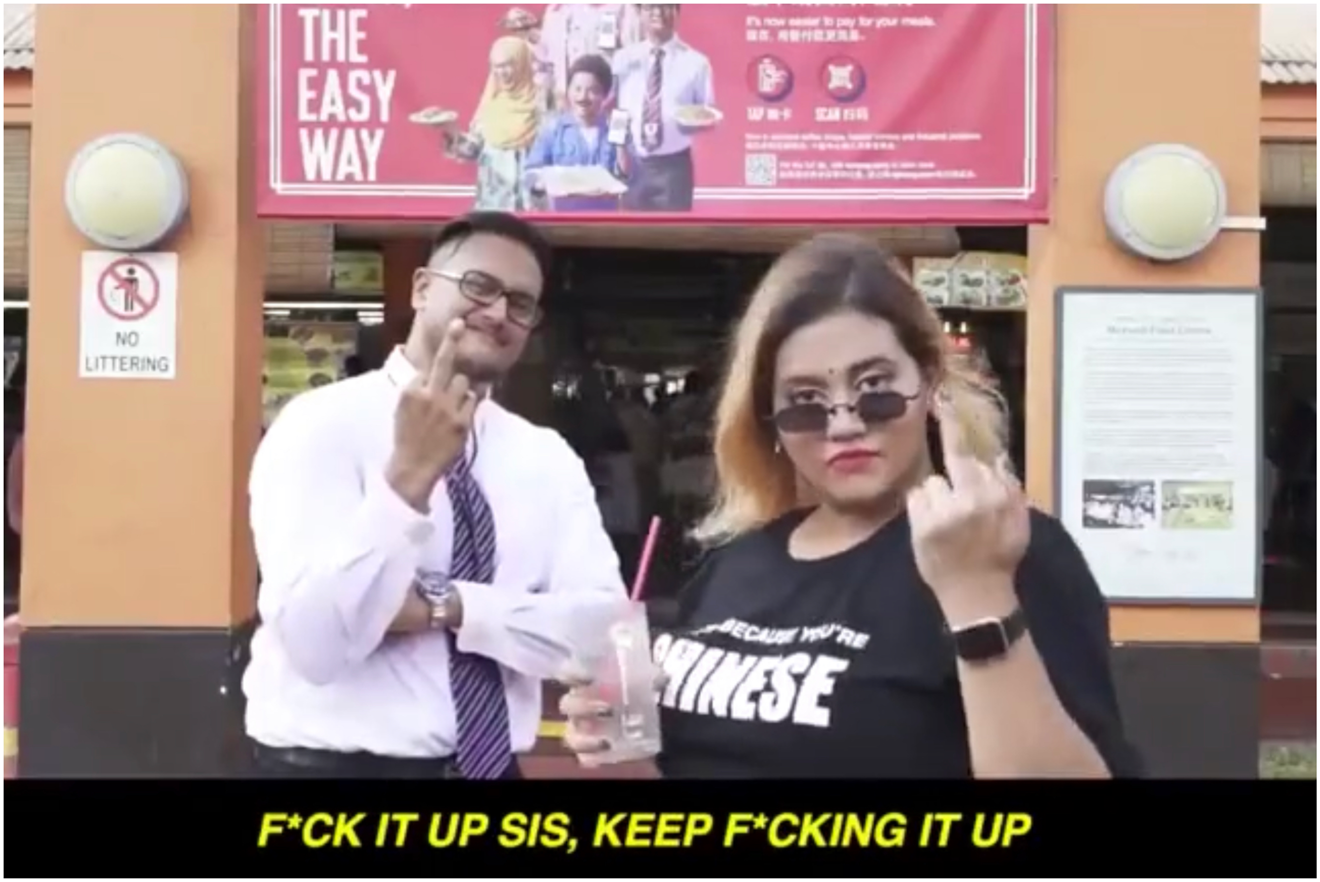
In his analysis of swear words, Goddard (Reference Goddard2015:198) contends that there is a metalexical awareness that accompanies the use of such words, including fuck, where the speaker has an ‘ethno-metapragmatic awareness of the status of the word’. Users of swear words are cognisant of the vulgar nature of what they are saying, and its propensity to be perceived as offensive to the listener. Besides their choice to reinterpret Azalea's song to communicate their antiracist intentions, and while straddling the double meanings of the phrasal verb, the Nair siblings demonstrate their awareness of their song's vulgarity in multiple ways, and express this awareness through metapragmatic elements in their video. For instance, while the word fuck and its morphological permutations are heard in their entirety, they are censored in the subtitles of the video (Figure 1). The use of parentheses around the word ‘Racist’, as seen in Figure 2, is also a strategic metapragmatic element used in the video that mitigates the aggressive impact of ‘K. Muthusamy’. This is also directly addressed at the end of the video, when Preeti makes a disclaimer, explaining that they do not think all Chinese Singaporeans are racist. Their expression of this metapragmatic awareness culminates in the Nair siblings’ final letter of apology, where they ‘unconditionally apologise for the tone, aggression, vulgarities, and gestures used’, thus acknowledging that the pragmatics of what they said allowed for its offensive interpretation.Footnote 4
Self-censoring of subtitles in ‘K. Muthusamy’.
Use of parentheses in the subtitles in ‘K. Muthusamy’.

At this juncture, it should be reiterated that ‘fuck it up’ is polysemic, and its different interpretations are subject to uptake in its circulation. A video released by a group of local content creators also addressed the incident and analysed the lyrics of ‘K. Muthusamy’ in a metapragmatic debate that evinced how ‘K. Muthusamy’ could have been interpreted as offensive, racist, and seditious.Footnote 5 Once it is acknowledged that the Nair siblings were metapragmatically aware of their use of the phrase, it is possible to understand their display of this awareness as an intentional move to soften the pragmatic force of ‘K. Muthusamy’. That is, their use of buffering metapragmatics in the video suggests that the Nair siblings knew their use of vulgar language and gestures in reference to a specific racial group was risky, and that they were aware of the potential for their video to be perceived as offensive. Their positioning of the video as a humorous parody of a serious issue also indicates their awareness of its potential for offence. Thus, their critique of the use of brownface with ‘K. Muthusamy’ was a calculated risk that straddled humour, subversion, and anger. As Weaver (Reference Weaver2010:44) observes, resistance through humour has ‘the potential for multifarious political and ethical interpretations [to] map themselves onto the socio-linguistic space’; this is the ambiguity of the position occupied by ‘K. Muthusamy’, which allowed it to succeed in its subversion, but also created an opening for state intervention in its circulation.
As shown in the figures, the video features Preeti and Subhas Nair rapping and flashing their middle fingers, and the song is syntactically constructed with AAE features common to rap songs (Eberhardt & Freeman Reference Eberhardt and Freeman2015), including the habitual be (I be cooking curry), copular ain't (This ain't no joke), and singular -s absence (the ‘K’ stand for King). It is clear that the siblings are cognisant of the syntactical and morphological features of AAE, and are able to incorporate them into their lyrics to align with the generic style of hip hop. Hip hop culture and its concomitant linguistic and extralinguistic practices such as the use of AAE, expressions like ‘fuck it up’, and hand gestures are commonly employed by the African American community to lament racial injustices in the US (Perry Reference Perry2004). Their borrowing by the Nair siblings to express antiracist sentiments is therefore unsurprising, and is arguably the cause of the state's concern. Law and Home Affairs Minister Kasiviswanathan Shanmugam, an Indian Singaporean, is recognised by Singaporeans and the state as a key figure in the government, and is known to be unbending in his views. Shanmugam is highly regarded as an authority on legal matters in Singapore and a representative of the state's position. After the ‘K. Muthusamy’ video was reported to the police, Shanmugam publicly denounced the video in an interview and justified his reasons for doing so:
(5) This rap video insults Chinese Singaporeans, uses four-letter words on Chinese Singaporeans. Vulgar gestures, pointing of middle finger to make minorities angry with Chinese Singaporeans. When you use four-letter words, vulgar language, attack another race, put it out in public, we have to draw the line and say ‘not acceptable’. (from Channel News Asia interview with Shanmugam, July 30, 2019)Footnote 6
The linguistic sign of ‘fuck it up’, in its potential for multiple interpretations, is understood as racist and offensive by Shanmugam, who is considered here to be a state-representative actor and a materialisation of the state listening subject. By zooming in on the vulgar meaning of the verb ‘fuck’, Shanmugam ignores the critical meaning of ‘fuck it up’; it is decontexualised and recontextualised (Park & Bucholtz Reference Park and Bucholtz2009) as a ‘four-letter word’ that must convey offence to the Chinese Singaporean community. In Facebook comments on Shanmugam's interview, netizens were also observably in agreement with his sentiments.
While there is no way to tell the race of the writers, the second comment in Figure 3 points out that ‘Racism cuts both ways’, suggesting an alignment of opinion between the general public and the state that racial minorities are capable of being racist towards a majority race. Such a view of racism, which served as the premise for the vilification and subsequent removal of ‘K. Muthusamy’, ignores the power differentials involved in race-based discrimination.
Netizens agreeing with the state's intervention regarding ‘K. Muthusamy’.

Given the strictures on the antiracist practices of racial minorities in Singapore, my privileged position as a researcher of Chinese descent should be acknowledged in my examination of race. In line with the goals of critical sociolinguistics, I offer the findings of this article in service of antiracism. I do not profess to speak for minority racial groups, but wish to reflexively extend the conversation on race in Singapore by providing a substantiated account of how antiracism was rearticulated as racism in this case, and by interrogating the structures of power that allowed for brownface to be used in the first place. This section has outlined the multiple meanings of the linguistic sign of ‘fuck it up’, and how it underwent two sequences of reinterpretation, first by the Nair siblings as racialised speaking subjects, and then by Shanmugam as representing the state listening subject. While Preeti and Subhas Nair's video draws from the hip hop genre and its historicity as expressions of ‘a counter-protest movement… in the wake of the [American] civil rights movement’ (Lamotte Reference Lamotte2014:687), Shanmugam's reinterpretation of the video is contingent on one particular meaning of the linguistic sign ‘fuck it up’, and therefore characterises the video as offensive discourse intended to destabilise the racial order in Singapore. The following section expands on the practice of rearticulation undertaken by the state listening subject.
THE ‘RACISM’ OF ‘THE LANGUAGE OF RESISTANCE IN AMERICA’
Once the video came to the attention of the authorities, the Nairs were ordered to remove it from all social media platforms, and netizens were strongly discouraged from circulating it. Arguments were made for and against the removal; while some approved of the decision, others railed against the state's unequal reaction towards the ‘E-Pay’ ad and the ‘K. Muthusamy’ video, calling the police investigation and legal order to remove the latter excessive and unreasonable, particularly in comparison to the mild censure of the former. Significant to the debate was the state's differential treatment of racial insensitivities when expressed by the Chinese majority and when expressed by racial minorities. Eventually, on 2 August 2019, at the request of the authorities, the Nair siblings issued an apology, which they stylised as a spoof of the apology issued by Havas Worldwide, the creative agency responsible for the ‘E-Pay’ ad featuring the brownface. This, as might be expected, met with disapproval from the Ministry of Home Affairs, who released a statement to castigate the Nair siblings for their ‘mock, insincere apology’ that ‘shows contempt for the many Singaporeans who have expressed concern at their blatantly racist rap video’.Footnote 7 The siblings subsequently issued a longer apology the next day, in which they expressed regret for the way they had approached the controversy.
Following his comments on the offensive nature of the ‘K. Muthusamy’ video, Shanmugam addressed the issue again in a separate interview, where he elaborates on why the government had to insist on the removal of the video. Shanmugam builds on his earlier statements, where he took issue with the vulgar nature of ‘fuck it up’ and the hand gestures used by the Nairs.
(6) The Nair siblings, like everyone else, had every right to raise the issue of racism. But the way they did it was not right. So I agree with their right to raise it, but question the way it was done. If everyone starts discussing race and religion the way they did it, then you will in fact get more racism, not less. That is our key concern. They have used the language of resistance in America, but we thankfully are in a very different situation. (from Channel News Asia interview with Shanmugam, August 4, 2019)Footnote 8
Shanmugam makes patently clear that it was not the subject matter but the mode of delivery the Nair siblings chose to speak out against the use of brownface that warranted the video's removal. Shanmugam had previously described the mode of delivery in terms of its communicative content, when he identified, in (5), the ‘four-letter words… vulgar gestures, pointing of middle finger’ as the source of offence; in (6), the later interview, he explicitly codifies this particular style as ‘the language of resistance in America’. The stylistic parallels between ‘K. Muthusamy’ and hip hop music videos in the US are not lost on Shanmugam. As explicated earlier, ‘K. Muthusamy’ borrows heavily from the linguistic and extralinguistic features of hip hop. In this interview, however, Shanmugam goes beyond the observable features to draw a connection between the ways in which antiracism is deployed in ‘K. Muthusamy’ and in the genre of hip hop in America. The stylistics of the ‘K. Muthusamy’ video are no longer at the forefront of the state's ire; rather, it is the video's imagined potential to incite US-style social unrest that motivates the need for state intervention. Shanmugam underscores his disdain for US race politics in (6) by elaborating that ‘we thankfully are in a very different situation’. Here, he highlights that Singaporean society rests on a distinct set of values that maintains its racial harmony, while using ‘the language of resistance in America’ will only lead to ‘more racism, not less’ (6). As Kong (Reference Kong2006:110) argues in her analysis of the treatment of rock and pop music in Singapore, there is a clear attempt to ‘demarcate national boundaries as boundaries within which morality resides and beyond which belong negative decadent forces’. Meaning-making occurs at multiple points of the discourse to justify the state's decision to remove the ‘K. Muthusamy’ video: first, by denouncing the Nair siblings’ juxtaposition of ‘vulgar’ language and gestures with Chinese Singaporeans as offensive; and second, by drawing links between the ‘K. Muthusamy’ video and antiracist discourse in the US to underscore race in Singapore as distinctly harmonious.
It is significant that the state listening subject not only attends to the quality of the linguistic practices of the racialised speaking subject, but actively historicises them to justify the need for Singapore to have its own brand of racial discourse. In arguing that the Nair siblings have adopted Americanised language to discuss race in Singapore, Shanmugam pulls the focus from what they were trying to say with ‘K. Muthusamy’ to how it was said; this then justifies the panic surrounding how race is discussed in Singapore. The perception of the ‘K. Muthusamy’ video was very much influenced by the genealogy of hip hop and its role in antiracism in the US, where racial issues do not align with Singapore's imagined racial harmony. This misalignment is, to Shanmugam, a crucial one:
(7) We have progressed by having clear government policies, and Singaporeans generally accepting [sic] multiracial values. As I said, we're not in the American situation, and we must see how we can progress further… [with reference to social unrest in other countries] I'm not saying the governments were right or wrong, the rights and wrongs of the situations. They face different issues. But we in Singapore can be thankful that we have avoided headlines like these. (from Channel News Asia interview with Shanmugam, August 4, 2019; see n. 8)
There is a clear delineation of Singapore's shores as the boundaries of racial harmony, and a positioning of race in Singapore as less tumultuous than in its foreign counterparts, and therefore preferable. As Perry (Reference Perry2004:5–6) writes, ‘Ideologically, hip hop allows for open discourse. Anything might be said, or for that matter, contradicted’; this liberty to engage in ideological challenges is exactly what characterises the ‘American situation’ in (7), and what the Singapore government wants to steer clear of. In order to drive home this distinction between Singapore and its riotous foreign counterparts, the Nair siblings are branded as users of Americanised antiracist language that will bring about further racial tensions, a situation that Singapore cannot afford.
Consider the 2017 National Day video campaign by local telecommunications company StarHub, where racial harmony in Singapore was centred in the titular ‘#RegardlessofColour’ video.Footnote 9 It featured scenes of Chinese, Malay, and Indian Singaporeans living and interacting harmoniously, and notably included Martin Luther King's ‘I have a dream’ speech as non-diegetic sound. Renowned for its historic significance in the US civil rights movement, the speech espoused ideals of freedom, anti-slavery, and racial equality for the African American community. While the application of King's highly situated speech to a mediatised imagination of racial harmony in Singapore is arguably tenuous, it demonstrates a state-approved extrapolation of antiracist discourse, in contrast to Shanmugam's argument that ‘the language of resistance in America’ is not suitable for Singapore. The videos from StarHub and the Nair siblings both draw from a US-specific antiracism, but the Nairs’ linguistic borrowing from hip hop culture—including its syntax and lexicon—is deemed offensive and racist when it is juxtaposed with a specific racial group, while StarHub's sampling from the rhetoric of an esteemed activist is acceptable. It is therefore clear that the rearticulation of the ‘K. Muthusamy’ video as ‘the language of resistance in America’ has less to do with proposing a typology of antiracist speech, and more to do with imbricating the Nair siblings’ linguistic practices with the supposedly inciteful qualities of hip hop.
The rearticulation of the linguistic sign of ‘fuck it up’ and more broadly, the ‘K. Muthusamy’ video, as racist is arguably a differentiation strategy undertaken by the state listening subject to preserve the Singaporean brand of politic racial harmony. The state listening subject is demonstrably selective of the linguistic practices that it rearticulates, which it does in its own interests. The act of rearticulation evinces the state's sensitivity to a geopolitics of race that informs Singapore's own ideal of racial harmony: a precarious balance of intolerance and cooperation that must reject externalities that threaten to tip the scales. This section, along with the previous one, has considered the process of rearticulation in the context of the ‘K. Muthusamy’ video, analysing the linguistic signs at stake and the role of the state listening subject. With this context in mind, I want to now consider the conceptualisation of the state listening subject and its ability to rearticulate linguistic practices as a key function of its subjecthood, offering a possible approach for future sociolinguistic projects that investigate the speaking-perceiving relations between states and their citizens.
THEORISING THE STATE LISTENING SUBJECT
The state listening subject was introduced at the start of this article as a development of Rosa & Flores's raciolinguistic investigations of a white listening subject, and their suggestion that nonhuman entities could be materialised in the form of ‘institutions, policies, and technologies’ (Rosa & Flores Reference Rosa and Flores2017:8). I suggest the conceptualisation of the state listening subject as a nonhuman, multi-actor entity that does not have a sole representative, but a host of state-representative actors that listen, perceive, and rearticulate on behalf of the larger state. That is, the state listening subject can be represented by state actors including ministers, members of parliament, and any political leader whose responsibilities serve state interests. Shanmugam, as the minister for law and home affairs, served as the main state-representative actor whose responses to the ‘K. Muthusamy’ video were made not as an Indian Singaporean man, but as a powerful, non-racialised government official who represents the law of the state. By nature of being an abstraction of the state, Shanmugam is able to perceive and rearticulate the linguistic practices of the Nair siblings while simultaneously concealing the state listening subject as an identifiable or recognisable entity. His rearticulation, as circulable state discourse, is further bolstered by other state actors who similarly have major stakes in the state. After Shanmugam's initial response, Senior Parliamentary Secretary for Ministry of Home Affairs and Ministry of Health Amrin Amin and Senior Minister of State, Ministry of Transport and Ministry of Communications and Information Janil Puthucheary condemned the video in online statements:Footnote 10
(8) If we don't stand up and condemn this offensive act now, if we keep silent, or worse, laugh and sing along, remember it could be us next time… I am not keeping quiet now when rap is used to attach derogatory labels, hurl vulgar words and gestures at Chinese Singaporeans. (from Amin's Facebook, July 30, 2019)
(9) Preeti and Subhas Nair's rap video in response to the advertisement is also offensive. In addition it is vulgar, aggressive, and does nothing to help either the initial mistake nor the circumstances that allowed it to happen. (from Puthucheary's Facebook, July 30, 2019)
The content of Amin's and Puthucheary's statements aligns with that of Shanmugam's, where the linguistic signs of the ‘K. Muthusamy’ video are not considered in its pragmatic context, but as an ‘offensive act’ (8) that warrants state condemnation. Rearticulating the linguistic sign of ‘fuck it up’ occurs here again, as Amin and Puthucheary act on behalf and in the interests of the state listening subject as non-racialised government officials. More importantly, the process of rearticulation undertaken by multiple state-representative actors attests to the intangibility of the state listening subject as a multi-actor entity that conceals its own source of symbolic power.
It is of interest that the state-representative actors in question—Shanmugam, Amin, and Puthucheary—are presented as non-racialised individuals. At no point in their statements do they highlight their identities as racial minorities. Yet it is also significant that the comments of these three individuals on the incident were the most salient in mainstream and social media; government officials who are also racial minorities were more prominent in the discussion of the incident than those of Chinese descent, even if Shanmugam's position as law minister automatically put him in the spotlight. There seems to be at least two ways to think about the visibility of their race. On one hand, these state-representative actors were presented as non-racialised in order to avoid solidarity with the Nair siblings on the basis of being racial minorities, therefore maintaining their authority as government officials. On the other hand, the salience of their identities as racial minorities in mainstream and social media allowed for the amplification of their rearticulation of the ‘K. Muthusamy’ video—and by extension, the Nair siblings—as racist, since the positions of both camps as racial minorities are now aligned, thereby legitimising their condemnation of the Nairs’ behaviour. In both strands of thought, the state-representative actors are able to maintain, or even increase, the power differential between them and the Nair siblings by nature of belonging to a minority race. While it is unclear if this was a deliberate strategy on the part of the state, the (in)visibility of the races of Shanmugam, Amin, and Puthucheary bolsters the argument that the state listening subject has substantial power over the racialised speaking subject.
It is theoretically crucial to distinguish the process of rearticulation from its antecedents. In particular, Derrida's formative notion of iterability, drawing from Austinian thought on speech acts, allows for the conceptualisation of rearticulation as a linguistic tool. Derrida (Reference Derrida1988:8) introduced iterability as the possibility for a written sign to be ‘communicable, transmittable, decipherable, iterable’ for future receivers of the sign, such that its meaning is no longer dependent on that of the original. In the case of the brownface incident, it is clear that the linguistic sign of ‘fuck it up’ has been iterated by the state listening subject to strip it of its intended meaning. Yet this is not a case of pragmatic misinterpretation; the large power distance between the state listening subject and the Nair siblings must be considered. Rearticulation, as derivative of but distinct from iterability, suggests not only a misconstruing of a linguistic sign, but the imposition of an alternative and dominant meaning that will only be recognisable as such. In other words, the power of the state listening subject allows for the construction and imposition of a new and incontestable meaning of the original linguistic sign via the process of rearticulation. In the case of ‘K. Muthusamy’, rearticulation is further facilitated by the pragmatic possibilities of the Nair siblings’ use of ‘fuck it up’, which delivers a critique while also risking it being interpreted as offensive and racist; where ‘K. Muthusamy’ falters as antiracist discourse in Singapore is in its vulnerability to having its meanings be rearticulated. While ‘rearticulation’ as a term is used across linguistic research, it currently lacks substantial theorisation as a concept. This case study suggests that it may be productive for future studies to consider a redefinition of the term as a semiotic process that features significantly between different groups of contrasting power to misconstrue and impose meanings in language.
As the article's earlier sections demonstrated, the reading of ‘fuck it up’ can no longer be considered in the way the Nair siblings intended it; rather, the linguistic sign is now read as racist and offensive, as it was rearticulated by the state listening subject and mediatised through multiple platforms to the general public. It is important to reiterate here that the state's removal of the video means that it is no longer permitted to circulate, while the state listening subject's rearticulation continues to do so. Rearticulation as a semiotic process therefore goes beyond making sense of a particular linguistic sign: it manufactures meaning as it is to be circulated, understood, and accepted by the populace. This hegemonic imposition of meaning is a testament to the way power resides in such practices of rearticulation. It is significant that the Nair siblings were formally asked by the state to issue an apology, in which they admitted to wrongly approaching the issue that caused offence; this effectively ratifies the state listening subject's assertion that ‘fuck it up’ was indeed racist. This is not to say that there is no room for resistance against the power of the state listening subject; in fact, while the Nair siblings acquiesced to the demand for an official apology, they did so without admitting that they were racist by apologising only for the way they approached the calling out of the use of brownface. The siblings continued to receive strong support from some members of the public who recognised the importance of what they did, despite the state listening subject's rearticulation of the ‘K. Muthusamy’ video. Yet it must be acknowledged that meaning-making does not occur in a vacuum, and is often imbricated with complex relationships of power between the state and its citizens.
DISCUSSION AND CONCLUSION: REARTICULATION AS RACIALISATION
I return to Rosa & Flores's (Reference Rosa and Flores2017) raciolinguistic project of interrogating the co-naturalisation of race and language to demonstrate how rearticulation, as practiced by the state listening subject, is very much a racialising process that selectively (de)couples race and language to suit national interests. The process of racialisation is put forth by Omi & Winant (Reference Omi and Winant1994:13) as ‘the extension of racial meaning to a previously racially unclassified relationship, social practice, or group’; to racialise something or someone is therefore to imbue them with meanings associated with race as a category of social difference. Accordingly, sociolinguists who work on race and language have adopted this perspective to develop it as ‘a semiotic process that naturalizes social difference’ (Chun & Lo Reference Chun, Lo and Bonvillain2016:220). I venture that the state listening subject's rearticulation of the Nair siblings’ antiracist linguistic practices as racist is arguably a process of racialisation, since it is precisely the foregrounding of the racial differences between the Nair siblings and Chinese Singaporeans that allows for such an accusation of racism. To rearticulate antiracist discourse produced by racial minorities as racist is to draw naturalised links between the race of the speaking subject and their linguistic practices, effectively reifying race as a national organising principle. It is therefore significant but unsurprising that in all of the state actors’ responses to the incident, the ‘E-Pay’ advertisement was never labelled as racist; instead, the use of brownface was euphemised with terms like ‘disrespectful’, ‘insensitive’, and ‘inappropriate’ (see n. 10) to avoid the implication that it could incite social unrest. The ‘E-Pay’ ad, as a product approved by the state, escapes charges of racism because it lacks the intention to incite unrest, and attests to the selective racialisation processes in Singapore—racial minorities are racialised alongside their linguistic practices, while the state listening subject and the majority Chinese population are not.
Preeti and Subhas Nair, as Indian Singaporeans, therefore provided the state with an exemplary case to demonstrate that one racial group would not be allowed to attempt to destabilise the racial order in Singapore. Therein lies the paradox of the construction of race in Singapore: racial differences are underscored and reified by the same powers that insist on equality of the races. This equality is linguistically inscribed in the lines of the Singapore National Pledge, where Singaporean citizens pledge to unite ‘regardless of race, language or religion’.Footnote 11 An earlier draft of the Pledge, submitted by then Foreign Minister S. Rajaratnam, invoked the same rhetoric of equality, but explicitly called for Singaporeans to ‘pledge ourselves to forget differences of race, language and religion’.Footnote 12 If the Singapore state's formative democratisation of the nation meant the wilful overlooking of racial differences, there ought to be a troubling of its laws and policies that selectively racialise its citizens, and its maintenance of CMIO as a framework of race categorisation despite its inherent instability and inability to harmoniously manage the complex racial issues in Singapore. Racialisation remains a key component of governance, as a 1990 National Day theme song, pointing to an insistence on race as an institution, explains: ‘every creed and every race / has its role and has its place’.Footnote 13
Rearticulation, as I have argued, serves as a powerful semiotic process that ensures the maintenance of a racial order, and is a key function of the state listening subject to regiment the institutionalisation of racial categories. PuruShotam (Reference PuruShotam1997:33) observes how the CMIO framework has proliferated in Singapore society, becoming ‘a commonly used aspect of Everyday Life knowledge’ that has centralised the organisation of race. The state listening subject's rearticulation of the Nair siblings’ linguistic practices achieves the racialisation of the speaking subject and, by extension, increasingly naturalises CMIO as an ideal of multiracialism; the acronym is a complete linguistic sign in itself that represents the fantasy of racial harmony while simultaneously drawing the very lines it strives to blur. As Rosa & Flores (Reference Rosa and Flores2017) set out to theorise, a raciolinguistic perspective must concern itself with troubling neat categories of race that underscore difference, and be critical of attempts to couple race and language. By focusing on the state listening subject as not only a perceiver of linguistic practices but also an agent of rearticulation and racialisation, I hope to extend the conversation on how the co-naturalisation of race and language can reify already unequal power distances between racial groups. In the case of Singapore, the rearticulation of antiracism as racism serves the purpose of maintaining a state-ordained categorisation of the races, and is an unfortunate reminder that racial differentiation is exactly how Singapore intends to achieve racial harmony. Shanmugam corroborated this point in his speech at a dialogue on race in 2019, when he argued that even though ‘the CMIO classification… recognis[es] that we are different’, it serves the purpose of building trust.Footnote 14
With the Nair siblings and the ‘K. Muthusamy’ video as contextual evidence, I introduced the concept of a state listening subject as a development of Rosa & Flores's (Reference Rosa and Flores2017) work on a raciolinguistic perspective, and I described how the state listening subject's ability to rearticulate linguistic signs allows for the imposition and circulation of a new dominant meaning. Rearticulation, as in Shanmugam's interpretation of antiracist discourse as racist, also racialises the speaking subject, in this case by drawing links between the race and the linguistic practices of the Nair siblings, casting them as a distinct racial group attempting to attack another. The selective (de)coupling of race and language is therefore ultimately in service of political interests, with the ideal of racial harmony placed front and centre. Obscured by the nation-wide kerfuffle, however, was the larger disservice of distracting from what Preeti and Subhas Nair first set out to do: unravelling a racism that is woven into Singapore's social fabric, and shedding light on the ways in which everyday acts of racism by non-racialised majority groups go unquestioned.
How should a raciolinguistic perspective in a non-Western context be augmented in order to account for the specificities of a more conservative society? I suggest that a geohistorical treatment of race should be applied to the broader discussion on power distances between races, considering not only interracial relationships, but also how they are managed and administered by the state. In the case of Singapore, it is the amalgamation of the legacy of our colonial past and our present iron-grip management of race that offers a complex case of race and racialisation in a non-Western context. It is therefore insufficient to rely on a theorisation of race that is specific to the ways whiteness and non-whiteness are experienced and negotiated in the US; the demographics and political climate of the region must also be accounted for, alongside the dynamics of power between the state and its people. The brownface incident underscores the complex racial dynamics between multiracial Singaporeans and the state, yet the issue often extends beyond its citizens to include xenophobic sentiments towards migrant workers and new citizens, which I am unable to adequately discuss in this article. These instances of racism and xenophobia attest to the futility of the state's racial harmony rhetoric; racial differences and tensions will persist in any multicultural society despite attempts to manage language ideologies. What these racial issues in Singaporean society might show us, however, is that the CMIO framework is already fracturing.


 Open access

