





Introduction
There is general consensus amongst historians that early modern Europe was on the move long before the rise of capitalism and the development of a liberal market economy.Footnote 1 Nevertheless, there is still a great deal of work to do on understanding the social impact of early modern European mobility on ordinary city practices and economic survival.Footnote 2 The intention of this article is to shed light on everyday Italy–Germany mobility mechanics and its repercussions on urban life via an early modern Gemona case-study. It will argue that Gemona’s position on the border would have exposed the city to criminal activities, especially contraband, which resulted in the emergence of certain key figures in institutional roles. The town lends itself to investigation due to the richness of its archival material and the case-study provides new insights for urban historical research.
This small-scale case-study approach may appear to be unconventional but, in actual fact, microhistory might be said to have been rediscovered in recent years. From the 1970s to the 1990s, in the wake of seminal work by Edoardo Grendi, Giovanni Levi and Carlo Ginzburg, microhistory dominated Italian historiography.Footnote 3 The emergence of new cultural history and global history currents then led to its decline, as attention shifted to broader connections and cross-cultural exchanges, setting aside the small scale in favour of a wider spectrum.Footnote 4 What subsequently occurred, however, is an ongoing microhistory comeback in which the latter is seen as a tool with which to balance global history by means of specific case-studies which can facilitate larger-scale comparisons.Footnote 5 This is what Anne Gerritsen and Christian De Vito recently called the ‘micro-spatial’ approach: the goal is to analyse a subject on a broader scale from the starting point of distinct spaces and well-identified actors.Footnote 6 In this sense, this article’s focus on Gemona has a great deal to tell us about mobility in the Alpine region – and border regions in general – and can help to shed light on cross-border trade practices.Footnote 7
Gemona is a small town in upper Friuli and its historical importance as a Germany–Italy crossroads is well known. It was not a centre of great demic importance – the population of Gemona numbered around 2,500 at the beginning of the fifteenth century, rising to around 3,500 in the seventeenth century, in line with modest population growth figures in the Friuli region. Udine, the largest and fastest-growing city, for which we have more data, had 6,000 inhabitants at the end of the thirteenth century and 15,000 at the end of the fifteenth century.Footnote 8 Nonetheless, the town’s strategic importance was linked to the fact that the two roads that connected the Gail valley (Austria) to Friuli were Via del Monte Croce (Plöcken Pass) and Via del Fella, valley roads which joined up first in Gemona, and then on the plains. This made Villach and Gemona the two main Carinthia–Friuli transit points, to the extent that the two cities competed for a monopoly on wagon supply.Footnote 9 In 1149, for instance, Emperor Conrad III of Germany stayed in Gemona with his court on his way back from the Holy Land, showing that the town was then already a major Alpine region hub (Figure 1).Footnote 10
Gemona and the Alpine trade routes.
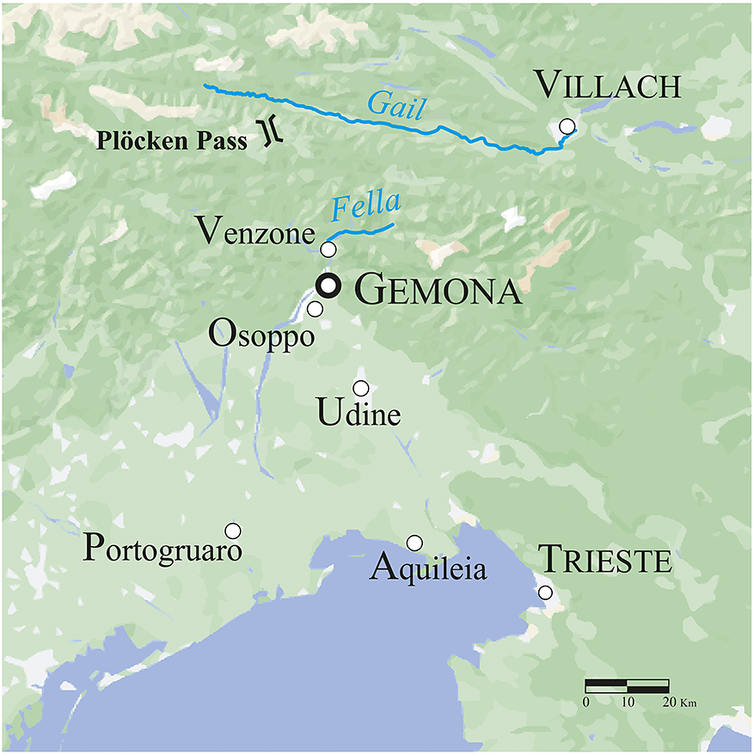
The territory was then ruled by the patriarchs of Aquileia, the ecclesiastical and temporal lords of the region now called Friuli. In the twelfth century, the city of Gemona was accorded ‘fortified town’ (oppidum) status and hosted an important market within its walls. It may have been at this time that the habit of unloading goods and changing wagons, which later gave rise to the Niederlech custom, began. Its vocation as a commercial hub shaped the history of medieval Gemona, resulting in a bitter rivalry with Venzone.Footnote 11
In 1420, Friuli was incorporated into the Republic of Venice. In the early years of the fifteenth century – probably as a reaction to its gruelling war against Genoa (1378–81) – the Venetians began work on building a mainland state in defence of their economic power. With a view to countering the advance of Sigismund of Luxemburg, king of the Romans, who saw the patriarchy of Aquileia as the property of the Holy Roman Empire, Venice finally incorporated the whole Friuli region into the Venetian Republic, and Gemona with it. Overall, the Venetian approach was to preserve the political balance of conquered territories, confirming most of the jurisdictional and fiscal rights granted to them by their predecessors. After the conquest of the region, a Venetian patrician called luogotenente, who resided in Udine, was charged with representing the Venetian authorities in Friuli, and granted normative, judicial and executive powers.Footnote 12
Niederlech – the word comes from the German word niederlegen meaning ‘to put down’ – formalized the practice of changing vehicle at the mountains–plains intersection. It was granted to the Gemona community by the patriarchs of Aquileia, supposedly in the twelfth century, and confirmed by the Venetians in 1420.Footnote 13 The law obliged merchants travelling between Germany and Italy to spend the night in the town, pay duties, unload their goods from the small wagons used in the mountains and load them onto bigger and heavier wagons more suitable for the plains roads. It is what stands out most about medieval Gemona, making the town an interesting case-study for scholars interested in urban history. For German merchants bringing their goods to Italy, in fact, Gemona was a place of hospitality, providing them with board and lodging, and the town benefited from their presence, supporting the local economy, in a climate of synergy and mutual support.
The importance of Gemona as a key German–Italian trade hub from the Middle Ages to the modern age is well known, particularly as a result of Philippe Braunstein’s fundamentally important studies: the cities of the Holy Roman Empire were the Venetian Republic’s most important supplier, culminating in the setting up of the Fondaco dei Tedeschi in Venice in the thirteenth century, a full-blown sorting centre for German goods. Not solely an economic but also a cultural crossroads, the Fondaco welcomed artisans (blacksmiths, shoemakers, bakers, cooks, weavers, servants) and merchants who brought all kinds of metals, leather and furs, horn products, linen and yarns, wax and fabrics (such as wool, damask and linen) to the Venetian lagoon.Footnote 14 In Gemona, in particular, the iron trade appears to have played a pre-eminent role in the local economy. Although it came primarily from far-off mines and was mainly intended for re-export, in actual fact this iron also satisfied local demand: iron objects were produced in the town and iron trading companies existed which bought it in exchange for goods and basic necessities such as wheat and wine.Footnote 15
In this context, it is the nature of Gemona’s environment which is of primary interest. Two elements are inter-related here: the Alpine mountains and the Germany–Italy border. The fact that the ancien régime states struggled to regulate mountainous areas and bend them to their will is acknowledged. In the eighteenth century, when the Republic of Venice was in desperate need of money and attempted to reform the mainland’s feudal system, the Venetian Senate asked the ‘Superintendents for fiefs’ (Provveditori sopra feudi) to produce a report on the Friuli region, to find out what jurisdictions ‘actually existed in Friuli’ (esistano veramente nel Friuli).Footnote 16 We can infer from this that the Venetians were not even familiar with the region’s political geography, or at least not in depth. It is thus not surprising that the presence of the state was perceived of as weak at its borders, nor that some were able to fill the power vacuum. In mountain regions, especially borderlands, the absence of a strong state presence left room for those with money and followers to seize power. It has, for instance, been shown that the peripheral agents of the Savoy state gabelles (duties) in the eighteenth century not only performed supervisory duties, but also used their offices to pursue personal interests and enrich themselves. In fact, such figures accumulated local power and often concluded informal agreements with the central authorities, as quasi-autonomous political subjects.Footnote 17 The same is true of Gemona, where the merchants’ agents took advantage of their Niederlech rights to gain power and social status.
It is well known that, in the early modern period, contraband and illegal activities were especially common in border regions and mountainous areas and in this sense a comparison between Friuli and Trentino, Tyrol and Cadore is of use.Footnote 18 In the sixteenth and seventeenth centuries, Trentino was frequently the scene of contraband and illegal trafficking between Germany and Italy, which the Venetians authorities repeatedly complained about but proved incapable of preventing.Footnote 19 Similarly, in Tyrol the ‘Supreme General of the Forests’ (Bergrichter) was tasked by the archduke with inspecting trails, mule tracks and waterways on the border with the Republic of Venice, in order to limit contraband in wood, and reporting smugglers to the authorities in Innsbruck. Even in this case, the government proved incapable of preventing contraband and the smugglers circumvented such controls in various ways, with corruption being the most blatant.Footnote 20 The situation in Cadore was similar: the Republic of Venice entrusted the ‘captain of Cadore’ with the task of limiting contraband and seizing any illegally transported goods, but the results were far from satisfying.Footnote 21
My aim here is to examine the mechanics of German–Italian trade in the early modern period, starting from the wealth of unpublished documents to be found in the Gemona town council archives.Footnote 22 Although the subject has been paid considerable attention by medieval historians, the history of Niederlech from the fifteenth to the seventeenth century has, in fact, not yet been fully explored. Nevertheless, Gemona’s economy was still revolving around this practice in the second half of the eighteenth century, and other commercial activities had not yet emerged.Footnote 23 This article will argue that Niederlech was extremely significant to early modern Gemona and a key factor in the city’s reorganization of social hierarchies.
The innkeepers in court
Three events provide an insight into the policy of the Venetian government towards Gemona and Niederlech. Firstly, on 3 of July 1420, after the Venetian conquest of Friuli, the Republic of Venice confirmed the rights of Gemona, including Niederlech.Footnote 24 Secondly, on 18 February 1469, following complaints by German merchants, a letter from Doge Cristoforo Moro reinstated the right to transport goods between Gemona and Portogruaro on German horses and wagons, which had previously been banned to encourage the use of Italian wagons.Footnote 25 Thirdly, on 18 January 1519, Doge Leonardo Loredan restored Niederlech to Gemona from Osoppo, where the Venetians had transferred it in 1515 – as the latter was a fiefdom of Girolamo Savorgnan, condottiero of the republic – as a reward for his contribution to the war against Maximilian I.Footnote 26
This last episode, in particular, attracted the attention of local historians, since the decision to reward a condottiero at the expense of a community seemed controversial.Footnote 27 Venetian patrician Marin Sanudo noted in his diaries that, in 1517, the College received German representatives complaining about what he called the ‘Anderlech’, ‘because the Germans didn’t want to bring their goods to Osoppo, since the place was out of the way, and they would rather bring them to Gemona like they did before’ (perché Todeschi non voriano mandar le soe bale a Osop per esserli straman di la strada, ma andar come prima a Gemona).Footnote 28 This means that at this point, the Niederlech tradition had made the city a place of hospitality with which German merchants were familiar. Moreover, in both 1469 and 1519 the Venetians reneged on their promises after hearing the Germans’ complaints, and this is indicative of the instability of Venetian rule in Gemona. The republic seems not to have had a firm grip on the outer regions of the Terraferma and not to have fully understood German–Italian mobility dynamics. As I will show, the fragility of Venetian institutions and the Republic’s lack of control over its border set the scene for criminal activities, chiefly contraband, in which Gemona’s innkeepers seem to have played a significant part.
Scholars have emphasized the economic, social and political importance of inns and taverns in ancien régime Europe: first of all, what has been underlined is that hostelries were places where large quantities of money and every kind of news circulated freely. Although research into hostelries in the early modern period has focused mainly on northern Europe – while the Italian focus has been mainly public squares – the historiographical trend in recent years appears to have changed, in particular thanks to the contribution, among others, of Rosa Salzberg and Matteo Pompermaier, who have brought new interest to the role of inns and lodging houses in Venice.Footnote 29
Niederlech was undoubtedly a great opportunity for the innkeepers, who had every reason to exploit the flow of merchants toing and froing between Germany and Italy. This was common to other Friuli towns located along the road to Germany, such as Venzone and Tolmezzo. In these towns, too, the innkeepers acted as intermediaries between merchants and local authorities, not only keeping track of goods but also lending money to trusted customers.Footnote 30 Although we do not know exactly how many inns there were in Gemona, we do know that they were concentrated around the square, in order to facilitate the loading and unloading of goods arriving in the town.Footnote 31 On the road that leads to the cathedral and the city hall, the symbols of spiritual and temporal power respectively, Palazzo Elti is still extant (now home to the Civic Museum). The Eltis, one of the most influential innkeeping families in Gemona and at the centre of our study, bought this in the early sixteenth century (Figure 2).Footnote 32
Location of Palazzo Elti in early modern Gemona.
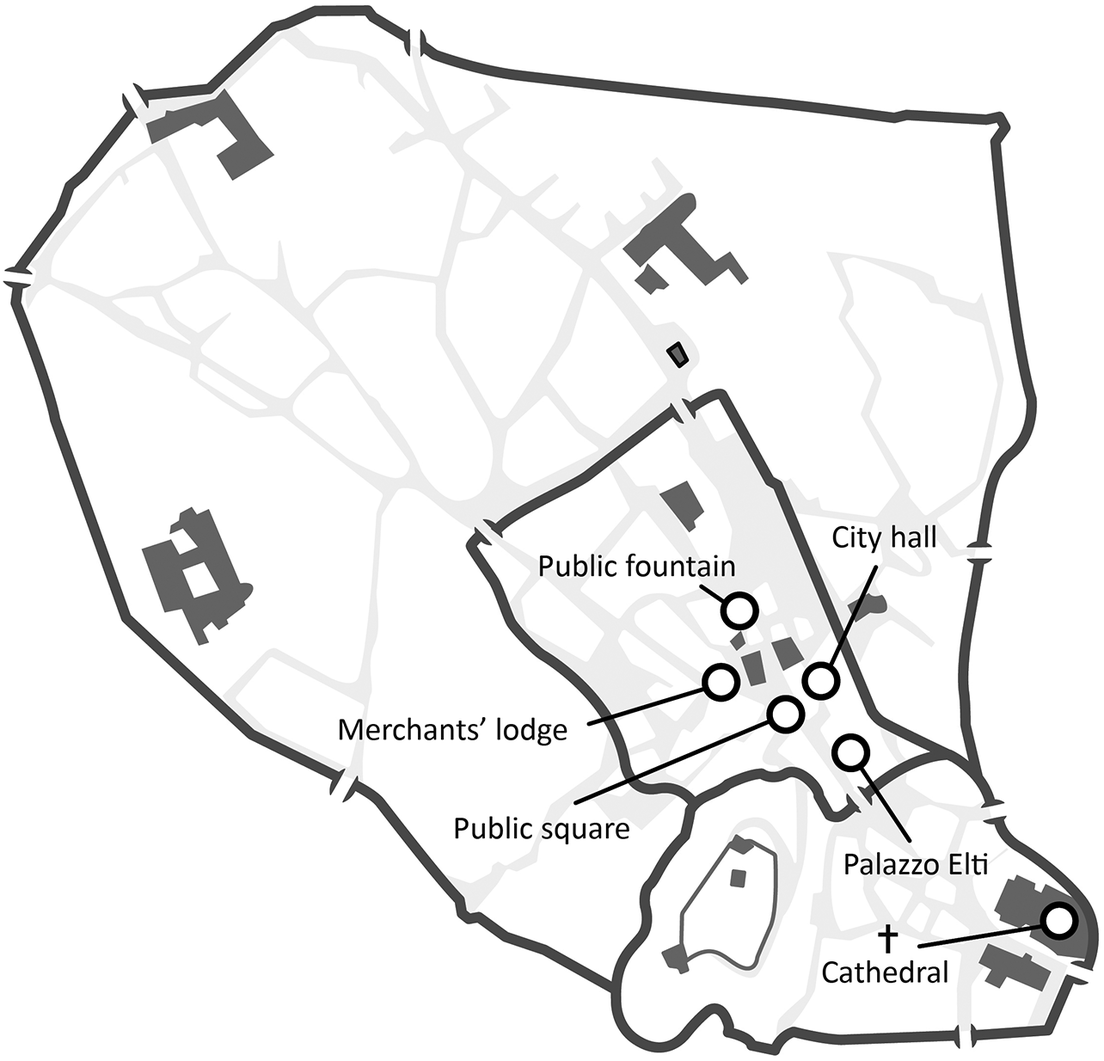
As Beat Kümin has argued, ‘no other profession in the early modem period, apart from the clergy, possessed a comparable range of contacts or better facilities to bring people together and to know what was going on’. Innkeepers were able to make use of these resources to earn power and social status, both honestly and dishonestly, and Gemona was an ideal place to get rich in, with innkeepers often being on the wrong side of the law.Footnote 33
Rosa Salzberg’s recent study on Venetian lodging houses has revealed that they were not simply places to sleep and eat in, but also to meet other people, be entertained and even look for medical help, places that put people of diverse origins and cultures in contact with each other and thus were fundamental cogs in the urban society wheel.Footnote 34 In a transit hub such as Gemona, it was mainly merchants who turned to the inns and the latter responded by specializing in offering merchants all the support they needed, that is, primarily warehouses and staff capable of handling goods and money.Footnote 35
Moreover, the innkeepers (hospites) were the professional category which most benefited from Niederlech. In fact, in addition to owning the hospitia they often acted as agents (agentes) for foreign merchants. Innkeepers, in other words, were tasked by merchants with accommodating carters coming to the city, overseeing the loading and unloading of goods, paying duties to the authorities and sometimes storing merchandise in inn warehouses. It goes without saying that they all were German-language natives or spoke it fluently.Footnote 36
Warehouse availability was a key factor in contraband and, in this respect, another example from the Venetian mainland may be of use. Lake Garda, on the Veneto–Trentino border was also notorious for contraband.Footnote 37 One of the families who took advantage of this situation was the Beatrice family: Giovanni Beatrice (1576–1617), known as Zanzanù, began his criminal career as a smuggler and later became one of the most infamous, bloody bandits in the Mediterranean. As 1598 enquiries by the Venetians showed, the Beatrice family smuggled corn from Lake Garda to Habsburg lands and they, too, used the family warehouse to sell cereals illegally.Footnote 38
On 16 June 1488, following complaints from Gemona ambassadors and German merchants, a letter from Doge Agostino Barbarigo forbade the city’s innkeepers from ‘trading secretly’ (oculte facere mercantiam) in wine and other goods, on pain of a 50 ducat fine and a ban on running inns.Footnote 39 There is nothing surprising about the innkeepers’ illegal activities: it was common for such people to exploit their position to gain social prestige and wealth in the early modern period. An exemplary case is that of Franz Stockhammer, innkeeper at Traunstein (Bavaria), who was accused of sexual assault in 1671 and for having beaten the mayor’s wife in 1680, but who also held public office and belonged to the city’s elite. The records show that this was by no means unusual: innkeepers’ social status was considerable, they were part of the local political elite and middlemen between the authorities and foreigners.Footnote 40
The 1488 measure was a difficult one to enforce. Two years later (6 April 1490), the doge invited the community of Gemona to observe the measure ‘inviolably’ (inviolabiliter).Footnote 41 In 1505 (5 November) a letter from Doge Leonardo Loredan addressed certain civic disorders resulting from the ‘mischief’ (la malitia) of those still trading illegally and delaying trials with all means available to them. It would seem that the innkeepers relied on their lawyers to prevent the Gemona community from stopping them trafficking in goods and the Venetian government thus demanded that local institutions should do all they could to remedy the situation.Footnote 42
On 10 September 1519, the community of Gemona sent a plea to the Republic of Venice calling its attention to the abuses and ‘extortions’ (estorsioni) perpetrated by the innkeepers. The situation depicted was a dramatic one. The Gemona community argued that the measures taken by the Venetian government in 1488 were not in themselves sufficient to tie the hands of the innkeepers, who were constantly handling money, acting as agents of German merchants and trafficking in goods in contempt of the law. The agents were tasked by merchants to pay Niederlech duties and thus managed large sums of money; were in regular contact with Italian and German carters, whom they forced to buy overpriced goods; and promised discounts on duties to foreigners in exchange for wine. In addition, constant court cases against hospites were emptying the community’s coffers, because the merchants’ agents were ‘very rich and powerful’ (richissimi et potenti) and knew how to delay the course of justice with ‘machinations and delaying tactics’ (machinationi et cavillationi).Footnote 43
This innkeeper–community conflict is extremely interesting and seems to show that they were regarded more as outsiders than members of the community. As we have seen, elsewhere innkeepers were often members of the local governing elite whilst in Gemona their relationship with the authorities was conflictual. As we shall see, in the long run they became an integral part of local society, but at this time the civic council saw them as foreigners jeopardizing community stability.Footnote 44
The innkeepers refused to toe the line, arguing that the ducal letter of 1488 did not apply to them. The Gemona community thus asked the Republic of Venice to take firmer measures and make the offence punishable with six months’ exile rather than a prohibition on running inns, to begin only once the 50 ducats fine had been paid up in full. As the local institutions pointed out in their plea, the innkeepers’ contempt for the 1488 law was causing a whole host of problems for the ‘poor but loyal land’ (povera ma fedelissima terra) of Gemona, ‘situated near to the mountains in an unfertile area’ (situata alla costa delle montagne in loco sterile) which had no other means of economic survival other than trading and selling wine locally. Gemona asked Venice to honour the ancient right of Niederlech, granted to the community by the patriarchs of Aquileia ‘since time immemorial’ (antiquissimamente) and confirmed by the republic ‘with great goodness’ (con tanta benignità).Footnote 45
Most of the archival sources dealing with Niederlech are trials and sentences against innkeepers and agents of the German merchants accused of breaking the 1488 law. In fact, in 1551 (13 June), Gemona’s ‘minor council’ (an assembly of around 15 members tasked with solving small-scale problems) decided to bring fresh accusations against all those disobeying the doge’s letter, to put a stop to illicit trading once and for all.Footnote 46 The council’s resolution was an extremely optimistic one: the new trials did nothing to solve the problem and the innkeepers kept breaking the rules.
In the second half of the sixteenth century and the first half of the seventeenth century, the trials revolved around a number of local families, especially the Elti, Federli, Gropplero, Sassavolante and Serena families. Our knowledge of the origins of these families is limited, but we can assume that their history was a common one. We know, for instance, that the Elti family were descendants of the Held family, originally from Salzburgerland (Austria) and that they moved to Gemona in the fifteenth century for economic reasons. They were landowners and farmers attracted to the city by its ideal location on the Italian–German border, later becoming counts. The same is true of the Gropplero family. The Groppleros were also from Salzburgerland and came to Gemona in 1568. One of them married a local aristocrat, thereby gaining access to an earldom.Footnote 47
What we do know for certain is that their easy access to money and information, and their ability to attract clients, meant that these families could exploit the lack of state control to seize power. It is noteworthy that, from the last decade of the seventeenth century right up to the fall of the Venetian Republic (1797), members of the Elti and Federli families held the rank of ‘captain’ of Gemona, the town’s highest political office, many times.Footnote 48 The captain was the representative of the patriarch of Aquileia in Gemona and his role was to administer civil and criminal justice, preside over the meetings of the civic council and protect public order.Footnote 49 This enabled the Elti and Federli families to climb the social ladder by the end of seventeenth century, putting several decades of smuggling and criminal activities to good use.
For instance, on 14 January 1555 the community of Gemona took action against Giorgio Elti and brothers Giorgio and Giovanni Serena. Both the Elti family and the Serena brothers belonged to wealthy, powerful families whose money came from innkeeping and illicit trades. The minor council gathered with a view to enforcing the doge’s letter of 1488, fined the two families 50 ducats and banned them from running inns, which meant that the defendants were able to escape exile.Footnote 50 As I will show below, in the years which followed not only did the Elti and Serena families continue to exploit their innkeeping status, but they also acquired power and wealth via contraband and extortion.
While all this was happening, the Venetians do not seem to have been contributing significantly to enforcing the law. The Venetian luogotenente in Friuli received the complaints of the Gemona community and sent local institutions letters in which he reiterated his support without actively contributing to improving the situation.Footnote 51 Ultimately, on 11 April 1556, Gemona and the German ‘nation’ (natio) signed an agreement in an effort to bring an end to the problem. German ambassadors Johannes Amhauser and Hieronymus Ghengher obtained the right to a permanent agent in the city, a representative of the German nation tasked with managing trade. The agent was to have a ‘family’ (fameglia) of scribes and servants and his role was to pick up and drop off goods travelling between Germany and Italy, in accordance with the 1488 law. The agreement prohibited the German representative from exercising the profession of innkeeper and providing accommodation in exchange for any type of payment.Footnote 52 There is no record of further activity by German agents in Gemona, and judging by the number of trials in subsequent years it can be assumed that the 1556 agreement neither put an end to contraband, nor stopped innkeeper abuses.
Ten years later, Teobaldo Federli, a member of another local family whose social status came from innkeeping, was accused of breaking the 1488 law. He was ultimately acquitted of the charge, but innkeepers were clearly still being investigated for abuse of powers connected to Niederlech.Footnote 53 Moreover, the privileged position of these men was undeniable. For example, on 10 April 1567, a German agent called Sinibald tried to obtain a licence from the local government to sell wine in Gemona, but the council refused to grant it.Footnote 54 By contrast, the following year Teobaldo Federli obtained a licence to sell (licentiam vendendi…ad minutum) Cretan wine in the city ‘without prejudice to the doge’s letters of 16 June 1488’ (sine tamen aliquo preiuditio literarum ducalium 1488 16 iunii).Footnote 55 We do not know who supplied the Federli family with this fine wine nor exactly whom it was sold to – although we can assume that it was intended for local consumption – however, the case is significant as it shows that the Federlis’ social status allowed them to obtain licences that were denied to foreign merchants.Footnote 56
In 1573, Biagio Serena, Bulfardo Gropplero, Eligio Elti and Cesare Comenduno were accused of breaking the 1488 law, and the civic council decided to hear witnesses in order to obtain a conviction.Footnote 57 On 4 August 1577, Giulio Sassavolante presented Gemona’s minor council with a plea defending the Serena, Federli, Sassavolante and Gropplero families which argued that Gemona’s land was ‘infertile and mountainous’ (sterili et alpestri) and that its people’s only source of income was selling wine. The agents expressed astonishment at the community’s accusations, on the grounds of the poverty of the land.Footnote 58 This same technique was used by the local government in 1519, as we have seen, when the community of Gemona asked the Republic of Venice to take action against the innkeepers. However, the infertility of the land was not simply a literary topos but also a real problem, which led to contraband and extortion.
According to Gemona’s civic institutions, the German merchants’ agents were acquiring ‘incomes, alliances and connections’ (guadagni, intelligenza e società) illegally and at the expense of the community. This was the argument of the authorities when they fined Teobaldo Federli and Marzio Sassavolante 50 ducats each on 8 August 1620.Footnote 59 That same year, Tobia Federli was tried for selling ‘wine, iron, lead and many other goods’ (vino, ferro, piombo e…diverse altre robbe) and accepting donations of ‘fish, salami, lambs and other such things’ (donationi di pesce, di salami, agnelli et altre cose) from the carters in exchange for reduced duties.Footnote 60 He was finally fined 50 ducats and exiled.Footnote 61 On 7 June 1621, it was Giovanni Serena’s turn to be tried for selling wine, nails and cattle and fined 20 ducats, but he escaped exile.Footnote 62
In 1641, Paolo Tribuzzo di Campo Rotto and Francesco Crodero, servants of the Elti family, were tried together with other followers of the Elti family, and fined 50 ducats each on the grounds that they helped the latter run illegal businesses at their home, accommodating the carters and trafficking in goods.Footnote 63 This shows that families like the Elti succeeded in co-ordinating a number of servants by using their property as headquarters. Money, political influence, servants: in the seventeenth century, the Gemona innkeepers behaved like minor nobles exercising ‘informal’ powers that conflicted with the council’s official powers.Footnote 64
It is clear that, at this point, the agents of Gemona’s German merchants had acquired definitive social status, and the local authorities had failed to control them. No wonder, then, that certain members of the most prominent innkeeping families, such as the Elti and Federli families, were soon to hold political office.
Conclusion
The aim of this article was to shed light on the everyday impact of German–Italian mobility on city life via a specific case-study – Gemona in the early modern period. What makes early modern Gemona an interesting field of inquiry is the Niederlech privilege, a law that obliged merchants travelling between Germany and Italy to change wagons, pay duties and spend the night in the town. My specific focus was Gemona innkeepers and the way they took advantage of this custom to smuggle goods across the border. The case-study is relevant for urban historians as it helps illustrate what the opportunities were for early modern towns at the margins of state control, as well as what impact the transnational networks of contraband had upon the structures of power and wealth within the urban communities.
The location of Gemona on the Italian–German trade routes allowed the city to exercise the right of Niederlech, which was decisive for the local economy. Urban life was built around this practice: as mentioned, the inns were concentrated around the public square, where the unloading of goods took place and where merchants coming from Germany could find the public fountain, useful for watering the animals.Footnote 65 The coming and going of merchants created jobs and gave economic sustenance to a place which, due to the scarcity of resources, would otherwise have struggled to generate significant urban growth. Niederlech offered work to stevedores, porters, innkeepers, saddlers, blacksmiths, carpenters, owners of warehouses, stallholders and shopkeepers of all kinds, while at the same time diverting people from agricultural work, made difficult in Gemona by the lack of defence against the floods and the low irrigation potential of the land.Footnote 66
The case of Gemona is particularly useful to understand what impact the location in a border area could have on the urban environment, because it illustrates how the city economy would have relied for its sustenance on the practices connected to Niederlech until the fall of the Republic of Venice, despite the decline of these commercial routes. From the beginning of the eighteenth century, in particular, the rise of the Habsburg Empire would have damaged the economy of Gemona, as the House of Austria established its own port in Trieste, moving the merchants and merchandise away from Venice and therefore from the ancient Friulian transit routes that led to the Lagoon through the Alps.Footnote 67
Being located at the margins of state control, the natural environment exposed Gemona to a whole series of illicit activities, an opportunity that was intelligently seized by the innkeepers who played the role of intermediary between foreign merchants and the urban community. The Republic of Venice was never able to prevent the innkeepers from exploiting German–Italian trade and smuggling across the border, neither was local society able to halt their advance. Geographical factors such as Gemona’s peripheral position and border town location enabled them to engage in illegal business which was to last for centuries.
The sources used here are mostly trials and indictments against innkeepers who acted as agents of the German merchants, in other words, were tasked by the merchants with overseeing Niederlech-related operations (goods storage, changing wagons, payment). The most common accusations were illegal trade and accepting gifts in exchange for favours, such as tax evasion. All of this eventually led to an agreement between the community of Gemona and the German nation (1556) by which the Germans obtained the right to a permanent agent in the city responsible for managing trade. This agreement did not, however, prevent the aforementioned families from continuing with their illegal trafficking.
Gemona’s proximity to the mountains and position at the edge of the Venetian mainland state meant that its political space offered an ideal environment for criminal networks interested in border trade. Although the Venetian Republic decreed that smugglers should be exiled from the city, the civic council chose not to make use of this most of the time, demonstrating the extent to which the most influential families were in a position of strength in their dealings with the local institutions. In the cases analysed, only Tobia Federli was exiled from Gemona in 1620, following serious allegations of corruption. This gives the impression that these families had the upper hand over the civic institutions. In addition, they acquired aristocratic titles through marriage: the Elti and Federli families became counts and their members frequently acted as city ‘captains’ from the seventeenth century onwards. There was very little that the Republic of Venice could do to prevent the rise of the families in charge of Niederlech-related activities, and this led to the emergence of a new ruling class, one that was to occupy political office within the Venetian institutional framework for some time. The examples cited also show that these families created a solid network, a place of mutual protection and kinship, as is clear from the plea sent to the minor council by Giulio Sassavolante in defence of the Serena, Federli, Sassavolante and Gropplero families in 1577.
In my opinion, this network of contraband would have reshaped the local hierarchies of power. In Gemona, the ability to take advantage of German–Italian trade seems to have been the decisive factor in the emergence of a new ruling class. It was this that enabled Gemona’s innkeepers to rise up the social ladder and it was the everyday mechanics of German–Italian trade which enabled them to take political office and acquire aristocratic titles at a later date. Instead of co-operating with the Republic of Venice, Gemona’s innkeepers exploited the fragility of the Venetian system and its lack of control over the German–Italian border to carve out a role for themselves. In other words, smuggling at the border would have been what allowed the innkeepers to appropriate wealth and influence, obtaining a sort of a posteriori legitimation when public offices and noble titles were granted, thus formalizing a power they had obtained by accumulating wealth illegally.
Whilst some aspects of this case-study would seem to be in accord with the general European situation at the time, others are somewhat surprising. If, in fact, it was common in ancien régime Europe for innkeepers and customs officers to act as middlemen between local authorities and travellers – this was also the case in Gemona, where innkeepers not only helped merchants store their goods, change wagons and carry out Niederlech-related operations, but also supplied travellers with wine, iron, lead and other goods – what is surprising in the sources analysed is the conflict between the innkeepers and the community. While elsewhere these figures seem to have fitted easily into local political life and held important political office, in Gemona, at least in the period analysed here, the civic council attempted to combat their power, including with the help of Venice, which witnessed these events from afar (perhaps with little involvement, as well as with limited room for manoeuvre). Although in Gemona too, in the last decades of the fourteenth century, two innkeepers held important political office (Vualterius and Vinzislaus, both of German origin and members of the city council), fifteenth-century developments in innkeeping and the innkeepers’ progressive specialization as agents of German merchants was to lead to the conflicts referred to above.Footnote 68 Gemona’s innkeepers seem to have acted as an alternative source of power and their interests thus clashed with those of the town authorities. It was only in the last decade of the seventeenth century that they held political office, and social mobility would thus appear to have been a direct consequence of their involvement in illegal activities.
In conclusion, the case-study of Gemona helps to shed light on city life in cross-border areas and, more generally, on the mechanics of physical and social mobility in early modern Europe. The city, which would have had a weak urban role due to the poverty of its hinterland, became instead an important commercial hub because of its location at the German–Italian border. The practice of Niederlech, as well as the city’s location at the margins of state control, created the conditions for intense smuggling activities, and the innkeepers benefited from these illicit trades by accumulating wealth and power. In the long run, this led to the formation of a new ruling class – one born in opposition to the control of the city government, but which later became itself representative of the local authority and thus of the Venetian state.
Acknowledgments
This work is an extension of a paper presented during the Infrastructures of Mobility in Trans-Alpine Europe (1450–1750) seminar organized by Istituto Storico Italo-Germanico in Trento and Fondazione Bruno Kessler (30 September 2021). I would like to thank Rosa Salzberg for her comments on an earlier draft of this article.


 Open access

