

Human sacrifice is recognized as one of the most dramatic and enduring rituals in societies worldwide. Sacrifice, ritual warfare, and execution of captured warriors do not represent random acts of aggression but consist of organized and ritualized acts of homicide deemed permissible by society and are often embedded in its institutions (Klaus and Toyne Reference Klaus, Toyne, Klaus and Toyne2016:1–2). In many ancient empires, the power and authority of those who govern were never assured and had to be continuously justified in a tangible way to their subjects. Sacrifice accompanied and intensified during the emergence of early states and periods of social transition, functioning to generate concepts of legitimacy, perpetuate asymmetrical power relationships, and maintain stability and solidarity. Emerging rulers used sacrifice to effect communion with the supernatural realm, thereby legitimizing and naturalizing the new status quo through their association with the divine (Campbell Reference Campbell and Campbell2014; Swenson Reference Swenson2003). Human sacrifice thus served as a form of political theater during which the worldviews held by the elites, rulers, and other authority figures were communicated to spectators, participants, and the victims.
Bioarchaeology with its analytical tool kit is well positioned to explore the motivations and functions of human sacrifice because it interprets mortuary and osteological data within the broader social and historical context. Victim selection, bodily treatments, and how victims are killed are highly organized actions in which each decision articulates what motived the state to stage these sacrificial events. Foucault (Reference Foucault1977:47–50, 138) argued that destructive acts on the body by those in power transform the body into a malleable, compliant entity on which the state may inscribe codes of meaning. These actions on the body generate vivid images of coercion and provide a physical representation of the immutable authority of those staging the event. Social identities—whether rank, group membership, or gender—may be communicated, intensified, or even subsumed into deliberately crafted identities to enhance the sacrificial currency of certain individuals or groups (Fiskesjö Reference Fiskesjö2001:149; Swenson Reference Swenson and Campbell2013). As such, repetitive demographic variables like age-at-death and sex may illuminate the social implications of sacrifice and why certain individuals were viewed as ideal victims. Studies of sacrifice generally focus on the sacrifice of male bodies as a mechanism for elites to maintain power and obedience over their subjects: in doing so, these studies excluded critical discussions of the sacrifice of female bodies (Hill Reference Hill2000:318) and, the focus of this study, of the bodies of children and adolescents.
This work contributes to a growing body of literature that examines the role ritual violence played in sustaining the imperial authority of the Chimú Empire (AD 1050/1100–1450). Recent work on the north coast of Peru by the Programa Arqueológico Huanchaco (PAHUAN) has identified evidence that the Chimú Empire staged episodic rituals in which hundreds of children, adolescents, adults, and juvenile camelids were sacrificed at multiple locations near Chan Chan in the Moche Valley. This article presents the results and interpretations of a bioarchaeological analysis of victims of human sacrifice at the site of El Pollo in the Moche Valley.
We consider whether sacrifice documented at El Pollo was part of a highly standardized sacrificial program staged and sanctioned by the Chimú Empire throughout the imperial core. Comparisons of demographic profiles, bodily treatments, and injury patterns of victims between El Pollo and other Chimú sacrifice sites in the Moche Valley support the argument that sacrifice involved several standardized procedures. Victims at El Pollo show evidence of excessive incisions to the torso, and several adult males show evidence of sacrifice by chest opening, which are features not documented at other sacrificial sites in the Moche Valley. We argue that these conspicuous additions to the repertoire of violence indicate that the sacrificial program could be modified to suit transformations in Chimú imperial enterprises. Specifically, sacrifice at El Pollo may reflect the growing efforts of imperial expansion and consolidation of newly conquered communities beyond the imperial heartland.
Sacrifice on the North Coast of Peru
Bioarchaeological evidence reveals that methods and motivations for sacrifice changed alongside major sociopolitical trends throughout Andean history. Conclusive evidence of sacrifice in the preceramic (2500–1800 BC) and Early Horizon (800–200 BC) periods is rare (Burger Reference Burger1992; Feldman Reference Feldman1980; Quilter Reference Quilter1989). Ritual violence assumed prominence for the Moche beginning in the Early Intermediate period (100 BC–AD 650) as evidenced by retainer offerings in elite tombs (Fernández López Reference Fernández López and Pérez2021; Verano Reference Verano1997, Reference Verano2001a, Reference Verano2001b). Ceramics and mural paintings at Moche ceremonial precincts portray scenes of prisoners sacrificed by throat slitting (Alva and Donnan Reference Alva and Donnan1993:132; Donnan and McClelland Reference Donnan and McClelland1979; Uceda Reference Uceda2001). At Huaca de la Luna in the Moche Valley, the bodies of male warrior captives were found bound, mutilated, and killed by having their throats slit during multiple events spanning several centuries (Bourget Reference Bourget and Pillsbury2001a; Verano Reference Verano2001a, Reference Verano2001b, Reference Verano, Scherer and Verano2014; Verano and Phillips Reference Verano, Phillips, Klaus and Toyne2016). Underneath a series of sacrificed males were the remains of three infants, two of which were headless. Although none show physical evidence of violent death, it is likely that they were dedicatory offerings (Bourget Reference Bourget, Benson and Cook2001b, Reference Bourget2016:33–40).
The demise of the Moche was followed by dramatic changes in the geopolitical landscape in which the Lambayeque (Sicán) society ascended to regional power in the La Leche-Lambayeque Valleys (AD 900–1300). The numerous retainer burials at the Lambayeque (Sicán) capital Batán Grande show an emphasis on social stratification between elites and non-elites (Klaus and Shimada Reference Klaus, Shimada, Klaus and Toyne2016; Shimada et al. Reference Shimada, Shinoda, Farnum, Corruccini and Watanabe2004). In the Jequetepeque Valley, warrior captives continued to be executed, as evidenced by the bound and mutilated bodies of males at Pacatnamú (Verano Reference Verano, Donnan and Cock1986). For adolescents and young women, strangulation was the preferred method of sacrifice, as evidenced by the remains documented within the temple at Dos Cabezas (Donnan and Cordy-Collins Reference Donnan and Cordy-Collins2015).
Although adult males and females continued to be ritually killed, examples of child sacrifice increased during this period, and chest mutilation was added to the repertoire of violence (Blom Reference Blom, Crawford, Hadley and Shepherd2018). Two children at Huaca Santa Clara (Virú Valley; Millaire and Surette Reference Millaire and Surette2011) and one child from Santa Rita B (Chao Valley; Gaither et al. Reference Gaither, Kent, Vásquez Sánchez and Tham2008:109) showed chest wounds. At Cerro Cerrillos in the Reque Valley, Moche descendants relied on traditional methods of sacrifice but began sacrificing children via chest opening (Klaus et al. Reference Klaus, Centurión and Curo2010). Although child sacrifice continued into the Late Horizon (AD 1438/1450–1532) on the north coast of Peru and in the southern highlands with the well-known Qhapaq hucha (or capacocha) ceremonies, ritual violence targeting children and adolescents reached its zenith on the north coast of Peru during the coalescence and expansion of the Chimú Empire.
Human Sacrifice in the Chimú Empire
In the early Late Intermediate period (ca. AD 1050/1100), the Chimú Empire emerged and consolidated the Moche, Chicama, and Virú Valleys to form an imperial heartland: at its center the capital city Chan Chan developed into one of the largest urban settlements in South America (Mackey and Klymyshyn Reference Mackey, Klymyshyn, Moseley and Cordy-Collins1990; Moore and Mackey Reference Moore, Mackey, Silverman and Isbell2008; Moseley Reference Moseley1975; Prieto Reference Prieto2023). Depictions of violence in Chimú visual media are rare compared to their north coast predecessors (Prieto and Verano Reference Prieto, Verano, Walsh, O’Neill, Moen and Gullbekk2023:250). A series of unprovenanced fragments of possibly the same textile (known as the “Prisoner Textile”) depict bound prisoners and mutilated bodies (Hamilton Reference Hamilton2016:87; Lapiner Reference Lapiner1976:279–282). The Chimú Staff God is sometimes shown wielding a tumi knife or holding a severed human head by the hair (Mackey Reference Mackey and Makowski2002). A wooden architectural model discovered in a Chimú tomb at Huaca de la Luna includes two bound male captives, two individuals holding trophy heads, and a figure holding a tumi-like knife (Uceda Reference Uceda1999). Wooden sculptures from Huaca el Dragón (or Huaca Arco Iris; Iriarte Reference Iriarte1969) and Huaca Taycanamo in Chan Chan depict a cast of ritual participants, including male captured warriors bound by ropes accompanying the funerary procession of a deceased Chimú leader (Jackson Reference Jackson2004:Figure 9). Recently, wooden sculptures of warriors holding trophy heads were found at the entrance to one of the palaces in Chan Chan (Gayoso Rullier and Gamarra Carranza Reference Gayoso Rullier and Carranza2023:Figure 7).
The role of sacrifice in maintaining the immutable power of Chimú ruling elites materializes in the burial platforms within the royal palaces in Chan Chan. Periodic rituals venerating deceased rulers were performed at the burial platforms (Conrad Reference Conrad, Moseley and Day1982; Moore Reference Moore2004). Excavations within the burial platform of the Las Avispas palace revealed more than 90 young human retainers deposited in crypts surrounding a central cell that presumably once held a deceased Chimú ruler (Conrad Reference Conrad, Moseley and Day1982; Day Reference Day, Moseley and Day1982:99–100; T. Pozorski Reference Pozorski1979). Human sacrifice likely articulated the power asymmetries and emphasized the eternal political sovereignty of ruling elites at Chan Chan (Moore Reference Moore2004; Pillsbury and Leonard Reference Pillsbury, Leonard, Evans and Pillsbury2004:262).
During the fourteenth century, the Chimú Empire expanded beyond the imperial heartland to ultimately control much of the north coast until it was conquered by the Inca Empire around AD 1450/1470 (Mackey and Klymyshyn Reference Mackey, Klymyshyn, Moseley and Cordy-Collins1990; Topic Reference Topic, Moseley and Cordy-Collins1990). Although expansion was motivated by political and economic concerns, bioarchaeological studies confirm that the Chimú relied on ritual violence to demonstrate imperial power in newly conquered communities.
Dedicatory sacrifices of women with neck ligatures were interred within new constructions at Farfán (Jequetepeque Valley; Keatinge and Conrad Reference Keatinge and Conrad1983) and Manchan (Casma Valley; Verano Reference Verano2001a) following Chimú conquest. The bodies of 180 men and young boys were found bound, blindfolded, and executed by having their throats slit at Punta Lobos (Huarmey Valley), which is argued to represent a reprisal killing following local resistance to Chimú conquest (Verano and Toyne Reference Toyne2011). Analyses of skeletal remains at Túcume (Toyne Reference Toyne2011) and Chotuna-Chornancap (Klaus et al. Reference Klaus, Turner, Saldaña, Castillo, Wester, Klaus and Toyne2016) in the Lambayeque Valley revealed that males, females, and nonadults were sacrificed by having their chests opened and throats slit during several events that coincided with Chimú conquest and occupation.
Human Sacrifice in the Moche Valley
Human sacrifice in the Moche Valley was first documented during excavations of Zone C in the modern town of Huanchaco (currently known as José Olaya-Iglesia Colonial or JO-IG), where the remains of 17 children and juvenile camelids were uncovered (Donnan and Foote Reference Donnan, Foote, Donnan and Mackey1978:399–408; Prieto and Verano Reference Prieto, Verano, Walsh, O’Neill, Moen and Gullbekk2023:237). Recent work by PAHUAN has documented that the Chimú Empire staged sacrificial performances dispatching hundreds of children, adolescents, adults, and juvenile camelids outside the Chimú capital city Chan Chan at the sites of Huanchaquito-Las Llamas (HLL) and Pampa La Cruz (PLC; Prieto and Verano Reference Prieto, Verano, Walsh, O’Neill, Moen and Gullbekk2023; Prieto et al. Reference Prieto, Verano, Goepfert, Kennett, Quilter, LeBlanc and Fehren-Schmitz2019, Reference Prieto, Verano, Rowe, Castillo, Flores, Chachapoyas and Campaña2024; Figure 1).
Location of Chimú sacrificial grounds in the Moche Valley.

Excavations at the site of HLL uncovered 140 humans (137 children and 3 adults) and 205 camelids. Almost all children and adolescents were placed in flexed positions on their backs or sides facing northwest toward the ocean (Prieto et al. Reference Prieto, Goepfert, Valladares and Vilela2015, Reference Prieto, Verano, Goepfert, Kennett, Quilter, LeBlanc and Fehren-Schmitz2019). Victims show transverse incisions on their unfused sternal elements (sternebrae). No adults were sacrificed via chest opening, but two females were interred in face-down, crouched positions and show head wounds. The one male was buried extended on his back (Prieto et al. Reference Prieto, Verano, Goepfert, Kennett, Quilter, LeBlanc and Fehren-Schmitz2019).
Excavations conducted 2.6 km north of HLL at the site of PLC uncovered 247 humans and 291 camelids that were sacrificed during at least six ritual events spanning five centuries.Footnote 1 Most victims sacrificed during the earlier events (cal AD 1050–1300/1350) were placed in extended positions oriented east-west, whereas those sacrificed during the later events (cal AD 1300/1320–1500) show a greater variety of positions and orientations. More than half the children and adolescents exhibit cutmarks on the sternebrae consistent with sacrifice via chest opening. More than one dozen adults were found, but none show chest wounds (Prieto et al. Reference Prieto, Verano, Rowe, Castillo, Flores, Chachapoyas and Campaña2024:Apprendix 1). Two adult males were found in extended, face-down positions with their upper and lower limbs bound by ropes. A wooden sculpture of an anthropomorphic figure with a rope around the neck was also documented, perhaps indicating that these adult males were captured warriors. More than a dozen adult and adolescent females were found in seated positions facing north with an array of prestigious items as valuable ritual offerings, signifying their status (Prieto et al. Reference Prieto, Verano, Rowe, Castillo, Flores, Chachapoyas and Campaña2024:102–110).
The dramatic increase and elaboration of sacrifice in the Moche Valley coincided with transformations in Chimú political power and imperial agendas of territorial expansion. Bioarchaeological analysis conducted on the remains of victims from the newly discovered site of El Pollo provides an opportunity to compare the method of sacrifice to other known examples in the Moche Valley and to consider whether sacrifice at El Pollo was motivated by concerns relating to the imperial enterprises of the Chimú Empire.
El Pollo Archaeological Context
El Pollo is located on a bluff 1.3 km west of the Pacific Ocean and approximately 13 km north of Chan Chan (Figure 1). El Pollo is a quadrangular structure constructed from unworked stone measuring approximately 42 × 40 m (Figures 2 and 3; Chachapoyas and Witt Reference Chachapoyas, Witt and Prieto2020). Even though the first systematic excavations of the site were not conducted until 2019, the structure is located near the site of Caracoles excavated by Shelia Pozorski in the 1970s (S. Pozorski Reference Pozorski1979:177–178). El Pollo is also located near the settlement La Joyada (cal AD 1430/1495–1635; Dominguez Reference Dominguez2019; Kautz and Keatinge Reference Kautz and Keatinge1977) and a walled road surrounded by agricultural fields that are irrigated by a branch of the Intervalley Canal near Cerro la Virgen (Billman et al. Reference Billman, Bardolph, Hudson, Briceño Rosario, Prieto and Sandweiss2020; Keatinge Reference Keatinge1975; Prieto and Dominguez Reference Prieto and Dominguez2018).
View of El Pollo archaeological site, showing the quadrangle structure and excavated area with the sacrificial contexts. (Color online)

South–north drone view of the quadrangle structure at El Pollo. The excavations were conducted on the left side (west) of the architectural building: (a) west–east drone view of the quadrangle structure at El Pollo with (b) the 2019 excavation team. (Color online)

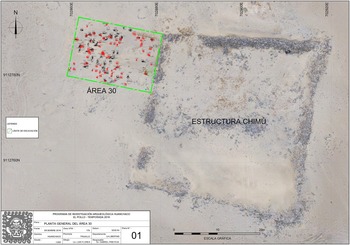
Excavations at El Pollo opened a unit measuring 14 × 20 m with an approximate area of 280 m2 along the northwest portion of the structure’s wall (Figures 2 and 3). Four stratigraphically defined layers were identified, interspersed by three layers of compact sediment. A total of 49 human interments and 78 camelid deposits were documented in all the layers (Figure 4). Nearly every body (n = 48) showed fully or partially articulated skeletal elements, indicating that these were primary deposits. Excavations also documented four concentrations of comingled human and camelid remains that may have been disturbed while the site was in use or by modern looting.
Map of the 78 camelids (red) interments, 49 human (black) interments, and features (pink) in Area 30, El Pollo. (Color online)

Surface survey within the quadrangular structure identified numerous carved Spondylus sp. and Conus fergusoni shells, beads, and metal objects (Figure 5). A few artifacts accompanied the interments, including textile fragments, drilled pods of ishpingo (Nectandra sp.) seeds, and a small fish pendant carved from mother-of-pearl shell. A fragmented neck of a Late Chimú and Chimú-Inca stirrup-spout vessel of fired blackware with a small, carved monkey gripping the spout was the only diagnostic ceramic.
Artifacts from El Pollo including a stirrup-spout vessel, a carved fish pendant, metal fragments, and Spondylus sp. and Conus fergusoni shells. (Color online)

Six organic materials including cotton yarns from textiles, pods of Nectandra sp. seeds, and rope bindings were selected for Accelerator Mass Spectrometry (AMS) radiocarbon dating (Witt Reference Witt2023). Uncalibrated radiocarbon measurements range between 585 ± 15 and 380 ± 20 BP (Table 1). Results were calibrated at 2σ using the Southern Hemisphere Curve (SHCal20; Hogg et al. Reference Hogg, Heaton, Hua, Palmer, Turney, Southon and Bayliss2020) in OxCal v4.4 (Figure 6). The calibration of the six radiocarbon dates indicates the existence of at least three separate sacrificial episodes between cal AD 1300 and cal AD 1550. One sampled interment (E112) yielded a time range of cal AD 1300–1400, which corresponds to the transition between the Middle and Late Chimú periods and is generally synchronous with one sacrificial event (Event 4) in the PLC chronology. A second interment (E108) provided a time range of cal AD 1450–1450, aligning with a later sacrificial event (Event 5) at PLC and is contemporaneous with the HLL sacrificial context (Prieto et al. Reference Prieto, Verano, Rowe, Castillo, Flores, Chachapoyas and Campaña2024:113). Three interments (E119, E123, and E130), along with a votive offering with Nectandra sp. Seeds, yielded a collective time range of cal AD 1450–1650. Given that the latter part of this range extends into the colonial period (AD 1532–1650), a more plausible time frame for the ritual activity is restricted to AD 1450–1532, encompassing the period of Inca presence on the north coast of Peru.
Multiplot showing AMS results from El Pollo.

AMS Provenance and Results from El Pollo.

Although the number of AMS dates is limited, the results demonstrate that the human and camelid burial contexts at El Pollo were not the result of a single sacrificial event but rather multiple events, mirroring the findings reported at PLC (Prieto et al. Reference Prieto, Verano, Rowe, Castillo, Flores, Chachapoyas and Campaña2024). The sacrificial events date to the later periods of the Chimú chronology, which is characterized by waves of imperial expansion and is contemporary with the sacrificial episodes at PLC and HLL. Furthermore, several sampled interments (although possibly biased) appear to correspond to the time of Inca conquest and subsequent presence in the Moche Valley. No Inca artifacts or architecture were documented at El Pollo.
Materials and Methods
A bioarchaeological approach analyzes and interprets mortuary and biological data within an archaeological context, making it ideal for reconstructing burial treatments, biological profiles, and injuries (Martin Reference Martin, Martin, Harrod and Pérez2013). Sacrifice is under strict social control because the repetitive actions and procedures involved in the victims’ death create recognizable archaeological remnants that differ from mortuary contexts (Eeckhout and Owens Reference Eeckhout and Owens2008; Swenson Reference Swenson2003). Atypical treatments, like rope bindings and aberrant body positions, are variables that provide convincing evidence of sacrifice and are instrumental in studying the motivations and ramifications of sacrificial behavior (Schwartz Reference Schwartz, Porter and Schwartz2012). The pertinent mortuary data examined in this work are cardinal orientations of the body and skull, body positions, and the presence of atypical burial treatments.
Skeletal remains were examined to reconstruct victim biological profiles (age-at-death and sex) and injury patterns. Pathological conditions are reported elsewhere (Witt Reference Witt2023). Age-at-death and sex estimations were calculated based on accepted standards (Buikstra and Ubelaker Reference Buikstra and Ubelaker1994; Schaefer et al. Reference Schaefer, Black and Scheuer2009) and organized into broad age groups designated as infant (0–4 years), child (5–11 years), adolescent (12–17 years), young adult (18/21–35 years), middle adult (36–50 years), old adult (50+ years), and adult (18/21+ years). Infants, children, and adolescents are categorized as nonadults.
Skeletal trauma may be synthesized to reconstruct the expression and extent of violence in ancient communities. Death of the victim is the central feature of sacrifice, and as such, victims who are ritually killed may exhibit recognizable evidence of lethal wounds on their skeletons (Verano Reference Verano2001a). Multiple standards were referenced when recording and interpreting wound morphology, patterning, and location (Galloway et al. Reference Galloway, Zephro, Wedel, Wedel and Galloway2014; Symes et al. Reference Symes, Chapman, Rainwater, Cabo and Myster2010). Injuries were observed macroscopically using the naked eye, a 10× hand lens, or both. Wounds were classified as antemortem (healed prior to death), perimortem (sustained at or around the time of death), and postmortem (occurred after death); we only considered perimortem wounds in this study. Perimortem wounds are differentiated from postmortem damage by the presence of defined wound edges, homogeneous staining between the bone and fracture margin, and bone fragments adherent to the fracture. Wound morphology was examined to determine whether injuries were produced from blunt force or sharp force weapons. Injury locations were recorded based on their anatomical location. Numerical counts calculating the number of individuals with trauma and the frequency of wounds were conducted.
Results
Burial Treatments
Body positions and orientations varied. Individuals faced all cardinal directions, with more individuals facing east (n = 15/41; 37%) than the other directions. Most bodies were oriented east–west or west–east (n = 29/47; 62%). Flexed and seated positions (n = 25/43; 58%) were the most common, followed by extended positions (n = 9/43; 21%). More than half of nonadults were in flexed positions, with individuals placed on their back (n = 15/33; 45%) or on their left or right sides (n = 6/33; 18%). Several individuals were in extended (n = 7/33; 21%) and aberrant (n = 5/33; 15%) positions with contorted limbs and twisted torsos (Table 2). Adults were found in extended (n = 2/10; 20%), flexed (n = 3/10; 30%), and seated positions (n = 1/10; 10%).
Body Positions and Orientations of Human Interments at El Pollo.

Four adult males were found in aberrant positions either bound by ropes, placed face-down or on the back, or both (Table 2). Of these four males, two middle adult males were found extended on top of one another, with ropes binding the upper and lower limbs (Figure 7). The third male was found face-down with the upper and lower extremities bound by ropes (Figure 8).
Adult male (EP108) shown on back in an extended position on top of a second adult male (EP112) in a face-down extended position northeast of a child (EP107). The shaded areas on EP112 represent ropes binding the arms behind the back and binding the lower leg bones.

Adult male (EP120) on back in a face-down position south of a child (EP127). The shaded area represents ropes binding the arms behind the back.

Age-at-Death and Sex Estimations
Age-at-death estimations range between four and 50 years. Most individuals are nonadults (n = 37/49; 76%), whereas a smaller portion are adults (n = 12/49; 24%). Children (n = 18/49; 38%) and adolescents (n = 18/49; 38%) are equally represented. Adults represent almost one-fourth (n = 12/49; 24%) of individuals in the sample. Young adults (n = 6/12; 50%) make up half of the adults represented, followed by middle adults (n = 5/12; 42%). The assemblage includes adult males (n = 11/12; 92%) and one female (n = 1/12; 8%).
Perimortem Trauma
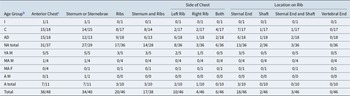
Sharp force injuries are present on both nonadults (n = 31/37; 84%) and adults (n = 7/11; 64%; Table 3). A horizonal transverse cut was observed on a sternebrae or the sternum on most individuals (n = 34/40; 85%), including nonadults (n = 27/29; 93%), all young adult males (n = 5/5; 100%), one middle adult male (n = 1/4; 25%), and one adult male (n = 1/1; 100%). Several individuals show superficial transverse incisions on the sternebrae, or “false starts” (n = 8/34; 24%). “False starts” occur when the applied energy of a knife or blade results in a superficial cut that fails to completely transect the targeted bone (Symes et al. Reference Symes, Chapman, Rainwater, Cabo and Myster2010:11).
Sharp Force Trauma by Age Groupa and Chest Location at El Pollo.

a Number of individuals with trauma/number of individuals in group.
b I = infant, C = child, AD = adolescent, NA = nonadult, YA M = young adult male, MA M = middle adult male, MA F = middle adult female, A M = adult male, A = adult.
c Trauma on either the sternebrae, sternum, or ribs.
Incisions to the ribs were also documented on many sacrificial victims (Table 3). Incisions are present in almost half of individuals with observable ribs (n = 20/46; 43%), including children (n = 8/17; 47%), adolescents (n = 9/18; 50%), and young adult males (n = 3/5; 60%). Victims show incisions on the third or fourth left rib (n = 10/46; 22%), on both left and right ribs (n = 6/46; 13%), and on the right ribs (n = 4/46; 9%). Many victims exhibit incisions on the sternal portion of the rib (n = 18/46; 39%), with fewer individuals showing cutmarks on the rib shaft (n = 2/46; 4%) or on both the sternal end and shaft (n = 3/46; 7%). No individuals show incisions on the vertebral end.
Among those with rib incisions, more than half exhibit one to two incisions (n = 12/21; 57%). The other half show three or more incisions (n = 9/21; 43%), including four victims who exhibit more than five incisions (n = 4/21; 19%). Four deep incisions along with at least one dozen superficial incisions were identified on a left rib belonging to an adolescent, which is the highest cutmark count on a single victim at El Pollo.
Blunt force trauma is rare compared to sharp force trauma. The middle adult male discovered in a face-down position bound by ropes shows a perimortem fracture at the junction of the scapular spine and acromion process of the right scapula (Figure 7).
Discussion
Interment patterns and bodily treatments may signal motivations for sacrifice but first must be differentiated from local burial traditions. Although more work must be completed to understand the variations of Chimú burial practices in the Moche Valley, the available data suggest that communities interred their dead in seated and flexed positions with metal objects, shell and bead ornaments, and ceramic vessels. Body postures and orientations vary, with individuals found seated upright, lying on their sides, or placed on their backs and fronts (Castillo Reference Castillo, Prieto and Boswell2019; Chimoven et al. Reference Chimoven, Olazo, Santamaria, Toledo and Vasques2016; Donnan and Mackey Reference Donnan and Mackey1978:288–289, 340–343, 356–357). Although no single burial pattern dominates and almost none of the victims were interred with artifacts at El Pollo, most nonadult and male individuals with chest wounds were found in seated or flexed positions. The similarities in body orientations and positions among victims and the local burial patterns suggest that most individuals were interred in a manner following local burial traditions.
The differences in burial orientations and bodily treatments between victims at El Pollo and those from other Chimú sacrificial sites in the Moche Valley likely reflect distinct motivations for staging sacrifice. HLL victims, for example, are interred in a layer of mud and face the Pacific Ocean, which may indicate that sacrifice was performed to mitigate the effects of the El Niño-Southern Oscillation phenomenon, a climatic event that brings devastating coastal flooding (Prieto et al. Reference Prieto, Verano, Goepfert, Kennett, Quilter, LeBlanc and Fehren-Schmitz2019). Similarly, most victims buried in and around Mound 1 at PLC are oriented west facing the ocean (Prieto et al. Reference Prieto, Verano, Rowe, Castillo, Flores, Chachapoyas and Campaña2024). At El Pollo, many victims face east toward the quadrangular structure. Although no excavations were conducted within the structure, it is possible that victims were oriented toward the structure to emphasize a connection between the victims and the activities—perhaps the sacrificial ritual itself—that took place within it. The adoptions of some local burial treatments outside the quadrangular structure indicate that victims were periodically sacrificed and interred as offerings of value as part of ritually motivated activities.
Several adult males were interred in a manner that differed from the treatments afforded to victims sacrificed via chest opening. Physical restraints and aberrant placements indicate that they were not viewed as valued offerings but were dispatched for other purposes. Denial of proper burial is one way in which captured warriors were transformed into submissive victims suitable for sacrifice (Scher Reference Scher2018). Although none of the bound El Pollo victims show lethal injuries, the scapular wound on one male was likely sustained following a direct impact to the shoulder from a heavy weapon. This wound type has been observed in circumstances where combatants suffered beatings following capture (Blondiaux et al. Reference Blondiaux, Fontaine, Demondion, Flipo, Colard, Mitchell and Buzon2012). The age profiles of the El Pollo males resemble those of captured warriors from earlier north coast contexts, including Pacatnamú (Verano Reference Verano, Donnan and Cock1986), Huaca de la Luna (Verano Reference Verano2001a, Reference Verano2001b, Reference Verano, Scherer and Verano2014), and PLC (Prieto et al. Reference Prieto, Verano, Rowe, Castillo, Flores, Chachapoyas and Campaña2024).
It is possible that the adult males were perceived as enemies who, once captured, were bound, beaten, and killed to commemorate military successes during a period of militaristic expansion. Aspiring leaders might have imposed obedience through reprisal killings or by capturing victims for sacrifice to pacify or discourage uprisings (Sinopoli Reference Sinopoli1994:166). Radiocarbon measurements from the ropes binding two of the bound males indicate that initial sacrificial events occurred between cal AD 1300 and 1350, which is contemporaneous to one sacrificial event (Event 3) at PLC (Prieto et al. Reference Prieto, Verano, Rowe, Castillo, Flores, Chachapoyas and Campaña2024:93) and to the reprisal killing at Punta Lobos following local resistance to Chimú conquest (Verano and Toyne Reference Toyne2011).
The chest wound morphology on nonadults and several adult males is consistent with lethal, perimortem sharp force insults. The location and distribution of the injuries are consistent with deep transverse slicing across the sternum and along the superior and inferior borders of the ribs, which would open the chest cavity and sever blood vessels (Figure 9). Several layers of connective tissues between the ribs protect the chest cavity, including costal cartilage and thoracic wall muscles. The distribution of cuts indicates that chest opening also involved severing these intercostal muscles; the associated ribs sustained cuts as a result.
Composite illustration of cutmark locations in El Pollo sample (drawing: Rachel Witt).

There are no known visual representations of chest opening in the Andean archaeological record. Ethnohistories of sacrifice in the Inca Empire describe several sacrificial methods, including heart removal (Cobo [Reference Cobo1990 [1653]]). Chest opening has been documented on victims sacrificed at other north coast sites before and after the expansion of the Chimú Empire, although wound locations and methods varied (Gaither et al. Reference Gaither, Kent, Vásquez Sánchez and Tham2008; Klaus et al. Reference Klaus, Centurión and Curo2010, Reference Klaus, Turner, Saldaña, Castillo, Wester, Klaus and Toyne2016; Millaire and Surette Reference Millaire and Surette2011; Toyne Reference Toyne2011; Verano Reference Verano, Donnan and Cock1986). Chest-opening techniques at El Pollo are most like those documented on victims at HLL, PLC, and JO-IG, where heart extraction is argued to be the goal of sacrifice (Prieto et al. Reference Prieto, Verano, Goepfert, Kennett, Quilter, LeBlanc and Fehren-Schmitz2019). None of the El Pollo victims show injuries typical of evisceration or organ removal, including rib fractures, cuts to the internal surface of the ribs, or incisions on the anterior thoracic vertebral bodies (Tiesler and Oliver Reference Tiesler and Oliver2020). Although heart removal cannot be excluded given the chest-cutting pattern documented on victims from other Chimú sacrificial contexts in the Moche Valley, it is possible that sacrifice at El Pollo may have involved opening the chest to observe rather than remove the heart. Nevertheless, these data from El Pollo support previous studies arguing that chest opening emerged as a highly systematic procedure that was part of a standardized sacrificial program staged at multiple locales outside the Chimú capital city (Prieto and Verano Reference Prieto, Verano, Walsh, O’Neill, Moen and Gullbekk2023; Prieto et al. Reference Prieto, Verano, Goepfert, Kennett, Quilter, LeBlanc and Fehren-Schmitz2019, Reference Prieto, Verano, Rowe, Castillo, Flores, Chachapoyas and Campaña2024).
Several El Pollo victims show deep cuts on multiple regions of the chest, high concentrations of deep incisions on individual ribs, and “false starts” on the sternebrae that go beyond what would be necessary to open the chest. The rib wound pattern may represent failed attempts to open the chest by a less experienced sacrificer, which is argued to account for the examples of “false starts” at HLL (Prieto et al. Reference Prieto, Verano, Goepfert, Kennett, Quilter, LeBlanc and Fehren-Schmitz2019). A vast vascular system in the intercostal spaces between adjacent ribs and underneath the coastal cartilage connecting the ribs and sternum is responsible for supplying blood to the anterior chest wall. Transecting the sternebrae and connective tissues would sever the anterior and posterior intercostal arteries, as well as the internal thoracic arteries, thereby causing serious bleeding. Bioarchaeological evidence of sacrificial bloodletting on the north coast of Peru indicates that the throat, not the chest, is typically targeted for maximum blood output (Toyne Reference Toyne2011; Verano Reference Verano2001a, Reference Verano2001b). Although none of the El Pollo victims show evidence of throat slitting, the wound pattern suggests that when opening the chest, sacrificers also severed major vessels in multiple regions of the chest, thereby releasing large quantities of blood.
Modern Andean belief systems view blood offerings as necessary to revitalize land, induce the rainy season, or ensure bountiful harvests (Bastien Reference Bastien1978). Ancient north coast societies relied on bloodletting to generate powerful offerings to support agricultural cycles. Moche sacrifice involved bloodletting and collection because blood is argued to represent the water needed to vitalize the desert coast while symbolically expressing political domination (Bourget Reference Bourget2016:406–407). Despite the differences in motivations for ritual killing between Lambayeque (Sicán) elites and local north coast communities, both groups regarded blood as an appropriate offering to the mountains and ancestors who engendered fertility (Klaus and Shimada Reference Klaus, Shimada, Klaus and Toyne2016). For the Inca, human blood was spilled to bring rain (Murúa Reference Murúa1964 [1590]) or fed to major gods and huacas to fulfill the needs of the state (Cobo Reference Cobo1990 [1653]:110–111).
Although bloodletting and collection may reflect Chimú concerns of revitalizing agricultural lands in a desert landscape, the timing of these rituals and similarities to other sacrificial methods outside the Moche Valley indicate that bloodletting was perhaps meant to sustain other Chimú enterprises. High concentrations of rib incisions have been documented on nonadults and adults sacrificed at Túcume (Toyne Reference Toyne2011) and Chotuna-Chornancap (Klaus et al. Reference Klaus, Turner, Saldaña, Castillo, Wester, Klaus and Toyne2016) following early waves of Chimú imperial conquest of the region. Similarly, sacrifice during Event 4 (cal AD 1300/1320–1400/1420) at PLC represents the largest occurrence of individuals with rib cutmarks (n = 15/38; 39%) and is contemporaneous with sacrifice at El Pollo: both contexts correspond to waves of Chimú territorial expansion.
Nonadults dominate the demographic profile at El Pollo, a pattern that mirrors that of HLL, JO-IG, and PLC, indicating that a specific age group was targeted for sacrifice. Ethnohistories composed by Spanish and mixed-ancestry authors in the sixteenth and seventeenth centuries and ethnographic sources may shed light on the relationship between age and sacrifice among Andean societies (Blom Reference Blom, Crawford, Hadley and Shepherd2018). Children and their blood are viewed as especially powerful offerings. An account by Calancha (Reference Calancha1977 [1638]) from the early colonial period describes ceremonies held by communities in the Pacasmayo (Jequetepeque) Valley on the north coast during which children sacrificed to the moon divinity (known in the local language as Si) are associated with water, blood, and the sea (Rowe Reference Rowe1948:49–50). Ethnographic accounts observe that modern Andean children occupy a liminal position ideal for communicating directly to deities, and their bodily fluids are regarded as potent sources of agricultural fertility (Sillar Reference Sillar1994:55). Although perceptions of age among modern Andean societies are not necessarily analogous to those held by the Chimú Empire, it is possible that these young victims were believed to occupy a liminal position in society, thereby making them suitable sacrificial offerings.
The inclusion of adult males in the sacrificial program of chest opening at El Pollo is unique to the Moche Valley. Like the nonadult victims, it is possible that they also occupied a liminal social space making them suitable for sacrifice. Guaman Poma de Ayala (Reference Guaman Poma de Ayala, Murra, Adorno and Orioste1980 [1615]:143,155,158) discusses how the Inca categorized imperial subjects by age and assigned specific duties based on their work capacity. After adolescence (18–20 years), men were “not quite adults” (Dean Reference Dean and Klein2001:157) but performed roles outside the home as messengers and assistants to warriors and lords. Not until men reached their early thirties did their status change to warrior or other active participants in Inca society. Although there are no written accounts describing how the Chimú understood social categories of aging, perhaps the young adult males dispatched at El Pollo were not recognized as adults and thus occupied a liminal space that made them appropriate victims for sacrifice.
The Inca would also sacrifice low-status, able-bodied men between the ages of 25 and 50 (runas) to effect communion with the gods and during cyclical or singular events that venerated various huacas, ensured agricultural productivity, and safeguarded the health of the Inca state and its ruler (Besom Reference Besom2009:46–48). Similarly, the capacocha ceremony involved sacrificing boys, girls, and young women to commemorate significant events (Besom Reference Besom2009). Victims could be selected for their youth and physical attractiveness (Cobo Reference Cobo1990 [1653]:111–113) and were often the children of provincial nobles (Besom Reference Besom2009:28; Betanzos Reference Betanzos, Hamilton and Buchanan1996 [1557]:78, 132). The victim selection process articulated the power relations between the ruling elite in Cusco and provincial lords in newly conquered territories in which subservient lords performed the ultimate act of abnegation by volunteering their children as offerings to the empire and were rewarded with social prestige (Besom Reference Besom2009:291–292; Cobo Reference Cobo1990 [1653]:111–114; Patterson Reference Patterson, Patterson and Gailey1987:119).
Although it would be inaccurate to assume that the Chimú motivations for sacrifice are analogous to Inca sacrifice, it is possible that, as with the Incas, Chimú sacrifice functioned to articulate the expanding influence of this empire. Nonadults and adult males were selected for ritual chest opening and bloodletting because their connection to the spiritual realm was used to naturalize the power relations between the ruling elite, subservient lords in the provinces, and newly conquered communities. Sacrifice had profound implications for the social fabric and political praxis of Chimú society, especially for the communities within the Moche Valley and beyond in which these periodic displays of ritual violence functioned as opportunities to express political aspirations, power asymmetries, and Chimú imperial authority.
Conclusions
This work supports previous scholarship arguing that the hundreds of victims documented at HLL, JO-IG, PLC, and now El Pollo were dispatched following a standardized procedure for opening the chest as part of a sacrificial program sanctioned and coordinated by the Chimú Empire spanning several centuries (Prieto and Verano Reference Prieto, Verano, Walsh, O’Neill, Moen and Gullbekk2023; Prieto et al. Reference Prieto, Goepfert, Valladares and Vilela2015, Reference Prieto, Verano, Goepfert, Kennett, Quilter, LeBlanc and Fehren-Schmitz2019, Reference Prieto, Verano, Rowe, Castillo, Flores, Chachapoyas and Campaña2024). This transformation in sacrificial methods and these imperial developments in Chimú society reflect a shift in which young people were viewed as versatile, potent offerings capable of effecting communion with the supernatural realm. The organizational capacity and investment required to amass hundreds of victims to be sacrificed periodically for centuries indicate that the Chimú viewed these rituals as a necessary investment for generating political efficacy and serving imperial enterprises that outweighed any economic loss.
Sacrifice at El Pollo involved sacrificing both nonadults and adults. Given the size of the walled structure and its proximity (yet relative isolation) to the capital city, sacrifice at El Pollo functioned in a manner like that documented at other sacrificial contexts—to display theatrical scenes of violence to a large audience. The unique elements of sacrifice at El Pollo, including ritually opening the chests of adult males and incisions to the chest to release blood, show that the sacrificial method could be modified, thereby reflecting the range of ritual settings and circumstances in which sacrifice was performed. These novel elements resemble sacrificial methods used by the Chimú in newly conquered communities beyond the Moche Valley. Indeed, the inclusion of warrior captives and the timing of sacrifice at El Pollo correspond to waves of Chimú expansion, indicating that sacrifice in the Moche Valley might have served other imperial enterprises like commemorating the increasing influence and growth of the empire. Establishing the presence of nonlocal victims in the sample by comparing cranial modification forms and through stable isotope analysis is a crucial next step to support this proposition (Witt Reference Witt2023).
Human sacrifice endured at El Pollo and PLC after Inca conquest of the region (Prieto et al. Reference Prieto, Verano, Rowe, Castillo, Flores, Chachapoyas and Campaña2024). Although the nature of the Inca presence in the Moche Valley is outside the scope of this work, adopting these sacrificial traditions perhaps helped the Inca facilitate sociopolitical integration. It is also possible that, by allowing sacrifice to continue, the Inca placated local Chimú elites, thereby enabling them to focus on other imperial goals like controlling local political structures, trade networks, and labor. This strategy has been discussed elsewhere (Klaus et al. Reference Klaus, Turner, Saldaña, Castillo, Wester, Klaus and Toyne2016). The continuation of human sacrifice at El Pollo nevertheless highlights the enduring importance of this ritual performance.
This article interprets these bioarchaeological data in the context of sociopolitical developments on the north coast of Peru to consider the social ramifications and associations of sacrificial behavior in Chimú society. For many ancient empires, the power of those who govern is never assured and must be continuously justified. Human sacrifice in the Chimú Empire served as a form of political theater during which the imperial enterprises of conquest and expansion were communicated to spectators, participants, and the victims. By contextualizing ritual violence documented at El Pollo within the complex, dynamic trajectory of north coast sociopolitical developments, this study contributes to our current knowledge of sacrifice and its varied manifestations in archaeological societies in the Andes Mountains.
Acknowledgments
A special thanks to the Penn State Radiocarbon Laboratory for analyzing the samples in this study. We thank Mr. Eduardo “Lalo” Nestorovic for allowing us to excavate on his chicken farm where El Pollo is located and for his logistical support. We are grateful to Kristin Romey, Kurt Mutchler, and Robert Clark from the National Geographic Society for encouraging us to work at El Pollo since 2016. We thank members of the Programa Arqueológico Huanchaco and students from Universidad Nacional de Trujillo for field and laboratory assistance. We acknowledge the support of the Laboratorio de Arqueologia y Conservación de la Facultad de Ciencias Sociales, Universidad Nacional de Trujillo, for providing a space to study the collections excavated at El Pollo. We appreciate the consultation and editorial advice from Jason Nesbitt and members of Tulane University’s Anthropology Writing Group. Excavations at El Pollo and permission to analyze human remains were approved under the Ministerio de Cultura R.D. N° 287-2019/DGPA/VMPCIC/MC de fecha 16 de julio de 2019.
Funding Statement
This study was supported by the National Science Foundation Doctoral Dissertation Research Improvement Grant (Biological Anthropology Program Award No. 1945861), Rust Family Foundation (RFF-2019-110), the Lambda Alpha National Honors Society, Tulane University School of Liberal Arts Summer Merit Fellowship, and the Stone Center Summer Field Research Grants for Graduate Students.
Data Availability Statement
All human remains from El Pollo have been properly returned to the Ministerio de Cultura in Trujillo, Peru, as requested by the guidelines for archaeological praxis in Peru. The remains are currently stored at the Huaca Arco Iris Storage Facility, which is the official place for returning archaeological collections after excavations and analysis.
Competing Interests
The authors declare none.








 Open access

