


Introduction
The possibility of interpersonal utility comparisons (IUCs) is one of the foundational issues of economics and is deeply connected to questions of distributive justice (for good overviews of these issues, see, e.g., Jevons, Reference Jevons1911; Harsanyi, Reference Harsanyi1955; Waldner, Reference Waldner1972; Arrow, Reference Arrow1977; Sen, Reference Sen and Boskin1979; Hausman, Reference Hausman1995; List, Reference List2003; Rossi, Reference Rossi2014). Unsurprisingly, therefore, there has been much discussion of this issue since the early days of the subject. One relatively recent pivot in the discussion concerns evolution: in particular, it has been suggested that, from an evolutionary biological perspective, we should expect that IUCs are possible (Goldman, Reference Goldman1995; Rossi, Reference Rossi2014; see also Sorensen, Reference Sorensen1998). After all, since all humans are part of the same species, we should expect our utility functions to be built similarly – and thus, we should expect them to be comparable.
However, a closer look at this argument suggests that it is not compelling as it stands. In particular, since cultural learning plays a crucial role in our cognitive evolution, the conclusion that we evolved to be psychologically similar to each other is far from obviously true. This, though, does not mean that evolutionary theory has nothing to say about the possibility of IUCs. In fact, as this paper makes clear, by expanding the evolutionary argument with work in gene–culture–technology coevolutionary theory, it becomes possible to support the contention that IUCs may well be sometimes possible. This has important implications for the analysis and design of social institutions.
To show this, this paper begins, in the section ‘The problem of IUCs’, by clarifying the terms of the debate – i.e. how the problem of the possibility of IUCs should be understood. The section ‘The argument from evolution and its problems’ considers the traditional appeal to evolutionary biological considerations in this debate and makes clear why this appeal fails. The section ‘An updated gene–culture–technological coevolutionary argument’ introduces recent work from gene–culture coevolutionary theory to deepen the discussion from the previous section and show its implications for the debate surrounding IUCs. The section ‘Conclusion’ concludes.
The problem of IUCs
The question of whether, and if so, how, we can compare utilities across people can be (and has been) understood in many different ways. To avoid confusion, therefore, it is important to be clear about (i) how the notion of ‘utility’ is to be understood in this debate and (ii) the epistemological nature of this debate.
Starting with point (i), it is clear that ‘utility’ is a famously ambiguous concept (Broome, Reference Broome1991; List, Reference List2003; Hausman, Reference Hausman2012). In its most general and least substantive understanding, ‘utility’ is just a theoretically grounded measure of a choice ordering. Now, as is widely known, on one of the major economic theories of choice – expected utility theory – IUCs are not possible: we can capture choice behaviors with utilities that are not unique (or only up to certain transformations) and not interpersonally comparable (Hausman, Reference Hausman1995; List, Reference List2003; Rossi, Reference Rossi2014). Nothing in what follows will question this. However, it is important to note that this conclusion is quite limited.
First, expected utility theory is merely one among many different theories of choice. It is true that many other theories – such as prospect theory (Kahneman et al., Reference Kahneman, Slovic and Tversky1982) and regret theory (Loomes and Sugden, Reference Loomes and Sugden1982) – do not allow for interpersonal comparisons either. However, some other theories have much less of an issue with this. For example, the theory of simple heuristics (Gigerenzer and Selten, Reference Gigerenzer and Selten2001) sees agents as making decisions by following a set of relatively simple rules. There is nothing in this theory of simple heuristics that precludes the evaluations that feature in these rules to be comparable.Footnote 1 In this sense, therefore, the fact that expected utility theory does not allow for IUCs merely means that one (albeit major) theory of decision-making does not allow for them – nothing more and nothing less.
Second, it is of course also possible to add something to expected utility theory to allow for expected utility comparisons. For example, we could appeal to ‘extended preferences’ (Harsanyi, Reference Harsanyi1955, Reference Harsanyi1977; Arrow, Reference Arrow1977) and scale utilities in reference to an impartial observer. Or we could use the 0-to-1 rule and scale utilities in a linear manner between the most and least preferred option (Hausman, Reference Hausman1995). While there is some controversy over exactly which of these addenda to adopt (if any), the key point to note here is just that they exist – for they imply that the jump from the impossibility of IUCs in expected utility theory to the impossibility of IUCs tout court is further constrained.
Third and most importantly, when we ask about the possibility of IUCs, we often have something more in mind than just the choice-focused understanding of utility.Footnote 2 In particular, from a public policy perspective, we generally want to know how people’s well-being is affected by a policy. Importantly, to do that, we need to consider how people evaluate their world: what it is that they want or value (Dorsey, Reference Dorsey2009; Bykvist, Reference Bykvist2010; Hausman, Reference Hausman2012).Footnote 3 For this, though, we need to switch to a more substantive reading of utility than that of a theoretical measure of what is chosen – after all, things are chosen for many different reasons, apart from how highly they are evaluated (such as their placement or what the agent did previously). It is therefore such a more substantive reading of utility that will be at the forefront of the rest of the paper.
It is furthermore the case that substantive readings of utility can be more or less specific. On the most specific end of the spectrum, ‘utility’ is a measure of felt pleasure (see, e.g., Narens and Skyrms, Reference Narens and Skyrms2021).Footnote 4 In this sense, its interpersonal comparability depends entirely on the degree to which different individuals’ felt pleasures are comparable – a particular psychophysical question. Much progress has been made on this latter point, and while there is still much to investigate concerning these issues, there is some reason to think that, in this sense, IUCs are possible to an increasingly specific degree (Narens and Skyrms, Reference Narens and Skyrms2021).Footnote 5
The problem with focusing on this specific reading of utility is that more than just felt pleasures affect our evaluative outlook. We can evaluate something very highly that involves considerable pain and discomfort, as when we decide to call out others’ racist behavior even if it involves painful experiences. Hence, the most common interpretation of ‘utility’ is broader and sees it as a label for a general evaluative outlook (sometimes also called ‘preference’) (Hausman, Reference Hausman2012; Rossi, Reference Rossi2014; Broome, Reference Broome1991; but see also Angner, Reference Angner2018). In this sense, utility is a representation of the obtaining of something that is positively evaluated, but the nature of this evaluation can be very varied (Hausman, Reference Hausman2012). In particular, it need not involve much pleasure, but could be based on our moral commitments or assessments of what is rational. Because of its wide scope and flexibility, this reading of ‘utility’ is the most common in the literature (Hausman, Reference Hausman2012) and will therefore also be the central one in the rest of this paper.Footnote 6
With this in mind, the question at the heart of this paper is whether we evaluate (in this broad sense) the world on the same scale (Davidson, Reference Davidson, Elster and Hylland1986; Goldman, Reference Goldman1995). Is it the case that, for you, all states of the world are evaluated nearly similarly and not so differently from a neutral baseline (a modicum of food and shelter, say), whereas I evaluate different states of the world drastically differently from each other, with even minor differences to the neutral baseline leading to major jumps in evaluative strength?Footnote 7 Or is this not the case? If it is the case, is there some way of determining the differences in these scales, so that they can be bridged with the appropriate translation function? Or is such a function out of reach for us?
Note that, given the broadness of the notion of utility underlying these questions, they are harder to answer than the more specific psychophysical question of the interpersonal comparability of felt pleasures. Since the sense of utility involved here is broad – and can be based on feelings of discomfort, sadness and pain, as well as no feelings at all – it is not just an issue of whether we feel or display the same amount of pleasure. For this reason, assessing the possibility of IUCs so understood is very difficult: the same behavioral, neural and other physical states seem consistent with many different evaluative scales (List, Reference List2003).
With this in mind, consider point (ii) mentioned earlier: the epistemological nature of the problem. Given the broad understanding of utility just laid out, it is possible to see the problem of the possibility of IUCs as just a specific instance of the problem of other minds.Footnote 8 Is it conceivable, plausible, or deniable that two people have different mental lives with identical behaviors or physical states (List, Reference List2003; Rossi, Reference Rossi2014)? This issue is just a specific version of the general discussion surrounding skepticism or empiricism. Because of this, the latter discussion transfers to the present case of IUCs as well. In particular, on an empiricist reading, if there is no available evidence that could determine whether two agents have different utility functions, positing the existence of such differences is meaningless. This conclusion, though, depends on the acceptance of empiricism. For example, on a Popperian reliabilist reading (Lipton, Reference Lipton and O’Hear1995), it does not go through (see also Goldman, Reference Goldman1995; Rossi, Reference Rossi2014): the availability of evidence (or lack thereof) does not entail anything about what claims we are justified in making. (Of course, strongly skeptical epistemological views would also deny this.)Footnote 9 If so, though, then the problem of the possibility of IUCs may become effectively definitionally unanswerable (or as answerable as general skepticism is).
However, at stake here is a more specific, empirical version of the problem. We may agree with the empiricist that, if IUCs are meaningful at all, they would need to show up somewhere. However, this does not mean that we should presume that the relevant evidence is easily obtainable – or indeed ever obtainable for us. That is, we may acknowledge that we can ascertain that others have minds, and we may also acknowledge that it may, in principle, be possible to determine whether people’s evaluations of the world are fundamentally the same or different – e.g. if we had sufficient neural information (Goldman, Reference Goldman1995). However, we may also note that the relevant (neural) information may not be available for a long time (if ever). What we are looking for are considerations that may help us adjudicate this question now – not in some future completed science or social science.Footnote 10
On the flip side, the fact that we cannot easily tell behaviorally or neurologically whether the scale of our evaluative outlooks is the same does not mean that there is no other (non-controversial) reason to affirm or deny this. There may be other, non-behaviorist or non-neural considerations to which we can appeal to determine whether this is the case. It is precisely here where the consideration of evolutionary biology comes in. (Of course, the appeal to evolutionary biology is not the only way to try to resolve this issue – see also Rossi, Reference Rossi2014. However, it is the one that will be in focus here.)
In the same way, we may also see the problem of the possibility of IUCs as an implication of the general problem of evaluative incommensurability (see, e.g., Chang, Reference Chang1997). If evaluative attitudes are not generally commensurable within individuals, they would not be comparable across individuals either. In this reading of the problem, a slightly different version of the previous point applies. In those cases where evaluative attitudes are seen as commensurable within individuals – the existence of which is accepted even by those thinking that they are not always so commensurable – we would still need to find reasons for thinking that the scales of commensurability within individuals are comparable across individuals as well. This again brings up all the issues just discussed. In short, evolutionary biological considerations may be thought to be a bridging principle to underwrite the empirical possibility of IUCs – assuming this empirical possibility is granted at all.
The argument from evolution and its problems
In particular, several authors have suggested that, from an evolutionary biological perspective, we should expect IUCs to be possible. So, Goldman (Reference Goldman1995: 724) (there attributed to Sorensen, Reference Sorensen1998; see also Rossi, Reference Rossi2014) writes:
The general hypothesis, then, is that natural selection has molded us into a population of hyper-similar individuals, which helps support the reliability of simulation. It would not be easy to get firm scientific evidence for this hypothesis; but it seems possible, and if accomplished it would strengthen the scientific case for the accuracy of simulation in IU comparisons.Footnote 11
Similarly, Binmore (Reference Binmore and Kincaid2009: 552), when writing about ‘sympathetic preferences’ in the vein of Harsanyi’s impartial observer, states:
It is easy to see why the forces of biological evolution might lead to our behaving as though we were equipped with sympathetic preferences. Mothers commonly care for their children more than they do for themselves—just as predicted by the model that sees us merely as machines that our genes use to reproduce themselves. In such basic matters as these, it seems that we differ little from crocodiles or spiders. However, humans do not sympathize only with their children; it uncontroversial that they also sympathize to varying degrees, with their husbands and wives, with their extended families, with their friends and neighbors, and with their sect or tribe.
In the background of Binmore’s suggestion here is the claim (similar to that made by Goldman) that it is biologically plausible that we have evolved to be sufficiently similar to each other so that sympathizing with others – putting ourselves in their shoes – is actually accurate. Otherwise, it would just be determining what I would feel if X were true twice over (Nichols and Stich, Reference Nichols and Stich2003).
Unfortunately, these appeals to evolutionary biology are not spelled out systematically or in detail, which makes it hard to assess them clearly. The first step in assessing these appeals to evolutionary biology therefore has to be in making the steps of the argument more precise.
To do this, it is best to begin by considering physical traits – such as human livers, hearts, or kidneys – and asking the parallel question to that of IUCs for these traits: would it be reasonable to think that there is intraspecific variation in the ways in which these traits function? That is, is it reasonable to think that in different humans, the processes going on in their livers, hearts, kidneys, etc., are fundamentally different?
Now, in one sense, the answer is straightforward: yes, this is the case. After all, variation is common in biology, and therefore, there will of course be intraspecific differences in liver, heart, or kidney function. In this sense, therefore, this question is easy to answer. However, in a different sense, answering this question is not so straightforward. Abstracting away from minor variation around a mean (and leaving aside more extreme cases, such as congenital diseases), it is not unreasonable to see liver, heart, or kidney function as broadly similar in humans. Indeed, it is precisely this that makes it reasonable to speak of ‘human liver functioning’ and contrast it with, say, ‘bearded lizard liver function’. Human physiology, as a science, is based on this being the case. Indeed, the existence of species-typical physical traits is underwritten by two, mutually reinforcing evolutionary biological reasons: common ancestry and natural selection. Consider these in turn.
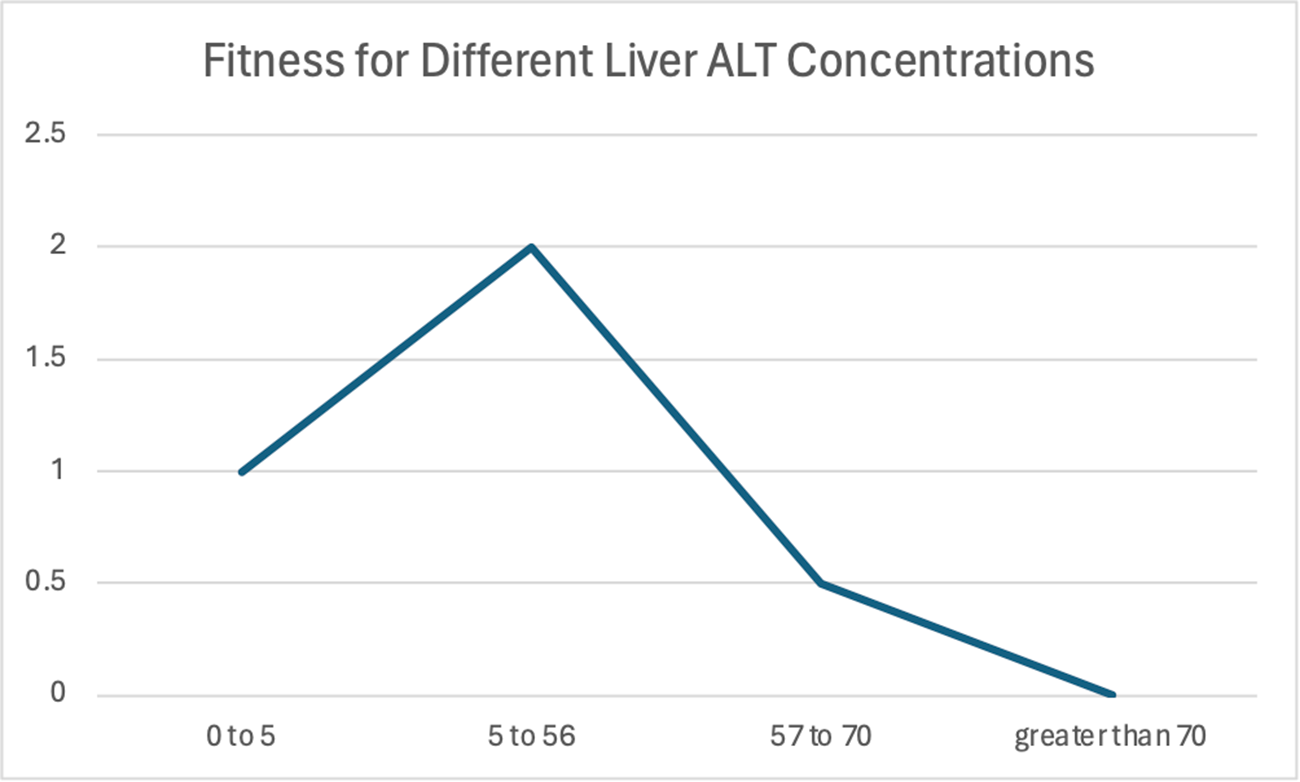
First, adaptively important traits (like livers) should be expected to spread through the relevant population. While this need not be the case if the trait only recently came under selection, it is very plausible for older, highly conserved traits – like hearts, livers, or kidneys. That is to say, since liver function matters for all humans, there is selective pressure for livers to operate well in all humans. On the (reasonable) assumption that the fitness of liver functioning is single-peaked – so that there is one specific way for livers to function that is adaptively optimal – this thus suggests that human livers function in the same way for all humans (modulo minor differences). Concretely, if there is selection for livers to produce alanine transaminase at about 30 units (5–56, say) per liter, then we should expect all human livers to do this – after all, this is what is optimal for all humans. Figure 1 sketches a – purely illustrative – fitness function for this case.Footnote 12
Illustrative fitness values for liver function. ALT, alanine transaminase.
Second, even if a given physical trait has not been under strong selection, the fact that all humans are related to each other can provide a reason to think that the trait works quite similarly across people. Because of interbreeding across humans, humans are all quite alike genetically: genetic diversity in humans is estimated to be about 0.1% (Understanding Human Genetic Variation, 2007). So, just in virtue of the fact that humans are part of the same species, we should expect physical traits that have been part of the human lineage for a long time to be largely similar. The same is true for other organisms: while every bearded dragon is a little different, we still expect bearded dragon spikes and tails to function in roughly the same way across the species (independently of the adaptive histories – or lack thereof – of these traits). While this need not be the case for traits that do not have a long history of intermixing – e.g. because they are only recently culturally inherited – it is plausible for many physical traits (like hearts, livers and kidneys).
For present purposes, noting all of this matters, as it might be taken to suggest that something similar is true for human utility functions, too. In particular, we may think that psychological traits like our evaluative attitudes operate like physical traits so that we can directly transfer the two evolutionary biological points just made from the physical case to the psychological case.
First, how we evaluate the world matters for our decision-making: it determines what we choose to do. In turn and for obvious reasons, the latter greatly impacts our fitness. Hence, it is plausible that utility functions are adaptively very important. By the same reasoning as the one just laid out for physical traits, we thus may expect all humans to have utility functions that are broadly similarly structured. Note that this does not imply that we cannot differ over what it is that we want: the content of our wants (plausibly) needs to be adaptively responsive to the specifics of our situation – what resources we hold, which are available, etc.Footnote 13 Still the nature of our wanting – the scale of our preferences – could be thought to be the same: the function of wanting (arguably) is to get to us to obtain the object of the want (Millikan, Reference Millikan1984, Reference Millikan2002; Papineau, Reference Papineau1987, Reference Papineau2003); this may thus be seen to be same across people. Hence, we may be led to expect IUCs to be possible.
This argument seems to be further strengthened by the second evolutionary point sketched earlier: the idea of common ancestry. Even if our utility functions have not been under strong selection, the fact that humans form one common gene pool may be taken to suggest that these utility functions are structured in the same way. The intermixing of human traits – through sexual reproduction and the formation of a largely similar human genome – could be taken to suggest that differences in utility functions would be washed out. This thus may be seen to further support the possibility of IUCs.
Overall, therefore, the standard set of evolutionary biological arguments in the discussion of IUCs center on establishing the claim that we should expect all humans to have evolved minds that work in similar ways. It is this pan-human psychological similarity that is then used to support the possibility of IUCs: while the existence of some variation in our evaluative structures may need to be expected, the overall functioning of our evaluative systems should be basically the same. In this regard, this evolutionary argument for the possibility of IUCs is related to the classic nativist evolutionary psychological ‘argument from Grey’s anatomy’ for a human psychic unity (Tooby and Cosmides, Reference Tooby, Cosmides, Barkow, Cosmides and Tooby1992; Buss, Reference Buss2014; Barrett, Reference Barrett2015). Just like it is uncontroversial that we can compile books like a ‘Grey’s Anatomy’ that detail human physiological structures and their functions, it should also be uncontroversial that we can lay out a ‘Grey’s Anatomy of the Mind’. After all, minds are just instantiations of biophysical systems, and should thus follow the same principles as all such systems.
However, this argument faces some relatively clear concerns (some of which are also noted by Rossi, Reference Rossi2014). The first concern is that, even accepting the broad outlines of the premises of the argument, questions about the scope of the conclusion of the possibility of IUCs remain. In particular, even if we agree that it is reasonable that psychological evaluations are largely intraspecifically similar (just like leaf size in a sugar maple tree is generally between 3 and 6 inches), this does not mean that the remaining ranges are not evaluatively significant. It could be the case that the satisfaction you get from playing the piano is largely the same as the one that I get from playing the guitar; however, it could also be that the remaining differences are still quite sizable. Consider again leaf size in sugar maples: while most leaves may be about 4.5 inches across, some may be 3 and some 6 – effectively double in size. The same may be true for utility functions: even if we accept that human evaluative processes are largely similar across people, this does not mean that the remaining variation is not significant. At least, the evolutionary biological considerations appealed to above have provided no reason to rule this out.
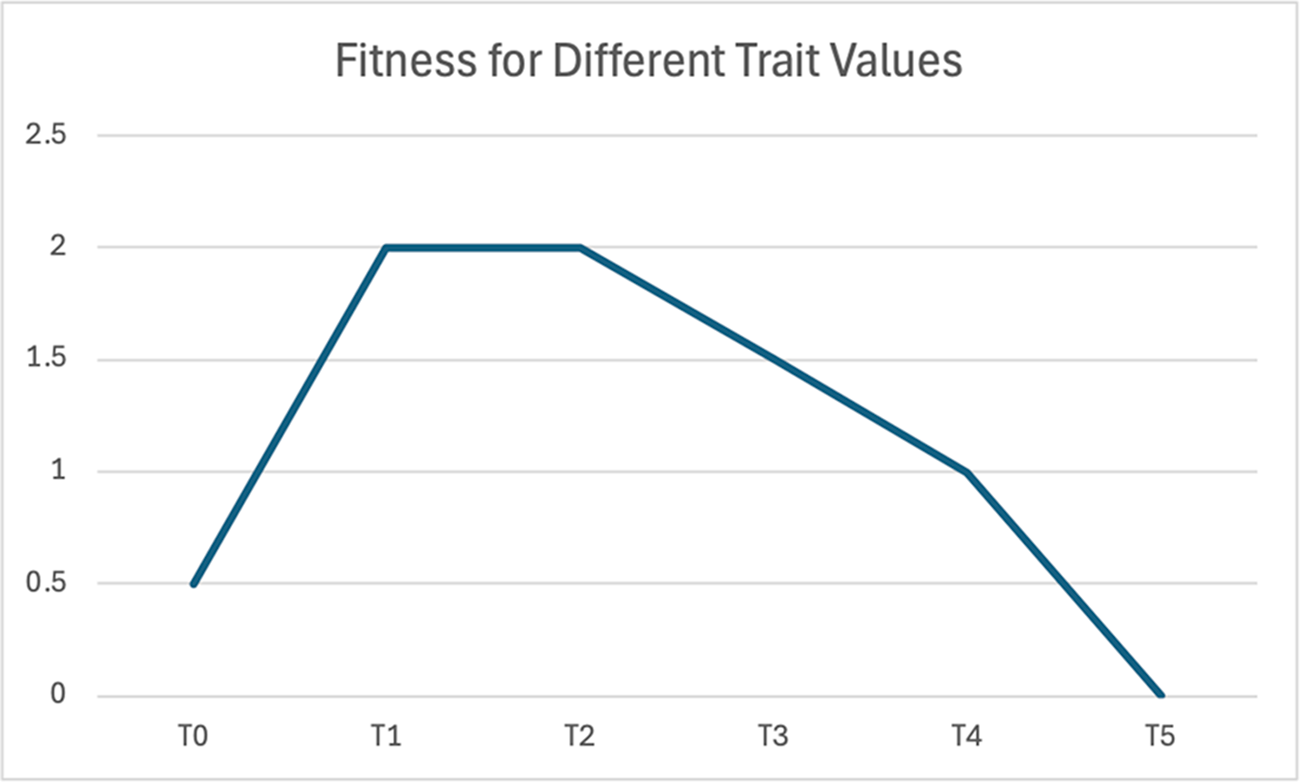
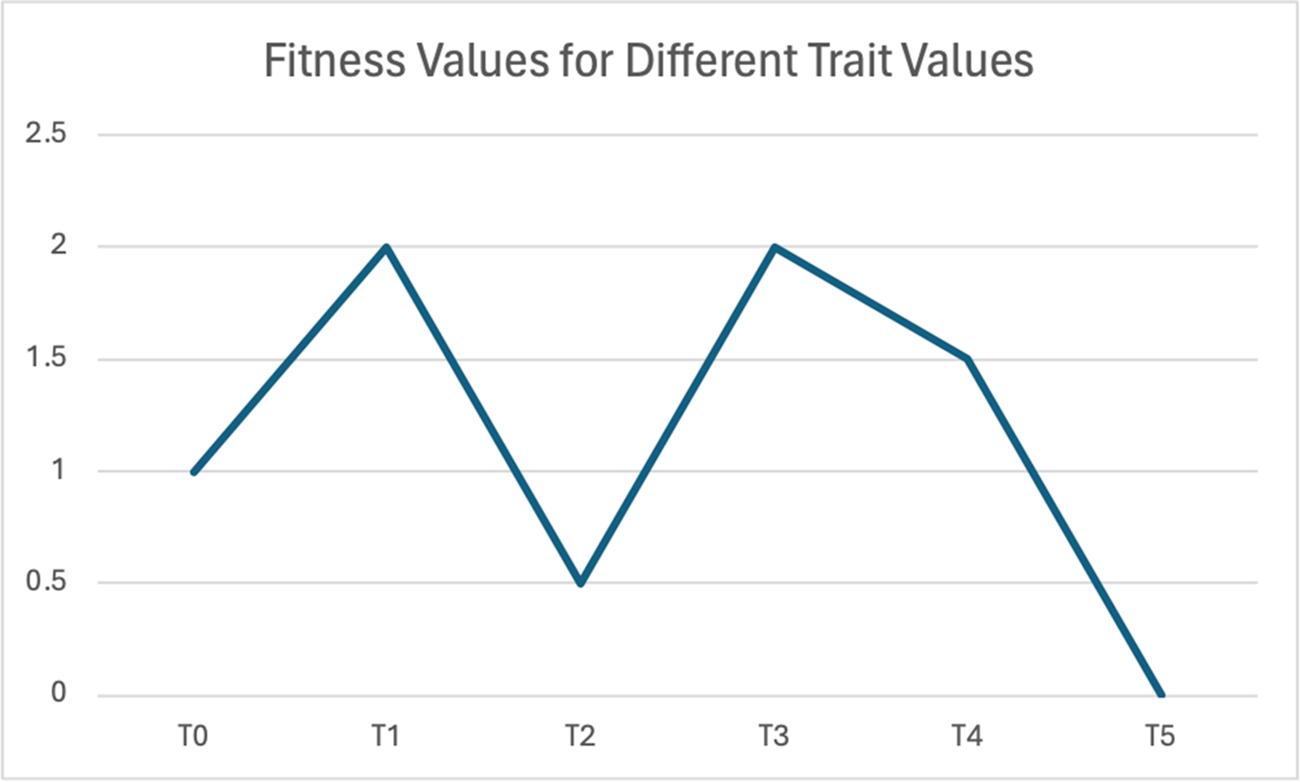
The second concern with the above two-pronged evolutionary argument targets the plausibility of the premises on which it rests. On the one hand, as far as the selection-based argument is concerned, this argument presupposes that the fitness function over human psychological evaluative structures is not multi-peaked or containing plateaus. For if either of this is true, then even with strong selection, we cannot rule out the evolution of a polymorphism in the relevant set of traits. As made clearer in Figures 2 and 3, in such cases, the evolution of trait values T1, T2, or T3 will heavily depend on chance and the starting place of the relevant (sub-) populations – there is no unique trait value that these populations need to be expected to converge to.
A fitness function with a plateau.
A multi-peaked fitness function.
Moreover, this is not a far-fetched possibility, as plausibly adaptive polymorphisms are common in the biological world. Indeed, they are found in human physiological traits, too: for example, it appears that hemoglobin production in Tibetan highland populations is different from that in other human populations (see, e.g., Huerta-Sanchez et al., Reference Huerta-Sanchez2014). This concern thus cannot be ruled out a priori when it comes to human psychological evaluative structures.
On the other hand, as far as the argument from common ancestry is concerned, there is the (related) concern that this argument rests on an overly simplistic picture of human cognitive evolution, as it underplays the role of culture in human evolution. In general, much about human cognition has evolved in response to cultural factors. While there is debate about the strength and nature of cultural influences on human cognition – with some placing most of the emphasis on culture (Tomasello, Reference Tomasello1999; Sterelny, Reference Sterelny2012; Heyes, Reference Heyes2018), and some seeing cultural influences as merely ‘triggering’ different innate biases (Tooby and Cosmides, Reference Tooby, Cosmides, Barkow, Cosmides and Tooby1992; see also Schulz, Reference Schulz2021; Ward, Reference Ward2022) – there is no debate concerning the fact that culture matters for human cognition.Footnote 14 Given this, it is entirely reasonable to expect that there are cultural influences on our evaluative systems as well. Put differently, our evaluative system may have evolved to be a culturally mediated cognitive polymorphism – we may not have evolved just one, culturally universal set of preferences, but a system for acquiring many preferences from our culture. Given this, though, the above common ancestry-based argument for the possibility of IUCs does not go through: the utility functions need not have a long history of intermixing, as they are likely to be heavily culturally determined.
All in all, therefore, as presented, the above evolutionary argument for the possibility of IUCs cannot be seen as compelling. However, it would be premature to end the discussion here: for while the evolutionary argument as commonly conceived is not compelling, it is possible to use some of the ideas in the background of the argument to build a more compelling, gene–culture coevolutionary case for the sometime possibility of IUCs.
An updated gene–culture–technological coevolutionary argument
To understand the impact that broadly evolutionary considerations can have on the debate surrounding the possibility of IUCs, it is best to begin where the criticisms above have left off: namely, by noting that it is very plausible that utility functions – in both content and structure – will, at least partially, culturally evolve.Footnote 15
On the one hand, as noted earlier, it is plausible that much of what we want has no particular biological significance outside of the cultural realm – e.g. when it comes to fashion, foods, or forms of music. Perhaps within some very broad limitations, there is no adaptive significance to shirt designs, the eating of cooked shellfish, or the use of microtones in music. Putting this the other way around, our evaluative system has evolved in such a way that we can acquire wants that match our particular culture (Boyd and Richerson, Reference Boyd and Richerson2005; Sterelny, Reference Sterelny2012; Henrich, Reference Henrich2015; Heyes, Reference Heyes2018). In turn, which wants are culturally reinforced will depend on the specifics of that culture – a point to which I will return momentarily.Footnote 16
On the other hand and most importantly for present purposes, this is likely to be especially true for the intensity of our wanting. That is, different cultures may favor different utility scales. So, even though different utility scales may not make a material cultural or biological difference to our behaviors – in line with the common contention that they are very difficult (or even impossible) to detect – they may still be differentially culturally favored: it is plausible that we have evolved in such a way that we culturally learn how intensely to want things. To see this, it is best to proceed in two steps.
First, note that we should see human cultural evolution as being both enhanced by and enhancing of technological evolution (Schulz, Reference Schulz2020, Reference Schulzforthcoming; Tomasello, Reference Tomasello2021). In particular, human cultural learning is made powerful in part due to the fact that it can be underwritten by artifacts and institutions that aid this learning (and which are themselves the product of cultural learning). So, writing, myths and calculating devices like the Plimpton 322 tablet and quipus can make the storage, acquisition and processing of much cultural information possible.
In the present context, these kinds of tools are important, as they can make different utility scales visible in ways that pure behavior cannot. Indeed, this present paper is a good example of this: we can write or talk about different utility scales, even if we cannot easily show them in our behavior. For example, in some cultures, people may hear the Goldilocks tale, Stoic lectures, or Buddhist teachings on the importance of keeping one’s exuberance in check. In other cultures, people may hear stories like that of Jacob in the Bible, who, in his grief, tears his clothes and refuses to be comforted. These different depictions of emotional intensity can be used to differentially emphasize different utility scales in different cultures: in some cultures, we may be taught less intense preference satisfaction, in others, we may be taught more intensive preference satisfaction.
More specifically, cognitive technology like myths, dances and songs can help define what we should expect as the baseline of our evaluative systems. We may learn that ‘pain is unavoidable and pleasure is rare’, or we may learn that we should ‘expect a pain-free life’. Similarly, myths, dances and songs can help define what a ‘unit’ of evaluation is. We may learn that ‘if you feel slightly uncomfortable about something, don’t do it’, or we may learn to ‘ignore anything unless it leads to major damage to body or property’. Importantly, this is exactly what it takes to define utility scales: we need to set out a zero and a unit (Binmore, Reference Binmore and Kincaid2009; Rossi, Reference Rossi2014). By being taught what we should take our baseline evaluative expectation to be, as well as which things we should take into account in our evaluations (and which not), we can thus learn about which utility scales to adopt – even though these scales are otherwise behaviorally inert and thus bio-culturally neutral.Footnote 17 Putting this the other way around, we may agree that behavioral data may not be compelling evidence for whether utility scale A or B is the right one in the case at hand – but these data can still be used as pedagogical tools to instruct others whether to adopt scale A or B. In this way, cultural artifacts can not only scale the utility of an outcome within an agent, but also across agents.Footnote 18
This matters, as the fact that these different evaluative schemes can be taught through cognitive technology like myths means that they can be correlated with other bio-cultural traits – like what to wear when, or how to grow which crops. Myths, stories, songs and rituals rarely if ever only emphasize or teach one cultural trait – they mostly or always teach several at once (Boyd and Richerson, Reference Boyd and Richerson2005). The Goldilocks tale is not just about the value of moderation – it has implications for how to treat others (‘the Golden Rule’). Jacob’s tale is not just about the intensity of grief, but also emphasizes the value of forgiveness. Importantly, these other culturally transmitted traits may well be bio-culturally adaptive: how an individual treats others can be a major factor in how well they fare in society and also contribute to the stability of that society (Whiten and Byrne, Reference Whiten and Byrne1997; Sterelny, Reference Sterelny2003; Machery and Mallon, Reference Machery and Mallon2010; Mikhail, Reference Mikhail2011; Tomasello, Reference Tomasello2021; Westra and Andrews, Reference Westra and Andrews2022; Westra et al., Reference Westra, Fitzpatrick, Brosnan, Gruber, Hobaiter, Hopper, Kelly, Krupenye, Luncz, Theriault and Andrews2024).
It is important to be clear about the argument here. The key conclusion to be stressed is that it is theoretically and empirically plausible that we can and do culturally learn what evaluative intensities to adopt. Of course, it is also entirely possible that we merely culturally learn the expression of our evaluations, not their intensities themselves. However, the latter possibility should not be seen to rule out the former. Indeed, the very fact that it is also entirely theoretically and empirically plausible that we culturally learn the contents of our preferences – and not just particular behavioral choice patterns – should be seen to underwrite this point. It is widely accepted that we can learn the psychological causes of behavioral dispositions, and not just the behaviors themselves (Boyd and Richerson, Reference Boyd and Richerson1985; Fodor, Reference Fodor1989; Barrett et al., Reference Barrett, Dunbar and Lycett2002). Given that we think this is true for the contents of our evaluations, it is plausible that the same is true for their intensities as well. While this does not amount to the clear establishment of the conclusion that we can culturally learn our evaluative intensities (and not just their expression), it is at least a reason in favor of the truth of this conclusion. Importantly, this is also useful, as it points to new work that can be done to improve our public policies. I return to this later.
For now, what matters is just to note that a given utility scale can spread through a given culture even though it is otherwise behaviorally inert and not inherently adaptive, biologically or culturally: it may be co-transmitted with other cultural traits that are bio-culturally adaptive.Footnote 19 That is to say, we may (culturally) teach about utility scales by accident: myths do not spring up to support the transmission of specific such scales – but the latter can be embedded in myths that spring up to support the cultural transmission of other traits. To understand this form of path-dependent cultural evolutionary hitchhiking better, consider the following simple model.Footnote 20
Assume there is a trait A1 – a particular behavior, like a certain version of slash-and-burn agriculture – that is correlated with A2 – a particular utility scale, like a form of Stoicism that emphasizes a flat evaluative outlook – in culture C. This correlation can stem from the fact that A1 and A2 are both components of the same myth: a myth that teaches both the importance of slash-and-burn agriculture and the importance of the Stoic evaluative outlook. In that case, if A1 evolves in C – because slash-and-burn agriculture is in fact adaptive in C – it can drag A2 along with it.
In more detail, in the model, there is an optimal agricultural practice out of 100 available practices (the number of available practices and the optimal value can be changed).Footnote 21 However, the society in question does not know what that optimal agricultural practice is. In the initial setup stage of the model, when the first families of the society settled the area, each family (out of the 10 that initially settled the area – an arbitrary number that can be changed) picks an agricultural practice at random out of the 100 available practices, and each family has their own unique, randomly determined utility scale (also out of 100). In the initial stage, the society further creates myths and stories, which (among other things perhaps) contain more or less explicit references to agricultural practices (‘do not till fields that cannot be seen by the sun’) and utility scales (‘Let your sadness run deep when the world is not right, but let your joy run free when it is’). In the model, it is assumed that the agricultural practice of the families that happen to be closest to the optimal agricultural practice gets to determine the content of the myth – both when it comes to the agricultural part and the utility scale.Footnote 22
Each generation then reproduces according to how close their agricultural practices are to the optimum. That is, each family i’s fitness is determined by the following:
 \begin{align} w_{\text{i}} = (100-|(\text{Optimal agricultural practice}-\text{Agriculture practice}_{\text{i}})|)/100.\end{align}
We then allow family i to reproduce with probability p, where
 \begin{align} \text{p}_{\text{i}} = w_{\text{i}} + w_{0}, \end{align}
where w 0 is the baseline fitness.
Importantly, subsequent generations initially adopt their parent’s agricultural practices and utility scales, but with a normally distributed mutation rate with a standard deviation of 1. However, as they grow up, they then change their agricultural practices and utility scales by moving them toward the founding myth of the society. That is, they set:
 \begin{align}
\text{Agriculture}_{\text{updated}} & = [(1-b) * (\text{best current agriculture}-\text{agriculture}_{\text{initial}} )] \nonumber\\
& \quad + \text{agriculture}_{\text{initial}} \end{align}
\begin{align}
\text{Agriculture}_{\text{updated}} & = [(1-b) * (\text{best current agriculture}-\text{agriculture}_{\text{initial}} )] \nonumber\\
& \quad + \text{agriculture}_{\text{initial}} \end{align} \begin{align}
\text{Utility scale}_{\text{updated}} & = [(d * (1-\text{b})) * (\text{Founding myth utility scale}-\text{utility scale}_{\text{initial}})] \nonumber\\
& \quad + \text{utility scale}_{\text{initial}})\end{align}
\begin{align}
\text{Utility scale}_{\text{updated}} & = [(d * (1-\text{b})) * (\text{Founding myth utility scale}-\text{utility scale}_{\text{initial}})] \nonumber\\
& \quad + \text{utility scale}_{\text{initial}})\end{align} where b  $ \in \left[ {0,\,1} \right]$ is a bias parameter that models how attached they are to their own utility and agricultural scale, and d $ \in \left[ {0,\,1} \right]$ is a parameter modeling the independence of utility-scale learning and agricultural learning (on which more later).
The final part of the model consists in the cultural evolution of the myth: every generation, the agricultural part of the myth (and only that) moves a little closer to the optimal agriculture practice. This is to model the fact, over time, the people can recognize what agricultural practices work and which do not, which then (perhaps subtly) affects the myths. Then, the older generation dies, the younger generation becomes old, and the model repeats.
For present purposes, what the model shows very clearly is that, even though utility scales are completely irrelevant for bio-cultural success, everyone in the society ends up having a narrow range of utility scales (Figure 4).
Cultural evolution of a set of utility scales (black) and their variance (green).
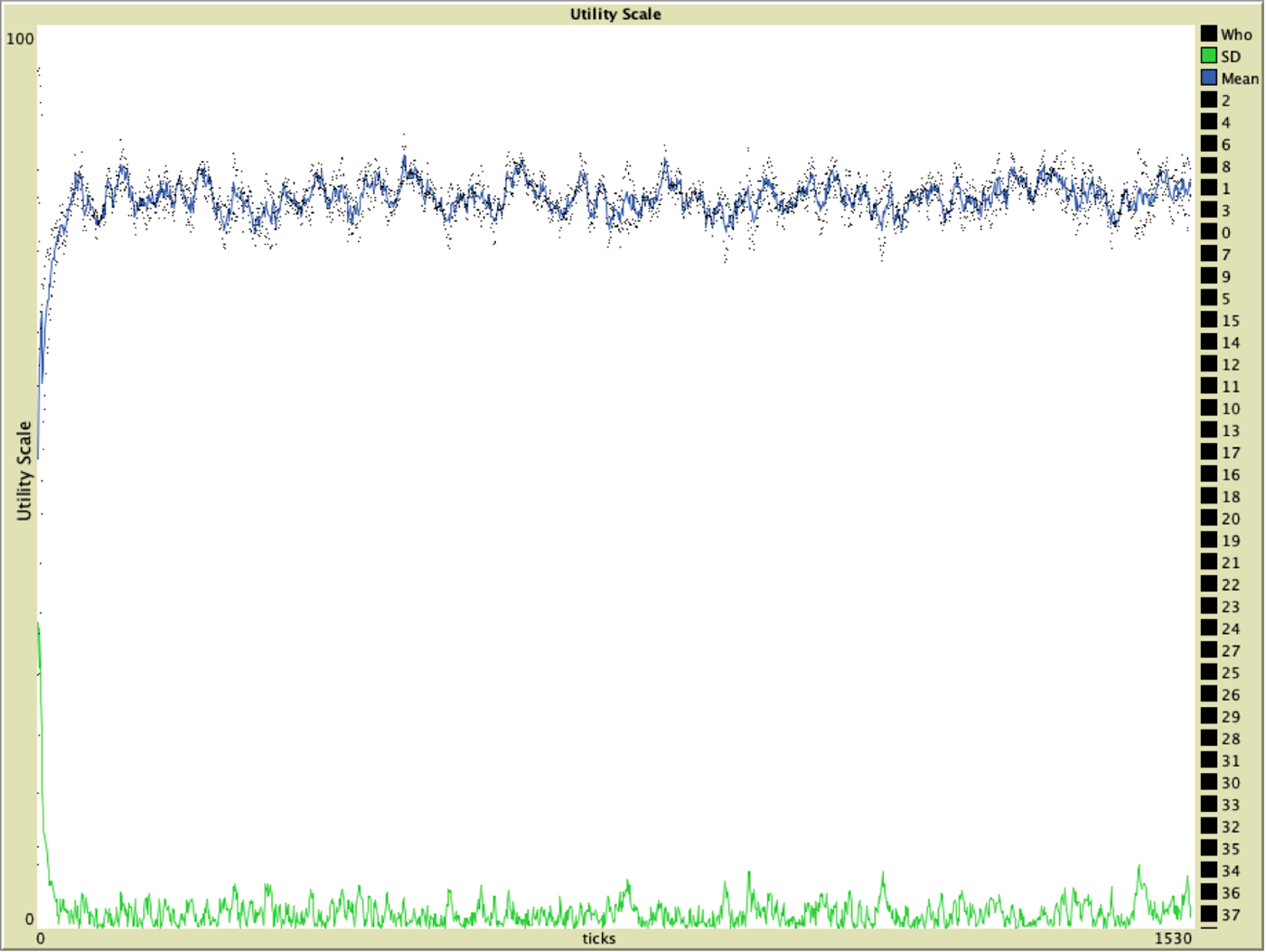
As Figure 4 shows, the standard deviation of utility scales plummets over time.
Importantly, also, different societies can – though need not – end up with very different utility scales (even if they inhabit very similar ecologies) (Figure 5).
Cultural evolution of a different set of utility scales (black) and their variance (green).
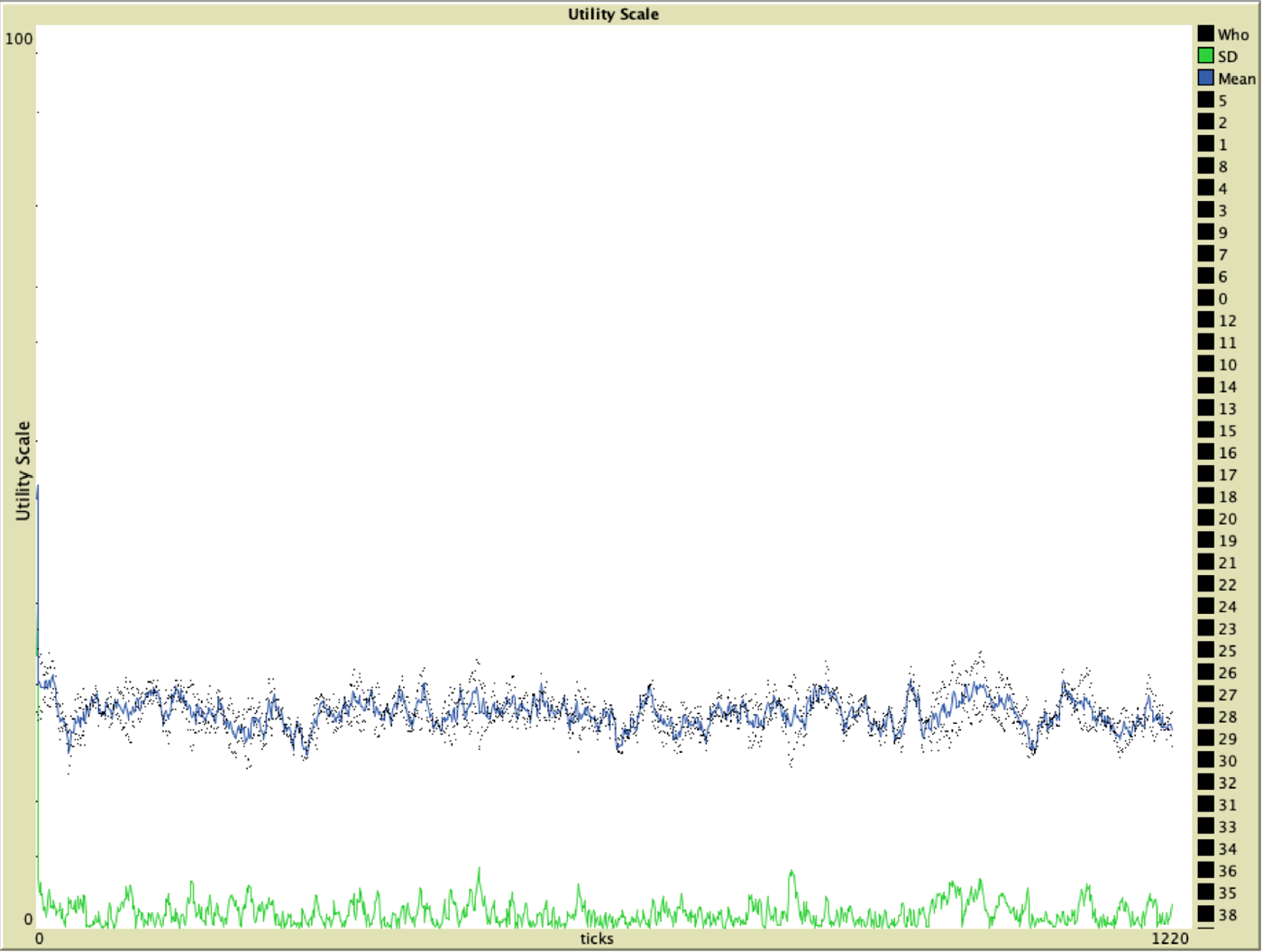
In the first case, the society ends up occupying a narrow range of utility scales between 70 and 80; in the second case, the range is confined to 25 to 35. These cases are completely distinct: they have no utility scales in common. Of course, in other cases, they may well have overlapping scales. In this model, this is purely driven by chance: what utility scale happens to be embedded in the initial founding myth. This is in line with the fact that utility scales are here assumed to be behaviorally inert – they can be learned, but they do not affect behavior otherwise.
It is important to be clear about the role that the model plays in the argumentative context here. Without a doubt, this is a simple, idealized model, and many of its detailed conclusions depend on the specifics of its assumptions. However, it still can add much of the value to the discussion about the plausibility and possibility of IUCs. Most directly, it can make this discussion more precise; what may seem reasonable informally often turns out to be more complex when put in the more precise setting of a model. More specifically, the model clarifies the argument of the paper along two main dimensions.
First, the model makes clear that it is reasonable that variation in utility scales will not go to zero. Of course, this is built into the model as a result of the fact that there are errors and biases in the transmission of utility scales – but these are reasonable assumptions that are implausible to give up. Importantly, though, the model also shows that the variation in utility scales lessens over time. Put differently, as was the case in the basic evolutionary biological argument, there is still room for individual variation in culturally acquired traits. The point to note here is just that this individual variation is now likely to be significantly narrower, since one of the main sources of this variability is controlled for: cultural differences. While this thus does not ensure that IUCs are possible, it makes it more likely. In this way, the model is helpful for making more precise the idea that at least intra-cultural IUCs may be possible: within a culture, our evaluative intensities tend to be closer to each other since they are often acquired as by-products of the cultural transmission of other traits.
Second and relatedly, the model shows that the size of the remaining variation in utility scales depends on how tightly utility scales are linked to the – bio-culturally adaptive – agricultural practices. If they are very tightly linked – i.e. if d = 1 – the variation in utility scales is very narrow. However, in cases where people pay less attention to the utility scale in the myth than to the agricultural practice – i.e. if d < 1 – more variance in utility scales results (Figure 6).
Cultural evolution of a set of utility scales (black) with larger variance (green).
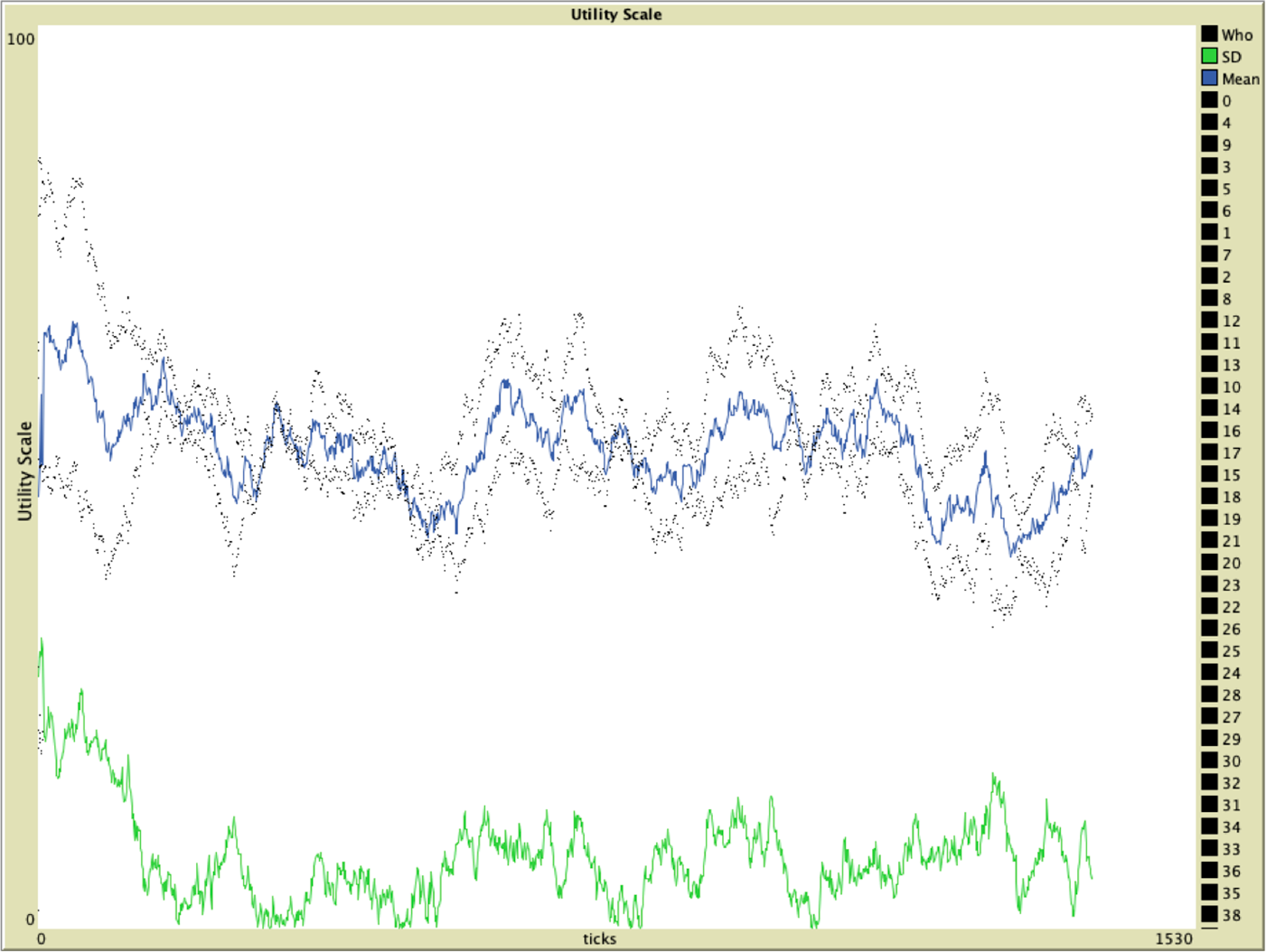
Interestingly, initial simulations suggest that the variation remains low even for small d – though it eventually does get substantial (Figure 7).
Variation of utility scales across different values of agricultural independence (gaps are cases where the culture went extinct).
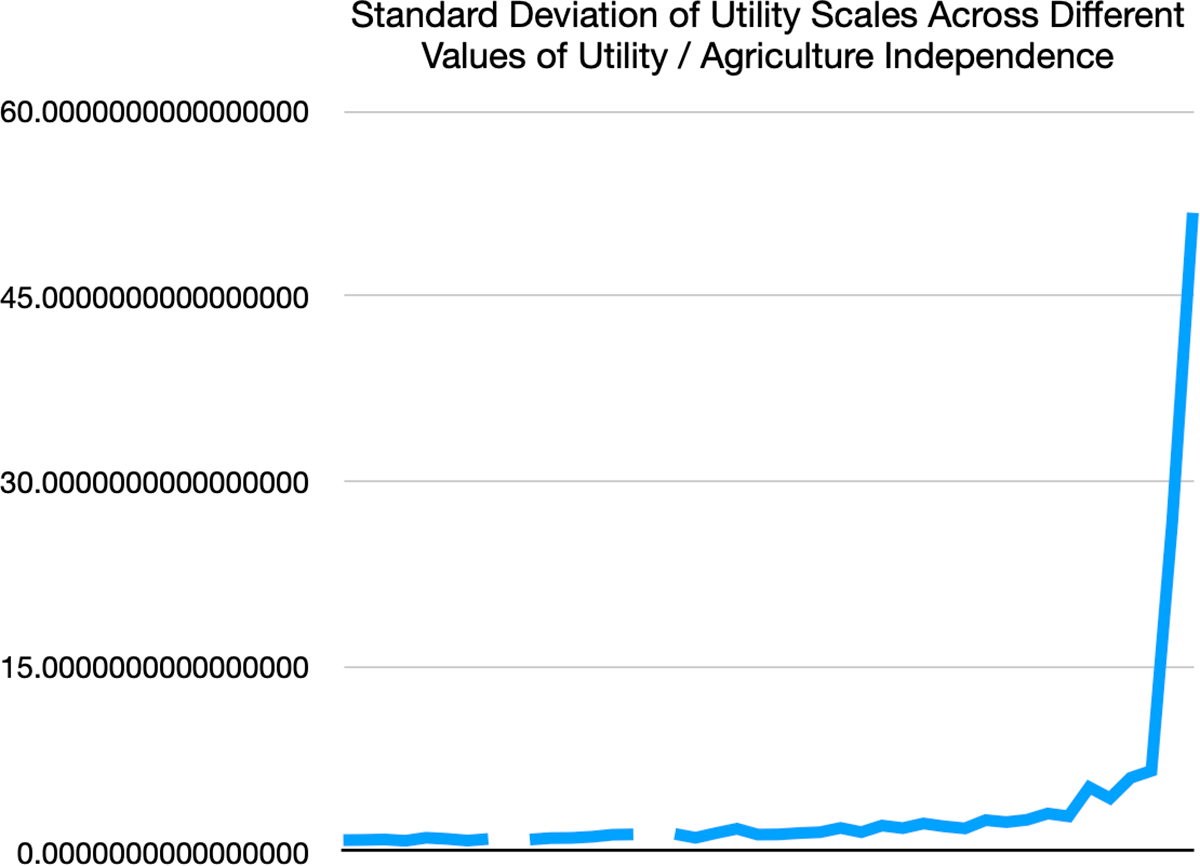
This last point is one of the key results here, so it is useful to spend a bit more time on it. Even with all the presuppositions made in the model, significant variation in utility scales may remain, making IUCs difficult even within cultures. In this way, the model again brings out the complexities in this situation: it is not that cultural evolution will definitely lead to easy IUCs within cultures. Whether it does so or not needs to be assessed on a case-by-case basis. Still, the model makes clearer which cases are conducive to the possibility of IUCs: namely, those with sufficiently high levels of d. In this way, the model is useful for making the empirical investigation of the possibility of IUCs easier: we now understand better what to look for. Here, it is especially helpful to consider the relationships among its various assumptions. For example, as noted in Figure 5, the variance in utility scales and independence from the agricultural myth are positively correlated – but not linearly so. This also helps us get clearer on where and why IUCs are possible, and thus aids in the design of improved public policies. This a point to which I return momentarily.
In this context, it is also important to note that, while many details of the model can be changed, its overall thrust rests on solid foundations. In particular, the model combines aspects from other, well-established work in gene–cultural coevolutionary theory. So, the model shares some foundations with work on the cultural evolution of maladaptive traits like celibacy (Boyd and Richerson, Reference Boyd and Richerson1985, Reference Boyd and Richerson2005; Boyd, Reference Boyd2018) – but unlike in the latter case, utility scales are assumed not to be maladaptive, but just selectively neutral. Similarly, in Boyd and Richerson’s (Reference Boyd and Richerson1987) model of the evolution of ethnic markers, ethnic markers become adaptive as a guide to appropriate teachers – though they are not initially adaptive. In the model presented here though, it is not even the case that utility scales function as markers: indeed, since they are assumed to be behaviorally inert, they cannot do so. However, as the model makes clear, they can still hitchhike on the evolution of other traits.Footnote 23
Putting all of this together, the model can be seen to support and make more precise the key contention of this paper: given the place of culture and technology in human cognitive evolution, it is plausible – though not guaranteed – that utility scales, while behaviorally inert, can hitchhike on the techno-cultural evolution of other, bio-culturally adaptive traits. In turn, this provides a reason for thinking that IUCs are sometimes possible: members of a culture converge to a small set of utility scales, simply because these scales techno-culturally evolve as by-products of other techno-culturally evolving traits.Footnote 24 Put differently, given what we know about the general impact of culture and technology on even fundamental features of human minds (e.g. what we value or how we make decisions), the possibility of IUCs becomes more credible (Tomasello, Reference Tomasello1999; Csibra and Gergely, Reference Csibra and Gergely2011; Sterelny, Reference Sterelny2012; Heyes, Reference Heyes2018; Schulz, Reference Schulz2020, Reference Sterelny2021; Schulz, Reference Schulzforthcoming).
This model-cum-argument has several important novel, policy-related implications. First, in its very nature, the present, culturally restricted perspective on IUCs is helpful for moving the debate surrounding the possibility of IUCs away from an ‘either/or’ framing. The question should not be whether or not IUCs are ever possible; the question should be when IUCs are possible. That is, even if we grant that IUCs are sometimes possible, it is still a further question when they are possible; the former does not entail that they are always possible. This makes the debate more precise and opens up new avenues of investigation. As noted in the introduction, a key motivating reason for why we are interested in the possibility of IUCs centers on moral and political considerations: in making complex policy decisions, we may want to ensure that the losers of a proposed policy do not unduly suffer, compared to the benefits accrued by the winners. What the present argument shows is that it is plausible that it is sometimes possible to make these kinds of assessments – but also that this is sometimes not possible. We cannot rely on the possibility of IUCs in making all kinds of policy assessments, but nor should we rule out this possibility in all cases.
Second, the present account predicts that IUCs will be harder across cultures.Footnote 25 This matters, as it might help us understand the pervasiveness of some of the difficulties with cross-cultural communication. It may be true that it is not just the case that people in different cultures express their evaluations differently (though, as noted earlier, this may also be true); their evaluations might in fact differ. Again, as far as we know, this is just a possibility. However, the point here is that this possibility is at least worth investigating. Cross-cultural communication is geopolitically of major importance for many different issues. Anything that can help us better understand its difficulties – and, thereby, point us toward ways of ameliorating these difficulties – is thus important.
Third, the present account suggests that appropriate technology can help improve cross-cultural IUCs. Put differently, appropriate technology can help us determine the transformation function between utility scales in different cultures.Footnote 26 Importantly, this technology is not restricted to better neural imagining (say), but also involves the study of writing, myths and art. If people learn how intensely to evaluate the world, then anything that can help make it clearer how they do so can help us triangulate on the nature of others’ evaluative scales. In turn, this can be used in the creation of improved ways of cross-cultural communication.
Finally, the present account brings into view the question of the origin of the cultural technologies that shape our utility functions. In the above model, that origin was whichever founding family happened to be closest to the most adaptive agricultural practices. However, especially in more complex circumstances, it is possible that the cognitive technology that shapes utility functions could be provided by a multinational corporation or governmental agency. This matters, as such an entity could shape our utility function in problematic ways – e.g. so as to make us more or less satisfied with our current situation, which may make us more or less likely to change it (e.g. by buying more or less of certain products or be inclined to vote for or against the incumbent party) (see also Nussbaum, Reference Nussbaum2000). The model brings this clearly into view, gives us tools to assess the efficacy of this, and thus enables us to change that situation if needed.
Conclusion
It is possible to make progress concerning the question of the possibility of IUCs by considering broadly evolutionary biological insights. However, to do so, three things need to be noted. First, this question needs to be understood as concerning the intraspecific variation in evaluative structures in humans. Second, a simple appeal to evolutionary biology to resolve this question does not fit the fact that there is much variation in biological traits – especially ones that also respond to cultural pressures. Third, it is possible to answer the question by drawing on the facts that many human psychological traits evolve in response to cultural pressures and that it is possible to use technology to teach about evaluative intensities. This analysis makes clear that the possibility of IUCs is not an either/or affair, that differences in evaluative intensity may underlie cross-cultural communicative difficulties and that these difficulties may be ameliorated through the deployment of appropriate cognitive technology.


 Open access

