

At the dawn of the 4th c. BCE, the Roman army led a sustained attack on Veii, in an extraordinary bid for conquest. The scale of the annexation and the subsequent, unprecedented maintenance of such immense new territory is portrayed in Roman studies as a historical watershed, especially when accompanied by discussion of the effort invested in fortifying a Roman urban boundary (after a crippling defeat at the hands of the Gauls) and the ensuing socio-political restructuring.Footnote 1 The occupation is also typically understood as a return to strength after an extended period of unsettling transition.Footnote 2
This characterization of the period before expansion is not a strong feature of the ancient sources, and the narrative of calamitous interlude specifically is a modern one. Although there is commentary about the uncertain historicity of events before the Gallic Sack and there is evidence for conflict and difficulty, neither Livy nor Dionysius of Halicarnassus portray any part of the first century of the Republic as a time of unique decline or conflict so much as one of usual, if sometimes menacing, adjustments and engagements. The image of an Archaic apogee (especially of a “Great Rome of the Tarquins”) followed by an interim period followed by impressive activities again from the 4th c. BCE (especially a “Middle Republic”) derives, instead, from a strong tradition of periodization in humanistic scholarship. Especially recognizable, in this case, is an episodic juxtaposition of crisis and consolidation, decline and growth, obscurity and intelligibility, as well as the use of exceptional people or activities, like Camillus, the sack of Veii, or the sack of Rome, as fulcrums in the historical narrative.Footnote 3 For the early Republic, such an account is assembled by reading Livy and Dionysius of Halicarnassus's comparative silence on late 5th-c. BCE triumphs (and, relatedly, fewer mentions of new temple dedications) alongside mentions of debt crises, the institution of the military tribunate, the secession of the plebs, and other selectively chosen elements of the textual tradition, as well as shifts or decreases in, again, selectively chosen categories of archaeological evidence, namely imported, especially Attic, ceramics and monumental stone remains of architecture.Footnote 4 In this way, the image of the 5th c. BCE as a particularly problematic period arose in scholarship.
Even despite decades of recalibration and important contributions on early 5th-c. BCE material, which have shortened the length of the putatively intermediary moment to within the very middle and late 5th c. BCE, the sense of a regression, transition, or, at best, incomprehensibility still dominates the study of these decades.Footnote 5 They often receive little attention in scholarship except with respect to difficulties, and one consequent, striking feature of Roman studies is the sense of a void just before the start of the 4th c. This apparent absence serves still in many cases as a barrier – a historical one, used by scholars as a bookend, and a scholarly one, manifesting in the comparative scarcity of complex studies – that segregates treatments of earlier actions from those on the other side of the chasm.Footnote 6 Another characteristic is the degree to which the 6th and early 5th c. BCE have become moments to consider highly complex sociocultural activities, while assessments of the 4th c. BCE manage to position Romans as emerging from a substantively different community, sometimes portrayed as incoherent, unproductive, or unsophisticated, into a moment of especial engagements.Footnote 7 This has had widespread repercussions for discussion of everything from religion, to societal structures, regional exchanges, artistic activity, trade, politics, and much more.
Much the same was once the case for the study of (central) Italy as a whole: a dark 5th c. BCE was understood to bear on decreased temple construction and imports, and Rome's regression was seen as both bound to this situation and distinctive within it.Footnote 8 Yet scholarship on the landscape beyond Rome has long since turned to other questions, and it has focused increasingly on the once overlooked, evidence for healthy continuity, maintenance, and adjustments in indigenous and mixed social practices, artisanal production, sacred imagery, mobility, and much more that entangles early actions with later ones, across temporal and spatial boundaries.Footnote 9 This work looks away from the historical telos of Rome and often rejects historically privileged interests in growth and expansionist regimes to consider, instead, all manner of engagements in a less prescriptive and linear fashion. Such views embrace scholarship on the connective, multivalent entanglements of communities around the Mediterranean and beyond, and they highlight movements between these worlds as well as the fluidity of sociocultural practices that cross perceived boundaries.Footnote 10 In its most critical application, this kind of analysis, which often focuses on material remains, has revealed that sequential, linear histories, especially when principally focused on a single social or political place or trajectory, like Rome's, are prone to exclusions and erasure, and, at the same time, they are not able to account for the ways in which individuals and communities – typically many, simultaneously – engaged with one another, affecting events in multiple places along numerous historical paths at differing scales.Footnote 11
In what follows, I address one kind of evidence for such multilayered, multivalent connectivity and action from the midst of the period in question (especially ca. 460–390 BCE), namely architectural fragments made of fired clay and applied to buildings in Rome. Their fictility is important: such clay objects are an exceptional category to think with because their material and fabrication allow the tracing of recipes, handmade processes, visual and material traditions, and other kinds of exchange in highly active, peopled environments.Footnote 12 I begin by enumerating examples of such made things, which expand the evidence for urbanism, religious practice, sociopolitical history, and production economies in Rome. The remains are all published and well known to specialists, but they register in scholarship mostly as craft products, as terracottas, and as ornaments, when they are also (as craft products and terracotta ornaments) a highly meaningful part of built landscapes, religious traditions, sociocultural exchanges, and more.Footnote 13 Second, I suggest that these architectural fragments are evidence not only of buildings and sculptures that supplement the record in Rome (in a way that might undermine episodic histories), but also of the dynamics and contributions of creative industries and peoples across political and disciplinary boundaries.Footnote 14 Their exploration opens up multiple other worlds, which coexisted with any Roman ones and which might suggest other ways to view the 5th c. BCE and the moments that surrounded it and ran through it.Footnote 15
Architectural evidence: context and additions
Before describing these remains, it may be helpful to provide a sense of the evidence for construction from the period as it is often described. Through the end of the 20th c. CE, most assessments of early Rome ended at ca. 509 BCE, when the colossal Temple of Jupiter was purportedly dedicated on the Capitoline, capping an era of impressive building work. Afterward, little to nothing was discussed until the early 4th c. (ca. 390 BCE), when construction began on the enormous urban circuit wall. The late 6th-c. BCE terminus was itself bound to the regal period and to several historical threads, which anticipated that artistic production was fixed to political will and, in this moment, to the shift in governmental structure, the expulsion of putatively Etruscan kings, and other complex sociopolitical adjustments.Footnote 16 Much of this has changed, and exploration of architecture in most recent studies crosses this boundary, continuing through the early–mid-5th c. BCE. Scholars now generally recognize that dozens of impressive temples, infrastructural works, urban boundary walls, houses, and more were built in Rome over a long period from the late 7th c. through ca. 470/60 BCE.Footnote 17 These include famous examples like the Temple of Jupiter, the Regia, the Atrium Vestae, the Temple of Castor, and some impressive houses on the north Palatine, as well as many temples and buildings only made visible by way of fragmentary remains, such as an Amazon from the Esquiline or beaten-earth floors below the Forum of Caesar, and infrastructural works, like segments of fortification walls, paved pathways, and earthen fills. Overall, this material has come to exemplify an early social space that was extraordinarily productive and entangled with the Italic and Mediterranean worlds.
Attention to these projects has, however, not corrected the narrative of a drop-off in building activity in the 5th c. BCE; rather, it has only tweaked it: instead of an immediate period of uncertainty after the fall of the monarchy, scholars have wondered about the mid–late 5th c. BCE, when only one or two archaeologically attested building projects appear to be visible. The new paradigm is itself still tied problematically to modern periodization, now art historical and socio-cultural, rather than entirely political. The absence of much discussion of projects dating from ca. 470/60 to 390 BCE noticeably aligns with the traditional dates for the end of the Archaic period and the start of the Middle Republic, leaving a gap between them. In fact, most studies of early Rome now invoke these terms (Archaic or Middle Republic) rather than Regal or Republican.Footnote 18 Yet there is plenty of evidence for materials dating from within these decades. Much of it has not seen close scrutiny because of the disciplinary bias for certain kinds of evidence, especially monumental remains in stone, which are almost completely lacking in the record for the mid-5th to very early 4th c. BCE. The period is also made to look more lacunose than it is because of the (often innocent) desire to fit remains into period studies: a building that is datable to the mid–late 5th c. BCE, like the Temple of Apollo Medicus, is included in “late Archaic” finds; a roofing element datable to ca. 420 BCE associated with the “emergent” Middle Republic or understood as an outlier; an example from the mid-5th c. used to explain a lingering archaism.Footnote 19 As materials are pulled into better-studied adjacent temporal frames, often because of artificial period structures, the decades in question are left without their own treatments, their sequestration perpetuated.
So, together, the preference for certain kinds of evidence and the tradition of period structure feed misconceptions. Scholars looking to ceramics and everyday objects have begun to address this, especially by questioning the degree to which dating mechanisms have tended to rest on established period typologies rather than stratigraphic or other more empirical metrics, and they have highlighted how art historical and political periodization has often reinforced and exacerbated problems in a patently circular manner.Footnote 20 This has not yet permeated study of the built environment to the same degree, resulting in, on the one hand, an urban and architectural history that is fragmented, without a clear explanation of how remains from the 6th and early 5th c. BCE connect to those of the 4th, and, on the other, the ongoing suggestion of a “dark” moment for building.Footnote 21 The addition here of evidence for perhaps a dozen architectural undertakings across the period between ca. 470/60 and 390 BCE will hopefully still further suggestions of a Rome in the throes of architectural stagnation or absent the necessary evidence for analysis of sociocultural engagements.
The evidence for building(s)
Large stone remains are difficult to uncover for this early period since they are deep under later monuments and often absent in the constricted trenches that reach such early layers. Good cut stone was also regularly removed from its original context for reuse in antiquity, leaving only one building with remains from the period in question: the Temple of Apollo Medicus.Footnote 22 Architectural sculpture and protective elements are far more plentiful. Often the only remnants of a building, one must work to reimagine their original circumstances as single pieces of a much larger puzzle. Many elements, including antefixes, revetment plaques, simas, and more, were stamped from molds and set beside dozens of facsimiles repeated along the eaves; they co-existed with pedimental sculptures and other freehand ornamental features as well as hundreds of protective tiles.Footnote 23 As a whole, these terracottas covered the roofs and occasionally the walls of temples and other buildings, protecting the structures from the elements and creating a primary visual-haptic encounter.
As evidence for the built environment, they are often overlooked and underappreciated because of their small size, often faded and fragmentary nature, and less obvious value (when compared with stone remains) to understanding architectural form and function; they have also suffered from the epistemologically biased hierarchy of a “fine arts” taxonomy.Footnote 24 Yet they are no less revealing of potentially monumental change and active building communities. Although few come from primary contexts, many do come from a consistent type of secondary context: ritual deposits from sacred precincts. Given the nature of the sculptures (their iconography and size, as well as the contexts of comparable examples from other central-Italic sanctuaries), the regularity with which they are tied both to destruction layers and ritual deposits, and the sacred meaning associated with ritual decoration, they are widely understood to pertain to previous structures (whether temples or ancillary buildings) from within the sanctuaries where they were interred.Footnote 25 The secondary contexts in these cases are therefore understood to be evidence of buildings on these sites, and, consequently, their general topographical situation is accepted (Fig. 1). Other fragments derive from less secure contexts, but their discovery nonetheless offers helpful information about the kinds of architectural craft that were present in Rome. Additionally, their dimensions and even their mold-made replication for other buildings (in Rome or outside of it) can indicate the relative sizes of the beams they were affixed to or the deployment of certain sculpted features at multiple sites.Footnote 26 So, it is worth documenting their contexts and exploring their potential significance. I begin with a concise topographical summary of the evidence, followed by a brief synthesis of the scale of building work they reveal.
Schematic map of Rome with the locations of architectural remains in the long 5th c. BCE (Map by J. N. Hopkins.)

One of the clearest contexts of ongoing construction, demolition, reconstruction, and use from anywhere in the city comes from excavations, at the edge of the Colosseum valley, of two sanctuaries flanking a pathway. The earliest evidence for occupation of each area dates to the 8th and 7th c. BCE, respectively.Footnote 27 Both were monumentalized in the mid- and late 6th c. BCE, and several phases of work, including new buildings, precinct walls, drainage works, and a newly flagged roadway, were added in the early 5th c. BCE.Footnote 28 Reconstruction began again in the mid–late 5th c. BCE, when a roof with female antefixes was installed alongside a freshly repaved street between the sanctuaries, and work continued in the late 5th and very early 4th c. BCE, when still two more roofs were added, as were painted wall plaques (Figs. 2 and 3a).Footnote 29 Further up the Velia, a single large floral revetment plaque, discarded in a well, indicates the presence of a moderately sized building on the now-demolished summit of the hill. It is often incorporated into studies of the Archaic period but usually as a “later” find, since it resembles examples that date anywhere from 485 to 450 BCE.Footnote 30 Across the Palatine, on the southwest slope, sometime after the early 5th c. BCE, a temple built on cappellaccio foundations and ornamented with antefixes of Juno Sospita and satyrs must have been destroyed or needed restructuring. A ritual deposit above it contains materials datable through the mid-5th c. BCE but no later, after which time the site was partially covered by a large cappellaccio platform, and a new building received roofing elements datable to the mid–late 5th c. BCE (Fig. 3b).Footnote 31
Female head antefix from the excavations between the Palatine, Velia, and Colosseum Valley. Mid–late 5th c. BCE (Photo by Luigi Spina, published by permission of Carlo Rescigno and licensed by the Ministero della Cultura – Parco Archeologico del Colosseo.)

(a) Satyr head antefix from the excavations between the Palatine, Velia, and Colosseum Valley. Mid–late 5th c. BCE (Photo by Luigi Spina, published by permission of Carlo Rescigno and licensed by the Ministero della Cultura–Parco Archeologico del Colosseo); (b) drawing of beard fragment from satyr head antefix from the southwest Palatine. Mid–late 5th c. BCE (By permission of Patrizio Pensabene.)

On the Capitoline and Esquiline, construction also continued after the early–mid-5th c. BCE. A set of architectural elements on the Capitolium – revetments, antefixes, and high relief sculptures pertaining to a pedimental ensemble – date to the end of the 5th c. BCE (Fig. 4).Footnote 32 On the Arx, the evidence is scarce, but two sculpted female heads – either architectural sculptures or votive or cult statues – date to the early and mid-5th c. BCE respectively.Footnote 33 Meanwhile, testimony of construction on the Esquiline derives from an antefix that is similar in style, and in the specific kind of diadem, to examples from the Capitoline but is of a type that is well known to exist at Caere too, even deriving from the same molds or prototypes (Fig. 5).Footnote 34 It could date anywhere from the late 5th to mid-4th c. BCE, so, perhaps slightly later than the period in question.
Female head antefix from the Capitolium. Late 5th c. BCE (Inv. 44718. Musei Capitolini, Antiquarium. Archivio Fotografico dei Musei Capitolini. © Roma, Sovrintendenza Capitolina ai Beni Culturali.)
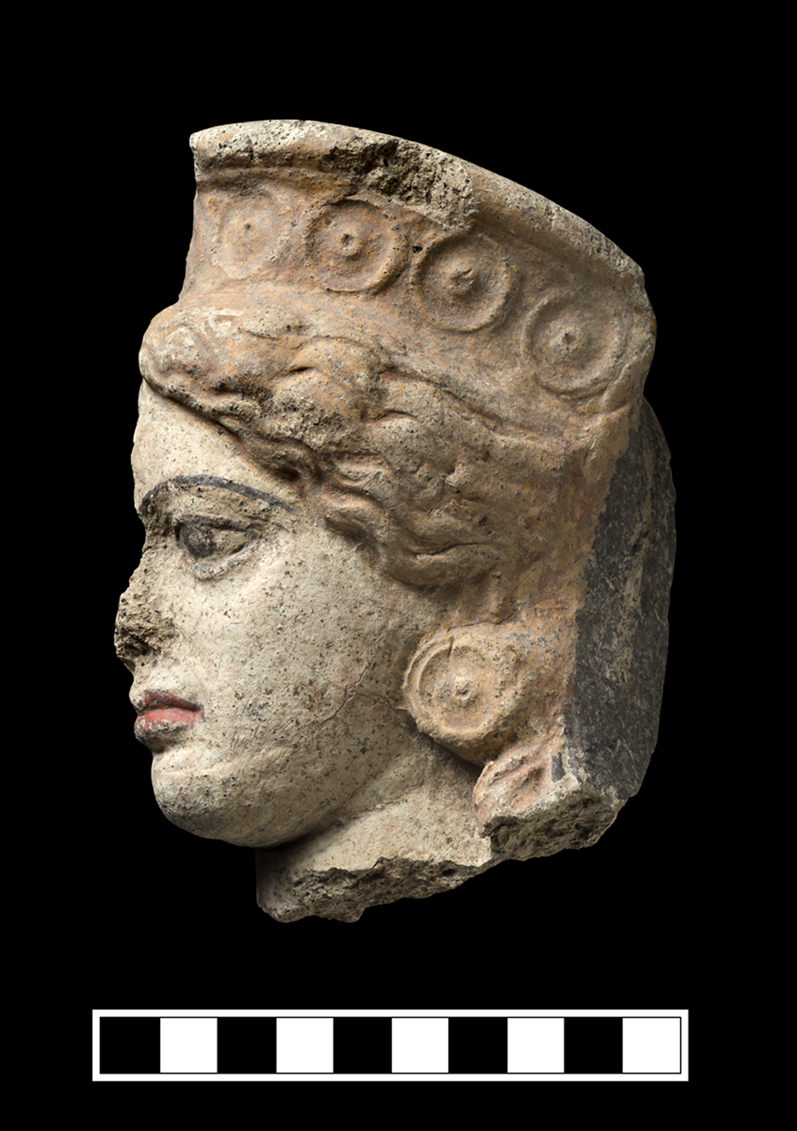
Female head antefix from the Esquiline. Late 5th–mid-4th c. BCE (Inv. 62649. Photo by Romano D'Agostino. Licensed by the Ministero della Cultura – Museo Nazionale Romano.)

In the Forum, the Temple of Castor, a newly paved plaza, and other monuments built in the late 6th and early 5th c. BCE were accompanied by yet another structure. Beneath the Basilica Julia, excavation in the 1960s unearthed several phases of Republican and pre-Republican construction; two antefixes from the early 5th c. BCE are typically associated with the Temple of Castor, across the Vicus Tuscus, but often neglected is the thick stratum of burned terracottas – a collapsed roof – sandwiched between 6th- and early 4th-c. BCE strata.Footnote 35 The tiles represent one of the few primary contexts of a building from the middle of the 5th c. BCE; it fell and was later covered with what appears to be a mid-Republican house and then the Basilica Sempronia. Its function remains unclear, but it bears witness to yet another monument, perhaps the tabernae veteres or one of the houses said to preexist the basilicas along the edge of the Forum.
A final cache of terracottas derives from a single excavation along the Tiber, recovered during construction of the modern embankment.Footnote 36 Their specific contexts are sadly lost, but their number, variety, and fine craftsmanship are of vital significance. They include antefixes and other small finds of nearly a hundred architectural sculptures in dozens of stylistic variations that testify to continuous maintenance and reconstruction over nearly 400 years of occupation.Footnote 37 A majority belong to small buildings, perhaps porticos, of the late 3rd and 2nd c. BCE, but four examples pertain to new 5th-c. BCE and very early 4th-c. BCE buildings or refurbishments. The earliest is a full-bodied dancing satyr and maenad, of a type found also on the Temple of Castor and in the sanctuary at the northeast corner of the Palatine.Footnote 38 Two other antefixes bear female heads and a fourth is of a Silenus; the earliest female head dates to the very middle of the 5th c. BCE and the other female head and the Silenus to the end of the 5th or beginning of the 4th c. BCE (Figs. 6 and 7).Footnote 39
Female head antefix from the Tiber banks. Mid-5th c. BCE (Inv. 1530. Museo Nazionale Romano. Photo by Romano D'Agostino. Licensed by the Ministero della Cultura – Museo Nazionale Romano.)

Female head antefix from the Tiber banks. Late 5th or early 4th c. BCE (Inv. 4479. Museo Nazionale Romano. Photo by Romano D'Agostino. Licensed by the Ministero della Cultura – Museo Nazionale Romano.)

In all, the finds increase the archaeological evidence for architectural projects between ca. 470/60 and 390 BCE by a minimum of eight and as many as 12 buildings, including, perhaps, one from the Esquiline, at least four from the Palatine and Velia, at least one from the Capitoline, another from the Forum, and at least two others from the Tiber. Some may have been refurbishments, but such maintenance is itself important testimony to the desire and ability to keep urban architecture in good repair; in this context, it is worth noting the ongoing use and small refurbishments throughout the 5th c. BCE of houses, roads, and other buildings first constructed in the mid–late 6th c. BCE on the north slope of the Palatine and beneath the Forum of Caesar.Footnote 40 Still, even accounting for architectural elements that may signal small repairs, the number of new buildings and complete or substantial overhauls is at least six.Footnote 41
Though the remains themselves may be small, it is important to underscore that the building activities they belonged to were not; the architectural elements are consistent in size and typology with remains from some of the largest monuments in the region. For example, the female head antefixes described above and discussed at greater length below, as well as the Silenus type, are found on impressive buildings at Falerii, Volsinii, Satricum, and elsewhere.Footnote 42 Revetments from the Velia and Palatine are of a scale found only on moderately sized and large temples, like the Temple of Castor and temples at Ardea.Footnote 43 Furthermore, although evidence for construction remains heaviest during the first 30–40 years of the Republic, nearly one third of all known building projects from across a long 5th c. belong between ca. 460 and 390 BCE (see Fig. 1 with dating of finds divided into a first, second, and third part of the period, purely to register distribution). Certainly, these are fewer major works than remain from the early 5th c. BCE (and the argument here is, consequently, not for a lost “Great Rome” of the mid–late 5th c. BCE), but it is nothing like the architectural fracture and absence that dominates historiography of the period.
The dynamics and contributions of craft in and beyond Rome
These small terracotta remnants index an active world of makers building in Rome through the 5th c. BCE. A careful analysis of the material, technological, and formal practices visible in them also reveals distributed craft networks that were dynamic across the region and beyond this temporal sweep.Footnote 44 In this sense, as I explore now, the qualities of these remains (as much as the quantity of work they indicate) militate against both the privileging/sequestration of Rome in historical inquiry and the segmentation/periodization of any part of the 5th c. BCE as a moment of transition or as an after/before moment: post-Archaic or pre-Middle Republican.
One of the best documented architectural elements in the record in the decades under examination is the terracotta antefix. Within this category, one of the most characteristic images across the 6th, 5th, and 4th c. BCE (so, connecting such features beyond the 5th c. BCE) is the female head.Footnote 45 Five mid-5th to early 4th-c. BCE examples of two types used in Rome highlight the value of close scrutiny (Figs. 2 and 4–7). All possess placid faces, strong brows and noses, and diadems of rosettes or floral crowns with grape clusters atop a symmetrically parted coiffure of waves. Absent from these examples are the subtle smile and flat, abstracted waves of hair characteristic of earlier antefixes from the 6th and early 5th c. BCE (Fig. 8). Absent also is the yellow polychrome used to treat blonde hair and gold jewelry in similar examples from the mid-4th c. BCE onward (Fig. 9).Footnote 46 In large part, it is the ongoing preference for reds, browns, creams, and blacks combined with an emerging interest in more naturalistic facial features that signals their date, as does their archaeological context at a few sites in Rome and at other sites around the region. This view of their distinguishing features is helpful in isolating the period of their manufacture, and essential here is their meaningfulness to a reported lacuna in the Roman record of a fundamental change in styles in the Mediterranean during the 5th c. BCE. Perhaps better than any of the well-studied categories of evidence, these antefixes register for Rome a change in artistic practices with respect to mimetic images in anthropomorphic form; that is, the shift to naturalism.Footnote 47 Yet their significance lies not simply in a vague connection to Mediterranean stylistic trends, koines, or artistic languages, but rather in the highly specific craft communities they reveal and the ongoing engagement with existing and new communities of makers in and beyond Rome, before, during, and after the 5th c. BCE.Footnote 48
Female head antefix from the Capitolium. Late 6th c. BCE (Inv. S 2126 Musei Capitolini, Palazzo die Conservatori. Archivio Fotografico dei Musei Capitolini. © Roma, Sovrintendenza Capitolina ai Beni Culturali.)

Female head antefix, probably from Caere, 4th c. BCE (Inv. 96.18.158. Metropolitan Museum of Art. Open Access.)

The antefixes from the Tiber and Palatine provide a good example. Two are remarkably alike and have been dated to the mid- and mid–late 5th c. BCE. They appear even to derive from the same mold or prototype. Their pronounced, bulging eyes, thick locks of hair cascading down over their temples, and mouths, cheeks, and facial structures, as well as the absence of Archaic smiles, are characteristic of a shift away from abstraction, common in the mid 5th c. BCE regionally and across the Mediterranean. They are comparable precisely to the female figures in the metopes of the Heraion at Selinunte, dated ca. 460–450 BCE, the metopes at Olympia, especially the head of Athena in metope 10 from the east porch, dated ca. 470–456 BCE, and a mold for a terracotta female head from the Campo della Fiera excavations at Volsinii (Orvieto), dated ca. 460–450 BCE (compare Figs. 2 and 6 with Figs. 10–11).Footnote 49 They are often compared especially to antefixes of satyrs and maenads from Falerii as well, which date to the mid- and late 5th c. BCE and register emergent, especially strong Tiberine connections from Rome up to Volsinii.Footnote 50
Mold and modern cast from Volsinii, Campo della Fiera. Mid-5th c. BCE (Courtesy of S. Stopponi from the archives of the excavations at Campo della Fiera.)

Head from metope of Artemis and Acteon, Heraion at Selinunte. 460–450 BCE. (Photograph by Clemente Marconi. Reproduced by permission of the Museo Archeologico Regionale “Antonio Salinas,” Palermo.)

Stylistically, they are undoubtedly closest to these examples, but a closer look at some details suggests a more diffuse and complex engagement between makers in their crafting. They incorporate an arrangement of grape clusters and rosettes that was, in the mid-5th c. BCE, still found only in a few comparanda: the motif is first documented in roofs made for buildings in Satricum, Lavinium, Rome, and Falerii in the late 6th and early 5th c. BCE, in antefixes with heads of Satyrs (Figs. 12a–b).Footnote 51 In this early phase they are found paired with heads of Juno Sospita. Then, with these heads from the Tiber and Palatine in Rome, the motif is found in female head antefixes paired with satyrs. In this way, these antefixes assemble the treatment of hair and the polychrome found in female heads prominent amongst groups of makers working along the Tiber (especially well documented at Volsinii and Falerii) with a kind of ornamental crown (and a highly specific composition of it) that is only recognizable earlier and contemporaneously in the Silenus examples from Latium and Falerii, incorporated now into female heads. The bundling of these geographically restricted features appears to take place in this moment. After their use in the mid-5th-c. BCE examples, the assembled elements quickly became popular in wider distribution, and heads with similarly placid faces and nearly identical rosettes and grape clusters find a much wider purchase on buildings and other sculpted artifacts at Rome, Caere, Capua, Palestrina, Ostia, and elsewhere in the early 4th c. and through the 3rd c. BCE, in subtly changing styles (Fig. 13, and see Fig. 7).Footnote 52 So, these antefix types, which became so common for so long in such dispersed geographical usage find their roots in the assemblage of distributed craft elements: a slow, practiced process that took most of the 5th c. BCE to come together.
(a) Satyr head antefix from the Capitolium. Late 6th or early 5th c. (Inv. AntCom 3374. Musei Capitolini, Palazzo die Conservatori. Archivio Fotografico dei Musei Capitolini. © Roma, Sovrintendenza Capitolina ai Beni Culturali); (b) drawing of satyr head antefix from the southwest Palatine. Early 5th c. BCE (By J. N. Hopkins.)

Female head and satyr head antefixes from the Tiber banks. Late 4th to 3rd c. (Inv. 4479bis, 4479tris. Museo Nazionale Romano. Photo by Romano D'Agostini. Licensed by the Ministero della Cultura – Museo Nazionale Romano.)

The manner in which these multiple activities in differing contexts became entangled and were then adjusted recalls that such works operated in a world of carefully considered artisanal craft, wherein makers who had encountered discrete features combined them in a single piece. Some elements first appear in the 6th to early 5th c., including the interest in female heads, a semi-circular band atop the hair (as seen in Fig. 8), the grape cluster and rosette motif, a symmetrical coiffure, and the manner of architectonic structural attachment. With time, and in an incremental, distributed fashion, makers combined certain elements and changed others, incorporating a few new features, including hairstyles, a compound band-and-crown, or select polychrome, then altering or dropping them (for the compound band-and-crown and its later absence, compare Figs. 2 and 7). Viewed in this way, for their temporally and geographically diffuse and fluid assemblage, the terracottas provide a trace of those responsible for this kind of work: makers who possessed a specific set of tasks and skills; for example, a practiced visuality gained in part by careful observation of examples on roofs or in workshops around the region. This is to say, they index creativity, a feature of maker communities that distinguishes their capabilities, their specific, embodied kind of wisdom, and the contributions they made to the materially vibrant world.Footnote 53 Whatever other agencies and power structures may have permitted construction, these capacities were also necessary, and they were rooted in this kind of hand- and bodily known craft.
The distributed nature of these features also recalls the mobility of such work, which sent these makers around the region. In fact, a hallmark of terracotta analysis has been the study of replicated roofing elements, which indicate variegated networks of makers crisscrossing the landscape, taking up space in multiple communities as they worked. The phenomenon of mobile workshops is especially well studied for the 7th to early 5th c. BCE, when scholars have documented the shipment of molds and whole finished roofs, as well as the transportation of materials (the clay substance, inclusions, and pigments they were crafted from) and the mobility of the specialists involved in their often highly complex joinery and installation atop finished buildings.Footnote 54 The female heads begin to reveal that such activity did not stop, and many other terracottas from the mid-5th to early 4th c. BCE indicate the continuity of trans-regional action. A few further examples expose both the regularity of this itineration and its multilayered, co-present quality.
The heads of satyrs with grape clusters register this distribution well. They are found in replica at first, in the examples connecting communities in Rome and Latium, as explained above. In the mid-5th c. BCE, however, artisans adjusted their features to include curled, modeled beards and severe faces. They are found together with maenads with similar grape clusters and rosettes in a sanctuary overlooking the Colosseum Valley and in replica – perhaps, it seems, even from the same original molds or prototype – on the southwest Palatine.Footnote 55 But they are also found in examples at Caere, Falerii, Lanuvium, and Capua, a distribution that crosses multiple linguistic and geographical boundaries and yet seems to bind the trading and making communities, as well as the sacro-civic images of their buildings.Footnote 56 The type saw multiple changes toward the end of the 5th and across the 4th c. BCE that appear to match adjustments in female antefixes, visible in examples illustrated throughout this article. Their use on buildings in multiple polities across the region registers an ongoing connectivity between maker communities for an extended period, either working at multiple sites or transporting molds or finished roofs all around the region.
The same distributed engagement is recognizable in the female heads from the Capitoline and Esquiline. Some of the earliest examples of the type, featuring a diadem encrusted with rosettes or disks, are found on the Capitoline in Rome and at Falerii, in both antefixes and near life-size sculptures.Footnote 57 They are not identical at that point. In fact, they are different in scale, placement, function, and, with respect to antefixes, the exact features of the hair and face. Still, they register some initial connection in the similar softening of severe gazes, as well as the type of diadem, which is, at first, shared only in these and a few other examples. Perhaps the same artisans worked on them in multiple places, creating molds from scratch each time, or, perhaps they reveal artisans traveling, seeing each other's products, and recreating them. In either case, the choice of hairstyle, diadem, and treatment of the gaze is so close and found only in such a limited distribution at first that it indicates some kind of artisanal connection. Then, from the early 4th c. BCE, a tighter connection appears. At Rome (on the Esquiline), Caere, and other sites, the same head, copied from the same mold or prototype, peered down from roofs in differing divine, linguistic, and political geographies, either stamped by the same hand or manufactured using molds that were traded (compare Figs. 5 and 9).Footnote 58 Some examples, which may date to the turn of the 5th to 4th c. BCE, still retain the preference for red, black, cream, purple, and brown polychrome. But soon, by the mid-4th c. BCE, artisans had begun coloring the same heads in bright yellows, oranges, and greens that must have created strikingly different images along the eaves of buildings.
Much the same is the case across the landscape. Late 5th-c. BCE floral revetments from the Capitoline are also found in replica, even with the same composition of polychrome, at Falerii, and still more examples of the mid- and late 5th c. BCE from the southwest and north Palatine have been identified as replicating or closely emulating contemporaneous examples found at Pyrgi, Volsinii, and elsewhere.Footnote 59 Each roof assembles such elements, often mixing and matching individual features – antefixes, revetments, cresting – that could fit together. In some cases, the evidence points to such close attention to replication – not only in stamped images but also in color choices and the style of painted eyes or hair, for example – that it seems hard to dismiss the likelihood of artisans moving from site to site to help build and decorate the roofs of impressive sanctuaries.Footnote 60 In other cases, it is possible that molds traveled through networks of trade and craft engagement without their makers, deployed by local roofers at a remove from the hands that first manufactured them. In still other examples, as in the mid- and late 5th-c. BCE antefixes from the Tiber, Palatine, and Capitoline, artisans appear to have looked to each other's work in multiple polities, perhaps when they traveled to different sites to install their own sculptures, as they crafted new elements, combining and adjusting features in the sacred images that adorned the roofs of temples across the landscape.
In this context, it is important to underscore that the dates for many of these roofing elements overlap, and they register the coexistence of multiple crafting networks, some traveling between a handful of polities in Latium and Rome, others up and down the Tiber Valley, and still others down the Tiber and up the coast to polities in Etruria. It is also worth lingering for a moment on just how they affected geographically distributed sacred space. The examples described here populate multiple sites in Rome, some eight to 12 buildings on the Capitoline, Palatine, and Esquiline, and by the Tiber. Replicas and other examples that assemble motifs and styles are recognizable also at some of the most prominent sanctuaries in the region, including at Volsinii (Fanum Voltumnae, Belvedere Temple), Tarquinii (Ara della Regina), Satricum (Mater Matuta), and Falerii (Vignale and Scasato temples), among others. As one considers how these objects were present, their situation on buildings – many of substantial, even immense, dimensions – and especially in spaces of belief and devotion, is vital. These images looked down on people in places of worship all around the region, in different divine, linguistic, social, and political contexts, and it is the labor and considered contributions of these maker groups, who traveled from site to site, and of traders, who may have transported some of the materials, that were, in many ways, responsible for their presence in such a scattered world.
This work did not begin in the mid-5th c. BCE, nor did it go through an especial period of transition from that moment. Certainly, there were changes in some motifs, styles, compositions, and tectonic features, but this only points to the continuity of dynamism amongst workshops, a feature of building practice and craft tradition that is well attested for the 6th and early 5th c. BCE and did not cease to be a feature of the landscape across the late first millennium.Footnote 61 The grape cluster motif, for example, is retained from the late 6th c. through the 3rd c. BCE, increasing in variety and popularity across that temporal expanse, and, in fact, most examples of terracottas from the period in question retain many elements as they introduce new ones. Although it is somewhat beyond the scope of this article, it is worth emphasizing that these connections continued to affect construction at Rome and across the region after the 5th c. BCE, most recognizably in the ongoing use of female and satyr antefixes, but also in pedimental sculpture, floral reliefs and more, which connected an especially strong maker community along the Tiber and Anio Rivers from the middle of the 5th through the 3rd c. BCE.Footnote 62 These distributed traces of craft tradition, even the specific connections and distributions of some examples, like the maenads with large nimbus shells, characterize a practiced art that does not appear to have fractured or changed in one especially transformational way at any particular moment in the 5th c. BCE, but which, instead, slowly adjusted through discrete applications of bundled features in the handmade work of terracotta fabricators.
In sum, these terracottas and the temporal and geographical expanse they reveal bear witness to not simply a fuller record, a changing iconography or style, or the increasing use of one roofing system or another. Rather, a part of their significance lies in the specific fluid entanglement of multiple architectural sculptural elements and their indexicality of multiple itinerant craft communities, workshops, and specialists. The creative intelligence of these makers is not understood to have been a part of the social world of those who held positions of political leadership; it would have been held in an especial craft wisdom bound in the sharing of terracotta recipes, the understanding of roof joinery, the potentials and limitations of roofing systems, the dexterous skill in shaping and pressing clay, the ability to recreate in three dimensions the natural features of the human form, and much more.Footnote 63 The evidence for mobility in the roofs they manufactured places their work in many landscapes, often not overlapping with anticipated political alliances of the period and frequently extending into multiple linguistic, sacred, political, and sociocultural spaces that are beyond the boundaries often established in Roman, Etruscan, or other historical traditions.
Other stories
Much of the work revealed in these remains cannot be tied explicitly to an extant documentary record of building, or to political alignments, social changes, or reported religious shifts found in the historical tradition. In part, it has been the inability to read the evidence of these terracottas alongside prominent features in the history of Rome, and especially to associate them with famed structures, impressive temple plans, urban images, great personages, historical achievements, or, generally, the will or ambitions of Rome or Romans, that has left them out of many narratives on Rome. Perhaps this is for the best, as it has allowed scholars to focus on different features of their making and presence, and different stories to which they contribute.
Most of the peoples and activities related to the hand crafting of these terracottas shaped life well beyond Rome, and many of the makers responsible for them probably came from outside of Rome. In fact, at present, there is not enough evidence to argue convincingly for the sociocultural or political make-up of the workshops or to identify their geographical homes or centers of production, if they had such fixed roots. Some have suggested Rome or Falerii, for example, but this is either based on the number of examples at a particular site or it has been rooted in cultural determinism and imperialist suppositions about Rome from the 3rd c. BCE onward, read back onto earlier periods without good evidence. What is clear is that for most elements, examples exist in wide distribution beyond Rome, also characterizing impressive and sacred buildings at Falerii, Tarquinii, Satricum, Volsinii, and elsewhere, connecting religious encounters, bound in belief, through this work. As a distributed, uncentered assemblage of architectural features, they begin to reveal that, often, materials in Rome are not isolatable to Rome or explainable even primarily, sometimes, by way of a Romanness or the ways Rome or Romans brought them and their makers into being in the landscape. In considering the actions of those who made them or their effects on religious practice, craft industry, social interaction, and much more, Rome's place in the experiential ecology of building, belief, and clay-shaping cannot be understood as primary. It was a part of the work of these makers, one stop on the journey for multiple craft communities. As a stop in their world of work, their contributions to the landscape in Rome shaped life in Rome, and, as the work of one workshop after another accreted in the urban assemblage, their effects on Rome became evermore entangled with Rome itself.Footnote 64 But they were not only of Rome, and they became ever more entangled elsewhere as well.
Linearity tends, in the way that it pulls evidence and activity back to one place or one thread, to re-inscribe the historical centrality of whichever narrative it relates to, especially when those narratives, like Rome's, have had such a strong pull for so long. In the case of the 5th c. BCE, it fosters a sense that the elite, political, Roman narrative is the most important to the moment and to understanding the lived landscape in that moment. In assessing this material, I hope to have revealed how partial such a view is and how much it might overlook. I would suggest that the field resolutely dismiss a view of the period as one of cultural fracture, not only because of the evidence for ongoing construction and engagement, but also for the way such an expectation restricts analysis and focuses attention on a few features in the landscape. Whatever difficulties Rome and Romans may have experienced – and they appear to have been many in the 5th c. BCE – some elements of the community, including those involved in building sacred spaces, were active, producing in ways that sustained a dynamic fabric across the region to expansive effect. They contributed to a world of production and belief that had widespread implications for the kinds of architectural ornament that were possible, and for the kinds of sacred images people would encounter in the 5th c. BCE and well beyond it. This is only a small example of the effects of their work, and ongoing analysis of these and other often-neglected materials from this period will undoubtedly reveal still more worlds worth exploration.
Beyond disciplinary reflection, I believe the multiplication of entangled and diverging histories may benefit the study of the decades in question. In fact, the evidence as presented here may offer a useful explanation of some activities that the field has occasionally found to be mystifying. Focused on the conflicts among elites, social restructuring, military action, and a Roman political telos, traditional narratives have struggled to explain how the extraordinary expansion of the 4th and 3rd c. BCE was possible. The evidence of the craft networks of the 5th c. BCE goes some way to suggesting that such a situation should not be confounding, in part because the premise of an especial moment of transition or of activity that was discrete from the 6th or 4th c. BCE neglects many continuous threads that are evident in these terracottas. Their presence indicates ongoing regional entanglements, sophisticated craft adaptation, continuous architectural work, and visual-material dynamism. Many of these capabilities and actions maintained and adjusted the maker-community relationships that were essential to the existing building ecology of the late 6th and early 5th c. BCE, when large and even colossal structures had become possible.Footnote 65 Such evidence provides a geo-temporal connectivity among sophisticated building communities that might begin to account for a polity that, in ca. 388 BCE, began construction of the largest city wall known from the western Mediterranean world, apparently with an exceptionally well-structured supply chain of materials from outside its territory and with the evident aid of non-local building knowledge.Footnote 66 This sits somewhat more comfortably in a view that looks around statecraft, beyond Rome, beyond the putative watershed of the early 4th c., and toward the many mobile maker groups that appear to have remained engaged across the 5th c. BCE, transporting their work throughout the region and building impressive sanctuaries right up to (and past) the sack of Veii and the start of mural construction.
To return to a point made in the introduction of this article, to an extent, it has been the historical centering of Rome, the periodizations of the discipline, and the preference for certain kinds of evidence that has dimmed the light on these worlds, hindering recognition of many actions across the 5th c. BCE. Scholarship on the region beyond Rome has begun to erode the appearance (and the epistemological acceptability) of chronological boundaries, even for matters of convenience. As with this analysis of terracottas in and beyond Rome, it reveals slow, ongoing changes and continuities in ceramic production, votive practice, the crafting of divine images, and much more.Footnote 67 In this work, it has become clear that while many qualities of the evidence shift across the 5th c. BCE, such adjustment is not remarkable. Classes of material culture change constantly, and in this, the 5th c. BCE is no different. What makes this problematic for the discipline is that many types of evidence from the 5th c. BCE are only beginning to see anything like the scrutiny that materials from the 7th to 6th c. or 4th to 2nd c. BCE have seen. This means much of the work begins anew or must be reconsidered in light of the toppling of old methodologies and suppositions. Such work might uncover more connections that have gone unrecognized and other stories that need to be written. This will undoubtedly create narratives of the past that are discontinuous, fragmentary in their comprehensions (to us and to those who lived through them), and multiple in their potential interpretations and trajectories. In fact, such views will almost certainly lead to other histories and other worlds that deserve writing, and, in this work, Rome may lose hold of the center in historical inquiry. In view of the imperialisms of the discipline itself, maybe that is for the best.
Acknowledgments
C. Smith and A. Rhodes-Schroeder were partners in thinking through these issues; their thoughts on the decline narrative and on documentary evidence related to the moment proved essential to the formulation of the problem presented here. I also wish to thank S. Bernard, F. De Angelis, P. Lulof, R. Osborne, C. Potts, and N. Terrenato for their valuable insights, as well as the anonymous peer reviewers for their essential contributions and suggestions. Finally, P. Thompson stepped in swiftly at critical moments to help organize the article for submission, and I am grateful for his work.


 Open access

