


Introduction
The decline of mass armiesFootnote 1 has made the mobilization of large segments of society for military purposes less relevant. Recruitment switched from appeals to patriotism to highlighting working conditions and benefits.Footnote 2 The abolition of conscription has been welcomed by pacifists and libertarians alike as a victory of individualism over ‘legally sanctioned state violence’.Footnote 3 The transformation of the military into smaller volunteer forces, which rely on advanced technology and which outsource tasks to third countries, and local nationals also rendered the question less urgent whether citizens in general were prepared to defend their country.Footnote 4 Until recently, indications that fewer and fewer citizens were willing to fight for their country did not cause much alarmism outside military circles. To the contrary, historians,Footnote 5 anthropologists,Footnote 6 psychologists,Footnote 7 and political scientists viewed the declining willingness to fight as part of a larger transformation towards less belligerent and less aggressive societies.
More recently, however, Russia’s war of aggression against Ukraine and an increase in organized violence more broadlyFootnote 8 has raised questions about the reintroduction of conscription and reignited interest in citizens’ willingness to fight for their country. In this article, we contribute to this discussion by examining citizens’ attitudes on the willingness to fight, which have been surveyed by the World Values Survey and European Values Study (referred to as WVS/EVS from here on) in a growing number of countries since the early 1980s.
The remainder of this article proceeds as follows: We first discuss descriptive statistics, showing that the trend of declining willingness to fight has slowed over the past decade and even reversed in some countries. We then introduce our theoretical argument that conflict in a society’s vicinity serves as a cue to remind citizens that the risk of war persists and increases citizens’ willingness to fight. We find evidence for this argument in a series of multilevel regressions that control for a range of individual-level and country-level factors. In addition, we contextualize our findings with insights derived from our own focus group research. Our conclusion offers some thoughts about the broader ramifications of our findings.
A declining decline: new data on citizens’ willingness to fight
Since the 1980s, the WVS/EVS include the following item: ‘Of course, we all hope that there will not be another war, but if it were to come to that, would you be willing to fight for your country?’. To be sure, answering a survey is very different from joining the military and from actually risking one’s life in battle.Footnote 9 Although the WVS/EVS data may therefore not fully predict who will take up arms in the event of war, they are valuable because the same question has been posed, over a period of forty years, to hundreds of thousands of individuals in more than 100 countries. This allows us to compare countries and to map trends over time.
We take the study by Ronald Inglehart, Bi Puranen, and Christian Welzel as a reference point for our descriptive statistics, because to our knowledge it has been the first and thus far only study to propose a general global trend towards a declining willingness to fight, based on the WVS/EVS data.
In their research, Inglehart et al. drew from the WVS/EVS data, highlighting a broad decline in citizens’ willingness to fight for their country since the 1980s.Footnote 10 Figure 1 replicates the graph from the original article, illustrating the average change in the willingness to fight from each country’s first to its most recent participation in the WVS/EVS.Footnote 11 The analysis omits countries with less than ten years in the dataset and standardizes values according to each nation’s duration in the survey, following the methodology used in the original graph. However, the study, published in 2015, was constrained by the WVS/EVS data which were back then only available until 2009.
Change in average willingness to fight by countries with at least ten years of being included in the WVS/EVS. Reproduction of inglehart et al. (2015, p. 430, Figure 5).

While there was a pronounced downturn in the average willingness to fight from the 1980s to mid-2000s, contemporary trends differ. Our extended analysis in Figure 2 incorporates the newest WVS/EVS data until 2022, which were not available to Inglehart et al. We distinguish countries previously represented in the original study (in grey) from those added based on post-2009 data (in light blue). Consistent with the original graph, we note that in the majority of countries, the average willingness to fight has decreased. Yet, while Inglehart et al. identified only five states with growing readiness to fight, our extended data highlights seven such states from their original dataset (grey). If we also take into consideration the newly added countries (light blue), roughly 25 percent of countries show a heightened average readiness to defend their nation since the 1980s. This contrasts with about 15 percent of countries in the Inglehart et al. sample.
Change in average willingness to fight by countries with at least ten years of being included in the WVS/EVS. Including all available countries and waves. Standardized by years of survey participation.

A few individual examples illustrate this trend: In Slovenia, the average willingness to fight steadily declined from 95 percent in 1992 to 63 percent in 2011. However, by 2017, it had risen again to 80 percent. Similarly, in Kyrgyzstan, the average dropped from 87 percent in 2003 (the first recorded measurement) to 72 percent in 2011, before increasing to 94 percent in 2020. In Morocco, citizens’ willingness to fight declined significantly from 95 percent in 2001 to 77 percent in both 2007 and 2011 but rebounded to 84 percent in 2021. Lastly, in Germany, willingness to fight has been measured at eight different points in time. While the average remained between 45 and 50 percent in the 1980s and 1990s, it steadily declined to a low of 34 percent in 2006. However, more recent measurements in 2017 and 2018 indicate an increase to just over 50 percent.
We take this as a starting point for our research. If the average willingness to fight is again rising, compared to the mid-2000s, then we ought to ask the question: why? However, these trends are primarily contextual; our argument and data remain significant even without them, as they contribute a valuable dimension to understanding citizens’ willingness to fight. Ultimately, our aim is to identify the factors that lead citizens to answer ‘yes’ to this survey question. The next section reviews existing explanations and introduces our own model.
Theory: conflict, beliefs, and the international system
Citizens’ willingness to fight: wealth, values, and threats
In the past decade, a promising avenue of research on the causes of citizens’ bellicosity has emerged, focusing on WVS/EVS data. Numerous studies have homed in on a specific item within this survey data: respondents’ willingness to fight for their country. For instance, existing research has taken citizens’ willingness to fight to reflect how much they value their own life. In line with their theory of value change, Inglehart et al. argue that the willingness to risk one’s life in battle decreases as opportunities for self-realization increase in more affluent societies.Footnote 12 Because of the wealth–opportunity–value link, life becomes more valuable as opportunities for self-realization increase.Footnote 13 While Inglehart et al. focus on between-country differences, other authors have shown that this might apply within societies as well. In countries with high inequality, wealthy individuals are less inclined to make personal sacrifices, i.e., fight for their country.Footnote 14
The wealth–opportunity–value link covers one important dimension of the willingness to fight item of the WVS/EVS. However, the item is multidimensional, i.e., responses to the question indicate more than just the value attached to one’s own life. For example, they are also an indication of patriotism, i.e., of the value attributed to one’s country.Footnote 15
Proximate conflict, threat perceptions, and beliefs about warfare
We argue that the interpretation of a declining willingness to fight as part of a broader development towards emancipative values, supported by growing levels of wealth, is incomplete. The willingness to fight is also influenced by armed conflict in a country’s vicinity. The higher the number of armed conflicts and the higher their severity in a country’s neighbourhood, the more likely citizens will indicate their willingness to fight for their country. Although testing the underlying causal mechanisms empirically is beyond the scope of this article, we posit that the proximity of armed conflict could impact on citizen attitudes in the following ways: First, the outbreak and/or escalation of armed conflict close to home serves as a reminder that the recourse to the use of force remains possible, notwithstanding the prohibition in the UN Charter. Occurrences of armed conflict closer to home make it more difficult to view international relations as a Kantian community of interdependent societies, bound together by international law and a dense web of institutions, with little necessity to fight for one’s country, if not (yet) on a global scale then at least on a regional one. Instead, interpretations of international relations as a Hobbesian state of anarchy, where states whose citizens are unwilling to fight for their country run higher risks of being bullied, exploited, or even conquered by other states gain plausibility.
Second, and related, citizens are more likely to feel threatened themselves if they observe states (or armed non-state actors) in their neighbourhood resorting to force. Whether armed conflict close by is caused by conflict over resources, revisionist claims to contested territory, rising (hyper-)nationalism or authoritarianism, citizens will find it harder to dismiss neighbouring leaders’ threatening rhetoric as cheap talk and to believe that their own country is effectively shielded from the spread of conflict in the future. Research has indeed shown that citizens in NATO countries and especially those protected by US troop deployments show a lower willingness to fight for their country,Footnote 16 while residents of countries engaged in territorial disputes tend to express a higher willingness to fight.Footnote 17
In both cases, answering the question whether one would be willing to fight for one’s country affirmatively becomes more likely because it appears as a contribution to effective deterrence or defence, rather than a counterproductive signal of resolve that might lead to a spiral of threats and counter-threats and even to an unintended war.
It is important to clarify that our independent variable is not merely the overall level of conflict worldwide. Indeed, proximity of a conflict matters for at least two reasons: First, proximate conflicts receive a disproportionately higher level of media attention.Footnote 18 Research has shown that media coverage of political violence evokes emotional reactions in viewers, which can influence their policy preferences.Footnote 19 Yet, existing studies have thus far not explored the relationship between conflict reporting and citizens’ willingness to fight. While we do not test this relationship directly ourselves, we argue that media reporting is one factor that links proximate conflict to respondents’ willingness to fight.
A second avenue that connects proximate conflicts and citizens’ willingness to fight is the influx of refugees, or previous migration which has established ethnic kinship with conflict parties in a nearby war. While some refugee flows outgrow regional boundaries, most often refugees seek shelter in nearby countries.Footnote 20 Consequently, proximate conflicts lead to an increase in the number of refugees and involuntary migrations to neighbouring countries.Footnote 21 Similarly, most regular migration occurs regionally as well. Thus, there exists a higher likelihood that countries close to a conflict share extensive ethnic connections to that conflict. In turn, regular and forced migration increases awareness of proximate conflicts and could thereby impact citizens’ willingness to fight.
It is important to note that citizens’ willingness to fight is not only influenced by spatial characteristics but also by temporal ones. In fact, societies with a history of armed conflict tend to harbour a heightened sense of threat and a stronger inclination for defence.Footnote 22 Simultaneously, critical events can lose their potency over long time periods.Footnote 23 These temporal constraints inform our research: We do not only look at ongoing conflicts but also examine how the recent history of proximate conflicts influences citizens willingness to fight.
Lastly, there is a rich literature on the spill-over effects of conflicts. Research has highlighted several key aspects of this relationship. For example, Buhaug and Gleditsch (2008) argued that a country’s risk of civil conflict is influenced by the civil conflicts of its immediate neighbours. However, the likelihood of conflict spillover is often mitigated by the capacity of the state.Footnote 24 While this body of research, and its proposed causal mechanisms, is informative, it diverges from our own research in two important ways: First, beyond a few exceptions,Footnote 25 the literature has focused on civil wars. However, we believe that both proximate civil and interstate wars shape citizens’ willingness to fight. Second, many existing studies highlight or exclusively identify effects emanating from adjacent states.Footnote 26 In contrast, we argue that the decision to engage in conflict is also influenced by proximate conflicts beyond immediate neighbours, as these shape how bellicose citizens perceive their surroundings and thus, the level of threat they experience.
Taken together, these deliberations result in the following hypothesis:
H1: The willingness to fight is higher among citizens of countries that have encountered a greater number of proximate conflicts in the past decade compared to those in other countries.
Empirical analysis
To test our hypothesis, we run a set of multilevel logit regressions with country-level random intercepts and year-fixed effects.Footnote 27 After we conducted our quantitative analysis, we also employed focus group research with university students. We organized four groups, each consisting of approximately eight students, totaling 30 participants. The groups were gender-balanced and included both EU and non-EU citizens. While these focus groups are hardly representative in terms of age and level of education, they helped us to contextualize our findings. We will refer to the insights gained by our focus groups when appropriate.
Data
We evaluate how proximate conflicts affect citizens’ willingness to fight for their country. Our study draws on the WVS/EVS data, an individual-level national survey conducted across the globe. The World Value Survey has been conducted in seven waves from 1981 to 2022. The European Value Study, which by design is compatible with the data obtained in the WVS, has been conducted in five waves from 1981 to 2017. As Figure 3 shows, the question we rely on as our dependent variable, named E012 in the WVS/EVS coding scheme, has been included in almost all conducted surveys, resulting in data from 471,548 individuals in 112 countries.
Number of countries and waves in which the ‘willingness to fight’ question has been asked.

The map and Table 1 highlight the unequal regional representation in the surveys.Footnote 28 This leads to higher external validity for our findings in regions such as North America, Europe, and Asia, where numerous countries have participated in multiple surveys. In contrast, Latin America is less represented, and the lack of data is most pronounced in North and sub-Saharan Africa.
Number of respondents per region across all waves.

As a result, while our findings are relevant across various regions and contexts, caution is warranted when drawing conclusions about African countries. This is particularly important given the comparably low degree of statehood in sub-Saharan Africa and high importance of ethnic kinship within countries. Thus, responses in this region might differ from other regions.
Dependent variable
The dependent variable is based on the following WVS/EVS item: ‘Of course, we all hope that there will not be another war, but if it were to come to that, would you be willing to fight for your country?’. The question has been asked in all waves of the survey, except the 2008 EVS. The response ‘yes’ is represented by 1, and ‘no’ is represented by 0. We exclude all instances of missing data, along with responses categorized as ‘don’t know’.Footnote 29
There is one frequently named issues with this variable, namely that the question is formulated in vague terms.Footnote 30 Indeed, researchers have pointed out that there might be a big difference between participation in a war of choice and a war of necessity. Footnote 31 Our focus group research corroborates these concerns, with all participating students expressing reluctance to fight for their country outside the context of self-defence. However, for our research this is of lesser importance: We aim to determine whether proximate conflicts impact citizens’ perceptions of the necessity of involvement in any form of conflict, regardless of their specific interpretations of the willingness to fight question. In fact, we do not make claims about the nature of conflicts we expect respondents to associate with the question.
As depicted in Figure 4, the overall average of people responding ‘yes’ when asked if they are willing to fight for their country is 70.6 percent. However, noteworthy regional variations exist, with the percentage of ‘yes’ answers ranging from 79 percent in North Africa to 62 percent in Western Europe.
Average percentage of ‘yes/no’ responses in all WVS/EVS waves by region.

Main independent variables
Our main independent variable is a moving count of proximate conflicts per country. We rely on data from the Uppsala Conflict Data Program (UCDP) Armed Conflict Database to construct it.Footnote 32 More specifically, we consider all types of conflicts coded in the UCDP dataset (extrasystemic, interstate, intrastate, internationalized intrastate) and all intensity levels (minor armed conflict and war). To assign each conflict to a country, we use the location Footnote 33 variable and then aggregate all conflicts occurring in a country per year. Next, conflict locations are matched with geographical data from the cshapes package in R to calculate the minimum distance between each state dyad in the international system.Footnote 34 This results in a dyadic dataset in which all states a are paired with the number of conflicts occurring in state b per year, except from those conflicts in which state a is actively involved. We then calculate the moving sum of the number of conflicts occurring in a distance of 500 km of each state a for the past ten years, while weighting wars with a factor of 2.Footnote 35 This process collapses the dyadic structure into a monadic dataset.
In Figure 5, we visualize the independent variable on the example of France. The French were interviewed by the World and European Value Survey in 1981, 1990, 1999, 2006, and 2018. In 2006, we subscribe a proximate conflict score of 14 to France. In the decade until 2006, there were two conflicts in France’s 500 km radius: A civil conflict in the United Kingdom in 1998; and a civil conflict in Algeria from 1997 to 2006. Notably, during the years 1997–1999, the Algerian civil conflict intensified, reaching the intensity of a war as defined by the UCDP criteria. This adds to one year of minor conflict in the United Kingdom, and seven years of minor conflict and three years of war in Algeria, resulting in a score of 14 (as noted before, wars are weighted with a factor of 2).
Example of independent variable – France in 2006.

In Figure 6, we depict the distribution of the independent variable, grouped by region: Countries in Africa or Asia experience a considerably higher number of conflicts, especially wars, within 500 km of their borders than those in Western Europe, the Americas or Oceania.
Distribution of the aggregate number of conflicts within a 500 km range of a given country over a timespan of ten years; sorted by region.

Noticeable, the average percentage of ‘yes’ responses in the willingness to fight question in Figure 4 corresponds loosely to the distributions shown in Figure 6, i.e., where there is a larger distribution of proximate conflicts there also seems to be more people willing to fight for their country. This is further indicated in Figure 7, where we plot the mean proportion of ‘yes’ responses per country-year against our proximate conflict score which we divide into three quantiles corresponding to the spread of the data: ‘low’, ‘medium’, and ‘high’. As becomes immediately evident, the mean proportion of respondents answering ‘yes’ moves up with the level of conflict both in the median and in the lower and upper quartile.
Visualizing the distribution of the average percentage of ‘yes’ to willingness to fight by country-year per proximate conflict level (500 km, ten-year moving sum).

Lastly, we visualize the relationship between the willingness to fight and the sum of proximate conflict directly in a scatterplot in Figure 8. We plot the mean willingness to fight per country-year against the sum of proximate conflict the country experienced in the year in question. Both the Loess fitted line, and a linear regression line indicate an overall positive relationship between these two variables, i.e., moving from low to high averages in the willingness to fight corresponds with a higher level of proximate conflict. In sum, our descriptive analysis suggests that there might indeed be a positive relation between citizens’ willingness to fight and proximate conflict.
Scatter plot, visualizing the relationship between average willingness to fight and the sum of proximate conflict per country-year.

In addition to our main independent variable, we employ a second, more complex, measure. Here we use a dynamic calculation of distance to construct the variable. We take the inverted distance divided by the sum of all distances to normalize the outcome, and multiply it with the intensity level of conflict, thereby automatically applying a factor of 2 to wars. In mathematical terms, it can be depicted as follows:
 \begin{equation}{C_j}\, \times {w_{ij}}\end{equation}
 where  ${C_j}\, \in \left\{ {0,1,2} \right\}$ with $0$ representing no conflict, $1$ minor conflict and $2\,$war, is the conflict occurring in state $j$ and ${w_{ij}}$ is a distance weight calculated as
 \begin{equation}{w_{ij}} = \,\frac{{1/{d_{ij}}}}{{\mathop \sum \nolimits_{j = 1}^n 1/{d_{ij}}}}\end{equation}
This results in a second independent variable which dynamically penalizes conflicts that are further away. This approach is taken from Buhaug and Gleditsch.Footnote 36 We then again calculate a moving sum of the past decade (see Appendix for corresponding descriptive statistics).
Control variables
Next to our main independent variable, we add a range of control variables on the individual- and country-level. Existing research has pointed to three broad dimensions that influence citizens’ willingness to fight: the value one places on their own life, the value attributed to the country and a country’s defence policy environment. We account for a range of standard control variables, including Gross Domestic Product (GDP) and age, as well as factors related to these three dimensions.
Individual level. On the individual level, we rely on data provided by the WVS/EVS. As is common practice in survey data analysis, we include a variable for sex and age in our analyses. Indeed, women often exhibit a greater aversion to violence.Footnote 37 Moreover, as age increases, the willingness to fight is likely to decrease, not least due to the decreasing feasibility of participation in warfare. In addition, we include a measure of income that asks respondents to indicate their income from lowest to highest group (0–10). Earlier research has shown that income levels can influence respondents’ willingness to fight. Furthermore, military recruitment often targets low-income individuals, which might affect their willingness to fight.Footnote 38 Lastly, we add a measure of confidence in the national military. We believe it is important to account for this aspect as citizens might not be willing to fight, even in the face of threats, if they do not generally trust their own military. In fact, previous studies have found this variable to be positively associated with citizens’ willingness to fight.Footnote 39
We conduct a principal component analysis (PCA)Footnote 40 of the three pro-choice itemsFootnote 41 used by Inglehart et al., as they have shown that higher pro-choice attitudes can lower citizens willingness to fight. The three pro-choice items reflect a wealth-opportunity-value link, which aligns with the dimension concerning the value one places on their own life. To control for the value respondents directly place on their own country, we also add a variable measuring national pride, which might positively affect citizens’ willingness to fight.
Country level. As is common practice we add the natural logarithm of GDP per capita (constant 2010 US$) taken from the World Bank through the wbstats package in R.Footnote 42 A nation’s wealth might correspond to the average value people place on their own life (wealth–value–opportunity link). We then add the Polyarchy democracy scale which we take from the Quality of Government dataset based on the VDem dataset.Footnote 43 This could positively correlate with the significance respondents place on their nation, potentially heightening their willingness to fight. However, this is not certain. In fact, some prior studies have shown that individuals in democratic nations tend to exhibit a lower willingness to fight.Footnote 44
Next, we control for a range of additional factors that touch upon the country’ legacy of conflict and defence policy. We add a variable on each country’s history of war using the UCDP Armed Conflict Database, which is coded from 0 to 1, where recent wars are weighted more heavily, and a value of 1 indicates current involvement. In addition, we include a dummy for military conscription.Footnote 45 All these variables are lagged by one year to provide us with data until 2022, corresponding to the last WVS/EVS survey year. Lastly, studies have shown that a nation’s readiness to engage in conflict may diminish when under the protective umbrella of an ally. Much of this research has specifically focused on the United States.Footnote 46 Accordingly, we have incorporated a binary variable to represent the status of being an US ally. However, we think that this dynamic could similarly influence nations that benefit from defence commitments from any country, not solely the United States. To account for such circumstances, we introduce an additional control variable. Both variables are constructed using the Alliance Treaty Obligations and Provisions database, which we have updated to include data up through 2022.Footnote 47
Data analysis
Considering the nested structure of our data, which includes individual-level data alongside country-specific variables, we employ multilevel models. Due to the dichotomous nature of our dependent variable, our chosen method is a logit estimator with country-specific random intercepts. Significantly, these random effects account for all constant confounding factors. In addition, we employ year fixed-effects to assure taking account of temporal confounders as well. As previously noted, some conflicts have a global impact, extending their influence well beyond their immediate region. However, if these conflicts truly have global effects, incorporating year-fixed effects in our analysis would help control for these influences.
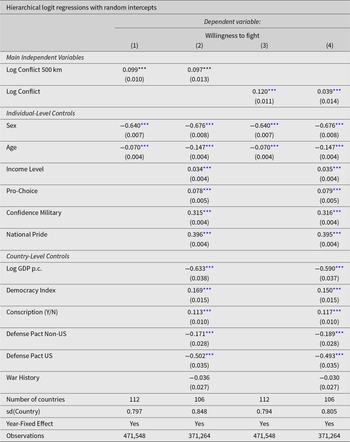
We centered all non-dichotomous independent variables around a mean of zero. We run four models: Model 1 only controls for sex and age. In Model 2, we add additional individual- and country-level control variables. Models 3 and 4 are the same as Models 1 and 2 except that we replace our main independent variable (Log Conflict 500 km) with our dynamic independent variable (Log Conflict Dynamic).
Results
The results are reported in Table 2. Notably, our main independent variables are positively correlated with citizens’ willingness to fight throughout all models and highly statistically significant. This strongly supports our hypothesis. Thus, we are able to produce considerable evidence that proximate conflict increases citizens’ willingness to fight.
Regression results from a hierarchical model with random intercepts by country.

* Note: p < 0.1; **p < 0.05; ***p < 0.01.
Importantly, most control variables behave as expected, confirm previous results, and are further providing evidence that the WVS/EVS willingness to fight item is multidimensional. Both being female and increasing age decrease the likelihood of respondents answering with ‘yes’, a result observed in previous studies and intuitively logical.Footnote 48 However, our focus group research revealed some interesting nuance. Concurring with the quantitative findings, female participants in these groups were more hesitant to claim that they would be willing to fight for their country. Yet, this seemed to be largely driven by specific concerns related to their role as a woman, including the risk of sexual violence and the physical demands of combat roles, instead of a general aversion to violence. For instance, female participants frequently raised concerns about their ability to engage in heavy lifting and other demanding physical tasks. Nevertheless, many women expressed a readiness to contribute to national defence through alternative roles, such as intelligence or support services, which they often regarded as falling outside of the scope of the willingness to fight question.
With respect to measures related to affluence, GDP p.c. is negatively related to the willingness to fight. However, surprisingly, the pro-choice PCA is positively related. Another dimension of the willingness to fight item which previous studies had looked at and which we can confirm with our results is the value placed on one’s own country. We find that individuals with patriotic feelings are more willing to fight for their country. In addition, we find that citizens in democracies seem to have a higher likelihood of answering ‘yes’. Related, our focus group research showed that students heavily prioritized fighting for a country that corresponded to their own liberal-democratic values. This supports our findings, indicating that democracies may possess a greater capacity to motivate their citizens to engage in combat for their cause.
Lastly, we included additional controls in our analyses to account for the defence history and defence policy dimension of the dependent variable beyond our main proximate conflict regressor. Our results show that a country’s history of war is negatively related to citizens’ willingness to fight, but statistically insignificant. However, being on the receiving end of a defence commitment is negatively related to our dependent variable and statistically significant. Lastly, military conscription increases the willingness to fight. Intuitively, it seems reasonable that having a substantial share of citizens partake in military service would increase their willingness to fight. Moreover, because women are often sparred from conscription service, this would further explain the observed gender gap. However, we do not want to imply causality. Indeed, the effect’s direction could also be reversed: In countries with conscription, citizens may feel obliged to respond more affirmatively due to societal or legal repercussions.
One notable result that diverges from existing literature is the positive correlation between income levels and citizens’ willingness to fight. This might be explained by the more nuanced approach taken by Anderson, Getmansky, and Hirsch-Hoefler. In their analysis, they divide income into five quintiles and interact each quintile with the country-level Gini index. They then conclude that in high-inequality countries, income negatively affects respondents’ willingness to fight.Footnote 49 However, since income levels are not central to our study, we chose to control for them without replicating their method, as doing so would have unnecessarily complicated our model. When applied in this manner, our results align with previous findings, which show that when income is used as an unconditional control, it positively correlates with citizens’ willingness to fight.Footnote 50
Regarding substantive effects, Figure 9 shows the predicted probability of change in the willingness to fight variable. The x-axis depicts our main independent variable, the proximate conflict score within a 500 km radius, combining minor conflicts and wars over the past decade. As pointed out before, wars are weighted with a factor of 2 in our independent variable. Consequently, certain countries register scores exceeding 50, with some even surpassing 100. All independent variables are held at their mean. The predicted probability visualizes Model 2 of the regression table. Even after controlling for a broad range of individual- and country-level factors, our independent variable still significantly impacts the proportion of willingness to fight, altering it by up to 0.08 proportion points.
Predicted probability of change in the willingness to fight by score of proximate conflict.

Robustness tests
To assure the robustness of our findings, we conducted a wide range of additional analyses. All results are reported in the Appendix.Footnote 51 First, we re-run our analyses with the inclusion of different time frames. Instead of summing up proximate conflicts in the past ten years, we now sum it up for the past five and fifteen years.Footnote 52 In both analyses, the results remain unchanged. Lastly, we add a survey weight variable and rerun our main model.Footnote 53 This produces results that are consistent with our original analysis, providing additional assurance in the validity of our findings.
Besides these methodological tests, two more substantial objections to our findings might relate to the very nature of our data. First, given that the WVS/EVS encompass over a hundred countries, including numerous autocracies, there are inherent challenges that accompany the breadth of our sample. This diversity enhances the external validity of our conclusions but introduces conceptual complexities. Specifically, individuals in autocratic regimes may be disinclined to express their genuine views, a hesitancy that could be particularly pronounced when questions pertain to their willingness to defend their country –an issue potentially interpreted as a referendum on the allegiance to the ruling government. To mitigate this concern, we subset our dataset to include only those countries that score 0.7 or above on the V-Dem Polyarchy Index.Footnote 54 The results confirm our original findings.
Second, our data include all types of conflict from the UCDP dataset: extra-systemic, interstate, intrastate, and internationalized intrastate. However, one could argue that interstate conflicts affect citizens in nearby countries differently than civil conflicts. Accordingly, we rerun the model including only interstate conflicts. While the effect direction remains unchanged, this diminishes the statistical significance of the independent variable in one of our four models.Footnote 55
In summary, thorough testing across various configurations of our regression analysis consistently shows that the results retain their direction and statistical significance. We take this as evidence that citizens are indeed influenced by the conflicts in their surroundings, which shape their beliefs about war in the international system, resulting in an observable increased willingness to fight.
Conclusion
A declining willingness to fight was introduced to peace and conflict studies as the individual-level basis for the long peace.Footnote 56 In this article, we plead for a more nuanced view on citizens’ willingness to fight. First, a declining willingness to fight is not just another long-term trend towards post-materialism and emancipation. As the last wave of the WVS/EVS shows, the willingness to fight has, on average, gone up again even though we have not seen a decline in wealth. This, we argue, is because the willingness to fight does not only reflect the value attributed to one’s own life but also the value attributed to one’s own country, the defence policy environment, and threat perceptions. We have shown that armed conflict in a society’s neighbourhood leads to an increase in citizens’ willingness to fight, not because it depresses life opportunities or the appreciation of one’s own country but because it acts as a reminder that war has not disappeared.
Second, we caution against the idea of a straightforward and strong connection between a rising willingness to fight and rising numbers of armed conflict because both variables in this equation are subject to multiple influences: As the example of Nordic countries illustrates, a high willingness to fight for one’s country does not necessarily imply expansionist ambitions but can also signify a preparedness to defend liberal-democratic values.Footnote 57 Most importantly, the decline of violence and warfare in particular has been attributed to a battery of structural factors that operate independently of the willingness to fight.Footnote 58 If one accepts deterrence as an explanatory factor of the long peace, a high willingness to fight for one’s country no longer appears alarming at all. In fact, like any unilateral measure of disarmament, a declining willingness to fight may also make countries vulnerable to less pacifist-minded ones.Footnote 59
Looking into the future, we belief that there could be an additional emphasis put on a more nuanced measurement of citizens’ willingness to fight. The WVS/EVS has provided scholars with highly valuable data across many countries and over a period of forty years. To fully understand the drivers and consequences of the willingness to fight, however, additional research into citizens’ interpretation of this question and into the link between such attitudes and actual conflict is required. For instance, researchers might want to focus on the precise circumstances under which citizens are willing to engage in armed conflict: Are they willing to defend their country, no matter the domestic political situation? Would they protect their families with arms? Their hometown, but not perhaps far away regions in their country? What about supporting war efforts by other means (intelligence gathering, production)? These and similar questions will be crucial to answer in future research on citizens’ willingness to fight.
Our research carries also policy relevance. In recent years, policymakers across the world started to pay attention to the societal preparedness for war. In a recent report by RAND, it was argued that the ‘will to fight is the single most important factor in war’.Footnote 60 Russia’s invasion of Ukraine has underscored that even the wealthy Western societies now have to prepare for war. This has led to a renaissance of the ‘whole-of-society’ and integrated approaches to security. For instance, the new Dutch Security Strategy, released in 2023, speaks of the active role which citizens, civil society and private organizations have in the ‘division of responsibility for national security within the Kingdom’.Footnote 61 Understanding how the growing threats influence public opinion, and how the public views on national defence are formed, is of fundamental importance for policymakers.
Supplementary material
The supplementary material for this article can be found at https://doi.org/10.1017/eis.2025.12.
Alexander Sorg is a postdoctoral Stanton Nuclear Security Research Fellow at Harvard University’s Project on Managing the Atom. Prior to joining Harvard University, Alexander worked as a postdoctoral researcher at Sciences Po Paris, and the Free University Amsterdam. Alexander holds a Ph.D. in International Affairs from the Hertie School in Berlin.
Wolfgang Wagner is professor of international security at the Vrije Universiteit Amsterdam/The Netherlands. He has published widely on the security and defense policies of liberal democracies with special attention for the role of parliaments and political parties. Recent publications include The Democratic Politics of Military Interventions. Political Parties, Contestation, and Decisions to Use Force Abroad (Oxford University Press 2020) and Political Parties and Foreign Policy (special issue of Foreign Policy Analysis 2020, co-edited with Tapio Raunio). More information on his work can be found at wolfgang-wagner.org.
Michal Onderco is Professor of International Relations at Erasmus University Rotterdam and is also affiliated with Peace Research Center Prague at Charles University in Prague. He holds a PhD in Social Sciences from Vrije Universiteit Amsterdam.
Acknowledgements
This research was generously supported by the Small Projects for NWA routes 2020 (project number: NWA.1418.20.021) within the Dutch Research Agenda (NWA), financed by the Dutch Research Council (NWO). We extend our sincere gratitude to Ethan Corbin, Isabelle Duyvesteyn, Tine Molendijk, Lonneke Peperkamp and Ainė Ramonaitė. Additionally, we appreciate the feedback and engagement of participants at the research seminars hosted by Vrije Universiteit Amsterdam, Charles University, the Hertie School and the EISA PEC 2023 conference.




 Open access

