

Discoveries that took years of work and millions of dollars in investment here in the United States can be stolen by computer hackers or carried out the door by an employee in a matter of minutes. This theft is not just wrong; it poses a grave threat to our national security. (Sessions, Reference Sessions2018)
Introduction
In May 2020, the Federal Bureau of Investigation (FBI) arrested Ohio State University immunologist/rheumatologist Song Gou Zheng in Alaska, while he was en route to China. The U.S. Department of Justice charged Zheng with grant fraud and making false statements for failing to disclose to his employer and to the U.S. National Institutes of Health (NIH) that he was a participant in China’s Thousand Talent Program (TTP) while he was receiving $4.1 million in NIH grants, and for failing to declare any potential conflicts of interest from this foreign affiliation—both of which are required under NIH grant rules. The U.S. government alleged that Zheng had used his TTP affiliation to transfer scientific knowledge developed under his NIH grant in the United States to Sun Yat-sen University in Guangzhou, China. In commenting on the case, Assistant Attorney General for National Security John C. Demers stated, “Yet again, we are faced with a professor at a U.S. university, who is a member of the Chinese Talent Plan, allegedly and deliberately failing to disclose his relationship with a Chinese university and receipt of funds from the Chinese Government in order to obtain millions of dollars in U.S. grant money … to supplement the research goals of the Chinese Communist Party” (U.S. Department of Justice, 2020b). Zheng was charged with one count of fraud or bribery concerning programs receiving federal funds, a crime punishable by up to 10 years in prison, and one count of making false statements, which is punishable by up to five years in prison. Zheng was placed on administrative leave without pay from Ohio State and—having been deemed a flight risk—held in jail without bond. In November 2020, he pleaded guilty to making false statements to federal authorities. In May 2021, Zheng was sentenced to 37 months in prison for making false statements to federal authorities; he was also ordered to pay more than $3.4 million in restitution to the NIH and $413,000 to the Ohio State University (U.S. Department of Justice, 2021b).
That same year, the high-profile arrest of Harvard University scientist Charles Lieber, the first non–Chinese American charged with failing to disclose his affiliation with the TTP, brought further academic, media, and policy attention to the TTP (U.S. Department of Justice, 2020f). Like Zheng, Lieber was charged with lying about his contribution to the TTP and failing to disclose funds that he had received from China, including a $50,000 per month salary, $150,000 in annual living expenses, and a $1.5 million grant to establish a research laboratory at Wuhan University of Technology, China (Pietsch, Reference Pietsch2021). In December 2021, Lieber was found guilty of lying to federal authorities, falsifying tax returns, and failing to report foreign finances. As of this writing, his sentencing was pending (U.S. Department of Justice 2021c; Pietsch, Reference Pietsch2021).
Zheng’s and Lieber’s cases are only two of several law enforcement, private-sector, and university investigations into scientists recruited under China’s TTP that have been launched since 2018 (see U.S. Department of Justice, 2020d). The charges against the scientists tend to be similar—failing to disclose their affiliation or the receipt of funding from the TTP, receiving U.S. and Chinese funding for similar work, and failing to declare potential conflicts of interest with this work. The Department of Justice and the FBI maintain that China uses its TTP to recruit individuals with knowledge or access to cutting-edge science and technology (S&T) research and U.S. intellectual property in order to benefit China’s military and economic ambitions. To counter Chinese influence and stem the flow of U.S. S&T knowledge and technology to China, the FBI launched the “China Initiative” in 2018. Two years later, FBI director Christopher Wray noted the intensity of this effort: “We’ve now reached the point where the FBI is opening a new China-related counterintelligence case about every 10 hours” (Wray, Reference Wray2020). Yet, to date, only one of the cases involving life scientists has been confirmed as an economic espionage case; in all the other cases, charges centered on the individuals’ false statements and concealment of their participation in the TTP and related funding. But there was no determination that these individuals’ work actually helped China’s military ambitions. So, the question remains: is the TTP truly helping to enhance Chinese security ambitions?
In this article, we examine China’s TTP and the claim that it might support China’s military ambitions. At the heart of the controversy over the TTP are core questions that remain unaddressed and need to be given more attention: What is required to develop and transfer knowledge that can further a country’s S&T ambitions, particularly in the realm of security? And can the knowledge of a visiting scientist be easily used to further a country’s ambitions? To date, security discussions about the TTP have centered on a narrow definition of knowledge that focuses on explicit knowledge but does not capture other essential dimensions that have been shown to shape S&T developments, including in the military field—namely, tacit knowledge, as well as the social, political, managerial, and economic contexts necessary to ensure the effective transfer and use of such knowledge. We draw on literature from the field of science and technology studies to contextualize the TTP and discuss the key issues that should be considered in evaluating whether and how scientific contributions to the TTP by visiting scholars can actually support innovation and military developments in China. In this article, we focus on life sciences, but the analytical framework presented here also applies to other scientific fields.
To provide important background information on this problem, we first give an overview of the TTP’s origins and recruiting process. We then discuss the evolution of U.S. government views about the TTP, particularly the FBI’s China Initiative, and the resulting policy of sanctions against U.S.-based contributors to the TTP.Footnote 1 In the second part of the article, we provide an overview of the overlooked dimensions of knowledge development and use in the life sciences, particularly as applied to weapons developments, to highlight the key elements of the successful use of expertise in the S&T field. We then discuss how the TTP actually operates and the challenges that it faces in order to understand whether the expertise of visiting scholars can be effectively used to promote Chinese security ambitions.
This article bases its analysis on two major sources of information: (1) open-source materials about China’s TTP and known FBI investigations and arrests of TTP recipients, and (2) published literature on Chinese S&T developments. We analyzed these data using a set of themes identified from existing STS literature pertaining to knowledge transfer and use, including studies related to the use of science in weapons developments (e.g., tacit knowledge, social construction of S&T, management, organization), as well as themes that emerge from the local economic and political contexts (e.g., cultural revolution, indigenous innovation). This methodology allowed us to identify the challenges to knowledge transfer under the TTP. These aspects of the TTP have not been considered thus far in security discussions, resulting in an inaccurate assessment of the threat that the program poses to U.S. security, and possibly in unwarranted sanctions and penalties.
We end this article with a discussion of the importance of generating a more accurate understanding of how knowledge transfer and development works, how such understanding will yield more beneficial intelligence collection and analysis as it relates to the TTP, and alternative policy responses. Ultimately, this article aims to provide an analytical framework that can yield more accurate assessments of the security threat posed by international scientific cooperation programs such as the TTP, and more beneficial policymaking vis-à-vis U.S.-China relations in S&T.
Origins of China’s Thousand Talents Program
Interestingly, the TTP is an attempt by the Chinese government to reverse the brain drain that has plagued the country since the Cultural Revolution. Chinese scholars trace China’s need for “talent” to the Cultural Revolution of the 1960s and 1970s, which caused economic devastation but also led to the persecution of notable scholars and scientists and the closure of schools and universities (Andreas, Reference Andreas2009; Appelbaum et al., Reference Appelbaum, Cao, Han, Parker and Simon2018; Chandra, Reference Chandra1987; Wei & Brock, Reference Wei and Brock2012; Yang, Reference Yang2015). The resulting deficiency in China’s educational system and the lack of Chinese intellectuals, including scientists and other professionals, stymied China’s development as a nation. In the late 1980s, to remedy these shortcomings, the Chinese government sent students and other professionals abroad for training and study to bring new knowledge back to China and thus improve China’s educational system. Unanticipated by Chinese officials at the time, this decision led to many of China’s best students and experts choosing to stay in Western countries after their studies, further hindering China’s development (Yang, Reference Yang2015). From 1985 to 2006, the average return rate of students back to China was 25%; Chinese government officials had expected a 90% return rate (Cao, Reference Cao2008, pp. 336–337). In response to this significant brain drain, starting in the 1990s, the Chinese government began to focus its attention more on building up its universities and attracting and retaining talent, launching its first “talent” programs to attract Chinese émigrés back to China (Cao et al., Reference Cao, Bas, Wagner and Jonkers2020; Farrer, Reference Farrer2014; Robbins, Reference Robbins2016; Simon & Cao, Reference Simon and Cao2009; Wang et al., Reference Wang, Wang, Liu, Altbach and Salmi2011; Yang, Reference Yang2015; Zhang et al., Reference Zhang, Patton and Kenney2013).
Moving into the twenty-first century, Chinese leadership—including not only Chinese political leaders but also the CEOs and heads of Chinese multinational corporations—emphasized the importance of turning China from a country known for cheap labor and manufacturing into one focused on innovation and a knowledge-based economy (Appelbaum et al., Reference Appelbaum, Cao, Han, Parker and Simon2018; Farrer, Reference Farrer2014). Chinese officials acknowledged that the country’s traditional emphasis on rote and passive learning in the classroom would not prepare Chinese young people to compete in a complex, changing global environment (Loh & Teo, Reference Loh and Teo2017; Mulroney, Reference Mulroney2015; Simon & Cao, Reference Simon and Cao2009). To address these problems, Chinese leaders realized that existing talent efforts were not sufficient, and so the Chinese Communist Party became more intimately involved in increasing the government’s attention and efforts toward talent development in national planning (Simon & Cao, Reference Simon and Cao2009; Yang, Reference Yang2015).
As a result of this new approach, China issued the 2006 Medium- and Long-Term Plan for the Development of Science and Technology (2006–2020), which emphasized “brain” over “brawn” in China’s global leadership position (Cao & Simon, Reference Cao and Simon2006). One of the policies that resulted from this plan was the creation in 2008 of a more ambitious recruitment effort, known as the Recruitment Program of Global Experts, or Thousand Talents Program, the aim of which was to recruit, within 5 to 10 years, 2,000 highly qualified foreign and returning Chinese scholars from abroad. The qualifications were defined broadly as PhD degree holders, including Chinese scientists under 55 years of age and foreigners under 65 years of age. All candidates were required to have worked at a well-known foreign university or scientific establishment and to have a strong publication record. The TTP primarily recruits professors and other specialized experts in science, engineering, and mathematics, although some of the recruits were from the fields of social sciences, humanities, and arts. The goal of this program was for TTP faculty to spend time at Chinese universities and research centers and then transfer their acquired knowledge and skills back to Chinese students and scholars to improve the Chinese educational system, in turn building up China’s S&T knowledge and innovation base (Farrer, Reference Farrer2014).
In 2010, China issued another plan—the National Medium- to Long-Term Human Talent Development Plan (2010–2020)—to recruit more talent and enhance innovation (Cao et al., Reference Cao, Bas, Wagner and Jonkers2020; People’s Republic of China, 2010). The plan called for the establishment of a variety of additional national programs to support, develop, and attract talent (Cao et al., Reference Cao, Bas, Wagner and Jonkers2020; Simon & Cao, Reference Simon and Cao2009; Wang et al., Reference Wang, Wang, Liu, Altbach and Salmi2011), and it mandated that all provinces and central Party and state departments create their own talent development plans, using the national plan as a guide (Yang, Reference Yang2015). As a result, several regional administrations (e.g., Shanghai, Shenzhen, Beijing, Hubei) established their own TTPs for recruiting overseas talent who would be placed at universities and research facilities within their jurisdictions. These talent programs would aim to recruit highly skilled and expert Chinese emigrants back to China to help develop its universities and industries. In 2011, the scheme was extended to foreigners, and an additional Youth Talents Plan was created to attract promising researchers under the age of 40 (Jia, Reference Jia2018a). By the late 2000s, these various talent programs—estimated at about 200 different programs (Joske, Reference Joske2020)— increasingly targeted foreign scientists with the aim of bringing English and other important language skills to Chinese students and researchers, to more effectively compete in the global research and industry environment and to raise China’s global university rankings, which required increasing numbers of foreign students and faculty on their campuses (Farrer, Reference Farrer2014).
The TTP recruiting process
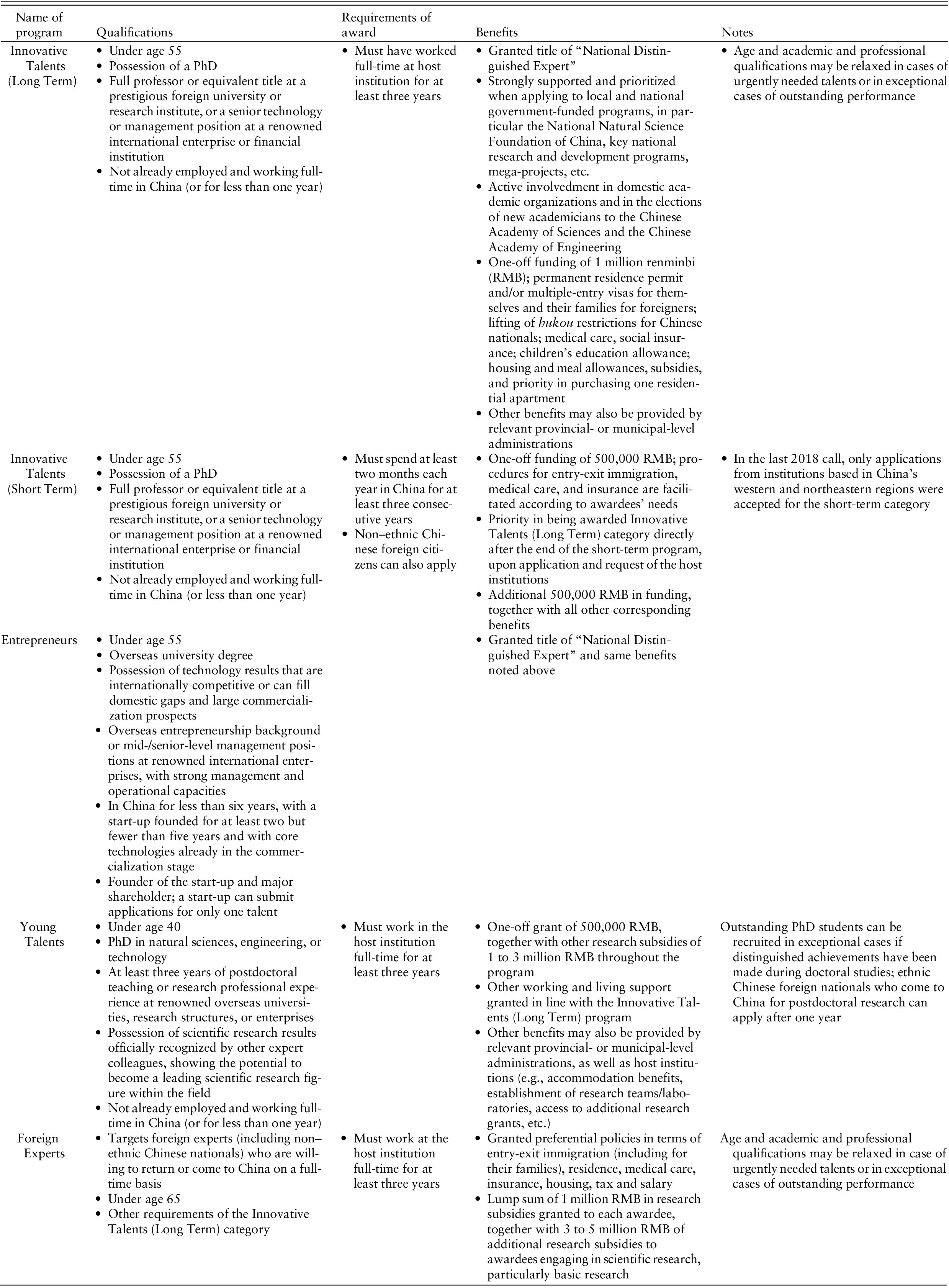
The TTP is a grant system that provides Chinese universities with the opportunity to receive funding set aside by the Chinese government to recruit expert talent from abroad. This funding is awarded in addition to the amount that each university already receives from the government to hire faculty. While the TTP is administered by the Chinese government, there is no set compensation package for faculty hiring. Instead, universities work with candidates to create very generous financial and other arrangements, such as royalty packages for intellectual property and flexible working conditions, as part of the hire (Robbins, Reference Robbins2016). TTP professors may also receive additional perks, such as accommodation subsidies, meal allowances, relocation compensation, paid home visits, spousal hire accommodations, and preferential treatment for housing, medical care, children’s education, permanent residency, and multi-entry visas (Hairong, Reference Hairong2011; Jia, Reference Jia2018b). In addition to recruiting overseas faculty, China’s talent programs can also recruit entrepreneurs and other individuals working in the private sector, to work in Chinese state-owned enterprises, high-tech development zones, and industrial parks (U.S. Senate, 2019, p. 21). Moreover, there are many variants of the TTP with different requirements. Some TTPs require a multiyear full-time employment commitment in China, whereas others only require a two-month China commitment; the compensation also varies according to the type of talent program the individual is recruited under. Table 1 provides a summary of these different programs (European Union, n.d.).
When a prospective expert is identified by university faculty or officials, sometimes with the help of recruiters based overseas (Joske, Reference Joske2020), the sponsoring university submits an application to the Chinese government, and a subsequent interview of the candidate is arranged (Jia, Reference Jia2018b; Robbins, Reference Robbins2016). The government then assesses that candidate’s qualifications and how they fit within China’s five-year plans and national S&T priorities. The results of this assessment determine whether the university receives funding from the TTP to recruit that individual (Robbins, Reference Robbins2016). Although the approval process can be completed in a few months, it can take longer to put in place the administrative and financial arrangements for each contract (Jia, Reference Jia2018b).
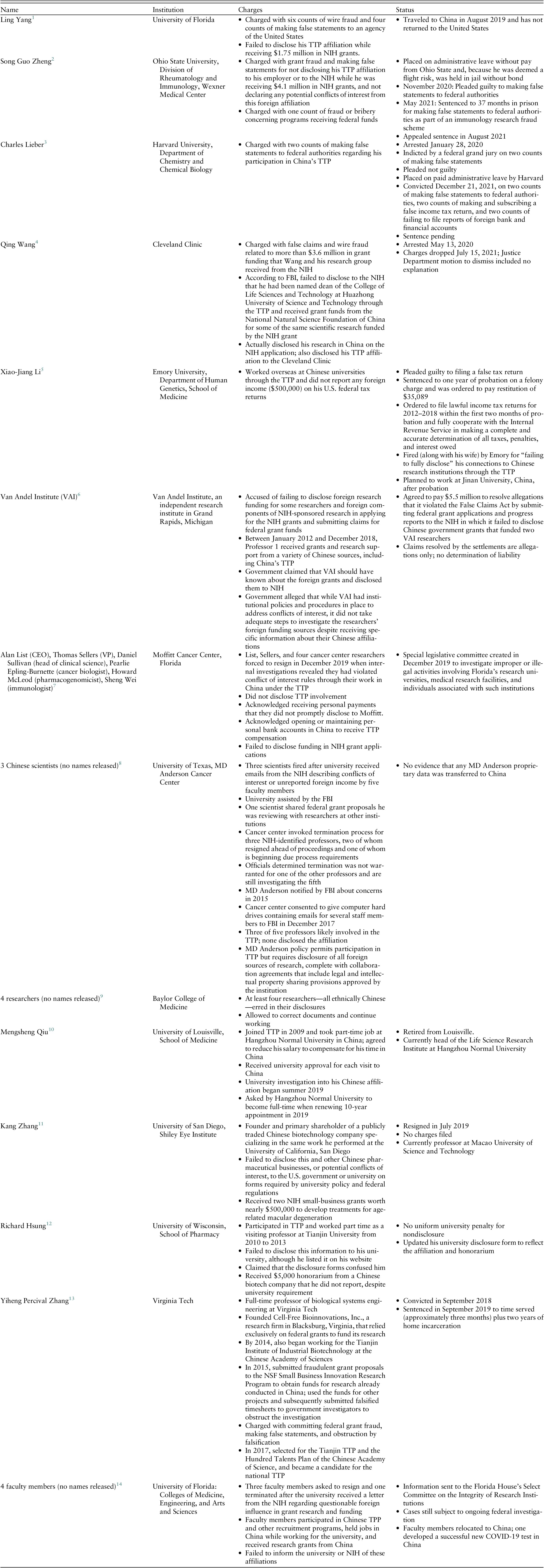
It is difficult to identify the exact number of TTP recipients to date because of limitations in access to Chinese government data. Therefore, existing estimates vary greatly. For example, the Chinese government claims that between 2008 and 2016, the various talent programs recruited 60,000 scientists and entrepreneurs from overseas (Joske, Reference Joske2020). Other sources provide more conservative numbers; one source estimates that between 2008 and 2018, the TTP (and its subsequent iterations) attracted more than 7,600 scientists and engineers to China, including 3,500 under the Youth Talents Plan and 390 foreigners (Jia, Reference Jia2018c). Because of China’s stated policy of expanding its biotech industry,Footnote 2 the TTP has been especially focused on recruiting talent in the life sciences and biotechnology. According to Dan Zhang, former secretary-general of the TTP, “The life sciences committee for biotech is one of the largest groups in the [TTP] programme. We’ve recruited more than 1,400 people, from both science and industry—including company founders, chief scientific officers or leading academics” (Ellis, Reference Ellis2018). Chinese S&T scholar Cong Cao estimates the number of expatriate Chinese life scientists on the faculties of American universities at approximately 2,500, which gives further impetus to target these faculty through the talent programs (Appelbaum et al., Reference Appelbaum, Cao, Han, Parker and Simon2018, p. 9). Within the Youth Talents Plan, life scientists make up the largest number of awardees (Appelbaum et al., Reference Appelbaum, Cao, Han, Parker and Simon2018, pp. 10, 28). Thus, life scientists have been a target for recruitment under the TTP, and consequently they have represented several U.S. law enforcement targets since 2018 (see Table 2).
Thousand Talents Program cases involving U.S.-based life scientists and related experts.
1 U.S. Department of Justice, 2021a.
2 Defino, Reference Defino2021; U.S. Department of Justice, 2020c, 2021b.
3 Bikales & Chen, Reference Bikales and Chen2020; U.S. Department of Justice, 2020f; U.S. Department of Justice, 2021c.
4 Nakashima & Nakamura, Reference Nakashima and Nakamura2021; U.S Department of Justice, 2020b; Wilmer et al., Reference Wilmer, Benjamin, Hyun-Soo, Luo and Varghese2021.
5 Mervis, Reference Mervis2020c; U.S. Department of Justice, 2020a.
6 U.S. Department of Justice, 2019b.
7 Mervis, Reference Mervis2020a, Reference Mervis2020b; Moffit Cancer Center, 2019; Griffin, Reference Griffin2019; Griffin, Reference Griffin2020b
8 Ackerman, Reference Ackerman2019.
9 Armstrong et al., Reference Armstrong, Waldman and Golden2019.
10 Armstrong et al., Reference Armstrong, Waldman and Golden2019.
11 Armstrong et al., Reference Armstrong, Waldman and Golden2019; Racino & Castellano, Reference Racino and Castellano2019.
12 Armstrong et al., Reference Armstrong, Waldman and Golden2019.
13 U.S. Department of Justice, 2019c.
14 Griffin, Reference Griffin2020a; Griffin, Reference Griffin2020b.
Changing U.S. government views about the TTP
Despite the recent wave of arrests and investigations of scientists contributing to the TTP, U.S. government views about the TTP have not always been negative. In fact, when the TTP was launched, the U.S. government and American universities viewed it as a positive development and welcomed the opportunity to cooperate with China. The fact that the TTP was launched during the 2007–2008 global financial crisis, when many foreign universities and national governments were facing budget cuts for research funding, might have contributed to this positive view of the TTP. So, it is not surprising that university administrators and faculty welcomed resources from China (Farrer, Reference Farrer2014). However, even when the financial crisis started to subside, the program continued to be viewed as benign, particularly in the life sciences, partly because of the weaknesses of China’s research environment and its underdeveloped applied research base.
For example, among business executives, the TTP was viewed as a benign form of cooperation. Indeed, in 2010, the executive search firm J. Robert Scott informally polled executives from pharmaceutical, biotech, medical devices and diagnostics and healthcare services organizations in the United States and China about the impact of China’s talent programs. According to several of the executives, “China’s programs to develop and attract top talent do not pose a significant threat to US-based life sciences companies in the next decade, but many think they will heavily contribute to making China a truly powerful industry innovator—especially in the areas of drug development, medical devices and diagnostics, drug discovery and health services” (Lundh, Reference Lundh2011, p. 547). They also cited China’s immature life sciences sector, its hierarchical business and research culture, corruption and fraud in China’s academic institutions, along with its relatively weak commitment to enforcing intellectual property rights protections, as the key reasons why it would take time for this industry to develop and be able to compete globally. The executives polled expected only “niche” areas to develop in China, particularly those involving “R&D that will take the longest to migrate out of the United States” (Lundh, Reference Lundh2011, p. 547). The executives further noted it would likely take 20 years to build the human capacity in China necessary to build the infrastructure and applied research base required to create a powerful indigenous biotech/pharma capability.
In the early years of the TTP, U.S. government officials touted the program as a way to facilitate the “open exchange of ideas” between China and the United States and to bring China “into the fold of the rest of the world” (Griffin, Reference Griffin2019). Throughout his administration (2009–2016), President Barack Obama called repeatedly for greater cooperation between the United States and China and stated that he welcomed “the rise of China,” even when the two countries faced economic or security disagreements (Li, Reference Li2016; White House, 2015). During the Obama administration, many U.S. universities expanded their educational and research collaborations with China (British Council, 2012), with the total amount of gifts and contracts from China to U.S. universities from 2013 to 2020 estimated at nearly $1 billion (Lorin & Kochkodin, Reference Lorin and Kochkodin2020). Furthermore, the NIH viewed collaborations with China as good for U.S. biomedical research; it initiated a formal partnership with China on this in 2010 and renewed it in 2015 (National Institutes of Health, 2015). At the time, several universities encouraged their faculty to participate in the TTP (Armstrong et al., Reference Armstrong, Waldman and Golden2019).
U.S. officials’ views of the TTP started to change under the Donald Trump administration, which reversed position and took a more aggressive policy stance toward China, rooting the TTP in the ongoing fight about China’s infringement on intellectual property rights. In December 2017, the Trump administration released a new National Security Strategy that discussed the possibility of restricting visas for science, technology, engineering, and math (STEM) students from certain nations to prevent the transfer of intellectual property to competitor countries (White House, 2017). Although specific countries were not named, this proposal was listed in a section highlighting the theft of U.S. intellectual property by China.
In February 2018, FBI director Wray told a U.S. Senate intelligence committee that China was using professors, scientists, and students in academia to collect intelligence information (Wray, Reference Wray2018). In April 2018, a joint U.S. House of Representatives hearing titled Scholars or Spies: Foreign Plots Targeting America’s Research and Development focused on the Chinese espionage threat to American science. That same month, the National Intelligence Council produced a classified report on China’s TTP (Capaccio, Reference Capaccio2018). And in June of that year, Anthony Schinella (Reference Schinella2018), the national intelligence officer for military issues in the Office of the Director of National Intelligence, stated that China’s foreign talent programs “facilitate the transfer of foreign technology, intellectual property and know-how to advance China’s science, technology and military modernization goals.” Then, in August 2018, NIH director Francis Collins sent a letter to more than 10,000 NIH-grantee universities saying that the agency was investigating multiple research institutions at which researchers had failed to disclose improper support from foreign governments and had shared information on grant applications with foreign entities (Collins, Reference Collins2018a); Collins further testified on this issue at a U.S. Senate committee hearing a few days later and announced a new NIH working group to improve NIH oversight related to this concern (Collins, Reference Collins2018b).
Another national security turn occurred in June 2018, when the FBI’s Counterintelligence Division began a partnership with the three largest university associations—the American Council on Education, the Association of American Universities, and the Association of Public and Land-Grant Universities—to hold regular meetings on these concerns (Brown, Reference Brown2019). There was undoubtably a political element in the Trump administration’s portrayal of the TTP as a tool of Chinese espionage. However, the TTP continues to be viewed as an ongoing security threat under the Joe Biden administration, as will be discussed later.
In addition to these federal-level investigations, states have also started their own investigations into TTP cases. For example, Florida legislators established a new committee in December 2019 to investigate “Chinese meddling in Florida taxpayer-funded research” and the way that research institutions monitor foreign collaborations by faculty members (Mervis, Reference Mervis2020a). This committee was established after six scientists at the Moffitt Cancer Center, including its CEO, were fired after failing to disclose their affiliation with China’s TTP (Mervis, Reference Mervis2020b; Moffitt Cancer Center, 2019). (See Table 2 for details of these cases.)
The FBI’s China Initiative
These actions were all important precursors to the FBI’s China Initiative launched in November 2018, announced by Attorney General Jeff Sessions and led by Assistant Attorney General John C. Demers, who was also in charge of the Justice Department’s National Security Division (Sessions, Reference Sessions2018). The initiative was to focus on countering Chinese espionage efforts in the United States by identifying “priority Chinese trade theft cases,” “reviewing [foreign] investments and licenses in U.S. infrastructure and telecommunications” (Sessions, Reference Sessions2018), and identifying and prosecuting covert foreign agents [e.g., scientists] to include on U.S. university campuses and other research facilities (Armstrong et al., Reference Armstrong, Waldman and Golden2019; Sessions, Reference Sessions2018; U.S. Department of Justice, 2020d, 2020e). Sessions noted that this new focus on China had begun in early 2017 (at the start of the Trump administration), when the Department of Justice charged three people with spying for China (Sessions, Reference Sessions2018).
Statements by Sessions and FBI officials have repeatedly emphasized that China seeks to illicitly or illegitimately acquire U.S. academic and private-sector research and information to advance its scientific, economic, and military development goals (Federal Bureau of Investigation, 2019; Sessions, Reference Sessions2018; U.S. Department of Justice, 2020d, 2020e; U.S. Senate, 2019). These statements are furthered by claims that by doing so, China could save “significant time, money, and resources while achieving generational advances in technology” (Federal Bureau of Investigation, 2019). Thus, the FBI’s China Initiative has cast a very wide net, targeting China’s espionage and acquisition efforts by looking for cases of theft of information, intellectual property, or material; economic espionage; plagiarism; commercialization of early-stage collaborative research; grant fraud; export control violations; and unreported conflict of interest (Brown, Reference Brown2019; Federal Bureau of Investigation, 2019). The FBI has also focused on identifying and prosecuting “non-traditional collectors” (e.g., students, scientists, and professors in STEM areas), otherwise referred to as “recruitment in place”—in other words, individuals based in the United States who send economic, scientific, and technological intelligence from the United States back to China (Armstrong et al., Reference Armstrong, Waldman and Golden2019; Federal Bureau of Investigation, 2019). The various Chinese TTPs are seen by the FBI and other intelligence entities as a key mechanism facilitating this espionage.
Although the China Initiative was born during a period of high tensions with China exacerbated by the Trump administration, concerns about the Chinese TTPs go beyond the Trump administration. Indeed, the FBI under the Biden administration continued to investigate suspected TTP-related individuals, and in October 2021, the CIA announced the creation of a new China Mission Center focused on intelligence gathering on the national security threats posed by China. Additionally, in March 2021, the Biden White House issued new national security guidance on China’s increasing S&T threat (Central Intelligence Agency, 2021; White House, 2021).
U.S. government officials are quick to point out that participation in a Chinese talent plan is not illegal, but they remain concerned about the incentives and the conduits that these programs offer to participants to either willingly or unknowingly transfer to China proprietary/sensitive information or intellectual property created in the United States and paid for with taxpayer funds (Brown, Reference Brown2019). Many FBI and Justice Department officials are troubled by the finding that several TTP recipients failed to disclose their affiliation with the TTP program—even when asked to do so directly by U.S. universities or federal grantmaking agencies. There have also been allegations that some TTP participants receiving U.S. and Chinese funding have conducted duplicate research, often using what the FBI refers to as “shadow labs” in China; others have been caught sending research information, materials, and technology funded and developed in the United States to China (U.S. Senate, 2019). The FBI has also noted that TTP contracts protect China’s right to the patents and other intellectual property developed during the work with the talent plan—which creates an obvious legal problem if the work overlaps with U.S.-funded research and takes place at U.S. universities (Brown, Reference Brown2019).
China Initiative investigations
As of February 2022, 14 investigations were underway involving a total of 28 life scientists with TTP ties, including 17 ethnic Chinese, 6 non–ethnic Chinese scientists, and 5 individuals whose names and ethnicity were not publicly disclosed (see Table 2). A review of these cases shows that, contrary to FBI claims, most of the individuals showed no signs of criminal action or intent that could harm U.S. security interests—that is, they presented no attempt at theft or spying.
In the life sciences, only one was a clear-cut case of criminal intent that could have harmed U.S. economic interests. The case involved Haito Xiang, an imaging scientist who worked for the Climate Corporation, a Monsanto subsidiary (U.S. Department of Justice, 2019a; U.S. Department of Justice, 2019d; Bross, Reference Bross2019; U.S. Department of Justice, 2022). Xiang was intercepted at an airport in 2017 before boarding a plane to China with a one-way ticket. He was transporting proprietary Monsanto information about farming software that aims to improve agricultural productivity. Xiang pleaded guilty in January 2022 and is awaiting sentencing. It is important to note, however, that Xiang was not part of a TTP program.
In all the other cases, the scientists were faulted for not disclosing their ties with the TTP and failing to report their foreign income to their universities and/or federal granting institutions. This “nondisclosure” group includes cases with varying degrees of irregularities or no irregularities at all. One of the most serious offenses in this nondisclosure group was a clear case of attempting to defraud the government by a professor of biological systems and engineering at Virginia Tech, Yiheng Percival Zhang. Zhang falsified National Science Foundation (NSF) grant documents to obtain funding for research he had already done at a Chinese institute and used U.S. grant money for other projects in his biotech company in the United States (see Table 2). Three other cases present clear research integrity problems: the individuals involved seem to have intentionally concealed their affiliation with the TTP and their foreign income but did not commit obvious acts that would threaten U.S. security or economic interests. These include the cases of Charles Lieber, a biochemist at Harvard University; Song Guo Zheng, a immunologist/rheumatologist from Ohio State University; and Xiao-Jiang Li, a neuroscientist at Emory University. All pleaded guilty to making false statements to federal authorities and were sentenced or awaiting sentencing (see Table 2).
Four other nondisclosure cases resulted in resignations or firing but no charges were filed against the scientists, suggesting that perhaps their reporting failures were not viewed as damaging. These include three unnamed scientists who were fired from the University of Texas MD Anderson Cancer Center, six other scientists fired from the Moffit Cancer Center in Florida, one scientist fired from the University of San Diego Shiley Eye Institute, and three others who were forced to resign from the University of Florida College of Medicine—all for similar offenses of not reporting foreign income and affiliation with the TTP against university and/or NIH rules. While the federal investigation in the University of Florida case remains ongoing, the scientists have already relocated to China, and one of them successfully developed a new rapid COVID-19 test in China (Armstrong et al., Reference Armstrong, Waldman and Golden2019).
The remaining four cases did not involve intentional or any misconduct by the scientists. In one case, the nondisclosure fault lay on the home institution. The Van Andel Institute (VAI) in Michigan failed to disclose that two of its researchers had received income under the TTP, stating that because their TTP projects did not intersect with NIH-funded work, they did not need to report, which might indicate that VAI was aware of the researchers’ foreign activities beforehand. Although VAI admitted no liability, it agreed to repay $5.5 million to the NIH for not disclosing foreign ties for two of its researchers (Tucker, Reference Tucker2019). In another case, Baylor College of Medicine was informed by the NIH that three of its Chinese scientists had not disclosed their foreign ties. Baylor decided to educate them about disclosure rules instead of firing them, and no charges were filed (Ackerman, Reference Ackerman2019). In 2020, Qing Wang, a heart disease expert who had worked at the Cleveland Clinic for over 20 years, was charged with making false claims and wire fraud related to funds he and his team had received from the NIH. The FBI claimed that Wang failed to disclose that he had been named dean of the College of Life Sciences and Technology at Huazhong University of Science and Technology through the TTP and received $480,000 in grants from the Chinese government, including funds from the Chinese National Natural Science Foundation. However, the charges were dropped in July 2021 without any comments from the Department of Justice. This seems to indicate that the Justice Department could not find evidence of wrongdoing. Peter Zeidenberg, Wang’s lawyer, stated that Wang had in fact disclosed his research in China on the NIH form. He summed up the case as follows: “Ultimately this came down to whether the grant forms were filled out correctly … The information was all there. It just wasn’t where the NIH was looking” (Nakashima & Nakamura, Reference Nakashima and Nakamura2021).
The final case concerns Mengsheng Qiu, a researcher at the University of Louisville School of Medicine, who, like Wang, was accused of not disclosing his ties with a Chinese university. The case seems to have completely fallen apart since Qiu had informed his university of his work in China and even negotiated a reduction in salary to take into account the time spent away from his U.S. lab. No charges were filed, but Qiu decided to return to China and take a full-time position at Hangzhou Normal University (Armstrong et al., Reference Armstrong, Waldman and Golden2019).
The investigations involving life scientists are only a portion of all the cases pursued under the China Initiative, but they show that the FBI has been pursuing with the same zeal cases that demonstrate an actual intent to harm U.S. interests (only one in the life sciences that did not involve a TTP recipient) and cases that present problems with research integrity but do not constitute a threat to the United States. More importantly, the FBI’s China Initiative has accused a few scientists of wrongdoing when they in fact committed no mistake, and it has chased away scientists who had been working in the United States for many years. In effect, the China Initiative is helping the Chinese government bring people back when their skills could have been used to benefit the United States.
Recently, the FBI’s China Initiative came under fire after a series of cases (involving life and non-life scientists) were dismissed or dropped, while another high-profile case against Massachusetts Institute of Technology (MIT) professor of mechanical engineering Gang Chen was expected to be dropped (Nakashima & Nakamura, Reference Nakashima and Nakamura2022). In 2021, Chen was accused of hiding his ties to the TTP in a grant application submitted to the U.S. Department of Energy and failing to declare $19 million he had received from China’s Southern University of Technical Science in Shenzhen. However, Energy Department officials indicated that when Chen applied for the grant in 2017, there was no requirement to disclose ties to foreign governments or entities. Additionally, the president of MIT stated publicly that the funds received from the Chinese university had been awarded to MIT, not to Chen personally, to support work at his MIT department. The FBI was aware of this disqualifying information but chose not to reveal it until Chen’s defense attorney made the request, raising concerns that other FBI China Initiative cases might not be supported by strong evidence of a crime, as demonstrated by the cases involving life scientists discussed earlier. As a result, Attorney General Merrick Garland requested that the Department of Justice conduct a review of the FBI’s China Initiative (Nakashima & Nakamura, Reference Nakashima and Nakamura2022).
A recent spate of case dismissals also highlights an important weakness of the FBI’s China Initiative: a lack of expertise within the FBI to evaluate whether research done in China or information shared with Chinese colleagues constitute a security threat. This problem precedes the FBI’s China Initiative and was brought to the fore under the Obama administration, when several cases against scientists of Chinese descent were dismissed. One of them concerned Xiaoxing Xi, a professor at Temple University who was accused of sharing documents about sensitive technology with colleagues in China. The case fell apart when leading physicists demonstrated that the documents shared were not related to a restricted superconductor technology, as the FBI had stated. As a result, the Department of Justice issued guidelines in 2016 requiring FBI field officers to coordinate with their superiors in Washington, DC, on cases concerning national security, presumably to make sure the evidence is strong. However, U.S. officials have indicated that such consultation does not always take place in cases of alleged grant fraud (Nakashima & Nakamura, Reference Nakashima and Nakamura2021).
The other obvious weakness of the FBI’s China Initiative is that it does not recognize that individual scientists’ failings may be partly due to the lack of oversight by granting institutions or universities. At the university level, concerns about foreign influence over U.S. universities prompted Congress over 30 years ago to amend the Higher Education Act of 1965 to require institutions of higher education to disclose annually, through self-reporting, gifts from and contracts with foreign sources in the amount of $250,000 or more in one year (Zais, Reference Zais2019, pp. 1–3). However, according to Mitchell Zais, former U.S. deputy secretary of education, although approximately 3,700 higher education institutions in the United States are deemed eligible to report this information, less than 3% documented receiving foreign gifts or contracts in recent reporting (Zais, Reference Zais2019, p. 3).
Federal grantmaking bodies have also shown some lapses in oversight. As a result of the FBI investigations and arrests, several federal funding agencies, such as the NIH and the NSF, conducted internal investigations and issued new policy guidance for their grant programs. For example, since August 2018, the NIH has investigated 189 scientists at 87 institutions (Mervis, Reference Mervis2020d; Mervis, Reference Mervis2020e). For 93% of the 189 scientists whom the NIH has investigated to date, China was the source of their undisclosed support (Mervis, Reference Mervis2020d; Mervis, Reference Mervis2020e). Of the 189 scientists, nearly 70% (133) failed to disclose to the NIH the receipt of a foreign grant, and 54% (102) failed to disclose participation in a foreign talent program; only 9% hid ties to a foreign company, and only 4% had an undisclosed foreign patent (Mervis, Reference Mervis2020e). Some 5% of cases involved a violation of the NIH’s peer-review system (Mervis, Reference Mervis2020e); some of these cases involved individuals downloading confidential grant applications and sending them to China (Armstrong et al., Reference Armstrong, Waldman and Golden2019). As of June 2020, 54 scientists had resigned or been fired as a result of NIH investigations into the failure of grantees to disclose financial ties to foreign governments (Mervis, Reference Mervis2020d).
Similarly, in July 2020, the NSF released data from its Inspector General’s Office indicating that since 2018, the agency had reassigned, suspended, or terminated grants; forced institutions to return funds; or barred researchers from applying for future funding in about 20 cases in which agency rules were not followed (Silver, Reference Silver2020). Separately, the inspector general referred an undisclosed number of criminal and civil cases involving fraud and nondisclosure to the Department of Justice. According to the NSF, all but two of the cases involved ties to China, although a majority of the scientists were U.S. citizens and were not ethnically Chinese (Silver, Reference Silver2020).
The NSF has also taken action to address concerns about Chinese espionage and improper influence in its grant programs. In July 2019, the NSF issued a new policy prohibiting its employees from participating in foreign talent recruitment plans, although the policy did not apply to NSF-funded researchers (National Science Foundation, 2019). However, these raw numbers do not reveal how many of the cases investigated by the NIH and NSF constitute actual misconduct versus simple negligence by the scientists or their institutions or no misconduct at all. The devil is in the details, as demonstrated by several of the cases discussed here.
As important, the NIH and NSF investigations revealed that their oversight of grantees and affiliated institutions was insufficient. Although the NIH has a Division of Grants Compliance and Oversight that can conduct site visits at institutions to check on compliance issues, the number of oversight visits fell from 28 in fiscal year 2013 to only 3 reviews in fiscal year 2018 (U.S. Senate, 2019, p. 56). On the NSF side, a 2019 study from JASONFootnote 3 commissioned by the NSF concluded that a review of classified and open-source information on China’s talent programs indicated “problems with respect to research transparency, lack of reciprocity in collaborations and consortia, and reporting of commitments and potential conflicts of interest” (JASON, 2019, p. 39). In response to the JASON report, the NSF created a new position in March 2020, chief of research security strategy and policy, to develop and implement policy recommendations to improve NSF’s research integrity practices while maintaining scientific openness and collaboration (National Science Foundation, 2020a, 2020b).Footnote 4
The FBI’s China Initiative did not survive the Justice Department’s review. On February 23, 2022, the Department of Justice announced their decision to terminate the China Initiative, and instead create a broader program — the Strategy for Countering Nation-State Threats — that aims to counter hostile activities from a larger group of countries, including China, Iran, Russia and North Korea (Gilbert and Kozlov, Reference Gilbert and Kozlov2022). Whether the new initiative will learn from the mistakes made under the China Initiative remains to be seen. One would certainly hope that the new initiative will have a better-defined mandate to capture only cases where an obvious crime has been committed. The FBI investigations under the China Initiative have included a mixed bag of cases, some showing apparent illicit activity, others with a clear intent to hide TTP affiliations (even when no obvious crime took place), and cases in which no active crime or attempt to deceive could be found. Another key question that has not been addressed thus far by FBI or federal granting institutions is whether contributions to the TTP have or could help advance innovation and security developments in China and the other countries covered under the new Strategy for Countering Nation State-Threats. In the next section, we address this question by first providing an overview of what is required to ensure innovation and technological developments, particularly in the context of foreign technical assistance, and then by analyzing how the TTP actually operate to determine whether it can indeed support innovation and technological progress in China.
The TTP through the lens of science and technology studies
Government officials who view the TTP as a conduit for knowledge transfer or theft often assume that the mere contribution of U.S.-based scientists to the TTP will promote technical innovation and progress in China. Additionally, they assume that with such cooperation, China can save funds and several years of research and development to eventually surpass the United States. These assumptions, however, run counter what empirical studies in the field of science and technology studies (STS) have demonstrated: that knowledge does not transfer easily and requires a specific social and managerial environment to be transferred and used effectively. When those conditions are not present, foreign expertise can in fact impede progress. Other factors, such as the economic and political contexts in which the transfer takes place, can affect whether this knowledge leads to innovation. In this section, we highlight the key conditions required to ensure successful knowledge transfer and use, and then analyze the Chinese TTP context to determine whether it presents these elements.
Essential elements of knowledge transfer and use
Much of U.S. officials’ misunderstanding of the threat posed by the TTP stems from the inaccurate belief that knowledge is one-dimensional and that it can be easily transferred through documents or words. Empirical research about the creation, transfer, and use of technical knowledge, including in the life sciences and weapons development, demonstrates that knowledge is multifaceted, composed of explicit and tacit forms (Ben Ouagrham-Gormley, Reference Ben Ouagrham-Gormley2014; Cambrosio & Keating, Reference Cambrosio and Keating1988; Collins, Reference Collins1985, Reference Collins2001; Jordan & Lynch, Reference Jordan, Lynch, Clarke and Fujimura1992; Mackenzie & Spinardi, Reference Mackenzie and Spinardi1995; Shapin, Reference Shapin1995; Shapin, Reference Shapin1998; Vogel, Reference Vogel2013). Explicit knowledge is the part of knowledge that can be articulated in words, charts, designs, or formulas and transferred easily by tangible means (e.g., publications, documents, emails). Tacit knowledge is the part of knowledge that cannot be easily articulated; it is composed of skills, know-how, and ways of doing things in a laboratory that cannot be transcribed into a tangible form and therefore transferred easily. Scientists are not always aware of their tacit skills, and therefore they often fail to measure their importance for the successful completion of a process or experiment. Furthermore, STS literature shows that explicit knowledge cannot be used effectively without access to tacit knowledge, indicating that documents alone cannot help reproduce an experiment or make tangible headway in technological developments, particularly with complex and cutting-edge S&T. Because tacit knowledge is unarticulated and often subconscious, its transfer requires a direct, long-term interaction between scientists, who by working together side-by-side in the laboratory pass on ways of doing things or skills to their colleagues. The recipient emulates the “trainer” and picks up ways of doing things through practice, sometimes without necessarily noticing that a skill has been acquired.
In some cases, the skill or know-how can be articulated, but it is concealed—not intentionally but because its owner does not measure the importance of the skill for the experiment’s success or is simply unaware that they are doing things in a certain essential way. It is only through direct cooperative work in the laboratory that this knowledge can be revealed. For example, during the Cold War, Western scientists were never able to achieve the same results as Soviet scientists in their measurement of the quality (Q) of sapphire—a step in laser developments—even though they used the same well-known method, which involved suspending a sapphire at the end of a thread rubbed with animal grease to make the measurement. It was only after the breakup of the Soviet Union, by virtue of a scientific exchange, that a former Soviet scientist showed his British colleagues the technique he used, employing oil from human skin instead of animal grease. By rubbing the thread behind his ears or under his nose, the Russian scientist collected oil from his own skin. This little trick made the whole difference in the experiment and was not mentioned in any of the written protocols.
Interestingly, however, whether the tacit skill is fully unarticulated or concealed and revealed, its acquisition requires a long trial-and-error process that may take weeks, months, or even years to be mastered. This is because tacit knowledge often relies on manual skills or visual and other sensory cues that cannot be precisely measured, and mastering them necessitates extended learning and/or experimentation. In the Q sapphire experiment, for example, it took British scientists a year to replicate the Soviet time measurements because they had to experiment with different scientists’ skin oils—some were too oily, some too dry. Finding the right amount of oil was a matter of judgment and experience (Collins, Reference Collins2001).
The challenge of unmeasurable variables is particularly acute in the life sciences, where scientists deal with the added challenge of working with unpredictable biological agents that are highly sensitive to environmental and handling conditions. For example, the 2002 synthesis of the polio virus by scientists at the State University of New York, Stony Brook, hinged on the mastery of a well-known and seemingly simple technique: preparing the cell extract used to grow the virus by crushing bovine cells in a “dounce homogenizer” (a kind of mortar and pestle). However, the production of a good cell extract depends on the amount of strength the scientist uses to crush the cells: too hard and the cells are destroyed, too soft and the cells are not crushed enough. In both cases, the extract cannot be used. As a result, it could take weeks to produce a good cell extract, and some scientists in the Stony Brook lab were better at it than others (Vogel, Reference Vogel2008).
Additionally, knowledge does not transfer automatically and requires a specific social environment to occur. STS literature has shown that a collaborative environment in which people cooperate, communicate, and exchange information freely is more likely to allow knowledge transfer and innovation because scientists can call on the expertise of a variety of team members in their midst (not only that of a visiting scientist), create new knowledge—known as “communal knowledge”—and innovate. In competitive work environments, in which people are more reluctant to share information and collaborate, individual knowledge is not readily available to team members, which impedes innovation. Additionally, trust is an essential element of knowledge transfer: to acquire new knowledge, the recipient needs to trust the competence of the author, but also trust that the experiment can succeed. In the Q sapphire experiment, for example, British scientists were able to replicate Soviet time measurements because, after observing the former Soviet scientist achieve such results in their lab, they trusted that such results were possible (while during the Cold War, they had assumed that Soviet scientists lied about their achievements), and therefore they persevered in their experimentation until they achieved similar results (Collins, Reference Collins2001).
Conversely, conflicts and lack of trust can impede knowledge transfer, however competent the scientist. This is particularly the case when an outsider is the source of this new expertise. For example, in the Soviet bioweapons program, a scientist from Vector, a bioweapons facility in Siberia, was sent to the Obolensk facility near Moscow to help his colleagues achieve better results in their experimentation. However, the Obolensk facility was plagued by conflicts and competition among scientists who did not trust the visiting scientist, assuming that he had been sent to replace them. It took the visiting scientist two years to create his lab in the facility because the management did not easily provide the resources to do so and very few staff members wanted to join his lab, thus effectively precluding the use of his expertise (Ben Ouagrham-Gormley, Reference Ben Ouagrham-Gormley2014). Trust can be even more difficult to achieve when a visiting scientist needs to operate in a different culture and use a different language.
Furthermore, for knowledge to transfer and “stick,” the recipient needs to have sufficient absorptive capacity—that is, a sufficient base knowledge to comprehend and use the new expertise. When absorptive capacity is too low (i.e., when the recipient does not have sufficient knowledge at the start of the cooperation), the new expertise cannot be integrated and used by the recipient and can in fact create delays and impede progress in a project. Additionally, transfers of expertise face the challenge of “technology translation” to a new environment. STS literature has shown that in order to transfer knowledge to a new laboratory or a different country, the visiting scientist needs to adapt their knowledge to the local circumstances, which can be very different from those of the laboratory of origin. Because the host laboratory does not have the same skill set available and may have different laboratory equipment and ways of doing things, the visiting scientist needs to adjust their expertise to the new environment by modifying a practice, a process, or a protocol, thus delaying the transfer.
In addition, testing the new process, practice, or protocol will require some experimentation, which can also be time-consuming (Ben Ouagrham-Gormley & Vogel, Reference Ben Ouagrham-Gormley and Vogel2010). The challenges of technology translation are particularly high when there is a need to replicate past work and operate in a foreign environment, where cultural and language issues may be added to the mix. Foreign technical assistance in the field of weapons development provides several examples that aptly illustrate these points (Ben Ouagrham-Gormley, Reference Ben Ouagrham-Gormley2014; Kelley, Reference Kelley1996; Mackenzie & Spinardi, Reference Mackenzie and Spinardi1995). For example, Libya received extensive support from the covert nuclear supply network operated by Pakistani A. Q. Khan, in the form of centrifuges, bomb designs, and training, among other things. Yet, Libya was never able to use any of Khan’s support because Libyan scientists and engineers lacked the expertise and industrial base to create a nuclear program from scratch. The Libyans’ absorptive capacity was also very limited: when a group of Libyans traveled to Dubai to receive training in centrifuge production from a Swiss acolyte of Khan, they could not master the operation of the complex machine tools (Collins & Franz, Reference Collins and Franz2014). Similarly, Iraq received extensive support from German suppliers in support of its nuclear program, including on-site consultation with German experts, particularly in the production of centrifuges. Yet, it took three years for the Iraqis to build a prototype centrifuge because the equipment and technology received came from different suppliers, which caused integration problems that the Iraqis could not solve. To help overcome these problems, their German consultant offered solutions that required the acquisition of more advanced technology, which, in turn, required more knowledge and created additional integration problems that the Iraqis could not solve with their current level of expertise (Obeidi & Pitzer, Reference Obeidi and Pitzer2004).
It is also important to highlight the role of tacit knowledge in reproducing an experiment or a task, which is an important part of learning when a visiting scientist comes in a lab to teach a new skill to local scientists. As indicated earlier, explicit information in the form of written documents such as protocols, formulas, or even the methods section in a journal article provide an incomplete picture of the knowledge required to reproduce an experiment. Because much of the essential tacit knowledge required is not articulated in these documents, even experts in the field may not be able to reproduce work done by colleagues in a different laboratory. Only the involvement of the authors of the documents in the experiment can provide the missing pieces of the puzzle. For example, in the Soviet bioweapons program, an anthrax production plant in Stepnogorsk, Kazakhstan, was unable to produce the anthrax biological weapon designed at a Russian facility even though it had received over 400 pages of written protocols and samples of the strain from the Russian facility. It was only after the Russian team of scientists who had developed the strain came to Stepnogorsk that they could make some progress. The Russian scientists brought with them the tacit skills and expertise that helped decipher the documents, but also helped adapt the protocols to the local infrastructure. Nevertheless, it took five years of experimentation before they could produce the weapon successfully because they also had to translate the technology to the Stepnogorsk environment, which involved modifying the protocols and time-consuming experimenting and testing of the new process (Vogel, Reference Vogel2006).
Additionally, an experiment is rarely the work of one lone individual, but instead the result of an assemblage of skills available within a team (Mackenzie & Spinardi, Reference Mackenzie and Spinardi1995), where each member performs a specific task that cannot be easily or successfully carried out by another member. As a result, one visiting scientist cannot transfer all the expertise required to replicate an experiment because they lack much of the collective knowledge that was created in the home laboratory—not to mention the fact that the essential stages of an experiment are often performed by postdoctoral researchers or technicians, rarely the principal investigator. As a result, inviting the principal investigator to transmit hands-on laboratory skills may be insufficient and even unproductive.
Reproducibility in the biological field is made even more challenging by the mercurial nature of bioagents, which are very sensitive to environmental conditions, such as temperature or pH, as well as to handling conditions, such as the way a scientist holds a vial or the level of pressure applied to an instrument during an experiment. Additionally, since reagents may present seasonal variations, an experiment may be more difficult to perform successfully at different periods of the year (because of different environmental conditions), even by scientists who have performed the experiment successfully multiple times (Vogel, Reference Vogel2008). A skill learned in one laboratory may also be difficult to reproduce in another laboratory because of the varying environmental conditions and the differing characteristics of the reagents used, including water. In the 2002 polio virus experiment, a Belgian postdoctoral researcher who had learned the technique to produce the cell extract that enables the growth of the polio virus at Stony Brook was unable to reproduce his work at his Belgian laboratory (Vogel, Reference Vogel2013). As a result, the learning of a skill is not complete until it can be translated to the new environment in which it is meant to be used, and this translation process is fraught with challenges.
Finally, several other important factors increase the difficulty of transferring and using knowledge effectively in a new environment. One essential element is the management style prevailing in the laboratory or in a program. Research in STS and weapons development (Ben Ouagrham-Gormley & Vogel, Reference Ben Ouagrham-Gormley and Vogel2010; Kelley, Reference Kelley1996) has shown that management styles that create a social environment conducive to knowledge transfer and learning (openness, unfettered communications, trust) are more likely to ensure progress in an experiment and innovation, while a management style that creates barriers to cooperation and collaboration impedes knowledge transfer and effective use. As a result, even with a higher level of skill, a facility with managers who favor secrecy and limited cooperation will not perform as well as a facility with fewer skills at the outset but with managers who promote the right kind of social environment. In addition, the political environment in a country may affect the way that knowledge is transferred and used. For example, if political leaders interfere in scientific decisions by dictating the direction of research based on their own priorities rather than what scientists know to do, or by promoting individuals who are close to the regime rather than those who have the expertise, the scientific or technological program will suffer (Ben Ouagrham-Gormley, Reference Ben Ouagrham-Gormley2014).
To sum up, the transfer and learning of a new skill is a long-term process that requires extended collaboration, side-by-side experimentation, as well as a social and political environment that favors such exchanges. As we will see in the next section, these conditions are not evident in the Chinese context of many examples of the TTP.
Taking a closer look at the TTP: Progress or problems?
Although the TTP has been touted by U.S. government officials and researchers as a major source of China’s illicit access to science and technologies that could accelerate the country’s economic and security development, a number of studies of the TTP and China’s S&T environment reveal a much different aspect of the TTP that has been largely ignored by U.S. officials. Indeed, several experts have noted that the program faces several shortcomings and problems that could compromise its alleged benefits. Simply put, the TTP has not been able to foster the kind of social, political, and economic environment required for knowledge transfer and use, and for this reason, it is unlikely to yield the results that U.S. officials and the media believe.
One of the major failings of the TTP is that it has not been able to retain scientists for long enough periods of time to ensure knowledge transfer and to make an impact on China’s development. Several Chinese S&T scholars and observers have noted that the number of TTP recipients, a variable that has been the focus of U.S. observers, does not reflect the quality of their work and their actual impact on China’s development. For example, Sharma (Reference Sharma2013) states that the TTP is “not bringing researchers back to stay full-time, commit to the long-term development of China’s S&T sector and nurture future local PhD talent.” TTP recipients often prefer part-time or visiting research positions in China that involve shorter periods of time in the country; they are also unwilling to leave their academic positions in the United States (Appelbaum et al., Reference Appelbaum, Cao, Han, Parker and Simon2018). In some cases, U.S.-based researchers have lied about their commitment to spend extended time in China just to be selected for a TTP position and end up spending shorter amounts of time in China than promised—something that Chinese administrators turn a blind eye to in order to reach their quotas. With limited involvement in Chinese labs’ work, visiting scientists are unlikely to transfer their tacit skills to local scientists and nurture a young generation of researchers that could make an impact on China’s science.
Second, apart from the high-level scientists who have made newspaper headlines, the TTP has not been able to recruit top talent to China (Cao, Reference Cao2008; Farrer, Reference Farrer2014; Sun et al., Reference Sun, Guo and Zhang2017; Tian, Reference Tian2013; Zweig & Wang, Reference Zweig and Wang2013), which further reduces the impact of their contributions to China’s development. David Zweig, director of the Centre on China’s Transnational Relations at Hong Kong University of Science and Technology, states that the overall TTP numbers hide important details: many returnees have included businesspeople and entrepreneurs, as well as those who returned to state-owned enterprises. Zwieg comments, “If you look carefully at the data, and particularly the data for PhDs, then the numbers are not so terrific… . The problem was that the Thousand Talents was really targeting the very best and the very best aren’t the ones coming back” (Sharma, Reference Sharma2013). Sun et al. (Reference Sun, Guo and Zhang2017) concur, adding, “China is experiencing a serious shortage of academics at the high-end, which presents a great challenge to its efforts to build an innovation-oriented country” (p. 276). In addition, TTP faculty have found it difficult to build high-quality research teams in China because most highly qualified Chinese students go abroad for their education (Li et al., Reference Li, Yang, Wu, Barnett and Phipps2018), which suggests that the absorptive capacity of the staff available might not be as high as needed.
Additionally, the TTP has given rise to conflicts and jealousy among some local scientists, who feel like second-class citizens at their universities. Indeed, TTP recipients, even those who choose to stay for longer periods, are not welcomed by their Chinese peers because they are seen as “the favored child,” receiving larger salaries, benefits, institutional resources, and promotions, compared with scientists and experts who have chosen to stay in China. This has created resentment among colleagues and difficult working relationships between scientists in some institutions (Cao et al., Reference Cao, Li, Li and Liu2013; Farrer, Reference Farrer2014; Zweig et al., Reference Zweig, Chen and Rosen2004). This type of relationship between TTP and local scientists is unlikely to create the level of trust required to learn from visiting scholars or the open culture that favors information exchange. To limit the impact of the TTP on local staff, many Chinese university administrators prefer shorter TTP appointments, in which established foreign scholars visit for only a few weeks a year and make no claims on internal resources (Farrer, Reference Farrer2014). Although it is a legitimate response to their staff’s feelings, in limiting the length of scientific visits, university administrators have in fact reduced the impact that the visiting scientists can have on local staff and the visiting scholars’ commitment to sharing their expertise in the lab, two factors that limit knowledge transfer. As China scholar James Farrer (Reference Farrer2014) writes, “such a tenuous attachment to the institution … could scarcely have the spillover effects on furthering research and innovation that government planners associated with ‘internationalization’” (pp. 406–407).
Compounding these problems, the connection between TTP scientists and their host university is made more tenuous by the challenges of navigating the cultural system of Chinese science, in which research funding is based less on results and peer review and more on personal connections (guanxi) with Chinese science administrators and bureaucrats (Yu, Reference Yu2014). In this context, certain “research monopolies” tend to get all the Chinese government research funding (Gold et al., Reference Gold, Guthrie and Wank2002; Han & Appelbaum, Reference Han and Appelbaum2018; Tang, Reference Tang2019). Therefore, TTP recipients who have been based in the West (including both returnee Chinese nationals and foreigners) and outside the Chinese science system for several years are at a disadvantage because they “lack knowledge of the rules of the game and have little access to the social ties that can bring success in key areas such as promotions, grants or even such minor stakes as office space” (Farrer, Reference Farrer2014, p. 414). Many TTP recipients have felt disadvantaged in receiving additional Chinese government research funding (beyond their initial start-up package), which can make it difficult to commit and make long-term progress in their scientific work (Farrer, Reference Farrer2014; Jia, Reference Jia2018c; Li et al., Reference Li, Yang, Wu, Barnett and Phipps2018). In some cases, TTP recipients have not received the research funding they were promised, or universities have “reallocated” some of these funds for other purposes (Hvistendahl, Reference Hvistendahl2014).
Moreover, the management style of China’s science and of the TTP program by central authorities and universities creates barriers to the effective transfer of expertise from TTP recipients and makes it harder for Chinese universities to benefit from the visiting scientists. Indeed, universities often use the TTP as a tool of promotion and power, rather than a means to improve local science. Universities benefit from the TTP by being able to recruit high-profile experts to list on their rosters and being able to cite high-impact publications from these TTP recipients. Universities also receive their own dedicated funding if they have supported a selected TTP candidate, and having TTP awardees is used in performance evaluations of universities (Hvistendahl, Reference Hvistendahl2014). This has led to situations in which personal and university motivations and agendas have affected the effectiveness of the TPP—universities have brought in experts who did not fit into the university’s research needs (Farrer, Reference Farrer2014) or kept money promised to TTP recipients (Hvistendahl, Reference Hvistendahl2014).
In other cases, some local administrators and academic departments have used the TTP to gain local power politically, rather than to address local talent shortages or advance research; scholars note there is little supervision and evaluation of these programs (Yang, Reference Yang2015). Others have noted that China’s pressure to “catch up” and become a world S&T leader has led to a focus on short-term results in these talent programs (e.g., number of research publications, journal impact factors), instead of a focus on the quality of the science and investment in a coherent, consistent, long-term research trajectory for scientists within the TTP (Han & Appelbaum, Reference Han and Appelbaum2018; Yang & Marini, Reference Yang and Marini2019). As a result, the effectiveness and impact of these talent programs on the larger policy goal of developing China’s S&T and innovation base and educational system remain doubtful. In fact, a recent study found that TTP recipients have negatively affected the research output (number of publications and citations) of their Chinese colleagues who were hired before the TTP (Jia & Fleischer, Reference Jia and Fleisher2020), suggesting an adverse effect on overall Chinese scientist productivity.
Finally, it is important to highlight the potentially negative role that central management can have on the program’s objectives. Although many have touted the role that the Chinese central government plays in organizing, overseeing, administering, and coordinating talent recruitment efforts, surveys of domestic Chinese scientists reveal that excessive government interference in directing scientific research has hindered innovation. Many of the government bureaucrats holding power over science may not have technical expertise related to their portfolio (Han & Appelbaum, Reference Han and Appelbaum2018), and so they may not make decisions based on the best science or the best scientific strategy. As China S&T scholar Benjamin Shobert (Reference Shobert, Fei, Shobert and Wong2016) writes, “the underlying ecosystem that supports meaningful innovation does not yet exist” (p. 37). Yanzhong Huang (Reference Huang2014) adds that as a result, China lacks sufficient indigenous innovation to make it a threat to U.S. and other leading innovation centers. Zweig argues that China needs to overhaul its universities and research system and move power away from Chinese bureaucrats in order to attract more permanent returnees to build up indigenous innovation. As this major restructuring is unlikely, Zweig argues that the Chinese might “have reached their peak” in these talent programs (Sharma, Reference Sharma2013).
Therefore, China may have poured a lot of money into these talent programs, but this investment is not likely to significantly further its larger policy goals of self-sustaining, indigenous innovation that can compete with the West. The TTP has failed to create the kind of social context that can further knowledge transfer, while China’s cultural context and management of the program by university and central authorities have created additional roadblocks to the integration of TTP scientists into the local scientific environment. It is quite possible that the TTP has increased China’s S&T capabilities substantially beyond where they were in the aftermath of the Cultural Revolution. However, the expertise gap created by the Cultural Revolution, the subsequent brain drain of Chinese students and scholars, and the continued deficiencies in the Chinese educational system, have created major structural, cultural, and social problems that pose challenges for the TTP alone to make China a global S&T innovation leader.
Policy implications
In some ways, the U.S. and Chinese governments are making decisions about the TTP based on the same set of assumptions: knowledge transfers easily and quickly, and therefore it is sufficient to offer the right kind of incentives for experts to travel to China and easily transfer their collected knowledge to local staff who will use it efficiently and appropriately. This is not how science works in practice. To achieve knowledge transfer and innovation, visiting scientists need to work together with local scientific teams over the long term, experiment, and adjust their expertise to the local circumstances and skill set available, which is necessarily time-consuming. The time required for this collaboration to achieve knowledge transfer and innovation will vary depending on the level of absorptive capacity of the recipients. Finally, to be fruitful, their collaboration needs to occur in an environment allowing trust, learning, and information exchange, without interference from political leaders. In other words, the image of the scientist-spy for hire who can achieve the same results in any environment, conjured up in U.S officials’ statements—and, to some extent, shared by the Chinese government—stands in sharp contrast with the reality of science, which suggests instead a close, personal, long-term, and protracted working relationship between visiting and local scientists, whose interactions are shaped by social, cultural, and political factors.
This is not to say that the TTP cannot be used as a vehicle for theft or espionage. But, thus far, the FBI cases brought against TTP recipients largely demonstrate a clear problem with disclosure and research integrity. But the direct linkage between that problem and the harm done to U.S. economic and national security is tenuous at best. If the U.S. government is truly concerned about U.S. taxpayer-funded S&T being willingly or inadvertently shared with China in ways that would undermine U.S. research, intelligence assessments should start considering the sociotechnical factors that shape S&T efforts.
To obtain a more accurate assessment of the danger posed by Chinese S&T developments resulting from these talent programs, it is necessary to carefully study the personnel and knowledge flows to better understand (1) who and what is being transferred and for what purpose; (2) whether the relationship is short term or long term and whether it involves training/apprenticeship relationships; (3) the problems and bottlenecks that emerge in these knowledge transfers; (4) the local economic, political, and managerial factors that facilitate or hinder knowledge transfer; and (5) whether these knowledge transfers through the TPP are contributing to specific indigenous S&T innovation in China (If so, what? If not, why not?). This work would involve conducting case study analyses of specific people, going to specific Chinese institutions, and tracking the specific work that is produced through these people and knowledge transfers. This kind of analysis would help better evaluate how, and under what conditions, successful (or unsuccessful) knowledge transfer is occurring. Arguably, the Chinese government might also find it beneficial to conduct this kind of research, for it could help determine whether their large investment is achieving the expected results.
In advance of this inquiry, we do know some baseline information that will aid in this assessment. To date, scholars of Chinese S&T raise a key point in their empirical work: China has struggled with indigenous innovation and becoming a global leader in S&T innovation, including in the military field, because of a whole host of social, cultural, and political factors that stem from the overarching Chinese communist system in which Chinese science is situated (Denis & Cao, Reference Denis and Cao2009; Gilli & Gilli, Reference Gilli and Gilli2019). These include, for example, China’s educational system, which relies on rote memorization and passive learning, rather than critical thinking and problem-solving skills; heavy bureaucratic control over science that stifles research and innovation and is based on short-term, quick results, instead of building an ecosystem for long-term innovation; academic systems that prioritize quantity over quality, patronage relationships (kao shan; literally, “rely on the mountain top”), and personal connections, rather than rigorous peer-review evaluation systems; and tolerance of scientific fraud, mismanagement, misconduct, and corruption (Ataie-Ashtiani, Reference Ataie-Ashtiani2018; Cao, Reference Cao2014; Cao et al., Reference Cao, Li, Li and Liu2013; Han & Appelbaum, Reference Han and Appelbaum2018; Hvistendahl, Reference Hvistendahl2013, Reference Hvistendahl2014; Lei & Zhang, Reference Lei and Zhang2017; Qin, Reference Qin2017; Shi & Rao, Reference Shi and Rao2010). Han and Appelbaum (Reference Han and Appelbaum2018, p. 16) write that many of these challenges are top-down in nature, and others are based on social relationships that are deeply ingrained in Chinese culture; therefore, “changing China’s higher education research environment will likely require more than just increased numbers of returnees.” Junbo Yu (Reference Yu2014, pp. 65–66) goes further, pessimistically concluding, “This culture dampens the prospects for real scientific breakthroughs.”
From this perspective, we can surmise that China will continue to face challenges in using the foreign scientific knowledge and technology it has acquired through whatever means (e.g., talent programs), until it develops the in-house/in-country tacit knowledge within and across its research and development sectors to identify, assimilate, and exploit this external knowledge for indigenous innovation (Cohen & Levinthal, Reference Cohen and Levinthal1989). As Chinese S&T scholars Fu et al. (Reference Fu, Woo and Hou2016) write,
The ease of mastering foreign technological knowledge increases with the capability of the country in indigenous innovation. The buying of foreign technology is one thing but then being able to use it fully is another. Technological learning is not a straightforward task even when one has prior technical training in the activity into which the new production technology is introduced. Only with the successful internalization of the tacit knowledge of the foreign innovation can the foreign innovation be employed to reach its potential. (p. 149)
This is because of the importance of tacit knowledge and other sociotechnical factors involved in making explicit knowledge work in new contexts—a perspective lost in a U.S. security community that is focused on tangible bodies, information, and materials to define successful technology transfer to China.
China will be unable to “leapfrog” ahead of the United States if it does not have the necessary indigenous knowledge infrastructure and ecosystem to support innovation. This does not mean that some knowledge loss may have costs or be detrimental, but it may not pose the dire national security concerns that the proponents of this argument make. We need more nuanced and complex assessments that can parse these details out. As a famous Chinese proverb states, “It takes ten years to grow a tree, but a hundred years to cultivate people” (十年树木, 百年树人)|十年树木, 百年树人) (Kaiser, Reference Kaiser2012). Wei Jia, a biochemist at the University of North Carolina in Greensboro, refers to this proverb in commenting on the TTP: “Without a long-term commitment to creating such an environment [for scientific innovation], any talent schemes would be futile” (Qiu, Reference Qiu2009). Muming Poo, a neuroscientist at the University of California, Berkeley, agrees, stating that “Talent schemes and science-infrastructure reform must go hand in hand” (Qiu, Reference Qiu2009). Isolated efforts, such as the talent programs, will not lead to the necessary changes that China still needs to be a global S&T innovation powerhouse. Therefore, a narrow focus on the TTP by U.S. intelligence and law enforcement misses the bigger picture of assessing China’s S&T capabilities in a more holistic and robust way.
These insights are not novel in and of themselves; as demonstrated previously, S&T scholars and business leaders are well aware of these hurdles to S&T development and transfer (for some examples, see Nahapiet & Ghoshal, Reference Nahapiet and Ghoshal1998). These insights are also not surprising for scholars who have studied former Soviet S&T defense establishments (Ben Ouagrham-Gormley, Reference Ben Ouagrham-Gormley2014; Holloway, Reference Holloway1994; Mackenzie & Spinardi, Reference Mackenzie and Spinardi1995; Vogel, Reference Vogel2013). Those programs suffered from some of the same deficiencies and problems as China’s: scientific purges; too much bureaucratic control, which stymied innovation; secrecy; scientific fraud and misconduct; and corruption.
As illustrated by the earlier Soviet anthrax weapon example, transferring knowledge developed in one defense facility often required the wholesale transport of research teams from one Soviet location—and the tacit knowledge developed there—to another for extended periods of time (Vogel, Reference Vogel2006). China has adopted the same organizational principles as the former Soviet Union: an economy ruled by five-year plans, decisions made at the highest level with little coordination with and contributions from lower echelons, and an incentive system based on quantity rather than quality. Therefore, it is not surprising that it faces the same challenges in knowledge acquisition and knowledge transfer as the Soviet Union. Soviet science was indeed plagued by corruption and inefficiencies caused in part by political and party interference in scientific decisions and the deficiencies of the Soviet planned economy. As a result, the Soviet Union’s grand ambitions, particularly in its bioweapons developments, failed to be realized in many ways because of the social, political, and cultural contexts in which S&T had to develop in the Soviet Union (Ben Ouagrham-Gormley, Reference Ben Ouagrham-Gormley2014).
Security officials regularly miss these important features in evaluating what it takes to develop S&T for security applications. American security officials also worried about Iraqi development of nuclear, chemical, and biological weapons without understanding the larger domestic context that inhibited Saddam Hussein’s ambitions (Ben Ouagrham-Gormley, Reference Ben Ouagrham-Gormley2014; Duelfer, Reference Duelfer2004; Kerr et al., Reference Kerr, Wolfe and Pappas2005; Vogel, Reference Vogel2013). Going back further in history, U.S. officials jumped to conclusions about the German development of nuclear weapons during World War II, spearheading the Manhattan Project during what was thought to be a race against time to beat the Germans in producing the bomb. Historian of science Michael A. Dennis (Reference Dennis2013) writes, however, that this was a false assumption based on poor information: “Much as in the race to the moon, only one party [the United States] was actually running” (p. 3). The U.S. security community has historically jumped to conclusions about the transfer of information, materials, and technology to its enemies without trying to understand the larger social, political, economic, and cultural contexts in which these transfers must operate—thus leading to repeated erroneous assessments about an enemy’s economic and military capabilities. It is long overdue to do better.
The policy recommendations that flow from this analysis are fourfold: (1) improving open-source and intelligence collection on China’s S&T developments; (2) beefing up U.S. research integrity and administrative oversight by institutions and researchers; (3) continuing to support U.S-China research collaborations; and (4) opening up international dialogue on scientific ethics and research integrity.
First, U.S. intelligence and law enforcement need to do a better job of assessing the real security threats from China and in the future from the other countries included in the new Strategy for Countering Nation State-Threats. To date, U.S. security officials have been focused on the wrong things. The problem is akin to the “streetlight” effect”—a type of bias that occurs when people search for something only where it is easiest to look, rather than where they are most likely to yield results. The TTP is an easy target for U.S. intelligence and law enforcement; however, it sheds very little light on China’s actual S&T capabilities and threats. If we are truly concerned about a rising Chinese economic and military power that could supplant the United States, we should be investing a lot more open-source and intelligence analysis to better understand how indigenous innovation is (or is not) occurring in China. What is facilitating—and what is continuing to hinder—this innovation? What social, political, and cultural factors are changing that might facilitate further innovation? Or, do these factors maintain barriers to innovation? To assist with this effort, a new advisory board could be constituted, drawing on existing contracting mechanisms and advisory groups such as JASON, the FBI’s Office of the Private Sector, the State Department’s Office of Analytic Outreach, and the National Intelligence Council Associates program. However, experts should be drawn not only from the sciences, but also from the social sciences, with experts in Chinese S&T, as well as scholars with expertise in the social studies of S&T, to provide a more contextualized understanding of China’s S&T capabilities.
Second, a focus on improving U.S. research integrity and administrative oversight across U.S. federal grantmaking bodies and within U.S. academic and research institutions is a must. There should be better reporting about foreign collaborations, affiliations, awards, and contracts—as is already required by U.S. grantmaking rules and federal law—and better accountability structures and practices to hold those who break the rules accountable. Individuals should bear the consequences for costs they incur to U.S. researchers, institutions, and the federal government by breaking those rules. The 2019 JASON report concluded that most of the problems of foreign influence that have been identified, “are ones that can be addressed within the framework of research integrity” (p. 4). It recommends that failure to provide necessary disclosures should be treated largely as research misconduct or a violation of research integrity, and should be investigated and handled that way, similarly to the ways in which falsification of data or plagiarism cases are handled by institutions, journals, and funding agencies. Punishments for research misconduct can include retraction of publications, demotion, loss of privileges, loss of grants, barring of grant support, or dismissal. This suggested approach makes sense. In some cases, one might pursue legal avenues and apply criminal penalties, but this should be considered only after a thorough investigation and consideration of the level and scope of research misconduct. JASON recommends that institutions and professional societies take more responsibility for regular education and training and increase the availability of resources regarding the required disclosures to ensure that researchers understand the parameters for compliance and the punishments for noncompliance. Requiring researchers to take annual exams, certifications, and trainings showing they understand the requirement before they can conduct work on research grants would be another way to ensure compliance.
Third, there are real costs to stopping scientific collaborations such as the TTP. The 2019 National Science Board report Science and Engineering Labor Force documented that in 2017, half the foreign-born individuals in the United States with a terminal degree in science and engineering were from Asia, with India (23%) and China (10%) as the leading countries of origin. For foreign-born holders of science and engineering doctorates, however, China showed a higher proportion (24%). Additionally, the five-year stay rates in the United States for Chinese PhD degree holders remained stable at 83%, whereas the 10-year stay rate was 90%. Although this was a decline from the 93% five-year stay rate in 2003, the numbers show that the overwhelming majority of Chinese PhDs remain in the United States after their studies and training are completed (National Science Board, 2019, 2020). U.S. academia and the private sector have been successful in attracting these highly skilled Chinese S&T experts to remain in the United States; their outputs directly benefit the American economy and S&T base (Blunt, Reference Blunt2019; Waldman, Reference Waldman2020). These findings are consistent with conclusions by S&T scholars who find that “only a few receiving, core countries benefit from migration, and more sending, periphery countries receive negative welfare” (Sun et al., Reference Sun, Guo and Zhang2017, p. 277; see also Ackers, Reference Ackers2005; Commander et al., Reference Commander, Kangasniemi, Winters, Baldwin and Winters2004; Meyer et al., Reference Meyer, Kaplan and Charum2001).
In China’s case, it appears that Chinese scholars with the strongest abilities and stable employment abroad stay overseas and do not return to China (Sun et al., Reference Sun, Guo and Zhang2017). However, in some cases, those individuals investigated or charged by U.S. law enforcement through the 2018 China Initiative choose to return to China to continue their research in peace; others have chosen to hide their TTP affiliation (Mallapaty, Reference Mallapaty2018). Although some might say “good riddance” to those who leave, we need to remember the potential negative consequences of these departures. One poignant example comes from the 1950s, involving Qian Xuesen, a brilliant World War II rocket scientist from the California Institute of Technology, who helped create U.S. missiles to shoot down German V1 and V2 rockets. After the war, Xuesen was embroiled in the xenophobia of McCarthyism and deported by the United States back to China for supposed communist sympathies—he subsequently became the father of China’s missile program (Brown, Reference Brown2009). Therefore, there are real costs and risks incurred by preventing Chinese scientists from coming to and working in the United States, while still maintaining collaborations in China. It is worth continuing to support U.S.-China S&T collaborations in ways that benefit America’s number-one global standing for innovation and national security, while also continuing to conduct robust assessments on what threats China may pose in the future and how to mitigate those.
Finally, we need to open up international dialogue on scientific ethics and research integrity. It is clear that a broader global conversation about what constitutes research ethics is needed. This is particularly relevant to China because it has supported research in controversial areas such as cloning, gene editing, and organ transplantation. These are “niche” areas deemed too ethically risky for U.S. or many Western scientists to pursue but are supported by Chinese scientists and are areas that will likely continue to be funded by the Chinese government. With government support, Chinese scientists have been able to produce a variety of cloned and genetically engineered animals. The Beijing Genomics Institute, for example, has produced 500 cloned pigs a year, making it the world’s largest center for animal cloning (Topal, Reference Topal2014); it has also produced a variety of genetically modified animals, a practice which has raised ethical concerns (Larson, Reference Larson2015).
There was also the 2018 human germline genome editing controversy, in which Jiankui He, a TTP recipient, used human germline genome editing to create genetically modified Chinese twins to make them—unsuccessfully—resistant to HIV. Finally, another recent medical controversy in China involved Italian surgeon Sergio Canavero. In 2017, Canavero, along with his Chinese collaborator, Harbin Medical University professor Ren Xiaoping, planned to conduct the first human head transplant in the northern Chinese city of Harbin, involving connecting the spinal cord and blood vessels of a healthy body of a brain-dead donor to a recipient’s disease-free head (Hjelmgaard, Reference Hjelmgaard2017). Canavero has repeatedly stated that he chose to conduct the experiment in China because no medical establishment in Europe or the United States was willing to host this work (Tribune News Service, 2017). Some scholars have called this practice “ethics dumping” or “ethical variability”—where researchers from countries with strict regulations choose to conduct risky experiments in countries with weaker regulations (The Economist, 2019; Petryna, Reference Petryna2005). China may continue to be a site for risky research if more ethical considerations are not undertaken by the government—and, although the data are not conclusive, the various talent programs may contribute to this risk. This discussion of research ethics, however, should also involve intelligence and law enforcement community members. The 2019 JASON report found, “examples of what has been interpreted by the intelligence community and law enforcement as theft by foreign researchers actually appears to be the collegial sharing of academic work that occurs between, for example, investigators and the postdoctoral scholars they mentor and assist in starting their own research groups, which might be in another country” (p. 21). Therefore, there are many stakeholders in both the United States and China who would benefit from a broad conversation about research integrity.
There will always be tensions between scientific and security communities, but there is merit in focusing more attention and resources on areas that pose real risks. Shortly after 9/11, biosecurity scholar Gerald Epstein (Reference Epstein2001) wrote, “The biological research community, the biotech industry, and the national security community do not share a history of interaction that has characterized other disciplines such as microelectronics, computer science, or space technology” (pp. 321–322). Nearly 20 years later, the same lack of interaction still holds, albeit with new opportunities for potential engagement around the TTP controversy—particularly with a new administration in the White House. This article is a start in reframing the conversation on China’s talent programs to more productive areas of engagement that will benefit both U.S. science and U.S. national security.


 Open access

