

Introduction
Suicide is a priority public health issue, with its suicide rate accounting for 1.4% of the total causes of death worldwide in 2019 (Anton et al., Reference Anton, Alvarez, Astorga, Koite, Sanchez, Andres, Toranzo, Garcia, Garrote, Maderuelo, Santos, Gallego and Cegama2016). Thus, it ranks among the top 10 causes of death in 5 of the 21 regions defined by the Global Burden of Disease study (Ferrari et al., Reference Ferrari, Santomauro, Aali, Abate, Abbafati, Abbastabar, Abd ElHafeez, Abdelmasseh, Abd-Elsalam, Abdollahi, Abdullahi, Abegaz, Abeldaño Zuñiga, Aboagye, Abolhassani, Abreu, Abualruz, Abu-Gharbieh, Abu-Rmeileh and Murray2024).
From a political perspective, suicide is considered a fatal outcome in mental health, given that mood disorders, primarily depression, but also schizophrenia, bipolar disorder, anxiety disorder, and the use of psychoactive substances (mainly alcohol), are involved (Gili et al., Reference Gili, Castellví, Vives, de la Torre-Luque, Almenara, Blasco, Cebrià, Gabilondo, Pérez-Ara, M.-M, Lagares, Parés-Badell, Piqueras, Rodríguez-Jiménez, Rodríguez-Marín, Soto-Sanz, Alonso and Roca2019). Additionally, psychosocial factors, such as bullying and violence (Brådvik, Reference Brådvik2018), have historically been associated with various suicidal behaviors.
Mental health holds a prominent place on the international political agenda, as mental health problems are currently increasing significantly. Psychiatric illnesses (whose importance had previously been overlooked) have emerged as a crucial component of the global burden of disease, both in terms of functional disability and premature death, leading to the assumption that they could rival infectious diseases as the leading cause of illness and death worldwide (Duffy & Kelly, Reference Duffy and Kelly2019). For its part, the World Health Organization (WHO) has emphasized the importance of adequate access to services and effective management of mental and substance use disorders in the effort to reduce suicide rates (Kapur et al., Reference Kapur, Ibrahim, While, Baird, Rodway, Hunt, Windfuhr, Moreton, Shaw and Appleby2016; Pompili & Baldessarini, Reference Pompili and Baldessarini2015).
In the Latin American region, since 1990, the Caracas Declaration has guided countries to reorganize, decentralize, and deinstitutionalize mental health services (Rodríguez et al., Reference Rodríguez, González and Salud2007), serving as a fundamental pillar within the process of health system reform. This process is interpreted as the construction and strengthening of an administrative apparatus designed to prevent chronic disability, uphold human rights, and reduce the cost of care (Hatta et al., Reference Hatta, Nakamura, Usui and Kurosawa2010), through a robust system of public mental health policies integrated within the healthcare system (Vásquez-Escobar et al., Reference Vasquez-Escobar, Arroyave and Gómez2024), ensuring comprehensive patient care, promotion, and prevention through primary mental health care (Cohen et al., Reference Cohen, Magnezi, Weinstein, Cohen, Magnezi and Weinstein2020), strengthening public health surveillance systems (Azofeifa et al., Reference Azofeifa, Stroup, Lyerla, Largo, Gabella, Smith, Truman, Brewer and Brener2018).
Accordingly, it is possible to identify that in the Latin American region, disparities in the prevention, care, and rehabilitation of mental disorders have become a growing public health issue due to barriers to access to health services (Houghton et al., Reference Houghton, Bascolo and Del Riego2020).
Thus, Colombia is an upper-middle-income country located in the Latin American and Caribbean region (Healthdata, 2021). In 1993, Colombia enacted and implemented the General Social Security Health System (Book II of Law 100 of 1993), which established two major affiliation regimes: the contributory (for those with payment capacity) and the subsidized (for those without payment capacity), accompanied by a Health Benefits Plan (PBS by its initials in Spanish). This package of services and technologies (excluding collective actions) was different for each affiliation regime (between 1993 and 2012), but it has now achieved equality.
In Colombia, following Law 100 of 1993 (which established the current social security system), there has been a gradual process of deinstitutionalization of psychiatric institutions and strengthening of political actions guiding the country toward a more robust approach to mental health issues (Atun et al., Reference Atun, de Andrade, Almeida, Cotlear, Dmytraczenko, Frenz, Garcia, Gómez-Dantés, Knaul, Muntaner, de Paula, Rígoli, Serrate and Wagstaff2015) and, by extension, suicide.
In other regions of the world, where efforts have been directed toward evaluating mental health system reforms, as well as the impact of targeted strategies (aimed at populations with specific risk factors) and universal strategies (targeted at the entire population) (Maple et al., Reference Maple, Pearce, Sanford, Cerel, Castelli Dransart and Andriessen2018; Schlichthorst et al., Reference Schlichthorst, Reifels, Krysinska, Ftanou, Machlin, Robinson and Pirkis2020). In Latin American countries has focused on epidemiological description. Additionally, these have led to develop national studies that, while providing a better understanding of the burden of suicide (Kohn et al., Reference Kohn, Ali, Puac-Polanco, Figueroa, López-Soto, Morgan, Saldivia and Vicente2018), have not focused on analyzing the possible impact of mental health system reforms on suicide.
In line with the above, this research aims to analyze the possible impact of mental health system reforms on suicide rates in Colombia from 1999 to 2021. Evaluating the relationship between national mental health reforms and suicide mortality trends is essential in contexts like Colombia, where limited empirical evidence exists despite a high burden of mental illness and suicide-related deaths. This study contributes to closing a regional evidence gap and aligning local policy evaluation with international priorities in suicide prevention.
Methods
Data
We initially retrieved 54,577 records of suicide-related deaths between 1999 and 2021, as registered by the Colombian National Vital Statistics System and coded using International Classification of Diseases, 10th revision (ICD-10) classifications X60–X84 and Y87.0. Following data cleaning procedures, we applied exclusion criteria to ensure data quality and analytic relevance: 12 cases were excluded due to missing sex, 2,383 cases due to missing age or age under 15 years, 68 cases due to missing area of residence, and 190 cases due to ICD-10 code X849 (intentional self-inflicted injury by unspecified means in an unspecified place) (Ellingsen et al., Reference Ellingsen, Alfsen, Ebbing, Pedersen, Sulo, Vollset and Braut2022). Thus, the final analytic sample included 51,924 suicide-related deaths.
Observation periods
It is possible to begin a description of the Colombian normative context starting from the year 1999, when universal coverage for the Colombian population was projected (Restrepo-Zea et al., Reference Restrepo-Zea, Casas-Bustamante and Espinal-Piedrahita2020). Additionally, starting the study 6 years after the implementation of Law 100 of 1993 allows for the maximum homogenization of the series’ breadth and provides a more robust database. Thus, the development of mental health policy can be organized as follows:
Period 1: 1999–2007
This phase encompasses the implementation of Law 100 of 1993 and the mental health policy approved in 1998, leading up to the enactment of the first health system reform (Garavito et al., Reference Garavito, Burgess, Sanguinetti, Peters and Juan2023).
During this period, barriers to access to health services were identified, characterized by a limited PBS for the subsidized regime population without payment capacity (Hernández, Reference Hernández2002). Regarding mental health services, the PBS did not guarantee comprehensive or equitable care. Prevention and promotion strategies were unclear, and individual care faced limitations in terms of medication and specialized consultations (Ruiz Gómez et al., Reference Ruiz Gómez, Amaya Lara and Venegas Calle2007).
Period 2: 2008–2015
This phase encompasses the implementation of several reforms:
-
- The implementation of the first health system reform (Law 1122 of 2007): This reform aimed to address the difficulties identified with the implementation of Law 100 of 1993 and included mental health in territorial and national health planning.
-
- Constitutional Court Ruling T-760-2008: This ruling mandated the Colombian state to equalize the Health Benefits Plan for mental health between the contributory and subsidized regimes. Since then, there has been a progressive increase in the scope of mental health services included in the PBS, funded through the Capitation Payment Unit (adjustment value for each insured person in each regime) (Restrepo-Zea, Reference Restrepo-Zea2022).
-
- The second reform to the Colombian health system (Law 1438 of 2011): This reform nominally directs the health system toward primary health care.
-
- Third reform to the Colombian health system Law 1438 of 2011, the Decennial Public Health Plan, in response, was issued and implemented, highlighting suicidal behavior as a significant mental health issue and directing its prevention within territorial planning (Minsalud, 2012).
-
- Law 1616 of 2013 (Mental Health Law): This law aimed to guarantee the full exercise of the right to mental health for the Colombian population through the prevention of mental disorders and comprehensive, integrated care (Congreso, 2013).
Period 3: 2016–2021
-
- This period begins with the implementation of Statutory Health Law 1751 of 2015, which regulates health as a Fundamental Right in Colombia. The most significant aspect of this stage is that, in response to Law 1616 of 2013 and the Decennial Public Health Plan, health decision-making led to the national declaration directing all departments to mandatorily carry out epidemiological surveillance of suicide attempts (following the model proposed by the WHO) (Mosquera Bahamon & Ávila Mellizo, Reference Mosquera Bahamon and Ávila Mellizo2024). Additionally, the suicide behavior prevention plan was formulated, and the document from the National Council of Economic and Social Policy was approved.
-
- CONPES 3992 “Strategy for the Promotion of Mental Health in Colombia,” which materializes the coordination and guidance of the bodies responsible for economic and social direction in the government, ensuring commitment from institutions and a budget allocation (CONPES, 2023), and the percentage of expenditure on mental health increased from 1.8% in 2020 (Statista, 2020) to ~3.6% in 2021 of the total health expenditure (Ministerio de Protección Social, 2021).
Variables
For the statistical analysis, data from four demographic variables were considered (year, sex, age groups, and area of residence). The lower age limit of 15 years was selected based on internationally adopted epidemiological criteria for suicide research, including the rationale proposed by Campisi et al. (Reference Campisi, Carducci, Akseer, Zasowski, Szatmari and Bhutta2020), which emphasizes that suicidal behavior typically emerges during mid-adolescence and becomes more accurately reported from that age onward. This cutoff is also consistent with surveillance standards from the Global School-based Student Health Survey and WHO protocols. Therefore, the analysis includes individuals aged 15 years and older, grouped into four age categories: adolescent and young adult (15–24 years), young adult (25–44 years), middle-aged adult (45–64 years), and elderly (65+ years).
Dependent variable construction
In this study, the age-standardized suicide rate (ASSR) per 100,000 person-years served as the dependent variable for both the Joinpoint regression and segmented time series analyses. This metric accounts for population age structure and supports meaningful comparison across time and subgroups. The term “person-years” refers to the sum of the population at risk during each year of observation. It allows the rate to reflect both the number of suicides and the population size for each year, ensuring comparability across time.
Although suicide rates were stratified by sex, year, age group, and area of residence, age was the key factor used to compute ASSRs. We applied the direct standardization method using the WHO’s 1997 standard population (Ahmad et al., Reference Ahmad, Boschi-Pinto, Lopez, Murray, Lozano and Inoue2001). For each bracket (15–24, 25–44, 45–64, and 65+ years), we calculated age-specific suicide rates, which were subsequently weighted by the standard population’s proportions to derive the ASSRs, expressed per 100,000 person-years. This approach adjusts for differences in the population age structure across time and subgroups.
Statistical analysis
Joinpoint regression
Joinpoint regression was used to identify statistically significant changes in suicide trends over time (Moreno-Betancur et al., Reference Moreno-Betancur, Latouche, Menvielle, Kunst and Rey2015), enabling the detection of inflection points—years in which the direction or magnitude of the trend shifted significantly (Kim et al., Reference Kim, Fay, Feuer and Midthune2000). This method fits a series of linear segments to a time series, connecting them at “joinpoints,” and has been widely applied in epidemiological studies analyzing mortality and morbidity trends (Hasani et al., Reference Hasani, Musa, Cheng and Dass2024; Hincapie-Castillo & Goodin, Reference Hincapie-Castillo and Goodin2023; Kim et al., Reference Kim, Fay, Feuer and Midthune2000; Puzo et al., Reference Puzo, Qin and Mehlum2016).
We selected this method because it allows changes in trends to emerge from the data without requiring prespecified breakpoints, making it especially appropriate for exploratory analyses where the timing of policy effects is uncertain. This feature is particularly relevant in public health policy evaluation, where reform implementation is gradual and multifactorial.
The model permitted a maximum of three joinpoints, consistent with the number of annual observations (n = 23) and in line with recommendations to avoid overfitting while maintaining analytical flexibility. Model selection was based on the Monte Carlo permutation method with 4,499 replicates, as implemented in the Joinpoint Regression Program version 4.9.1.0 (Statistical Research and Applications Branch, National Cancer Institute, 2025). This algorithm identifies the optimal number and location of joinpoints and tests the statistical significance of each segment.
Results are reported using both the annual percentage change (APC) for each identified segment and the Average APC (AAPC) for the entire period. APC estimates local variations within segments, while the AAPC summarizes overall trends, facilitating comparison across subgroups and alignment with existing literature.
A known limitation of Joinpoint models is the risk of attributing changes in trends to single events, which can oversimplify the underlying drivers—especially in complex phenomena like suicide that are influenced by multiple structural, political, and psychosocial determinants (Hincapié-Castillo & Goodin, Reference Hincapie-Castillo and Goodin2023; Kim et al., Reference Kim, Fay, Feuer and Midthune2000). While the method is effective at detecting abrupt shifts in trends, results must be interpreted cautiously and within the broader social context.
Time series analysis
To assess the effect of reforms in the Colombian health system (regarding mental health) on suicide, an interrupted time series analysis was conducted for the period from 1999 to 2021. The estimation of the series parameters was performed using a segmented regression model with a negative binomial distribution (Bernal et al., Reference Bernal, Cummins and Gasparrini2017). Due to the ecological nature of the data and the lack of reliable, annual macro-level indicators at subnational levels, the models did not control for structural determinants, such as economic crises or political instability.
Before estimating the final models, we tested for first-order autocorrelation in the residuals using the Durbin–Watson (DW) statistic. The result for the overall model (DW = 2.11; p > 0.05) indicated no significant autocorrelation. Additional checks based on residual plots and correlograms confirmed this finding. To assess model fit, we computed the Akaike Information Criterion (AIC) and Bayesian Information Criterion (BIC) for alternative model specifications, selecting the model with the lowest AIC/BIC values. We also calculated McFadden’s pseudo-R 2 as an indicator of explanatory power. The best-fitting model showed good performance across all metrics (e.g., AIC = 184.32; BIC = 192.15; McFadden’s R 2 = 0.27).
To support the evaluation of autocorrelation across subgroups and segmented periods, Table 1 summarizes the DW statistics for each model specification.
Table 1. Durbin–Watson statistic by subgroup and model segment, Colombia 1999–2021

Note: The results in this table provide the Durbin–Watson test statistics for each subgroup and time period. These values support the assumption of no first-order autocorrelation, strengthening the validity of the segmented regression models applied. DW values close to 2 indicate no first-order autocorrelation. Values below 1.5 suggest positive autocorrelation.
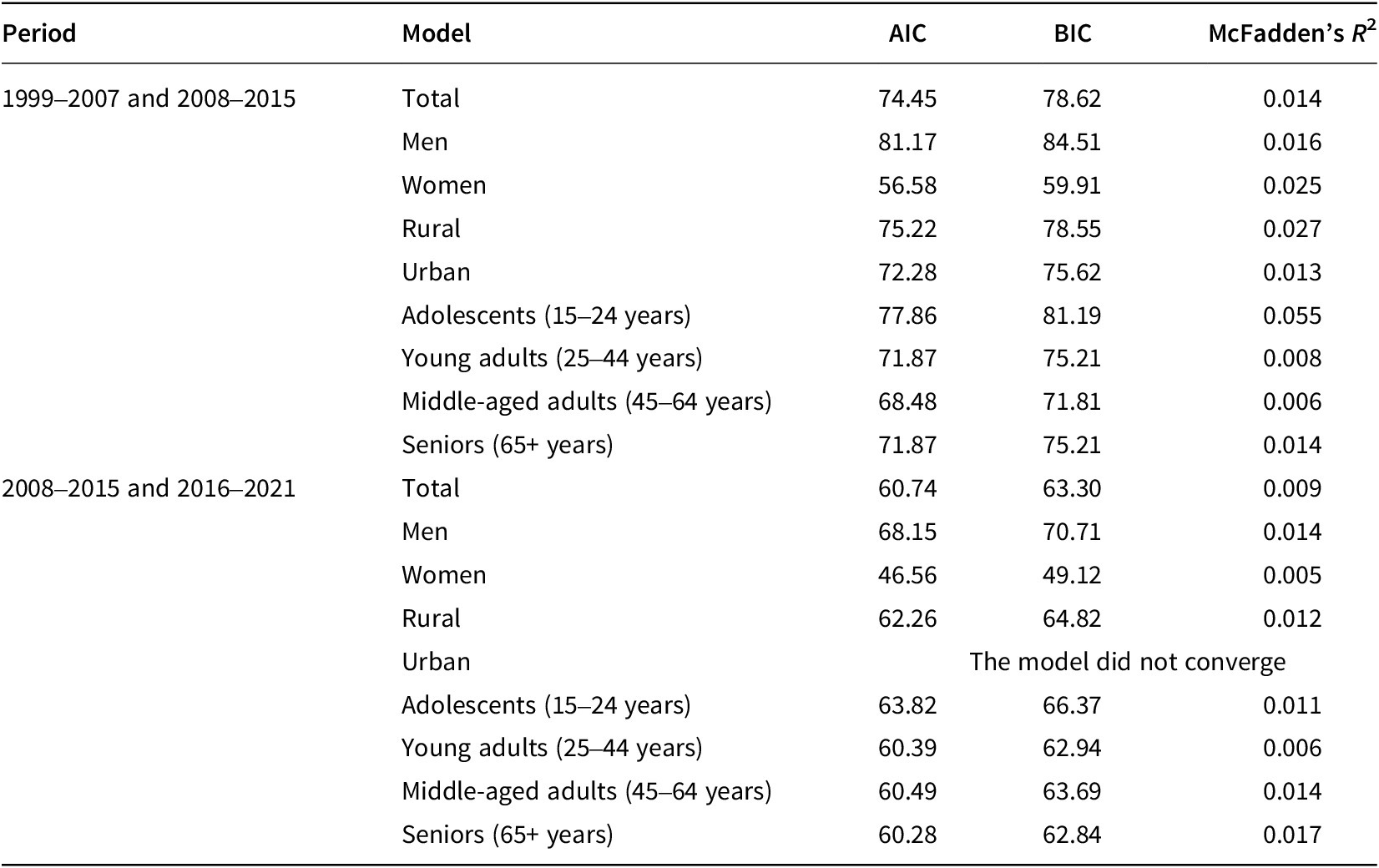
To complement these diagnostics, Table 2 presents model fit indices—including AIC, BIC, and McFadden’s pseudo-R 2—for each subgroup and segmented reform period.
Table 2. Model fit indices by subgroup and reform period, Colombia 1999–2021

Segmented time series analysis using a negative binomial distribution was chosen due to the count nature of the data and the objective of assessing the potential impact of mental health reforms. This approach is particularly appropriate for quasi-experimental evaluations using longitudinal aggregate data and allows for the detection of immediate and sustained effects of policy interventions on outcome trends.
The slope indicated the trend, whether decreasing, increasing, or stable. Segmented regression models were applied to estimate the effects of reform periods on suicide trends, using a quasi-experimental time series design. Before model estimation, we tested for autocorrelation with the DW statistic (DW = 2.11; p < 0.05), supplemented by visual inspection of residuals and correlograms. For model selection and assessment, we reported the AIC, BIC, and McFadden’s pseudo-R 2 (Model 1: AIC = 184.32; BIC = 192.15; R 2 = 0.27). These diagnostics ensured model adequacy and transparency. Level changes indicated an immediate effect, while changes in slope indicated a gradual or long-term effect (Salinas-Rodríguez et al., Reference Salinas-Rodríguez, Manrique-Espinoza and Sosa-Rubí2009).
Model
The segmented regression model was as follows: $ {Y}_t $
= β
0 + β
1 ×
$ {Y}_t $
= β
0 + β
1 × $ {\mathrm{Time}}_t $
+ β
2 ×
$ {\mathrm{Time}}_t $
+ β
2 × $ \mathrm{start}\ \mathrm{of}\ \mathrm{the}\;{\mathrm{reform}\ \mathrm{period}}_t $
+ β
3 × time after reform
$ \mathrm{start}\ \mathrm{of}\ \mathrm{the}\;{\mathrm{reform}\ \mathrm{period}}_t $
+ β
3 × time after reform $ t $
+
$ t $
+ $ {e}_t $
where
-
- $ {Y}_t $
is the incidence rate ratio (IRR) in time t.
$ {Y}_t $
is the incidence rate ratio (IRR) in time t. -
- Time t is a variable coded as 0 (before the implementation of the reform) and 1 (after the implementation of the reform).
-
-
$ {\beta}_0 $
is the intercept (or baseline level) of the IRR at the beginning of each reform period (time 0). -
-
$ {\beta}_1 $
is the slope of the IRRs before the start of the reform period 2. -
-
$ {\beta}_2 $
is the change in the level of the IRR observed with the implementation of reform period 2 (measured from the last observation before to the first observation after the implementation). -
-
$ {\beta}_3 $
is the estimate of the change in the IRR trend per unit of time -
-
$ {e}_t $
is the random variability not explained by the model.


The interrupted time series analysis determined the level of suicide incidence in each segment analyzed, before and after the implementation of the four reforms in the Colombian health system. The time unit for analyzing the impact of mental health policies on the suicide rate was annual, with two interruptions:
-
- Model 1: with nine observations (years) before the start of the reform period 2, and eight observations (years) after the start of its implementation.
-
- Model 2: with eight observations (years) before the start of the reform period 3, and six observations (years) after the start of its implementation.
All models were implemented using Stata/MP 17.0. Goodness-of-fit metrics (AIC, BIC, and pseudo-R 2) and autocorrelation diagnostics (DW test, residual plots, and correlograms) were examined for robustness and model adequacy.
Results
During the study period, there were 51,924 deaths by suicide in individuals aged 15 years and older, with 81% (n = 41,919) being men and 19% (n = 10,005) women; regarding the residence area, 72% were urban deaths (n = 37,350) and 28% rural deaths (n = 14,574) (Table 3).
Table 3. Demographic characteristics of suicides that occurred in Colombia between the periods 1999–2007, 2008–2015, and 2016–2021

With respect to the age group distribution, the highest percentage of cases was among young adults at 38% (n = 19,693), followed by adolescents at 32% (n = 16,718), middle-aged adults at 20% (n = 10,621), and the elderly at 9% (n = 4,892) (3).
The overall age-standardized suicide rates (ASSRs) did not show a consistent pattern; there were minor reductions and increases throughout the observation period, with no clear association with the mental health system reforms, either in total ASSRs or when disaggregated by sex.
Regarding sex, men had higher ASSRs compared to global rates, showing similar inflection points to the global rates. There was a brief decline from 1999 (ASSR 12.4/100,000) to 2014 (ASSR = 10.3/100,000; APC = −1.69%; p < 0.05), followed by an increase from 2014 to 2018 of +6.29% (p < 0.05), and a slight decline between 2018 (ASSR = 7.5/100,000; 95% confidence interval [CI] = 7.47–7.50) and 2021 (ASSR = 7.4/100,000; 95% CI = 7.38–7.40; APC = −2.03; p < 0.05). (Figure 1)

Figure 1. Age-standardized suicide rates (ASSRs) per 100,000 population by year and sex in Colombia (1999–2021). Vertical dotted lines indicate the boundaries of the three reform periods: 1999–2007, 2008–2015, and 2016–2021.
Note: The points represent ASSRs, and the lines represent the trend lines between the junction points. The numbers adjacent to the lines represent estimates of the annual percentage change (APC) during the corresponding periods, depending on the Joinpoint model; a star indicates statistical significance at α = 0.05. Vertical dotted lines indicate the boundaries of the three reform periods: 1999–2007, 2008–2015, and 2016–2021.
Among women (figure1), suicide rates increased during some periods, with a nonsignificant inflection point identified between 1999 and 2001 (p > 0.05), followed by a long-term reduction from 2001 to 2012 (APC = −4.72%; p < 0.05), and a second increase from 2012 to 2021 of +3.48% (p < 0.05).
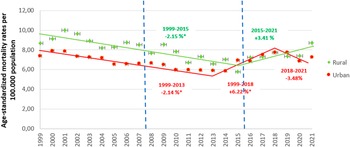
Suicide by residence area also showed that decreases in suicide rates did not align with mental health system reform periods. However, rural areas consistently had higher ASSRs, except in 2015, when urban areas had a higher rate (urban ASSR = 6.92; 95% CI = 6.80–7.04 vs. rural ASSR = 5.88; 95% CI = 5.58–5.97) and in 2018 and 2019, which showed parity in suicide rates between areas (Figure 2).

Figure 2. Age-standardized suicide rates (ASSRs) per 100,000 population by year and area of residence (urban vs. rural) in Colombia (1999–2021).
Note: The points represent ASSRs, and the lines represent the trend lines between the junction points. The numbers adjacent to the lines represent estimates of the annual percentage change (APC) during the corresponding periods, depending on the Joinpoint model; a star indicates statistical significance at α = 0.05. Vertical dotted lines indicate the boundaries of the three reform periods: 1999–2007, 2008–2015, and 2016–2021.
Finally, suicide by age groups did not show a clear temporal coincidence with reform periods. Adolescents had the highest rates throughout the period, with the most inflection points, starting in 1999 with an ASSR of 10.35 (95% CI = 9.57–11.06) and an initial increase of +8.64% between 1999 and 2001 (p < 0.05), followed by two significant declines of −6.97% (2001–2004; p < 0.05) and −3.59% (2004–2013; p < 0.05), then an increase of 5.60% between 2013 and 2018 (p < 0.05). The second highest ASSR was in individuals aged 65 years and older, starting in 1999 with an ASSR of 7.09 (95% CI = 5.97–8.22), showing no statistically significant inflection points throughout the period (APC = 2011–2021; +4.07; p < 0.05) (Figure 3).

Figure 3. Age-standardized suicide rates (ASSRs) per 100,000 population by year and age group in Colombia (1999–2021).
Note: The points represent ASSRs, and the lines represent the trend lines between the junction points. The numbers adjacent to the lines represent estimates of the annual percentage change (APC) during the corresponding periods, depending on the Joinpoint model; a star indicates statistical significance at α = 0.05. Vertical dotted lines indicate the boundaries of the three reform periods: 1999–2007, 2008–2015, and 2016–2021.
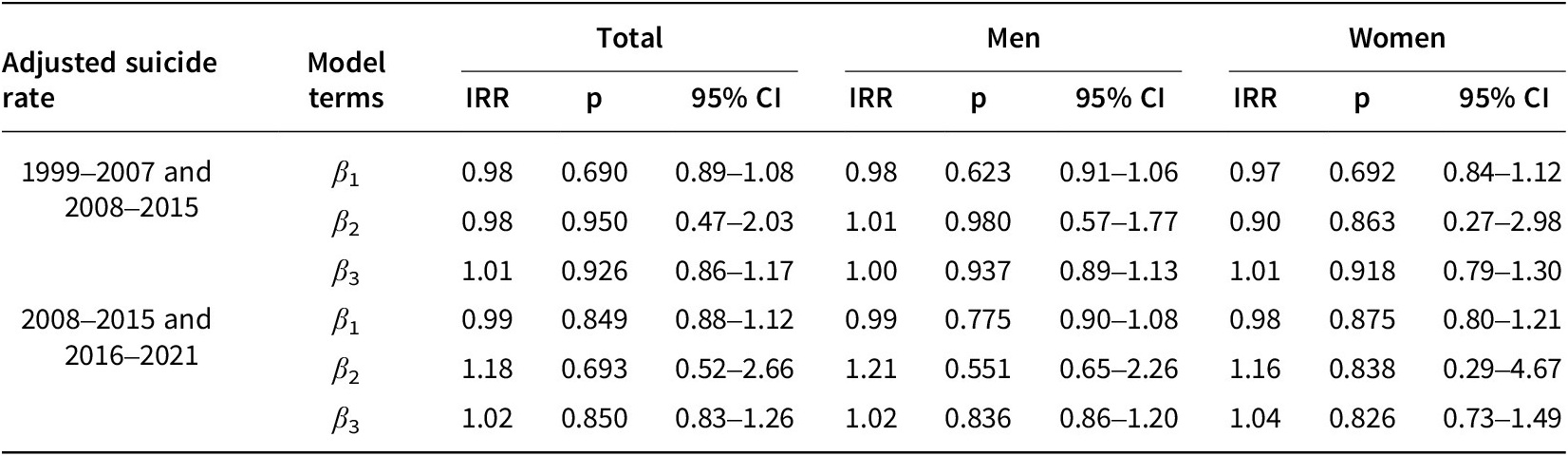
Regarding the impact of mental health system reforms on suicide (Table 4), there were no statistically significant changes between ASSR behavior and the strengthening of political approaches. For Model 1 (9 years before and 8 years after reform period 2), the predicted mean ASSR before reform compared to the baseline mean ASSR (β 1) showed a reduction of 2% (p > 0.05) (p = 0.690) for total and for men (p = 0.623), with a 3% reduction for women alike (p = 0.692). The immediate implementation of reform period 2 (β 2) showed a 2% reduction in IRR for total suicides (p = 0.950), with men showing a 1% reduction (p = 0.980) and women showing the greatest reduction in IRR at 10% (p = 0.863), the sustained effect over time of β₃ reflects the same behavior, characterized by small, statistically non‑significant reductions. On the other hand, when analyzing model 2 (Table 4), the largest reduction in IRRs can be observed in the immediate effect of reform period 2 (β₂), with an 18 % reduction in the IRR for total suicides (p = 0.693), a 21 % reduction for men (p = 0.551), and a 16 % reduction for women.
Table 4. Interrupted time series (ITS) based on trends of age-standardized suicide rates (ASSRs), Colombia 1999–2021

Note: β 1 = Slope of the line before the intervention (Time) − β 2 = Immediate effect (Change) − β 3 = Sustained effect (t_after).
For the residence area (Table 5), the interrupted time series models also showed no statistical association (p > 0.05), indicating no change; for Model 1, rural suicides decreased by 1% (p = 0.845), compared to a 2% decrease in urban areas (p = 0.627). The immediate effect (β 2) showed a 3% reduction for rural and 1% for urban areas (p = 0.978), with a similar sustained effect (β 3).
Table 5. Interrupted time series (ITS) based on trends of age-standardized suicide rates (ASSRs) for area of residence, Colombia 1999–2021

Note: β 1 = Slope of the line before the intervention (Time) − β 2 = Immediate effect (Change) − β 3 = Sustained effect (t_after).
Model 2 (Table 5) showed a higher percentage reduction but was statistically nonsignificant for the immediate effect of reform period 2, with a 19% reduction for rural areas (p = 0.660).
Regarding the impact of mental health system reforms on suicide by age group (Table 6), the results were similar to other variables, with no statistically significant findings (p > 0.05). The largest reductions in IRR were observed in the immediate effect of reform period 2 (β 2), with young adults showing a 22% reduction (p = 0.642), followed by adolescents at 21% (p = 0.616), middle-aged adults at 17% (p = 0.724), and the elderly at 11% (p = 0.806).
Table 6. Interrupted time series (ITS) based on trends of age-standardized suicide rates (ASSRs) for age group, Colombia 1999–2021

Note: β 1 = Slope of the line before the intervention (Time) − β 2 = Immediate effect (Change) − β 3 = Sustained effect (t_after).
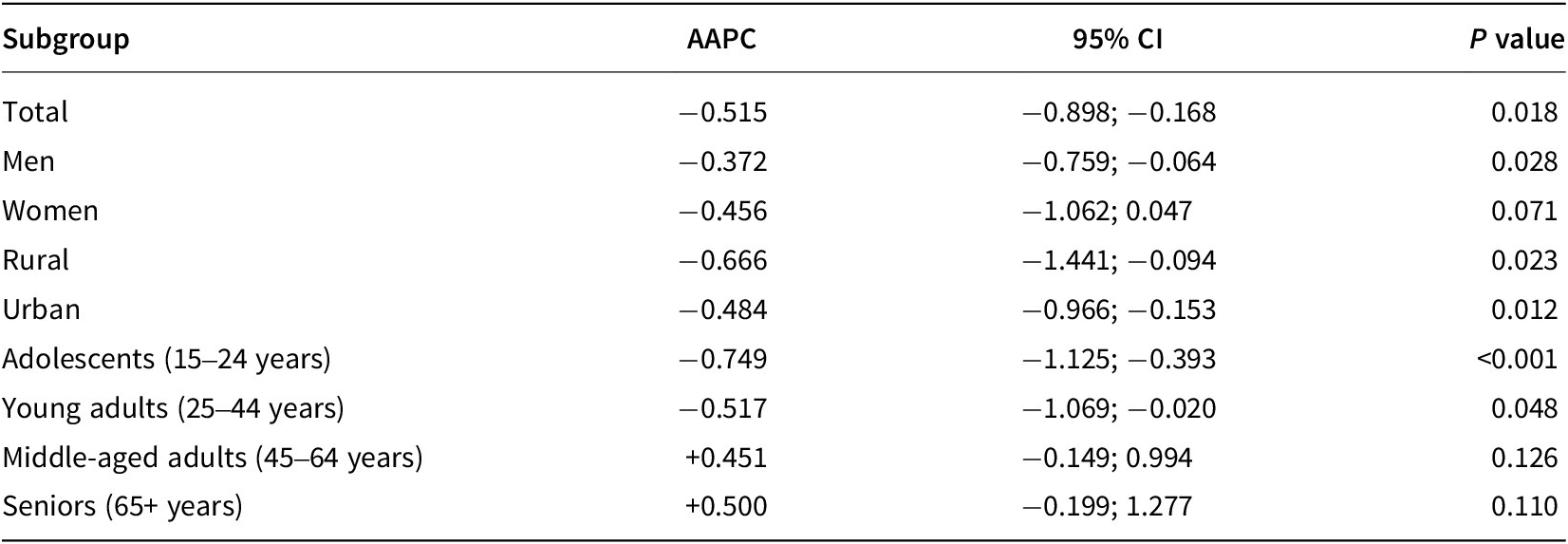
To complement the segmented trends shown by APC, the AAPC for each subgroup was calculated over the full 1999–2021 period. The results are summarized in Table 7.
Table 7. Average annual percentage change (AAPC) in suicide rates (ASSRs), Colombia 1999–2021, by subgroup

Note: AAPC based on Joinpoint regression using the WHO 1997 standard population. Bold values indicate statistical significance (p < 0.05).
Discussion
The behavior of age-standardized suicide rates (ASSRs) in Colombia shows statistically significant changes; generally, no variable presented an increasing trend throughout the period. Inflection points vary depending on the variable being analyzed. For instance, the suicide rates in urban areas follow a similar pattern across groups, while rural suicide rates remain higher, showing two inflection points and ending the period with an increase. In contrast, age groups show different ASSR patterns, with middle-aged and older adults being the only groups with higher ASSRs at the end of the period. The time series analysis reveals no statistically significant changes in suicide rates with the implementation of any of the mental health system reforms, suggesting that the observed patterns from the Joinpoint analysis may not be associated with these reforms. The observed epidemiological behavior may be associated with other variables unrelated to the development and strengthening of the health system, such as socioeconomic conditions or political events, which were not captured in this study. The temporal fluctuations observed in suicide rates do not coincide with reform periods in a statistically significant manner, as confirmed by the segmented regression models.
Comparison with other countries and regions of the world
The global ASSR trends from 1999 to 2021 in Colombia diverge from worldwide suicide patterns. A global study observed a decrease in suicide rates, starting at an ASSR of 13.57 in 1999 and dropping to 9.46 in 2021 (Naghavi, Reference Naghavi2019). Global studies have observed similar trends worldwide. For instance, Europe, which has the highest age-standardized suicide rates (ASSRs) in the world, saw a decrease from 22.09 in 1999 to 13.31 in 2020. Asia also experienced a decline, with rates falling from 14.22 in 1999 to 9.61 in 2020. The United States saw a slight increase, with ASSRs rising from 8.65 in 1999 to 10.21 in 2020. In Africa, the rates decreased from 7.04 in 1999 to 6.04 in 2020 (Ilic & Ilic, Reference Ilic and Ilic2022; WHO, 2021). This suggests that public mental health policies and the support from the healthcare system and social protection during this period did not leverage the favorable global and regional trends in suicide rates; rather, the opposite seems to have occurred. This study contributes to bridging the evidence gap in Latin America by applying robust analytical methods to evaluate the impact of mental health reforms. The absence of statistically significant associations between mental health reforms and suicide rates in this study represents a key finding, not merely a null result. These findings underscore the need for context-specific evaluations that account for structural determinants beyond health policies.
These findings are consistent with previous studies in both high-income and Latin American countries that report mixed results regarding the impact of mental health policy reforms on suicide trends. For example, while some European nations reported reductions in suicide following system-wide reform efforts (Harris et al., Reference Harris, Brett, Johnson and Deary2016; Pirkola et al., Reference Pirkola, Sund, Sailas and Wahlbeck2009), others did not find significant associations (Matsubayashi & Ueda, Reference Matsubayashi and Ueda2011). In Latin America, evidence remains scarce and context-dependent, with structural and political variables playing a critical mediating role. This underscores the difficulty of attributing population-level outcomes to policy changes in isolation and the need for context-specific evaluations.
On the other hand, despite the global increase in suicides up until 2019, the trends in suicide rates in some regions, such as Europe (from 2000 to 2019), reflect a decreasing trend in both sexes (APC = −2.4%; 95% CI = −2.6 to −2.3) (Yip et al., Reference Yip, Zheng and Wong2022). In contrast to the United States, which shows slight but significant increases in suicide rates (APC = +0.6%) (Lange et al., Reference Lange, Cayetano, Jiang, Tausch, Oliveira and Souza2023; Naghavi, Reference Naghavi2019), Colombia did not follow the same regional trend. Instead, it exhibited a rising trend up until 2018, after which it showed a decreasing trend (−2.03%). This pattern is similar to that observed in other Central American countries, such as Costa Rica, El Salvador, Guatemala, Nicaragua, Panama, and Venezuela, which also experienced a decline in overall suicide rates and among men (Healthdata, 2021; Hertzman, Reference Hertzman2017).
In our study, the suicide rate among women decreases until 2012, and from that point onward, it shows an increase of +3.8% (2012–2021; p < 0.05), a trend also observed in other countries in the region. Between 2000 and 2019, suicides among women in countries such as Costa Rica, Guyana, Brazil, Mexico, and Chile demonstrated an upward trend (Dávila-Cervantes, Reference Dávila-Cervantes2022).
Globally, suicide rates were nearly three times higher among individuals aged 65 years and older. In the Colombian context, the age group patterns align with those observed in Latin America and the Caribbean, where the highest suicide rates are found among adolescents, followed by older adults. Notably, for young people, suicide is the second leading cause of death globally (He et al., Reference He, Ouyang, Qiu, Li, Li and Xiao2021; Hertzman, Reference Hertzman2017).
Explanation of results
This study can be considered pioneering in assessing the impact of mental health service development on suicide in a country such as Colombia. From a descriptive perspective, a significant political development process has been undertaken, as reflected in the reforms to the health system, which have brought about transformations in mental health care. However, it was not possible to establish the specific effect of changes in access to and coverage of individual and collective services on suicide rates. This analysis represents an effort to assess mental health system transformation in Colombia from a population outcomes perspective, contributing to a growing body of work seeking to understand how institutional changes affect mental health at the national level.
Overall, no coincidences were observed in the peaks or declines in age-standardized suicide rates (ASSRs) when analyzing the combined variables, a phenomenon also observed in research conducted in most countries around the world (Ilic & Ilic, Reference Ilic and Ilic2022), nor is it possible to discern a preliminary pattern, as some European countries have reported reductions in suicide rates following comprehensive reform initiatives (Pirkola d with the implementation or strengthening of mental health policies. The observed epidemiological behavior may be associated with other variables unrelated to the development and strengthening of the health system.
Regarding the impact of adopted mental health reforms, a systematic review conducted in high-income countries (e.g., Australia, Canada, Finland, Sweden, Japan, England, Wales, New Zealand, Iceland, Italy, Germany, and Russia), where integration and deinstitutionalization reforms were formulated and implemented between 1999 and 2011 (Shen & Snowden, Reference Shen and Snowden2014), did not find a direct relationship between the strengthening of mental health public policies and suicide rates (Mann et al., Reference Mann, Apter, Bertolote, Beautrais, Currier, Haas, Hegerl, Lonnqvist, Malone, Marusic, Mehlum, Patton, Phillips, Rutz, Rihmer, Schmidtke, Shaffer, Silverman, Takahashi and Hendin2005; Schlichthorst et al., Reference Schlichthorst, Reifels, Krysinska, Ftanou, Machlin, Robinson and Pirkis2020). In contrast, reforms focused on regulatory regulation of methods and environments in these same countries did show a statistically significant association with the reduction of suicide rates (except Great Britain, England, Wales, and Scotland) (Gunnell et al., Reference Gunnell, Knipe, Chang, Pearson, Konradsen, Lee and Eddleston2017; Ishimo et al., Reference Ishimo, Sampasa-Kanyinga, Olibris, Chawla, Berfeld, Prince, Kaplan, Orpana and Lang2021; Mann et al., Reference Mann, Apter, Bertolote, Beautrais, Currier, Haas, Hegerl, Lonnqvist, Malone, Marusic, Mehlum, Patton, Phillips, Rutz, Rihmer, Schmidtke, Shaffer, Silverman, Takahashi and Hendin2005). It is important to note that although Colombia has been strengthening the regulation of firearm possession (Langmann, Reference Langmann2021) and the distribution of highly lethal pesticides (London & Bailie, Reference London and Bailie2001), these issues are not addressed within public health policy.
In the same vein, a study conducted in England in 2010 and 2012 (during which time mental health care strategies were strengthened in response to national health policies) evaluated the impact on suicide rates. The study found a higher IRR (IRR = 0.88; p < 0.001) for the general population compared to patients with psychiatric diagnoses (IRR = 0.76; p < 0.001) (Kapur et al., Reference Kapur, Ibrahim, While, Baird, Rodway, Hunt, Windfuhr, Moreton, Shaw and Appleby2016). In conclusion, some aspects of mental health service provision might have an effect on suicide rates among clinical populations, as evidenced by studies in other contexts. Our study aimed to assess the potential impact on the general population, but did not yield conclusive results.
In the United States, between 2014 and 2017, the Community Mental Health Act was enacted and implemented with a public health focus. The evaluation of its impact found that a 14.27% reduction in the number of Community Mental Health Centers was associated with a 9.63% increase in suicide rates (Hung et al., Reference Hung, Busch, Shih, McGregor and Wang2020). These findings are not consistent with the situation in Colombia, where the implementation of Listening Centers and Orientation Zones, starting from the second reform period in the mental health system, along with other strategies to strengthen individual and collective services, showed nonsignificant results (p > 0.05). Similarly, a study conducted in Brazil between 2008 and 2012, which increased municipal coverage through Primary Health Care Centers, also failed to demonstrate significant effects on suicide rates (Silva et al., Reference Silva, Silva, Santos, Bezerra, Oliveira, Silva and Conceição2020) and assessed the association with age-standardized suicide mortality rates (ASSRs), finding statistically nonsignificant results (IRR = 0.981; p > 0.05) (Machado et al., Reference Machado, Alves, Rasella, Rodrigues and Araya2018).
Colombia is a country where mental health policies have been formulated since the early 1990s. However, the law that affirmed mental health as a right was only partially implemented by 2015. In this regard, Gordon & Snowden argue that mental health policies are more effective when accompanied by a mental health plan or law, as these help translate the vision, values, and principles articulated in the policy into concrete strategies and activities (Shen & Snowden, Reference Shen and Snowden2014). Colombia is a country that has initiated its mental health system reform process relatively late. It is only from the second reform period that changes in the transformation toward primary mental health care have become visible. Additionally, the country has the lowest percentage of public health expenditure allocated to mental health in the region (OMS, 2023) with a late political development (Shen & Snowden, Reference Shen and Snowden2014). Meanwhile countries such as Cuba, Brazil, Mexico, and Chile have been implementing mental health reforms since the 2000s (Caldas de Almeida & Horvitz-Lennon, Reference Caldas de Almeida and Horvitz-Lennon2010).
The political development concerning mental health, and specifically suicide-related behaviors, in Colombia has been slow. A notable strengthening of policy frameworks emerged during the second phase of healthcare system reform, driven by enhanced access to mental health services and their redefinition as a fundamental right. This process was reflected in a more pronounced reduction in suicide rates during the immediate implementation of this reform period (Model 2). However, these reductions were neither statistically significant nor sustained over time.
In this context, analyzing suicide trends in a country like Colombia through the lens of socioeconomic development variables is essential. First, the findings of this study do not identify a measurable impact of strengthened suicide prevention policies on mortality rates. Second, because global evidence has well-documented the direct influence of economic crises on suicide mortality trends during periods of financial downturn (Norström & Grönqvist, Reference Norström and Grönqvist2015). These observations are further supported by national studies demonstrating that suicide mortality rates have risen by as much as threefold during economic crises, as exemplified by the 1999 financial crisis (Astudillo Mendoza & Carmona González, Reference Astudillo Mendoza and Carmona González2021; Campo-Arias & Herazo, Reference Campo-Arias and Herazo2015).
Finally, Colombia is a country with significant social inequalities (Vasquez-Escobar et al., Reference Vasquez-Escobar, Arroyave and Gomez-Barrera2025) that directly impact access to mental health services. Departments with low population density exhibit the highest suicide rates in the country (Vargas-Espíndola et al., Reference Vargas-Espíndola, Villamizar-Guerrero, Puerto-López, Rojas-Villamizar, Ramírez-Montes and Urrego-Mendoza2017), which do not have adequate health services coverage (Minsalud, 2023) and even less so to mental health services. According to the National Mental Health Survey for 2015, five of the seven regions into which the country was divided for analysis were classified as having very low access to mental health services (Instituto Nacional de Salud, 2019; Minsalud, 2015).
Limitations
A more comprehensive analysis of the impact of mental health system reforms should include additional specific variables related to the cause of mortality by suicide. However, including more variables, such as method, marital status, or health insurance scheme, would result in more than 50% of the data being lost (counts not shown), which could potentially lead to overestimating the results and introducing biases into the research (Raghunathan, Reference Raghunathan2004).
Due to data limitations, this study does not account for macro-level time-varying covariates, including unemployment, poverty rates, or political stability indicators, which were unavailable for analysis, and may confound the association between mental health reforms and suicide trends. Their exclusion limits causal interpretation and should be addressed in future research.
Conclusions
Although studies conducted in other countries have identified the impact of mental health policies, it is crucial to emphasize that all cases with statistically significant associations focused on populations with mental health diagnoses (targeted strategies), and monitored one or two specific strategies. In contrast, studies attempting to assess the potential impact of reforms or policy changes on the general population (universal strategies) yielded results consistent with those of the present study, finding no statistical association between suicide trends and the strengthening of public policy.
Despite the robust development of mental health policies in Colombia, there remains a gap between implementation and impact, and this research may serve as evidence of that gap. Despite advancements in the provision of individual services, Colombia lacks a primary care-centered mental health care model, and as long as geographic access barriers persist, outcomes are likely to remain unfavorable.
Although the analyses conducted did not identify statistically significant associations between mental health system reforms and changes in suicide trends, the observed patterns suggest a complex interplay of factors beyond the scope of health sector interventions alone. The findings underscore the need for more integrated and targeted approaches in mental health policy evaluation, including structural determinants and the quality of implementation. This study contributes to a growing body of evidence highlighting the limitations of attributing broad population outcomes to policy reforms in isolation.







 Open access

