




1. Introduction
Engineering design is a highly cognitive process (Dym et al. Reference Dym, Agogino, Eris, Frey and Leifer2005) that can induce stress for designers (Zhu, Yao & Zeng Reference Zhu, Yao and Zeng2007; Petkar et al. Reference Petkar, Dande, Yadav, Zeng and Nguyen2009; Nguyen, Xu & Zeng Reference Nguyen, Xu and Zeng2013; Nguyen & Zeng Reference Nguyen and Zeng2014, Reference Nguyen and Zeng2017; Nolte & McComb Reference Nolte and McComb2020, Reference Nolte and McComb2021). The multiple skills designers must use to solve design problems (e.g., analytical and technical skills, decision-making and creativity; Dym et al. Reference Dym, Agogino, Eris, Frey and Leifer2005) and the inherent complexity of design problems (e.g., ill-defined and constantly evolving; Dym et al. Reference Dym, Agogino, Eris, Frey and Leifer2005) contribute to the cognitive stress of engineering design. Students must overcome the inherent characteristics and stress induced during design to successfully learn this critical engineering skill.
Previous research has shown that mental stress is induced during engineering design (Zhu et al. Reference Zhu, Yao and Zeng2007; Petkar et al. Reference Petkar, Dande, Yadav, Zeng and Nguyen2009; Nguyen et al. Reference Nguyen, Xu and Zeng2013; Nguyen & Zeng Reference Nguyen and Zeng2014, Reference Nguyen and Zeng2017; Nolte & McComb Reference Nolte and McComb2020, Reference Nolte and McComb2021). Not only can substantial mental stress during design unnecessarily burden novice designers, but excessive pressure during problem-solving tasks has been shown to decrease performance (Beilock et al. Reference Beilock, Kulp, Holt and Carr2004; Beilock & DeCaro Reference Beilock and DeCaro2007). Therefore, stress-management interventions are needed to aid the design process, improve design outcomes, and increase the well-being of engineering students.
Many educational strategies have been explored for improving the outcomes and experience of engineering design for students. Some of the more common strategies include incorporating project-based learning into design curriculum (Dym et al. Reference Dym, Agogino, Eris, Frey and Leifer2005; Palmer & Hall Reference Palmer and Hall2011), the flipped classroom (Kerr Reference Kerr2015; Saterbak Tracy Volz & Wettergreen Reference Saterbak Tracy Volz and Wettergreen2016) and reflective practice (Dias & Blockley Reference Dias and Blockley1995; Dias Reference Dias2002; Adams, Turns & Atman Reference Adams, Turns and Atman2003). While these practices focus on design education more generally, this study proposes that a state mindfulness intervention (i.e., a mindfulness intervention aimed at increasing an individual’s level of temporary or short-term mindfulness) could better improve the engineering design process by reducing students’ perceived stress during design. Previous mindfulness research has shown that mindfulness-based interventions have many positive design-relevant effects like reduced stress (Mohan, Sharma & Bijlani Reference Mohan, Sharma and Bijlani2011; Shearer et al. Reference Shearer, Hunt, Chowdhury and Nicol2016; Pascoe et al. Reference Pascoe, Thompson, Jenkins and Ski2017) and improved executive functioning (Zeidan et al. Reference Zeidan, Johnson, Diamond, David and Goolkasian2010). A mindfulness-based intervention may help students to better manage or appraise the stress of design.
Brief mindfulness-based interventions to increase students’ levels of state mindfulness have been investigated in other academic domains and have been found to increase students’ academic performance in the form of quiz scores (Calma-Birling & Gurung Reference Calma-Birling and Gurung2017), improve group task performance (Cleirigh & Greaney Reference Cleirigh and Greaney2015) and lower students’ test anxiety (Colangelo & Audet Reference Colangelo and Audet2017). However, no previous research has been conducted to investigate the effect of a brief mindfulness-based intervention on the engineering design experience. This type of research is important for identifying stress-management interventions for the stress of engineering design and may also contribute to the improved well-being of engineering students. The study presented here will investigate the effect of a brief mindfulness-based intervention on introductory students’ cognitive stress experience during concept generation, concept selection and physical modelling. This article will briefly review stress during engineering design and the history of mindfulness, generally and within engineering research, before detailing the methods, results and implications of this specific study.
2. Relevant literature
2.1. Implications of stress
Previous research has found that engineering design induces mental stress in students (Zhu et al. Reference Zhu, Yao and Zeng2007; Petkar et al. Reference Petkar, Dande, Yadav, Zeng and Nguyen2009; Nguyen et al. Reference Nguyen, Xu and Zeng2013; Nguyen & Zeng Reference Nguyen and Zeng2014, Reference Nguyen and Zeng2017; Nolte & McComb Reference Nolte and McComb2020, Reference Nolte and McComb2021) that persists even after the design task has ended (Nguyen & Zeng Reference Nguyen and Zeng2017). A detailed discussion on how stress might manifest during specific stages of the engineering process relevant to this study is included in Nolte & McComb (Reference Nolte and McComb2021). Stress during design is problematic because high levels of mental stress can reduce students’ creativity (Nguyen & Zeng Reference Nguyen and Zeng2012) and effort (Nguyen & Zeng Reference Nguyen and Zeng2014, Reference Nguyen and Zeng2017), which will impact design outcomes. While acute mental stress can have both positive and negative effects, long-term or chronic stress has predominantly negative effects on cognition and health.
Short-term or acute mental stress is often defined as stress lasting only short periods. In design, this could be completing short tasks or the last push to complete a project by an upcoming deadline. Some acute stress can improve cognition by increasing creativity (Nguyen & Zeng Reference Nguyen and Zeng2014) or concentration (Degroote et al. Reference Degroote, Schwaninger, Heimgartner, Hedinger, Ehlert and Wirtz2020) but too much acute stress can impede cognition resulting in decreased task performance (Sandi Reference Sandi2013). However, the effects of acute stress can be moderated by the intensity or origin of the stress (Sandi Reference Sandi2013) and the requirements of the task (LeBlanc Reference LeBlanc2009; Plessow et al. Reference Plessow, Schade, Kirschbaum and Fischer2012). For example, the level of pressure during a mathematics task did not decrease performance for questions that were practiced but did decrease performance for questions that were not practiced (Beilock et al. Reference Beilock, Kulp, Holt and Carr2004). Acute stress also increases respiration, blood pressure and cardiac output (Dusek & Benson Reference Dusek and Benson2009), which could have implications for an individual’s health and well-being stress-management interventions for acute stress could help designers produce better designs.
Chronic stress is repeated occurrences of acute stress with insufficient rest time and long-term stress is stress lasting extended periods. Typical chronic stressors can include many negative life conditions like caregiving, low socioeconomic status, chronic health challenges and discrimination (Hammen, Dalton & Thompson Reference Hammen, Dalton and Thompson2015). While engineering or design projects are unlikely to be the most significant contributor to an individual’s chronic stress, the constant rigour of engineering coursework (Godfrey & Parker Reference Godfrey and Parker2010) or substantial design projects lasting multiple weeks (like a senior capstone project) could contribute to chronic stress. Additionally, engineering students are already at a higher risk of adverse health conditions due to stress (Foster & Spencer Reference Foster and Spencer2003) and college students in the United States (American College Health Association 2020) are experiencing increased mental stress due to greater educational (Acharya, Jin & Collins Reference Acharya, Jin and Collins2018; Hoyt et al. Reference Hoyt, Cohen, Dull, Maker Castro and Yazdani2021), economic (Hoyt et al. Reference Hoyt, Cohen, Dull, Maker Castro and Yazdani2021) and environmental stressors (Acharya et al. Reference Acharya, Jin and Collins2018; Hoyt et al. Reference Hoyt, Cohen, Dull, Maker Castro and Yazdani2021). Long-term or chronic stress can have adverse effects on physical health (McEwen Reference McEwen1998) and mental health (Khan & Khan Reference Khan and Khan2017). Moreover, chronic job stress is also one of the leading causes of job burnout (Wang, Huang & You Reference Wang, Huang and You2016; Salvagioni et al. Reference Salvagioni, Melanda, Mesas, González, Gabani and de Andrade2017). Teaching engineering students stress-management strategies is critical to their well-being and educational success.
The task-induced stress of engineering design has been identified using several methodologies like electroencephalogram (EEG; Nguyen & Zeng Reference Nguyen and Zeng2014, Reference Nguyen and Zeng2017), heart rate variability (HRV; Nguyen et al. Reference Nguyen, Xu and Zeng2013) and eye gaze (Petkar et al. Reference Petkar, Dande, Yadav, Zeng and Nguyen2009). However, the use of these methodologies makes it difficult to identify sources of stress during design, which is important because prior research has concluded that sources of stress for design vary by design activity (Nolte & McComb Reference Nolte and McComb2020, Reference Nolte and McComb2021). Identifying these sources of stress is critical to better instruction of design and improving students’ design experience. Additionally, the method or strategy used to solve a design problem will likely contribute to the stress of design. For example, previous research found that using a breadth-first information collection strategy during design can cause a higher stress response than a depth-first information strategy (Wang, Nguyen & Zeng Reference Wang, Nguyen and Zeng2015; Zhao & Zeng Reference Zhao and Zeng2019). These results indicate that stress-management techniques for design would be more effective if they were applicable to stress during design generally rather than targeting the many specific sources of stress during the design process.
Furthermore, additional research is needed to understand how engineering designers cope or manage the task-induced stress of design. Previous research has identified that the style of coping used to manage task-induced stress can affect performance (Delahaij et al. Reference Delahaij, van Dam, Gaillard and Soeters2011; Matthews & Campbell Reference Matthews and Campbell2016). An accepted general model of individual differences in coping posits that there are three broad categories including task-focused coping defined as dealing with or managing the demands of the task directly, emotion-focused coping defined as dealing with one’s feelings about the stressor, and avoidance coping defined as redirecting one’s attention away from the task/stressor (Endler & Parker Reference Endler and Parker1990). One study found that coping behaviour can be influenced by personality factors and external pressures of the task and may reflect individual differences in perceived workload (Matthews & Campbell Reference Matthews and Campbell2016). Understanding how designers attempt to manage task-induced stress during design can contribute to better instruction on managing stress and can inform stress-management strategies for design.
2.2. Mindfulness
Mindfulness practices have their origin in the Buddhist religion but have recently become popularised as a postmodern secular practice (Kabat-Zinn Reference Kabat-Zinn1994; Davis & Hayes Reference Davis and Hayes2011). The great variety and evolution of modern mindfulness practices have resulted in many definitions of mindfulness. However, an accepted and operationalised definition of mindfulness is a ‘particular orientation towards one’s experiences in the present moment, an orientation that is characterised by curiosity, openness, and acceptance’ (Bishop et al. Reference Bishop, Lau, Shapiro, Carlson, Anderson, Carmody, Segal, Abbey, Speca, Velting and Devins2004, p. 232). The present study will use this operationalised definition of mindfulness while acknowledging that the category of mindfulness spans many practices.
Mindfulness-based research can be divided into two categories including research on state and trait mindfulness as this division aligns with the dichotomy of state and trait mindfulness questionnaire measures (Sauer et al. Reference Sauer, Walach, Schmidt, Hinterberger, Lynch, Büssing and Kohls2013). State mindfulness is an individual’s short-term level of mindfulness corresponding to a certain moment and trait mindfulness is an individual’s enduring level of mindfulness, which is consistent and stable over time. Mindfulness-based interventions can be designed to target individuals’ state or trait mindfulness. Some of the positive impacts of mindfulness-based interventions include reduced stress (Shearer et al. Reference Shearer, Hunt, Chowdhury and Nicol2016; Pascoe et al. Reference Pascoe, Thompson, Jenkins and Ski2017), lessened perceived pain (Creswell et al. Reference Creswell, Lindsay, Villalba and Chin2019), improved attention (Zeidan et al. Reference Zeidan, Johnson, Diamond, David and Goolkasian2010; Norris et al. Reference Norris, Creem, Hendler and Kober2018), better working memory (Zeidan et al. Reference Zeidan, Johnson, Diamond, David and Goolkasian2010; Mrazek et al. Reference Mrazek, Franklin, Phillips, Baird and Schooler2013), improved emotion regulation (Davis & Hayes Reference Davis and Hayes2011) and increased executive functioning (Zeidan et al. Reference Zeidan, Johnson, Diamond, David and Goolkasian2010). Similarly, research examining how levels of trait mindfulness predict behavioural outcomes has also found many benefits. For example, studies have found that college students with higher trait mindfulness have less alcohol abuse (Bodenlos, Noonan & Wells Reference Bodenlos, Noonan and Wells2013) and less perceived stress (Vinothkumar, Vinu & Anshya Reference Vinothkumar, Vinu and Anshya2013). This brief overview demonstrates that mindfulness-based practices have potential benefits for both student well-being and engineering design.
Studies of mindfulness interventions in engineering and engineering design are limited. However, some interventions of longer duration (i.e., multiple weeks) have been shown to improve engineering students’ software development (Bernárdez et al. Reference Bernárdez, Durán, Parejo and Ruiz-Cortés2014) and conceptual modelling (Bernárdez et al. Reference Bernárdez, Durán, Parejo and Ruiz-Cortés2018). Also, a one-credit course for engineering students based on positive psychology research found that students’ noncognitive competencies like mindfulness can be taught and developed (Ge et al. Reference Ge, Berger, Major and Froiland2019) and engineering students were receptive to practicing mindfulness in an online class during the COVID-19 pandemic (Miller & Jensen Reference Miller and Jensen2020). While not directly related to engineering design, these results suggest that mindfulness practice applies to engineering and would be successful if included in engineering courses. Additionally, first-year engineering students were also receptive to a mindfulness intervention (less than an hour) for stress reduction and resilience (Huerta Reference Huerta2018) and another mindfulness intervention (four sessions, 1 hour a session) for first-year engineering students was shown to improve students’ intrapersonal and interpersonal skills (Huerta et al. Reference Huerta, Carberry, Pipe and McKenna2021). The results of these studies show that first-year engineers are receptive to practicing mindfulness and that mindfulness practice has potential benefits for engineering students.
Most of the research on mindfulness in engineering has investigated how students’ levels of trait mindfulness predict their well-being and academic outcomes. Engineering students with higher levels of trait mindfulness are more innovative (Rieken et al. Reference Rieken, Schar, Shapiro and Sheppard2017), have less perceived stress (Lal et al. Reference Lal, Pathak, Chaturvedi and Talukdar2019), increased mathematical test scores (Bellinger, DeCaro & Ralston Reference Bellinger, DeCaro and Ralston2015), improved academic outcomes (Estrada & Dalton Reference Estrada and Dalton2019) and enhanced entrepreneurship skills (Rieken, Schar & Sheppard Reference Rieken, Schar and Sheppard2016). While some of these findings may relate more directly to engineering design, like improved innovation and mathematical test performance, others indicate more holistic benefits of incorporating mindfulness into engineering education.
The effectiveness of state mindfulness interventions on students’ experience during engineering design problems has not previously been investigated and will inform the development of successful stress-management strategies for engineering design education and industrial practice. However, in other academic disciplines, brief mindfulness interventions have been found to increase students’ academic performance in the form of quiz scores (Calma-Birling & Gurung Reference Calma-Birling and Gurung2017), improve group task performance (Cleirigh & Greaney Reference Cleirigh and Greaney2015) and lower students’ test anxiety (Colangelo & Audet Reference Colangelo and Audet2017). Mindfulness interventions in engineering may not only improve engineering skills but could also provide benefits to students more generally.
3. Research aims and significance
Previous research has determined that the engineering design process is stressful (Zhu et al. Reference Zhu, Yao and Zeng2007; Petkar et al. Reference Petkar, Dande, Yadav, Zeng and Nguyen2009; Nguyen et al. Reference Nguyen, Xu and Zeng2013; Nguyen & Zeng Reference Nguyen and Zeng2014, Reference Nguyen and Zeng2017; Nolte & McComb Reference Nolte and McComb2020, Reference Nolte and McComb2021). While some acute stress is beneficial (Nguyen & Zeng Reference Nguyen and Zeng2014; Degroote et al. Reference Degroote, Schwaninger, Heimgartner, Hedinger, Ehlert and Wirtz2020), overwhelming or excessive stress can be detrimental to cognition and task performance (Sandi Reference Sandi2013). For example, experiencing substantial stress can impair an individual’s ability to complete tasks that require complex, flexible reasoning (Sandi Reference Sandi2013), which are skills necessary to successful engineering design. Therefore, techniques are needed to help students’ manage their stress to an appropriate level during engineering design activities.
Mindfulness-based interventions for engineering design are promising as research in other domains has shown many positive benefits such as reduced stress (Mohan et al. Reference Mohan, Sharma and Bijlani2011; Shearer et al. Reference Shearer, Hunt, Chowdhury and Nicol2016), improved attention (Zeidan et al. Reference Zeidan, Johnson, Diamond, David and Goolkasian2010; Norris et al. Reference Norris, Creem, Hendler and Kober2018), enhanced visuospatial processing (Zeidan et al. Reference Zeidan, Johnson, Diamond, David and Goolkasian2010), better working memory (Zeidan et al. Reference Zeidan, Johnson, Diamond, David and Goolkasian2010; Mrazek et al. Reference Mrazek, Franklin, Phillips, Baird and Schooler2013) and increased executive functioning (Zeidan et al. Reference Zeidan, Johnson, Diamond, David and Goolkasian2010). This study extends previous work by the authors focused on characterising stress in design (Nolte & McComb Reference Nolte and McComb2020, Reference Nolte and McComb2021) to understand the effect of a brief mindfulness-based intervention on stress during design. Specifically, this work will address the following research questions (RQs):
-
(i) How do students perceive the inclusion of a brief mindfulness-based activity during an engineering design task?
-
(ii) What is the effect of a brief mindfulness-based activity on students’ stress experience and sources of stress during three engineering design tasks?
-
(iii) How do students cope with stress during engineering design activities?
It is hypothesised that the brief mindfulness intervention will be well-received by engineering students and induce an increased level of state mindfulness, leading to lower appraisals of stress during the design activities. This hypothesis is supported by a combination of previous research that has found that students are receptive to mindfulness-based interventions (Lin & Mai Reference Lin and Mai2016; Huerta Reference Huerta2018; Miller & Jensen Reference Miller and Jensen2020), brief mindfulness interventions were effective in increasing participants’ levels of state mindfulness (Cleirigh & Greaney Reference Cleirigh and Greaney2015; Mahmood, Hopthrow & de Moura Reference Mahmood, Hopthrow and de Moura2016; Calma-Birling & Gurung Reference Calma-Birling and Gurung2017; Colangelo & Audet Reference Colangelo and Audet2017), and practicing mindfulness can reduce perceived stress (Mohan et al. Reference Mohan, Sharma and Bijlani2011; Shearer et al. Reference Shearer, Hunt, Chowdhury and Nicol2016; Pascoe et al. Reference Pascoe, Thompson, Jenkins and Ski2017).
The results of this study can be used to improve design education and help researchers and instructors better understand students’ experiences during engineering design. By better understanding students’ experiences, modifications can be made to design curricula to better support students while also teaching design more effectively. Additionally, understanding the effect of a brief mindfulness intervention for engineering design may indicate its applicability to other disciplines or processes that have similar characteristics like an inherent complex problem-solving component. Managing excessive stress in engineering design could also improve designer well-being.
4. Methodology
First-year engineering design students completed three 30-minute experimental sessions during an engineering design course, where their stress and mindfulness during three principal stages of the design process were investigated. Each session consisted of a short video followed by a 10-minute design task. Design tasks included the concept generation, concept selection and physical modelling tasks utilised in prior work as previous research indicated that these three stages had unique stress signatures and sources of stress (Nolte & McComb Reference Nolte and McComb2020, Reference Nolte and McComb2021). Data were collected online using pre and posttask surveys during the spring semester of 2021. At the time of data collection, classes were online due to restrictions related to the COVID-19 pandemic.
4.1. Experimental design
First-year engineering students (N = 80) participating in four sections of a cornerstone engineering design course (Ritter & Bilen Reference Ritter and Bilen2019) at a large mid-Atlantic university participated in this institutional review board-approved study (Table 1). First-year engineering students were chosen as the population for this study as they are learning engineering design for the first time, allowing instructors to help them form positive design and stress-management techniques that they can use for the duration of their careers. Participants were 26.2% women and 71.3% men (2.5% participants did not disclose their gender). The average age of participants was 18.77 years (SD = 1.16) and ranged from 18 to 26 years of age. When asked to report their race/ethnicity, 73.8% of participants identified as white, 15% identified as Asian and 8.8% identified as another minoritised race (2.4% of participants chose not to report their race/ethnicity). All students, including students who did not consent to the use of their data for this study, received course credit for completing the activities.
Experimental methodology.

Additionally, students were asked to report their previous experience with mindfulness activities at the end of the experiment. Students were asked, ‘Within the last 6 months, how often did you intentionally participate in mindfulness activities? Examples may include mediation, yoga, Qigong, Tai Chi, and so on’. Of the students who answered the question, 35 students chose never, 14 chose less than five times a year, 9 chose once a month, 7 chose once a week, 8 chose more than once a week and 3 chose daily. When asked to list their mindfulness activities, most students reported meditation or exercising (e.g., working out, yoga, running and walking). This indicates that a majority of the students participating in this study had minimal experience with mindfulness activities before this experiment.
Students completed three experimental sessions, each consisting of a short video followed by a 10-minute design task, on three different days. Before completing the design task students were assigned to watch either an engineering mini-biography or participate in a mindfulness-based activity according to the class section they were enrolled in Table 1. While prior iterations of this work used videos of famous engineers before the design task to stabilise students’ stress (Nolte & McComb Reference Nolte and McComb2020, Reference Nolte and McComb2021), this work used the engineering mini-biography videos as a control condition. The experimental condition received a 5-minute mindfulness-based video that guided them through a body scan practice narrated by a male voice (Goldstein Reference Goldstein2012) intended to increase students’ levels of state mindfulness. Previous research determined that a similar 5-minute body scan meditation increased reported levels of state mindfulness when delivered in an online modality (Mahmood et al. Reference Mahmood, Hopthrow and de Moura2016). The first three course sections only watched the mindfulness-based video before one of the design activities to determine the effect of a singular brief mindfulness-based activity on the cognitive experience of engineering design. The last section (Class Section D) watched the video before all three activities to determine if repeated exposure to the brief mindfulness-based activity had any additional effect(s) on students’ cognitive experience during design. Two measures were used to understand students’ mindfulness during the experimental session. The first measure was the Toronto Mindfulness Scale (TMS; Lau et al. Reference Lau, Bishop, Segal, Buis, Anderson, Carlson, Shapiro, Carmody, Abbey and Devins2006), which was used to determine students’ level of state mindfulness before beginning the design task (Table 2). The second measure was a short written reflection on the video students’ watched before the concept selection activity. Students’ written reflections were used to answer RQ1 (How do students perceive the inclusion of a brief mindfulness-based activity during an engineering design task?).
Measures.

Three 10-minute design tasks were chosen for this study including a concept generation, concept selection, and physical modelling task (Table 1). These tasks were chosen because they are considered principal stages of the design process (Dieter & Schmidt Reference Dieter and Schmidt2012). Each task had a distinct theme to ensure that students did not acclimatise to a specific problem and only one theme was used for each task because prior research concluded that cognitive stress-related results were activity dependent, not theme dependent (Nolte & McComb Reference Nolte and McComb2021). A more detailed explanation about why these tasks were chosen and how cognitive stress may manifest during each task can be seen in Nolte & McComb (Reference Nolte and McComb2021).
All three design tasks were completed in the second half of the semester to ensure that all students had previous experience with the design concepts before participating in the experiment. For concept generation, students were asked to either sketch or describe as many ideas as they could brainstorm to allow office workers to effectively work and exercise at the same time (Nguyen & Zeng Reference Nguyen and Zeng2017). For concept selection, students were given six designs for accessible water fountains (Goldschmidt & Smolkov Reference Goldschmidt and Smolkov2006) and asked to rate them for six accessibility requirements using a decision matrix (Pugh Reference Pugh1991). All students were given the same six designs formatted as a 2D picture with a one-sentence description and rated the same six accessibility requirements on a scale of 1 (does not meet the requirement) to 10 (meets the requirement perfectly). For the physical modelling task, students were asked to build a given design for a brace to completely immobilise a knee (Wilson et al. Reference Wilson, Rosen, Nelson and Yen2010) using only paper and tape. All students built the same design, which was piloted to ensure a reasonable difficulty and formatted as a 2D picture with a three-sentence description. Each design task was followed by a few questions about students’ experiences during the task. The design tasks were not evaluated for performance and the total number of participants that completed each design task varied slightly due to absences.
Three measures were collected to investigate students’ cognitive stress during the design task (Table 2) and answer RQ2 (What effect does a mindfulness-based activity have on students’ stress during three engineering design tasks?). The Short Stress State Questionnaire (SSSQ; Helton Reference Helton2004) was used to measure students’ change in state stress from before the design task to after. The SSSQ is a commonly used multidimensional measure of state stress based on the Dundee Stress State Questionnaire (Matthews et al. Reference Matthews, Joyner, Gilliland, Campbell, Falconer, Huggins, Merville, Deary, DeFruyt and Ostendorf1999, Reference Matthews, Campbell, Falconer, Joyner, Huggins, Gilliland, Grier and Warm2002) and has previously been used to measure task-induced stress (Helton Reference Helton2004). A modified version of the NASA Raw Task Load Index (NASA-RTLX; Hart & Staveland Reference Hart and Staveland1988, Reference Hart and Staveland2006) was also included in this study because cognitive workload as measured by the NASA-TLX has previously been found to be a predictor of participants’ cognitive stress (Brown Reference Brown1994; Fallahi et al. Reference Fallahi, Motamedzade, Heidarimoghadam, Soltanian and Miyake2016) and mental workload is theorised to contribute to mental stress during design (Nguyen & Zeng Reference Nguyen and Zeng2012). Therefore, the results of the modified NASA-RTLX can inform and support the SSSQ results. The original NASA-RTLX was expanded to include three additional items (Table 2). These items were included to better indicate students’ cognitive experience during design (Nolte & McComb Reference Nolte and McComb2020, Reference Nolte and McComb2021) and were found in a prior study to have good internal consistency with the NASA-RTLX measure of frustration (Nolte & McComb Reference Nolte and McComb2021). Finally, to identify sources of stress for each design task, students were asked to identify their top five perceived sources of stress from a predetermined list of 20 design-related stressors (Nolte & McComb Reference Nolte and McComb2020, Reference Nolte and McComb2021). The predetermined list of stressors was created during the piloting of the prior study (Nolte & McComb Reference Nolte and McComb2020, Reference Nolte and McComb2021) and included a range of possible stressors unique to each task and across tasks. A subsequent question also asked students to report any stressors they experienced that were not in the predetermined list.
Finally, students were asked if they used any coping mechanisms to manage stress during the design task. This question was asked to answer RQ3 (How do students cope with stress during engineering design activities?) and identify if the mindfulness-based video helped students to cope with the stress of design. Students were asked to write two to three sentences about how they managed stress after each of the design tasks.
4.2. Procedure
The experimental sessions were completed in-class during a synchronous online class session once per week and the total data collection across the four class sections spanned 1 month. Students consented to the experiment before completing any of the experimental sessions and demographic data was collected after students completed the first experimental session. Students individually completed the experimental sessions at the beginning of their class sessions. To begin each session, students were reminded by the researcher of any materials they may need to complete the task (e.g., paper and tape for physical modelling). Students were then given instructions on how to access the study materials and how to complete the first half of the session. The first half of the session included the video and the pretask survey. Immediately after finishing the video, students were instructed to take the pretask survey.
After students had completed the first half of the session, the researcher provided instructions for the second half of the session. The second half of the session included the design task and the posttask survey. Students were told that they had 10 minutes to complete the design task and at the end of 10 minutes the online platform would automatically advance to the posttask survey. At the end of 10 minutes, they were instructed to stop the design task regardless of whether they had finished. After completing the design task, students answered the survey questions related to the design task and took the posttask survey. Students completed each task by submitting their deliverable for the activity. This deliverable was a picture(s) of their brainstorming sheets for concept generation, a reflection on the video for concept selection, and a picture(s) of their model for physical modelling. A generalised procedure for each experimental session can be seen in Figure 1.
Generalised experimental session procedure.

5. Results
The results for this study will be presented in three sections including results related to mindfulness, stress and coping. Each section will address one of the research questions. Results will be presented across class sections (i.e., experimental condition) when applicable. The analysis for this experiment was conducted using R Studio and R version 4.0.3. Statistical tests were chosen according to the characteristics of the data and, unless noted in the text, all assumptions for statistical tests were met. An alpha level of 0.05 was used to assess significance.
5.1. Mindfulness results
This section will detail results directly related to the mindfulness-based video intervention. Specifically, three sections will be included. The first section will verify how many students watched each video for each of the tasks and the second section will describe the TMS results to determine if there was a significant increase in students’ state mindfulness due to the mindfulness-based video. The last section will review students’ written reflections on the video to understand how the video was received by students. While the first two sections will serve as a manipulation check to (a) verify that the mindfulness intervention was received and (b) that the intervention had an effect, the last section will directly inform RQ1.
Verification of video participation
At the beginning of each experimental session, students watched a short video. The mindfulness-based video was a short body scan meditation that was 293 seconds in duration. The concept generation video was a mini-biography on Ernst Matzeliger that was 295 seconds in duration, the concept selection video on Lillian Gilbreth was 288 seconds in duration, and the physical modelling video on Alexander Graham Bell was 285 seconds in duration.
The amount of time students spent on the activity page with the video was analysed to verify that students watched the video (Table 3). Additionally, the number of students who were on the video page for a duration longer or shorter than the video duration was also calculated (Table 3). Most of the students in the study did follow directions and watched the video. However, there were a small number of students who did not watch the video for each activity. The number of students who were not on the video page long enough to have watched the video was similar for each of the videos, which indicates that the video completion rate did not depend on the topic of the video. Therefore, this result indicates that students were equally likely to complete the video, regardless of if they were assigned the mindfulness-based video or control video.
Average time spent watching the short videos.

Note: Results in the shaded boxes indicate results for the mindfulness-based video. The mean and standard deviation for the total amount of time students spent on the activity page with the video is presented along with the number of students who were on the page longer (↑) and shorter (↓) than the duration of the video.
Toronto Mindfulness Scale
Students completed the TMS during the pretask survey immediately following the video for each activity. The TMS was used to gauge students’ level of state mindfulness after the video and before the design task. Students’ total mindfulness was calculated as the mean of their responses for all 13 TMS questions. Students’ level of curiosity (six items) and decentering (seven items) were also calculated by taking the average of the questions corresponding to each of the two factors (Lau et al. Reference Lau, Bishop, Segal, Buis, Anderson, Carlson, Shapiro, Carmody, Abbey and Devins2006). Prior testing indicated that multiple exposures to the mindfulness-based activity (Class Section D) did not affect students’ state mindfulness levels and consequently, was not controlled for in these analyses. Additionally, the content of the control videos was not found to impact students’ state mindfulness levels. TMS scores were compared for each class section by design task to determine if the mindfulness-based video did induce a higher level of state mindfulness.
Multiple Kruskal–Wallis tests were used to compare TMS scores for each task by class section (Table 4). These between-subjects comparisons indicate that students did not show increased state mindfulness after watching the mindfulness-based video as determined using their TMS scores. The exception to this trend was that Class Section A (M = 2.34, SD = 0.85) was found to have significantly lower decentering scores compared to Class Sections B (M = 3.95, SD = 0.52) and D (M = 3.04, SD = 0.74) for concept selection. This was determined using a post hoc Dunn Test with Holm p-value correction, which resulted in significant results for Class Section A compared to Class Section B (Z = 3.34, p = 0.005) and Class Section D (Z = 2.68, p = 0.037) as seen in Part C of Figure 2. This significant result is likely due to an external factor rather than the experimental manipulation because only one of the control class sections is significantly different from the experimental class sections.
Kruskal–Wallis test results for Toronto Mindfulness Scale scores. Statistical significance is indicated by an asterisk (*).

Toronto Mindfulness Scale scores for each task by class section.

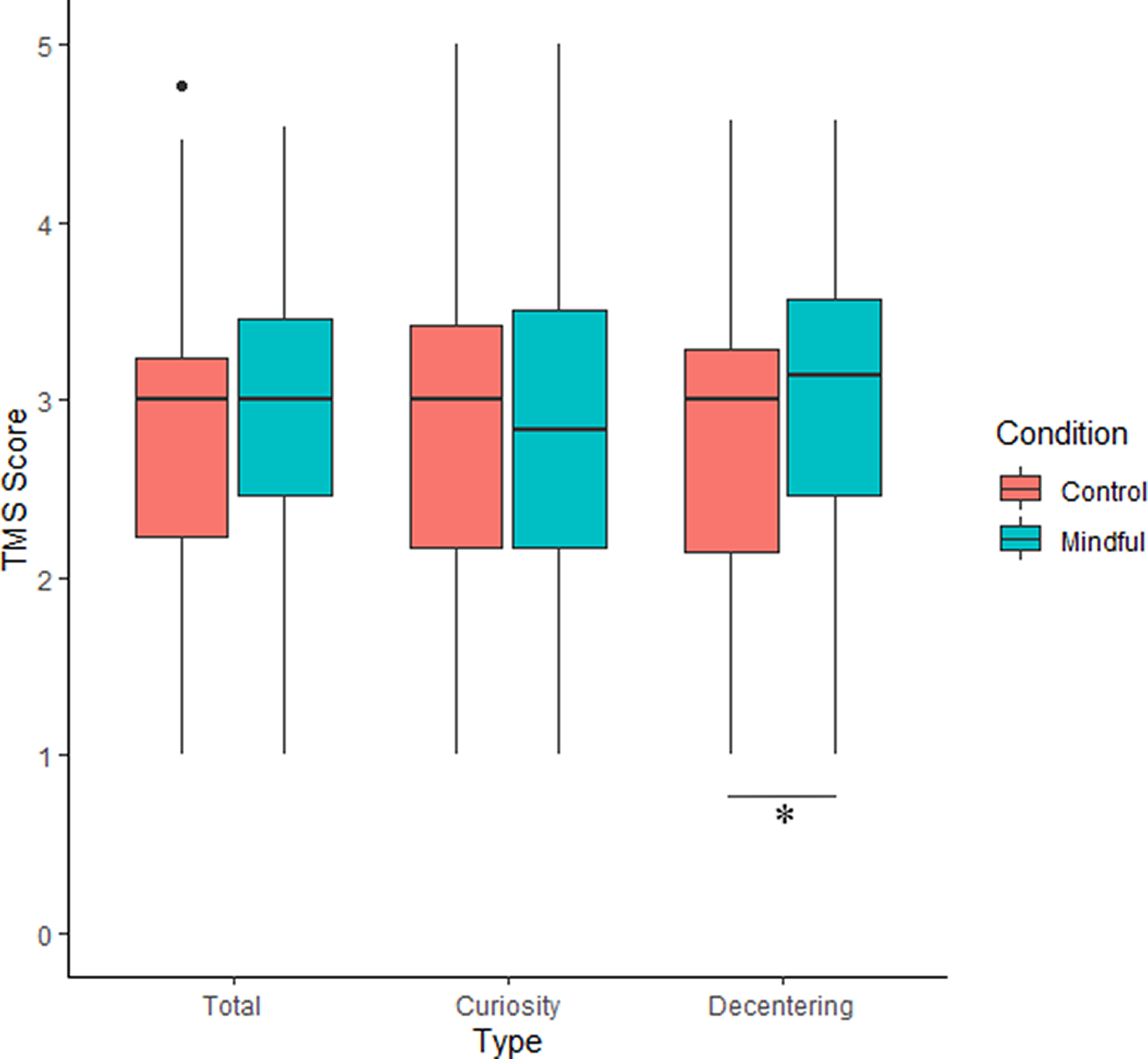
All of the TMS scores corresponding to a mindfulness-based video were compared to the TMS scores corresponding to the control videos using three Mann–Whitney U tests to determine if the mindfulness-based video was effective in generally increasing mindfulness. Total TMS (Z = −1.109, p = 0.267, r = −0.071) and curiosity (Z = −0.062, p = 0.950, r = −0.004) scores were not found to be significantly different for students who watched the mindfulness-based video compared to the control video (Figure 3). However, a significant difference was found for the decentering (Z = −2.517, p = 0.012, r = −0.162) scores. Specifically, it was found that decentering scores for the mindfulness-based video (M = 2.98, SD = 0.80) were significantly higher than decentering scores for the control video (M = 2.73, SD = 0.82) as seen in Figure 3. This indicates that the mindfulness-based video was able to increase students decentering overall, but the effect is small. Increased decentering suggests that students who watched the mindfulness-based video were more likely to have a wider awareness of their experience within the context rather than getting distracted by their thoughts or feelings (i.e., awareness with disidentification or distance) (Teasdale et al. Reference Teasdale, Moore, Hayhurst, Pope, Williams and Segal2002; Lau et al. Reference Lau, Bishop, Segal, Buis, Anderson, Carlson, Shapiro, Carmody, Abbey and Devins2006) during the subsequent design tasks. Likely, an effect was not seen at the class section level for each design task because the effect is small. Future research could include the TMS before and after the mindfulness-based meditation activity to provide a clearer evaluation of the effect on students’ state mindfulness.
Toronto Mindfulness Scale scores for all videos. Statistical significance is indicated by an asterisk (* < 0.05).
Video reflections
Students submitted a short written reflection (at least three sentences) on the video they watched before the concept selection task. Students’ written reflections inform RQ1. Class Sections B and D watched the mindfulness-based body scan video, while Class Sections A and C watched a biography video on the life and accomplishments of Lillian Gilbreth, one of the first woman industrial engineers.
The words most commonly used to describe students’ thoughts on or attitudes towards the video were determined by counting the number of students who used these words in their reflections (Table 5). For the control video, the most common words were interesting (used by N = 18 students), inspiring (N = 15), enjoyable (N = 5) and impressive (N = 5). The words interesting (N = 5) and enjoyable (N = 9) were also used to a lesser extent in the reflections for the mindfulness-based video while inspiring and impressive were not used at all in the reflections of the mindfulness-based video. These results show a positive attitude towards the video on Lillian Gilbreth and some overlap between the words used to describe both videos.
Common words used in students’ written video reflections
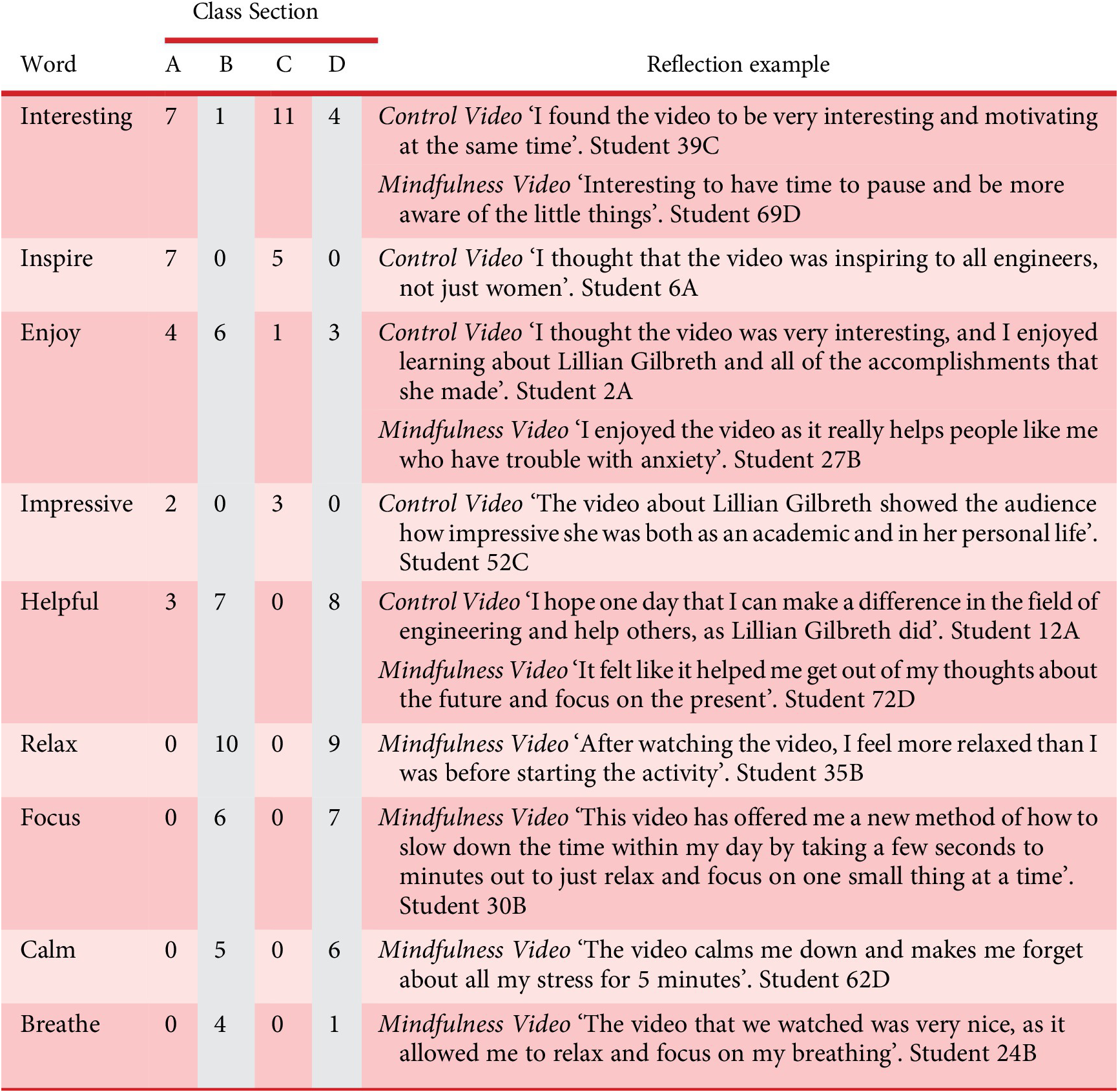
Note: Shaded cells indicate results for class sections that watched the mindfulness-based video.
For the mindfulness-based body scan video, the most common words used in students’ reflections were helpful (N = 15), relax (N = 19), focus (N = 13), calm (N = 11) and breathe (N = 5). The only common word used to describe the mindfulness-based video that was also used to describe the control video was help (N = 3). It is also of note that students who watched the mindfulness-based video often used the word stressed (N = 18). However, this word was not typically used to describe the video (e.g., the video was stressful) but instead used to provide context (e.g., ‘Doing this certainly helped manage any stress that I carried in from last night’s exam’ Student 60D). Overall, this suggests that many students perceived the mindfulness-based video positively and found it to be helpful even though TMS results suggest only a small increase in students’ state mindfulness.
Generally, students who experienced the mindfulness-based video wrote positive reflections with only a few students writing negative reflections. Moreover, a total of five students explicitly stated that they would do this type of activity again in the future or would like to incorporate more mindfulness into their lives. However, two students mentioned that they thought this mindfulness activity was a waste of class time. For example, Student 78D had the strongest negative opinion about the mindfulness-based activity and wrote ‘It’s a pretty big waste of time! These videos are fairly agitating. Class time is for class; meditation and introspection have its own time’. in their reflection. Additionally, two students suggested that the duration of 5 minutes was too long, and another student mentioned that the narration in the video made them ‘uneasy and uncomfortable’. While there was a largely positive response to completing a mindfulness-based practice in an engineering design course, these comments provide context to the breadth of student experiences and possible challenges to implementing practices like this into engineering courses.
5.2. Stress results
Three measures were collected to understand students’ stress during the engineering design tasks. First, the SSSQ was used as a multidimensional measure of the task-induced stress of design. The modified NASA-RTLX was also included because this measure of cognitive workload is indicative of cognitive stress levels and therefore, can be used to support the SSSQ results. The SSSQ and modified NASA-RTLX were used to determine if the mindfulness-based video affected students’ level of perceived stress during the design task. Finally, students’ top five perceived sources of stress were collected to determine if the mindfulness-based intervention changed the way students experienced stress during the design tasks, regardless of if it changed their overall level of stress. All results in this section support RQ2.
Short Stress State Questionnaire
Students completed the SSSQ during the pre and posttask surveys immediately before and after each design task. SSSQ scores were used to measure the task-induced stress of each design task. Standardised SSSQ change scores were calculated for each of three factors by dividing the change in the pre to postscores by the standard deviation of the prescores (Helton Reference Helton2004). Multiple Kruskal–Wallis tests were used to determine if the three SSSQ factors varied by class section for each of the tasks (Table 6 and Figure 4). SSSQ change scores were not found to vary by class section for any of the design tasks. It may be that the mindfulness-based video had no effect on the stress of design at the task level or it may be that the effect was too small to be seen at the task level.
Kruskal–Wallis test results for SSSQ scores.

Short Stress State Questionnaire scores for each task by class section.

Since no differences were seen by class section, SSSQ change scores were collapsed across class section and multiple Friedman’s tests were used to determine if the SSSQ factors varied by design task (Figure 5). Distress change scores [χ2(2) = 11.454, p = 0.003] and worry change scores [χ2(2) = 23.584, p < 0.001] were found to vary by design task. However, engagement change scores were not found to vary by task [χ2(2) = 1.970, p = 0.374]. Post hoc pairwise comparisons using the Wilcoxon signed-rank test with a Holm p-value correction were used to determine how the SSSQ change scores varied by design task. For distress, it was found that physical modelling change z-scores were significantly different from concept generation (Z = −3.090, p = 0.002) and concept selection change z-scores (Z = −2.453, p = 0.11). Concept generation change z-scores (M = −0.383, SD = 0.588) and concept selection change z-scores (M = −0.291, SD = 0.587) were significantly lower than physical modelling change z-scores (M = −0.078, SD = 0.614). For worry, it was found that change z-scores were significantly different for physical modelling compared to concept generation (Z = −3.876, p < 0.001) and concept selection (Z = −4.100, p < 0.001). Students showed a lessened decrease in worry for physical modelling (M = −0.167, SD = 0.555) when compared to concept generation (M = −0.602, SD = 0.705) and concept selection (M = −0.524, SD = 0.634). These findings suggest that physical modelling was the most stressful of the three tasks.
Short Stress State Questionnaire scores by design task. Statistical significance is indicated by an asterisk (* < 0.05, ** < 0.01, *** < 0.001).

Modified NASA-RTLX
Students completed the modified NASA-RTLX during the posttask survey immediately after finishing the design task. A total modified NASA-RTLX score was calculated by averaging students’ scores for all of the corresponding questions. Kruskal–Wallis tests were used to determine if these totals varied by class section for each design task (Figure 6). Total modified NASA-RTLX scores were not found to vary by class section for any of the design tasks including concept generation [H(3) = 1.017, p = 0.797], concept selection [H(3) = 1.272, p = 0.736] and physical modelling [H(3) = 5.644, p = 0.130]. Previous research found similar results for the traditional NASA-RTLX and the modified NASA-RTLX (Nolte & McComb Reference Nolte and McComb2021) so only the modified results are presented here. Similar to the SSSQ results, there may be no effect on cognitive workload due to the mindfulness-based video or it may be that the effect is too small to be seen at the task level.
Total NASA-RTLX and modified NASA-RTLX scores for each task by class section.

To determine if total modified NASA-RTLX scores varied by task, scores were collapsed across class sections and compared using a Friedman’s test. As seen in Figure 7, it was found that total modified NASA-RTLX scores varied by task [χ2(2) = 41.910, p < 0.001]. Physical modelling scores were found to be significantly different compared to concept generation (Z = −5.125, p < 0.001) and concept selection (Z = −4.987, p < 0.001) scores using post hoc pairwise comparisons conducted using Wilcoxon Signed-Rank tests (p-values adjusted using the Holm method). Physical modelling scores (M = 39.472, SD = 13.567) were higher than concept generation (M = 27.979, SD = 12.163) and concept selection (M = 30.451, SD = 15.986) scores. These results suggest that physical modelling had a higher mental workload than concept generation and concept selection. Furthermore, since cognitive workload can be an indicator of mental stress (Brown Reference Brown1994; Fallahi et al. Reference Fallahi, Motamedzade, Heidarimoghadam, Soltanian and Miyake2016), this result supports the SSSQ results in concluding that physical modelling was the most stressful of the three design tasks.
Total NASA-RTLX and modified NASA-RTLX scores by task. Statistical significance is indicated by an asterisk (*** < 0.001).

Sources of stress
Students were asked to rank their top five sources of stress for each task from a provided list of stressors during the posttask survey. Perceived stressors were compared by class section for each design task to determine if the mindfulness-based video affected perceived sources of stress. Top stressors for each task were determined by the number of students who ranked each possible stressor as one of their top five (Table 7). Ties between stressors reported by the same number of students were broken according to which stressor was ranked higher by more students.
Students’ top two sources of stress for each task by class section.

Note: Shaded cells in the table indicate results for students who experienced the mindfulness-based video.
Results indicate that experiencing a mindfulness-based video did not noticeably impact perceived sources of stress during the design tasks. Common perceived sources of stress for concept generation were Not enough ideas (three class sections), I got stuck on one thing (three class sections), Not enough time (two class sections) and I was uninterested in the task (two class sections). For concept selection, all four class sections listed I could not choose one thing as one of their top stressors and perceived stressors of I got stuck on one thing (three class sections) and The task was too easy (two class sections) were also reported by multiple sections. The top three stressors for physical modelling according to all four sections were I got stuck on one thing, the Materials were difficult to use, and there was Not enough time for the task. Interestingly, students who watched the mindfulness-based video ranked Not enough time above Materials were difficult to use while results were opposite for class sections that watched the control video. This may indicate that students who experienced the mindfulness-based video perceived time to be more of an issue. However, Class Sections C and D also had a different instructor than Class Sections A and B, so these results could also be due to instruction style. Overall, perceived stressors aligned with results from prior research (Nolte & McComb Reference Nolte and McComb2021).
Students were also given the opportunity to report any additional stressors in a subsequent free-response question. Students’ responses included task-specific stressors like ‘I am not good at drawing’, ‘Couldn’t understand some of the designs’, and ‘The materials were not entirely the best to create a prototype for a mobilising knee joint’. Task-specific stressors typically overlapped with options in the predetermined list but were often more specific than the options in the list. Alternatively, examples for external stressors included ‘Zoom’, ‘School’, ‘My general anxiety’, and ‘The 9 dogs’. These responses demonstrate the broad range of stressors experienced by students during the design tasks.
5.3. Coping mechanisms
After completing each of the design tasks, students were asked to report any methods they used to manage stress during the task (i.e., coping mechanism). These results directly inform RQ3. These short response answers (N = 78 for concept generation, N = 72 for concept selection and N = 70 for physical modelling) not only highlighted coping mechanisms that students used but also their top perceived stressor and their self-reported perceived stress level. Common coping mechanisms were tagged, and results can be seen in Table 8.
Coping mechanism repeatedly reported by students for each design task by class section.

Note: Class section indicated by A, B, C or D for each of the design tasks. Bolded results indicate results for class sections that experienced the mindfulness-based video.
Most students reported using at least one coping mechanism to manage stress during the design tasks. However, a small number of students reported having no perceived stress during the design task and therefore used no coping mechanisms for that task. A total of 12 students reported no stress during concept generation (Class Section A = 1, B = 3, C = 3 and D = 5), 12 during concept selection (Class Section A = 4, B = 1, C = 3 and D = 4) and 2 during physical modelling (Class Section A = 0, B = 0, C = 2 and D = 0). A similar number of students reported having no perceived stress for concept generation and concept selection, while physical modelling had considerably fewer students report that they perceived no stress. This result supports that physical modelling was more stressful than concept generation or concept selection.
Students’ top perceived source of stress as reported in the reflections was the time limitation. The time limitation was mentioned by 18 students for concept generation (Class Section A = 6, B = 6, C = 3 and D = 3), 19 students for concept selection (Class Section A = 6, B = 5, C = 3 and D = 5) and 17 students for physical modelling (Class Section A = 2, B = 5, C = 5 and D = 5). Time was perceived as a stressor fairly consistently across design tasks and class sections. This indicates time constraints for design tasks may cause recurring mental stress for students.
Students reported many coping mechanisms across the design tasks but the most common can be seen in Table 8. While it appears that the coping mechanism of Focus is used more often by students who watched the mindfulness-based video before concept generation, this pattern does not follow for concept selection or physical modelling. For Minimise Performance, Breathing and Take a Break, the students who watched the mindfulness-based video before physical modelling appear to use these coping mechanisms less. This could be due to the mindfulness-based video but could also be because these two class sections (C and D) had a different instructor than the other two class sections (A and B). Overall, coping mechanisms were fairly consistent across design tasks and class sections.
Several specific coping mechanisms are of note. Task-specific coping mechanisms like drawing for concept generation, self-reassurance for concept selection and planning for physical modelling were reported occasionally. Also, listening to music was reported as a coping mechanism eight times. This was uniquely possible because these students were participating in the course using an online format. Other coping mechanisms that were mentioned infrequently were drinking water, laughing at the quality of their deliverables, checking their phones, talking to friends, cuddling a cat, singing and saying profanities. This suggests that there is a wide range of coping mechanisms used by students to manage the task-induced stress of design.
6. Discussion
Students in four class sections of an introductory engineering design course completed three 10-minute design tasks after either watching a mindfulness-based body scan or control video. Design tasks included a concept generation, concept selection and physical modelling task. Data were collected using pre and posttask surveys. The discussion section for this study will detail results related to mindfulness, stress, and lastly, coping to answer the three proposed research questions.
6.1. Mindfulness
Overall, it was found that the mindfulness-based body scan video did increase students’ decentering. This result indicates that students who watched the mindfulness-based video should have had a wider awareness of the experience in the context rather than being carried away by their thoughts and feelings about the experience (Teasdale et al. Reference Teasdale, Moore, Hayhurst, Pope, Williams and Segal2002; Lau et al. Reference Lau, Bishop, Segal, Buis, Anderson, Carlson, Shapiro, Carmody, Abbey and Devins2006) during the design task. However, students’ total TMS scores and curiosity were not affected by watching the mindfulness-based video. Additionally, when TMS scores were compared by class section for each of the design tasks, no significant effect was found for the students who watched the mindfulness-based video. This is likely due to the small effect of the mindfulness-based intervention.
While a previous study found that the mindfulness-based intervention used here was effective in increasing state mindfulness (measured by the TMS) when delivered using an online modality (Mahmood et al. Reference Mahmood, Hopthrow and de Moura2016), those results were not fully replicated in the current work. Mahmood et al. (Reference Mahmood, Hopthrow and de Moura2016) discussed that when the same mindfulness intervention was used in an in-person group lab setting, increases in state mindfulness were not observed. The authors suggested that the anonymity of completing the exercise online in a familiar space likely contributed to increased mindfulness for the online group while the in-person group did not show increased mindfulness. However, the study also used different populations for the in-person (high school students from the United Kingdom) and online experiment (U.S.A. Amazon MTurk users). The population used in the current study likely has more in common with the in-person participants from Mahmood et al. (Reference Mahmood, Hopthrow and de Moura2016). Additionally, while the mindfulness-based intervention was delivered individually online, students may not have felt complete anonymity because the intervention was being administered during a synchronous course session. Both of these factors likely contributed to the lack of significant results for the mindfulness-based video used here.
While statistically significant results were lacking for the mindfulness-based intervention used in this study, students wrote generally positive reflections on completing the mindfulness-based activity. Many students reported that completing the mindfulness-based activity was helpful as it increased their relaxation and focus, made them calmer, and reminded them to breathe. Moreover, several students reported that the mindfulness-based activity was enjoyable and interesting. However, a small number of students did not appreciate having to complete a mindfulness-based exercise in class because they felt it did not align with their engineering curriculum. While these results may be susceptible to response bias, they suggest that students are generally receptive to learning about and completing mindfulness-based practices in their engineering courses. This is further supported by the subset of students who explicitly wrote that they would do this exercise again or would like to incorporate more mindfulness activities into their lives. These results align with previous research that found that first-year engineering students were receptive to a mindfulness intervention to reduce stress and increase resilience (Huerta Reference Huerta2018) and other studies that found students enjoyed completing meditation in class (Lin & Mai Reference Lin and Mai2016; Miller & Jensen Reference Miller and Jensen2020). In response to RQ1 (How do students perceive the inclusion of a brief mindfulness-based activity during an engineering design task?), these results indicate that students are receptive to and perceive multiple benefits from completing a mindfulness-based activity in-class.
This study suggests that students are interested in incorporating mindfulness-based practices into their engineering curriculum and that a brief mindfulness intervention can increase students’ level of state mindfulness. However, no effect was observed on students’ stress experiences during design, likely because the increase in students’ state mindfulness was small. This suggests that longer-duration mindfulness interventions, mindfulness-based interventions with multiple sessions to allow students to practice, or mindfulness-based intervention with a workshop component to provide students with more instruction on how to engage with the practices should be considered for engineering design students. Previous studies that included mindfulness interventions for college students with longer durations or repetitive mindfulness interventions have more consistently resulted in increased student mindfulness (see O’Driscoll et al. Reference O’Driscoll, Byrne, Mc Gillicuddy, Lambert and Sahm2017 or Chiodelli et al. Reference Chiodelli, de Mello, de Jesus, Beneton, Russel and Andretta2020 for examples). For example, another study found that a four-session intervention (1 hour per session) for first-year engineering students was able to help students become more mindful and increase some of their intrapersonal and interpersonal competencies (Huerta et al. Reference Huerta, Carberry, Pipe and McKenna2021).
6.2. Stress
The measures of stress used in this study (including the SSSQ, the modified NASA-RTLX, and perceived sources of stress during the design task) were not found to significantly differ by class section for any of the three design tasks. In response to RQ2 (What is the effect of a brief mindfulness-based activity on students’ stress experience and sources of stress during three engineering design tasks?), these results indicate that the brief mindfulness-based activity does not have an observable impact on students’ stress experience during design. This most likely results from the minimal increase in students’ state mindfulness due to the brief mindfulness-based video, which is supported by the TMS results.
However, it is also possible that the stress of the short design tasks did not reach the level or intensity at which mindfulness training would be helpful. According to the stress-buffering hypothesis of mindfulness (Cohen & Wills Reference Cohen and Wills1985), the effects of mindfulness practice on stress will be most pronounced during high-stress situations as mindfulness mitigates appraisals of stress and reduces reactions to stress. Since these design tasks were not evaluated for students’ performance and the duration of the tasks was short, students may not have experienced the high-stress levels needed to observe the effects of mindfulness. While this is a possible explanation for why no mindfulness-related effects were observed on stress students’ stress measures, it is more likely that lack of increased state mindfulness is responsible for the results in this study. Students’ SSSQ and modified NASA-RTLX results both suggest that students experienced meaningful stress during these design tasks, which is also supported by previous research that found that engineering design induces stress (Zhu et al. Reference Zhu, Yao and Zeng2007; Nguyen & Zeng Reference Nguyen and Zeng2017; Nolte & McComb Reference Nolte and McComb2020, Reference Nolte and McComb2021). Nonetheless, future research should be conducted to definitively determine whether the lack of effect on stress in this study is due to a deficient induction of increased state mindfulness or the level of stress experienced during the tasks.
Stress by design task
When measures of stress were collapsed across class sections and compared by design task, it was found that physical modelling was the most stressful of the three design tasks. Concept generation and concept selection were found to produce similar levels of stress. These results confirm findings in previous research that while conceptual design is stressful, physical aspects of design are likely more stressful (Nolte & McComb Reference Nolte and McComb2020, Reference Nolte and McComb2021).
The SSSQ results concluded that physical modelling had the smallest decrease in worry and distress when the design tasks were compared. Concept generation and concept selection produced similar decreases in worry and distress. Worry spans items relating to self-regulation and cognitive interference and is sensitive to task importance (Helton Reference Helton2004). Distress relates to negative affect and is sensitive to task difficulty (Helton Reference Helton2004). Students likely experienced less distraction from off-task stressors (i.e., the smallest decrease in worry) and had more difficulty (i.e., the smallest decrease in distress) during physical modelling. Additionally, all three tasks were found to have similar levels of engagement, which indicates that students experienced similar energy-alertness, motivation, and self-efficacy for each of the three design tasks. Therefore, the SSSQ results indicate that physical modelling was the most stressful of the design tasks because it resulted in the smallest decreases in stress for the two significant SSSQ subscales.
Since cognitive workload can indicate a participant’s level of cognitive stress (Brown Reference Brown1994; Fallahi et al. Reference Fallahi, Motamedzade, Heidarimoghadam, Soltanian and Miyake2016), the modified NASA-RTLX results support the SSSQ conclusion that the physical modelling task was the most stressful. Physical modelling produced the greatest cognitive workload, while concept generation and concept selection produced similar levels of cognitive workload. Prior work likewise concluded that physical modelling was the most stressful; however, it also concluded that concept generation was more stressful than concept selection when each question of the modified NASA-RTLX was compared for each design task (Nolte & McComb Reference Nolte and McComb2021). This work supports the previous conclusion that physical modelling was the most stressful but indicates that there is more overlap between the stress of concept generation and concept selection. This is likely because both concept generation and concept selection are conceptual design tasks, while physical modelling has a physical component and is likely more novel for students.
Each design task was also found to have distinct sources of stress that were informed by prior work (Nolte & McComb Reference Nolte and McComb2020, Reference Nolte and McComb2021). For concept generation the top stressors were Not enough ideas, I got stuck on one thing, Not enough time and I was uninterested in the task. The top stressors for concept selection were I could not choose one thing, I got stuck on one thing, and The task was too easy, while the top stressors for physical modelling were I got stuck on one thing, Materials were difficult to use, and Not enough time. These results indicate that each design task had consistent stressors that were mostly distinct from the other design tasks. All three design tasks had I got stuck on one thing as one of their top stressors. This may indicate that students were struggling with design fixation. Additionally, Not enough time was a top stressor for both concept generation and physical modelling. This finding suggests that these tasks may require more time for students to complete. Generally, these stressors overlap greatly with those identified in previous research (Nolte & McComb Reference Nolte and McComb2021). Instructors should be aware of these stressors for each design task and modify instruction to help students overcome these challenges. For example, instructors could schedule more time for concept generation and physical modelling activities and teach techniques to help students overcome design fixation.
6.3. Coping mechanisms
Regarding RQ3 (How do students cope with stress during engineering design activities?), students reported five common coping mechanisms including Focusing, Minimising performance, Breathing, Taking a break or Avoiding/Distracting when asked how they managed the stress of the design tasks. Many students were able to manage the stress of the design tasks by solely Focusing on the design tasks. This is likely a very effective coping mechanism for short design tasks like the ones used in this study and is a good example of task-focused coping (Endler & Parker Reference Endler and Parker1990). Multiple students even said that focusing on the task helped them to forget about external stressors for the interim of the design task. For example, Student 60D wrote, ‘I focused entirely on the project at hand and forgot about anything other than it’. However, there is an overall consensus that students’ attention spans do not last longer than about 15 minutes (Bradbury Reference Bradbury2016). Therefore, this coping mechanism is unlikely to be sustainable during longer design projects or activities unless combined with other coping mechanisms like Taking a break.
Additionally, students often Minimised the importance of their performance (emotion-focused coping) to mitigate some of the stress from the design task. While this mechanism may have been effective for the design tasks used in this study because the tasks were not graded, it is unlikely that this will be a viable coping mechanism in real-world design. Instructors should help students prepare for receiving critical feedback and try to increase students’ design self-efficacy.
Another repeatedly mentioned coping mechanism for students was to Concentrate on their breathing or take a few deep breaths. While the 5-minute mindfulness-based body scan video did suggest using the breath as an anchor (Goldstein Reference Goldstein2012), it was not the main focus of the practice. Additionally, breathing was reported as a coping mechanism by students who did and did not experience the mindfulness-based video before the design task. Students were likely taught deep breathing as a stress management technique earlier in their lives as breathing is known to calm the sympathetic nervous system (Oneda et al. Reference Oneda, Ortega, Gusmão, Araújo and Mion2010). As students are already using breathing techniques to calm themselves and manage stress, this may suggest that some students would be more receptive to a mindfulness-based meditation focused on breathing and monitoring the breath. Future research should investigate if engineering students are more receptive to or gain greater benefits from different mindfulness practices.
Multiple students mentioned Taking a break as one of the coping mechanisms they used to manage their stress during the design tasks. While many students did not report what they did while they were taking a break, others mentioned that they used the break to regroup, breathe, get a drink of water, or think about something else. Interestingly, previous research has found that task switching improves engineering design performance and reduces design fixation (Sio, Kotovsky & Cagan Reference Sio, Kotovsky and Cagan2017). Instructors should encourage students to take short breaks when needed and use their breaks productively.
Some students also reported Avoiding the design task or distracting themselves from the design task to manage stress. While this coping mechanism was reported by multiple students, its use should be avoided. Previous research has found that when avoidance is used as a coping mechanism for task-induced stress it leads to the withdrawal of attention from that task, which can lead students to give up on the task (Matthews & Campbell Reference Matthews and Campbell2016). Additionally, avoidance coping has been associated with poorer task performance (Delahaij et al. Reference Delahaij, van Dam, Gaillard and Soeters2011; Matthews & Campbell Reference Matthews and Campbell2016). Instructors should encourage students to use other, more productive coping mechanisms to manage the stress of design.
While students currently utilise many mechanisms for coping with task-induced stress, teaching engineering students mindfulness is still a promising avenue for helping students manage the stress of engineering and design. Coping mechanisms like Focusing and Minimising performance will likely not help students effectively manage stress during longer design projects or in their careers. Alternatively, coping mechanisms like Taking a break or Breathing naturally lend themselves to encouraging mindfulness and expanding students’ techniques for managing challenging, stressful situations. Extended mindfulness training for engineering students could promote positive stress management coping that students could rely on long after completing their education. It is contended that mindfulness helps buffer stress by changing structures in the brain associated with attention and emotion regulation, which can lead to more positive appraisals of stress and lower reactivity to stress (Cohen & Wills Reference Cohen and Wills1985; Creswell Reference Creswell2017). Future work should examine how longer duration mindfulness-based interventions affect engineering students.
6.4. Limitations and recommendations for future research
The results of this study contribute to a deeper understanding of the effect of mindfulness-based interventions in engineering courses. However, this research does have some limitations. The primary limitation of this study is the limited participant diversity in terms of age, gender, racial/ethnic and socioeconomic demographics due largely to the demographics of the institution where this study was conducted. This work should be replicated with more diverse student populations as previous research has concluded that minority status can contribute to students’ college stress (Cokley et al. Reference Cokley, McClain, Enciso and Martinez2013) and that mindfulness-based practices can alleviate some of the stress of identifying as a minoritized student (Womack & Sloan Reference Womack and Sloan2017) Additionally, this study only relies on a singular mindfulness-based body scan video to induce increased state mindfulness. It may be that other mindfulness-based videos are better suited for this student population. Future work should include other types of mindfulness practices to understand their effect on engineering students. While the tasks used in this study were designed to be representative archetypes of concept generation, concept selection and physical modelling they may lack complete authenticity. For example, the tasks used in this study were not graded or evaluated for performance. Future research could investigate how changing the characteristics of the design task effects stress and how the inclusion of a mindfulness-based intervention effects design outcomes. Finally, this study was conducted during the spring semester in 2021 when courses were still being administered online due to the restrictions related to the COVID-19 pandemic. Future work should definitively determine whether any of the results from this study were specifically due to the online instruction or COVID-19 pandemic. A more detailed discussion of this issue can be seen in Nolte & McComb (Reference Nolte and McComb2021).
Future research should incorporate additional measures of mindfulness to more fully determine what effect the mindfulness-based activity has on students’ levels of state mindfulness. Some researchers contend that self-report measures of mindfulness are inadequate and that each measure of mindfulness has conceptual differences (Bergomi, Tschacher & Kupper Reference Bergomi, Tschacher and Kupper2012). Using measures such as neuroimaging, physiological measures or behavioural tests may be more indicative of true changes (Tang & Posner Reference Tang and Posner2013). Future research should also include longer-duration mindfulness-based interventions, mindfulness-based interventions with multiple sessions to allow students to practice, or mindfulness-based intervention with a workshop component to provide students with more instruction on how to engage with the practices. Longer duration or multiple session mindfulness interventions have been found to increase students’ levels of mindfulness more consistently (see the reviews of O’Driscoll et al. Reference O’Driscoll, Byrne, Mc Gillicuddy, Lambert and Sahm2017 and Chiodelli et al. Reference Chiodelli, de Mello, de Jesus, Beneton, Russel and Andretta2020 for examples). One possible avenue would be to incorporate the four-workshop mindfulness intervention developed by Huerta et al. (Reference Huerta, Carberry, Pipe and McKenna2021) into introductory engineering design curricula and courses.
7. Conclusion
This study investigated the effect of a brief mindfulness-based intervention on introductory engineering students’ cognitive stress experience during concept generation, concept selection and physical modelling. The mindfulness-based intervention was a short body scan practice and data were collected using surveys before and after each of the three design tasks. In response to RQ1, it was found that students were receptive to the mindfulness-based activity and perceived multiple benefits. However, while RQ2 hypothesised that students who experienced the mindfulness-based intervention would report decreased stress during the design tasks, this result was not found. Results do indicate that students experienced a small increase in their mindfulness, specifically their decentering, but this had no observable impact on student stress. In addition, it was concluded that physical modelling was the most stressful and that concept generation and concept selection had similar levels of stress. Finally, in response to RQ3, students were found to use five recurring coping mechanisms to manage the task-induced stress of design. Future research should investigate the efficacy of longer-duration mindfulness-based interventions for engineers and engineering design.
Acknowledgment
We would like to acknowledge Dr. Charles Cox for his assistance in the data collection for this study.
Financial support
H.N.’s research assistantship is supported by the Defense Advanced Research Projects Agency through cooperative agreement N66001-17-4064. Any opinions, findings and conclusions or recommendations expressed in this article are those of the authors and do not necessarily reflect the views of the sponsor.


 Open access

