




Introduction
In the summer of 1960, Captain Lê Thanh Giảng, Director of the General Bureau of Railways’ Bridge Team No. 1, certified the personal record of a thirty-three-year-old riveter named Thành. Comrade Thành was a veteran of the Resistance War against the French who performed his work admirably, “always willing to carry on and overcome” and always maintaining “proper decorum, never straying and drinking.”Footnote 1 Captain Giảng noted that Thành had been praised on numerous occasions for the repair work he carried out on the rail bridges that crisscrossed the Red River Delta. By all accounts, Comrade Thành was a model citizen of the newly independent Democratic Republic of Vietnam. But the man in question was not Vietnamese and his real name was not Thành. Rather, this exemplary worker was an Algerian named Rabat Boulacen, a former private in the Corps Expéditionnaire Français en Extême-Orient (French Far East Expeditionary Corps [CEFEO]).Footnote 2 Ten years earlier, on the evening of 25 July 1950, Boulacen grabbed a Bren light machine gun, fifteen magazines of .303 ammunition, and two hand grenades and slipped away from his post, disappearing into the jungle of Quảng Nam province.Footnote 3 That Tuesday night a decade earlier, the man who would be Thành deserted the French army for the Việt Minh.Footnote 4
During the Indochina War, France assembled one of the world’s largest multi-ethnic, multi-confessional armed forces to preserve its empire in Southeast Asia. Between 1946 and 1954, servicemen from France’s colonies in North and Sub-Saharan Africa comprised more than a third of the CEFEO: 122,900 came from Morocco, Algeria, and Tunisia and 60,340 came from French West and Equatorial Africa. A month before the opening attack at Điện Biên Phủ in March 1954, nearly half of the French Expeditionary Corps came from a French colony. Wary of instituting a draft in metropolitan France after 1945, Paris raised a volunteer army, drawing on experiences recruiting colonial tirailleurs to fight in the World Wars. Unlike those wars, however, the war in Indochina would be the first time colonial subjects would be sent to fight other colonial subjects during a war for independence.
The mobilisation of soldiers from North and Sub-Saharan Africa represented a potent symbol of postwar France’s ability to command the loyalty of its colonial subjects during its first modern war of decolonisation. But it also represented an ever-present anxiety for officials who worried about desertion and defection and feared that disaffected African veterans influenced by enemy propaganda would join anticolonial movements elsewhere in the French Union following demobilisation.Footnote 5 Similarly, the Democratic Republic of Vietnam (DRV) perceived Africans serving in French uniform as a threat to its own rhetoric of anticolonial solidarity. But it also saw them as an opportunity to spread propaganda among the colonial military and foment an imperial insurrection. To that end, the DRV implemented a psychological warfare program known as địch vận—or “rallying the enemy”—from the very beginning of the conflict.Footnote 6 This campaign sought to persuade all those who served in French uniform—from the Europeans and Africans who served in the Expeditionary Corps to the Vietnamese, Cambodians, and Laotians who served as auxiliaries—to recognise the righteousness of the Việt Minh’s cause, abandon the fight, and join their side. African soldiers in particular represented a potent pool of future rebels who could be trained and eventually sent back to their homelands to fight for their own national liberation. Today’s deserters might be tomorrow’s revolutionaries.
Swayed by the promise of an empire-wide rebellion, more than three hundred African soldiers defected over the course of the war. Afterward, many, like Rabat Boulacen, decided to remain in North Vietnam, joining hundreds of other deserters and former prisoners of war—disenchanted young officers from metropolitan France and disgruntled Foreign Legionnaires from Germany and elsewhere in Europe—who opted for a new life in a new Vietnam. These “migrants” to the Democratic Republic of Vietnam were welcomed as người Việt Nam mới (“new Vietnamese people”) and represented a postcolonial future marked by global revolutionary collaboration.Footnote 7 Yet tensions soon emerged along racial and cultural lines as DRV cadres struggled to govern their newest residents and African defectors—increasingly marginalised by the uncompromising process of Communist state-making—became disillusioned with the realities of life in North Vietnam.
Using ministerial archives from the nascent DRV, original địch vận propaganda materials, and oral history interviews, this article traces how formerly colonised subjects from opposite ends of the French empire perceived one another whilst confronting competing ideas about decolonisation.Footnote 8 In particular, it argues that decolonisation in Indochina produced both conditions ideal for transnational anticolonial cooperation and a mutual discontent that undermined its realisation. Both Vietnamese Communists and the Africans who defected to their side would become dissatisfied by one another’s expectations of anticolonial solidarity and both, in turn, became disappointed by their behaviours, actions, and expressions of commitment. Initially eager for France’s colonial troops to join their ranks, Vietnamese Communists grew worried about the presence of Arab and Black men who behaved in ways that did not conform to their model of revolutionary conduct and whose demands for assimilation and autonomy threatened the DRV’s state-building project. For their part, North and Sub-Saharan Africans faced racial prejudice and xenophobic distrust from North Vietnamese society that echoed experiences of French colonialism. Frustrated by their inability to integrate as full citizens and refused the training necessary to enact the revolutionary future they were promised, the “new Vietnamese” began seeking alternatives to their lives in the Democratic Republic as their homelands sought independence for themselves.
These dual discontents, I argue, arise not only from the conventional difficulty of integrating foreigners into the post-independence nation, but also from Vietnamese Communism’s own division between its self-professed internationalist anticolonial mission and its desire for the internal solidification of the party-state. Communism has long exhibited a tension between the transnational and the national, from doctrinal debates over prioritising domestic rather than world-wide revolution to official repudiations of racial difference and national origin in favour of solidarity built on class and adherence to ideology.Footnote 9 The Democratic Republic of Vietnam—nominally a coalition of nationalists, but directed by the leadership of Hồ Chí Minh’s Indochinese Communist Party (later the Vietnamese Worker’s Party)—framed its war against the French as both a struggle for national liberation and a broader revolutionary dismantling of the empire. Christopher Goscha has written on the “missionary impulses” that informed Vietnamese Communism’s internationalist outlook.Footnote 10 He argues that Vietnamese Communists were animated by a sense of “duty” (bổn phận) to spread “revolutionary civilization” to the “world outside” Vietnam, specifically to their Indochinese “brothers” in Cambodia and Laos.Footnote 11 Seeing themselves as part of a global revolutionary network “running from Moscow to eastern South East Asia by way of China,” they were keenly aware of their need not only to liberate their own country from colonialism, but to help the world’s “weak and oppressed” accomplish the same.Footnote 12 The Indochina War brought the greater French empire directly to Vietnam’s doorstep: Black and brown soldiers from the other side of the globe who spoke unfamiliar languages, worshipped unfamiliar religions, and engaged in unfamiliar cultural practices. The complexity they represented often frustrated Vietnamese Communists’ revolutionary world vision and would test the limits of Afro-Asian solidarity. Ironically, the policies and approaches undertaken by DRV cadres to target, persuade, re-educate, and later integrate soldiers from French North and Sub-Saharan Africa ultimately subverted the prospect for true collaboration between formerly colonised people.
The conditions that pitted subaltern against subaltern in Indochina were not unique to the French colonial empire. Every land-based or overseas empire of the modern period—from the United Kingdom and the United States to the Ottoman Empire and Imperial Japan—employed colonial subjects or otherwise marginalised communities to bolster its armed forces, defend the homeland, and expand territory. Whilst many were conscripted or forced to serve, many others did so willingly, hoping that military service would not only lead to upward mobility, but also recognition that could lead to social and political inclusion. Other dynamics that defined the Indochina experience have similarly manifested themselves in different periods and different circumstances: a desire by opposition forces to exploit the precarious racial and ethnic composition of imperial militaries to attract deserters, conflicts of conscience experienced by colonial soldiers fighting against a society that mirrored their own, or the emergence of racial and cultural tensions between groups that otherwise should have been aligned in their purposes. The story of French colonial soldiers in Indochina can thus be seen in comparative context with such diverse cases as Indians who supported Britain’s imperial project in Africa and echoed its racialised rhetoric, Koreans conscripted to defend the Japanese Empire’s Co-Prosperity Sphere across Southeast Asia, and Black Americans who expressed doubts about their service against Filipino nationalists at the turn of the century—and later again in Vietnam itself.Footnote 13
The experiences of African servicemen during the Indochina War therefore demand closer examination. Their role in the conflict remains little-studied by historians and is still largely unrecognised by the public in both Vietnam and the West. Western scholarship tends to analyse the participation of Africans only in relation to the French colonial state, ignoring how non-French actors like the Vietnamese themselves perceived and engaged them.Footnote 14 In Vietnamese accounts, the involvement of African soldiers is largely ignored; their presence being subsumed into a monolithic, and mainly white, “French enemy” (giặc Pháp). Whenever Africans are mentioned, they are emphasised as part of a well-established narrative that insists on three points: firstly, the French empire’s use of colonial subjects as “cannon fodder” cajoled into fighting the Vietnamese for money or out of ignorance; secondly, the DRV’s self-proclaimed “humanitarian policy”(chính sách nhân đạo) that emphasises its fair treatment of African deserters and prisoners of war because they, too, were victims of imperialism; and lastly the belief that those Africans who did defect received revolutionary training and returned to their homelands to lead national liberation movements of their own.Footnote 15 This narrative is belied by the actual experiences of Africans who had diverse motivations for both serving in the French military and abandoning it, who faced prejudice and paranoia from a society in the midst of a revolutionary transformation, and who remained in the DRV—either by their own choice or by Hanoi’s stubborn instance to keep them there to ensure their “political enlightenment”—long after the highwater mark of decolonisation elsewhere had receded. By tracing this unconventional example of South-South migration, this article attempts to recover the forgotten histories of men like Rabat Boulacen and move beyond the limits of contemporary scholarship in Vietnam and the West to showcase both the promises—and the limitations—of anticolonial networks between Africa and Asia during one of the modern era’s first major wars of decolonisation. In so doing, we can examine how these historical actors struggled to realise the transnational potential of decolonisation in the face of postcolonial nation-building.
Imagining the New Vietnamese
Following the outbreak of hostilities between the French state and the Democratic Republic of Vietnam in December 1946, Vietnamese Communists quickly identified the necessity of mobilising resources to rally the enemy.Footnote 16 As one early địch vận field manual pronounced: “We are fighting the French enemy, who is currently stronger in terms of technology [and] weaponry. Relying on weapons alone to defeat the enemy is more difficult and costly. A famous military strategist has said: ‘The most victorious battle is the one that requires no fighting for the enemy to disintegrate.’ The địch vận mission is a way of fighting the enemy without fighting.”Footnote 17 In April 1947, just as the first battalions of North African soldiers embarked from Marseilles, the Central Cadres Conference resolved that: “Địch vận is as important as combat.”Footnote 18 For an embryonic state forced into the mountains north of Hanoi with few initial resources to wage conventional warfare, DRV leadership saw any effort to sap French morale and manpower as worthwhile. Convincing colonial soldiers to abandon the French military not only complemented the logic of anticolonial solidarity espoused by Hồ Chí Minh since the 1920s, but fulfilled a practical necessity.Footnote 19
Analysing the training manuals and internal reports published by the Địch Vận Bureau (Cục Địch Vận) provides a glimpse into how Vietnamese Communists imagined African soldiers and how they inscribed them into the larger ideological framework of their struggle. More than mere propaganda, địch vận was an ambitious ecosystem of psychological warfare whose cadres engaged in an array of activities, from printing subversive pamphlets to developing curricula for the political re-education of rallied soldiers and managing their well-being in camps scattered across DRV-held territory. At the centre of địch vận was a pedagogical mission—a belief that Vietnamese Communists would not only “entice enemy soldiers” (lôi kéo quân lính địch), but also “enlighten the enemy” (giác ngộ địch).Footnote 20 If used properly, địch vận could be “as powerful as artillery and bazookas.”Footnote 21
The Địch Vận Bureau centralised all rallying efforts, overseeing the creation of địch vận groups in every administrative region and attaching specialised teams to units of the People’s Army of Vietnam (PAVN). Địch vận relied heavily on the printed and spoken word: leaflets, clandestine newspapers, posters, and slogans shouted through megaphones. The content of these communications were often tailored to the particular soldiers that Vietnamese Communists hoped to persuade. Cadres translated propaganda into French, German, and Arabic—usually with the help of defectors—and altered the content of their messages to address different audiences. But effectively communicating required cadres to understand the enemy they were fighting. In the earliest months of the war, Vietnamese Communists only faced metropolitan French soldiers and their anti-Communist Vietnamese allies. These were known entities. But as the conflict deepened, the number of soldiers from North and Sub-Saharan Africa quickly swelled and their presence on the battlefield became increasingly visible. In 1948, soldiers from the Maghreb and Sub-Saharan Africa comprised approximately 17% of all CEFEO troops.Footnote 22 By 1950, the number of Maghrebi troops more than doubled from 10,783 to 25,208 and the presence of soldiers from French West and Equatorial Africa increased fivefold from 2,477 to 13,618.Footnote 23 As the war in Indochina reached its most kinetic phase in 1951-1952, one in three servicemen came from an African colony. Understanding and making sense of these soldiers became a priority for địch vận cadres.
According to training material circulated to instruct cadres and the general populace in the art of rallying the enemy, Vietnamese Communists divided their adversary into four broad categories: French soldiers (lính Pháp), German soldiers of the Foreign Legion (lính Đức), “Black Westerner” soldiers (lính Tây đen), and “puppet” troops (Ngụy binh)—those Vietnamese, either professionally-trained or auxiliaries, who fought with the French.Footnote 24 The term “Black Westerner”—first used by the Vietnamese public in the early twentieth century for Tamil migrants from France’s possessions in India—referenced the dark skin of both Black and Maghrebi soldiers.Footnote 25 Vietnamese Communists often amalgamated North African and Sub-Saharan soldiers simply as “African soldiers” (lính Phi), although there are many recorded instances of cadres singling out “North Africans” (Bắc Phi) in their reporting. Rarely, however, were Black soldiers given this distinction, except in rare cases when they were identified as all being “Sénégalais” (Senegalese) or simply “da đen” (black skinned). Soldiers from North and Sub-Saharan Africa were subsumed further still into the larger and, from a Western perspective, somewhat novel category of “European-African soldiers” (lính Âu-Phi)—a designation presumably used to draw a clear, and age-old, distinction between the “foreign” enemy and the Vietnamese.
Africans were seen as natural, but challenging, targets to rally. In one manual, Vietnamese Communists described Africans in racial and unflattering terms: “Black-skinned soldiers are slower [chậm hiểu hơn], the majority are illiterate, stupid [dốt nát], therefore it is a bit harder to mobilise them.”Footnote 26 “However,” the manual assured, “if we are patient and smart, we can still enlighten and rally [African soldiers] as usual. After all, they are in the same boat as us.”Footnote 27 It was this central idea—that African soldiers, as colonised subjects and members of the peasant and working classes, shared common cause with Vietnamese Communists—that inspired and perpetuated efforts to rally them. But, for địch vận leadership, the tây đen had to be shown the way.
Whilst địch vận cadres noted that some North Africans rallied on their own, swayed by the rising tide of militant nationalism in their own homelands, not all African soldiers were so inspired. Many remained loyal to the French, a reality that baffled Vietnamese Communists. Cadres believe the only explanation was because, in the words of one report, “Africans still bear the slave mindset.”Footnote 28 It was thus the implicit duty of Vietnamese Communists to liberate them from such a mentality. In their eyes, địch vận propaganda and political re-education could achieve such a result. More importantly, however, properly “enlightened” African soldiers could be “returned to their home countries” to follow in the footsteps of the Vietnamese themselves.Footnote 29 A global revolution could therefore be organised from the jungles, highlands, and rice paddies of Vietnam. African servicemen in Indochina tethered the mission of Vietnamese Communism to a wider world. A 1950 report insisted that cultivating affiliations with African soldiers was “a primary element to obliterate all the French colonisers’ determination to resist.”Footnote 30 And as Hồ Chí Minh himself had declared in a letter to rallied Maghrebi soldiers six months earlier: “The Vietnamese people, the North African people, and [our] friends from other French colonies, unite tightly together and share one ideal: to shatter French colonialism and take back independence. Therefore, a liberated Vietnam will help the liberation of your countries easily and the victory of Vietnam will help your victory later.”Footnote 31 Such thinking was part of an overarching ideological strategy not just to defeat the French in Indochina, but to defeat the root cause of France’s fight—imperialism itself. This language is notable because it emerged just as DRV strategists began their shift toward a general counter-offensive, moving from “low-intensity guerrilla skirmishes to conventional warfare in order to defeat the coloniser on the battlefield.”Footnote 32 Rallying enemy troops, especially African soldiers capable of inciting anticolonial sentiment among French Union forces, or even back in the colonies, supported a conflict that was fast becoming a “total war.”Footnote 33
Early địch vận successes at rallying African soldiers suggest that such international revolutionary ambitions might materialise. DRV lists indicate that a handful of North Africans rallied as early as the spring of 1948. Amrane Moustapha from the 1st Régiment des Tirailleurs Algériens slipped away from his unit in Saigon’s Chợ Lớn district in June 1947, making him perhaps one the first colonial soldiers to rally to the Việt Minh.Footnote 34 The PAVN’s stunning military successes over the French in 1950, especially at Cao Bằng, did much to amplify địch vận efforts, and DRV records show an uptick in Africans joining their ranks between 1951 and 1953.Footnote 35 To inspire even more desertions, the DRV corresponded with North African nationalist icons and requested that they call on their fellow Maghrebis to defect. Vietnamese Communists wrote to Abd El-Krim, leader of the interwar Riffian insurgency against the French and living symbol of Moroccan nationalism exiled in Cairo, proclaiming: “Our struggle is yours and your fight is no different than ours.”Footnote 36 In solidarity, the Moroccan Communist Party sent a long-time syndicalist named M’hamed Ben Aomar Lahrach to DRV-held territory via Moscow and Beijing in 1950 to organise rallied Maghrebi soldiers and serve as their interlocuter.Footnote 37
The PAVN even put a few trustworthy deserters, like Rabat Boulacen himself, back into battle against the French. After serving five months in various regiments of the PAVN, Boulacen was transferred to an experimental but short-lived unit made up of armed North African deserters called the Détachement d’Indépendance Nord-Africaine (Đội Quân Bắc Phi Độc Lập [North African Independence Detachment]).Footnote 38 In the fourteen months that Boulacen served as a machine-gunner in its ranks, he claimed to have participated in direct battles against French Union forces throughout the Central Highlands and Quảng Ngãi province.Footnote 39 Although little is known about the operational history of the North African Independence Detachment, it represented perhaps the most tangible example of the DRV’s desire to actualise rallied colonial soldiers for a future revolution and make real the French fear that failure in Asia would spell the end of the French Union itself. Whilst the DRV may have hoped that such a unit might become a latter-day international brigade, it is more likely that they served the practical purpose of using every available man and weapon in the days before Communist Chinese support arrived and the DRV decided on a policy of mass peasant mobilisation in support of its general counter-offensive.
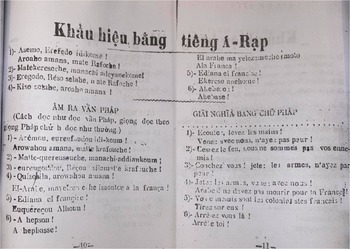
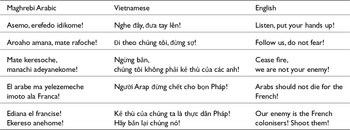
Those African soldiers who did not take up arms provided support in other ways, most importantly by producing much needed translations of địch vận propaganda, leaflets, and “rallying phrases” to convince their compatriots to defect. So great was the faith Vietnamese Communists placed in the power of words that they believed, even in the heat of battle, “If suddenly we shout phrases or countersigns, [the enemy] will suddenly act accordingly. In a minute of lightning speed, we [can] determine the enemy’s surrender.”Footnote 40 But such words were only useful if the enemy could understand them. To that end, North Africans translated phrases into phonetic darija (colloquial Maghrebi Arabic) that địch vận cadres could shout through megaphones (Figure 1, Table 1).
Địch vận rallying phrases in phonetic Maghrebi Arabic. Based on the dialect of Arabic used, it is likely that the original translator was either from western Algeria or Morocco. Source: Ban Địch Vận, Khẩu hiệu Địch-vận trong lúc tác-chiến (n.p.: Phòng Chánh Trị Nam Bộ, 1949).
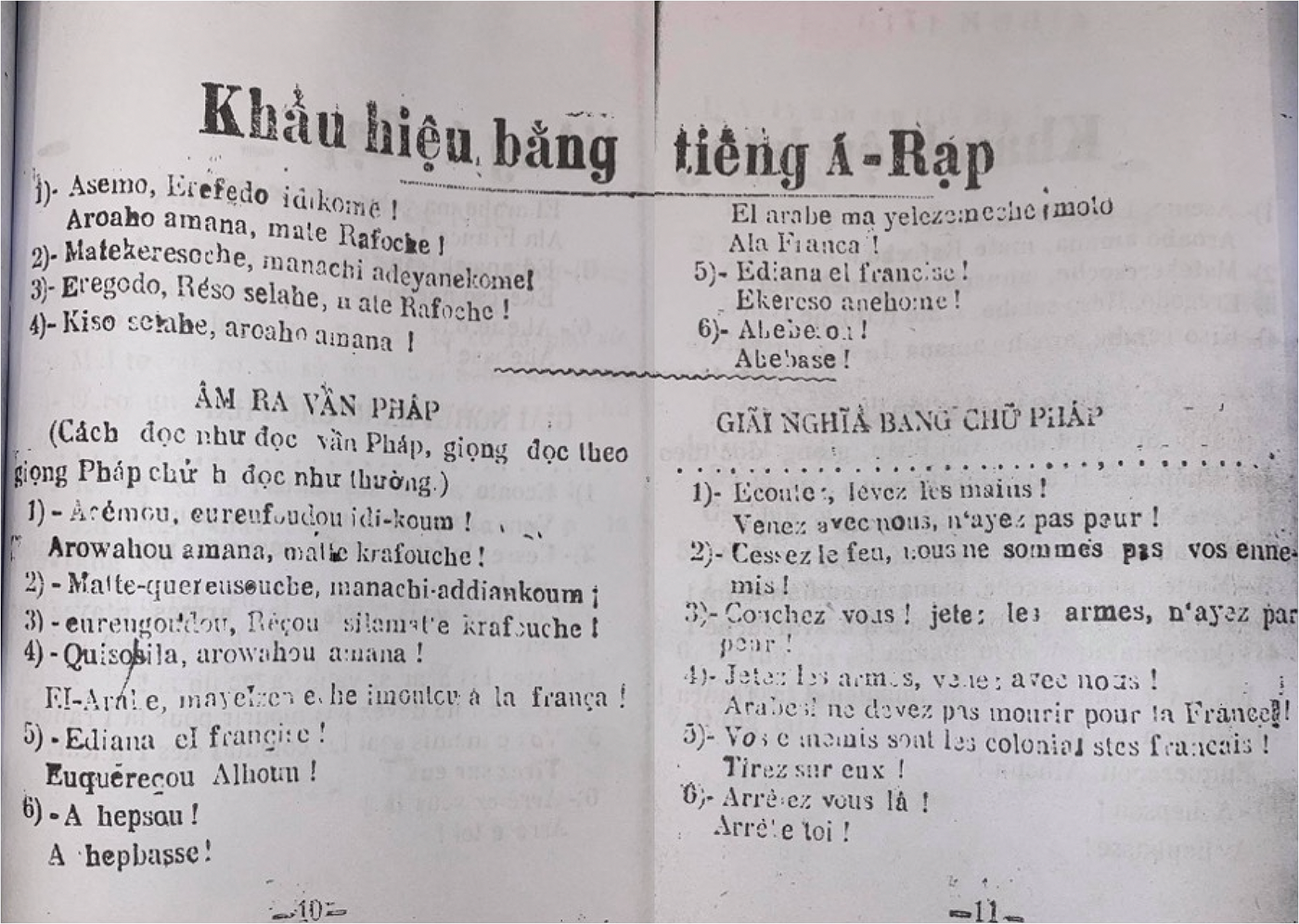
Figure 1 Long description
The system picked up Vietnamese letters and the phoneticized Arabic as junk elements, it conveys meaningful information because they exactly replicate the text that is on the image to anyone with a text reader so that a visually impaired person using a text reader can read these elements. They have value as alt-text. Is it possible for the system to override any error you are receiving now that I’ve confirmed these are not corrupted elements but in fact the alt-text
Transcription and Translation of Select Rallying Phrases in Maghrebi Arabic

Table 1 Long description
This table provides translations of rallying phrases from Maghrebi Arabic into Vietnamese and English, focusing on themes of resistance and unity. Key phrases include calls to listen and raise hands, follow without fear, cease fire, and identify the French colonizers as the enemy. The translations emphasize the urgency and emotional appeal of the original Arabic phrases, reflecting a historical context of resistance against colonial forces. The table allows for cross-cultural understanding of the sentiments expressed in these rallying cries, highlighting the shared human experience of resistance and solidarity.
But how many soldiers were persuaded by such words? Soldiers may have had several motivations for defecting, ranging from the ideological to the practical. Growing nationalist movements across North Africa certainly inspired many to question their service. At least one group of Moroccans deliberately sought out the Việt Minh in 1953, following France’s decision to exile Sultan Mohammed V to Madagascar in response to his vocal support for Moroccan independence. Others, like Rabat Boulacen, may have been swayed by their experiences, the harshness of a conflict that was not theirs, or simply as a means to sit out the war in what they hoped would be the relative comfort of the enemy’s camp. Some deserted because of their love for a local Vietnamese woman—perhaps one who was herself a Việt Minh sympathiser.Footnote 41 And lastly, some soldiers, fearing imminent capture, may have found it more compelling to announce their intention to defect, placing their survival above all else.
Exact figures are hard to determine in part because the French military had difficulty accounting for missing troops during the war, but also because many deserters were often confused for prisoners of war, an ambiguity some African soldiers exploited in order to be repatriated after the conflict. Nonetheless, according to one French report, only a total of 338 North African soldiers and seventy-eight Sub-Saharan African soldiers deserted between 1947 and 1954.Footnote 42 Of course, not every African soldier who deserted rallied to the Việt Minh. Some wanted nothing to do with the war and had simply gone AWOL. French records claim that 282 North African soldiers and only forty-four Sub-Saharan soldiers deliberately rallied to the DRV during the conflict.Footnote 43 A report from the Địch Vận General Directorate in November 1954 counts 341 individuals from “Africa and other colonised countries” as having rallied.Footnote 44 Nonetheless, those who deserted paled in comparison to the mounting number of fresh arrivals from the colonies and Vietnamese Communists would soon find themselves frustrated by the very soldiers they sought to rally.
Despite the early hope that Vietnamese Communists had for rallying France’s colonial soldiers, địch vận cadres were frustrated by their underwhelming results. By their own admission, cadres were not as successful as they would have liked. As one report disclosed: “the African bloc…has not shown a sign of leaning towards us.”Footnote 45 Whilst communication always posed a problem, a larger issue was an inability to understand the cultural differences among France’s colonial soldiers. This perhaps led one report to lament that the Địch Vận Bureau’s underperformance was because cadres did not “understand the psyche of the African soldiers” (“tâm ly linh Fi” [sic]).Footnote 46
The belief that Africans ought naturally to be allies of the Vietnamese may have prevented cadres from truly understanding the enemy they hoped to convince. If Africans did not rally, cadres believed it was because they were not communicating clearly enough or simply because, in the words of one report, “Africa is still oppressed.”Footnote 47 But such thinking denied colonial soldiers the agency to have decided for themselves whether or not they wanted to serve in the French military. Many Vietnamese Communists were convinced that Africans had been duped into serving or were only doing it for money. Hữu Ngọc, a famed cultural commentator and one-time địch vận cadre overseeing African deserters and prisoners of war following Điện Biên Phủ, has claimed that African soldiers enlisted out of necessity and “not for the goals of defending the body and soul of colonialism. They had been tricked by colonial propaganda that proclaimed that the Vietnamese government was composed of Communist brigands.”Footnote 48
In reality, North and Sub-Saharan Africans were far from colonial mercenaries. They enlisted for a variety of reasons. Certainly money played a role: the military offered regular and reliable pay and therefore financial stability, a rarity for many indigenous men in France’s colonies. But military service offered more: a chance to break free from the strictures of rural life and domineering local notables; social independence from cultural and religious obligations; the dignity of uniform, rank, and responsibility; the chance for upward mobility and social advancement in a colonial society that made both things difficult, and lastly a sense of adventure that appealed to particular masculine sensibilities.
Moreover, many North and Sub-Saharan Africans came from societies that still valued, if only symbolically, men who undertook the profession of arms. They often hailed from families or communities in which older generations had fought for the French since the nineteenth century, participating in wars of imperial conquest and fighting in France itself. Military service, therefore, was not an aberration, but rather a tradition. As Gregory Mann has shown, veterans in Senegal and Mali formed potent political blocs in the colonies and their service provided an example for younger generations.Footnote 49 Lastly, many colonial subjects, for better or worse, still placed their faith in France—despite a recent history of bloody colonial repression, such as the Thiaroye massacre in Senegal in December 1944 or the Sétif massacre in Algeria in May 1945.
The postwar reorganisation of the colonial empire into the French Union held out the promise of reform and imperial federation that, as Frederick Cooper has argued, was more serious, more robust, and more attractive than previously thought, especially in French West and Equatorial Africa.Footnote 50 African soldiers also held differing ideas of what defined service, bravery, loyalty, and honour. For example, some tirailleurs sénégalais saw desertion “as an act of cowardliness and others read it as a sign of bravery.”Footnote 51 Such diverse and nuanced motives for service often perplexed Vietnamese Communists who saw the world through the lens of Marxist-Leninist materialism and considered their African “brothers” as the ignorant victims of capitalist manipulation and imperial exploitation. By flattening “African” identity and forcing their participation into a decolonial imaginary that satisfied the logic of Communist revolution, the DRV missed an opportunity to reach African soldiers on their own terms.
Making the New Vietnamese
To what extent did those Africans who rallied to the Việt Minh affect the trajectory of anticolonial struggles in their homelands? In modern Vietnam there is a popular belief that many of these men were released to liberate their own colonies from French imperialism. For example, one oft-repeated tale insists that the first president of an independent Algeria had been a defector—a claim not borne out by Algerian history.Footnote 52 This assertion echoes similar ones in official accounts and the press, which have advanced claims that many North Africans who rallied “returned home and became effective cadres of the movement for the liberation of their country.”Footnote 53 In reality, most Africans stayed in North Vietnam well into the 1960s.
As the war came to a close following the dramatic capture of Điện Biên Phủ in May 1954, Vietnamese Communists had to decide what to do with the men who had joined their side. More importantly, they were suddenly forced to face the endgame of a policy that always had an ambitious, if ill-defined, long-term objective. Địch vận was predicated on the implicit assumption that rallied soldiers would be repatriated after the war to spread revolution. But fulfilling this plan was more challenging than Vietnamese Communists realised. Because of their treason, many of these newfound African allies dared not return to their French-occupied homelands. Moreover, some simply did not want to go back. Like Rabat Boulacen, many decided to exchange their machine guns for rivet guns and stay in the Democratic Republic of Vietnam.
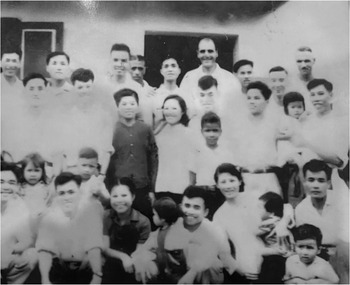
In general, those Africans who rallied remained in the DRV after the war ended and Vietnam was partitioned along the seventeenth parallel. In addition to producing propaganda, the Địch Vận Bureau took charge of those who rallied, running the camps where they were housed during the conflict and overseeing the livelihoods of those who stayed afterward. Most African soldiers resided at a former camp for ralliers transformed into an agricultural cooperative rechristened the “Viet-African Production Farm” (Nông Trường Sản Xuất Việt-Phi) located fifty-five kilometres northeast of Hanoi in Ba Vì (Figure 2). Until the mid-1960s, these men would live and work there, contributing their labour to the Democratic Republic and in the process becoming người Việt Nam mới—“new Vietnamese people.”Footnote 54 It is unclear how this label originated, but it appears that Vietnamese Communists used it as a form of address in the 1950s and 1960s—one perhaps echoing socialist ideals of “newness” and personal transformation emanating from the revolution.Footnote 55 According to Nguyễn Xuân Hạ, who worked at Ba Vì in the early 1960s, the Địch Vận Bureau coined the term to make ralliers feel more welcomed.Footnote 56 Whilst người Việt Nam mới may have been used in everyday conversation between Vietnamese Communists and their foreign comrades, DRV archives reveal that this label was never employed officially. In reporting, cadres referred to ralliers simply as hàng binh—“soldiers who surrendered voluntarily.” As far as North Vietnamese officialdom was concerned, these men were defined by their past, not their present.
Maghrebi ralliers pose with their families and local cadres at the Viet-African Farm in Ba Vì. Source: Hội Việt Phi Ba Vì – 27/7.
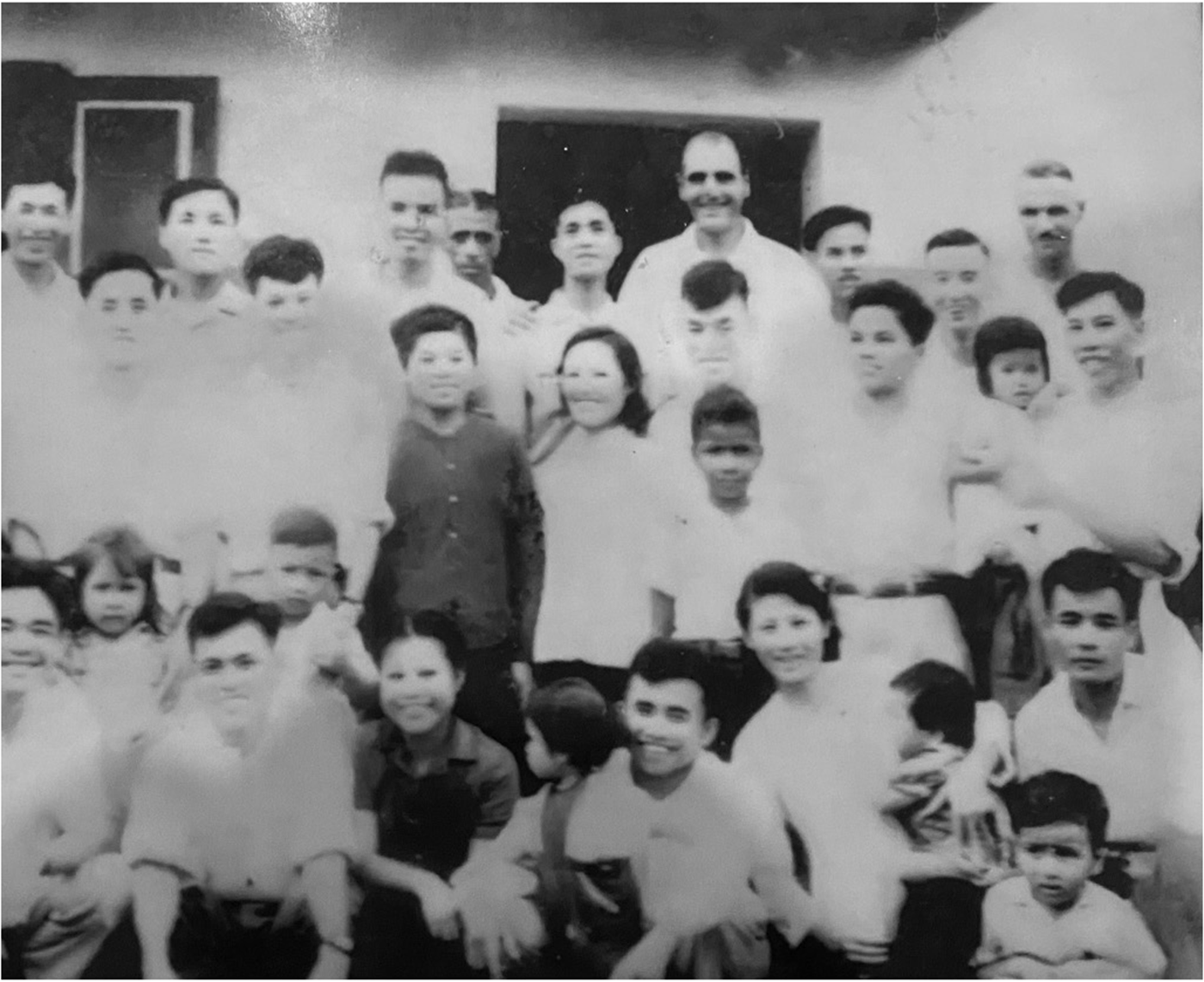
Figure 2 Long description
A group of people, consisting of men, women and children, is gathered in front of a building. The group is arranged in several rows, with some individuals standing and others sitting. The background shows a building with visible windows and a door. The people are closely positioned, suggesting a group photo setting.
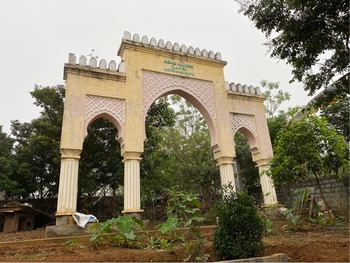
By 1955, 279 African soldiers remained in the DRV. Officials provided them with salaries and bungalows to live in, often with their Vietnamese partners and mixed-race children. Ba Vì was even appointed with a triple-arched, North African-inspired village gate, which remains standing and is locally known as the “Moroccan Gate” (Figure 3).Footnote 57 That same year, the DRV put their “new Vietnamese” comrades to work: African soldiers harvested rice, laboured in coal mines, milked cows and raised goats, or worked to repair the many bridges, roads, and railways devastated by war. Despite being provided with employment and accommodation, many grew frustrated. They resented being confined to designated villages and doing manual labour when many had technical skills they could put to good use. Supervision by military authorities and requirements to take political education lessons further provoked anxiety among the “new Vietnamese” that they might never become normal civilians.
The “Moroccan Gate” in Ba Vì following a restoration supported by the Moroccan government. Source: Author’s Photograph.
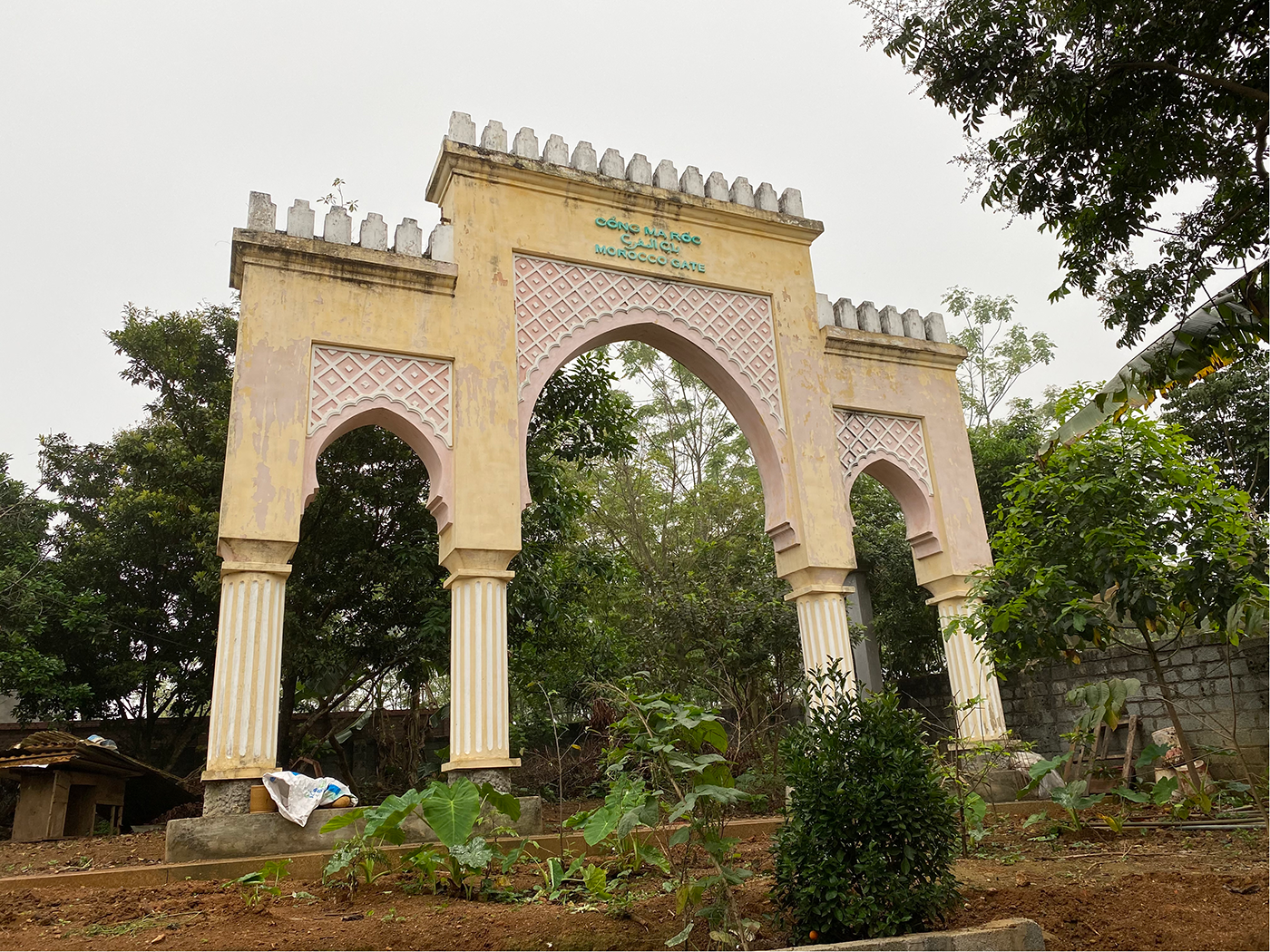
Figure 3 Long description
The image shows a triple-arched gate with intricate designs on the arches. The gate features columns with detailed patterns and is set in a garden area. There are various plants and trees surrounding the gate and a small structure is visible to the left. The sky appears overcast, contributing to a subdued atmosphere.
The Địch Vận Bureau found itself having to manage the expectations of those who felt that they were not being properly integrated into North Vietnamese society. In early 1955, a group of “European and African comrade workers” employed at the Bố Hạ coal mine north of Hanoi wrote a list of “propositions” to express their discontent. Among them was the desire to receive fixed salaries, to spend their pay as they pleased, to be issued identification cards to “freely circulate like all other Vietnamese workers,” to marry Vietnamese women legally, to be given jobs that aligned with their pre-war occupations, and, perhaps most telling of all, “to enter the [Vietnamese Workers] Party.”Footnote 58 Or, as the petitioners made clear: “to actively take part in the political life of the country.”Footnote 59
Such a document suggests that the “new Vietnamese” expected a degree of parity with regular Vietnamese. The question was to what extent Hanoi would allow foreigners to participate in the DRV’s social and political life. In theory, many of these demands were addressed by a decree issued in April 1955 by Deputy Prime Minister Phạm Văn Đồng. Recognising the precarity many Africans felt, it stated that the “people who were previously in the French Expeditionary Corps and who later voluntarily left…and who currently volunteered to stay in Vietnam to live and work, are all accepted.”Footnote 60 It ensured residency permits would be issued and insisted that the “new Vietnamese” were “protected by the laws of…the Democratic Republic of Vietnam.”Footnote 61 Therefore they were eligible to marry Vietnamese women in addition to enjoying North Vietnam’s other “free and democratic rights,” including participation in “occupation-related organisations such as: [worker] unions [and] peasant unions.”Footnote 62 Most notably, the decree recognised the contributions that many African defectors made during the war, bestowing the status of PAVN veteran to anyone who had “participated in the People’s Army or accomplished any resistance-related task.”Footnote 63 Those who sustained injuries “in the name of resistance” were even entitled to the same financial benefits as wounded Vietnamese veterans.Footnote 64 These policies demonstrated that the state was responsive to the concerns of the “new Vietnamese” and sought to normalise their legal and social status, at least on paper. Absent were any policies related to political integration, such as eligibility for party membership or citizenship.Footnote 65
Demands for parity, however, worked in both directions. Hanoi expected the “new Vietnamese” to behave like any other Vietnamese. That meant accepting the authority of the party-state, tolerating the omnipresence of its cadres, following its decrees, participating in its mobilisation campaigns, conforming to expectations of moral temperament, and undergoing re-education and self-criticism when such expectations were not met. The “new Vietnamese” may have wanted equal treatment in some regards, but not in others. Their demands for parity often conflicted with their requests to be treated differently, partly because they were different—culturally, religiously, and ethnically—and partly because they saw themselves as having made a great sacrifice by defecting. Many felt entitled to special recognition at a moment when the DRV had little to give its own citizens never mind foreigners who regularly complained about the jobs they were given, the money they were allocated, and the regulations they were obliged to follow. The “new Vietnamese” found themselves residents of a state undergoing massive and uncertain transformations. In the wake of war, the DRV needed to extend and solidify its sovereignty over territory and populations previously administered by the French. The pressures of reconstruction and a disastrous land reform campaign coupled with mounting anxiety over the future of unification as financial aid and military assistance from the United States flowed to the emergent Republic of Vietnam all conspired to foment tensions between Vietnamese new and old.
As one report admits, there was significant “prejudice” (thành kiến) toward the “new Vietnamese.”Footnote 66 Supervisors at the state-run mines, factories, and railways were reticent to employ hàng binh because they were seen as a “complicated sort.”Footnote 67 Factory managers perceived foreigners as “an obstacle” because “defectors frequently question, [make] demand[s], [and] annoy [them].”Footnote 68 Since many Africans could not speak fluent Vietnamese, they required the presence of a Francophone cadre to interpret, thus slowing work and increasing miscommunications that affected production quotas. The “new Vietnamese” were seen as being “rowdy” (ba gai), “lazy,” (lười lao động), and “stubborn” (ngang bướng) and the Địch Vận Bureau lamented that many were harshly disciplined for “trivial misconduct,” like playing cards.Footnote 69 In a few extreme instances, such as in the mines of Tuyên Quang and Thái Nguyên, Vietnamese supervisors physically abused their foreign labourers.Footnote 70 Moreover, địch vận reports indicate that many Vietnamese still resented the prior military service of tirailleurs. Consequently, many directors of state-run projects saw the “new Vietnamese” as more trouble than they were worth and often asked to relocate them for “peace of mind.”Footnote 71 Even the Địch Vận Bureau feared that service in the French military had been an “evil influence” on African soldiers and consequently they were too attached to “freedom,” enjoyed “debauchery,” took “discipline lightly,” and lived “as they like” engaging in heavy drinking and illicit trading.Footnote 72
Given such casual suspicion, racialised prejudice, and depressing working conditions it is not surprising that morale declined among the “new Vietnamese.” Some Africans suffered from homesickness and began questioning their place in the Democratic Republic, especially as independence movements spread elsewhere in the French empire. One group of North Africans quit their jobs and returned to Ba Vì where they remained unemployed, a worrisome condition in a country devoted to putting people to work. According to one June 1955 report, African soldiers frequently feigned illness so that they would be transferred to a nearby hospital where it was easier to slip away from their minders, often to the capital.Footnote 73 The same report observed that out-of-work “new Vietnamese” wandered around “seeking places to debauch, going to urban areas to defraud, eat and leave without paying, [and] thieve.”Footnote 74 In Hanoi’s eyes, unemployment led to vagrancy, which led to criminality and subversiveness. According to the Địch Vận General Directorate, some even attempted to contact “suspicious elements,” such as the French diplomatic delegation in Hanoi and foreign representatives from the International Control Commission.Footnote 75 And in what may very well have been nothing more than outright paranoia amid a heady atmosphere of immediate postwar reckoning, denunciation, and intensifying communisation, the report claimed that wayward African workers also went to “the homes of Americans.”Footnote 76 Some, it seemed, wanted “to go back to the enemy.”Footnote 77 To the chagrin of DRV cadres, some asked outright to return to the very empire they had deserted.
Nonetheless, Hanoi remained committed to ensuring that its African residents would stay. The Ministry of Labour stated, “our policy is always to proactively enlist them to stay with us, to settle their lives, to educate [and] re-educate them to become good labourers, to help them build families, to make them believe in the future of our regime, [and] in their future so that they agree to support our current struggle.”Footnote 78 As in wartime, Vietnamese Communists felt a sense of paternalistic responsibility toward their African “brothers” to reform and enlighten them so that they could “take care of their lives” and “work happily” all whilst “correcting the warped ideologies and behaviours” that inhibited their integration into the new socialist society—and threatened to affect the wider North Vietnamese population.Footnote 79
Indeed, keeping Africans in the DRV had larger ideological implications. As during the war, Africans’ futures were linked to that of the Communist state—cadres perceived their struggles as one and the same. Convincing Africans that a life in North Vietnam was worthwhile would therefore be a testament to the power of Vietnamese Communism itself. Returning them would be an admission of failure, not just in their power to persuade, but perhaps in the very political philosophy their persuasion promoted. In places where địch vận efforts to address dissatisfaction were falling short the Ministry of Labour warned that there are “currently European-African defectors that want to return to the French Union.”Footnote 80 This, the Ministry argued, would harm the cause of Vietnamese Communism as France would “use them to spread propaganda, defame and sabotage us, reinforcing their militaristic mindset.”Footnote 81 No matter how troublesome African workers might be to the authorities, releasing them back to the French would be an admission of defeat at the hands of an enemy that they had just vanquished on the battlefield. As one report reasoned, keeping Africans in Vietnam was necessary to “retain political impact.”Footnote 82 But doing so meant a fraught commitment to integrating them. It would also mean, ironically, that the “new Vietnamese” were fated to remain in the Democratic Republic of Vietnam, where they would participate in Vietnam’s ongoing revolution, rather than ones brewing in their homelands. In the end, protecting the process of Communist state-making foreclosed the possibility of global revolution.
Conclusion
At the end of the report that Captain Giảng certified in July 1960, Rabat Boulacen appended a special request: after nearly five years of faithful service to the DRV, Boulacen wanted to return to Algeria and join the ongoing fight for independence being led by the Front de Libération Nationale (National Liberation Front [FLN]). “I want to return to my country, fight for the nation, [and] liberate Algeria in spite of the bourgeois leadership,” Boulacen dictated to the cadre taking down his statement.Footnote 83 “[I] believe that the Communists will assume leadership, but if it is only the bourgeoisie that get a hold of power, I will revolt until the very end. I am resolved to follow Communism’s path of purpose until the very end. Vive Communiste [sic].”Footnote 84 No record indicates that his request was reviewed.
The next time Boulacen may have seen his native soil again was sometime after July 1962 when, following 132 years of colonial rule and seven years of brutal warfare, Algeria finally won independence from France. If his fervour had been genuine, it is likely that Boulacen would have been disappointed upon his return. In 1963, one year after Ahmed Ben Bella proclaimed the creation of the People’s Democratic Republic of Algeria, the FLN consolidated its political power and outlawed the Algerian Communist Party.
With Algerian independence, all that remained of the French empire was a smattering of comptoirs and island outposts. In 1956, nationalists in Morocco and Tunisia had negotiated their countries’ independence from France. And by the end of 1960, France retained none of its colonies in Sub-Saharan Africa. The years after the Indochina War were ideal for Vietnamese Communists to seed the French empire with the men it had taken in, educated, and in some cases allowed to fight. It is striking, therefore, that they did not. Only when the clouds of war once more threatened Vietnam in the mid-1960s did many of the Algerians, Tunisians, Moroccans, and Senegalese return to their homelands, now newly independent countries constructed without their assistance.Footnote 85 And as in the war against France, Vietnamese Communists would once again mobilise international solidarity for domestic interests in their war against the Republic of Vietnam and its American allies—this time to de-legitimise the southern non-Communist alternative and achieve territorial unification under Communist rule.
If during the Indochina War the efforts of Vietnamese Communists were missionary in purpose and global in scope, what accounts for the shift from the promise of empire-wide rebellion toward the cultivation of “new Vietnamese people” in the DRV? The answer lies in their very attempt to link national independence to the wholescale destruction of imperialism. Despite the immense opportunity presented by a conflict deploying colonial subjects against one another, neither Vietnamese Communists nor African ralliers could manifest transnational anticolonial action. Decolonisation in Indochina produced a sense of dual discontentment among its participants as each proved a disappointment to the other.
North and Sub-Saharan Africans who followed địch vận propaganda mostly waited out the war in camps and were unable to return home afterward. Rebaptised as “new Vietnamese,” they faced an uncertain future, suspicion from a party-state focused on internal revolutionary transformation, and racial bias that echoed colonial prejudices. For Vietnamese Communists, Africans were seen as ideal to carry the torch lit by the Việt Minh. Yet not every tirailleur was quick to rally or, once on the other side, integrate into Vietnamese society as expected. Convinced that their African “brothers” had been tricked by France and poisoned by their military service, Vietnamese Communists believed they had the responsibility to enlighten and reform them. But if the “new Vietnamese” had the potential to reform, they also had the potential to subvert. Prone to question authority or exhibit “troublesome behaviour,” there was an implicit fear that African soldiers might serve as vectors for the very corrupting influences that Vietnamese Communists were working to abolish in their own population. In the end, they projected onto African soldiers the hopes and fears of their own revolution.
Reticent to admit that their methods were not succeeding and reluctant to send Africans back to territories controlled by the French, the DRV committed itself to settling Africans into a more permanent life in North Vietnam. But only to a certain degree. As the new state weathered the tumult of its early postwar years, Africans were kept apart from wider Vietnamese society in special cooperatives, safely cordoned off in remote areas of northern Vietnam working on farms, repairing bridges, and mining coal. Freedom of movement was limited and attempts to enter urban areas were met with anxiety and suspicion. Political participation, party membership, and citizenship were never extended to the “new Vietnamese” and none were ever groomed for the future organising they might be expected to carry out back home. Instead, these soldiers lived a life in limbo: never fully allowed to integrate into wider Vietnamese society and not permitted, either by circumstance or the DRV itself, to return home. In response, Africans exercised what little agency they had to achieve their own vision of independence: they wrote petitions, quit unsatisfying jobs with abusive employers, evaded government minders, and made contact with foreigners to find pathways home. But this behaviour only fuelled suspicion and anxiety.
Much like địch vận propaganda in wartime, the idea of người Việt Nam mới, held out a promise that was never fully realised. It signalled an ambitious, if ambiguous, aspiration to nurture revolutionary networks and promote a global fight for national liberation. But that project became firmly rooted on Vietnamese soil and African soldiers became avatars for the “world outside” that Vietnamese Communists sought to change at a moment when the Democratic Republic of Vietnam looked to be accelerating the tempo of history.
Acknowledgements
The author owes a sincere debt of gratitude to Bùi Khánh Minh who, as principal research assistant, helped collect and translate many of the Vietnamese-language sources cited herein. Khánh Minh also accompanied the author to Ba Vì to conduct oral history interviews. Her continuing intellectual engagement with this project not only made this article possible, but improved it. The author must also recognise Dương Quang Hoàng Thơ for her valuable assistance transcribing interviews and for building a GIS database of African ralliers based on DRV archival records. In Hanoi, the author received the assistance of Mr. Mohamed Berrah, Ambassador of Algeria to Vietnam, and Mr. Saadi Salama, Ambassador of the State of Palestine to Vietnam. Appreciation is also due to Elisabeth Leake and Erez Manela, organisers of the Decolonisation’s Discontents workshop held jointly at Tufts and Harvard in September 2023, as well as to the workshop’s fellow participants for their insightful comments and suggestions. Sincere thanks are extended to this article’s anonymous reviewers and to the author’s friends and colleagues from around the globe who graciously read early drafts and provided valuable feedback: Haydon Cherry, Sean Fear, Christopher Goscha, and Antoine Lê. Lastly, the author would like to thank the inhabitants of Ba Vì whose memories of the North and Sub-Saharan Africans who became their neighbours brought this history back to life.

 Open access

