





1. Introduction
The putative cognitive advantages of bilingualism have been a topic of debate for several decades. It has been hypothesized that bilinguals may have enhanced conflict monitoring and/or inhibition abilities compared to monolinguals. Because bilinguals are constantly managing two languages, they need to suppress or inhibit the non-target language, which may lead to cognitive advantages in bilinguals over monolinguals. Researchers have reported a cognitive advantage in bilinguals across several cognitive domains, including inhibitory functioning (Badzakova-Trajkov, Reference Badzakova-Trajkov2008; Bialystok, Craik, & Luk, Reference Bialystok, Craik and Luk2008; Carlson & Meltzoff, Reference Carlson and Meltzoff2008), cognitive control (Kousaie & Phillips, Reference Kousaie and Phillips2017), and task switching (López Zunini, Morrison, Kousaie, & Taler, Reference López Zunini, Morrison, Kousaie and Taler2019; Prior & Gollan, Reference Prior and Gollan2011).
However, not all researchers have found such an advantage (e.g., Blom, Küntay, Messer, Verhagen, & Leseman, Reference Blom, Küntay, Messer, Verhagen and Leseman2014; Kousaie, Sheppard, Lemieux, Monetta, & Taler, Reference Kousaie, Sheppard, Lemieux, Monetta and Taler2014; Nichols, Wild, Stojanoski, Battista, & Owen, Reference Nichols, Wild, Stojanoski, Battista and Owen2020). In a recent study examining performance in 744 demographically (i.e., age, education, social economic status, gender, and handedness) matched participants, Nichols et al. (Reference Nichols, Wild, Stojanoski, Battista and Owen2020) concluded that all bilingual effects disappeared when confounding factors were removed. They also note that the effect size of bilingualism size was so small that it would have negligible impact on the cognitive performance of any one individual. However, a limitation of this study was that bilingualism was defined quite broadly using only self-report, which may have introduced noise into the results. Some studies suggest that these inconsistencies represent a publication bias favoring studies showing an effect of bilingualism on executive control (de Bruin, Treccani, & Della Sala, Reference De Bruin, Treccani and Della Sala2015). One meta-analysis did, however, find an association between bilingualism and working memory even after controlling for publication bias (Linck, Osthus, Koeth, & Bunting, Reference Linck, Osthus, Koeth and Bunting2014). Similarly, a more recent quantitative analysis also observed that when controlling for publication bias, bilinguals outperformed monolinguals on working memory tasks more often than would be expected by chance (Grundy, Reference Grundy2020).
Working memory is the cognitive process involved with manipulating and temporarily storing information in memory for short periods (Baddeley, Reference Baddeley2003). Everyday events such as having a conversation, learning, problem-solving, attention, and the ability to selectively ignore information are associated with working memory performance (Alloway & Alloway, Reference Alloway and Alloway2010; Swanson & Beebe-Frankenberger, Reference Swanson and Beebe-Frankenberger2004). Early research observed the relationship between working memory and second language acquisition (Atkins & Baddeley, Reference Atkins and Baddeley1998; Baddeley, Gathercole, & Papagno, Reference Baddeley, Gathercole and Papagno1998). Language processing is also dependent on working memory (Cowan, Reference Cowan1996). For example, managing two competing languages at once requires resources from working memory (Thorn & Gathercole, Reference Thorn and Gathercole1999). Continual demands on working memory (from the management of two languages) may improve working memory capacity over time (Grundy & Timmer, Reference Grundy and Timmer2017). Furthermore, working memory is often measured using span tasks such as the delayed match-to-sample task, which activates a major component of working memory, the phonological loop (Baddeley, Reference Baddeley2000; Germano & Kinsella, Reference Germano and Kinsella2005). The phonological loop has also been associated with language, as people with a phonological loop deficit have been shown to be unable to acquire a new language (Baddeley et al., Reference Baddeley, Gathercole and Papagno1998).
Given the association of working memory with both executive function and language acquisition, it is an important process to examine when studying bilingualism. While some studies have shown better working memory performance in bilinguals compared to monolinguals (Grundy & Timmer, Reference Grundy and Timmer2017; Kudo & Swanson, Reference Kudo and Swanson2014; Morales, Calvo, & Bialystok, Reference Morales, Calvo and Bialystok2013) others report no advantage (Blom et al., Reference Blom, Küntay, Messer, Verhagen and Leseman2014; Lukasik, Lehtonen, Soveri, Waris, Jylkkä, & Laine, Reference Lukasik, Lehtonen, Soveri, Waris, Jylkkä and Laine2018; Ratiu & Azuma, Reference Ratiu and Azuma2015). These inconsistent findings may be related to the languages being studied, as well as to the type of measurement tools used.
1.1. Linguistic distance
Languages are arranged based on the ancestral language they are derived from. Languages derived from the same ancestral (or parent) language are grouped together in a language family. A language family has several groupings or branches of languages, which share more similarities than languages from other branches within the same family. For example, the parent (proto) Indo-European family tree has several branches comprising 445 languages (Eberhard, Simons, & Fennig, Reference Eberhard, Simons and Fennig2020). Although these languages have changed over time, they all share several similarities (Rowe & Levine, Reference Rowe and Levine2015). Both English and French are Indo-European languages; English is derived from the Germanic branch, whereas French is derived from the Italic branch. Although the Indo-European language is the most-studied language family, it is only one of many language families.
Languages that are part of the same family share lexical, grammatical, and vocabulary similarities; that is, the linguistic distance between them is small (Rowe & Levine, Reference Rowe and Levine2015). Linguistic distance is thus defined as how different one language is from another. For example, according to Ethnologue's method of lexical similarity, the similarity between English and German is 60% (they are on the same branch) whereas the similarity between English and French is only 27% (even though they have the same parent language, they reside on different branches within the family tree) (Maldonado García & Borges de Souza, Reference Maldonado García and Borges de Souza2017). This similarity is determined by counting the number of words that show similarity in form and meaning using a standardized wordlist. The percentage score, which indicates lexical similarity, represents the proportion of words that overlap (i.e., where form and meaning are similar) between the two languages.
It has been hypothesized that, to avoid interference between languages, greater cognitive demands are placed on the cognitive control system in bilinguals with two languages that are derived from the same family than bilinguals with two languages derived from different language families (Gollan, Sandoval, & Salmon, Reference Gollan, Sandoval and Salmon2011). However, in bilingualism research, few studies have examined the effect of linguistic distance. One such study compared German–English bilinguals to Italian–English bilinguals (D'Anselmo, Reiterer, Zuccarini, Tommasi, & Brancucci, Reference D'Anselmo, Reiterer, Zuccarini, Tommasi and Brancucci2013), and found that linguistic distance influenced cognitive processing. Specifically, they observed that English–German bilinguals showed stronger right ear advantage processing for their L2 (English) than the English–Italian group. Another study observed that bilingual speakers of two closely-related languages (Swedish–English) performed better than monolinguals on memory and fluency tasks, whereas bilinguals with two languages that are more distant (Swedish–Finnish) showed no advantage over monolinguals (Ljungberg, Elbe, & Sörman, Reference Ljungberg, Elbe and Sörman2020).
In contrast, some studies have found the opposite effect. Bialystok et al. (Reference Bialystok, Craik, Grady, Chau, Ishii, Gunji and Pantev2005) compared Cantonese–English bilinguals to French–English bilinguals and English monolinguals during a Simon task. These authors observed overall faster reaction times in the Cantonese–English bilinguals than the other two groups, suggesting higher behavioral performance for the bilinguals with languages that have a larger linguistic difference. Similarly, Wierzbicki (Reference Wierzbicki2014) compared English–German and English-Chinese bilinguals to English monolinguals during a Simon task and found that bilinguals whose languages were more linguistically distant (i.e., English-Chinese bilinguals) exhibited fewer errors than English monolinguals and English–German bilinguals, who did not differ.
Taken together, these findings indicate that linguistic distance may play an important role in differences in cognitive processing between monolinguals and bilinguals. However, given the limited research and mixed results, more research is clearly needed to better understand the influence of linguistic distance on cognitive function in bilinguals.
1.2 Linguistic distance in the current study
As mentioned above, English and French are both derived from the proto-Indo-European language, and therefore share some similarities. In contrast, Arabic is an Afro-Asiatic language and thus does not share many similarities with either English or French. One major difference between English and Arabic is morphology; that is, how words are formed in each language. Arabic word formation combines a lexical root, pattern morpheme, and inflectional affix (Ryding, Reference Ryding2014). Affixes are inserted into a word stem following a pattern in a non-linear sequence. A common example of this language structure is using the root “K-T-B”, which represents the concept of writing. When combined with the word pattern “maCCaCa” the word generated is maktaba, or place of writing (McLoughlin, Reference McLoughlin2009). When the root “K-T-B” is combined with the pattern “maCCooC” the word maktoob is generated, or having done the writing (i.e., written) (McLoughlin, Reference McLoughlin2009). In English and French, in contrast, new words can be generated by combining morphemes sequentially (Brinton & Brinton, Reference Brinton and Brinton2010; Fejzo, Reference Fejzo2016). For example, English and French often use prefixes and suffixes attached to either the beginning or end of a word stem to form either a new word or a new form of the same word (e.g., happy can become unhappy or happiness).
Based on Ljungberg et al. (Reference Ljungberg, Elbe and Sörman2020), we hypothesize that a linear trend in cognitive processing will be observed, with English–French bilinguals exhibiting the most enhanced working memory performance (i.e., more accurate, faster responses, and larger amplitudes), followed by Arabic–English bilinguals and then English monolinguals. However, given the greater linguistic difference between Arabic and English compared to French and English, it is possible that the Arabic–English bilinguals’ ERPs may not differ from that of English monolinguals.
To our knowledge, only one study has compared English monolinguals to Arabic–English bilinguals (Soliman, Reference Soliman2014). In this study, 615 children aged 8–12 completed 12 different tasks assessing four components of working memory. A significant performance difference that favored bilinguals was observed only when examining the latent variables underlying working memory tasks. Differences between monolinguals and bilinguals were more pronounced in complex tasks that maximized cognitive load, supporting previous findings suggesting that enhanced performance in bilinguals may be greatest when task demands are high (Sullivan, Janus, Moreno, Astheimer, & Bialystok, Reference Sullivan, Janus, Moreno, Astheimer and Bialystok2014).
1.3 Electrophysiological measures
Neuropsychological tasks provide measures of accuracy and reaction time but cannot provide information on the underlying brain activity involved in a given cognitive process. Using electrophysiological tools such as event-related potentials (ERPs) may provide insight into group differences not observed when using behavioral measures alone. ERPs measure the underlying neural processing associated with specific cognitive events. They have excellent temporal resolution and thus may be more sensitive to language differences than performance measures alone. The P2, N2, and P3b ERP components are examined in the present study because of their association with working memory (Dunn, Dunn, Languis, & Andrews, Reference Dunn, Dunn, Languis and Andrews1998).
The P2 is an anterior maximal positive–going component that occurs approximately 150–300 ms post–stimulus presentation. Associated with attentional control in working memory, larger P2 amplitudes reflect both enhanced attentional allocation and working memory processing (Finnigan, O'Connell, Cummins, Broughton, & Robertson, Reference Finnigan, O'Connell, Cummins, Broughton and Robertson2011; Li, Tang, & Chen, Reference Li, Tang and Chen2016). The N2 component is a negative–going waveform that occurs between 200 and 350 ms post–stimulus presentation and is also maximal in anterior sites. The N2 reflects effort during task completion (Pinal, Zurrón, & Díaz, Reference Pinal, Zurrón and Díaz2014), with larger N2 amplitudes suggesting greater effort required to complete the task. Finally, the P3b is a parietally maximal positive–going component that occurs between 250 and 600 ms following stimulus presentation (Polich, Reference Polich2007). The P3b typically decreases with increasing task difficulty, reflecting a decrease in the availability of resources for task completion and is thought to be associated with the manipulation of working memory (Kok, Reference Kok2001; Polich, Reference Polich2007).
Several studies have reported differences in N2 and P3b amplitude between bilinguals and monolinguals when performing executive functioning tasks (Barac, Moreno, & Bialystok, Reference Barac, Moreno and Bialystok2016; Kousaie & Phillips, Reference Kousaie and Phillips2012; Moreno, Wodniecka, Tays, Alain, & Bialystok, Reference Moreno, Wodniecka, Tays, Alain and Bialystok2014; Sullivan et al., Reference Sullivan, Janus, Moreno, Astheimer and Bialystok2014). In some of these studies, electrophysiological differences were observed in the absence of behavioral differences (Barac et al., Reference Barac, Moreno and Bialystok2016; Kousaie & Phillips, Reference Kousaie and Phillips2012). These results provide evidence for differences in brain processing between monolinguals and bilinguals during cognitive tasks, even when a behavioral difference may not be present. When examining the N2, delayed latency (Barac et al., Reference Barac, Moreno and Bialystok2016) and larger amplitudes (Sullivan et al., Reference Sullivan, Janus, Moreno, Astheimer and Bialystok2014) have been observed in bilinguals compared to monolinguals. Studies examining the P3b have been relatively inconsistent. For example, both Barac et al. (Reference Barac, Moreno and Bialystok2016) and Sullivan et al. (Reference Sullivan, Janus, Moreno, Astheimer and Bialystok2014) observed larger P3b amplitudes in bilinguals compared to monolinguals, while Kousaie and Phillips (Reference Kousaie and Phillips2012) reported larger P3b amplitudes in monolinguals compared to bilinguals. These inconsistencies may be because the P3b is mainly affected by working memory and these studies are not designed to manipulate working memory. For this reason, we wanted to determine the effects of bilingualism on the P3b during a working memory task.
We previously reported ERP differences between English monolinguals and English–French bilinguals in the absence of performance differences in two working memory tasks, an n-back task (Morrison, Kamal, & Taler, Reference Morrison, Kamal and Taler2018) and a delayed matching–to–sample task (DMS) (Morrison, Kamal, Le, & Taler, Reference Morrison, Kamal, Le and Taler2019). During both the n-back and DMS task, bilinguals exhibited larger P3b amplitudes than monolinguals, and during the DMS task, bilinguals also exhibited smaller N2b amplitudes. These findings were interpreted as indicating that bilinguals have more cognitive resources available during WM tasks, and that task completion may be less effortful for bilinguals relative to monolinguals (Morrison et al., Reference Morrison, Kamal and Taler2018, Reference Morrison, Kamal, Le and Taler2019). Here we expand on a previously reported sample (Morrison et al., Reference Morrison, Kamal and Taler2018, Reference Morrison, Kamal, Le and Taler2019) by collecting an additional 10 English monolinguals and 8 English–French bilinguals. Additionally, to address our research question on linguistic similarity, we collected a novel sample of 23 Arabic–English bilinguals. Because English and French are from the same parent language and share some similarities, we expected that English–French bilinguals would show larger P3b amplitudes than the Arabic–English bilinguals, whose languages are much more linguistically distant. Following this hypothesis, we predicted that Arabic–English bilinguals and English monolinguals would display similar ERP amplitudes. To our knowledge, this study is the first to examine cognitive processing using ERPs in Arabic–English bilinguals.
2. Methods
For this study, 23 Arabic–English bilinguals (15 females) aged 18–30 were recruited through word of mouth and at the University of Ottawa and tested in Ottawa at the Bruyère Research Institute (all participants were tested in the same location). These participants had high self–reported proficiency in both their L1 and L2. They were then compared to younger adult English monolingual and English–French bilinguals, a subset of whose data have been published previously. All 23 Arabic–English bilinguals completed both tasks. Demographic information for all participants is provided in Table 1; Tables 3 and 4 provide information about the number of English monolingual and English–French bilingual participants that completed each task.
Group mean (SD) for demographic data and neuropsychological measures for all participants: group mean score (SD).

Notes: All neuropsychological means presented are number of correct responses. Probability and parietal eta squared are the results obtained from the MANOVA. BNT = Boston Naming Test, WCST = Wisconsin Card Sorting Test (categories completed). Stroop1 = read names of colors, Stroop2 = name the color of Xs, Stroop3 = read the ink color of color words printed in a different color (e.g., the word “RED” printed in green ink). Digit Symbol-Written = match the digit to corresponding symbol by writing the answer, Digit Symbol-Oral = match the digit to corresponding symbol by reading the answer aloud. Arabic–English bilinguals were younger than English–French bilinguals and had lower education than the other two groups. Arabic–English bilinguals performed worse on the Stroop2 and BNT-English than the other two groups, and worse on the WCST, Stroop3, Animals-French/Arabic, and Digit Symbol-Oral than English–French bilinguals.
Participants completed a health questionnaire by phone to screen for neurological and psychiatric conditions, usage of medication that could influence the central nervous system or cognitive functioning, and major head injuries, all of which were exclusionary criteria. During the phone screen, participants also completed a self-report language questionnaire for English, French, and Arabic. Participants were asked to rate their fluency in listening, reading, speaking, and writing on a scale of 1 (no ability) to 5 (native-like ability). Bilinguals also completed a language questionnaire to assess frequency of use for both their L1 and L2 (scores are provided in Table 2). Potential monolingual participants who rated their French proficiency in any modality at a two (very little ability) or higher were excluded. Participants who rated their knowledge of any language other than English, French, or Arabic higher than 2 in any modality were also excluded.
Relative use of language and self-reported proficiency ratings: group mean (SD).

Notes: Self-rated proficiency was rated on a five-point scale: 1-no ability at all, 2-Very little ability, 3-Moderate ability, 4-Very good ability, 5-Native-Like ability. Language use was rated on a 5-point scale: 0%, 25%, 50%, 75%, and 100% of the time. Age of acquisition is reported for monolingual speakers because many received French instruction in school but never achieved fluency. older adults. Older adults had higher self-reported French writing abilities. aEnglish–French bilinguals and English monolinguals had higher scores than Arabic–English bilinguals. bArabic–English bilinguals had high scores than English–French bilinguals. cEnglish–French bilinguals had higher scores than Arabic–English bilinguals
This study received ethical approval from both the Bruyère Research Institute and the University of Ottawa ethics board; participants provided informed written consent before starting the study and were compensated $10 an hour.
3. Procedure
Participants completed three testing sessions lasting approximately 1.5 hours each. The three sessions occurred approximately 1–2 weeks apart. Not all participants completed the three testing sessions. Therefore, the number of participants that completed each task differs (see Table 3 & 4 for participant information for each task). In the first session, participants completed a neuropsychological test battery to assess language proficiency and cognitive functioning. This battery included the letter-number sequencing task, forward and backward digit span, written and verbal Digit Symbol Substitution subtests of the Wechsler Adult Intelligence Scale-III (WAIS-III) (Wechsler, Reference Wechsler1997), the Stroop task (Stroop, Reference Stroop1935), the Wisconsin Card Sorting Test (Grant & Berg, Reference Grant and Berg1948), verbal fluency (controlled oral word association test: FAS (Borkowski, Benton, & Spreen, Reference Borkowski, Benton and Spreen1967) and animal fluency), and the Boston Naming Test (BNT) (Kaplan, Goodglass, & Weintraub, Reference Kaplan, Goodglass and Weintraub1983)). English–French bilingual participants completed the fluency tasks and BNT in both English and French. Arabic–English participants completed the animal fluency in both English and Arabic. Neuropsychological test scores are presented in Table 1. Participants completed the delayed matching-to-sample and n-back tasks in two separate sessions (sessions 2 and 3). The order in which they completed the tasks was counterbalanced. During session 2 and 3, the participants completed the tasks while EEG, accuracy, and reaction times for each task were recorded.
Behavioral performance in the delayed match-to-sample task for each condition and group.
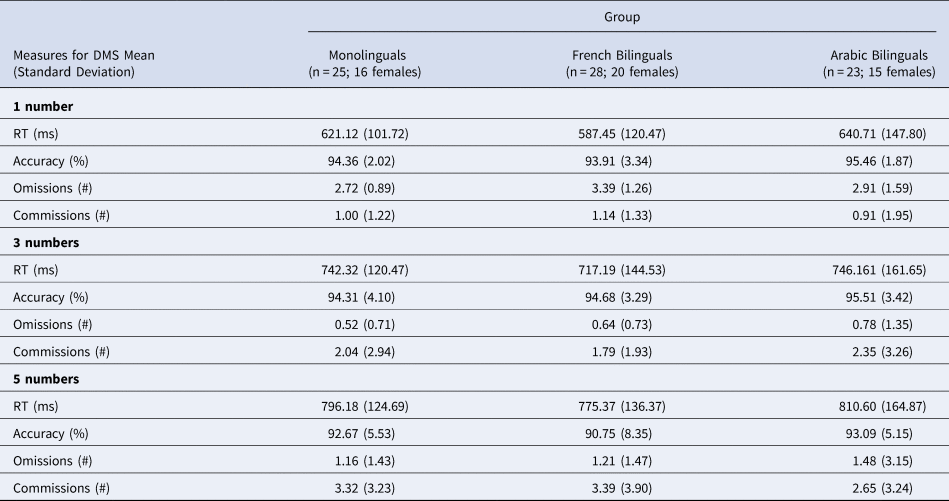
Notes: Values given are means with standard deviations. A total of 26 monolinguals took part in the study; however, one monolingual's behavioral data were lost due to computer error.
Behavioral performance in the n-back task for each condition and group.

Notes: Values given are means with standard deviations.
3.1 Delayed matching-to-sample task
This task included three levels of task difficulty (low load, 1 number; medium load, 3 numbers; high load; 5 numbers). For each condition the task began with a fixation cross on the screen for 1000 ms, followed by the memory array which the participant was asked to memorize, then a blank screen for 500 ms, and a probe stimulus for 1500 ms. Participants were asked to indicate if the probe stimulus matched one of the previous numbers in the memory array. To respond participants pressed either the “A” key to indicate that the stimulus was previously presented or the “L” key to indicate that the stimulus was not previously presented. Because the memory array had three different memory loads, the time of presentation varied between set size. For low load, the memory array was presented for 1200 ms, for medium load the memory array was presented for 3600 ms, and for high load, the memory array was presented for 6000 ms. There were 120 trials per condition. The presentation was always completed starting with the low load condition, followed by the medium load condition, and ending with the high load condition.
3.2 N-back task
The n-back task also had three different memory load conditions (0-back, 1-back, 2-back). In the 0-back condition, participants were asked to press the left mouse key when the number 0 appeared. In the 1-back condition, participants were asked to press the left mouse key when the number matched the number presented immediately before (e.g., an 8 followed by another 8), and in the 2-back condition, participants were asked to press the left mouse key when the number displayed matched the number presented two trials before (e.g., an 8 followed by a 4 then another 8). Each memory load block consisted of 180 trials, lasting approximately 10 minutes each, totaling approximately 30 minutes. All numbers were presented for 1000 ms with an inter-stimulus interval of 1700 ms.
3.2 EEG data recording
EEG recording was kept consistent in both tasks. EEG activity was recorded using 31 active silver-silver electrodes attached to an electrode cap (Brain Products, GmbH, Munich, Germany) and placed according to the international 10–20 system. The Oz electrode was placed on the infraorbital ridge of the left eye to record vertical eye blinks. Impedances were kept below 20 kΩ and the EEG was digitized at a rate of 500 Hz with a time constant of 2 s. The FCz location was used as the reference during recording, but offline a new reference for all channels was generated using an average of both mastoids (M1 and M2).
The EEG signals were reconstructed using Brain Products’ Analyzer software (Brain Products, GmbH, Munich, Germany). The EEG was down-sampled to 250 Hz, then digitally filtered using a low-pass filter of 30 Hz and a high-pass filter of 0.1 Hz. The EEG was then visually inspected for high levels of noise, and noisy channels were replaced by interpolating the data of surrounding electrode sites (Perrin, Pernier, Bertrand, & Echallier, Reference Perrin, Pernier, Bertrand and Echallier1989). Low levels of noise resulted in interpolation being completed in five participants on temporal and occipital electrode sites not of interest to the study. Interpolation was completed on two Arabic–English bilingual participants, two English–French bilingual participants, and one English monolingual participant. Vertical eye movements were calculated by subtracting the infraorbital electrode from the FP1 electrode. Horizontal eye movements were computed by subtracting F7-F8. Independent Components Analysis was used to identify and remove eye movements and blink artifacts that were statistically independent of the EEG activity (Makeig, Bell, Jung, & Sejnowski, Reference Makeig, Bell, Jung and Sejnowski1996). These vertical and horizontal eye movements were then partialled out from the EEG activity. Lastly, the EEG was reconstructed into 1200 ms epochs, which included a 200 ms pre-stimulus baseline period. Trials containing values greater than ± 100 μV relative to the baseline on the EEG channels were excluded from further analysis and rejected from the averaging. Only correct trials were included in averages.
4. Statistical analysis and Results
4.1 Neuropsychological data
All neuropsychological data are presented in Table 1. Scores were analyzed in a MANOVA with language as a fixed factor and neuropsychological test scores as the dependent variable.
4.2 Behavioral data analysis
Accuracy and reaction time by language are presented in Table 3 (delayed matching-to-sample) and Table 4 (n-back). Trials exceeding ±2.5 standard deviations for the mean were excluded as outliers. The analysis of accuracy and reaction was completed using mixed ANOVAs with the within-subject factor of Condition (Low, Medium, and High load) and the between-subjects factor of Language (Monolingual, English–French Bilingual, Arabic–English Bilingual).
4.3 ERP analysis
Three components were selected for analysis in both tasks: the P2, N2, and P3b. For all three components, three regions of interest were chosen for analysis. Frontal (F3, Fz, F4), Fronto-central (FC1, FCz, FC2), and Central (C3, Cz, C4) were analyzed together in one ANOVA. The within-subjects factors were ROI (Frontal, Fronto-central, Central) and Condition (Low, Medium, High) and the between-subjects factor was Language (Monolingual, English–French Bilingual, and Arabic–English Bilingual). For the P3b, the parietal sites were also analyzed (P3, Pz, P4) in a separate ANOVA. The within-subjects factor was Condition (Low, Medium, High load) and the between-subjects factor was Language (Monolingual, English–French Bilingual, and Arabic–English Bilingual). A Greenhouse-Geisser correction procedure was used for all ERP analyses when sphericity was violated (Greenhouse & Geisser, Reference Greenhouse and Geisser1959). Bonferroni-corrected pairwise comparisons were performed when comparing groups.
4.4 DMS performance results
Performance data are presented in Table 3. Working memory load had a significant effect on performance measures. Accuracy was lower in the high load than the medium (p < .001) and low load (p < .001; main effect of Task Difficulty, F(2,146) = 22.83, p < .001, n2p =.24). Reaction time became longer with increasing task difficulty, with all levels significantly differing (p < .001; main effect of Task difficulty, F(2,146) = 223.97, p < .001, n2p =.75). No main effects nor interactions involving language were significant in either accuracy or reaction time.
4.5 DMS ERP results
Figure 1 illustrates the ERP deflections elicited by the target stimulus across conditions. The anterior maximum P2 occurred at approximately 190 ms. Following the P2 was the N2, which again was maximal over anterior regions and occurred around 280 ms post-stimulus presentation. The P3b had a widespread scalp distribution and occurred between 290 and 390 ms post-stimulus presentation.
Grand averaged ERP waveforms collapsing across language to show the main effect of task difficulty during the DMS task. Averages at frontal (F3, Fz, F4), fronto-central (FC1, FCz, FC2), central (C3, Cz, C4), and parietal (P3, Pz, P4) regions are shown. Negative is plotted upwards.

4.5.1 P2 (mean amplitude: 170–210)
The anterior P2 analysis revealed that medium load elicited the largest amplitude compared to low (p = .009) and high load (p = .003), which did not differ (main effect of Task Difficulty, F(2,146) = 5.07, p = .014, n2p = .07). No main effects or interactions involving language were significant.
4.5.2 N2 (mean amplitude: 220–320)
N2 amplitude in anterior regions became larger with increasing memory load, with all conditions significantly differing (p < .05; main effect of Task Difficulty, F(2,146) = 15.15, p < .001, n2p = .17). This analysis also revealed that monolinguals exhibited larger amplitudes than both English–French bilinguals (p = .032) and Arabic–English bilinguals (p = .018), irrespective of task difficulty (main effect of Language, F(2,73) = 3.60, p = .032, n2p = .09). English–French bilinguals did not differ from Arabic–English bilinguals (p = .69). Interactions involving language were not significant.
Grand averaged ERP waveforms during the DMS task for each group at frontal (F3, Fz, F4), fronto-central (FC1, FCz, FC2), central (C3, Cz, C4), and parietal (P3, Pz, P4). Negative is plotted upwards. English–French and Arabic–English bilinguals had smaller N2b amplitudes than English monolinguals. English–French bilinguals displayed larger P3b amplitudes than English monolinguals.

4.5.3 P3b (mean amplitude: 250–450)
The anterior P3b amplitude was affected by memory load: amplitude was smaller in the high load compared to both medium and low load (p < .001), (main effect of Task Difficulty, F(2,146) = 11.59, p < .001, n2p = .14). A trend towards a main effect of Language was observed, F(2,73) = 3.60, p = .073, n2p = .07. Based on prior research and expectations that the P3b would differ between groups, we followed up the source of this interaction with a Bonferroni post-hoc analysis. This analysis revealed that English–French bilinguals exhibited larger P3b amplitudes than English monolinguals (p = .023). Arabic–English bilinguals’ P3b amplitude did not differ from that of either monolinguals or English–French bilinguals. Interactions involving language were not significant.
The parietal ROI analysis also showed that amplitude was influenced by working memory load. P3b amplitude became smaller with increasing memory load, with all conditions significantly differing (p ≤ .008; main effect of Task Difficulty, F(2,146) = 32.74, p < .001, n2p = .31). Main effects and interactions involving language were not significant.
4.6 Nback performance results
Performance data are presented in Table 4. Similar to the delayed matching-to-sample results, accuracy and reaction time were both influenced by working memory load. Correct responses to the target were categorized as target accuracy, whereas overall accuracy included both responses and null responses. Target accuracy decreased with increasing memory load, with all conditions significantly differing (main effect of Task Difficulty, F(2,162) = 176.07, p < .001, n2p = .69). Overall accuracy also decreased with increasing task difficulty, with all conditions significantly differing (main effect of Task Difficulty, F(2,162) = 441.07, p < .001, n2p = .85). There were no main effects or interactions involving language on task difficulty. Reaction time became longer with increasing task difficulty (main effect of Task Difficulty, F(2,162) = 104.86, p < .001, n2p = .56) with all conditions significantly differing (p < .001). The main effect of Language was not significant.
4.7 Nback ERP results
Figure 3 illustrates ERP waveforms by condition collapsed across language. The P2 was maximal over frontal regions and occurred around 200 ms. The following component, the N2, occurred around 275 ms. The P3b occurred between 275–475 ms post-stimulus presentation.
Grand averaged ERP waveforms collapsing across language to show the main effect of task difficulty in the n-back task. Averages at frontal (F3, Fz, F4), fronto-central (FC1, FCz, FC2), central (C3, Cz, C4), and parietal (P3, Pz, P4) regions are shown. Negative is plotted upwards.

4.7.1 P2 (mean amplitude:125–225)
P2 amplitude became larger with increasing task difficulty, with all conditions significantly differing (p ≤ .009; main effect of Task Difficulty, F(2,164) = 24.28, p < .001, n2p =.23). No main effects or interactions involving language were significant.
4.7.2 N2 (mean amplitude: 215–340)
The N2 analysis in anterior regions showed that with increasing task difficulty the N2 amplitude became smaller, with all conditions significantly differing (p ≤ .014; main effect of Task Difficulty, F(2,164) = 21.61, p < .001, n2p = .21). Interactions and main effects involving language were not significant.
4.7.3 P3b (mean amplitude: 275–475)
The anterior region analysis revealed that P3b amplitude increased with increasing memory load, with all conditions significantly differing (p ≤.007; main effect of Task Difficulty, F(2,164) = 20.38, p < .001, n2p = .20). English–French bilinguals exhibited larger amplitudes than both monolinguals (p = .009) and Arabic–English bilinguals (p = .005), (main effect of Language, F(2,82) = 5.34, p = .007, n2p = .12). The language by task difficulty interaction was not significant.
The parietal ROI analysis showed only one significant effect: P3b amplitude was smaller in 0-back than 1-back (p < .001) and 2-back (p < .001) which did not differ from each other (main effect of Task Difficulty, F(2,164) = 41.30, p < .001, n2p = .33). A trend toward a main effect of Language was observed, F(2,82) = 2.62, p = .079, n2p = .12. Based on prior research and expectations that the P3b would differ between groups, we followed up the source of this interaction and completed a Bonferroni post-hoc analysis. This analysis revealed that English–French bilinguals exhibited larger P3b amplitudes than Arabic–English bilinguals (p = .025). The language by task difficulty interaction was not significant. A summary of ERP results is presented in Table 5Footnote 1.
Summary of ERP results

Notes: DMS = delayed matching-to sample n.s. = no significant differences
Grand averaged ERP waveforms during the n-back task for each group at frontal (F3, Fz, F4), fronto-central (FC1, FCz, FC2), central (C3, Cz, C4), and parietal (P3, Pz, P4) regions. Negative is plotted upwards. English–French bilinguals displayed larger P3b amplitudes than both English monolinguals and Arabic–English bilinguals.

To ensure ERP differences were not associated with baseline differences in cognitive performance, all analyses were completed a second time with groups that were matched based on neuropsychological test performance. All ERP group differences remained the same for the DMS task. N-back P3b group differences became slightly more significant with English–French bilinguals exhibiting larger amplitudes than both monolinguals (p = .002) and Arabic–English bilinguals (p = .002), (main effect of Language, F(2,74) = 6.84, p = .002, n2p = .16). Furthermore, we observed that the main effect of language became significant in the parietal ROI analysis, with English–French bilinguals exhibiting larger amplitudes than Arabic–English bilinguals (p = .013), (main effect of Language, F(2,74) = 3.27, p = .044, n2p = .08).
5. Discussion
Only a few studies have examined the influence of linguistic distance on cognitive functioning in bilinguals (Bialystok et al., Reference Bialystok, Craik, Grady, Chau, Ishii, Gunji and Pantev2005; Ljungberg et al., Reference Ljungberg, Elbe and Sörman2020; Sörman, Hansson, & Ljungberg, Reference Sörman, Hansson and Ljungberg2019; Wierzbicki, Reference Wierzbicki2014). The goal of the present study was to examine whether linguistic distance influences performance and underlying cognitive processes on working memory tasks. We compared the behavioral performance and EEG response of Arabic–English bilinguals, English–French bilinguals, and English monolinguals while they completed two working memory tasks. In two previous studies (Morrison et al., Reference Morrison, Kamal and Taler2018, Reference Morrison, Kamal, Le and Taler2019), we reported ERP differences between English monolingual and English–French bilingual young adults in the absence of a bilingual working memory advantage. Because English and Arabic share fewer similarities than English and French, more resources may be required to manage and switch between English and French than between English and Arabic (Gollan et al., Reference Gollan, Sandoval and Salmon2011). Therefore, in the current study, we expected that English-Arabic bilinguals would exhibit similar ERPs to the English monolinguals. Although we did not observe group behavioral differences, some neuropsychological task scores and ERPs differed.
5.1. Neuropsychological data
Neuropsychological performance differed across the three groups. Arabic–English bilinguals achieved lower scores on several tasks compared to English–French bilinguals and English monolinguals. Compared to both groups, Arabic–English bilinguals’ performance was lower on the Stroop2 and BNT-English. Arabic–English bilinguals’ performance was lower than that of English–French bilinguals on the WCST, Stroop3, Animal fluency, and Digit Symbol-Oral, but did not differ from that of English monolinguals. These findings suggest that English–French bilinguals display enhanced inhibition (measured by Stroop 2 and 3), set-shifting/attention (measured by the WCST), and processing speed (measured by the digit symbol) compared to Arabic–English bilinguals, which supports our prediction that French–English bilinguals would show a larger advantage in cognitive functioning compared to Arabic–English bilinguals.
5.2. Behavioral data
Participants also completed two working memory tasks while EEG was recorded: the delayed matching-to-sample task and the n-back task. In both tasks and across all groups, accuracy was lower and reaction time increased with increasing memory load. Importantly, there were no significant group differences or interactions involving group for accuracy for either of the tasks. It should be noted there appears to be a non-significant trend for reaction time differences based on language group, whereby English–French bilinguals responded the fastest in both tasks, followed by English monolinguals and then Arabic–English bilinguals. Future research should further explore this issue with a larger sample and a more difficult task. However, the current results suggest that there are no behavioral language-group differences in working memory as measured by the delayed matching-to-sample and n-back task, under the levels of difficulty employed in this study.
5.3. ERP data
The N2 has been suggested to reflect cognitive effort (Folstein & Van Petten, Reference Folstein and Van Petten2008; Pinal et al., Reference Pinal, Zurrón and Díaz2014), with larger N2s reflecting additional effort for task completion. In our study, the N2 analysis revealed inconsistent results between tasks. Monolinguals displayed larger N2 amplitudes than both the English–French and Arabic–English bilinguals during the delayed matching-to-sample task. However, in the n-back, the N2 amplitude did not differ between groups. The larger N2 in monolinguals during the delayed matching-to-sample task may therefore suggest that monolinguals require more effort to maintain similar performance to that of the two bilingual groups.
The P3b has been associated with several cognitive processes including attention, resource allocation, and memory (for a review see Polich, Reference Polich2007). Some researchers have also suggested that a larger P3b might reflect the ease of decision making and the availability of cognitive resources for successful task completion (e.g., Kok, Reference Kok2001). Both the delayed matching-to-sample and n-back tasks elicited P3b language group differences. English–French bilinguals exhibited larger anterior P3b amplitudes than monolinguals, but not Arabic–English bilinguals, during the delayed matching-to-sample task. In the n-back task, English–French bilinguals exhibited larger anterior P3b amplitudes than both monolinguals and Arabic–English bilinguals. Based on Polich's and Kok's interpretation of the P3b, a larger P3b in English–French bilinguals could reflect either 1) that English–French bilinguals maintained attention on the task whereas monolinguals and Arabic–English bilinguals did not, or 2) that English–French bilinguals have additional resources available for task completion compared to the other groups.
Several studies have found that bilinguals exhibit larger P3b amplitudes compared to monolinguals (Barac et al., Reference Barac, Moreno and Bialystok2016; Moreno et al., Reference Moreno, Wodniecka, Tays, Alain and Bialystok2014; Sullivan et al., Reference Sullivan, Janus, Moreno, Astheimer and Bialystok2014). These findings have been interpreted as reflecting heightened executive control processes in bilinguals compared to monolinguals. Other studies, in contrast, have observed smaller P3b amplitudes in bilinguals compared to monolinguals (Kousaie & Phillips, Reference Kousaie and Phillips2012; López Zunini et al., Reference López Zunini, Morrison, Kousaie and Taler2019), suggesting that task completion is more effortful for bilinguals (Kousaie & Phillips, Reference Kousaie and Phillips2012) or that bilinguals use different processing strategies than monolinguals do (López Zunini et al., Reference López Zunini, Morrison, Kousaie and Taler2019). It is difficult to justify interpreting the larger P3b observed in our English–French bilinguals as an advantage when taking into consideration the behavioral data. If English–French bilinguals were more attentive during the task or had additional cognitive resources compared to the other two groups, they should also have achieved better behavioral performance. Since accuracy was quite high in both tasks, it is possible that the tasks were not difficult enough to observe group performance differences. Sullivan et al. (Reference Sullivan, Janus, Moreno, Astheimer and Bialystok2014) reported that differences between monolinguals and bilinguals are largest under high-demand conditions.
Group differences in ERPs were not consistent for the delayed matching-to-sample and n-back tasks. Task-dependent ERP differences suggest that different cognitive processes are involved in task completion. Completing the delayed matching-to-sample may activate the phonological loop and articulatory rehearsal components of working memory (Baddeley, Reference Baddeley2000; Germano & Kinsella, Reference Germano and Kinsella2005). On the other hand, the n-back task is a dual-task paradigm because the maintenance, encoding, and processing of stimuli occurs simultaneously (Polich, Reference Polich2007; Watter, Geffen, & Geffen, Reference Watter, Geffen and Geffen2001). Thus, larger N2 amplitudes in monolinguals compared to both bilingual groups in only the delayed matching-to-sample task may reflect that activation of the phonological loop is more effortful for monolinguals than bilinguals. Given the relationship between the phonological loop and language acquisition (Atkins & Baddeley, Reference Atkins and Baddeley1998), bilinguals may require less effort than monolinguals when activating the phonological loop because of their language experience. Future research should replicate this study with a more difficult delayed matching-to-sample task to better understand the interaction between language group, task difficulty, and the components of working memory.
Bialystok et al. (Reference Bialystok, Craik, Grady, Chau, Ishii, Gunji and Pantev2005) and Wierzbicki (Reference Wierzbicki2014) observed performance advantages in bilinguals whose two languages had a larger linguistic distance than bilinguals with linguistically similar languages. Ljungberg et al. (Reference Ljungberg, Elbe and Sörman2020), in contrast, found that bilinguals who spoke linguistically similar languages performed better than English monolinguals, whereas bilinguals who spoke linguistically distant languages showed no advantages over monolinguals. Our results are partially supportive of the study by Ljungberg et al. (Reference Ljungberg, Elbe and Sörman2020) and of our hypothesis that Arabic–English bilinguals’ performance on working memory tasks would be more similar to English monolinguals’ performance than that of English–French bilinguals.
We also found that Arabic–English bilinguals exhibited lower performance on several neuropsychological tasks compared to the English–French bilinguals, and only differed from monolinguals on two of the neuropsychological tasks. During the n-back task, Arabic–English bilinguals’ P3b amplitudes were similar to those of the monolinguals, which were smaller than those of the English–French bilinguals. These results suggest that conflicting findings across bilingualism studies could be due in part to differences in the linguistic distance between bilinguals’ two languages. However, given that there were English proficiency differences between our groups, future research should aim to replicate these findings.
5.4. Limitations
There are a few limitations to the current study. The Arabic–English bilinguals reported lower English proficiency than the English–French bilinguals. There were also significant language usage differences between Arabic–English and English–French bilinguals. Although Arabic–English bilinguals used Arabic more at home for communication, they used Arabic less at school than the English–French bilinguals used French. Arabic–English bilinguals listened and spoke in Arabic at home 30% more than English–French bilinguals listened and spoke in French at home. At school/work, English–French bilinguals used French almost 30% more across all modalities (listening, reading, speaking, and writing). The context in which these bilinguals use their language may influence their level of proficiency in both languages.
It should also be noted that of the 23 Arabic–English bilinguals, 20 had immigrated to Canada, and immigration status may thus have influenced study outcomes. In this study, English–French bilinguals were recruited as a comparison group because Ottawa has a large population of highly proficient English–French bilinguals. However, as noted above, English and French share a similarity of only 27%. Future research should compare English monolinguals to bilinguals who speak even more closely-related languages, such as English and German, to determine if speaking more linguistically similar languages results in larger performance and ERP differences.
6. Conclusions
The present study examined whether performance differences between bilinguals and monolinguals during a working memory task are influenced by the linguistic distance between a bilingual's languages. We found that monolinguals exhibited larger N2 amplitudes compared to both English–French and Arabic–English bilingual groups in the delayed matching-to-sample task. Larger N2 amplitudes in monolinguals may suggest increased effort needed to complete a task that requires the phonological loop component of working memory. English–French bilinguals exhibited larger P3b amplitudes than monolinguals in both tasks, and larger P3b amplitudes than Arabic–English bilinguals in the n-back task. Taken together, these findings suggest that linguistic distance may influence whether differences in cognitive functioning and their underlying processes are observed between monolinguals and bilinguals.
Acknowledgments
We thank the participants in this study. This research was funded by a Natural Sciences and Engineering Research Council of Canada (210924-190799) grant to V.T.
Declarations of interest
none


 Open access

