


Introduction
Some aspects of the past remain unresolved and continue to re-emerge in various forms, disrupting the linear continuity of time and shaping the present in subtle, often indirect ways, or, as Jacques Derrida described it, haunting us (Davis Reference Davis, del Pilar Blanco and Pereen2013; Derrida & Stiegler Reference Derrida, Stiegler, del Pilar Blanco and Pereen2013). Engagement with such troubled legacies usually arises from the need to confront and process difficult experiences marked by injustice, loss or repression. This theme has become central to the archaeology of the contemporary past (e.g. Buchli & Lucas Reference Buchli and Lucas2001; González-Ruibal Reference González-Ruibal2008) and constitutes the focus of this article.
The archaeology of the contemporary past investigates diverse subjects, including abandoned modern infrastructure, disused military installations, mass-produced decorative objects, domestic furnishings, graffiti, waste-disposal sites and even artefacts in outer space, such as disused satellites and lunar probes (Rathje & Murphy Reference Rathje and Murphy2001; Burström Reference Burström, Holtorf and Piccini2009a, Reference Burström, Ruin and Ers2011; Capelotti Reference Capelotti2010; Gorman Reference Gorman2016; Kiarszys Reference Kiarszys2019, Reference Kiarszys2022, Reference Kiarszys2025). A growing subfield concerns the tangible remains of modern conflicts, encompassing battlefields and wartime destruction but also examining ideologically or ethnically motivated violence and social unrest (Saunders Reference Saunders2003, Reference Saunders, Bender and Winter2010; Schofield Reference Schofield2005; Stichelbaut Reference Stichelbaut2009; Passmore et al. Reference Passmore2015; Tunwell et al. Reference Tunwell2016; Zalewska & Kiarszys Reference Zalewska and Kiarszys2021; Stichelbaut et al. Reference Stichelbaut2023; Kiarszys & Dzikowski Reference Kiarszys and Dzikowski2024). Researchers have addressed the archaeological legacies of genocide, mass graves and concentration or death camps, carefully navigating the ethical and methodological challenges that such work entails (Schofield & Cocroft Reference Schofield and Cocroft2007; Burström Reference Burström2009b; Uziel Reference Uziel and Cowley2010; Carr Reference Carr2016; Kobiałka & González-Ruibal Reference Kobiałka and González-Ruibal2024; Kobiałka et al. Reference Kobiałka2025). These approaches also consider the social and commemorative dimensions of difficult heritage—a perspective this article seeks to adopt.
Here, we consider the war crime that occurred in Yahidne, Ukraine, in March 2022, when Russian forces occupied the village for 27 days and confined over 368 civilians to the cramped basement of the local school. These events left behind substantial material evidence, produced both by the prisoners and the occupying soldiers. Drawing on Derrida’s concept of ‘hauntology’ (2006: 63, 201–202), we reinterpret the tangible traces associated with this atrocity. We examine the evolving significance of the site, its persistence over time and the processes through which it has been transformed into a heritage site memorialising these events.
Studies of this kind inevitably raise questions about the status of archaeology as a discipline—its role in the contemporary world and its inherent limitations. In this light, the material traces of the Yahidne war crime may be regarded by some scholars as too recent to fall within the traditional domain of archaeology or to be formally recognised as heritage. However, we argue that acknowledging their heritage status enables a more comprehensive understanding of the significance of these relics.
Materials and methods: the archaeological record of the recent past
The study of the events at Yahidne, being very recent, posed substantial challenges due to the scarcity of well-established, credible sources. Consequently, our research involved the collection and critical evaluation of available documents and accounts. In this section, we outline the materials consulted in our analysis.
The account of the events during the Russian occupation of Yahidne presented here is based on interviews and discussions conducted with Ukrainian eyewitnesses in December 2022, February and June 2023 and February and March 2025. During these visits, we collected photographic documentation of the village and the school. The tragic events in Yahidne have also been extensively documented in journalistic reports and documentaries (e.g. Rubinsztein-Dunlop & Hemingway Reference Rubinsztein-Dunlop and Hemingway2022; Domashchenko Reference Domashchenko2023; Oslavska Reference Oslavska2023; Coynash Reference Coynash2025; Press Service 2025), which, following critical evaluation, served as additional sources of information. These accounts reflect how individuals remembered their imprisonment; they are not detached or analytical reports, but recollections expressed through emotional language and containing personal details that might otherwise be omitted. While gathering this information, we focused on establishing a general timeline of events and collective experiences, deliberately avoiding deeply personal or traumatic details to prevent distress among witnesses. Given the ongoing conflict in Ukraine and the persistent threat of renewed occupation, we were also careful not to compromise the safety or privacy of any individuals. For this reason, we do not disclose any names or publish photographs of residents.
To develop a general landscape perspective of Yahidne during the Russian occupation, we used available high-resolution satellite imagery. Obtaining commercial data from the period of 3–30 March 2022 proved challenging due to restricted access amid the ongoing military conflict. The only available sources covering this time frame were two Maxar images accessible via Google Earth: one captured by the WorldView-3 satellite on 18 March 2022 at 08:53:31 UTC (Co-ordinated Universal Time) (ground resolution of 300mm), and another taken by the WorldView-2 satellite on 22 March 2022 at 08:55:43 UTC (ground resolution of 500mm).
While the Yahidne crime scene was examined by Ukrainian criminal investigators after the village’s liberation, access to the school was temporarily restricted. In November 2023, selected artefacts left by both the imprisoned civilians and the Russian soldiers were catalogued and secured by the Chernihiv Regional Historical Museum of V.V. Tarnovsky to preserve them for future research and exhibition. Following this, between late November and early December 2023, the National Institute of Cultural Heritage of Poland (NID), invited by the Ukrainian Ministry of Culture and the Chernihiv Regional Administration, co-ordinated a project to digitally document the Yahidne school. The project produced lidar scans of the building, photogrammetric models of selected interior features, CAD (computer-aided design) plans and photographic documentation required for the planned renovation, as the structure had sustained damage in the course of the fighting. Throughout these works, the school building and its surroundings underwent minor alterations that may be regarded as analogous to formation processes in archaeology; nevertheless, most of the crime scene has retained its original form.
The past is not gone, it is haunting us
Archaeological studies of the recent past often centre on themes of memory and personal emotion, particularly as these emerge through interaction with familiar yet decaying elements of material culture. Abandoned everyday objects can be especially evocative: they exist in a space between familiarity and estrangement, recognisable yet distant, as they represent a time that is no longer ours, but not yet entirely past (e.g. Burström Reference Burström2008: 29, Reference Burström, Holtorf and Piccini2009a: 140–41, Reference Burström, Ruin and Ers2011: 120).
Yet, when confronted with the question of what makes one mass-produced artefact, found in a meaningful contemporary context, more culturally significant than an almost identical item that is unrelated to dramatic events, archaeologists often struggle to provide a satisfactory answer. What determines the extraordinary cultural value of, for instance, a comb, a pair of glasses, a boot or a suitcase recovered from the grounds of a former concentration camp? The typical response points to the context of discovery: the object derives meaning from the circumstances and location in which it was found. Alternatively, explanations invoke a collective memory and emotional resonance. However, such interpretations merely acknowledge the co-occurrence of specific elements—place, context, memory, emotion—without fully articulating the underlying cultural mechanisms at work. In our view, Derrida’s concept of hauntology provides a valuable framework for examining this complex relationship.
The term hauntology was introduced by Derrida in his book Spectres of Marx (Reference Derrida2006: 63, 201–202), originally published in 1993, and the concept has since been widely adopted (e.g. Kleinberg Reference Kleinberg2017; Rich Reference Rich2021). Derrida’s work played a crucial role in the emergence of the spectral turn—a shift in academic thought that challenges foundational assumptions of Western ontology, which privileges materiality and linear temporality (Davis Reference Davis, del Pilar Blanco and Pereen2013; del Pilar Blanco & Peeren Reference del Pilar Blanco, Peeren, del Pilar Blanco and Pereen2013). Within this ontological framework, something is considered real only if it is fully present, immediate and knowable. Hauntology disrupts this logic by suggesting that presence is always haunted by absence; we are haunted by futures that never arrived and by pasts that never fully disappeared. This approach is grounded in the notion that things that appear forgotten or repressed may continue to shape the present.
The ‘spectre’ is the central figure in hauntology (Davis Reference Davis, del Pilar Blanco and Pereen2013: 55–57; Derrida & Stiegler Reference Derrida, Stiegler, del Pilar Blanco and Pereen2013: 38–39). It arises from unresolved past events, often rooted in painful and troubling human experiences such as the Yahidne war crime discussed here. From that point on, the spectre returns uninvited and often unexpectedly, haunting the present and directing reflection toward what has been lost and what futures might have been. Its recurrence disrupts chronological continuity of time and epistemic certainty; it is always yet to come, never fully present and inherently incomplete. Spectres, however, should not be seen as mere recollections of material entities but as traces of unresolved differends—ethical, historical, social and political. These observations resonate with the work of psychoanalysts Nicolas Abraham and Maria Torok on repressed trauma and its latent agency, whose theories significantly influenced Derrida’s concept of hauntology (Davis Reference Davis, del Pilar Blanco and Pereen2013).
The Derridean spectre is also associated with failed mourning, when loss has not been adequately acknowledged or released, and the perpetrator has gone unpunished. It embodies a hope for justice: an openness to the arrival of the ‘other’ and a readiness for ethical responsibility (Derrida Reference Derrida2006: 9–10; Derrida & Stiegler Reference Derrida, Stiegler, del Pilar Blanco and Pereen2013: 46, 49). To describe another effect produced by the spectre, Derrida drew on Sigmund Freud’s concept of the ‘uncanny’: the (re)appearance of the spectre reveals the strange within the familiar (del Pilar Blanco & Peeren Reference del Pilar Blanco, Peeren, del Pilar Blanco and Pereen2013: 34–35).
As we demonstrate, the Yahidne war crime embodies all these dimensions—a spectre born of trauma, unfulfilled mourning for the stolen past and lost future, profound harm and yet sustained by an enduring hope for justice, manifested in the local community’s efforts to establish a heritage site commemorating this atrocity.
Our disappearance is already here: rise of the spectre
Yahidne is situated more than 120km north-east of Kyiv and approximately 15km south of Chernihiv, on the eastern bank of the Desna River along the E95 motorway. During the early stages of the Russian invasion in 2022, it became the site of tragic events. On 3 March, just seven days after the invasion began, Russian forces from the 55th Mountain Motorised Rifle Brigade, normally based in Kyzyl, Tuva Republic, over 4200km from Yahidne, entered the village. The unit was subsequently reinforced by elements of the 228th Motor Rifle Regiment from Yekaterinburg.
After their arrival, Russian forces seized and fortified many civilian buildings, including the primary school, the communal hall and several larger houses, converting them into temporary barracks and defensive strongpoints. The school was turned into a military garrison and command centre, its basement used as a prison, while soldiers occupied the upper floors. About 368 civilians from Yahidne, including 69 children, were confined to the basement, occupying approximately 200m2. The youngest captive was a 1.5-month-old infant; the oldest, a 93-year-old person.
Living conditions in the basement were exceptionally difficult. Prisoners were deprived of necessities, including access to toilets, clean water and adequate food. Poor ventilation quickly rendered the space damp and suffocating, and the psychological toll was immense. There was no room to lie down and rest, forcing people to sleep sitting on chairs or the cold floor. According to eyewitness accounts, the soldiers frequently tormented the prisoners and looted their personal belongings.
As the situation worsened, elderly detainees began to die from exhaustion and the absence of medical care. At first, Russian soldiers did not allow the removal of the bodies, so the prisoners had to remain in the cramped space alongside the deceased. Eventually, some bodies were moved to the boiler building or hastily buried outside.
Occasionally, the prisoners were briefly allowed outside. Some civilians were temporarily released to feed their animals while their relatives were held as hostages. However, most of the livestock had already been slaughtered and consumed by the soldiers, who also looted almost everything of value from the houses, damaging or destroying whatever they could not take with them.
After 27 days, on 30 March 2022, Russian forces hastily withdrew from Yahidne. The following day, the first Ukrainian troops arrived, and the village was liberated. During the occupation of Yahidne, 10 civilians died from exhaustion while imprisoned in the school basement, and a further 17 or 19—the exact number is still under investigation—were killed elsewhere in the village. The prisoners endured immense psychological and physical trauma. These events have left the local community with a profound and enduring sense of injustice and harm. They disrupted the ordinary flow of life, giving rise to a spectre that continues to haunt the daily existence of the local population.
We acknowledge that this brief report cannot fully convey the immense trauma experienced by the children and adult residents of Yahidne. Yet, even this restrained account reveals that we are confronting an unresolved past.
The seeing clock, satellite images and out-of-joint time
Considering the recurring presence of the spectre, Derrida sometimes engaged with the work of Roland Barthes, particularly on photography. This subject shares many conceptual parallels with hauntology and the notion of ‘out-of-joint’ time (Derrida Reference Derrida2006: 20–30). From a Barthesian perspective, photographs are also temporally disjointed; they bring the past into the present. In Camera Lucida, Barthes famously remarked that “cameras, in short, were clocks for seeing” (Barthes Reference Barthes2000: 15). This metaphor not only refers to the clockwork mechanics of analogue cameras but, more profoundly, signifies their power to connect us with things that no longer exist, much like a spectre. Certain photographs make us viscerally aware of absence. Anticipating later discussions, tangible relics arising from dramatic past events can serve a similar function. Today, satellite images can also act as instruments for detecting absence, akin to ‘seeing clocks’.
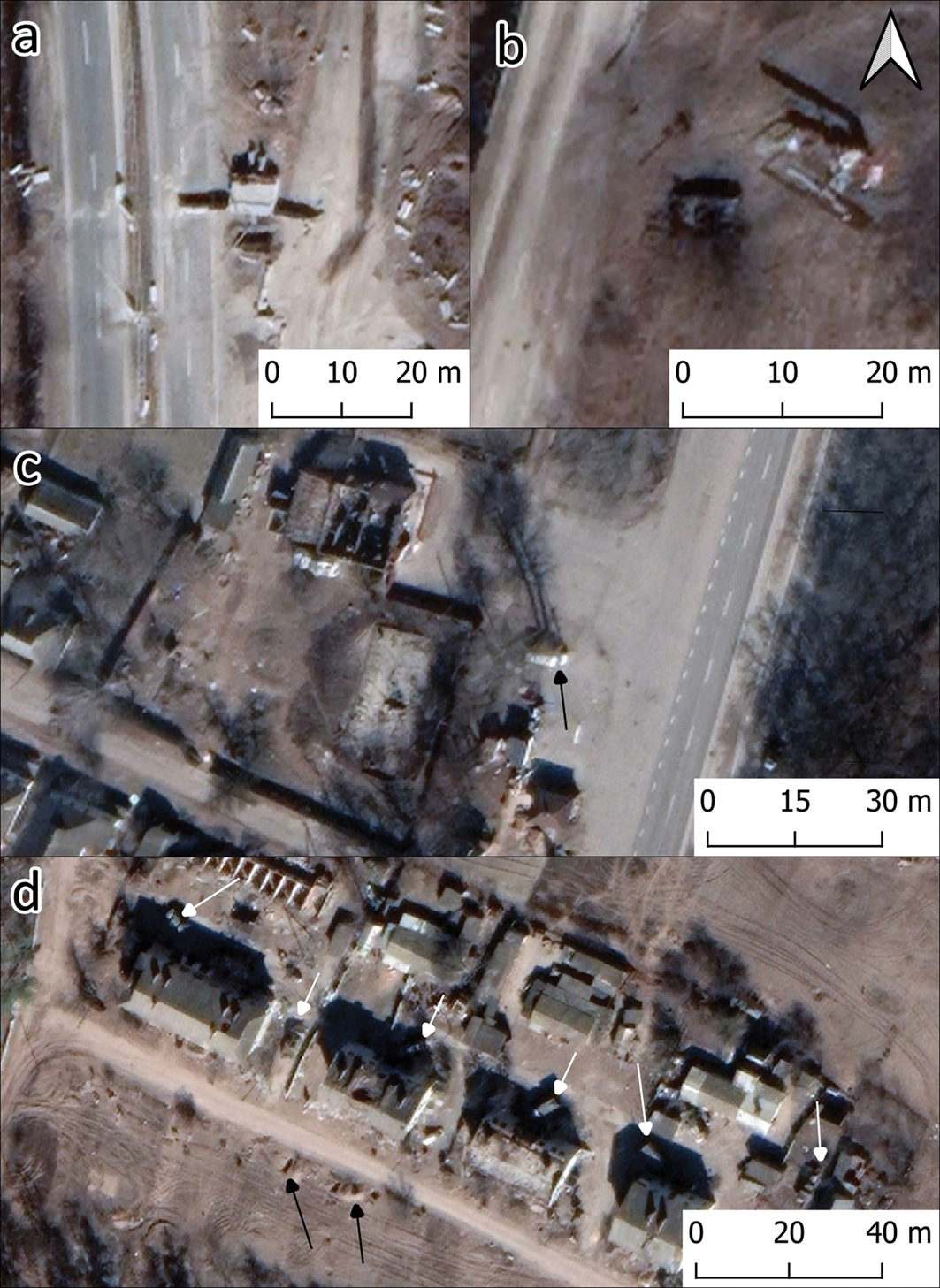
The satellite image from 18 March 2022 reveals an extensive military presence in the Yahidne area. Heavy vehicle movements are visible along the main roads, while the surrounding fields are covered with artillery craters. Smoke continues to rise from damaged buildings, open fields and nearby forested areas. At the northern outskirts of the village, the remnants of a destroyed checkpoint can be identified, with a burnt-out tank abandoned on the roadside some distance away (Figure 1a & b). In the centre of the village, a civilian truck is parked (Figure 1c). According to eyewitness accounts, this truck was damaged by the soldiers, and the driver was arrested. Other immobilised civilian vehicles are also present along the road; the fate of their drivers is unknown.
Satellite images of Yahidne from 18 March 2022: a) a destroyed Ukrainian checkpoint; b) a tank wreck with its turret lying several metres away; c) a car park in central Yahidne, the black arrow indicates an immobilised truck and a destroyed roadside bar is visible to the east; d) houses occupied by Russian army soldiers, the white arrows indicate military vehicles, black arrows mark foxholes (courtesy of Google Earth Pro; imagery provider: Maxar Technologies; annotations by G. Kiarszys).

Figure 1 Long description
The image contains four satellite photos of Yahidne from 18 March 2022. The first photo shows a destroyed Ukrainian checkpoint with debris scattered around. The second photo displays a tank wreck with its turret several meters away. The third photo features a car park in central Yahidne, with a black arrow indicating an immobilized truck and a destroyed roadside bar visible to the east. The fourth photo shows houses occupied by Russian army soldiers, with white arrows marking military vehicles and black arrows indicating foxholes.
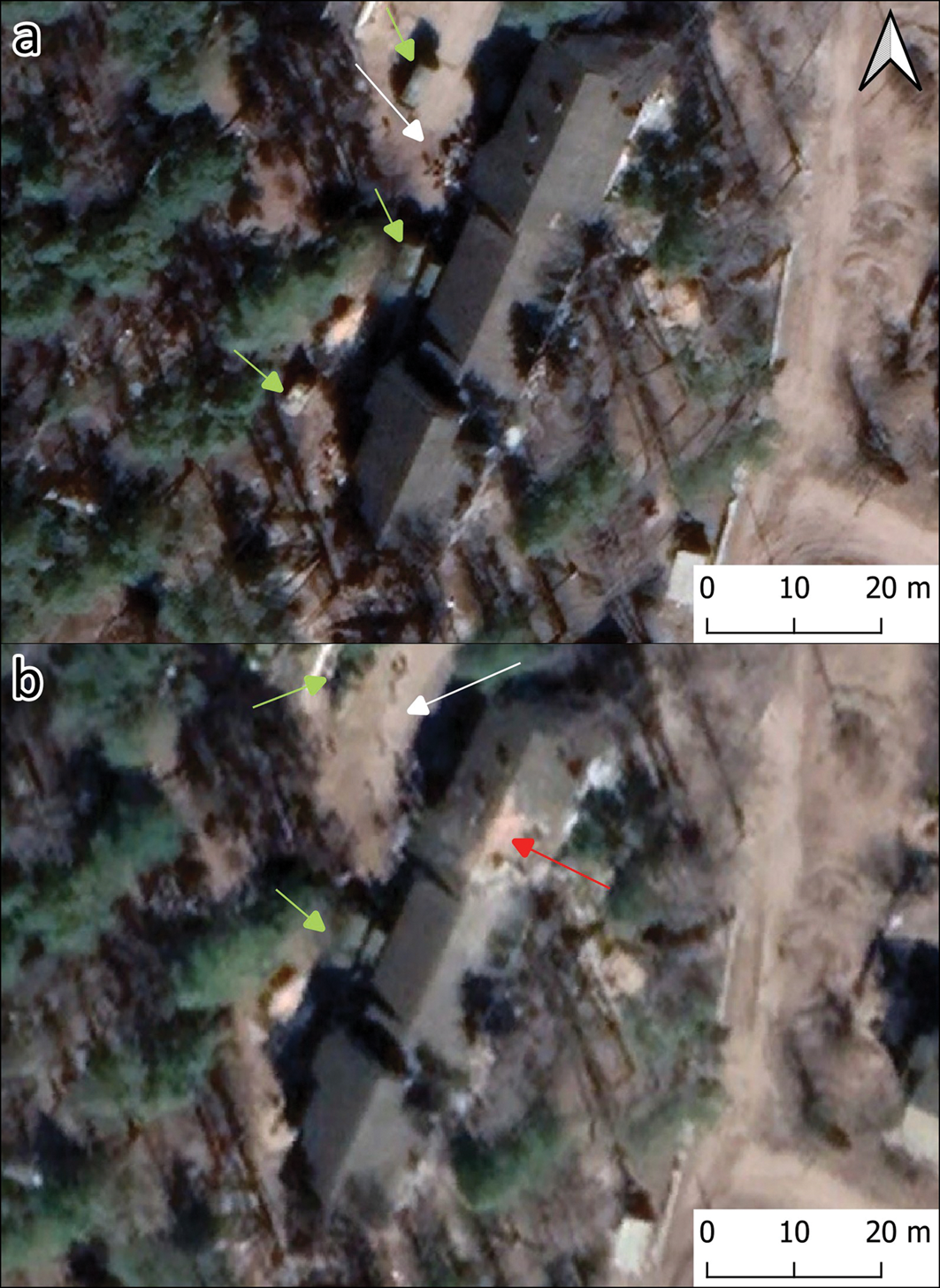
By mid-March 2022, many buildings in Yahidne had sustained visible damage. Deep vehicle tracks are imprinted into the arable fields in the centre of the settlement, indicating the movement and prolonged presence of heavy machinery (see online supplementary material (OSM) Figure S3a). Approaching the area near the school, several buildings used as fortified positions are surrounded by military vehicles. Temporary field fortifications are also discernible, particularly foxholes aligned along the main road leading to the school (Figure 1d). Several military vehicles are parked adjacent to the school itself, while armoured vehicles appear to be entrenched within the nearby forest. A rare and evocative detail in the image is the elongated shadows cast by a group of Russian army soldiers near the school’s rear entrance, their silhouettes forming a kind of spectral presence (Figure 2a). The main absence in this scene is that of the civilians imprisoned in the basement.
The school in Yahidne: a) image from 18 March 2022, the white arrow points to shadows cast by Russian army soldiers, green arrows mark military vehicles; b) image from 22 March 2022, the red arrows show rocket damage to the roof, white arrows indicate soldiers in the yard, green arrows mark vehicles (courtesy of Google Earth Pro; imagery provider: Maxar Technologies; annotations by G. Kiarszys).

Figure 2 Long description
The image consists of two aerial views of a school in Yahidne. The first image, taken on 18 March 2022, shows shadows cast by Russian army soldiers indicated by a white arrow, and military vehicles marked by green arrows. The second image, from 22 March 2022, displays rocket damage to the roof highlighted by red arrows, soldiers in the yard indicated by white arrows, and vehicles marked by green arrows. The images are annotated by G. Kiarszys and provided by Google Earth Pro with imagery from Maxar Technologies.
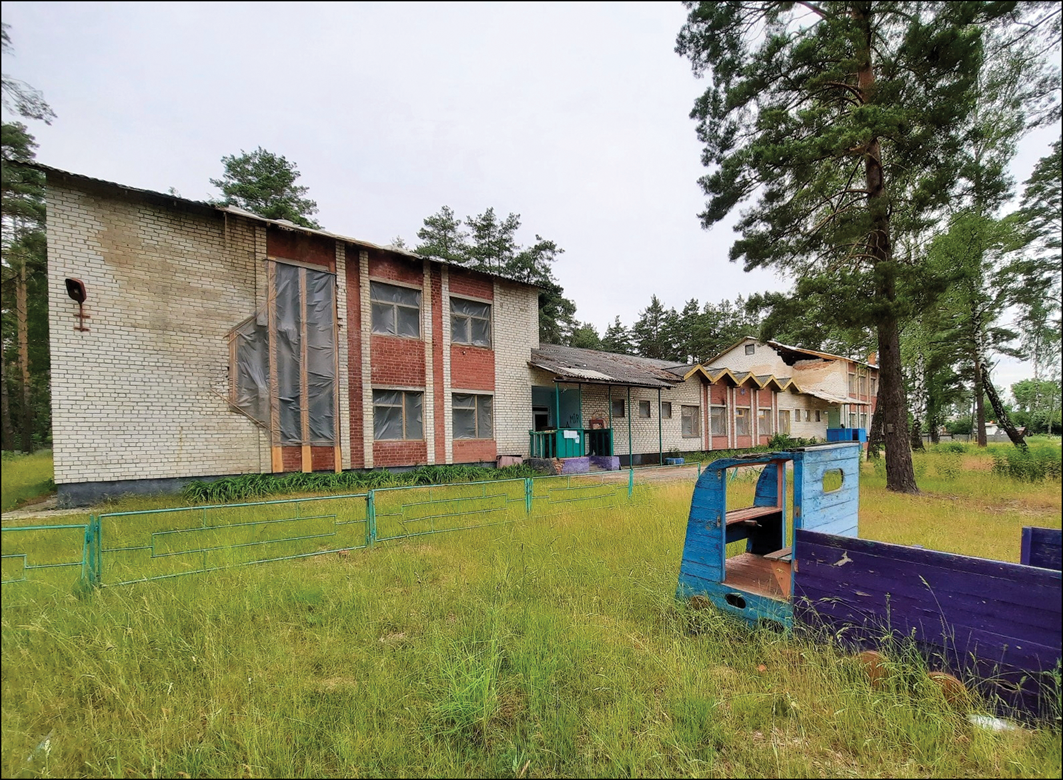
The satellite image from 22 March 2022 reveals further destruction of Yahidne following heavy artillery barrages. The school sustained direct hits from at least two rockets, resulting in damage to its roof and eastern façade (Figures 2b & 3). Several houses previously occupied by the soldiers were also struck and destroyed, with burnt-out and immobilised vehicles still visible nearby. By the end of the occupation, continued fighting had led to the devastation of additional structures within the village, including the communal gathering hall and the health centre.
. Eastern facade of the Yahidne school, showing damage to the roof and walls caused by rocket strikes, 11 June 2023 (photograph by M. Lemiesz).

Figure 3 Long description
The image shows the eastern facade of a school building that has sustained significant damage. The roof is partially collapsed, and the walls have large holes and exposed areas where bricks are missing. The building is surrounded by a grassy area with a few trees in the background. A colorful play structure is visible in the foreground, adding a contrast to the otherwise somber scene.
Since its liberation, many of the buildings in Yahidne have been either renovated or demolished and rebuilt from scratch. A new road surface has been laid, lamp-posts installed and the roadside chapel near the coffeehouse repaired. Although some traces of destruction remain, they are far fewer than in the immediate aftermath of the Russian withdrawal. The area has been cleared of explosives, yet residents still tend to avoid the surrounding forests. Some of the field fortifications, such as trenches and shelters for armoured vehicles, have not yet been levelled, and fragments of rockets and shrapnel remain scattered throughout the fields.
The trace, the absence and the uncanny
In Derridean hauntology, the ‘trace’ was originally conceived as a non-material mark of something significant yet no longer present (Derrida Reference Derrida1997: 47–48; Derrida & Stiegler Reference Derrida, Stiegler, del Pilar Blanco and Pereen2013: 39, 47). Material traces of the recent past, however, may exhibit a similar tendency. Engagement with abandoned places and familiar artefacts can evoke unresolved traumas or suppressed narratives. It may also facilitate processes of mourning by acting as a conduit between what is materially present and what remains unspoken.
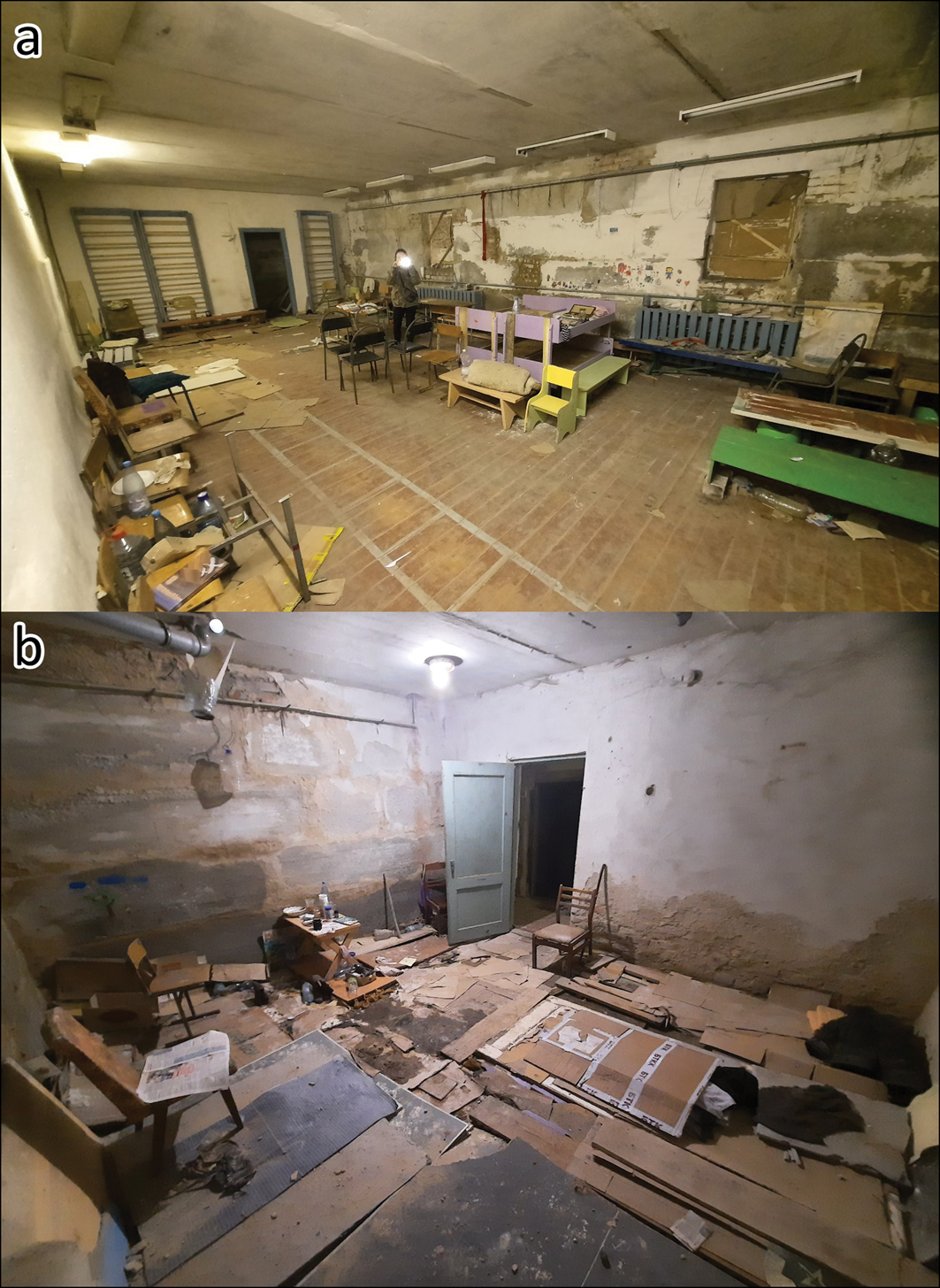
The abandoned interiors of the Yahidne school still preserve numerous material traces of the crime. The school’s basement comprises seven chambers and a long corridor, all of which were used as prison cells during the occupation. The interiors remain cluttered with school furnishings: chairs, ping-pong tables, desks and doors repurposed as makeshift beds to accommodate the youngest children. Several children’s beds, originally from the upstairs nursery rooms, were also brought down to the basement (Figure 4a). Due to the limited space, adults spent long hours seated in tightly packed conditions, either on benches or on the concrete floor, which was lined with cardboard to provide minimal insulation (Figure 4b).
Interior of the school basement: a) the largest basement chamber, originally a gym; b) a room insulated with cardboard and ping-pong tables, 11 June 2023 (photograph by M. Lemiesz).

Figure 4 Long description
The image consists of two photos depicting the interior of an abandoned school basement. The first photo, labeled 'a', shows the largest basement chamber, which was originally a gym. The room is filled with scattered debris, broken furniture, and overturned tables. The walls and ceiling appear worn and damaged, with visible signs of neglect. The second photo, labeled 'b', shows a smaller room that was insulated with cardboard. This room contains overturned ping-pong tables and various pieces of debris scattered across the floor. The walls and ceiling are also in a state of disrepair, with peeling paint and exposed insulation. The overall scene conveys a sense of abandonment and decay.
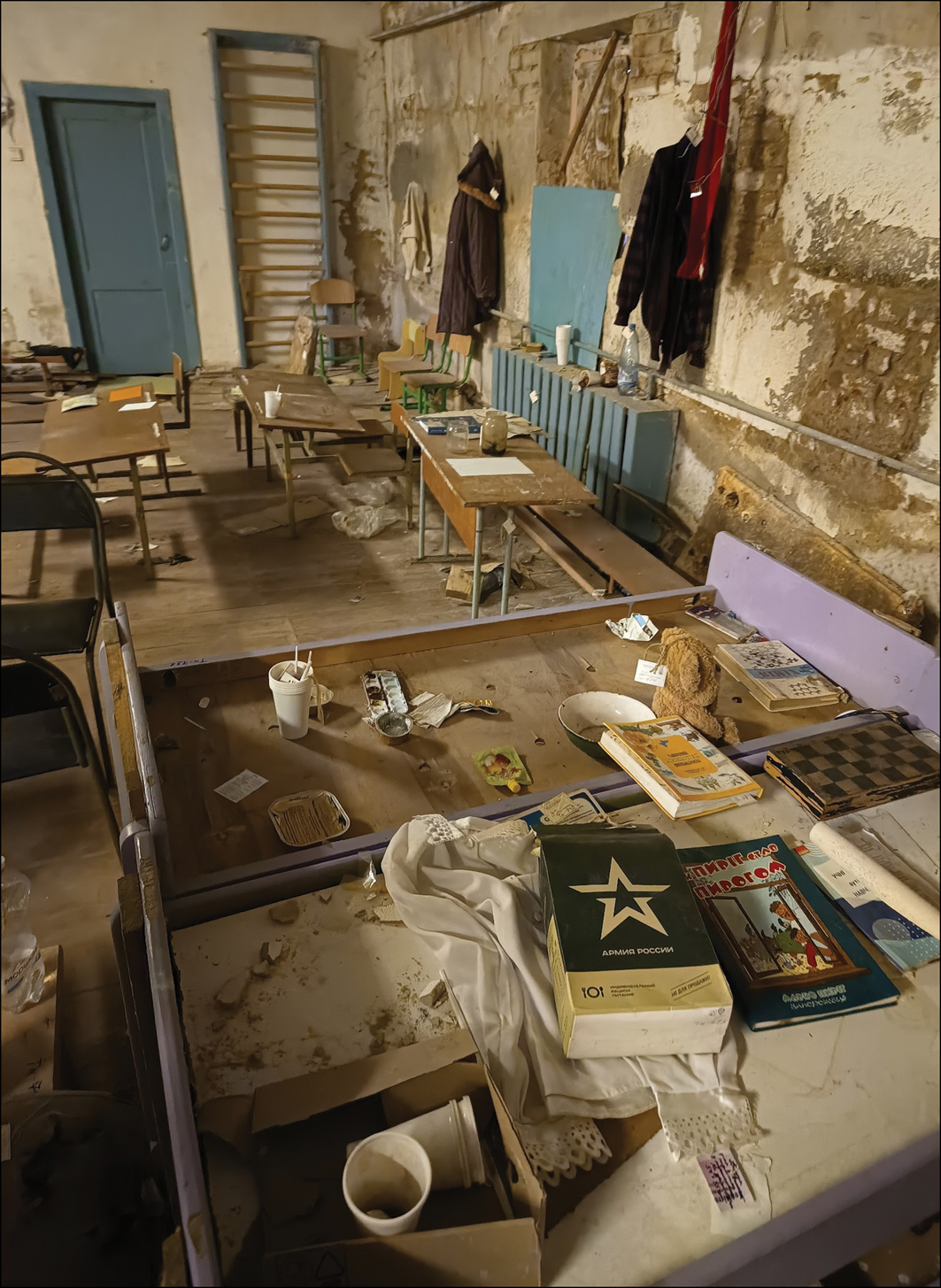
The prisoners left various items behind, including clothing, plastic bags, cups, remnants of military rations and jars of pickled cucumbers that had been given to them by the soldiers of the Russian army. Another category of artefacts found in the basement is schoolbooks, including Russian and Ukrainian language textbooks, Ukrainian history books for children and materials for other subjects. The prisoners read these to cope with the monotony (Figure 5). The abandoned plastic and cuddly toys form a haunting contrast with the dark, confined spaces of the basement. The Russian forces also distributed a special edition of the newspaper Komsomolskaya Pravda. Its articles sought to justify the armed operation, claimed that the Russian Federation forces were being warmly welcomed by Ukrainians and announced a swift victory that never materialised.
Artefacts from the basement, including schoolbooks, a box of military rations, cups, drawings, a cuddly toy, a chessboard and children’s beds, 1 March 2025 (photograph by G. Kiarszys).

Figure 5 Long description
The image shows an abandoned room filled with school desks, books, and various personal items. The room has a worn-out appearance with peeling walls and a dirty floor. There are several desks arranged in rows, some with books and papers on them. A chessboard, a cuddly toy, and a box of military rations are visible among the scattered items. Clothes hang on the walls, and a ladder is positioned in the corner. The overall scene suggests a place that was once used for educational purposes but has since been abandoned.
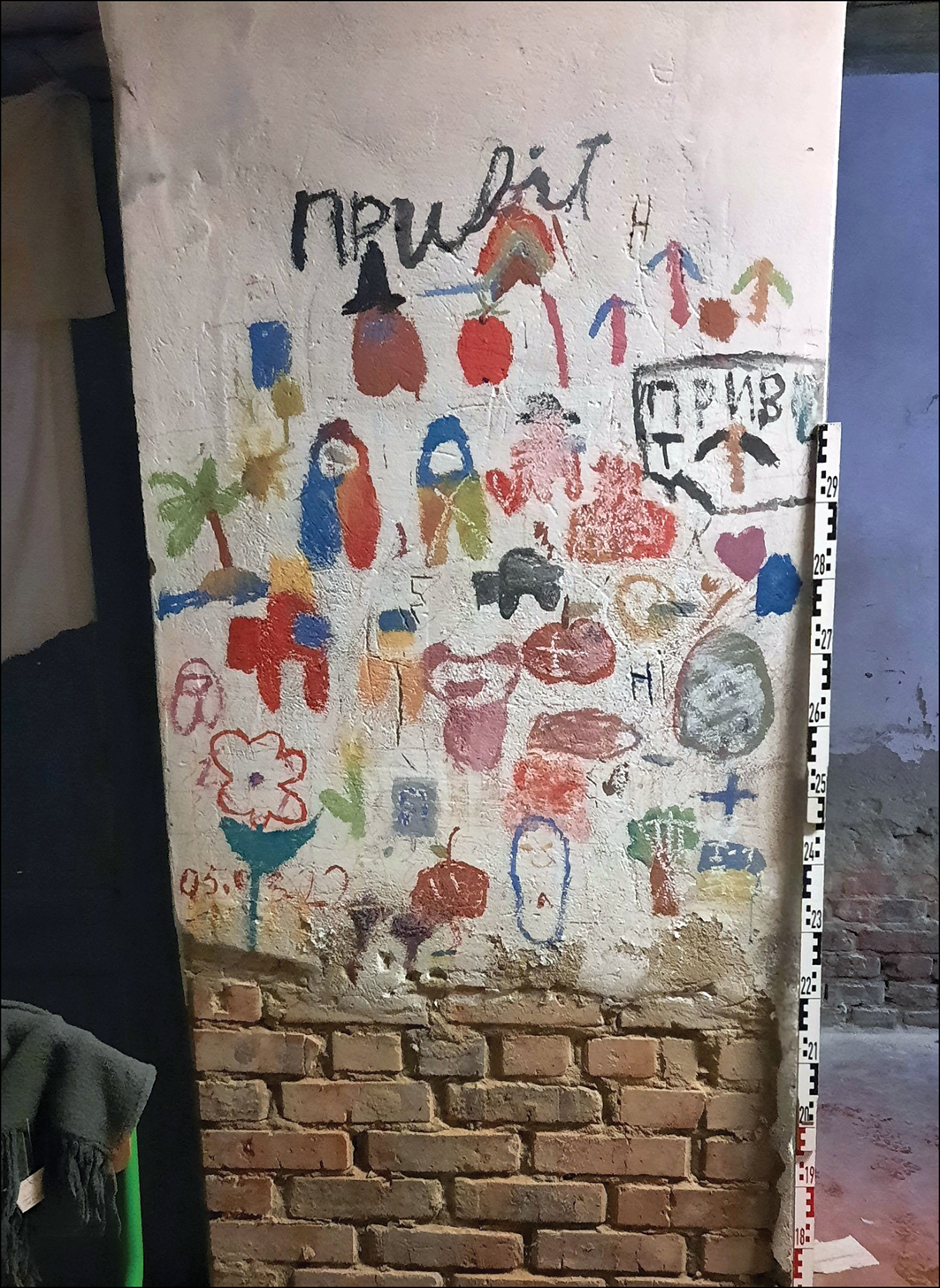
To make the long imprisonment more bearable for the children and to distract them with something joyful, someone found crayons and paints, which meant they could draw on the walls. The resulting images depict the familiar figures that typically inhabit children’s imaginations: characters from their favourite computer games, such as Among Us, and internet memes, as well as mattocks from Minecraft, colourful flowers, butterflies, the sun, clouds, trees, Ukrainian flags and fantastical beings of their own invention. Above one such scene, the word “Hello” is scrawled (Figure 6); above another, the inscription reads “No Exit”. Elsewhere, a child has scribbled, “Mommy, when will you buy me a phone?” Words from the Ukrainian national anthem also appear, alongside other inscriptions, now partly faded or illegible. In rooms without crayons, children used charcoal to draw scenes of a football match, buildings, and a meteor on a collision course with a grocery store. Someone else scratched into the corridor wall a scene depicting two figures hunting a mammoth with a spear, accompanied by a wolf howling at the moon from a rocky outcrop. And yet, strikingly, across all these images, there is no mention of the foreign soldiers or the violence inflicted. This omission, this silent void, speaks volumes, drawing attention to a sinister absence that haunts the basement walls as much as the drawings.
Children’s wall drawings in the main basement chamber, 1 March 2025 (photograph by M. Lemiesz).

Figure 6 Long description
The image shows a white wall in a basement chamber covered with colorful children's drawings and graffiti. The drawings include various shapes, figures, and text, such as a palm tree, people, animals, and abstract forms. There is a ruler attached to the right side of the wall, and the drawings are scattered across the surface, creating a vibrant and playful scene. The text includes some Cyrillic characters and numbers, adding to the eclectic mix of artwork.
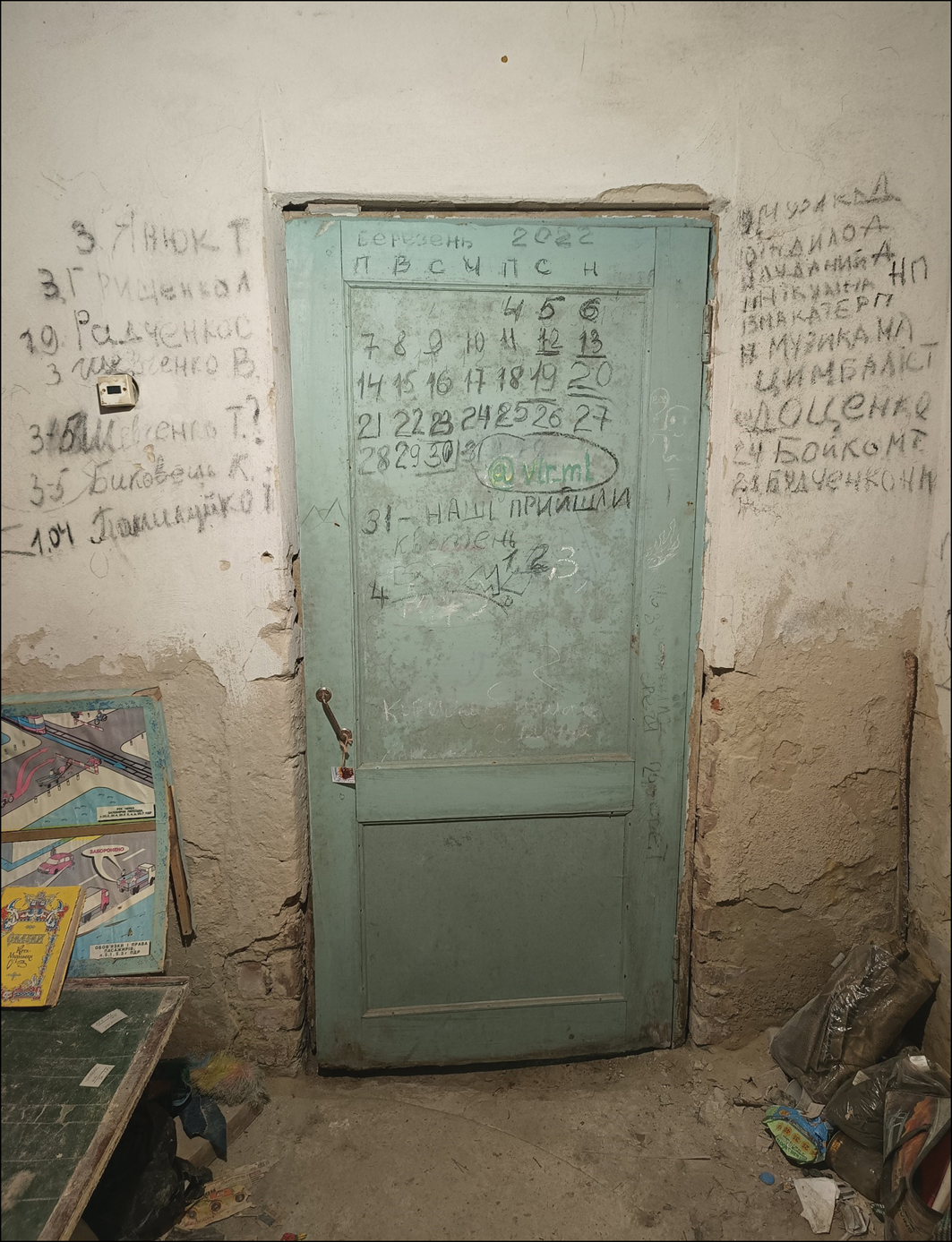
Adults also left their marks on the walls, though these were generally more uniform, most often calendars for March, used to track the days of imprisonment. These appear in several rooms in varying forms. Perhaps the most symbolic is the calendar drawn on the door of one of the smaller chambers (Figure 7). It begins on 4 March, with several dates underlined, possibly marking unknown significant events. Notably, 30 March is marked as the day when Russian forces withdrew from the village, and the prisoners were finally freed. On the following day, someone returned and inscribed the words “ours have come”, marking the arrival of Ukrainian soldiers. On the wall to the right of the door, someone listed the dates and surnames of those who died in the basement; on the left, the names of those killed elsewhere in the village. In total, 17 of the 27–29 victims are listed here, reflecting the fact that the prisoners were only partially aware of the events unfolding beyond the basement.
Door marked with a calendar tracking the Russian withdrawal and Ukrainian return. The names of people killed in the village and of those who died in the basement are listed to the left and right of the door, respectively, 1 March 2025 (photograph by G. Kiarszys).

Figure 7 Long description
The image shows a green door with a calendar written on it, tracking the Russian withdrawal and Ukrainian return. The calendar is labeled with the month of March 2022 and includes dates from 1 to 31. To the left of the door, names of people killed in the village are listed. To the right of the door, names of those who died in the basement are listed. The door is surrounded by a wall with additional writing and some items placed on the floor nearby.
The upper floors of the school retained a substantial amount of material evidence left behind by Russian soldiers. In the period directly following the Russian withdrawal, Ukrainian criminal investigators collected DNA samples from the site, which have already contributed to identifying many of the perpetrators (e.g. Domashchenko Reference Domashchenko2023; Coynash Reference Coynash2025). Personal documents belonging to nine Tuvan soldiers were also recovered from the scene.
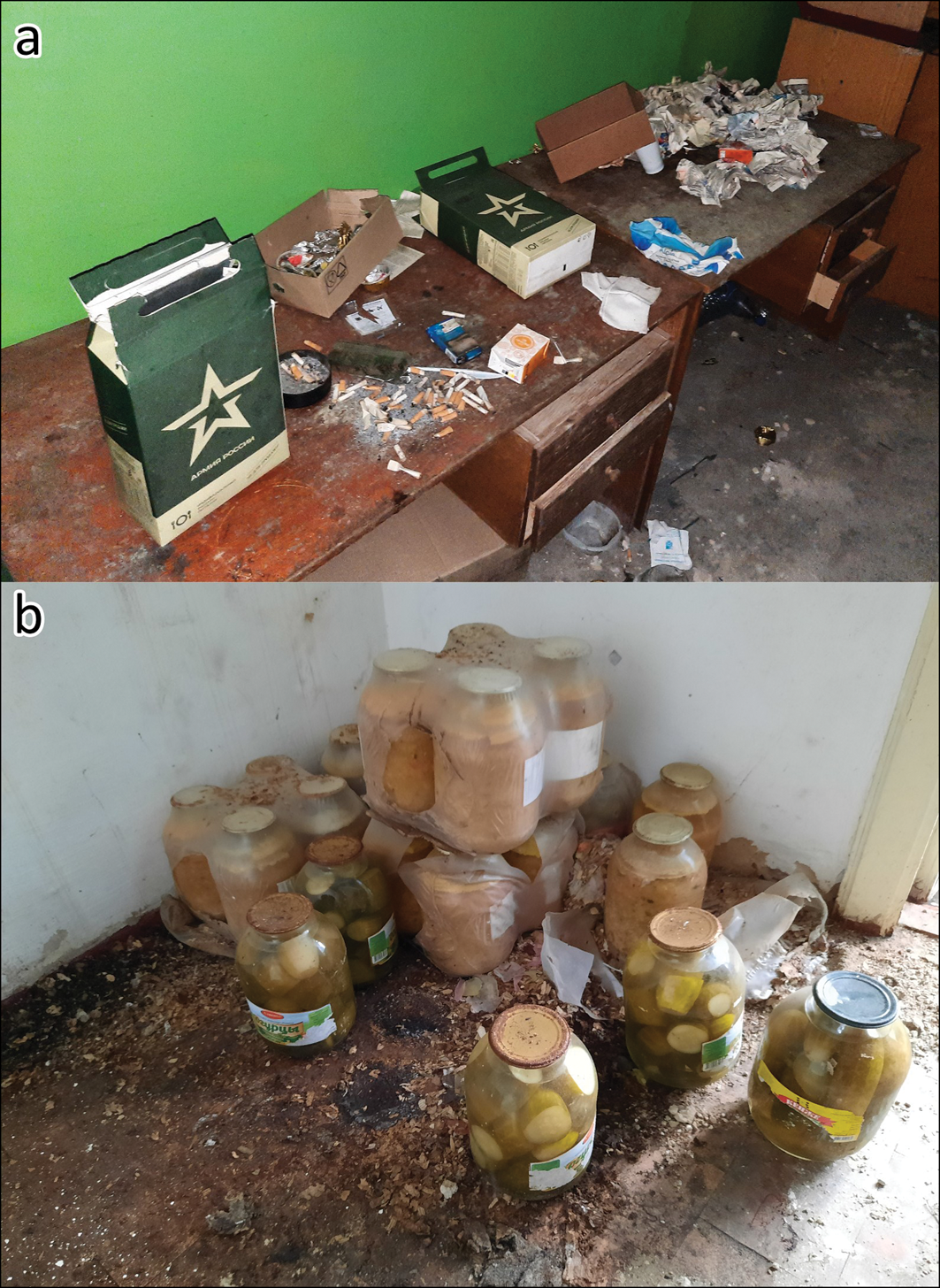
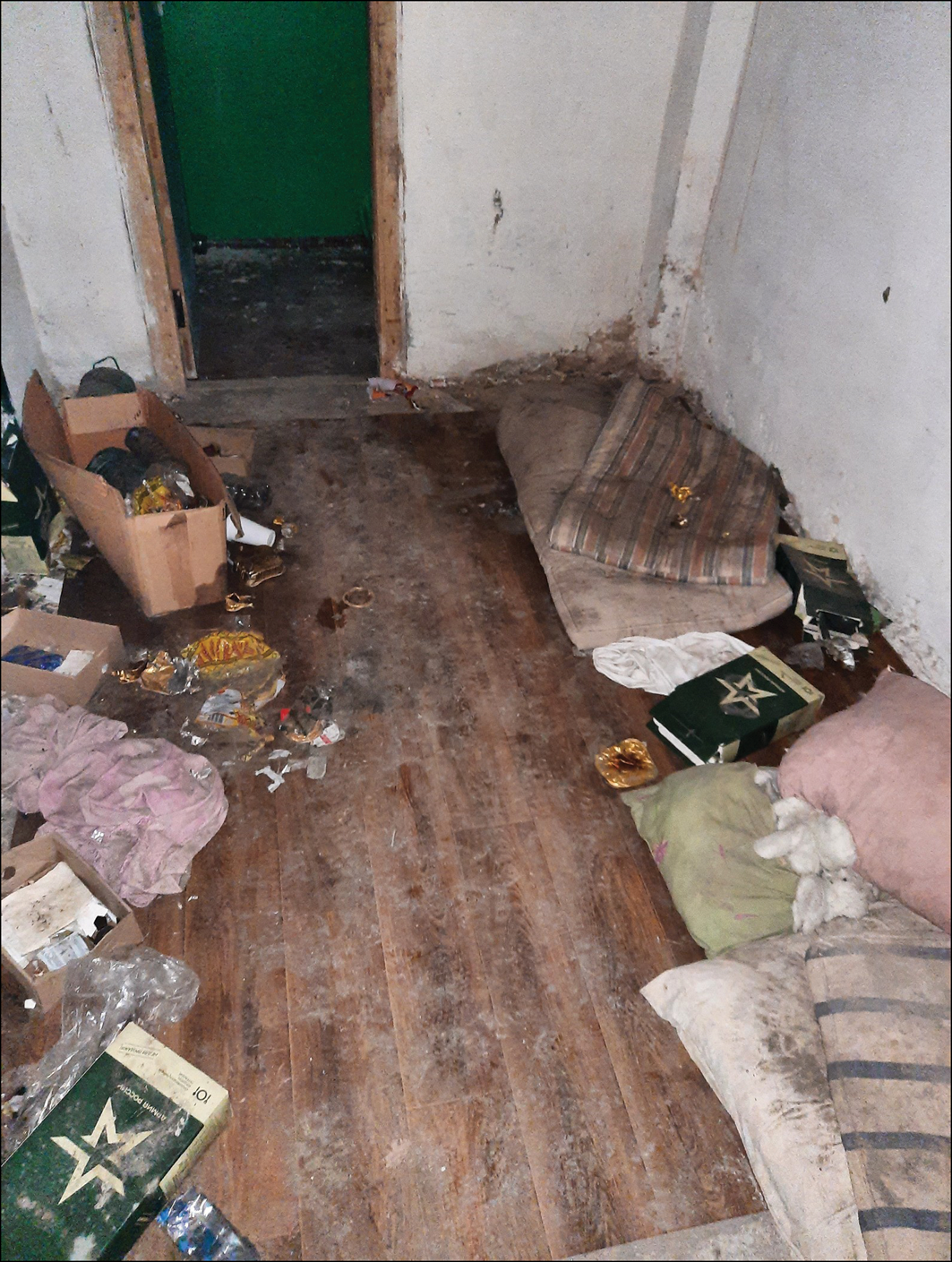
Among the items still present are personal and military belongings, including uniforms, crumpled propaganda newspapers (possibly used to dry wet boots), cigarette butts, half-eaten military rations and numerous large jars of pickled cucumbers and sauerkraut, many with expiration dates from 2012 and 2014 (Figures 8a, b & 9). The classrooms were left heavily littered and severely damaged. Some rooms on the ground floor had been fortified using sand-filled ammunition boxes (Figure S13b). Russian army soldiers marked the walls with various inscriptions—nicknames, crude diagrams of observation zones and lines of fire, the name of their unit and hostile messages aimed at their Ukrainian opponents (Figure S16).
Waste left behind by Russian army soldiers: a) empty ration boxes, cigarette butts and propaganda newspapers, 1 March 2025; b) a supply of jars containing pickled cucumbers and sauerkraut, 10 June 2023 (photographs by a) G. Kiarszys; b) M. Lemiesz).

Figure 8 Long description
The first photo shows a cluttered table with empty ration boxes, cigarette butts, and propaganda newspapers scattered across its surface. The table is situated in a room with green walls and a wooden floor. The second photo displays a collection of jars containing pickled cucumbers and sauerkraut, placed on the floor in a room with white walls and a wooden floor. The jars are of various sizes and shapes, some stacked on top of each other. The photos highlight the remnants left behind by Russian army soldiers, providing a glimpse into their daily life and the waste they generate.
Room used by the soldiers for sleeping with discarded rations and other materials, 10 June 2023 (photograph by M. Lemiesz).

Figure 9 Long description
The image shows a room with wooden flooring and white walls, appearing to be in a state of disarray. Various discarded items, including boxes, clothing, and other materials, are scattered across the floor. A mattress with a striped pattern is positioned against one wall, and a green door is visible in the background. The room gives the impression of being used temporarily, possibly by soldiers, with personal belongings and rations left behind.
All the traces left behind, briefly described in this article, contribute to a profound sense of the uncanny—meaning it evokes the unthinkable, things that appear detached from the present yet remain undeniably present. The ominous presence of these artefacts stands in stark contrast to the peaceful school-wall decorations depicting characters from children’s stories, fairytales and symbols of peace (Figures S14 & S17). The school’s interiors feel simultaneously familiar and alien. The contemporary observer recognises the building’s original educational purpose and some of its furnishings, yet other material remnants seem surreal and dislocated, as if tied to impossible, irrational events that defy understanding. Here, we encounter the spectre in its recurring form. And yet, Derrida’s deconstruction does not seek a fixed or final meaning. Instead, it invites an openness to the ‘other’, to that which resists resolution or simple understanding.
Conclusions: things to come and the arrival of the ‘other’
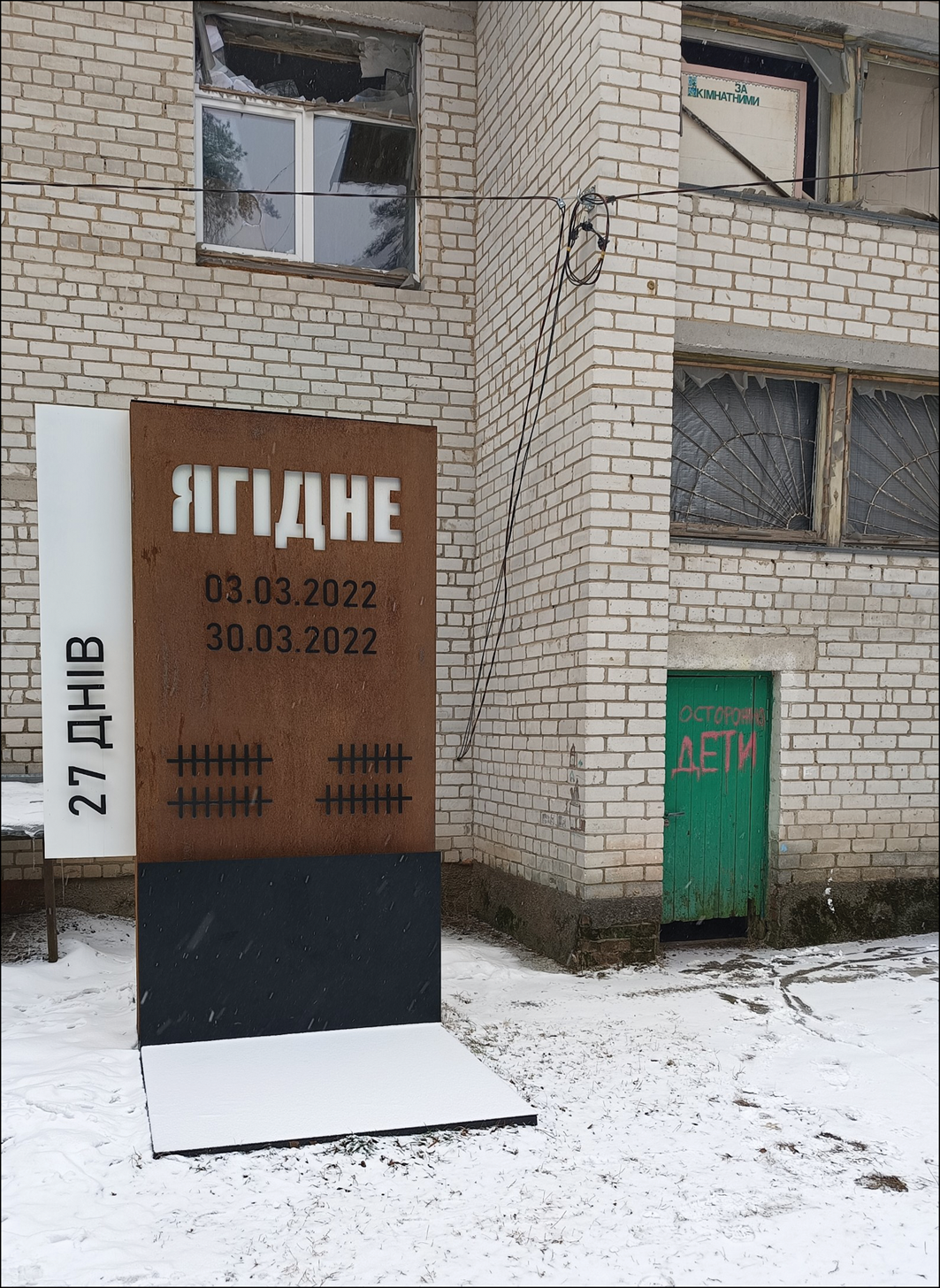
While closure or justice for those who were imprisoned may seem distant, there are still ethical ways to take responsibility for the past. Soon after the events in Yahidne, the local community decided that the school would never again serve its original purpose. It had been irrevocably transformed, both physically and in the minds of residents. At present, a monument stands at the back of the school, commemorating the victims of the 27 days of Russian occupation (Figure 10). It was deliberately positioned near the basement doors, which still bear red lettering reading ‘Warning. Children’. Plans are now in progress to convert the building into a museum that will bear witness to what happened in Yahidne and stand as a testimony to the world (Press Service 2025). An architectural concept has already been proposed, though it sparked controversy when community members expressed a strong desire to actively participate in shaping the project (Mamonova Reference Mamonova2025).
Memorial to the victims of the war crime: ‘27 Days. Yahidne’. The door in the background, marked in red with the warning ‘Warning. Children’ leads to the basement where Yahidne’s residents were imprisoned, 1 March 2025 (photograph by G. Kiarszys).

Figure 10 Long description
The image shows a memorial sign placed in front of a brick building with several broken windows. The sign is brown with white text, indicating the dates 03.03.2022 to 30.03.2022 and the number 27 days, represented by tally marks. The ground is covered in snow. In the background, there is a green door marked with red text that reads 'Warning. Children,' leading to a basement where residents of Yahidne were imprisoned during a war crime. The scene is set in a snowy environment, emphasizing the somber and historical context of the memorial.
This clarifies the first significant aspect concerning the status of archaeology of the recent past and its role, as outlined in the introduction to this article. The use of digital methods allowed for the detailed documentation of the school building and its interiors (Figure S14). Preserving this record is important for several pragmatic reasons. Necessary renovations may alter parts of the building, potentially erasing some of the tangible traces of the Russian occupation. In the future, once the museum is established, this digital documentation can serve both as a reference for creating an exhibition faithful to the original scene and as a resource for subsequent analyses. In this sense, the archaeological digital record functions as a Barthesian seeing clock, potentially enabling the creation of a museal simulacrum. It should be noted that selected artefacts recovered from Yahidne school (e.g. doors with inscriptions and calendars), and photographs of the wall drawings, have already been displayed in museum exhibitions both in Ukraine and abroad (e.g. National Museum of the History of Ukraine 2023).
The second aspect of archaeology’s role highlighted in this article is more reflective: the Yahidne case illustrates how cultural heritage emerges from the material remnants of a very recent war crime. Such processes are seldom discussed by archaeologists, who often treat heritage as given, self-evident and objective. By applying Derridean hauntology, we can gain a deeper understanding of what constitutes heritage and how it is created. This perspective also helps explain the local community’s deep attachment to preserving the Yahidne school, precisely because of its connection to collective traumatic memories.
The Yahidne war crime left behind numerous material traces, which fall within the domain of archaeology. At first glance, they may appear mundane: an abandoned school building, cheerful drawings on the walls, a calendar inscribed for some reason with names, discarded clothing, broken furniture, rubbish, jars with pickled cucumbers, and spent military equipment. Yet each of these elements silently gestures toward what has been lost, toward absence itself and announces the inevitable return of the spectre. In this way, the material remains become not only evidence of a past atrocity, but conduits through which absence insists on being acknowledged, demanding a reckoning. In our view, this final aspect—the lingering presence of unresolved events and their material echoes—deserves recognition within archaeological approaches to the recent past because it enables a holistic and systemic understanding of the relationships among humans, memory, material relics and absence.
Acknowledgements
The authors acknowledge the use of AI tools for proofreading and improving the linguistic quality of the manuscript.
Online supplementary material (OSM)
To view supplementary material for this article, please visit https://doi.org/10.15184/aqy.2026.10322 and select the supplementary materials tab.
Author contributions: using CRediT categories
Grzegorz Kiarszys: Conceptualization-Lead, Data curation-Lead, Formal analysis-Lead, Funding acquisition-Lead, Investigation-Equal, Methodology-Lead, Project administration-Lead, Resources-Lead, Software-Lead, Supervision-Lead, Validation-Lead, Visualization-Equal, Writing - original draft-Lead, Writing - review & editing-Lead. Marek Lemiesz: Conceptualization-Supporting, Formal analysis-Supporting, Investigation-Equal, Project administration-Supporting, Validation-Supporting, Visualization-Equal, Writing - original draft-Supporting, Writing - review & editing-Supporting.


 Open access

