





Developmental psychopathology emphasizes that procedures and models incorporating multiple levels of analyses are necessary for understanding the development of mental health in children (Cicchetti, Reference Cicchetti, Beauchaine and Hinshaw2008; Kozak & Cuthbert, Reference Kozak and Cuthbert2016). Biological and experiential factors interact in complex ways to shape development over time, and in order to understand and effectively address children’s mental health problems, we need to properly assess, evaluate, and measure both environment and neurobiology. Considerable biopsychosocial research has focused on aspects of children’s physiological functioning as dispositional characteristics that may moderate the effects of contextual factors on the development of psychopathology (Belsky & Pluess, Reference Belsky, Pluess and Cicchetti2016). In most studies, however, the measurement and quantification of physiological reactivity have not reflected the level of complexity or sophistication inherent in theoretical models of the links between physiology and emotion regulation (Hastings & Kahle, Reference Hastings, Kahle, LoBue, Pérez-Edgar and Buss2019), which limits the extent to which biopsychosocial moderation models have been appropriately tested.
Parasympathetic nervous system (PNS) activity plays an essential role in regulatory processes, serving restorative functions by down-regulating autonomic arousal and supporting an orienting response without recruiting the metabolically demanding sympathetic nervous system (SNS; Porges, Reference Porges2003). PNS activity has mainly been studied using respiratory sinus arrhythmia (RSA), a measure of heart rate variability that corresponds with respiration and serves as an index of parasympathetic control over cardiac activity. RSA reactivity, in the form of increases and decreases in RSA to different stimuli, has been regarded as a critical component of emotion regulation to affective demands (Hastings et al., Reference Hastings, Kahle and Han2014). Most studies of PNS reactivity as an index of regulation have examined static change scores of RSA from baseline to a task (Burt & Obradović, Reference Burt and Obradović2013). However, as described by Dennis-Tiwari (Reference Dennis-Tiwary2019), emotion regulation is dynamic, such that it needs to be understood as change that occurs over seconds, developmental periods, and across contexts. In parallel, then, RSA reactivity needs to be understood as a dynamic, non-linear process rather than static change (Beauchaine et al., Reference Beauchaine, Bell, Knapton, McDonough-Caplan, Shader and Zisner2019; Burt & Obradović, Reference Burt and Obradović2013; Miller et al., Reference Miller, Chocol, Nuselovici, Utendale, Simard and Hastings2013). Yet, whether reactivity is specific to or consistent across different affective stimuli like distinguishable negative emotions is unclear (Fortunato et al., Reference Fortunato, Gatzke-Kopp and Ram2013).
Although many studies have examined the potential moderating role of RSA reactivity on the association of contextual factors on psychopathology, results are far from consistent (El-Sheikh & Whitson, Reference El-Sheikh and Whitson2006; Obradović et al., Reference Obradović, Bush and Boyce2011; Shader et al., Reference Shader, Gatzke-Kopp, Crowell, Jamila Reid, Thayer, Vasey, Webster-Stratton, Bell and Beauchaine2018; Shanahan et al., Reference Shanahan, Calkins, Keane, Kelleher and Suffness2014). A potential explanation resides in how reactivity is conceptualized and assessed, as traditional methods for quantifying PNS change such as static change scores are limited in their ability to capture physiological reactivity as a dynamic process (Hastings et al., Reference Hastings, Kahle and Han2014; Obradovic, Reference Obradović2012). Yet, the use of dynamic, non-linear approaches to RSA reactivity has not been examined in the context of biopsychosocial models. Further, the extent to which children evidence consistent patterns of dynamic RSA reactivity across tasks as one would expect if it reflects a trait-like, temperamental susceptibility to environmental influences also has received relatively less attention. Therefore, the goals of this study were two-fold. First, we examined children’s underlying patterns of non-linear change in RSA across emotional scenarios to identify whether vagal flexibility (VF) could be utilized as a measure of individual differences in parasympathetic reactivity. Second, we examined the extent to which such a pattern of RSA reactivity moderated the association between authoritarian parenting and socioeconomic status (SES) and the development of internalizing (IP) and externalizing (EP) problems across two years.
A dynamic approach to modeling RSA reactivity
According to Polyvagal Theory (Porges Reference Porges2003, Reference Porges2007), the myelinated vagus promotes affiliative behaviors and social engagement by down-regulating the SNS, supporting adequate physiological arousal to stimuli and facilitating an orienting response (Beauchaine, Reference Beauchaine2012; Hastings et al., Reference Hastings, Kahle and Han2014). The vagus connects and rapidly carries information between the central nervous system and PNS-innervated peripheral tissue through efferent and afferent nerve signals, affecting numerous somatic targets including the cardiopulmonary system, from which RSA can be assessed to index PNS activity. Extensive research has focused on baseline RSA, or PNS activity in a wakeful relaxed state (Hastings et al., Reference Hastings, Kahle and Han2014; Zisner & Beauchaine, Reference Zisner, Beauchaine and Cicchetti2016), and RSA reactivity to stimuli, which are jointly thought to reflect the capacity for flexible physiological self-regulation that underlies effective emotion regulation (Porges, Reference Porges2003, Reference Porges2007; Porges & Furman, Reference Porges and Furman2011). According to Porges (Reference Porges2003), RSA reactivity reflects a process called “neuroception”, through which an individual implicitly evaluates the meaning or safety of a situation, which occurs outside of conscious awareness. Neuroception is the sub-conscious appraisal of social situations that shapes the autonomic nervous response (ANS) response and consequently individuals’ expression and regulation of emotions and social behavior. Polyvagal theory suggests that mild to moderate RSA withdrawal to stimuli, which usually accelerates heart rate, supports attention and orienting to salient cues that may indicate challenge, whereas RSA augmentation (or applying the vagal brake), which typically slows heart rate, facilitates a calm state for social engagement (Hastings et al., Reference Hastings, Nuselovici, Utendale, Coutya, McShane and Sullivan2008; Porges, Reference Porges2007).
As such, a large body of research has examined these two directions of RSA reactivity to contextual challenges and emotional stimuli in relation to children’s emotion reactivity, regulation, and IP and EP (Burt & Obradović, Reference Burt and Obradović2013; Graziano & Derefinko, Reference Graziano and Derefinko2013). Children with more EP and IP have been found to show atypical patterns of PNS activity relative to children with fewer problems; however, specific studies and meta-analyses have suggested that these findings are fairly inconsistent. For example, in separate meta-analyses, Graziano and Derefinko (Reference Graziano and Derefinko2013) concluded that reduced RSA withdrawal to a variety of stimuli was associated with both more EP and more IP, yet Beauchaine and colleagues (Reference Beauchaine, Bell, Knapton, McDonough-Caplan, Shader and Zisner2019) found that greater RSA withdrawal was associated with more EP but not more IP. These inconsistencies may be partially attributable to the samples and methodologies of the particular studies included in the meta-analyses, including how RSA reactivity has been assessed in those studies.
This body of research has mainly relied on static measures of RSA reactivity, such as arithmetic or residual change scores from baseline RSA to RSA during a challenge or stimulus exposure. However, researchers are increasingly recognizing that these traditional methods of quantifying PNS change are limited in their ability to capture physiological reactivity as a dynamic process (Brooker & Buss, Reference Brooker and Buss2010). Burt and Obradovic (Reference Burt and Obradović2013) raised two methodological issues: (1) the inability of these statistical approaches to model measurement error and account for unreliability in physiological measures, and (2) their lack of temporal sensitivity to fluctuations in PNS activity that unfold over time in response to stimuli. Thus, a growing number of studies have used alternative analytic methods capable of capturing temporal dynamics of the physiology of emotion reactivity and regulation (Hastings & Kahle, Reference Hastings, Kahle, LoBue, Pérez-Edgar and Buss2019; Hastings et al., Reference Hastings, Kahle and Han2014). For example, researchers have used latent growth curves to model non-linear changes of RSA that unfold over the course of emotional stimuli (Brooker & Buss, Reference Brooker and Buss2010; Fortunato et al., Reference Fortunato, Gatzke-Kopp and Ram2013; Miller et al., Reference Miller, Chocol, Nuselovici, Utendale, Simard and Hastings2013). This dynamic perspective on parasympathetic reactivity and recovery has been termed vagal flexibility (Miller et al., Reference Miller, Kahle and Hastings2015). Using latent basis growth curve models (LGCM), Miller et al. (Reference Miller, Chocol, Nuselovici, Utendale, Simard and Hastings2013) found that VF, or dynamic decreases and increases of parasympathetic influence in response to emotional stimuli, was a better marker of parasympathetic contribution to emotion regulation than simple change scores. In four and six-year-old children, greater VF to an anger scenario was positively associated with better self-control of aggression (Miller et al., Reference Miller, Chocol, Nuselovici, Utendale, Simard and Hastings2013), while greater VF to sadness scenarios predicted greater empathy and prosociality concurrently and two years later (Miller et al., Reference Miller, Hastings, Narvaez, Braungart-Rieker, Miller-Graff, Gettler and Hastings2016). Using a similar time-course approach, Cui and colleagues (Reference Cui, Morris, Harrist, Larzelere, Criss and Houltberg2015) found that greater VF while recalling an anger event was concurrently related to better emotion regulation and more prosocial behaviors in adolescents.
Whether VF is a general or trait-like characteristic that a child is likely to evidence across discrete emotional challenges or specific to different stimuli like distinguishable negative emotions (e.g., sadness, anger, fear) has begun to be examined. Using LCGM, Fortunato and colleagues (Reference Fortunato, Gatzke-Kopp and Ram2013) modeled RSA reactivity to different emotion-inducing video clips and found that inter-individual differences in children’s non-linear RSA change were strongly correlated among negative emotions. In another study, RSA reactivity to sadness, fear, and anger were also correlated with each other, but not with RSA reactivity to happiness (Gatzke-Kopp et al., Reference Gatzke-Kopp, Greenberg and Bierman2015). These studies suggest that children may manifest a shared VF pattern across relatively similar challenges (e.g., passively engaging with negatively emotional stimuli).
This study builds on these findings by assessing dynamic RSA reactivity to negative emotions to identify whether a common, higher-order factor describes children’s RSA responses across emotional stimuli. RSA reactivity may reflect individual differences in temperamental traits such as emotional and attentional reactivity (Rothbart, Reference Rothbart2007). Some models of temperament and emotion focus on underlying motivational systems guiding behavior, which differ across negative emotions (Hane et al., Reference Hane, Fox, Henderson and Marshall2008). According to these models, children’s physiological response may be expected to load onto distinct factors of avoidant (sadness and fear) and approach (anger) motivated emotions (Fortunato et al., Reference Fortunato, Gatzke-Kopp and Ram2013). Conversely, Rothbart’s model of temperament considers anger, fear, and sadness as subordinate dimensions of negative affectivity (Reference Rothbart2007). Under this theoretical lens, a general physiological response across negative emotions could underlie a proneness to flexibly regulate arousal in response to negative stimuli, a critical aspect of trait-like individual difference in emotion regulation (Muhtadie et al., Reference Muhtadie, Koslov, Akinola and Mendes2015; Porges, Reference Porges2007). Thus, the first goal of this study was to examine whether VF, a dynamic measure of parasympathetic reactivity, was common across three negative emotions guided by two different motivational systems.
RSA reactivity in biopsychosocial models of development
While studies have shown that VF to specific emotions is associated with children’s feelings and behaviors (Brooker & Buss, Reference Brooker and Buss2010; Cui et al., Reference Cui, Morris, Harrist, Larzelere, Criss and Houltberg2015; Miller et al., Reference Miller, Chocol, Nuselovici, Utendale, Simard and Hastings2013, Reference Miller, Nuselovici and Hastings2016), research examining VF in the context of biopsychosocial models is missing in the literature (Miller & Hastings, Reference Miller, Hastings, Laible, Carlo and Padilla-Walker2019). To our knowledge, there has yet to be a study using a dynamic approach to parasympathetic change either within or across multiple tasks in interaction with environmental inputs predicting children’s emotional and behavioral problems, although there is considerable theoretical justification for expecting such biopsychosocial processes (Cicchetti & Toth, Reference Cicchetti and Toth2009). The long-standing diathesis-stress model(Gottesman & Shields, Reference Gottesman and Shields1967; Zuckerman, Reference Zuckerman and Zuckerman1999) states that children with dispositional vulnerabilities may develop more problems than their counterparts when exposed to disadvantage. The integrated theory of neurobiological susceptibility (Ellis et al., Reference Ellis, Boyce, Belsky, Bakermans-Kranenburg and van Ijzendoorn2011) introduced a new conceptualization of dispositional characteristics, such as autonomic nervous system reactivity, conferring not vulnerability but greater plasticity or capacity for change in response to context, such that those same children prone to manifesting more problems in disadvantageous contexts would be likely to fare better than average in advantageous contexts (Belsky, Reference Belsky1997; Belsky et al., Reference Belsky, Bakermans-kranenburg and Van Ijzendoorn2007; Boyce & Ellis, Reference Boyce and Ellis2005). Past studies of RSA reactivity to emotional stimuli or affective challenges and environmental factors predicting children’s adjustment have provided support for either or both of these models (Obradović et al., Reference Obradović, Bush, Stamperdahl, Adler and Boyce2010; Shanahan et al., Reference Shanahan, Calkins, Keane, Kelleher and Suffness2014; Wagner et al., Reference Wagner, Hastings and Rubin2018b).
For example, less RSA reactivity (less withdrawal) to emotional video stimuli has been found to act as a differential susceptibility factor, associated with more problems in contexts of greater maternal rejection (Wagner et al., Reference Wagner, Hastings and Rubin2018b) marital conflict (Obradovic et al., Reference Obradović, Bush and Boyce2011), and community violence (Cui et al., Reference Cui, Zhang, Houltberg, Criss and Morris2019), and with fewer problems in less aversive contexts, whereas these environmental factors were not associated with problems for greater RSA withdrawal. Conversely, El-Sheikh et al. (Reference El-Sheikh, Harger and Whitson2001), El-Sheikh and Whitson Reference El-Sheikh and Whitson2006) and Katz and Gottman (Reference Katz and Gottman1997) found that less RSA reactivity acted as a diathesis, being associated with more problems for children who experienced more marital conflict, but not fewer problems than average in the absence of conflict; marital conflict did not predict problems when RSA withdrawal was greater. Other studies have failed to find that RSA reactivity moderated associations between environmental factors and adjustment (e.g., Eisenberg et al., Reference Eisenberg, Sulik, Spinrad, Edwards, Eggum, Liew and Hart2012). At least three challenges in biopsychosocial research may contribute to such discrepancies in findings.
First, as argued previously, static change scores from baseline to emotional task may not provide the best or most appropriate measure of physiological change. RSA reactivity to affective challenges may be better represented as dynamic patterns of change over time (Hastings et al., Reference Hastings, Kahle and Han2014; Burt & Obradović, Reference Burt and Obradović2013). Second, parasympathetic regulation may confer susceptibility in general, to a broad array of environment factors, or more narrowly, to specific features of the environment, which Belsky and Pleuss (Reference Belsky and Pluess2009) conceptualized as domain-general versus domain-specific plasticity, respectively. A third, and similar, challenge is determining whether the interactive effects of PNS reactivity and environmental factors differ depending on the observed outcome or domain of functioning, for example, IP or EP.
Expanding on the second challenge, the neurobiological susceptibility model treats both environmental conditions and reactive physiology as uniform processes when predicting maladjustment; hence, read at its broadest level, it proposes domain-general plasticity. However, it is possible that certain environmental conditions will interact differently with children’s PNS responsivity to shape development (Boyce, Reference Boyce2016). Two such conditions that have been the focus of considerable research in developmental psychopathology are authoritarian parenting style (Pinquart Reference Pinquart2017a, Reference Pinquart2017b), which can be seen as more proximal and interpersonal for a child’s experiences, and lack of family socioeconomic resources, which can be seen as more distal or as a setting condition for a child (Korous et al., Reference Korous, Causadias, Bradley and Luthar2018; Peverill et al., Reference Peverill, Dirks, Narvaja, Herts, Comer and McLaughlin2021). If similar patterns of biopsychosocial interactions between parasympathetic reactivity and both authoritarian parenting and SES emerge, it could be considered as tentative evidence for domain general plasticity rather than specificity.
Authoritarian parenting style is characterized by low flexibility or responsiveness and high control, power assertion, punitiveness, and valuing of obedience and respect for authority (Grusec, Reference Grusec2011; Maccoby & Martin, Reference Maccoby, Martin and Mussen1983). This particular parenting style is thought to provide a negative emotional climate for the parent-child relationship, reducing the effectiveness of parental socialization practices (Darling & Steinberg, Reference Darling and Steinberg1993). Interactions characterized by greater control, punishment and negativity arouse children’s negative affect without providing sufficient support, increasing emotion regulation problems and IP and EP (Eisenberg et al., Reference Eisenberg, Spinrad and Eggum2010). Families in lower SES households experience a range of stressors that can undermine the quality of the parent-child relationship and increase controlling and punitive parenting (Conger & Conger, Reference Conger and Conger2008). Yet, parents’ childrearing behavior does not fully explain the contribution of SES to children’s psychopathology. As discussed by Peverill and colleagues (Reference Peverill, Dirks, Narvaja, Herts, Comer and McLaughlin2021), children from low-SES backgrounds are more likely to live in dangerous or substandard neighborhoods (Flouri & Sarmadi, Reference Flouri and Sarmadi2016), lack adequate healthcare (Bradley & Corwyn, Reference Bradley and Corwyn2002) and experience food insecurity (Slopen et al., Reference Slopen, Fitzmaurice, Williams and Gilman2010), which are also risk factors associated with the development of EP and IP during early childhood (Korous et al., Reference Korous, Causadias, Bradley and Luthar2018).
It remains unknown whether children with a particular parasympathetic response profile will be susceptible to the adverse effects of these two environmental stressors to similar degrees. Studies have rarely examined how RSA reactivity moderates aspects of parenting and SES in the same model without creating cumulative risk scores that encompass both conditions (Li et al., Reference Li, Sturge-Apple, Martin and Davies2019; Obradović et al., Reference Obradović, Bush, Stamperdahl, Adler and Boyce2010). Notably, Conradt and colleagues (Reference Conradt, Measelle and Ablow2013) found that RSA withdrawal interacted solely with caregiver behavior, but not with economic stress, to predict behavioral dysregulation. Other studies have found evidence for RSA reactivity interacting with SES to predict physical health while controlling for parenting (Hagan et al., Reference Hagan, Roubinov, Adler, Boyce and Bush2016) and for RSA reactivity interacting with intrusive parenting to predict problems while controlling for SES (Rudd et al., Reference Rudd, Alkon and Yates2017). Thus, it is plausible that RSA reactivity may act as a domain-general susceptibility factor, at least for these two types of environmental factors.
Considering the third challenge, it is unclear whether distinguishable aspects of functioning are similarly predicted by the interactive effects of RSA reactivity and environmental factors. Biopsychosocial studies that have examined RSA reactivity as a moderator of associations between environment and both IP and EP have not produced consistent effects. Some studies have found interaction effects for both aspects of problems (Katz & Gottman, Reference Katz and Gottman1997) while others have found interaction effects only for one (Li et al., Reference Li, Sturge-Apple, Martin and Davies2019; Mclaughlin et al., Reference Mclaughlin, Alves and Sheridan2014; Obradović et al., Reference Obradović, Bush and Boyce2011). Others have found gender differences in whether interaction effects predict IP or EP (Gray et al., Reference Gray, Theall, Lipschutz and Drury2017; Rudd et al., Reference Rudd, Alkon and Yates2017), and temporal differences in whether effects predict IP or EP concurrently or prospectively (El-Sheikh et al., Reference El-Sheikh, Harger and Whitson2001; El-Sheikh & Whitson, Reference El-Sheikh and Whitson2006).
Although these three challenges make it difficult to infer from past studies how PNS regulation should be expected to predict children’s adjustment in the context of environmental challenges, some likely patterns are evident. We expected low VF to negative emotion-inducing stimuli to be a marker of susceptibility. As suggested by polyvagal theory, children with mild RSA withdrawal or augmentation might perceive emotionally laden situations as safe contexts for engagement, which could pose a risk in social contexts characterized by punitive or strictly controlling parenting or unsafe neighborhoods. Further, low VF might indicate a poor dispositional capacity to flexibly modulate arousal, hindering emotion regulation and thus prompting children to rely on external sources of regulation. Being more dependent on external influences, these same children would be expected to thrive when raised in resource enriched environments, with warmer, more positive, and more supportive parent child interactions. Conversely, stronger VF might support more effective regulation of emotion, serving as a buffer from emotionally challenging contexts, but also reducing the potential influences of socializing experiences and contexts. Therefore, the second goal of this study was to investigate low VF as a potential susceptibility or sensitivity factor to the influence of authoritarian parenting and family socioeconomic resources for the development of EP and IP throughout early and middle childhood.
The current study
Comprehensively, the current literature on biopsychosocial models of PNS reactivity as a moderator of environmental influences in the development of IP and EP exhibits substantial variability across studies. A potential reason lies in the use of static modeling of RSA reactivity, which does not capture the temporal, non-linear sensitivity of the PNS in response to stimuli (Miller et al., Reference Miller, Hastings, Narvaez, Braungart-Rieker, Miller-Graff, Gettler and Hastings2016). Based on previous findings using analytic methods capturing between-person differences in the temporal variation of PNS reactivity to specific negative emotions, we used the factor of curves model (FOCUS; McArdle & Epstein, Reference McArdle and Epstein1987) to explore a higher order factor of RSA reactivity to three emotions. We hypothesized that VF would be characterized by a single, latent factor among all emotions. Second, and based on polyvagal theory, we explored whether VF would interact in ways consistent with neurobiological susceptibility in the associations between context and the development of IP and EP in the transition from early to middle childhood, expecting that low VF could potentially be a susceptibility factor. Specifically, we examined whether VF moderated the associations between both mother’s authoritarian behaviors and family SES and children’s development of IP and EP over two years.
Methods
Participants
This study used data from a study of biopsychosocial processes contributing to the development of children at risk for EP, which was conducted from 2005 to 2010. At time 1 (T1), 180 children (95 boys, 85 girls) and their mothers were recruited in a large city in Canada through direct mailing or advertisement in preschool and elementary schools. Children’s age ranged from 4.0–4.9 years (n = 98) or 6.0–6.9 years (n = 82) at screening, although 12 children passed their 5th or 7th birthday before the lab visit (M age =5.58, SD=1.10). Families were predominantly Caucasian (78.7%), with fewer identifying as Latinx/Hispanic, Black, Asian, mixed ethnicity, or other; lived in opposite-sex two-parent households (72%; 28% single-mother households); and spoke English (57.2%) or French (23.9%) as their first language. Families were, on average, of middle SES, with considerable variability (M = $79,700 CND, SD = $43,470, Mode = $50–60,000, range from less than $10,000 to over $220,000). Half of mothers (54.5%) and fathers (46.1%) had some college or an undergraduate degree. All children lived with their mothers and had no identified physical or cognitive challenges.
To obtain a more socioeconomically diverse sample, direct mailings targeted lower-income neighborhoods. To oversample children with externalizing symptoms, some advertisements targeted families of children with difficult, disruptive or aggressive behaviors. Mothers responded to a subset of items from the Child Behavior Checklist (CBCL; Achenbach & Rescorla, Reference Achenbach and Rescorla2000) during a telephone screening interview, and 47.8% of the sample had externalizing and/or aggression problem T-scores equal to or above 60 at screening. Mothers were financially compensated with $75 for their participation at both Time 1 and 2, and children received a t-shirt at the end of each visit. At time 2 (T2; 24 months later), 152 families (81 boys, 71 girls; M = 7.09 years, SD = 1.13) returned for a follow-up visit.
Procedure
At time 1 (T1), children and their mothers attended a 3-hour laboratory assessment conducted in the family’s preferred language, either English (n = 146) or French (n = 34). Prior to this visit, mothers were mailed consent forms for them to review, as well as a set of questionnaires including the Parenting Style and Dimensions Questionnaire and the full version of the age-appropriate CBCL (either preschool, 1.5–5 years, or school age, 6–18 years). One hour into the laboratory visit, cardiac monitors were attached to the children’s chest to record inter-beat intervals (IBI). After they were comfortable with the monitors, children’s cardiac activity was recorded while seated during three baseline procedures lasting a total of four minutes: listening to soothing music (1 min), watching a calming video (2 min), and sitting quietly (1min). Mothers then left the room and children watched a video presenting a series of emotional vignettes; the mood induction videos lasted a total of 7.5 minutes. At T2 mothers completed the school-age version of the CBCL.
Measures
Authoritarian parenting
At T1, Mothers completed the Parenting Styles and Dimensions Questionnaire (Robinson et al., Reference Robinson, Mandleco, Olsen, Hart, Perlmutter, Touliatos and Holden2001) to assess their authoritarian parenting style. This questionnaire contains 24 items measuring levels of verbal hostility (i.e., “I yell or shout when my child misbehaves”), corporal punishment (i.e., “I slap my child when he or she misbehaves”), punitive or non-reasoning strategies (i.e., “I take away privileges without much explanation”), and directedness (i.e., “I scold and criticize to make my child improve”), generating an overall authoritarian score. Mothers endorsed items on a scale ranging from 1 (never) to 5 (always). The overall scale of authoritarian parenting showed good internal consistency, with α = 0.79. With a mean score of 2.08, mothers reported that, on average, they used all 24 of these behaviors “once in a while,” or a subset of behaviors more frequently, which is comparable with previous studies that used the PSDQ with community samples (Robinson et al., Reference Robinson, Mandleco, Olsen and Hart1995; Roger et al., Reference Roger, Rinaldi and Howe2012; Sandstrom, Reference Sandstrom2007).
Socioeconomic status
At T1, mothers reported on their family income to the nearest $10,000 increment, their household roster, and their achieved level of education, as well as the father’s achieved level of education in two parent households. Family income was reported on an 18-point scale, ranging from 1 (less than 10,000 CND) to 18 (more than 220,000 CND). Income-to-needs ratio was calculated by dividing their income with the income value corresponding with the Canadian federal poverty line for a family of that size for the year of data collection (2005). Income-to-needs ratios ranged from 0.13 to 8.70 (M = 2.64, SD = 1.69). Ratios of less than 1 indicate poverty and ratios from 1 to 2 indicate economic disadvantage (100% and 200% of the federal poverty line, respectively; U.S. Department of Commerce, 2015); 45.5% of families lived at or below 200% of the federal poverty line.
Maximum achieved education in the family was calculated by selecting the highest achieved education between mother and father on a 6-point scale score that ranged from (1) completed high school (grade 11, in Quebec) to (6) Ph.D., M.D., J.D. or similar post-graduate degree. 16.7% of the sample had no more than a high school degree, 30% had a technical or unfinished college degree, 38.9% had an undergraduate degree, and 14.4% has a postgraduate degree. Scores for these two measures were significantly correlated, r = .44, p < .001; therefore the two scores were standardized, reversed, and then averaged to provide a single score for socioeconomic resources in which higher scores reflected lower SES.
Child behavior checklist
At T1 and T2, mothers completed the full version of the CBCL, with the form matched to the child’s age. The preschool form (ages 1.5–5) was used for younger children at T1, and the school age form (ages 6–18) used for older children at T1 and all children at T2 (Achenbach & Rescorla, Reference Achenbach and Rescorla2000). The CBCL is the most extensively used instrument for assessing children’s maladjustment at different developmental stages and has good reliability and validity. The broad-band internalizing (IP) and externalizing (EP) problems scores were used for these analyses (in this sample, all α > .71). Because the preschool and school-age forms of the CBCL include different numbers of items in their IP and EP scores, raw scores are not comparable between them. Therefore, the CBCL broadband T-scores for EP and IP, which are age- and gender-standardized based on population norms, were used in all analyses.
Emotional vignettes
Children’s cardiac activity was recorded while they watched the Mood Induction Stimulus for Children (MISC; Cole et al., Reference Cole, Jordan and Zahn-Waxler1990). The MISC showed a series of 60s emotionally evocative scenarios, presented as a series of images like a comic strip with narration, of a gender-matched child and the child’s parent experiencing situations in which the child felt sadness, fear and anger. Emotions were conveyed through the character’s facial expressions, speech content and intonation, as well as evocative musical scores. Each vignette started with a 15s introduction of the scene with neutral or mildly positive tone. In the next 15s, the emotional content of the scenario was introduced, which intensified in the next 15s segment. Each scenario was then resolved in a 15s segment with mildly positive tone. Between sequential vignettes, there was a 15s scene of shimmering stars and harp music. The three vignettes included in the current analyses were presented in a fixed order for all children, first sadness, then fear, then anger.
Cardiac data
Cardiac interbeat intervals (IBI) were recorded using MiniLogger Series 2000, an ambulatory monitor with a sampling rate of 250 Hz that was attached to children’s upper chest with two adhesive electrodes. IBI data were edited and analyzed using Mxedit software (Delta Biometrics, Inc., Bethesda, MD). Raw IBIs were inspected and edited by reliable, trained editors following recommended best practices (Berntson et al., Reference Berntson, Bigger, Eckberg, Grossman, Kaufmann, Malik and van der Molen1997). There were 154 children with usable IBI data, and RSA was computed using the Porges-Byrne algorithm in Mxedit (Porges & Byrne, Reference Porges and Byrne1992), which applies a 21-point moving polynomial filter to capture variability in children’s IBI at the natural frequency range of young children’s respiration (0.24 to 1.04 Hz). Baseline RSA was calculated as the average of the RSA score for each of the three baseline activities, which were highly inter-correlated (all r >.85). The four segments of each emotional vignette were examined as 15s epochs for calculating RSA.
Analytic strategy
Cardiac data was missing for 26 children due to refusal to wear ambulatory monitors, excessive movement or experimenter error resulting in unusable data. Children with and without missing cardiac data were not different in terms of age, SES, authoritarian parenting, EP, or IP, although more girls were missing cardiac data in comparison to boys (χ2 (1) = 4.02, p = .045). Due to attrition or failure to complete the CBCL, 32 families were missing EP and IP data at T2. Little’s MCAR test showed that the data were missing completely at random (χ2 (73) = 75.88, p = .386). We used full information maximum likelihood (FIML) because it is the most conservative, flexible and least biased approach to handling missing data when data are missing completely at random (Enders, Reference Enders2001; Enders & Bandalos, Reference Enders and Bandalos2001). Three outliers (+/− 3 SD from the mean) were identified for baseline RSA and authoritarian parenting and winsorized prior to analysis (Wilcox, Reference Wilcox2012).
To explore whether VF was a general physiological response across three negative emotions, we specified a Factor of Curves (FOCUS) model (McArdle & Epstein, Reference McArdle and Epstein1987) using the lavaan package in R (Rosseel, Reference Rosseel2012). This model allowed us to probe whether there was a common source to each physiological process and has more power than other multivariate LGMS (i.e., associative univariate growth models) to detect interindividual differences in change (Isiordia & Ferrer, Reference Isiordia and Ferrer2018). A second-order growth curve model with two levels was fit to the data. The first level consisted of univariate latent growth curves that represent the latent trajectories or patterns of growth of each physiological response. Each curve had an initial intercept that represented RSA during the first epoch, the introductory portion of each scenario, and a slope that represented how RSA changed across the course of the subsequent 3 epochs in the emotional scenario. At the second level, latent factors were modeled to asses a higher order factor which captured what was shared among each lower-order process, or physiological trajectory. In other words, the second level intercept and slope represented the extent to which there was common RSA for the three introductory epochs and similar changes in RSA across the three scenarios of negative emotion. Therefore, high order factors can be interpreted as reflecting core processes, or core physiological responses among all curves (Isiordia & Ferrer, Reference Isiordia and Ferrer2018).
The proposed FOCUS model is shown in Figure 1. Based on prior work, we specified a latent basis growth model for each emotion at the first level (Miller et al., Reference Miller, Chocol, Nuselovici, Utendale, Simard and Hastings2013, Reference Miller, Hastings, Narvaez, Braungart-Rieker, Miller-Graff, Gettler and Hastings2016). For each vignette, the intercept was set to represent initial RSA during neutral content section (epoch 1) and was fixed to 1 for all scenarios. Based on the lower mean RSA during the first emotional content (epoch 2, see Table 2), in comparison to the neutral content, the slope factor loadings for the first two epochs of each vignette were set to 0 and to −1, representing initial RSA suppression. The slope factor loadings for the emotion continuation ${\lambda _3}$
(epoch 3) and positive resolution
${\lambda _3}$
(epoch 3) and positive resolution ${\lambda _4}$
(epoch 4) sections of the emotion induction videos were freely estimated from the data in order to model a potential nonlinear pattern of RSA change (McArdle & Epstein, Reference McArdle and Epstein1987). We constrained the variances of the intercept
${\lambda _4}$
(epoch 4) sections of the emotion induction videos were freely estimated from the data in order to model a potential nonlinear pattern of RSA change (McArdle & Epstein, Reference McArdle and Epstein1987). We constrained the variances of the intercept $\sigma _l^2$
and slope
$\sigma _l^2$
and slope $\sigma _s^2$
to be equal across emotions, and residual variances
$\sigma _s^2$
to be equal across emotions, and residual variances $\sigma _e^2$
to be equal within each emotion (Isiorda & Ferrer, Reference Isiordia and Ferrer2018). In line with Miller et al. (Reference Miller, Chocol, Nuselovici, Utendale, Simard and Hastings2013), constraining residual variances of the anger vignette to be equal across epochs significantly worsened the fit of the model (χ2
(1) = 15.52, p < .001) and the resulting estimated latent variance for anger was negative in an exploratory, univariate LGCM. Upon inspection, the estimated residual variance for the second epoch was not significantly different from 0 (b = 0.154, p = .246), therefore it was constrained to zero. The resulting parameters estimated at the lower level include intercept means (
$\sigma _e^2$
to be equal within each emotion (Isiorda & Ferrer, Reference Isiordia and Ferrer2018). In line with Miller et al. (Reference Miller, Chocol, Nuselovici, Utendale, Simard and Hastings2013), constraining residual variances of the anger vignette to be equal across epochs significantly worsened the fit of the model (χ2
(1) = 15.52, p < .001) and the resulting estimated latent variance for anger was negative in an exploratory, univariate LGCM. Upon inspection, the estimated residual variance for the second epoch was not significantly different from 0 (b = 0.154, p = .246), therefore it was constrained to zero. The resulting parameters estimated at the lower level include intercept means ( ${\mu _{sI}}$
,
${\mu _{sI}}$
, ${\mu _{fI}}$
,
${\mu _{fI}}$
, ${\mu _{aI}}$
) and slope means (
${\mu _{aI}}$
) and slope means ( ${\mu _{sS}}$
,
${\mu _{sS}}$
, ${\mu _{fS}}$
,
${\mu _{fS}}$
, ${\mu _{aS}}$
) for sadness, fear, and anger, respectively.
${\mu _{aS}}$
) for sadness, fear, and anger, respectively.
A path diagram of the Factor of Curves (FOCUS) model used to model vagal flexibility. I = intercept, S = slope.

At the second level, we specified the intercept factor with sadness serving as reference by fixing it to 1 and estimating the remaining loadings, ${\alpha _{0f}}$
for fear and
${\alpha _{0f}}$
for fear and ${\alpha _{0a}}$
for anger, on the second level intercept factor. Because we hypothesized that physiological responses to negative emotions could be characterized by a core process in children, we set the loading of each slope to 1, such that the three latent slopes for emotion contributed equally to the second level slope factor. We then compared this model to a model in which the three emotion slope loadings on the second-order slope factor were free to vary. Because we were interested in examining VF as a source of individual differences in children’s response to their home environment, we calculated the variance of RSA intercept
${\alpha _{0a}}$
for anger, on the second level intercept factor. Because we hypothesized that physiological responses to negative emotions could be characterized by a core process in children, we set the loading of each slope to 1, such that the three latent slopes for emotion contributed equally to the second level slope factor. We then compared this model to a model in which the three emotion slope loadings on the second-order slope factor were free to vary. Because we were interested in examining VF as a source of individual differences in children’s response to their home environment, we calculated the variance of RSA intercept $\sigma _{0F}^2$
and RSA slope
$\sigma _{0F}^2$
and RSA slope $\sigma _{sF}^2$
with the latter representing inter-individual differences in VF. The covariance
$\sigma _{sF}^2$
with the latter representing inter-individual differences in VF. The covariance ${\sigma _{0FsF}}\;$
between intercept and slope was also examined. Finally, we tested our hypothesis using model fit indices; χ2, the comparative fit index (CFI; Bentler, Reference Bentler1990) and the root mean square error of approximation (RMSEA; Browne & Cudeck, Reference Browne and Cudeck1992). Model fit was considered good if CFI and TLI were greater than .97, RMSEA of less than .05, with the upper-bound of its confidence interval of less than .08, and a non-significant p value for χ2.
${\sigma _{0FsF}}\;$
between intercept and slope was also examined. Finally, we tested our hypothesis using model fit indices; χ2, the comparative fit index (CFI; Bentler, Reference Bentler1990) and the root mean square error of approximation (RMSEA; Browne & Cudeck, Reference Browne and Cudeck1992). Model fit was considered good if CFI and TLI were greater than .97, RMSEA of less than .05, with the upper-bound of its confidence interval of less than .08, and a non-significant p value for χ2.
In addition to modeling VF to negative emotion-inducing scenarios, we were interested in examining our hypothesis regarding the moderating role of VF in the associations between environmental risks and children’s development of EP and IP, controlling for child’s sex and age. We extracted the value for the second level latent intercept and slope for each participant and conducted a path analysis using Mplus version 7.5 (Muthen & Muthen, Reference Muthén and Muthén1998–2015). All environmental risk predictor variables and covariates were mean-centered prior to analyses and to computing interactions. We fitted a model that included predictive paths from both predictors at T1 and their interaction terms (authoritarian, SES, authoritarian x VF, and SES x VF) to both EP and IP at T1 and T2. This model also included stability paths for EP and IP from T1 to T2, and significant covariances based on correlation results and between predictors, and interaction variables. Lastly, we examined significant interaction effects (p <.05) using simple slopes at +/− 1 SD of VF (Aiken & West, Reference Aiken and West1991) and regions of significance (RoS) via the Johnson-Neyman technique (Connor, McCabe et al., Reference McCabe, Kim and King2018; Fraley, Reference Fraley2020; Preacher, Reference Preacher2020) to identify whether VF appeared to function as a marker of neurobiological susceptibility to context (Del Guidice, Reference Del Giudice2017; Roisman et al., Reference Roisman, Newman, Fraley, Haltigan, Groh and Haydon2012). We calculated RoS on the moderator (VF) and on the predictor (SES and authoritarian parenting), and percentage of observed data falling under these RoS. We used this analytical technique to (1) identify all possible significant values of VF and of observed data for which there were significant associations between predictors and outcomes and (2) to identify at which values of the predictor children who had lower and higher VF significantly differed in EP and IP. Specific high and low values of the predictor are referred as upper and lower bounds and were interpreted as consistent with neurobiological susceptibility if they were significantly different within −2 and +2 SD of the predictor. Likewise, we tested the proportion of interaction (PoI), a metric capturing the proportion of the total area that can be attributable to neurobiological susceptibility resulting in for “better” rather than “for worse”. This ratio is expected to range between 0.40 and 0.60 to support differential or neurobiological susceptibility (Roisman et al., Reference Roisman, Newman, Fraley, Haltigan, Groh and Haydon2012), or 0.20 to 0.80 when the sample is asymmetric or skewed (Del Giudice, Reference Del Giudice2017) as was the case with our data.
Results
Modeling VF across negative emotions
Descriptive statistics for RSA during each emotion induction video are presented in Table 1. In comparison to a model in which the second level paths for the slopes were free to vary, the constrained model had lower AIC (5126.76) and BIC (5193.57) than the freely estimated model, AIC (5128.33), BIC (5201.22), but the two model fits did not differ significantly, χ2 (2) = 2.43, p = 0.30. In addition to lower AIC and BIC, the fixed model was more parsimonious, as two fewer parameters needed to be estimated; therefore, the fixed model was used for all analyses. Table 2 presents results from the FOCUS model. Overall, this model had excellent fit to the data (χ2(68, 154) = 78.3, p = .18, CFI = .99, TLI = .99, RMSEA = .031, CI[.00 - .059]), indicating that the specification of a higher-order factor with shared RSA intercept and slope among fear, anger, and sadness inducing stimuli was tenable. We interpret the second level latent slope as representing the construct of VF, or the tendency to dynamically modulate RSA as a general tendency across emotions.
Descriptive Statistics for Respiratory Sinus Arrhythmia (RSA) During Negative Emotion Induction Videos

FOCUS model parameter estimates and fit indices
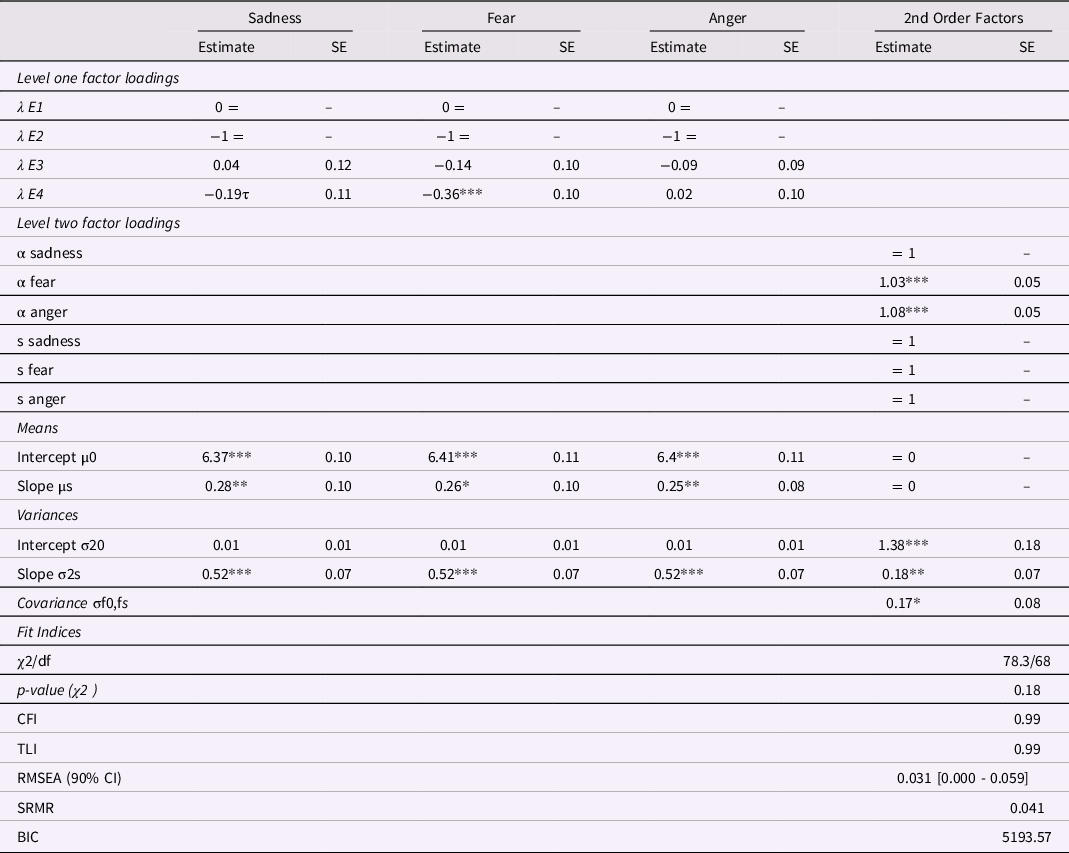
Note: E1, E2, E3, and E4 represent each RSA epoch. τ <.01, *p < .05, **p <.01, ***p <.001
At the first level, the estimated means for intercept and slope were significant for all emotions. The intercept represents the average RSA level during the neutral content in epoch 1. Additionally, the average RSA of the sample at each epoch is equal to the interaction between the mean slope value for each emotion and that epoch’s latent basis coefficient. As seen in Figure 2, across all emotions, children initially suppressed RSA when the emotion was introduced and recovered or came back toward levels of RSA comparable to the starting neutral epoch when the emotion intensified during epoch 3, on average (λ E3sad = .42, p = .716; fear = −0.14, p = .162; anger = −.091, p = .322). During the mild positive resolution in fear (λ E4 = −.36, p = .001) and sadness (λ E4 = −.19, p = .095), children exhibited moderate suppression.
Trajectories of children’s vagal flexibility while watching scenarios of a child experiencing and expressing sadness, fear, and anger. RSA is respiratory sinus arrhythmia. Each epoch lasted 15 seconds. Negative emotions are first presented in E2 and increase in intensity at E3. E1 is a neutral introduction and E4 is a mainly positive resolution.
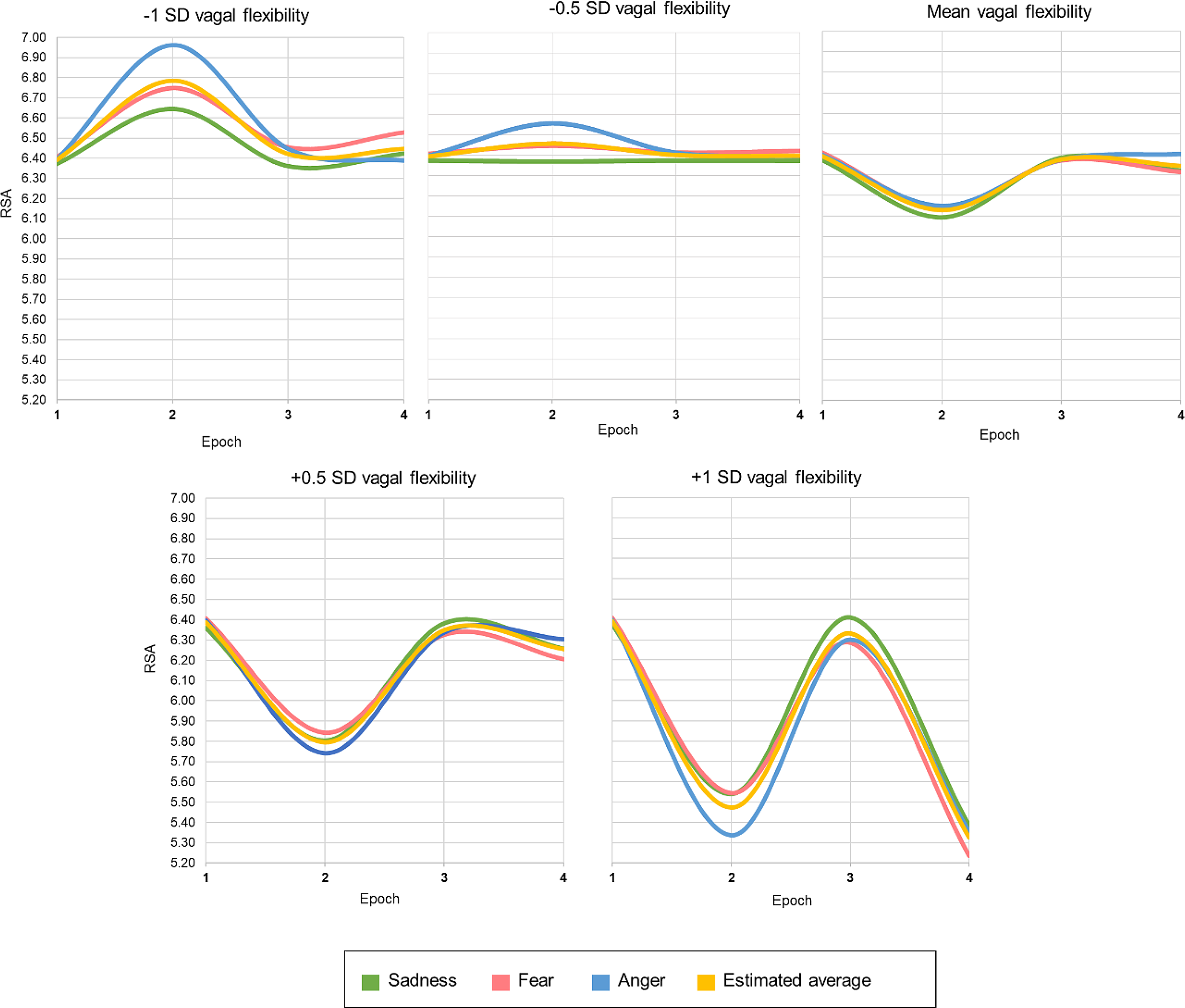
At the second level, significant variances in both the intercepts (σ2 0F = 1.38, p < .001) and the slope (σ2 sF =.18, p = .012) indicated that there were meaningful individual differences in children’s initial RSA levels and patterns of change or VF over the negative emotion-inducing videos. Children with higher values for the latent slope (0.5, 1 SD VF) had a more pronounced pattern of suppression, followed by recovery, and then suppression during the mild positive resolution, whereas children with lower slope coefficients (−0.5, −1 SD VF) had a slightly flatter pattern of augmentation during the emotion introduction, suppression when the emotion intensified and no change during resolution. There was also a statistically significant positive covariation between RSA intercept and slope (σf0, fs = .17, p =.033). This shows that children who had higher RSA during the neutral portions at the beginning of the scenarios (epoch 1) also had greater VF or steeper slopes across the scenarios.
Does VF moderate associations between the home environment and children’s maladjustment?
Descriptive statistics and zero-order correlations for all measures are presented in Table 3. Mothers of boys reported lower SES at T1, t(178) = 2.269, p =.019, and higher IP scores at T1, t(171) = 2.763, p =.006, and T2 t(150) = 3.466, p =.001, compared to mothers of girls. Baseline RSA was positively correlated with both RSA intercept and RSA slope. At T1, children who were older had higher IP scores and greater VF. Authoritarian parenting was positively correlated with low SES at T1 and IP at T1 and T2, and low SES was positively associated with more EP and IP at T1 and T2. IP and EP were positively correlated with each other, and were not significantly different from T1 to T2 (paired sample t-tests, all p >.05). Because of these results, children’s baseline RSA, gender and age at T1 were included as covariates in the following models.
Descriptive statistics and zero-order correlations

Note: N = 180, *p <0.05, **p <0.01 (all tests were two-tailed). SES is a reversed composite of standardized income-to-needs and parental education, higher scores reflect low socioeconomic status.
Model parameters predicting IP and EP at T1 and T2 from home environment risks with RSA slope as the moderating variable are presented in Table 4, and the path model is summarized in Figure 3. No main effects or interactions involving RSA intercept or slope were significantly related to problems at T1. Baseline RSA was not related to IP or EP at T1 or T2. Children who were older or came from homes with lower SES had more EP at T1, and boys and children who came from lower SES households had more IP at T1. This step explained 11% and 13% of the variance in EP and IP at T1, respectively.
Results for path model are standardized. Dotted lines are covariances and solid lines are coefficients and significant at *p <.05, **p <.01, and ***p <.001.
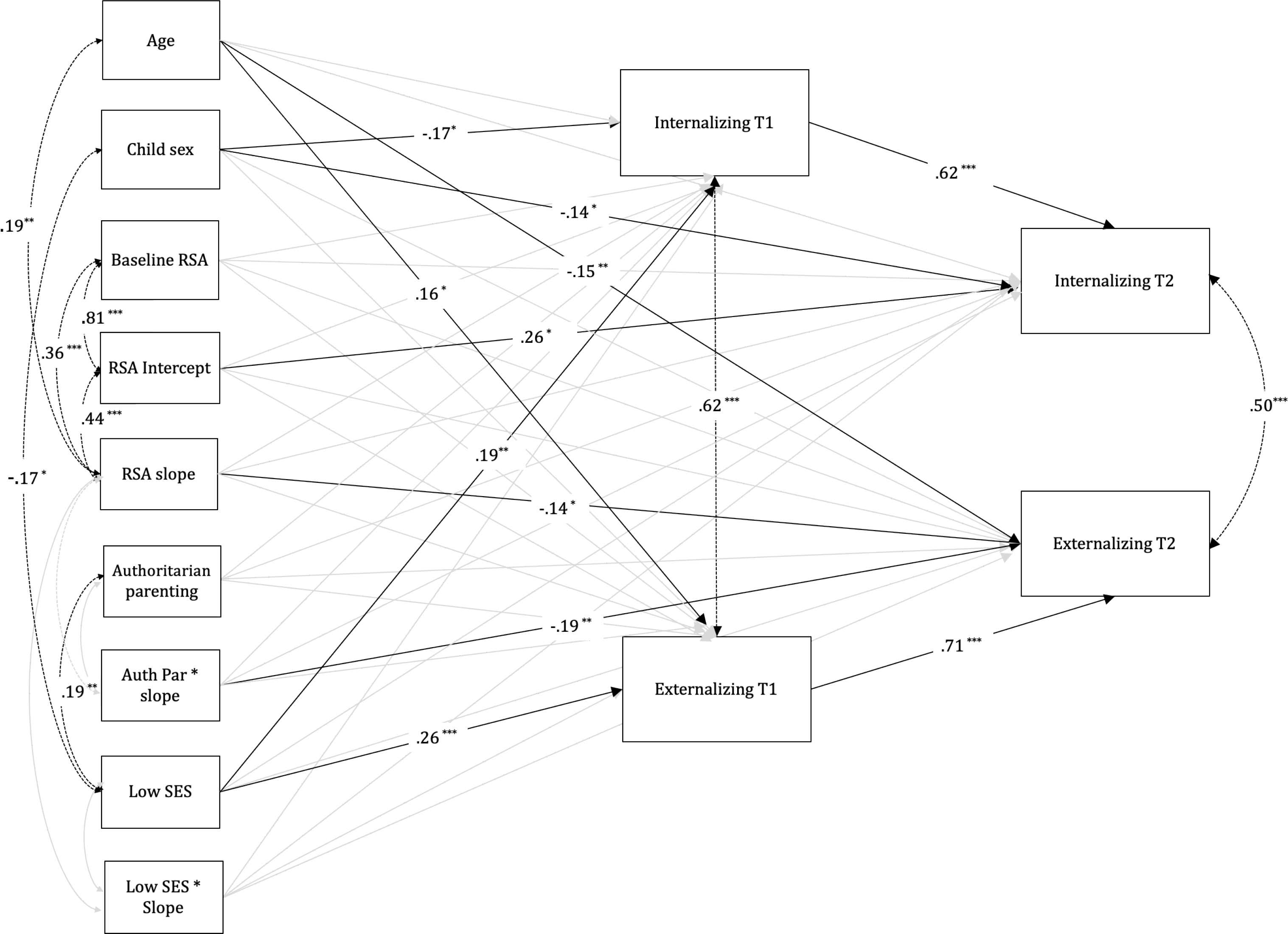
Path coefficients predicting internalizing and externalizing problems with vagal flexibility moderating environmental factors

Note. Significant results are bolded. Model fit χ2/df = 32.644/38, p = 0.72, CFI = 1.00, TLI = 1.02, RMSEA = 0.00 (90% CI 0.00 - 0.04), SRMR = 0.042
RSA intercept was positively associated with IP at T2, such that children who had higher RSA during the introductory epochs of the emotion scenarios had more IP two years later. RSA slope was inversely associated with the development of EP, such that children who had greater VF (steeper non-linear slopes) had fewer EP two years later. This effect was moderated by an interaction between RSA slope and authoritarian parenting. Examining the interaction, a cross-over effect was evident (see Figure 4). Examination of the simple slopes showed that the prediction of T2 EP from T1 authoritarian was positive and significant at low VF (−1 SD, flatter slopes; B = 0.27, p < .001), and negative and approaching significance at high VF (+1 SD, steeper slopes; B = −0.16, p = .06).
Vagal flexibility moderates the prediction of Time 2 externalizing problems from authoritarian parenting. The figure depicts the lower and upper bounds of authoritarian at which the simple slopes for low and high VF project to significantly different EP scores. Shaded regions indicate significance of the predictor (authoritarian scores). Ʈ = 0.06 ***p < 0.001.
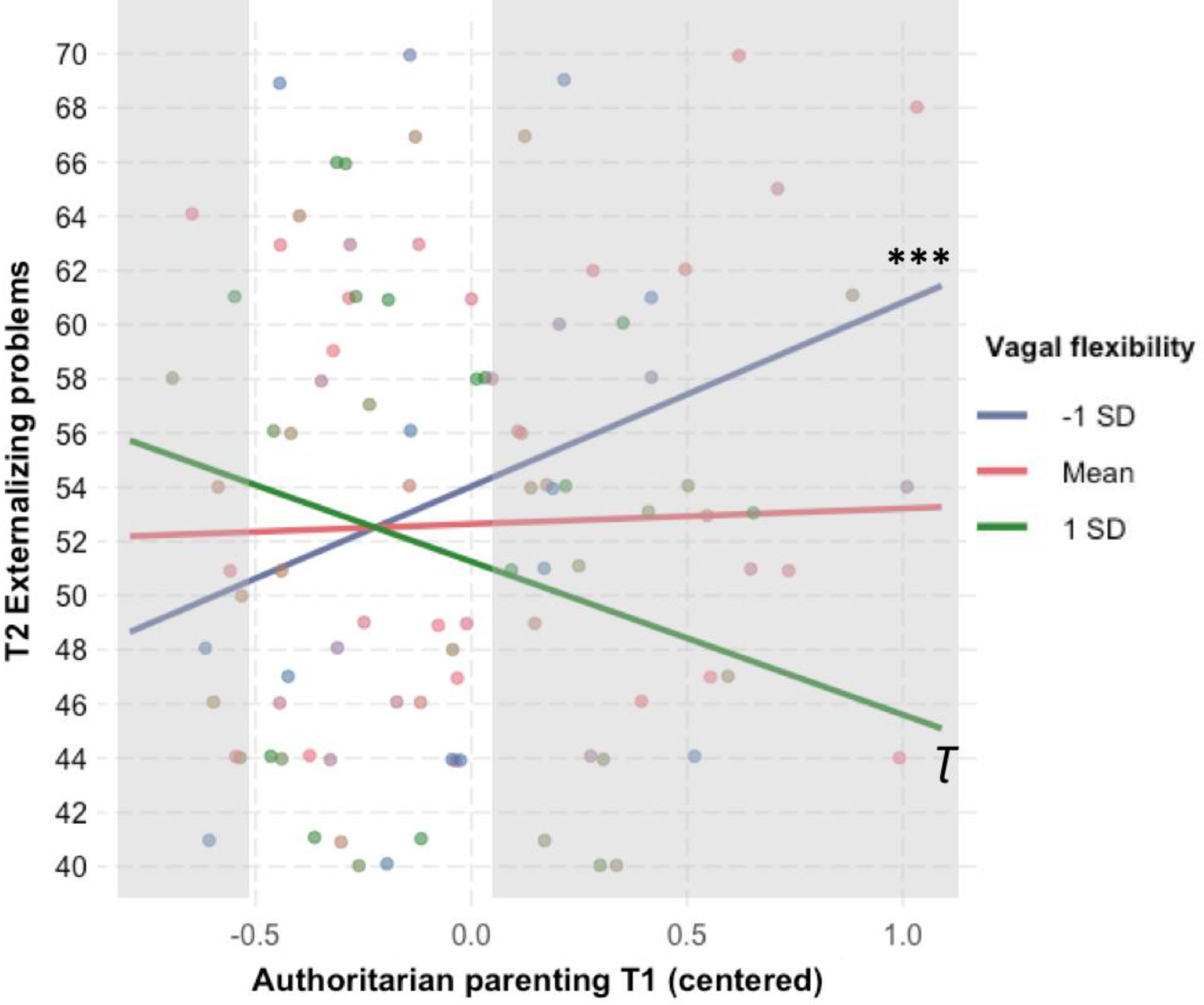
The ROS analysis showed that the positive association between authoritarian parenting and T2 EP for low VF was significant at and below −.22 SD of VF, equivalent to 26.67% of observed data. The negative association between authoritarian parenting and T2 EP for high VF was significant at and above 1.07 SD of VF, equivalent to 10.56% of observed data. The ROS analysis also showed the lower and upper bounds of authoritarian parenting at which the simple slopes for lower and higher VF projected to significantly different values of T2 EP (see Figure 4). The lower bound of authoritarian parenting was −1.59 SD (approximately equal to a score of 1.41, or mothers endorsing a 2, once in a while, for 10 of the 24 authoritarian items), such that children with lower VF had significantly fewer EP at T2 in comparison to children with higher VF when mothers reported very low levels of authoritarian parenting. The upper bound of the RoS analysis was at the mean, such that children with lower VF evidenced significantly more EP at T2 than children with higher VF when mothers reported average or higher levels of authoritarian parenting. Notably, the projected upper value of EP for high VF at low levels of authoritarian parenting was considerably less (T = 56) than the projected upper value of EP for low VF at high levels authoritarian parenting (T = 61.5). Lastly, the PoI was 0.85 within the range of +/−2 SD of authoritarian parenting, which is outside the parameters to support neurobiological susceptibility. Therefore, our cross-over effect suggests that children with lower VF reacted to more authoritarian parenting “for worse” with respect to their development of EP, whereas children with higher VF were buffered against the effects of authoritarian parenting on subsequent EP. There was not robust evidence of a “for better” effect of children with lower VF in contexts of less authoritarian parenting.
Post-hoc analysis
In a follow-up analysis, we tested whether we could replicate these results using static RSA change scores instead of latent intercept and slopes. In the same path model, we replaced the second-order latent slope factor with the arithmetic mean of RSA change score for the three emotion vignettes. RSA change scores were calculated by subtracting the overall RSA for each emotion vignette, computed as a single 60s epoch, from baseline RSA, such that positive RSA change scores represent children who had RSA suppression from baseline to emotion stimuli, whereas children with a negative score experienced RSA augmentation (Obradovic et al., Reference Obradović, Bush and Boyce2011). Paralleling the association of latent RSA intercept predicting IP at T2, children who had greater RSA suppression to the three videos had lower IP at T2 (B = −.16, p = .03). However, the RSA change score was not associated with EP at T2, neither directly nor in interaction with authoritarian parenting, and there were no other direct or moderated associations between RSA change and children’s EP and IP (all p ≥ .124). In addition, age was not significantly associated with RSA change (r = .087, p = .294).
Discussion
Studying the dynamic unfolding of PNS responses to negative emotions may contribute to a more accurate portrayal of how physiology underlies the experience and regulation of emotion, advancing our understanding of biobehavioral development and mental health problems in children. Traditional methods of quantifying physiological reactivity often overlook how children’s reactivity and regulation of negative emotions are non-linear processes that quickly unfold over time. As predicted, our findings indicate that VF can be modeled as a common physiological response to negative emotional stimuli, characterized by a pattern of suppression and then augmentation (or recovery) across social scenarios depicting emotions of sadness, anger, and fear. Further, although biopsychosocial models theorize roles of RSA reactivity as a source of susceptibility or diathesis in the relation between environmental stressors and the development of psychopathology during childhood, results of prior studies have been inconsistent. As predicted, we found that children with lower VF had more EP two years later, and this was particularly true in the context of having a more authoritarian mother. Longitudinally, while lower VF exacerbated the positive relation between more authoritarian parenting and increases in EP during childhood, higher VF buffered this association. We found no evidence that VF made children more susceptible to their environment in a domain-general way, as VF neither moderated associations between SES and problems nor was involved in the prediction of IP. Notably, static RSA change scores did not significantly predict EP. Overall, our results depict a specific association and coordination between parenting, dynamic physiological reactivity, and the development of EP during the transition from early to middle childhood.
Using factor of curves (McArdle & Epstein, Reference McArdle and Epstein1987), we were able to model a higher order, average pattern of children’s dynamic RSA change over the course of sad, fear, and anger inducing clips. This higher order latent factor represents the extent to which dynamic and rapid RSA change shares a similar non-linear growth pattern among these three emotions. In line with previous findings (Cui et al., Reference Cui, Morris, Harrist, Larzelere, Criss and Houltberg2015; Miller et al., Reference Miller, Chocol, Nuselovici, Utendale, Simard and Hastings2013, Reference Miller, Hastings, Narvaez, Braungart-Rieker, Miller-Graff, Gettler and Hastings2016), on average, a pattern of initial RSA suppression during the introduction to each emotion was followed by a rebound in RSA during the intensification of the emotion, ending with modest suppression during the final positive resolution (albeit this was non-significant for anger and trending for sadness). In line with polyvagal theory and the principle of neuroception (Porges, Reference Porges2007; Porges & Furman, Reference Porges and Furman2011), initial RSA withdrawal may indicate an orienting response to the emotional stimuli, possibly in preparation of the potential need to mobilize resources for active coping. The subsequent increase in RSA or RSA recovery may support calming as the context is perceived as safe for engagement. Thus, as stories progressed and the emotions were first introduced and then intensified, on average, children may have initially allocated resources to attend to the negative emotional cues, and then perceived that the events were not personally threatening.
By this interpretation, children with non-linear, rapidly changing PNS regulation of cardiac activity were likely matching their neurophysiological state with the actual contextual demands of the task and stimuli, demonstrating increased VF (Porges, Reference Porges2007). Therefore, this non-linear, temporal approach to RSA reactivity may represent flexible orientation and engagement underlying emotions that rapidly change as individuals attend to salient cues in the environment (Hastings & Kahle, Reference Hastings, Kahle, LoBue, Pérez-Edgar and Buss2019; Miller & Hastings, Reference Miller, Hastings, Laible, Carlo and Padilla-Walker2019). Children with higher VF not only suppressed PNS influence during the introduction but also, to a lesser degree, during the positive resolution at the end of the vignette, indicating further engagement with positive cues. Conversely, children with slightly lower VF had blunted RSA change or mild RSA augmentation to the emotion introduction, which could indicate initial disengagement with the stimuli presented, with late suppression when the emotion intensified. These latter responses represent a possible mismatch of parasympathetic modulation with changing environmental demands, potentially with disadvantageous consequences.
Moreover, similar to findings from Fortunato and colleagues (Reference Fortunato, Gatzke-Kopp and Ram2013), we found consistency of between-person differences in VF, such that children who had lower or higher VF to sadness-inducing clip were also likely to have similar VF levels to fear and anger clips. Thus, VF to negative emotions can be represented by a higher-order factor in line with Rothbart’s model of domain general negative emotionality (Rothbart, Reference Rothbart2007), rather than distinct between-person differences in VF to approach or avoidance motivated emotions (Fox et al., Reference Fox, Kirwan and Reeb-Sutherland2008). Previous research has also documented that VF to anger (approach) and to sadness (avoidance) were correlated with each other but not with happiness (Gatzke-Kopp et al., Reference Gatzke-Kopp, Greenberg and Bierman2015; Hastings et al., Reference Hastings, Kahle and Han2014). Although Fortunato and others (Reference Fortunato, Gatzke-Kopp and Ram2013; Gatzke-Kopp et al., Reference Gatzke-Kopp, Greenberg and Bierman2015) have reported that RSA reactivity to avoidance versus approach emotions is related specifically to IP or EP, respectively, they suggested that reactivity to these two affective dimensions were not orthogonal, but rather “unique profiles of RSA reactivity that could potentially coexist in a single individual” (Fortunato et al., Reference Fortunato, Gatzke-Kopp and Ram2013, p. 247). Thus, even though prior studies have attempted to differentiate affect-specificity of parasympathetic reactivity and regulation, their findings are consistent with our inference that VF to different emotional stimuli may reflect an overarching individual characteristic that children bring into multiple emotional situations. Altogether, children with highly flexible vagal responses engaged and disengaged the vagal brake similarly across different negative emotions. This trait-like capacity for the regulation of emotion possibly shapes how these children react to their environment, and how their relationship partners such as their parents react to them, setting up interactions that promote adaptive and maladaptive adjustment in the transition from early to middle childhood.
Regarding our moderation hypotheses, we found that more authoritarian parenting by mothers at T1 predicted increases in EP from T1 and T2 only for children with lower VF to an emotion induction. Notably, this predictive association held for slightly more than a quarter of the children in our sample. This is consistent with prior studies that used arithmetic or residual change scores for RSA reactivity and found that, when RSA withdrawal was lower or blunted, associations were stronger between maternal rejecting attitudes and EP (Wagner et al., Reference Wagner, Hastings and Rubin2018a) and between interparental conflict and EP (Katz, Reference Katz2007; Obradovic et al., Reference Obradović, Bush and Boyce2011). One possible interpretation for the current findings is that blunted RSA reactivity to negative affective stimuli may reflect an under-aroused autonomic profile, and disengagement with the social and emotional information being presented (Porges, Reference Porges2007). Children with a relatively non-responsive parasympathetic profile to emotional stimuli may experience autonomic under-arousal and thus may be prone to higher sensation seeking, fearlessness, or aggressive behaviors (Raine, Reference Raine2002; Schoorl et al., Reference Schoorl, Van Rijn, De Wied, Van Goozen and Swaab2016). Likewise, this group of children may be less sensitive to the negative emotional state of others and to socioemotional cues for appropriate behavioral responsiveness (Moore et al., Reference Moore, Hubbard, Morrow, Barhight, Lines, Sallee and Hyde2018; Muhtadie et al., Reference Muhtadie, Koslov, Akinola and Mendes2015), exacerbating EP in the context of a parent who is perhaps mirroring or modeling such interpersonal insensitivity by socializing with greater punitiveness, control, and hostility (Eisenberg et al., Reference Eisenberg, Cumberland and Spinrad1998). Altogether, we found that a profile of reduced dynamic parasympathetic response predicts to more EP when coupled with even modest levels of authoritarian parenting.
In contrast to our findings with low VF, maternal authoritarian parenting tended to predict decreases in EP over time for children with higher VF, such that the lowest projected EP scores were for children with higher VF and more authoritarian mothers. Prior research has found that VF to anger stimuli is positively associated with children’s and adolescents’ control and regulation of aggression and anger (Cui et al., Reference Cui, Morris, Harrist, Larzelere, Criss and Houltberg2015; Miller et al., Reference Miller, Chocol, Nuselovici, Utendale, Simard and Hastings2013), and VF to sadness is positively associated with empathy (Miller et al., Reference Miller, Hastings, Narvaez, Braungart-Rieker, Miller-Graff, Gettler and Hastings2016). Under the premise that higher VF confers greater capacity for effective engagement with and regulation of emotion, it is possible that children with higher VF are particularly likely to be attentive to potentially emotionally charged interpersonal exchanges with their parents, but also able to maintain a calmer, more regulated state during such interactions, potentially buffering the consequences of authoritarian parenting. Moreover, considering a child evocative effects perspective, children’s temperament or trait-like characteristics evoke and affect parental attitudes and behaviors (Lengua & Kovacs, Reference Lengua and Kovacs2005; Wittig & Rodriguez, Reference Wittig and Rodriguez2019). It is possible that mothers who reported strict and authoritarian attitudes may have viewed their children with greater VF as particularly well-behaved, given their emotionally calm and well-regulated responses, and therefore reported few EP over time for these children (Hastings & Rubin, Reference Hastings and Rubin1999; Kochanska, Reference Kochanska1990). This may be particularly likely given that maternal reports were used to assess both parenting and children’s EP; it will be important for future research to evaluate this biopsychosocial pattern using independent sources of data.
The PoI analysis suggested the interaction of VF and authoritarian parenting predicting the development of EP was not within the parameters of neurobiological susceptibility to context models (Del Giudice, Reference Del Giudice2017). Children with less flexible RSA change to negative emotions were vulnerable to developing more EP when their primary caregivers were moderately to highly authoritarian but, when they had less authoritarian mothers, they did not develop meaningfully fewer problems than children with average or higher VF. Moreover, the significant association of authoritarian parenting with EP for children with higher VF, resulting in a full cross-over effect, was not consistent with either a neurobiological sensitivity to context or a diathesis-stress model. Overall, children with higher VF evidenced modestly more EP when mothers reported very little authoritarian parenting, but notably, the estimated range of EP for children with higher VF fell within normative population parameters (T < 56). Thus, mothers who had not endorsed authoritarian parenting reported more EP in children with higher VF than in children with lower VF, but not to a clinically meaningful degree. It was only in the context of average and higher levels of authoritarian parenting that children started to exhibit more concerning levels of EP, and that was only evident for children with lower VF. Possibly, this pattern could be seen as conforming to the goodness-of-fit model, such that healthy development is a result of an adequate match between children’s needs and dispositional characteristics and their parenting contexts (Wachs & Gandour, Reference Wachs and Gandour1983, Thomas et al., Reference Thomas, Chess and Birch1968).
Given that we found VF moderated associations between parenting and adjustment but not between SES and adjustment (see also Conradt et al., Reference Conradt, Beauchaine, Abar, Lagasse, Shankaran, Bada, Bauer, Whitaker, Hammond and Lester2016), and that the moderation effect predicted EP but not IP (Li et al., Reference Li, Sturge-Apple, Martin and Davies2019; Obradović et al., Reference Obradović, Bush and Boyce2011), our findings suggest domain specificity for VF with respect to both context and functioning. Regarding context, we measured parasympathetic regulation in response to three emotional scenes of a child with their parent. Considering that PNS functioning is context-dependent (Obradović et al., Reference Obradović, Bush and Boyce2011; Zeytinoglu et al., Reference Zeytinoglu, Calkins and Leerkes2019), it is possible that parasympathetic regulation of induced emotion in response to such scenarios pertained most strongly to how children react to their interpersonal relationships, and less so aspects of their general life context like SES. In effect, PNS reactivity may be dually context-specific, both to the life context in which children are developing and to the nature of the stimuli children to which are reacting (Obradović et al., Reference Obradović, Bush and Boyce2011). Considering domain specificity of functioning, our finding could be seen as consistent with recent evidence for stronger links between RSA reactivity and EP than with IP (Beauchaine et al., Reference Beauchaine, Bell, Knapton, McDonough-Caplan, Shader and Zisner2019). Possibly, contexts of authoritarian parenting may make parasympathetic regulation of emotion particularly salient for control of anger and disruptive behavior. Conversely, it is important to recognize that these children were intentionally over-sampled for elevated EP; 47.8% of children had subclinical or higher levels of EP at recruitment (T ≥ 60). As is common in children, EP and IP were highly comorbid, but it is unclear whether the same findings would emerge in at-risk or clinical samples with IP, anxiety or depression, or in general community samples.
A few emergent findings that were not predicted also warrant attention. Higher RSA intercept predicted increased IP at T2. Lest this be seen as inconsistent with the frequent association of higher baseline RSA with fewer IP (Forbes et al., Reference Forbes, Fox, Cohn, Galles and Kovacs2006; Schmitz et al., Reference Schmitz, Kreamer, Tuschen-Caffier, Heinrichs and Blechert2011), it is important to recognize that RSA intercept was not a baseline measure; it was RSA during the first 15s when the scenarios were introduced with a mildly positive tone. Baseline RSA was measured, and it was higher (6.84) than RSA in the introductory epochs of the scenarios (6.31 – 6.36), such that overall there was RSA withdrawal from baseline to the emotion induction task. Further, baseline RSA was included in the model and allowed to covary with RSA intercept. Thus, higher RSA intercept can be interpreted as less RSA withdrawal, or RSA augmentation, during the start of emotion inductions, such that its relation with IP is consistent with some meta-analyses and studies associating weaker RSA withdrawal to elevated IP (Buss et al., Reference Buss, Davis, Ram and Coccia2018; El-Sheikh et al., Reference El-Sheikh, Keiley, Erath and Dyer2013; Graziano & Derefinko, Reference Graziano and Derefinko2013). Congruently, a similar association was replicated using static change scores, such that greater RSA suppression from baseline to emotion stimuli was associated with lower IP at T2. Moderate RSA withdrawal supports an active orientation response which would be normative and adaptive in the context of a mildly positive story introduction (Hastings & Kahle, Reference Hastings, Kahle, LoBue, Pérez-Edgar and Buss2019). Weaker RSA withdrawal or RSA augmentation may have reflected a failure to engage or attend to, or even active disengagement from, the emotional task.
Additionally, we found a significant positive association between children’s age at T1, which ranged from 4 to 6 years, and their dynamic RSA change to negative emotions. Although static change scores of RSA reactivity have been found to decrease with age (Calkins & Keane, Reference Calkins and Keane2004), Dollar et al. (Reference Dollar, Calkins, Berry, Perry, Keane, Shanahan and Wideman2020) recently reported that RSA reactivity increased across assessments at 4 and 5 years. Further, it is well-documented that children’s emotion regulation capacities increase from preschool to early elementary school-age (Blair & Raver, Reference Blair and Raver2015; Herndon et al., Reference Herndon, Bailey, Shewark, Denham and Bassett2013). As we have proposed that VF reflects parasympathetic contribution to effective emotion regulation, these developmental patterns could be seen as convergent. Relatedly, and in accordance with other studies capturing developmental decreases in EP around preschool age (Olson et al., Reference Olson, Choe and Sameroff2017), older children in this study also had fewer EP at T1 and T2. Future studies could explore whether increased emotion regulation capacities over development, in part indexed by greater VF, potentially contribute to age-related differences in EP.
Finally, children who lived in homes with lower SES had more EP and IP, concurrently at T1. This finding is not surprising considering the large body of work supporting this association (Korous et al., Reference Korous, Causadias, Bradley and Luthar2018; Peverill et al., Reference Peverill, Dirks, Narvaja, Herts, Comer and McLaughlin2021) and cash transfer experiments that document the causal effect of economic resources on the development of mental health (Fernald et al., Reference Fernald, Gertler, Hidrobo, Maholmes and King2012). According to the Family Stress Model (Conger & Conger, Reference Conger and Conger2002), economic pressures affect children via parental distress, poorer interparental relationships, and harsher parent-child interactions. Consistent with this, mothers in this sample who reported lower household SES also reported more authoritarian parenting. Low SES also has been shown to increase EP and IP through fewer opportunities for cognitive stimulation, enriched schooling, access to adequate healthcare and housing, and living in safer neighborhoods (Yoshikawa et al., Reference Yoshikawa, Aber and Beardslee2012). Thus, it is possible that other unmeasured factors besides parenting contributed to the association between SES and adjustment found in this study.
Limitations and conclusions
The results of this study should be interpreted in the context of certain limitations. Our sample of participants was not recruited to be representative of the broader population. Instead, this study design intentionally oversampled for EP during early and middle childhood, therefore our results may not extend to other populations and warrant future replication with community samples. RoS analyses assume normality in the distribution of predictors, which was not the case for mother’s endorsement of authoritarian practices. However, including percentages of observed data in each region provide transparency and clarify the inferences we can make out of our data (McCabe et al., Reference McCabe, Kim and King2018). Mothers reported on both their endorsement of authoritarian behaviors and their children’s problem behaviors, which would be expected to strengthen their association due to shared-method variance (Rowe & Kandel, Reference Rowe and Kandel1997). However, there were not significant direct associations between authoritarian parenting and either EP or IP, and the interaction effect showed that predictive associations between authoritarian parenting and subsequent EP were both positive (at lower VF) and negative (at higher VF). This is consistent with arguments that, even after considering shared-method variance, maternal reports still inform about children’s maladjustment (Müller et al., Reference Müller, Romer and Achtergarde2014; Rowe & Kandel, Reference Rowe and Kandel1997). Yet, it would be advisable for future research to include multi-informant raters of children’s behaviors to better capture children’s EP and IP development. Concerning RSA measurement, respiration was not assessed directly for each participant, although there is debate whether this is necessary (Shader et al., Reference Shader, Gatzke-Kopp, Crowell, Jamila Reid, Thayer, Vasey, Webster-Stratton, Bell and Beauchaine2018). However, one of the strengths of this study was that our negative emotion induction required no participant movement or vocalization, issues that could affect the precision of RSA assessment (Beauchaine et al., Reference Beauchaine, Bell, Knapton, McDonough-Caplan, Shader and Zisner2019). In addition, there could be other possible patterns that could account for the variance in RSA slope (i.e., a linear decrease with RSA suppression with no recovery). These patterns could be differently associated with maladjustment, and future research should extend on multivariate models to parse these differences across participants.
It should be noted that this study only examined between-person differences and how children’s slopes varied in magnitude in comparison to each other. Examining within-person differences (i.e., how children change in comparison to themselves) may add to our knowledge on the nature of children’s physiological regulation (Gatzke-Kopp & Ram, Reference Gatzke-Kopp and Ram2018). Autonomic regulation of emotion is a multisystem process, and future research should recognize dynamic changes in sympathetic influences as well as parasympathetic responses to emotions. Finally, it is unclear whether VF (and its moderating effects) may extend to negative events other than passive emotional video stimuli. It is fundamental that the field takes into account how different stimuli (i.e., emotional, cognitive challenge) may demand different patterns of physiological responses that may or may not relate to maladjustment (Beauchaine, Reference Beauchaine2015a). Future research should examine VF in different active emotional contexts, such as a frustration, emotion recall, or social exclusion task, which could be a more accurate portrayal of children’s day-to-day emotional lives. Finally, to our knowledge, this is the first study to use FOCUS model to capture a latent, non-linear factor of RSA changes to discrete, rapid emotions. Current work is also examining other complex, non-linear measures thought to reflect flexible PNS responses, particularly across longer tasks with multiple data points. These include cardiac fractility, the optimal temporal variability of the heart rate variability series, and cardiac entropy, or the randomness of the series (Berry et al., Reference Berry, Palmer, Distefano and Masten2019). More such research is needed to integrate and understand the complex nature of the physiology of emotion regulation.
The present findings have important implications for the links between parenting, parasympathetic regulation, and children’s mental health. Children with blunted VF, or dynamic RSA change that does not match the needs of the proximal stimuli, may be at heightened risk for EP when raised by parents with authoritarian practices. Using physiological assessments in tandem with contextual and behavioral evaluations may help identify at-risk children during early childhood before persistent patterns of problem behaviors are established (Beauchaine et al., Reference Beauchaine, Neuhaus, Brenner and Gatzke-Kopp2008). Yet, the incorporation of neurobiological measures needs to be informed by careful scientific study of what and how biological activity should be measured and quantified, and using more fine-grained temporal approaches may provide a more detailed account of children’s physiological regulation of emotion (Beauchaine & Bell, Reference Beauchaine, Bell, Beauchaine and Crowell2020; Hastings & Kahle, Reference Hastings, Kahle, LoBue, Pérez-Edgar and Buss2019). Adequately evaluating each individual’s parasympathetic response may aid our understanding of how children are appraising and engaging with emotionally salient situations, with different consequences for both the type and content of interventions (Glenn et al., Reference Glenn, Lochman, Dishion, Powell, Boxmeyer, Kassing, Qu and Romero2019). Taken together, this study presents novel evidence about the unique contribution of non-linear unfolding of trait-level PNS reactivity to negative emotion stimuli, as well as the potential associations of VF in combination with children’s experiences within their home environment with the development of IP and EP. Our results underscore that VF is context specific with regard to the relation between parenting and the etiology of children’s EP, and it provides information static change scores do not capture, highlighting how the contribution of dynamic PNS regulation is more complex than what broad biopsychosocial models may imply.
Acknowledgments
We would like to thank the participating families, the members of the Affective and Behavioural Competence Development Lab at Concordia University, Nathaniel Spilkin, the members of the Healthy Emotions, Relationships and Development Lab at University of California, Davis, and the Chilean National Agency for Research and Development (ANID) Doctoral Fellowship program.
Author contributions
Elisa Ugarte: Conceptualization, Methodology, Data curation, Formal Analysis, Visualization, Writing-original draft, Writing - review & editing. Jonas Miller: Conceptualization, Data curation, Methodology, Writing – review & editing. David G. Weissman: Methodology, Writing – review & editing. Paul Hastings: Conceptualization, Methodology, Data curation, Formal Analysis, Writing – review & editing, Supervision, Project administration, Funding acquisition.
Funding statement
This research was supported by Canadian Institutes of Health Research (Grant MOP-67117 to Paul D. Hastings. Elisa Ugarte was supported by ANID Doctoral Fellowship program; Grant 72180409 for the writing of this paper.
Conflicts of interest
None.
Ethical standards
This study was reviewed and approved by the IRB of Concordia University, Montreal.


 Open access

