


Introduction
Mutual support among residents in collaborative forms of housing presents an alternative or complementary care model to informal family care and formal social care provision delivered within individuals’ own homes or specialised housing with care facilities for older people. This is particularly the case in cohousing – an ‘intentional’ community-led housing model where residents have a commitment to mutuality and autonomy through self-governance (see Field Reference Field2004) – which has been posited as a basis for creating more socially engaged neighbourhoods (Fernández Arrigoitia and West Reference Fernández Arrigoitia and West2021; Hagbert et al., Reference Hagbert, Holt Larsen, Thörn and Wasshede2020; Ruiu Reference Ruiu2016; Tummers Reference Tummers2016) and acting as a counter to social isolation and loneliness (Hudson et al. Reference Hudson, Scanlon, Udagawa, Fernández Arrigoitia, Ferreri and West2021; Izuhara et al. Reference Izuhara, West, Hudson, Fernández Arrigoitia and Scanlon2022). Cohousing is designed to offer a balance of privacy and community, comprising individual homes but also shared activities and spaces including a common house and shared meals. Communities are ideally between 12 and 36 households and aim to constitute a single small neighbourhood while being inclusive of the wider community (McCamant and Durrett Reference McCamant and Durrett1994). Most crucially, cohousing’s resident-members are the decision-makers about their community through a process of consensus (Beck Reference Beck2020; Krokfors Reference Krokfors2012).
It is inevitable that ageing processes take place in cohousing, both as lifecourse transitions of individual residents and as a whole community. Cohousing – in particular, ‘senior cohousing’, which is designed for residents aged 50+ – has been promoted as a good environment in which residents might age better (Brenton Reference Brenton2013; Durrett Reference Durrett2009; Glass Reference Glass2009). In this context, Glass and Vander Plaats (Reference Glass and Vander Plaats2013) argue that the senior cohousing model not only encourages mutual support among its residents but also fosters an increased acceptance of ageing and significantly lessens social isolation, loneliness and anxiety. At the same time, senior cohousing is expressly not proposed as a replacement for the formal health and social care systems in England (Brenton Reference Brenton2008, Reference Brenton2013). Instead, its potential benefits are framed as a way for older people to collectively maintain greater agency in later life, and as a way of coping with age-related health decline (Brenton Reference Brenton1998).
Despite a growing body of literature on ageing and mutual support within collaborative housing communities, to date there has been little research which has explored how transitions that become more likely in later life, including bereavement, physical and cognitive impairment, and increased dependency, are experienced, negotiated and managed among residents of such schemes. One of the aims of this article is thus to theorise the role of collaborative housing communities in mitigating and supporting later-life transitions to greater care need. In doing so, we acknowledge that level of disability, health or care need should not be conflated with ageing; rather, our aim was to identify specific instances in which older members of a community experienced an increased level of social and health-care need and how, in turn, communities responded.
Drawing on case studies of different collaborative housing communities in England over two years between 2021 and 2023, this article will focus on three cohousing communities to examine: (1) how the communities respond to and manage the changing health and social care needs of their residents; and (2) to what extent mutual support within the communities helps the residents maintain a sense of autonomy, continuity and inclusion in community life despite the challenges. The aim of theoretical contribution is twofold: (1) to bring new insight to debates in social gerontology on age and stage-based expectations of later life (Grenier Reference Grenier2012; Grenier et al. Reference Grenier, Lloyd and Phillipson2017); and (2) to inform wider policy debates around alternative housing models and care innovation in current market-driven welfare systems.
Transitions in later life and the role of intermediaries
Later-life transitions and agency
Our interest in this article is in the role that housing communities play in supporting later-life transitions, especially where that involves a decline in physical health leading to a higher need for care and support. Some social gerontologists have spoken of this transition in terms of a distinction between a ‘third age’ of a prolonged period of active, healthy and productive retirement (Gilleard and Higgs Reference Gilleard and Higgs2000; Laslett Reference Laslett1991) and a ‘fourth age’ that is characterised by frailty, decline, dependency and a loss of agency due to impairment, illness, limited mobility or mental capacity. In Gilleard and Higgs’ (Reference Gilleard and Higgs2010, Reference Gilleard and Higgs2000) and Higgs and Gilleard’s (Reference Higgs and Gilleard2015) formulation, the fourth age is not so much a stage of life as a ‘social imaginary’, bound up with fears of sequestration and dehumanisation in institutions of care, that casts a pall over the later life. However, critics argue that while the fourth age may be the dominant social imaginary, the efforts of social gerontological research ought to lay the emphasis on better understanding ‘people’s experiences of health problems, disability, and increasing dependency on others as we age’ (Reference Lloyd, Twigg and MartinLloyd forthcoming; Wahl and Ehni Reference Wahl and Ehni2020). Grenier’s (Reference Grenier2012) work, drawing on Holstein and Gubrium (Reference Holstein and Gubrium2007), is emblematic of this thinking. She argues, in particular, for interpretive approaches to research that take greater account of personal frames of meanings, significance and expectations rather than dominant interpretations based on age or life stage.
Grenier’s (Reference Grenier2012) own research has highlighted the will to seek continuity of identity in later life and has drawn attention to the fluidity of experiences of continuity and change in later-life transitions. It has also highlighted a fluctuating sense of independence over the lifecourse. What is key to these conceptualisations of transitions in later life is a move away from ‘age and chronology’ and ‘fixed ages and stages’ to a greater emphasis on the intersection of social expectations and institutions with personal meanings, experience and circumstance. It is also increasingly understood that health status matters more in later life than chronological age (Petrová Kafková Reference Petrová Kafková2016). Grenier’s work in particular invites a more expansive notion of agency than simply active agency to consider the agency associated with maintaining a sense of continuity of identity and belonging and the role of supportive actors in enabling the small acts of agency that can bolster a sense of wellbeing even in the face of corporeal challenges (see also Kiuru and Valokivi Reference Kiuru and Valokivi2022 on this point).
Critical gerontology’s challenge to this – reconceptualising and differently interpreting a fourth age as being more agentic than assumed (Grenier and Phillipson Reference Grenier, Phillipson, Baars, Dohmen, Grenier and Phillipson2013) – is highly relevant to our study of cohousing, where shared activity and community life lead potentially to a degree of mutual support and understanding that blurs the boundary between agency and dependency. Those living in cohousing have made active decisions to live differently and, for some of them, to age differently with a commitment to mutuality and solidarity. A question arises of how the community responds to individual ageing when that individual might no longer be able to meet earlier expectations of community participation and mutuality, in physical terms at least. What particularly interests us is the role that residents play as intermediaries for other residents who are in the process of transition.
The role of intermediaries
Intermediaries are individuals or organisations that act as a link between people and facilitate communications and agreements, which may lead to actions and outcomes. In the social care context, it may be a professional based in a primary care, community or voluntary organisation, who plays a role in connecting individuals with appropriate services to improve the health and wellbeing of people in need (O’Grady et al. Reference O’Grady, Barrett, Broderick and Connolly2022). Family members, friends or others who give informal support may also play the role of intermediary.
Groups and individuals acting as intermediaries often have a close understanding of each other’s changing needs. In the context of crisis management, for example, Nero and colleagues (Reference Nero, Orru, Nævestad, Olson, Schobert, Windsheimer, Keränen, Jukarainen and Kajganovic2023) demonstrate the benefits of the role of care organisations who represent the needs and capabilities of vulnerable people as intermediaries between their clients and authorities such as local governments. This process goes two ways in that the intermediary organisations advocate for their clients’ needs to the authorities to adopt crisis measures (bottom-up), but also communicate official information regarding risks and government rules down to clients (top-down) (Nero et al. Reference Nero, Orru, Nævestad, Olson, Schobert, Windsheimer, Keränen, Jukarainen and Kajganovic2023). Established trust and relationships are key for this ‘go-between’ role to be successful. Yet, even in advanced welfare systems, family members such as spouses, partners and adult children are often expected to take responsibility when their family members experience the transition into impairment and decline. Bragstad et al. (Reference Bragstad, Kirkevold and Foss2014) argue in a Norwegian context that families act as an intermediary between their vulnerable relatives and social care services, to influence decision-making at significant events such as hospital discharge. In this context, intermediaries take the role of active participants on behalf of people experiencing transitions in later life.
Given that these intermediary roles are based on trust, which was established through long-term relationships, it is not surprising that such roles also arise in cohousing communities with their commitment to mutual support, shared values and solidarity. While formal paid care workers, external agencies or even families situate care as separate from ‘normal life’, the support of intermediaries in cohousing might be motivated by a will to continue to include and maintain participation and, in turn, may be more conducive to the fluid understandings of transitions in terms of the maintenance of identity framed by authors such as Grenier (Reference Grenier2012). The intentional nature of cohousing communities around the commitment to mutuality indeed reinforces the potential of their intermediary roles.
Research methods and case studies
Longitudinal qualitative research
Our longitudinal research explored innovative care practices across six collaborative housing communities in England over a period between 2021 and 2023. We conducted two waves of fieldwork in each community with an 8–12 month interval between the first (summer/autumn 2021) and the second (autumn 2022) to observe changes, capture specific care-related incidents and follow individual and community responses. We used qualitative methods of inquiry, which included in each community in each wave: (1) six in-depth individual interviews with older residents with health and care needs; (2) a focus-group interview with six to eight residents (who were not individual informants); and (3) interviews with those in supporting roles within communities. Participant observation was also undertaken around these visits, with researchers involving themselves where possible in the everyday shared lives of communities such as time spent informally in the common room. Using a topic guide and vignettes, the focus-group interviews explored the attitudes and behaviours of residents regarding existing mutual support provision, and the benefits and challenges of growing older in the community. On the other hand, individual interviews generally focused on members’ lived experiences of changing care needs, formal and informal care arrangements, past and present mutual support practices, and friends and family relationships. Our analysis, especially around the transition examples that form the focus of this article, draws on multiple accounts from focus groups, individual interviews and participant observation.
Focus-group interviews took on average 90 minutes, while individual interviews lasted typically around 60 minutes. All were digitally recorded with the informants’ consent and were fully transcribed for thematic analysis. Fieldwork notes and transcripts from all the interviews were organised and analysed using NVivo12, which allowed us to carefully examine the various participants and timelines involved in the specific care events described in the analysis. The research followed the research ethics guidelines of the authors’ institution and pseudonymised the names of the informants and their housing communities. Ethical approval was given by the National Health Service Authority Social Research Ethics Committee.
The cohousing case studies
‘Collaborative housing’ is a broad term for a range of self-managed and community-orientated housing including cohousing, housing cooperatives, self-build initiatives and community land trusts (Czischke et al. Reference Czischke, Carriou and Lang2020). As such they represent a form of housing that is distinct from fully independent living in mainstream housing and specialist forms of housing with care, the two dominant forms of housing in which older people give and receive care in later life. The research included six collaborative housing cases in total: three cohousing communities and three ‘other’ (non-cohousing) schemes (a housing cooperative for older people and two self-managed retirement schemes, one of which was comparable to an extra care home). All three of these ‘other’ schemes had built-in services such as wardens. However, while the aim of the wider research project was to explore how different models of collaborative housing meet the changing care needs of older residents, this article focuses on mutual support practices and the intermediary networks within the three cohousing communities as we found such practices distinctive compared with the schemes with paid staff.
In terms of case study selections, the choice of established cohousing communities is limited (currently approximately 40 established schemes, albeit with many more at some stage of development) in England (UK Cohousing Network 2023). However, the long-term familiarity and networks of the authors with communities (and the support of the UK Cohousing Network) enabled us to select and approach suitable communities for the fieldwork. While we selected communities with as many older members as possible, only one cohousing project is explicitly for older residents aged 50+. The residents of cohousing were predominantly white, middle-class and highly educated homeowners with the exception of some social renters at Hazel Lane. This represents the current demographic of cohousing in the UK (Arbell Reference Arbell2022). Beyond this, the selected three cohousing communities represent many different attributes on the wide spectrum of examples that make up cohousing (see Table 1 for summary description).
Summary of case study cohousing communities
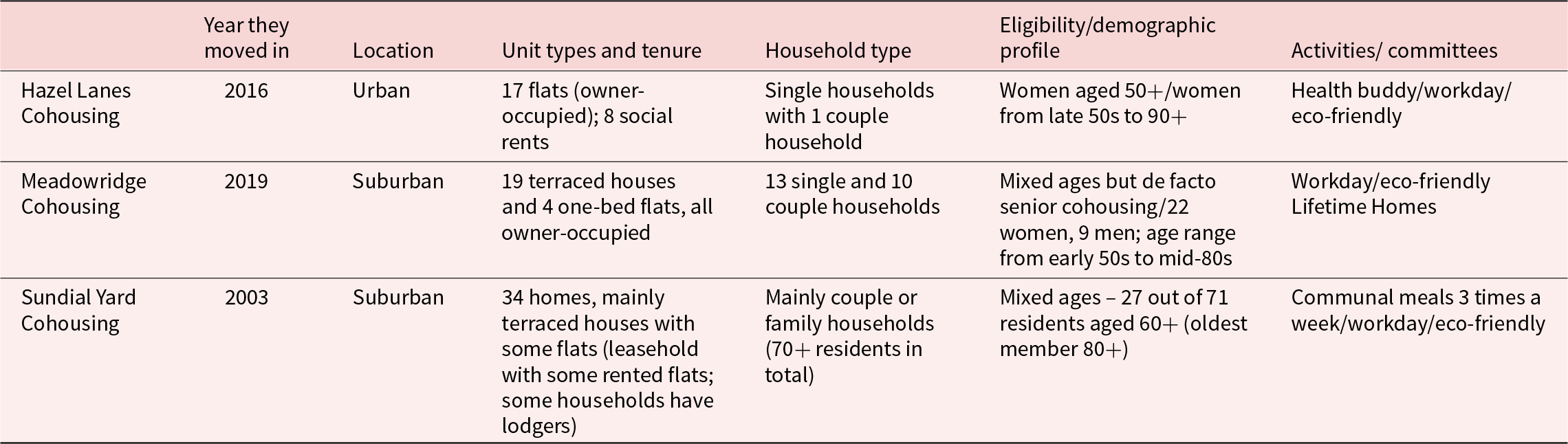
During our fieldwork period and immediately before and after that, all three communities experienced multiple instances where individual residents had a rapid increase in care need usually triggered by a specific health event, sometimes leading to chronic health conditions or death.
Community practices of mutual support
At all three communities, we found that the residents regard a range of mutual support provision and social activities, both organised and informal, as part of the commitment to a general sense of ‘good neighbourliness’. Indeed, key actors in the cohousing movement often refer to the model as ‘intentional neighbourhoods’ that straddle community-level organisation and governance alongside more spontaneous and sub-group-level acts of neighbourly support. It is these overlapping levels of broader support that, while not considered to be a part of ‘social care’, help to build and maintain the social bonds within communities that in turn enable the kinds of mutual support focused on in this article, and which chime with other studies of ageing in cohousing (Glass Reference Glass2016).
Mutual support among residents was often practical and individual-based, including providing lifts, fetching shopping and prescriptions, and meal preparation during short periods of illness. In addition, there was a more formalised system of supporting each other and sharing personal information called ‘health buddies’ at Hazel Lanes, which was set up during the Covid-19 pandemic:
So two or three of us will be in a group that actually look out for each other … We’ve exchanged phone numbers of relatives just amongst the three of us, for instance, in my case. And we check that we’re up and alive each day, really! I mean, I’ve got a blind in my kitchen window and one of my buddies lives next door and she knows that if it is not up a bit – I don’t have it right up – but if it’s still down at 10:00am, she knows to give us a knock whatever. (Focus-group participant, Hazel Lanes Cohousing)
The buddies have keys for each other’s front doors and have given each other permission to go into their flat. Although not part of community policy, some members in the other communities informally had similar arrangements in place.
In line with the transition literature (Grenier Reference Grenier2012), residents may have varied interpretations and expectations of mutual support around changing care needs. In contrast with other aspects of community management, which tended to be based on a set of agreed principles and written policies, the limits of mutual support were often implicit, or had gone largely undiscussed, without a policy or guideline. It had, however, been an emerging topic focused on by each community in recent years, with Sundial Yard forming a special interest group on ‘Growing Older Gracefully’. In all three communities, such discussion was further prompted by the intervention of the researchers through the focus groups. Common expectations voiced by some informants were that mutual support remained at the level of companionship and ‘practical support’ not extending to ‘personal care’:
I think it’s that point at which someone is beginning to not cope at home, which is the hardest thing. We, in no way, are set up to rescue each other. We won’t do personal care. We won’t put on your hearing aids, we won’t change your bedsheets. But we will look after your cat if you go on holiday, we will do shopping if you’re ill. And if it’s time for somebody to go and be looked after more intensively, then I’m afraid that has to happen. (Celia, Sundial Yard Cohousing)
I think when I first started looking into Hazel Lanes, I kind of made sure that I would not be ‘expected’ to bathe people or you know, there was a limit to what I would be expected to do. So, although you [are] in effect saying, isn’t it, you ‘look out’ for each other but you don’t ‘look after’ people because I couldn’t do that. (Focus-group participant, Hazel Lanes Cohousing)
This point about ‘looking out’ for your neighbour but not ‘looking after’ appeared to be an important mantra, the meaning of which was interpreted by the Hazel Lanes informant as ‘not coming in every day or bathing or whatever it might be needed’. The boundary of mutual support is, however, often ambiguous. The above informant at Sundial Yard indeed described contested interpretations around the level of responsibility and sense of obligation regarding mutual support, given the commitment and shared values of mutuality in cohousing.
For the communities, especially at the older women-only cohousing, there was the promotion of a ‘preventative health and wellbeing’ approach, derived from the understanding of mutual support acting as a ‘buffer’. There was a philosophy held by many residents of ‘living well together’ to prevent the need for formal care, if possible:
If I were living in [the town] all on my own, I would be involved in one or two more associations. There would come a moment where I would not want to be involved or I would not want to be active, I would be very passive. I would grow to be more and more passive. What cohousing is doing is preventing me to be passive, I cannot only be receptive of services from my cohousing, I have to find a place where I still give services to my cohousing. It’s a different relationship. (Sophie, Meadowridge Cohousing)
It was striking that, in practice, mutual support in times of ill health or at the end of life often went much further than had been ‘expected’, exceeding the boundary of mutual obligation in each of the communities. Such care – usually unplanned and often by a small number of other residents within the community – was one of the key findings, and one which validated the longitudinal approach to doing the fieldwork. Some incidents were recounted after the event, but others unfolded during the fieldwork, allowing the researchers to interrogate the events and the changing attitudes and practices of the community in detail.
Care transition examples
The research identified several cases – at least one in each community – which allowed us to examine how transitions to greater care needs were negotiated within those communities. Such situations stemmed either from a worsening chronic condition or from the diagnosis of a terminal illness. However, the responses also varied depending on the individual and their relationship with their community: some drew primarily on support from family members in managing their care; others relied more heavily on other community members. In the latter case, we noted how small groups of residents within the community took on the role of informally managing or negotiating between the complexity of different services and other parties including local GP practices, hospital services, local social care services as well as family members. These community members went further than being just ‘friendly neighbours’ to play an advocacy and intermediary role. The following are some examples from the case studies to highlight the significance of cohousing neighbours as ‘peer intermediaries’ and their shared and distinctive approaches to filling the care gaps. These may not be ‘typical’ community practices, but it is not uncommon to observe them in cohousing.
Eric, Meadowridge Cohousing
Eric (aged 81 at interview) was a founding member of Meadowridge Cohousing, and actively involved in the development of the project from an early stage. Following the death of his wife several years earlier and his stepson emigrating abroad, Eric moved into a flat in Meadowridge soon after its construction in December 2019. He lived in the development for only 16 months, having been diagnosed with cancer a year after moving in, and passing away around 4 months later. Over this time, Eric’s network of care and support transitioned from mutual neighbourly interaction towards a gradual increase in practical and emotional support, and advocacy, from other residents. This more intensive support continued over a short three-month period until the arrival of his stepson and when more formal care services could be arranged.
Of particular significance in this case was the timing of his diagnosis during the pandemic and successive lockdowns, creating barriers to accessing health and social care services and delays for his stepson’s arrival from abroad. During this time, Eric sustained an injury after a fall, triggering increased care needs. The community was able to initially respond by putting in place a rota for food, visits and prescription collections, with a small group of Eric’s close friends (Eleanor, Lisa and John) going beyond neighbourly support to address their growing awareness of a gap in care provision. For Eleanor and Lisa, who both previously worked in health-related professions, mutual support extended to helping Eric out of bed in the morning, contacting his GP and contacting Eric’s friends outside the community (see Figure 1 for who was involved and their support).
Close friends of Eric and their support provision.

Although the support Eleanor, Lisa and others gave Eric provided an important buffer until more formal care services could be arranged, there was apprehension about overstepping the boundary between mutual support and formal support. The arrival of Eric’s stepson, therefore, provided some relief to the responsibility taken on by residents, as he took over day-to-day care provision and arrangements. Although Eleanor and Lisa continued to assist in advocating for Eric’s care, the arrival of Eric’s stepson signalled a shift in the community’s role from supporting Eric so intensively towards ‘caring for the carer (his stepson)’.
Luna, Hazel Lanes Cohousing
Luna (91 at the time of interview) was a founding member of Hazel Lanes Cohousing and played an instrumental role in setting up the community and driving the development of the project over a period of almost 20 years. She was one of the first members to move into a flat upon its completion in December 2015. Luna lived in Hazel Lanes for seven years, taking an active role in community life and many of the working groups, before experiencing a decline in her health in the last couple of years. Luna had a broad network of support during her time in cohousing, from her family, including two sons who lived in the UK, medical professionals who treated her for cancer and the community, within which she had a close group of friends. Towards the end of 2022, Luna spent several weeks in hospital for cancer treatment. With the arrangements made by her family, care workers and community members, Luna was able to return home before she died.
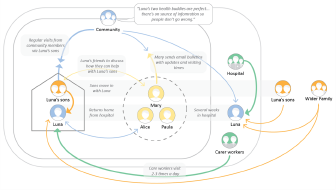
There were three key moments during Luna’s life at Hazel Lanes that triggered a shift in her care and support. In 2017, Luna had several stays in hospital, on one occasion prompted by other residents calling for an ambulance and helping her out of her flat. Her return home was facilitated by fellow residents providing daily meals and visits. During the pandemic, the community set up joint online shopping orders, the ‘health buddy’ system. Finally, when Luna went into hospital for several weeks and it was uncertain if she would be able to return home, her health buddies (Mary, Alice and Paula) played a significant role in providing a point of contact between the community and Luna’s family (see Figure 2). This included discussing with the family the limits to care that the community could provide and sending regular updates on Luna’s health and visiting times to the community. On Luna’s return home, and during her final month living in the community, she received formal care from two care workers two to three times a day organised by her sons, and daily visits from family and friends of the community.
Luna’s intermediaries and their roles.
James, Sundial Yard Cohousing
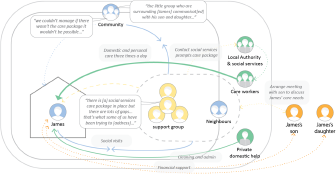
James (79 at the time of interview) moved into Sundial Yard Cohousing in 2014 (already ten years established) in his early 70s. James, who was divorced with two adult children, one living abroad and another in the UK, lived alone in a one-bed rental flat in Sundial Yard. This is significant insofar as membership of cohousing communities is often connoted with property ownership. Over the years while James lived in cohousing, he regularly contributed to maintaining the shared garden and developed a close group of friends within the community. Following a series of health issues prior to moving in, James was diagnosed with cancer and a degenerative disease, limiting his ability to be involved more widely within the community. His closer cohousing friends became an important support group for James, fetching prescriptions, providing lifts to hospital appointments and cooking meals. As his health deteriorated, the community became increasingly concerned for James’s welfare and key members played a role in prompting the contact of social services and his children (see Figure 3). James lived at home for several more years with a social care package in place, including care workers’ visits three times a day and additional daily home help. He moved into a nearby care home in 2022 following an assessment by the local council prompted by a home-help employee and members of the community and facilitated by his daughter.
James’ support group and their roles.
The case of James differs slightly from the previous two examples. He had significant health conditions limiting his ability to remain active within the community for the duration of his time living in Sundial Yard. In addition, although James had two children, his lack of contact with them meant that his family was not involved in decision-making around his health and care at an early stage. This situation caused significant strain in the community, and on his support group, who had to provide informal peer support over a longer period. When a further meeting was arranged with Adult Social Services and his daughter, a community member also attended to ensure the limits of residents’ ability to care for James. James’s friends in the community continued to visit him regularly after he moved into a nearby care home.
Care transitions analysis
The aforementioned examples outlined three different transitional experiences of residents’ health and care during their time living in cohousing. Together, these examples illustrated a ‘layering up’ and intensifying of support and care for residents over time as their health conditions changed. In the context of cohousing, the intermediary role of residents is of particular interest because it emerges from mutual support and social interaction which in turn are generated by ‘intentionality’ towards the cohousing ethos. This includes the purposeful building of community throughout the planning and development processes prior to moving in together, often going beyond ‘good neighbourliness’. As a participant of a focus group at Hazel Lanes put it, the difference with communities that ‘haven’t grown up as a group’ is that:
They haven’t set out the recommendations that we’ve actually agreed on and it’s very much – if somebody bought a piece of land and sold off a plot and calls it cohousing, it has some sort of superficial analogy. It’s not the same. It’s not likely to happen. That’s why it’s a big example of the advantage of cohousing – community. (Focus-group participant, Hazel Lanes Cohousing)
In all three examples, the intermediary role was taken on by a smaller group of residents, often made up of close friendships that had developed through their involvement in the community and helping each other. Since it was often an informal system, it can be flexible and is based on trust. The intimacy and closeness of such ties was expressed as an important attribute by an informant:
We’ve formed friendships like, you know, friendships, not acquaintances, so within those friendship groups you’re going to be more able to be more intimate as in that intimate space of being with somebody who’s really sick and there will be those sorts of groups here and then there is the less intimate one which is we’re all here to help and support each other. ‘Okay I’m happy to do a rota, who’s willing to stick their names in to do cooking?’ (Eleanor, Meadowridge Cohousing)
Such intimate experiences of going through the later-life transition together tend to create a firmer bond between some residents. Such events did not happen in isolation, however. Individual relationships were embedded in the broader intentional community:
She had a cancer operation and neither of her sons could be with her the day of the operation and she kept saying, ‘I’m fine to go alone. I’m fine to go alone.’ And I said to her, ‘you’re not going alone. I’m coming too.’ And finally, she said, ‘all right.’ So I went with her to her operation which was quite an experience because I’ve only ever been for myself, not with somebody for something that serious. But it felt really important and a really lovely thing to do and it has created an even firmer bond in our relationship. (Alice, Hazel Lanes Cohousing)
Such intimate relations of co-living as well as mutual support more broadly are supported by the physical proximity of living in cohousing and its purposeful design. This aligns and contrasts with other studies on co-living, for example sharing a flat in which the residents value integrity, although they still manage to perform a caring role for each other (Törnqvist Reference Törnqvist2024). Having their own front door provides a certain level of distance in such intimate relationships, allowing residents to be less vulnerable to exposure. While at Hazel Lanes there was a more formalised buddy system for all members, the advocacy support around transitions that we examine here often (but not always) reflected friendship bonds that pre-dated the later-life transitions. We did not come across any member of the three cohousing groups who was excluded either from the life of the community or from exchanging support, although mutual support provision is not always reciprocal or consistent across the residents. For example, there were inevitably some residents whose closest friendships lay outside the community and thus they relied on them by choice. While the three examples around the transitions have an intermediary role played by community groups, the research also found that, in some cases, the intermediary role was taken primarily by family members.
In some cases, the residents may also have had greater social capital in terms of skills and expertise that allowed them to step up to this role more easily. The peer intermediaries often had a greater level of knowledge and awareness about the support needs of other residents, as evident in the case of Eric. Their role included knowing the timing of requesting additional support and navigating through the complex health and social care systems, including paperwork. Equally, however, they understood the limits of mutual support which the peer could or should provide:
I think all of us can use our skills to support – I guided a couple of people here to get the support they need in the community. I’ve done enough caring, I’ve looked after my family, I’ve looked after people, this is my time now. I’m going to support my friends and people in the community but if people need carers, they need carers. (Eleanor, Meadowridge Cohousing)
In Luna’s case, the intermediaries were enablers for Luna to exercise agency in the transition to a fourth age, supporting her choice of returning to cohousing and thus control over receiving palliative care in the familiar community environment. Agency in this context was detached from physical activity or ‘action’ (but as a ‘recipient’ of care), as Grenier and Phillipson (Reference Grenier, Phillipson, Baars, Dohmen, Grenier and Phillipson2013) argue in the fourth age critique. Living in her cohousing, such ‘choice’ and ‘action’ were supported and made possible largely by the existence of intermediaries. For example, it was a positive act of strength and control but not necessarily one of independence that Luna had the capacity to mobilise the resources available in the community. At the same time, that such support was available at this time of need was part of the community’s general intentions and expectations.
In comparison with the other two communities, Hazel Lanes, having set up as the older-women cohousing, showed a more conscious approach to potential later-life transitions. For example, such an approach was demonstrated through the health buddy system and support for every member to have power-of-attorney arrangements in place. These reflected this community’s explicit aim of ‘growing older together’. It was, nevertheless, surprising that all three cohousing communities were to a greater extent unprepared for significant transitions to greater care needs, since they were ‘muddling through’ each event rather than discussing potential care planning as a community. It should be acknowledged, though, that such events were a relatively new occurrence even at Sundial Yard, and that this may change, not least prompted by some of the discussions that formed part of our fieldwork.
Significantly, the intermediary role of residents did not replace or negate the need for the involvement of family members. While a lack or delay of the involvement of family members can place an unsustainable burden on the community, and on the intermediaries, in particular, in all three cases families remained the key decision-makers for moving residents out of the community (James) or arranging end-of-life care (Eric and Luna). The arrival or involvement of family members into the decision-making was often described as a moment of relief for the community, allowing residents to shift their role towards ‘caring for the family carers’: ‘I think people started to find it a strain when [Eric] was really ill but then his stepson came over from America and moved in with him for the most of his illness … the people who were looking after him were relieved when his stepson came (focus-group participant, Meadowridge Cohousing).
Instead of directly providing care to their fellow residents, the intermediaries played a distinctive role of acting as go-betweens in a two-way communication process with families and social services. There were many examples of members contacting family:
People were worried and what happened also was that four [residents], without [me] being involved, they got together and set up a meeting with my son … and we had this phone meeting conversation where they basically said ‘our dad is in this state and we’re going to sort out a support programme for him and so on’. And that … I seem to remember was quite important … and then that led to the carers coming in and so on. (James, Sundial Yard Cohousing)
Or it was evident that, in some cases, the intermediaries became a point of contact between family members and the community after significant events and shifts in care needs:
[Mary]’s kept sending out bulletins about [Luna] when she was in hospital and that kind of thing, and letting people know whether they could or couldn’t visit and then same with home … Yes, because the health buddy – so that there’s one source. There’s one source for information so people don’t go wrong. (Alice, Hazel Lanes Cohousing)
Although residents, particularly those who were closer friends or had the relevant knowledge and skills, were willing to step into an intermediary role, they clearly stated that they were not each other’s carers. Most residents described a clear boundary of ‘not providing personal care for each other’. The importance of the involvement of formal care services and family members, when mutual support could no longer be sustained, was recognised within cohousing communities. However, in practice this can be less than clear-cut, particularly in emergency situations or during the pandemic, when residents were understandably reluctant to stand back and do nothing. Where residents did go beyond this boundary, it was usually only temporary, acting as an emergency buffer until formal services were put in place.
It should be acknowledged, however, that there was considerable ambivalence in groups about such supportive intermediate roles. While some, for instance those involved with Eric at Meadowridge, felt that even in such a demanding situation, their support had been given willingly and without regret, others – most notably those supporting James at Meadowridge – at times felt overwhelmed or that more could have been done by family members. Such attitudes perhaps to some degree reflected that James’s was not a terminal condition, and his longer-term care had become an issue. Further, while there was a clear line drawn in terms of personal care, there was little consensus across the communities about whether such ad hoc support should become an expectation, especially given the possibility that the average age, and thus level of care need overall, was likely to continue to rise in the foreseeable future.
It is also important to acknowledge the gendered nature of the transition support in cohousing (Fernández Arrigoitia et al. Reference Fernández Arrigoitia, Ferreri, Hudson, Scanlon and West2023). The women sometimes framed their lives in the community as a positive response to the gendered nature of their role earlier in their lives. A focus-group participant at Hazel Lane, the older women-only cohousing, for example, expressed the joy of making time for herself, ‘no longer living in the shadow of men’. However, the examples given from the other two communities do both depict intermediary support being given to a single male resident, mainly by women, albeit in James’s case the core of his support was from two male–female couples. It was also notable that disproportionately more women than men volunteered to take part in our focus groups, which we had promoted as focusing on issues of care and support. It is perhaps not surprising that gendered social attitudes are often carried forward by members into their cohousing communities, especially among older generations, as López Gómez and colleagues (Reference López Gómez, Estrada Canal, Farré Montalà, Pasveer, Synnes and Moser2020) have found in a Spanish context. Nonetheless, in cohousing, ‘individuals’ (not households) are treated as members and thus both men and women are expected to contribute to community work, although the nature and the extent of that ‘work’ may differ.
In other self-managed collaborative housing with built-in services in our wider case studies, such intermediary roles of contacting family members who made critical decisions or liaising with public and private services were usually performed by the paid wardens or managers. The built-in services including a daily ‘welfare call’ in senior housing cooperatives provided an extra layer of security to residents while allowing them to maintain their autonomy and control through self-management of the housing schemes, compared to their more conventional institutional counterparts.
Discussion and conclusion
The aim of this article was, first and foremost, to consider how collaborative housing communities, and cohousing in particular, given its commitment to mutual support over the lifecourse, support later-life transitions, especially when those transitions entail increasing care and support needs. We have examined this with reference to three cohousing case studies. However, we can also draw on data from our wider research to consider broader questions; namely, what new insight into debates in social gerontology on age and stage-based expectations of later life (Grenier Reference Grenier2012; Grenier et al. Reference Grenier, Lloyd and Phillipson2017) does research from this alternative housing and caring form bring; and how might it inform wider policy debates around alternative housing models and care innovation in current market-driven welfare systems?
Deep and broad support for transitions
Our study found that cohousing fosters greater sociability, trust and friendship among its members, which in turn brings a greater level of mutual support. This seems to chime with the aims of advocates of this housing model, especially in the context of ageing and of increased support needs. However, a more surprising finding was that the social bonds formed also enabled the formation of smaller, informal support groups who were able to respond flexibly to sudden health events or increased support needs, and who as neighbours are first on the scene. While cohousing members were clear that their support should not replace formal care services, these small groups or individuals can act as crucial peer intermediaries between the member in need and increasingly fragmented health and social care services, family members (who often are not close by, or always available) and the rest of the cohousing community. Although old age increases one’s risk of becoming more dependent, losing physical strength does not always imply the loss of the capacity for agency (Baars Reference Baars2016; Laceulle Reference Laceulle2018). Cohousing thus supports individuals in maintaining their own independence, preventing a more rapid loss of agency to highly instrumentalised health and care systems, through the inter-dependence of cohousing membership. Furthermore, an often-overlooked aspect of mutual support within such communities is that a broader role is provided in wider community support for the carers themselves, often extended to kin and others beyond the community.
However, does cohousing achieve something that any established neighbourhood might? We would argue that the various degrees of mutual support we witnessed – from a broader, shallower mode of ‘looking out for’ to the intermediary groups around specific care needs – reflect the complex social relationships that exist in cohousing, and that have been found to occupy a social space somewhere between neighbours and family, with the privacy of the former but sometimes the intimacy and support of the latter (Sandstedt and Westin Reference Sandstedt and Westin2015). We found this concept to be at least in part intentional by the community: while there is no expectation that all members will be close friends, they make a commitment to maintaining community and to mutual support; in the case of Hazel Lanes this is most explicit and embraces the concept that members will grow old together.
Unsurprisingly, each of the cases illustrated also tested the limits of these cohousing relationships, as they (self-)impose a burden on the carer individuals involved, despite broader agreements about the limits of care expected of one another. In the case of James, whose care needs became too great to be met within the community and moved to a nursing home, there were tensions around how and when this move should have happened. Perhaps more significantly, at the time of our engagement with each of the communities, such incidents were the exception rather than the norm; on one hand, it might be that these forms of support around care transitions continue to be sustainable, as different residents might be involved in each instance. Or might such support become unsustainable as the community grows older together? All three communities acknowledge the latter possibility to differing extents, and there were signs of success – most notably at the more intergenerational Sundial Yard – of recruiting younger members to begin to negate this.
Challenging the social imaginary of the fourth age
Our research exploring the lived experiences of residents suggests that shared coping around dependency similarly challenges the idea of a fourth age as unagentic. In the case of Hazel Lanes, there was a sense of pride that Luna, a founder member of the cohousing community, achieved her wish to die at home. That community residents, many of whom themselves were facing significant health challenges, were able to achieve this for Luna was a bonding experience, as were other caring acts. This also points to a different social imaginary of the end of life: one that does not involve sequestration in families or institutions of care, but leaves space for friendship and, arguably, with it the continuation of one’s identity as a community member. Even James, whose health condition was chronic and degenerative, ultimately moved into residential care but continued to benefit from the support of members of the cohousing. One could also imagine that the quality of relationships with family members at the end of life was enhanced by the additional support that cohousing residents were able to offer in our case examples. If the social imaginary of the fourth age implies a vicious circle of fear and decline, what we see in our case examples points to a more virtuous circle of care in which acts of care bolster individual and community self-esteem. This is not to say that cohousing communities can, or should be expected to, supplant formal care. Setting and maintaining boundaries is also a key aspect of community life, which brings us to our final point about the policy implications.
The limits of mutuality?
In the current landscape of later-life housing and care provision, it seems that cohousing, alongside other forms of collaborative housing, has something to offer those in later life and particularly those who seek independence from institutions of care and family. It is certainly the assertion of its advocates. However, what was much less evident within any of the three communities was any planning for formal care. In some European countries, senior cohousing does indeed incorporate a significant level of formalised paid support, even going as far as personal and medical care (López Gómez et al. Reference López Gómez, Estrada Canal, Farré Montalà, Pasveer, Synnes and Moser2020). López Gómez et al.’s (Reference López Gómez, Estrada Canal, Farré Montalà, Pasveer, Synnes and Moser2020) Spanish examples are more closely comparable with our three non-cohousing case studies where community members benefited significantly from the support of staff – often managed indirectly by an intermediate agency. Such support ranged from a daily ‘welfare call’ from the site manager through to personal care services (albeit each of the schemes was designed for ‘independent living’ and not for those needing full-time care). Here, it was the staff who also performed an equivalent intermediary role between residents, family members and formal health and care services – often going beyond the remit of their employment in doing so.
However, while the residents of these other schemes in our research certainly had control of key aspects of their housing and its attendant services, and though there was also a sense of community and some degree of mutual support, in practice decision-making was left to a small group of residents, with a majority appearing to exercise little agency or independence in this sense. We consider it possible that there is a trade-off between community autonomy and the commissioning of more formalised care, as suggested by Jann (Reference Jann2015), in comparing a spectrum of older people’s housing settings from their own individual homes through to institutionalised care settings. López Gómez et al. (Reference López Gómez, Estrada Canal, Farré Montalà, Pasveer, Synnes and Moser2020) also hint at a tension within cohousing settings, between schemes that offer the security of such in-built services and projects that are more focused on prevention and self-management, allied with a more generalised notion of ‘successful ageing’; for older members of the latter, the cohousing ideal represents a distancing of themselves from issues of formal care through mutuality. In analysing such dichotomies, however, we perhaps risk overlooking the very real achievements of the handful of established cohousing communities in England in terms of mutuality and support that likely extend the horizon of agency in later life for their members, who, after all, are, at the same time, better at negotiating rather than rejecting the existing formal care resources available.
Acknowledgements
The article is based on a research project ‘Collaborative housing communities and innovative practices in social care (CHIC)’. This is independent research funded by the National Institute for Health and Care Research, the School for Social Care Research.* The views expressed in this article are those of the authors and not necessarily those of the NIHR SSCR, the National Institute for Health and Care Research or the Department of Health and Social Care.
* For the purpose of open access, the authors have applied a Creative Commons Attribution (CC BY) licence to any Author Accepted Manuscript version arising from this submission.
Ethical standards
Ethical approval was given by the National Health Service Authority Social Research Ethics Committee.


 Open access

