


Introduction
Micro and small enterprises (MSEs) account for 99% of businesses within the European Union, contributing to the economy and creating employment opportunities (EU-OSHA 2018). It is also recognised though, that many follow a low road strategy in relation to safety at work practices, due to a lack of resources or knowledge on how to protect workers. Worker vulnerability is exacerbated by the prevalence of precarious and informal employment and the invisibility of those businesses to labour inspectors (EU-OSHA 2018). The present paper presents the findings of a study carried out to understand the organisation of work in small seaweed farms within North West Europe, and how it influences experiences of occupational safety and health (OSH) risks and arrangements for their management.
The following sections first provide a brief account of the methods used in the study, before presenting an analysis of relevant findings from the qualitative fieldwork, that focuses on contexts in which owners and managers seek to assess and manage the risks of the work for which they are responsible in the seaweed production sector. This is followed by a discussion in relation to the wider literature, especially that addressing work health and safety in micro and small firms and precarious and non-standard forms of work, typical of those found widely in agriculture and food production. Arising from this, the paper ends with some reflections on what may be required of approaches to supporting health and safety and compliance with regulatory standards in the emergent work activity represented by seaweed production in European economies. Drawing on the lessons of the wider literature, it considers how such support might be provided from within the sector and its business relations as well as the implications for public and private regulatory influences.
The industry
Seaweed has a variety of uses, such as in food, feed for livestock, in pharmaceuticals and cosmetics or as biostimulant (van den Burg et al Reference van den Burg, Selnes, Alves, Giesbers and Daniel2021b). The production of seaweed is a sector that is growing globally, but is a relatively new activity in Europe, accounting for less than 1% of world seaweed production (Araújo et al Reference Araújo, Vázquez Calderón, Sánchez López, Azevedo, Bruhn, Fluch, Garcia Tasende, Ghaderiardakani, Ilmjärv, Laurans, Mac Monagail, Mangini, Peteiro, Rebours, Stefansson and Ullmann2021, FAO 2022). Although European producers aim to strengthen their position in the global supply chain, production is still marginal compared to the established, low-cost/high-yield growers in South-East Asia (China and Indonesia being the largest suppliers), mainly because of technological, licensing, and market-related issues (Selnes et al Reference Selnes, Giesbers and van den Burg2021; van den Burg et al Reference van den Burg, Dagevos and Helmes2021a, Reference van den Burg, Selnes, Alves, Giesbers and Daniel2021b). The cost of production and lack of competitiveness on price create some uncertainty on the future position of European seaweed into the existing global value chain (van den Burg et al Reference van den Burg, Selnes, Alves, Giesbers and Daniel2021b). European producers are currently supplying their seaweed to wholesalers or as final product (e.g., seaweed flakes). It is suggested though that they should be aiming for high-value products in order to target higher value activities and market segments (van den Burg et al Reference van den Burg, Dagevos and Helmes2021a; van den Burg et al Reference van den Burg, Selnes, Alves, Giesbers and Daniel2021b; Albrecht Reference Albrecht2023).
Exact figures and demographics of workers in the industry are sparse, but in 2022 it was estimated that 1,161 workers were employed in algae-related activities, with France (478) and Spain (285) employing the largest number (Vazquez and Sanchez Reference Vazquez and Sanchez2022). Nearly, all are employed in the production and processing of seaweed rather than other forms of algae. Although production is mostly based on wild harvesting (68% of seaweed in Europe is wild-harvested), recent increase in demand has stimulated the creation of small-scale seaweed farms producing cultivated seaweed (Stanley et al Reference Stanley, Kerrison, Macleod, Rolin, Farley, Parker, Billing, Burrows and Allen2019; Vazquez and Sanchez Reference Vazquez and Sanchez2022). A report from Phyconomy (2022) indicates that production at the lower end (less than 100 tonnes) is mainly generated by these small-scale farms or harvesters, co-ops, or family-run businesses, while the Secretariat of Seaweed for Europe (2021) reports that 58% of the 223 companies it surveyed employed less than 10 people and that the European seaweed industry is mostly comprised of small local businesses. Vazquez and Sanchez (Reference Vazquez and Sanchez2022) also report that 87% of the 156 companies that are focused on algae cultivation activities in France, Spain, and Portugal are micro-enterprises with fewer than five employees.
The turnover of European seaweed (which also includes wild harvesting) is estimated at around EUR 129.5 million but, due to a recent drive to accelerate production, the largest number of investment opportunities and start-up companies are currently found in Europe (Kuech et al Reference Kuech, Breuer and Popescu2023).
In Europe, seaweed production is primary concentrated on the Atlantic region and mostly takes place in the intertidal zone or offshore (by boat), in structures such as ropes or rafts (Araújo et al Reference Araújo, Lusser, Sanchez Lopez and Avraamides2019; Araújo et al Reference Araújo, Vázquez Calderón, Sánchez López, Azevedo, Bruhn, Fluch, Garcia Tasende, Ghaderiardakani, Ilmjärv, Laurans, Mac Monagail, Mangini, Peteiro, Rebours, Stefansson and Ullmann2021). Production stages include seeding, monitoring, harvesting, and processing of the seaweed. Cultivation methods depend on the type of algae grown, but sea-based production results in variability of the quality and yield as well as vulnerability due to environmental conditions and diseases (Araújo et al Reference Araújo, Vázquez Calderón, Sánchez López, Azevedo, Bruhn, Fluch, Garcia Tasende, Ghaderiardakani, Ilmjärv, Laurans, Mac Monagail, Mangini, Peteiro, Rebours, Stefansson and Ullmann2021). In seaweed cultivation, much of the production process is carried out by hand and it is labour-intensive (Msuya cited in Gegg and Wells Reference Gegg and Wells2017). Often aquaculture and seaweed operations occur in remote environments, making access to health services challenging (Cavalli et al Reference Cavalli, Jeebhay, Marques, Mitchell, Neis, Ngajilo and Watterson2019). Although literature on hazards in seaweed production are scarce and focused on studies carried out in the largest producing regions (see e.g., Said et al Reference Said, Kyewalyanga, Msuya, Mmochi, Mwihia, Skjerve, Ngowi and Lyche2018; Ngajilo and Jeebhay Reference Ngajilo and Jeebhay2019; Thamrin et al Reference Thamrin, Wahyu, Muis, Russeng, Birawida, Amqam and Hardianti2019; Thamrin et al Reference Thamrin, Muis, Wahyu and Hardianti2020; Ngajilo et al Reference Ngajilo, Adams, Kincl, Guernsey and Jeebhay2023; Valderrama et al Reference Valderrama, Cai, Hishamunda and Ridler2013), it is agreed that cultivation can entail biological (Cavalli et al Reference Cavalli, Jeebhay, Marques, Mitchell, Neis, Ngajilo and Watterson2019), ergonomic (Hussin and Khoso Reference Hussin and Khoso2021; Shimada et al Reference Shimada, Takemasa, Kohbu, Ishikawa and Azuma1990; Thamrin et al Reference Thamrin, Muis, Wahyu and Hardianti2020), and physical hazards (Hussin and Khoso Reference Hussin and Khoso2021; Thamrin et al Reference Thamrin, Wahyu, Muis, Russeng, Birawida, Amqam and Hardianti2019). Thamrin et al (Reference Thamrin, Muis, Wahyu and Hardianti2020), also found that two-thirds (67%) of seaweed workers surveyed suffered from fatigue, especially during busy periods, suggesting that work organisation may also give rise to significant risks. Those risks are not dissimilar to hazards found in aquaculture and fishing in general, although they can vary depending on the species, and the operating area’s climate and environmental conditions (see e.g., Myers and Durborow Reference Myers, Durborow, Carvalho, David and Silva2012; Fry et al Reference Fry, Ceryes, Voorhees, Barnes, Love and Barnes2019; de Oliveira et al Reference de Oliveira, Cavalli, Kunert Filho, Carvalho, Benedetti, Rotta, Peixoto Ramos, de Brito, de Brito, da Rocha and Stech2017; Windle et al Reference Windle, Neis, Bornstein, Binkley and Navarro2008; Phu et al Reference Phu, Phuong, Dung, Hai, Son, Rico, Clausen, Madsen, Murray and Dalsgaard2015; Tatar Reference Tatar2019). Additionally, globally, there is evidence of informal and seasonal employment, as well as employment of vulnerable workers such as migrants and children (Fröcklin et al Reference Fröcklin, de la Torre-Castro, Lindström, Jiddawi and Msuya2012; Cai et al Reference Cai, Lovatelli, Aguilar-Manjarrez, Cornish, Dabbadie, Desrochers, Diffey, Garrido Gamarro, Geehan, Hurtado, Lucente, Mair, Miao, Potin, Przybyla, Reantaso, Roubach, Tauati and Yuan2021; Hussin and Khoso Reference Hussin and Khoso2021; Ngajilo et al Reference Ngajilo, Adams, Kincl, Guernsey and Jeebhay2023; Valderrama et al Reference Valderrama, Cai, Hishamunda and Ridler2013). Specifically, in Europe, most jobs in the sector are seasonal and many seaweed workers are registered as ‘fishers’ or are self-employed (Gegg and Wells Reference Gegg and Wells2017).
Effective management of workers’ exposure to risks in the industry needs to take some account of the effects of enterprise size, its economic and business relations, forms of employment arrangements, including pay and contract length, and the visibility of enterprises to agencies of public (and private) regulation (EU-OSHA 2021). It was to explore these influences on seaweed workers’ experiences of work safety and health in this developing sector of economic activity in Europe that the present study was undertaken.
As outlined above, the European seaweed industry mostly comprises micro and small enterprises (MSEs). There is a substantial literature that finds health and safety management in MSEs to be problematic (see EU-OSHA 2018 for a review). There is further evidence suggesting a likelihood of undeclared, informal and non-standard work taking place in micro and small firms involved with seasonal work in sectors such as food and agriculture (EU-OSHA 2018). Although there is only limited empirical evidence, such that there is, indicates that in terms of employment type, subcontracting and informal employment has grown in aquaculture (Cavalli et al Reference Cavalli, Jeebhay, Marques, Mitchell, Neis, Ngajilo and Watterson2019) and is common in seaweed cultivation, with many workers being occasional staff (Cai et al Reference Cai, Lovatelli, Aguilar-Manjarrez, Cornish, Dabbadie, Desrochers, Diffey, Garrido Gamarro, Geehan, Hurtado, Lucente, Mair, Miao, Potin, Przybyla, Reantaso, Roubach, Tauati and Yuan2021). Such forms of precarious employment have been long associated with negative OSH outcomes (Quinlan et al Reference Quinlan, Mayhew and Bohle2001; Quinlan and Bohle Reference Quinlan and Bohle2009). Hiring temporary personnel who have no training or knowledge of how to identify and protect themselves from OSH hazards can put both them and other unskilled and skilled workers at risk (Moreau and Neis Reference Moreau and Neis2009). Temporary workers are also likely to be less familiar with OSH systems at the work site, are less likely to be unionised, are less aware of their work rights, and are less likely to challenge OSH practices because of fear of loss of employment than are permanent employees (Quinlan et al Reference Quinlan, Mayhew and Bohle2001).
There is little empirical evidence on any of these factors in the emergent European seaweed industry. To address this gap and to better understand the impact of the structure and organisation of work and employment on workers’ experiences of OSH risks and their management in this developing industry in North West Europe, this paper draws on the findings of a wider project undertaken to explore possible protocols supporting the seaweed sector in monitoring and assessing food safety, environmental safety, and work health and safety (carried out between January 2021 and December 2022). Using reference to qualitative findings obtained in the fieldwork, it explores the health and safety arrangements and outcomes as experienced by owners/managers, workers, and other stakeholders in the sector. It situates these experiences in relation to the wider literature on work health and safety, both in seaweed production and in micro and small firms in agriculture and food production, with which it argues, the emergent seaweed cultivation industry in Europe shares features in common.
Materials and methods
As outlined above, this study was part of a wider project focused on food safety, environmental safety, and work health and safety. The present paper, and the methods and findings described below, relate only to the OSH part of the research.
Initially, a literature review was carried out to gain an understanding of OSH-related concerns in seaweed production. There was a scarcity of information in the literature on OSH within the seaweed sector, therefore, papers related to OSH in aquaculture in general were also included. The search strategy was based on keywords and phrases identified in relation to the objectives of the research and included both truncated variations and combinations of terms. Searches were carried out in the Google Scholar and Scopus databases and were limited to the period 2011 and 2021 and articles written in English. Also reviewed were online resources, official statistics, or reports published from governmental agencies, professional associations, universities, national or international organisations, institutions, and bodies. These were related to OSH, aquaculture, and/or seaweed cultivation. Despite the limited research to date, there was some evidence of similar concerns with sectors that share characteristics of work and employment.
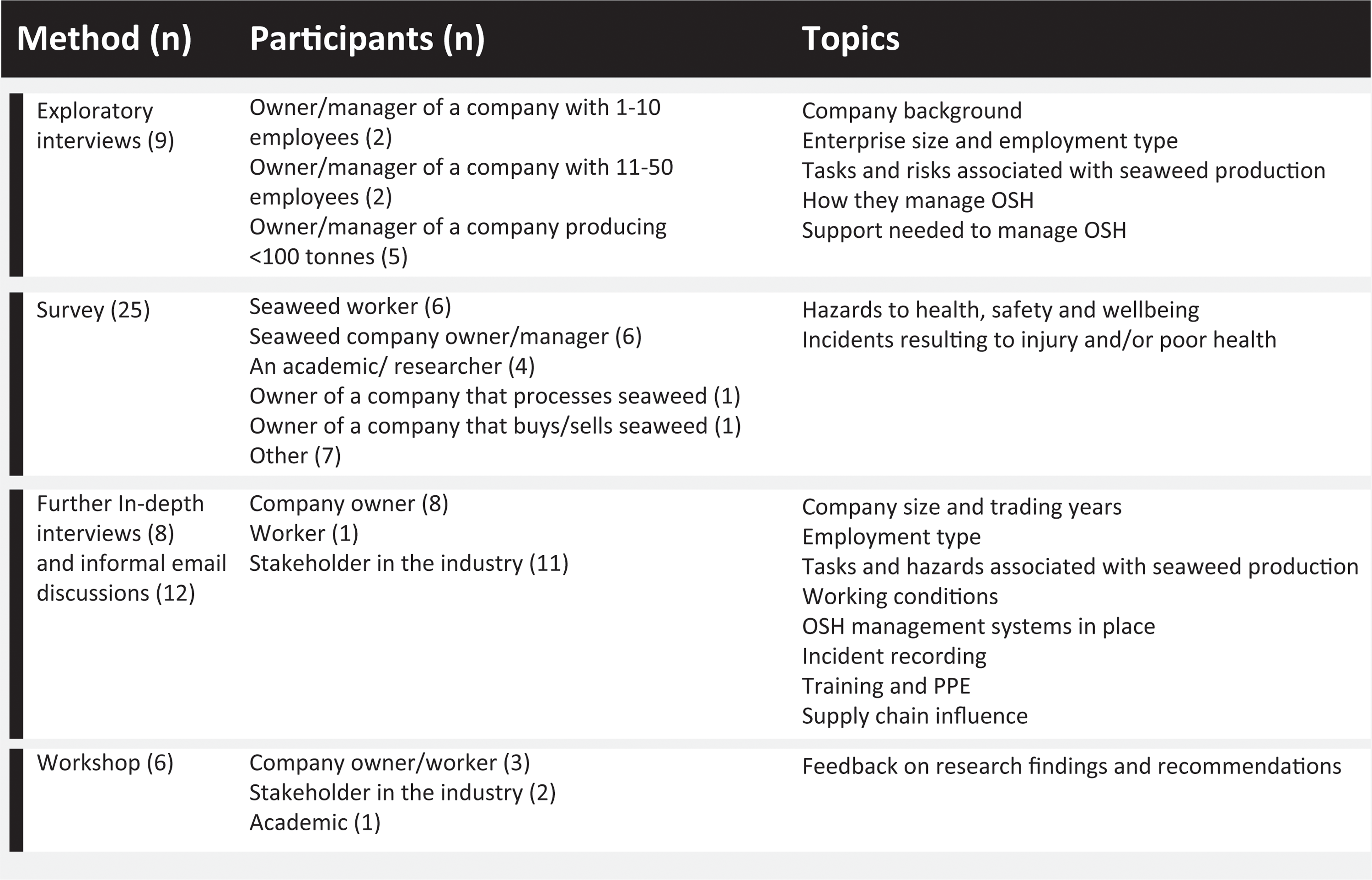
Next, exploratory interviews with seaweed companies were carried out to better clarify some of the key insights of the literature review and gather more information in seaweed production methods and risks associated with it. Twelve interviews were conducted with owners/managers of seaweed companies based in Europe, Asia, and North America. Seven of the companies gave their number of employees and 10 provided their yield. Comments relating to OSH from companies operating in areas where seaweed production is still developing, with fewer than 50 employees and/or low yields were identified and separated for further analysis. Interviews gave an initial overview of production, hazards to environmental, food, and OSH and how these hazards are managed.
A small questionnaire-based survey followed, to better specify risks associated with seaweed production – as identified by the exploratory interview and the literature review – looking to understand measures taken to manage those risks and further information on OSH in the supply chain. The questionnaire was designed in Microsoft Forms and administered through professional networks in the industry, social media, and the Safe Seaweed Coalition. It began with a brief introduction to the study and included sections on each of the project’s three disciplines – environment, food, and OSH. There were 36 responses to the survey overall. Responses relating to OSH were separated, and open-ended comments were further analysed. Only the analysis of the qualitative comments is included in this study as the sample size was too small to present any quantitative results.
Following analysis of the survey results, further in-depth interviews were conducted with seaweed companies in Western Europe, focusing on start-ups and micro and small-sized companies, reflecting the make-up of the sector as identified by previous research stages. The aim was to understand better, the experiences of owners/managers and workers in the seaweed industry, in particular the structure and organisation of work and employment, how health and safety is managed, and what influences this. These allowed a more detailed exploration of the topics by talking to workers directly, talking to managers specifically involved with OHS as well as representatives of bodies representing workers and employers. Five companies agreed to an interview and three agreed to an informal email discussion, where research participants unable to take part in an interview, answered the interview questions in an email, and provided further information or clarification on follow-up emails. These were based in the UK (5), Republic of Ireland (1), the Netherlands (1), and Norway (1). All the companies that participated in the interviews/email discussions were MSEs and/or start-ups. Seaweed, aquaculture and fishing associations and groups, certification scheme organisations, public bodies, government agencies and unions were also contacted and asked to participate in the study. Two stakeholders agreed to an interview and nine agreed to an informal email discussion.
Three different discussion guides were formed with questions for managers/owners of seaweed companies, workers, and stakeholders. These were formulated taking into account the themes emerging from the literature review and results of the exploratory interviews and the survey. The discussion guides were emailed in advance to the interviewees with a document that provided information about the study and the planned use of data and a consent form.
Evidence from both set of interviews, email discussions, and survey qualitative comments were integrated and analysed thematically (Braun and Clarke Reference Braun and Clarke2006) and used to inform a set of recommendations. A hybrid workshop was organised to present findings of the research and recommendations and seek feedback. Stakeholders from the industry were invited via email or social media to the event; six took part in the discussion on the day. Comments related to OSH were transcribed, further analysed, and included in the research findings as outlined below.
Figure 1 shows the total number of participants in each stage of the research process and topics discussed.
Participants and topics discussed
Findings
This study identified a number of issues relating to OSH in the seaweed industry. These included the acknowledgement of the presence of significant risks to health and safety, concerns over resourcing in a newly developing sector in which start-ups and MSEs predominated, and resource constraints, as well as low unionisation rates, precarious, temporary and informal work and workers were all in evidence. The following paragraphs summarise qualitative findings across the range of these issues, and where pertinent, further illustrate them with quotes from study participants.
Structural challenges included the small size of the companies with respondents facing significant financial and operational pressures and a general lack of resources both as start-ups and as enterprises scale up. For these reasons, owners/managers reported that they generally looked after OSH themselves, based on previous experience gained in other industries or with informal advice from friends and others whose OSH knowledge they respected. Most did not have specific OSH management systems in place and did not employ health and safety advisors. While some said they had thought of using an external OSH advisor because they did not have good access to information on how to organise OSH in their business, they regarded the costs of doing so as prohibitive. A stakeholder in the industry stated:
Most seaweed companies are relatively small businesses with lots of pressures on their time. […] I don’t know any Scottish seaweed companies who employ a specialist Health and Safety Manager. These companies are not big enough (yet) to justify such a role, instead H&S has to be just one of the many responsibilities of the founder or general manager of these businesses. They are all very busy people.
As with many micro and small firms, efforts described by respondents to manage these risks and protect workers in these structural and organisational contexts were characterised by unsystematic, inconsistent, top-down, and largely behaviour-orientated arrangements. Under such constraints, respondents further felt themselves to lack both guidance and support from regulatory scrutiny. One company owner said:
So [name removed] will give a briefing just to remind everybody what we’re doing, what the expectation is of the day and then we just refresh through all the safety things.
In a similar vein, referring to workers, a different company owner, when asked if they involve their workers in OSH management, reported that they do not and that they communicate down to them how to avoid risks and follow safety procedures:
No, we cascade down to them if you like, so I’ll assess the risk, how we work, how we operate.
Related to the limited resources were several indications of the presence of structures of informality in employment in the responses of participants in the study. They spoke of how small seaweed farms relied on staff fulfilling multiple roles. It was not unusual for those involved with cultivation and harvesting to indicate they performed other duties as well, such as handling social media, helping with managing the business, etc., and owners, and on occasion family members, were also involved in cultivation and harvesting. They further recounted how, during busy periods, temporary workers, self-employed individuals (e.g., local fishermen), or volunteers were hired to help, and contracted workboat operators would sometimes provide further help with deployment and harvesting, while an industry stakeholder confirmed that subcontracting in seaweed cultivation was common practice globally. As one company owner reported:
But it is also a challenging industry because it’s so seasonal. It’s very difficult to have a large, fixed staff when their main operations are only for two months of the year, so one month with deployment and one month with harvesting. So, there is a need for seasonal workers and that’s also going to increase.
Even with the inclusion of temporary workers, respondents said that small seaweed companies still often lacked enough staff, especially during their busiest seasons. They commented on the work intensity during busy times and what measures – if any – were taken to address this. Some considered extra staff would help mitigate psychosocial risks such as stress and fatigue, but recruitment was challenging because of the seasonality and the nature of the job. A company owner reported:
Yes, fatigue and stress is a concern because we have very intense seasons. And very short seasons. Especially when we harvest, we have very long working days. The way to mitigate… It’s very difficult to mitigate because you can’t find the rotational staff. It’s not possible to get that many people.
Some respondents were further aware that lack of staff can not only lead to fatigue and psychosocial risks but may also increase the risk of injury due to time pressures. A respondent in the workshop commented on the difficulty of putting into practice OSH measures during busy periods:
I think there’s a big difference between the written theory and then putting it in practice, it all kind of falls apart, especially when you’re out seeding and you just need to cope and you’re going to go on the boat and do XY&Z, and you’ve got time limit to get the seaweed seeded or harvested.
Another company owner commented how they have to work through rough weather conditions to still be able to deliver products to their clients.
The rough weather conditions and the cold water. Falling in the water is a risk. It is difficult for an entrepreneur to say: the weather conditions are not good enough, so my clients will not get their products today.
In addition to the hire of temporary workers to help with seaweed cultivation and harvesting, it was clear that it was common practice to do this without the use of formal employment contracts. A stakeholder in the industry further mentioned that some workers in the wider aquaculture sector were migrant workers who were also in precarious employment, and that there was a lack of transparency in the sector concerning these matters. The same lack of transparency was also mentioned by a company owner, when referring to undeclared work and the reluctance of workers to complain about working conditions because of fear of losing their job.
They would tend to be doing this… and this is unofficial… I don’t know how much I can say but more often than not it’s on the black economy. So, it’s paid in cash. The people that are wanting it are paying cash because they want as much seaweed biomass to go through as possible (…) You know that people are afraid to speak up because their livelihood is tied up with it. Now it might be casual labour, but to them…
The employment security of workers might have been enhanced by their belonging to trade unions but generally the unionisation rate in the seaweed industry was agreed to be very low and similar to that experienced in the fishing and aquaculture sectors. It was further felt by some respondents that although working conditions in these wider sectors were acknowledged to be poor, they perceived the trade unions organising workers to have little knowledge or resources to help improve them. An industry stakeholder stated:
So actually, it is terrible, and we are trying now to look at the picture, but the more we’re trying to research and get in contact with workers and try to get them connected and unionized, the bigger the problem is appearing. We need much more resources to deal with this.
In the face of these structures of insecurity and informality within the sector and the perception of a general lack of resources to address OSH more systematically, respondents were nevertheless aware of the nature and variety of risks related to seaweed production. Specifically, they identified risks that they thought depended on the area and type of operations but also age and gender of the workers (Figure 2).
Seaweed production risks
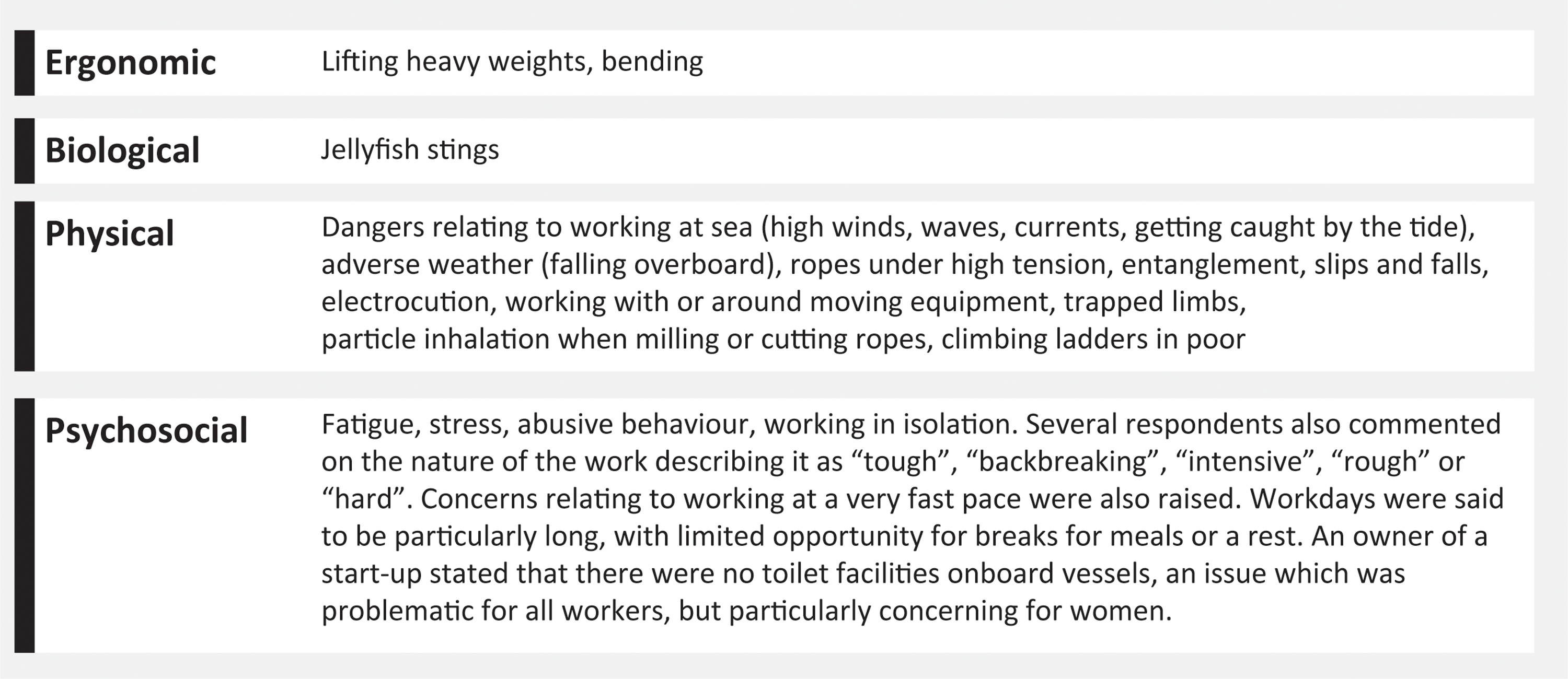
To protect workers from these kinds of risks, most of the seaweed producers interviewed indicated that they carried out risk assessments. But there was inconsistency evident in what they meant by this. For some, risks assessments were included as part of other obligations such as certifications required for the use of particular equipment, for example. Others commented that they would like some advice on how to carry out risk assessments properly, whereas one respondent mentioned that there were no formal risk assessments in place and such assessment was done informally. Interviews with seaweed managers and workers also revealed lapses in practice, such as workers not wearing personal protective equipment (PPE) and untidy or poorly designed work environments.
Although respondents felt that relevant training could help prevent accidents and support workers to deal with risky situations, results indicated that not all new workers were provided with OSH training. A number of respondents suggested that there was insufficient guidance available on safe working practices in this new sector, commenting on the absence of requirements regarding safety courses or training specifically designed for the seaweed industry. They suggested that in its absence, some owners/managers did what they could by offering their crew the same training that fishing boat entrants receive, whereas others focused on the safe use of equipment (e.g., cranes).
They further pointed out a need for greater industry research and development, suggesting that because the sector is in its infancy, there is widespread adaptation of equipment designed for other sectors, a practice which also carries risk. A company manager stated:
A lot of farmers do a lot of manual operations, they haven’t got the cranes and other things they need to fully automate the harvest processes. And I think that is going to be a feature of this industry for a while. Small operations running with not purpose-built equipment, they are adapting something else, whether it is a fishing boat or we are using a dairy plant so we are adapting a dairy plant for our purpose and bringing in additional equipment. So that brings a lot of risk with it because it is not optimal, there is a lot of temporary fixes. That is quite different to the setting where you have purpose-built everything and the operator sits behind the screen and it happens. That is what would worry me the most, some of these temporary fixes going wrong.
Both owners/managers and stakeholder respondents perceived a lack of clarity or continuity as to who was responsible for OSH in a work environment in which more than one company might operate, and when more than one authority regulated and enforced legislation.
Discussion
What stands out most from the findings outlined in the previous section are the risks to OSH found in seaweed production and limitations in the capacity of the sector to address them adequately and improve the prevention of harm arising from them for its workers. But neither are especially specific to the sector. Instead, they reflect findings of the wider literature on OSH and micro and small firms more generally and especially those found in other forms of agriculture and food production. This is evident, for example, in the nature of the risks, in the structural and organisational features of work in the sector that help to create them, and which stand in the way of their effective management. It is further seen in the ways that respondents suggest owners/managers ‘do what they can’ for OSH, without proper resources, knowledge, or support, as well as in their perceptions of limitations of public and private regulatory influences on the achievement of better risk management practices. In the following discussion, we first situate our findings on these elements of OSH practice, and what influences them in seaweed production. We then discuss them in the wider context of findings on OSH arrangements, and what determines them, and their outcomes in micro and small firms in food and agriculture more generally. Then, we pose some questions concerning what is needed to ensure best practice on OSH might be followed more effectively in this emergent sector.
Risks and seaweed production
The study identified a variety of hazards related to seaweed production in North West Europe. These are also, to a large extent, reflected in the findings of the limited literature on the sector in other parts of the world (see e.g., Thamrin et al Reference Thamrin, Muis, Wahyu and Hardianti2020; Ngajilo et al Reference Ngajilo, Adams, Kincl, Guernsey and Jeebhay2023). This literature draws attention to further hazards associated with climate change such as exposure to toxic microalgal blooms, the increase of which is attributed to increasing water temperature (Ngajilo et al Reference Ngajilo, Adams, Kincl, Guernsey and Jeebhay2023). Climate change is expected to affect OSH in agriculture in general, with exposure to extreme weather having a direct impact to working conditions and health, safety, and wellbeing (Jones et al Reference Jones, McNamara and Jakob2020).
Although the hazards workers and owners/managers in this emergent sector face in North West Europe have some differences with those in the sector in other parts of the world, many of the structural and organisational factors that determine the extent of the risk they present are similar, as the following subsections show.
Structural and organisational considerations
Our research findings indicate that small seaweed farms have limited resources and knowledge to devote to the OSH management, with owners and managers following a top-down behavioural approach to OSH. This is a finding typical of many studies on small businesses in the food and agriculture sector (including fishing and aquaculture), where such support is generally found to be poor (Watterson et al Reference Watterson, Little, Young, Murray, Doi, Boyd and Azim2012).
The wider literature suggests that in aquaculture, as elsewhere, company size affects the way OSH is managed. Larger farms are more likely to provide PPE for their workers, keep records of chemical use, sign up for certification schemes that include occupational health and safety and training, and have the resources to hire health and safety consultants (Phu et al Reference Phu, Phuong, Dung, Hai, Son, Rico, Clausen, Madsen, Murray and Dalsgaard2015; Cavalli et al Reference Cavalli, Jeebhay, Marques, Mitchell, Neis, Ngajilo and Watterson2019). In a review of OSH in agriculture with the European Union, Jones et al (Reference Jones, McNamara and Jakob2020) noted that larger farms were also more likely to have access to safer technologies and to put structured OSH systems in place.
The same authors further report that the structure of work in agriculture allows for atypical employment and estimate that over 30% of employment in agriculture is temporary or seasonal and that the percentage of migrant workers has increased, a trend they suggest is likely to continue (Jones et al Reference Jones, McNamara and Jakob2020). Studies on aquaculture and seaweed production elsewhere in the world further suggest that temporary employment and subcontracting are common in the industry (Cavalli et al Reference Cavalli, Jeebhay, Marques, Mitchell, Neis, Ngajilo and Watterson2019; Cai et al Reference Cai, Lovatelli, Aguilar-Manjarrez, Cornish, Dabbadie, Desrochers, Diffey, Garrido Gamarro, Geehan, Hurtado, Lucente, Mair, Miao, Potin, Przybyla, Reantaso, Roubach, Tauati and Yuan2021; Valderrama et al Reference Valderrama, Cai, Hishamunda and Ridler2013). Ngajilo et al Reference Ngajilo, Adams, Kincl, Guernsey and Jeebhay2023 report that in Tanzanian aquaculture, small-scale farms dominate the sector and work within them is informal or semi-formal in nature, with their workers facing precariousness and poor working conditions. Our research results in North West Europe also showed that limited resources in small seaweed farms result in the employment of temporary workers and informal work practices during busy seasons. There is a substantial literature documenting poor working conditions (including those of OSH) and major challenges for regulation in the informal economy in low- and middle-income countries (LMICs). As we observe above, our findings indicate that informality is not restricted to LMICs but is a feature of the work in seaweed production in North West European countries too.
Jones et al (Reference Jones, McNamara and Jakob2020) further note that agricultural trade unions are concerned about lack of training and health monitoring of temporary workers – including migrant and family workers who are more likely to carry out dangerous tasks –, especially as they are thought most likely to suffer from accidents (which they are not likely to report) or poor health outcomes due to insufficient training, lack of experience or familiarity with the workplace and – in some cases – absence of provision and use of protective equipment. Again, our findings point to the same concerns being articulated among our respondents in North West Europe.
The International Union of Food and Agricultural Workers reports human rights violations, slavery, human trafficking, and child labour in the wider fishing and aquacultural sectors as well as significant challenges to enforce laws and ensure access to workers (IUF 2014). Together with the International Transport Workers Federation, they advance efforts to unionise workers and improve working conditions. But, as one of our respondents stated, there is little information on the working conditions in the sector and there is a lack of international regulation to protect aquaculture workers, many of whom are self-employed, or have no experience of union organisation. There are efforts to overcome these barriers, by studying work practices and analyse regulations across regions, working with labour inspectors to help them improve practices, create visibility of the sector globally, and put pressure on the supply chain to improve working conditions and allow workers to organise themselves. Overall, promoting decent labour standards in aquaculture has been recognised (see e.g., FAO 2022; ILO 2021); nevertheless, progress to improve working conditions is slow in an industry that is growing fast.
Business relations and OSH
Pressures on small farms are exacerbated by supply issues and price volatility. The literature suggests that price volatility can be passed down the value chain to small-scale seaweed farmers and that price control and delivery requirements of big brands in global supply chains may lead to exploitation of suppliers in economically vulnerable positions at the ends of such chains. (Aslan et al Reference Aslan, Supendy, Taridala, Hafid, Sifatu, Sailan and Niampe2018; Asri et al Reference Asri, Brodie, Cottier, Le Masson, Matoju, Montalescot, Nagabhatla, Shaxson and Suyo2022; Fröcklin et al Reference Fröcklin, de la Torre-Castro, Lindström, Jiddawi and Msuya2012; Msuya Reference Msuya, Valderrama, Cai, Hishamunda and Ridler2013). Despite increasing demand for seaweed, large buyers may reduce the price they pay to small farmers, thus forcing them to cultivate larger areas, which impacts negatively working conditions and OSH outcomes (Rönnback et al Reference Rönnback, Bryceson and Kautsky2002; Fröcklin et al Reference Fröcklin, de la Torre-Castro, Lindström, Jiddawi and Msuya2012; Ngajilo et al Reference Ngajilo, Adams, Kincl, Guernsey and Jeebhay2023). In the emergent sector in NW Europe, we found no evidence of these practices, but this may reflect the newness of the sector rather than any safeguard against their occurrence. As one study on the viability of growing seaweed in the North Sea concluded, ‘there are still many uncertainties about the exact costs of production and the potential revenues’ (van den Burg et al Reference van den Burg, van Duijn, Bartelings, van Krimpen and Poelman2016).
Such controls of prices by economically more powerful buyers (such as in food and agriculture and other sectors where low-profit margins may affect the resources a small business can dedicate to managing OSH) are known to encourage owners/managers and workers in small firms to cut corners (see e.g. James and Lloyd Reference James and Lloyd2008 on the power of large retailers to negatively affect OSH practices in the food processing industry). In another study exploring influences and attitudes of small businesses, managers spoke about how they were pressured by customers on their pricing (specifically, larger companies that could choose to use another, cheaper supplier), which resulted in these suppliers making less investment in health and safety measures (Vickers et al Reference Vickers, Baldock, Smallbone, James, Ekanem and Bertotti2003). These authors also note that, in some circumstances, customer requirements for health and safety might have positive effects. That is, such requirements could be orientated towards persuading suppliers to adopt better health and safety measures in order to win orders and gain business. Either way, it is widely accepted that customer pressure may be a significant influence on how small businesses organise health and safety for their workers. The question remains what determines whether such pressure leads to positive or negative outcomes in terms of such practices.
The authors of a major review of the literature on OSH in micro and small firms acknowledged the heterogeneity of these firms and cautioned against generalisation when discussing their features (EU-OSHA 2016). They nevertheless noted that among these businesses there are a proportion across a range of sectors, that for a host of reasons, pursue ‘low road strategies’ towards their business survival, including undertaking dirty and dangerous manual work for comparatively low profit, and often filling niches in the economy eschewed by other better resourced and more financially successful businesses. Such firms and their workers, because of their business position, are among the more vulnerable to the effects of tightening profit margins – including cutting corners on safety and health as a consequence. It is also among them that resources and capacities to provide appropriate and effective arrangements for safety and health are often at their most limited. The combined effects of these pressures may lead to outcomes in which the more serious forms of poor health and safety outcomes are experienced. This is not to suggest that the micro and small firms involved in the present study were necessarily all pursuing such strategies. Nevertheless qualitative evidence presented in the previous section indicates that – especially in the period of their start-up – such small organisations experienced some of their features; these included including physically demanding, time-consuming, stressful and hazardous work, a precarious business position and – as many respondents acknowledged – a limited capacity to provide the most effective arrangements for workers’ safety and health at the same time as organising an economically viable business.
Public and private regulatory influences
Supply chain pressures to adhere to best practice standards on OSH are a form of private regulation that the wider literature indicates most likely to be effective when applied within a regulatory framework defined by public regulation and in the presence of the means of support for securing compliance with both public and private regulatory standards (see e.g. Walters and James Reference Walters and James2011). The empirical findings in the previous section suggest that there was little evidence of awareness among respondents concerning the influence of private regulation such as might be possible through influences of lead firms in supply chains on better practice among suppliers and little pressure from their supply chain relations influencing them to improve OSH. When company owners/managers were asked whether there were any standards that their customers require them to meet, the vast majority replied that there were no requirements for OSH, although some did mention that their customers have requirements for food safety. While there may be standards and certification schemes in food and agriculture that include elements of good practice on occupational health and safety management, farm owners/managers in our study argued that small farms lacked the necessary resources to apply for them and did not find them beneficial in the short term as they were not required by their customers.
In terms of public regulation, Cavalli et al (Reference Cavalli, Jeebhay, Marques, Mitchell, Neis, Ngajilo and Watterson2019) note that EU Member States and the UK have adopted generic occupational health and safety directives which also cover aquaculture, with Member States being responsible for securing compliance with them from duty holders. It is equally well known that effective compliance with principle and process-based standards requires capacities for competence from duty holders that are seldom in evidence among the persons responsible for OSH in micro and small firms – as has also been well illustrated by our findings in the case of seaweed farming. The wider literature on OSH in MSEs shows that owners/managers in these businesses frequently demand more prescriptive measures from regulators. They want to be told exactly what they must do to meet regulatory requirements and they would, ideally, like further support in doing it. As the previous section makes clear, this is also what was much in evidence in our findings.
Furthermore, aquaculture occupational health and safety is commonly the regulatory responsibility of more than one government agency. Our research findings showed how some seaweed farms owners/managers were unsure about which was the regulatory authority for OSH, and they identified a general lack of clarity and consistency surrounding the OSH regulatory framework. In the UK for example, responsible enforcing authorities for seaweed farming can include the Health and Safety Executive (HSE), the Maritime and Coastguard Agency, the Marine Management Organisation and local authorities, with one company owner reporting that they were unsure which authority to contact for OSH advice. Similarly, in Ireland, the Irish Maritime Administration (IMA) and the Health and Safety Authority (HSA) are the two bodies responsible to enforce legislation related to the health and safety of those working on fishing vessels (Health and Safety Authority 2022). In the Netherlands, responsible for OSH is the Ministry of Social affairs and Employment (Ministerie van Sociale Zaken en Werkgelegenheid) and compliance is monitored by the Inspectorate SZW. Regulations provide a framework of what companies should aim to achieve in terms of OSH but do not define how to achieve it.
Under such circumstances, the uncertainty of some duty holders concerning the identity of regulatory bodies for OSH is perhaps not surprising. It is no doubt compounded by the likely infrequency of inspection visits (Watterson et al Reference Watterson, Jeebhay, Neis, Mitchell and Cavalli2019). For example, in the UK, in response to reduced public funding over two decades, the HSE has been progressively reducing the number of its inspections leading to fewer visits to MSEs (EU-OSHA 2017). Overall then, the public regulatory framework within which support and guidance to MSEs achieve better practice and is most likely to be effective was only a shadowy presence in the environment inhabited by our respondents in the sector. As such, it was unable to provide the context in which such support has been shown to work most effectively to address structural, organisational, and capacity-building challenges for better OSH practice in MSEs in other sectors.
Conclusions and ways forward
This paper has presented a small case study of the challenges that securing effective OSH arrangements present for owners/managers and their workers in MSEs in start-ups in seaweed production – a relatively new form of economic activity in North West Europe. It is acknowledged that it was a small qualitative study with limited collection of field data in which, although the original intention had been to seek balanced participation, the owners/managers of seaweed production enterprises were over-represented. It is also likely these respondents were from companies with a greater than average awareness of and/or concern about OSH in the sector. These caveats notwithstanding, we think that the findings of the study present a realistic snapshot of the challenges for effective management of OSH in the sector and corroborate those already evident in the literature on seaweed production and aquaculture elsewhere, as well as resonating with current understandings concerning the challenges of achieving effective arrangements for OSH in micro and small firms more widely.
The findings identify several serious obstacles to the operation and sustainability of effective arrangements for OSH in a sector that is acknowledged to present serious OSH risks. These include a combination of limited availability of resources and capacities to manage OSH among the many other demands on the time and abilities of owners/managers and workers in MSEs, with structural and economic factors promoting precarious work, including temporary, and informal work. Together with the low visibility and inaccessibility of the sector MSEs to the agents and processes of both public and private regulations, collectively, all these factors contribute to the ‘structures of vulnerability’ inhabited by both owners/managers and their workers in the sector. In turn, these ‘structures of vulnerability’ expose managers and workers to risks of injury and ill health, that are likely to be rather greater than those that might be experienced in larger, better established, and better resourced establishments in the sector and elsewhere (see Nichols Reference Nichols1997, 164-167).
Such findings are congruent with those of the wider literature on the challenges for OSH presented by work in micro and small firms. On the other hand, there is a burgeoning literature on what might be done to help such enterprises to manage the risks they encounter in their production activities more effectively. However, as the EU-OSHA study referred to previously, found that, while there may be a plethora of examples of interventions intended to support MSEs to improve their arrangements for OSH,Footnote 1 there are very few that provide effective, transferable, and sustainable solutions in the absence of adequate resourcing, effective surveillance, and access to repositories of relevant knowledge (see EU-OSHA 2016, 2018). The EU-OSHA study noted that key elements of successful initiatives to support such solutions often involved orchestrated constellations of public and private actors and processes. These acted in concert in support of MSEs in ways in which key elements of their self-interest were coordinated in mutually supportive and sustainable strategies (EU-OSHA 2018; see also Hasle et al Reference Hasle, Limborg, Grøn and Refslund2017; Hasle and Vang Reference Hasle and Vang2021). Support for the effectiveness of such orchestration is also evident in recent reviews of the literature on securing compliance on OSH more widely, as well as in studies of ‘what works’ in public/private regulatory mixes to improve safe work at the ends of global supply chains (Abbott et al Reference Abbott, Genschel, Snidal, Zangl, Abbott, Genschel, Snidal and Zangl2015; EU-OSHA 2021; Bluff et al Reference Bluff, Johnstone, Walters, Limborg and Gensby2022; Walters et al Reference Walters, Johnstone and James2024).
There was little sign of any of these types of interventions in the findings of the present study. Given the small size and recent emergence of the sector, this is not surprising. We would suggest that if seaweed production and harvesting is to expand in Europe as predicted, effective means will be required to ensure that adequate arrangements are made for the health, safety, and wellbeing of the increasing number of workers likely to be involved. There is clearly a potential for better orchestration of existing influences in the sector. For example, we have already mentioned some of the multiple state institutions, including those responsible for surveillance of OSH, that oversee requirements on small businesses in the sector. There are also others that deal with tax, company registration, work permits, and so on in the business environment of these MSEs. Alongside them there are sector organisations representing the interests of owners/managers and workers, agencies of local government that oversee food safety and environmental protection, and so on. The literature gives many examples of how coordinated actions among combinations of such institutions can help provide frameworks for innovative public and private regulatory influences to help support improvement in the capacities of owners/managers in micro and small firms to achieve better OSH standards in their productive activities (see e.g., Hasle et al Reference Hasle, Limborg, Grøn and Refslund2017; EU-OSHA 2018; Parker and Nielsen Reference Parker, Nielsen and Drahos2017, as well as further examples in the wider literature on ‘smart regulation’ such as Gunningham and Sinclair Reference Gunningham, Sinclair and Drahos2017).
This is not to ignore or diminish the challenge presented by the structure of employment in the sector or the pattern of seasonal work that helps to determine it; nor is it to make light of the serious absence of both material and knowledge-based resources in the sector and in relation to OSH surveillance. It would be both somewhat glib and rather naïve to suggest that such challenges are easily overcome. However, these challenges are not especially unique to the sector. Similar ones are widely reported, especially in relation to MSEs obliged to follow the ‘low road’ business strategies we have referred to previously. A substantial literature already exists on addressing ways of dealing with seasonal work to minimise undocumented work and workers, on strategies to promote the formalisation of employment structures and practices, and on innovative ways to include OSH in support for business start-ups (see e.g. Fairman and Yapp Reference Fairman and Yapp2005; Hasle et al Reference Hasle, Bager and Granerud2010; ILO 2020; Fiałkowska and Matuszczyk Reference Fiałkowska and Matuszczyk2021; Porru and Baldo Reference Porru and Baldo2022).
There is therefore a case for further research to explore how the lessons already learned from examples of successful support elsewhere might be effectively transferred to the sector to better understand structural and organisational constraints to their effectiveness and how they could be overcome. Further research could focus on other European regions and seek more information on the number, profile, and experiences of workers in the seaweed industry as well as those agencies and regulators that could best support OSH when they come in contact in seaweed MSEs. Additionally, research could also assess whether methods to measure and prevent work-related harm in other industries, and toolkits or inspection advice successful in other types of work, could be adapted and transferred to the seaweed sector.
Acknowledgements
The authors also wish to acknowledge the support of the stakeholders, seaweed producers, and workers in the seaweed industry who shared their knowledge and experiences to inform the research.
Author contributions
Eva Makri is a Research Associate at Solent University. She has carried out public engagement and consultations to inform mental health service reviews. Her research interests broadly focus on research methodologies, mental health and wellbeing interventions, and the work environment and how it affects health and wellbeing. David Walters is an Emeritus Professor at Cardiff University. Until 2019 when he retired, he was Professor of Work Environment in the School of Social Sciences at Cardiff. He has researched and written widely on social, political, and economic relations of work health and safety, including on challenges posed by micro and small firms. Emma Wadsworth is Professor of the Work Environment and Vice Provost Research & Innovation at Solent University (UK). Her research interests include the health, safety and wellbeing of workers, workplace, and regulatory arrangements for their protection, and the wider contexts and environments in which these are situated and with which they interact. Helen Devereux is a Research Fellow at Warsash Maritime School, Solent University. Helen is interested in the sociology of work. Her current research interests include the various ways in which the organisation of work and employment impact on the occupational health, safety, and wellbeing of workers. Prior to her academic career Helen worked as an Officer of the Watch onboard chemical tankers. Sander van den Burg PhD is senior researcher of aquaculture and mariculture at Wageningen Economic Research, Wageningen, the Netherlands. He is responsible for research and advisory projects on the sustainable development of the aquaculture and mariculture sectors, including analysis of environmental, economic, and social impacts. His research interests lie in the potential of low-trophic aquaculture to combine ecosystem restoration with food production. Sander van den Burg was project leader for Safe Seaweed by Design.
Funding statement
This research was supported by Lloyd’s Register Foundation under grant reference GA\100395. For more information about the project, see https://www.wur.nl/en/project/safe-seaweed-by-design.htm#. The funder had no involvement in preparing the manuscript.
Competing interests
The author(s) declare none.


 Open access

