


Introduction
The jaguar Panthera onca is the largest felid in the Western Hemisphere. Relative to that of other large felids, jaguar conservation has been more proactive than reactive, with efforts to conserve the species prior to declines (Rabinowitz, Reference Rabinowitz2014). Nevertheless, it has been estimated that globally the species has experienced a c. 20–25% reduction in population and range over the last three jaguar generations (Quigley et al., Reference Quigley, Foster, Petracca, Payan, Salom and Harmsen2018). Anthropogenic modification of the landscape, loss of wild prey and killing of jaguars have fragmented populations and continue to threaten subpopulations and their connectivity. Occupying c. 51% of their historical home range, jaguars are currently categorized as Near Threatened on the IUCN Red List (Quigley et al., Reference Quigley, Foster, Petracca, Payan, Salom and Harmsen2018). However, if the conservation status of subpopulations is assessed independently, Amazonian subpopulations would be categorized as Least Concern, and all others as Endangered or Critically Endangered (de la Tore et al., Reference de la Torre, González-Maya, Zarza, Ceballos and Medellín2017; Quigley et al., Reference Quigley, Foster, Petracca, Payan, Salom and Harmsen2018).
Historically, jaguars were generally considered to be panmictic (Eizirik et al., Reference Eizirik, Kim, Menotti-Raymond, Crawshaw, O'Brien and Johnson2001; Ruiz-Garcia et al., Reference Ruiz-Garcia, Payan, Murillo and Alvarez2006). However, recent research has identified genetic differentiation for Mesoamerican subpopulations, indicating reduced gene flow and connectivity (Wultsch et al., Reference Wultsch, Caragiulo, Dias-Freedman, Quigley, Rabinowitz and Amato2016). Thus, Mesoamerican jaguar subpopulations and the connectivity amongst them are critically important for maintaining range-wide population connectivity (Rabinowitz & Zeller, Reference Rabinowitz and Zeller2010; Olsoy et al., Reference Olsoy, Zeller, Hicke, Quigley, Rabinowitz and Thorton2016; Wultsch et al., Reference Wultsch, Caragiulo, Dias-Freedman, Quigley, Rabinowitz and Amato2016). Within Mesoamerica, Costa Rica plays an important role in the Jaguar Corridor Initiative (Olsoy et al., Reference Olsoy, Zeller, Hicke, Quigley, Rabinowitz and Thorton2016). The Osa Peninsula in south-west Costa Rica is one of the six key conservation areas for jaguars in the country (SINAC, 2018), as well as being an internationally important jaguar conservation area (Rabinowitz & Zeller, Reference Rabinowitz and Zeller2010; de la Tore et al., Reference de la Torre, González-Maya, Zarza, Ceballos and Medellín2017).
Corcovado National Park, one of the largest national parks in Costa Rica (424 km2), is central to the conservation of the Osa Peninsula jaguar subpopulation. The Park is well-known for its rich biodiversity (Rivera, Reference Rivera2014) and is an important destination for wildlife viewing tourism (Minca & Linda, Reference Minca, Linda, Font and Tribe1999). The Park supports a wildlife community that is uniquely different from areas outside it (Soto et al., Reference Soto, Beirne, Whitworth, Diaz, Flatt and Pillco-Huarcaya2021), including several other threatened species (e.g. Baird's tapir Tapirus bairdii, Central American squirrel monkey Saimiri oerstedii, white-lipped peccary Tayassu pecari; Olson et al., Reference Olson, Matzinger, Saborio-R and Carazo-Salazar2019a). The long-term persistence of these mammal populations within the region probably depends on the status of the Park and its connectivity with other protected areas (Beal et al., Reference Beal, Matzinger, Saborio-R, Bristan and Olson2020; Soto et al., Reference Soto, Beirne, Whitworth, Diaz, Flatt and Pillco-Huarcaya2021; McCullough et al., Reference McCullough, Beirne, Soto-Navarro, Eppert, Flatt and Kemp2024).
The last assessment of jaguar populations in Corcovado National Park, in 2003, reported a mean density of 6.98 ± SD 2.36 jaguars per 100 km2 (Salom-Pérez et al., Reference Salom-Pérez, Carrillo, Sáenz and Mora2007). Since then, the conservation status of jaguars and white-lipped peccaries within Corcovado National Park has been questioned (E. Carrillo, pers. comm., 2012; Rivera, Reference Rivera2014), and some have suggested that the Park may lose its conservation value, crying ‘S.O.S.’ for the Park and claiming it is ‘slowly dying’ (Carrillo, Reference Carrillo2021a,Reference Carrillob; Pastor, Reference Pastor2021). In 2017, concerns for wildlife within the Park were considered by the Costa Rican Supreme Court, which ordered the government to better protect the Park (Resolución No. 00641-2017 Sala Constitucional of Costa Rica). The status of the jaguar is at the root of the various concerns, but no assessment of the species has been published since that of Salom-Pérez et al. (Reference Salom-Pérez, Carrillo, Sáenz and Mora2007).
To address this question, Area de Conservación Osa–Sistema Nacional de Areas de Conservacion increased its wildlife monitoring efforts in 2013, implementing intensive year-round track surveys throughout the Park. In 2015, we collaboratively expanded this monitoring effort in the form of a partnership, JaguarOsa, to evaluate the status of jaguars within the Park through the establishment of a long-term camera-trap monitoring network (Olson et al., Reference Olson, Shipley-Mellon, Kolasch, Azofeifa, Mora, Herrera and Saborio-R2022). Using the camera-trap dataset we assessed the status of jaguars within the Park using a spatially explicit Jolly–Seber model (Jolly, Reference Jolly1965; Seber, Reference Seber1965; Royle et al., Reference Royle, Chandler, Sollmann and Gardner2013). We also compared our findings to those of other studies, in particular that of Salom-Pérez et al. (Reference Salom-Pérez, Carrillo, Sáenz and Mora2007). Our objective was to assess trends in jaguar abundance over the course of our study and to estimate jaguar densities within our study area for comparison to range-wide densities.
Study area
Corcovado National Park, on the Osa Peninsula in south-west Costa Rica (Fig. 1), was established in 1975 to protect the tropical wet forest of the Corcovado River watershed. The nearest weather station, south of Barrigones, received on average 103 and 454 mm of rain per month in the dry (December–April) and wet seasons (May–November), respectively, the relative humidity was 80–90% and the temperature 22.0–33.9 °C during 2004–2018 (IMN, 2023). The Park is in the tropical wet forest life zone (Holdridge et al., Reference Holdridge, Grenke, Hatheway, Liang and Tosi1971), with a peak elevation of 745 m (Cerro Brujo; Salom-Pérez et al., Reference Salom-Pérez, Carrillo, Sáenz and Mora2007), and contains one of the last extensive tracts of intact evergreen tropical rainforest along the Pacific Ocean in Central America (Salom-Pérez et al., Reference Salom-Pérez, Carrillo, Sáenz and Mora2007). The Park is relatively mountainous but also has a large lowland area, the bajura, one of the few remaining large areas of lowland Pacific tropical forest, around the Corcovado Lagoon (Olson et al., Reference Olson, Matzinger, Saborio-R and Carazo-Salazar2019a). With > 6,000 species of insects, 117 species of reptiles and amphibians, 500 species of trees, 360 species of birds and 140 species of mammals, the Park is globally renowned for its biodiversity (Rivera, Reference Rivera2014). Bordered to the north by Golfo Dulce Forest Reserve and Guaymi Indigenous Reserve, Corcovado National Park is connected to Térraba Sierpe National Wetland and Piedras Blancas National Park via a relatively undeveloped corridor (Fig. 1; Beal et al., Reference Beal, Matzinger, Saborio-R, Bristan and Olson2020; McCullough et al., Reference McCullough, Beirne, Soto-Navarro, Eppert, Flatt and Kemp2024). Corcovado National Park has been considered a last frontier for artisanal gold miners despite government efforts since 1985 to end mining there (Naughton, Reference Naughton1993), and it experiences illegal hunting (Altrichter & Almeida, Reference Altrichter and Almeida2002; Rivera, Reference Rivera2014).
Corcovado National Park, Costa Rica, on the tip of the Osa Peninsula, is part of a series of protected areas in the region. Land-cover data (from 2017) courtesy of Osa Conservation. Boundaries of the wildlife monitoring sectors of the National Park are approximate. (Readers of the printed journal are referred to the online article for a colour version of this figure.)

Methods
During 2015–2021 we implemented large-scale, long-term camera-trap monitoring within Corcovado National Park (Fig. 1; Olson et al., Reference Olson, Shipley-Mellon, Kolasch, Azofeifa, Mora, Herrera and Saborio-R2022). Our camera-trap network consisted of 13–34 paired or unpaired camera stations, depending on the year (Table 1; Olson et al., Reference Olson, Shipley-Mellon, Kolasch, Azofeifa, Mora, Herrera and Saborio-R2022). We installed cameras typically during January–March and maintained them throughout the year, but we took down some cameras before the wet season (Table 1). Theft, camera malfunction, access issues, availability of funding and field crew, and changes in monitoring goals resulted in variations in survey efforts between years (Table 1). Camera station locations were quasi-stratified and guided by two, sometimes-competing, criteria: (1) spacing between camera stations of 1.6–3.4 km (Salom-Pérez et al., Reference Salom-Pérez, Carrillo, Sáenz and Mora2007; Wearn & Glover-Kapfer, Reference Wearn and Glover-Kapfer2017; Beal et al., Reference Beal, Matzinger, Saborio-R, Bristan and Olson2020), and (2) installing camera stations in as many 4 × 4 km grid cells as possible (SINAC, 2018; Soto et al., Reference Soto, Beirne, Whitworth, Diaz, Flatt and Pillco-Huarcaya2021). The spacing was based on the study by Salom-Pérez et al. (Reference Salom-Pérez, Carrillo, Sáenz and Mora2007) of jaguar movements and camera spacing in Corcovado National Park. The grid covering the entire country was developed by SINAC (2018) to support jaguar monitoring nationwide. In addition to these criteria, general camera-trap placement was also guided by local knowledge of the study area. Locally, we placed cameras in areas with relatively high abundance of wildlife signs (i.e. along trails and near river crossings), bañaderos (i.e. muddy, wet areas where animals cool off), ridgelines and small clearings; Wearn & Glover-Kapfer, Reference Wearn and Glover-Kapfer2017; Beal et al., Reference Beal, Matzinger, Saborio-R, Bristan and Olson2020). We also attempted to maintain historical camera-trap locations as far as possible (Harmsen et al., Reference Harmsen, Foster, Sanchez, Gutiérrez-González, Silver and Ostro2017). This resulted in a stratified-biased camera-trap placement design that is compatible with capture–recapture analytical frameworks (Wearn & Glover-Kapfer, Reference Wearn and Glover-Kapfer2017). We intended each camera to function for a minimum of 45 days (Wearn & Glover-Kapfer, Reference Wearn and Glover-Kapfer2017), but retained most camera-trap stations for longer periods, although some cameras malfunctioned or were stolen before the 45-day period was complete. We installed camera traps at ≤ 1 m above the ground (Wearn & Glover-Kapfer, Reference Wearn and Glover-Kapfer2017; Soto et al., Reference Soto, Beirne, Whitworth, Diaz, Flatt and Pillco-Huarcaya2021). In some areas we increased the height at which cameras were deployed, to reduce theft or damage from white-lipped peccaries or to improve the chances of detecting jaguars. Depending on site layout we angled cameras diagonally down-trail to increase the mean size of the detection zone (Wearn & Glover-Kapfer, Reference Wearn and Glover-Kapfer2017; Beal et al., Reference Beal, Matzinger, Saborio-R, Bristan and Olson2020).
Annual camera-trap survey effort in Corcovado National Park, Costa Rica (Fig. 1), during 2015–2021.

1 Active camera stations only (theft and malfunction caused variation in camera stations).
2 Per cent of 4 × 4 km grid cells with at least one functioning camera-trap station in that year.
3 In 2019 we attempted to maintain camera stations for the entire year.
4 In 2021 we increased our spatial coverage by moving cameras to new sites, and we also received funding for more cameras.
We used no-glow or low-glow infrared flash trail cameras of the following models and brands: Hyperfire PC800 and Ultrafire Covert (Reconyx, USA), Core DS and Trophy Cam (Bushnell, USA), Strike Force and Dark Ops (Browning, USA) and UV557 (Uovision, China). We used LED white-flash trail cameras (Ultrafire WR6, Reconyx, USA) at only one or two camera stations annually. We set camera traps to take a video or burst of three photographs with < 1 s between subsequent photographs and no refractory period between passive infrared sensor-triggered events (Apps & McNutt, Reference Apps and McNutt2018). To avoid pseudo-replication, we considered video or photo series of a species to be independent events only if they were separated by at least 30 min (Pichler et al., Reference Pichler, Mallinger, Farmer, Morrison, Khadka and Matzinger2021).
Abundance indices
We calculated the relative abundance index (RAI) for species as: RAI = (E/TN) × 1,000, where E is the number of events and TN is the total number of trap-nights (Pichler et al., Reference Pichler, Mallinger, Farmer, Morrison, Khadka and Matzinger2021). We used the RAI because it is considered an accurate index of abundance (Parsons et al., Reference Parsons, Forrester, McShea, Baker-Whatton, Millspaugh and Kays2017; Palmer et al., Reference Palmer, Swanson, Kosmala, Arnold and Packer2018) or site use (Sollmann, Reference Sollmann2018) for some species under some circumstances. Although the RAI is subject to various forms of bias (Anile & Devillard, Reference Anile and Devillard2016), it can be useful for assessing changes in species abundance over time, especially when using similar methodologies each year (Wearn & Glover-Kapfer, Reference Wearn and Glover-Kapfer2017). We calculated frequency of occurrence as the proportion of sites where jaguars were detected (Beal et al., Reference Beal, Matzinger, Saborio-R, Bristan and Olson2020; Pichler et al., Reference Pichler, Mallinger, Farmer, Morrison, Khadka and Matzinger2021). We determined the minimum known number of jaguars alive based on individual identification using rosette spot patterns and other physical features, and we determined sex based on the presence or absence of male genitalia (Harmsen et al., Reference Harmsen, Foster, Sanchez, Gutiérrez-González, Silver and Ostro2017). Using these individual identities we generated a detection history for individuals (Harmsen et al., Reference Harmsen, Foster, Sanchez, Gutiérrez-González, Silver and Ostro2017).
For each individual we estimated minimum years alive (Olson et al., Reference Olson, Saborio-R and Carazo-Salazar2019b). To determine residential status of each jaguar, we modified the definitions used by Harmsen et al. (Reference Harmsen, Foster, Sanchez, Gutiérrez-González, Silver and Ostro2017), with residents defined as any individual detected in ≥ 3 consecutive years, undetermined individuals as those detected for the first time within the last 2 years of the study, and transients as all individuals that did not meet the criteria for resident or undetermined status. A posteriori, we assessed the per cent of the activity area of a jaguar (associated with the spatially explicit Jolly–Seber model, see below) that was within the National Park boundaries. This allowed us to assess whether a jaguar was mainly active inside the Park or not, as we would expect resident jaguars to have activity centres contained almost entirely within the Park.
Spatially explicit Jolly–Seber model
We assumed jaguar population dynamics followed the Jolly–Seber model (Jolly, Reference Jolly1965; Seber, Reference Seber1965; Royle et al., Reference Royle, Chandler, Sollmann and Gardner2013), a special hidden Markov model (Rabiner & Biinghwang, Reference Rabiner and Biinghwang1986). We chose a spatially explicit Jolly–Seber model as our survey had multiple seasons of data and there was evidence of recruitment and mortality (see below). Therefore, single-season spatially explicit capture–recapture models were not appropriate because they would fail to capture the time series nature of our design. Because we made observations of both mortality and recruitment we preferred the Jolly–Seber model over a Cormack–Jolly–Seber model, which would only account for mortality. In the Jolly–Seber model assumptions of individual detectability are similar to classic capture–recapture models, in which individuals need to be detectable but it is not necessary to detect all individuals.
The spatially explicit aspect of our model dictated that our study area (i.e. the buffer around camera traps) had to be large enough so that any individuals outside the area would be unlikely to be captured by our cameras (Royle et al., Reference Royle, Chandler, Sollmann and Gardner2013; Augustine et al., Reference Augustine, Royle, Kelly, Satter, Alonso, Doydston and Crooks2018). Our study area was a 10 km radius around all camera-trap stations such that the activity centre of each jaguar would be captured within the entire study area. A 10 km radius is larger than most jaguar home ranges, especially for our study area (Morato et al., Reference Morato, Stabach, Fleming, Calabrese, De Paula and Ferraz2016; Thompson et al., Reference Thompson, Morato, Niebuhr, Alegre, Oshima and de Barros2021). We included only identifiable detections in the spatially explicit Jolly–Seber model.
Our model assumes each individual can take three hidden states, denoted as zi,t for individual i at time t: namely not-yet recruited, alive or dead. The dynamic is modelled as state transitions of each individual each year. There are three main vital rates controlling these transitions: (1) initial recruitment ψ (probability of an individual already being in the study area in year 1); (2) recruitment in subsequent years γ (probability of a not-yet recruited individual being recruited in a year); and (3) survival rate φ (probability of an individual remaining alive for 1 year). Individuals cannot exit the study and return (i.e. individuals cannot transition back and forth from alive to dead or not-yet recruited states). We augmented our detection history to allow a total of 60 potential individuals (12 known individuals were detected). We explicitly modelled the activity centres of each jaguar, s_i, on a static 1-km grid. We clipped the 1-km grid to remove points in the Pacific Ocean or outside the study area (i.e. the 10-km buffer around camera stations). We modelled jaguar spatial selection dependent upon the abundance of the white-lipped peccary (RAIr, estimated by interpolation of the mean white-lipped peccary RAI), a preferred prey species (Foster et al., Reference Foster, Harmsen, Valdes, Pomilla and Doncaster2010), in a logistic form (i.e. probability of a jaguar selecting a given grid r is exp(RAIrβ)/Σrexp(RAIrβ), where β is the strength of selection).
Using individual detection histories and assuming population dynamics were hidden, we pooled detection data in 7-day intervals as the secondary sampling occasion. We indexed detection history by year t, secondary occasion k, trap j and individual i. We assumed that detection processes followed a Gaussian distance sampling model (i.e. probability of a living individual i (centred at si) being seen at trap j at location xj with deployment status dj,k,t = 1, if at year t and occasion k it is functioning, would exponentially decay with distance squared). That is:

where p 0 is the baseline detection rate and α is the spatial scale at which the detection rate decays. A full list of model parameters is given in Supplementary Table 1. We implemented our model in Stan (Carpenter et al., Reference Carpenter, Gelman, Hoffman, Lee, Goodrich and Betancourt2017). Unlike other software that use Gibbs sampling, Stan utilizes Hamiltonian Monte Carlo sampling (Betancourt, Reference Betancourt2017), which has better performance for models with many parameters but does not allow discrete parameters to be sampled. Thus we manually marginalized hidden states and activity centres during posterior sampling using a forward algorithm. We sampled the state of each individual via a forward-filter, backward-sampling algorithm. We report total population as the posterior distribution of the number of living individuals and we report density in each 1 km2 grid cell as the posterior mean number of living individuals whose activity centres were in that grid cell.
To inform conservation efforts, we used population vital rates generated by our model to forecast the population over the next 2 years. We then assessed what would happen if conservation efforts to improve connectivity for the jaguars of Corcovado National Park led to a doubling of recruitment (i.e. increased immigration). We developed these forecasts to help assess the importance of connectivity for this population, not necessarily as precise predictions of future populations.
Model contraction for comparison with Salom-Pérez et al. (Reference Salom-Pérez, Carrillo, Sáenz and Mora2007)
Salom-Pérez et al. (Reference Salom-Pérez, Carrillo, Sáenz and Mora2007) reported a relatively high density of jaguars in their study area within Corcovado National Park in 2003. They chose a buffer area based on mean maximum distance moved for jaguars in their study area, which can overestimate density because jaguars that reside outside buffers might be detected by cameras (Royle et al., Reference Royle, Chandler, Sollmann and Gardner2013; Augustine et al., Reference Augustine, Royle, Kelly, Satter, Alonso, Doydston and Crooks2018). However, to facilitate a comparison and assess changes in population status over time, we used their buffer extent as a study area and used detection data only from those cameras within the extent of their study area. Using this contracted dataset we re-ran our spatially explicit Jolly–Seber model. The result from this approach is probably, however, a significant overestimation of the average density across the National Park.
Results
During 2015–2021 our survey encompassed c. 23–59% of Corcovado National Park, with a mean coverage of 32% (Table 1). Our survey effort range was 577–2,949 trap-nights per year, with a mean of 1,453 trap-nights per year (Table 1). Over the 7 years, we detected a total of 11 jaguars (two females and nine males, a sex ratio of 0.22 females per male; Table 2). Once a male jaguar was detected, it was likely to be detected in subsequent years, but female jaguars were less likely to be detected in subsequent years (Table 2). The range of minimum years alive for males was 2–17 years (Olson et al., Reference Olson, Matzinger, Saborio-R and Carazo-Salazar2019a) and for the two females was 2–8 years (Table 2). The mean minimum years alive was 5.75 years for males and 5.00 years for females.
Sex (M, male; F, female), minimum years alive (MYA), status (resident, transient or undetermined), percentage of activity centres contained within Corcovado National Park (Activity), and detections (X) by year for individual jaguars Panthera onca in the National Park.

1 Determined using a modified Harmsen et al. (Reference Harmsen, Foster, Sanchez, Gutiérrez-González, Silver and Ostro2017) method. Residents, any individual detected in ≥ 3 consecutive years; undetermined, individuals detected for the first time within the last 2 years of study; transients, all other individuals (which could be residents but with imperfect detection).
2 Macho Uno was estimated to be 12–14 minimum years alive in 2018 (Olson et al., Reference Olson, Matzinger, Saborio-R and Carazo-Salazar2019a).
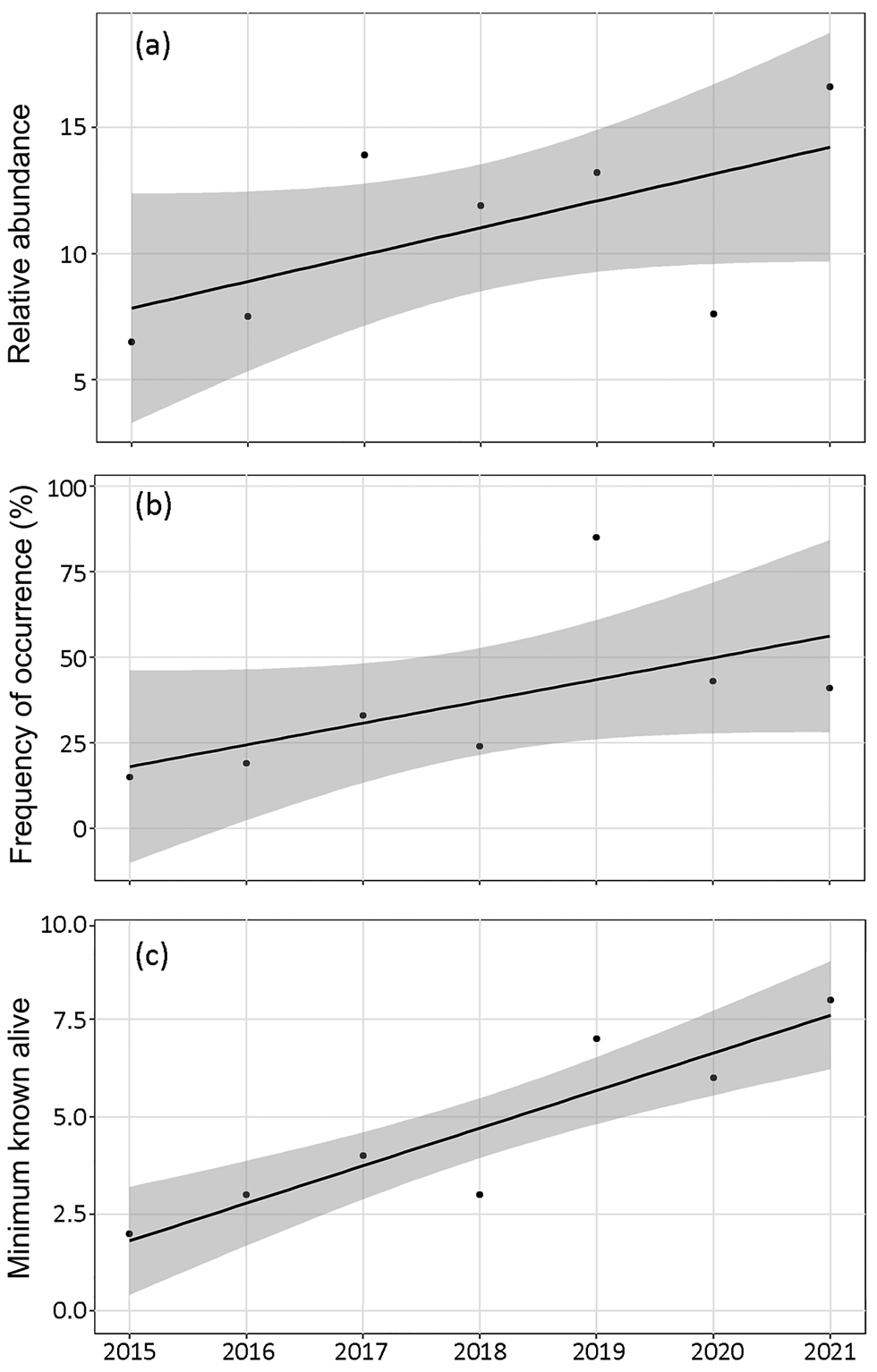
Using the modified Harmsen et al. (Reference Harmsen, Foster, Sanchez, Gutiérrez-González, Silver and Ostro2017) method, the residential status of two males was classified as undetermined (22%), five males were classified as resident (55%) and two males (22%) and both females (100%) as transient (Table 2). The per cent range of the activity centres of individuals contained within the Park boundaries was 52–100%. Resident jaguars had activity centres that were predominantly contained within the Park boundaries (mean 96.6%, range 90.2–99.9%), more so than for all other jaguars (mean 85.0%, range 52.1–100%). All indices of abundance (i.e. RAI, frequency of occurrence and minimum-known-alive information) for jaguars exhibited slight positive trends over time (Fig. 2).
Trends in jaguar Panthera onca (a) relative abundance (events/100 trap-nights), (b) frequency of occurrence (per cent of camera traps capturing jaguars) and (c) minimum known alive (number of jaguars in a given year) during the study period in Corcovado National Park, Costa Rica (Fig. 1). Lines are generalized linear model fit trendlines, grey areas are 95% confidence intervals.

Spatially explicit Jolly–Seber mark-recapture model
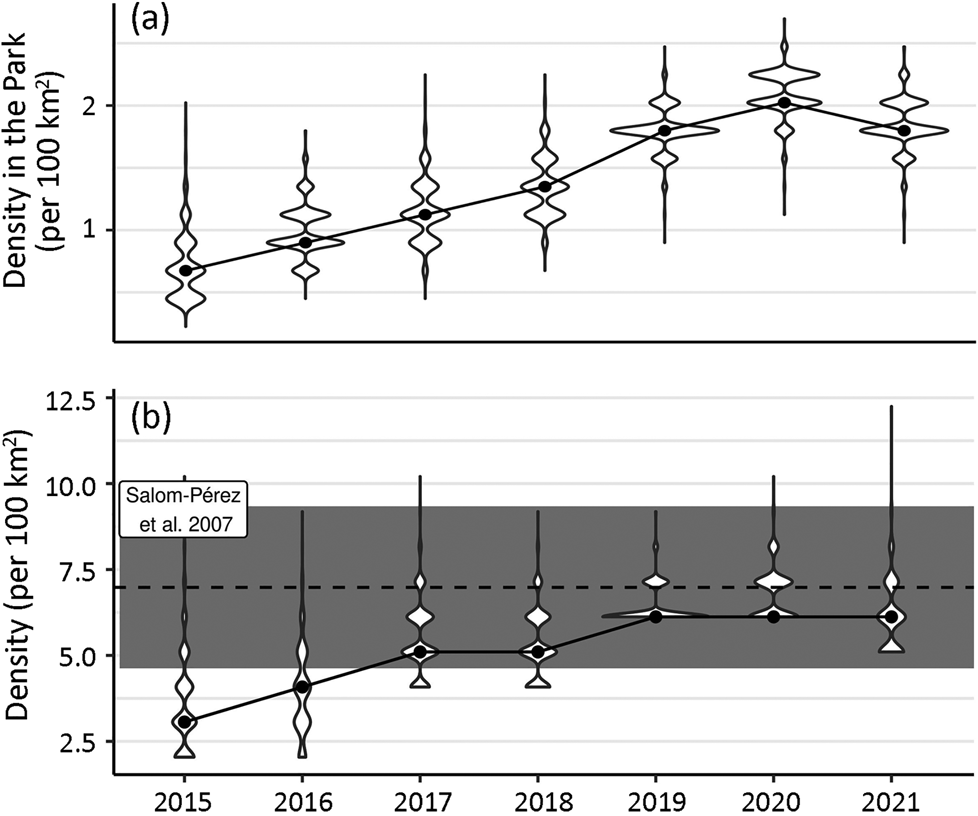
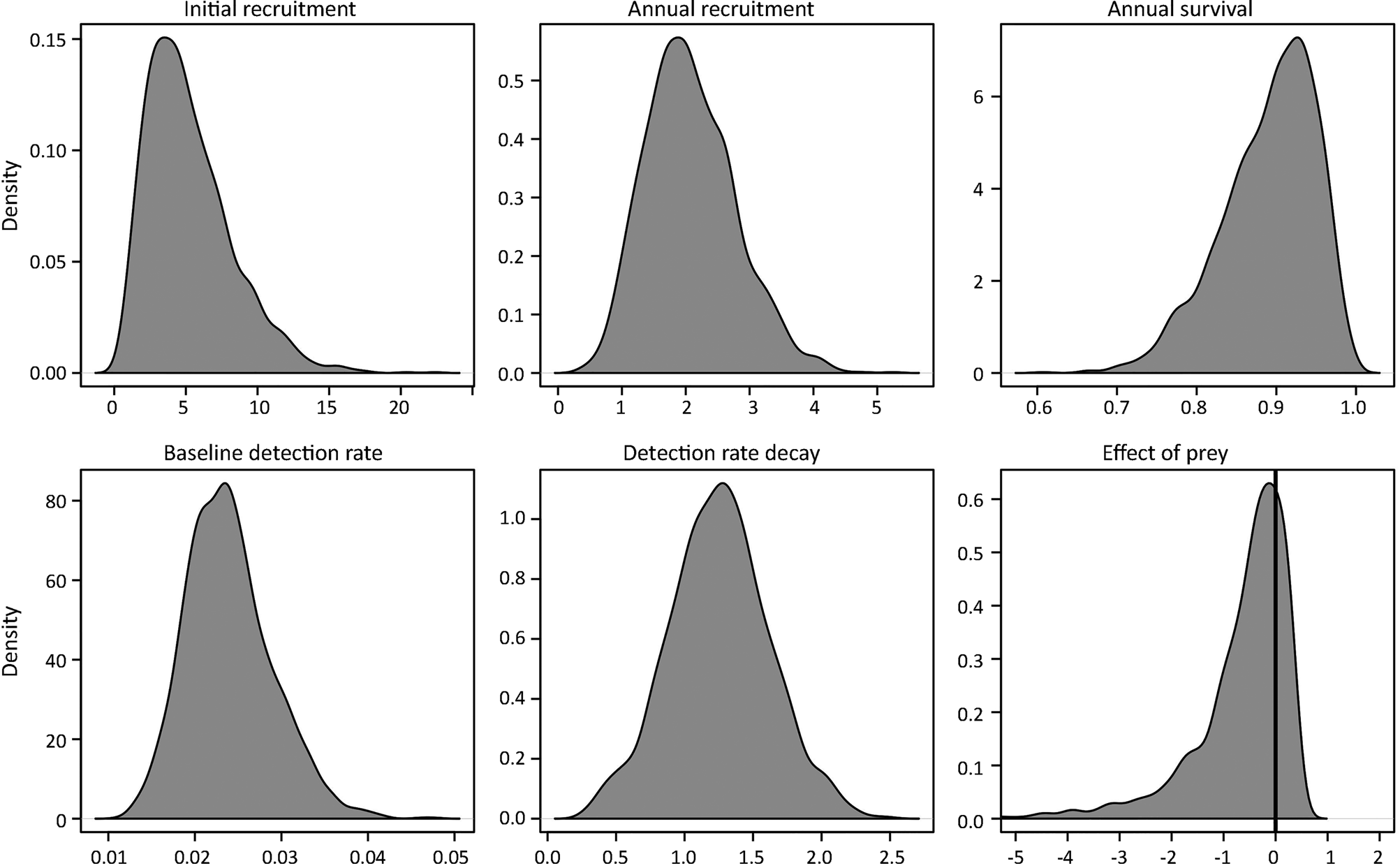
Jaguar density in the National Park increased over time from an estimate of 0.44 per 100 km2 (95% credible interval (CrI) 0.22–0.99) in 2015 to 1.21 per 100 km2 (95% CrI 1.10–1.54) in 2020 (Fig. 3a). Annual recruitment was 2.01 individuals (95% CrI 0.90–3.56) and annual survival rate 0.90 (95% CrI 0.76–0.98; Fig. 4). White-lipped peccary abundance did not exhibit a significant effect on jaguar spatial selection (Fig. 4).
Jaguar density estimates (per 100 km2) derived from a spatially explicit Jolly–Seber capture–recapture model for (a) Corcovado National Park, and (b) the study area of Salom-Pérez et al. (Reference Salom-Pérez, Carrillo, Sáenz and Mora2007) within the Park. Black dots indicate modal density estimates, with 95% credible intervals (violin plots). The line highlights the general trend. (b) Density estimates from 2003, as reported by Salom-Pérez et al. (Reference Salom-Pérez, Carrillo, Sáenz and Mora2007), are indicated by the dashed line, with the dark grey area representing the error range.

Probability distributions (i.e. densities) for jaguar vital rates derived from a spatially explicit Jolly–Seber capture–recapture model for Corcovado National Park. Initial recruitment: number of jaguars estimated alive in 2015. Annual recruitment: number of jaguars expected to be recruited within the population each year. Annual survival: expected survival of individuals throughout our study period. Baseline detection rate: jaguar detection probability. Detection rate decay: rate at which the detection probability is expected to decrease over time. Effect of prey: β coefficient for the effect of interpolated mean white-lipped peccary Tayassu pecari abundance over the course of the study.

Jaguar density was highest in three general areas of the National Park: (1) the bajura and the north-central mountainous region (i.e. the Bajura, Los Planes and Rancho Quemado wildlife monitoring sectors; Fig. 1), (2) along Playa Corcovado (e.g. sector Llorona), and (3) the south-east mountainous region (sectors El Tigre, Oro and Leona; Fig 5, Supplementary Fig. 1). Three jaguars had overlapping activity centres in the south-east mountainous region, four jaguars had overlapping activity centres in the bajura/north-central mountainous region, at least two jaguars had overlapping activity centres along Playa Corcovado (sector Llorona) and the remaining two jaguars had an activity centre that was broad-ranging (Supplementary Fig. 1).
Distributions of jaguar density (shaded areas) derived from a spatially explicit Jolly–Seber capture–recapture model (2015–2021) relative to camera-trap locations with and without jaguar detections, grid points within 10 km of a camera trap used in the model, and the study area of Salom-Pérez et al. (Reference Salom-Pérez, Carrillo, Sáenz and Mora2007) for Corcovado National Park.

To assess the importance of connectivity for this population we forecasted jaguar populations for 2 years using model outputs, and again under a scenario in which recruitment was doubled (i.e. increased immigration). Density of jaguars in Corcovado National Park was projected to increase substantially under the enhanced immigration scenario (Supplementary Fig. 2).
Using a contracted dataset within the study area of Salom-Pérez et al. (Reference Salom-Pérez, Carrillo, Sáenz and Mora2007), jaguar abundance in this smaller area increased over time, similar to the trends observed for the entire study area. For 2015 and 2016 jaguar density estimates fell largely outside the range of error for the density estimates for 2003 given by Salom-Pérez et al. (Reference Salom-Pérez, Carrillo, Sáenz and Mora2007; although 95% credible intervals were overlapping), but modal estimates for all remaining years were within the range of error for the density estimates given by Salom-Pérez et al. (Reference Salom-Pérez, Carrillo, Sáenz and Mora2007; Fig. 3b). These densities are inflated because of use of the constrained study area and dataset.
Qualitative observations of jaguar reproduction and mortality
During 2015–2021 we observed signs of reproduction within or near Corcovado National Park. In 2019 we observed a recently independent young adult male (El Hijo). In 2021 we observed examples of reproductive behaviour (Vivi with El Trotomundo) and a postnatal female (Vivi; mammary glands visibly enlarged), further supported by observations of tracks of an adult female with young in the same area. Preliminary data from recent surveys also indicate reproduction (e.g. 2022: a new adult female, Azul, with a juvenile, Celeste; 2023: Vivi with a juvenile, Aurora; juvenile Dani in 2022). We documented one mortality: a skull from a juvenile jaguar in 2023. Our observations suggest this juvenile jaguar may have died because of infanticide. We have no other verified reports of jaguar mortalities within the National Park during our study period. However, mortality events are difficult to document.
Discussion
Long-term, well-designed monitoring programmes are crucial for wildlife conservation, especially for cryptic and threatened species such as the jaguar (Harmsen et al., Reference Harmsen, Foster, Sanchez, Gutiérrez-González, Silver and Ostro2017). This research is the most intensive (2015–2021; 23–59% coverage; 1,453 trap-nights per year on average) camera-trap monitoring ever conducted in Corcovado National Park, and we also examined jaguar population metrics using both a spatially explicit Jolly–Seber model and traditional indices.
Density comparison
Our results suggest that during 2015–2021 the jaguar population of Corcovado National Park has increased (Figs 2 & 3). Spatially explicit Jolly–Seber models allow researchers to estimate demographic parameters such as density, survival and recruitment for open populations of rare and cryptic species such as jaguars (Gardner et al., Reference Gardner, Reppucci, J., Lucherini and Royle2010). Our density estimates were higher than those from a spatially explicit capture–recapture model reported for the Brazilian Cerrado (0.29 ± SE 0.10 jaguars per 100 km2; Sollmann et al., Reference Sollmann, Furtado, Gardner, Hofer, Jácomo and Tôrres2011) and similar to those reported for the transitional Chaco-Chiquitano Forest in Bolivia (0.46–0.99 jaguars per 100 km2; Noss et al., Reference Noss, Gardner, Maffei, Cuéllar, Montaño and Romero-Muñoz2012), studies that used similar analytical approaches to ours. However, our results are much lower than those reported for jaguars in the Atlantic Forest of Brazil (3.22 jaguars per 100 km2, 95% CI 1.29–7.98; Srbek-Araujo & Chiarello, Reference Srbek-Araujo and Chiarello2017) and in the Peruvian Amazon (3.3–12.2 jaguars per 100 km2; Tobler et al., Reference Tobler, Carrillo-Percastegui, Zúñiga and Powell2013). Jaguar density is significantly influenced by anthropogenic disturbance, prey density and forest connectivity (Sollmann et al., Reference Sollmann, Furtado, Gardner, Hofer, Jácomo and Tôrres2011; Noss et al., Reference Noss, Gardner, Maffei, Cuéllar, Montaño and Romero-Muñoz2012). Our estimates of jaguar density are comparable to those for other sites with similar conditions, but we would expect jaguar density estimates for Corcovado National Park to be lower than those in larger and relatively higher-quality sites (e.g. 1,320 km2 Emas National Park, Sollmann et al., Reference Sollmann, Furtado, Gardner, Hofer, Jácomo and Tôrres2011; 34,400 km2 Kaa-Iya del Gran Chaco National Park, Noss et al., Reference Noss, Gardner, Maffei, Cuéllar, Montaño and Romero-Muñoz2012; > 14,000 km2 Peruvian Amazon, Tobler et al., Reference Tobler, Carrillo-Percastegui, Zúñiga and Powell2013; > 495 km2 Brazilian Atlantic Forest Reserves, Srbek-Araujo & Chiarello, Reference Srbek-Araujo and Chiarello2017). However, observed differences in jaguar density could also be because of subtle differences in methodology employed between these studies.
Additionally, it is important to note that: (1) jaguar density in Corcovado National Park varied substantially in space (Fig. 5), (2) our density estimates are based on the mean jaguar density for the entire National Park, and (3) jaguar density estimates will be less reliable farther from camera-trap sites. Thus, we expect our density estimates to be most representative of the area covered by our camera traps and urge caution in applying our density estimates too broadly.
Quigley et al. (Reference Quigley, Foster, Petracca, Payan, Salom and Harmsen2018) summarized jaguar density estimates for Mesoamerica from 27 separate studies published during 2000–2010 and reported a range of 0.74–11.20 jaguars per 100 km2. However, density estimates from historical camera-trap surveys have come under increased scrutiny (Maffei et al., Reference Maffei, Noss, Silver, Kelly, O'Connell, Nichols and Karanth2011; Tobler & Powell, Reference Tobler and Powell2013). Quigley et al. (Reference Quigley, Foster, Petracca, Payan, Salom and Harmsen2018, p. 6) capture the arguments well:
Unfortunately, many…reported density estimates have inadequate sample sizes of area or capture and recaptures. Careful reviews have shown that these estimates tend to be biased positively rather than negatively…This means that many of the older publications from before 2010 tended to overestimate densities at an unknown quantity. It also means that previous assessments have been overly optimistic about jaguar status throughout their range.
Thus, to compare our results with the most recent jaguar density reported for Corcovado National Park (Salom-Pérez et al., Reference Salom-Pérez, Carrillo, Sáenz and Mora2007), we had to reanalyse our data using their smaller study area. Within this, jaguar densities increased over time, similar to that observed for the entire study area. Although jaguar density estimates for this contracted study area and dataset in 2015 and 2016 fell largely outside the range of error for the density estimates of Salom-Pérez et al. (Reference Salom-Pérez, Carrillo, Sáenz and Mora2007) for 2003 (although the 95% credible intervals overlapped), all remaining years were near their modal estimate and well within their range of error (Fig. 3b). These results suggest that current jaguar density estimates are at least similar to those in 2003 (Salom-Pérez et al., Reference Salom-Pérez, Carrillo, Sáenz and Mora2007).
Jaguar distribution
Jaguars were distributed in three main areas of the National Park (the bajura/north-central mountains, Playa Corcovado and the south-eastern mountainous region). Although the effect of prey abundance was essentially non-existent, white-lipped peccary herds have been detected in these areas (Olson et al., Reference Olson, Shipley-Mellon, Kolasch, Azofeifa, Mora, Herrera and Saborio-R2022). We suspect that our use of an interpolated mean relative abundance as a metric of prey abundance may not have adequately captured variation in prey density.
Compared with the distribution of our camera traps, jaguar activity centres demonstrated potential spatial gaps in camera-trapping monitoring, which could be a focus of future monitoring efforts. There were no cameras in the relatively mountainous Oro and Rancho Quemado sectors (within the Park boundaries) during our study, but they appear to be important areas for jaguar activity. Additionally, the mountainous sectors of Los Planes, San Pedrillo and El Tigre were partially covered by our survey efforts, but expansion into additional areas within these sectors may be warranted.
Population vital rates
In addition to documenting the number of jaguars in the landscape, other metrics can also provide insights into the health of a population. We estimated a recruitment rate of 2.01 individuals per year (Fig. 4), indicating a growing population. Our recruitment rate was, however, lower than estimates for Cockscomb Basin Wildlife Sanctuary in Belize (3.3 males and 2.8 females on average per year; Harmsen et al., Reference Harmsen, Foster, Sanchez, Gutiérrez-González, Silver and Ostro2017). We estimated an annual survival rate of 0.90 (Fig. 4), suggesting that jaguars in Corcovado National Park have a high year-to-year survival probability and relatively low annual mortality risk. Our survival estimates were higher than those reported (c. 0.78) by Harmsen et al. (Reference Harmsen, Foster, Sanchez, Gutiérrez-González, Silver and Ostro2017) and those reported by Gutiérrez-González et al. (Reference Gutiérrez-González, Gómez-Ramírez, López-González and Doherty2015) for a population in northern Mexico (0.47–0.56). The long-term study by Harmsen et al. (Reference Harmsen, Foster, Sanchez, Gutiérrez-González, Silver and Ostro2017) provides one of the best comparisons for Mesoamerican jaguar population vital rates, in part because their study area is similar in size (490 km2) to ours and is one of the highest-quality jaguar habitats in Mesoamerica, with limited anthropogenic impacts. It is probable that the survival rate estimated by Harmsen et al. (Reference Harmsen, Foster, Sanchez, Gutiérrez-González, Silver and Ostro2017) was lower than we observed because of individuals emigrating from their high-quality and relatively stable high-density study area. The relatively high jaguar survival rates in our study are also evident based on the minimum years alive of individuals. One individual in our study, Macho Uno, is now amongst the oldest wild jaguars ever recorded (Table 2; Olson et al., Reference Olson, Matzinger, Saborio-R and Carazo-Salazar2019a,Reference Olson, Saborio-R and Carazo-Salazarb). Based on minimum years alive, four jaguars have been alive within the study area for at least 6 years (Table 2). Such observations suggest a high-quality habitat with an adequate prey base and sufficient protection (Olson et al., Reference Olson, Matzinger, Saborio-R and Carazo-Salazar2019a).
Although Corcovado National Park is probably a high-quality habitat with adequate prey and protection, we suspect it may suffer from reduced immigration. For example, Cockscomb Basin Wildlife Sanctuary abuts the Maya Mountain Massif, a large protected area (5,900 km2), and is surrounded by predominantly forested lands. Corcovado National Park, on the other hand, is on the tip of the Osa Peninsula between Golfo Dulce Forest Reserve (605 km2) and the Pacific Ocean (Soto et al., Reference Soto, Beirne, Whitworth, Diaz, Flatt and Pillco-Huarcaya2021). Connectivity has been a long-standing concern for the wildlife of Corcovado National Park (Salom-Pérez et al., Reference Salom-Pérez, Carrillo, Sáenz and Mora2007; Beal et al., Reference Beal, Matzinger, Saborio-R, Bristan and Olson2020; McCullough et al., Reference McCullough, Beirne, Soto-Navarro, Eppert, Flatt and Kemp2024). We suspect that reduced connectivity between the Park and other jaguar populations partially explains the reduced recruitment rates observed in comparison to Harmsen et al. (Reference Harmsen, Foster, Sanchez, Gutiérrez-González, Silver and Ostro2017). Meyers et al. (Reference Meyers, Moreno, Sutherland, de la Torre, Esser and Jordan2019) found that jaguars were particularly sensitive to reductions in landscape-level connectivity, and Soto et al. (Reference Soto, Beirne, Whitworth, Diaz, Flatt and Pillco-Huarcaya2021) found that jaguars were sensitive to anthropogenic landscape modifications within our study area. Thus, efforts to enhance connectivity and reduce anthropogenic disturbance in and around protected areas such as Corcovado National Park would be beneficial to jaguars. When we forecasted jaguar populations for the next 2 years, we found that doubling recruitment rates (i.e. enhancing immigration) caused the population to grow at a faster rate. These findings further highlight the need for continued conservation of lands functioning as corridors between Corcovado National Park and other protected areas with jaguars such as La Amistad International Park.
We detected 11 jaguars (two females and nine males), with a total sex ratio of 0.22 females per male and an annual sex ratio range of 0–1 females per male. The sex ratio reported by Salom-Pérez et al. (Reference Salom-Pérez, Carrillo, Sáenz and Mora2007; 0.75 females per male) lies within this. Sex ratio is an important demographic parameter for understanding population dynamics; however, estimates of sex ratios for jaguars need to be interpreted cautiously. Throughout jaguar range, camera-trap studies have generally resulted in a male bias (Harmsen et al., Reference Harmsen, Foster, Sanchez, Gutiérrez-González, Silver and Ostro2017), potentially because males have larger home ranges (Tobler et al., Reference Tobler, Carrillo-Percastegui, Zúñiga and Powell2013; Morato et al., Reference Morato, Stabach, Fleming, Calabrese, De Paula and Ferraz2016) or are more likely to use trail systems (Harmsen et al., Reference Harmsen, Foster, Sanchez, Gutiérrez-González, Silver and Ostro2017; Montalvo et al., Reference Montalvo, Saenz-Bolanos, Cruz-Diaz, Kamilar, Carrillo and Fuller2023). For example, Harmsen et al. (Reference Harmsen, Foster, Sanchez, Gutiérrez-González, Silver and Ostro2017) estimated that male jaguars had detection probabilities 2.1–9.4 times greater than those of females. Such bias leads to an underestimation of female jaguars. Thus, we expect there are other females in the National Park that were not detected by camera traps. That both observed females were transient based on the modified Harmsen et al. (Reference Harmsen, Foster, Sanchez, Gutiérrez-González, Silver and Ostro2017) method is probably in part because of the reduced detection probabilities for females. We have already detected an additional female jaguar during our 2022 survey that was probably present in the study area during our study.
Jaguar populations often contain both resident and transient individuals (Harmsen et al., Reference Harmsen, Foster, Sanchez, Gutiérrez-González, Silver and Ostro2017). In our study area resident jaguars have relatively stable home ranges over time and largely reside within the area, whereas transient jaguars have relatively unstable or non-existent home ranges and are present only sporadically (Table 2, Supplementary Fig. 2). We used two approaches to gain insights into the status of jaguars in Corcovado National Park. These approaches indicated that five males (Macho Uno, El Trotomundo, Espejo, Calvin and Don Álvaro) were resident, with activity centres predominantly (> 90%) within the Park. Three of the seven individuals classified as undetermined or transients were individuals detected in only 1 year, and other individuals were only detected in 2 years. Reliance on detection histories, especially with known detection biases against female jaguars, could result in resident jaguars being classified as transient because of a failure to detect them. For example, Vivi was classified as transient despite the fact that our observations suggested she was probably present within her home range during the entire study period (Supplementary Fig. 1).
Conservation crisis?
Our findings indicate that jaguars in Corcovado National Park may not be in a state of crisis. Rather, our data indicate a relatively healthy and growing population. The jaguar densities we recorded were comparable to densities in other areas of jaguar range containing healthy jaguar populations, as well as to the jaguar density estimates for the Park in 2003 (Salom-Pérez et al., Reference Salom-Pérez, Carrillo, Sáenz and Mora2007). Density estimates and population indices increased over time, suggesting a growing population, which was corroborated by estimated high survival rates and positive recruitment rates. Additionally, we observed evidence of recent reproductive activity throughout our study, and jaguar individual minimum years alive and residential status data indicate that the National Park contains suitable habitat with adequate prey to support jaguar populations. Although our findings suggest hope for the future of jaguars in Corcovado National Park, they do not diminish the importance of continued conservation. To ensure the conservation of jaguars in the Park, we must continue to work together, both within and outside the Park. Although efforts outside the Park have developed and are exhibiting signs of success, we encourage more formal protection of habitat corridors connecting Corcovado National Park to other protected areas. In addition, efforts to conserve jaguars, their prey and their habitat within the Park need to be maintained, to ensure the long-term persistence of jaguars there.
Author contributions
Study design: ERO, PJM, GS-R, AA; fieldwork: ERO, PJM, ETSM, AA; funding acquisition: ERO, PJM, GS-R, AA; data analysis: ERO, YS; writing: ERO, YS, GS-R.
Acknowledgements
We thank W. Montes Fernandez, D. Herrera, E. Olmos, C. Aguilar, M. Carvajal, O. Rimbert, H. Santamaría, J.L. Sánchez, M. Peterson, A. Shipley-Mellon, M.R.W. Beal, J. Franke, J. Kolasch, A. Smith, V. Chevalier, G. Scott, N. Barton, R. Gibson, J. Johnson, W. Isakson, G. Crabbs, Area de Conservación Osa–Sistema Nacional de Areas de Conservacion (SINAC-ACOSA) staff and local guides, and two anonymous reviewers and the editor for their comments. This project was funded in part by Sigurd Olson Professorship in Natural Sciences and Northland College Professional Development Funds to ERO, Explorers Club to PJM, Northland College McLean Travel Grant and Northland College Parsonage Fund for Student Opportunities to PJM, SINAC-ACOSA to AA, ETSM and GS-R, and a generous donation from the Matzinger Family. The research was completed under SINAC-ACOSA research permits INV-ACOSA-004-15, INV-ACOSA-007-16, INV-ACOSA-0010-17, INV-ACOSA-022-18, INV-ACOSA-023-19, INV-ACOSA-023-20 and SINAC-ACOSA-DASP-PI-R-003-2021. We thank MIT SuperCloud and Lincoln Laboratory Supercomputing Center for providing high-performance computing resources. ERO thanks Lindi Olson for her unwavering support. This work is dedicated to the memory of Parker J. Matzinger: he was a burst of light.
Conflicts of interest
None.
Ethical standards
This research abided by the Oryx guidelines on ethical standards and was conducted in a socially responsible manner that does not violate privacy or cause other unnecessary harm. Following Sharma et al. (Reference Sharma, Fiechter, George, Young, Alexander and Bijoor2020), the National System of Conservation Areas granted all necessary permits to install the camera traps. The main goal of the camera traps was to gather information about wildlife within Corcovado National Park; however, as this is a collaborative project between Northland College and the Costa Rican National System of Conservation Areas, images providing information about illegal activities were shared with the Law Enforcement Department to be used in accordance with legislation in Costa Rica.
Data availability
Because of the sensitivity of jaguar location information, data cannot be made available. Code and workflow for analysis can be found at github.com/YunyiShen/Costa-Rica-Jaguar.




 Open access

