


By the end of the fourteenth century AD, Native peoples throughout what is today the midwestern and southeastern United States had withdrawn, or had begun to withdraw, from many major centers of population established in the preceding centuries; this resulted in a significant reduction in population density across entire regions amid a wave of migrations spanning generations (Cobb and Butler Reference Cobb and Butler2002, Reference Cobb, Butler, Brian and Paul2006; Emerson and Hedman Reference Emerson, Hedman and Ronald2016; Krus and Cobb Reference Krus and Cobb2018; Krus et al. Reference Krus, Herrmann, Friberg, Bird and Wilson2023; Munoz et al. Reference Munoz, Gruley, Massie, Fike, Schroeder and Williams2015; Williams Reference Williams, Dye and Cox1990). These depopulation events and their accompanying relocations fundamentally altered the geopolitical landscape of the Midwest and Southeast (Anderson Reference Anderson1991; Meeks and Anderson Reference Meeks, Anderson, John and Sue2013). One of the better-known Middle to Late Mississippian depopulations was that of the Savannah River Valley (SRV) circa AD 1400 (Anderson Reference Anderson1994; Ritchison Reference Ritchison2018; Ritchison and Anderson Reference Ritchison, Anderson, Robert and Aaron2022). Not only were major centers of the SRV left unoccupied but the broader region also remained depopulated at the time of the Soto entrada more than a century later (Hudson Reference Hudson1998).
The Late Mississippian Irene period (around AD 1300/1350–1590; see Table 1) of the Georgia Coast is characterized by a significant transformation in settlement—an increase in settlement intensity and the emergence of a four-tiered site-size hierarchy (Caldwell and McCann Reference Caldwell and McCann1941; DePratter Reference DePratter1974; Moore Reference Moore1897; Pearson Reference Pearson1977)—and in subsistence practices; for example, the introduction of maize agriculture into a long-established estuarine fisher-hunter-gatherer subsistence regime (Thomas Reference Thomas2008a, Reference Thomas2008b). Irene period peoples established more sites than during any preceding period, an increase driven primarily by the establishment of new components in locations never previously occupied (Ritchison Reference Ritchison2018; Turck and Thompson Reference Turck and Thompson2016).
Currently Accepted Chronology for the Georgia Coast and Associated Ceramics Used in This Analysis.

The significant increase in new single-component sites could simply represent a shift to more dispersed settlement if increases in population did not accompany this shift. Yet, populations did increase on the Georgia Coast during the fourteenth century, and into the fifteenth century AD, following the depopulation of the major population centers of the SRV (Anderson Reference Anderson1994; Pearson Reference Pearson1977, Reference Pearson2014; Ritchison Reference Ritchison2018, Reference Ritchison2020a, Reference Ritchison2020b; Thomas Reference Thomas2008b; Thompson and Turck Reference Thompson and Turck2009). The coastal zone of Georgia was one of several probable destinations for many emigrants, the region likely having been integrated into networks of trade with interior groups—primarily through the exchange of marine shell, perhaps finished beads, and leaves of Ilex vomitoria used to produce asi lustee, the ritually significant “white drink” or “black drink” of the Muscogee and others (Chaudhuri and Chaudhuri Reference Chaudhuri and Chaudhuri2001; Garland et al. Reference Garland, Ritchison, Tucker and Thompson2023; Pearson Reference Pearson2019; Pearson and Cook Reference Pearson and Cook2012; Thompson and Worth Reference Thompson and Worth2011). There are also strong similarities in ceramics between the two regions (Williams and Thompson Reference Williams and Thompson1999), demonstrating that residents of the SRV and the coast shared elements of cultural practices.
Thus, the Irene period settlement transformations on the Georgia Coast were likely instigated by the arrival of immigrants from the Savannah River Valley beginning during the latter half of the fourteenth century (Ritchison Reference Ritchison2018; Ritchison and Anderson Reference Ritchison, Anderson, Robert and Aaron2022). Although the stylistic similarities and the cross-regional adoption of new pottery styles concomitant with the depopulation of the valley complicate the identification of immigration via the intrusion of distinctly nonlocal ceramics, the argument for immigration is strongly supported by the juxtaposition of the timing of coastal settlement expansion and the depopulation of the SRV, as similarly argued by Cordell (Reference Cordell1995) for the Rio Grande Valley. A Bayesian chronological model of single-component Irene sites—the element of settlement patterning that experienced the greatest change during the Irene period—places the establishment of these sites between cal AD 1355 and 1400 (at the 68.3% HPD; Ritchison Reference Ritchison2018). This corresponds to the end of occupation at the major centers of Savannah River Valley during the final quarter of the fourteenth century (Stephenson et al. Reference Stephenson, King, Smith, Gougeon and Meyers2015). The scale and rate of changes observed suggest that in situ population growth was not the primary cause of these changes but instead an influx of people occurred during the span of one or a few generations (Ritchison Reference Ritchison2018; Ritchison and Anderson Reference Ritchison, Anderson, Robert and Aaron2022; Thomas Reference Thomas2008b).
Although its centrality in archaeological narratives has waned—and more recently waxed—over the last half-century, migration is a prominent process in the developmental trajectories of human societies (Anthony Reference Anthony1990; Baker and Tsuda Reference Baker and Tsuda2015; Burmeister Reference Burmeister2000; Clark et al. Reference Clark, Birch, Hegmon, Mills, Glowacki, Ortman and Dean2019; Cook and Comstock, eds. Reference Cook and Comstock2022; Gori et al. Reference Gori, Lami and Pintucci2018; McSparron et al. Reference McSparron, Donnelly, Murphy and Geber2020; Pluckhahn et al. Reference Pluckhahn, Wallis and Thompson2020; Van Dommelen Reference Dommelen2014). A migration is a movement of people across a boundary, be that cultural, political, or environmental, that involves a departure and an eventual relocation (Tsuda et al. Reference Tsuda, Baker, Eder, Knudson, Maupin, Meierotto, Scott, Brenda and Tsuda2015:19). Because migrations occur at multiple demographic and temporal scales, and are historically contingent in both process and outcome, archaeologists must contend with material signatures across scales, ranging from obtrusive to ephemeral, when identifying and investigating past cases of population movement. This variability makes migration a challenging process to examine archaeologically. Further complicating this, migration events are driven by the decisions of discrete social units such as households, clans, and towns that are not equally visible throughout the extant, global archaeological record. For example, scholars of the American Southwest, where there is a relatively high degree of preservation and temporal control, have led in the development of theory and method in the study of past human migrations. There, the culturally generative role of both small- and large-scale migration in times of uncertainty and socioenvironmental stress has been shown to be central to the historical development of southwestern peoples (e.g., Bernardini Reference Bernardini2005; Cabana and Clark Reference Cabana and Clark (editors)2011; Cameron Reference Cameron1995; Clark et al. Reference Clark, Birch, Hegmon, Mills, Glowacki, Ortman and Dean2019; Duff Reference Duff2002).
However, with a relatively less well-preserved archaeological record and a legacy of less precise chronological controls, archaeological studies exploring migrations in the American Southeast—early hypotheses notwithstanding (e.g., McKern Reference McKern1937; Rouse Reference Rouse1940)—have been more limited (Pluckhahn et al. Reference Pluckhahn, Wallis and Thompson2020). Where such research has been conducted, it has largely focused on the complex agricultural societies of the late precolonial and early contact periods (around AD 1000–1700), particularly on the emergence and spread of the Mississippian cultural bundle (Alt Reference Alt, Brian and Paul2006; Anderson Reference Anderson1994; Beck Reference Beck2013; Blitz and Lorenz Reference Blitz and Lorenz2002; Cobb and Butler Reference Cobb and Butler2002, Reference Cobb, Butler, Brian and Paul2006; Comstock and Cook Reference Comstock and Cook2021; Cook and Comstock, eds. Reference Cook and Comstock2022; Cook and Price Reference Cook and Price2015; Krus and Cobb Reference Krus and Cobb2018; Pauketat et al. Reference Pauketat, Boszhardt and Benden2015; Williams Reference Williams, Dye and Cox1990).
Many of the efforts to examine Mississippian migration events focus on the role that population movements played in the fluorescence of Cahokia and the spread of its influence during the Early Mississippian period (Alt Reference Alt, Brian and Paul2006; Cook and Comstock Reference Cook, Comstock, Robert and Aaron2022; Cook and Comstock, eds. Reference Cook and Comstock2022; Hedman et al. Reference Hedman, Emerson, Fort, Lambert, Betzenhauser, Pauketat, Robert and Aaron2022; Lambert and Ford Reference Lambert and Ford2023; Mehta and Connaway Reference Mehta and Connaway2020; Pauketat et al. Reference Pauketat, Boszhardt and Benden2015). Cahokia is understood to have been a cosmopolitan urban center where peoples from across the North American midcontinent gathered and formed a new conception of life and society at about AD 1050 (Pauketat et al. Reference Pauketat, Alt, Betzenhauser, Kruchten and Benson2023). As with many migrations, this flow was bidirectional, with peoples flowing into Greater Cahokia and Cahokians returning to these homelands, as well as joining existing or establishing new settlements in other regions (Schroeder et al. Reference Schroeder, White, Stevens, Munoz, Robert A. and Aaron R.2022). Over the following century, peoples throughout the Midwest and Southeast established new monumental centers where populations, as well as political and religious power, coalesced. These major centers may have been following the example of Cahokia or tracing similar developmental trajectories because of shared experiences of changing climates, technology, and population increase.
Yet, when comparing our knowledge of large-scale population movements in the American Southwest to those now apparent in the Eastern Woodlands, scholars of the Mississippian period have frequently struggled to identify specific migration routes from source to destination, have perhaps overemphasized environmental factors as determinates, and, in many cases, have not developed a clear understanding of how the impacts of either losing or receiving populations at the community level were experienced by migrants and non-migrants or locals. Thus, lacking some of the strengths of archaeological records of other regions here in the Eastern Woodlands (e.g., temporal control), much remains to be learned about relationships between population movements and attendant social transformations among these largely sedentary or agricultural societies with “developed notions of place and territory” (Cobb Reference Cobb2005). Migrations involving such societies can result in social frictions, requiring interacting groups to resolve their competing interests (Clark et al. Reference Clark, Birch, Hegmon, Mills, Glowacki, Ortman and Dean2019). Competing interests would have revolved around common resources, such as hunting grounds, fisheries, and farmland, creating problems of collective action (Blanton and Fargher Reference Blanton and Fargher2016; Carballo et al. Reference Carballo, Roscoe and Feinman2014; Ostrom Reference Ostrom2004; Thompson Reference Thompson2023). Although archaeologists have engaged with the history of collective action problems and their solutions, much of this effort has been spent on examining state-level societies (Blanton and Fargher Reference Blanton and Fargher2008; Reference Blanton and Fargher2016; Thompson Reference Thompson2023). Yet, collective action problems have faced human groups at all scales, from residents of urbanized hierarchical states to members of mobile bands of hunters, fishers, and foragers (Thompson Reference Thompson2023).
Of the large-scale depopulation events and resultant movements presently known in the Eastern Woodlands, the case of the fourteenth-century AD Savannah River Valley and Georgia Coast provides an opportunity to better understand how such events were experienced by a local population as they received a significant influx of migrants. In this case, we know much about the patterns of depopulation and something of the motivations of the emigrants—push factors relating to drought and competition-related stresses on the valley’s agriculturally supported political economies (Anderson Reference Anderson1994)—as well as of the state of things in the receiving region (Thomas Reference Thomas2008b).
Here, my objective is to examine how coastal communities responded to challenges posed by immigration, especially in terms of reorganizing space at the local and regional levels. To do so, I examine recent intra-site shovel test surveys at cultural sites that are characteristic of several levels of the region’s described settlement hierarchy (Pearson Reference Pearson1977). These surveys, on and near Sapelo Island, Georgia, provide new insight into how a large-scale immigration event affected community spatial organization. I examine what the archaeological record of the barrier-island Kenan Field site (9MC67) and of the surrounding back-barrier island sites reveals about community-level responses to the challenges posed by the integration of coastal fisher-hunter-gathers and immigrant Mississippian farmers. I then explore the collective action challenges that arose from this immigration event, considering the perspectives of both migrants and coastal locals. Finally, I integrate the changes in spatial organization at the dispersed community of Kenan Field with existing archaeological and ethnohistoric evidence to describe how these challenges may have been addressed and resolved by a reinvestment in traditional institutions of community organization.
Methods
To investigate responses to the Irene period immigration event at the community level, I examined the spatial patterning of settlements at four sites on and near Sapelo Island: Kenan Field, Mary Hammock, Little Sapelo Island, and Patterson Island (Ritchison Reference Ritchison2019; Thompson and Pluckhahn Reference Thompson and Pluckhahn2010; Turck and Thompson Reference Turck and Thompson2010, Reference Turck and Thompson2011, Reference Turck and Thompson2012; see Figure 1). In 2007 and 2008, Thompson and Roberts Thompson (Reference Thompson and Thompson2010) and Turck and Thompson (Reference Turck and Thompson2010, Reference Turck and Thompson2011, Reference Turck and Thompson2012) conducted systematic shovel test surveys on four small islands (called hammocks or hummocks) located between Sapelo Island and the mainland: Mary Hammock, Little Sapelo Island, Patterson Island, and Pumpkin Hammock. Using the same methods, I excavated the neighboring Kenan Field site on the western shore of Sapelo Island between 2013 and 2021 to reconstruct its internal spatial organization during the Mississippian period.
Locations of the surveyed sites discussed in the text. (Color online)

Kenan Field, covering 635,980 m2, includes two uninvestigated earthen mounds, a linear embankment, more than 500 surface shell middens, and buried deposits dating from the Late Archaic period to the modern era (Crook Reference Crook1978, Reference Crook and Daniel1980a, Reference Crook and Daniel1980b; Ritchison Reference Ritchison2019, Reference Ritchison2020a, Reference Ritchison2020b). Little Sapelo Island (448,567 m2), Patterson Island (182,026 m2), and Mary Hammock (104,352 m2) exhibit their own, less consistent occupations spanning the coastal region’s human history (Turck and Thompson Reference Turck and Thompson2010, Reference Turck and Thompson2011, Reference Turck and Thompson2012). Because of its small size and linear shape, Pumpkin Hammock was not part of the analyses described later, but its Mississippian period component and proximity to Kenan Field merit its inclusion in the discussion that follows. These sites are all surrounded by a highly productive salt marsh estuary and are connected by tidal creeks and rivers (Thomas Reference Thomas2008b).
To reconstruct physical community organization over time at these sites, I analyzed ceramic distribution data recovered from systematic shovel test surveys. At Kenan Field, I also produced 61 radiocarbon dates (Ritchison Reference Ritchison2020b) from secure, sub-plowzone contexts across the site. At each site, shovel tests were pre-plotted at 20 m intervals. Each shovel test was placed at known UTM NAD83 (Zone 17) coordinates using a combination of real-time kinematic GPS units, total stations, and handheld high-accuracy—1 m or less—GPS units. Each shovel test was excavated as a 50 × 50 cm test unit in arbitrary 20 cm levels. Excavated matrix was screened through at least ¼-inch mesh.
Ceramics collected during back-barrier island surveys and the Kenan Field survey were placed into typological categories following DePratter (Reference DePratter1991). However, because types may span multiple defined chronological periods, such as Refuge plain and Deptford check stamped, and some could only be classified as intermediate or indeterminate types—for example, Wilmington / St. Catherines plain or Savannah/Irene check stamped—ceramics were placed into analytical supra-periods (Turck Reference Turck2011). Ceramic material from the late precolonial Middle Mississippian through the colonial period can be especially difficult to categorize because of similarities in temper (sand/grit) and surface treatment; for example, the frequently overstamped complicated rectilinear and curvilinear motifs are difficult to differentiate without substantial surface area being available. Most sherds from Kenan Field, particularly the shallowly deposited late precolonial materials, have less than 10 cm2 of surface area, likely a result of postcolonial period agricultural plowing. Consequently, many sherds that could not be placed within a single typological category were placed into either a Middle/Late Mississippian or a Late Mississippian/colonial supra-period following Turck (Reference Turck2011). However, this was a conservative choice, and most of the material in these two overlapping supra-periods likely relates to Late Mississippian Irene period activities at the site (Ritchison Reference Ritchison2020a). Because most of these supra-periods overlap in time and are of different durations, many sherds were included in multiple supra-periods. Rather than being a weakness, this approach reflects the accumulation of human activities and material signatures that together would have structured the transformation of community layouts over the span of a human lifetime or lifetimes.
I used two methods to reconstruct the internal site structure for each site using the weight of ceramics recovered in each shovel test. First was natural neighbor interpolation, a method commonly used by archaeologists to visualize spatial distributions. The second method was the univariate Local Moran’s I test, also known as a LISA, or local indicators of spatial autocorrelation (Anselin Reference Anselin1995). I conducted these analyses in ESRI’s ArcGIS Pro (ver. 3.2) software.
The Local Moran’s I test measures local spatial autocorrelation and identifies spatial clusters and outliers (Anselin Reference Anselin1995). It compares the spatial distribution of a dataset to a series of random permutations of that set in which the position of data points is alternated to determine the likelihood that any given cluster of values—that is, a data point and its defined neighbors—within the set is random or nonrandom. Statistical significance is calculated only in terms of a pseudo p-value obtained by comparing the results of the test over these many random permutations of the data. Here, ceramic data were run through 9,999 permutations, and all values with a pseudo p-value ≤ 0.05 were accepted.
This statistic does not feature a solution to the multiple comparison problem (Anselin Reference Anselin2024), and thus, a sensitivity analysis was performed via two additional processing iterations to ensure that the cluster and outlier identification was not highlighting spurious patterns in the data: I then adjusted the acceptable significance threshold and used a false discovery rate correction. These additional methods, not described further here for the sake of brevity, limited the number of significant results but preserved the spatial patterning of the clusters and outliers (if not their extent). However, the main objective of my application of these methods was not to understand whether settlement transformation occurred at the sites under analysis (I argue that it is obvious it did) but to characterize the nature of these transformations. Thus, the inability of the results of test statistic to be formalized as a true p-value does not limit the capacity of the test to reveal meaningful patterning within the data.
Table 1 High positive index values from the test statistic suggest that a data point has similar values to neighboring locations. These high positive Local Moran’s I values indicate two possible results, termed either High-High values, where high values are in a similarly high-valued area, or Low-Low values, where low values are in similarly low-value areas. A negative Local Moran’s I index value suggests that a location has a value significantly different from those nearby. The two results related to large negative values are Low-High, where a low value is in a high-value area, and High-Low, where a high value is in a low-value area. The results of the natural neighbor interpolation and the Local Moran’s I test were then used to spatially delineate locales that I interpret to be areas of concentrated domestic activity; however, future excavation will be needed to characterize the use of space at this scale because our excavation strategy could not locate or define architectural features.
In previous work, I also calculated population estimates based on both the extent of occupation areas and ceramic accumulations. These methods and full results are discussed in detail elsewhere (Ritchison Reference Ritchison2020b), but the survey results of the most recent season of fieldwork in the summer of 2021 are included here. To estimate populations at the sites, I combined the amounts of recovered ceramics and a Bayesian modeled assemblage of 61 radiocarbon dates on charred botanical remains to estimate populations for Kenan Field using two methods: (1) calculating occupational extents from the interpolated density surfaces of each period to estimate a total accumulation of households following Brannan and Birch (Reference Brannan, Birch, Lucas and Eric2017) and (2) estimating average contemporaneous populations per year using rates of ceramic accumulations following Varien and Mills (Reference Varien and Mills1997), with Bayesian chronological modeling providing estimated occupation spans. Households represent 5.7 individuals following Brannan and Birch (Reference Brannan, Birch, Lucas and Eric2017).
Without a comparable radiocarbon dataset for the back-barrier island sites, I only estimated populations for those sites based on occupation area and report those results here for the first time. Neither estimation method is likely to precisely reflect actual populations, but these models provide internally consistent comparisons across time. Here, reported dates of occupations for Kenan Field represent the posterior results of the Date command for sequentially ordered Phases representing each period of occupation as modeled in OxCal 4.4 (Bronk Ramsey Reference Ramsey2009). Reported ranges from the Bayesian modeling are reported at the 68.3% highest probability density and in italics.
These surveys revealed details of intra-site spatial patterning over nearly 5,000 years of occupational history for each site, but complete results are presented elsewhere (Ritchison Reference Ritchison2019, Reference Ritchison2020a, Reference Ritchison2020b; Thompson and Turck Reference Thompson and Turck2010). Here, I focus on data relating to the occupations in the periods before, during, and after the late fourteenth-century AD immigration event.
Results
Kenan Field
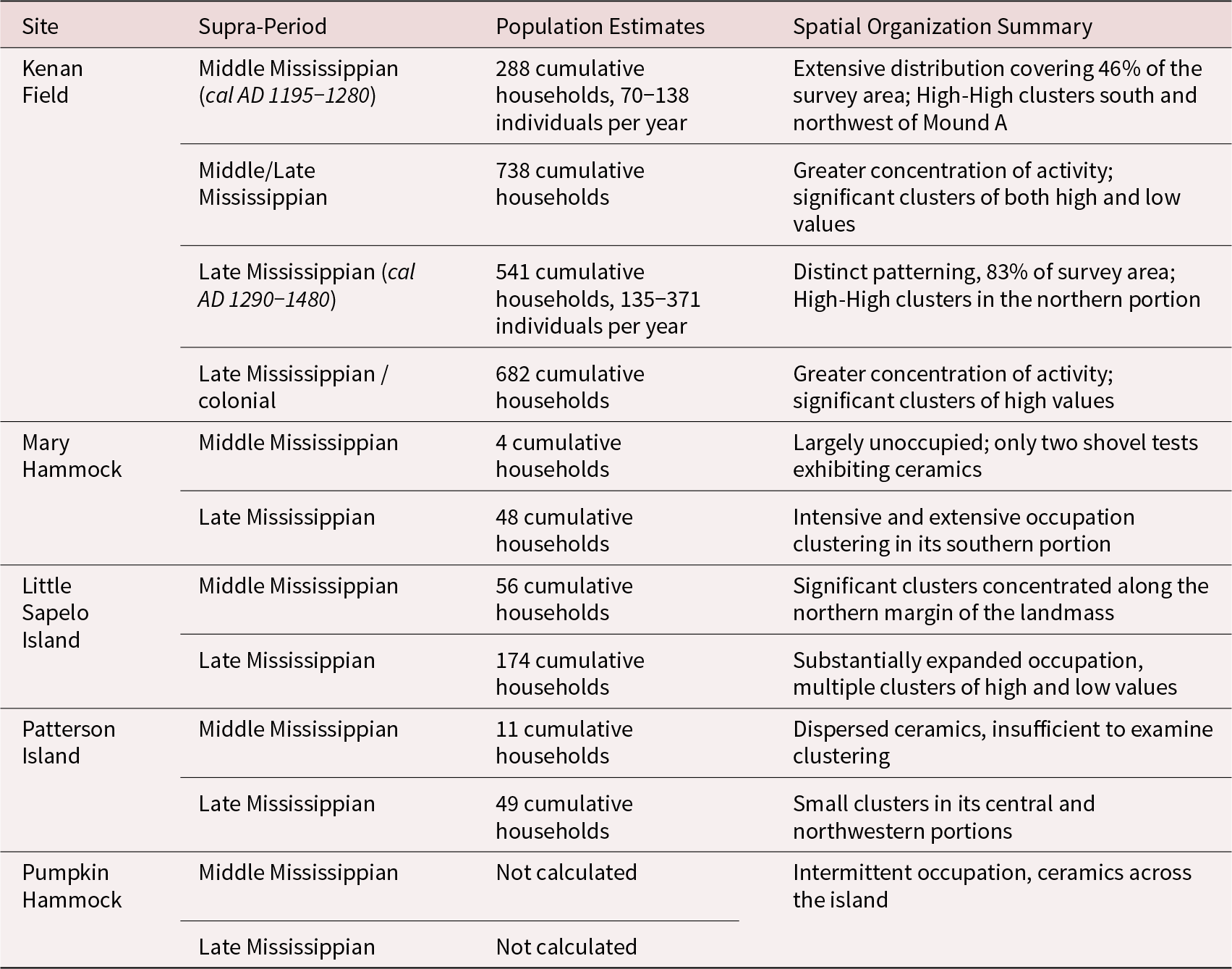
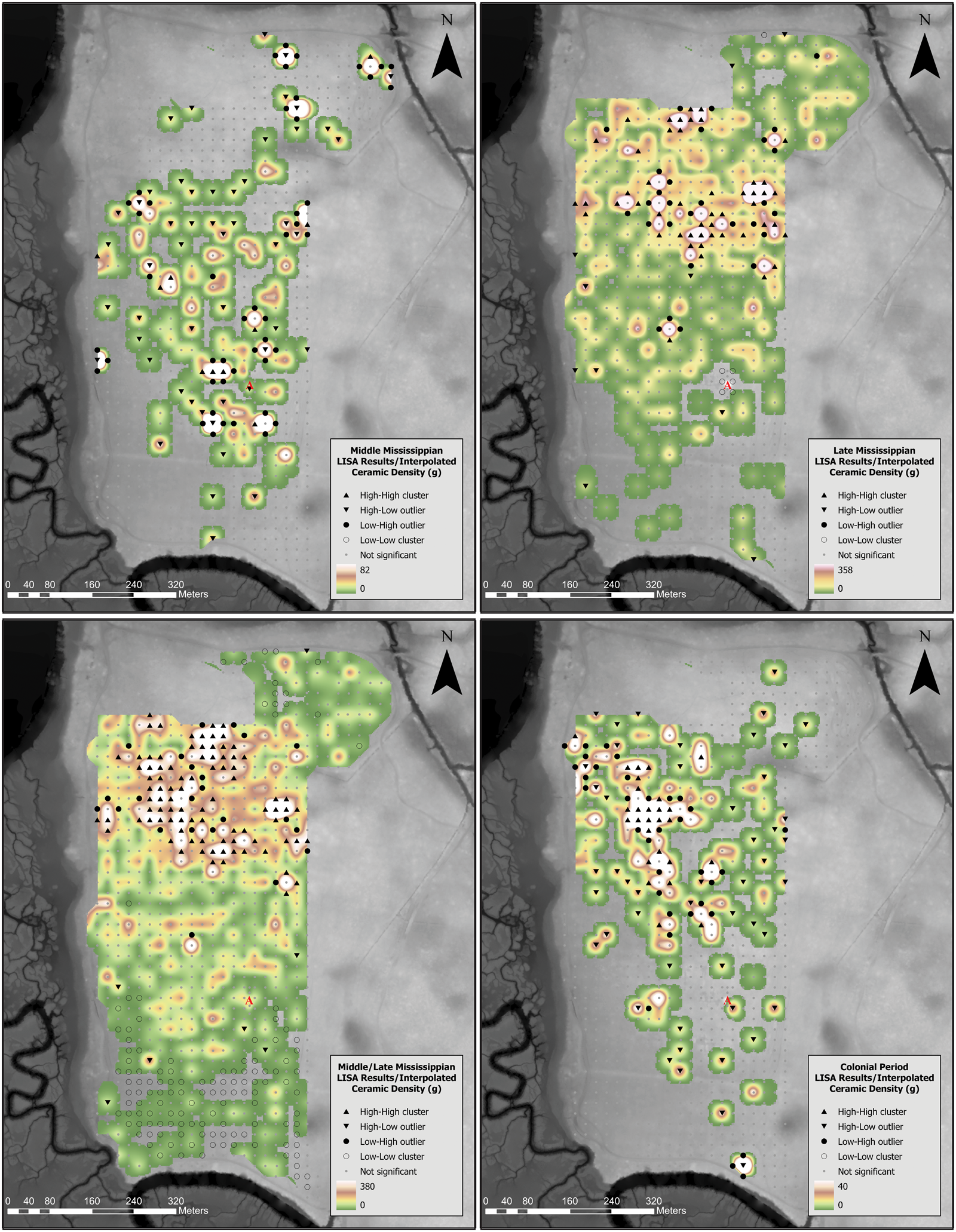
The results reported here are summarized in Table 2. The Middle Mississippian period dates to between approximately 1150 and 1325 CE (DePratter Reference DePratter1991). The Middle Mississippian occupation at Kenan Field was probably between cal CE 1195 and 1280 and lasted between 25 and 80 years. The spatial distribution of Middle Mississippian material is the most extensive of any supra-period up to this period, covering approximately 46% of the survey area (Figure 2; Ritchison Reference Ritchison2020a).
Summary of Results.

Ceramic density interpolations and LISA results of the Kenan Field Survey related to the period of the immigration event (i.e., Middle Mississippian, Late Mississippian, Middle/Late Mississippian, and colonial periods). (Color online)

The Local Moran’s I test for the Middle Mississippian supra-period revealed a few High-High cluster results located about 60 m south to 300 m north of Mound A. Most results of the local autocorrelation test are High-Low and Low-High outliers. The overall pattern appears to be one of dispersed occupations, with a subset of areas occupied throughout the period. These isolated areas of activity extend between 30 and 50 m in diameter. The occupation area-based population estimate suggests that approximately 288 households occupied the site during the Middle Mississippian period; ceramic accumulations-based estimates suggest that the average number of individuals occupying the site per year ranged from 70 to as many as 138 (Ritchison Reference Ritchison2020b).
The Late Mississippian period encompasses the period from approximately 1325 to 1580 CE. The Late Mississippian occupation at Kenan Field was probably between cal AD 1290 and 1480 and likely lasted between 190 and 240 years. Bayesian estimations suggest no interruption between the Middle and Late Mississippian occupations. The spatial patterning of the Late Mississippian materials is distinct from the Middle Mississippian period and all earlier supra-periods (Figure 2; Ritchison Reference Ritchison2019, Reference Ritchison2020a). Although Late Mississippian ceramics were nearly ubiquitous across the entire survey area, the greatest concentrations were in the northern portion of the survey area. The only areas lacking these ceramics were the southern portion of the survey area at lower elevations and near the marsh edge.
The Local Moran’s I results for the Late Mississippian are also distinct in the northern portion of Kenan Field, with numerous High-High clusters indicating intensive occupation. Interspersed within these two zones of clusters are occasional outliers. The Low-High outliers in the northern occupation cluster suggest a delineation or separation of space without material refuse within the otherwise intensively used area. The central portion of the site contained a relatively even distribution of ceramic material, resulting in few statistically significant results.
In total, the occupation area of the Late Mississippian period covers approximately 83% of the survey area (Figure 2), translating to an estimated accumulation of 541 households during this period. This is a 93% increase. Ceramic accumulations-based estimates place the average yearly population of this period at 135–371 individuals, again a substantial increase over Middle Mississippian populations.
Differences between the intra-site patterning in the Middle and Late Mississippian periods are more evident between the Middle/Late Mississippian and late Mississippian/colonial supra-periods. The Local Moran’s I results from these supra-periods suggest an even greater concentration of activity. Of the significant results, most were clustered results (i.e., High-High and Low-Low). For the first time, Low-Low clusters are apparent in the data and occur across most of the southern portion of Kenan Field. At the north end of that site, High-High clusters indicate intensive occupation. Interspersed within these two zones of clusters are occasional outliers. The Low-High outliers in the northern occupation cluster suggest an area without material refuse within the otherwise intensively used area. The central portion of the site contained a relatively even distribution of ceramic material, resulting in few statistically significant results.
The spatial extent of materials of each of these two supra-periods was greater than that of the strictly Late Mississippian ceramics (Figure 2). In sum, 14,589.32 g of Middle/Late Mississippian ceramics were recovered across 91% of the survey area. A comparable 13,225.17 g of Late Mississippian/colonial ceramics were recovered across 86% of the survey area. Occupation area–based population estimates for these supra-periods dwarf other periods, with a total number of 738 and 682 households, respectively. Due to the temporal overlap in each of these two supra-periods, average yearly population estimates were not calculated, but the already provided Middle and Late Mississippian period ceramic accumulations-based population estimates incorporate these materials via two schemes of reapportionment—proportional and temporal—as outlined in Ritchison (Reference Ritchison2020b).
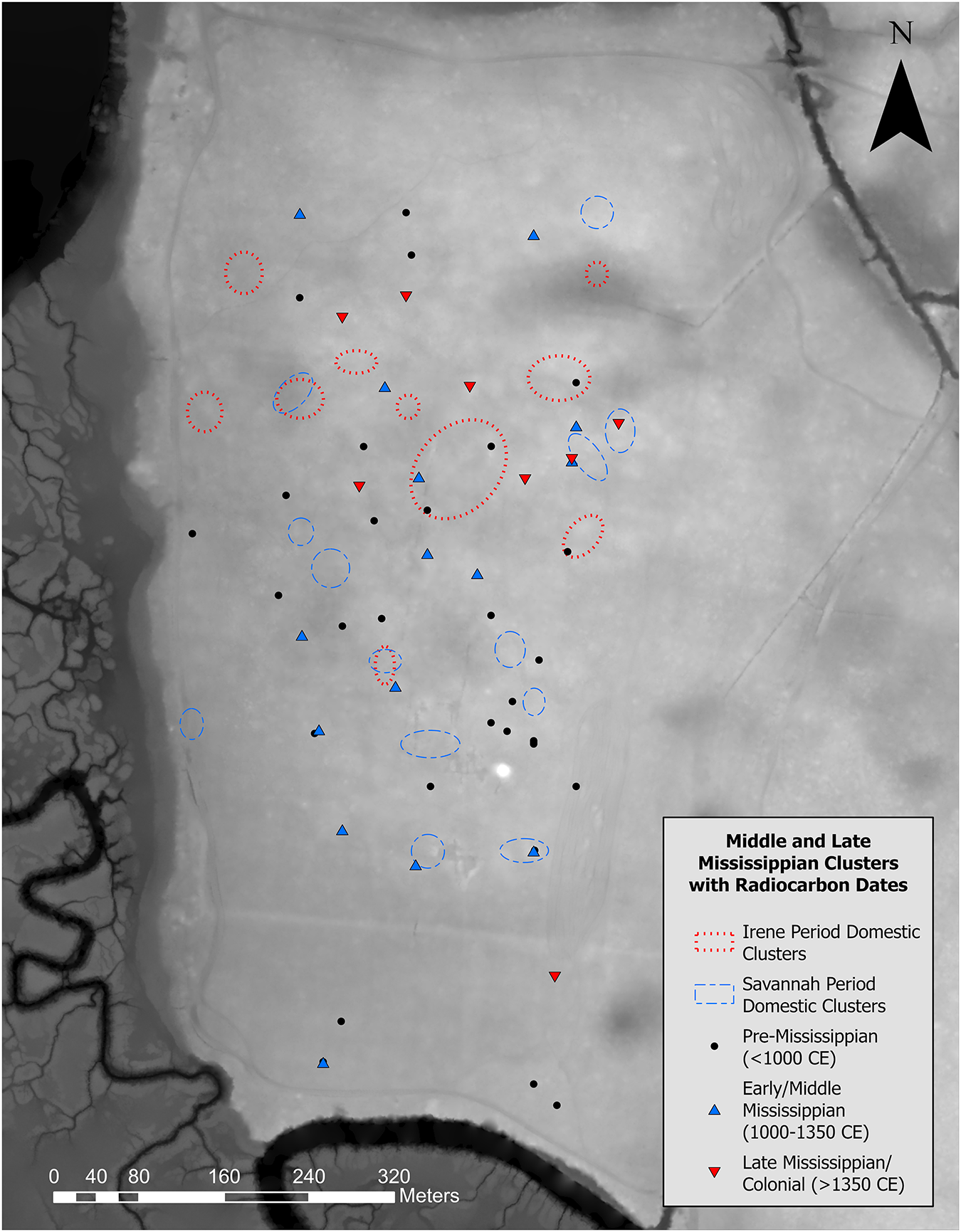
Using the Local Moran’s I results, I identified areas of clustering using the Low-Low signatures to manually delineate spatially adjacent High-High and High-Low results from the Local Moran’s I tests for the Savannah and Irene periods. The Irene period has fewer, larger (n = 13; M = 1668.19 m2) domestic clusters located closer together than the clusters of the Savannah period (n = 16; M = 770.03 m2; see Figure 3). The increased size of Irene clusters further demonstrates the increased density of domestic areas associated with the reduced settlement area and larger population.
Locations of concentrations of domestic refuse during the Middle and Late Mississippian periods in relation to recovered radiocarbon dates (by median calibrated date). (Color online)

The concentration of Irene period activity in the northern portion of Kenan Field is also apparent in the radiocarbon dates (Figure 3). Thirteen of 61 dates (21.3%) had calibrated median ages between AD 1250 and 1650 (Ritchison Reference Ritchison2020b). Of these, nine dates had median ages that postdate 1350, the likely start of the period when migrants were arriving along the coast and new single-component Irene period sites were being established. Eight of these nine dates were in the primary zone of Irene period deposition at the northern third of the site. In comparison, pre-Irene and Middle Mississippian dates are more evenly distributed across the entire Kenan Field site.
Back-Barrier Islands
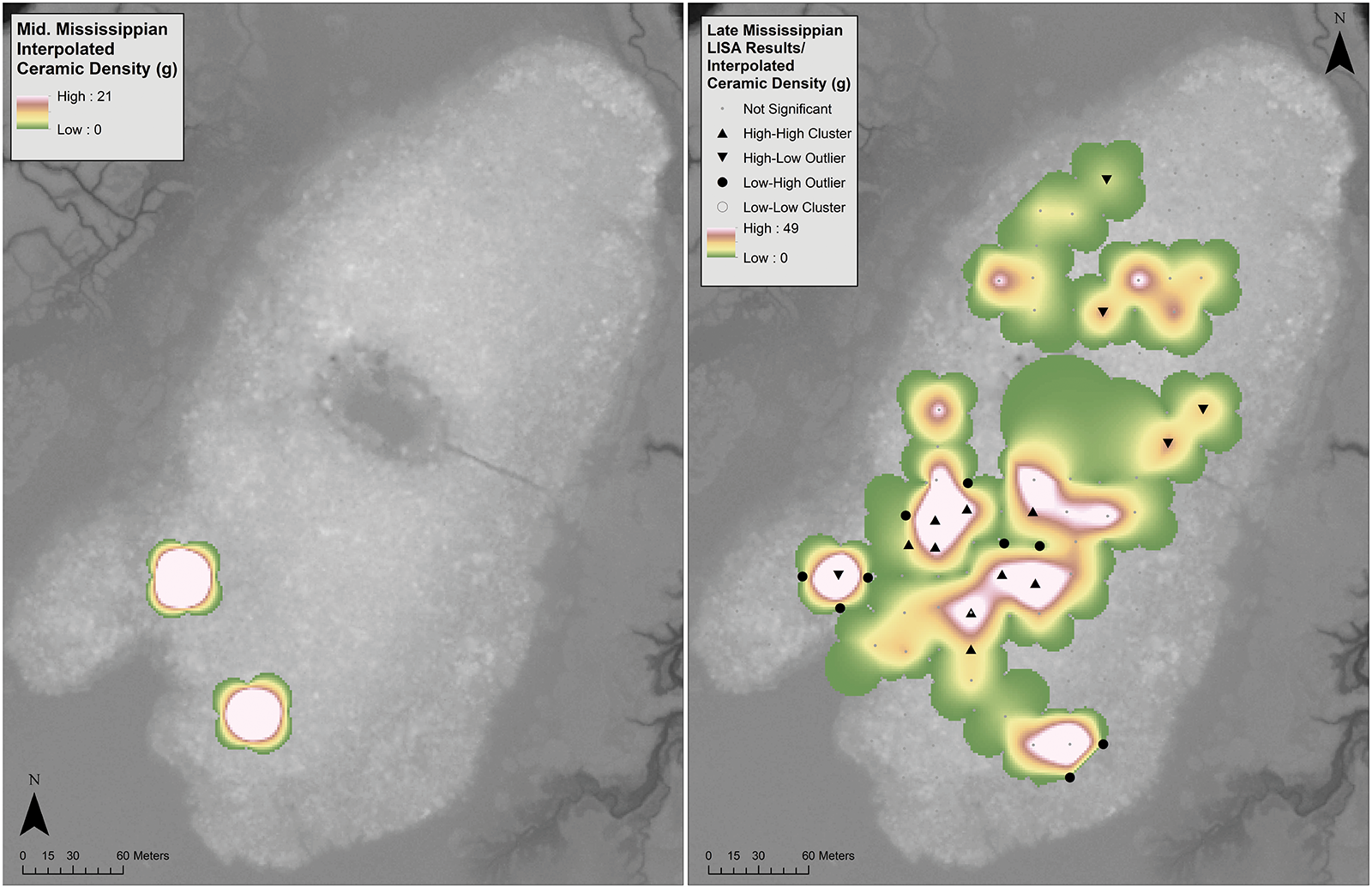
Mary Hammock was largely unoccupied during the Middle Mississippian period, with only two shovel tests exhibiting any temporally diagnostic ceramics (Figure 4). Occupation area–based population estimates for this hammock suggest that only 20 people or approximately four households occupied the site across the entire span of the period.
Ceramic density interpolations and LISA results of Mary Hammock for the Middle and Late Mississippian periods. (Color online)

On Mary Hammock, the settlement situation changed dramatically during the Late Mississippian: the occupation of Mary Hammock during that period was the most intensive and extensive in this island’s history (Figure 4). Although materials were recovered across most of the island, clustering is evident in the southern portion of the island and south of an apparently natural depression that may have held water (note the evident historic drainage ditch in the lidar elevation map). Occupation area-based estimates suggest an increased population on Mary Hammock: up to 276 individuals in approximately 48 households, an immense 1,259% increase.
On Little Sapelo Island, occupation was concentrated along the northern margin of the island’s central landmass (Figure 5). The results of the Local Moran’s I test suggest that this concentration is statistically significant, with High-Low outliers and High-High clusters both apparent and delineated by Low-High outliers. Cumulative occupation area-based estimates place Middle Mississippian-period populations on Little Sapelo at 320 individuals or an estimated 56 households.
Ceramic density interpolations and LISA results of Little Sapelo for the Middle and Late Mississippian periods. (Color online)

The occupation of Little Sapelo Island expanded in the Late Mississippian, with materials recovered across most of the island (Figure 5). The Local Moran’s I results reveal multiple clusters, with one group on the central portion of the southern core of the island and another on the northeastern edge. These clusters are delineated by Low-High outliers, and several Low-Low clusters separate these clusters from several High-Low outliers, suggesting an active disuse or avoidance of refuse disposal in certain areas between these concentrations. An estimated 174 households were established on Little Sapelo Island during this period, a 208% increase.
Middle Mississippian period ceramics were recovered in only a few, widely dispersed tests on Patterson Island (Figure 6). The Local Moran’s I test was not run for this supra-period due to the paucity of recovered materials. Cumulative occupation area–based population estimates place approximately 61 individuals or an estimated 11 households on Patterson Island during the Middle Mississippian period.
Ceramic density interpolations and LISA results (where applicable) of Patterson Island for the Middle and Late Mississippian periods. (Color online)

Late Mississippian period Irene ceramics were the most common type found on Patterson Island and were recovered primarily from its central and northwestern portions (Figure 6). Late Mississippian Local Moran’s I results demonstrate more significant results and a greater amount of material recovered from this period. I found more High-High clusters and High-Low outliers in this period than during the Middle/Late Mississippian. Late Mississippian/colonial Irene/Altamaha ceramics were recovered in concentration in a few sites located on the edges of the concentrations of the strictly Irene material. The number of cumulative households on Patterson Island for this period is estimated to be 49, a 362% increase.
Because of its small size and narrow morphology, Pumpkin Hammock is difficult to analyze in the same way as the other islands (Figure 1). The island was occupied intermittently, but Middle and Late Mississippian ceramics make up the largest portion of the ceramics assemblage and were recovered across the island. Several sand- and grit-tempered ceramics were also recovered and are likely either Middle or Late Mississippian in origin, although this cannot be confirmed.
Discussion
During and following the period of immigration to the Georgia Coast, Kenan Field accumulated a significantly larger population than ever before (Ritchison Reference Ritchison2020b), notably larger than the scale of settlement at the site during the preceding Middle Mississippian period. Mid-sized village and hamlet sites (such as the surveyed back-barrier islands) experienced moderate increases in population, and new, typically smaller, settlements were established in novel locations (Ritchison Reference Ritchison2018; Thomas Reference Thomas2008b). The site-level survey data presented here suggest that residents of Kenan Field began to live more densely in a core area of the site while simultaneously adopting a “dispersed town” pattern, represented by decreasing residential density outside the site core and the establishment/growth of secondary settlements on nearby back-barrier islands.
This pattern of nucleation, coupled with new occupations in historically novel locations, was not exclusive to Sapelo Island, having been noted in surveys elsewhere on the coast (Porter Freeman Reference Porter Freeman2022; Napolitano Reference Napolitano, Victor and Thomas2013; Sipe Reference Sipe, Victor and Thomas2013)—although Kenan Field and its surrounding hammocks provide the most complete picture of these patterns at the community level. The built environment often holds a material record of a shifting social landscape (Lawrence and Low Reference Lawrence and Low1990; Menz et al. Reference Menz, Hollingshead, Haley, Menz, Hollingshead and Messer2024; Thompson Reference Thompson, Birch and Thompson2018; Thompson and Birch Reference Thompson, Birch, Jennifer and D. Thompson2018). I suggest that the evident combination of nucleation and dispersal may have been a means by which melded communities negotiated the use of common pool resources such as suitable farmland and fisheries. Providing immigrants access to farmland would have required a reallocation of space while negotiating access by immigrants to fisheries would have been predicated on organizing the timing and scale of harvesting to ensure their continued availability. Based on Spanish colonial records and bioarchaeological data, agriculture was not just accommodated but was also widely adopted and integrated throughout Indigenous coastal societies, beginning after AD 1000 and accelerating during and after the Irene period (Garland et al. Reference Garland, Reitsema, Larsen and Thomas2018; Hutchinson et al. Reference Hutchinson, Larsen, Schoeninger and Norr1998; Larsen Reference Larsen2002; Thomas Reference Thomas2008a; Worth Reference Worth1999). Shell fisheries appear to have been sustainably maintained during the Late Mississippian period, as they had been for prior millennia, even with significant increases in population over time (Thompson et al. Reference Thompson, Rick, Garland, Thomas, Smith, Bergh and Sanger2020).
Areas with histories of human occupation would have been ideal locations for agriculture on the coast. Thomas (Reference Thomas2008b:922–923) observed that, at the time of the immigration event and the introduction of maize, major settlements on St. Catherines Island were already located on the most advantageous soils available. Further, these soils were enriched by the long history of deposition and decomposition of shell and other human detritus; these factors measurably improved soil chemistry with respect to agriculture (Dorroh Reference Dorroh1971; McAvoy and Harrison Reference McAvoy and Harrison2012). As large sites, such as Kenan Field, reduced the areal extent of the core habitation zone, areas of previous occupation would have become available for use as farm or garden plots. Crook (Reference Crook1978) mapped the locations of 577 surface shell middens at Kenan Field, features understood by coastal archaeologists to be a characteristic of Mississippian period deposition patterns: 64% were outside the primary core of Irene period occupation identified in the present survey (Figure 7). Thus, most of the shell refuse, either resulting from Irene period habitation or from earlier activities, was located in areas that had the lowest density of domestic (i.e., ceramic) refuse.
Distribution of surface shell features at Kenan Field in relation to the core of the identified Late Mississippian village (reproduced and modified from Crook Reference Crook1978).

However, there was likely some upper limit to population at the larger sites, even with the potential for the emergence of or reinvestment in social institutions to mitigate the scalar stresses imposed by increased density, as I discuss later (Bandy Reference Bandy2004; Fletcher Reference Fletcher1995; Ortman et al. Reference Ortman, Cabaniss, Sturm and Bettencourt2014). With new, dispersed homesteads and hamlets throughout the estuary accompanying density increases at large sites, this dual transformation of the settlement pattern would have further allowed residents, either newly arrived or local, to be closer to fixed coastal resources, such as fisheries or productive ecotones.
I do not wish to privilege economic considerations in my explanation for the co-occurrence of settlement nucleation and dispersal because economizing lenses, although relevant, provide an incomplete understanding. A need for increased agricultural production was likely not the primary predicament in the integration of these two populations. Rather, farming was a centrally important cultural practice for the Ancestral Muskogean immigrants from the Savannah River Valley (Chaudhuri and Chaudhuri Reference Chaudhuri and Chaudhuri2001). Coastal residents likely felt similarly regarding their role in the maintenance of the coastal socioecological system. In integrating these groups, migrants and locals would have had to accommodate both agricultural needs and ensure appropriate institutional support for access to and the sustainment of fisheries. Both of these environmental and social relations present collective action problems that relate to access to spatially fixed and unequally distributed resources with a low potential for exclusion and to the collection and sharing of information regarding compliance with the collective interest. These challenges would have been intensified by the concomitant population increase throughout the region (Ritchison Reference Ritchison2018; Thomas Reference Thomas2008b).
Increasing populations in an area or at a site may result in an escalation of intragroup conflict (Bandy Reference Bandy2004). This relationship between intragroup disputes and population densities is such that “sources of irritation . . . increase at a rate greater than population size” (Rappaport Reference Rappaport1968:116). As pointed out by others (Bandy Reference Bandy2004; Fletcher Reference Fletcher1995; Johnson Reference Johnson, Renfrew, Rowlands and Segraves.1982), this “irritation” is couched in terms of interpersonal conflict, but an intertwined facet of the stresses engendered by increased population densities is the difficulty of information management in larger social units. As such, with a significant increase in population and the possibility of increasing intragroup conflict, residents of Kenan Field would have likely been at risk of a breakdown of community integration causing fissioning into smaller social units. Given that we do not see this fissioning at a large site like Kenan Field, it suggests that the regional pattern of settlement expansion was not driven by fissioning alone. Thus, institutional development was a likely factor in the local response to the challenges imposed by the migration-driven population increase (Johnson Reference Johnson, Renfrew, Rowlands and Segraves.1982).
The co-occurrence of settlement densification and population increase at some sites and the expansion of low-density dispersed settlement at the regional scale seem to be evidence for both pathways of accommodating increasing populations outlined by Bandy (Reference Bandy2004): settlement fissioning or the development of new integrative social institutions. Archaeology and ethnohistory provide probable context for the role of social institutions in the integration of migrant populations. Institutions are nexuses wherein structural transformations are embodied and experienced as norms and resources, such as structural resources and schemas (sensu Sewell Reference Sewell2005), are navigated and transformed. Such transformations can be incremental or rapid (Beck et al. Reference Beck, Bolender, Brown and Earle2007). This is particularly true for what Thompson and coauthors (Reference Thompson, Holland-Lulewicz, Butler, Hunt, Wendt, Wettstaed, Williams, Jefferies and Fish2022:1) termed “keystone institutions”: those such as democratic councils that are organized for and subject to the (shared, but differential) power and authority of broad swaths of society. Based on the lack of evidence for interpersonal or intercommunity conflict in the archaeological record of the Georgia Coast before the colonial period, along with the patterns of population growth and densification revealed here and hinted at by prior work (Pearson Reference Pearson1977; Thomas Reference Thomas2008b), institutional (re)development/transformation was likely a key component of the sociopolitical response to the fourteenth-century immigration event.
At Kenan Field, ceramic deposits from the Late Mississippian suggest an arcuate or semi-circular village pattern. This is distinct from the more dispersed, irregular form of the village that preceded it. A result of the settlement adopting this form is the establishment of a plaza where one had not yet previously existed. Certainly, plazas have a long history as a keystone institution on the Southern Atlantic coast, indeed throughout the Eastern Woodlands (Menz et al. Reference Menz, Hollingshead, Haley, Menz, Hollingshead and Messer2024; Saunders et al. Reference Saunders, Mandel, Sampson, Allen, Allen, Bush and Feathers2005; Thompson and Worth Reference Thompson and Worth2011). Plazas are loci wherein information is implicitly and explicitly shared within a community, as well as where decision-making and collective identity formation activities are carried out. Some of the earliest plazas evident in the archaeological record of North America were produced from and by the circular arrangement of the shell-ring villages of the Southern Atlantic and Gulf Coasts (Thompson Reference Thompson, Birch and Thompson2018). The activities undertaken within plazas were key to community integration. At Kenan, shovel test data suggest the plaza was likely not engineered like it was at major centers in the interior (Cobb and Butler Reference Cobb and Butler2017; Kidder Reference Kidder2004). Yet but it may have been just as intentional an element of the reconfiguration of settlement as the increased density. Few intra-settlement, subsurface surveys have been undertaken on the Georgia Coast, but based on surface distributions and limited subsurface testing, some relatively clear areas that could be described as plazas have been noted at Middle and Late Mississippian sites, such as the Irene, Middle Place, Meeting House Field, and Redbird Creek sites (Caldwell and McCann Reference Caldwell and McCann1941; Pearson Reference Pearson1979, Reference Pearson2014; Saunders and Russo Reference Saunders and Russo1988; Sipe Reference Sipe, Victor and Thomas2013). Investment in the establishment of a plaza as a part of a seemingly more spatially organized village may have been one means by which the Kenan Field community sought to reduce the tensions of increased populations and melded economic and ethnic identities.
However, although the reorganization of the village at Kenan Field may have echoed ancestral shell-ring villages, reconfiguring the space alone was not likely a complete solution to the challenges of increased density. Important “keystone institutions” have been observed at several archaeological sites across the ancestral American Southeast: they were public structures, variously known as townhouses, council houses, earth lodges, or rotundas (Larson Reference Larson and David1994; Thompson et al. Reference Thompson, Holland-Lulewicz, Butler, Hunt, Wendt, Wettstaed, Williams, Jefferies and Fish2022). In Southern Appalachia, examples of townhouses date back to the thirteenth century (Anderson Reference Anderson1994; Rodning Reference Rodning2011; Rudolph Reference Rudolph1984; Sullivan Reference Sullivan, Birch and Thompson2018). And by the latter half of the sixteenth century, most towns of the Ancestral Muskogean inhabitants of the Georgia Coast, known as the Guale to the Spanish, had council houses (Francis and Kole Reference Francis and Kathleen2011). This development may have followed as shortly as a half-century after the extended period of arrival for SRV emigrants. For the Muscogee, these structures represent collective identities, where members of a dispersed population come together as a social and political entity (Broadwell Reference Broadwell1991; Chaudhuri and Chaudhuri Reference Chaudhuri and Chaudhuri2001:68–73; Thompson et al. Reference Thompson, Holland-Lulewicz, Butler, Hunt, Wendt, Wettstaed, Williams, Jefferies and Fish2022).
In the Savannah River Valley, similar communal structures were among the earliest public buildings at Mississippian sites and were frequently embedded within platform mounds as political systems became more hierarchical across the Middle Mississippian period (Anderson Reference Anderson1994). The best-known communal structure from the region is “the Rotunda” at the Irene site. Contrasting the smaller, often rectangular, structures observed throughout the valley during the early Middle Mississippian period (including at Irene), this large circular structure was constructed near the beginning of the Late Mississippian Irene period, coinciding with the depopulation of the Savannah River Valley and the final conical capping of the site’s platform mound (Caldwell and McCann Reference Caldwell and McCann1941; Saunders Reference Saunders, Gregory and Marvin2017; Thompson Reference Thompson2009).
At Irene, the council house would have allowed for the integration of the larger community through participatory political action (Thompson Reference Thompson2009). As argued by Thompson (Reference Thompson2009) and Saunders (Reference Saunders, Gregory and Marvin2017), the Rotunda and associated spatial transformations across the site at the time of its construction and the depopulation of the SRV reflected a strategy of inclusion: community members were both observers and participants in political activities. The construction of the Rotunda was likely a response to the collapse of strongly hierarchical polities (Anderson Reference Anderson1994; Thompson Reference Thompson2009) and represented a reinvestment in the development of governance through consensus building. Its monumental scale may relate to the expansion of social networks during the preceding decades as SRV residents aggregated at fewer central sites when environmental and social conditions appear to have worsened (Anderson Reference Anderson1994). Able to host up to approximately 300 people (Caldwell and McCann Reference Caldwell and McCann1941; Thompson Reference Thompson2009), the Rotunda required significant collective labor investments and would have further intensified the socially integrative aspects of this settlement transformation. The scale of the Irene council house is not an outlier for the late precolonial and early colonial periods, as seen in the later, nearly identical council house at San Luis de Talimali (Shapiro and Hann Reference Shapiro, Hann and David1990).
As noted by Chaudhuri and Chaudhuri (Reference Chaudhuri and Chaudhuri2001:82–90), Ancestral Muskogean talwas (towns/communities) were materialized by both their roundhouses and their ceremonial grounds and town squares. Distributional data from the Kenan Field survey suggest that the reconfiguration of the community during and after the immigration event included the creation of a new plaza area. However, the survey strategies used in this study were not intended to locate architectural remains, so the presence of a council house has not been demonstrated empirically. Yet, the described ubiquity of council houses in post-migration sixteenth-century records from the Spanish colonial endeavor suggest that we should examine the spatial and temporal distribution of public structures and how their emergence may relate to new collective action challenges. Ultimately, the material and documentary record both suggest a narrative that SRV migrants and coastal locals drew on mutually shared conceptions of political and community organization, built on and transforming those of their past and present, to navigate and resolve the challenges of the fourteenth- to fifteenth-century AD SRV migration event.
Thus, the pattern of settlement transformation revealed at Kenan Field, and as repeated across the Georgia Coast during the Irene period, supports a hypothesis that councils were established or expanded during the Late Mississippian period as an institutional response to the challenges created by a major increase in population. Formal councils would have provided for the resolution of collective action problems created by the immigration event by mitigating scalar stresses and managing resource access. Democratic institutions would have allowed communities to seek consensus, for example, on the layouts of their villages and would have created venues for sharing information about the behavior of any “selfish” shell-fishers (i.e., new immigrants not yet integrated into local managing institutions).
Yet, the full role of collective political institutions in the coalescence of migrants and locals on the Georgia Coast remains to be more fully understood. We currently lack broad architectural evidence of such organizing institutions on the coast before the immigration event: this lack is largely a result of regional archaeological research foci, ill-suited methods for their identification, and legacies of historic disturbance, often concentrated on Irene period cultural sites (Thomas Reference Thomas2008b). However, we know that council houses are keystone institutions to contemporary and ancestral Muscogee peoples (Thompson et al. Reference Thompson, Holland-Lulewicz, Butler, Hunt, Wendt, Wettstaed, Williams, Jefferies and Fish2022) and that organizing social institutions are shown as being central to the maintenance of coastal socioecological systems, such as shell-fisheries (Thompson et al. Reference Thompson, Rick, Garland, Thomas, Smith, Bergh and Sanger2020).
Conclusion
As noted by Pauketat (Reference Pauketat2003), resettlement of displaced populations often plays a major role in cultural construction. For the fourteenth-century residents of the Georgia Coast, a new, shared identity seems to have been the response to the challenges posed by this immigration event. Much of the evidence discussed here suggests that this new identity was antecedent to, if not the same as, that expressed by the Guale less than two centuries later at the time of European contact.
I argue that the process of immigration was the primary influence leading to the spatial, political, and economic transformations observed on the Georgia Coast during the Irene period. The examination of changes in the internal organization of several related settlements, ranging from small to large, during this Late Mississippian migration event gives us a new understanding of social and political development for the late precolonial Georgia Coast. Yet, much remains unknown. For example, the extant archaeological record of public architecture in the coastal region is sparse, especially when juxtaposed with the ethnohistoric record that is replete with council houses (Francis and Kole Reference Francis and Kathleen2011; Worth Reference Worth1995). Examining the temporality and constitution of such structures will be necessary to understand how and when they were established.
Histories of the precolonial Southeast must deal with the historically contingent contexts and trajectories that have become apparent as researchers have reevaluated regional culture histories with data compiled during a century of work and gathered from the application of new chronological methods. We now recognize the role of population relocations in the emergence, spread, and development of Mississippian societies throughout the Southeast and Midwest. During the fourteenth and fifteenth centuries AD, these movements were, in part, the result of the inherent instability of many Middle Mississippian chiefdoms (Anderson Reference Anderson1994; Beck Reference Beck2003) and environmental fluctuations (Anderson et al. Reference Anderson, Stahle and Cleaveland1995; Benson et al. Reference Benson, Pauketat and Cook2009; Cook and Comstock, eds. Reference Cook and Comstock2022). A better understanding of the role of the built environment and collective social institutions in resolving the challenges imposed by migration, particularly the emergence of communities, identities, and socioecological systems in response to social and environmental perturbations, could help address many of the “grand challenges” of archaeological research and of our contemporary era (Kintigh et al. Reference Kintigh, Altschul, Beaudry, Drennan, Kinzig, Kohler and Limp2014; Pluckhahn et al. Reference Pluckhahn, Wallis and Thompson2020).
Additional research is also needed to better understand how the emergence, maintenance, character, and variability of Ancestral Native American democratic institutions functioned as social nexuses in the coalescence of locals and migrants at various times and places in the ancient Eastern Woodlands. Identifying and understanding events of population movement, from regional to site-level depopulations, and their attendant consequences in both homelands and destinations will lead to a better understanding of the transformations of the late precolonial period and how these events conditioned the later entanglements of the colonial era.
Acknowledgments
This research would not have been possible without the institutional support of the University of Georgia Laboratory of Archaeology and Department of Anthropology, the University of Illinois Department of Anthropology, the Georgia Department of Natural Resources, and the Sapelo Island Nation Estuarine Research Reserve. Many thanks must also go to the 130 volunteers and field school students who assisted in the Kenan Field shovel test surveys since 2013. Thanks to Jacob Holland-Lulewicz, Victor Thompson, Christopher Rodning, Gary Ritchison, Secretary of Culture and Humanities RaeLynn Butler of Muscogee Nation, and several anonymous reviewers for constructive commentary on iterations of this article.
Funding Statement
Funding for this research was provided by the National Science Foundation (DDRI# 1643072).
Data Availability Statement
The data used in this study are curated at the University of Georgia Laboratory of Archaeology.
Competing Interests
The author declares none.




 Open access

