

“Disenchantment with democracy” is Sven Beckert's diagnosis for the United States around 1900.Footnote 2 According to Beckert, the era's elites paid little regard to the ideals of democracy and worked to exclude the lower classes from the electoral process.Footnote 3 But was acceptance of democracy really that low? Previously overlooked elite discourses and efforts—particularly discussions that dealt with the practice of elections—show that this explanation does not tell the whole story. By drawing on endeavors concerning election reform in New York City, I argue that at the turn of the century a new understanding of democracy became a kind of modern consensus. This was the case not only in New York, a city in a republic, but also in Berlin, in the Prussian constitutional monarchy. These findings support the interpretation that around 1900 the understanding and acceptance of democracy underwent a seminal change in the transatlantic world. The consensus held that state legitimacy required mass participation and, even more, that mass participation was connected to “everybody” and to a meaning of “universal”— though this ideal of “universal” was constructed and exclusive in important ways.
Some decades before, the situation had been different. Then, the New York bourgeoisie openly advocated abolishing universal (manhood) suffrage.Footnote 4 In the postbellum period, new class dynamics challenged American society. Industrialization and increasing immigration led to the formation of an underprivileged working class, and many elite citizens openly demanded excluding these people.Footnote 5 Furthermore, elections in New York City had been so violent that Republican administrations marshaled federal troops to keep order.Footnote 6 In 1870, the leading Democratic paper New York World advised its readers to go to the polls only with arms. To many members of the city elites, mass suffrage caused these ills.Footnote 7 The Atlantic Monthly commented on the growing hostility of “the most intelligent classes” toward mass suffrage: “No careful observer can have failed to notice the change of sentiment in this respect.”Footnote 8
Actually, the change was not that remarkable. Contrary to the widespread belief that American society had once been “truly” democratic, disenchantment with democracy was a close companion of mass suffrage from the time of the adoption of the Constitution—and indeed before. Antebellum New York was not “steeped in the country's republican heritage and the moral imperatives of frugality and thrift.” Also antebellum New York elites did not like to share “public space with other social groups,” as Beckert argues.Footnote 9 In The Upper Ten Thousand, Charles Astor Bristed sheds a different light on New York, where the upper class was disinclined to engage in politics and happy to build chic parks for their ladies so that they might no longer be afraid of “troupes of whiskered and mustachioed chatterers” on Broadway, as the New York Post hoped.Footnote 10 Elite citizens in the “metropolis of wealth and fashion” (as Nathaniel Parker Willis, another contemporary, called New York) distanced themselves from polling places, which were crowded with drunken immigrants and workers. Alexander Keyssar sees a “mushrooming upper- and middle-class antagonism to universal suffrage” throughout the country from the 1850s.Footnote 11 Moreover, Mark W. Summers states, “By the 1850s, many Americans were […] wondering whether democracy itself had failed, whether the price of it—demagogues, bribetakers, ballot-box stuffers—was too high to bear.”Footnote 12
As early as in 1828, fifty-eight New York citizens petitioned the Common Council complaining about the new constitution of 1821 with its destructive “extension of the elective franchise.”Footnote 13 To quote another contemporary, the New York citizen Philip Hone wrote in 1840, “Scenes of violence, disorder, and riot have taught us in this city that universal suffrage will not do for large communities.”Footnote 14 The lamentation of citizens about universal manhood suffrage did not stop—until the turn of the century. Actually, the acceptance of mass suffrage was not a return to old American republican ideals, but an amazingly new emergence.Footnote 15 In spite of economic depressions and a high rate of immigration in the 1890s, and though reformers and citizens still disputed women's suffrage, by 1900 a consensus emerged favoring mass suffrage and mass participation.Footnote 16 In 1910, the muckraking journalist Ray Stannard Baker wrote, “The tendency of government throughout the entire civilized world is strongly in the direction of placing more and more power in the hands of the people.”Footnote 17 The denial of democracy at this time was past, a bygone occurrence of postwar years. Contemporaries were well aware of that change.Footnote 18 Tycoon Andrew Carnegie in his Triumphant Democracy sang praises of the American republic, taking universal suffrage (including blacks) as a given.Footnote 19 Of course, there were still dissenters from mass democracy, but they had been quite marginalized. Furthermore and ironically, the question of black suffrage at this time took a dire turn.
The New York election reformers belonged to the Progressive movement. Much good writing exists on the progressive reformers.Footnote 20 Few historians, however, have examined the highly committed intellectual elites at the turn of the century who refined technicalities of elections.Footnote 21 These reforms can tell us much about the understanding of democracy at that time because they dealt with the very heart of democracy: elections. The omission of these reformers might be because little research exists on the practices of elections in general.Footnote 22 Based on new sources, however, this essay also seeks to contribute to the evaluation of the reformers' general program. To be sure, progressives were an extremely variegated community.Footnote 23 Despite thought-provoking dissensions, I agree with those scholars who see in the Progressive movement a common way of interpreting and discussing social and political problems. Progressives argued that a civil society could and should solve the era's major problems.Footnote 24 Reformers advocated, in James J. Connolly's words, “a call for communal action against selfish and corrupting interests.”Footnote 25 Furthermore, I agree with Shelton Stromquist that progressives aimed to “constitute an imagined people” or tried a “re-inventing of ‘the people.’”Footnote 26 Similarly, Michael McGerr points out that one of the progressives' aims was to “change other people.” McGerr also stresses the will to “segregate society” as a further progressive aim. For election reformers both components belonged together: changing and segregating “the people.” Nevertheless, I do not conform to McGerr's critical verdict about the movement, which targets an undemocratic middle class that wanted to exclude lower classes.Footnote 27
Instead, looking at the core of modern democracy, elections, I argue that progressive reformers played a major part in making modern democracy more rational and more disciplined, which to them meant more just and fair and, therefore, more democratic. Reformers' dedication to mass suffrage and their “democratic claims” (following Richard L. McCormick) went hand in hand with efforts to ensure the “purity” of suffrage. Safe voting techniques protected voting as a rational act of the responsible modern individual, whose pure will should be falsified neither by parties nor by bribery or lack of education. In other words, reformers enforced the process of functional differentiation. Nevertheless, these efforts had an elitist touch, too. Above all, most of the reformers holding an ideal of a democratic community of rational and equal citizens thought that numerous people (especially paupers and illiterates in the North and blacks in the South) needed additional education to become equal citizens.
I focus on New York City (with a population of 3.4 million) and Berlin (1.9 million) because both cities were central to elite discourses in their respective countries and both were arenas of numerous lively elections. I will first deal with the reform discourses of progressives in New York City, then with technical details of reform and their modernizing impact. This will be the main part of my essay. I will then compare the situation in New York City with the situation in Berlin. The broader international context helps avoid the trap of American exceptionalism.Footnote 28 Furthermore, it is crucial in illuminating my thesis: at around the turn of the century, mass suffrage and mass participation became a transatlantic consensus. This consensus is important for understanding the worldwide appeal of universal suffrage after World War I. Without the elites' agreement with mass suffrage, and without their achievements concerning the rationalization and the disciplining of elections, this momentous expansion of democracy could not have happened.
REFORMING OF ELECTIONS AND DEMOCRATIC IDEALS
Which mark should the voter make on the ballot paper? Was a cross the best idea? Why not just a single line? Or was a circle the safest sign to avoid any possible misunderstanding? These were the questions that the New York citizen Albert S. Bard concerned himself with around 1900. He was also engaged in the question of what the ballot paper should look like. Not too big, but also not too small. A figurative party emblem could mislead voters into marking the ballot paper without really thinking about their choice. Actually, Bard objected to the practice of marking the paper in favor of a party.Footnote 29 Voters should be mature and responsible, in order to be able to make a factual decision. This was hard work for Mr. Bard: he had to figure out an election procedure that forced voters to show rationality and responsibility. Bard had a plain image of a republican polity: it should be filled with disciplined, well-educated gentlemen who ponder their vote rationally—a world of honest and efficient manliness.Footnote 30
Mr. Bard was typical of New York intellectual elites around 1900. He participated in many of the innumerable clubs for world betterment that shot up like mushrooms. Bard's intellectual associates of the clubs belonged to the Progressive movement. Most of his fellow reformers were middle-class, staid men who regarded it “a serious question whether millionairism is useful to a state.”Footnote 31 Nevertheless, some billionaires such as John Jacob Astor, J. P. Morgan, and Cornelius Vanderbilt supported progressive ideas.Footnote 32 Important for Albert S. Bard and other reformers were organizations such as the Citizens Union or the City Reform Club. In the Electoral Laws Improvement Association, of which Bard was president, he worked with William Mills Ivins, an acclaimed reformer and Republican politician.Footnote 33 Together with Seth Low (educator, Republican mayor of New York, and ex-president of Columbia University), Bard was a member of the Association to Prevent Corrupt Practices at Election.Footnote 34 Bard also belonged to other societies in New York City that promoted the improvement of election practices, such as the Corrupt Practices Committee, the Municipal Voters' League, and the Honest Ballot Association.Footnote 35 Many of the reformers were ambitious lawyers, often with Ivy League degrees. These men dominated the New York State Bar Association and used it to pursue their goals.Footnote 36 Their agenda focused on fighting corruption and assuring fair and free elections. “Honors are easy, where the two ‘machines,' entrenched in their strongholds, outbid each other across the Bowery in open rivalry as to who shall commit the most flagrant frauds at the polls,” was muckraking journalist Jacob A. Riis's description of elections in the poor wards. Conditions in these areas invited fraud and corruption. Residents sold their votes in exchange for much-needed protection of the boss and money.Footnote 37 The newspapers and contemporary journals were full of complaints about destructive election frauds.Footnote 38
But “new political historians” such as Howard W. Allen and Kay Warren Allen have raised the question of whether election fraud was more or less an invention designed to keep unwanted classes and races from participating in elections. As Allen and Allen remark, “the charges seemed but part of a political campaign of elite groups to regain or retain control of city politics.”Footnote 39 Progressives, so goes the argument, wanted to get rid of all non-middle-class voters in order to be able to establish their “middle-class paradise.”Footnote 40 These historians use the decline in voter turnout as evidence of the progressives' exclusionary aims. Whereas in 1896, 79 percent went to the polls, in 1924 fewer than 50 percent did so.Footnote 41 For this reason, Paul Kleppner has called the turn of the century the era of political demobilization.Footnote 42 But progressive reforms alone cannot sufficiently explain the long process of turnout decline and its “secular nature,” as Mark L. Kornbluh puts it. Kornbluh convincingly demonstrates that, in addition to the reforms, there were plenty of reasons for this decline. Social changes and new leisure time facilities made elections less central for public amusement. A growing welfare state provided fewer reasons for people to rely on parties and to give their vote to the party boss. Furthermore, the two separate one-party systems, which split among themselves the different constituencies, instead of one national two-party-system, made elections less competitive and less intriguing.Footnote 43 The decline in turnout was also closely linked to the decline of parties' importance. As Glenn Altschuler and Stuart Blumin elucidate, “When the parties controlled the polling place, voter turnout was very high. And when they lost that control, turnout declined.”Footnote 44 The complexity of a modern state with an increasing number of duties, such as schooling, social welfare, and urban infrastructure, required an efficient bureaucratic apparatus, not a set of party organizations. Federal expenditures per capita in 1800 amounted to $17; by 1900 they had risen to $107.Footnote 45 The growing central authority was hostile to fierce groups of men gathering in powerful parties, and needed and generated a disciplined society, in line with Norbert Elias's insights about the development of modernity.Footnote 46 Moreover, reformers repeatedly won elections with working-class and lower-middle-class support. Not only elites wanted change, and not only middle-class citizens had the feeling that something had to be done.
Even more important to this essay is the question of whether election fraud actually existed to an appreciable extent. If not, this would indeed suggest that “fraud” was a tactical assertion and not an existing evil. The records, letters, and newspapers, however, provide compelling evidence for widespread election fraud. Contemporaries from all backgrounds, not just the upper and middle classes, regarded fraud as a matter of course.Footnote 47 Records on courts suing election fraud and the countless files about the practical process of elections do offer an insight in election practices.Footnote 48 Often fraud was just too normal to bring to trial. Even overseas, the fraudulent American elections were infamous.Footnote 49 Paul Kleppner claims that the evidence of fraud throughout the United States is “remarkably thin” and depends mostly on a study of Joseph P. Harris, a reformer himself, or Allen and Allen's allegation of a “most fragile evidence” of election fraud, just does not stand up to the extensive historical record.Footnote 50 Not only the overwhelmingly majority of contemporaries long before Harris's book—written in 1934—agreed on the fact that corruption was a haunting problem. Also historians working empirically and consulting a variety of sources, such as Altschuler and Blumin, show the immense extend of fraud.Footnote 51 And to be sure: nobody would doubt the frauds against blacks in the decades after Civil War. For sure, fraud was also part of elitist rhetoric, but to deny its very existence in the light of the sources available is highly problematic.Footnote 52
Historians must evaluate reformers' aims with the pervasiveness of fraud in mind. Reformers saw themselves as a democratic elite. They repeatedly referred to the consensus of mass suffrage and democratic ideals.Footnote 53 “Put the bosses out and put the people in,” the banner headline of a leaflet read, offering a neat encapsulation of the reforming credo.Footnote 54 Election reformers identified themselves as “thorough believers in true Democracy” who acted to “prove the independent spirit of the American voter and give positive encouragement to a true Democracy” and to protect “the expression of the popular will.”Footnote 55 Reformers emphasized that “the people who are to be governed are entitled to a voice in that government.”Footnote 56—”Our form of government is that the people are the sovereigns, and that the power vibrates from them to the officeholder, and not from the officeholder to the people,” was a characteristic sentiment of reformers.Footnote 57 “So long as the government of this country is based upon the suffrages of its citizens,” declared the Reform Club in 1899, “so long will the free and enlightened exercise of the suffrage be the most important factor in that government.”Footnote 58
Many reformers even worried about the growing absenteeism of voters at the ballot box.Footnote 59 Some advocated printing a party emblem on the ticket to make casting the ballot easier, though others disagreed with this suggestion.Footnote 60 All in all, Albert S. Bard and his friends reveal themselves—in their internal correspondence, as well as in their programs, leaflets, and amendments—to be devoted republicans; none of them questioned the rightness of universal manhood suffrage. Whatever “true democracy” meant to them—these discourses of democracy were a remarkable transformation from the 1870s, when there was an open and strong opposition to mass suffrage.
That said, it remains a crucial question: what did the progressive reformers mean when they spoke of “true democracy?” If we take a closer look at their reforming ideas, their aim reveals itself in the scrupulous efforts to find the right mark for ballot papers or in the zeal to implement primaries.Footnote 61 For sure, their understanding of elections was closely linked to ideas of “purity.” Here the two features of progressivism came together: achieving an “enlightened exercise of the suffrage” required constructing a new people and segregating society, as McGerr calls it: to segregate those already fit for democracy and those who, in the eyes of the reformers, needed help, such as illiterates or new immigrants.Footnote 62 As the close analysis of the election reforms show, reformers intended the proposed techniques to rationalize elections and to ensure voter discipline. They wanted to empower the individual citizen. If the individual citizen has the power to govern, however, that power necessarily must be enlightened and responsible.Footnote 63 In addition, if the individual governs through his ballot, he must cast that ballot free from influences such as alcohol or bribery or violence. Therefore, reformers also focused on a vigilant civil society and made “watchers” an integral part of elections, as men and women (even before they received suffrage!) supervised the polls. The Honest Ballot Association distributed rewards to the amount of $1000 for evidence of illegal registration.Footnote 64 Citizens like Albert S. Bard, who decades before would have avoided the teeming polling places, engaged themselves to act as watchers (Fig. 1).Footnote 65 In New York City, the election reformers furnished watchers with blanks to note “troubles,” but also, very telling, to note “remedy suggested”:
Albert S. Bard's “Trouble Sheet” when acting as a watcher to monitor elections, 1912.Footnote 66

“The result of an election should be the embodiment of the will of the majority of a free, unprejudiced, sober and educated people;” wrote the reformer John I. Davenport, continuing, very typically, “for it is politically true that prejudice, intoxication, and ignorance are the ancestry of violence and fraud.”Footnote 67 Often, though, poor and uneducated voters came from countries without a democratic tradition; and—so argued the reformers—these immigrants, with their poverty, illiteracy, and their indifference toward politics, were easy prey to bribery. In New York City, immigrants were indeed a remarkable challenge and added to the contemporary “sense of emergency,” to borrow Robert Wiebe's phrase.Footnote 68 At around the turn of the century, 2.7 of the city's 3.4 million inhabitants were immigrants or their children.Footnote 69 Reformers hoped that registration would help to keep uneducated immigrants away from the polls, thus ensuring that elections displayed the rational decision of the empowered individual citizen. A “qualified people,” Stromquist called it.Footnote 70
Three examples best reveal how the proposed election reforms reveal the disciplining ideas of segregation and rationality: considerations concerning the ballot papers, registration, and the polling stations.
TECHNIQUES OF RATIONALIZING AND DISCIPLINING
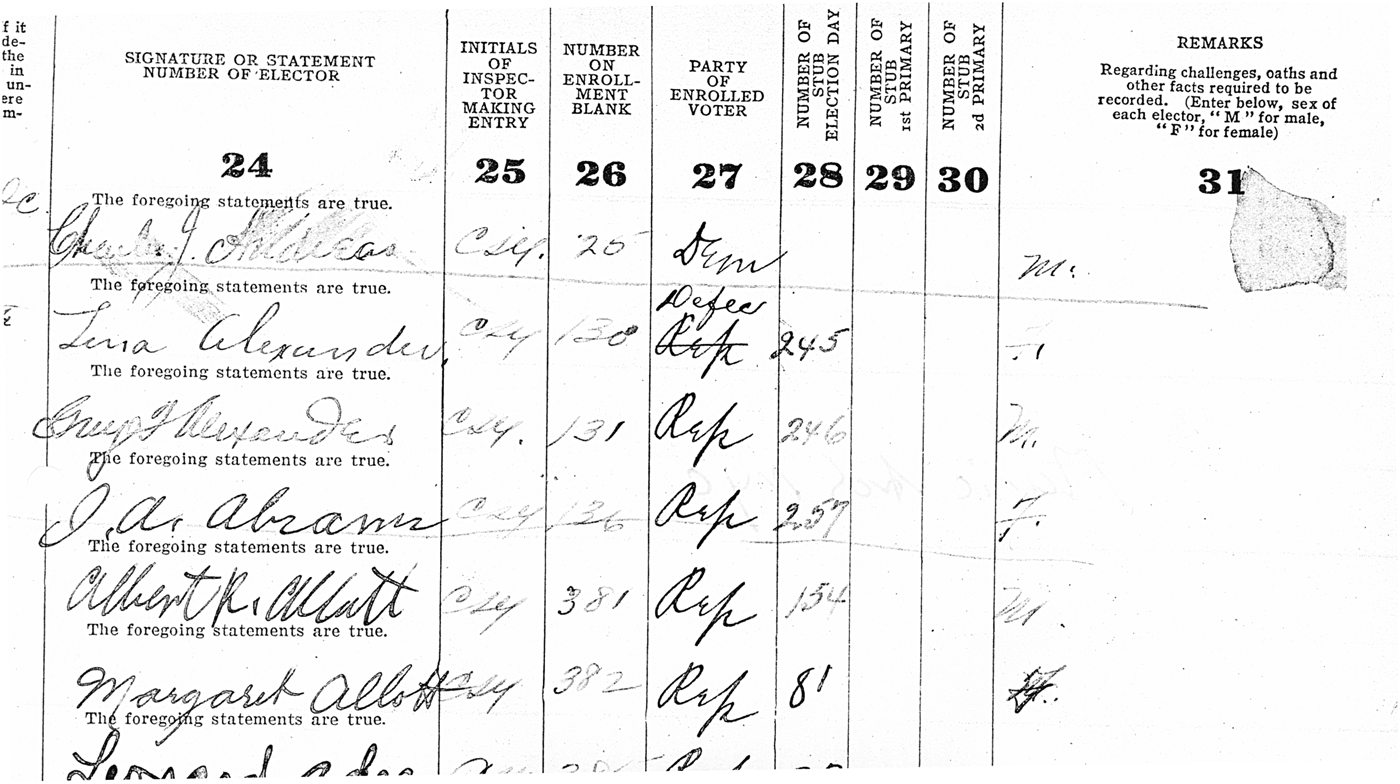
Reformers wrote whole books about the importance of registration and used scientific discourses to flesh out their arguments.Footnote 71 They wanted an exact definition of who constituted a citizen and who did not. Until the turn of the century, this question was often left to the men gathering around the polling place, bystanders, voters, party thugs, or officials.Footnote 72 Finally, in 1921, New York City implemented a registration procedure that required at least thirty-one items of information about the voter (Fig. 2):
The disciplined and well-defined voter. Detail of Registration Book, New York City, 1921.Footnote 73
This mirrors the reformers' meticulous feat to identify and reach the “honest” citizens. Reformer Edward Ridley Finch (“a Yale graduate, a lawyer, a Republican, and […] an authority on the evil of ‘repeating,’”) goes into detail about registration in his essay on “The Fight for a Clean Ballot.” In each election district, he expounded, there were up to 650 voters, and the “hours of the voting day are from six o'clock in the morning until five o'clock in the afternoon, 660 minutes. It is obviously impossible to vote with proper safeguard 650 people in 660 minutes.”Footnote 74 One means to define the “sober” voting citizen was to control the voters' alphabetization. In the 1920s New York City reintroduced a literacy test.Footnote 75 By the mid-1920s twenty-two states were disfranchising illiterate citizens, thirteen being outside the South.Footnote 76
A second major task was the call for ballots not to be a mere instrument in the hands of parties but to display clearly the individual candidates.Footnote 77 This started with endless considerations about the marks on the ballot.Footnote 78 Typical for the careful attention is the brochure “Judge Lambert's Rulings on the Marking of Ballots” (Fig. 3). In an introduction, John G. Saxe II, member of the New York State Senate and president of the New York Bar Association, wrote, “Both Judge Giegerich and Judge Lambert agreed that there must be a cross. Two lines which do not cross (1) or a check mark (2) are not ‘cross X marks.’ But the lines need not be ‘straight’ (3).” This was important, because the parties could come to an agreement with fraudulent voters, to mark the ballot in a special way; so the partisans could later check, that the voters voted as pre-decided.
In “Judge Lambert's Rulings on the Marking of Ballots” (around 1905).Footnote 79
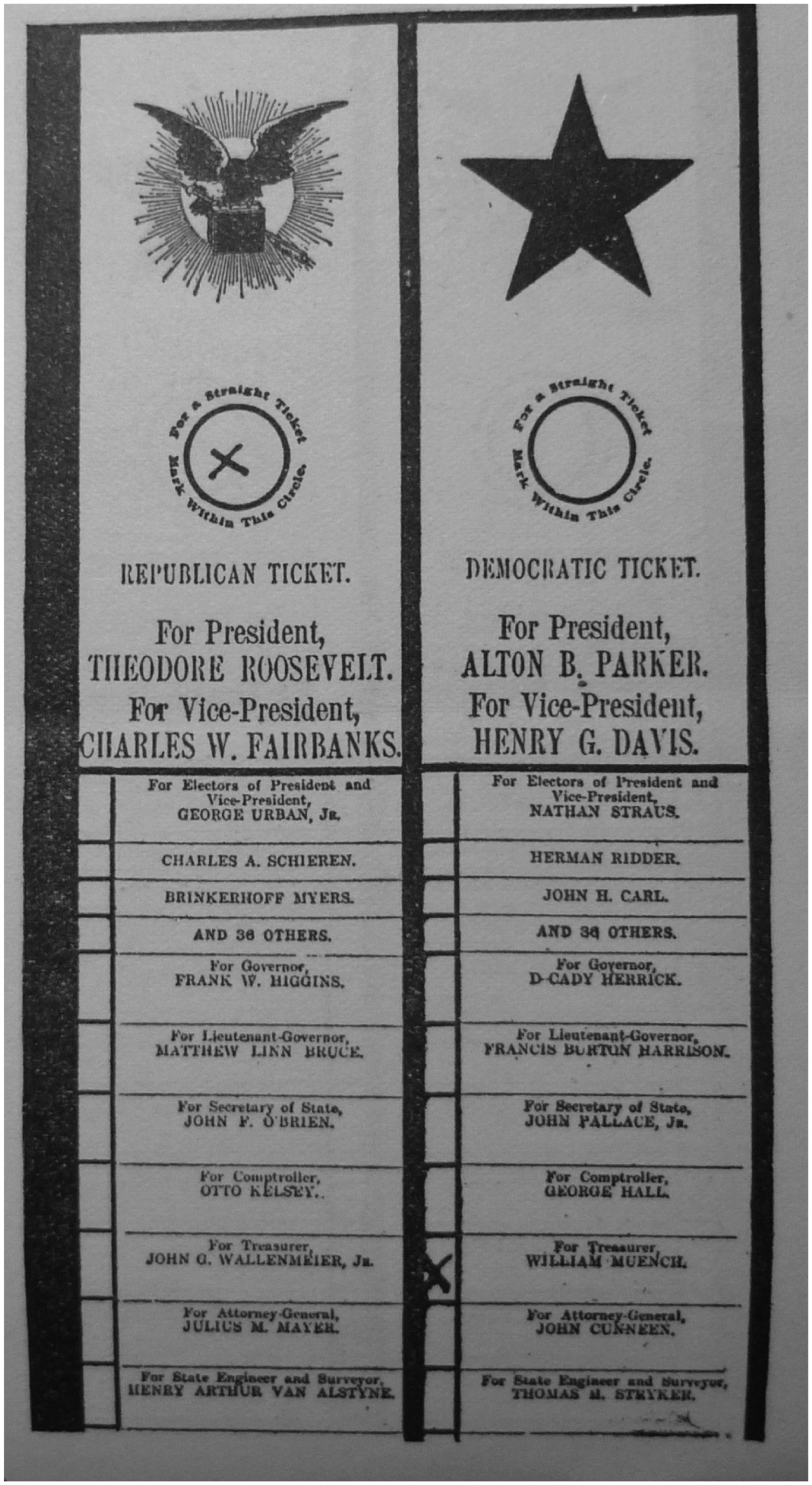
They also wanted the ticket to offer an opportunity for independent candidates.Footnote 80 This meant that it should be possible not only to mark the cross for a party (a “straight ticket”), but to split the vote and have the opportunity to vote for candidates of different parties or even an independent candidate (a “split ticket,” Fig. 4).
Possibility to split the vote and to be compelled to vote for one party only, 1904.Footnote 81
Others felt that the ticket should induce more thinking and more deliberation. Most reformers favored the Massachusetts ballot (Fig. 5):
For many reformers the ideal ticket: detail of Specimen Ballot for Commonwealth of Massachusetts, 1896.Footnote 82
The Massachusetts ballot was a version of the “Australian ticket,” which granted many of the reformers' ideas for a rational election decision. It helped foster secrecy and therefore hindered party influence, because then party members could no longer control the vote. The handling of the ticket clearly required a disciplined and well-educated citizen. The reform clubs also lobbied for the introduction of voting machines, since machines were much better than ballot papers at signaling the exact vote of the citizen.Footnote 83 Voting machines also had the side effect of normally being too complicated for those who could not read, who accordingly were prevented from voting (Fig. 6).
Easy to handle? “Instruction manual for U.S. Standard Voting Machine.”Footnote 84
The discourses of election reform also related to a variety of efforts in social engineering.Footnote 85 For many of the reformers, election amendments were a part of the whole universe of reform efforts. Albert S. Bard, for example, became known not for his work in improving elections but for his protection of historic monuments in New York City. Growing cities such as New York had to deal with previously unknown problems: piles of waste and unsanitary conditions, widespread poverty among immigrants, crime, and alcoholism.Footnote 86 Election reform was intimately connected to the fight against these evils, as all of these problems required the intervention of a professional administration. In 1898, citizens from all over the country declared about elections “that to purify this system is to take a long step in the direction of honesty, economy, and efficiency in every branch of the public service.”Footnote 87 One progressive aim was not only to banish dirt from the streets, but also to illuminate New York City streets—and New York polling places.Footnote 88
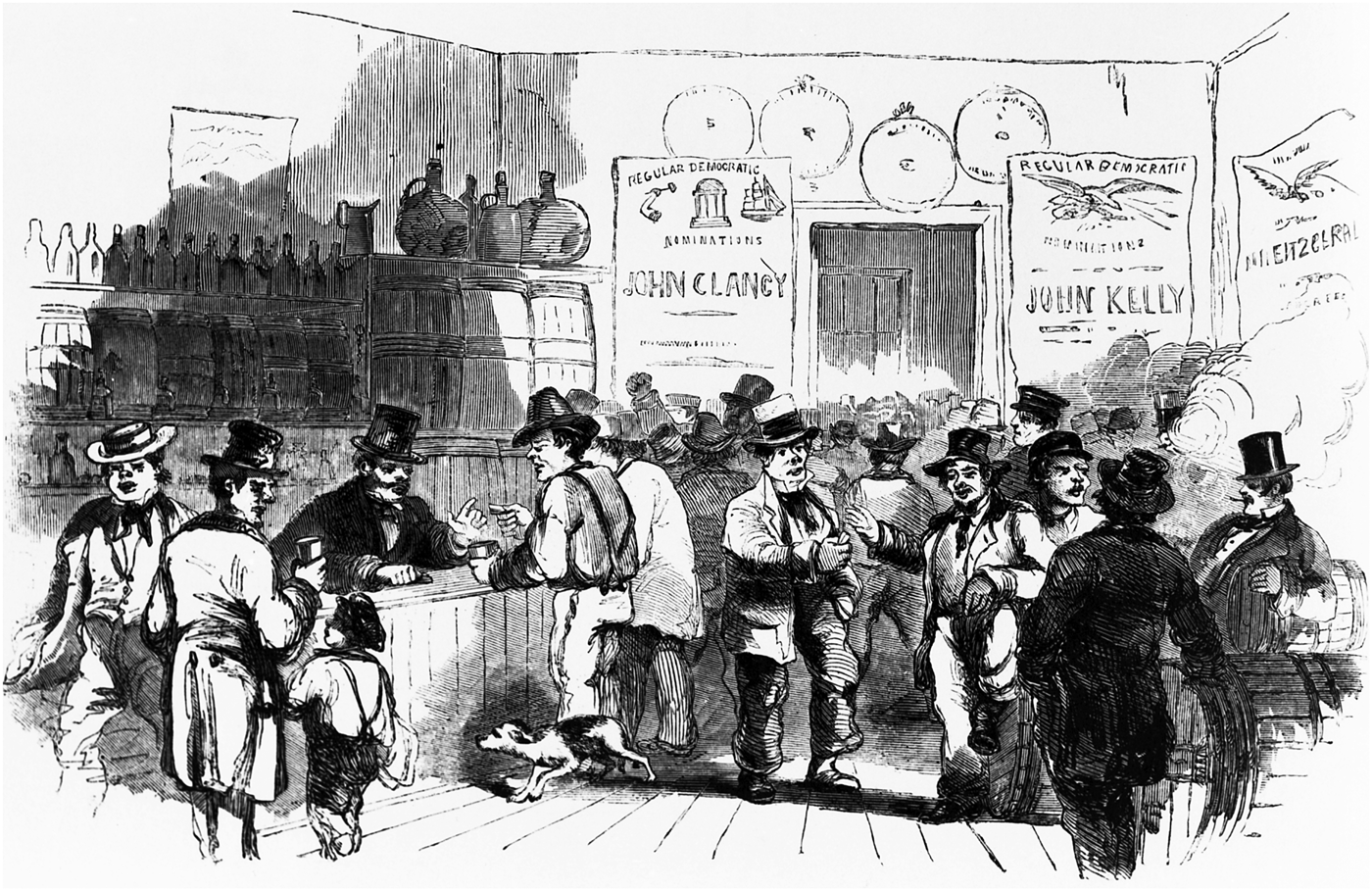
At the end of the nineteenth century, 90 percent of the polling places in New York immigrant districts were located in taverns (Fig. 7).Footnote 90 Reformers opposed the placement of voting stations in inns, small basement shops, or airless sitting rooms. They disapproved of the wild mixture of alcohol and disturbances in these voting places, which they connected to the prevalence of voter fraud like stuffed ballot boxes or repeated voting by one person. Polling places, they argued, should be light and tidy, with no candlelight, but rather electric or gas lighting. And to ensure the private, rational choice, there had to be polling booths. Finally, at the beginning of the new century, reformers asked the police to check polling places before balloting began to assure that they were “fitted up, swept, heated, properly lighted.”Footnote 91
Before Progressive Reforms. “Voting Place, No 488, Pearl Street, Sixth Ward, New York City, 1858.”Footnote 89
Beginning in 1916, elections in New York City took place exclusively in public buildings such as courthouses, town halls, and schools.Footnote 93 The chairman of the Board of Elections called this denouement a “complete success,” which contributed to the “most wholesome developments of electoral practices in this City.”Footnote 94 A municipal report enthused: “the atmosphere and surroundings […] cannot fail to have a very wholesome effect upon those who go there to register and cast their votes.”Footnote 95 “The use of public buildings, with plenty of space, light, and air, and with an atmosphere of respectability,” the political scientist Joseph P. Harris stated years later, “tends to reduce the rowdyism which sometimes prevails at the polls. The use of basement rooms in apartments, of small shops, and contested quarters tends to facilitate frauds.”Footnote 96
Is it convincing to see these diligent and somehow pettifogging reformers as a phalanx of conspirators who claimed democracy, but who behind closed doors really meant aristocracy. Yet the sight behind these closed doors—the letters and notes of reformers—do not provide evidence of this assumption. Despite the decline of turnout (which was, as shown above, not only due to the reform efforts, but also because of the secular decline of parties' importance), the new election practices had many advantages: they allowed women to appear at the polling station, they helped diminish the power of parties and bullies—and, yes, they prevented fraudulent votes. If elections are considered to be an institutionalized procedure for the choosing of office holders by the summation of the individual decisions of the people, as Stein Rokkan puts it, then the reformers' achievements came closer to this aim than the old election practice. The progressives wanted the individual citizen to choose, and not the money of the bribes or the parties or the political machines. Therefore education and technical changes to balloting were crucial for their concept of citizenship.
But what about the southern states? Stromquist speaks of the “centrality of race to Progressive reform,” and Walter Nugent claims that the “majority of the Americans in the early twentieth century, progressives included, did not believe in racial equality.”Footnote 97 Without any doubt, race was the reformer's blind spot. Northern reformers, however, had the “luxury of silence about race,” as McGerr puts it.Footnote 98 Still, reforms in the South and in the North were quite different. In the North, reformers wanted to stop party rule; in the South, they cemented party rule with the help of their new constitutions and white primaries. The demobilization of voters in the South around 1900 was the largest in U.S. history. In the North, for many reformers. exclusion of African Americans was due to their lack of education, and not to race.
Let us have a closer look at the ideas about African American voters in the South of a typical reformer, E. L. Godkin, an abolitionist and founder of the magazine The Nation, because he was extremely influential—in some respects the primary voice of the reform movement. Being a supporter of the civil service reforms to professionalize administration, he generally doubted the abilities of uneducated men to execute participation and control.Footnote 99 In an essay on “The Republican Party and the Negro” in 1889, he defended the actions of Reconstruction and criticized the neglect of the Republican Party of the “Negro's political or social rights at the North,” especially concerning schooling, while only concentrating on blacks in the South—obviously to get their (Republican) votes. At the same time Godkin believed that the legislature in some southern states, especially in South Carolina and Mississippi, suffered from heavy misrule at the time when federal military troops ensured Reconstruction in the South between 1867 and 1872.Footnote 100 To be sure Godkin, the strong supporter of abolitionism, developed during Reconstruction a disconcerting sympathy for “white supremacy.” Therefore, he became a controversial figure among abolitionists, although also an intellectual leader of the liberal reform movement.Footnote 101 “Nothing but education will make the southern Negro a free voter in the American sense of the term. The one question […] is whether the whites who control the State governments are making reasonable provision for raising him in point of intelligence to the white man's level,” Godkin concluded.Footnote 102 He explained black exclusion not as a result of race but of a deficient education, and therefore the exclusion seemed to him logical if not inevitable.
However, W. E. B. Du Bois delineates a similar picture. He saw a majority of African American voters as victims of political machines, also linking their allegedly political “incompetence” to a lack of education and exclusion through a white society. Du Bois complained, “And when election day comes he [the black voter] receives a bit of printed paper with unknown names and deposits it in a place indicated.”Footnote 103 Following the tradition of educating blacks (like paupers and immigrants) to become part of the “sober and educated people” (to quote John I. Davenport), intellectuals and reformers between 1909 and 1910 founded the National Association for the Advancement of Colored People, which among other goals sought to secure full suffrage for black citizens.Footnote 104 Furthermore, for some reformers, their efforts for “pure elections” were in fact the same as their fight for black suffrage and against white election fraud to prevent Afro Americans from voting during Reconstruction.Footnote 105 To tell a citizen, “he cannot vote until he learns to read is not the same as saying he cannot vote,” one reformer noted.Footnote 106 In the South, the call for education had another tone: “Get rid of the illiterate and corrupt voters and assure control […] by the whites,” as a newspaper blared in 1898.Footnote 107 Southerners directed literacy tests against blacks, a campaign, which, as has been well documented, was terribly successful. Years before the northern States did, the South widely introduced the literacy test—but, ultimately for a very different purpose.Footnote 108
All of these election reforms were seemingly reacting to special problems in the United States: racial tensions, massive election frauds, as well as to a high percentage of immigrants, a huge potential for violence, a demoralized urban administration, and a well-organized corrupt election machine. Crucially, though, these discourses of reform can also be found worldwide. Indeed, election reform was a kind of generalized movement throughout the West. Space precludes going into extensive detail, but I will examine the case of Berlin, to underscore the worldwide similarities and meanings in election reform. Berlin permits an insightful case study, because in Prussia the infamous “Dreiklassenwahlrecht” (Three-Class Franchise) was still in force, while Germany after 1871 had the most progressive suffrage in Europe, with an equal, universal, secret, manhood ballot. The German nation also did not exclude minorities like the Poles (unlike the United States, which officially excluded Chinese inhabitants and “Indians”).
ELECTION REFORMS IN BERLIN
At noon on Sunday, February 27, 1910, 8000 people gathered in the Berlin Zirkus Busch, a fashionable rotunda in the pompously eclectic style of the 1890s, to protest against the unequal Prussian Three-Class Franchise (“Dreiklassenwahlrecht”). The meeting was not a “party event,” as the newspaper Berliner Tageblatt underscored; it was a “huge manifestation of non-politicians, desired and launched by scholars and citizens,” among them industrialists and artists.Footnote 109 Thousands more did not find a place in the building. When the meeting ended, the departing crowds melded with the masses waiting outside and spontaneously marched toward the castle. There they started to rise in protest against the unequal Prussian suffrage and to hail equal universal manhood suffrage.Footnote 110
The strong international interdependence of social reform has been well researched.Footnote 111 The social sciences, offering the scientific background to reforms, were a successful European export item.Footnote 112 American progressives looked closely at other countries' social reforms, especially to Germany.Footnote 113 Sebastian Conrad underscores the point: “Social elites pursuing reform policies were no longer able to do this merely by pointing to precedents on the local or regional level.”Footnote 114 Election reform was also a major topic in Europe around 1900, and in most European countries, such as Denmark, Sweden, or Germany, there was a vigorous process of democratization.Footnote 115 Also in these countries democratization was connected to reforms of election techniques. Within roughly one decade around 1900, a number of European states introduced the secret ballot: for example, Italy in 1895, Austria in 1907, France in 1913.Footnote 116 In Berlin, the Zirkus Busch meeting was only one out of many meetings in favor of election reforms. Newspapers and political rallies addressed the issue election after election. Against the backdrop of a common acceptance of a wide suffrage, Berliners furiously debated the reform ideas. Here, too, the aim was to protect the “will of the people.” Interestingly, while in New York City reform ideas arose from civil society, in Berlin—though accompanied by public discussions—ideas for improvement often came from the highly effective administration.Footnote 117 This is important, because consensus in Prussia and Germany had to be accompanied by acceptance on the part of the influential and professional bureaucracy. German bureaucratic elites had a long tradition of instituting liberal and Progressive reforms.Footnote 118 Prussians valued government service more than did Americans. Government service offered a promising career path for aspiring men, and state officials were an important and well-respected part of the German society. Therefore, German civil society and bureaucracy were closely intertwined.
Even the majority of conservative politicians in Prussia no longer militated against mass participation. Far from it! Conservatives vehemently rejected the frequent and often tactical accusations by liberals and leftists that right-wing parties were planning to abolish universal manhood suffrage for elections to the German parliament, the Reichstag.Footnote 119 Mass suffrage had become a symbol for “civilization.” In 1892, for example, the distinguished Catholic Staatslexikon stated approvingly that “most civilized states” had accepted democratic ideals, particularly the idea of equality within the franchise.Footnote 120 As early as 1883, the conservative minister of education, Robert Viktor von Puttkamer, declared in the Prussian parliament that “a civilized nation of culture [Kulturstaat]” should widen the “precious political right,” the suffrage, “as far as possible.”Footnote 121 Intellectuals, politicians, and social scientists persistently referred to mass suffrage as a matter of “Kulturnation” (“nation of culture”) or “civilized states.”Footnote 122 Full of admiration for the American method of governance, the historian Otto Hintze in 1914 saw a general “democratization of public life” in all nation of cultures [Kulturstaaten].”Footnote 123
Leading figures such as Max Weber, Ferdinand Tönnies, Friedrich Meinecke, or Gerhart Hauptmann repeatedly showed their commitment to democratic participation and urged for reforms in Prussia.Footnote 124 The German reform community corresponded in nationwide newspapers and scientific journals. In comparison with the United States, several intellectuals did not feel less democratic, but less venal. Prussian historian Hans Delbrück, expounded, “Americans do not understand that we feel more free under our severe but accurate and parliamentarian and well controlled civil service regiment [Beamten-Regiment] than under a corrupt demagogue regiment.”Footnote 125 Mass suffrage for many Germans was a point of honor and pride. “We do not believe,” wrote the Weser Zeitung euphorically in 1897, “that there has ever been on earth something that can be compared even from afar to the electoral apparatus, which exists in all civilized countries, either in its extent or in its magnitude, its refinement or technical accomplishment.”Footnote 126 As Margaret Anderson demonstrates, German society before World War I was familiar with and generally fond of democratic practices.Footnote 127 In the last prewar elections to the German Reichstag in 1912 turnout was 85 percent, and the Social Democrats won the highest result with one third of all votes.
This does not mean that there was no opposition to universal manhood suffrage. In addition, though severely criticized, the Three-Class Franchise (which was universal but not equal) would not be abolished until the end of World War I. In Saxony, a country with a strong socialist party, conservatives even managed to install a Class Franchise as late as 1896. The spirit of reform proved stronger, however, and the newly installed suffrage was abolished in 1909. What is more, several South German states enlarged their suffrage in 1905 and 1906 to universal manhood suffrage.Footnote 128 Prussia was under heavy pressure. A prestigious newspaper commented on the various election reforms and reform efforts: “In the face of the undeniable democratization of the common opinion it is sure enough that Prussia cannot stand back as the only exception.”Footnote 129 “Prussia should not oppose to the developing law of the whole world of culture,” a liberal politician wrote. “All peoples get democratized right now. Even Prussia cannot miss this trend.”Footnote 130 By 1900, even conservatives felt that voting had to be more equal—and conservatives themselves defended this Class Franchise by noting its universality.Footnote 131 They underscored that they only opposed equal suffrage, but not universal suffrage. Much evidence suggests that the World War stopped the reforming process and that the Prussian unequal suffrage would have been abolished within a short period of time. All in all, criticism of universal suffrage was a rearguard action. For example, after a discussion in the German parliament on universal male suffrage, the traditional Hamburger Nachrichten ranted: “The Reichstag session was a unanimous homage to the one and only all-powerful and inerrable sovereign in present-day Germany: the universal suffrage of the Reichstag.”Footnote 132
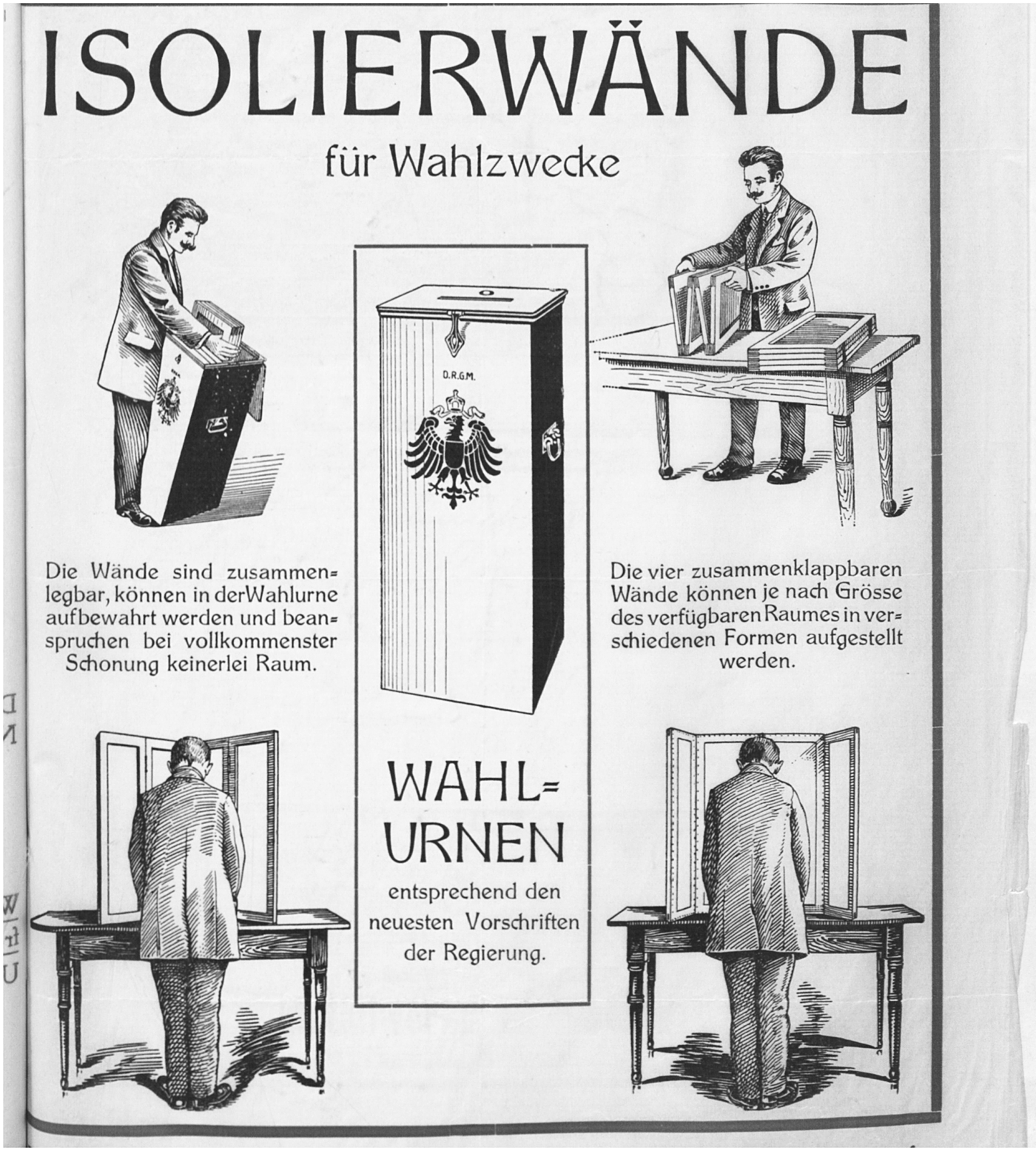
Reform discourses were omnipresent in Germany. All political sides took part, including conservative players. They accused Social Democrats, especially in Berlin, of committing “election terror” (“Wahlterror”) in working-class districts. “Wahlterror” consisted of bullying anybody who did not vote for them, which meant boycotting businesses or discriminating against every worker who did not want to join them.Footnote 133 Except for some marginal conservative groups, every party claimed its zeal to protect the secrecy of the ballot of the German Reichstag suffrage.Footnote 134 Hence, liberal and socialist parties, social reformers, and the administration all backed a 1903 plan to ensure secret and fair elections.Footnote 135 In Berlin as well, the reforms sought to ensure that only rational, responsible citizens, freed of other influences, would cast ballots. Because of this desire, the 1903 reform introduced the secret, enclosed ballot and private polling booths.
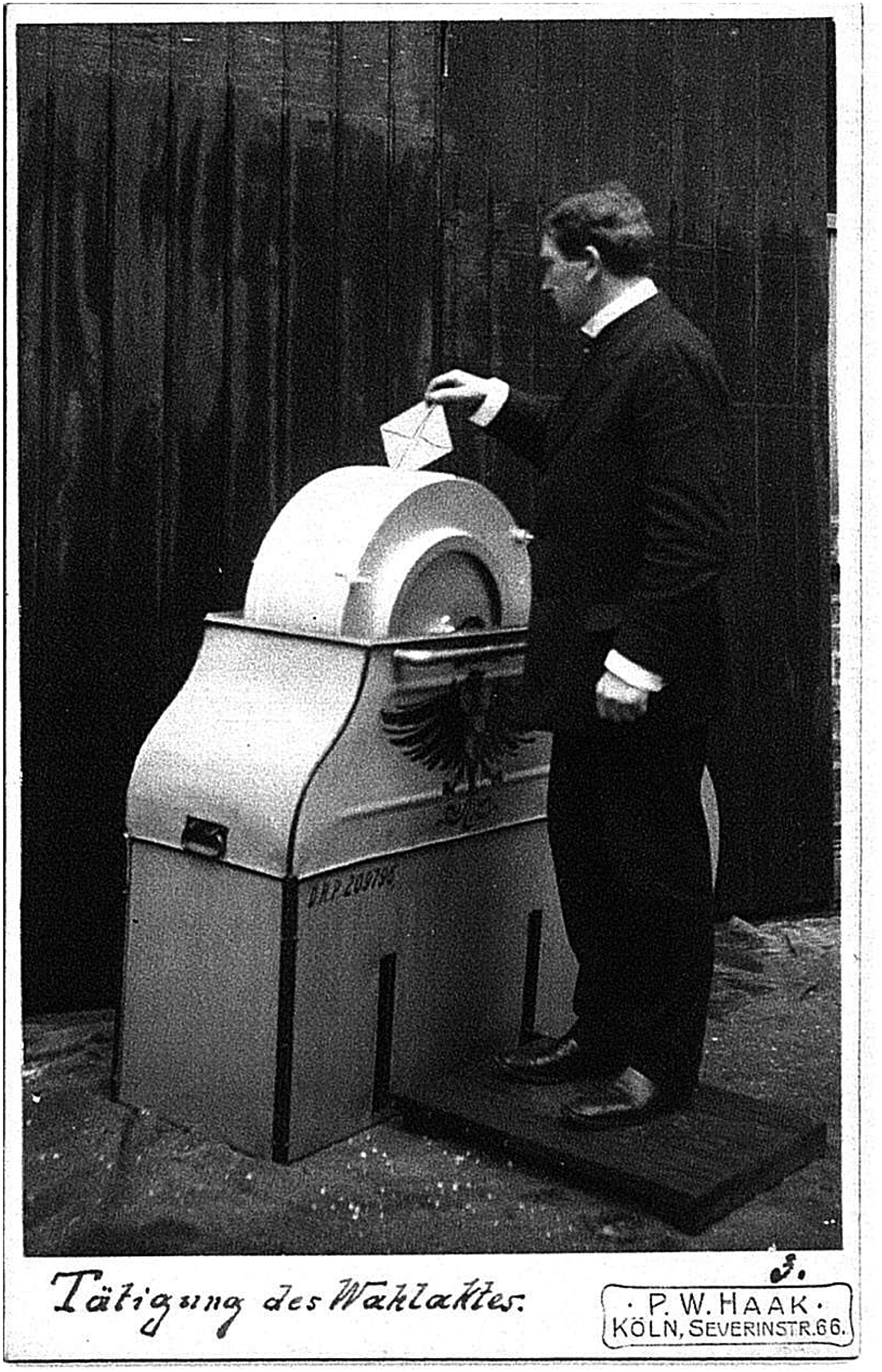
There were also wide discussions concerning a new and standardized form for the ballot and ballot box (see Figs. 8, 9 and 10).Footnote 137 In the Reichstag in Berlin they discussed at length such technical problems as the special difficulties in the countryside of installing ballot boxes.Footnote 138 The Berlin municipality and intellectuals debated fair election registration. A certain Dr. Otto Arendt claimed in Der Tag, a Berlin journal that provided a platform for election reform discussions, “Registration lists are the foundation of the suffrage, and hence deserve to find much more attention than before.”Footnote 139 Finally, the Berlin administration found an efficient system that combined a permanent registration of citizens and a newly composed registration list for every election.Footnote 140 Years later, New York reformers also demanded permanent registration.Footnote 141 As in New York, reforms of this kind were intended to ensure the privacy of the ballot and the “free expression of the people,” and to protect the “highest and holiest property of the people,” as a German journalist put it.Footnote 142
After Progressive Reform. Electric lighting, polling booths, sober men, rational vote: New York Polling Place in around 1910.Footnote 92
The sober, political man: information leaflet “Insulation walls for elections,” ca. 1902.Footnote 136
The modern person: autonomous, rational, responsible, empowered. “Performing the act of voting,” model of a fraud resistant ballot box, Germany, 1910.Footnote 157
Reformers on both sides of the Atlantic looked to the same electoral technologies to “purify” the act of voting and, by extension, the voter. The “Berliner Tageblatt” wrote that the new laws concerning ballot booths and envelopes would help to create a voter with “a sense of autonomy.”Footnote 143 A conservative politician interpreted the improvement of the secret ballot as a means to “foster political responsibility.”Footnote 144 Even Prussia, with it antiquated Three-Class Franchise, which around 1900 appeared embarrassing to many citizens, adopted modern techniques of voting. Some large cities introduced the possibility of casting the vote throughout the entire election day, and not just during a single election meeting.Footnote 145 All in all, modern elections in a “civilized” country were no longer possible without standard techniques of voting. Election practices in the United States and Germany became more and more similar.
CONCLUSION
The varied election reforms concerning election techniques are far from minor questions. They reveal the very idea of the responsible, empowered, disciplined, and rational citizen. Obviously, the elites' answer to immigration, growing social inequality, corruption, and machine politics was not to deny universal suffrage, as some had previously done.Footnote 146 Rather, the highly complex and exhausting endeavors for reform actually reveal the reformers' aim to protect mass democracy.
The dedication to the “purity of the polls” must be seen as part of a “‘return to the people’ movement.”Footnote 147 The efforts to install primaries, to delegate nominations to the people, to offer methods for an exact count, to implement improvements in referendum processes, and to push back party influence and bribery—were all part of the “purification.” Reformers and officials introduced modern election techniques as a means to guarantee an essential aspect of the modern democratic idea: that is, the voter should act in a mature, responsible, and rational manner, and that, therefore, elections should be conducted in a disciplined manner, without any bribery or violence. Paradoxically, reformers in the United States believed that creating this “modern voting man” necessitated an education process to construct a disciplined people. Therefore, they took measures to segregate those persons whom they considered not (yet) fit for executing a rational vote. Most reformers, though, intended segregation as a transitional stage. Theoretically expressed, the aim was a functional differentiation—to free politics from other influences and enable a “rational” government. “Rationality,” and not only in Max Weber's view, was the hallmark of modernity. In his essay on “Contesting Democracy,” Jan-Werner Müller draws the picture of an age of reason and security. He quotes Stefan Zweig, who wrote about the years before the First World War: “everything radical, everything violent seemed impossible in an age of reason.”Footnote 148 The quotidian concerns of ballot reform were intimately enmeshed with these grander themes of modern life.
Besides, one cannot overestimate the reforming efforts in consideration of one of the most important changes in twentieth-century societies: suffrage, emancipation, and equal rights for women. Prevailing middle-class progressive gender ideals informed arguments favoring female suffrage. These ideals considered women more disciplined, less prone to alcohol and violence, and more concerned about the public good.Footnote 149 In addition, only disciplined elections without male binge drinking and without violence could enable the wide diffusion of the idea that women, like men, could participate and vote. Paul Kleppner contends that “other changes in the political system—e.g., female suffrage, initiative, referendum, recall, and direct election of U.S. Senators—seemingly do not fit into the same framework” of a general decline in democracy during this period.Footnote 150 Regarding election reforms as a process of disciplining and rationalizing, however, these changes actually easily fit into a framework that emphasizes the centrality of democratization.
The look at Germany and Berlin underscores that election reforms were more than a middle-class effort of New York progressives. As other studies on Great Britain and France show, election reforms around the turn of the century built the very grounding of modern elections in the transatlantic world.Footnote 151 Standardized procedures for casting the ballot and voting practice with standardized paper ballots and polling booths were part of the “universalization of Eurocentric practices and values,” as expressed by Arif Dirlik.Footnote 152 The techniques of voting are so important because in the ballot booth the citizen is the modern individual: no longer subject to social, religious, traditional, or other influences. The man insulated in the booth is the very construction of the modern person: autonomous, rational, responsible, and empowered.Footnote 153 The great global sweep for a universal suffrage, including for women, would not have been possible without the reformers' achievements around 1900. Therefore, I disagree with Sven Beckert's assertion that “disenchantment with democracy” became a hallmark of these years.Footnote 154 At the turn of the century, democratic practice was broadly accepted. This is clear not only due to the reformers' discourses in favor of mass suffrage, but also due to their meticulous endeavors to ensure fair election techniques, and to capture the individuals' will via complex election procedures.Footnote 155 Electoral techniques to secure a modern voter, who cast his or her individual and rational ballot, constituted a crucial part of the disciplining project, a crucial part of what Norbert Elias called the “civilizing process.”Footnote 156 Ultimately, civilization came to mean democracy, and we continue to live with that powerful transatlantic progressive legacy.