




Ever since the advent of generative grammar, much work in syntax has been devoted to the structure of the clausse and its two-part configuration: the core of the clause, on the one hand, and the left periphery, on the other. By left periphery, I mean any lexical material that appears to the left of the canonical subject position. In (1a), for example, we find a neutral word order (Subject-Auxiliary-Verb-Object), whereas in (1b), the interrogative equivalent of (1a), we see that the auxiliary ‘has’ appears to the left of the clause (Auxiliary-Subject-Verb-Object).
(1) a. Claudia has watched a movie.
b. Has Claudia watched a movie?
Originally, the core clause was labelled S (for sentence) while the left periphery was labelled COMP (see Bresnan Reference Bresnan1970). For theoretical reasons (the rise of X-bar theory, Chomsky Reference Chomsky, Jacobs and Rosenbaum1970; Jackendoff Reference Jackendoff1977) as well as empirical reasons (two elements can appear to the left of the canonical subject, as shown by (2)), two positions were postulated for the left periphery: COMP and its specifier, as in (3), the idea being that the wh-phrase ‘what’ appears in the specifier position while the auxiliary is in COMP.
(2) What has Claudia watched?


Wh-phrases are not the only elements that can be fronted in English and other languages. Topics (4a) or focused elements (4b) are often fronted to the left of the canonical subject:
(4) a. Not a single movie did Claudia watch.
b. The movie, Claudia watched, but not the TV series.
Throughout the years, it was discovered that two positions were not sufficient, and COMP was decomposed into many different projections (depending on the language). Since the advent of Rizzi’s (Reference Rizzi and Haegeman1997) influential paper, for example, showing that minimally a fronted topic and a fronted focus can appear to the left periphery of the canonical subject, more and more work has pointed to the conclusion that the functional projection corresponding to COMP needs to be split. Following this seminal article’s proposition that fronted topics and foci structurally conform to the X-bar schema and are projected as heads, research on the complementizer space (i.e., the clause’s left periphery) has become increasingly popular (Cinque Reference Cinque1999, Reference Cinque2002; Belletti Reference Belletti and Rizzi2004a, Reference Belletti2004b; Poletto Reference Poletto2000; and many others).Footnote 1 The CP domain is now a rich domain encoding not only focus and topicalization, but also illocutionary force and finiteness. The diagram in (5) gives the basic structure found in Rizzi (Reference Rizzi and Haegeman1997).
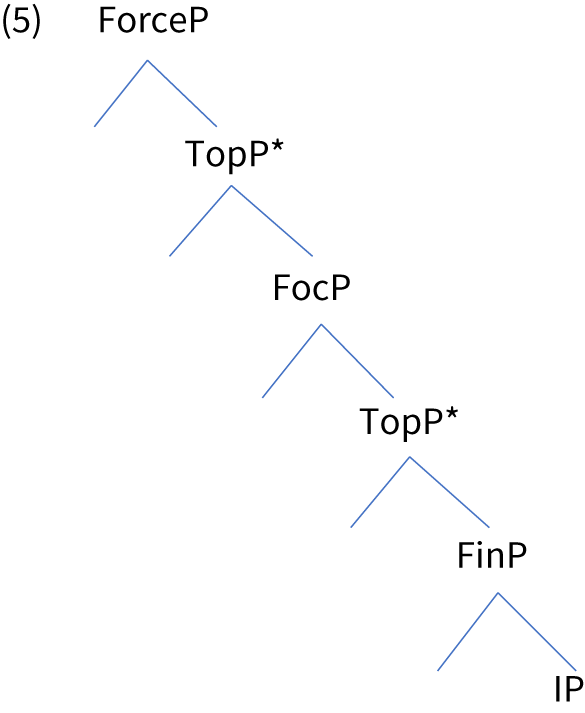
ForceP is the locus of clause-typing (is the clause declarative, interrogative, imperative, etc.?); TopP* hosts topics (there are two positions, and they are iterable, indicated by *); FocP is the landing site for wh and/or focused elements; FinP determines whether the clause is finite or non-finite; IP is the canonical clause (sometimes called TP).
While the initial work on the left periphery of the clause focused on Italian, with later extensions to other Romance languages as well as Germanic languages, a larger pool of language families was gradually included over the years (see Rizzi and Bocci Reference Rizzi, Bocci, Everaert and van Riemskijk2017 for a comprehensive list). Much linguistic variation was discovered, and much progress has been made in mapping out the different elements that can appear at the left periphery cross-linguistically (Poletto Reference Poletto2000; Aboh Reference Aboh2004; Haegeman Reference Haegeman2010, Reference Haegeman2012; Torrence Reference Torrence2013; Samo Reference Samo2019; and many others).Footnote 2
Not all the articles collected in this thematic issue necessarily follow the cartographic approach to the letter, but the overall theme remains that of the left periphery of the clause as broadly described above. The left periphery can be referred to informally without necessarily adopting all the functional heads proposed in the literature for the left field of the clause, and the title of this special issue can therefore be interpreted descriptively rather than theoretically.
Within this broad framework, this special issue has two goals: 1) provide empirical insights on the left periphery of a number of (non-Indo-European) understudied languages (e.g., Ojibwe, Inuktitut, Chuj, Passamaquoddy, Wolof); 2) provide theoretical proposals that shed light on the relationship between the complementizer space and other linguistic properties (e.g., C and agreement, clause typing, varieties of V2, independent/conjunct contrast, independent/dependent contrast, C and language change/contact). These connections are understudied and for the most part remain mysterious. By focusing on, for example, the relationship between C and other properties such as agreement, some of the articles thus go beyond the mere description of various positions at the left edge of the clause.
The functional head C has been the subject of numerous studies on word order. For example, C is typically the locus of V2 (den Besten Reference den Besten and Abrahams1983; Holmberg Reference Holmberg1986; Platzack Reference Platzack, Hellan and Christensen1986; Sigurðsson Reference Sigurðsson, Maling and Zaenen1990; Vikner Reference Vikner1995; and many others) where the verb moves to C.Footnote 3 Raising of the verb to C has even been proposed for Algonquian languages. One prevalent idea in the Algonquian literature (see e.g. Campana Reference Campana1996; Brittain Reference Brittain1997, Reference Brittain2001) is that although the verb in the independent mode remains lower in the structure (i.e., in T), the verb head in the conjunct mode moves all the way to C, blocking the person proclitic that otherwise appears in the independent mode.
The functional head C has also become a prevalent topic in the discussion on phases (Chomsky Reference Chomsky and Kenstowicz2001, Reference Chomsky, Freidin, Otero and Zubizarreta2008). Most linguists agree that unlike TP (for example), C is a phase. While the specifier position of C is accessible to higher material, anything under C is not – in other words, it is not visible for higher operations. CP also become important in the discussion around complement selection of verbs. Some verbs select a CP (e.g., think, say), but others do not: they might select a TP (want) or even a smaller clause.
C has also been discussed in relation to agreement. In a number of languages, it is possible for C to agree in φ-features (Haegeman Reference Haegeman1992, Reference Haegeman2000; Haegeman and Koppen 2012; Carstens Reference Carstens2003, Reference Carstens2016).
Finally, according to Chomsky (Reference Chomsky, Freidin, Otero and Zubizarreta2008), T does not have its own Agree ([uφ]) features and cannot act as a probe for the subject on its own. Instead, T inherits its [uφ] features from C, so that it is C that ultimately initiates the Agree relation that values the subject’s interpretable φ-features. The features inherited to T can trigger subject A-movement to Spec,TP, rather than Spec,CP, given that C’s Agree/φ-features have been passed on to T (φ-agreement with the subject can also spell out via T, e.g., ‘He walks.’). Feature inheritance provides an elegant account of infinitives as TPs that are not dominated by a CP. Because there is no C level, nonfinite T does not inherit any Agree features and agreement with a subject, or Case assignment, is impossible.
Chomsky mentions that the presence of [uφ] features might be what marks the end of phase, a notion formalized by Richards (Reference Richards2007). The Phase Impenetrability Condition (Chomsky Reference Chomsky and Kenstowicz2001) indicates that a phase head, like C, spells out its complement, making it inaccessible to further syntactic operations, but the head remains visible. Richards (Reference Richards2007) proposes that C must transfer its φ-features to T so that these uninterpretable features can be valued and deleted at the same instant – that is, the instant of spell-out of the complement of C. This renders the uninterpretable features originating on C invisible to further derivation.
In summary, the originality of this thematic issue comes from the inquiries into less studied languages, on the one hand, and into the relationship between C and other syntactic features, on the other. One goal is to showcase features of the left periphery of clauses in Indigenous languages; therefore, we include papers on two Algonquian languages, one on Inuit, and another one on Mayan.
The participants are all well-known linguists and experts in their domains of enquiry. Many thanks for their contributions and willingness to participate in this thematic issue. My personal interest in the left periphery goes back to my work on optional wh- movement in French (Mathieu Reference Mathieu2004), on the left periphery of Old French (Mathieu Reference Mathieu2006a, Reference Mathieu2006b, Reference Mathieu and Arteaga2012) and clause typing in Ojibwe (Lochbihler and Mathieu Reference Lochbühler and Mathieu2016).
The special issue begins with Peter Grishin’s article “CP and clause type in Passamaquoddy”. In his contribution, the author considers the interaction of Ā-movement, long-distance agreement (LDA), and clause type in Passamaquoddy (Eastern Algonquian) while giving insights into the structure of the left periphery in that language. Three kinds of LDA patterns are observed in the language depending on the type of complement involved: (i) LDA into epistemic complements of verbs like ’kocicihtun ‘know’; (ii) LDA into direct perception complements; and (iii) LDA into complements of verbs like ’pawatomon ‘want’ (subordinative complements). All three types behave differently in terms of extraction and agreement, and it is proposed that these three patterns can be derived from the variant clause size involved in each case: epistemic complements are full, phasal CPs and direct perception complements are reduced, while nonphasal CPs and subordinative complements are (nonphasal) bare TPs.
In “Exhaustivity and nominal predication: The non-discourse function of the left periphery”, Martina Martinović investigates nominal predicate sentences, in other words of the type They are thieves, in Wolof and Igala. Even though these are typologically distinct languages, they display similar behaviour regarding this construction. The author argues that nominal predicate sentences in these languages involve movement of the nominal predicate and movement of the subject of which it is predicated to Spec-CP and Spec-TopP, respectively. Given that nominal predication in Wolof and Igala involves positions at the left periphery, the author argues that the commonplace view that this domain of the clausal structure has exclusively discourse functions cannot be maintained. The article shows that, in both Wolof and Igala, constituents can occupy a left periphery position while also being discourse-neutral and that they receive an exhaustive interpretation. Furthermore, they can be preceded by a topic, which is diagnosable by, for example, its incompatibility with wh-phrases and with bare quantifiers.
In “The relativized EPP: Evidence from agreement and word order in Border Lakes Ojibwe”, Christopher Hammerly explores patterns of agreement and word order in Border Lakes Ojibwe that show alternations between VOS and VSO word orders and complex interactions between probes on Voice, Infl, and C. Hammerly shows that the behaviour of lower probes feeds and bleeds the possible agreement and movement relations on each subsequent probe. These complex interactions culminate with the peripheral agreement marker on C, the typical left periphery functional head, which in this language shows a curious pattern that the author calls reverse omnivority, where the probe agrees with lower-ranked arguments over higher-ranked arguments regardless of whether it is a logical subject or object. The core theoretical innovation is an extension of the syntactic operation Agree to encode a relativized EPP, which captures variation and restrictions on movement and the possibility of movement and feature copying being independent. The account provides a strong case for Ojibwe as a configurational language.
In their contribution “Absolutive case assignment as a root phenomenon in Inuktitut”, Julien Carrier and Richard Compton dispute the common claim in the literature that, in Inuit languages, verbal agreement occurs in the CP-domain, by showing that absolutive case also occurs in certain nominalized clauses which lack verbal agreement. Therefore, the authors analyze gerund and participial constructions in Inuktitut in order to determine the contexts in which absolutive case is assigned. Carrier and Compton conclude that absolutive case is not assigned through verbal agreement but is nevertheless tied to the CP-domain. They propose that absolutive case is assigned in any clause endowed with illocutionary force, projecting ForceP bundled with TopP in Inuktitut, which they assume is responsible for absolutive case assignment. Carrier and Compton end their article with the claim that the assignment of absolutive case is a root phenomenon in the language, as it requires the clausal left periphery.
In “The syntax of quantifiers in Chuj”, Justin Royer, Cristina Buenrostro and Peter Jenks provide a novel description and syntactic analysis of different types of quantifiers in Chuj, an underdocumented Mayan language. The authors focus on a subset of expressions that quantify over entities, and that have been noted to appear obligatorily in sentence-initial position (i.e., the left periphery of the clause). Royer, Buenrostro and Jenks argue that three types of quantifiers should be distinguished: (i) Predicative A- quantifiers, which occur sentence-initially because Chuj is a predicate-initial language; (ii) Focus D-quantifiers, which occur sentence-initially because they are lexically specified for an [A’] feature; and (iii) Basic D-quantifiers, which, lacking an [A’] feature, have no effects on the syntactic position of their host arguments.
The special issue concludes with Karen De Clercq and Liliane Haegeman’s contribution “Inside or outside the clause: the syntax of V3”, in which the authors examine a syntactic pattern found in the Ghent variety of Flemish featuring a constituent in first (main-)clause position followed by the invariant element die and the finite verb, thus resulting in Verb Third (V3). The article has two objectives: (i) to define the nature of die on the basis of distributional and semantic arguments, and (ii) to embed this pattern into a wider discussion of the structure of the left periphery in so-called “well-behaved” V2 languages like Flemish. The authors propose that die is a generalized resumptive, that it is a left-peripheral head lexicalizing Force°, and that the XP in first clause position is clause-CP-internal. They also argue that, at least in (Ghent) Flemish, the left periphery of main clauses cannot consist of one projection (Spec-CP and the corresponding head) but is better analyzed (within the cartographic framework) as a structurally rich domain with distinct syntactic positions. The behaviour of die is very intriguing and paves the way for further comparisons between Germanic varieties that exhibit similar elements (such as German resumptives).

 Open access

