


Introduction
Capacity development can be defined as ‘the process through which the abilities of individuals, institutions, and societies to perform functions, solve problems, and set and achieve objectives in a sustainable manner are strengthened, adapted, and maintained over time’ (UNDP, 2010, p. 32). The term capacity development implies progress from a base of existing knowledge and skills, emphasizes that the process for building capacity can be dynamic and occur at multiple scales, including individual, organizational and systems levels (CADRI, 2011), and considers how to sustain the capacity that is built (Whittle et al., Reference Whittle, Colgan and Rafferty2012). Capacity development for individuals includes strengthening technical and interpersonal skills, fostering knowledge acquisition and awareness, and effecting change in attitudes, behaviours and cultural norms. Capacity development also addresses organizational and system-level practices through use of organizational assessments, competence registers, and cross-sectoral and integrated planning approaches, among others (Kapos et al., Reference Kapos, Balmford, Aveling, Bubb, Carey and Entwistle2008, Reference Kapos, Balmford, Aveling, Bubb, Carey and Entwistle2009; Porzecanski, Reference Porzecanski, Sterling, Copsey, Appleton, Barborak and Bruyerein press). It encompasses many different formats, such as formal training, peer learning, mentorship, community engagement, learning networks, communities of practice, and others. Capacity development can also encompass physical resources but we do not address this as it lies outside our scope.
Research identifies capacity development as crucial to achieve biodiversity conservation goals (e.g. Barnes et al., Reference Barnes, Craigie, Harrison, Geldmann, Collen and Whitmee2016; Gill et al., Reference Gill, Mascia, Ahmadia, Glew, Lester and Barnes2017; Geldmann et al., Reference Geldmann, Coad, Barnes, Craigie, Woodley and Balmford2018; Coad et al., Reference Coad, Watson, Geldmann, Burgess, Leverington and Hockings2019). Although capacity development is considered important to many conservation programmes, there is limited evidence around its specific impacts. Rather, relevant studies often restrict their analyses to assessing broad measures of capacity. For example, Geldmann et al. (Reference Geldmann, Coad, Barnes, Craigie, Woodley and Balmford2018) and Gill et al. (Reference Gill, Mascia, Ahmadia, Glew, Lester and Barnes2017) found that positive conservation outcomes in protected areas correlated with capacity. They measured capacity using general metrics such as number of staff and the presence or absence of a training plan. However, it is not clear which underlying factors contributed to these successes. Capacity comprises more than the sum of these commonly used quantitative measures. The impacts of capacity development intervention on knowledge, behaviour and attitudes are more difficult to measure and, therefore, not typically considered in such studies. Thus, even though there is evidence that capacity development benefits conservation, it is often not clear what interventions can most effectively and efficiently support and/or achieve conservation outcomes. A more thorough understanding of the outcomes from capacity development interventions (Ferraro & Pattanayak et al., Reference Ferraro and Pattanayak2006) could help address the twin challenges of limited resources allocated to conservation and an imperative to meet sustainability goals.
A comprehensive summary of capacity development interventions and their evaluation can help build evidence-based guidance to support conservation. Evaluating interventions is critical to determine what works and when; evaluations can focus on specific indicators (e.g. change in attitudes) and/or seek to uncover what would have happened in the absence of an intervention (i.e. a counterfactual; Ferraro & Pattanayak, Reference Ferraro and Pattanayak2006). Rigorous, measurable and impact-focused evaluation of capacity development investments helps practitioners make better design and implementation decisions and supports funding agencies to allocate resources more effectively (Aring & DePietro-Jurand, Reference Aring and DePietro-Jurand2012; Loffeld et al., Reference Loffeld, Humle, Cheyne and Blackin press). Evaluators may employ different approaches to frame an intervention and design an evaluation. For instance, some researchers posit that evaluation requires advanced planning to set forth clear objectives and goals for outputs and outcomes, so that monitoring, evaluation and research are conducted to assess achievement (Baylis et al., Reference Baylis, Honey-Rosés, Börner, Corbera, Ezzine-de-Blas and Ferraro2016). The process for achieving goals need not be linear in nature; evaluations that apply approaches and tools from systems thinking and complexity may help to focus on different areas for action compared to a linear approach. These approaches to evaluation emphasize feedback and learning throughout the intervention, view capacity as an emergent process of a complex adaptive system, and adapt the evaluation to reflect this dynamic nature (Black et al., Reference Black, Groombridge and Jones2013; Knight et al., Reference Knight, Cook, Redford, Biggs, Romero and Ortega-Argueta2019; Patton, Reference Patton2019).
Our goal is to provide the first comprehensive assessment of how capacity development in conservation and natural resource management has been evaluated. We seek to collate and synthesize existing knowledge to explore the following questions: What types of impacts/outcomes are being evaluated? Who are the subjects of evaluations? What types of methods are being used for evaluation? To what extent do current evaluations incorporate causal models and/or systems approaches?
We supplement this case study analysis with a review of documents that are focused on guidance and lessons learnt for effective capacity development evaluation. We assess these guidance documents to contextualize our findings on conservation and natural resource-specific synthesis within the broader field of capacity development evaluation.
Methods
We followed an a priori protocol adapted from the systematic map approach of Collaboration for Environmental Evidence (2018). We used two systematic review methods for our approach: framework synthesis and an evidence map. Framework synthesis is used to shape an initial conceptual framework for an issue, around which other aspects of a study can be organized and that can be amended as part of an iterative process (Brunton et al., Reference Brunton, Oliver and Thomas2020). An evidence map is a thematic collection of research articles. The map identifies and reports the distribution and occurrence of existing evidence on a broad topic area, question, theme, issue or policy domain (McKinnon et al., Reference McKinnon, Cheng, Dupre, Edmond, Garside and Glew2016; Saran & White, Reference Saran and White2018).
Framework synthesis
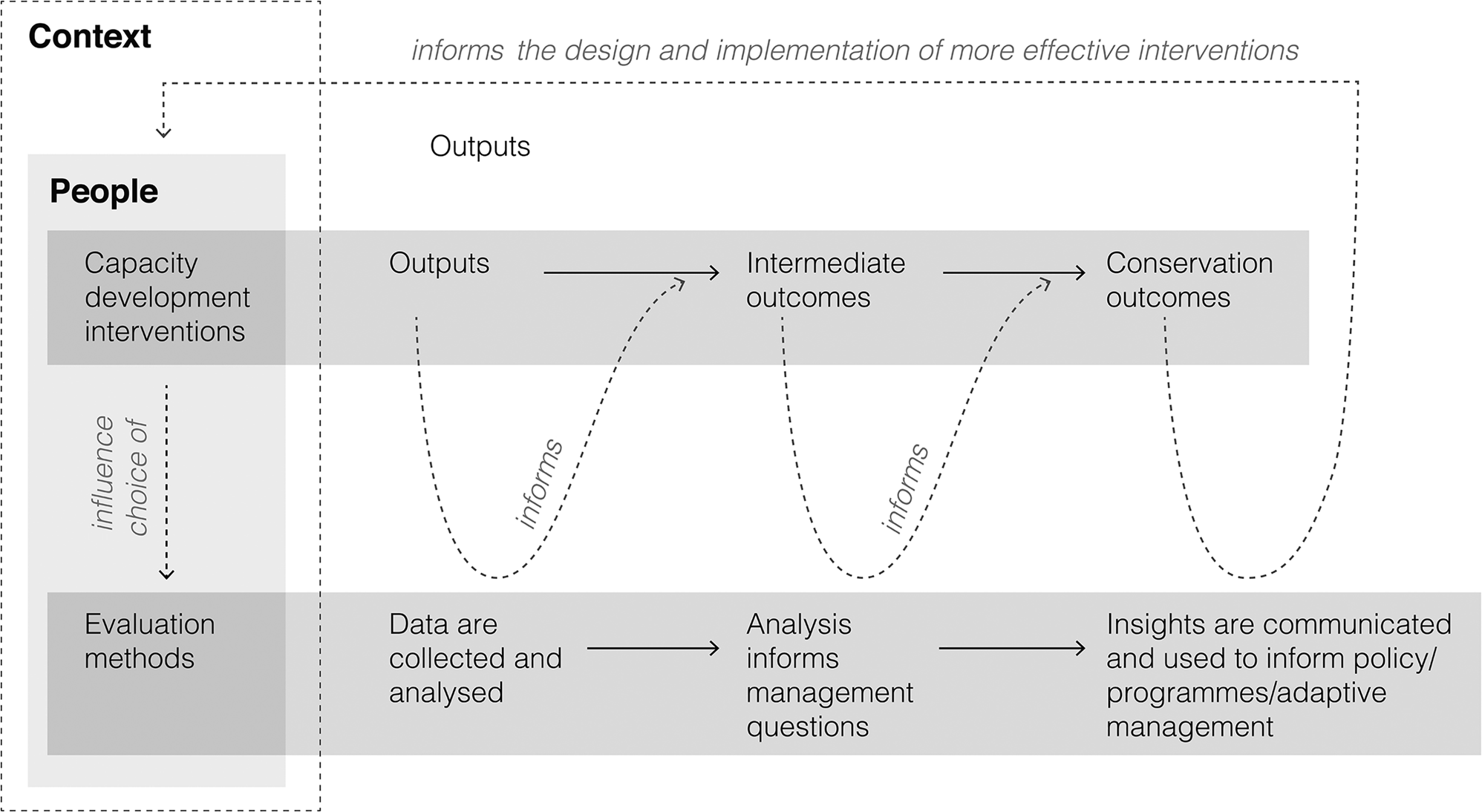
We used framework synthesis (Brunton et al., Reference Brunton, Oliver and Thomas2020) to develop broad themes about capacity development evaluation and situate our findings within the broader literature. We used expert solicitation to familiarize ourselves with key topics, ideas and publications regarding evaluation of capacity development in the fields of conservation, development, and planning, monitoring and evaluation. We contacted the World Commission on Protected Areas Capacity Development Evaluation Working Group, which comprises more than 20 global experts in capacity development and evaluation, through e-mail and directly at workshops. This expert solicitation ultimately led to a core literature dataset that provided lessons learnt, guidance, best practices and other recommendations. We used the resulting dataset for two purposes. Firstly, we developed a preliminary framework consisting of various implementation approaches for a range of capacity development interventions that led to various outcomes, including conservation. These interventions are evaluated in different ways and contexts (Fig. 1). We used this framework to develop our codebook system, described below and in Supplementary Material 1. Secondly, we undertook a qualitative inductive thematic review (Thomas & Harden, Reference Thomas and Harden2008) of the dataset to identify patterns and distil key themes on guidance for effective capacity development evaluation, to situate the findings from our evidence map within this broader context in the discussion.
Causal model for evaluation of capacity development interventions. Choice of capacity development intervention and evaluation methods is influenced by people, who implement and are targeted by the intervention and evaluation, and by the broader context (we note that the influence of people and broader context extend throughout the causal model; for our purposes we are emphasizing how they affect intervention type and evaluation method related to decisions in particular). As shown, the capacity development intervention leads to outputs, intermediate outcomes, and ultimately to conservation outcomes. The evaluation of outputs and outcomes along the intervention results chain in tur informs ongoing adaptive management as well as the design of more effective interventions in formative and summative ways (modified from CAML, 2020).
Evidence map search strategy
We determined search terms based on our framework synthesis and a scoping process that included expert review and focused on peer-reviewed and grey literature published since 2000. Starting in 2015, we carried out a pilot search and scoping exercise to hone the search strategy for relevant articles. Iterative searches were conducted subsequently and reviewed by outside experts, with the final set of searches performed in June 2019. All searches were restricted to English language works. We searched for articles from a literature database (Web of Science, Clarivate, Philadelphia, USA), a search engine (Google Scholar, Google, Mountain View, USA), and several grey literature/specific organization portals (OpenGrey, Collections at United Nations University, U.S. Environmental Protection Agency, My Environmental Education Evaluation Resource Assistant, and United States Agency for International Development). We supplemented our core database search strategy by contacting experts to solicit relevant case study literature (specifically experts from the World Commission on Protected Areas Capacity Development Evaluation Working Group as detailed above). For further details on the search strategy, see Supplementary Material 1.
Evidence map inclusion/exclusion process and critical appraisal
Abstract/title inclusion/exclusion analysis Three team members (EJS, AS, EB) used Colandr (Cheng et al., Reference Cheng, Augustin, Bethel, Gill, Anzaroot and Brun2018) for screening titles and abstracts for relevance. Colandr removes duplicates, allows review by multiple screeners, and applies machine learning and natural language processing algorithms to sort articles according to relevance, which can reduce the time taken to screen compared with traditional methods (Cheng et al., Reference Cheng, Augustin, Bethel, Gill, Anzaroot and Brun2018). At least two team members (EB, AS or EJS) assessed each article; in instances of disagreement, the involved team members discussed the specific study and a consensus decision was reached in consultation with a third-party reviewer when necessary. We erred on the side of including a paper if it seemed to meet our inclusion criteria: (1) actions/interventions related to capacity development, (2) explicit evaluation of capacity development outcomes or impacts, (3) in the fields of conservation and/or natural resource management, and (4) type of capacity development recipient (included recipients were conservation and natural resource management professionals, educators, Indigenous peoples and local community stewards, pre-professionals (e.g. interns, young people involved in training programmes), community scientists, and conservation and Indigenous peoples and local community organizations. We use the inclusive term community scientist because citizenship, or the perception that an individual may or may not be a citizen, is not germane and can impact inclusion efforts. In terms of recipient type, we chose to exclude evaluation of youth environmental education programmes (e.g. for ages 5–14 in classroom or informal settings) as there is an extensive body of literature on the evaluation of environmental education (see systematic reviews by Stern et al., Reference Stern, Powell and Hill2014; Ardoin et al., Reference Ardoin, Biedenweg and O'Connor2015; Thomas et al., Reference Thomas, Teel, Bruyere and Laurence2018; Monroe et al., Reference Monroe, Plate, Oxarart, Bowers and Chaves2019).
Full-text inclusion/exclusion and critical appraisal of case studies The full text of articles was further assessed by one reviewer (EJS, AS, EB or MSJ) for relevance and articles were excluded from the dataset if they met any of the following additional criteria: (1) insufficient detail on evaluation, (2) focus only on youth environmental education programmes, or (3) the only evaluation was comparing outcomes of volunteers with professionals. In instances where an intervention was evaluated in more than one publication, we chose case studies that had the most detail related to our inquiry and those most recently published. For literature deemed relevant at the full-text level, we performed a critical appraisal to ensure our study included literature appropriate for our research aims by assessing the following four principles of quality: conceptual framing, validity of study design, quality of data sources, and quality of analysis (see Supplementary Material 1 for additional detail). Reviewers assessed each principle of quality to determine inclusion in the coding analysis.
Evidence map data collection
For included studies, we developed an a priori codebook system to extract data for 21 key fields, covering general information on each study (e.g. geography, sector), the capacity development intervention, evaluation methods, types of data and analyses, and output and outcome categories assessed. Coding fields included a combination of a priori categories and free text. We used the framework synthesis to develop a pilot codebook and refined it through an iterative process with the multidisciplinary coding team. A subset of the authors coded the included articles (Supplementary Material 1).
Evidence map analysis
We calculated descriptive statistics for the final case studies to assess the overall landscape of capacity development evaluation in conservation and natural resource management. We created a relational database to sort and cross reference the data for the coded variables across the case studies. We used this database to generate a visual heat map of the distribution and frequency of all variables from the 21 coded fields in comparison with every other coded variable.
Results
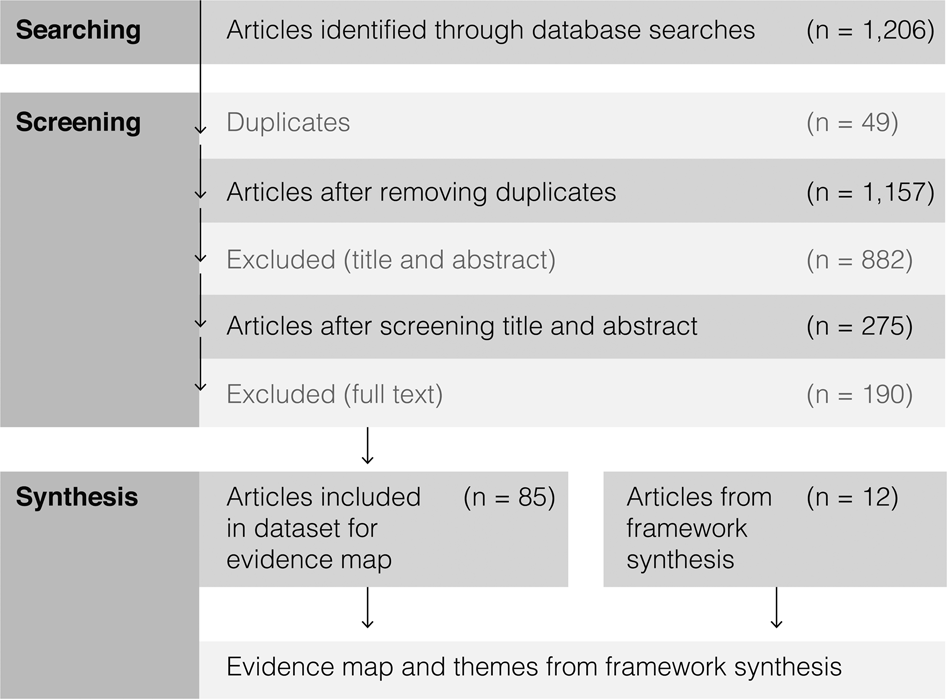
We identified 1,206 potentially relevant studies, of which 85 case studies were included in the final evidence map (Fig. 2, Supplementary Material 1 & 2). Key portions of the visual heat map of evidence are presented in Supplementary Material 3 and Supplementary Figs 1–8. For the framework synthesis thematic review, our dataset consisted of 12 articles (Supplementary Material 1). The themes from this dataset have been integrated into our discussion.
Search and inclusion process for the evidence map and framework synthesis. For details on the criteria used for inclusion, exclusion, and critical appraisal see Methods and Supplementary Material 1.
Summary of included case studies
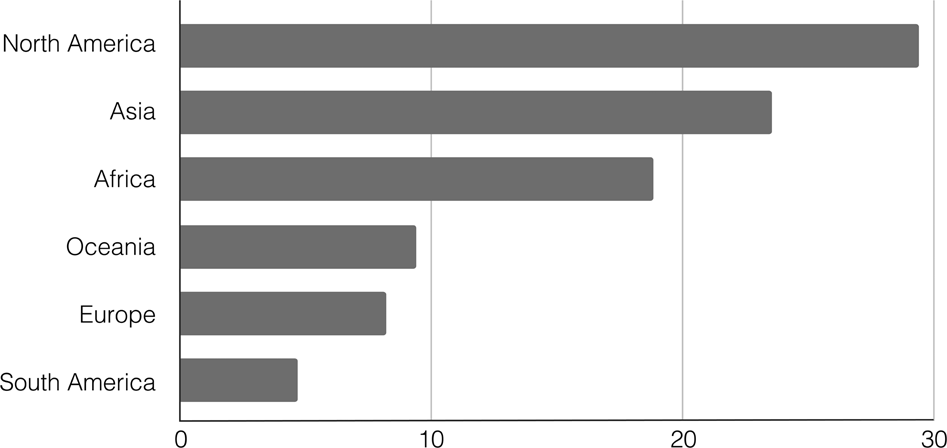
Of the 85 included studies, 42% assessed programme interventions at one specific locality and 42% examined interventions that took place at multiple localities within a country. Only a few assessed interventions on multi-national (10%) or global (6%) scales. The geographical distribution of the case studies was predominantly in North America (31%), Asia (25%) and Africa (20%), with fewer studies in Oceania, Europe and South America (Fig. 3). All interventions involved conservation and/or natural resource management sectors, and many were multi-sectoral, including education (19%), economic development (18%), agriculture (16%) and governance/policy (13%).
Geographical distribution of the case studies (n = 85), excluding five case studies that involved multiple continents.
We found that 42% of the included studies described an explicit causal model. A causal model could be inferred in most of the remaining cases (46%); in 10 instances (12%) it was difficult to identify a causal model. We did not assess if the explicit or inferred models accurately reflected the causal thinking employed in the study.
Capacity development interventions overview
The capacity development interventions in the evidence map were wide-ranging and some incorporated multiple approaches. Interventions most often included training, informal education, and learning networks and communities of practice; mentoring and formal adult education were less common (Fig. 4a). Training included initiatives to train the trainers and on-the-job-training, including geospatial equipment, species monitoring and interpersonal skills. Community scientists were also trained in how to monitor coral reefs, mammals, invasive species and water quality. Informal education included conservation corps opportunities for high school and university students, landowner and farmer workshops on management techniques, community workshops about alternative livelihoods, and work experience such as internships. Mentoring primarily involved peer mentoring of new participants by programme alumni. Formal adult education included establishing graduate and certificate programmes in the fields of conservation and natural resource management. Additionally, 8% of cases included capacity methods labelled as ‘other’, such as partnerships and workshops with peer learning and networking.
Overview of capacity development intervention factors as a per cent of cases overall (n = 85). A case study could be in more than one category (so the sum of all bars can be > 100%). (a) What is the method to build capacity? (b) What type of organization implemented the intervention? (c) Who is the target of capacity development? CoP, communities of practice.
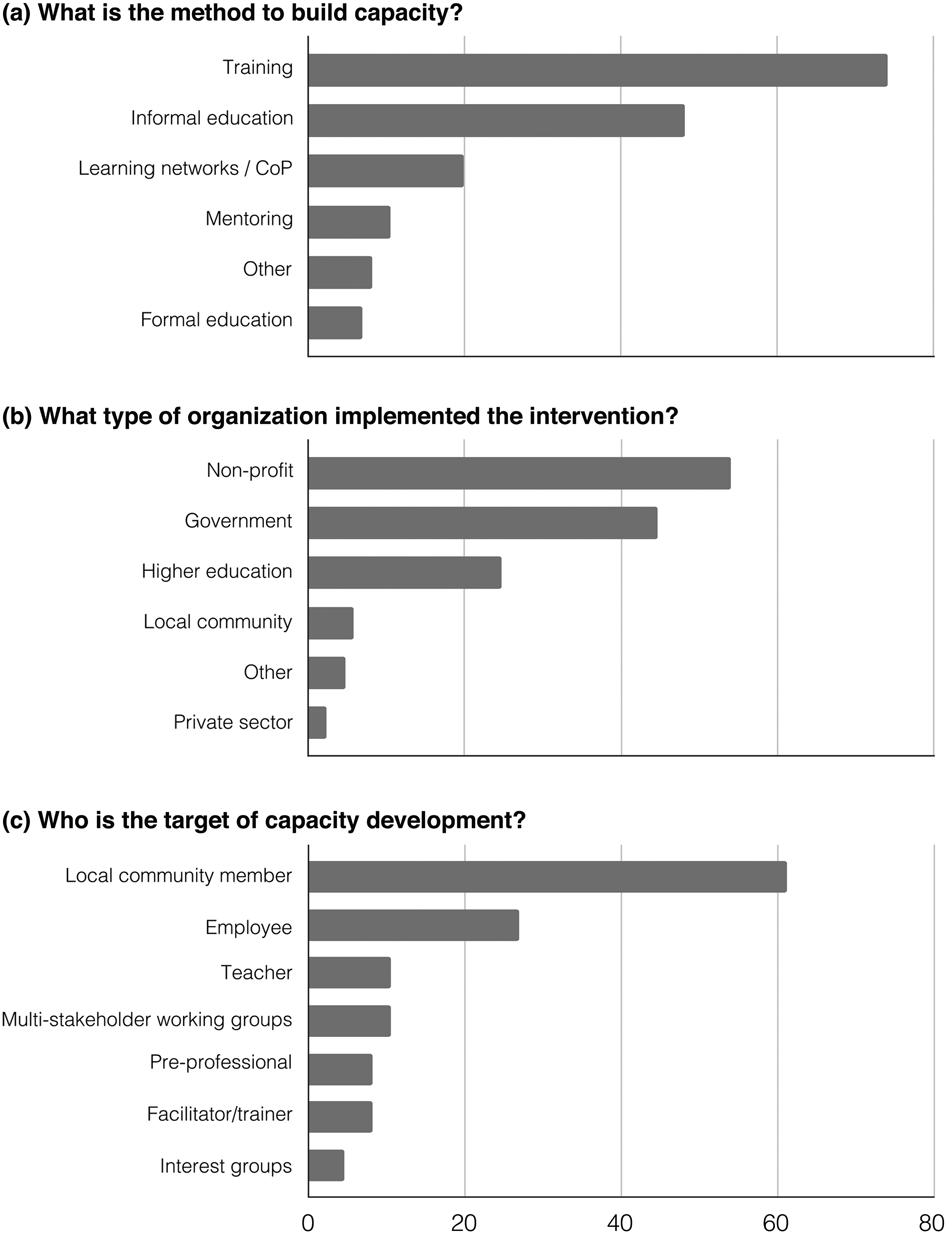
Of the cases that focused on specific global regions, the use of training as a capacity development method was highest in Africa (100% of cases used training), followed by Asia (80%) and North America (72%). Capacity development interventions were most often implemented by individuals working in non-profit organizations, government and higher education (Fig. 4b). Interventions were also implemented by more than one organization (32%).
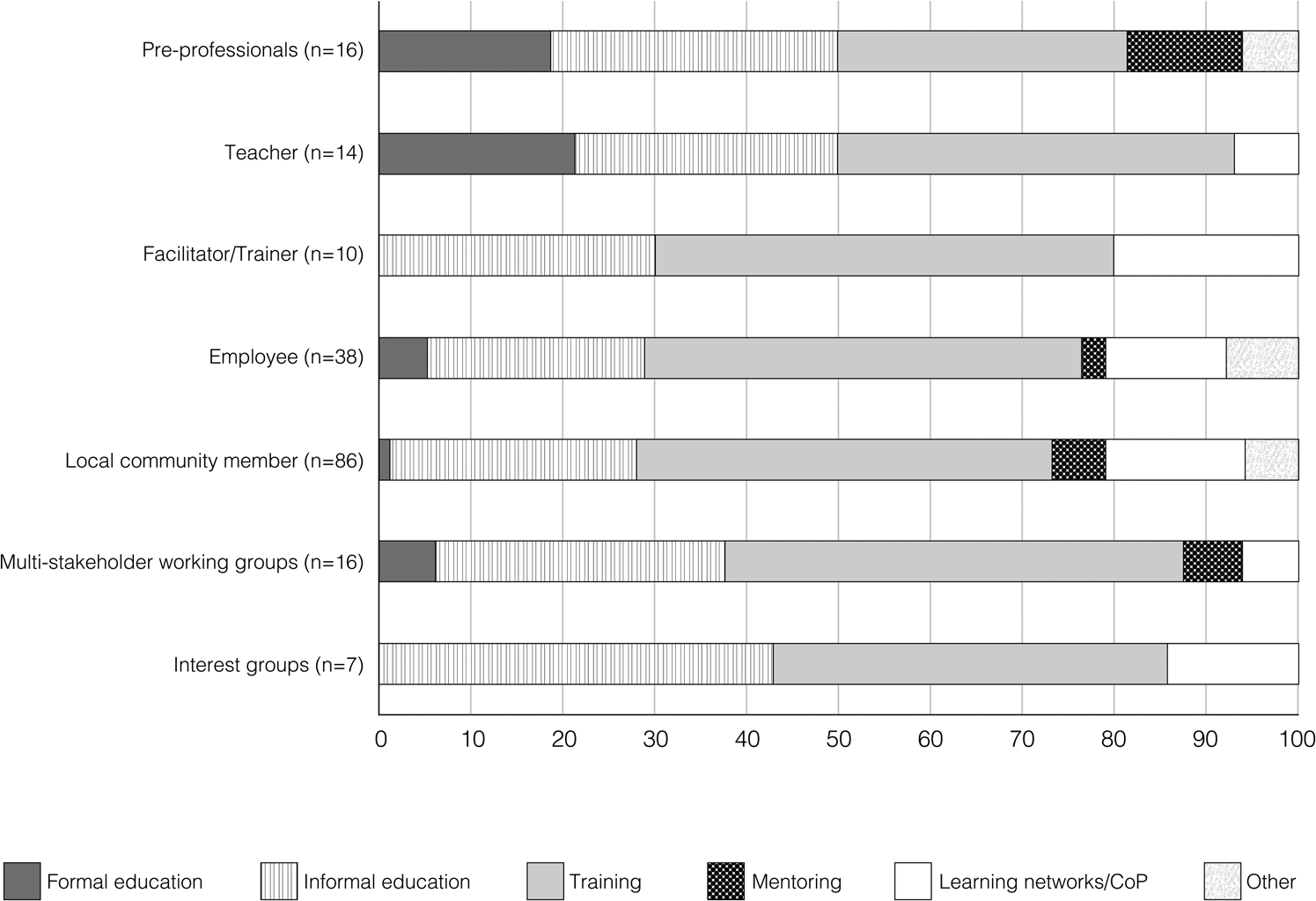
Capacity development interventions mostly targeted local community members and employees working within governments or non-profit organizations, followed by multi-stakeholder working groups, teachers, pre-professionals, facilitators and interest groups (Fig. 4c). Community members included farmers, fishing clubs, and Indigenous-led groups. External actors regularly initiated the capacity development interventions (58%), meaning the need for capacity building was determined by an outside party, rather than initiated internally from the group that received the intervention (28%), although who initiated the study was difficult to determine in 14% of cases. Viewing the relationship between types of capacity development approaches and capacity development targets in terms of the approaches used, mentoring was not used to build capacity in teachers, facilitators/trainers or interest groups, and it was used most often in cases targeting pre-professionals (Fig. 5).
Relationship between types of capacity development and capacity development targets; n is the number of times a capacity development approach was coded with a specific target. The figure maps which capacity development approaches were used to build capacity in each targeted group. CoP, communities of practice.
Evaluation overview
In parallel with our analysis of the different types of capacity and intended beneficiaries, we also analysed the methods used in evaluations. In our evidence map only a small proportion (16%) included a control group. In 68% of the case studies, the organization that ran the capacity development intervention also conducted the evaluation of the intervention; in 32% of cases the organization tasked with evaluation differed from the implementing group. Evaluations were most commonly led by individuals working in higher education, followed by employees in non-profit organizations and government (Fig. 6a).
Overview of capacity development evaluation factors as a per cent of cases overall (n = 85, unless specified otherwise). (a) What type of organizations were the evaluations led by? (b) What tools were used to evaluate? (c) Who is being evaluated by the tool (in 14% of case studies, the tools were used on a different group from the target of the intervention)? (d) How long after the intervention was the evaluation (n = 53; 15 cohort studies and 17 studies without timing information were excluded)?
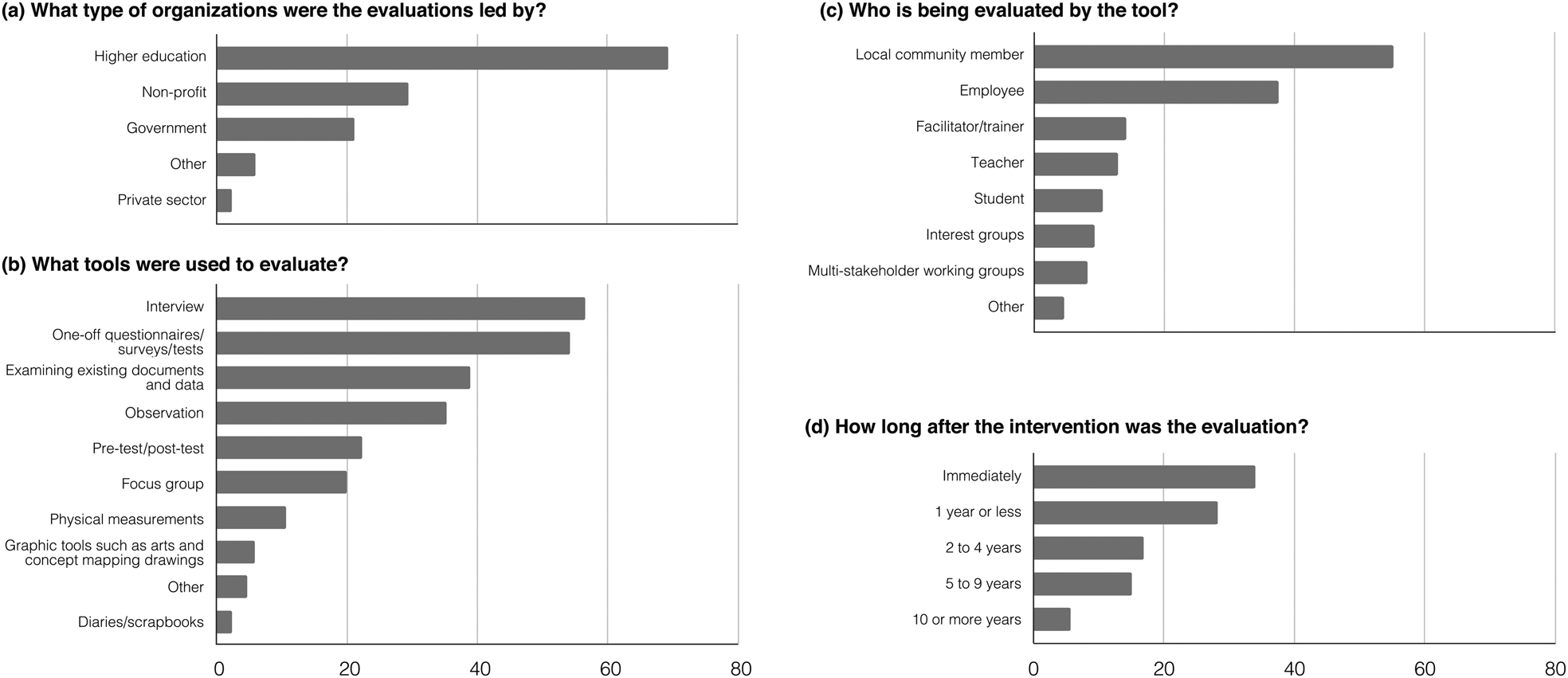
Case studies used a range of evaluation tools, with most employing more than one (80%), most commonly interviews and one-off questionnaires or tests (Fig. 6b). Only 22% of case studies used pre- and post-tests to evaluate capacity development; fewer used physical measurements, graphical tools such as concept mapping, or diaries/scrapbooks. Some case studies employed other types of evaluation tools such as those from systems modelling. Approximately 65% of the case studies evaluated interventions with interactive oral methods (interviews and/or focus groups) whereas c. 20% used solely written methods (questionnaires and pre- and post-tests). By region, Africa had the highest use of oral methods (75%) and their use was lowest in Europe (47%).
In most case studies, the evaluation tools were used to evaluate the individual targets of the capacity development intervention directly, who most often were community members and employees (Fig. 6c). In 14% of case studies, the tools were used on a different group from the target of the intervention. For example, managers were interviewed to understand how the capacity of an employee had developed.
We found that in > 60% of all cases the evaluation took place either immediately after the intervention or within 1 year of the intervention (Fig. 6d), with few evaluations (6%) taking place ≥ 10 years afterwards. These figures (n = 53) exclude cases where there was insufficient data to determine the timing gap and also evaluations that assessed multiple cohorts, leading to varied times post intervention. We separately assessed the articles with multiple cohorts and available timing data (n = 12) taking into account the longest time frame for each; these evaluations were evenly spread over 2–4 years, 5–9 years, and ≥ 10 years post intervention. Regarding frequency, most cases had one evaluation point (74%), with fewer having two (11%), or three or more evaluations (8%); the frequency was unclear in 7% of articles. All evaluations encompassed summative (at the end of intervention) components, and only a small portion were evaluated during the intervention (18%).
Analysis approach
Approximately half (51%) of the studies used a combination of quantitative and qualitative methods to evaluate capacity development interventions, 26% analysed outcomes with only quantitative methods and 23% using only qualitative methods. Quantitative analyses generally included descriptive and inferential statistics, and qualitative analyses included methods or approaches such as grounded theory, thematic coding, and most significant change. Data were validated through cross-verification, or using more than one data collection method, in 54% of the studies.
Outputs and outcomes
In our sample, evaluation studies assessed six categories of outputs and outcomes (Fig. 7). A majority of studies assessed three categories: learning, knowledge or awareness outcomes; application of new behaviour or skills; and attitude change. A smaller portion assessed participant satisfaction regarding the intervention. More studies assessed medium- and long-term, non-conservation related outcomes, such as poverty alleviation, than conservation related outcomes (41 vs 15%).
Categories of outputs/outcomes assessed among evaluations of capacity development interventions shown as a per cent of cases overall (n = 85). Case studies are included multiple times if they assessed multiple categories.
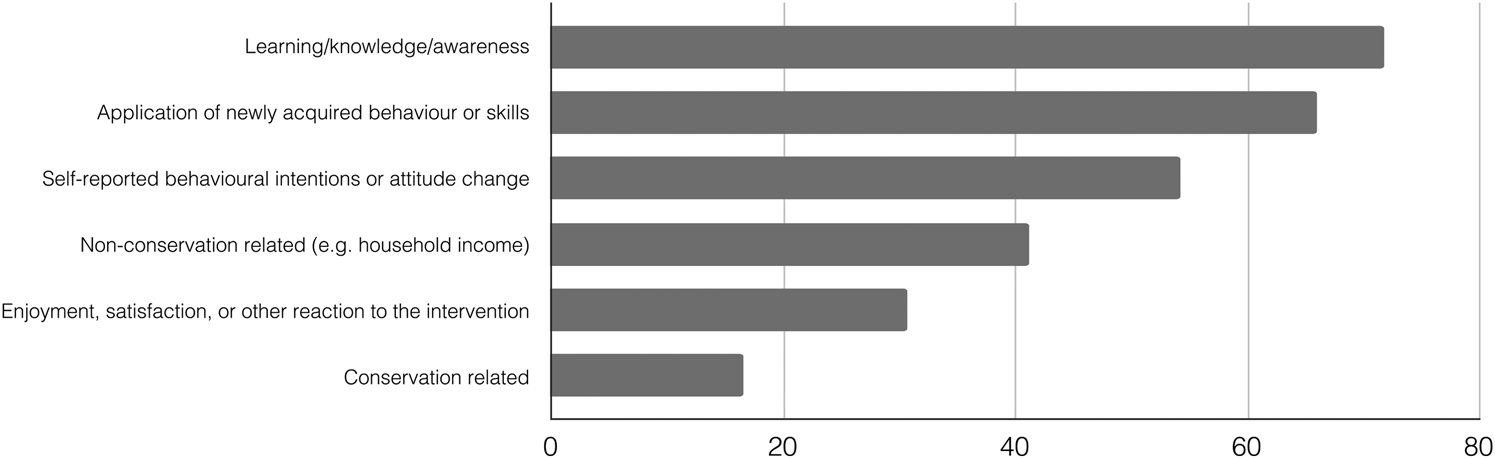
Conservation related outcomes included empirical evidence, observations, and/or perceptions regarding the desired state of biodiversity and/or threats to biodiversity. Fourteen studies assessed these conservation outcomes criteria, of which 79% targeted local community members. The majority of the 14 case studies (72%) that assessed conservation outcomes were implemented by a single organization, and the majority (79%) of evaluations were predominantly led by individuals working in higher education, sometimes working with other organizations in government or the private sector. Over 75% of the conservation outcomes cases described evaluation efforts in Africa and Asia. Among the 16 case studies in Africa, 31% assessed conservation outcomes, followed by 20% of the 20 studies in Asia, and of the 25 case studies in North America, only 8% assessed conservation outcomes. Most of the 14 cases (79%) used training alone or in combination with other methods to develop capacity. Half of the conservation outcomes involved direct measurement of conservation data, and others assessed perceptions of the state of biodiversity (21%), changes in threats to biodiversity (14%), and changes in biodiversity data quality or conservation practices (14%). Of the 10 case studies assessing conservation outcomes that provided enough detail to assess the timing of the evaluation, 60% evaluated ≥ 5 years after intervention. In comparison, across all 65 cases that provided timing information, only 29% had ≥ 5 year time frames. For case studies assessing conservation outcomes, the presence of a clear or explicit causal model was slightly higher compared with the overall cases (50 vs 42%).
Systems approaches
We identified an explicit systems approach in only 6% of the case studies in our evidence map. For example, Elbakidze et al. (Reference Elbakidze, Dawson, Andersson, Axelsson, Angelstam and Stjernquist2015) used systems thinking methods to evaluate strategic spatial planning initiatives in municipalities in Sweden, including the use of causal loop diagrams to assess stakeholder participation. In their analysis of an integrated conservation and development project in Guyana, Mistry et al. (Reference Mistry, Berardi, Simpson, Davis and Haynes2010) used a system viability approach for monitoring and evaluation of impact.
Although few cases in our evidence map took an explicit systems approach, we note that systems approaches to evaluation can consist of several implicit elements, including the level of assessment (e.g. individual, organizational, system) and the degree to which an evaluation considered intervening variables (i.e. those outside the study's control) that can impact the end result of capacity development interventions. Of all 85 case studies, we found that the majority of the case studies assessed at the individual level (85%). Organizational (40%) and systems levels (14%) were less well-represented. Two or more levels were assessed in 34% of the case studies, and of this subset of case studies (n = 29), 14% assessed all three levels, 59% assessed individual and organizational levels, 17% assessed individual and systems level, and 10% assessed organizational and systems levels. Of all 85 case studies, almost half (47%) assessed how outcomes were mediated by intervening variables that can affect the end result of capacity development interventions. Of these, 36% assessed individual-level intervening variables (e.g. motivation to learn, level of expertise) and 26% considered contextual factors (e.g. work environment, socio-economic status).
Discussion
From our review, we identified that the literature on capacity development evaluation in conservation and natural resource management spans: (1) case studies of single evaluated interventions, (2) aggregate studies that consider only general categories of capacity development (e.g. presence or absence of a training plan), and (3) general recommendations and lessons learnt in monitoring, planning and evaluation of capacity development. Here we provide the first overview documenting the state of the available evidence of capacity development evaluation in conservation. Our purpose was to identify the evidence and existing knowledge gaps to inform future research on and implementation of capacity development interventions.
In our framework synthesis, we found that much of the evaluation literature on capacity development has focused on formal, results-based management and project framework approaches such as use of standardized templates and tools (Watson, Reference Watson2006; Baser & Morgan, Reference Baser and Morgan2008; Carleton-Hug & Hug, Reference Carleton-Hug and Hug2010; Ling & Roberts, Reference Ling, C.M. & Roberts, D.2012). There is consensus that evaluation emphasis must shift from inputs (e.g. funding) and outputs (e.g. number of workshops) to outcomes resulting from the interventions (Ferraro & Pattanayak, Reference Ferraro and Pattanayak2006). Outcomes can better reflect the actual conservation impacts of an intervention because they link the intervention to changes in biodiversity or people and place.
Our evidence map highlighted that much of the literature does not provide sufficient description on how capacity interventions lead to conservation outcomes, including the factors that modulate the effectiveness of capacity development interventions. Most studies assessed learning and behavioural change outcomes from capacity development interventions. Of the few studies that assessed conservation outcomes directly, the majority were related to interventions undertaken by academics and targeted at building the capacity of local community members, a similar pattern to the cases overall. This may be because local community members are frequently the stakeholders most likely to have a strong influence over biodiversity (Garnett et al., Reference Garnett, Burgess, Fa, Fernández-Llamazares, Molnár and Robinson2018), in comparison with employees, pre-professionals and trainers, and because research on community-based natural resource management has increased over the past 4 decades (Milupi et al., Reference Milupi, Somers and Ferguson2017).
The small number of studies evaluating the conservation outcomes of capacity development investments may relate to how difficult it is to make a direct connection between a single intervention and conservation outcomes. Challenges associated with evaluating these connections may stem from temporal scale problems; there is often a lag between capacity development interventions and when the status of conservation targets can be expected to change. Monitoring and evaluation resources rarely continue for sufficient time to assess these outcomes in the long-term (Veríssimo et al., Reference Veríssimo, Bianchessi, Arrivillaga, Cadiz, Mancao and Green2018). Our evidence map shows that about half of the evaluations took place within a year of the intervention, and relatively few had a time horizon of ≥ 5 years. This gap may be related to project funding timelines that often exclude post-project follow-up, and is particularly problematic given that the goal of many conservation efforts is to achieve enduring change. Funding constraints can hinder proper design, implementation and assessment of capacity development evaluation (Carleton-Hug & Hug, Reference Carleton-Hug and Hug2010). Going forward, evaluators and donors should work together to align the knowledge and resources necessary for high quality evaluation. Such evaluations should provide accountability to internal and external audiences, as well as important insights regarding how to improve future interventions. These efforts could be based on a recognition that rigorous evaluation can meet the needs of both donors and practitioners by contributing to more effective allocation of funding and greater achievement of conservation goals (Aring & DePietro-Jurand, Reference Aring and DePietro-Jurand2012; Loffeld et al., Reference Loffeld, Humle, Cheyne and Blackin press). This can be supported by approaching evaluation through a systems lens that emphasizes the dynamic feedback loops between learning and impact over the life of a project or programme (Black et al., Reference Black, Groombridge and Jones2013; Knight et al., Reference Knight, Cook, Redford, Biggs, Romero and Ortega-Argueta2019; Patton, Reference Patton2019).
In our framework synthesis, we identified arguments made by some authors that effective evaluation relies on (1) clarifying achievable programme objectives, (2) identifying a causal model and testable hypotheses, and (3) defining the purpose of evaluation along with performance indicators and data collection protocols (Baylis et al., Reference Baylis, Honey-Rosés, Börner, Corbera, Ezzine-de-Blas and Ferraro2016). Evaluators should develop credible causal models (i.e. models that map all pathways between actions and outcomes, including intermediate outputs, and describe the assumptions and mechanisms between steps; Cheng et al., Reference Cheng, McKinnon, Masuda, Garside, Jones and Miller2020), to help identify relevant outputs and outcomes, and support effective evaluation. We note the need to be flexible and consider advice to prioritize feedback, learning and adaptation even when starting with clear, predetermined objectives. Such thinking draws from systems evaluation approaches that view capacity as an emergent process (Lusthaus et al., Reference Lusthaus, Adrien and Perstinger1999; Watson, Reference Watson2006).
Our framework synthesis indicated that to fully understand the impacts of capacity development efforts, conservationists may need to apply a systems approach to evaluation that explores the dynamic relationship between investment in one set of capacity development interventions and effects at other levels. As an example, organizational readiness for change may affect results of individual capacity development. Our framework synthesis also highlighted the importance of considering readiness for effective evaluation, related to the unique socio-political context of a capacity development programme (Lusthaus et al., Reference Lusthaus, Adrien and Perstinger1999; Carleton-Hug & Hug, Reference Carleton-Hug and Hug2010; Pearson, Reference Pearson2011). In our evidence map, there is a significant focus on evaluations of individual-level capacity development, with less attention at the organizational or systems levels. Although not every intervention needs to result in systems-level outcomes, and not every evaluation needs to assess systems-level outcomes, it is important to acknowledge that systems-level forces shape every capacity development initiative. For instance, political and social systems of power influence whether and how investments in individual capacity have an effect in organizations or on conservation outcomes (Porzecanski et al., Reference Porzecanski, Sterling, Copsey, Appleton, Barborak and Bruyerein press).
Our framework synthesis highlighted the importance of considering intervening variables when evaluating capacity development (Ferraro & Pattanayak, Reference Ferraro and Pattanayak2006). Fewer than half of the studies in our evidence map assessed how intervening variables affected the outcomes of capacity development interventions. This may be because of limited resources and time, as well as limited knowledge about these approaches and their importance in evaluation. Our framework synthesis found that evaluating capacity development requires a comprehensive analytical framework that accounts for the individual, organizational and systems levels in assessing the complex process of learning, adaptation, and attitudinal change. Nevertheless, it can be challenging to identify appropriate measurement tools and indicators to measure these complexities (Mizrahi, Reference Mizrahi2004).
However, the majority of the studies in our database did not include an explicit causal model linking interventions and expected outcomes. Lack of causal models can lower effectiveness, limit replicability, and hinder the development of the evidence base about effectiveness of interventions and best practices (Watson, Reference Watson2006; Cheng et al., Reference Cheng, McKinnon, Masuda, Garside, Jones and Miller2020). Employing systems approaches to capacity development could improve effectiveness through their emphasis on careful consideration of linkages and causal relationships in understanding where to invest scarce conservation resources.
Our framework synthesis identified the importance of using a diversity of research approaches, including a mixed-methods design, conducting different types of evaluation for different user groups and needs, and making use of participatory methodologies (Baser & Morgan, Reference Baser and Morgan2008; Carleton-Hug & Hug, Reference Carleton-Hug and Hug2010; Horton, Reference Horton2011). We found some support for this in our evidence map, where most studies used more than one evaluation method, and some seemed to tailor methods to the capacity development recipients. A few studies using both written and oral evaluation methods cited lower comprehension from written methods than oral methods (Scholte et al., Reference Scholte, De Groot, Mayna and Talla2005; Amin & Yok, Reference Amin and Yok2015), showing that the method of evaluation can affect the results and thus should be considered carefully.
In terms of capacity development interventions, we noted that across all our evidence map cases, the predominant recipients were community members and, although most studies used a diversity of techniques, the most frequent type of intervention was training. Other forms of capacity development, such as peer learning or learning networks that might mirror existing forms of exchange within a community, were less common. This may result, in part, from the fact that capacity development interventions in this study were generally not initiated internally (i.e. by those within the group that received the intervention) and this may limit community leadership, ownership and decision-making power (Dobson & Lawrence, Reference Dobson and Lawrence2018). Evaluations in our evidence map were undertaken mostly by academic organizations, perhaps because this group benefits professionally from publishing research literature. We note that the types of cases in our evidence map might have been affected by our literature search having focused exclusively on English language sources.
Our framework synthesis highlighted the need to shift the emphasis of evaluation from accountability to external stakeholders such as donors, towards accountability to internal stakeholders and to evaluation that informs learning and programme improvement (Baser & Morgan, Reference Baser and Morgan2008; Simister & Smith, Reference Simister and Smith2010; Horton, Reference Horton2011). Although programme accountability is important to inform future funding decisions, programmes can only adapt, grow and improve when an evaluation focuses on understanding what worked, what did not, and why. In addition to why the evaluation is being done, it is important to consider who is performing an evaluation. In the majority of our evidence map cases, the groups leading an intervention also undertook evaluation of their own work; only in one-third of the cases was an evaluation done by an independent group. Self-evaluation is important, particularly formative evaluation that helps with adaptive management. However, independent evaluators can bring fresh eyes to an initiative and help identify gaps as well as successes that could be overlooked by those closest to a project. The fact that few cases had regular, periodic evaluation suggests there is a need for more evaluation to support course corrections for ongoing interventions. Evaluation of longer-term interventions could also uncover important cyclical or nonlinear patterns in changes to intervention participants or the social-ecological systems within which they are nested.
The need for more robust knowledge-sharing among evaluators was a theme identified in our framework synthesis and further supported by our evidence map. Over 20% of the articles were excluded (at full-text assessment) because of a lack of evaluation details. Even among the case studies included, we found insufficient information to code certain fields. Although this lack of information may be a result of word limitations in peer-reviewed journals, it hampers the ability to build the evidence base on capacity development evaluation. Evaluators in conservation should share more detailed information on methodologies and the results of evaluations, to inform the evaluation field and practitioners (Carleton-Hug & Hug, Reference Carleton-Hug and Hug2010; Horton, Reference Horton2011). Evaluators can overcome word limitations by providing detailed supplementary information, or publishing this information in public data repositories or in grey literature. Furthermore, the challenges of linking capacity development investment to achieving conservation outcomes point to the possibility that we will need to be able to track progress towards conservation outcomes at scale, which would involve collaboration to establish indicators that are meaningful across multiple capacity development initiatives.
In conclusion, our evidence map and framework synthesis clarifies the need for better evidence about the effectiveness of capacity development, its linkages to conservation objectives, and the contextual factors that affect the implementation of capacity interventions. Some of this evidence will need to come from evaluations and assessments, and we suggest that future efforts consider developing credible causal models (Cheng et al., Reference Cheng, McKinnon, Masuda, Garside, Jones and Miller2020). We also suggest that more evaluations employ systems approaches that draw from the theories, methods, tools and approaches of systems thinking and complexity, and utilization-focused, developmental, and principles-focused evaluation (e.g. Knight et al., Reference Knight, Cook, Redford, Biggs, Romero and Ortega-Argueta2019; Patton, Reference Patton2019). We recognize that operationalizing capacity development evaluation in conservation is a long-term, collaborative endeavour, but without it, we risk continuing to overlook or misunderstand the impacts of conservation interventions.
Future research should examine the evidence summarized in this evidence map to assess the impacts of capacity development, looking at a range of outputs and outcomes and seeking lessons learnt for practitioners. To develop decision-making tools that give capacity development implementers guidance on which evaluation approach to use under what circumstances, we need to understand better what outcomes emerge from different types of capacity development interventions on different targeted groups, as assessed by different evaluation methods. This information would facilitate the design of more effective capacity development interventions and more useful evaluations.
We view the evidence presented here as setting a baseline for the ongoing and long-term efforts to improve capacity development evaluation in conservation and natural resource management. It is a starting point for future review and evidence synthesis of when, how and why capacity development interventions and their evaluation are most impactful. In the meantime, we hope this evidence map provides critical information to help evaluators and practitioners in their work to develop the capacity needed to protect and manage social-ecological systems globally.
Acknowledgements
We thank Sarah Trabue and Kathryn Powlen for help coding, compiling and sorting relevant data; Audrey Ek for performing initial scoping searches and participating in early coding that helped develop the codebook; Nikolas Merten for assisting with coding of conservation outcomes; and Nadav Gazit for graphic design expertise and assistance with figures. We gratefully acknowledge support from the John D. and Catherine T. MacArthur Foundation for this research (JZC; DCM).
Author contributions
Conceptualization and design: EB, NB, JZC, RF, MG, MSJ, KL, TACL, DCM, ALP, XAS, AS, JNS, EJS; data collection, analysis and interpretation, writing and revision: all authors.
Conflicts of interest
None.
Ethical standards
This research abided by the Oryx guidelines on ethical standards.


 Open access

