


Introduction
Egg hatching is a critical developmental step in the life cycle of parasitic nematodes, marking the shift from a protected, quiescent embryonic stage to a motile or infective larva (Mkandawire et al. Reference Mkandawire, Grencis, Berriman and Duque-Correa2022). The eggshell – composed of lipid, chitin, and vitelline layers, and sometimes an additional uterine layer – provides mechanical protection and selective permeability, allowing eggs to remain viable under adverse abiotic conditions for extended periods (Muller Reference Muller1953; Wharton Reference Wharton1980; Stein and Golden Reference Stein and Golden2018; Lindgren et al. Reference Lindgren, Gunnarsson, Höglund, Lindahl and Roepstorff2020). In aquatic environments, abiotic factors such as temperature, salinity, and oxygen availability strongly influence both hatching success and larval viability (Muller Reference Muller1953). Hatching represents the first environmentally triggered developmental activation and is highly sensitive to even minor fluctuations in these conditions (Warkentin Reference Warkentin2011; Mkandawire et al. Reference Mkandawire, Grencis, Berriman and Duque-Correa2022). Small changes in temperature or salinity can accelerate, delay or completely inhibit hatching, with cascading effects on larval survival, infectivity, and transmission potential (Born-Torrijos et al. Reference Born-Torrijos, Holzer, Raga and Kostadinova2014; Montory et al. Reference Montory, Cumilla, Cubillos, Paschke, Urbina and Gebauer2018; Mkandawire et al. Reference Mkandawire, Grencis, Berriman and Duque-Correa2022). Despite its ecological importance, the effects of abiotic stressors on early developmental stages in aquatic anisakid nematodes are still poorly understood and insufficiently explored.
Avian anisakids of the genus Contracaecum constitute a diverse group of heteroxenous nematodes with a cosmopolitan distribution across freshwater, brackish, and marine ecosystems. Their life cycle typically involves copepods or other aquatic invertebrates as intermediate hosts, teleost fish as paratenic hosts, and piscivorous birds as definitive ones (Moravec Reference Moravec2009). Contracaecum rudolphii (s.l.) is considered a complex of sibling species that parasitize cormorants of family Phalacrocoracidae in both Boreal and Austral regions (Mattiucci et al. Reference Mattiucci, Turchetto, Brigantini and Nascetti2002, Reference Mattiucci, Sbaraglia, Palomba, Filippi, Paoletti, Cipriani and Nascetti2020; Shamsi et al. Reference Shamsi, Norman, Gasser and Beveridge2009; Garbin et al. Reference Garbin, Mattiucci, Paoletti, González-Acuña and Nascetti2011; D’Amelio et al. Reference D’Amelio, Cavallero, Dronen, Barros and Paggi2012; Shamsi Reference Shamsi2019; Caffara et al. Reference Caffara, Tedesco, Davidovich, Rubini, Luci, Cantori, Glogowski, Fioravanti and Gustinelli2023). The life cycle of C. rudolphii (s.l.) species complex includes larval embryonation inside the egg, leading to the development of a first-stage larva (L1), which must hatch to initiate transmission. After hatching, the free L2 larva infects a first intermediate host, although this stage remains poorly characterized. Several experimental studies have investigated potential candidates, such as copepods, amphipods and isopods by exposing them to larval stages under controlled condition (Mozgovoy et al. Reference Mozgovoy, Shakhmatova and Semenova1965, Reference Mozgovoy, Shakhmatova and Semenova1968; Huizinga Reference Huizinga1966; Koie Reference Koie2001; Moravec Reference Moravec2009). Teleost fish serve as paratenic hosts, where third-stage larvae (L3) accumulate and remain infective until transmission to the definitive host, i.e. mainly cormorants.
In European waters, C. rudolphii sp. A and C. rudolphii sp. B (Bullini et al. Reference Bullini, Nascetti, Paggi, Orecchia, Mattiucci and Berland1986; Mattiucci et al. Reference Mattiucci, Turchetto, Brigantini and Nascetti2002, Reference Mattiucci, Sbaraglia, Palomba, Filippi, Paoletti, Cipriani and Nascetti2020) provide a valuable model for investigating eco-physiological adaptation in aquatic parasitic nematodes. Although these reproductively isolated taxa share the same definitive host, i.e. the great cormorant, Phalacrocorax carbo sinensis (Mattiucci et al. Reference Mattiucci, Turchetto, Brigantini and Nascetti2002, Reference Mattiucci, Sbaraglia, Palomba, Filippi, Paoletti, Cipriani and Nascetti2020; Szostakowska and Fagerholm Reference Szostakowska and Fagerholm2007), they are hypothesized to have a life cycle adapted to different aquatic environments. Specifically, C. rudolphii sp. A is predominantly associated with brackish and marine habitats, whereas C. rudolphii sp. B is more commonly found in freshwater systems (Mattiucci et al. Reference Mattiucci, Turchetto, Brigantini and Nascetti2002, Reference Mattiucci, Sbaraglia, Palomba, Filippi, Paoletti, Cipriani and Nascetti2020). Given their distinct environmental distribution, it can be hypothesized that egg hatching success in the two sibling species may be influenced by abiotic factors such as temperature and salinity. These variables may shape species-specific developmental thresholds, reflecting ecological adaptation. However, no comparative studies have yet assessed how these factors influence hatching in these taxa.
To address this gap, this study aims to investigate the effects of temperature and salinity on egg hatching in the two sibling species of the C. rudolphii (s.l.) complex occurring in European waters, by exposing eggs to controlled environmental gradients under in vitro conditions, in order to test whether the two species exhibit distinct hatching responses, potentially reflecting their ecological adaptation to different aquatic environments.
Materials and methods
Collection and isolation of C. rudolphii spp. eggs
Adult nematodes of C. rudolphii (s.l.) were collected from the gastrointestinal tracts of two great cormorants found dead in the Latium region (Central Italy) during the winter seasons between 2021 and 2024 – one entangled in fishing nets and the other one stranded along the riverbank. From each cormorant, 10 gravid live female nematodes were selected, rinsed twice in autoclaved natural freshwater, and processed within 48 hours. Approximately, 1000 eggs were carefully extracted from the terminal section of the uterus of each live female.
The eggs were repeatedly washed with natural freshwater (filtered through 0.45 µm membranes and autoclaved) on a 30 µm mesh filter. Eggs from each individual female were then transferred into separate wells of 6-well cell culture plates, each containing the same sterile freshwater. The eggs were stored under sterile conditions at +4 °C for 3 days. Molecular identification of each female was carried out during this storage period (details in the next paragraph), after which the eggs were used in the hatching experiments. Eggs of both sibling species were tested simultaneously. After hatching, L2 larvae were counted and monitored daily for the following days. When the first mortalities were observed, the experiment was terminated.
Molecular identification of C. rudolphii (s.l.)
Total genomic DNA from ∼2 mg of each female was extracted using Quick-gDNA Miniprep Kit (ZYMO RESEARCH) following the standard manufacturer recommended protocol. The ITS region of rDNA, including the first internal transcribed spacer (ITS-1), the 5.8S gene, the second transcribed spacer (ITS-2), and ∼70 nucleotides of the 28S gene, was amplified using the primers NC5 (forward; 5′-GTAGGTGAACCTGCGGAAGGATCATT-3′) and NC2 (reverse; 5′-TTAGTTTCTTTTCCTCCGCT-3′) (Zhu et al. Reference Zhu, Gasser, Podolska and Chilton1998). Polymerase chain reactions (PCRs) were carried out in a 15 µL volume containing 0.3 µL of each primer 10 mM, 2.5 µL of MgCl2 25 mM (Promega), 15 µL of 5 × buffer (Promega), 0.3 µL of DMSO, 0.3 µL of dNTPs 10 mM (Promega), 0.3 µL (5 U/μL) of Go-Taq Polymerase (Promega) and 2 µL of total DNA. PCR temperature conditions were the following: 94 °C for 5 min (initial denaturation), followed by 30 cycles at 94 °C for 30 s (denaturation), 55 °C for 30 s (annealing), 72 °C for 30 s (extension) and followed by post-amplification at 72 °C for 5 min. Additionally, the cytochrome c oxidase subunit 2 (cox2) locus of the mtDNA was amplified using the primers 211 F (forward; 5′-TTTTCTAGTTATATAGATTGRTTYAT-3′) and 210 R (reverse; 5′-CACCAACTCTTAAAATTATC-3′) (Nadler and Hudspeth Reference Nadler and Hudspeth2000; Valentini et al. Reference Valentini, Mattiucci, Bondanelli, Webb, Mignucci-Giannone, Colom-Llavina and Nascetti2006). PCRs were carried out in a 25 µL volume containing 2 µL of each primer 10 mM, 4 µL of MgCl2 25 mM, 5 µL of 5 × buffer, 2 µL of dNTPs 10 mM, 0.25 µL (5 U/μL) of Go-Taq Polymerase and 3 µL of total DNA. PCR temperature conditions were the following: 94 °C for 3 min, followed by 35 cycles at 94 °C for 30 s, at 46 °C for 1 min, at 72 °C for 90 s, and followed by post-amplification at 72 °C for 10 min.
The successful PCR products were purified, and Sanger sequenced on an Automated Capillary Electrophoresis Sequencer 3730 DNA Analyzer (Applied Biosystems), using the BigDye® Terminator v3.1 Cycle Sequencing Kit (Life Technologies). The obtained sequences were analysed, edited, and assembled by Sequence Matrix v. 1.7.839 and compared with those available in GenBank using BLASTn (Morgulis et al. Reference Morgulis, Coulouris, Raytselis, Madden, Agarwala and Schäffer2008).
In vitro exposure to temperature and salinity gradients
Eggs of C. rudolphii (s.l.) were exposed to a salinity gradient (0, 10, 20, 40, 60, 70 and 80 practical salinity units [psu]), obtained by dissolving analytical-grade sodium chloride (NaCl) in autoclaved, filtered natural freshwater. This range was selected to encompass the ecological variability of salinity conditions observed in the natural habitats, where the life cycle of the two species of C. rudolphii (s.l.) takes place, i.e. from freshwater to hypersaline coastal environments (Mattiucci et al. Reference Mattiucci, Sbaraglia, Palomba, Filippi, Paoletti, Cipriani and Nascetti2020). Each salinity level was tested under four constant temperature regimes (5 °C, 10 °C, 20 °C and 30 °C), reflecting the average thermal conditions typical of seasonal variation. The upper extreme (30 °C) was included to simulate a heatwave scenario, which is common in hypersaline environments during summer periods. All temperature treatments were maintained in climate-controlled chambers to ensure constant and reproducible conditions.
Hatching experiments were carried out using eggs collected from eight gravid females of C. rudolphii (s.l.), four identified as C. rudolphii sp. A and four as C. rudolphii sp. B. For each species, two females originated from one individual cormorant host and two from another one. Approximately, 5000 eggs were collected from each female and distributed into experimental wells in aliquots of ∼50 eggs per replicate. Experiments were conducted across a full matrix of temperature (30 °C, 20 °C, 10 °C, 5 °C) and salinity (0, 10, 20, 40, 60, 70, 80 psu) conditions. For each temperature–salinity combination, three independent biological replicates per female were set up, resulting in a total of 12 replicates per condition per species (i.e. 3 replicates × 4 females).
Egg hatching success
Daily observations of hatching success and timing were conducted over a 15-day incubation period using a Leica M205 stereomicroscope. Hatching was defined as the complete emergence of the larva from the eggshell (Dziekońska-Rynko and Rokicki Reference Dziekońska-Rynko and Rokicki2007). Embryonic development and larval formation were assessed based on morphological features according to Moravec (Reference Moravec2009). In detail, larvae were considered hatched only upon reaching the second larval stage (L2), characterized by active movement, a slender body with dense mid-body granulation, and the presence of a loosened second-stage cuticle at both ends of the larval body, as described by Moravec (Reference Moravec2009). Hatching success was assessed by directly counting eggs and live larvae in the wells, which were placed on transparent plastic film marked with 1 mm × 1 mm squares and examined under the stereomicroscope. Observations began on the first day of incubation and were conducted daily. Once hatching was first detected, counts were carried out until no further increase in the number of hatched larvae was detected. For each count, four adjacent millimetre squares were randomly selected across the grid, and the total number of individuals within these squares was used to extrapolate to the whole area, following the method described by Højgaard (Reference Højgaard1998). The count was repeated independently by the same operator at least twice, and the variation between repeated counts was consistently <5%, confirming the robustness of the measurements.
Statistical analysis
For each replicate, hatching success was calculated as the proportion of hatched L2 larvae relative to the total number of larvae initially placed in the dish (mean 50 ± 3; range 45–55), and hatching success was expressed as the percentage of hatched L2 larvae relative to this initial count. Differences in hatching success between C. rudolphii sp. A and sp. B under different incubation temperatures and salinities were assessed using mixed Beta regression model, which is appropriate when the response variable is continuous and bounded by 0 and 1 (Kieschnick and McCullough Reference Kieschnick and McCullough2003; Ferrari and Cribari-Neto Reference Ferrari and Cribari-Neto2004). Replicate was included as a random factor to account for variability among replicates. In addition, to test the combined effects of temperature and salinity on egg hatching dynamics over time, we built two mixed Beta regression models, one for each species. Specifically, hatching success was used as the dependent variable, while the interaction day × salinity × temperature was included as the independent variable. Model performance was evaluated by calculating the correlation between predicted and observed values, as well as the marginal and conditional R2 (Nakagawa and Schielzeth Reference Nakagawa and Schielzeth2013). All statistical analyses were performed using R version 4.2.2 (R Core Team 2022) and the package glmmTMB (Brooks et al. Reference Brooks, Kristensen, van Benthem, Magnusson, Berg, Nielsen, Skaug, Maechler and Bolker2017).
Results
Molecular identification of C. rudolphii spp.
A tissue fragment from each of the 20 adult females was genetically identified by sequence analysis of the ITS region of rDNA and the mitochondrial cox2 gene. In the first cormorant (entangled in fishing nets), 7 females were identified as C. rudolphii sp. A and 3 as C. rudolphii sp. B. In the second cormorant (stranded along the riverbank), 8 females were identified as C. rudolphii sp. B and 2 as C. rudolphii sp. A. Overall, 12 specimens were identified as C. rudolphii sp. A and 8 as C. rudolphii sp. B, showing 99–100% sequence identity with reference ITS and cox2 sequences previously deposited in GenBank for C. rudolphii sp. A and C. rudolphii sp. B (accession numbers: OR263224-OR236202 for ITS, OR854803-OR269668 for cox2). The sequences generated in this study were deposited in GenBank under accession numbers PV990952 (cox2) and PV982888 (ITS) for C. rudolphii sp. A and PV990953 (cox2) and PV982889 (ITS) for C. rudolphii sp. B.
Temperature and hatching success
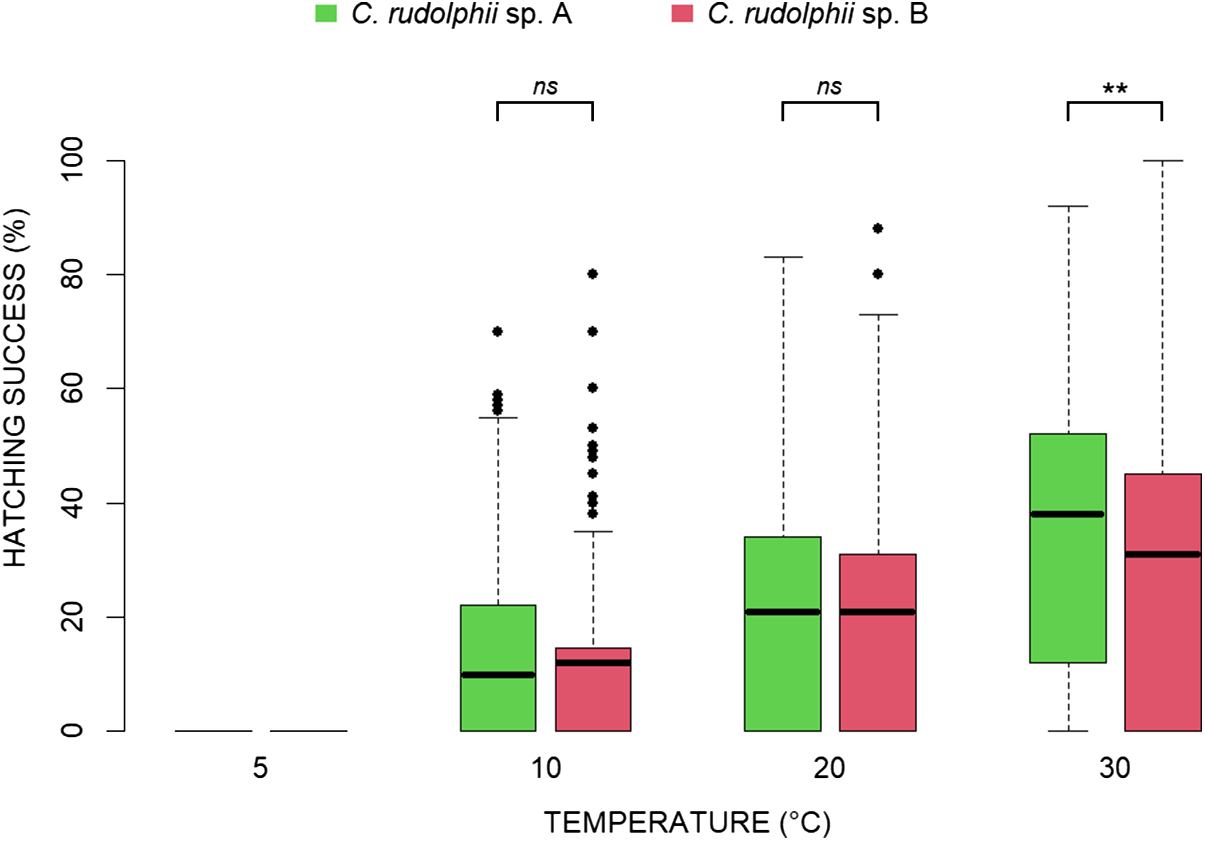
The effect of temperature on egg hatching success in C. rudolphii sp. A and sp. B is shown in Figure 1. No hatching was observed at 5 °C in either species. At 10 °C, both taxa showed limited hatching, with mean success rates of 9.6% for C. rudolphii sp. A and 11.6% for C. rudolphii sp. B. The difference between species at this temperature was statistically nearly significant (intercept = 0.098 ± 0.014; β = 0.018 ± 0.01; P = 0.062) (Figure 1). At 20 °C, hatching success increased moderately in both species, with mean values of approximately 21% for both C. rudolphii sp. A and C. rudolphii sp. B. However, the interspecific difference at this temperature was not statistically significant (intercept = 0.211 ± 0.02; β = 0.003 ± 0.01; P = 0.822). Finally, at 30 °C, both species exhibited their highest hatching performance, with C. rudolphii sp. A reaching a mean success rate of 37.6%, compared to 31.3% in C. rudolphii sp. B, with a statistically significant difference (intercept = 0.380 ± 0.02; β = −0.067 ± 0.02; P < 0.001) (Figure 1).
Box plots of hatching success (%) for C. rudolphii sp. A (green) and C. rudolphii sp. B (red) at four incubation temperatures. Error bars represent standard deviation values. Asterisk indicates statistical significance range: *P < 0.05, **P < 0.001, ns = not significant. The thick line within each box represents the mean value.

Salinity and hatching success
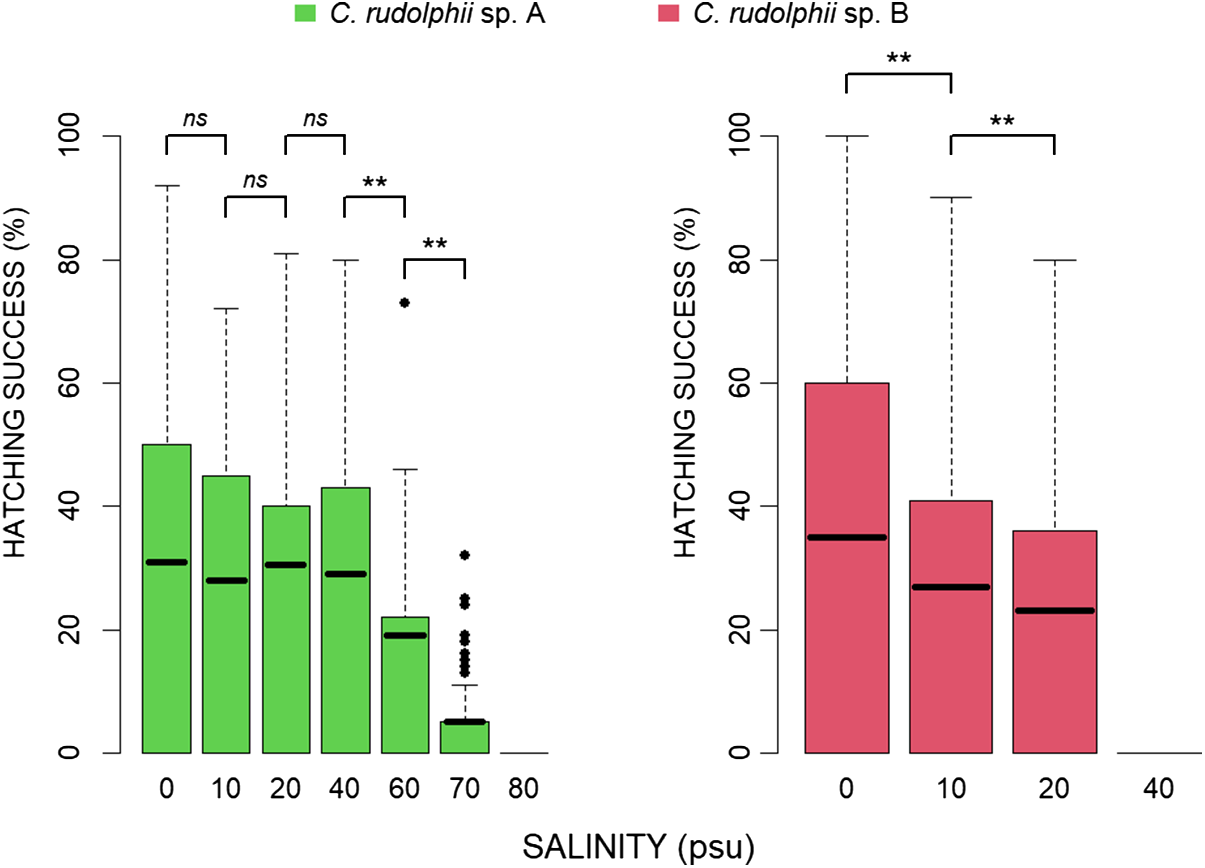
The effect of salinity on egg hatching success in C. rudolphii sp. A and C. rudolphii sp. B is shown in Figure 2. L2 larvae of C. rudolphii sp. A hatched successfully up to 40 psu, with a significant decline at 60 psu and no hatching observed at 80 psu (Figure 2). Hatching success was comparable between 0 and 40 psu, with mean values of ∼30%, and no significant differences observed (intercept = 0.309 ± 0.02; β = −0.022 ± 0.01; P = 0.091). However, it decreased significantly at higher salinities: 18.9% at 60 psu (intercept = 0.287 ± 0.02; β = −0.083 ± 0.02; P < 0.001) and 5.4% at 70 psu (intercept = 0.204 ± 0.02; β = −0.135 ± 0.02; P < 0.001). No hatching occurred for C. rudolphii sp. A at 80 psu. In contrast, C. rudolphii sp. B exhibited successful hatching only up to 20 psu. The highest success was recorded at 0 psu (35.2%), followed by a progressive and statistically significant decline at both 10 psu (27.2%; intercept = 0.353 ± 0.03; β = −0.080 ± 0.01; P < 0.001) and 20 psu (23.2%; intercept = 0.272 ± 0.03; β = −0.039 ± 0.01; P < 0.001). No hatching occurred for C. rudolphii sp. B at 40 psu or above.
Bar plots of hatching success (%) of C. rudolphii sp. A (green) and C. rudolphii sp. B (red) at different salinity levels. Error bars represent standard deviation values. Asterisk indicates statistical significance range: *P < 0.05, **P < 0.001, ns = not significant. The thick line within each box represents the mean value.

Combined effects of temperature and salinity over time
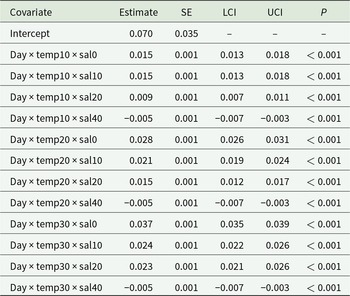
The combined effects of temperature and salinity on egg hatching dynamics over time are shown in Figure 3. Both species exhibited similar hatching timelines. At 10 °C, L2 larvae emerged between days 12 and 14; at 20 °C, hatching occurred between days 4 and 7; and at 30 °C, larvae began to emerge as early as days 1–3. In all temperature conditions, hatching success reached a plateau within a few days after the onset of hatching (Figure 3). Model analysis showed that in C. rudolphii sp. A, hatching success increased significantly at all temperatures and salinity levels, except at 70 psu, where it decreased significantly at 10 °C and showed no significant effect at 20 °C and 30 °C (Table 1, Figure 4). In C. rudolphii sp. B, hatching success increased significantly between 0 and 20 psu across all temperatures (Table 2, Figure 4), but decreased significantly at 40 psu under all temperature conditions.
Observed hatching success (%) of C. rudolphii sp. A (A) and C. rudolphii sp. B (B) under three incubation temperatures (10 °C, 20 °C, 30 °C) and different salinity levels (0–80 psu), over time.

Predicted hatching success (%) of C. rudolphii sp. A (A) and C. rudolphii sp. B (B) under three incubation temperatures (10 °C, 20 °C, 30 °C) and different salinity levels (0–80 psu), over time. Shaded areas indicate 95% confidence intervals.

Mixed-Beta regression models investigating the effect of salinity (sal0 = 0 psu, sal10 = 10 psu, sal20 = 20 psu, sal40 = 40 psu, sal60 = 60 psu, sal70 = 70 psu, sal80 = 80 psu) on egg hatching success of C. rudolphii sp. A over time at 10 (temp10), 20 (temp20), and 30 (temp30) °C. Estimates, standard errors (SE), 95% confidence intervals (LCI, UCI), significance (P), correlation between predicted and observed values, and marginal (R2m) and conditional (R2c) R2 are reported

Random effect: replicate; variance = 0.002, SD = 0.051.
Predicted vs observed values: r = 0.700, P < 0.001. R2m = 0.43, R2c = 0.48.
Mixed-Beta regression models investigating the effect of salinity (sal0 = 0 psu, sal10 = 10 psu, sal20 = 20 psu, sal40 = 40 psu) on egg hatching success of C. Rudolphii sp. B over time at 10 (temp10), 20 (temp20) and 30 (temp30) °C. Estimates, standard errors (SE), 95% confidence intervals (LCI, UCI), significance (P), correlation between predicted and observed values, and marginal (R2m) and conditional (R2c) R2 are reported

Random effect: replicate; variance = 0.010, SD = 0.102.
Predicted vs observed values: r = 0.783, P < 0.001. R2m = 0.46, R2c = 0.61.
In all the experimental conditions where hatching was observed, L2 larvae of both species displayed active movement and were consistently attached to the bottom of the wells. For all experimental conditions, larvae were monitored and counted for 3 days after hatching. During this period, the number of active larvae remained stable, with variations ≤5 individuals per day. A decline, with the first mortalities, was observed only after day 3, at which point the experiments were stopped.
Discussion
This study provides the first experimental evidence of species-specific hatching responses to temperature and salinity gradients in the sympatric anisakid nematodes C. rudolphii sp. A and C. rudolphii sp. B. Previous research on C. rudolphii (s.l.) reported hatching in seawater at 15 °C and 20 °C (Bartlett Reference Bartlett1996). However, in that paper, the two sibling species had not yet been disclosed; therefore, no species-specific differences in hatching dynamics were evidenced.
The results here presented confirm that temperature strongly influences embryonic development and hatching success in C. rudolphii (s.l.). Temperature does not appear to be a limiting factor differentiating the two taxa; indeed, both C. rudolphii sp. A and C. rudolphii sp. B successfully hatched at 10 °C and above, with comparable performance at 20 °C and 30 °C. However, notably, C. rudolphii sp. A consistently exhibited slightly higher hatching rates, suggesting a marginal advantage under both cold and warm conditions. Nevertheless, the overall thermal response profiles largely overlapping between the two species (Figure 3). Complete inhibition of development occurred at 5 °C in both taxa, indicating this value as a lower thermal threshold. Comparable thermal tolerance patterns have been observed in other anisakid nematodes. For instance, Anisakis simplex (s.s.) and A. pegreffii hatched within the range of 3–25 °C and 3–27 °C, respectively, with the latter showing greater tolerance to higher temperatures (Gomes et al. Reference Gomes, Quiazon, Itoh, Fujise and Yoshinaga2023). Similarly, in the digenean Schistosoma mansoni, development accelerates above 30 °C but fails beyond this threshold, highlighting the complex and non-linear effects of heat stress on parasite transmission (Pflüger Reference Pflüger1980). In the present study, temperature also significantly influenced the timing of larval emergence. At 10 °C, hatching occurred between days 12 and 14; at 20 °C, between days 4 and 7; and at 30 °C, as early as days 1 to 3, confirming a clear acceleration of development with increasing temperature (Figure 3). While high temperatures appear to enhance hatching efficiency and speed, our study did not assess larval survival or infectivity post-hatching, which remains an open question. To evaluate larval viability and competence, experimental infections in suitable intermediate hosts would be necessary. A noteworthy observation during the study was the active swimming and bottom-attachment behaviour of newly hatched L2 larvae in both species. This behaviour suggests that benthic or epibenthic invertebrates may serve as first intermediate hosts in natural environments. This supports earlier hypotheses proposing copepods and/or amphipods as potential initial hosts (Huizinga Reference Huizinga1966; Moravec Reference Moravec2009).
In contrast to temperature, salinity emerged as a key ecological factor differentiating the two species. Contracaecum rudolphii sp. A hatched successfully up to 70 psu, confirming the parasite’s broad environmental tolerance and its euryhaline adaptation. Conversely, C. rudolphii sp. B was restricted to a narrower range (0–20 psu), with hatching success declining sharply above 10 psu and being completely inhibited at higher concentrations. This marked asymmetry suggests that C. rudolphii sp. B is specialized for freshwater environments (e.g. lakes and rivers), while C. rudolphii sp. A is adapted to variable salinity conditions, including brackish and marine habitats.
Therefore, salinity acts as an ecological driver during early development, contributing to the differential distribution and abundance of these sibling taxa and shaping their life-cycle dynamics. The congruence between experimental tolerance data and field-based host-parasite associations strongly supports the hypothesis of ecological segregation and local adaptation between C. rudolphii sp. A and C. rudolphii sp. B.
In agreement with these findings, L3 larvae of C. rudolphii sp. A significantly prevail in fish from brackish and coastal environments (Mattiucci et al. Reference Mattiucci, Sbaraglia, Palomba, Filippi, Paoletti, Cipriani and Nascetti2020); whereas C. rudolphii sp. B is predominantly found in freshwater fish (e.g. Szostakowska and Fagerholm Reference Szostakowska and Fagerholm2007; Culurgioni et al. Reference Culurgioni, Sabatini, De Murtas, Mattiucci and Figus2014; Mattiucci et al. Reference Mattiucci, Sbaraglia, Palomba, Filippi, Paoletti, Cipriani and Nascetti2020). Analogously, adult specimens of C. rudolphii sp. A are frequently found in cormorants inhabiting marine or brackish areas, while C. rudolphii sp. B occurs more frequently in cormorants from freshwater ecosystems. This ecological partitioning is further supported by the hypothesis proposed by Marion (Reference Marion1995), which suggests that cormorants exhibit distinct feeding preferences depending on their natal environment: individuals born and raised in freshwater tend to forage primarily in freshwater habitats, while those from marine or brackish origins show a preference for saline environments. These differentiated foraging habits likely drive the distinct parasite assemblages observed in cormorant populations, reinforcing the ecological segregation between the two C. rudolphii taxa. This pattern has been documented across several European regions. In Italy, C. rudolphii sp. A has been recorded in cormorants from salt marshes and brackish coastal habitats (Mattiucci et al. Reference Mattiucci, Turchetto, Brigantini and Nascetti2002, Reference Mattiucci, Sbaraglia, Palomba, Filippi, Paoletti, Cipriani and Nascetti2020; Amor et al. Reference Amor, Farjallah, Piras, Burreddu, Garippa and Merella2020; Carmeño et al. Reference Carmeño, Rusconi, Castelli, Prati, Bragoni, Santoro, Postiglione, Sassera and Olivieri2022; Cammilleri et al. Reference Cammilleri, D’Amelio, Ferrantelli, Costa, Buscemi, Castello, Bacchi, Goffredo, Mancini and Cavallero2023), with similar findings reported from Spain (Roca-Geronès et al. Reference Roca-Geronès, Fisa, Montoliu, Casadevall, Tobella, Bas, Palomba and Mattiucci2023). Conversely, C. rudolphii sp. B has consistently been identified in cormorants from freshwater lakes and rivers, such as Poland (Szostakowska and Fagerholm Reference Szostakowska and Fagerholm2007) and again in Italy (Amor et al. Reference Amor, Farjallah, Piras, Burreddu, Garippa and Merella2020; Mattiucci et al. Reference Mattiucci, Sbaraglia, Palomba, Filippi, Paoletti, Cipriani and Nascetti2020; Caffara et al. Reference Caffara, Tedesco, Davidovich, Rubini, Luci, Cantori, Glogowski, Fioravanti and Gustinelli2023).
Conclusions
This study provides the first experimental evidence of species-specific hatching responses to water temperature and salinity in the two sibling species C. rudolphii sp. A and C. rudolphii sp. B, which occur sympatrically and syntopically in the great cormorant, Ph. carbo sinensis as their definitive host. While temperature significantly influences embryonic development and hatching success in both taxa, it does not appear to play role in differentiating their ecological preferences. In contrast, salinity results as a key driver shaping species-specific hatching success, highlighting marked differences in environmental tolerance: C. rudolphii sp. A exhibited a broad euryhaline capacity, whereas C. rudolphii sp. B showed a preference for freshwater conditions.
In conclusion, even when co-infecting the same host, the eggs of these two species – expelled via cormorant faeces – are exposed to abiotic features which are responsible for the hatching success. This pattern greatly contributes to the ecological segregation of these reproductively isolated species, as observed across different aquatic ecosystems.
These findings not only elucidate important aspects of C. rudolphii spp. ecology, but also underscore the relevance of this parasite group in the context of ongoing climate change – particularly in coastal and brackish habitats where temperature and salinity fluctuations are expected to intensify. Given that anisakid presence and density may serve as indicators of environmental change (Palomba et al. Reference Palomba, Marchiori, Tedesco, Fioravanti, Marcer, Gustinelli, Aco-Alburqueque, Belli, Canestrelli, Santoro, Cipriani and Mattiucci2023), species within C. rudolphii (s.l.) could also act as valuable sentinels for monitoring ecosystem responses to climate-driven shifts.
Financial support
The project was implemented under the National Recovery and Resilience Plan (NRRP), Mission 4 Component 2 Investment 1.4, Call for tender No. 3138 of 16 December 2021, rectified by Decree n.3175 of 18 December 2021 of the Italian Ministry of University and Research funded by the European Union-Next Generation EU. Project code CN_00000033, Concession Decree No.1034 of 17 June 2022 adopted by the Italian Ministry of University and Research, CUPJ83C22000860007, Project title ‘National Biodiversity Future Centre-NBFC’.
Author contributions
MP, BB, GC, MF, DC, GN, SM Writing, review and editing; MP, SM Writing original draft; MP, SM Supervision; MP, BB, MF, SM Methodology; MP, BB, GC, MF, SM Formal analysis; MP, BB, GC, SM Data curation; MP, GN, SM Conceptualization.
Competing interests
None
Ethical standards
All applicable international, national, and/or institutional guidelines for the care and use of animals were followed. The dead animals were examined under the permission of the Local Ethics Commission for Research Involving Animals (decision no. 050VT427).



 Open access

