


Introduction
The Mediterranean Sea is a hotspot area for introduction of species and nearly 1000 species have been reported from the region (Zenetos et al., Reference Zenetos, Çinar, Crocetta, Golani, Rosso, Servello, Shenkar, Turon and Verlaque2017; Galanidi et al., Reference Galanidi, Aissi, Ali, Bakalem, Bariche, Bartolo, Bazairi, Beqiraj, Bilecenoglu, Bitar, Bugeja, Carbonell-Quetglas, Castriota, Chalabi, Çinar, Dragicevic, Dulcic, El Haweet, Farrag, Galil, Guerin, Hyams-Kaphzan, Kapedani, Kamberi, Livi, Macic, Masse, Mavric, Orlando-Bonaca, Ouerghi, Petovic, Png-Gonzalez, Shenkar, Sghaier, Shakman, Yahyaoui, Yokeş and Zenetos2023). They have created unpredictable, irreversible changes in the Mediterranean ecosystems, outcompeting native species, changing food webs, and destroying biogenic habitats (Çinar et al., Reference Çinar, Bilecenoglu, Öztürk, Katağan, Yokeş, Aysel, Dağli, Açik, Özcan and Erdoğan2011, Reference Çinar, Bilecenoğlu, Yokeş, Öztürk, Taşkın, Bakir, Doğan and Açik2021). Some sessile invasive alien species densely attach to artificial substrata such as hulls of ships, pipes, and nets, and significantly reduce their usage efficiency (Çinar, Reference Çinar2006; Ferrario et al., Reference Ferrario, Caronni, Occhipinti-Ambrogi and Marchini2017; Tempesti et al., Reference Tempesti, Langeneck, Romani, Garrido, Lardicci, Maltagliati and Castelli2022). The main fouling invasive alien species are algae, sponges, serpulid polychaetes, and ascidians (Koçak et al., Reference Koçak, Ergen and Çinar1999; Çinar, Reference Çinar2006; Mineur et al., Reference Mineur, Johnson, Maggs and Stegenga2007; Çinar et al., Reference Çinar, Katagan, Koçak, Öztürk, Ergen, Kocatas, Önen, Kirkim, Bakir, Kurt, Dagli, Açik, Dogan and Özcan2008; Zenetos et al., Reference Zenetos, Çinar, Crocetta, Golani, Rosso, Servello, Shenkar, Turon and Verlaque2017; Lezzi & Giangrande, Reference Lezzi and Giangrande2018; Evcen & Çinar, Reference Evcen and Çinar2020). The newly described sponge species, namely Paraleucilla magna Klautau, Monteiro & Borojevic, 2004, densely invaded harbour environments and mussel farming ropes in the Mediterranean Sea, creating dense mats, resulting in dead of species underneath (Longo et al., Reference Longo, Mastrototaro and Corriero2007; Evcen & Çinar, Reference Evcen and Çinar2020). Serpulid polychaetes such as Hydroides and Ficopomatus species densely occur on artificial substrata in polluted and brackish waters (Çinar et al., Reference Çinar, Katagan, Koçak, Öztürk, Ergen, Kocatas, Önen, Kirkim, Bakir, Kurt, Dagli, Açik, Dogan and Özcan2008; Çinar, Reference Çinar2013). Ascidians are known to be pioneer colonizers in benthic communities, and also good competitors and efficient space monopolizers (Vieira et al., Reference Vieira, Flores and Dias2021).
A total of 28 alien ascidian species have been reported from the Mediterranean Sea (Izquierdo-Muñoz et al., Reference Izquierdo-Muñoz, Díaz-Valdéz and Ramos-Esplá2009; Galanidi et al., Reference Galanidi, Aissi, Ali, Bakalem, Bariche, Bartolo, Bazairi, Beqiraj, Bilecenoglu, Bitar, Bugeja, Carbonell-Quetglas, Castriota, Chalabi, Çinar, Dragicevic, Dulcic, El Haweet, Farrag, Galil, Guerin, Hyams-Kaphzan, Kapedani, Kamberi, Livi, Macic, Masse, Mavric, Orlando-Bonaca, Ouerghi, Petovic, Png-Gonzalez, Shenkar, Sghaier, Shakman, Yahyaoui, Yokeş and Zenetos2023). They were introduced to the region via shipping or natural dispersal via the Suez Canal (Zenetos et al., Reference Zenetos, Gofas, Verlaque, Çinar, Garcia Raso, Bianchi, Morri, Azzurro, Bilecenoglu, Froglio, Siokou, Violanti, Sfriso, San Martín, Giangrande, Katağan, Ballesteros, Ramos-Esplá, Mastrototaro, Oceana, Zingone, Gambi and Streftaris2010; Ulman et al., Reference Ulman, Ferrario, Forcada, Seebens, Arvanitidis, Occhipinti-Ambrogi and Marchini2019; Çinar et al., Reference Çinar, Bilecenoğlu, Yokeş, Öztürk, Taşkın, Bakir, Doğan and Açik2021). Some of them are highly invasive, covering large areas and outcompeting native species (Ordóñez et al., Reference Ordóñez, Pascual, Fernández-Tejedor, Pineda, Tagliapietra and Turon2015; Stabili et al., Reference Stabili, Licciano, Longo, Lezzi and Giangrande2015; Çinar, Reference Çinar2016; Montesanto et al., Reference Montesanto, Chimienti, Gissi and Mastrototaro2021a). They are frequently found on submerged ropes or tyres in harbour environments, but also occur in natural substrata like rocks (Çinar et al., Reference Çinar, Katagan, Öztürk, Egemen, Ergen, Kocatas, Önen, Kirkim, Bakir, Kurt, Dagli, Kaymakçi, Açik, Dogan and Özcan2006; Ramos-Esplá et al., Reference Ramos-Esplá, Bitar, Sghaier, Çinar, Deidun, Ferrario and Ulman2020; Montesanto et al., Reference Montesanto, Chimienti, Gissi and Mastrototaro2021b). Along the coasts of Turkey, 14 alien species have been reported up to date, with eight species being found in the Levantine Sea, and 11 species in the Aegean Sea (Çinar et al., Reference Çinar, Bilecenoğlu, Yokeş, Öztürk, Taşkın, Bakir, Doğan and Açik2021). Among the species, only one didemnid species (Didemnum ahu Monniot and Monniot, 1987) has been reported on a bivalve shell in İzmir Bay (Aegean Sea) (Aydın-Önen, Reference Aydın-Önen2020).
Didemnum vexillum was originally described from New Zealand (Kott, Reference Kott2002) and regarded as a global alien invader in temperate waters (Turon et al., Reference Turon, Casso, Pascual and Viard2020). It has a high growth rate that enables it covering large areas quickly, overgrowing almost every other sessile species (Lambert, Reference Lambert2009). This colonial ascidian is a relatively recent invader in the Mediterranean Sea, first encountered on oyster crops in aquaculture facilities in the Ebro Delta (Spain) (Ordóñez et al., Reference Ordóñez, Pascual, Fernández-Tejedor, Pineda, Tagliapietra and Turon2015), and on biota (mussels, sessile ascidians, and other fouling organisms) and maritime structures in the Venice Lagoon, based on material collected in 2012 (Tagliapietra et al., Reference Tagliapietra, Keppel, Sigovini and Lambert2012). However, in the Ebro Delta, its first observation goes back to 2002, but becomes more apparent in the 2010s (Ordóñez et al., Reference Ordóñez, Pascual, Fernández-Tejedor, Pineda, Tagliapietra and Turon2015). It was also the case in the Venice Lagoon where it was first observed in the late 2007 (Tagliapietra et al., Reference Tagliapietra, Keppel, Sigovini and Lambert2012). This species was considered as invasive alien species in the western Mediterranean and Adriatic Sea.
In the present study, the occurrence of the highly invasive alien species D. vexillum was reported in the eastern Mediterranean (Ildır Bay, Aegean Sea, Türkiye) and information regarding its morphological and ecological characteristics was documented.
Material and methods
The colonies of D. vexillum were collected on 13 December 2022 on nets of bluefin tuna cages (38°29′39′′N-26°23′24′′E), which were located at 60–65 m depths off the coast of Izmir Peninsula in the eastern Aegean Sea (Figure 1). The bluefin tuna farm system was composed of eight cages, each of 200–250 ton fish, and the breeding period for fish is 6 months, usually between June and January. Nets extend to a depth of 35 m.
Map of the investigated area with the location of sampling sites (red dot).

The surface water temperature in the sampling time was 15 °C. Its colonies on the net were photographed by a compact Olympus underwater camera (Tough TG-6). The material taken on nets was first fixed with 4% formaldehyde and transferred to the laboratory. The colony was first rinsed under tap water and then placed in jars containing 70% ethanol. It was cut into small pieces to observe zooids, spicules, and larvae. The measurements of the zooids and spicules were made an ocular micrometre. The colony was deposited in ESFM (Ege University Faculty of Fisheries Museum).
Results and discussion
Taxonomy
Phylum: Chordata Haeckel, 1874
Subphylum: Tunicata Lamarck, 1816
Classis: Ascidiacea Blainville, 1824
Order: Aplousobranchia Lahille, 1886
Family: Didemnidae Giard, 1872
Didemnum vexillum Kott, Reference Kott2002
Didemnum vexillum Kott, Reference Kott2002, 625–628, fig. 1; Lambert, Reference Lambert2009: 5–28, figs 1–5.
Short description
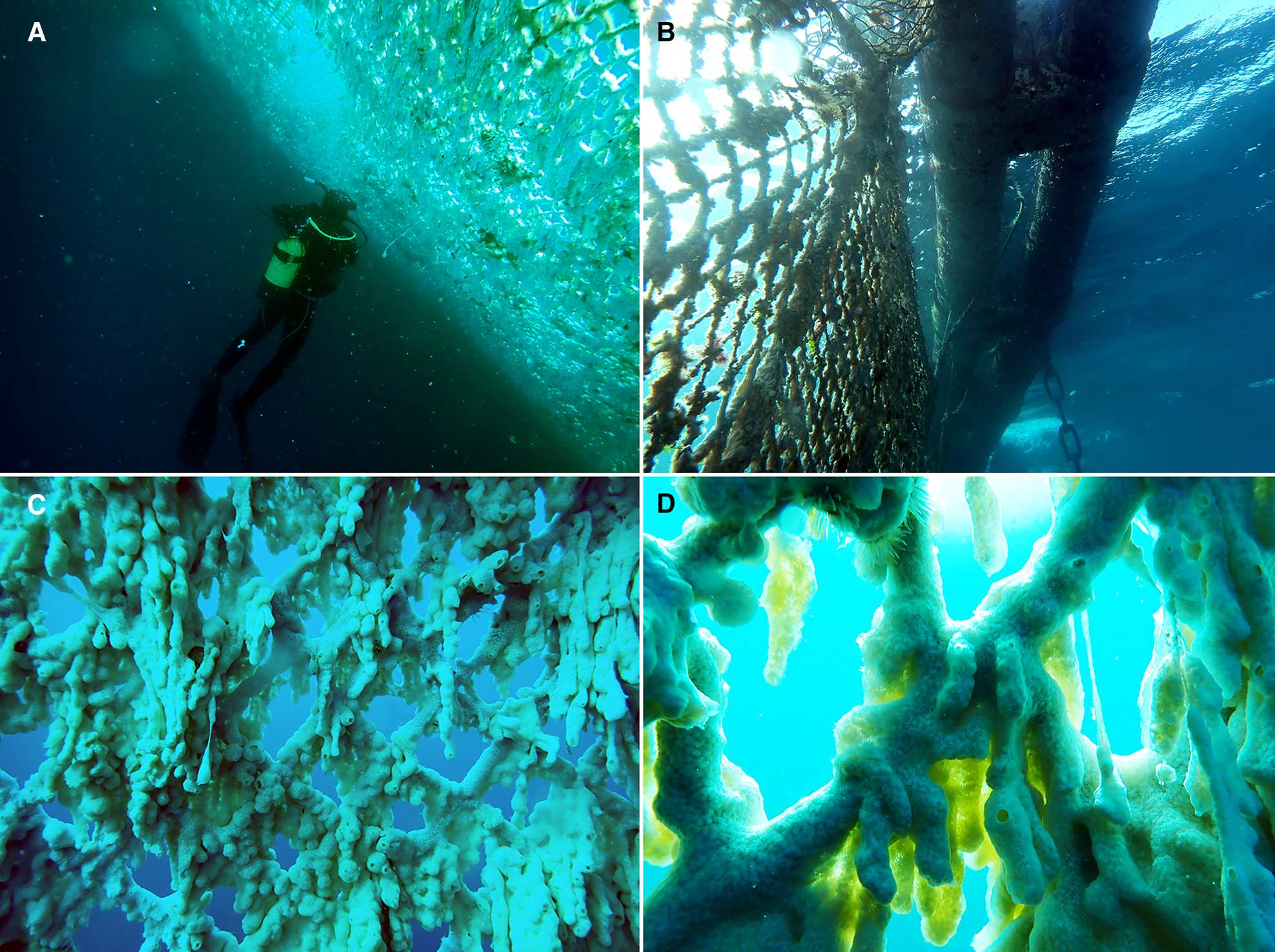
It is a colonial species, creamy whitish in colour (Figure 2C–D, 3A). It was found growing on net surfaces of bluefin tuna cages, developing short and long lobes with a cloacal opening at tip of each lobe (Figure 2A–D). The colony has a characteristic reticulate pattern. The colony thickness is around 2–3 mm (Figure 3C, D). Spicules embedded into the surface layer of tunic, 10–50 μm (N = 20) in diameter (average: 31.3 μm ± 2.47 SE), with sharply tipped short rays, about 10–20 in visible field (Figure 3B). The thorax and abdomen almost 1 mm long (Figure 4A–C); thorax with six small pointed lobes in the oral syphon and wide atrial aperture on branchial sac; with four rows of stigmata, first row contains eight or nine stigmata per side; thoracic organ could not be observed (Figure 4B). The abdomen with a straight digestive system; containing a spherical-shaped testis with a spiralled sperm duct forming 6–8 turns before passing straight towards atrial aperture (Figure 4C). It has also incubating oocytes with one large and two small eggs (Figure 4D). Larvae placed within the tunic beneath zooids; with six pairs of lateral ampullae and three adhesive papillae (Figure 4E).
A–B. Nets of bluefin tuna cages, C–D. Didemnum vexillum colonies on nets.
A. A Didemnum vexillum colony, general view, B. spicules of colonies, C–D. colony vertical section showing main canals. Scale bar: A = 2 mm, B = 55 μm, C = 2 mm, D = 1.7 mm.

A. Whole zooid, ventro-lateral view, B. thorax, C. abdomen, D. oocytes, E. larva. Scale bar: A = 0.17 mm, B = 120 μm, C = 90 μm, D = 55 μm, E = 215 μm.

Associated fauna
Nets surrounding the bluefin tuna cages were densely covered with the invasive colonial ascidian D. vexillum. This species almost clogged nets opening in some parts, hindering water circulations inside cages. A few species (some algae and actinarians) were observed to be associated with it, but no sessile encrusting invertebrates were observed on nets.
Distribution
Didemnum vexillum is native to Japan (Lambert, Reference Lambert2009). It is spreading in cool temperate areas via human assistance (Kleeman, Reference Kleeman2009). It has become introduced in several regions including New Zealand, the eastern Atlantic (Netherlands, France, Ireland, United Kingdom, Spain), western Mediterranean, and both the west and east coasts of the United States and Canada (Lambert, Reference Lambert2009; Stefaniak et al., Reference Stefaniak, Zhang, Gittenberger, Smith, Holsinger, Lin and Whitlatch2012; Tagliapietra et al., Reference Tagliapietra, Keppel, Sigovini and Lambert2012; Ordóñez et al., Reference Ordóñez, Pascual, Fernández-Tejedor, Pineda, Tagliapietra and Turon2015; McKenzie et al., Reference McKenzie, Reid, Lambert, Matheson, Minchin, Pederson, Brown, Curd, Gollash, Goulletquer, Occhipinti-Ambrogi, Simard and Therriault2017). The present study expands its distributional range to the eastern Mediterranean (Aegean Sea).
Habitat
This species densely colonizes natural and artificial substrates at depths ranging from 1 to 81 m depth (Bullard et al., Reference Bullard, Lambert, Carman, Byrnes, Whitlatch, Ruiz, Miller, Harris, Valentine, Collie, Pederson, McNaught, Cohen, Asch, Dijkstra and Heinonen2007; Lambert, Reference Lambert2009; Carman & Grunden, Reference Carman and Grunden2010). It fouls heavily on aquaculture establishments such as mussel and oyster cages (Lambert, Reference Lambert2009). Its current distribution pattern indicates that it is a temperate species and can tolerate a temperature range between −2 and 28 °C (Bullard et al., Reference Bullard, Lambert, Carman, Byrnes, Whitlatch, Ruiz, Miller, Harris, Valentine, Collie, Pederson, McNaught, Cohen, Asch, Dijkstra and Heinonen2007; Valentine et al., Reference Valentine, Carman, Dijkstra and Blackwood2009; Ordóñez et al., Reference Ordóñez, Pascual, Fernández-Tejedor, Pineda, Tagliapietra and Turon2015). Water temperatures above 8–10 °C are required for colony growth (Kleeman, Reference Kleeman2009). Its occurrence in the Mediterranean Sea suggests its capability to adapt to warmer waters. The maximum thermal limit of this species was known to be 24 °C (Bullard et al., Reference Bullard, Lambert, Carman, Byrnes, Whitlatch, Ruiz, Miller, Harris, Valentine, Collie, Pederson, McNaught, Cohen, Asch, Dijkstra and Heinonen2007), but Ordóñez et al. (Reference Ordóñez, Pascual, Fernández-Tejedor, Pineda, Tagliapietra and Turon2015) proved that it can sustain temperature 28 °C in the Mediterranean Sea. It prefers salinities above 26 psu (Bullard & Whitlatch, Reference Bullard and Whitlatch2009).
In the study area, the surface temperature near the bluefin tuna cage system was 15 °C (December), but it increases to 26 °C in the summer period in the area (Eryilmaz & Yücesoy-Eryilmaz, Reference Eryilmaz and Yücesoy-Eryilmaz2016). It was only found on cage nets only, and there has been no observation at the moment that this species also colonizes natural substrata. It has a vertical distributional pattern on the cage nets which goes down to 35 m depth. It colonizes nets from surface down to 16 m, after that, nets were fouled only by a brown alga species. This vertical distribution might be associated with the thermocline that usually develops around 15–20 m depth in the region in the summer period (Eryilmaz & Yücesoy-Eryilmaz, Reference Eryilmaz and Yücesoy-Eryilmaz2016).
The vector for introduction
The sexual reproduction of the species generates short-lived lecithotrophic tadpole larvae that have a short distance dispersal ability (meters to kilometres) (Fletcher et al., Reference Fletcher, Forrest and Bell2013). Translocation by human activities explains its sudden appearances in distant locations in the world's oceans (Lambert, Reference Lambert2009). Kleeman (Reference Kleeman2009) categorized its dispersal by larval release or fragmentation from adult colonies as natural processes (current and hitchhiking) and human vectors (hull fouling, ballast water/sea chests, fishing and dredging, and aquaculture). Its presence in the Gulf of Maine and France was explained by imports of large quantities of the Pacific oyster [Magallana gigas (Thunberg, 1793)] from Japan and other invaded areas (Dijkstra et al., Reference Dijkstra, Harris and Westerman2007). In the Ebro Delta, it might have been introduced to the area as epifauna with the oyster spat from the French Atlantic coast (Ordóñez et al., Reference Ordóñez, Pascual, Fernández-Tejedor, Pineda, Tagliapietra and Turon2015). Shipping was considered to be a possible vector for its introduction to the other invaded area in the Mediterranean Sea, the Lagoon of Venice (Tagliapietra et al., Reference Tagliapietra, Keppel, Sigovini and Lambert2012).
According to the interview by workers in bluefin tuna farming, this species first appeared in the area in nearly 5 years ago (2018), so its introduction to the area can be explained by three possible means. (1) Bluefin tuna trade is being held between Japan and Türkiye. Possibly due to the tax advantage, the Japanese merchant ship arrives in Malta and anchors there. A Maltese ship sails to Türkiye to convey farm-harvested fish to the Japanese ship. This invasive species may have primarily introduced to Malta by the Japanese ship and secondarily to Türkiye by the Maltese ship. (2) Bluefin tuna specimens breeding in the cage systems in Ildır Bay are fished off the coasts of Cyprus or Malta, and transferred to the area in nets slowly hauled by ships. Although this species has not yet been recorded in either Malta or Cyprus, the invaded areas in the western Mediterranean and Adriatic Sea by this species are close to Malta and colonies attached to nets or ships may have transferred this species to the region. (3) Another possibility is leisure yachting activity. The İzmir Peninsula is one of the favourite destination of yacht tourism. Many leisure yachts from the Mediterranean and other regions sail to Ildır Bay, nearby the bluefin tuna cages are located, and colonies as a part of foulers on hulls of ships might have been translocated to the area. However, workers in sea-bream and sea-bass cage farming in the area told us that this species do not exist on their nets, indicating its local colonization and its introduction via the bluefin tuna transportation. It is unknown at this stage if this species has invaded natural or other artificial substrata (docks, pier, pontoons, etc.) in the area.
Impacts
Didemnum vexillum is an aggressive and rapidly growing colonial ascidian (Bullard et al., Reference Bullard, Lambert, Carman, Byrnes, Whitlatch, Ruiz, Miller, Harris, Valentine, Collie, Pederson, McNaught, Cohen, Asch, Dijkstra and Heinonen2007). It forms dense encrusting mats with lobes in the introduced areas and is capable of changing or modifying habitats. It has a strong competitive ability, commonly overgrowing several sessile species including other ascidians, sponges, macroalgae, cnidarians, bryozoans, mussels, polychaetes, and crustaceans (Bullard et al., Reference Bullard, Lambert, Carman, Byrnes, Whitlatch, Ruiz, Miller, Harris, Valentine, Collie, Pederson, McNaught, Cohen, Asch, Dijkstra and Heinonen2007). It is capable of increasing their sizes 6–11 times in just 15 days (Valentine et al., Reference Valentine, Carman, Blackwood and Heffron2007a). On Georges Bank, off the coast of New England (USA), 50–90% surfaces of area within a 230 km2 were covered by this species (Bullard et al., Reference Bullard, Lambert, Carman, Byrnes, Whitlatch, Ruiz, Miller, Harris, Valentine, Collie, Pederson, McNaught, Cohen, Asch, Dijkstra and Heinonen2007). The species smothered marked sized Perna canaliculus (Gmelin, 1791) mussels in New Zealand within 14 days (in summer) (Coutts & Sinner, Reference Coutts and Sinner2004). It clogged syphons and caused condition loss or even death of mussels. Didemnum vexillum does not specifically attach itself to artificial substrata, but also colonizes natural habitats, having dramatic effects on native biota by altering habitat complexity and structure (Mercer et al., Reference Mercer, Whitlatch and Osman2009), and adversely affecting economically important activities such as fishing and aquaculture (Bullard et al., Reference Bullard, Lambert, Carman, Byrnes, Whitlatch, Ruiz, Miller, Harris, Valentine, Collie, Pederson, McNaught, Cohen, Asch, Dijkstra and Heinonen2007; Valentine et al., Reference Valentine, Collie, Reid, Asch, Guida and Blackwood2007b). It poses a major economic threat to the mussel farms located along the northern Adriatic coasts and lagoons (Tagliapietra et al., Reference Tagliapietra, Keppel, Sigovini and Lambert2012).
In the eastern Mediterranean, this species solely occurred on nets of bluefin tuna cages and entirely outcompeted the native fouler, the mussel Mytilus galloprovincialis Lamarck, 1819 (interview with workers in bluefin tuna farming), which was regarded as a previous pest for the farm because of clogging mesh's eye openings. It seems that this species does not have a profound effect on the tuna fish breeding activity, as the breeding period is almost 6 months in the area (caging in June and harvesting in December or January). After harvesting tuna fish, nets are removed from the cage and underwent to cleaning. This species changed the cleaning procedure of nets in the farming. Normally, when mussels are attached, nets go to net washing device for cleaning. However, as the didemnid attaches nets firmly, nets cannot be adequately cleaned up by net washing machines, thus they are laid on the ground in the sun and retain there until they are completely dried out. It then detaches from nets easily and if required nets are subjected to antifouling paintings.
Data availability
The data that support the findings of this study are available from the corresponding author, upon reasonable request.
Acknowledgements
The authors acknowledge Mervan Üzülmez, who was the diver in the farm for sharing his observation on this species, and two anonymous reviewers for their useful comments that greatly improved this article.
Author's contributions
M.E. Çinar: Conceptualization, data curation, identification, writing, review, and editing. A. Özgül: conceptualization, data curation, sampling.
Financial Support
This study was supported by Ege University Scientific Research Projects Coordination Unit (Project Number: 23853).
Competing interest
None.
Ethical standards
Not applicable.


 Open access

