





1. Introduction
Rotating thermal convection is a fundamental process observed in nature, occurring in the fluid cores of stars and planets, as well as in planetary atmospheres and oceans (Atkinson & Zhang Reference Atkinson and Zhang1996; Marshall & Schott Reference Marshall and Schott1999; Aurnou et al. Reference Aurnou, Calkins, Cheng, Julien, King, Nieves, Soderlund and Stellmach2015). Understanding the dynamics of this process is crucial in geophysical and astrophysical contexts, where heat and momentum transport under rotational constraints sustain magnetic fields and drive large-scale flow structures (Heimpel, Gastine & Wicht Reference Heimpel, Gastine and Wicht2016; Schumacher & Sreenivasan Reference Schumacher and Sreenivasan2020). Among rotating thermal convection models, the rotating Rayleigh–Bénard convection (RRBC) framework provides valuable insights into rotation-influenced buoyancy-driven flows (Kunnen Reference Kunnen2021; Ecke & Shishkina Reference Ecke and Shishkina2023).
In RRBC, a fluid layer is heated from below and cooled from above while rotating about a vertical axis. The heat transfer and flow properties in this system are described by key dimensionless parameters: the Rayleigh number ( $Ra$
), quantifying thermal driving; the Prandtl number (
$Ra$
), quantifying thermal driving; the Prandtl number ( $Pr$
), characterising fluid diffusivity; and the Ekman number (
$Pr$
), characterising fluid diffusivity; and the Ekman number ( $Ek$
), which measures rotational influence. In strongly rotational systems (
$Ek$
), which measures rotational influence. In strongly rotational systems ( $Ek \leq 10^{-4}$
), increasing
$Ek \leq 10^{-4}$
), increasing $Ra$
leads to distinct convection regimes, ranging from rotation-dominated to buoyancy-dominated flows, each governed by unique scaling laws for heat and momentum transport (Julien et al. Reference Julien, Rubio, Grooms and Knobloch2012b
; Cheng et al. Reference Cheng, Stellmach, Ribeiro, Grannan, King and Aurnou2015; Aurnou, Horn & Julien Reference Aurnou, Horn and Julien2020; Kunnen Reference Kunnen2021; Ecke & Shishkina Reference Ecke and Shishkina2023). A well-known diffusion-free scaling law for heat transfer,
$Ra$
leads to distinct convection regimes, ranging from rotation-dominated to buoyancy-dominated flows, each governed by unique scaling laws for heat and momentum transport (Julien et al. Reference Julien, Rubio, Grooms and Knobloch2012b
; Cheng et al. Reference Cheng, Stellmach, Ribeiro, Grannan, King and Aurnou2015; Aurnou, Horn & Julien Reference Aurnou, Horn and Julien2020; Kunnen Reference Kunnen2021; Ecke & Shishkina Reference Ecke and Shishkina2023). A well-known diffusion-free scaling law for heat transfer, $Nu - 1 \sim Ra^{3/2}\, Ek^2\, Pr^{-1/2}$
, where
$Nu - 1 \sim Ra^{3/2}\, Ek^2\, Pr^{-1/2}$
, where $Nu$
is the Nusselt number representing the ratio of total to conductive heat transfer, assumes independence from viscosity (
$Nu$
is the Nusselt number representing the ratio of total to conductive heat transfer, assumes independence from viscosity ( $\nu$
) and thermal diffusivity (
$\nu$
) and thermal diffusivity ( $\kappa$
) (Stevenson Reference Stevenson1979; Julien et al. Reference Julien, Knobloch, Rubio and Vasil2012a
; Stellmach et al. Reference Stellmach, Lischper, Julien, Vasil, Cheng, Ribeiro, King and Aurnou2014; Cheng & Aurnou Reference Cheng and Aurnou2016; Plumley et al. Reference Plumley, Julien, Marti and Stellmach2017; Bouillaut et al. Reference Bouillaut, Miquel, Julien, Aumaître and Gallet2021; Song et al. Reference Song, Shishkina and Zhu2024c
; van Kan et al. Reference van Kan, Julien, Miquel and Knobloch2025).
$\kappa$
) (Stevenson Reference Stevenson1979; Julien et al. Reference Julien, Knobloch, Rubio and Vasil2012a
; Stellmach et al. Reference Stellmach, Lischper, Julien, Vasil, Cheng, Ribeiro, King and Aurnou2014; Cheng & Aurnou Reference Cheng and Aurnou2016; Plumley et al. Reference Plumley, Julien, Marti and Stellmach2017; Bouillaut et al. Reference Bouillaut, Miquel, Julien, Aumaître and Gallet2021; Song et al. Reference Song, Shishkina and Zhu2024c
; van Kan et al. Reference van Kan, Julien, Miquel and Knobloch2025).
This diffusion-free heat transfer scaling is thought to represent an idealised geostrophic turbulence regime, where the system is independent of $\nu$
and
$\nu$
and $\kappa$
, consistent with the energy cascade paradigm in high-
$\kappa$
, consistent with the energy cascade paradigm in high- $Ra$
turbulent flows (Ahlers, Grossmann & Lohse Reference Ahlers, Grossmann and Lohse2009; Lohse & Shishkina Reference Lohse and Shishkina2024). Geostrophic turbulence, often termed ultimate Rayleigh–Bénard turbulence under strong rotation, is crucial for geophysical and astrophysical systems, such as planetary cores, atmospheres and stellar convection zones, where large
$Ra$
turbulent flows (Ahlers, Grossmann & Lohse Reference Ahlers, Grossmann and Lohse2009; Lohse & Shishkina Reference Lohse and Shishkina2024). Geostrophic turbulence, often termed ultimate Rayleigh–Bénard turbulence under strong rotation, is crucial for geophysical and astrophysical systems, such as planetary cores, atmospheres and stellar convection zones, where large $Ra$
values occur (Vallis Reference Vallis2017). Understanding this regime is vital for predicting heat and mass transport in these environments. Despite recent advances in achieving ultimate turbulent scaling through direct numerical simulations (DNS) and experiments with taller convection cells (Cheng et al. Reference Cheng, Aurnou, Julien and Kunnen2018; Ecke & Shishkina Reference Ecke and Shishkina2023), replicating extreme conditions (
$Ra$
values occur (Vallis Reference Vallis2017). Understanding this regime is vital for predicting heat and mass transport in these environments. Despite recent advances in achieving ultimate turbulent scaling through direct numerical simulations (DNS) and experiments with taller convection cells (Cheng et al. Reference Cheng, Aurnou, Julien and Kunnen2018; Ecke & Shishkina Reference Ecke and Shishkina2023), replicating extreme conditions ( $Ek \sim 10^{-7}$
,
$Ek \sim 10^{-7}$
, $Ra \sim 10^{12}$
) in laboratory experiments remains challenging. Only very recently, the diffusion-free heat transfer scaling has been observed with no-slip boundaries at very high
$Ra \sim 10^{12}$
) in laboratory experiments remains challenging. Only very recently, the diffusion-free heat transfer scaling has been observed with no-slip boundaries at very high $Ra$
(
$Ra$
( $Ra\gt 10^{12}$
) and very strong rotation (
$Ra\gt 10^{12}$
) and very strong rotation ( $Ek\lt 10^{-8}$
) in DNS (Song et al. Reference Song, Kannan, Shishkina and Zhu2024a
,Reference Song, Shishkina and Zhu
b
,Reference Song, Shishkina and Zhu
c
). In contrast, DNS studies and reduced asymptotic models suggest that stress-free boundaries are generally perceived as more favourable for achieving diffusion-free heat transfer. Diffusion-free scaling of
$Ek\lt 10^{-8}$
) in DNS (Song et al. Reference Song, Kannan, Shishkina and Zhu2024a
,Reference Song, Shishkina and Zhu
b
,Reference Song, Shishkina and Zhu
c
). In contrast, DNS studies and reduced asymptotic models suggest that stress-free boundaries are generally perceived as more favourable for achieving diffusion-free heat transfer. Diffusion-free scaling of $Nu$
has indeed been observed at moderate Ekman numbers (
$Nu$
has indeed been observed at moderate Ekman numbers ( $Ek\lt 10^{-6}$
) (Julien et al. Reference Julien, Knobloch, Rubio and Vasil2012a
; Stellmach et al. Reference Stellmach, Lischper, Julien, Vasil, Cheng, Ribeiro, King and Aurnou2014; Plumley & Julien Reference Plumley and Julien2019; Oliver et al. Reference Oliver, Jacobi, Julien and Calkins2023; van Kan et al. Reference van Kan, Julien, Miquel and Knobloch2025), significantly higher than thresholds for no-slip boundaries, leading researchers to believe that stress-free conditions more readily facilitate the exploration of the geostrophic turbulence regime.
$Ek\lt 10^{-6}$
) (Julien et al. Reference Julien, Knobloch, Rubio and Vasil2012a
; Stellmach et al. Reference Stellmach, Lischper, Julien, Vasil, Cheng, Ribeiro, King and Aurnou2014; Plumley & Julien Reference Plumley and Julien2019; Oliver et al. Reference Oliver, Jacobi, Julien and Calkins2023; van Kan et al. Reference van Kan, Julien, Miquel and Knobloch2025), significantly higher than thresholds for no-slip boundaries, leading researchers to believe that stress-free conditions more readily facilitate the exploration of the geostrophic turbulence regime.
The Nusselt number has traditionally served as the primary diagnostic for identifying diffusion-free scaling and geostrophic turbulence in rapidly RRBC (Stellmach et al. Reference Stellmach, Lischper, Julien, Vasil, Cheng, Ribeiro, King and Aurnou2014; Bouillaut et al. Reference Bouillaut, Miquel, Julien, Aumaître and Gallet2021; Maffei et al. Reference Maffei, Krouss, Julien and Calkins2021; Oliver et al. Reference Oliver, Jacobi, Julien and Calkins2023; Song et al. Reference Song, Shishkina and Zhu2024c
; van Kan et al. Reference van Kan, Julien, Miquel and Knobloch2025). However, using no-slip boundary conditions, recent analyses suggest that relying solely on $Nu$
scaling may be insufficient to fully capture the transition into the geostrophic turbulence regime (Song et al. Reference Song, Shishkina and Zhu2024c
). Achieving a truly diffusion-free state demands not only asymptotic thermal transport but also diffusion-free momentum transport, characterised by the Reynolds number (
$Nu$
scaling may be insufficient to fully capture the transition into the geostrophic turbulence regime (Song et al. Reference Song, Shishkina and Zhu2024c
). Achieving a truly diffusion-free state demands not only asymptotic thermal transport but also diffusion-free momentum transport, characterised by the Reynolds number ( ${Re}$
) and diffusion-free convective length scales (
${Re}$
) and diffusion-free convective length scales ( $\ell /H$
), normalised by the container height (
$\ell /H$
), normalised by the container height ( $H$
). Theoretical predictions for geostrophic turbulence anticipate clear, diffusion-independent scaling laws:
$H$
). Theoretical predictions for geostrophic turbulence anticipate clear, diffusion-independent scaling laws: ${Re} \sim Ra\, Ek\, Pr^{-1}$
and
${Re} \sim Ra\, Ek\, Pr^{-1}$
and $\ell /H \sim Ra^{1/2}\, Ek\, Pr^{-1/2}$
(Guervilly, Cardin & Schaeffer Reference Guervilly, Cardin and Schaeffer2019; Madonia et al. Reference Madonia, Aguirre Guzmán, Clercx and Kunnen2021; Oliver et al. Reference Oliver, Jacobi, Julien and Calkins2023; Song et al. Reference Song, Shishkina and Zhu2024c
).
$\ell /H \sim Ra^{1/2}\, Ek\, Pr^{-1/2}$
(Guervilly, Cardin & Schaeffer Reference Guervilly, Cardin and Schaeffer2019; Madonia et al. Reference Madonia, Aguirre Guzmán, Clercx and Kunnen2021; Oliver et al. Reference Oliver, Jacobi, Julien and Calkins2023; Song et al. Reference Song, Shishkina and Zhu2024c
).
Stress-free boundary conditions are employed extensively in studies of planetary atmospheres, including Jupiter’s (Christensen Reference Christensen2010; Fuentes et al. Reference Fuentes, Anders, Cumming and Hindman2023), and solar convection dynamics (Featherstone & Hindman Reference Featherstone and Hindman2016; Vasil, Julien & Featherstone Reference Vasil, Julien and Featherstone2021; Käpylä Reference Käpylä2024), under the implicit assumption that they naturally facilitate diffusion-free turbulence across thermal, momentum and structural measures. However, through our extensive DNS studies of idealised RRBC, we uncover a crucial and unexpected distinction. While $Nu$
robustly transitions to diffusion-independent scaling at moderate
$Nu$
robustly transitions to diffusion-independent scaling at moderate $Ek$
accessible to current simulations,
$Ek$
accessible to current simulations, ${Re}$
and
${Re}$
and $\ell /H$
persistently exhibit significant residual dependence on viscosity. This divergence indicates that even as heat transport becomes effectively diffusion-free, viscous effects continue to influence the strength of convective motions and maintain larger-scale, viscosity-dominated coherent vortices in stress-free RRBC.
$\ell /H$
persistently exhibit significant residual dependence on viscosity. This divergence indicates that even as heat transport becomes effectively diffusion-free, viscous effects continue to influence the strength of convective motions and maintain larger-scale, viscosity-dominated coherent vortices in stress-free RRBC.
We therefore argue that genuine geostrophic turbulence can be unambiguously recognised only when $Nu$
,
$Nu$
, ${Re}$
and
${Re}$
and $\ell /H$
simultaneously exhibit diffusion-free scaling. Our extensive DNS datasets with stress-free boundary conditions, covering a wide parameter space with
$\ell /H$
simultaneously exhibit diffusion-free scaling. Our extensive DNS datasets with stress-free boundary conditions, covering a wide parameter space with $Ra$
and Ekman numbers down to
$Ra$
and Ekman numbers down to $Ek = 5 \times 10^{-8}$
, clearly show that the asymptotic, diffusion-free regime for
$Ek = 5 \times 10^{-8}$
, clearly show that the asymptotic, diffusion-free regime for $Nu$
is achieved far in advance of
$Nu$
is achieved far in advance of ${Re}$
and
${Re}$
and $\ell /H$
. This highlights a significant physical implication: current geophysical and astrophysical models employing stress-free boundaries with moderate
$\ell /H$
. This highlights a significant physical implication: current geophysical and astrophysical models employing stress-free boundaries with moderate $Ek$
may underestimate the influence of viscosity on large-scale flow structures. Recent asymptotic theories, rescaled specifically for stress-free RRBC, propose that fully diffusion-free conditions across all diagnostics might require extremely low
$Ek$
may underestimate the influence of viscosity on large-scale flow structures. Recent asymptotic theories, rescaled specifically for stress-free RRBC, propose that fully diffusion-free conditions across all diagnostics might require extremely low $Ek\sim 10^{-10}$
(van Kan et al. Reference van Kan, Julien, Miquel and Knobloch2025). Exploring this parameter regime remains a formidable computational and experimental challenge, underscoring the need for innovative numerical techniques and novel experimental approaches to conclusively achieve and characterise the regime of fully developed geostrophic turbulence.
$Ek\sim 10^{-10}$
(van Kan et al. Reference van Kan, Julien, Miquel and Knobloch2025). Exploring this parameter regime remains a formidable computational and experimental challenge, underscoring the need for innovative numerical techniques and novel experimental approaches to conclusively achieve and characterise the regime of fully developed geostrophic turbulence.
2. Numerical methods
In this study, we investigate RRBC by analysing DNS datasets from our recent work, utilising both stress-free and no-slip boundary conditions on the horizontal plates that bound the fluid domain. Specifically, we employ stress-free RRBC DNS data from Kannan & Zhu (Reference Kannan and Zhu2025), and no-slip RRBC simulation datasets from Song et al. (Reference Song, Kannan, Shishkina and Zhu2024a
,Reference Song, Shishkina and Zhu
b
,Reference Song, Shishkina and Zhu
c
) to conduct a detailed comparison of the geostrophic turbulence regime under these distinct boundary conditions, assuming fixed-temperature conditions on the horizontal plates, and periodic lateral boundaries in both cases. The Boussinesq approximation is applied to model the system, which rotates with constant angular velocity $\Omega$
around the vertical
$\Omega$
around the vertical $z$
-axis, with gravitational acceleration
$z$
-axis, with gravitational acceleration $\boldsymbol{g} = -g\boldsymbol{e}_z$
, where
$\boldsymbol{g} = -g\boldsymbol{e}_z$
, where $\boldsymbol{e}_z$
is the vertical unit vector.
$\boldsymbol{e}_z$
is the vertical unit vector.
The simulations were performed using the second-order finite-difference code AFiD (Verzicco & Orlandi Reference Verzicco and Orlandi1996; van der Poel et al. Reference van der Poel, Ostilla-Mónico, Donners and Verzicco2015; Zhu et al. Reference Zhu2018). The reference scales adopted are the domain height $H$
, the temperature difference between the plates
$H$
, the temperature difference between the plates $\varDelta$
, and the characteristic free-fall velocity
$\varDelta$
, and the characteristic free-fall velocity $u_f = \sqrt {\alpha _T g H \Delta }$
, where
$u_f = \sqrt {\alpha _T g H \Delta }$
, where $\alpha _T$
is the thermal expansion coefficient, and
$\alpha _T$
is the thermal expansion coefficient, and $g$
is the gravitational acceleration. The dimensionless governing equations are
$g$
is the gravitational acceleration. The dimensionless governing equations are
 \begin{equation} \boldsymbol{\nabla} \boldsymbol{\cdot} \boldsymbol{u} = 0, \end{equation}
 \begin{equation} \frac {\partial \boldsymbol{u}}{\partial t} + \boldsymbol{u}\boldsymbol{\cdot} \boldsymbol{\nabla } \boldsymbol{u} = - \boldsymbol{\nabla } p + \sqrt {\frac {Pr}{Ra}}\, \nabla ^2 \boldsymbol{u} + \theta \boldsymbol{e}_z - {\frac {1}{Ek}} \sqrt {\frac {Pr}{Ra}}\, \boldsymbol{e}_z \times \boldsymbol{u}, \end{equation}
 \begin{equation} \frac {\partial \theta }{\partial t} + \boldsymbol{u}\boldsymbol{\cdot} \boldsymbol{\nabla } \theta = \frac {1}{\sqrt {Ra\,Pr}}\, \nabla ^2 \theta , \end{equation}
where $\boldsymbol{u}$
is the velocity field,
$\boldsymbol{u}$
is the velocity field, $p$
is the pressure, and
$p$
is the pressure, and $T$
is the temperature.
$T$
is the temperature.
The dimensionless control parameters are defined as
 \begin{equation} \Gamma = \frac {L}{H}, \quad Pr = \frac {\nu }{\kappa }, \quad Ek = \frac {\nu }{2\Omega H^2}, \quad Ra = \frac {\alpha _T g \Delta H^3}{\nu \kappa }, \end{equation}
where $\Gamma$
is the aspect ratio (with
$\Gamma$
is the aspect ratio (with $L$
as the horizontal length),
$L$
as the horizontal length), $Pr$
is the Prandtl number,
$Pr$
is the Prandtl number, $Ek$
is the Ekman number, and
$Ek$
is the Ekman number, and $Ra$
is the Rayleigh number, which have been introduced before. The Rossby number
$Ra$
is the Rayleigh number, which have been introduced before. The Rossby number $Ro = \sqrt {Ra/Pr} \, Ek$
, quantifies the relative strength of buoyancy to the Coriolis force.
$Ro = \sqrt {Ra/Pr} \, Ek$
, quantifies the relative strength of buoyancy to the Coriolis force.
The datasets used in this study cover $5 \times 10^{-8} \leq Ek \leq 5 \times 10^{-6}$
,
$5 \times 10^{-8} \leq Ek \leq 5 \times 10^{-6}$
, $10^{8} \leq Ra \leq 5 \times 10^{12}$
and
$10^{8} \leq Ra \leq 5 \times 10^{12}$
and $0.125 \leq \Gamma \leq 2$
for stress-free RRBC, and
$0.125 \leq \Gamma \leq 2$
for stress-free RRBC, and $5 \times 10^{-9} \leq Ek \leq 1.5 \times 10^{-8}$
,
$5 \times 10^{-9} \leq Ek \leq 1.5 \times 10^{-8}$
, $3 \times 10^{11} \leq Ra \leq 3 \times 10^{13}$
and
$3 \times 10^{11} \leq Ra \leq 3 \times 10^{13}$
and $0.125 \leq \Gamma \leq 0.5$
for no-slip RRBC. All simulations were performed with a fixed Prandtl number
$0.125 \leq \Gamma \leq 0.5$
for no-slip RRBC. All simulations were performed with a fixed Prandtl number $Pr = 1$
. Further numerical details can be found in Song et al. (Reference Song, Shishkina and Zhu2024c
) for no-slip RRBC, and in Kannan & Zhu (Reference Kannan and Zhu2025) for stress-free RRBC.
$Pr = 1$
. Further numerical details can be found in Song et al. (Reference Song, Shishkina and Zhu2024c
) for no-slip RRBC, and in Kannan & Zhu (Reference Kannan and Zhu2025) for stress-free RRBC.
We analyse key diagnostic quantities, including $Nu$
and
$Nu$
and ${Re}$
, which characterise the vertical momentum transport. These are defined as
${Re}$
, which characterise the vertical momentum transport. These are defined as
 \begin{equation} Nu = 1 + \sqrt {Ra\, Pr}\, {\left \langle u_z \theta \right \rangle }_{V,t}, \quad {Re} = \sqrt {\frac {Ra}{Pr}}\, {\Big\langle u_z^2 \Big\rangle }^{1/2}_{V,t}, \end{equation}
where $\left \langle \cdot \right \rangle _{V,t}$
denotes averaging over the volume
$\left \langle \cdot \right \rangle _{V,t}$
denotes averaging over the volume $V$
and time
$V$
and time $t$
, and
$t$
, and $u_z$
is the non-dimensionalised vertical velocity component.
$u_z$
is the non-dimensionalised vertical velocity component.
3. Results and discussion
The Nusselt number $Nu$
is shown in figure 1 as a function of
$Nu$
is shown in figure 1 as a function of $Ra$
for various
$Ra$
for various $Ek$
values, under both no-slip (red-shaded) and stress-free (blue-shaded) boundary conditions. We observe that for varying control parameters,
$Ek$
values, under both no-slip (red-shaded) and stress-free (blue-shaded) boundary conditions. We observe that for varying control parameters, $Nu$
follows diffusion-free scaling in some regions. Specifically,
$Nu$
follows diffusion-free scaling in some regions. Specifically, $Nu - 1 \sim Ra^{3/2}\,Ek^2 \equiv \widetilde {Ra}^{3/2}$
, at distinct supercritical Rayleigh numbers
$Nu - 1 \sim Ra^{3/2}\,Ek^2 \equiv \widetilde {Ra}^{3/2}$
, at distinct supercritical Rayleigh numbers $\widetilde {Ra} \equiv Ra\,Ek^{4/3}$
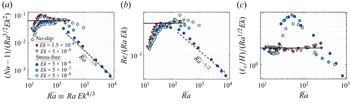
, as shown in figure 2(a). This diffusion-free scaling holds for moderate values
$\widetilde {Ra} \equiv Ra\,Ek^{4/3}$
, as shown in figure 2(a). This diffusion-free scaling holds for moderate values $40 \leq \widetilde {Ra} \leq 200$
under stress-free conditions, and for higher values
$40 \leq \widetilde {Ra} \leq 200$
under stress-free conditions, and for higher values $\widetilde {Ra} \geq 200$
under no-slip conditions. Based on the scaling behaviour of
$\widetilde {Ra} \geq 200$
under no-slip conditions. Based on the scaling behaviour of $Nu$
, it might be inferred that the whole flow dynamics is diffusion-free.
$Nu$
, it might be inferred that the whole flow dynamics is diffusion-free.
Dimensionless convective heat transport $Nu - 1$
as a function of the Rayleigh number
$Nu - 1$
as a function of the Rayleigh number $Ra$
for various Ekman numbers
$Ra$
for various Ekman numbers $Ek$
, obtained from DNS of RRBC with stress-free and no-slip boundary conditions at
$Ek$
, obtained from DNS of RRBC with stress-free and no-slip boundary conditions at $Pr = 1$
. The dashed lines represent the heat transfer scaling for geostrophic turbulence,
$Pr = 1$
. The dashed lines represent the heat transfer scaling for geostrophic turbulence, $Nu - 1 \sim Ra^{3/2}$
.
$Nu - 1 \sim Ra^{3/2}$
.

However, recent work by Song et al. (Reference Song, Shishkina and Zhu2024c
) reports that in addition to $Nu$
, both the convective length scale
$Nu$
, both the convective length scale $\ell$
and the Reynolds number
$\ell$
and the Reynolds number ${Re} = u_{z,rms}H/\nu$
, which characterises momentum transport, also follow diffusion-free scaling in the geostrophic turbulence regime. Here,
${Re} = u_{z,rms}H/\nu$
, which characterises momentum transport, also follow diffusion-free scaling in the geostrophic turbulence regime. Here, $u_{z,rms}$
denotes the root mean square (rms) of the vertical velocity component
$u_{z,rms}$
denotes the root mean square (rms) of the vertical velocity component $u_z$
. Specifically, the proposed diffusion-free scaling relations are
$u_z$
. Specifically, the proposed diffusion-free scaling relations are $\ell / H \sim Ra^{1/2}\,Ek\,Pr^{-1/2}$
and
$\ell / H \sim Ra^{1/2}\,Ek\,Pr^{-1/2}$
and ${Re} \sim Ra\,Ek\,Pr^{-1}$
(Aurnou et al. Reference Aurnou, Horn and Julien2020; Song et al. Reference Song, Shishkina and Zhu2024c
). To explore this further, we examine whether the data obtained under stress-free conditions align with the diffusion-free scaling for
${Re} \sim Ra\,Ek\,Pr^{-1}$
(Aurnou et al. Reference Aurnou, Horn and Julien2020; Song et al. Reference Song, Shishkina and Zhu2024c
). To explore this further, we examine whether the data obtained under stress-free conditions align with the diffusion-free scaling for $\ell$
and
$\ell$
and ${Re}$
at moderate values of
${Re}$
at moderate values of $\widetilde {Ra}$
, where
$\widetilde {Ra}$
, where $Nu$
exhibits diffusion-free scaling.
$Nu$
exhibits diffusion-free scaling.
The compensated plots for $Re$
and
$Re$
and $\ell /H$
, along with their respective diffusion-free scaling, are presented as functions of
$\ell /H$
, along with their respective diffusion-free scaling, are presented as functions of $\widetilde {Ra}$
in figures 2(b) and 2(c). Here,
$\widetilde {Ra}$
in figures 2(b) and 2(c). Here, $\ell /H$
is based on the
$\ell /H$
is based on the $u_z$
spectra,
$u_z$
spectra, $\ell _c/H=\sum _{k} [\hat {u}_z(k)\,\hat {u}^*_z(k)]/\sum _{k} k [\hat {u}_z(k)\,\hat {u}^*_z(k)]$
, where
$\ell _c/H=\sum _{k} [\hat {u}_z(k)\,\hat {u}^*_z(k)]/\sum _{k} k [\hat {u}_z(k)\,\hat {u}^*_z(k)]$
, where $\hat {u}_z(k)$
and
$\hat {u}_z(k)$
and $\hat {u}^*_z(k)$
are, respectively, the Fourier transform of
$\hat {u}^*_z(k)$
are, respectively, the Fourier transform of $u_z$
and its complex conjugate at the mid-height, and
$u_z$
and its complex conjugate at the mid-height, and $k$
is the wavenumber. It is evident that at the values of
$k$
is the wavenumber. It is evident that at the values of $\widetilde {Ra}$
where
$\widetilde {Ra}$
where $Nu$
follows diffusion-free scaling in figures 1 and 2(a), both
$Nu$
follows diffusion-free scaling in figures 1 and 2(a), both $Re$
and
$Re$
and $\ell _c/H$
exhibit diffusion-free scaling only under no-slip conditions, as shown by Song et al. (Reference Song, Shishkina and Zhu2024c
). However, for stress-free conditions, at moderate values of
$\ell _c/H$
exhibit diffusion-free scaling only under no-slip conditions, as shown by Song et al. (Reference Song, Shishkina and Zhu2024c
). However, for stress-free conditions, at moderate values of $40 \leq \widetilde {Ra} \leq 200$
, neither
$40 \leq \widetilde {Ra} \leq 200$
, neither $Re$
nor
$Re$
nor $\ell _c/H$
data exhibit diffusion-free scaling. This suggests that although the heat transfer is diffusion-free, the momentum transport and associated length still depend on diffusion under the stress-free boundary conditions. Here, it should be noted that the moderate range
$\ell _c/H$
data exhibit diffusion-free scaling. This suggests that although the heat transfer is diffusion-free, the momentum transport and associated length still depend on diffusion under the stress-free boundary conditions. Here, it should be noted that the moderate range $40 \leq \widetilde {Ra} \leq 200$
is defined based on our DNS parameters (
$40 \leq \widetilde {Ra} \leq 200$
is defined based on our DNS parameters ( $Ek \geq 5 \times 10^{-8}$
,
$Ek \geq 5 \times 10^{-8}$
, $Ra \leq 5 \times 10^{12}$
). As
$Ra \leq 5 \times 10^{12}$
). As $Ek$
decreases, the upper bound may increase, potentially broadening the regime where
$Ek$
decreases, the upper bound may increase, potentially broadening the regime where $Nu$
is diffusion-free; however,
$Nu$
is diffusion-free; however, $Re$
and
$Re$
and $\ell /H$
are not.
$\ell /H$
are not.
(a) Nusselt number $Nu - 1$
, normalised by the diffusion-free scaling
$Nu - 1$
, normalised by the diffusion-free scaling $Ra^{3/2}\, Ek^2$
. (b) Dimensionless momentum transport
$Ra^{3/2}\, Ek^2$
. (b) Dimensionless momentum transport $Re$
, normalised by its geostrophic turbulence scaling
$Re$
, normalised by its geostrophic turbulence scaling $Ra\,Ek$
. (c) Dimensionless convective length scale
$Ra\,Ek$
. (c) Dimensionless convective length scale $\ell _c/H$
, normalised by its geostrophic turbulence scaling
$\ell _c/H$
, normalised by its geostrophic turbulence scaling $Ra^{1/2}\,Ek$
, shown as a function of the supercriticality parameter
$Ra^{1/2}\,Ek$
, shown as a function of the supercriticality parameter $\widetilde {Ra} \equiv Ra\, Ek^{4/3}$
and increasing supercriticalities.
$\widetilde {Ra} \equiv Ra\, Ek^{4/3}$
and increasing supercriticalities.

This discrepancy raises the question: if $Re$
and
$Re$
and $\ell _c/H$
do not conform to diffusion-free scaling, what alternative scaling do they follow, and how can this behaviour be understood? To address this, we analyse the flow structure to gain insight into the scaling of the associated length scales in this moderate
$\ell _c/H$
do not conform to diffusion-free scaling, what alternative scaling do they follow, and how can this behaviour be understood? To address this, we analyse the flow structure to gain insight into the scaling of the associated length scales in this moderate $\widetilde {Ra}$
regime, where heat transfer remains diffusion-free.
$\widetilde {Ra}$
regime, where heat transfer remains diffusion-free.
Previous studies for stress-free plates showed that at moderate $\widetilde {Ra}$
values, the flow exhibits a large-scale cyclone–anticyclone vortex dipole with rapidly rotating vortex core (Julien et al. Reference Julien, Rubio, Grooms and Knobloch2012b
; Favier, Silvers & Proctor Reference Favier, Silvers and Proctor2014; Rubio et al. Reference Rubio, Julien, Knobloch and Weiss2014; Ecke & Shishkina Reference Ecke and Shishkina2023), a simple structure that fills the domain. For a fixed value of rotation rate (fixed
$\widetilde {Ra}$
values, the flow exhibits a large-scale cyclone–anticyclone vortex dipole with rapidly rotating vortex core (Julien et al. Reference Julien, Rubio, Grooms and Knobloch2012b
; Favier, Silvers & Proctor Reference Favier, Silvers and Proctor2014; Rubio et al. Reference Rubio, Julien, Knobloch and Weiss2014; Ecke & Shishkina Reference Ecke and Shishkina2023), a simple structure that fills the domain. For a fixed value of rotation rate (fixed $Ek$
) but increasing
$Ek$
) but increasing $Ra$
, the transport properties trend to those in non-rotating case, i.e.
$Ra$
, the transport properties trend to those in non-rotating case, i.e. $Nu -1 \sim Ra^{1/3}$
and
$Nu -1 \sim Ra^{1/3}$
and $Re \sim Ra^{1/2}$
. This behaviour is fully supported by the scalings
$Re \sim Ra^{1/2}$
. This behaviour is fully supported by the scalings $ (Nu -1 )/ (Ra^{3/2}\,Ek^2 ) \sim Ra^{-7/6}$
and
$ (Nu -1 )/ (Ra^{3/2}\,Ek^2 ) \sim Ra^{-7/6}$
and ${Re}/ (Ra\, Ek ) \sim Ra^{-1/2}$
, as shown in figures 2(a) and 2(b), respectively.
${Re}/ (Ra\, Ek ) \sim Ra^{-1/2}$
, as shown in figures 2(a) and 2(b), respectively.
We now focus on the scaling properties of stress-free flows where the heat transport follows the diffusion-free scaling, i.e. in the range $40 \leq \widetilde {Ra} \leq 200$
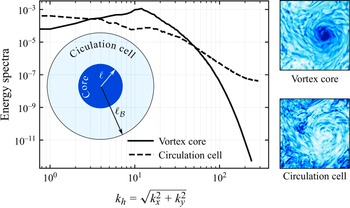
. They are determined by the scaling relations of the vortex core. To derive them, the large-scale vortex can be viewed spatially as a vortex core (rotation-dominated region) surrounded by a circulation cell (shear-dominated region) in the background, as illustrated in the inset of figure 3 (Petersen, Julien & Weiss Reference Petersen, Julien and Weiss2006). Each circulation cell region has its own length scale:
$40 \leq \widetilde {Ra} \leq 200$
. They are determined by the scaling relations of the vortex core. To derive them, the large-scale vortex can be viewed spatially as a vortex core (rotation-dominated region) surrounded by a circulation cell (shear-dominated region) in the background, as illustrated in the inset of figure 3 (Petersen, Julien & Weiss Reference Petersen, Julien and Weiss2006). Each circulation cell region has its own length scale: $\ell$
for the core, and
$\ell$
for the core, and $\ell _{\mathcal{B}}$
for the whole cell.
$\ell _{\mathcal{B}}$
for the whole cell.
Okubo–Weiss decomposition of barotropic energy at $Ra = 2\times 10^{11}$
,
$Ra = 2\times 10^{11}$
, $Ek = 5 \times 10^{-8}$
, with spectra for vortex core (solid line) and background circulation cell (dashed line). Vortex core and circulation cell length scales,
$Ek = 5 \times 10^{-8}$
, with spectra for vortex core (solid line) and background circulation cell (dashed line). Vortex core and circulation cell length scales, $\ell$
and
$\ell$
and $\ell _{\mathcal{B}}$
, are shown in the inset schematic. Right-hand column: contour plots of horizontal vorticity (vortex core) and strain (circulation cell), with dark/light colours for high/low values.
$\ell _{\mathcal{B}}$
, are shown in the inset schematic. Right-hand column: contour plots of horizontal vorticity (vortex core) and strain (circulation cell), with dark/light colours for high/low values.

In the shear-dominated circulation cell, advection is balanced by diffusion across the cell. This region is characterised by slow rotation and dominated by buoyancy forces, unlike the vortex core, which is rotation-dominated. Thus we have the balance
 \begin{equation} \boldsymbol{u \cdot \nabla} \boldsymbol{u} \sim \nu \nabla ^2 \boldsymbol{u}. \end{equation}
In the shear-dominated region of the circulation cell, advective forces locally outweigh the Coriolis effect, despite the system’s rapid rotation ( $Ek \geq 5 \times 10^{-8}$
) – unlike the rotation-dominated vortex core. Thus in the locally buoyancy-dominated region, where rotation is weak, the convective velocity scales with the free-fall velocity
$Ek \geq 5 \times 10^{-8}$
) – unlike the rotation-dominated vortex core. Thus in the locally buoyancy-dominated region, where rotation is weak, the convective velocity scales with the free-fall velocity $u_f$
, which represents the maximum velocity attainable by a fluid parcel when its potential buoyant energy is fully converted into kinetic energy (Niemela & Sreenivasan Reference Niemela and Sreenivasan2003; Aurnou et al. Reference Aurnou, Horn and Julien2020). This scaling is also supported by our DNS results (see Appendix A). By applying an order-of-magnitude analysis to the above balance, with
$u_f$
, which represents the maximum velocity attainable by a fluid parcel when its potential buoyant energy is fully converted into kinetic energy (Niemela & Sreenivasan Reference Niemela and Sreenivasan2003; Aurnou et al. Reference Aurnou, Horn and Julien2020). This scaling is also supported by our DNS results (see Appendix A). By applying an order-of-magnitude analysis to the above balance, with $u_f$
as the convective velocity scale in the circulation cell, we obtain
$u_f$
as the convective velocity scale in the circulation cell, we obtain
 \begin{equation} \frac {u_f^2}{H} \sim \nu \frac {u_f}{\ell _{\mathcal{B}}^2}\,\, \implies\,\, \frac {\ell _{\mathcal{B}}}{H} \sim Ra^{-1/4}\,Pr^{1/4}. \end{equation}
For the scales of length in (3.2), the viscous term uses $\ell _{\mathcal{B}}$
, the circulation cell’s horizontal scale, due to dominant horizontal diffusion, while advection uses
$\ell _{\mathcal{B}}$
, the circulation cell’s horizontal scale, due to dominant horizontal diffusion, while advection uses $H$
, reflecting vertical momentum transport across the domain.
$H$
, reflecting vertical momentum transport across the domain.
Similarly, the length scale for the vortex core, which represents the characteristic scale of the flow structure, can be obtained by assuming a balance between viscous and Coriolis forces in the vorticity equation. This assumption is appropriate as the flow in this regime does not follow the diffusion-free scaling for $Re$
and
$Re$
and $\ell$
(see figure 2) deduced from the presumption that the flow obeys a CIA (Coriolis, inertia, Archimedean buoyancy) balance (Aurnou et al. Reference Aurnou, Horn and Julien2020; Vasil et al. Reference Vasil, Julien and Featherstone2021). Therefore, we assume that these structures, particularly the vortex core, are governed by a VAC (viscous, Archimedean buoyancy, Coriolis) balance. The viscous–Coriolis force balance can be written as
$\ell$
(see figure 2) deduced from the presumption that the flow obeys a CIA (Coriolis, inertia, Archimedean buoyancy) balance (Aurnou et al. Reference Aurnou, Horn and Julien2020; Vasil et al. Reference Vasil, Julien and Featherstone2021). Therefore, we assume that these structures, particularly the vortex core, are governed by a VAC (viscous, Archimedean buoyancy, Coriolis) balance. The viscous–Coriolis force balance can be written as
 \begin{equation} \nu\, \nabla ^2 \boldsymbol{\omega } \sim \Omega\, \frac {\partial \boldsymbol{u}}{\partial z}, \end{equation}
where $\omega$
is the vorticity field. Here, we consider the length scale in the vortex core,
$\omega$
is the vorticity field. Here, we consider the length scale in the vortex core, $\ell$
, to be the diffusion scale that governs the dynamics. We define
$\ell$
, to be the diffusion scale that governs the dynamics. We define $u$
as the characteristic velocity scale for the large-scale vortex, and approximate the vorticity of the large-scale roll as
$u$
as the characteristic velocity scale for the large-scale vortex, and approximate the vorticity of the large-scale roll as $\omega \sim u / \ell _{\mathcal{B}}$
. Although the circulation cell is shear-dominated, it shares the same rotational direction as the vortex core and encompasses it, which makes
$\omega \sim u / \ell _{\mathcal{B}}$
. Although the circulation cell is shear-dominated, it shares the same rotational direction as the vortex core and encompasses it, which makes $\ell _{\mathcal{B}}$
an appropriate length scale for estimating the vorticity. In the viscous–Coriolis balance, the Laplacian operates on
$\ell _{\mathcal{B}}$
an appropriate length scale for estimating the vorticity. In the viscous–Coriolis balance, the Laplacian operates on $\ell$
, the vortex core’s scale – where most dissipation takes place – to balance the Coriolis term (
$\ell$
, the vortex core’s scale – where most dissipation takes place – to balance the Coriolis term ( $\Omega u / H$
).
$\Omega u / H$
).
Applying these scaling assumptions, the order-of-magnitude analysis of the above balance yields
 \begin{equation} \frac {\nu }{\ell ^2} \frac {u}{\ell _{\mathcal{B}}} \sim \Omega \frac {u}{H}. \end{equation}
Substituting the scaling for $\ell _{\mathcal{B}}$
from (3.2) into this relation and rearranging terms, we can express the scaling for the convective length scale
$\ell _{\mathcal{B}}$
from (3.2) into this relation and rearranging terms, we can express the scaling for the convective length scale $\ell$
in terms of the control parameters of RRBC as
$\ell$
in terms of the control parameters of RRBC as
 \begin{equation} \frac {\ell }{H} \sim Ra^{1/8}\,Pr^{-1/8}\,Ek^{1/2} \equiv \widetilde {Ra}^{1/8}\,Pr^{-1/8}\,Ek^{1/3}. \end{equation}
The scaling relation $\ell /H \sim Ra^{1/8}$
, for fixed
$\ell /H \sim Ra^{1/8}$
, for fixed $Ek$
and
$Ek$
and $Pr$
, as presented in (3.5), was also demonstrated by Oliver et al. (Reference Oliver, Jacobi, Julien and Calkins2023) using asymptotically reduced RRBC simulation data. Through linear stability analysis, Oliver et al. (Reference Oliver, Jacobi, Julien and Calkins2023) found that the length scale follows
$Pr$
, as presented in (3.5), was also demonstrated by Oliver et al. (Reference Oliver, Jacobi, Julien and Calkins2023) using asymptotically reduced RRBC simulation data. Through linear stability analysis, Oliver et al. (Reference Oliver, Jacobi, Julien and Calkins2023) found that the length scale follows $Ra^{1/8}$
scaling, with the most unstable modes growing with
$Ra^{1/8}$
scaling, with the most unstable modes growing with $Ra$
as
$Ra$
as $k^{-8}$
. In contrast, we derive this relation here through force balance and an associated order-of-magnitude analysis.
$k^{-8}$
. In contrast, we derive this relation here through force balance and an associated order-of-magnitude analysis.
To compute these two length scales given in (3.2) and (3.5), and verify their scalings for the diffusion-free heat transfer regime, we separate the flow into rotation/vorticity and shear contributions following the Okubo–Weiss decomposition of barotropic (depth-averaged) energy (Okubo Reference Okubo1970; Weiss Reference Weiss1991; Petersen et al. Reference Petersen, Julien and Weiss2006; Rubio et al. Reference Rubio, Julien, Knobloch and Weiss2014). The corresponding spectra and contour plots for the circulation cell (shear-dominated) and vortex core (rotation-dominated) contributions are shown in figure 3. The dominant length scales for these two regions can be computed individually from these spectra for different cases. The length scales $\ell _{\mathcal{B}}$
, derived from shear spectra, and
$\ell _{\mathcal{B}}$
, derived from shear spectra, and $\ell$
, computed from depth-averaged vertical vorticity spectra, and denoted as
$\ell$
, computed from depth-averaged vertical vorticity spectra, and denoted as $\ell _\zeta$
to represent the rotational contribution, are plotted as functions of
$\ell _\zeta$
to represent the rotational contribution, are plotted as functions of $\widetilde {Ra}$
in figures 4(a) and 4(b), respectively. It can be seen that at moderate
$\widetilde {Ra}$
in figures 4(a) and 4(b), respectively. It can be seen that at moderate $40 \leq \widetilde {Ra} \leq 200$
in the diffusion-free heat transfer regime, the scalings deduced in (3.2) and (3.5) show good agreement. The scales
$40 \leq \widetilde {Ra} \leq 200$
in the diffusion-free heat transfer regime, the scalings deduced in (3.2) and (3.5) show good agreement. The scales $\ell _{\mathcal{B}}$
and
$\ell _{\mathcal{B}}$
and $\ell$
reflect the dipole’s multi-scale dynamics, yielding (3.5), which agrees with the DNS data (figure 4), thereby confirming the validity of these scale choices. The scaling
$\ell$
reflect the dipole’s multi-scale dynamics, yielding (3.5), which agrees with the DNS data (figure 4), thereby confirming the validity of these scale choices. The scaling $\ell / H \sim \widetilde {Ra}^{1/8}\, Ek^{1/3}$
holds approximately in
$\ell / H \sim \widetilde {Ra}^{1/8}\, Ek^{1/3}$
holds approximately in $40 \leq \widetilde {Ra} \leq 200$
, with figure 4(a) showing validity from
$40 \leq \widetilde {Ra} \leq 200$
, with figure 4(a) showing validity from $\widetilde {Ra} \approx 20$
to
$\widetilde {Ra} \approx 20$
to $\sim \!100$
, and figures 4(b,c) extending to
$\sim \!100$
, and figures 4(b,c) extending to $\sim 200$
. Deviations reflect evolving flow structures at higher
$\sim 200$
. Deviations reflect evolving flow structures at higher $\widetilde {Ra}$
on decreasing
$\widetilde {Ra}$
on decreasing $Ek$
. The convective length scale can be determined from temperature, vertical velocity and vertical vorticity, as the spatial correlations of these quantities are qualitatively similar across the cell, columns, plumes and geostrophic turbulence regimes (Nieves, Rubio & Julien Reference Nieves, Rubio and Julien2014). Notably, the convective length scale calculated from vertical velocity
$Ek$
. The convective length scale can be determined from temperature, vertical velocity and vertical vorticity, as the spatial correlations of these quantities are qualitatively similar across the cell, columns, plumes and geostrophic turbulence regimes (Nieves, Rubio & Julien Reference Nieves, Rubio and Julien2014). Notably, the convective length scale calculated from vertical velocity $\ell _c$
, as in figure 2(c), aligns well with the deduced scaling in (3.5) for moderate
$\ell _c$
, as in figure 2(c), aligns well with the deduced scaling in (3.5) for moderate $\widetilde {Ra}$
values (see figure 4
c).
$\widetilde {Ra}$
values (see figure 4
c).
The background convective length scale $\ell _{\mathcal{B}}$
, representing the spatial extent of the circulation region. (b) The characteristic convective length scale
$\ell _{\mathcal{B}}$
, representing the spatial extent of the circulation region. (b) The characteristic convective length scale $\ell _\zeta$
, derived from vertical vorticity
$\ell _\zeta$
, derived from vertical vorticity $\omega _z$
. (c) The convective length scale
$\omega _z$
. (c) The convective length scale $\ell _c$
, based on vertical velocity. All are normalised by the new scaling laws proposed in (3.2) and (3.5), within the diffusion-free heat transfer regime. These are plotted as functions of
$\ell _c$
, based on vertical velocity. All are normalised by the new scaling laws proposed in (3.2) and (3.5), within the diffusion-free heat transfer regime. These are plotted as functions of $\widetilde {Ra} = Ra\, Ek^{4/3}$
. A power-law fit to the DNS data in the moderate range
$\widetilde {Ra} = Ra\, Ek^{4/3}$
. A power-law fit to the DNS data in the moderate range $40 \leq \widetilde {Ra} \leq 200$
yields the scaling relation
$40 \leq \widetilde {Ra} \leq 200$
yields the scaling relation $Re \sim \widetilde {Ra}^\alpha$
at fixed
$Re \sim \widetilde {Ra}^\alpha$
at fixed $Ek$
, with fitted exponents
$Ek$
, with fitted exponents $\alpha$
for (a)
$\alpha$
for (a) $\ell /H=0.23 \pm 0.12$
, (b)
$\ell /H=0.23 \pm 0.12$
, (b) $\ell _\zeta /H=0.11 \pm 0.09$
and (c)
$\ell _\zeta /H=0.11 \pm 0.09$
and (c) $\ell _c /H=0.12 \pm 0.05$
(95 % confidence interval), supporting the scaling relations presented in (3.2) and (3.5).
$\ell _c /H=0.12 \pm 0.05$
(95 % confidence interval), supporting the scaling relations presented in (3.2) and (3.5).

Having established the convective length scale, we now focus on obtaining the scaling for momentum transport, characterised by $Re$
, in the diffusion-free heat transfer regime. To determine the scaling of
$Re$
, in the diffusion-free heat transfer regime. To determine the scaling of $Re$
, we follow the approach outlined by Song et al. (Reference Song, Shishkina and Zhu2024c
), where it was derived using exact relations that
$Re$
, we follow the approach outlined by Song et al. (Reference Song, Shishkina and Zhu2024c
), where it was derived using exact relations that $Nu$
and
$Nu$
and $Re$
are related to
$Re$
are related to $\ell$
by the equation
$\ell$
by the equation
 \begin{equation} {Re} \sim \frac {Nu - 1}{\left (\ell /H\right )\, Pr} \end{equation}
in this regime. Substituting $Nu - 1 \sim Ra^{3/2}\,Pr^{-1/2}\,Ek^2$
and
$Nu - 1 \sim Ra^{3/2}\,Pr^{-1/2}\,Ek^2$
and $\ell / H \sim Ra^{1/8}\,Pr^{-1/8}\,Ek^{1/2}$
from (3.5) into this relation, we obtain the scaling for
$\ell / H \sim Ra^{1/8}\,Pr^{-1/8}\,Ek^{1/2}$
from (3.5) into this relation, we obtain the scaling for $Re$
in the moderate
$Re$
in the moderate $\widetilde {Ra}$
diffusion-free heat transfer regime:
$\widetilde {Ra}$
diffusion-free heat transfer regime:
 \begin{equation} {Re} \sim Ra^{11/8}\,Pr^{-11/8}\,Ek^{3/2} \equiv \widetilde {Ra}^{11/8}\,Pr^{-11/8}\,Ek^{-1/3} . \end{equation}
The above scaling was also recently derived by Kannan & Zhu (Reference Kannan and Zhu2025) using the transition Rayleigh number scaling for stress-free RRBC, $Ra_T \sim Ek^{-12/7}$
, which marks the shift from rotation- to buoyancy-dominated regimes. For stress-free RRBC in the rotation-dominated regime at fixed
$Ra_T \sim Ek^{-12/7}$
, which marks the shift from rotation- to buoyancy-dominated regimes. For stress-free RRBC in the rotation-dominated regime at fixed $Pr = 1$
, the scaling
$Pr = 1$
, the scaling ${Re} \sim Ra^{11/8}\, Ek^{3/2}$
is obtained by equating the buoyancy-dominated scaling
${Re} \sim Ra^{11/8}\, Ek^{3/2}$
is obtained by equating the buoyancy-dominated scaling $Re \sim Ra^{1/2}$
with
$Re \sim Ra^{1/2}$
with $Ra_T$
. Additionally, numerical simulations by Oliver et al. (Reference Oliver, Jacobi, Julien and Calkins2023), using an asymptotically reduced model, report
$Ra_T$
. Additionally, numerical simulations by Oliver et al. (Reference Oliver, Jacobi, Julien and Calkins2023), using an asymptotically reduced model, report $Re \sim Ra^{1.325}$
from an empirical fit for
$Re \sim Ra^{1.325}$
from an empirical fit for $40 \leq \widetilde {Ra} \leq 200$
. This exponent closely matches the theoretical
$40 \leq \widetilde {Ra} \leq 200$
. This exponent closely matches the theoretical $11/8 = 1.375$
scaling derived here (3.7) for moderate
$11/8 = 1.375$
scaling derived here (3.7) for moderate $\widetilde {Ra}$
.
$\widetilde {Ra}$
.
Dimensionless momentum transport $Re$
, normalised by
$Re$
, normalised by $Ek^{-1/3}$
, versus supercriticality
$Ek^{-1/3}$
, versus supercriticality $\widetilde {Ra} = Ra\, Ek^{4/3}$
for stress-free (circles) and no-slip (triangles) RRBC. Inset:
$\widetilde {Ra} = Ra\, Ek^{4/3}$
for stress-free (circles) and no-slip (triangles) RRBC. Inset: $Re$
, normalised by (3.7), in the diffusion-free heat transfer regime, versus
$Re$
, normalised by (3.7), in the diffusion-free heat transfer regime, versus $\widetilde {Ra}$
. A power-law fit to stress-free DNS data for
$\widetilde {Ra}$
. A power-law fit to stress-free DNS data for $40 \leq \widetilde {Ra} \leq 200$
gives
$40 \leq \widetilde {Ra} \leq 200$
gives $Re \sim \widetilde {Ra}^\alpha$
at fixed
$Re \sim \widetilde {Ra}^\alpha$
at fixed $Ek$
, with
$Ek$
, with $\alpha = 1.26 \pm 0.14$
(95 % confidence interval), which supports (3.7) and which is clearly different from the diffusion-free scaling for no-slip boundary condition as shown in figure 2(b).
$\alpha = 1.26 \pm 0.14$
(95 % confidence interval), which supports (3.7) and which is clearly different from the diffusion-free scaling for no-slip boundary condition as shown in figure 2(b).

Figure 5 shows a compensated plot of $Re$
versus
$Re$
versus $\widetilde {Ra}$
, where
$\widetilde {Ra}$
, where $Re$
is normalised by the scaling in (3.7), for the diffusion-free heat transfer regime in stress-free and no-slip RRBC. The plot confirms that
$Re$
is normalised by the scaling in (3.7), for the diffusion-free heat transfer regime in stress-free and no-slip RRBC. The plot confirms that $Re$
follows the predicted scaling for stress-free RRBC in this regime of moderate
$Re$
follows the predicted scaling for stress-free RRBC in this regime of moderate $\widetilde {Ra}$
, and clearly deviates for no-slip RRBC .
$\widetilde {Ra}$
, and clearly deviates for no-slip RRBC .
Although the range of $Ra$
over which
$Ra$
over which $Nu$
follows the diffusion-free scaling increases with decreasing
$Nu$
follows the diffusion-free scaling increases with decreasing $Ek$
(as seen in figures 1 and 2
a), the length scales
$Ek$
(as seen in figures 1 and 2
a), the length scales $\ell _\zeta$
and
$\ell _\zeta$
and $\ell _c$
do not exhibit a similar broadening in figures 4(b) and 4(c). This difference arises because
$\ell _c$
do not exhibit a similar broadening in figures 4(b) and 4(c). This difference arises because $\ell$
reflects finer structural features of the flow, such as the presence and breakdown of coherent vortices, which evolve non-monotonically with control parameters. Therefore, asymptotic scaling in
$\ell$
reflects finer structural features of the flow, such as the presence and breakdown of coherent vortices, which evolve non-monotonically with control parameters. Therefore, asymptotic scaling in $\ell$
may require even lower
$\ell$
may require even lower $Ek$
to emerge clearly. Meanwhile, the derived scaling for
$Ek$
to emerge clearly. Meanwhile, the derived scaling for $Re$
appears valid over a broader range at low
$Re$
appears valid over a broader range at low $Ek$
(see figure 5), partly because
$Ek$
(see figure 5), partly because $Re$
depends analytically on
$Re$
depends analytically on $Nu$
and
$Nu$
and $\ell$
, and inherits smoothness from the former.
$\ell$
, and inherits smoothness from the former.
These results indicate that while $Nu$
follows diffusion-free scaling under specific flow parameters for stress-free conditions, the corresponding scalings for
$Nu$
follows diffusion-free scaling under specific flow parameters for stress-free conditions, the corresponding scalings for $\ell$
and
$\ell$
and $Re$
can remain highly dependent on molecular diffusivity (see (3.5) and (3.7)). Therefore, for the flow to be considered truly diffusion-free, both convective and momentum transport, along with their associated length scales, must be independent of molecular diffusivity.
$Re$
can remain highly dependent on molecular diffusivity (see (3.5) and (3.7)). Therefore, for the flow to be considered truly diffusion-free, both convective and momentum transport, along with their associated length scales, must be independent of molecular diffusivity.
4. Conclusions
This study investigated the scaling behaviour of the Nusselt number ( $Nu$
), Reynolds number (
$Nu$
), Reynolds number ( $Re$
) and convective length scale (
$Re$
) and convective length scale ( $\ell$
) in RRBC with stress-free boundaries, using our available DNS data. While
$\ell$
) in RRBC with stress-free boundaries, using our available DNS data. While $Nu$
followed diffusion-free scaling for some parameter range,
$Nu$
followed diffusion-free scaling for some parameter range, $Re$
and
$Re$
and $\ell$
did not, revealing that
$\ell$
did not, revealing that $Nu$
scaling alone cannot guarantee geostrophic turbulence. Therefore, the
$Nu$
scaling alone cannot guarantee geostrophic turbulence. Therefore, the $Pr$
dependence reported in this study should be interpreted with caution and still requires further validation. We proposed new scaling relations for
$Pr$
dependence reported in this study should be interpreted with caution and still requires further validation. We proposed new scaling relations for $Re$
and
$Re$
and $\ell$
in this diffusion-free heat transfer regime, showing that an accurate assessment of both thermal and dynamic properties is essential to characterise geostrophic turbulence accurately in stress-free conditions. These findings suggest that achieving fully diffusion-free turbulence in DNS may require more extreme rotational conditions than previously expected. Extrapolating our scalings suggests diffusion-free behaviour at
$\ell$
in this diffusion-free heat transfer regime, showing that an accurate assessment of both thermal and dynamic properties is essential to characterise geostrophic turbulence accurately in stress-free conditions. These findings suggest that achieving fully diffusion-free turbulence in DNS may require more extreme rotational conditions than previously expected. Extrapolating our scalings suggests diffusion-free behaviour at $Ek \sim Ra^{-1/4}$
(e.g.
$Ek \sim Ra^{-1/4}$
(e.g. $Ek \sim 10^{-9}$
for
$Ek \sim 10^{-9}$
for $Ra \sim 10^{12}$
at
$Ra \sim 10^{12}$
at $Pr = 1$
), requiring smaller Ekman numbers than those studied here, consistent with results from van Kan et al. (Reference van Kan, Julien, Miquel and Knobloch2025) using a rescaled RRBC model. By emphasising the importance of boundary conditions and multi-parameter scaling, this work advances understanding of RRBC in geophysical and astrophysical contexts, and encourages further research on geostrophic turbulence.
$Pr = 1$
), requiring smaller Ekman numbers than those studied here, consistent with results from van Kan et al. (Reference van Kan, Julien, Miquel and Knobloch2025) using a rescaled RRBC model. By emphasising the importance of boundary conditions and multi-parameter scaling, this work advances understanding of RRBC in geophysical and astrophysical contexts, and encourages further research on geostrophic turbulence.
Our scaling laws can be compared to theoretical bounds derived by Tilgner (Reference Tilgner2022), who investigated upper limits on heat transfer and kinetic energy in RRBC with stress-free boundaries at large Prandtl numbers. These bounds, derived via a variational approach, suggest that $Nu$
scales at most as
$Nu$
scales at most as $Nu \sim Ra$
in the infinite
$Nu \sim Ra$
in the infinite $Pr$
limit, moderated by rotational effects, while kinetic energy constraints reflect a balance between viscous dissipation and Coriolis forces. In our moderate Prandtl number regime (
$Pr$
limit, moderated by rotational effects, while kinetic energy constraints reflect a balance between viscous dissipation and Coriolis forces. In our moderate Prandtl number regime ( $Pr = 1$
, moderate
$Pr = 1$
, moderate $\widetilde {Ra}$
),
$\widetilde {Ra}$
), $Nu$
aligns with the diffusion-free scaling
$Nu$
aligns with the diffusion-free scaling $Nu - 1 \sim Ra^{3/2}\, Ek^2$
, which exceeds Tilgner’s bound at lower
$Nu - 1 \sim Ra^{3/2}\, Ek^2$
, which exceeds Tilgner’s bound at lower $Ra$
but may approach consistency at higher
$Ra$
but may approach consistency at higher $Ra$
as rotational suppression intensifies. Meanwhile, our
$Ra$
as rotational suppression intensifies. Meanwhile, our $Re$
scaling (
$Re$
scaling ( $Re \sim Ra^{11/8}\, Ek^{3/2}$
) indicates a stronger
$Re \sim Ra^{11/8}\, Ek^{3/2}$
) indicates a stronger $Ra$
dependence, which might be constrained by kinetic energy bounds at infinite
$Ra$
dependence, which might be constrained by kinetic energy bounds at infinite $Pr$
, highlighting the influence of finite Prandtl number effects in our DNS data. This comparison underscores the need for further exploration of Prandtl number dependencies to reconcile empirical scalings with theoretical maxima.
$Pr$
, highlighting the influence of finite Prandtl number effects in our DNS data. This comparison underscores the need for further exploration of Prandtl number dependencies to reconcile empirical scalings with theoretical maxima.
Funding
We gratefully acknowledge financial support from the Max Planck Society and the German Research Foundation through grants 521319293, 540422505 and 550262949. All the simulations have been conducted on the HPC systems of the Max Planck Computing and Data Facility (MPCDF) as well as the National High Performance Computing (NHR@ZIB and NHR-Nord@Göttingen).
Declaration of interests
The authors report no conflict of interest.
Appendix A. Velocity scale in the circulation cell
Figure 6 shows vertical velocity $u_z$
and streamfunction
$u_z$
and streamfunction $\psi$
contours at mid-plane for a cyclonic vortex at
$\psi$
contours at mid-plane for a cyclonic vortex at $Ra = 2 \times 10^{11}$
,
$Ra = 2 \times 10^{11}$
, $Ek = 5 \times 10^{-8}$
,
$Ek = 5 \times 10^{-8}$
, $Pr = 1$
(
$Pr = 1$
( $\tilde {Ra} \approx 126$
), with a fast-rotating core in a circulation cell (see inset) (Petersen et al. Reference Petersen, Julien and Weiss2006). The dipole, with a dominant cyclonic vortex, aligns with dipolar structures in the literature (Julien et al. Reference Julien, Rubio, Grooms and Knobloch2012b
; Rubio et al. Reference Rubio, Julien, Knobloch and Weiss2014). The cell’s convective velocity
$\tilde {Ra} \approx 126$
), with a fast-rotating core in a circulation cell (see inset) (Petersen et al. Reference Petersen, Julien and Weiss2006). The dipole, with a dominant cyclonic vortex, aligns with dipolar structures in the literature (Julien et al. Reference Julien, Rubio, Grooms and Knobloch2012b
; Rubio et al. Reference Rubio, Julien, Knobloch and Weiss2014). The cell’s convective velocity $u_{z,{\textit{cell}}}$
, averaged where
$u_{z,{\textit{cell}}}$
, averaged where $|\psi | \leq 0.8\,|\psi |\text{max}$
, yields
$|\psi | \leq 0.8\,|\psi |\text{max}$
, yields $Re_{z,\textit{cell}} = u_{z,\textit{cell},{\textit{rms}}}H/\nu$
, plotted versus
$Re_{z,\textit{cell}} = u_{z,\textit{cell},{\textit{rms}}}H/\nu$
, plotted versus $Ra^{1/2}$
in figure 6. We find
$Ra^{1/2}$
in figure 6. We find $Re_{z,\textit{cell}} \sim Ra^{1/2}$
, matching
$Re_{z,\textit{cell}} \sim Ra^{1/2}$
, matching $u_f$
scaling from buoyancy-dominated regimes (Niemela & Sreenivasan Reference Niemela and Sreenivasan2003; Aurnou et al. Reference Aurnou, Horn and Julien2020), which informs the length scale
$u_f$
scaling from buoyancy-dominated regimes (Niemela & Sreenivasan Reference Niemela and Sreenivasan2003; Aurnou et al. Reference Aurnou, Horn and Julien2020), which informs the length scale $\ell _{\mathcal{B}}$
in (3.2). Within the shear-dominated circulation cell, where rotational effects are minimal, buoyancy drives the flow, and the convective velocity scales as the free-fall velocity, yielding
$\ell _{\mathcal{B}}$
in (3.2). Within the shear-dominated circulation cell, where rotational effects are minimal, buoyancy drives the flow, and the convective velocity scales as the free-fall velocity, yielding $ Re_{z,\textit{cell}} \sim {Ra}^{1/2}$
. This localised scaling reflects the dominance of buoyancy in this region, contrasting with the rotationally influenced three-dimensional dynamics of the broader flow, including the vortex core.
$ Re_{z,\textit{cell}} \sim {Ra}^{1/2}$
. This localised scaling reflects the dominance of buoyancy in this region, contrasting with the rotationally influenced three-dimensional dynamics of the broader flow, including the vortex core.
Left-hand column: instantaneous $u_z$
and
$u_z$
and $\psi$
contours at mid-plane for a large-scale vortex at
$\psi$
contours at mid-plane for a large-scale vortex at $Ra = 2 \times 10^{11}$
,
$Ra = 2 \times 10^{11}$
, $Pr = 1$
,
$Pr = 1$
, $Ek = 5 \times 10^{-8}$
(red/blue for positive/negative values; white line at
$Ek = 5 \times 10^{-8}$
(red/blue for positive/negative values; white line at $\psi = 0.8\psi _{\textit{max}}$
marks vortex core). Right-hand column:
$\psi = 0.8\psi _{\textit{max}}$
marks vortex core). Right-hand column: $Re_{z,\textit{cell}}$
in the circulation cell (
$Re_{z,\textit{cell}}$
in the circulation cell ( $|\psi | \leq 0.8\psi _{\textit{max}}$
) versus
$|\psi | \leq 0.8\psi _{\textit{max}}$
) versus $Ra^{1/2}$
. Inset: schematic of vortex core and circulation cell.
$Ra^{1/2}$
. Inset: schematic of vortex core and circulation cell.






 Open access

