



With the world population projected to increase to 9 billion by the year 2050( Reference Pimentel and Pimentel 1 ), the challenges and complexities of feeding this population sustainably have come to the forefront. Sustainability is the ability to meet current needs of food production without compromising the ability of future generations to meet their needs and is critical to every aspect of the food system including production, processing, distribution, consumption and disposal of food( Reference Ericksen 2 ). A sustainable food system should not excessively use environmental or economic resources and should also produce social benefits such as supporting the local community. Aspects of the current food system can be considered unsustainable due to the excessive reliance on natural resources, loss of land and biodiversity, as well as air and water pollution( Reference Pimentel and Pimentel 1 , Reference Smith and Gregory 3 – Reference Hockstad and Weitz 6 ).
Consumers have the opportunity to play a critical role in moving the food system towards sustainability through their dietary choices by adopting environmentally and socially conscious eating behaviours, also known as Green Eating (GE)( Reference Weller, Greene and Redding 7 ). GE has been defined for consumers as follows: eating locally grown foods, limiting amounts of processed/fast foods, eating meatless meals at least one day per week, choosing organic foods as much as possible, and only taking what you plan on eating( Reference Weller, Greene and Redding 7 , Reference Nash, Arts and Lofgren 8 ).
Although there are conflicting studies( Reference Edwards-Jones, Canals and Hounsome 9 – Reference Wong and Hallsworth 11 ), most research has found transportation of local or domestically produced foods to emit fewer greenhouse gases compared with imported foods( Reference Blanke and Burdick 12 – Reference Saunders and Hayes 17 ), particularly foods imported by air( Reference Saunders and Hayes 17 ). Purchasing local foods can also have a positive impact on the local economy by returning more money to local farmers instead of distributors or manufacturers( Reference Darby, Batte and Ernst 18 – Reference Otto and Varner 20 ). With regard to protein choice, animal protein sources generally utilize more resources and increase pollution more than plant protein sources( Reference Garnett 5 , Reference Baroni, Cenci and Tettamanti 21 – Reference Pimentel and Pimentel 23 ). Certain animal production methods and certain animal varieties, such as beef, have been implicated as emitting more greenhouse gases( Reference Weber and Matthews 16 , Reference Carlsson-Kanyama and Gonzalez 22 ) and utilizing more natural resources such as fossil fuel and water( Reference Walker, Rhubart-Berg and McKenzie 24 , Reference Horrigan, Lawrence and Walker 25 ) than other proteins. Shifting diets towards animal and plant protein sources that produce the least amount of greenhouse gases and utilize less resources has been cited as a more environmentally conscious food choice( Reference Garnett 5 , Reference Baroni, Cenci and Tettamanti 21 , Reference Pimentel and Pimentel 23 ). Reducing food waste, another aspect of GE, could potentially reduce the excessive consumption of natural resources( Reference Hall, Guo and Dore 26 ). The amount of food waste in the USA is about 40 %( Reference Gunders 27 ) and has been calculated to equal 300 million barrels of oil and one-quarter of freshwater use annually( Reference Hall, Guo and Dore 26 ). An additional 4 million Americans could be fed every day by diverting 5 % of food waste from landfills( 28 ). In addition to the topics reviewed above, students considered choosing organic foods and reducing processed/fast foods as meaningful parts of the GE construct( Reference Weller, Greene and Redding 7 ) but these topics were not included in the GE Project intervention due to resource limitations and, therefore, the environmental effect of these topics is beyond the scope of the current paper.
Informing consumers of more sustainable food choices and eating habits within the food system could lead to behaviour changes. University students are a unique target population because, at this stage in their life, they are forming their identity and solidifying the foundation of their beliefs and attitudes( Reference Vermeir and Verbeke 29 ). Studies have investigated university students’ perspectives and knowledge about topics similar to GE such as sustainable agriculture( Reference Makiniemi, Pirttila-Backman and Pieri 30 ), local/seasonal foods( Reference Wilkins, Bowdish and Sobal 31 ), organic foods( Reference Dahm, Samonte and Shows 32 ), food waste( Reference Whitehair, Shanklin and Brannon 33 ) or a combination of these types of topic( Reference Bagdonis and Bruening 34 , Reference Pelletier, Laska and Neumark-Sztainer 35 ). Other studies have investigated the association between attitudes towards these topics and dietary quality in university students( Reference Pelletier, Laska and Neumark-Sztainer 35 , Reference Gerson, Goto and Wolff 36 ). Few interventions exist addressing these topics within the university population, and take place either in the dining hall( Reference Whitehair, Shanklin and Brannon 33 ) or in a classroom setting( Reference Hekler, Gardner and Robinson 37 ). Online interventions focusing on other targets conducted in this population were successful in motivating dietary behaviour changes( Reference Franko, Cousineau and Trant 38 – Reference Poddar, Hosig and Anderson 41 ). To the knowledge of the researchers, no online intervention exists motivating university students to adopt GE behaviours. Therefore, the objective of the GE Project was to investigate if an online intervention focused around sustainable aspects of GE (local eating, reducing waste and choosing environmentally friendly proteins) could increase GE behaviours in university students. It is hypothesized that the experimental group exposed to the intervention will significantly increase GE behaviours compared with a non-treatment control group.
Materials and methods
Study design
The GE Project was integrated into four general education courses including writing, animal sciences, nutrition sciences and an introduction to the university course for credit or extra credit. A variety of academic disciplines enrol in general education courses. The GE Project utilized a quasi-experimental design; courses were randomized and those with multiple sections (the same course taught at different times) were randomized by section into the experimental or control groups. Course announcements were made and professors provided student contact information to researchers. Students (n 1248) were sent a link to the GE Project. They were provided instructions on how to register by creating a username and password. The GE Project was 5 weeks in duration with students completing baseline and post assessments at week 1 and week 5, respectively. The experimental group received the intervention consisting of one of four modules per week. The control group did not receive the intervention but completed an unrelated online survey as well as the pre and post assessments for class credit. Participants in the GE Project had to be students between the ages of 18 and 24 years and provide online consent for their data to be used for research. Participants were excluded if they were outside the age range or did not provide consent. The Institutional Review Board of the University of Rhode Island approved the study.
Intervention
The experimental intervention contained four modules related to GE constructs: (i) Introduction to GE; (ii) Eat Local; (iii) Reduce Waste; and (iv) Environmentally-friendly Protein (see Table 1). Each module began with an introductory quiz about the participant’s habits corresponding to the module topic followed by feedback as a way to engage the participant. Content for the module consisted of basic information displayed as text, pictures, video clips and through interactive questions and answers. Each module had two specific learning objectives associated with the topic. Following the content, participants completed an assessment quiz to demonstrate their learning. Finally, participants were asked to choose a behavioural goal to follow through on the learning objectives.
Green Eating (GE) Project module content

Measurements
Green Eating survey
The GE survey was completed to assess primary outcomes, demographic and behavioural variables. The survey was developed in 2011 to assess participants’ readiness to adopt GE behaviours. The survey measures various aspects of GE that correspond to the Transtheoretical Model such as stage of change (SOC), decisional balance (DB) and self-efficacy (SE). The survey has been validated and has strong psychometrics( Reference Weller, Greene and Redding 7 ). The GE survey was administered online at baseline and post intervention.
Behaviour
The GE behaviour scale consisted of six items (α=0·81)( Reference Weller, Greene and Redding 7 ) assessing the frequency of pro-environmental food choices such as choosing locally grown products, shopping at farmers’ markets, choosing organic or fair-trade foods and beverages, selecting meats that are raised without antibiotics or hormones, and frequency of purchasing meat or poultry labelled ‘free range’. The response options were on a 5-point anchored Likert scale: ‘barely ever to never’ (=1); ‘rarely 25 %’ (=2); ‘sometimes 50 %’ (=3); ‘often 75 %’ (=4); and ‘almost always’ (=5). In the current sample, α=0·82 at baseline and α=0·86 at post, similar to the previously published coefficient alphas( Reference Weller, Greene and Redding 7 ), indicating reliability and structural validity of this measure in the current sample.
Decisional balance
The DB scale consisted of ten items split between two factors assessing the Pros (α=0·81), defined as advantages of or positive attitude towards GE, and Cons (α=0·72), defined as barriers of or negative attitudes towards GE( Reference Weller, Greene and Redding 7 ). The response options were on a 5-point anchored Likert scale ranging from ‘not at all important’ (=1) to ‘extremely important’ (=5). In this sample, for DB Pros α=0·77 at baseline and α=0·81 at post; for DB Cons α=0·66 at baseline and α=0·71 at post, indicating reliability of this measure in the current sample.
Self-efficacy
The SE scale consisted of eight items assessing situational SE to engage in GE behaviours at school and home resulting in two factors (SE School: five items, α=0·85; SE Home: three items, α=0·83)( Reference Weller, Greene and Redding 7 ). The response options were on a 5-point anchored Likert scale ranging from ‘not at all confident’ (=1) to ‘extremely confident’ (=5). For SE School in this sample, α=0·82 at baseline and α=0·83 at post. For SE Home, α=0·85 at baseline and α=0·86 at post, indicating reliability of this measure.
Stage of change
SOC reflects motivational readiness to change a behaviour( Reference Prochaska and DiClemente 42 ). SOC in the GE survey was measured using a single item. Participants were provided with the definition of GE: eating locally grown foods, limited amounts of processed/fast foods, eating meatless meals at least one day per week, choosing organic foods as much as possible, and only taking what you plan on eating. Participants were then asked if they practise GE, according to the definition, by choosing one statement representing their perceived stage: 1=‘no, and I do not intend to in the next 6 months’ (precontemplation); 2=‘no, but I intend to in the next 6 months’ (contemplation); 3=‘no, but I intend to in the next 30 days’ (preparation); 4=‘yes, I have been, but for less than 6 months’ (action); or 5=‘yes, I have been for the past 6 months’ (maintenance).
Module assessment quizzes (knowledge)
Module assessment quizzes were used to determine participant knowledge of GE. The quizzes reflected content that was covered in the corresponding module. Questions consisted of multiple choice or true/false answers.
Module variables
The introductory quiz questions were designed for self-assessment to provide feedback as a way to engage the participant. Feedback was based on three levels (low, middle or high) and was worded to encourage the participant to learn about the topic for the first time (low), learn more about the topic (middle) or potentially learn something new to teach others (high). At the end of each module, participants were asked to choose one statement representing their perceived stage to measure their motivational readiness to change the target behaviour (i.e. if they considered themselves a green eater, a local eater, if they make a conscious effort to reduce food waste or choose more environmentally friendly proteins) using the same stage categories as GE SOC. Participants were then asked to choose from a list of behavioural goals as a commitment to increasing awareness of the topic or making behaviour changes; confidence in achieving that goal was assessed using a scale similar to that used for SE.
Module evaluation
Participants were asked to evaluate the GE Project using a modified (fifteen-item) version of the Instructional Material Motivation Survey (IMMS)( Reference Keller 43 ). The IMMS measures attention, relevance, confidence and satisfaction of a learning programme. The response options were on a 5-point Likert scale of ‘not true’, ‘slightly true’, ‘moderately true’, ‘mostly true’ and ‘very true’. In addition, using items developed for previous process evaluations( Reference Dour, Horacek and Schembre 44 ), participants were also asked: (i) to rate the degree to which the GE Project motivated them to change, with response options on a 5-point Likert scale of ‘not at all’, ‘slightly’, ‘moderately’, ‘mostly’ and ‘very much’; (ii) their overall opinion of the GE Project, with response options on a 5-point Likert scale of ‘not good at all’, ‘needs improvement’, ‘satisfactory’, ‘good’ and ‘excellent’; and (iii) how likely they would recommend the GE Project to a friend based on a 5-point Likert scale of ‘not at all’, ‘slightly’, ‘moderately’, ‘mostly’ and ‘very much’. Open-ended questions included what the participants found useful and how to improve the GE Project.
Data analyses
Data were analysed using the statistical software package IBM SPSS Statistics version 22·0 for Mac. Descriptive statistics were performed and skewness and kurtosis were analysed to determine normality of the data. All data were normally distributed. A χ 2 analysis was performed for categorical variables. A repeated-measures ANOVA was used to determine differences in GE behaviour scores between intervention and control groups. A repeated-measures multiple ANOVA was used to determine differences in the Transtheoretical Model constructs, DB (Pros and Cons) and SE (School and Home), between intervention and control groups. An exploratory repeated-measures ANOVA was used to determine differences in knowledge score between intervention and control groups. Descriptive statistics were also performed for module evaluations. Estimating effect size for η 2 as well as ϕ 2 was based on Cohen’s determination for small (0·01), medium (0·06) and large effect size (0·12)( Reference Cohen 45 ).
Results
Participants
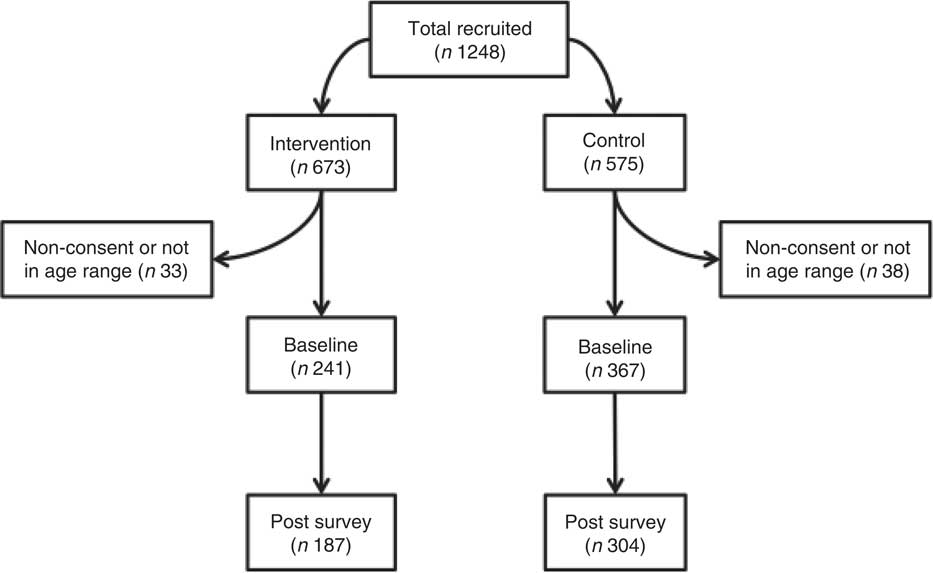
A total of 1248 students were recruited to participate in the study and assigned to either intervention (n 673) or control (n 575); seventy-one students were excluded from the study sample due to non-consent or not in age range (see Fig. 1). Differences between group sizes were due to differences in the roster size of courses that were randomized. A total of 608 participants completed the baseline assessment (see Fig. 1). Participants reported a mean age of 18·9 (sd 1·1) years, a mean BMI of 23·9 (sd 3·9) kg/m2, and a mean consumption of 3·3 (sd 1·5) cups of fruits and vegetables daily (see Table 2). Participants were primarily female and white. Nearly two-thirds (64·2 %) consumed red meat one to three times weekly and 71·6 % were moderately or extremely interested in learning about GE. For SOC, almost two-thirds (62·8 %) were not ready to change (precontemplation and contemplation stages). There were higher proportions of females and non-freshmen in the control group compared with the experimental group but no difference for age, BMI or daily consumption of fruit and vegetables (see Table 2). There was a 19·2 % attrition rate of those who completed baseline assessment to post with no difference in attrition between experimental and control groups (
 $$\chi _{{(1,{\rm }608)}}^{2} $$
=2·25, P=0·13). There was no difference in any variables comparing completers with non-completers (data not shown).
$$\chi _{{(1,{\rm }608)}}^{2} $$
=2·25, P=0·13). There was no difference in any variables comparing completers with non-completers (data not shown).
Participant distribution and completion
Comparison of demographics between groups in the Green Eating (GE) Project, a web-based intervention to promote environmentally conscious eating behaviours in US university students aged 18–24 years
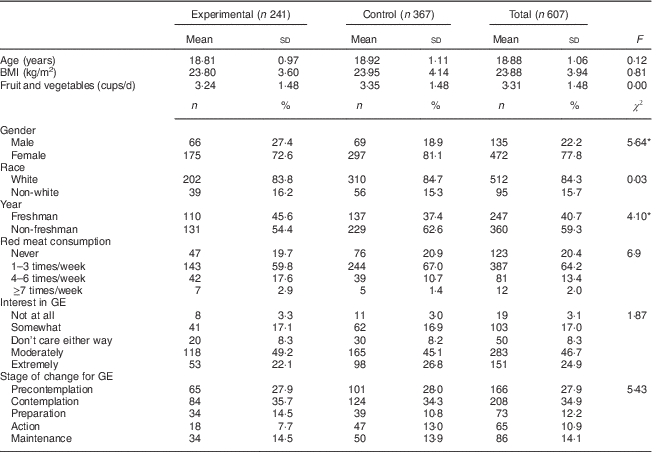
*P<0·05, **P<0·01, ***P<0·001.
Green eating constructs
There was no difference between groups for behaviours or other GE constructs at baseline. The experimental group improved GE behaviour score from pre to post more than the control group with a small to medium effect size (see Table 3). There was a significant multivariate time × group effect for other GE constructs: DB (Pros and Cons) and SE (School and Home). For DB Pros and SE School, univariate analyses showed that the experimental group increased scores more than the control group over time with a small to medium effect size but there were no differences in DB Cons and SE Home (see Table 4). Within-group analyses showed the experimental group significantly increased GE behaviours, DB Pros and SE School with no change in the control group; however, DB Cons increased in the control group with no change in the experimental group.
Univariate analysis for Green Eating (GE) behaviours in the GE Project, a web-based intervention to promote environmentally conscious eating behaviours in US university students aged 18–24 years

Behaviour score consisted of six behaviours based on an anchored Likert scale from 1 (=‘barely ever to never’) to 5 (=‘almost always’). The higher the score, the more frequent the behaviours.
*P<0·05, **P<0·01, ***P<0·001.
Univariate analyses for the Green Eating (GE) constructs DB Pros, DB Cons, SE School and SE Home in the GE Project, a web-based intervention to promote environmentally conscious eating behaviours in US university students aged 18–24 years
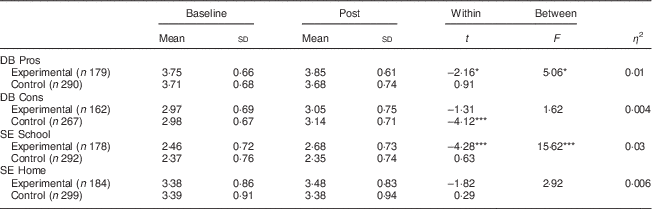
Multivariate analyses: Wilks’ λ=0·96, F(3, 410df)=5·12, P<0·01, η 2=0·04.
The decisional balance constructs, DB Pros and DB Cons, consisted of positive aspects and barriers associated with GE, respectively, based on an anchored Likert scale ranging from 1 (=‘not at all important’) to 5 (=‘extremely important’). The higher the score for DB Pros the more positively associated GE and the higher the score for DB Cons the more barriers associated with GE. The self-efficacy constructs, SE School and SE Home, consisted of eight items assessing the confidence of the subject to maintain GE behaviours while in a school or home environment, respectively, based on an anchored Likert scale ranging from 1 (=‘not at all confident’) to 5 (=‘extremely confident’). The higher the score, the higher the confidence in that environment.
*P<0·05, **P<0·01, ***P<0·001.
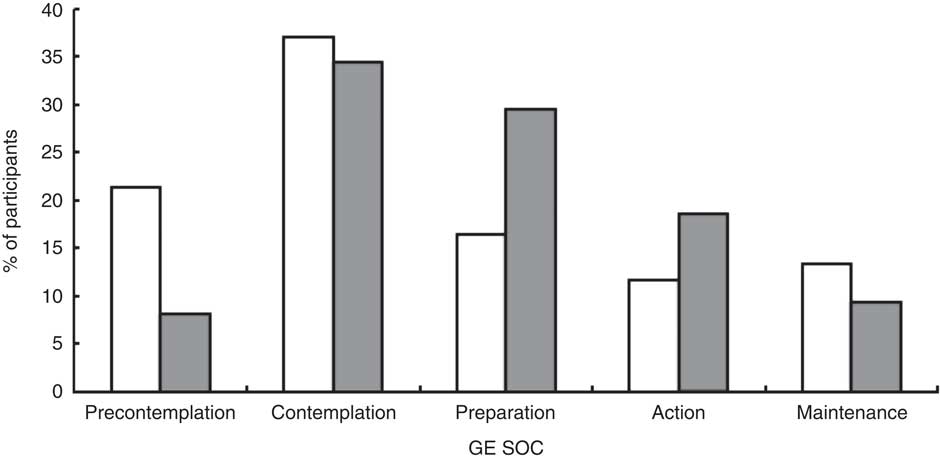
Green eating stage of change
There was no difference in GE SOC at baseline between groups (
 $$\chi _{{{\rm (4df)}}}^{{\rm 2}} $$
=5·43, P=0·25, ϕ
2=0·01). There was a significant difference in stage distribution between groups at post with a small to medium effect size (
$$\chi _{{{\rm (4df)}}}^{{\rm 2}} $$
=5·43, P=0·25, ϕ
2=0·01). There was a significant difference in stage distribution between groups at post with a small to medium effect size (
 $$\chi _{{{\rm (4df)}}}^{{\rm 2}} $$
=26·81, P<0·001, ϕ
2=0·05). The experimental group was less likely to be in precontemplation and more likely to be in later stages compared with the control group (see Fig. 2).
$$\chi _{{{\rm (4df)}}}^{{\rm 2}} $$
=26·81, P<0·001, ϕ
2=0·05). The experimental group was less likely to be in precontemplation and more likely to be in later stages compared with the control group (see Fig. 2).
Stage of change (SOC) for Green Eating (GE) ( , control group;
  , experimental group) at the post assessment in the GE Project, a web-based intervention to promote environmentally conscious eating behaviours in US university students aged 18–24 years
Knowledge
There was no difference in knowledge scores between groups at baseline. There was a significant difference between groups at post for Total GE Knowledge with a medium to large effect size. Within-group analysis showed that the experimental group significantly increased knowledge score and the control group had no change (see Table 5).
Univariate analysis for Total Green Eating (GE) Knowledge in the GE Project, a web-based intervention to promote environmentally conscious eating behaviours in US university students aged 18–24 years

Knowledge score based on fifteen questions associated with module content (each correct item=1, point range 0 to 15). The higher the score the greater understanding of module content.
*P<0·05, **P<0·01, ***P<0·001.
Module variables
Of the 201 experimental participants who accessed the modules, 78·1 % accessed all four modules, 10·2 % accessed three modules, 7·0 % accessed two modules and 4·7 % accessed one module. The majority of participants scored in the median range on intro quizzes, indicating moderate engagement in target behaviours. For the GE intro and local SOC algorithms, two-thirds of participants were not ready to change (i.e. in precontemplation or contemplation SOC). In contrast, 46 % had taken meaningful action to change (i.e. in action or maintenance SOC) for reducing waste. Participants were likely to be in contemplation or preparation SOC (65·8 %) for using environmentally conscious proteins, indicating awareness of the problem. Most common goals selected by participants included ‘make one healthy change to your diet’, ‘try one locally produced food on or off campus’, ‘take less food at one meal every day’ and ‘eat veggies instead of ham or bacon at breakfast’ (see Table 6).
Module variables (intro quiz category, stage of change (SOC), goal and confidence) in the Green Eating (GE) Project, a web-based intervention to promote environmentally conscious eating behaviours in US university students aged 18–24 years
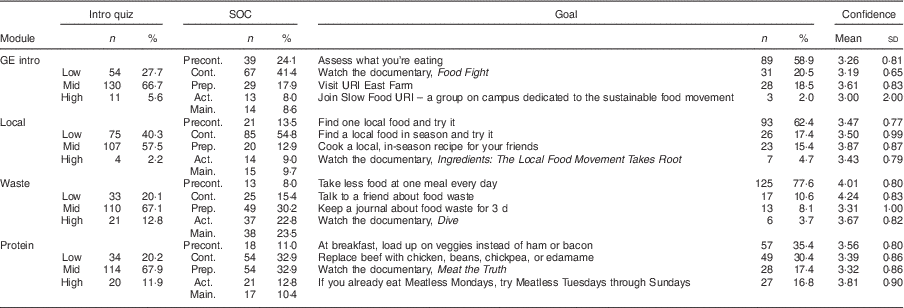
Precont., precontemplation; cont., contemplation; prep., preparation; act., action; main., maintenance; URI, University of Rhode Island.
Module evaluation
Participants evaluated the modules as slightly above neutral in holding their attention, being relevant in their lives and giving them a sense of satisfaction, and were confident that they understood and could complete the modules based on IMMS scores. A majority of the participants rated the project as moderately to mostly motivational (69·1 %), had a good or excellent overall opinion (77·1 %) and would likely recommend it to a friend (65·9 %; see Table 7). For the open-ended questions, students found the videos, language and layout of the project useful. To improve the project, they recommended adding more applicable scenarios for students eating in the dining halls and to add more videos.
Programme evaluation of the Green Eating (GE) Project, a web-based intervention to promote environmentally conscious eating behaviours in US university students aged 18–24 years

IMMS, Instructional Material Motivational Survey.
n varies.
Discussion
To the knowledge of the researchers, the GE Project was the first to investigate whether an online, interactive intervention would be successful in motivating university students to adopt GE behaviours. As hypothesized, the GE Project effectively increased GE behaviours in university students. In addition, the intervention increased DB Pros and SE School. There was also an increase in knowledge. The GE Project was also the first to explore SOC constructs for each individual target behaviour (i.e. local eating, reducing waste and choosing more environmentally friendly proteins). The GE Project demonstrated that, in the short term, students improved attitudes and behaviours related to environmentally conscious eating. If replicated, it could serve as a model for other universities and interventions could be developed for other populations to promote GE behaviours and, ultimately, motivate consumers to play a role in mitigating the environmental impact of the food system.
The results indicating that the experimental group significantly increased GE behaviours, DB Pros and SE School compared with control are similar to other studies utilizing online interventions in this age population. After completion of two 45-min sessions of an online programme to improve nutrition and fitness behaviours in university students, Franko et al.( Reference Franko, Cousineau and Trant 38 ) found the experimental group increased fruit and vegetable consumption and were more likely to advance a stage in readiness to eat more fruits and vegetables and decrease fat consumption compared with control. Greene et al.( Reference Greene, White and Hoerr 39 ) conducted a 10-week online intervention to promote healthful eating and physical activity in university students. The intervention was effective in increasing and maintaining fruit and vegetable consumption and physical activity levels in the intervention group at post and 15-month follow-up. Milan and White( Reference Milan and White 40 ) compared the effects of an online stage-tailored v. a non-tailored traditional intervention to increase folic acid supplementation use in university females. The tailored intervention was effective in significantly increasing self-efficacy and the pros of the behaviour. Poddar et al.( Reference Poddar, Hosig and Anderson 41 ) conducted a 5-week nutrition education intervention to increase dairy intake in university students and found the intervention was successful in significantly increasing self-efficacy for the behaviour. The present study was not effective in increasing GE Home but this outcome was expected as the impact of the modules was intentionally designed for the university setting and not the home setting.
In addition to advantages of GE, DB Pros can also be defined as positive attitudes towards GE. Previous research has shown that positive attitudes towards similar aspects as those found within the GE definition are associated with increased dietary quality in university students( Reference Pelletier, Laska and Neumark-Sztainer 35 , Reference Gerson, Goto and Wolff 36 ). Although the present study did not assess dietary quality in university students, previous research has found that aspects of dietary quality increased with advancing GE SOC( Reference Brown 46 ). Further research is needed to determine if adopting GE behaviours increases dietary quality in university students and the association between dietary quality and overall environmental impact.
The GE Project was not effective in reducing DB Cons. This is most likely due to the content of the project promoting the advantages of GE (DB Pros) and not addressing the barriers of GE (DB Cons). Research has shown that advancement through stages is associated with a reduction of cons for many health behaviours( Reference Prochaska, Velicer and Rossi 47 ). Including more information on overcoming barriers of GE within the project could motivate students to adopt GE behaviours and advance them through the stages but this would require further investigation.
At baseline, the majority of participants (62·8 %) were not ready to adopt GE behaviours. This is similar to previous research conducted in the laboratory( Reference Weller, Greene and Redding 7 ). For the present study, at post intervention, participants in the experimental group were less likely to be in precontemplation and more likely to be in later stages compared with control. This is similar to the study conducted by Milan and White( Reference Milan and White 40 ) in which the stage-tailored group was also more likely to be in a later stage compared with the non-tailored group. Although the present study was not stage-tailored, similar movement through stages was seen. To increase further movement through stages, future studies could tailor the GE modules to each participant’s stage for the target behaviour.
Knowledge scores also significantly increased in the experimental group compared with control. The knowledge items were created from content in the module and have not been validated; therefore, the increase in knowledge is exploratory. Another study found that, following exposure to a nutrition-based intervention, nutrition knowledge significantly increased in experimental students compared with control( Reference Franko, Cousineau and Trant 38 ). It is a limitation of the present study that the knowledge items were not validated prior to study induction. Validating knowledge items would provide a more robust instrument for determining the effectiveness of the modules in achieving the learning objectives.
The SOC constructs created for each target behaviour (local, waste and protein) provide further insight into some of the individual aspects of the GE definition. First, following the local module, over two-thirds of participants (68·3 %) were in precontemplation or contemplation indicating they were not ready to change. Little research has been conducted investigating US university students’ perspectives about local food. International studies have found university students felt it was important for them to purchase foods from local farms( Reference Bagdonis and Bruening 34 ) and categorized descriptions associated with local foods as ethical( Reference Makiniemi, Pirttila-Backman and Pieri 30 ). In contrast, research has found that high-school students from the USA were not concerned about where their food originated( Reference Harmon and Maretzki 48 ) and did not find it personally important that foods be grown locally( Reference Bissonnette and Contento 49 , Reference Robinson-O’Brien, Larson and Neumark-Sztainer 50 ). It is possible students in the present study found it difficult to access local foods on campus or travel to places that sell local foods. Many underclassmen at the university where the study took place do not have cars on campus. It is also possible that students are unaware when they are consuming local foods. Although dining services at the university sources foods locally whenever possible, local foods were not labelled (M McCullough, Associate Administrator of Dining Services, University of Rhode Island, personal communication, 2014).
Second, under half of students (43·9 %) were not ready to choose environmentally friendly proteins. A survey found university students cited lack of availability, lack of affordable options and lack of protein in the diet as barriers towards following a plant-based diet( Reference Wyker and Davison 51 ). It is possible the current sample of university students had similar thoughts but this would need to be confirmed by future research. Other studies conducted in adult consumers found there was also little knowledge about the environmental impact of animal food production( Reference Lea and Worsley 52 ) and adult consumers believed reducing meat consumption would have little impact on the environment( Reference Tobler, Visschers and Siegrist 53 ).
Third, in contrast to the local and protein modules SOC, the waste module SOC showed under half of students (46·3 %) were in action or maintenance indicating they were actively reducing their food waste. Research has shown that increasing awareness about food waste can decrease the generation of food waste. One study found that using prompt-type poster messaging in a dining hall informing students to reduce their food waste resulted in a 15 % decrease of food waste generation( Reference Whitehair, Shanklin and Brannon 33 ). The students in the present study were most likely in later stages due to environmental interventions currently in place to reduce food waste. The university dining halls have been trayless since 2007( Reference Robinson-O’Brien, Larson and Neumark-Sztainer 50 ) and research has shown that going trayless in dining halls can reduce food waste by between 25 and 32 %( Reference Kim and Morawski 54 , Reference Sarjahani, Serrano and Johnson 55 ) by forcing students to take only what they can carry.
Students rated the GE Project with a total IMMS score greater than 3·5, which indicates a better than average rating( Reference Keller 43 ). A majority of students (77·1 %) had a positive overall opinion of the GE Project, rating it as good to excellent. Students also would moderately to most likely recommend it to a friend (65·9 %). Students found the layout of the GE Project and videos embedded in the modules useful. To improve the GE Project, they recommended adding even more videos and more interactivity. Although the students rated the GE Project positively, increased interactivity and individual tailoring may be important for future interventions.
A few limitations of the GE Project should be mentioned. Although the intervention was effective the population was convenient and homogeneous, reducing the generalizability of the study to other populations. Interventions should be conducted in other universities or more diverse populations to determine effectiveness and the intervention would need to be modified for non-university populations. The module topics were also limited and, while important, they are in no way comprehensive. Future research could include more or other topics pertaining to GE such as processed and organic food. Also, the study was limited in duration and did not conduct a follow-up evaluation. Therefore, maintenance of the behaviour is unknown. Longer-duration studies with follow-up analysis should be conducted to determine how GE behaviours change over time. While increasing awareness and informing consumers is an important first step, there is also a need to assess actual environmental impact of the proposed behaviour changes. Future research could include directly measuring environmental behaviours following participation in the GE Project, such as the amount of food waste reduction. To better inform the consumer about food choice, there is also a need for research to analyse the entire life cycle of a food product.
Conclusions
Informing consumers of sustainable food choices such as those found within the GE Project could potentially motivate them to adopt dietary changes and ultimately assist in mitigating the environmental impact of the food system. University students are a unique consumer population because at this stage in their life they are solidifying their beliefs. To the authors’ knowledge, the GE Project was the first online, interactive programme to effectively motivate university students to adopt GE behaviours. Future studies could use the GE Project as a template to motivate students at other universities or other populations such as adult consumers.
Acknowledgements
Financial support: This work was supported by The University of Rhode Island. The University of Rhode Island had no role in the design, analysis or writing of this article. Conflict of interest: None declared. Authorship: Literature search: J.T.M. Figures: J.T.M. Study design: J.T.M., B.L.S., I.E.L. and G.W.G. Data collection: J.T.M. Data analysis: J.T.M. and G.W.G. Data interpretation: J.T.M. and G.W.G. Writing of manuscript: J.T.M., I.E.L., B.L.S. and G.W.G. All authors approved the final version of this paper. Ethics of human subject participation: The Green Eating Project was approved by the Institutional Review Board of the University of Rhode Island.



