

Zapotec civilization yields the earliest corpus of hieroglyphic texts from Mesoamerica. The definitive modern work on Zapotec writing is by Javier Urcid and his collaborators; his 2001 monograph is a comprehensive analysis. Building on Urcid’s foundation, this article demonstrates that “Glyph W”—a calendrical notation in hieroglyphic texts from the Danibaan/Monte Alban Ia (ca. 500–300 BCE) and Pe/Monte Alban Ib (ca. 300–100 BCE) phases at Monte Alban in Oaxaca, Mexico (Figure 1)—specifies how many evenings the moon had been visible since the new moon on the accompanying date, establishes absolute distances among seven fully preserved dates with Glyph W records, and identifies every possible placement of the series of these dates in absolute time.Footnote 1 Only one placement is consistent with the seventeenth-century Zapotec calendar.
Map of Oaxaca, and Monte Alban site core, based on Urcid (Reference Urcid2001:Figure 4.25); position of structures in the southern half of the plaza adjusted based on Levine and colleagues (Reference Levine, Hammerstedt, Regnier and Badillo2021:Figure 10), and earlier construction phases of Mound J are based on Urcid and Joyce (Reference Urcid, Joyce, Tsukamoto and Inomata2014:Figure 9.6). (Color online)

Mesoamerican Calendars
Two concurrent calendars were used throughout Mesoamerica before the Spanish invasion: the divinatory calendar and the “vague year.”
Divinatory Calendar
The divinatory calendar, 260 days long, permutes a trecena of 13 days, almost everywhere consisting of numerals 1–13, and a veintena of 20 days, named mostly by words for plants, animals, or forces of nature. Zapotec individuals were preferentially named for the day of their birth in this calendar.
Colonial Zapotec divinatory calendar names are well attested in colonial documents. Their most copious attestations come from document 822 in the Archivo General de Indias in Seville: a set of 103 calendars confiscated by the Inquisition from daykeepers in northern Zapotec territory and accompanied by community confessions of idolatry; a photographic copy is provided by Oudijk (Reference Levine, Hammerstedt, Regnier and Badillo2021). These divinatory calendar names show that, unlike day names in other Mesoamerican languages, Zapotec day names contained no trecena numeral. Instead, a non-numerical classifier, corresponding to a trecena position, preceded the veintena name; together, the classifier + veintena name formed a single phonological word (Justeson Reference Justeson and Ruggles2014:760). For example, the proto-Zapotec “6 Deer(s)” is reconstructible as *k-šoʔkkwa (“six”) kwe+ tzina (“deer”), whereas the divinatory calendar date “6 Deer” is *kkwa+ tzina. The calendrical term contains no numeral word, and instead of the classifier *kwe+, which is associated mostly with words for spirits, humans, and animals, it is preceded by the classifier *kkwa+ that marks this “Deer” as day six in a trecena. Linguistic forms marked by * are Terrence Kaufman’s proto-Zapotec reconstructions, reported in Justeson and Tavárez (Reference Justeson, Tavárez, Ruggles and Urton2007:18, 20).
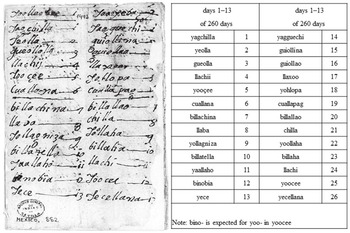
In Zapotec hieroglyphic writing, however, divinatory calendar dates are represented by veintena signs, followed by the numeral corresponding to the trecena position of the date: no sign corresponding to a classifier appears before the veintena sign. Although classifiers are spelled on some nouns in Zapotec hieroglyphic texts (Justeson and Kaufman Reference Justeson and Kaufman2011), glyphic numerals’ ungrammatical postposed placement effectively served a classifier-like function in writing. Similarly, 54 of the seventeenth-century Zapotec calendars, in Spanish script, index each date by a numeral; in 47 of these, the numeral is uniformly after the date (Figure 2).
Calendario 91, AGI 882 folio 1492r (Oudijk Reference Oudijk2021:459). Notes: The numerals 1 to 13 to the right of each column of day names are indexes, not part of the names. Kaufman’s phonemic analysis of the colonial Northern Zapotec spellings of these day names (reported in Justeson and Tavárez Reference Justeson, Tavárez, Ruggles and Urton2007:18–20), with the preposed trecena classifier in italics and the veintena name in roman type, are in column 1, yag-chila, yeo-lo-ee, yeo-lo-Ela, la-chii, yoo-çee, kwa-lana, 0-laba, yo-lo-niza, bila-tela, ya-lawo, bino-biaa, and yeze-ee; in column 2, yag-Etzi, yeo-lo-ina, yeo-lo-lao, la-xoo, yo-opa, kwa-Epag, bila-lao, 0-chila, yo-lo-ee, beo-Ela, 0-la-chii, yoo-cee (an error: it should be bino-çee), and yeze-lana.

Mesoamericanists typically cite veintena dates using indigenous or translated names from a particular Mesoamerican language. They are cited here by the English translation of the Zapotec name, and for broader accessibility, the roman numeral corresponding to their veintena positions is added in brackets. Córdova’s spellings of sixteenth-century Central Zapotec veintena names’ forms and meanings, determined by Terrence Kaufman (Justeson and Tavárez Reference Justeson, Tavárez, Ruggles and Urton2007:18), are as follows: chilla Cayman[I]; ii Wind[II]; EEla Night[III] (elsewhere House); Echii Lizard[IV]; zii (Zapotec meaning unknown, elsewhere “Snake”[V]); laana Stench[VI] (i.e., smelling like fish, meat, or metal [elsewhere Death]); china Deer[VII]; laba Rabbit[VIII]; niça Water[IX]; tella Knot[X] (elsewhere Dog); loo Monkey[XI]; piia Soaproot[XII] (elsewhere Tooth); ii Reed[XIII]; Eche Jaguar[XIV]; nnaa Corn[XV] (elsewhere “Eagle”); loo Crow[XVI] (also Buzzard); xoo Earthquake[XVII]; opa Cold[XVIII]; aappe (meaning unknown, elsewhere “Storm” [XIX]); and lao Face[XX] (elsewhere, varied).
Vague Year
The pan-Mesoamerican “vague year” (so called because it was exactly 365 days long; hereafter, “year”) consisted of 18 named 20-day units (“months”), followed by a 5-day unit. In colonial calendars, Zapotec years were named by the divinatory calendar date of their first day, preceded by the word “ruler” (proto-Zapotec *ko+ kke). In hieroglyphic texts, the year’s name is represented by that date, surmounted by a sign depicting a ruler’s headgear (Urcid Reference Urcid2001:111–113, Figures 4.5–4.7).
Zapotec hieroglyphic texts specify dates in the divinatory calendar; they do not mention the month within the year nor the day within the month. In well-preserved texts, at least one divinatory calendar date is associated with a named year.
The placement of a specific divinatory calendar date at a specific place in the year recurs only after 73 × 260 = 52 × 365 = 18,980 days (a “calendar round”). The calendar round surely began with the year 1 Earthquake [XVII]: 50 of the 103 calendars surrendered by northern Zapotec communities to the Inquisition (Oudijk Reference Oudijk2021) list the names of years, in order, always beginning with that year; 43 calendars list all 52 years of the calendar round, in order (calendars 44 and 64 mention 1 Earthquake [XVII] only).
In Mesoamerica, years were named for their 1st or 260th day; in 1695, the first day of the Zapotec year was 11 Earthquake[XVII] (Justeson and Tavárez Reference Justeson, Tavárez, Ruggles and Urton2007:41), so the 260th day was 10 Crow [XVI]. This shows that Zapotec years were named by their first day.
Glyph W
The next most frequent Zapotec calendrical expression is “Glyph W,” so designated by Caso (Reference Caso1928:43, Figure 20; Reference Caso1947:10). Numerals follow Glyph W, spelled in “bar-and-dot notation,” with rectangles representing fives and “dots” ones.
Previous attempts to interpret Glyph W linked its numeral to features of the divinatory calendar or the year, addressed only a limited set of features or examples, and are demonstrably incorrect. This article shows that Glyph W counts evenings in a lunation, beginning with the first visibility of the lunar crescent, at the time of the recorded event; determines the intervals among seven Glyph W records with knowable placements in both the divinatory calendar and the year; and that they date from 496 to 222 BCE. These inscriptions appear on monoliths (aka “stelae”) from Mound L and orthostats (“tablets”) from Mound J at Monte Alban.
Because Glyph W specifies the day in a lunation, the number of days separating Glyph W records can be determined. Generally, there can be only one solution. During archaeological phases of the monuments’ origins, around 600–200 BCE, a date can recur in both the 260- and 365-day calendars, within a two-day range in the lunar cycle, only at 7 × 52 × 365 days (about 350 years; lunar offset, 1.8936 days). If the divinatory calendar date appears twice in its year, it can recur also at 3 × 52 × 365 + 260 days (about 150 years; lunar offset, −1.4996 days). The first span could only occur between monuments of different archaeological phases; the second can occur within or crossing those phases.
Previous Hypotheses for the Function of Glyph W
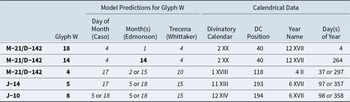
Three previous hypotheses for the function of Glyph W have been proposed. Table 1 shows that each is inconsistent with five complete, legible dates that are accompanied by a year name.
Evidence against Previous Hypotheses.

Note: Predictions from each hypothesis (day of month, month number, and trecena number are registered in the last three columns). Bolding is added to call attention to correct predictions for Caso, Edmonson, and Wittaker’s proposed models, and italics are used for incorrect predictions.
Day in a 20-Day Month
Caso (Reference Caso1928:95) treated Glyph W as a veintena sign in its appearance on Stela 13 (now designated monolith D-140), with a coefficient 4. With the discoveries of Stela 17 (monolith M-21), on which the numeral 18 follows Glyph W, and of Stela 15 (monolith D-142) with Glyph W followed by 14, Caso (Reference Caso1947:10) abandoned this hypothesis, because only numerals 1–13 follow veintena glyphs. Caso then suggested that Glyph W specified the day in a 20-day month. Later, mistakenly reading the trecena part of a date 13 Monkey[XI] as 18, Caso (Reference Caso and Gordon1965:938, Figure 14) stated more obliquely that it and another sign “are the glyphs for months,” with Glyph W the glyph for a particular month. However, the non-numerical part of this glyph is now known to be veintena day Monkey[XI] (Urcid Reference Urcid2001:198, Figure 4.99); using variable-angle lighting to bring out its details, Urcid established its numeral as 13.
Caso’s hypothesis may be adjusted so that Glyph W’s coefficient indicates the day within any month. Table 1 presents results for this hypothesis. If the divinatory calendar date naming the year was that year’s first day, as in the 1600s, the place(s) in the year of each divinatory calendar date can be determined. For five examples of Glyph W whose divinatory calendar date has a postposed trecena numeral and specified year, and for which Urcid (Reference Urcid, Deborah and Christopher2012:857, Figure 65.1) definitively established a position, Table 1 (in the column for Edmonson) shows that the hypothesis that Glyph W refers to a specific month can be made to agree with only one or two of five instances.
Count of Trecenas
Whittaker (Reference Whittaker1980, Reference Whittaker, Anthony and Brotherston1983) proposed that Glyph W’s coefficient specifies in which of 20 13-day sequences the divinatory calendar date fell, based on a single pair of dates that he interpreted as 10 Night[III] W-2 and 11 Night[III] W-5. He identified the veintena sign as Night[III] based on an assumption that it depicts a building, because the name of the third day in the veintena meant “house” in some central Mexican traditions. However, the Zapotec word for this day, spelled ‹Ela› and ‹EEla› in colonial documents, reflects proto-Zapotec *eeʔla ‘night’ (Justeson Reference Justeson and Ruggles2014:763), the usual and likely earliest name for day three in Mesoamerican languages. Whittaker’s interpretation was immediately rejected by Mixtec epigraphers, because the symbol he identified as day three is secured in Zapotec iconography as depicting a reed dart (Carlos Aróstegui and Nancy Troike, personal communications 1981–1982; Urcid Reference Urcid2001:222–224, Reference Urcid, Deborah and Christopher2012:250–273), and thus day Reed[XIII] (“reed” and “dart” are often the same word in Mesoamerican languages). Urcid and Domínguez (Reference Urcid, Domínguez, Teresa Uriarte and Gil2013:11) show that, at Cacaxtla, a day sign that is virtually identical to the Zapotec sign at issue and depicts a reed (Urcid Reference Urcid, Deborah and Christopher2012:Figure 65.1) contrasts with a sign that depicts a building frontally or from the side, securely identifiable with the central Mexican name for day 3 “House.”
In addition, day 12 Jaguar[XIV], the day sign depicting a feline head, is recorded as W-8 on Orthostat J-10. In the eighth trecena, the Jaguar day is 3 Jaguar[XIV] (7 × 13 + 3 = 20 × 4 + 14), and Night is 12 Night[III] (7 × 13 + 12 = 20 × 5 + 3)—which is 12 House according to Whittaker’s hypothesis. His hypothesis therefore entails that this feline head also represented a day name meaning “house”, the clear 2 Jaguar date falls in trecena 15 (14 × 13 + 12 = 20 × 9 + 14).
Whittaker’s hypothesis also requires distinguishing as separate signs what appear to be forms of Glyph W in the text spanning monoliths M-21 and D-142. The variant on D-142 is Glyph W’s usual form; that on M-21 is the left half of Glyph W, rotated counterclockwise, with an unusually large bar-and-dot numeral 18 squeezed below it. Sign rotation for visual reasons and glyphs partly overlaid on neighboring glyphs are common in Mesoamerica’s highly pictorial scripts.
Whittaker’s hypothesis is also inconsistent with the difference of three units in the W cycle for dates on J-13 and J-14, one day apart in the divinatory calendar and both falling in trecena 15. Whittaker (Reference Whittaker and Victoria1992:13) addressed this by treating J-14’s W-5 record as the text’s first sign—and not paired with any divinatory calendar date. This is unparalleled in the corpus and conflicts with the standard reading order, toward the glyphs’ faces, in Zapotec writing (also in epi-Olmec and Mayan); on J-14 they face leftward, so reading was surely left to right, beginning from the leftmost column. Furthermore, every other instance of Glyph W in columnar format occurs immediately after a divinatory calendar date; here, it is consistent only with reading W-5 after 11 Reed[XIII], which ends the column immediately to W-5’s left. 5 Soaproot[XII], the last date to the left of the year named 6 Earthquake[XVII], is the name of the immediately preceding year (and its 1st and 261st day); Whittaker’s interpretation would place them out of chronological order.
Urcid (Reference Urcid2001:250–273) discusses other details that contradict Whittaker’s proposal. The occurrence of different Glyph W coefficients for examples of the same date, 2 Face[XX] (Urcid Reference Urcid2001:269–271, Figure 4.167a), is decisive evidence against it.
Count of Months
The meaning of Edmonson’s (Reference Edmonson1988:273) hypothesis—that Glyph W specified “month in general”—is unclear. It could be interpreted as Caso’s day-of-month hypothesis, disproven above. Another possible interpretation—that the divinatory calendar date falls in the year’s nth month—must also be rejected. Divinatory calendar dates 12 Jaguar[XIV] on J-10 and 11 Reed[XIII] on J-14 are one day apart, and both fall in a year 6 Earthquake[XVII]. Under a month-count hypothesis, they would fall either in the same month or 13 months apart, and so they would not necessarily be in the same calendar round; however, their W coefficients differ by 3.
Determining the Length of the Glyph W Cycle
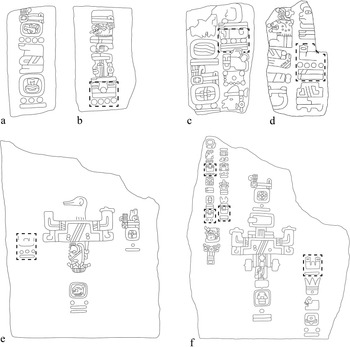
Zapotec hieroglyphic texts do not distinguish dates by the calendar round in which they occur. Monoliths D-139/D-140 and M-21/D-142 are from the Danibaan/Monte Alban Ia phase (ca. 500–300 BCE), and the orthostats (“tablets”) are from the following Pe/Monte Alban Ib phase (ca. 300–100 BCE) and later set along Building J (Urcid and Joyce Reference Urcid, Joyce, Tsukamoto and Inomata2014:16). However, each Zapotec text from these eras is associated with a single named ruler; therefore, dates on any text cannot span much more than one calendar round (52 years), and a sequence of dates with Glyph W from a single text provides constraints on the Glyph W cycle’s length. Two such texts are fully legible: two dates occur in the text spanning M-21 and D-142, and four occur on J-14 (Figure 3c–d, f).
Inscriptions from Monte Alban, usable for calibration of the Glyph W cycle: (a) monolith D-139; (b) monolith D-140; (c) monolith M-21; (d) monolith D-142; (e) orthostat J-10; (f) orthostat J-14 (drawings courtesy of Elbis Domínguez and Javier Urcid).

M-21 and D-142 both record an instance of the day 2 Face[XX] in a year 12 Earthquake[XVII]: this day falls on that year’s 4th and 264th days, the first at W-18 and the second at W-14 (see the Appendix for a detailed discussion).
J-14 contains four divinatory calendar dates, each with Glyph W, across at least two successive years. Urcid (Reference Urcid2001) definitively established the placements of the last three days’ signs in the veintena, so their placements in the divinatory calendar are known.
The standard format for orthostats containing calendrical data is the image of a hill, sometimes with a postposed title; a year-name appears immediately before that image, and a divinatory calendar date and Glyph W appear immediately after it (see Figure 3e–f). The last date on J-14—11 Reed[XIII] W-5—follows the year-name 6 Earthquake[XVII], year 45 of the Zapotec calendar round; therefore, it falls in a year 6 Earthquake[XVII]. 11 Reed[XIII] occurred on days 97 and 357 of that year; we show below that it refers to day 97.
5 Soaproot[XII] is the last date before the year-bearer reference; it named and was the 1st and 261st day of the immediately preceding year and does not occur before day 97 in the year 6 Earthquake[XVII]; one of just 4 dates on J-14 out of 260 possibilities, it surely dates to that year. Assigned to day 261, this and J-14’s preceding dates could all fall in that year. Ceremonies were held on day 261, the return of the year-bearer, in several Mesoamerican communities; for example, a 1939 Ixil ceremony began on day 260, “at sunset of the Gregorian day before when the Year Bearer day enters and are continued the next morning [day 261] at sunrise” (Lincoln Reference Lincoln1942:112).
Our analysis therefore begins with the premise that 5 Soaproot[XII] W-10 fell on day 261 of year 5 Soaproot[XII] and that the preceding date—11 Reed[XIII] W-2—fell on day 162 of the same year. Under these assumptions, the Glyph W cycle turns out to be a lunar day count.
Glyph W’s coefficients drop from 18 to 14 over 260 days on monoliths M-21 and D-142, yielding 264 days as a multiple of the cycle. This is a non-integer multiple because its factors (264 = 3 × 8 × 11) are all smaller than each monolith’s Glyph W coefficient. Similarly, the minimal sequence of J-14’s three secure dates places 10 Reed[XIII] on day 162 of year 44 (5 Soaproot[XII]), followed by the return of the year-bearer on day 261 and then by 11 Reed[XIII] on day 97 of the next year (6 Earthquake[XVII]); intervals between these dates are 99 and 201 days. Glyph W’s coefficient changes from 2 to 10 over the 99-day interval—assuming units of one day—and therefore to 2 after 91 days. Both factors of 91 (7 × 13) are less than Glyph W’s coefficients on the monoliths, again reflecting a non-integer length of Glyph W’s cycle.
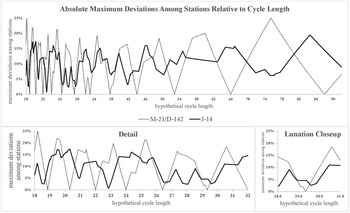
We evaluated 7,401 candidate lengths, from 18 to 92 days, at intervals of 0.01 days. Each candidate was tested for its fit to intervals among three known dates with W coefficients on J-14, and, independently, to the interval between the two dates on M-21 and D-142. We averaged the estimate for each candidate across the four intervals, three from J-14 and the single interval from M-21 and D-142. Each candidate was ranked for both texts, from the closest fit at rank 1 to the greatest deviation at rank 7,401, relative to the maximum percent deviation for that candidate cycle’s length (see Figure 4).
Deviations across 7,401 candidate intervals between 18 and 91 days. Deviations based on J-14 are in bold; those based on the monoliths are dotted.

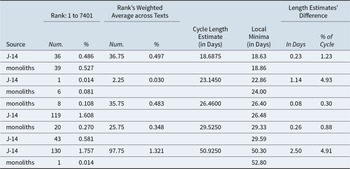
Justeson arrived at the lunar day count hypothesis in 1994, calculating the deviations across these 7,401 candidate lengths for J-14. Table 2 lists all pairs of local minima, one member from each text, for which no other local minimum lies between their values, and with the rank for both texts being in the smallest 5%—the most generous standard criterion for statistical significance. Only five intervals have ranks that meet the 5% threshold, each under 1.76% for both monuments.
Distributions of Local Minima as Candidates for the Glyph W Cycle’s Length.

An independent criterion is how close the two estimates for a candidate are, relative to their average. The interval of about 23.145 days has by far the best average rank, 3.5 of 7,401, but its difference between texts, at 4.93% of that interval, is the worst among the candidates. An interval averaging 29.525 days has the next-best average rank, 31.5 of 7,401; its percentage of between-text discrepancy, 0.88%, is also second-best for closeness of the texts’ intervals. The only interval with closer between-text minima, averaging 26.48 days long, is fourth in average rank (63.5). Multiples of the 29.525-day interval agree closest with the 91- and 264-day intervals, at 3.0821 and 8.9416 estimated units, deviating by 0.0821 and 0.0584 units, respectively; both the arithmetic and geometric means of these deviations are the lowest among the candidates.
Furthermore, the interval of roughly 29.525 days has a meaningful interpretation: its estimates flank the 29.5306-day average length of one lunation. We therefore interpret W-1 as day 1 of the lunation, beginning at the first appearance of the lunar crescent after the new moon.
This result is predicated on 11 Reed[XIII] W-5 being day 97 of the year 6 Earthquake[XVII]. A calibration placing it on day 357 of that year produces far more (115) local minima, and its smallest between-text deviations are larger than those of the 23 local minima under the day 97 calibration, which is a more random distribution.
Only numerals 1–18 are generally recognized in Zapotec writing. However, using raking lighting, Urcid (Reference Urcid2001:271) determined that the example of Glyph W on J-13 is followed by four rather than three numerical bars for “20”; they therefore range at least from 2 to 20 on Glyph W.
Inverted Glyph W
Three examples of Glyph W are inverted; none has a coefficient. The only such record that has fully legible year and divinatory calendar dates is 13 Monkey[XI] in a year 8 Wind[II], on J-16. If it dated in or near the same calendar round as J-10 or J-14, it would fall one calendar round plus 4,263 days before J-14’s W-2 on day 162 of the year 5 Soaproot[XII]. This span produces an average abnodal shift of 2.43 days, consistent with this inverted W record registering the moon’s invisibility. Alternatively, having three of 11 instances of Glyph W inverted is consistent with inverted W marking any placement in the 21st or higher day of lunar visibility: 3.550 ≈ 11 – 11 × (20/29.530586).
Placing Glyph W Records in Real Time
Seven calendar round placements of Glyph W records are consistent with their placement in the lunation and with Monte Alban’s archaeological chronology.
Absolute Distances among Recorded Dates
A divinatory calendar date has only one or two placements in a calendar round when the year in which it occurs is known. The possible placements for the Glyph W records are as follows:
Monoliths D-139 and D-140 (Figure 3a–b):
1 Cold[XVIII] W-4, in year 4 Wind[II] = day 37 or 297 in year 30;
so W-1 fell on day 34 or 294 = 11 Corn[XV]
∴ W-1 fell either on day 29×365 + 37 or 29 × 365 + 297 in some calendar round.
Monoliths M-21 and D-142 (Figure 3c–d):
2 Face[XX] W-18 and 2 Face[XX] W-14, in year 12 Earthquake[XVII] = days 4 and
264 in year 25;
so W-1 fell on 11 Night[III] in year 11 Soaproot[XII] = day 352 in year 24
and on 2 Deer[VII] in the next year, 12 Earthquake[XVII] = day 251 in year 25
∴ W-1 fell on day 23 × 365 + 352 and on day 24 × 365 + 251, in the same calendar
round.
Orthostat J-10 (Figure 3e):
12 Jaguar[XIV] W-8 in year 6 Earthquake[XVII] = day 98 or 358 in year 45;
so W-1 fell on 5 Deer[VII] = day 91 or 351 in year 45
∴ W-1 fell on day 44 × 365 + 91 or on 44 × 365 + 351 in some calendar round.
Orthostat J-14 (Figure 3f):
10 Reed[XIII] W-2 in year 5 Soaproot[XII] = day 162 in year 44;
so W-1 fell on 9 Soaproot[XII], day 161
5 Soaproot[XII] W-10 in year 5 Soaproot[XII] = day 261 in year 44;
so W-1 fell on 9 Night[III], day 252
11 Reed[XIII] W-5 in year 6 Earthquake[XVII] = day 97 in year 45;
so W-1 fell on 7 Water[IX], day 93
∴ W-1 fell on day 43 × 365 +161 and on day 43 × 365 +261, and on day 44 × 365 +93
in the same calendar round.
A day 1 Cold[XVIII], recorded on D-139/D-140, has two possible placements in year 30: day 37 and day 297. Counted from day 37, the 2 Face[XX] dates of M-21 and D-142 agree to within one day with the recorded lunar day count; counted from day 297, they would be seven days too late. 1 Cold[XVIII] therefore fell on day 37 in year 30.
On the orthostats, J-14 records 11 Reed[XIII] W-5 in a year 6 Earthquake[XVII]; also in a year 6 Earthquake[XVII], J-10 records 12 Jaguar[XIV] one day later in the divinatory calendar, with W-8. With 11 Reed[XIII] on J-14 secured at day 97, had J-14’s events been earlier than J-10’s, shifting forward from W-5 to W-8 on 12 Jaguar[XIV] would require 156 × 365 + 261 days; with J-10 earlier, W-5 is reached from W-8 after 51 × 365 + 259 days. The J-14 text is far longer and more detailed than that of any other orthostat; the terser texts seem to be background historical material, with the elaborate forthcoming text on J-14—recording the repeated ceremonial seating of two named individuals—being the focal monument closest to contemporaneous with its initial erection. For more detail, see the section, “Determining the Real-Time Placements of Zapotec Dates with Glyph W.”
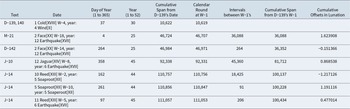
There are 21 interstation intervals among the seven W-1 stations in Table 3. The variation relative to an average lunation ranges from −2.088 days for the 18,425-day interval between stations at 46,707 and 110,756 days, to +2.408 days for the 91-day interval between station 110,756. Four and a half days exceed the observational range for first appearances (see the later discussion); two systematic factors account for the excess.
Spans between Recorded Dates, Separated by Multiples of 29.530586 Days after Adjusting to W 1.

Note: 1 XVIII W 4 assigned to day 37 of year II 4.
The hour when days in the Zapotec year advanced is unknown. Among twentieth-century Ixils, it advanced at midnight in some Mije communities, whereas the divinatory calendar advanced “when the sun is overhead” (Lipp Reference Lipp1991:62); the Zapotec divinatory calendar also advanced at noon in the sixteenth century (Córdova Reference Córdova1578:212). The divinatory calendar advanced before the year in Classic Lowland Mayan communities as well (Mathews Reference Mathews, Houston, Stuart and Chinchilla2001:405–407).
Cases and colleagues (Reference Cases, Belmonte, Lacadena, Boccas, Broda and Pereira2004) demonstrated that the Classic Mayan lunar day count began with the first appearance of the lunar crescent. Following the moon’s disappearance, its crescent is first observable, briefly, just after sunset; at Monte Alban, this occurred on average around 6:44 pm locally (see the later discussion on lunar first appearances).
With the divinatory calendar date changing at noon, its date is the same for a morning event as for the lunar first appearance the evening before; starting at noon after the first appearance, the same day in the lunation advances one day later in the divinatory calendar. Accordingly, if the first day of the lunar day count begins with the first observable lunar crescent, we will mistakenly project lunar dates from divinatory calendar dates of afternoon events one day later than from those of morning or evening events. Because we calibrate to the lunar first appearance, our calculations from afternoon events for what are actually sunset events are one day too late.
Our calibrations confirm that the next-to-last divinatory calendar date on J-14 falls on the year’s 261st day, the year-bearer’s return, which is likely the event that the text records. Because the divinatory calendar advanced that afternoon, this date guides our interpretation of the model’s calibration results to the actual dates of the lunar first appearance.
This factor accounts for just one day of deviation of the Glyph W record from first-appearance data; negative offsets of more than one day require an additional factor. Another systematic reason for a projected W coefficient being too large is daykeepers’ delay in observing the crescent. From the plaza at Monte Alban, at the highest elevation in its region, nothing blocked observation of its western horizon; the only systematic basis for delays is atmospheric interference. Such delays would be sporadic.
Between 650 and 50 BCE, data summarized in the next section show that every interval between successive first appearances at Monte Alban was 29 (46.94%) or 30 (53.06%) days long. This would be the full range of daykeepers’ observationally reliable experiences, so at most one day of deviation is plausibly attributable to delayed observation. Therefore,
• Candidates with cumulative deviations of −3 or −4 days, from the earliest date to any station, must be rejected.
• Candidates with cumulative deviations of −2 days can be due to delayed observation if and only if the recorded event occurred in the afternoon, the first appearance of the lunar crescent occurred 29 days after its prior first appearance, and the lunar crescent was not observed on that date, an offset of maximally 30 hours.
• Candidates with cumulative deviations of −1 day are acceptable. If the candidate’s actual first appearance took place 30 days after the previous one, it must be interpreted as an afternoon event; otherwise, it could have been an afternoon event or delayed observation, but not both.
• Candidates with positive deviations, indicating observation prior to the event, must be rejected.
Resolving Additional Glyph W Records
Given the calibration’s results, its W-20 record is consistent only with 5 Cold[XVIII] in year 3 Wind[II] of the calendar round before J-14. Projecting from 10 Reed[XIII] W-2 in year 5 Soaproot[XII], with no offset, its expected W coefficient is 19.009, an offset of −1 day.
The earliest date on J-14 places a unique day sign with trecena position 2 on W-4. If it occurred in the same year as J-14’s next two dates, its W-4 record is consistent only with Iguana[IV]. There is iconographic support for this placement: its features agree most closely with the snout and the hard-palate markings on the sculptured 10 Iguana[IV] date of the entrance to Tomb 5 at Cerro de la Campana (Urcid Reference Urcid1992:Figure 4, Reference Urcid2015:Figure 5a).
Determining Appearances of the Moon at Monte Alban, 650–50 BCE
Caldwell and Laney (Reference Caldwell and Laney2001) provide a reliable empirical model characterizing the conditions under which a lunar crescent is first observable on the western horizon. Limits for young crescents’ visibility are affected by astronomical and optical properties, such as interference from the setting sun (Caldwell and Laney Reference Caldwell and Laney2001:16) and the Danjon limit—the smallest elongation angle between the sun and moon at which a lunar crescent can be seen (Fatoohi et al. Reference Fatoohi, Stephenson and Al-Dargazelli1998:Figure 2). The main issues in observing the developing crescent relate to environmental and empirical limitations, such as weather, altitude, latitude, and human physiology (Schaefer Reference Schaefer1988:520–522). External conditions aside, the crescent is observable within three days after the new moon.
Caldwell and Laney (Reference Caldwell and Laney2001:17–20) established a systematic pattern for crescent observability after reviewing predictive models for characterizing the timing of the lunar crescent’s first appearance by naked-eye observation and the data on which they are based (Caldwell and Laney Reference Caldwell and Laney1999, Reference Caldwell and Laney2001). Krauss (Reference Krauss2012) applied Caldwell and Laney’s characterization of these conditions to a corpus of 209 records of the moon’s first appearance at Babylon and found that 206 (98.5%) conform to their model.
We determined that the following equation accurately distinguishes every example that Caldwell and Laney (Reference Caldwell and Laney2001) evaluate as observable under clear viewing conditions and that can be accurately distinguished to within a fraction of a degree from every example they evaluate as not observable:
 \begin{equation*}lunar\,elevation \gt 1.67 \times \sin \left( {\left( {lunar\,azimuth - solar\,azimuth} \right) \times \frac{\pi }{{21}}} \right) + 3.55\end{equation*}
Lowry applied this criterion to determine the dates of the 8,052 lunar first appearances at Monte Alban from 650 through 0 BCE, extracting data on solar and lunar positions at 10-minute intervals from 23:30 to 2:00, Greenwich time, using Horizon Systems (Giorgini et al. Reference Giorgini and Group2022), the Jet Propulsion Laboratory’s online query system. For each day selected by this formula, two records were produced that were 10 minutes apart: one before and one after the sun reached −4° elevation. Each record specifies the difference in lunar and solar azimuths, the lunar elevation above the horizon, and the solar-lunar-observer elongation angle; each pair among these intervals was interpolated to match a solar elevation at −4°. For difficulties detecting a young crescent moon, see Schaefer (Reference Schaefer1988), Doggett and Schaefer (Reference Doggett and Schaefer1994), and Krauss (Reference Krauss2012).
Determining the Real-Time Placements of Zapotec Dates with Glyph W
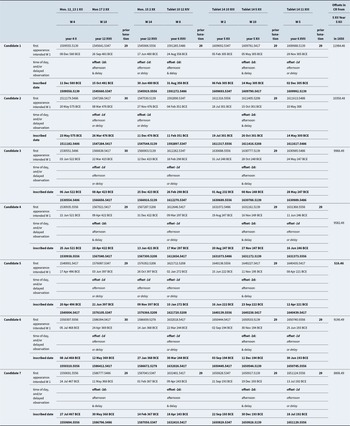
A viable placement of the seven Glyph W dates with dates in the Zapotec divinatory calendar and a 365-day year must be consistent with the constraints on offsets from the calibrated placements of W-1: all discrepancies in cumulative spans across the seven stations must be nonpositive, and negative discrepancies must be at most two days. Thousands of rejected sequences have positive cumulative deviations, and hundreds have negative deviations of −3 or −4 days; only seven satisfy the constraints (Table 4). All seven are consistent with archaeological chronology: the monoliths’ stations fall before 360 BCE, and the orthostats’ stations thereafter. However, only one turns out to be consistent with established features of Mesoamerican calendar histories.
Calibrated Candidates with Complete Glyph W Records.

Note: Calibrations of spans between recorded intervals among dates of the first visibility of lunar crescents at Monte Alban. Bolding in this table was added to emphasize dates, while italics are used for comments or notations on observational issues (time of day or delayed observation).
The span from the earliest date, on monolith D-142, to the latest, on orthostat J-14, is 175 years and five months. This interval approximates the range of dates between the construction phases of buildings in the Danibaan/Monte Alban Ia and Pe/Monte Alban Ib phases.
Mound J’s first incarnation is associated with the very beginning of the Pe/Monte Alban Ib archaeological phase, about 300 BCE (Elson Reference Elson, Deborah and Christopher2012:16). The orthostats along the bottom level of Mound J—including J-14, J-10, and J-13—were found in situ but not in the primary context (Urcid and Joyce Reference Urcid, Joyce, Tsukamoto and Inomata2014:151) associated with the third building phase of this often-refurbished building (Urcid Reference Urcid, Nelly and Guzmán2011:183, Figure 14, 184, Figures 15 and 17).
The two monoliths bearing Glyph W records from Building L-sub were produced “by circa 400 BCE” (Urcid and Joyce Reference Urcid, Joyce, Tsukamoto and Inomata2014:151) and reliably between 450 and 350 BCE. Our analysis places them in 397 BCE (see Table 4), a result predicated on the traditional view that together they form a single text. Because Urcid (Reference Urcid, Nelly and Guzmán2011:183–184, Figures 14 and 15) treats them as separate texts, the Appendix provides detailed evidence for the traditional interpretation.
Urcid and Joyce (Reference Urcid, Joyce, Tsukamoto and Inomata2014:151) attribute the inscribed Mound J orthostats to a demolished building of the Pe/Monte Alban Ib phase (300–100 BCE); given the ± 50-year reliability of these limits, the latest absolute date from these texts—11 XIII[Reed] in year 6 XVII[Earthquake]—must fall no later than 50 BCE. All seven candidate placements for the earliest of the orthostats’ dates on J-10 fall between 356 and 243 BCE.
Urcid and Joyce (Reference Urcid, Joyce, Tsukamoto and Inomata2014:151) conclude that the five-sided Mound J may also date to this phase, but that the orthostats facing it came from an older four-sided building that was demolished for Mound J’s construction. We suggest, however, that J-14, the latest and most elaborate text, was designed for a five-sided building. J-14’s text differs from those of all other orthostats, which have a single date if any and, at most, a minimal text; in contrast J-14 has a long four-sentence text, with each sentence referring to a dated event. Justeson and Kaufman (Reference Justeson and Kaufman2011) read the sentence concerning the return of the year-bearer, 5 Soaproot[XII], as stating that two named individuals “were repeatedly—five times—in a seated position” (some descendant of proto-Zapotec *ka:ʔyuʔ tyi+sokwa, *ka:ʔyuʔ meaning “five,” tyi+ being an aspect marker for repeated/“habitual” actions, and *sokwa the verb “[to be] seated”). The passage suggests that ceremonies relating to the five-sided building or its venue were already underway or that the text and building were designed for staging such a ceremony.
An independent criterion for evaluating the candidates is their relationship to Zapotec calendrical practices documented after the Spanish invasion of Mesoamerica. The correlation of the colonial Zapotec calendar round with the Gregorian calendar agrees precisely with that of the colonial Aztec system at Tlatelolco in AD 1508 (Justeson and Tavárez Reference Justeson, Tavárez, Ruggles and Urton2007:37–38, 66; see also 41, 42, 46, 48). Building on work by Jiménez Moreno (Reference Jiménez1961) and Kirchhoff (Reference Kirchhoff1950, Reference Kirchhoff1955), Calnek (Reference Calnek, Ruggles and Urton2007) demonstrated that the Aztec calendar was changed in that year at the Aztec capital in Tenochtitlan, with dates in both the divinatory calendar and the vague year shifted later by 20 days from a system that until then had been synchronous with that at nearby Tlatelolco. Jiménez Moreno had shown that 10 other central Mexican communities had systems with fewer or more such adjustments to the calendar round. One interpretation—accepted, for example, by Edmonson (Reference Edmonson1988)—is that such adjustments were undertaken to maintain agricultural ceremonies, observed in a particular 20-day month, with their seasonal associations.
Calnek (Reference Calnek, Ruggles and Urton2007) showed that, at the end of some calendar rounds, the last 20 divinatory calendar days were repeated, while the months advanced as usual. Although he did not endorse it as explaining the practice, an effect of such adjustments is to offset the departure of the 365-day cycle from the solar year of 365.24219 days: because 52 solar years amount to 52 × 365.24219 = 18,992.5939 days, after one calendar round the place of a given calendar round date falls just over  $\require{units}12\nicefrac{1}{2}$ days earlier in the seasonal cycle. After two calendar rounds, it falls nearly $\require{units}25\nicefrac{3}{16}$ days earlier; the 20-day addition would reduce the offset to $\require{units}5\nicefrac{3}{16}$ days.
Only one of the seven candidate chronologies in Table 4 is offset by such adjustments from the colonial Zapotec placement of the first day of a calendar round. A year 11 Earthquake began on February 23, 1695 (Justeson and Tavárez Reference Justeson, Tavárez, Ruggles and Urton2007:25–26); the first day of its calendar round would have fallen on March 4, 1659. For the candidate set spanning 496 to 221 BCE, the offset from the prior calendar round base to the 1659 base is 516.46 days. Accumulated corrections totaling 520 days entail 26 adjustments. Thirty-seven calendar rounds separate the calendar round base preceding the latest Glyph W record from the 1659 Zapotec calendar round base.
Optimally, five of eight calendar rounds should be 19,000 days long, just 0.751 days short of 8 × 18,992.59388 days; to maintain a correlation with the seasons, 26 calendar rounds of 19,000 days would be optimal after 41 or 42 calendar rounds. Forty-two calendar rounds reach the 1659 base from the 528 BCE base date of the calendar round in which the earliest of the attested Monte Alban lunar day counts occurs. Although a 19,000-day calendar round might be expected among the three completed calendar rounds of our calibration, no such model yields any viable candidate series. The 26 adjustments of the successful calibration must have occurred during the 36 calendar rounds between 212 BCE and CE 1659, which are three adjustments more than optimal.
Based on Jiménez Moreno’s data, 26 adjustments across 36 calendar rounds fall within the range of variation for this practice over this span. He showed that the first day of calendar rounds in 10 Central Mexican communities ranged minimally 180 days apart, reflecting a difference of at least nine adjustments from their common source—most likely near the loosening of Teotihuacan’s control of central Mexico around AD 550, 18 or 19 calendar rounds before 1508 (optimally 11 or 12 adjustments). The attested range of variation is therefore at least ± 4 of 18 or 19 calendar rounds; the two or three of 37 for the 496–221 BCE candidate of Table 4 fall well within this range: this independent evidence supports this placement of the Monte Alban records.
The next closest offset among candidates, 8,807 days, would entail an impossible 440 20-day adjustments in 36 calendar rounds. This secures the candidate series from 496 to 221 BCE as the era of the Glyph W records, spanning four calendar rounds: the first beginning on October 1, 528 BCE on 1 Earthquake, and the last ending on January 3, 213 BCE.
Conclusion
Monte Alban’s texts document the antiquity of lunar day counts in Mesoamerica 857 years before they were previously known to scholarship. The closest parallel to the Zapotec lunar day count is one surviving in hundreds of Mayan hieroglyphic texts. Guthe (Reference Guthe1921) recognized lunar day counts—day counts within a lunation embedded in a cycle of six or occasionally five lunar months—in the “Lunar Series” recorded on stone monuments of the Mayan Classic period. Ignacio Cases recognized the earliest example, dated AD August 1, 361, on Naachtun Stela 23, produced by a Teotihuacan-associated military takeover of Mayan centers (Nondédéo et al. Reference Nondédéo2019:62).
The only plausibly earlier Mayan lunar record appears on a looted stela in the John Hauberg collection. A consensus agrees with Schele and colleagues’ (Reference Schele, Mathews and Lounsbury1990) interpretation of its recorded date as falling in AD 197. Justeson would place it in AD 98 CE, yet either placement supports a conclusion that it was the Teotihuacanoid invasion that introduced Mayan lunar day counts into Mayan lunar dates.
Appendix: M-21 and D-142 as a Single Text
The most thorough, detailed, and definitive research on Zapotec hieroglyphic writing was conducted by Javier Urcid. Nonetheless, we follow Caso in treating monoliths M-21 and D-142 (aka Stela 17 and 15, respectively), which are regularly published together, as forming a single connected text, whereas Urcid interprets them as presenting distinct narratives.
This issue is relevant to cycle-length calibration. Intervals among Glyph W dates are key to determining the length of the cycle; texts with multiple dates are required to determine intervals. In our analysis, two texts with multiple dates provided independent calibrations of the cycle; comparing their results, the lunation emerges, unambiguously, as its length. This appendix presents internal evidence that the two monoliths form a single text.
Circumstantial Evidence
Five divinatory calendar records survive from the Danibaan/Monte Alban Ia phase: 10 Water[IX] and 2 Face[XX] on M-21, 8 Water[IX] on D-139, 1 Cold[XVIII] on D-140, and 2 Face[XX] on D-142. The 10 Water[IX] and 8 Water[IX] records are not accompanied by Glyph W. Justeson and Kaufman analyze these as the names of individuals. For example, 10 Water[IX] is the second sign in its column, following a single sign depicting a downward-facing human head and preceding a year name. With no verb prefix, it must be an equational sentence: “10 IX is [downward-facing-head].” This construction is unknown among dates with Glyph W. However, indigenous Mesoamericans, including Zapotecs, were conventionally named for the divinatory calendar date of their birth. With this 10 Water[IX] referring to a person, the downward-facing head glyph would state a property of that person—plausibly, being a sacrificial victim. The other two divinatory calendar records on these monoliths are clearly dates, immediately preceding Glyph W. If D-142 were not a continuation of M-21, its divinatory calendar + Glyph W record would be the only instance during the era of Glyph W notations that is not anchored in its text by a year name.
The recurrence of the same divinatory calendar date is not plausibly a coincidence; the probability that two or more of five unrelated divinatory calendar dates would recur by chance is
 \begin{equation*}1{\text{ }}-{\text{ }}\left( {260/260} \right) \times \left( {259/260} \right) \times \left( {258/260} \right) \times \left( {257/260} \right) \times \left( {256/260} \right){\text{ }} = {\text{ }}3.795\% .\end{equation*}
Because the two 2 Face[XX] events occurred on days 18 and 14 in the lunation, they must have taken place on different dates. Falling on the same day of the divinatory calendar, in a single text with no other dates, they would have had related significance as occasions of related ritually scheduled events.
Glyph W’s coefficients are consistent with this interpretation. The day 2 Face[XX] occurs twice in year 12 Earthquake[XVII]. Its placements at W-18 and W-14 are viable as placements in their lunations during that year, on days 4 and 264: if the earlier event occurred in the afternoon and the second in the evening or morning, 34.32% (2,760/8,043) of nine-lunation intervals in the Horizon data are consistent with this interval.
Direct Evidence
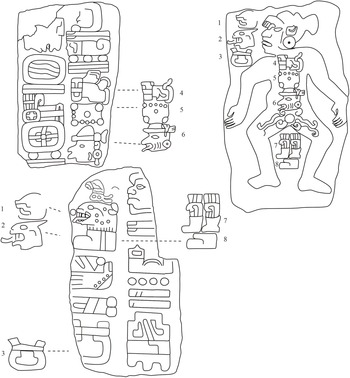
If the two monoliths did not constitute a single text, M-21 would be the only monument with a Glyph W record that is not anchored in a specified year, and the chance that Glyph W would happen to be at a position within ±1 day of the lunar shift after 260 days would be roughly 2/27 ≈ 7.4%. Coincidence is therefore implausible. Together, M-21 and D-142 constitute an almost literal copy of the text on Danzante 55; neither part appears in any other text (Figure 5).
Correspondences between danzante 55 and monoliths D-142 and M-21 (drawings adapted from Urcid [Reference Urcid2001] and courtesy of Elbis Domínguez and Javier Urcid).

The three-sign sequence that begins the text on the torso of the danzante (##4–6 on Figure 5) are the last three signs on M-21. It contains no sign recognized by Justeson and Kaufman as spelling an aspect-marking proclitic, which is required on verb stems; if the text on M-21 does not continue on another monument, this passage must be an equational sentence on both the monolith and the danzante. This shared sign sequence occurs in no other text; Urcid (Reference Urcid, Nelly and Guzmán2011:Figure 15) highlights this textual agreement.
On the danzante, two more signs (##7–8 in Figure 5) follow the three-sign sequence shared with M-21; the second is identifiable, by comparison with Mayan glyphs, as a logogram for being in a seated position (Justeson Reference Justeson1986:449; Justeson and Mathews Reference Justeson and Mathews1990:97), which is associated with a person’s status as ruler. This logogram must spell the local descendant of the proto-Zapotec verb root *sokwa “to be seated” (i.e., “to be in a seated position”). Verb words in Zapotec begin with an aspect marker, indicating whether the action of the verb is completed, habitual, or potential: here, “was seated,” “was repeatedly seated,” or “could be seated.” This is consistent with the beginning of a sentence: in Zapotec languages, in the basic and by far most common word order, the verb precedes the subject (noun phrase or pronoun), which precedes an object if present. Because Urcid (Reference Urcid, Nelly and Guzmán2011:216) interprets the angle of the figure’s legs on this and other danzantes as depicting a squatting position, it is consistent to treat the hieroglyphic sentence as describing the accompanying image. This analysis supports the interpretation of the three-sign sequence (##4–6) preceding this verb as a complete sentence on the danzante, and therefore in the identical passage ending M-21.
On the danzante, a column of three glyphs (##1–3 in Figure 5) begins in front of the figure’s face: first, the head of an animal; next, the head of another animal with spotted fur, a fringed neckline, and tongue protruding; and, finally, a “bag” or “bundle” sign. Urcid (Reference Urcid2001:417–24, Reference Urcid, Nelly and Guzmán2011:185–86) notes that the bag sign frequently ends phrases associated with prominent individuals, as in this case. Justeson and Mathews (Reference Justeson and Mathews1990:109) had noted the co-occurrence of the Zapotec bag sign with that for being seated, relating it to the association of bundles in Mayan art and texts with rulers’ accessions. It also occurs within the year-name headgear logogram for “ruler” in spelling “Lord 10 Earthquake[XVII]” on Monolith 7V-6 (Urcid Reference Urcid2001:Figure 4.28).
Zapotec texts, like later epi-Olmec and Mayan texts, were read toward glyphs’ faces, so the signs to the figure’s left were read before those on its torso. Because Zapotec word order is normally verb-initial, they likely spell an equational sentence, “So-and-so is lord,” or a caption labeling this person. The text along the torso therefore ends with the “be seated” logogram. Verb-final position is unusual in Zapotec but is grammatical in those Zapotec languages in which a third-person subject can be referenced with a “zero” (i.e., no) pronoun (Terrence Kaufman, personal communication 1999), with the preceding material being a separate sentence or an adverbial expression. The sign labeled 4 in Figure 5 is consistent with a person’s headgear (Urcid Reference Urcid2001:Figures 4.47 and 4.48), so signs 4–6 seem to spell a noun phrase or an equational sentence. If it is a noun phrase, it could spell an equational sentence with the name/caption to the figure’s left: “so-and-so, lord, is ruler X Y.”
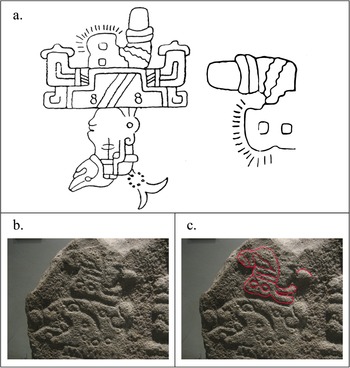
D-142 begins with a sign depicting a penis + scrotum (Figure 6), also found on orthostat J-26; this is followed by the spotted animal sign, with protruding tongue and fringed neckline, as on the danzante. Based on its similarity to the danzante caption, Justeson (Reference Justeson1986:450, Figure 7) mistakenly interpreted the monolith’s three-sign sequence as exemplifying an ungrammatical subject-verb word order. Terrence Kaufman (personal communication 1992) rejected this analysis, given the absence of any sign for an aspect marker, which is required before verbs. Lacking a prefix, a verb logogram must be interpreted as a participle. Most participles are derived from a verb by preposing *na+, for which a syllabogram should precede the verb logogram; however, the participle of *sokwa “to be seated” is one of the few consisting of the verb alone. Kaufman’s analysis agrees with Zapotec word order and is paralleled by another example of the same participle construction on danzante M-4 (Justeson and Kaufman Reference Justeson and Kaufman2011). The D-142 passage therefore conveys that the person named in the danzante caption is “seated, verb(s/ed) as lord.”
Penis glyph comparison from monolith D-142 and orthostat J-26: (a) orthostat J-26 with penis glyph rotated; (b) photo of glyphs in question on monolith D-142; (c) penis glyph highlighted in red. (Color online)

Together, M-21 and D-142 present substantially the same message as D-55, and M-21 presents about the same situation as D-55. A version of D-55’s name/caption appears on M-21; the clause(s) on D-55’s figure occurs on D-142. Because neither passage shared with D-55 by these monoliths appears anywhere else in the corpus, the straightforward conclusion is that they express related events involving the ruler named on D-55. In our view, these identical elements demand an interpretation of M-21 and D-142 as constituting a single narrative, to be read in that order. Urcid (Reference Urcid, Nelly and Guzmán2011) does not address the glyphs shared by D-55 and D-142.
The monoliths show that the divinatory calendar date of the first situation described on D-55, and recorded on M-21, preceded that associated with the occasion on which Jaguar is said to be a seated lord. Similarly, the sequence of the passages on the danzante suggests that the seating of the ruler came after the initial situation described in its text. The differing Glyph W placements on M-21 and D-142 show that they occurred some multiple of 260 days apart. If they occurred in the same year, the first situation, whose character is currently unknown, followed the arrival of the year-bearer by just three days; the ceremonial seating of the ruler was timed like the return of the year-bearer, again, just three days later.
Finally, the basis for Urcid’s (Reference Urcid, Nelly and Guzmán2011:Figure 15) interpretation of D-142 and D-55 as separate texts was his model for the original placements of these monuments, now displaced, on Building L: a hypothetical boustrophedon presentation, rightward on M-21 in the top third of the building; leftward on D-142 in the middle; and rightward again on the text spanning D-139, D-140, and D-141. This model cannot be correct: the reading order of D-142 violates the universal reading order in Zapotec, Mayan, and epi-Olmec texts, which is always toward the faces of day signs, and of the vast majority of other signs depicting human or animal faces.
Solving Glyph W without the Monoliths
As an alternative to the calibration results of Table 2, a numerical model based solely on the J-14 text yields three potential estimates for the cycle’s length. Among them, the lunation can be favored because it alone has a clear motivation, interpretation, and basis for implementation by Zapotec calendar specialists. It is also supported by the resulting correlation of J-14’s dates with the seventeenth-century placement of the Zapotec 52-year cycle.
Three intervals that are recoverable from J-14 are 91, 206, and 297 (= 91 + 206) days. The largest known Glyph W coefficient is 20, so the 91-day interval is between 1 and 4.5 (= 91/20) cycles; 206 is between 2 (≈206/91) and 10 (≈206/20) cycles, and 297 is the sum of the previous two. Five sets of estimates emerge from these comparisons (intermediate estimate is bolded and underlined):
(1) 18.20 (91/5), 18.56 (297/16), 18.73 (206/11)
(2) 22.75 (91/4), 22.85 (297/13), 22.89 (206/9)
(3) 30.33 (91/3), 29.70 (297/10), 29.43 (206/7)
and, with more varied estimates,
(4) 45.50 (91/2), 42.43 (297/7), 41.20 (206/5)
(5) 91 (91/1), 93 (297/3), 103 (206/2)
Among these alternatives, the 29.53-day lunation stands out as a meaningful interpretation.
Acknowledgments
Authorship is equal and order is alphabetical. Jon D. Giorgini of NASA’s Jet Propulsion Laboratory assisted with the Horizon Systems software; Allison Burger formulated the equation for visibility of the lunar crescent; Javier Urcid provided characteristically generous and detailed comments, suggestions, and criticism on numerous issues; Arthur Joyce assisted with our discussion of Monte Alban’s archaeological chronology; and Anthony Aveni advised us on ancient observational astronomy. Urcid and Elbis Domínguez provided the text drawings published here. Justeson thanks Terrence Kaufman (d. 2022) for his insights and mentoring on Zapotec comparative linguistics, for three decades of collaboration on Zapotec epigraphy, for our joint work organizing the documentation of 10 Zapotecan languages by a new generation of linguists, and for the reconstructed Zapotec vocabulary appearing here; and Thierry Gentis and Rodney Gerry of the Haffenreffer Museum for access to the Herbert J. Spinden collection of 1920s photographs of Monte Alban texts and images. We dedicate this research to the memory and legacy of Edward Calnek, who died in April 2025 while it was under review. Calnek was a role model, a supremely careful scholar, and an extraordinary, supportive human being; it was his analysis that enabled us to secure and most carefully characterize both the pattern of historical adjustments in the lengths of the calendar round and the variability in their timing.
Funding Statement
The authors have received no funding in support of this research.
Data Availability Statement
Data for this project was extracted from the publicly available Horizon’s system at NASAs Jet Propulsion Laboratories: J. D. Giorgini and the JPL Solar System Dynamics Group, NASA/JPL Horizons On-Line Ephemeris System, https://ssd.jpl.nasa.gov/horizons/. This data is published in the supplemental materials in Justeson and Lowry (Reference Justeson and Lowry2025).
Competing Interests
The authors declare none.


 Open access

