Vitamin D is an essential dietary micronutrient. Other than the traditionally recognized effects of vitamin D on Ca metabolism, numerous scientific studies also show that vitamin D deficiency may increase the risks for developing non-skeletal disorders such as CVD, obesity, high blood pressure, diabetes, autoimmune disease, depression and selected cancers( Reference Wacker and Holick 1 , Reference Fleet, DeSmet and Johnson 2 ). While vitamin D can be derived from dietary sources, sun exposure is essential for the synthesis of vitamin D: in man, UV-B radiation acting on the skin is the major source of vitamin D( Reference Burgaz, Akesson and Oster 3 , Reference Woo, Lam and Leung 4 ). Vitamin D deficiency is still at epidemic proportions worldwide( Reference Hilger, Friedel and Herr 5 ). In mainland China, there has been no systematic national survey to assess levels of vitamin D deficiency; however, findings from some surveys suggest that vitamin D deficiency is prevalent in young people( Reference Zhang, Stoecklin and Eggersdorfer 6 – Reference Zhu, Zhan and Shao 9 ). Although studies worldwide have identified lack of sun exposure as the main cause of vitamin D deficiency( Reference Holick 10 ), there is limited awareness of the association between sun exposure and vitamin D synthesis in some populations( Reference von Hurst, Stonehouse and Coad 11 – Reference Bonevski, Bryant and Lambert 13 ). The transition from adolescence to young adulthood is gaining recognition as an important period for health promotion and disease prevention( Reference Nelson, Story and Larson 14 ). To the best of our knowledge, no study about knowledge, attitude and practice (KAP) regarding vitamin D among university students has been conducted before in China. Moreover, the problem of vitamin D deficiency among university students in China has not been given sufficient attention. Therefore the present study explored the relationship between vitamin D and sun exposure attitude, knowledge and practice of university students.
Methods
Study participants
The participants were drawn by random cluster sampling from students attending elective courses at Nanjing Medical University. Our university provides a wide variety of elective courses about medicine, music, arts, linguistics and management science. To avoid the influence of knowledge acquired during their elective course, the present investigation was carried out with students at beginning of the course.
Procedure of investigation
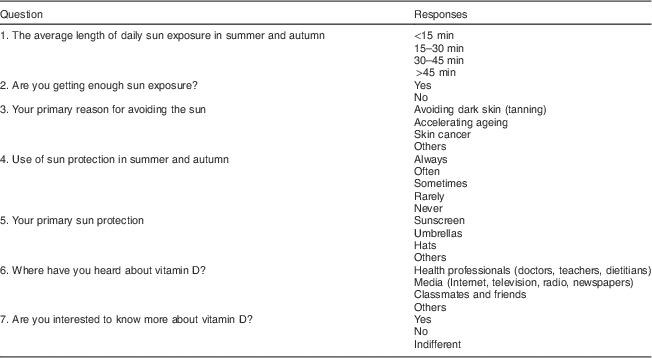
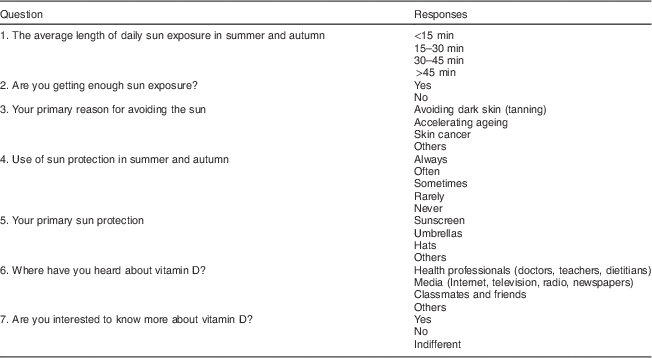
A KAP questionnaire was developed and pre-tested to facilitate a semi-structured interview. Most of the questions were closed-ended and the responses of participants were directly transcribed during the interview. First, participants completed a quiz. They were asked about six topics related to vitamin D and determined which was the best answer for questions. Each topic had three choices: true, false and ‘don’t know’. Knowledge scores were calculated according to the principle that every correct answer was equivalent to 1 point, and the maximum total score was 6 points. Then, some questions investigated the students’ attitudes and practice (behaviours) regarding vitamin D and sun exposure (Table 1). Finally, the students’ consumption of some foods rich in vitamin D was assessed. The three most common food sources of vitamin D in China were selected. All consumption frequencies were standardized into frequency per month. Respondents were also inquired about their intake of vitamin D-containing supplements. All data were gathered from standard questionnaires in Chinese language administered by trained staff.
The questions on attitude and practice regarding vitamin D and sun exposure administered to medical students (n 515), Nanjing, China
Statistical analysis
The statistical software package IBM SPSS Statistics 19 was used for statistical analysis. All experimental data are presented as means and standard deviation or percentage. Continuous and categorical data were examined by Student’s t test and the χ 2 test, respectively. A P value of less than 0·05 was considered statistically significant.
Results
Characteristics of participants
In total, 550 students were invited to participate; 515 valid questionnaires were returned (93·6 % participation rate), with notably more females (73·2 %) than males (26·8 %).
Knowledge of vitamin D
Our data showed that the rate of correct responses for four topics was below 50 %. Two-thirds of students knew the source of vitamin D; however, only 10 % of students could give a correct answer about the peak of bone mass (Table 2). We also found that the average score was 2·41 (sd 1·51) points for male students and 2·56 (sd 1·38) points for female students, but there was no gender difference in this knowledge (Student’s t test: P=0·31).
The responses to topics about vitamin D among medical students (n 515), Nanjing, China
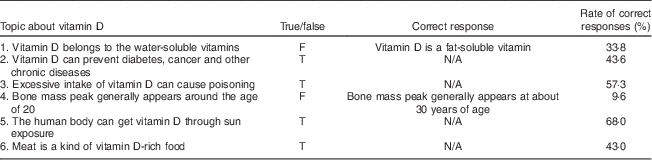
N/A, not applicable.
Status of sun exposure
Regarding length of daily sun exposure, thirty-five (6·8 %) students stated that they spent less than 15 min/d in the sun, 164 (31·8 %) reported spending 15–30 min/d, 141 (27·4 %) noted exposure for 30–45 min/d and 175 (34·0 %) stayed out in the sun for >45 min/d. Furthermore, 67·5 % thought that their sun exposure was enough, but 32·5 % gave a negative response. Subsequently, the reasons for avoiding the sun were investigated. Among those who indicated inadequate sun exposure, the three most frequent reasons among forty-four male students were avoiding dark skin (43·2 %), no desire to go out (18·2 %) and skin cancer (13·6 %). However, the three most frequent reasons for 124 female students were avoiding dark skin (75·0 %), skin cancer (16·1 %) and accelerating ageing (12·1 %).
Use of sun protection
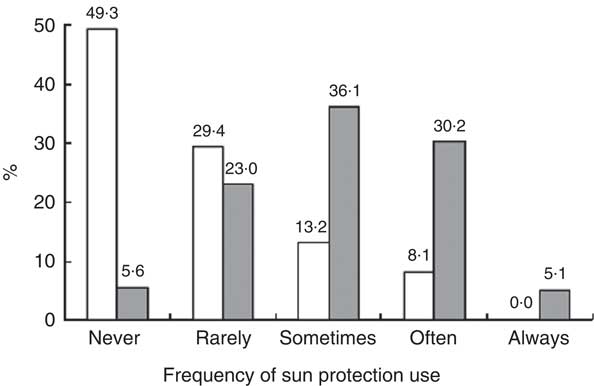
Overall, 426 (82·7 %) of the participants used some sun protection. Nearly half of male students never used sun protection, with the proportion of males in increasing frequency of sun protection use (categories of never/rarely/sometimes/often/never) decreasing gradually. Conversely, only 5·6 % of female students never used protective measures and 30·2 % of female students often had the aid of sun protection (Fig. 1). Thus, there were significant differences between males and females (χ 2 test: P=0·000). The most common types of sun protection used by the male group (n 70) were hats (>50 % of male students wore them), sunscreen (33 %) and umbrellas (20 %). In contrast, 75 % of the female group (n 356) used sunscreen as a popular protective measure against the sun, followed by umbrellas (72 %) and hats (42 %).
Proportion using sun protection measures during the summer and autumn according to frequency and gender ( , males;
  , females) among medical students (n515), Nanjing, China
Sources of information about vitamin D
The majority of the participants (59·5 %) indicated that they had obtained information about vitamin D from the media (Internet, television, radio, newspapers), while 43·3 % got their information through health professionals (doctors, teachers, dietitians) and 25·0 % stated that their information was given by classmates and friends. Only 8·8 % said that they had acquired information from their parents.
Attitude towards vitamin D
When students were asked whether they were interested to know more about vitamin D, most of them gave an affirmative response; only 3·0 % had no desire to learn about vitamin D. The thirst for knowledge was stronger in the female participants than the males (88·3 % v. 78·5 %). More male students took an indifferent attitude compared with the female students (18·5 % v. 8·7 %). There was a significant gender difference in attitude toward vitamin D (χ 2 test: P=0·003).
Consumption of foods rich in vitamin D and supplement use
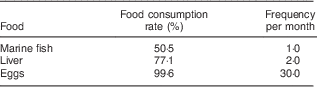
The results showed that almost all of the students often consumed eggs, while only half of them consumed marine fish. More importantly, students ate eggs every day, but they ate marine fish and liver only once or twice per month (Table 3). Additionally, only 5·6 % of students used cod-liver oil, the most common vitamin D supplement.
Consumption of selected foods rich in vitamin D among medical students (n 515), Nanjing, China
Discussion
University students are in a critical period for the development of lifestyles which are very important for their future health. University students tend to engage in problematic eating behaviours, including unhealthy dieting, high intake of fast foods, low intake of fruits and vegetables, and minimal consumption of dairy products( Reference Matvienko, Lewis and Schafer 15 ). Healthy dietary habits among students of health sciences are vital, as they themselves will become health-care professionals, and students who ignore adopting a healthy lifestyle are more likely to fail to convince or promote health for their patients or clients( Reference Sajwani, Shoukat and Raza 16 ).
Vitamin D, the sunshine vitamin, is an essential dietary micronutrient. Vitamin D status is traditionally measured through assays of 25-hydroxyvitamin D, the major circulating form of vitamin D( Reference Holick 17 ). Although we did not measure 25-hydroxyvitamin D levels, some studies have shown that questionnaires can be used to predict vitamin deficiency( Reference Nabak, Johnson and Keuler 18 , Reference Bolek-Berquist, Elliott and Gangnon 19 ).
Our findings revealed clear evidence of insufficient knowledge in this population. In particular, a high proportion of participants did not know the correct time for bone mass peak. Peak bone mass occurs at about 30 years of age( Reference Recker, Davies and Hinders 20 ) and models indicate that interventions to increase peak bone mass could effectively delay the development of osteoporosis( Reference Hernandez, Beaupre and Carter 21 ). Therefore, if students know about this as early as possible, improved status of vitamin D will help them achieve higher peak bone mass.
Although 68 % of the participants agreed that the human body can get vitamin D through sun exposure, only one-third of them stayed outside for more than 45 min/d during summer and autumn. This may reduce their vitamin D synthesis from sunshine. However, most students believed their sun exposure was enough. Regardless of gender, the main reason for preventing sun exposure was avoiding dark skin (tanning). The lack of sun exposure was further demonstrated in the use of sun protection, especially in female students. For years, many health campaigns have successfully promoted the use of sunscreen with a high SPF (sun protection factor) to prevent skin cancer. However, the use of sunscreen products prevents UV-B rays from being absorbed by the body and therefore vitamin D cannot be produced( Reference Faurschou, Beyer and Schmedes 22 ). Moreover, sunscreens were the most popular form of sun protection. A study performed in Western Europe, Australia and the USA found that 86 % of the responders declared they always took precautions against UV exposure( Reference Halpern and Kopp 23 ). Our study also showed that females reported higher sunscreen use than males. It also found that the media was the main source of information about vitamin D for almost 60 % of participants, as in another study( Reference Langbecker, Youl and Kimlin 24 ). Most students did not get information from their parents and perhaps this was because parents were not informed.
Other than sunshine, some foods items are important sources of vitamin D. Vitamin D-fortified food products are rare in China, so only the three most common foods were selected. The results indicated that the consumption frequency of some foods rich in vitamin D was low. Based on eating habits of the Chinese, consumption frequency of eggs was higher than in Korean adolescents and could be very beneficial in individuals who are at risk of vitamin D deficiency( Reference Shi, Yuan and Zhang 25 – Reference Rodríguez-Rodríguez, González-Rodríguez and Ortega Anta 27 ).
Taken together, our findings indicate that medical students are not fully aware of the benefits of vitamin D and therefore more health education seems vital to improve their knowledge and behaviour. Fortunately, most students are interested to know more about vitamin D. This should be good news for health education. Our results also evidence the need for actively increasing time outdoors. In addition, the consumption of foods rich in vitamin D could be encouraged through media campaigns and the guidance of health professionals.
Acknowledgements
Financial support: This work was supported by the Jiangsu Provincial Natural Science Foundation of China (grant number BK2010540); the Natural Science Fund for Colleges and Universities in Jiangsu Province (grant number 13KJB330001); the Practice Innovation Training Program Projects for Jiangsu College Students (grant number 2012JSSPITP1059); and the Priority Academic Program Development of Jiangsu Higher Education Institutions (2011) from Jiangsu Provincial Department of Education. The funders had no role in the design, analysis or writing of this article. Conflict of interest: None. Authorship: M.Z. was responsible for the study design and conception, data collection, manuscript drafting and final editing. W.Z. and Y.Y. participated in the study design, data collection, analysis and interpretation, and writing. Z.L. and Y.C. participated in the study design and supervision, writing and final editing. All authors approved the final manuscript. Ethics of human subject participation: The study was approved by the Research Ethics Committee of Nanjing Medical University. Written informed consent was obtained from all participants.