



A number of external influences on food intake have been well studied. For example, the influence that other people have on food consumption has been well documented, whereby dining with others consuming a small or large amount of food typically decreases or increases food intake, respectively( Reference Robinson, Blissett and Higgs 1 , Reference Robinson, Thomas and Aveyard 2 ). Similarly, there is now very consistent and reliable evidence that portion size can serve to increase or decrease the amount of food individuals consume in both laboratory and field settings( Reference Zlatevska, Dubelaar and Holden 3 , Reference Rolls, Morris and Roe 4 ).
Dishware size has also been identified as a potential external determinant of food consumption. Based on the notion that larger plate and bowl sizes distort portion size perception and may cause consumers to ‘mindlessly’ over-serve themselves food, Wansink and colleagues have suggested that encouraging consumers to use smaller dishware will reduce food consumption( Reference Wansink and van Ittersum 5 , Reference Van Ittersum and Wansink 6 ). The use of smaller dishware as a way of controlling food intake is now recommended by public health authorities such as the US Department of Agriculture( 7 ), nutrition scientists( 8 , 9 ) and popular media sources.
Although the use of smaller dishware to reduce food consumption has intuitive appeal, the scientific evidence supporting this claim is not convincing. We recently systematically reviewed and meta-analysed experimental studies that had examined the effect on food intake of providing participants with small v. larger bowls or plates( Reference Robinson, Nolan and Tudur-Smith 10 ). The majority of studies reviewed did not find that the dishware size participants used (i.e. whether they served their meal onto a small or large plate) had a significant effect on food intake( Reference Rolls, Roe and Halverson 11 – Reference van Ittersum and Wansink 18 ). We also examined whether inconsistencies in study findings may have been caused by differences in study designs. Due to the relatively small number of studies available, drawing confident conclusions about the cause of different findings was difficult, but studies which had used bowls (as opposed to plates) appeared to produce larger effects on food consumption( Reference Robinson, Nolan and Tudur-Smith 10 ). Thus, it may be the case that although plate size does not influence food intake, bowl size does. Discrepancies in study findings may also be accounted for by other methodological differences. For example, the first study examining the effect that serving oneself using small or large dishware has on food intake used a between-subjects design and examined a non-main meal food item (ice cream). Moreover, the setting in that study may have also impeded the ability of participants to monitor bowl size or the exact amount of food they served themselves, as it was conducted in the field( Reference Wansink, van Ittersum and Painter 16 ). Since then a number of studies (which find little evidence of dishware size influencing food intake) have used repeated-measures designs in a relatively distraction-free environment and examined food intake during a main meal( Reference Rolls, Roe and Halverson 11 – Reference Yip, Wiessing and Budgett 13 ). There are, of course, other plausible explanations which might explain why most studies have not replicated the previously reported dishware size effects on food intake. One is that earlier studies in this field tended to be conducted in field settings and because of this may be more likely to have potential methodological limitations or flaws (see Robinson et al.( Reference Robinson, Nolan and Tudur-Smith 10 ) for a discussion).
Given the inconsistent findings to date, the present study was designed to examine the effect of dishware size on food consumption under the methodological conditions which previous studies have observed a dishware effect on food intake: using a between-subjects design, examining intake of a snack food with small or large bowls, in a relatively distracting environment( Reference Wansink, van Ittersum and Painter 16 ). Participants were randomly assigned to serve themselves a snack food (popcorn) in a between-subjects design using either a small or a large bowl. Although conducted in the laboratory, we attempted to minimize attention paid to bowl size or the amount of food being served by having participants serve themselves from a large container of popcorn while watching a television programme (which is relatively reflective of an everyday situation in which a person would normally eat snack food). Because of the mixed findings to date we did not have a strong prediction as to whether the use of a smaller bowl would reduce food consumption.
Method
Sample size
Studies comparing the use of large v. small dishware size on food intake to date have tended to find either no effect or statistically large effects( Reference Robinson, Nolan and Tudur-Smith 10 ). Thus, we reasoned that if any effect were to be observed it would be statistically large and so powered our study accordingly. Using GPower 3·1 (d=0·8, P<0·05, 80 % power) we calculated that a minimum of fifty-two participants were required, although we sampled a slightly larger number than this in order to be able to account for any missing data or participants withdrawing.
Participants
Sixty-three volunteers (fifty-one women) participated in the study. Two participants were unable to be included in analyses due to an error with food weighing scales. This resulted in sixty-one available cases (twelve men and forty-nine women; mean age 31·2 (sd 9·8) years, age range 19–59 years; mean BMI 24·4 (sd 4·3) kg/m2, BMI range 18·0–37·0 kg/m2). Volunteers were recruited through poster and electronic advertisements to take part in a study assessing ‘food and mood’ in order to disguise the true study aims. Only individuals with food allergies were not eligible to participate. All participants gave written informed consent and were reimbursed with shopping vouchers upon completion. The study was conducted in accordance with the standards expressed in the Helsinki Declaration and was approved by the University of Liverpool ethics committee.
Design
A between-subjects design was used to assess the effects of bowl size (large or small) on self-served popcorn intake. Participants were randomly assigned to receive either a large (18 cm diameter; volume 800 ml) or smaller sized (16 cm diameter; volume 450 ml) bowl into which they could serve themselves popcorn from a separate serving bowl containing a large amount of popcorn.
Procedure
Participants were tested individually in a single (30 min) session in an eating behaviour laboratory at the University of Liverpool and were asked to abstain from eating for 2 h prior to the study session. Upon arrival, participants were informed that they would be watching a short (20 min) comedy programme and that popcorn would be available while watching the clip. A questionnaire assessing allergies and intolerances and demographic questions were first completed. In line with the study cover story, a series of 100 mm visual analogue scale (VAS) mood ratings (e.g. ‘How ANXIOUS do you feel right now?’), with the left-hand anchor (‘not at all’) coded as 0 and the right-hand anchor (‘extremely’) coded as 100, were then completed. Baseline hunger was included within these mood measures (‘How HUNGRY do you feel right now?’). The researcher then explained that participants would watch the film clip and, to make them more comfortable, would be provided with popcorn.
Participants were then presented with a glass of water, a tray holding a bowl of pre-weighed popcorn (salted popcorn from a UK supermarket (Tesco, home brand; 90 g serving containing 1913 kJ (457·2 kcal)), a serving scoop and either a large or small bowl in which to serve themselves. They were instructed to watch the entire programme and to help themselves to as much or as little popcorn as they liked but to only consume the popcorn that they had served themselves in their bowl. The bowl was placed on the table the participants were sat at within arm’s reach. To detract awareness from the study aims, participants were asked to pay attention to the clip as some questions about the clip would be asked after watching. When participants signalled that the clip had finished, the tray containing the snack was removed and additional appetite and mood ratings were completed as well as the twenty-one-item Three Factor Eating Questionnaire (TFEQ-R21Reference Stunkard and Messick (19 , Reference Cappelleri, Bushmakin and Gerber 20) ), questions pertaining to the enjoyment of the clip and their experience of the study. This included questions about the palatability of the popcorn, estimated the number of servings of popcorn they made during the video clip, whether they ate from the main serving bowl directly (as opposed to using their small or large bowl) and what they thought the aims of the study were. Weight and height were then measured (using electronic scales and a stadiometer) to calculate BMI before participants were fully debriefed and reimbursed for their time.
Results
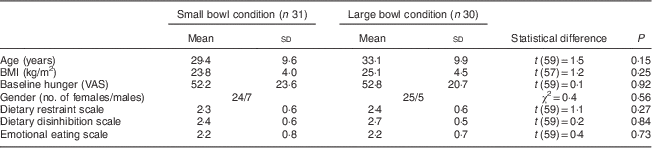
There were no significant differences between conditions (P>0·05) for all baseline variables (i.e. age, gender, BMI, hunger, TFEQ-21 scores; see Table 1). We examined the effect that bowl size condition had on mean food intake using an independent-samples t test. This was not statistically significant (t (59)=1·85, P=0·07), although participants in the small bowl condition (n 31; mean 34·0 (sd 21·9) g) tended to consume more food (a 36 % increase, d=0·5) than participants in the large bowl condition (n 30; mean 24·9 (sd 15·8) g).
Participant characteristics in a between-subjects laboratory study of dishware size and snack food intake
VAS, visual analogue scale.
Values presented are means and standard deviations, unless otherwise stated. Baseline hunger is on a 0–100 mm scale (anchors: 1=‘not at all hungry’, 100=‘extremely hungry’). Dietary restraint, disinhibition and emotional eating are represented by a score from 1 to 4, with higher scores denoting higher dietary restraint, dietary disinhibition and emotional eating. Statistical difference between small and large bowl conditions is compared using a t test, except for gender (χ 2 test).
Although no participants correctly guessed the aims of the study, four participants came close (e.g. mentioned portion size or serving behaviour) and removing these participants had no effect on the results reported above. We examined whether participants reported only using their bowl to serve into and eat from and 58/61 reported doing so, with the remaining three participants reporting they did take some popcorn without using their bowl. Removal of these participants had no effect on the results. We also examined whether the mean number of times participants reported serving themselves popcorn differed by condition. Participants in the small bowl condition reported serving themselves 4·0 (sd 2·7) times, as opposed to 3·5 (sd 1·5) times in the large bowl condition, although this difference was not statistically significant (t (59)=0·9, P=0·40).
Additional analysis
As the direction of the effect of condition was unexpected, we also examined whether any participant characteristics (age, gender, baseline hunger, BMI, TFEQ-21) were associated with food intake and used a forced-entry linear regression to examine whether the trend effect of bowl size condition still persisted when adjusting for other predictors of food intake. When accounting for baseline variables associated with food intake (see Table 2), the effect that bowl size had on food intake was of a similar size but became statistically significant (P=0·02). Being male and having higher baseline hunger were also significantly associated (P<0·05) with increased popcorn intake. The tendency for males to consume more popcorn than females was statistically significant in both adjusted (see Table 2) and unadjusted analyses (males: n 12, mean 46·0 (sd 20·6) g; females: n 49, mean 25·5 (sd 17·2) g; t (59)=3·5, P=0·001). The relationship between baseline hunger and popcorn intake was also significant in both adjusted (see Table 2) and unadjusted analyses (r (61)=0·31, P=0·016).
Independent predictors of food intake in a between-subjects laboratory study of dishware size and snack food intake

All baseline variables or participant characteristics that were associated with popcorn intake at P<0·20 were included in a forced-entry linear regression model to examine their (independent) predictive effects on popcorn intake. The overall model was significant (F (6, 52)=5·2, adjusted R 2=0·30, P<0·001). The association between rated palatability of the popcorn and intake approached statistical significance (r=0·29, P=0·08), but because rated palatability is not a participant characteristic per se and could be influenced by the amount of popcorn participants ate (‘I ate a lot, so I must like it’), we did not include it as a predictor in the regression model. However, if it is included the results remain the same and the effect of condition is still statistically significant (P=0·024).
* Denotes significant predictor.
† Baseline hunger is on a 0–100 mm scale (anchors: 1=‘not at all hungry’, 100=‘extremely hungry’).
‡ Direction of beta value indicates that participants in the small bowl condition ate more than participants in the large bowl condition.
§ Direction of beta value indicates that males ate more than females.
Discussion
Although we found evidence that participant gender and baseline hunger levels were associated with snack food intake, the use of a smaller bowl did not reduce snack food intake in the current study. Thus, the present findings fail to replicate earlier studies which suggested that bowl size influences food intake( Reference Wansink, van Ittersum and Painter 16 – Reference van Ittersum and Wansink 18 ), but are in line with a number of more recent studies which have shown little or no effect of bowl or plate size on food consumption( Reference Rolls, Roe and Halverson 11 – Reference DiSantis, Birch and Davey 14 ). Critically, there was some evidence that participants serving themselves with a small bowl tended to consume more food than participants serving themselves with a large bowl, although this effect was not hypothesized and the present study is the first one we are aware of to find this pattern of results, so future work may benefit from examining whether there are contexts in which the use of smaller dishware may promote overconsumption.
There was little evidence in the present study that participants were aware of the study aims or the bowl size manipulation used, which is to be expected, given the between-subjects design. While the use of smaller dishware as a way of reducing food consumption has intuitive appeal and is recommended to the general public as an effective strategy to limit energy intake( 7 – 9 ), it remains unclear how useful or applicable this approach is, although it certainly cannot be generalized to all eating scenarios. Given that there is likely to be a limited number of changes individuals can make to try to eat less, it is important that the messages we communicate to the general public are backed by convincing evidence. Thus, we believe the findings of the present study further suggest that recommendations concerning the use of smaller dishware to reduce food consumption are premature. However, there may of course be specific contexts or study designs which are conducive to dishware size influencing food consumption. For example, it may be the case that plate or bowl size only influences food intake if consumers are not allowed to serve themselves multiple times and refill their plate or bowl( Reference Robinson, Nolan and Tudur-Smith 10 , Reference Rolls, Roe and Halverson 11 ). Further work testing this and identifying the conditions in which dishware size does v. does not influence food consumption would now be useful.
Acknowledgements
Acknowledgements: The authors would like to thank Alisha Riley for her research assistance during the study. Financial support: This research received no specific grant from any funding agency in the public, commercial or not-for-profit sectors. Conflict of interest: E.R. was supported by the Wellcome Trust. The authors report no conflicts of interest. Authorship: E.R. and U.M. conceived the experiment and oversaw data collection. F.S. collected the data. All authors had input into the analysis, drafting of the manuscript and approved the final manuscript. Ethics of human subject participation: The study was conducted in accordance with the standards expressed in the Helsinki Declaration and was approved by the University of Liverpool ethics committee.



