


Statement of Research Significance
Research Question(s) or Topic(s): Personality traits (e.g., Neuroticism, Openness, Agreeableness, Conscientiousness, and Extraversion) associate with cognitive functioning. However, the mechanisms that explain these associations are not well understood. We, examined the relationship between these personality traits and cognition, and whether any associations are accounted for by differences in midlife cardiometabolic risk. Main Findings: Those lower in Neuroticism and higher in Openness and Agreeableness had better performance in each cognitive area (episodic memory, working memory, and executive control). Better cardiometabolic health partly explained the association of lower Neuroticism, higher Openness, higher Agreeableness, and higher Conscientiousness with better executive control. Study Contributions: This study addresses mechanistic gaps in the literature, by revealing that the relationship between personality and executive control is partly accounted for by differences in cardiometabolic risk. This may provide an avenue for future interventions seeking to promote cognitive outcomes in those at risk for decline.
Introduction
Traits of personality predict many key health outcomes, including aging-associated cognitive deficits and dementia (Levine et al., Reference Levine, Cohen, Commodore-Mensah, Fleury, Huffman and Khalid2021; Ringwald et al., Reference Ringwald, Kaurin, DuPont, Gianaros, Marsland, Muldoon, Wright and Manuck2021; Terracciano et al., Reference Terracciano, Piras, Sutin, Delitala, Curreli, Balaci, Marongiu, Zhu, Aschwanden, Luchetti, Oppong, Schlessinger, Cucca, Launer, Fiorillo and Rouch2022; Terracciano & Sutin, Reference Terracciano and Sutin2019). The most widely studied trait taxonomy is the lexically derived Five-Factor Model (FFM; Costa & McCrae, Reference Costa and McCrae1992), which taps individual differences in Neuroticism (the propensity to experience negative emotional states, such as anxious, irritable, or depressed mood); Conscientiousness (comprising attributes of self-discipline, orderliness, and goal setting); Openness to Experience (Openness; receptivity to new ideas and esthetic interests); Extraversion (degree of sociability and the propensity to experience positive emotions); and Agreeableness (extent of friendly, kindhearted, and compassionate disposition, anchored at the opposite pole by antagonism and hostility). Regarding cognitive impairments that may be related to these traits, a recent meta-analysis showed that high levels of Neuroticism and low levels of Conscientiousness conferred heightened risk for incident Alzheimer’s disease (AD) and AD-related dementias, as did low levels of Extraversion, Openness to Experience, and Agreeableness, albeit less strongly than Neuroticism and Conscientiousness (Aschwanden et al., Reference Aschwanden, Strickhouser, Luchetti, Stephan, Sutin and Terracciano2021).
Analogous results have been observed in cross-sectional studies of cognitive abilities, as seen across diverse measures of neuropsychological functioning and in populations of varying age. In meta-analytic summaries and among the largest studies, lower Neuroticism and higher Conscientiousness and Openness tend to associate with better performance on components of executive functioning (e.g., verbal fluency, set switching), episodic memory, and global cognition, whereas correlates of Agreeableness tend to be weaker or null and those of Extraversion inconsistent (Luchetti et al., Reference Luchetti, Terracciano, Stephan, Aschwanden and Sutin2021; Luchetti et al., Reference Luchetti, Terracciano, Stephan and Sutin2016; Sutin et al., Reference Sutin, Brown, Luchetti, Aschwanden, Stephan and Terracciano2023; Sutin, Stephan, Damian, et al., Reference Sutin, Stephan, Damian, Luchetti, Strickhouser and Terracciano2019; Sutin, Stephan, et al., Reference Sutin, Stephan, Luchetti, Strickhouser, Aschwanden and Terracciano2022; Sutin et al., Reference Sutin, Stephan, Luchetti and Terracciano2019). Earlier literature and individual studies present more mixed findings, however, which may reflect a variety of methodological factors, such as sample characteristics (e.g., clinical vs. nonclinical populations), small or underpowered samples (e.g., N < 400), variability in the cognitive tasks administered and in their sensitivity to small differences (e.g., screening devices vs. neuropsychological test batteries and multi-task aggregates), as well as variability in the instruments used to assess personality (Curtis et al., Reference Curtis, Windsor and Soubelet2015).
Despite evidence of a relation between personality traits and cognitive abilities, potential mechanisms that might account for such associations remain largely unaddressed. To our knowledge, for instance, little to no prior work has examined the possible role of two closely aligned biological factors that are each related to cognitive performance and aging-related dementias, as well as to some features of personality. These two factors are cardiometabolic risk and, in the absence of acute infection, the presence of a low-grade inflammatory state. The first is often expressed as the metabolic syndrome, an aggregate of correlated physiological conditions predictive of risk for heart and vascular disease and defined by indicators of insulin resistance, dyslipidemia, central adiposity, and elevated blood pressure (Agarwal et al., Reference Agarwal, Jacobs, Vaidya, Sibley, Jorgensen, Rotter, Chen, Liu, Andrews, Kritchevsky, Goodpaster, Kanaya, Newman, Simonsick and Herrington2012; Eckel et al., Reference Eckel, Alberti, Grundy and Zimmet2010; Gami et al., Reference Gami, Witt, Howard, Erwin, Gami, Somers and Montori2007; Grundy et al., Reference Grundy, Brewer, Cleeman, Smith and Lenfant2004). Notably, in addition to signaling heightened cardiovascular risk, the metabolic syndrome associates with poorer cognitive functioning across the lifespan, and in later life, with risk of mild cognitive impairment (MCI) and progression to dementia (e.g., González-Castañeda et al., Reference González-Castañeda, Pineda-García, Serrano-Medina, Martínez, Bonilla, Ochoa-Ruíz and Prete2021; Tahmi et al., Reference Tahmi, Palta and Luchsinger2021).
The second factor, systemic inflammation, is implicated in numerous disease processes and is typically indexed to levels of circulating pro-inflammatory mediators, such as Interleukin-6 (IL-6) and C-reactive protein (CRP). Like the metabolic syndrome, these inflammatory markers are elevated in individuals with MCI and AD (Darweesh et al., Reference Darweesh, Wolters, Ikram, de Wolf, Bos and Hofman2018; Lai et al., Reference Lai, Liu, Rau, Lanctôt, Köhler, Pakosh, Carvalho and Herrmann2017; Shen et al., Reference Shen, Niu, Wang, Cao, Liu, Tan, Zhang and Yu2019), predict progression from normative cognition to dementia (Long et al., Reference Long, Chen, Meng, Yang, Wei, Li, Ni, Shi and Tian2023), and covary inversely with cognitive performance, including aspects of memory and executive functioning, in both older adult and midlife samples (Fard et al., Reference Fard, Savage and Stough2022; Marsland et al., Reference Marsland, Gianaros, Kuan, Sheu, Krajina and Manuck2015, Reference Marsland, Petersen, Sathanoori, Muldoon, Neumann, Ryan, Flory and Manuck2006). That inflammation and the metabolic syndrome relate similarly to cognition likely reflects close linkage of these two constructs, as peripherally measured inflammatory markers correlate reliably with individual components of the metabolic syndrome (e.g., Hu et al., Reference Hu, Penninx, de Geus, Lamers, Kuan, Wright, Marsland, Muldoon, Manuck and Gianaros2018); possibly play a causal role in the development of obesity and insulin resistance (Han et al., Reference Han, Sattar, Williams, Gonzalez-Villalpando, Lean and Haffner2002; Lee & Pratley, Reference Lee and Pratley2005; Shoelson et al., Reference Shoelson, Lee and Goldfine2006); and explain over half the common variance of traditional syndrome components in hierarchical models of aggregated cardiometabolic risk (Marsland et al., Reference Marsland, McCaffery, Muldoon and Manuck2010). For these reasons, systemic inflammation is sometimes discussed as a component of the metabolic syndrome itself (Festa et al., Reference Festa, D’Agostino, Howard, Mykkänen, Tracy and Haffner2000; Ndumele et al., Reference Ndumele, Pradhan and Ridker2006).
Research linking these potential biological mediators to personality traits is less extensive than the literature examining associations between cardiometabolic risk, inflammation, and cognition. Nonetheless, the metabolic syndrome associates relatively consistently with higher Neuroticism and lower Conscientiousness (Mommersteeg & Pouwer, Reference Mommersteeg and Pouwer2012; Montoliu et al., Reference Montoliu, Hidalgo and Salvador2020; Phillips et al., Reference Phillips, Batty, Weiss, Deary, Gale, Thomas and Carroll2010; Sutin et al., Reference Sutin, Costa, Uda, Ferrucci, Schlessinger and Terracciano2010; Sutin et al., Reference Sutin, Stephan and Terracciano2019; Tanios et al., Reference Tanios, Terracciano, Luchetti, Stephan and Sutin2022; Thomas et al., Reference Thomas, Duggan, Kamarck, Wright, Muldoon and Manuck2022; Wright et al., Reference Wright, Weston, Norton, Voss, Bogdan, Oltmanns and Jackson2022), and higher levels of IL-6 and CRP tend to associate with lower Conscientiousness and Openness and, less reliably, with higher Neuroticism or other metrics of trait negative affect (e.g., Luchetti et al., Reference Luchetti, Barkley, Stephan, Terracciano and Sutin2014; Marsland et al., Reference Marsland, Prather, Petersen, Cohen and Manuck2008; Sutin et al., Reference Sutin, Stephan and Terracciano2018; Wright et al., Reference Wright, Weston, Norton, Voss, Bogdan, Oltmanns and Jackson2022). In one recent study, too, traits of Conscientiousness, Openness, and Extraversion among older adults covaried with levels of soluble Tumor Necrosis Factor Receptor 1 (sTNFR1), a receptor for the cytokine TNF-alpha, and in turn mediated these traits’ relation to a global measure of cognition (Stephan et al. Reference Stephan, Sutin, Luchetti, Aschwanden and Terracciano2024).
In prior work, we suggested that health-related correlates of personality might be underestimated when traits are assessed, as in most studies, solely by self-report, due to limits of introspection, defensive self-appraisals, or other presentation biases, as well as reliance on a single rater (Ringwald et al., Reference Ringwald, Kaurin, DuPont, Gianaros, Marsland, Muldoon, Wright and Manuck2021; Vazire & Carlson, Reference Vazire and Carlson2010). Alternatively, the addition of peer ratings enhances reliability of measurement by averaging over multiple informants and may provide a more objective assessment of evaluative traits like Agreeableness and Conscientiousness (Connelly & Ones, Reference Connelly and Ones2010; Jackson et al., Reference Jackson, Connolly, Garrison, Leveille and Connolly2015). Using both self- and informant ratings, for instance, we previously found a factor-analytically derived index of cardiometabolic risk modeled on the metabolic syndrome associated with four FFM traits – Conscientiousness, Agreeableness, Neuroticism, and Openness – in a large, otherwise healthy, midlife community sample (Dermody et al., Reference Dermody, Wright, Cheong, Miller, Muldoon, Flory, Gianaros, Marsland and Manuck2016). As cognitive performance was also evaluated in this study cohort, here we extend our analyses to address three further questions: 1) do these traits, assessed using multiple raters (i.e., self and multiple informants), likewise covary with an expanded composite of metabolic and inflammatory indicators (Hu et al., Reference Hu, Penninx, de Geus, Lamers, Kuan, Wright, Marsland, Muldoon, Manuck and Gianaros2018), as well as functioning in three cognitive domains (episodic memory, executive control, and working memory); 2) does a latent construct of cardiometabolic risk associate with midlife cognitive functioning; and 3) in a first test of cross-sectional mediation, can any association of personality traits with levels of cognitive performance be accounted for by correlated variation in our index of cardiometabolic risk?
Methods
Participants
Data included in the present study were derived from the University of Pittsburgh Adult Health and Behavior (AHAB) project, a registry of behavioral and biological measurements on non-Hispanic Caucasian and African American individuals between the ages of 30 and 54 years. Participants in the registry were recruited in 2001 – 2005 from several communities located in southwestern Pennsylvania in the United States (principally Allegheny County) via mass-mail solicitation (Manuck et al., Reference Manuck, Phillips, Gianaros, Flory and Muldoon2010; Marsland et al., Reference Marsland, McCaffery, Muldoon and Manuck2010). All procedures, including written informed consent, were conducted in accordance with approved protocol guidelines of the University of Pittsburgh Institutional Review Board and per the ethical standards of the Helsinki Declaration.
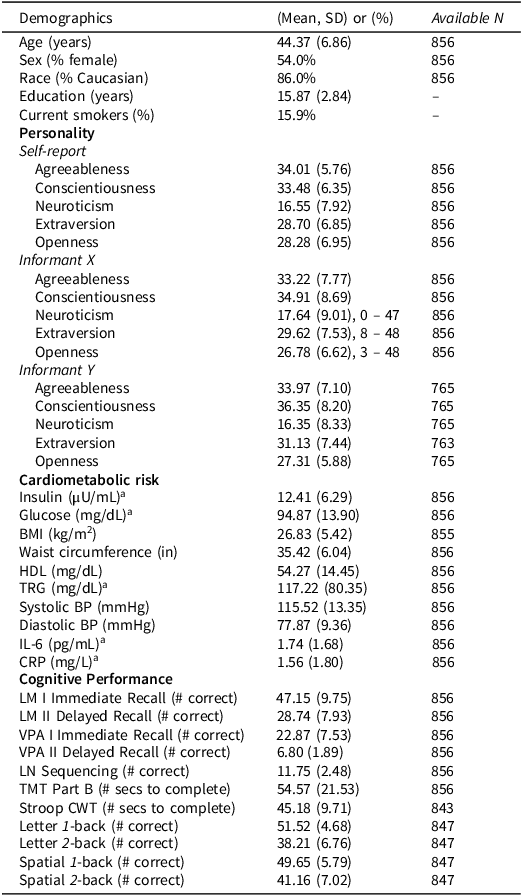
Personality data were available for 1,164 AHAB participants. Criteria for exclusion from participation in the registry included history of clinically manifest atherosclerotic cardiovascular disease, chronic kidney disease, or liver disease; cancer treatment in the year preceding study participation; neurologic disorders; disorders with psychotic features; or pregnancy. Additional exclusionary criteria included use of insulin, nitrates, glucocorticoid, antiarrhythmic, psychotropic, or prescription weight-loss medications, resulting in 948 participants. For the current analyses, participants were further excluded for use of antihypertensives, oral hypoglycemics, and cholesterol-lowering medications; use of immunosuppressants, cold medication, or antibiotics at the time of testing; interleukin-6 (IL-6) levels exceeding upper limits of detection for the high-sensitivity assay used in this study (> 10 pg/ml); or C-reactive protein (CRP) elevation (> 10 mg/L), which may be indicative of acute illness (e.g., common respiratory infection) (Dermody et al., Reference Dermody, Wright, Cheong, Miller, Muldoon, Flory, Gianaros, Marsland and Manuck2016). This yielded a final sample of 856 participants, whose demographic characteristics are summarized in Table 1.
Descriptive statistics of demographic characteristics, personality, cardiometabolic risk, and cognitive variables (N = 856)

Note: All cognitive variables consist of raw scores.
BMI = body mass index, HDL = high-density lipoprotein, TRG = triglycerides, BP = blood pressure, IL = interleukin, CRP = C-reactive protein, LM = logical memory, VPA = verbal paired associates, LN = letter number (sequencing test), TMT = trail making test, CWT = (Stroop) color and word test.
a Natural log transformed.
Measures
Personality assessments
Participants completed the 240-item Revised NEO Personality Inventory (NEO PI-R), which consists of five subscales assessing each FFM personality domain: Neuroticism, Agreeableness, Openness to Experience, Extraversion, and Conscientiousness (Costa & McCrae, Reference Costa and McCrae1992). In addition, up to two informants used the 60-item abbreviated form (i.e., the NEO Five-Factor Inventory [NEOFFI]) to rate the participant. The majority of participants (88%) had ratings from two informants. Informants were chosen by each participant and included spouses or partners (30%), parents (9%), siblings (12%), other close relatives (12%), close friends (31%), or other individuals (6%). In order to ensure consistency across self and informant report, self-reported FFM traits for each participant were calculated using the 60 items from the NEO PI-R that overlapped with the NEO-FFI (Dermody et al., Reference Dermody, Wright, Cheong, Miller, Muldoon, Flory, Gianaros, Marsland and Manuck2016). Of the 856 participants included in the final sample, ∼ 89% of participants had three subscale scores (i.e., ratings by the participant and two other informants) for each 12-item personality trait, and all participants had at least two.
Cardiometabolic assessments
As noted above, we modeled cardiometabolic risk here based on components of the metabolic syndrome (adiposity [BMI, waist circumference]; glycemic control [fasting serum levels of insulin and glucose]; blood pressure [systolic, diastolic]; blood lipids [fasting serum levels of high-density lipoprotein (HDL); and triglycerides (TRG)]), along with the inflammatory markers, IL-6 and CRP (Hu et al., Reference Hu, Penninx, de Geus, Lamers, Kuan, Wright, Marsland, Muldoon, Manuck and Gianaros2018), all of which were continuous variables. These were assessed in the morning following a 12-h overnight fast. At that time, a nurse completed a medical history and medication use interview, determined body mass index (BMI; kg/m2), and drew a 40 ml blood sample. Systolic and diastolic blood pressure (mmHg; SBP and DBP, respectively) were computed as the mean of two consecutive readings measured by a sphygmomanometer in a seated position. Fasting serum levels of HDL (mg/dL) and TRG (mg/dL), as well as glucose (mg/dL) and insulin (μU/mL) were determined as described previously (Muldoon et al., Reference Muldoon, Nazzaro, Sutton-Tyrrell and Manuck2000). IL-6 (pg/mL) was measured using a high-sensitivity quantitative sandwich enzyme immunoassay kit (R & D Systems, Minneapolis, MN), and CRP (mg/L) was measured with the BNII nephelometer from Dade Behring (Newark, DE) using a particle-enhanced immunonephelometric assay (Marsland et al., Reference Marsland, McCaffery, Muldoon and Manuck2010).
Cognitive assessments
Participants completed a comprehensive battery of neurocognitive tests (see Supplemental Material, Appendix A), from which we selected tasks that broadly reflect abilities in the domains of episodic memory, executive function, and working memory. The specific subtests included in the present study are described below.
Logical memory
This subtest of the Wechsler Memory Scale-III (WMS-III; Wechsler, Reference Wechsler1997) is designed to evaluate episodic memory for verbal information provided within the context of a story (Larrabee et al., Reference Larrabee, Kane, Schuck and Francis1985; Tröster et al., Reference Tröster, Butters, Salmon, Cullum, Jacobs, Brandt and White1993). Participants were read two one-paragraph stories (Story A and Story B) and then completed immediate and delayed recall of story details. Story A was read once and Story B was read twice. During delayed recall, participants were asked to verbally recall information from each story 25 – 35 min after its administration. The number of correctly recalled items (segments of the stories) was recorded.
Verbal paired associates
This WMS-III subtest is a measure of episodic memory for verbal details provided without context. Participants were read 14-word pairs and then were prompted with the first word of each pair, to promote learning of the word pairs, over four trials. For the delayed memory component of the test, participants were again prompted with the first word of each pair, after a 25 – 35 min delay. The number of correctly recalled word pairs were recorded.
Letter number sequencing
This WMS-III subtest is traditionally a measure of auditory working memory but correlates with additional cognitive abilities including information processing and visuospatial working memory (Crowe, Reference Crowe2000). Participants were read a random series of letters and numbers and were instructed to verbally sequence the numbers in ascending order first, then the letters in alphabetical order. The number of correct trials was recorded.
Trail making test: part B
The Trail Making Test Part B (Trails B) measures task-switching abilities (Reitan & Wolfson, Reference Reitan and Wolfson1985). Participants were instructed to draw a line alternating between connecting numbers and letters in sequential order as quickly as possible. The completion time is recorded as the main measure of performance, with longer completion time signifying poorer performance.
Stroop color and word test
This test, which has been extensively used in experimental and clinical settings as a measure of inhibition and the ability to ignore distracting information, has three components (Golden et al., Reference Golden and Freshwater1978). During the color test, participants were presented with a list of “x” marks in ink colors of red, green, and blue and were instructed to name as many of the ink colors displayed as possible in 45 s, in sequential order. During the word test, participants were presented with a list of color words printed in colors of the same name and instructed to read as many of the color names as possible in 45 s. Lastly, during the color-word test, the participants were presented with a list of color words, some printed in ink colors other than the colors named. They were instructed to name as many as possible of the ink colors displayed, while ignoring the printed color names, in 45 s. The number of correctly named ink colors during this test was recorded as the color-word interference score.
N-back tasks
These working memory tests consisted of two parts, the (verbal) letter n-back and the (visual) spatial n-back. In the letter n-back, participants viewed a series of letters, presented on a computer screen for 500 ms each with an intertrial interval of 2000ms. In the 1-back condition, participants were instructed to press a button if the letter on the screen matched the letter previously displayed, and a different button if they did not match. In the 3-back condition participants were asked to determine if the letter on the screen matched the letter that was displayed 3 letters earlier. During the spatial n-back task, the participants viewed a series of dots, presented on a computer screen for 500 ms each with an intertrial interval of 2000ms. During the 1-back, participants were asked to respond when the dot appeared in the same location displayed previously. During the 2-back, participants responded when the dot appeared in the same location as two trials prior. For both the letter and spatial n-back, there were 56 trials presented per condition (50% match, 50% non-match). The number of correct responses was recorded for each task.
Analytic plan
Our hypotheses were tested using structural equation modeling (SEM) in Mplus Version 8.8 (Muthén & Muthén, Reference Muthén and Muthén2017). To reduce the number of neurocognitive outcome variables, we first conducted an exploratory principal component analysis (PCA) with varimax rotation using IBM SPSS Statistics (Version 27). We then tested factor structures of each personality trait and cardiometabolic risk, as well as the three cognitive domains that emerged from the PCA, within a single comprehensive measurement model.
In separate models for each FFM personality trait, we first regressed each cognitive factor on the individual FFM trait. Then, to establish the independent indirect effect of each pathway and account for any intercorrelation in each model, we examined these multi-level pathways in parallel. Specifically, in each model, we tested: (1) the association of the personality trait with cardiometabolic risk, and (2) the association of cardiometabolic risk with each cognitive factor, controlling for each personality trait. The indirect effect was estimated using the Model Indirect command in Mplus. To calculate the corresponding bias-corrected CIs and account for the non-normal distribution of the mediated effect, we used the Asymmetric Confidence Interval feature of the Prodclin program (MacKinnon et al., Reference MacKinnon, Fritz, Williams and Lockwood2007). Covariates were age in years, sex (0 = male, 1 = female), and race (0 = Caucasian, 1 = African American).
Missing data (see Table 1) were handled using full information maximum likelihood. As the chi-square test is particularly sensitive to negligible sources of poor model fit in large samples using real-world data, we relied on multiple alternative fit indices as is the conventional conservative approach for evaluating model fit (Browne & Cudeck, Reference Browne and Cudeck1992; Hu & Bentler, Reference Hu and Bentler1999). Criteria for appropriate model fit included the root mean square error of approximation (RMSEA) of less than .05, the comparative fit index (CFI) close to .95 or greater, and the standardized root mean residual (SRMR) of less than .08. Results are reported as standardized betas (β) with 95% confidence intervals (in tables) or p values.
Results
Latent factor model fitting
Latent factors representing each of the five FFM personality traits, cardiometabolic risk, and three domains of cognitive ability were estimated within a single confirmatory model and are described below. Model fit was appropriate, χ2 = 1356.32, df = 555, p < .001; CFI = .95; RMSEA = .037, 90% CI [.034, .039]; SRMR = .036.
Personality model
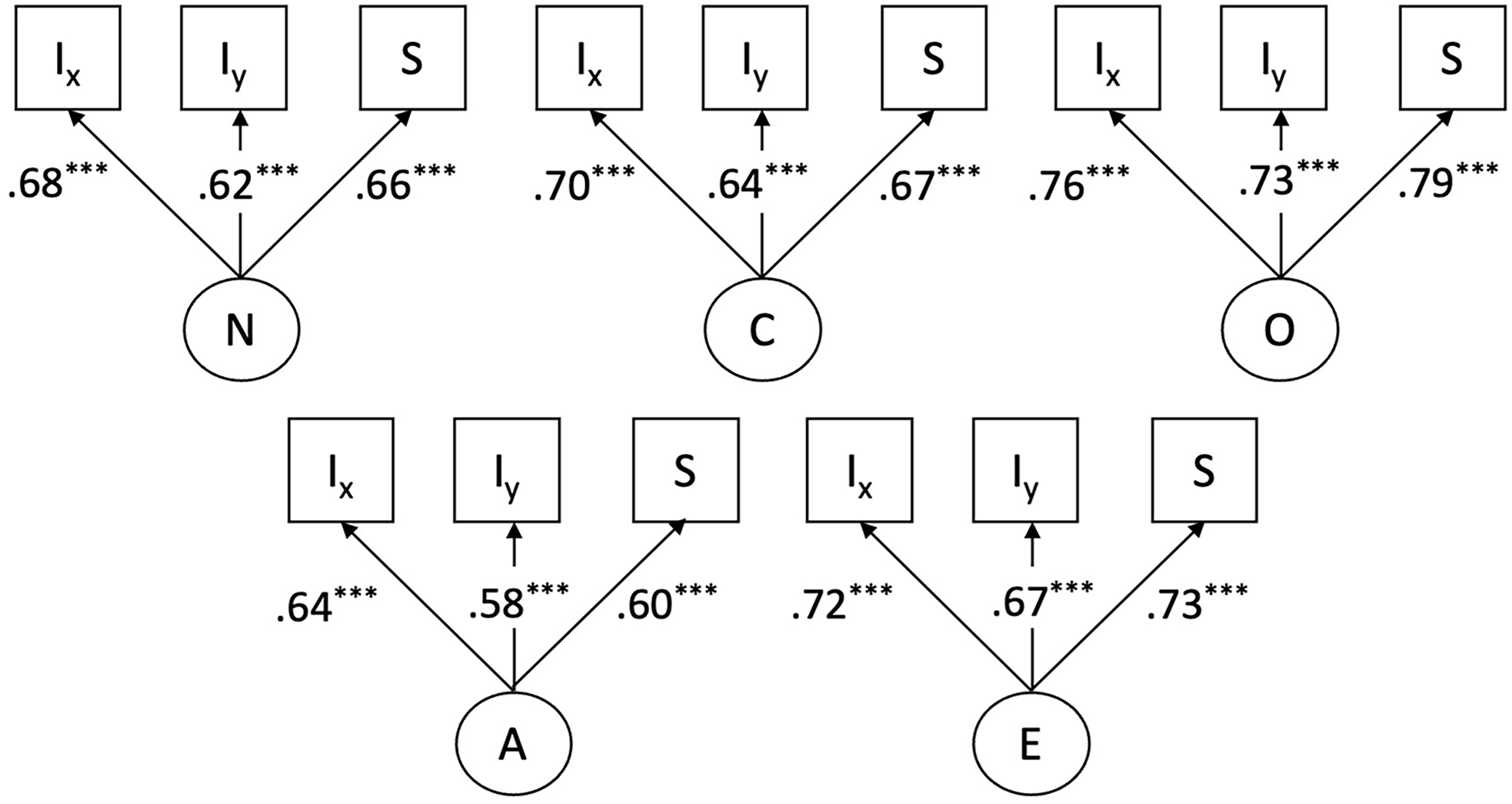
Five correlated personality latent factors were modeled representing each of the FFM traits: Neuroticism, Agreeableness, Openness to Experience, Conscientiousness, and Extraversion. Each latent personality factor had three indicators: a self-report and two informant reports, in accord with the multi-informant modeling approach (DeYoung, Reference DeYoung2006). The personality trait factor structures are depicted in Figure 1.
Measurement model for FFM personality traits. Note. Residual arrows for latent factors are omitted to simplify the figure. Circles indicate latent factors and rectangles indicate observed variables. Ix = informant x, Iy = informant y, S = self-report, N = neuroticism, C = conscientious, O = openness, A = agreeableness, E = extraversion. ***p < .001, **p < .01, *p < .05.

Cardiometabolic risk model
A second-order factor model representing cardiometabolic risk was estimated with five first-order factors having two indicators each: blood pressure (systolic and diastolic), glycemic control (i.e., natural log-transformed fasting insulin and glucose), adiposity (i.e., BMI, waist circumference), dyslipidemia (i.e., fasting HDL and natural log-transformed TRG), and inflammatory markers (i.e., IL-6 and CRP levels). This model structure (depicted in Figure 2) is consistent with previous investigations using the AHAB dataset (Marsland et al., Reference Marsland, McCaffery, Muldoon and Manuck2010; McCaffery et al., Reference McCaffery, Marsland, Strohacker, Muldoon and Manuck2012; Hu et al., Reference Hu, Penninx, de Geus, Lamers, Kuan, Wright, Marsland, Muldoon, Manuck and Gianaros2018), and all of the included indicators were significantly correlated (absolute rs = .07–.75, all ps < .05).
Measurement model for cardiometabolic risk. Note. Residual arrows for latent factors are omitted to simplify the figure. Circles indicate latent factors and rectangles indicate observed variables. BMI = body mass index, HDL = high-density lipoprotein, IL-6 = interleukin-6, CRP = C-reactive protein. ***p < .001, **p < .01, *p < .05. aVariable is natural log-transformed.

Cognitive model
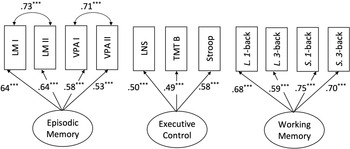
As previously noted, to reduce the number of outcome variables, we conducted an exploratory PCA with varimax rotation on the cognitive subtests of interest. The subtests loaded on three factors, with (1) Logical Memory and Verbal Paired Associates immediate and delayed recall subtests loading on the first factor; (2) Letter-Number Sequencing, (inverse) part B of the Trail Making Test, and the Stroop Color-Word Interference condition loading on the second factor; and (3) the letter and spatial n-back scores loading on the third factor.
Our PCA included tasks designed to measure verbal episodic memory, working memory, and executive function. Notably, we expected Letter-Number Sequencing, which is traditionally considered a working memory task, to have loaded on the third factor along with the n-back tests of working memory. However, in our analysis, this task correlated more strongly with the executive function tasks. Letter-Number Sequencing has been found to reflect aspects of cognition beyond auditory working memory, including processing speed and visuospatial working memory (Crowe, Reference Crowe2000), and likely requires more sorting and executive control abilities than similar working memory tasks that involve only a single stimulus type (e.g., only numbers such as in the Digit Span task). Therefore, this subtest likely engages cognitive processes that overlap more closely with the other executive tasks included in the PCA, specifically Trail Making Test part B and Stroop Color-Word Interference. Overall, we determined that the three cognitive factors most closely reflect verbal episodic learning and memory, executive control processes, and updating working memory, respectively; here, we label these cognitive domains as “episodic memory,” “executive control,” and “working memory.” To verify their structures (depicted in Figure 3) we included these factors in the comprehensive confirmatory factor analysis conducted in Mplus, which, as noted above, evinced appropriate fit.
Measurement model for cognitive performance. Note. Principal component analyses estimated three cognitive factors: episodic memory, executive control, & working memory. Standardized path coefficients are reported. Circles indicate latent factors and rectangles indicate observed variables. LM I = logical memory I (Immediate recall), LM II = logical memory II (Delayed recall), VPA I = verbal paired associates I (Immediate recall), VPA II = verbal paired associated II (Delayed recall), LNS = Letter-Number Sequencing, TMT B = trail making test part B, L. = letter (n-back), S. = spatial (n-back). ***p < .001, **p < .01, *p < .05.

Primary analyses
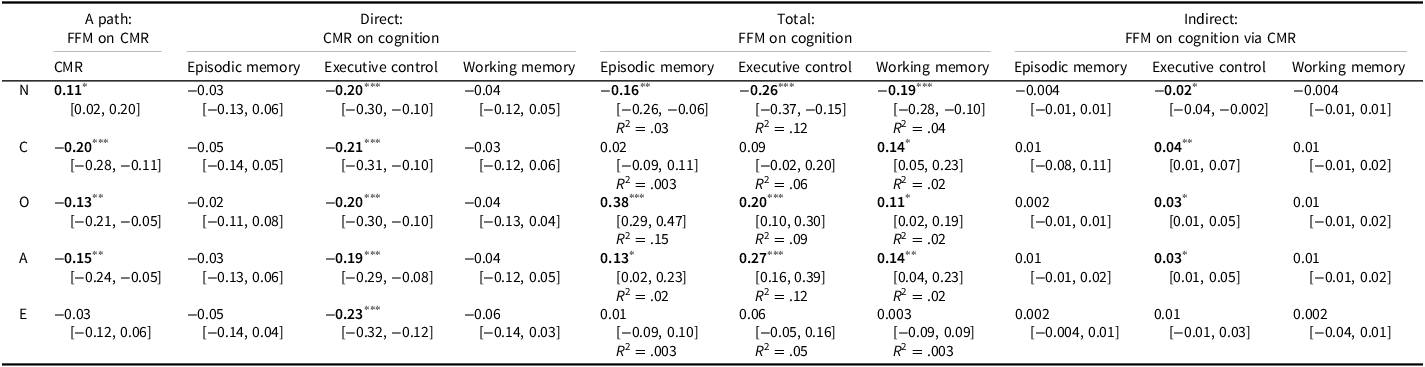
For each of the five FFM traits, we ran a model testing the effect of the trait on cardiometabolic risk (“a path” in mediation), the total effect of the trait on each cognitive domain, the direct effect of cardiometabolic risk on each cognitive domain controlling for the trait, and the indirect effect of the trait on each cognitive domain via cardiometabolic risk. Age, race, and sex included as covariates in all models. As detailed in Table 2, each model yielded appropriate fit (all χ2 = 503.44–533.96 df = 245, p < .001, CFI = .97, RMSEA = .035–.037, 90% CI[.031, .039] – [.033, .041], SRMR = .032–.033).
Estimates of FFM traits on cardiometabolic risk (CMR) and cognition

Note: Each row represents separate models testing associations between the respective FFM trait, CMR, and performance in each cognitive domain. R 2 refers to the proportion of variance explained by the personality predictor in the cognitive outcome. Fit was appropriate for all models: χ 2 = 503.44–533.96 df = 245, p < .001, CFI = .97, RMSEA = .035–.037, 90% CI[.031, .039]–[.033, .041], SRMR = .032–.033.
FFM = Five-Factor Model; CMR = cardiometabolic risk; N = neuroticism; C = conscientiousness; O = openness; A = agreeableness; E = extraversion.
***p < .001, **p < .01, *p < .05.
Effects of FFM traits on cardiometabolic risk (a path) and cognition (total effect)
Higher Neuroticism (β = 0.11, p = .02), lower Conscientiousness (β = −0.20, p < .001), lower Openness (β = −0.13, p = .002), and lower Agreeableness (β = −0.15, p = .002) were significantly associated with greater cardiometabolic risk. Lower Neuroticism was significantly associated with better episodic memory (β = −0.16, p = .001), better executive control (β = −0.26, p < .001), and better working memory (β = −0.19, p < .001). Higher Openness and Agreeableness were also significantly associated with better episodic memory (β = 0.38, p < .001; β = 0.13, p = .02), executive control (β = 0.20, p < .001; β = 0.27, p < .001), and working memory (β = 0.11, p = .01; β = 0.14, p = .01). Higher Conscientiousness was associated with better working memory only (β = 0.14, p = .01). Extraversion was not associated with cardiometabolic risk or any cognitive outcome.
Effects of cardiometabolic risk on cognition (direct effect)
Across all models, greater cardiometabolic risk associated with poorer executive control (β= −0.19 to −0.23, p < .001), but not episodic or working memory. With respect to the former, β coefficients vary slightly across trait-specific models due to each model accounting for a different personality trait.
Indirect effects of FFM traits on cognition via cardiometabolic risk
Lower cardiometabolic risk accounted for the association of several personality traits, specifically, lower Neuroticism (β = −0.02, p = .03), higher Openness (β = 0.03, p = .02), and higher Agreeableness (β = 0.03, p = .02), with better executive control, but not episodic memory or working memory. Additionally, although there was no association between Conscientiousness and greater executive control, the association was significant via the indirect effect of lower cardiometabolic risk (β = 0.04, p = .003). There were no significant indirect effects with Extraversion.
Secondary analyses
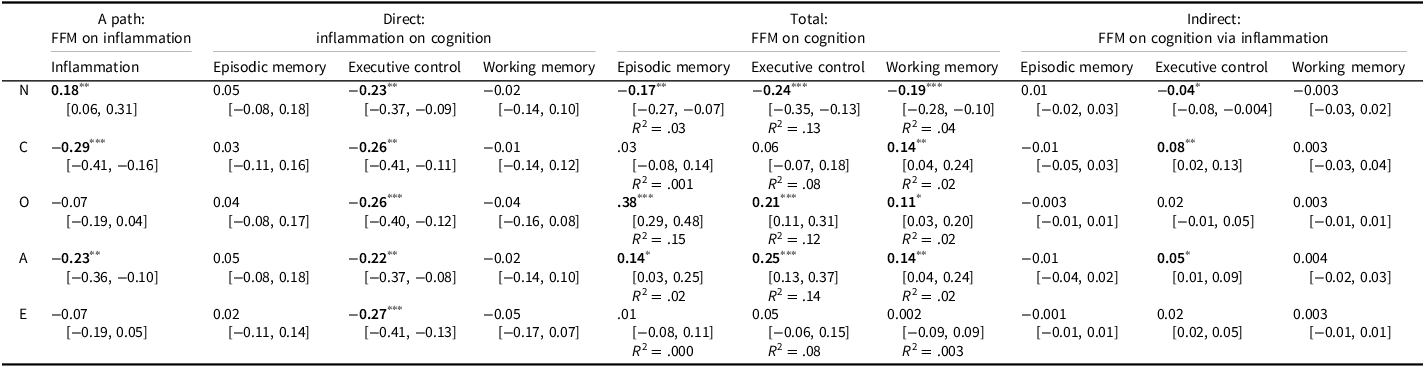
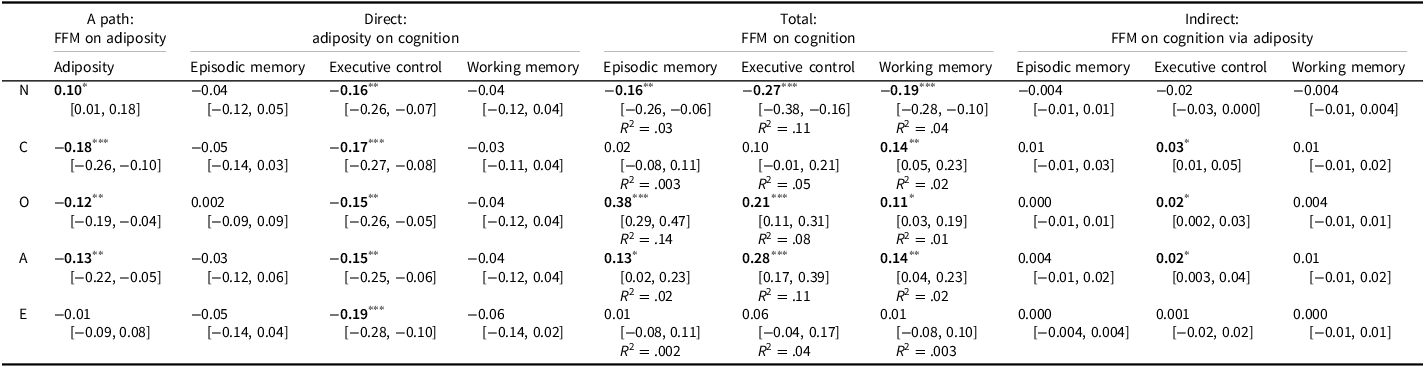
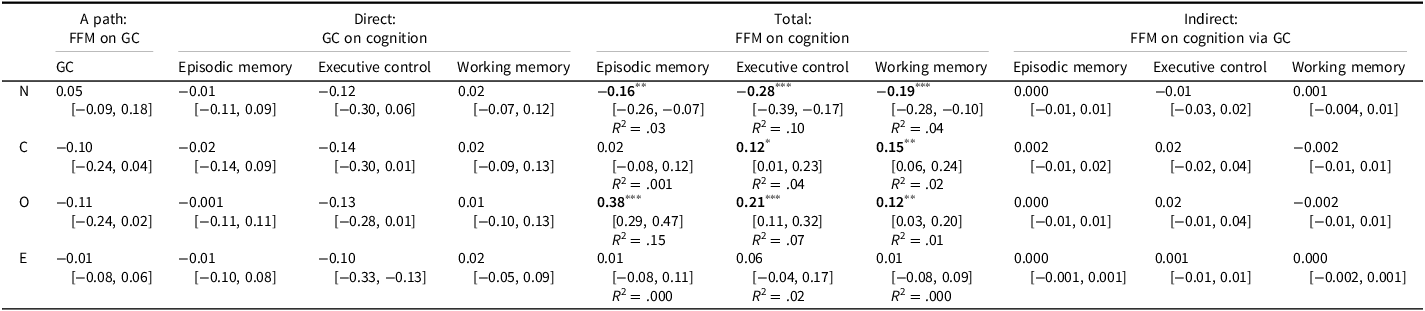
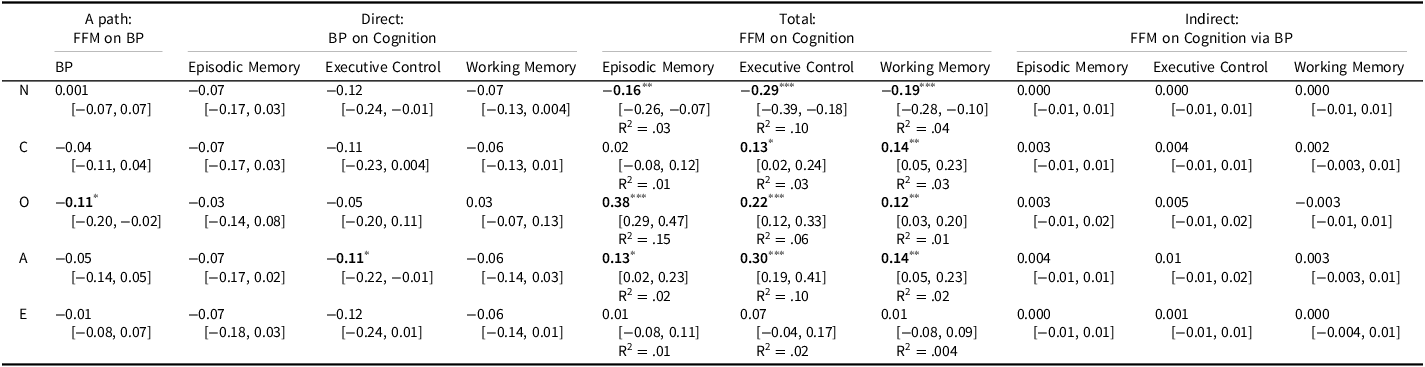
To evaluate whether results of primary analyses were driven differentially by individual components of cardiometabolic risk, secondary analyses summarized in Tables 3–7 examined total, direct, and indirect effects of the five personality traits on latent factors of inflammation, adiposity, glycemic control, blood pressure, and blood lipids, as related to each of the three cognitive domains and including age, race, and sex as covariates.
Estimates of FFM traits on inflammation and cognition

Note: Each row represents separate models testing associations between the respective FFM trait, inflammation, and performance in each cognitive domain. R2 refers to the proportion of variance explained by the personality predictor in the cognitive outcome. Fit was appropriate for all models: χ 2 = 239.59–270.65 df = 97, p < .001, CFI = .97, RMSEA = .041–.046, 90% CI[.035–.048]–[.039, .052], SRMR = .026–.030.
FFM = Five-Factor Model. N = neuroticism; C = conscientiousness; O = openness; A = agreeableness; E = extraversion.
***p < .001, **p < .01, *p < .05.
Estimates of FFM traits on adiposity and cognition

Note: Each row represents separate models testing associations between the respective FFM trait, adiposity, and performance in each cognitive domain. R2 refers to the proportion of variance explained by the personality predictor in the cognitive outcome. Fit was appropriate for all models: χ2 = 234.79–255.34 df = 93, p < .001, CFI = .98, RMSEA = .042–.045, 90% CI[.036–.049]–[.039, .052], SRMR = .024–.028.
FFM = Five-Factor Model. N = neuroticism; C = conscientiousness; O = openness; A = agreeableness; E = extraversion.
***p < .001, **p < .01, *p < .05.
Estimates of FFM traits on glycemic control and cognition

Note: Each row represents separate models testing associations between the respective FFM trait, glycemic control, and performance in each cognitive domain. Models testing associations between Agreeableness, glycemic control, and cognition are not presented, as these analyses did not converge. R 2 refers to the proportion of variance explained by the personality predictor in the cognitive outcome. Fit was appropriate for all models: χ 2 = 220.43–243.07 df = 94, p < .001, CFI = .97–.98, RMSEA = .040–.043, 90% CI[.033, .046]–[.036, .050], SRMR = .025–.028.
FFM = Five-Factor Model; GC = glycemic control; N = neuroticism; C = conscientiousness; O = openness; E = extraversion.
***p < .001, **p < .01, *p < .05.
Estimates of FFM traits on blood pressure and cognition

Note: Each row represents separate models testing associations between the respective FFM trait, blood pressure, and performance in each cognitive domain. R2 refers to the proportion of variance explained by the personality predictor in the cognitive outcome. Fit was appropriate for all models: χ2 = 213.66–243.25 df = 92, p < .001, CFI = .97–.98, RMSEA = .039–.044, 90% CI[.032, .046]–[.037, .051], SRMR = .023–.028.
FFM = Five-Factor Model; BP = blood pressure; N = neuroticism; C = conscientiousness; O = openness; A = agreeableness; E = extraversion.
***p < .001, **p < .01, *p < .05.
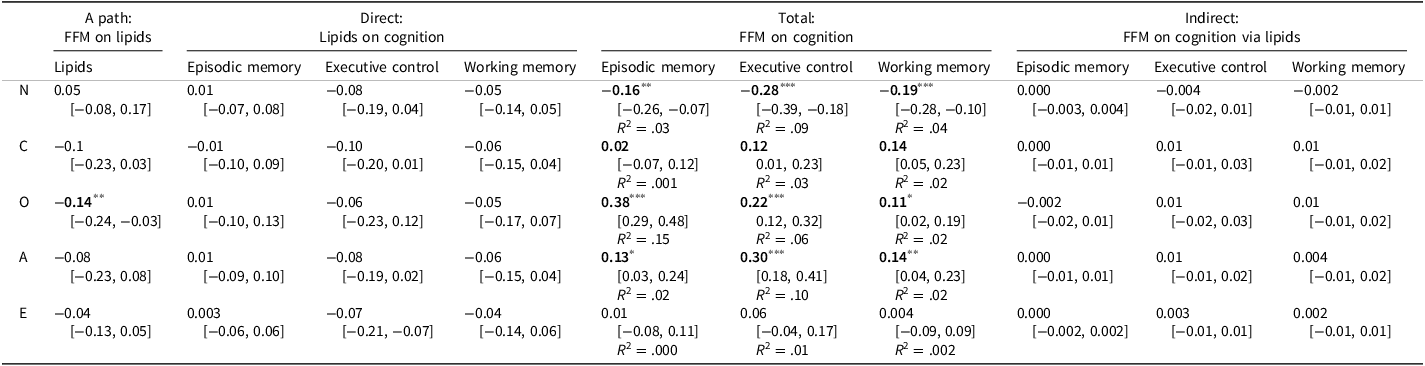
Estimates of FFM traits on blood lipids and cognition

Note: Each row represents separate models testing associations between the respective FFM trait, blood lipids, and performance in each cognitive domain. R 2 refers to the proportion of variance explained by the personality predictor in the cognitive outcome. Fit was appropriate for all models: χ 2 = 219.68–250.77 df = 93, p < .001, CFI = .97–.98, RMSEA = .040–.045, 90% CI[.033, .047]–[.038, .051], SRMR = .024–.028.
FFM = Five-Factor Model; N = neuroticism; C = conscientiousness; O = openness; A = agreeableness; E = extraversion.
***p < .001, **p < .01, *p < .05.
Effects of FFM traits on cardiometabolic risk components (a path)
Higher Neuroticism (β = 0.18, p = .004), lower Conscientiousness (β = −0.29, p < .001), and lower Agreeableness (β = −0.23, p = .001) were each significantly associated with greater inflammation. The same three traits, as well as Openness, were similarly associated with adiposity: Neuroticism (β = .10, p = .02), Conscientiousness (β = −.18, p < .001), Agreeableness (β = −.13, p = .002), and Openness (β = −.12, p = .002). Although Openness also covaried inversely with blood pressure (β = −.11, p = .02) and blood lipids (β = −.14, p = .01), there were no other significant associations of FFM traits with individual components of cardiometabolic risk. Altogether, then, the relationship of personality to overall cardiometabolic risk, as shown above for all traits but Extraversion, appears limited largely to two of its constituent factors, inflammation, and adiposity.
Effects of cardiometabolic risk components on cognition (direct effects)
As noted earlier, β coefficients of the direct effects of cardiometabolic indicators on cognition vary slightly across trait-specific models because each model accounts for a different personality trait. As depicted in Tables 3 and 4, respectively, when controlling for neuroticism, greater inflammation (β = −.23, p = .002) and adiposity (β = −.16, p = .001) were each associated with poorer executive control. However, neither these risk factors nor glycemic control, blood pressure, or blood lipids accounted for significant variation in episodic or working memory.
Indirect effects of FFM traits on cognition via cardiometabolic risk components
Among indirect associations, greater inflammation accounted for the association of several personality traits, specifically, higher Neuroticism (β = −0.04, p = .03) and lower Conscientiousness (β = 0.08, p = .01) and Agreeableness (β = 0.05, p = .02), with poorer executive control. Greater adiposity likewise accounted for effects on executive control associated with lower Conscientiousness (β = 0.03, p = .01), Agreeableness (β = 0.02, p = .02), and Openness (β = 0.02, p = .03), and did so marginally for Neuroticism (β = −0.02, p = .04). Finally, no trait-specific indirect effects were observed with other cardiometabolic components or in relation to either episodic or working memory.
Indirect effects of FFM traits on executive control via inflammation, adjusted for adiposity
In the foregoing analyses, inflammation, and adiposity, but not other cardiometabolic risk components, largely explained the association of personality traits with poorer executive functioning. Notably, adipocytes are known to release proinflammatory cytokines, and IL-6 and CRP correlate positively with body weight, particularly in the context of obesity (Beavers et al., Reference Beavers, Beavers, Newman, Anderson, Loeser, Nicklas, Lyles, Miller, Mihalko and Messier2015; Berg & Scherer, Reference Berg and Scherer2005; Malavazos et al., Reference Malavazos, Corsi, Ermetici, Coman, Sardanelli, Rossi, Morricone and Ambrosi2007). It is possible, therefore, that the explanatory role of systemic inflammation here partly reflects a downstream effect of FFM traits on adiposity. Accordingly, we ran additional models to determine whether covariate adjustment for adiposity erodes the indirect effects of Neuroticism, Conscientiousness and Agreeableness on executive functioning, as attributed to inflammation. As shown in Table S1, it did so in each instance, with the inflammatory pathway now proving nonsignificant for all three personality traits.
Discussion
We investigated the relation between FFM personality traits and midlife cognitive performance, and whether any associations may be accounted for by variance in cardiometabolic risk. Overall, structural models revealed several direct and indirect associations in support of our hypotheses. First, in line with prior work (Sutin, Brown, et al., Reference Sutin, Brown, Luchetti, Aschwanden, Stephan and Terracciano2022; Sutin, Stephan, et al., Reference Sutin, Stephan, Luchetti, Strickhouser, Aschwanden and Terracciano2022), higher cardiometabolic risk was associated with poorer cognitive performance, although these associations were specific to lower executive control in this sample. Moreover, Neuroticism and higher Openness and Agreeableness were associated with better performance in all examined cognitive domains (episodic memory, executive control, and working memory), and higher Conscientiousness was associated with better working memory. In addition, associations of lower Neuroticism, higher Openness, higher Conscientiousness, higher Agreeableness, with better executive control were accounted for by the indirect effect of cardiometabolic risk. Extraversion, however, was not associated with any cognitive outcome. Lastly, our results support and build upon previously reported findings (Dermody et al., Reference Dermody, Wright, Cheong, Miller, Muldoon, Flory, Gianaros, Marsland and Manuck2016), such that lower Neuroticism, and higher Openness, Agreeableness, and Conscientiousness were significantly associated with lower cardiometabolic risk, extended here to include inflammatory markers alongside metabolic syndrome components.
Altogether, our analyses testing the association between FFM traits and cognition corroborate numerous prior studies reporting associations of lower Neuroticism, higher Openness, and higher Conscientiousness with better cognitive performance across domains (Luchetti et al., Reference Luchetti, Terracciano, Stephan, Aschwanden and Sutin2021, Reference Luchetti, Terracciano, Stephan and Sutin2016; Sutin et al., Reference Sutin, Brown, Luchetti, Aschwanden, Stephan and Terracciano2023; Sutin, Stephan, Damian, et al., Reference Sutin, Stephan, Damian, Luchetti, Strickhouser and Terracciano2019; Sutin, Stephan, et al., Reference Sutin, Stephan, Luchetti, Strickhouser, Aschwanden and Terracciano2022; Sutin, Stephan, Luchetti, et al., Reference Sutin, Stephan, Luchetti and Terracciano2019). Notably, although Openness was associated with performance in each domain we assessed, this was the only trait that explained substantially more variance in (verbal) episodic memory than in executive control. These findings may, in part, reflect positive correlations between Openness and crystalized, fluid, and verbal intelligence (DeYoung et al., Reference DeYoung, Quilty, Peterson and Gray2014). With respect to Agreeableness and Extraversion, the literature has been mixed, with reports of positive, negative, and null associations with cognition. Here, we found no associations between Extraversion and cognitive performance; however, higher Agreeableness was positively correlated with performance across cognitive domains in this midlife sample.
Although it is unclear why findings pertaining to the relationship between Agreeableness and cognition are often mixed, it is notable that most prior studies reporting null results have not used multi-informant approaches to assess personality. There are a number of advantages of including peer ratings, alongside self-report, when evaluating personality as a predictor of health and behavioral outcomes. First, as a benefit of the aggregation of multiple indicators, combining ratings from multiple informants has been shown to improve measurement reliability (Jackson et al., Reference Jackson, Connolly, Garrison, Leveille and Connolly2015; Nunnally, Reference Nunnally1967). Including peer ratings may also attenuate measurement biases associated with relying solely on self-report (Huprich et al., Reference Huprich, Bornstein and Schmitt2011; Vazire & Carlson, Reference Vazire and Carlson2011). Indeed, in the current study sample, standardized betas were generally stronger for analyses which used latent personality traits based on multiple informants (e.g., Table 2), than for those using any single rater (Table S2).
Regarding the relation between cardiometabolic risk and cognition, we predicted that greater cardiometabolic risk would be associated with poorer performance across all cognitive domains given evidence of wide-ranging effects of cardiometabolic indicators on the brain (Friedman et al., Reference Friedman, Tang, de Haas, Changchien, Goliasch, Dabas, Wang, Fayad, Fuster and Narula2014). However, contrary to our expectations, there was a degree of domain-specificity in our findings, in that these associations were only significant for executive control, not episodic or working memory. These results parallel functional neuroimaging findings showing that associations between metabolic syndrome components and poorer cognitive performance were mediated by lower resting state connectivity in the default mode network for executive function but not memory (Foret et al., Reference Foret, Dekhtyar, Birdsill, Tanaka and Haley2021). Given that the metabolic syndrome and its indicators greatly increase risk for cerebrovascular injury (Arshad et al., Reference Arshad, Lin and Yahaya2018; Wardlaw et al., Reference Wardlaw, Smith and Dichgans2019), the specificity of our findings to executive control may be accounted for by disruptions in frontal–subcortical networks arising from microvascular and small vessel ischemic damage to subcortical regions, consistent with vascular patterns of cognitive impairment (Jokinen et al., Reference Jokinen, Kalska, Mäntylä, Pohjasvaara, Ylikoski, Hietanen, Salonen, Kaste and Erkinjuntti2006; Van Der Flier et al., Reference van der Flier, Skoog, Schneider, Pantoni, Mok, Chen and Scheltens2018; Wallin et al., Reference Wallin, Román, Esiri, Kettunen, Svensson, Paraskevas and Kapaki2018).
Other prior work has suggested that certain components of cardiometabolic risk may differentially associate with performance in specific cognitive domains (Levin et al., Reference Levin, Llabre, Dong, Elkind, Stern, Rundek, Sacco and Wright2014; Tahmi et al., Reference Tahmi, Palta and Luchsinger2021). However, secondary analyses (Tables 3–7) did not reveal significant associations between any of the individual cardiometabolic risk indicators and episodic or working memory. Thus, our findings suggest that executive function may be particularly sensitive to cardiometabolic risk. It should be noted, however, that our latent factor of episodic memory was limited to immediate/delayed recall scores on WMS-III tasks of story and paired associate memory, which may be restricted in their sensitivity to detecting subtle impairments in cognition, especially in younger, healthy populations, and relative to list learning and selective reminding tasks (Beck et al., Reference Beck, Gagneux-Zurbriggen, Berres, Taylor and Monsch2012; Rabin et al., Reference Rabin, Paré, Saykin, Brown, Wishart, Flashman and Santulli2009; Weissberger et al., Reference Weissberger, Strong, Stefanidis, Summers, Bondi and Stricker2017). Additionally, the episodic memory latent factor only contained verbal indicators, and the working memory factor consisted only of a very specific set of “updating” working memory tasks. Thus, it is possible that unmeasured aspects of episodic and working memory may nonetheless associate with cardiometabolic function.
We also address mechanistic gaps in the existing literature by reporting new evidence that differences in cardiometabolic risk accounted for associations of each FFM trait (except Extraversion) with executive control. Overall, these relations are consistent with conceptual models positing that certain features of the FFM traits, such as a greater susceptibility to distress related to high Neuroticism and a lower propensity to engage in health motivated behavior associated with low Conscientiousness, predispose individuals to heightened cardiometabolic health risk. And in turn, greater cardiometabolic risk may precipitate detrimental aging-related cognitive changes by reducing the structural integrity of the brain through multiple mechanisms such as impaired vascular reactivity, neuroinflammation, and oxidative stress (Allen et al., Reference Allen, Jennings, Muldoon and Gianaros2020; Beck et al., Reference Beck, de Lange, Pedersen, Alnaes, Maximov, Voldsbekk, Richard, Sanders, Ulrichsen, Dørum, Kolskår, Høgestøl, Steen, Djurovic, Andreassen, Nordvik, Kaufmann and Westlye2022; Farooqui et al., Reference Farooqui, Farooqui, Panza and Frisardi2012; Fuhrmann et al., Reference Fuhrmann, Nesbitt, Shafto, Rowe, Price, Gadie, Tyler, Brayne, Bullmore, Calder, Cusack, Dalgleish, Duncan, Henson, Matthews, Marslen-Wilson, Rowe, Shafto, Campbell and Kievit2019; Yates et al., Reference Yates, Sweat, Yau, Turchiano and Convit2012).
In this study, we modeled cardiometabolic risk as a second-order latent factor with five underlying first-order factors, in line with the conceptualization of a unitary cardiometabolic syndrome (Shen et al., Reference Shen, Todaro, Niaura, McCaffery, Zhang, Spiro III and Ward2003). This and similar structures have been previously replicated and tend to be robust to variation in characteristics such as age, sex, and race (Dermody et al., Reference Dermody, Wright, Cheong, Miller, Muldoon, Flory, Gianaros, Marsland and Manuck2016; Marsland et al., Reference Marsland, McCaffery, Muldoon and Manuck2010; McCaffery, Marsland, Strohacker, Muldoon, & Manuck, 2012; McCaffery et al., Reference McCaffery, Shen, Muldoon and Manuck2007), and prior work has suggested that combined indices of the metabolic syndrome may predict cardiometabolic morbidity beyond and above its individual components (e.g., Malik et al., Reference Malik, Wong, Franklin, Kamath, L’Italien, Pio and Williams2004). Nonetheless, we further explored the nature of the indirect effect of cardiometabolic risk in the relation between FFM traits and executive control by testing whether the individual components of cardiometabolic risk accounted for associations between personality and cognitive performance. Of these, only inflammation and adiposity did so significantly and with respect to executive control. As the indirect effect of inflammation was no longer significant in further models that adjusted for adiposity, it is conceivable that adiposity may mediate effects of FFM traits on executive control, at least in part, through an inflammatory pathway. Mechanistically, adipose cells are potent sources of proinflammatory cytokines, accounting for up to one third of circulating levels of IL-6 (Eder et al., Reference Eder, Baffy, Falus and Fulop2009; El-Mikkawy et al., Reference El-Mikkawy, EL-Sadek, EL-Badawy and Samaha2020), which, in turn, stimulate the peripheral release of CRP from hepatocytes. IL-6 can cross the blood brain barrier, promoting central inflammatory processes that can impart damage to brain tissue (Coppack, Reference Coppack2001; de Paula et al., Reference de Paula, Brunetta, Engel, Gaspar, Velloso, Engblom, de Oliveira and de Bem2021; Furutama et al., Reference Furutama, Matsuda, Yamawaki, Hatano, Okanobu, Memida, Oue, Fujita, Ouhara, Kajiya, Mizuno, Kanematsu, Tsuga and Kurihara2020; Huang et al., Reference Huang, Hussain and Chang2021). Consistent with this, bariatric surgery has been shown to occasion improvements in both systemic inflammation and cognitive functioning, including executive abilities (Custers et al., Reference Custers, Franco and Kiliaan2023; Custers et al., Reference Custers, Vreeken, Kleemann, Kessels, Duering, Brouwer, Aufenacker, Witteman, Snabel, Gart, Mutsaerts, Wiesmann, Hazebroek and Kiliaan2024; Handley et al., Reference Handley, Williams, Caplin, Stephens and Barry2016; Handley et al., Reference Handley, Williams, Caplin, Stephens and Barry2016; Hawkins et al., Reference Hawkins, Alosco, Spitznagel, Strain, Devlin, Cohen, Crosby, Mitchell and Gunstad2015).
It should be noted that the participants in this study were relatively healthy from a cardiometabolic and cognitive standpoint, given exclusion of individuals with chronic medical conditions and use of medications such as antihypertensives. Still, the prevalence of the metabolic syndrome (as traditionally defined) was 24% in this sample (Manuck et al., Reference Manuck, Phillips, Gianaros, Flory and Muldoon2010), which is comparable with other population estimates (Hirode & Wong, Reference Hirode and Wong2020). Further, although the findings of this study may be conservative, they do indicate that, even in a healthy, midlife population, relative differences in cardiometabolic risk may be sufficient to contribute to differences in cognitive performance. It is also possible that our restricted sample contributed to relatively small effect sizes. Yet, prior studies of personality and cognitive associations with varying sample characteristics and exclusion criteria have also reported effects that were modest, though comparable to other clinical predictors of cognitive decline, such as diabetes, smoking status, and physical inactivity (Luchetti et al., Reference Luchetti, Terracciano, Stephan and Sutin2016). Nevertheless, further investigation of these associations in clinical populations is needed to clarify the clinical relevance and utility of our findings. Lastly, as is a common challenge with cognitive testing, we cannot be sure that maximal effort was put forth by study participants; thus, it is not clear to what extent participant performance might have been underestimated in this study. Nonetheless, our relatively large sample size reduces our concern about any systematic underrepresentation of cognitive performance.
Overall, there were a number of strengths to the current study, including a large sample size; the combination of self- and multiple-informant reports to assess personality; neuropsychological assessments that captured performance in several cognitive domains; and the focus on midlife, as an important developmental period. However, our findings are also qualified by several limitations. First, given the cross-sectional nature of this study, we cannot establish the temporal precedence of FFM traits and cardiometabolic risk to make any causal determinations about their associations with cognitive function. Longitudinal studies will be important to verify temporal order and further clarify the implications of these findings. Additionally, exploring additional cognitive domains, such as visuospatial memory and psychomotor speed, may shed further light on associations between personality, cardiometabolic risk, and cognitive ability. Lastly, as previously noted, there may be limits to the generalizability of our results given that participants were predominantly White and relatively healthy; thus, future research examining these associations in more diverse and clinical populations will be important.
Conclusion
In sum, the current study provides a biological characterization of the associations between personality, physiological health, and cognition at midlife, and sheds light on previously poorly understood mechanisms linking FFM personality traits to cognition. Specifically, we contribute new evidence that lower cardiometabolic risk accounts for the associations between lower Neuroticism and higher Openness, Conscientiousness, and Agreeableness, with better executive control in midlife. Our study highlights, in particular, adiposity and systemic inflammation as key mediators of interest in future longitudinal investigations. From a clinical and public health perspective, these findings may aid in the early detection and intervention of poor cognitive outcomes, as they suggest a possible predictive utility of the FFM personality traits in identifying those at risk for poorer cognitive outcomes and highlight several potential modifiable intervention targets. Future research should explore whether these pathways account for longitudinal changes in cognition and risk for developing aging-related neurocognitive disorders.
Supplementary material
For supplementary material/s referred to in this article, please visit https://doi.org/10.1017/S1355617725101288.
Funding statement
This research was supported by NIH Grants HL040962, HL065137, and AG056043. The funders had no role in the design of the study, in the collection, analyses, or interpretation of the data; in the writing of the manuscript, or in the decision to publish the results.
Competing interests
The authors of this manuscript have no conflicts of interest to report.



 Open access

