


Globally, rainforests are in decline as a result of an increase in anthropogenic activities (Tscharntke et al. Reference Tscharntke, Leuschner, Veldkamp, Faust, Guhardja, Bidin, Tsaharntke, Leuschner, Veldkamp, Faust, Guhardja and Bidin2010). At the turn of the 20th century lowland tropical rainforest cover across Kenya was c. 240,000 ha (Freund, Reference Freund2005) but following severe deforestation and fragmentation, Kakamega Forest in western Kenya is the only remaining lowland tropical rainforest in the country. It covers 24,000 ha, with only 10,000 ha (42%) of indigenous forest remaining (Mitchell, Reference Mitchell, Bleher and Dalitz2004). Kakamega forest has high biodiversity, including rare and endemic species (KIFCON, 1994), and is the easternmost remnant of the Guineo–Congolian rainforest, which once spanned equatorial Africa (Kokwaro, Reference Kokwaro1988).
A common theme throughout the developing world is of a high density of poor people living adjacent to tropical forests who rely on subsistence harvesting from these forests (Myers, Reference Myers1992). This is also true of Kakamega Forest, which lies amidst one of the most densely populated rural areas of Kenya (542 people per km2; KNBS, 2015); 52% of the population live on < USD 1 per day (KNBS, 2009). Consequently, people have little choice but to rely on the harvesting of forest products for food, income and fuel (Wambua, Reference Wambua2008).
Kakamega Forest is managed by two semi-autonomous government agencies: the Kenya Forest Service, which collaborates with local Community Forest Associations to manage 196 km2 (c. 82%) of the forest, and Kenya Wildlife Service, which manages 44 km2 (c. 18%). In 1991 the two Services entered into a memorandum of understanding for management of forests throughout Kenya (Guthiga & Mburu, Reference Guthiga and Mburu2006). Within its jurisdiction, the Kenya Forest Service incentivizes conservation of Kakamega Forest by allowing people to legally harvest forest products upon the purchase of a permit, whereas the Kenya Wildlife Service prohibits all forms of harvest. Penalties for offenders in the area managed by the Kenya Wildlife Service are severe (Guthiga & Mburu, Reference Guthiga and Mburu2006; Wildlife Conservation & Management Act, 2013).
Nevertheless, illegal activities such as logging, charcoal burning and hunting occur throughout Kakamega Forest (Bleher et al., Reference Bleher, Uster, Bergsdorf, Hawksworth and Bull2006). There is, however, little information about how much and at what rate local communities are harvesting forest resources, either legally or illegally. The objectives of this study were fourfold: (1) quantify the rate and amount of wood harvested from Kakamega Forest; (2) assess differences in wood harvest between the areas managed by the two Services; (3) determine which, if any, wood species are preferentially harvested; and (4) assess economic drivers of wood harvest, and how far from the forest the harvested wood is used.
This project was conducted in collaboration with local people and the Kenyan conservation corporation Eco2librium. Eco2librium is a for-profit company that uses business solutions to solve social and environmental problems (Gao et al., Reference Gao, Jackson, Jeon, Jung and Schaller2015). From March to August 2015, we walked along forest edges and forest trails and randomly sampled women and girls who were bearing fuelwood, enquiring if we could weigh their wood bundles (Fig. 1). Wood harvesting from the forest is the primary source of cooking fuel for > 90% of people living near Kakamega Forest and is typically collected by women and young girls (Kiefer & Bussmann, Reference Kiefer and Bussmann2008). We weighed head-load bundles at 24 locations (21 and three in the Kenya Forest Service and Kenya Wildlife Service jurisdictions, respectively) and recorded the latitude and longitude, and date and time of measurements for each location. Sampling was randomized so that the Kenya Forest Service and Kenya Wildlife Service areas would be sampled proportionally. We varied the time and locations of measurements, to reduce avoidance bias. Avoidance of researchers is common in wood harvest studies because many harvesters lack permits, harvest restricted species or cut wood, and the permits only allow harvesters to gather already felled wood from non-indigenous species (Guthiga & Mburu, Reference Guthiga and Mburu2006).
Kakamega Forest, Kenya, showing the locations where harvested wood was collected and of markets where wood was sold.

For each head load we recorded wood mass, % cut wood (as opposed to already felled wood), % of wood from indigenous species, species, and bundle diameter, length and circumference. The field assistant was a trained forester and identified species based on local knowledge and the use of a field guide (Dalitz et al., Reference Dalitz, Dalitz, Musila and Masinde2011). We measured head-load mass by weighing wood harvesters with and without their bundles, subtracting body weight. To reduce inter-observer bias in estimation of % cut and % indigenous wood, we stratified percentages in six equally distributed bins and recorded the median percentile of each bin. While we measured wood bundles we also interviewed harvesters, requesting information about (1) age, (2) family size, (3) number of wood collection trips per week, and (4) home village (from which we were able to approximate the distances travelled to harvest wood).
We followed a subset of measured wood bundles from field sites to households or wood markets, to interview harvesters and wood buyers, asking (1) how much they charged for wood; (2) how they transported wood to and from markets; and (3) if a harvest or selling permit was required. All descriptive statistics were calculated using R v. 3.3.0 (R Development Core Team, 2015). To assess differences in wood harvesting (number of trips per week, wood mass, % cut wood, % indigenous wood, and wood diameter) between the Kenya Forest and Kenya Wildlife Service jurisdictions we used a multivariate analysis of variance, calculated with SAS 9.4 (SAS Institute Inc., Cary, USA).
We measured a total of 270 head bundles, and conducted 240 interviews around and within Kakamega Forest (Fig. 1) and 63 at 12 wood markets. Mean head-load mass was 29 ± SD 14 kg, harvesters made a mean of 3 ± SD 2 trips to the forest per week, and 99% of harvesters were females aged 6–68 years (median age = 16 years). Eleven percent of wood harvesters were aware of the need to have a permit to harvest firewood from the Kenya Forest Service forest. People harvesting from the Kenya Forest Service jurisdiction carried heavier bundles, walked longer distances to the forest, were older, made more collection trips per week, and carried a greater percentage of cut wood and a lower percentage of indigenous wood than those harvesting from the Kenya Wildlife Service jurisdiction (Table 1; multivariate analysis of variance F(28, 35) = 29.36, P < 0.0001; Wilk's Λ = 0.464).
Results of surveys of the head bundles of wood carried by wood harvesters collecting from the jurisdictions of the Kenya Forest Service and Kenya Wildlife Service in Kakamega Forest (Fig. 1), Kenya, with F and P values from a multivariate analysis.

* P ≤ 0.05.
1Wood mass, mean head-bundle mass; Distance travelled, mean distance travelled by harvesters to collect wood; Median age, median age of wood harvesters; Trips per week, mean number of wood collection trips per person per week; % cut wood, estimated % of cut wood in wood bundles by weight; Family size, median size of harvester's family; % indigenous wood, estimated % of indigenous wood in wood bundles by weight; Diameter, mean diameter of wood in head loads.
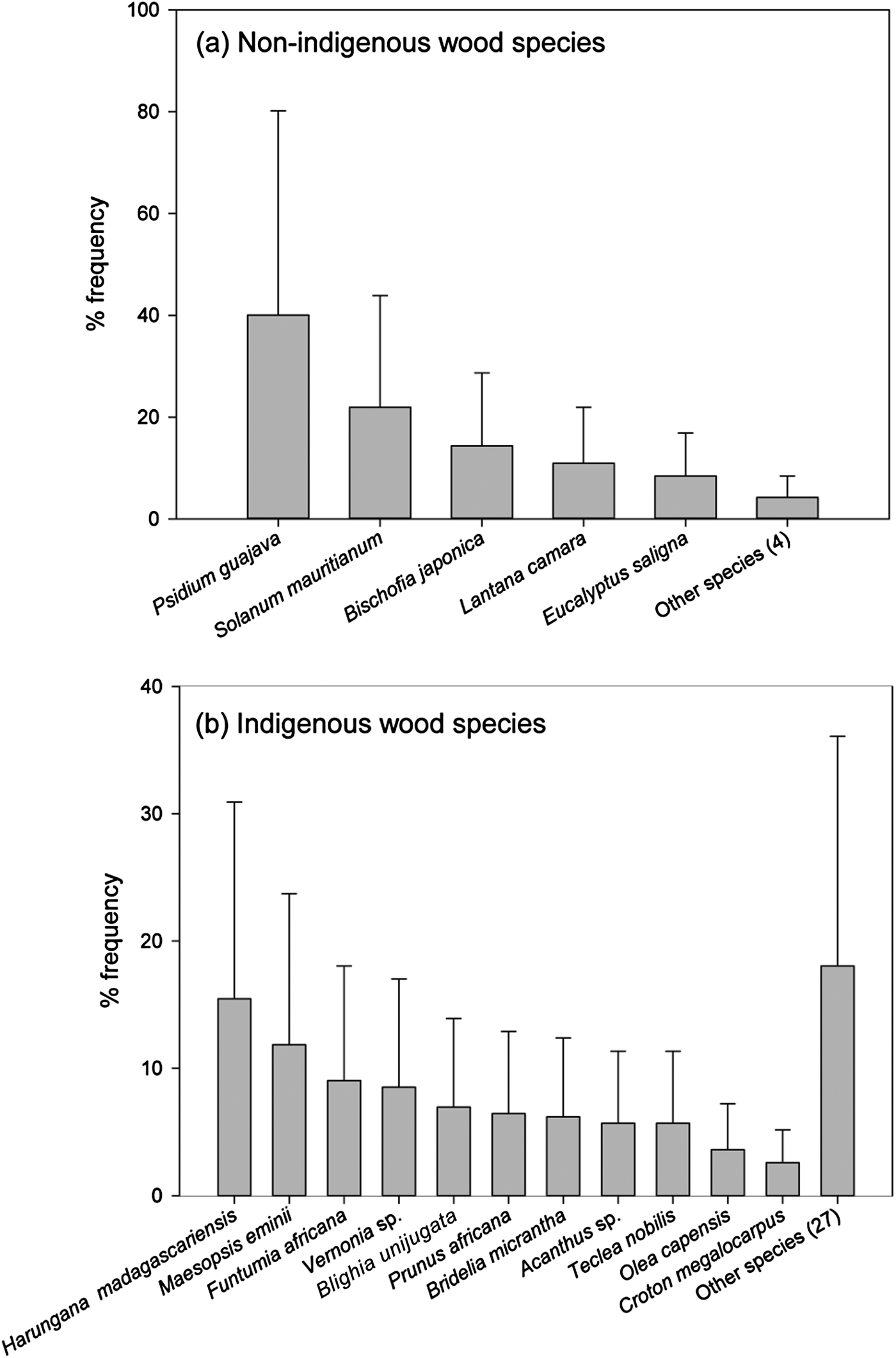
We identified 47 tree species in the head loads, 34 (72%) of which were from indigenous species. By weight the most common indigenous species harvested was Harungana madagascariensis (15% of all indigenous species harvested; Fig. 2a), and the most common non-indigenous species harvested was the guava tree Psidium guajava (40% of all non-indigenous wood harvested; Fig. 2b). This was consistent with the results from the wood market interviews, in which H. madagascariensis (25%, by weight, of indigenous wood species) and P. guajava (33%, by weight, of non-indigenous species) were the preferred indigenous and non-indigenous woods purchased by buyers.
Percentage frequency (± SD) of wood from (a) indigenous and (b) non-indigenous tree species harvested from Kakamega Forest, Kenya (note the different y-axis scales).
Wood was transported to the markets by foot (73.4% of sellers/transporters), motorcycle (9.4%), tractor (9.4%) and bicycle (4.7%). The maximum distance that wood was transported by foot was 9 km. When transported by motorcycle or tractor (by either harvesters or sellers), wood reaches as far as Kisumu, c. 50 km from the forest. At markets harvesters sell wood directly to end users or to sellers; the latter break down the bundles by species and size and collate them into new bundles. Wood from indigenous species is sold for a premium price and is in higher demand compared to wood from non-indigenous species. For example, at Lubao market a head-load bundle of wood from indigenous species sold directly by a harvester cost KES 200 (c. USD 2) whereas a head-load bundle from non-indigenous species sells for c. 25% less (KES 150, c. USD 1.5). Hotels purchased most of the wood (56% of buyers), followed by individuals (41%), schools (2%) and churches (1%).
Our study has four key findings. Firstly, we have quantified the rate of wood harvest from the areas managed by the Kenya Wildlife Service and Kenya Forest Service in Kakamega Forest. Secondly, those harvesting wood from the Kenya Wildlife Service jurisdiction are significantly younger and make fewer trips to the forest per week, suggesting that people are attempting to avoid arrest by sending their children. Thirdly, wood from indigenous species is preferred over that of non-indigenous species, and this preference is driven by market values, with buyers paying up to 25% more for the former (from our > 20 years of personal experience in the area, wood from the indigenous species harvested burns at a more consistent temperature, for a longer time, and has a more pleasant aroma and higher heat intensity). Fourthly, wood from Kakamega Forest is being sold in markets up to c. 50 km from the forest.
Fuelwood is the main product harvested from Kakamega Forest because it is a cheap source of energy for most households (Kiplagat et al., Reference Kiplagat, Mburu and Mugendi2008). The Kenya Forest Service offers regulated extraction, under permit, of forest resources as an incentive for conservation, and as ≥ c. 52% of people around the forest live in extreme poverty, with limited economic opportunities, this could be an incentive for forest conservation. However, there needs to be a balance between the rate of extraction, regeneration and replacement of forest resources, and both proper management and controlled harvesting are necessary to protect the forest.
The Kenya Wildlife Service, however, prohibits harvesting of wood and other forest products to ensure minimal disruption of ecological processes. Dead wood is crucial for forest health (Pfeifer et al., Reference Pfeifer, Lefebvre, Turner, Cusack, Khoo, Chey and Ewers2015), providing, for example, habitat and breeding sites for birds and invertebrates, and a substrate and nutrient source for fungi (Vrška et al., Reference Vrška, Přívětivý, Janík, Unar, Šamonil and Král2015), all of which are important for forest regeneration and maintenance of diversity (Travaglini et al., Reference Travaglini, Barbati, Chirici, Lombardi, Marchetti and Corona2007). The area managed by the Kenya Wildlife Service has higher biodiversity than that managed by the Kenya Forest Service (Kefa, Reference Kefa2016), suggesting that restrictive laws and harsh penalties may be a better approach for conserving forest biodiversity.
Areas with natural forest and indigenous trees such as Kakamega Forest may be targeted for wood extraction. To complicate matters further, the people charged with enforcing wood harvesting laws are often implicated in illegal logging or harvesting activities. For example, Mabatuk & Wesangula (Reference Mabatuk and Wesangula2015) recently reported that KES 20 million (approximately USD 20,000) worth of sandalwood Santalum album timber was impounded while being transported in a police car by an off-duty police officer (Mabatuk & Wesangula, Reference Mabatuk and Wesangula2015). Such blatant disregard for the law by those entrusted with its enforcement is perhaps the most difficult challenge to the conservation of Kenya's forests.
However, this may also suggest a way forward. As market economies seem to be driving deforestation, perhaps they could be used to incentivize forest conservation by diversifying local income, thereby reducing demand for forest resources. For example, with proper sensitization, the harvesting of invasive non-indigenous hardwood tree species, such as guava, could be encouraged, to counteract the high demand for wood from the rarer indigenous species. In addition, business solutions could be used to implement projects that create jobs, improve livelihoods and reduce demand for forest products (Lung & Espira, Reference Lung and Espira2015). Regardless, our data suggest that integration of economic forest conservation, economic diversification and effective forest management is needed to protect this forest.
Acknowledgements
Field methods were reviewed by the Bowling Green State University Human Subjects Research Board and were granted a waiver of approval on 10 March 2015, prior to the start of fieldwork. All research was conducted with the knowledge and approval of the legal governing bodies of Kenya and the Kakamega Forest, namely, Kenya National Commission for Science and Technology (Ref. no. NACOSTI/P/15/6537/4622), Kenya Forest Service (Ref. no, RESEA/1/KFS/VOL.II(25)), Kenya Wildlife Service (Ref. no. KWS/BRM/5001), the County Government of Kakamega (Ref. no. ED/12/1/169) and the State Department of Education (Kakamega County; Ref. no. WP/GA/29/17/VOL.II/2049). We thank the Kenya National Commission for Science and Technology, Kenya Forest Service and Kenya Wildlife Service for granting us permits to undertake this study and the County government of Kakamega County for approving our research permit, our collaborators at the National Museum of Kenya for administrative, logistical and technical support, the anonymous participants who spoke with us and allowed us to weigh their wood bundles, Bowling Green State University for material, financial and technical support, Dr Kefa Otiso and Genetic Research in Applied Spatial Ecology Lab members for their comments, the technicians Emma Spence, Gregory Brinkman and Nadejda Mirochnitchenko, Eco2librium staff, and in particular Herbert Imbuka, for their assistance with interviews, and two anonymous reviewers for their critiques.
Author contributions
CAK and AJG designed the project, collected and analysed the data, and wrote the article. ML and AE funded field data collection and helped with acquisition of necessary research permits from the Kenyan government.
Biographical sketches
Christopher Amutabi Kefa’s research focuses on assessing the impacts of human use of forests on forest biodiversity. Mark Lung has worked in Kenya for 20 years and is currently the Chief Executive Officer of Eco2librium. Anton Espira has conducted extensive ecology fieldwork internationally and is currently the Field Director of Eco2librium. Andrew Gregory is interested in spatial ecology, connectivity ecology and landscape genetics. The focus of his research is to understand population dynamics of non-equilibrium populations.



