




Introduction
The dedication of a special issue to disability and second language learning by Studies in Second Language Acquisition is timely. The field of second language (L2) research is experiencing an encouraging turn toward more inclusive research methods and learner populations. For example, in 2023, Language Learning unveiled its special issue titled SLA for All? We applaud the sentiment behind its publication and efforts within the field to closely examine and reduce biases. At the same time, we cannot help but notice who is still missing among the titular “all”: Disabled students exist even farther outside the realm of convenience than other non-WEIRD populations (White, Educated, Industrialized, Rich, Democratic; Andringa & Godfroid, Reference Andringa and Godfroid2020; Plonsky, Reference Plonsky2023). We realize that our very literal interpretation of the title of that special issue might imply an impossible expectation. Their point about the field being more inclusive is well taken and one we certainly agree with. Still, we must continuously take stock of who is not represented at the proverbial table or, more literally, in the pages of our journals.
Professional organizations in applied linguistics (AL) have also sought to shed more light on the intersection of L2 research and disability. The American Association for Applied Linguistics (AAAL) published a brief on ableism in language education in U.S. schools (Cioè-Peña, Reference Cioè-Peña2023), and Kayi-Aydar, in her plenary at the 2025 AAAL conference, called specifically for more intersectional research centered on disability. It’s also worth noting that language education in U.S. higher education continues to see rapidly declining enrollments, and to right the ship will take strategic and conscientious effort from researchers and educators alike, including, we would argue, purposeful pursuit of inclusive practices designed to recruit and retain world language students by better addressing their needs. With these field-wide and contextual backgrounds in mind, our intention behind this issue was to seize an opportune moment to amplify the voices of scholars who are engaged in this important work as it continues to gain momentum and share it with an audience well-positioned to undertake its advancement.
Our special issue rests upon the premise that disabled L2 learners—who comprise a large percentage of learners—must be included in scholarly discourse around teaching and research. How can we study L2 acquisition, teaching, or testing if we ignore a meaningful portion of the population? Having accepted that premise, scholars in the field should work to adopt more diverse and interdisciplinary research agendas that prioritize emic perspectives from within the disabled community.
We open the issue with this commentary detailing the current nexus of AL and disability studies. We highlight current movements within disability studies not yet recognized in AL, and we offer guidance for scholars interested in engaging with disability studies (including critical disability theory).
Disability and responsibility in applied linguistics
Applied linguistics holds language as an innate human ability: If you’re human, you can learn a language and with only an expected degree of variability. But when scholars untypify our participant base, that argument falls apart. When we broaden the range of who counts as a learner, assumptions about such understood elements of second language acquisition (SLA) as working memory, attention, or anxiety necessarily have to shift. There is already variance in the “success” of acquisition between and among participants who are considered most typical; there is even more variation in uncovered corners of the field. In a way, we view our argument as a call to extend the premise of individual differences: Not to add a unique construct under that umbrella, but rather to reach an expansive level of inclusion in AL research. Studies in Second Language Acquisition (SSLA) is a serendipitous home for this argument about expansion, given its origins as a dedicated space for scholar explorers leading the charge to create space for a subdomain of L2 studies and AL within the discipline of linguistics. Just as the establishment of SSLA became a beacon of change, so too does the journal push for change and reflection via its dedication of this special issue.
To examine the disabled experience within L2 learning, we are looking in fact at the tails, not the mean. That may be a hard truth for applied linguists to reconcile: When L2 learning and teaching happen in the real world, and if we are to care about such social constructs as inclusion, equity, and belonging, we must make purposeful moves to understand the outliers.
Instead of viewing “outliers” in a deficit sense (as exceptions), we need to rethink the value of what outliers tell us about the human experience. That additional variance is further compounded by the fact that, even among those of us who undertake the work of expositing the disabled L2 language learning experience and speaking to its instruction, there is much variation among us related to (a) who the learners are, (b) what they can do, (c) and what our scholarly and ethical responsibility to those learners is. To engage responsibly, we argue that scholars should ask themselves those same three questions, and the remaining sections of this introduction address each of them in turn.
Operationalizing disability
Disability, like other identities centered around common experience, is not a monolith (Yeng, Reference Yeng2009). As such, the lines one draws around it and the words one uses to describe it are necessarily flexible, and explicitness here is as important as in other methodological disclosures in academic discourse.
The language used to describe disability—and the humans whose identities are shaped around it—is a critical component of the context surrounding scholarship related to disability. Terminological choices are so integral to this work that it would be negligent for us not to introduce their importance and highlight potential contention in order to contextualize the editors’ allowance of the contributing authors’ various language choices made in this special issue.
There is no such thing as a neutral term for disability. Every term is ascribed a bias, a subjective alignment with social values. This is due to the nature of disability as a marginalized identity, which is subject to power dynamics and othering vis-à-vis the dominant culture. The tapestry of disability identity is further complicated by the concept of intersectionality (Crenshaw, Reference Crenshaw1989), whereby a person may hold multiple (marginalized) identities at once, creating an interactive web of relative privilege and potential for discrimination.
Construct consensus only exists in very discrete subgenres of research in disability and L2 learning. Disability can be both a physical trait, medically diagnosed or not, as well as an identity. Defining disability should not, as critical disability studies scholars argue, be exclusionary. Disability includes but is not limited to psychological disabilities (e.g., anxiety), neurological disorders (e.g., attention-deficit/hyperactivity disorder, autism spectrum disorder), physical disabilities like blindness and visual impairment, d/Deaf and hard-of-hearing, mobility-based disabilities, chronic illness, learning disabilities, processing disorders (e.g., dyslexia), and so forth. One way of setting parameters around disability is to adhere to the Diagnostic and Statistical Manual of Mental Disorders, Fifth Edition (DSM-5; American Psychiatric Association, 2013). However, the DSM-5 should only be used to familiarize oneself with terminology or stay informed about changes in diagnoses (a recent example is the removal of Asperger syndrome and “high-functioning autism”—sometimes referred to elsewhere as “low-support-needs Autism”—as separate diagnoses from autism spectrum disorder). Since most applied linguists are not required or certified to diagnose disabilities, using the DSM-5 to describe undiagnosed learners can be unethical or even illegal.
In this special issue, we view disability as a characteristic of diversity and an integral part of the human condition. This perspective is inspired by social movements related to disability justice that advocate for agency and equity. Some may share our point of view, while others may not, and there is room for a multitude of opinions, provided they are thoroughly justified and articulated. We have offered our suggestions on collaboration with the disabled community, terminology, and theoretical and methodological transparency, and we offer one more regarding defining disability. However, we do not provide means to classify or diagnose; rather, we provide two terms that can inform the audience and be as inclusive as possible. These terms will also clear up any misunderstanding about the researcher’s credentials and stance vis-à-vis disability. Ultimately, as we stated, the correct term to use is the one that an individual wants, but in situations where this information is unknown and cannot be obtained, we offer the following:
·Identifies as disabled: Refers to individuals who identify as part of the disabled community, regardless of a formal diagnosis.
·Identified as disabled: Refers to individuals who have been diagnosed (formally or informally) as disabled by an external entity but have not confirmed (or denied) membership.
We believe these two terms clarify individual circumstances and enable broader representation. Identifies as disabled gives agency to individuals from the community who are not officially recognized. The term provides space for conversations about classification/diagnosis and community membership. Identified as disabled recognizes individuals’ classification and diagnosis, yet also opens the conversation with the community about generalization and identity. Many discussions can be had around the nuance found in each term. Using these terms can help orient the audience without requiring the researcher to define what is and is not a disability.
Researchers should operate from an informed position, actively choosing to use community-endorsed terms to refer to the populations whose learning they examine. If researchers decide to take up research in this area, we editors urge them to make their language choices with care and purpose. Researchers must understand how their choices emically or etically align (or do not) with their participants, the greater discourse surrounding disability, and their intended audience. Researchers must anticipate reactions based on misalignment and then be forthcoming and explicit about why they have aligned themselves thus.
The range of terms to choose from is as varied as the authorship of this special issue. We have purposefully created space for contributing authors to use the terms that suit the context of their studies. For additional commentary on the importance of language choices, see Cornell (Reference Cornell, Kraemer and Lavolette2025) and Randez and Cornell (Reference Randez and Cornell2023). For very concrete advice, we recommend both the APA inclusive language guide (https://www.apa.org/about/apa/equity-diversity-inclusion/language-guidelines; American Psychological Association, 2023) as well as the Disability Language Style Guide (2021) by the National Center on Disability and Journalism (https://ncdj.org/style-guide/).
Disability in society and education
There are many models conceptualizing and theorizing disability as a construct. Three of the available models can be viewed as points on a single continuum: Three separate theoretical turns in time that have shaped perceptions and treatment of disability in society and education (see Thurber & Bandy, Reference Thurber and Bandy2018, for a helpful overview of the three models that follow).
The medical model of disability, the dominant model in the United States, predating the Disability Rights Movement of the 1970s, exposited disability through a deficit lens as an individual condition minimally requiring medical intervention and treatment in pursuit of a cure and a return from “other” to normal. Ideally, considering disability was viewed as an individual affliction, a disabled person’s individual resources must be employed in the pursuit of unafflicted wellness (i.e., picking oneself up by one’s bootstraps, so to speak). The medical model can still be seen today in U.S. educational contexts: Support for disabled students’ learning is gatekept through diagnosis and legal procedures in primary, secondary, and postsecondary educational contexts. U.S. legal statutes emerged from the Disability Rights Movement of the 1970s. Section 504 of the Rehabilitation Act of 1973 (Public Law 93-112) prohibits disability discrimination in federal programs. Later came the Americans with Disabilities Act (1990) focusing largely on access to government services and public accommodations (requiring, for example, physical access to buildings), as well as the Individuals with Disabilities Education Act (IDEA; reauthorized in 2004) which guarantees “free appropriate public education” to eligible disabled primary and secondary students (for a brief overview of legal results and history of the disability rights movement, see Randez & Cornell, Reference Randez and Cornell2023).
The social model of disability emerged as a reaction to the individual locus of disability espoused by the medical model (Barnes, Reference Barnes, Watson and Vehmas2012; Shakespeare, Reference Shakespeare and Davis2006), and shifted the onus of accommodation to designers of the environments in which disabled individuals operate. A common example used to illustrate the social model’s focus on environments is wheelchair use. A wheelchair is an assistive tool that gives users mobility autonomy and thus is not problematic in and of itself. To rely on the use of a wheelchair only becomes problematic when stairways are the dominant design paradigm, resulting in physical barriers (Dolmage, Reference Dolmage2017). Whereas the medical model placed the agent of change on individuals, proponents of the social model recognize that environments were constructed in alignment with dominant normativity and not conducive to an inclusive disabled experience; rather than changing the person or the disability, environments should be made more accessible.
The final point on this continuum is an assets-based focus on inherent value. Both the cultural model of disability and critical disability theory are situated at this end of the continuum. The cultural model places an emphasis on valuing the disabled experience, as other forms of diversity are valued. Critical disability theory expands on the shift of the locus of difference from the social model (environments), adding that ideology manifested in dominant culture underpins policy and rhetoric (e.g., Sleeter, Reference Sleeter2010), is responsible for inaccessible environments, and marginalizes disabled people.
Disability and language learning and teaching
Researchers’ and educators’ understanding of disability and language learning and teaching grows as the population of disabled language learners increases (or rather, as stigma about difference lessens, and diagnostic tools become more accessible, thereby causing diagnoses to climb). To give some brief context with a domestic example, the National Center for Education Statistics (NCES) estimated that over 15% of English language learners in public education in the United States had a disability in 2019 (NCES, 2024). The fact that roughly 800,000 learners of English in the United States have a disability further problematizes the general notion that disabled students often face difficulty in language courses due to inaccessibility (Berberi, Reference Berberi, Henshaw and Potowski2023; Scott et al., Reference Scott, Hildebrandt, Edwards, Sanz and Lado2013), though not every learner with a disability will struggle in learning an additional language (Sparks & Harrison, Reference Sparks and Harrison2026).
Disabled students may struggle with L2 learning for various reasons (the heterogeneity of “disabled students” is complicated, as explained in the previous section on operationalizing disability). Generally speaking, barriers commonly result from the multiskilled and spontaneous nature of L2 learning compared to other content learning. Contemporary L2 learning, not unlike the most student-centered and interactive content courses in which students are often expected to spontaneously employ both receptive and productive skills at once, demands a high level of active engagement and multitasking, which can be challenging for a variety of reasons.
There is also difficulty stemming from incompatibility with communicative pedagogy, given that implicit and indirect communicative teaching methods can be ineffective in the case of certain needs, such as for some neurodiverse learners. An overemphasis on logistical rather than intellectual rigor disproportionately disadvantages disabled students (Pryal, Reference Pryal2022) in general education and L2 learning alike, and systemic ableism in educational institutions and their policies further complicate disabled learners’ experiences (Dolmage, Reference Dolmage2017) and disabled language learners’ experiences specifically (e.g., Kangas, Reference Kangas2021).
Research on or related to disability within AL is not new, but researchers have barely scratched the surface despite some attention in recent years and growing populations of disabled learners (i.e., more diagnoses, not necessarily an uptick in disability). There exist many studies that focus on cognitive characteristics that are linked to disability, even if they do not address disability specifically or explicitly (e.g., processing and working memory are functions often affected by disorders like ADHD and autism). Other studies oriented around cognition focus on disability in the form of cognitive impairment. Disability has also been nested under the individual differences umbrella, as both a primary construct (e.g., the effect of learning disabilities on L2 development as explored in Kormos, Reference Kormos2017) and a secondary construct (e.g., motivation in dyslexic students as examined in Csizér et al, Reference Csizér, Kormos and Sarkadi2010). A considerable portion of the research at the intersection of disability and L2 acquisition is generated within K-12 contexts largely because of legal mandates with regard to public education equity; as aforementioned, the United States stipulates free accessible public education for children in its Individuals with Disabilities Education Act (1990; Public Law 101-476; reauthorized in 2004).
Cultivating the issue
One of our goals for this special issue was to remain as inclusive as possible. In order to stay true to our overall goal—bringing additional attention to a consistently underrepresented area of research within AL—we sought maximal and balanced representation from our contributors. To infuse equity into a fairly traditional publishing mechanism (with the aim of creating greater access for less privileged researchers), we solicited some of the articles for the issue and put out a call for the rest. We aimed for a demographic range among the contributors, being mindful of the importance of representation: race, gender, geographic location, career status, and disability (if known). Rather than maintain an echo chamber of perspectives, our goal with this issue was to represent the multiplicity of perspectives prevailing in AL, whether we, as individual researchers, agree with them or not. (Even the two of us ascribe to different theories on the conceptualization of disability.)
We centered the special issue around a self-reflective framework for researchers and scholars to use to advance equity that we introduced in a commentary piece for Language Testing: Our Awareness, Achievement, and Advancement framework serves as a way to connect historical events with current equitable practices to identify areas of improvement and change (Randez & Cornell, Reference Randez and Cornell2023). In that article, we used our framework to contextualize contemporary movements within the disabled community about terminology within language testing. We show that progression does not require a complete, immediate change but must be informed by the communities centered (not objectified) in the work. We aimed to solicit articles that align with our framework’s focus on connecting the fields of AL and disability studies.
Contributions to the special issue
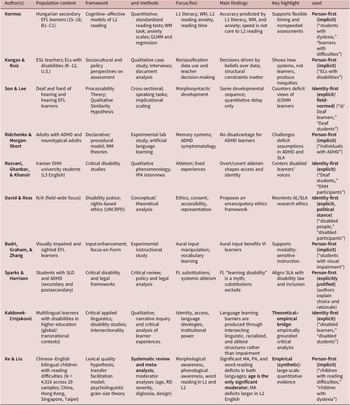
During curation, our intention behind this issue was to showcase the diversity of the disabled community and the scholars who engage with the nexus of disability and language learning. As editors, we wanted to expose readers to as much of the nexus as possible. The articles in this issue, shown in Table 1, highlight a variety of communities, contexts, onto-epistemologies, and disciplines. We included prominent voices in the field and emerging scholars. We included studies from across the world because these communities exist everywhere. Finally, we crafted an issue comprising empirical work and critical commentary to reiterate our belief that progress cannot happen in scholarship alone, but only in tandem with systemic critique and social discourse. Here are a few themes from the issue we would like to highlight:
Disability and Second Language Learning special issue literature matrix

Disability is not an inherent obstacle to L2 acquisition
Rather, it is the systems and environment that perpetuate the false premise that excludes this community from learning an additional language. Sparks and Harrison challenge the notion of an inherent foreign language learning disability and highlight how institutions could use beliefs of this nature to limit L2 learning opportunities. Ridchenko and Morgan-Short remind us to focus on an individual’s capability, rather than making a general assumption by separating cognitive-affective factors from a diagnosis. Along the same lines, Kormos draws attention to environmental factors that affect L2 literacy performance, which can be misconstrued as an effect of a diagnosis.
Being disadvantaged is a result of the system’s structure
Study by Rezvani, Ghanbar, and Khansir is a great example of how institutional practices reinforce ableist ideologies even in seemingly inclusive settings. Though these practices are not explicitly exclusionary and often well-meaning, they are often based on a medical model framework. This framework is evident in Kangas and Ruiz, which shows how educators, through policy, are limited in their capacity to view learners as more than data points. We also see systemic influence through instruction and curriculum. Badri, Graham, and Zhang demonstrate the applicability of universal design for visually impaired learners through input modification. Son and Lee support the notion that instruction designed for a specific community can help them achieve advanced levels of proficiency.
Inclusion is a matter of ethical self-reflection
For this point, we draw specifically from Sparks and Harrison and David and Ross, with the former representing where contemporary engagement of this nexus is, and the latter showing what the future should be. Sparks and Harrison show how ableism is ingrained in higher education policy and practices, even when they are not legally justified. The authors remind us that institutions should continuously evaluate their conduct to ensure it remains consistent with our ethical and legal obligations. David and Ross take us a step further, challenging scholarly actions that purport to be inclusive yet are ableist in practice. From how populations are framed to the methodologies used to the reporting practices, David and Ross encourage us, as a field, to self-reflect on how such practices reinforce deficit-oriented ideologies that position these communities as abnormal or disadvantaged. We feel commentaries such as these are just as important as empirical work, because they show that we cannot just “science our way to a solution.” We need to engage with our own beliefs and biases to progress toward sustainable inclusion.
Future directions
For those interested in critical disability theory—and other theoretical frameworks and methodologies that center marginalized identities—consider engaging with and learning from members of the community before designing your studies, particularly if the participants have intersectional identities you do not share. Disability movements have borrowed a phrase originally coined by South African activists: Nothing about us without us.
Critical-oriented scholarship has long shown the importance of providing spaces for marginalized communities to express, share, and inform. Including voices and perspectives from the community in scholarship is ethical at the macro and micro levels of scholarship. It is ethical at the macro level because it minimizes reinforcing ableist ideologies that position this community as disadvantaged or the other. Such reinforcement is not usually a conscious effort (i.e., researchers who do not include disabled voices are not inherently ableist), but excluding disabled voices and perspectives in scholarship robs readers of powerful counter-narratives. Counter-narratives that can counter researcher bias, misinterpretation, and the commodification of the disabled experience. It is ethical at the micro level as it disrupts inherent power dynamics brought on by Western empiricism by creating a collaborative relationship between the researcher and the researched, which is an extension of existing methodological practices like participatory research, which is already being used with disabled communities (Williams et al., Reference Williams, Ellis, Holloway, Caemawr, Craine, Williams and Grant2025; Spencer et al., Reference Spencer, Collings and Wilkinson2025). We believe that the inclusion of disabled voices and perspectives is necessary for an epistemological change from interventionist and treatment-oriented scholarship, influenced by the medical model, which views this population as an abnormality. However, we are aware of the diversity in disabled populations and recognize that our call to work with communities can sometimes be complicated, which we discuss in the following paragraphs.
There are individuals whose conditions may prevent them from engaging in scholarship in a manner that “qualifies” as collaboration. We understand that this community can be a protected class with restricted access (National Commission for the Protection of Human Subjects of Biomedical and Behavioral Research, 1979). However, we argue that situations of this nature should not automatically exclude collaboration altogether. Within reason, opportunities for this community to share their experience and voices should be an immediate consideration; a notion we acknowledge is easier said than done, but evidence can be found in other fields of study. The 2025 Educational Psychologist Special Issue (Heddy et. al., Reference Heddy, Emery, Louick, Chow and Peltier2025) demonstrates how disabled students can become active research participants, leading to advancement in theory (Daley, Reference Daley2025; Capin et al., Reference Capin, Vaughn, Hall and Mesite2025) and practice (Chow & Toste, Reference Chow and Toste2025). If it is the case that the individual cannot be an active participant, someone close to the individual should be given the chance to share their voice. At a minimum, we encourage scholars to explicitly label their research with disabled participants in a manner that lets readers know the extent of the participants’ engagement. Research with participants refers to active participation, where disabled voices are included, whereas research on participants identifies scholarship that involves traditional participation. Though we advocate for research with participants, we don’t position it as the only ethical approach.
However, we encourage scholars to pursue this type of scholarship, which will ensure that AL research on disabled communities is based on allyship in service to the community, rather than that of an apathetic observer. Although we advocate that AL shift toward a social model approach (Dwyer et. al., Reference Dwyer, Gurba, Kapp, Kilgallon, Hersh, Chang and Rivera2024) or a critical perspective to disability scholarship, we are aware that these perspectives are not the only viewpoints in contemporary inquiry. However, we call for theoretical or methodological transparency in which scholars are forthcoming about which model of disability frames their scholarship and their perspective on the community, their capabilities, and their place in broader society. This call for transparency is not intended to defend or criticize one’s point of view, but rather to take an ethical action that empowers the readership. By this, we mean it gives readers context about how communities are presented and represented (Randez, Reference Randez2024) and insight into the methodological choices made by the researcher. This can be an extension of reflexivity (Consoli & Ganassin, Reference Consoli and Ganassin2024) and positionality (Pillow, Reference Pillow, Young and Diem2023), but must address whether the researcher is taking an etic or emic perspective on the community. This notion continues our discussion around the distinction between working with versus about a community. When reflecting on your perspective, ask yourself:
·Is my presentation or representation of this community based on voices from the community or information about this community?
·Is my study focused on correcting an issue or documenting an experience?
·Who is this research for? Scholars? Practitioners or clinicians? The community?
Again, when answered truthfully, there are no right or wrong answers to these questions. The purpose of this reflection is to help researchers convey how they conceive of and structure their inquiry to a wider audience.
We also want to state that including the disabled community in the AL scholarship is easier than one might believe, given its “applied” nature. We have chosen three articles, published in SSLA, to show how they could easily be adapted to include disabled communities. We hope these examples inspire scholars to explore ways to extend the inclusivity of existing research to diverse disabled communities.
Strawbridge, T. (2023). The relationship between social network typology, L2 proficiency growth, and curriculum design in university study abroad. Studies in Second Language Acquisition, 45, 1131–1161. https://doi.org/10.1017/S0272263123000049
Strawbridge (2023) is a great example of how the context impacts L2 acquisition, both geographically and within the curriculum. Though focusing on study abroad programs, this study highlights how students, even in immersion settings, are subject to social network typologies. This notion underscores the importance of developing L2 programs that leverage environmental factors. Extending this work to disabled communities could involve exploring how social network typologies manifest in trilingual contexts, such as those highlighted in Rezvani et al. and Son and Lee, to identify curricular designs that limit L2/3 growth, specific to individuals’ physical needs. It could be the case that programs, in these contexts, are based on either a common L2 curriculum or the condition, instead of the nexus of both.
Ioup, G., Boustagui, E., El Tigi, M., & Moselle, M. (1994). Reexamining the critical period hypothesis: A case study of successful adult SLA in a naturalistic environment. Studies in Second Language Acquisition, 16, 73–98. https://doi.org/10.1017/S0272263100012596
As one of SSLA’s most cited articles, Ioup et al. (1994) represents the impact the journal has had on AL and the potential the field could have for disabled communities, as it shows how L2 acquisition is not psychologically limited, but dependent on environmental factors. This article challenges the critical period hypothesis by highlighting L2 acquisition in adulthood. The nature of Ioup et al. (1994) could encourage AL scholars to challenge inferred SLA limitations of disabled communities. Rather than simply adopting medical model-aligned notions from psychology, which are deficit-oriented, AL scholars could show how psychological factors are not sufficient to justify limiting L2 learning opportunities, building off of work like Ridchenko and Morgan-Short and Kormos.
Hwang, H. B., Coss, M. D., Loewen, S., & Tagarelli, K. M. (2024). Acceptance and engagement patterns of mobile-assisted language learning among non-conventional adult L2 learners: A survival analysis. Studies in Second Language Acquisition, 46, 969–995. https://doi.org/10.1017/S0272263124000354
Mobile-assisted language learning apps have impacted L2 learning by giving individuals opportunities to engage with a target language outside of conventional means (i.e., L2 classrooms). Hwang et al. (2024) further highlight this app’s potential by studying its use across a wide variety of participants in terms of age, education, and target language. The authors found that positive perspectives about the app, not the individual’s characteristics, were the biggest contributor to persistent use. We chose to highlight this paper due to its attention to wide inclusionary criteria, which we feel is a welcome addition to L2 scholarship. Also, we feel the findings of Hwang et al. (2024) could be applied to any learner group, as they focus on the value participants find in the app rather than their specific background. With investment in these apps increasing, understanding the value disabled communities find in these apps could highlight accessibility issues within design and potentially open this resource to more communities.
We also recognize several current challenges to research at this interdisciplinary intersection that we hope the next generation of researchers can surmount. First, with so few precedents set by scant existing research at this intersection, much of the study on underrepresented populations is necessarily new. However, important work has been done and should be prioritized in new projects; we recommend Henner and Robinson’s Crip Linguistics framework (Henner & Robinson, Reference Henner and Robinson2023). The field is already plagued by small sample sizes; disability—particularly low-incidence disability—does not lend itself well to larger samples needed for quantitative analyses. Further, depending on the theoretical framework one’s research originates from, the focus may in fact be on the tails rather than the mean, as we discussed in the introduction. Graduate students continue to be steered by degree programs that do not embrace the essence of or find themselves able to support inter- and transdisciplinary inquiry; thus, there are fewer researchers to take up this work than the field actually needs.
Conclusion
Our intention underpinning this special issue was to highlight the contributing manuscripts to demonstrate, representatively, the current heterogeneous state of research at the intersection of disability and AL. Contributors to the special issue demonstrate the wide range of perspectives on disability and language learning in AL research, showcasing both longstanding views on what support mechanisms should look like for disabled L2 learners, as well as emergent research derived from newer theories.
In this opening commentary for the special issue, we call for applied linguists to embrace expansive operationalizations of disability as suited to their disabled participants as well as their research inquiries. We ask that scholars be clear about their positions vis-à-vis disability, be explicit about the terms they use to set parameters and describe their disabled participants’ lived experiences and learning trajectories, foster mutually beneficial relationships with disabled participants and communities, and strongly consider researching with their participants rather than merely about them.
Caitlin’s acknowledgments
I’d like to dedicate this Disability and Second Language Learning special issue to the ones who came before and the ones who come after: to my family for raising me in a culture of disability inclusion and advocacy, and to the disabled activists and scholars who commit their lives and careers—and often both—to this work.
I’d like to thank Robert for his unfailingly conscientious collaboration, the contributing authors for their steadfastness to this intersection of research, the reviewers who lent their time and expertise, and the Studies in Second Language Acquisition team—editor, assistants, and editorial board—for dedicating space to this truly interdisciplinary endeavor.
Robert’s acknowledgments
I’d like to acknowledge the professional and personal influences that motivate me to engage with the topic of this special issue. Thank you to the SSLA editorial board for providing this space, and thank you to our contributors for your work and for allowing us to share it. Most importantly, I want to thank my “little buddy,” the third grader who opened my eyes to the struggles that multilingual students with special needs have in public schools. He is the third grader whom I failed because I didn’t have the knowledge, awareness, and tools to advocate for him, and he is the reason why I work to make sure other teachers are prepared to meet all the needs of their students.

 Open access

