





Adolescence is a unique developmental period distinguished by shifts in emotional intensity (Larson et al., Reference Larson, Csikszentmihalyi and Graef1980), neurobiological capacities to regulate emotion (Crone & Dahl, Reference Crone and Dahl2012), and social influences wherein peers become increasingly influential as youth place greater importance on peer evaluation (O’Brien & Bierman, Reference O’Brien and Bierman1988; Silk et al., Reference Silk, Stroud, Siegle, Dahl, Lee and Nelson2012). Relative to adults and, to some extent, younger children, adolescents experience elevated levels of negative affect in their everyday lives (Larson et al., Reference Larson, Csikszentmihalyi and Graef1980; Larson & Lampman-Petraitis, Reference Larson and Lampman-Petraitis1989). Such pronounced emotional reactivity underscores the need for adolescents to learn to implement adaptive emotion regulation strategies, as ineffective emotion regulation strategies are linked to depressive symptoms among teens (Aldao et al., Reference Aldao, Nolen-Hoeksema and Schweizer2010; Compas et al., Reference Compas, Jaser, Bettis, Watson, Gruhn, Dunbar, Williams and Thigpen2017; Schäfer et al., Reference Schäfer, Naumann, Holmes, Tuschen-Caffier and Samson2017).
Despite the importance of understanding the development of emotion regulation strategy use during adolescence, little is known about how parents and peers engage with adolescents’ use of emotion regulation strategies—a process hereafter referred to as interpersonal emotion regulation. Interpersonal emotion regulation builds upon the widely used definition of emotion regulation that describes one’s capacity to modify or maintain the intensity or duration of emotional experiences (Thompson, Reference Thompson1994). Specifically, interpersonal emotion regulation refers to how social agents influence one’s ability to regulate emotions (Barthel et al., Reference Barthel, Hay, Doan and Hofmann2018). For the current study, we conceptualize interpersonal emotion regulation as the process by which social agents (parents and peers) are actively involved with adolescents in enacting emotion regulation strategies. These questions are especially important to examine in adolescent girls, as they rely on interpersonally oriented emotional disclosure to manage emotions (Rose & Rudolph, Reference Rose and Rudolph2006), experience greater increases in negative affect during adolescence (Abitante et al., Reference Abitante, Haraden, Pine, Cole and Garber2022; Griffith et al., Reference Griffith, Clark, Haraden, Young and Hankin2021), and are at greater risk for developing depression (Nolen-Hoeksema & Girgus, Reference Nolen-Hoeksema and Girgus1994; Salk et al., Reference Salk, Hyde and Abramson2017) relative to boys. To this end, the current study used ecological momentary assessment (EMA) to understand how parents and peers engage with adolescent girls in enacting adaptive (problem-solving, cognitive reappraisal, acceptance, support seeking) and maladaptive (rumination, cognitive and behavioral avoidance) emotion regulation strategies in real life—and how such engagement in interpersonal emotion regulation is associated with adolescent girls’ depressive symptoms.
Adaptive and maladaptive emotion regulation strategies
Research on adolescent intrapersonal emotion regulation has shown that, despite the context-dependent nature of emotion regulation, some strategies are generally adaptive, and others are generally maladaptive, in reducing negative affect and depressive symptoms (Aldao et al., Reference Aldao, Nolen-Hoeksema and Schweizer2010; Compas et al., Reference Compas, Jaser, Bettis, Watson, Gruhn, Dunbar, Williams and Thigpen2017; Schäfer et al., Reference Schäfer, Naumann, Holmes, Tuschen-Caffier and Samson2017; Thompson, Reference Thompson1994). To maintain parsimony, we will hereafter refer to strategies as adaptive or maladaptive; however, the present study’s conceptualization of such strategies aims to capture how such strategies function more generally. Adaptive emotion regulation strategies include those that are characterized by active engagement with emotionally salient stimuli, such as cognitive reappraisal, problem-solving, acceptance, and support seeking (Compas et al., Reference Compas, Connor-Smith, Saltzman, Thomsen and Wadsworth2001; Connor-Smith et al., Reference Connor-Smith, Compas, Wadsworth, Thomsen and Saltzman2000). In contrast, maladaptive strategies include disengagement (i.e., attempts to dissociate from one’s internal thoughts, emotions, or the external stressor) and involuntary engagement (i.e., one’s approach toward external stressors; internal reactions without much voluntary control), with rumination as a prominent example (Compas et al., Reference Compas, Connor-Smith, Saltzman, Thomsen and Wadsworth2001; Connor-Smith et al., Reference Connor-Smith, Compas, Wadsworth, Thomsen and Saltzman2000). Indeed, meta-analyses show that adaptive strategies are linked to lower levels of negative affect and depressive symptoms, whereas maladaptive strategies are linked to higher levels of such outcomes (Aldao et al., Reference Aldao, Nolen-Hoeksema and Schweizer2010; Compas et al., Reference Compas, Jaser, Bettis, Watson, Gruhn, Dunbar, Williams and Thigpen2017; Schäfer et al., Reference Schäfer, Naumann, Holmes, Tuschen-Caffier and Samson2017). However, most emotion regulation research has examined such processes from an intrapersonal approach while neglecting to address the interpersonal influences on emotion regulation processes—despite the evidence that parents and peers are key contributors toward adolescent emotion regulation development (Buckholdt et al., Reference Buckholdt, Parra and Jobe-Shields2014, Reference Buckholdt, Kitzmann and Cohen2016; Butterfield et al., Reference Butterfield, Siegle, Lee, Ladouceur, Forbes, Dahl, Ryan, Sheeber and Silk2019; Criss et al., Reference Criss, Houltberg, Cui, Bosler, Morris and Silk2016; Glick & Rose, Reference Glick and Rose2011; Legerski et al., Reference Legerski, Biggs, Greenhoot and Sampilo2015; Rose et al., Reference Rose, Carlson and Waller2007; Rose, Reference Rose2002; Smith & Rose, Reference Smith and Rose2011; Yap et al., Reference Yap, Allen and Ladouceur2008, Reference Yap, Schwartz, Byrne, Simmons and Allen2010).
Interpersonal emotion regulation in adolescence
Emotion socialization is a broader interpersonal process emphasizing how key socializing agents, like parents and peers, teach youth appropriate ways to express and regulate their emotions (Eisenberg et al., Reference Eisenberg, Cumberland and Spinrad1998). Components of emotion socialization processes may include direct emotion coaching (validating, labeling, problem-solving emotions; Gottman et al., Reference Gottman, Katz and Hooven1997), responses to youths’ expressed emotions (Klimes-Dougan et al., Reference Klimes-Dougan, Pearson, Jappe, Mathieson, Simard, Hastings and Zahn-Waxler2014), and involvement in emotion regulation strategies (Morris et al., Reference Morris, Silk, Steinberg, Myers and Robinson2007, Reference Morris, Criss, Silk and Houltberg2017). In the present study, we define such involvement in emotion regulation strategy use as interpersonal emotion regulation—a specific component of emotion socialization that can be measured in real time to examine how key socializing agents directly engage with youths’ strategy use. This definition of interpersonal emotion regulation aligns with an existing framework conceptualizing external help with emotional experiences as a key aspect of emotion socialization occurring between two individuals (Morris et al., Reference Morris, Silk, Steinberg, Myers and Robinson2007, Reference Morris, Criss, Silk and Houltberg2017).
Our conceptualization of interpersonal emotion regulation is consistent with research underscoring parents’ and peers’ direct involvement in helping youth regulate their emotions in real time (Lougheed et al., Reference Lougheed, Craig, Pepler, Connolly, O’Hara, Granic and Hollenstein2016; Stone et al., Reference Stone, Mennies, Waller, Ladouceur, Forbes, Ryan, Dahl and Silk2019; Waller et al., Reference Waller, Silk, Stone and Dahl2014). Notably, Lougheed and Hollenstein (Reference Lougheed and Hollenstein2011) developed an observational coding system to measure real-time interpersonal emotion regulation between adolescents interacting with parents and peers. Using this coding system, Lougheed and colleagues (2016) measured interpersonal emotion regulation between adolescents and socializing agents during conflict discussions, as indicated by real-time observations of peers helping youth up-regulate positive emotions by reappraising the situation. Given target adolescents’ enhanced positive emotion during a conflict discussion, this example of interpersonal emotion regulation may be conceptualized as adaptive for youths’ emotional reactivity. Of note, study participants were not explicitly instructed to engage in interpersonal emotion regulation (Lougheed et al., Reference Lougheed, Craig, Pepler, Connolly, O’Hara, Granic and Hollenstein2016). This preliminary evidence suggests that interpersonal emotion regulation may be a relatively spontaneous, yet influential, process occurring between youth and socializing agents — even when youth do not explicitly ask for help.
Researchers studying interpersonal emotion regulation have employed methods enabling them to examine this process in real time (via observational coding; Lougheed et al., Reference Lougheed, Craig, Pepler, Connolly, O’Hara, Granic and Hollenstein2016) and in real-world contexts (via ecological momentary assessment [EMA]; Stone et al., Reference Stone, Mennies, Waller, Ladouceur, Forbes, Ryan, Dahl and Silk2019; Waller et al., Reference Waller, Silk, Stone and Dahl2014). In particular, EMA allows researchers to examine participants’ social and emotional experiences in real time via multiple prompts administered in a single day, thus limiting retrospective bias (Silk et al., Reference Silk, Forbes, Whalen, Jakubcak, Thompson, Ryan, Axelson, Birmaher and Dahl2011). By collecting data during participants’ daily lives, researchers are poised to examine fine-grained reports that better represent participants’ responses to salient stimuli occurring in real time (Silk et al., Reference Silk, Forbes, Whalen, Jakubcak, Thompson, Ryan, Axelson, Birmaher and Dahl2011). However, existing EMA studies have not examined the impact of interpersonal emotion regulation over time (i.e., longitudinally), or in prospective high-risk studies.
Interpersonal influences on emotion regulation development
As adolescents develop their emotion regulation repertoires, both parents and peers act as key influences on how adolescents learn to regulate their emotions. Although adolescents spend more time with peers and less time with parents, compared to childhood (Larson & Richards, Reference Larson and Richards1991), some empirical work suggests that parents continue to facilitate (or hinder) adolescents’ emotion regulation development (Buckholdt et al., Reference Buckholdt, Parra and Jobe-Shields2014, Reference Buckholdt, Kitzmann and Cohen2016; Butterfield et al., Reference Butterfield, Siegle, Lee, Ladouceur, Forbes, Dahl, Ryan, Sheeber and Silk2019; Yap et al., Reference Yap, Allen and Ladouceur2008, Reference Yap, Schwartz, Byrne, Simmons and Allen2010). In addition to parents, peers become increasingly influential for adolescents’ emotion regulation development (Criss et al., Reference Criss, Houltberg, Cui, Bosler, Morris and Silk2016; Glick & Rose, Reference Glick and Rose2011; Legerski et al., Reference Legerski, Biggs, Greenhoot and Sampilo2015; Rose, Reference Rose2002; Smith & Rose, Reference Smith and Rose2011). Despite the potential importance of both parents and peers in emotion regulation development, few studies have investigated adolescents’ use of such strategies with both parents and peers in tandem (Stone et al., Reference Stone, Mennies, Waller, Ladouceur, Forbes, Ryan, Dahl and Silk2019; Waller et al., Reference Waller, Silk, Stone and Dahl2014).
While many parents share a vertical, top-down relationship structure with adolescents, peers share a more horizontal relationship structure (von Salisch, Reference von Salisch2001). The top-down, parent-child relationship may motivate parents to seek interpersonal emotion regulation opportunities to subsequently guide their children towards more effective emotion regulation development (Gottman et al, Reference Gottman, Katz and Hooven1996; von Salisch, Reference von Salisch2001). Some research shows that mothers' supportive emotion-related behaviors were linked to less daily negative affect and improved intrapersonal emotion regulation over time among teen girls (Cui et al., Reference Cui, Criss, Ratliff, Wu, Houltberg, Silk and Morris2020). Further, regarding the unique qualities of the parent-child relationship, research has linked parental warmth and emotional responsiveness to more adaptive intrapersonal emotion regulation among adolescents (Criss et al., Reference Criss, Morris, Ponce-Garcia, Cui and Silk2016). Peers, however, adopt a horizontal relationship, aiming to strengthen social closeness without assuming the responsibility of guiding a fellow peer through such emotion-related behaviors (von Salisch, Reference von Salisch2001). A central task of adolescence is to build closer friendships (Hartup, Reference Hartup1996), with such friendships providing intimate companionship and emotional support that are linked to adaptive intrapersonal emotion regulation (Glick & Rose, Reference Glick and Rose2011; Legerski et al., Reference Legerski, Biggs, Greenhoot and Sampilo2015). For adolescent girls, more supportive emotion-related behaviors from peers have been linked to lower negative affect in daily life (Cui et al., Reference Cui, Criss, Ratliff, Wu, Houltberg, Silk and Morris2020). Taken together, the different relationship structures thus suggest that peers may provide support, but may not seek to engage in adaptive interpersonal emotion regulation as actively compared to parents (von Salisch, Reference von Salisch2001).
Limited empirical evidence indicates that both parents and peers are broadly helpful when engaged in adolescent regulatory efforts, though their roles may differ in teen girls’ emotional experiences (Jobe-Shields et al., Reference Jobe-Shields, Buckholdt, Parra and Tillery2014; Klimes-Dougan et al., Reference Klimes-Dougan, Pearson, Jappe, Mathieson, Simard, Hastings and Zahn-Waxler2014; Legerski et al., Reference Legerski, Biggs, Greenhoot and Sampilo2015). Research shows, for example, that mirroring and punishing responses to negative emotion from parents and peers have different effects on adolescents’ emotion regulation (Hale et al., Reference Hale, Price, Borowski and Zeman2023; Miller-Slough & Dunsmore, Reference Miller-Slough and Dunsmore2019). The differences in how parents and peers contribute to adolescents’ emotion regulation may be a function of development — particularly with how they engage with and guide emotions (Miller-Slough & Dunsmore, Reference Miller-Slough and Dunsmore2016). Parents show more stable responses to emotions that may reflect a longer history of guiding their children’s emotions (Miller-Slough & Dunsmore, Reference Miller-Slough and Dunsmore2016, Reference Miller-Slough and Dunsmore2019). Adolescent peers, however, are still undergoing emotional development and may not yet have the skills to move past emotional engagement to be more directive (Miller-Slough & Dunsmore, Reference Miller-Slough and Dunsmore2016, Reference Miller-Slough and Dunsmore2019). Collectively, extant research suggests that parents’ and peers’ unique relationship structures contribute to their influential, yet different, roles in engaging with and guiding adolescents’ emotion regulation strategy use.
Interpersonal emotion regulation: strategy use with parents and peers
Existing research on interpersonal emotion regulation is limited in several important ways. First, few studies on interpersonal emotion regulation examine adolescent samples, although studies in children and adults show effects of interpersonal emotion regulation on negative affect (Morris et al., Reference Morris, Silk, Morris, Steinberg, Aucoin and Keyes2011) and depressive symptoms (Christensen, Reference Christensen2019; Horn & Maercker, Reference Horn and Maercker2016), respectively. Second, most studies linking teens’ interpersonal emotion regulation to depression are limited to an investigation of the specific strategy of co-rumination (Hankin et al., Reference Hankin, Stone and Ann Wright2010; Rose et al., Reference Rose, Carlson and Waller2007; Rose, Reference Rose2002; Tompkins et al., Reference Tompkins, Hockett, Abraibesh and Witt2011; Waller & Rose, Reference Waller and Rose2013), thus neglecting other strategies that, from an intrapersonal approach, are also associated with depressive symptoms (Aldao et al., Reference Aldao, Nolen-Hoeksema and Schweizer2010; Compas et al., Reference Compas, Jaser, Bettis, Watson, Gruhn, Dunbar, Williams and Thigpen2017; Schäfer et al., Reference Schäfer, Naumann, Holmes, Tuschen-Caffier and Samson2017) and warrant further investigation from an interpersonal lens. Third, few studies employ the same measures to examine both parental and peer influences on adolescents’ emotion regulation strategy use within the same adolescent sample (Stone et al., Reference Stone, Mennies, Waller, Ladouceur, Forbes, Ryan, Dahl and Silk2019; Waller & Rose, Reference Waller and Rose2013; Waller et al., Reference Waller, Silk, Stone and Dahl2014). The remaining few studies measuring both parental and peer influences within the same sample show negative associations between supportive emotion-related behaviors and youths’ internalizing symptoms (Desjardins & Leadbeater, Reference Desjardins and Leadbeater2011; Stocker et al., Reference Stocker, Richmond, Rhoades and Kiang2007). These studies, however, used youths’ self-reported, global ratings of parental and peer emotional support (Desjardins & Leadbeater, Reference Desjardins and Leadbeater2011; Stocker et al., Reference Stocker, Richmond, Rhoades and Kiang2007). Thus, while few studies use standardized measures of parental and peer influences on adolescents’ emotions within the same sample, even fewer studies use consistent measures to examine adolescents’ selective use of interpersonal emotion regulation strategies with parents and peers.
To our knowledge, only two studies (Stone et al., Reference Stone, Mennies, Waller, Ladouceur, Forbes, Ryan, Dahl and Silk2019; Waller et al., Reference Waller, Silk, Stone and Dahl2014) have used EMA to examine both parental and peer interpersonal emotion regulation with youth within everyday contexts. Waller and colleagues (2014) examined prevalence rates of co-rumination and co-problem-solving (i.e., parents/peers helping youth with problem-solving) among youth with and without major depressive disorder (MDD). Relative to healthy controls, youth with MDD co-ruminated more frequently with both parents and peers. While youth with MDD co-problem-solved less often with peers relative to their non-MDD counterparts, group differences were not shown for co-problem-solving with parents. Thus, in the context of depression, youth engaged in interpersonal emotion regulation strategies with parents and peers differently. Indeed, these findings replicated work linking co-rumination to youth depression (Hankin et al., Reference Hankin, Stone and Ann Wright2010; Rose et al., Reference Rose, Carlson and Waller2007; Rose, Reference Rose2002; Tompkins et al., Reference Tompkins, Hockett, Abraibesh and Witt2011; Waller & Rose, Reference Waller and Rose2013). Stone and colleagues (2019) conducted the second EMA study on co-problem-solving and co-rumination, differing from the Waller et al. (Reference Waller, Silk, Stone and Dahl2014) study in two notable ways: first, the authors compared strategy effectiveness in reducing teens’ negative affect; second, this sample comprised youth with clinical anxiety rather than depression. Results showed that co-rumination was least effective for reducing teens’ daily negative affect and that co-problem-solving did not differ from co-rumination or co-distraction in terms of overall effectiveness (Stone et al., Reference Stone, Mennies, Waller, Ladouceur, Forbes, Ryan, Dahl and Silk2019). Of note, both studies (Stone et al., Reference Stone, Mennies, Waller, Ladouceur, Forbes, Ryan, Dahl and Silk2019; Waller et al., Reference Waller, Silk, Stone and Dahl2014) were conducted in clinical samples. In the present study, we used a prospective high-risk design to examine interpersonal emotion regulation among healthy adolescent girls at temperamental risk for developing depression, thus allowing us to investigate how interpersonal emotion regulation with parents and peers might influence girls’ development of depressive symptoms.
In sum, the extant literature provides evidence that both parents (Buckholdt et al., Reference Buckholdt, Parra and Jobe-Shields2014; Butterfield et al., Reference Butterfield, Siegle, Lee, Ladouceur, Forbes, Dahl, Ryan, Sheeber and Silk2019; Yap et al., Reference Yap, Allen and Ladouceur2008, Reference Yap, Schwartz, Byrne, Simmons and Allen2010) and peers (Criss et al., Reference Criss, Houltberg, Cui, Bosler, Morris and Silk2016; Glick & Rose, Reference Glick and Rose2011; Legerski et al., Reference Legerski, Biggs, Greenhoot and Sampilo2015; Rose, Reference Rose2002; Smith & Rose, Reference Smith and Rose2011) influence teens’ emotion regulation and internalizing symptoms. Only two studies to date have examined both parental and peer interpersonal emotion regulation with adolescents in the context of internalizing symptoms. However, to our knowledge, no study has simultaneously examined both rates of adolescent girls’ everyday interpersonal emotion regulation as well as the effectiveness of such interpersonal emotion regulation in reducing negative affect stemming from negative social interactions. Further, it remains unclear how such everyday interpersonal emotion regulation with parents and peers may impact girls’ longer-term experiences with depressive symptoms.
The current study
The current study used EMA to examine early adolescent girls’ use of adaptive and maladaptive interpersonal emotion regulation strategies with their parents and peers in response to negative affect resulting from social interactions occurring in daily life. The study was organized by three aims. First, we identified the frequency with which early adolescent girls engage with parents and peers when regulating their emotions (Aim 1). Based on varying levels of emotional guidance from parents versus peers (i.e., lower anticipated guidance from peers; higher anticipated guidance from parents), we predicted that, in response to negative emotion, girls would use maladaptive interpersonal emotion regulation strategies more often with peers than with parents (hypothesis 1a), and use adaptive interpersonal emotion regulation strategies more often with parents than with peers (hypothesis 1b).
Second, we examined the effectiveness of each regulatory strategy and each socializing agent in reducing negative affect (Aim 2). We hypothesized that there would be a main effect of strategy type use: relative to adaptive interpersonal emotion regulation strategies, adolescent girls’ use of maladaptive strategies would be associated with increased likelihood of experiencing continued negative affect (suggesting that maladaptive strategies are ineffective strategies for reducing negative affect; hypothesis 2a). We further predicted that, relative to maladaptive interpersonal emotion regulation strategies, girls’ use of adaptive strategies would be associated with decreased likelihood of experiencing continued negative affect (indicating that adaptive strategies are effective for reducing negative affect; hypothesis 2b). Given the little research examining parental and peer influences on adolescent negative affect in tandem, we did not have directional hypotheses for the effects of socializing agents. Thus, we explored if there was a main effect of socializing agent (parent, peer) and/or an interaction between socializing agent and strategy use in relation to the likelihood of experiencing continued negative affect.
Third, we investigated how frequencies of interpersonal emotion regulation with parents and peers were associated with concurrent and prospective depressive symptoms (Aim 3). We hypothesized that higher proportions of girls’ maladaptive strategy use at Time 1 would be associated with higher levels of depressive symptoms reported both concurrently and one year later (hypothesis 3a). Further, we hypothesized that higher proportions of girls’ adaptive strategy use at Time 1 would be associated with lower levels of depressive symptoms reported both concurrently and one year later (hypothesis 3b). Of note, the associations between strategy use and depressive symptoms (concurrent and prospective) were not expected to differ between parents versus peers.
Method
Participants
The current sample stems from the Girls Interactions in Real Life: Study of Brain Development (GIRLS Brain Study), a multi-wave, longitudinal investigation into the neural and socio-affective influences on the development of depression among early adolescent girls. We recruited 129 adolescent girls between ages 11 and 13 and their primary caregivers via community and online announcements. We oversampled for girls with shy and/or fearful temperament, as prior research has shown increased vulnerability for developing depression among youth with these temperaments (Chronis-Tuscano et al., Reference Chronis-Tuscano, Degnan, Pine, Perez-Edgar, Henderson, Diaz, Raggi and Fox2009; Gladstone & Parker, Reference Gladstone and Parker2006). Two-thirds of the sample were defined as “high-risk” and one-third as “typical-risk” regarding participants’ susceptibility to developing depression. We used this sampling strategy to ensure variability in the outcome of adolescent girls’ risk for developing depression. To determine participant risk status at Time 1, we used the Fear and Shyness subscales of the Early Adolescent Temperament Questionnaire–Revised as a screening measure (EATQ-R; Ellis & Rothbart, Reference Ellis and Rothbart2001). Participants scoring 0.75 standard deviations above the mean on one or both subscales, based on parent or adolescent report, comprised the “high-risk” status group, whereas the remainder of participants were considered to be “typical-risk.”
Participants were excluded if they met current or lifetime DSM-5 diagnostic criteria for major depressive disorder or any anxiety disorder (specific phobia as an exception), autism spectrum disorder, or psychotic disorder. Diagnostic criteria were determined by administration of the Kiddie-Schedule for Affective Disorders and Schizophrenia (K-SADS-PL; Kaufman et al., Reference Kaufman, Birmaher, Axelson, Perepletchikova, Brent and Ryan2016; updated from the Kaufman et al. (Reference Kaufman, Birmaher, Brent, Rao, Flynn, Moreci, Williamson and Ryan1997) version to align with the DSM-5). As determined by the Wechsler Abbreviated Scale of Intelligence (WASI; Wechsler, Reference Wechsler1999), participants with an IQ less than 70 were excluded from the study. Participants were also excluded due to: any lifetime presence of a neurological or serious medical condition; the presence of neurological anomalies or head injury; the presence of MRI contraindications (e.g., metal in body, including braces); use of psychoactive or other medications interacting with brain functioning (stimulants as an exception); the presence of uncorrected ocular impairments interfering with eye-tracking measures; and the presence of acute suicidality or risk of presenting harm to oneself or others.
Among the 129 participants recruited, 117 participants completed the EMA protocol. Three participants were excluded from analyses, as their EMA reports did not meet a negative reactivity threshold of non-negligible distress warranting the use of regulatory strategies. Two additional participants were excluded from analyses because they did not endorse any strategies that were operationalized as adaptive or maladaptive. Thus, the final sample consisted of 112 participants (M age = 12.39 years, SD = .77 years). See Table 1 for key demographic characteristics.
Demographic characteristics of the total sample

M and SD are used to represent mean and standard deviation, respectively. Both coded as continuous variables, pubertal status was reported from 1 (low) to 5 (high) according to the PDS, and SES was based on total family income reports ranging from 0 ($0–$10,000) to 10 ($100,000+) in $10,000 increments.
Procedure
The GIRLS Brain Study’s longitudinal design included three time points. Of interest to the current investigation were Time 1 (the first set of laboratory visits) and the one-year follow-up. Time 1 included the laboratory visits wherein participants completed baseline questionnaires and the 16-day EMA protocol. At the one-year follow-up, participants completed online questionnaires measuring depressive symptoms.
Instruments
Self-reported depressive symptoms
Adolescent participants completed the Mood and Feelings Questionnaire-Child Version (MFQ-C; Angold & Costello, Reference Angold and Costello1987) as an index of depressive symptoms. The 33 items on the MFQ-C assessed self-reported depressive symptoms from the past two weeks relative to the date of assessment. Participants completed the MFQ-C at Time 1 and at the one-year follow-up. The MFQ-C yields good (α = .88) and excellent (α = .90) levels of internal consistency at Time 1 and at the one-year follow-up, respectively.
Ecological momentary assessment
Protocol. EMA data were collected through brief survey prompts delivered to participants via study-provided smartphones. Following two laboratory visits at Time 1 (first to determine final eligibility; second for laboratory-based research tasks), participants began completing EMA surveys for 16 consecutive days, with three prompts delivered on weekdays and four prompts on weekends. Participants confirmed a time prior to the beginning of the school day to complete the first weekday prompt. The second two prompts alerted participants randomly within two pre-specified blocks of time outside of school hours (i.e., after school/evening hours); on weekends, prompts alerted participants randomly within four pre-specified blocks of time (i.e., morning, early afternoon, late afternoon, evening hours). In total, participants received 54 prompts throughout data collection. Each survey lasted approximately 3–5 minutes. Surveys included information on participants’ emotional experiences (i.e., negative affect), social interactions, and interpersonal emotion regulation strategy use.
Current Ratings of Negative Affect. Each EMA survey began with a prompt assessing participants’ concurrent negative affect ratings at the time of the survey. Participants were asked, “Please rate how you were feeling just before the phone beeped.” They then rated four negative emotions (sadness, worry, stress, anger) on a sliding scale from “Not at all (0)” to “Extremely (100),” thus comprising a measure of current negative affect at the time of the survey. The discrete emotion ratings were then averaged into a composite current negative affect rating that yields acceptable reliability (α = .79).
Real-Time Social Interactions and Peak Negative Reactivity. The present study focused on EMA items assessing emotion regulation in response to negative social interactions. Questions regarding social interactions instructed participants to consider any interactions occurring since their last EMA survey to capture interactions that may have occurred during times when EMA prompts were not feasible (i.e., during school hours). Participants were asked, “Think about the interaction with other kids your age that made you feel the worst since the last beep on (prior EMA collection time). What happened?” Participants indicated the medium through which the interaction occurred (e.g., in person, online, over the phone/text messaging), when it occurred (e.g., within the last 15 minutes, 4 hours ago, today, yesterday), as well as the number and types of people (e.g., friend, significant other/romantic interest, another peer) involved in this worst interaction. They then rated their negative emotional reactions to the interaction (sadness, worry, stress, anger) on a sliding scale from “Not at all (0)” to “Extremely (100),” thus providing a measure of peak negative reactivity to the social interaction. To ensure that participants’ negative reactivity ratings met a threshold of non-negligible distress that would warrant the use of emotion regulation strategies, only EMA samples reporting negative affect ratings at or above a threshold of 20 out of 100 were included in analyses. This approach regarding negative reactivity thresholds to examine emotion regulation strategy use is consistent with extant work using similar EMA methods (Stone et al., Reference Stone, Mennies, Waller, Ladouceur, Forbes, Ryan, Dahl and Silk2019; Tan et al., Reference Tan, Forbes, Dahl, Ryan, Siegle, Ladouceur and Silk2012; Waller et al., Reference Waller, Silk, Stone and Dahl2014).
Interpersonal Emotion Regulation Strategy Use. Participants then indicated the emotion regulation strategies employed to respond to their negative reactivity. Participants were asked, “Did you react in any of the following ways? (choose the one response that fits best)” among 8 potential strategies. Of interest to the current study were the following adaptive strategies: acceptance (“I realized I just had to live with things the way they are”); problem-solving (“I did or planned something to make things better”); cognitive reappraisal (“I tried to think of the problem in a different way so it didn't seem as bad”); and support seeking (“I talked to someone about it”). The following maladaptive strategies were included in the current study: rumination (“I kept thinking about how bad I was feeling or how bad the situation is”); cognitive avoidance (“I tried not to think about it or to forget all about it”); and behavioral avoidance (“I tried to avoid being around the people or situation that was bothering me”). Subsequently, participants were asked, “Did anybody help you, encourage you, or participate with you in this reaction?” Response choices included friends, mothers, fathers, siblings, other, and nobody. We coded “friends” as peer influences and “mothers” and “fathers” as parental influences. Thirty-two EMA samples endorsing interpersonal emotion regulation with both parents and peers simultaneously were excluded from analyses in order to examine differential parental and peer influences.
Covariates
Demographic information, such as adolescent age, pubertal status, and socioeconomic status, was examined for potential associations with analysis variables of interest (i.e., type of interpersonal emotion regulation strategy, parent or peer involved). These variables were included as covariates if significant associations were detected.
Time Elapsed Since the Most Recent Negative Interaction. Participants could vary in the amount of time elapsed since their most recent negative interaction reported via EMA. We calculated the time elapsed between each participant’s most recent negative interaction and their report of the event. This value was entered as a continuous person-mean-centered covariate.
Age. Participant age in years was calculated to the date.
Pubertal Status. Pubertal status was assessed at Time 1 using the Pubertal Development Scale (PDS; Petersen et al., Reference Petersen, Crockett, Richards and Boxer1988). Total response scores were computed to indicate female youths’ overall pubertal status across gonadarcheal and adrenarcheal development on a 5-point scale (Shirtcliff et al., Reference Shirtcliff, Dahl and Pollak2009). Examining pubertal status may provide nuances in adolescent emotional development that may not be detected in age analyses. To address potential collinearity, we examined the correlation between age and pubertal status.
Socioeconomic Status. The current study measured socioeconomic status as a mean-centered continuous variable at Time 1, with the reports of annual gross income in U.S. dollars from a scale of $0–10,000 (0) to $100,000+ (10) in $10,000 increments.
Statistical analyses
Preliminary analyses
All analyses were conducted in R 4.0.3 (R Core Team, 2020). We examined descriptive statistics and correlations between study variables. We also examined assumptions of multilevel modeling and assessed potential patterns of missing data in the study sample prior to conducting analyses for Aims 1 through 3.
Aim 1: to examine the frequency of adolescent interpersonal emotion regulation strategy use by socializing agent
To determine the frequency of strategy use for Hypothesis 1, we calculated separate proportions for parental and peer involvement in both maladaptive and adaptive strategy use. With those calculated proportions and the rstatix package in R (Kassambara & R Core Team, Reference Kassambara2020), we conducted Wilcoxon signed-rank tests —a non-parametric alternative to t-tests — to compare the frequency of each strategy type use by parents and peers, respectively, as the variable distributions were zero-inflated and positively skewed.
Aim 2: to examine the differential effectiveness of adolescent interpersonal emotion regulation strategy use in reducing negative affect at the time of the EMA prompt
We used multilevel modeling to examine within-person associations, with EMA surveys nested within person. Using the nlme package in R (Pinheiro et al., Reference Pinheiro, Bates, DebRoy and Sarkar2018), we examined an unconditional model to confirm adequate variance at the within- and between-person levels. To measure fluctuations in negative affect, current negative affect (at the time of the EMA prompt) was entered as the dependent variable, and negative reactivity to the social interaction and time elapsed since event occurrence were entered as fixed effects. Current negative affect violated assumptions of normality with a zero-inflated distribution. Thus, with the GLMMadaptive package in R (Rizopoulos & R Core Team, Reference Rizopoulos2017), we used a two-part mixed effects model for semi-continuous data (Olsen & Schafer, Reference Olsen and Schafer2001); one model was a conditional linear model providing the mean response for continuous, non-zero data, and the other was a hurdle model providing the probability of a non-zero response. To allow for individual variability in both parts (conditional linear, hurdle) of the model, we included a random intercept; likelihood ratio tests of model fit did not justify the inclusion of random slopes.
The model included the following predictor variables: 1) the type of strategy used (i.e., maladaptive or adaptive), and 2) parental or peer involvement in strategy use, with 2a) one binary variable indicating if a parent was (1) or was not (0) involved, and 2b) another binary indicating if a peer was (1) or was not (0) involved. Given that participants could select only one emotion regulation strategy used in response to the negative social interaction, the two types of strategies (maladaptive/adaptive) were direct inverses of the other. To aid in model interpretation, we applied effects (sum) coding to the type of strategy used variable.
For Hypothesis 2, we examined the main effect of interpersonal emotion regulation strategy type (maladaptive/adaptive interpersonal emotion regulation used) and its association with current negative affect. With regard to our exploratory aims, we examined both the main effect of parental versus peer involvement and the interaction between parental/peer involvement and strategy type in relation to current negative affect.
Aim 3: to examine how the frequency of interpersonal emotion regulation strategy use may affect concurrent and future depressive symptoms
Using the stats package in R (R Core Team, 2020), we conducted linear regressions to examine predictive associations between the proportions of parental and peer involvement in maladaptive and adaptive strategy use, respectively, and depressive symptoms as reported at Time 1 and at the one-year follow-up. Baseline depressive symptoms were included as covariates in models predicting symptoms at the follow-up. We used the calculated proportions of interpersonal emotion regulation strategy use from Aim 1.
Sensitivity analyses
Due to the small number of reports involving fathers engaged in interpersonal emotion regulation relative to mothers, sensitivity analyses were conducted with reports of father interpersonal emotion regulation removed from the sample. The pattern of results remained the same and we therefore decided to include father reports in the final sample.
Results
Preliminary analyses
See Figure 1 for detailed information on EMA call inclusion. Adolescent girls endorsed a total of 774 reports involving interpersonal emotion regulation from either parents (n = 306) or peers (n = 468), comprising 38% of the total reports of emotion regulation strategy use. A sizable amount of reports (n = 1440) indicated that girls did not engage in interpersonal emotion regulation with anyone. Descriptive statistics and correlations between study variables at the between-person level are shown in Table 2. Participants completed an average of 42.95 EMA prompts (range = 15–54). Age and pubertal status were significantly associated; thus, only pubertal status was included as a covariate, as it may provide more nuanced measures of development among youth aged 11–13. With the exception of peer interpersonal emotion regulation, socioeconomic status (SES) was also significantly associated with all primary study variables, justifying its inclusion as a covariate.
Ecological momentary assessment (EMA) of emotion regulation strategy use with parents and peers. ER = emotion regulation. Reasons for EMA call exclusion included: endorsing “nothing” or nonsensical (i.e., gibberish) reports about the social interaction; not endorsing any interactions with others (e.g., sleeping); not endorsing ER strategy use; or endorsing reports with a negative reactivity rating below the 20/100 threshold to warrant ER strategy use.

Descriptive statistics and correlations of study variables
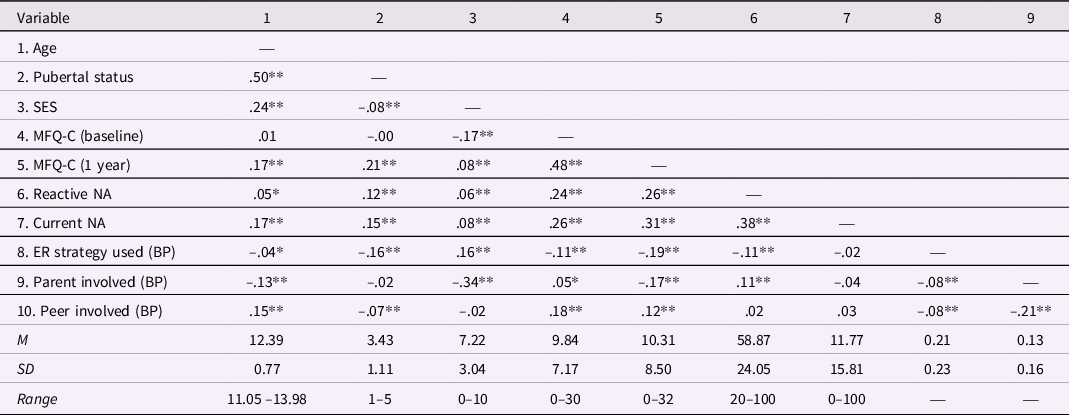
M and SD are used to represent mean and standard deviation, respectively. SES = Socioeconomic Status; MFQ-C = depressive symptoms; Reactive NA = negative affect in response to the negative interpersonal event; Current NA = negative affect at the time of the EMA prompt; ER = emotion regulation; BP = between-person level calculations derived from binary variables. Reactive NA indicates the peak negative reactivity rating (0–100) to the negative social interaction. Current NA indicates the continued experience of negative affect (0–100) at the time of the EMA prompt.* indicates p < .05. ** indicates p < .01.
Consistent with expectations, both MFQ-C reports of depressive symptoms at baseline and at the one-year follow-up were positively associated with one another as well as with person-means of negative affect reactivity (to the negative social interaction), current negative affect (negative affect at the time of the EMA call), and peer involvement in interpersonal emotion regulation. Proportion of adaptive emotion regulation strategy use was negatively associated with both baseline and follow-up MFQ-C reports. Parental involvement in interpersonal emotion regulation was positively associated with MFQ-C reports at baseline and negatively associated with MFQ-C reports one year later. Negative affect reactivity was associated with higher current negative affect, lower adaptive strategy use, and greater parental involvement (person-means for all variables). Parental and peer involvement (person-means) were also negatively associated.
For Aim 3, 8 participants were excluded from analyses for not completing: the baseline MFQ-C measure (n = 1), the MFQ-C one-year follow-up (n = 4), neither the baseline nor the one-year follow-up MFQ-C measure (n = 1), and the SES measure (n = 2)—thus resulting in a subsample of 104 participants for Aim 3 analyses. These 104 participants who completed all MFQ-C and SES measures differed from those who did not on pubertal status (p < .001). Specifically, youth with complete MFQ-C and SES data had a higher level of pubertal development (M = 3.47, range = 1–5) than youth with missing data (M = 2.88). No other patterns of missingness related to the study variables were observed.
To confirm justification for using multilevel modeling, we conducted a means-only model to calculate the intraclass correlation coefficient (ICC). The model yielded an ICC of .41, indicating that 41 and 59% of the variance in current negative affect was reflected at the between-person and within-person levels, respectively.
Aim 1. Frequency of interpersonal emotion regulation strategy use by socializing agent
Early adolescent girls significantly differed in the frequencies with which they used adaptive and maladaptive strategies with parents and peers (Table 3). Contrary to the hypothesized direction of effects, Wilcoxon signed-rank tests indicated that youth engaged in maladaptive emotion regulation strategies with parents more frequently (Mdn = .31, reflecting 31% of total EMA calls endorsing any emotion regulation use) than with peers (Mdn = .24, W = 78,776, p = .018). Further, youth engaged in adaptive strategies with peers more frequently (Mdn = .76) than with parents (Mdn = .69, W = 64,432, p = .018). For both Wilcoxon signed-ranks tests conducted, effect sizes were small in magnitude (r = .08). Note that while proportions of parent and peer involvement by strategy use were unique calculations (as participants could report receiving support from both a parent and a peer in the same observation), the proportions of adaptive and maladaptive strategy use were direct inverses of one another (due to the forced-choice/single-select nature of the strategy question).
Descriptive statistics and Wilcoxon signed-ranks test results (Aim 1)

ER = emotion regulation; Num. = numerator; Denom. = denominator. N = 306 corresponds to the total ER calls enlisting only parents; N = 468 corresponds to the total ER calls enlisting only peers. Wilcoxon signed-ranks tests comparing rates of adaptive and maladaptive ER use were grouped by socializing agent. * indicates p < .05.
Aim 2. Effectiveness of interpersonal emotion regulation in reducing negative affect
Results from the two-part mixed effects model are shown in Table 4, complete with both the continuous portion and the zero-inflated portion of the model. For the continuous portion of the multilevel model assessing current negative affect above zero, only covariates (time elapsed [β = –.02, p = .027]; negative reactivity [β = .01, p < .001]) significantly predicted lower and higher levels of negative affect at the time of the EMA call, respectively.
Results from multilevel model of momentary interpersonal emotion regulation use on negative affect (Aim 2)

ER = emotion regulation; BP = between-person effects; WP = within-person effects. Time elapsed indicates the time that had elapsed between occurrence of the negative social interaction and the time of the given EMA prompt. * indicates p < .05. ** indicates p < .01. *** indicates p < .001.
The zero-inflated portion of the model indicated that both parental (OR = .59, p = .018) and peer (OR = .62, p = .017) involvement had significant effects on current negative affect at the within-person level. At the within-person level, parental involvement in interpersonal emotion regulation significantly predicted girls’ decreased likelihood of experiencing any negative affect above zero at the time of the EMA call. In other words, when girls engaged in interpersonal emotion regulation with parents, they were less likely to experience continued negative emotion at the time of the survey. Similarly, there was a significant within-person effect of peer interpersonal emotion regulation involvement on girls’ decreased likelihood of experiencing negative affect above zero. When girls involved peers in interpersonal emotion regulation, they were also less likely to experience continued negative affect at the prompt.
Among the covariates, negative affect in response to the social interaction was significantly associated with the decreased likelihood of experiencing any continued negative affect above zero (OR = .99, p = .004). Contrary to our hypotheses, no other study variables were significantly associated with current negative affect at the time of the EMA call, nor did any between-person effects emerge among study variables. Inconsistent with our predictions, the type of strategy used was not significantly associated with girls’ likelihood of experiencing continued negative affect (OR = 1.00, p = .993). That is, neither the use of adaptive nor maladaptive strategies had a significant effect on girls’ likelihood of experiencing negative affect. Similarly, no significant interactions emerged between the type of strategy used and parental versus peer involvement in predicting the likelihood of experiencing negative affect (parents [OR = 1.02, p = .954]; peers [OR = 1.78, p = .123]).
Aim 3. Frequency of interpersonal emotion regulation predicting depressive symptoms
Concurrent depressive symptoms at baseline
Linear regression results are provided in Tables 5 and 6. Contrary to our hypotheses, neither higher proportions of parental (p = .723) nor peer (p = .595) involvement in maladaptive emotion regulation strategy use were significantly associated with concurrent depressive symptoms at baseline (Time 1). Similarly, neither higher proportions of parental (p = .403) nor peer (p = .789) involvement in adaptive strategy use were significantly associated with baseline reports of concurrent depressive symptoms. No significant associations emerged between pubertal status or SES and baseline depressive symptoms.
Regression results of interpersonal strategy use frequency predicting baseline depressive symptoms (Aim 3)

SES = socioeconomic status. *** indicates p < .001.
Regression results of interpersonal strategy use frequency predicting depressive symptoms one year later (Aim 3)

SES = socioeconomic status. * indicates p < .05. ** indicates p < .01. *** indicates p < .001.
Depressive symptoms one year later
Contrary to our predictions, neither higher proportions of parental (p = .065) nor peer (p = .559) involvement in maladaptive emotion regulation strategy use were significantly associated with depressive symptoms one year later. Similarly, higher proportions of peer involvement in adaptive strategy use were not significantly associated with future depressive symptoms (p = .310). However, consistent with our predictions, higher proportions of parental involvement in adaptive strategy use were negatively associated with depressive symptoms at the one-year follow-up (β = –11.63, SE = 4.99, p = .022). That is, more frequent use of parental interpersonal emotion regulation for adaptive strategies was related to fewer depressive symptoms among early adolescent girls one year later—above and beyond girls’ baseline depressive symptoms. For both models examining frequencies of adaptive and maladaptive interpersonal strategy use, baseline depressive symptoms emerged as significant covariates. Specifically, baseline depressive symptoms were positively associated with depressive symptoms one year later in both models (maladaptive model [β = .60, SE = .10, p < .001]; adaptive model [β = .63, SE = .10, p < .001]). SES was also positively linked with depressive symptoms one year later in the adaptive interpersonal emotion regulation strategy use model (β = .45, SE = .23, p = .049).
Discussion
The current study examined differences in interpersonal emotion regulation with parents versus peers using EMA methods to capture responses to socially salient, everyday interactions experienced by early adolescent girls. Our findings generally underscore the importance of daily interpersonal influences on teen girls’ emotion regulation development. Broadly, adolescent girls frequently involve both parents and peers in their regulatory efforts, engaging parental or peer support in approximately 38% of their reported efforts in real-world contexts, evidencing that parents and peers are likely influential in adolescents developing emotion regulation skills. Notably, although parents were more involved with adolescent maladaptive strategy use, their involvement in adaptive strategy use was uniquely predictive of the development of depressive symptoms, whereas peer involvement was not associated with adolescent depressive symptoms. These findings highlight that, although girls are socially reorienting toward peers during this developmental period, parents remain an important influence in girls’ regulatory efforts.
Interpersonal emotion regulation and daily negative affect
Study findings provide evidence that both parents and peers effectively help early adolescent girls down-regulate everyday negative emotion. When girls received help from parents or peers, they were less likely to experience continued negative affect at the time of the EMA prompt. These findings build upon prior EMA work showing the simultaneous influence of both parents and peers on youth interpersonal emotion regulation in daily life (Stone et al., Reference Stone, Mennies, Waller, Ladouceur, Forbes, Ryan, Dahl and Silk2019; Waller et al., Reference Waller, Silk, Stone and Dahl2014). The current work extends the literature in adolescent clinical samples (Stone et al., Reference Stone, Mennies, Waller, Ladouceur, Forbes, Ryan, Dahl and Silk2019; Waller et al., Reference Waller, Silk, Stone and Dahl2014) to a high-risk sample of early teen girls at risk for developing depressive disorders. Thus, the current study highlights that interpersonal emotion regulation may be effective for down-regulating negative emotion in high-risk youth, extending our knowledge of everyday interpersonal emotion regulation beyond clinical samples.
We found surprising patterns of early adolescent girls’ frequency of interpersonal emotion regulation strategy use in everyday life. Contrary to our hypotheses, early adolescent girls engaged in maladaptive emotion regulation strategies (i.e., rumination, cognitive and behavioral avoidance) with parents more often than with peers. Conversely, girls engaged in adaptive strategies (i.e., acceptance, problem-solving, cognitive reappraisal, support seeking) more frequently with peers than with parents. This is surprising because we expected parents to engage in more frequent adaptive interpersonal emotion regulation, relative to adolescent peers, as a result of parents’ generally more advanced emotion regulation capacities (Tottenham et al., Reference Tottenham, Hare and Casey2011; Zimmermann & Iwanski, Reference Zimmermann and Iwanski2014). Greater adaptive interpersonal emotion regulation among parents was also hypothesized to reflect parents’ tendencies to provide support through intentional emotion socialization behaviors that emphasize emotional guidance, such as emotion coaching (Gottman et al., Reference Gottman, Katz and Hooven1996; von Salisch, Reference von Salisch2001). Further, our findings among high-risk early adolescents differed from prior EMA work indicating that youth with and without MDD problem-solved with parents at similar rates — but that youth with MDD problem-solved with peers less frequently compared to non-MDD youth (Waller et al., Reference Waller, Silk, Stone and Dahl2014). Of note, the effect sizes for this set of findings were small in magnitude and therefore may not be robust.
Another potential explanation is that teens may approach friends with problems that are more solvable and amenable to adaptive strategies. In contrast, teens may seek their parents’ help with more challenging concerns that are less tractable to an adaptive strategy like problem-solving. However, we were unable to collect detailed information about the situation to which the strategy was applied or about the exact way that the strategy was implemented with parents and peers, thus limiting our interpretation of such differential frequencies of everyday strategy use across parents and peers. Alternatively, given the single-select format of the current study’s EMA protocol, girls’ responses might have reflected that they initially selected a maladaptive strategy and then moved onto another strategy after receiving parental interpersonal emotion regulation support. Adolescent girls in our sample might have also reported the single most emotionally salient strategy that they recalled when receiving the EMA prompt. Our rationale for using a single-select format was informed by prior EMA studies from our research group (Stone et al., Reference Stone, Mennies, Waller, Ladouceur, Forbes, Ryan, Dahl and Silk2019; Tan et al., Reference Tan, Forbes, Dahl, Ryan, Siegle, Ladouceur and Silk2012; Waller et al., Reference Waller, Silk, Stone and Dahl2014) finding that youth in this age range often selected nearly all response options — ultimately complicating the conclusions we could draw about emotion regulation strategy use. Thus, the single-select format, while allowing us to focus on the most salient strategy of the moment, is also a limitation in instances where teens may have used multiple strategies at the same time.
Surprisingly, and contrary to hypotheses, neither the use of adaptive nor maladaptive emotion regulation strategies were significantly more or less effective in down-regulating negative emotion in daily life. Similarly, no significant interactions emerged between the type of strategy used and the type of socializing agent in predicting current levels of negative affect. This differs from extant literature suggesting that adaptive and maladaptive strategies are differentially related to negative affect (Aldao et al., Reference Aldao, Nolen-Hoeksema and Schweizer2010; Compas et al., Reference Compas, Jaser, Bettis, Watson, Gruhn, Dunbar, Williams and Thigpen2017; Schäfer et al., Reference Schäfer, Naumann, Holmes, Tuschen-Caffier and Samson2017), although most of this literature has not used EMA methodology. Nevertheless, several reasons may explain these inconsistent findings. Of note, we had limited statistical power to examine the differences between parental and peer interpersonal emotion regulation by strategy type beyond our broader measures of adaptive and maladaptive strategies. However, more nuanced investigations into each strategy within the broadband measures of adaptive versus maladaptive strategies would be a fruitful direction for future research. Many researchers highlight the importance of contextual factors in the effectiveness of emotion regulation strategies (Blanke et al., Reference Blanke, Brose, Kalokerinos, Erbas, Riediger and Kuppens2020; Brockman et al., Reference Brockman, Ciarrochi, Parker and Kashdan2017; Troy et al., Reference Troy, Shallcross and Mauss2013). For example, cognitive reappraisal varies in its effectiveness on depressive symptoms depending on the context in which it is used (Troy et al., Reference Troy, Shallcross and Mauss2013); in controllable contexts, in which a more proactive strategy eradicates a stressor, reappraisal is less adaptive. Alternatively, developmental factors may be at play: The young adolescent girls in this sample (ages 11–13) may not yet be able to use strategies in the most effective way when responding to negative affect. Indeed, research indicates that, relative to older adolescents, young adolescents are often not successful at using reappraisal strategies—particularly in the context of social stimuli (Silvers et al., Reference Silvers, McRae, Gabrieli, Gross, Remy and Ochsner2012).
Interpersonal emotion regulation and depressive symptoms
We found partial support for our hypothesized associations between frequencies of interpersonal emotion regulation and concurrent and prospective depressive symptoms. More frequent involvement from parents and peers in adaptive/maladaptive strategy use was not linked to concurrent depressive symptoms. In partial support of our hypotheses, more frequent parental involvement in adaptive interpersonal emotion regulation significantly reduced early adolescent girls’ depressive symptoms one year later, above and beyond baseline symptoms. However, more frequent adaptive interpersonal emotion regulation with peers was not associated with future depressive symptoms. These results suggest that parents may play a uniquely beneficial role in girls’ long-term emotion regulation development. Such parental involvement in everyday interpersonal emotion regulation may reflect high levels of both emotional engagement and guidance on Miller-Slough and Dunsmore’s (Reference Miller-Slough and Dunsmore2016) circumplex model, ultimately helping to alleviate emotional distress. It is possible that parents equipped with more refined emotion regulation skills may effectively guide teens’ emotion regulation development and long-term mental health. Further, given the present study’s sample enriched for shy/fearful temperament, perhaps such participant traits prompted parents to adjust their interpersonal emotion regulation skills and overall parenting style. From a developmental perspective, early adolescents generally have difficulty with using adaptive emotion regulation strategies effectively (Silvers et al., Reference Silvers, McRae, Gabrieli, Gross, Remy and Ochsner2012) and have ample learning opportunities awaiting them. Further, perhaps youth who often interact with their parents in relation to adaptive strategies may learn the most effectively over time. Thus, although girls show a greater tendency to engage with peers in daily adaptive interpersonal emotion regulation, working with parents to engage in adaptive strategies (e.g., problem-solving, cognitive reappraisal) may have greater potential protective effects for mental health.
These findings may also be explained by extant literature on social support and well-being among early adolescent girls. Meta-analytic findings show that parental support, relative to peers, is more strongly associated with girls’ well-being (Chu et al., Reference Chu, Saucier and Hafner2010). Thus, girls especially seem to benefit from parental social support, here reflected in the effects of parental involvement in adaptive interpersonal emotion regulation on long-term depressive symptoms. Stability in social support may also be important for adolescent adjustment. Longitudinal research indicates that teens experience high turnover rates in their friendships from early to mid-adolescence, particularly between academic years (Faris & Felmlee, Reference Faris and Felmlee2018), which may indicate that adolescents experience relatively less stability in peer support. Taken together, these findings suggest that stability in social support may be a uniquely valuable aspect of parental support.
Future work on adolescent interpersonal emotion regulation may benefit from collecting more nuanced measures of parental and peer involvement by examining different types of parents (mothers versus fathers) and peers (close friends versus acquaintances). In the current study, we had limited statistical power to assess parental involvement with greater nuance, as there were few reports of fathers’ involvement in interpersonal emotion regulation to that of mothers. While there is a general lack of research with fathers in the field of interpersonal emotion regulation, the inclusion of measures comparing fathers’ and mothers’ regulatory involvement may help advance future interpersonal emotion regulation research. Further, our interpersonal emotion regulation data collection on peers did not distinguish between close friends and general peers, thus limiting nuances among peer relations. Indeed, one meta-analysis indicated that, relative to close friends, general peers' support showed more robust, inverse links to depression (Rueger et al., Reference Rueger, Malecki, Pyun, Aycock and Coyle2016). Thus, different types of peers and parents may differentially influence girls’ emotions, and further examination into how interpersonal emotion regulation with different types of parents and peers impact girls’ everyday negative emotions is warranted.
Limitations
Despite the current study’s strengths in using an EMA design to examine unique parental and peer influences in tandem, there are several limitations to note. We sought to provide participants with an inclusive prompt assessing interpersonal emotion regulation as it unfolds in youths’ daily lives. However, EMA data are limited by real-world factors influencing participants’ momentary responses, such as the saliency of reported events at the time of the prompt and unaccounted social factors that may operate in conjunction with interpersonal emotion regulation processes. Thus, although more ecologically valid, EMA measures introduce the potential for responses that are less controlled or monitored compared to the laboratory setting. Further, the phrasing used for our interpersonal emotion regulation measure precludes us from understanding the intentions of target adolescents, their parents, or their peers—as well as who might have initiated processes of interpersonal emotion regulation. It is possible that our measure of interpersonal emotion regulation also captured how parents and peers provided reinforcement of strategy use. Without knowing the intentions underlying instances of interpersonal emotion regulation, our findings cannot be applied to the functionalist perspective on emotion, which posits that the adaptiveness of emotion regulation strategies depends on the context (e.g., the social relationship; one’s goals within that relationship; Campos et al., Reference Campos, Campos and Caplovitz Barrett1989).
Moreover, researchers have raised pragmatic limitations when measuring youth emotion regulation, such as participants’ reactance to prompts about strategy use (Zeman et al., Reference Zeman, Klimes-Dougan, Cassano and Adrian2007). It is possible that receiving prompts explicitly asking about strategy use may have influenced how youth in this sample engaged with, and reported on, such strategy use. Further, assessment of emotion regulation was limited to adolescents’ subjective report of negative affect and did not incorporate other informative, observational measures. Additionally, the inclusion of stress in the aggregated negative affect composite may be a limitation. Prior EMA research has used stress to capture youths’ feelings of overall distress in real-world contexts (Hamilton et al., Reference Hamilton, Do, Choukas-Bradley, Ladouceur and Silk2021; Sequeira et al., Reference Sequeira, Silk, Edershile, Jones, Hanson, Forbes and Ladouceur2021). However, stress is not as well-differentiated compared to other negative emotions like sadness, worry, and anger; thus, its potential limitations are worth noting when measuring everyday emotional distress among youth. Moreover, the aggregation of discrete negative emotions into a negative affect composite may have masked associations that were negative emotion-specific. Prior EMA work examining anxious and non-anxious youth has shown that effective strategy use differs depending on the discrete emotion observed (Tan et al., Reference Tan, Forbes, Dahl, Ryan, Siegle, Ladouceur and Silk2012). As such, future work with this sample will use measures of discrete emotions to examine potential emotion-specific strategy responses in youth.
The generalizability of our findings is also limited, as our sample is comprised of early teen girls at risk for developing depressive disorders, two-thirds of whom were White. Indeed, due to our recruitment strategy of oversampling girls at temperamental risk for developing depressive disorders, the final study sample is not considered a typical sample. Additionally, despite having an adolescent sample enriched for risk for developing depressive symptoms, girls reported generally infrequent experiences of daily negative affect. We addressed this infrequent negative affect with our analytic approach; however, the generalizability of our findings may be limited among girls experiencing heightened negative emotion.
Implications
The current study’s findings have several important implications. Overall, our findings suggest that social involvement from both parents and peers serve as unique protective factors for early adolescent girls’ emotional development. In light of the COVID-19 pandemic’s detrimental effects of social isolation and heightened depression among teens (Hawes et al., Reference Hawes, Szenczy, Klein, Hajcak and Nelson2022), our findings underscore the important roles that both parents and peers play in alleviating daily negative emotions. The protective role of such parental and peer support may be critical for teens’ emotional development as they navigate future moments of acute distress.
Our findings indicate that early adolescent girls engage in direct maladaptive emotion regulation with parents more frequently than peers in daily life. However, results also show that parental involvement in adaptive emotion regulation was the only protective factor for future depressive symptoms. Taken together, findings suggest that while early female teens may frequently engage in maladaptive strategies with parents on a daily basis, greater parental involvement in adaptive emotion regulation may be a unique, long-term protective mechanism for at-risk girls’ susceptibility to developing depression. Our findings suggest that communities should offer more family-based training programs designed to enhance parents’ abilities to engage in adaptive interpersonal emotion regulation with their children. Clinicians working with teens may benefit from incorporating such training into parent sessions throughout a teen client’s treatment plan. With the possibility that teen therapy clients may be learning adaptive emotion regulation skills for the first time, additional parental support may help with skill refinement. Preliminary evidence from a parent-child group therapy for families of parents with, and youth at risk for developing, depression suggests that training families in adaptive coping can help reduce children’s future depressive symptoms (Compas et al., Reference Compas, Champion, Forehand, Cole, Reeslund, Fear, Hardcastle, Keller, Rakow, Garai, Merchant and Roberts2010). Thus, programs designed to enhance parents’ preparedness for and involvement in adaptive interpersonal emotion regulation may offer unique benefits to adolescents’ emotional well-being — both daily and long-term.
Funding statement
This work was supported by the National Institutes of Health under award number R01MH103241 to Jennifer S. Silk and Cecile D. Ladouceur, and Jessica L. Hamilton was supported by award number K01MH281584. The opinions expressed are solely the responsibility of the authors and are not those of the funding sources.
Competing interests
None.


 Open access

