


Intake of sugar-containing beverages has increased during the last decade. The average consumption in Sweden of carbonated sodas, judging from food disappearance data, has increased around 100 % in 15 years(Reference Jordbruksverke1). Similar trends are seen in most countries, for example in the USA where total sweetened beverage intake among children increased 135 % between 1977 and 2001(Reference Nielsen and Popkin2). A large proportion of the consumers of sweetened beverages are likely to be young as studies have shown that the older the child(Reference Striegel-Moore, Thompson and Affenito3, Reference Vereecken, Inchley and Subramanian4) and the younger the adult(Reference Nielsen and Popkin2, Reference Elfhag, Tynelius and Rasmussen5), the higher the soft drink consumption is.
Along with the increase in soft drink consumption, the obesity prevalence figures have increased all over the world(Reference Wang and Lobstein6), and not surprisingly, it has been speculated that there is a causal link between soft drinks and weight status. This hypothesis has been thoroughly explored in two recent reviews(Reference Bachman, Baranowski and Nicklas7, Reference Malik, Schulze and Hu8) and in one meta-analysis(Reference Vartanian, Schwartz and Brownell9). Although the conclusions from these reviews include calls for more research, there is enough evidence today, according to Malik et al. (Reference Malik, Schulze and Hu8) and Vartanian et al. (Reference Vartanian, Schwartz and Brownell9), to recommend prevention strategies targeting a reduction of soft drink consumption. The mechanism for the link between sugar-sweetened beverage intake and adiposity is not entirely clear. Several possibilities have been suggested, including high fructose content and displacement of calcium-containing beverages(Reference Bachman, Baranowski and Nicklas7). However, the most likely explanation is that a high beverage consumption simply leads to an excessive energy intake and positive energy balance. If this energy imbalance is caused by a difference in satiety properties between liquid calories and solid foods, as shown in some studies(Reference DiMeglio and Mattes10, Reference Rolls, Kim and Fedoroff11), or if the explanation is more complex, is yet to be proven. Previous research has mainly focused on soft drinks, but fruit juice consumption has been shown to be related to a higher body weight as well(Reference Bes-Rastrollo, Sanchez-Villegas and Gomez-Gracia12–Reference Sanigorski, Bell and Swinburn14).
Predictors and correlates for a high beverage intake have been studied before, but not extensively. Lower social status, measured as parental occupation(Reference Vereecken, Inchley and Subramanian4) or education plan of the child(Reference Bere, Sorli Glomnes and Te Velde15), seem to be associated with a higher intake of soft drinks. In young adults, smoking and low physical activity have also been shown to be related with a higher consumption of soft drinks(Reference Kvaavik, Andersen and Klepp16). Adults, but not children, with a high intake of sugar-sweetened soft drinks are less restrained and report more external eating than those with a lower intake(Reference Elfhag, Tynelius and Rasmussen5). Parents and family habits seem also to have an impact on children's soft drink consumption patterns. Parental soft drink consumption(Reference Grimm, Harnack and Story17), parenting practices(Reference de Bruijn, Kremers and de Vries18), availability of soft drinks at home(Reference Grimm, Harnack and Story17) and attitudes and norms of the parents(Reference Bere, Sorli Glomnes and Te Velde15, Reference de Bruijn, Kremers and de Vries18) have all been shown to be associated.
Whereas previous research has focused on socio-economic and behavioural factors, less is known about the associations between soft drinks and intake of other food groups and maternal body size. In addition, fruit juice has not previously been studied to the same extent as soft drinks. With more knowledge about the similarities and differences between soft drink and fruit juice consumption we are better equipped to address issues related to beverage consumption in intervention studies and when planning prevention strategies.
The aim of the present study is to investigate how eating behaviour, food choices, physical activity, BMI and smoking in Swedish teenagers, and education, beverage intake, smoking and BMI of their mothers, are associated with soft drink and fruit juice consumption of the teenagers.
Subjects and measurements
Subjects
Subjects were participants in the Stockholm Weight Development Study (SWEDES)(Reference Vagstrand19) with 481 adolescent children and their mothers from the Stockholm region. The recruitment base was 2342 participants of a pregnancy study (the Stockholm Pregnancy and Weight Development Study) from 1984(Reference Öhlin and Rössner20), which represented a cross-sectional sample of the women of southern Stockholm. Of these women, 1906 mother–child pairs were invited in 2001–2 and 25 % of those (n 481) agreed to participate in SWEDES. Mother–child pairs that had moved away from the Stockholm area were not invited. Seven teenagers did not complete the dietary questionnaire, which left 474 subjects (275 girls and 199 boys) to be included in the study (see Table 1 for characteristics).
Description of the participants
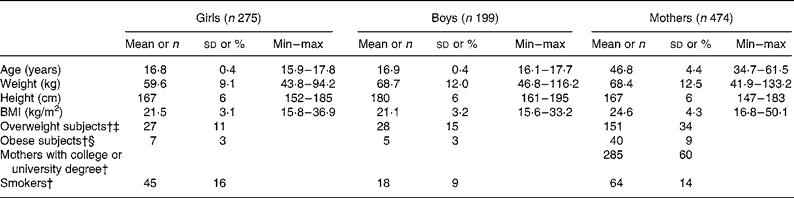
Min–max, minimum to maximum.
† Values are number and percentage.
‡ In mothers, overweight is BMI>25; in children, overweight is IsoBMI>25. The classification system for children recommended by the International Obesity Task Force(Reference Cole, Bellizzi and Flegal46).
§ In mothers, obesity is BMI>30; in children, obesity is Iso BMI>30.
Body measurements
Weight and height, for the calculation of BMI, were measured at the clinic. Weight was measured to the nearest 0·1 kg with subjects standing dressed in underwear. Standing height was measured to the nearest 1·0 cm.
Dietary intake
A dietary questionnaire originally developed for the Swedish Obese Subjects Study was used to assess dietary intake(Reference Lindroos, Lissner and Sjöström21). In a validation study, mean energy intake from the questionnaire did not differ significantly from estimated energy expenditure in neither normal weight nor obese adults(Reference Lindroos, Lissner and Sjöström21). The questionnaire has also been validated in eighteen 15-year-old adolescents (nine boys and nine girls) using doubly labelled water(Reference Lindroos, Lissner and Sjöström22). In both girls and boys, the reported mean energy intake did not differ significantly from measured energy expenditure. The questionnaire is based on a simplified dietary history and covers dietary intake during the past 3 months. Emphasis is placed on cooked meals and sandwiches and the questionnaire includes three coloured photographs with different amounts on the plates to assist subjects in describing portion sizes of cooked meals. Sweets (candies, chocolates) is quantified in detail and the participant can choose alternatives ranging from small, medium and larger pieces, sizes of pre-confectioned packages as sold in Sweden or per units of 100 g. Salty snacks (crisps and cheese doodles) are also quantified by pre-confectioned package size. For intake of beverages, fruits, milk and yoghurts, a semi-quantitative approach is used, using pre-defined portion sizes. The amounts of all reported foods are converted into energy intake and nutrient intake per day, using food tables from the Swedish National Food Administration(Reference Livsmedelsverket23). For more details of the questionnaire see Lindroos et al. (Reference Lindroos, Lissner and Sjöström21 ) where the entire questionnaire is published.
The questionnaire included two questions on non-alcoholic energetic beverages: (1) soft drinks (carbonated/non-carbonated sugar-sweetened soft drinks, including squash and cordial) and (2) fruit juice. Another five food groups were chosen as independent variables based on their possible relationship with beverage intake: (1) sugary foods (candies, chocolates, ice cream, cookies, cakes etc.) due to their similarity to sugar-sweetened beverages, i.e. high sugar content and small nutritional benefit; (2) salty snacks (potato crisps, cheese doodles etc.) as they are often consumed together with soft drinks; (3) milk (milk, fermented milk and yoghurt) as previous studies have shown an inverse association between milk and soft drink intake(Reference Vartanian, Schwartz and Brownell9); (4) fruits as we hypothesized that fruit juice might be consumed at the expense of fruit; (5) cooked meals (combined meals with meat/fish, potatoes/rice/pasta and vegetables) as we hypothesized that cooked meals might represent regular food patterns and, if so, would be inversely associated with beverages taken between meals.
The participants were also asked how many times per week they eat breakfast, choosing from never, one to four times per week, five or six times per week or daily. The first two categories and the last two were combined in the analyses (seldom = 0–4, often = 5–7 times/week). In addition, the participants were asked whether they usually eat their meals at the same time every day or not (yes/no).
Physical activity
The physical activity questionnaires were IPAQ(Reference Craig, Marshall and Sjostrom24) for the mothers and SAPAQ(Reference Ekelund, Neovius and Linne25) for the adolescents. These questionnaires are designed to collect information on frequency, duration and intensity of physical activity (PA) in three different domains (school/work, self-powered transportation and leisure time) during the last 7 d. Total metabolic energy turnover minutes calculated from the SAPAQ questionnaire were significantly correlated to the total metabolic energy turnover minutes assessed by accelerometry in a subgroup of the adolescents. This indicates a reasonable validity of the questionnaire for assessing the total volume of physical activity(Reference Ekelund, Neovius and Linne25).
Three Factor Eating Questionnaire – Revised 18 Items
Eating behaviour was assessed by the the Three Factor Eating Questionnaire – Revised 18 Items (TFEQ-R18)(Reference Karlsson, Persson and Sjöström26) which is a revised short-form version of the The Three Factor Eating Questionnaire, a frequently used instrument for describing eating behaviour(Reference Stunkard and Messick27). The short-form TFEQ-R18 is suggested as a psychometrically valid instrument suitable for use in large-scale studies(Reference Karlsson, Persson and Sjöström26). The TFEQ-R18 covers three eating behaviour domains: the Cognitive restraint scale (six items) assesses conscious control over food intake in order to influence body weight and body shape; the Emotional eating scale (six items) measures the tendency to overeat in relation to negative mood states, e.g. when feeling lonely, anxious or depressed; and the Uncontrolled eating scale (nine items) assesses the propensity to lose control over eating when feeling hungry or when exposed to external stimuli. Higher scores indicate greater Cognitive restraint, Emotional eating, or Uncontrolled eating.
Socio-economic data
Educational level of the mothers was assessed by the question, ‘What is your highest completed education?’, and five response alternatives based on the Swedish school system. The response alternatives were combined into a dichotomous variable; high and low education (university/college education or not). Both mothers and children were asked about their smoking habits. The twenty children who stated to be ex-smokers were all categorized as smokers, while ex-smokers among mothers were categorized as non-smokers.
Statistics
SPSS version 14.0 (SPSS Inc., Chicago, IL, USA) was used for the statistical analyses. Results with a P value under 0·05 were considered statistically significant. Mann–Whitney U test and Fisher's exact test were used to test differences between girls and boys in Table 2. Bivariate Pearson's correlation was used in the analyses in Tables 3 and 4. Linear multiple regression analyses were used in Tables 5 and 6. Not normally distributed variables, defined as skewness >2 or kurtosis >7(Reference Curran, West and Finch28), were either log- or square root-transformed (depending on which method produced less skewness). If a variable included zero-values, the constant 10 was added before log-transformation.
(Mean values, standard deviations and median values)

MET, metabolic energy turnover.
Values were significantly different from those of the girls (Mann–Whitney/Fisher's exact test): *P < 0·05, **P < 0·01, ***P < 0·001.
† For details of subjects and procedures, see Table 1 and Subjects and measurements.
‡ Values are transformed scale scores showing percentage of total possible raw scale scores.
§ Values are number and percentage of total.


To make the food group variables independent of total energy intake, residuals from separate linear regression models between total energy intake and the respective food group was calculated and used in the correlation and regression models instead of absolute intake (the residual method)(Reference Willett29).
The included independent variables were chosen to reflect three different dimensions: (1) life-style/socio-economy, (2) eating habits and (3) the impact of the mother. Firstly, all variables were included in the regression model. The model was examined for possible multicollinearity. Lowest tolerance values were found for emotional eating and cognitive restraint (0·65), but most other variables had values about 0·9. Residual plots were studied for heteroscedasticity and normal distribution, and partial plots for non-linear relationships and outliers, without any unwanted results. In all, the models seem to meet the assumptions of linear regression well. In the next step, only the variables with a P value less than 0·3 were kept in the model. Thereafter the variables were excluded in a stepwise procedure until only variables with P values less than 0·05 were left (Tables 5 and 6).
The study was approved by the local Ethics Committee of Huddinge University Hospital. Informed consent was obtained from each mother and verbal consent ascertained from each child.
Results
The energy from included food groups was not normally distributed, due to a few individuals with a very large consumption (Table 2). Boys reported a significantly higher intake of total energy and of all included food groups. Girls reported a more problematic eating behaviour with more cognitive restraint, emotional and uncontrolled eating, and less regular meals than boys did. In boys, the reported median intake of both soft drinks and fruit juice in boys was 200 g/d. Girls had a median intake of 140 g soft drink and 110 g fruit juice/d.
The reported energy intake from all food groups was strongly correlated to total energy intake (soft drinks, r 0·5; milk, r 0·5; cooked meals, r 0·5; salty snacks, r 0·4; sugary foods, r 0·6; fruits, r 0·3; fruit juice, r 0·3). The energy-adjusted food group variables were not associated with total energy intake.
Intake of soft drinks was negatively correlated with cooked meals and fruits, and associated with a low breakfast frequency in both girls and boys, as shown in Table 3. All other significant correlations differed by gender, although the soft drink-salty snack association was the only one that differed significantly (P = 0·006 for interaction). Fruit juice consumption correlated negatively with the intake of cooked meals and positively with the mother's fruit juice consumption in both girls and boys (Table 4). In boys only, a high consumption of fruit juice was also correlated with a high intake of sugary foods (P = 0·04 for gender interaction) and a low intake of milk (P = 0·04 for gender interaction). Smoking girls, but not smoking boys, had a higher intake of fruit juice than non-smokers did, but there was no statistically significant gender interaction.
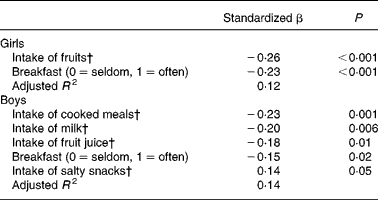
Table 5 shows the final multiple regression models for the correlates of soft drink consumption. The only significant correlates in girls were a low intake of fruit and breakfast less than five times per week. In boys, a low consumption of cooked meals, milk and fruit juice, breakfast less than five times per week and a high intake of salty snacks were all significant correlates.
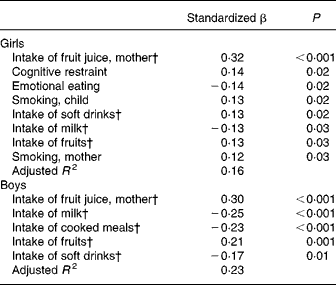
The adjusted correlates of fruit juice consumption are displayed in Table 6. The strongest correlate in both girls and boys were the mothers' reported intake of fruit juice. A high fruit juice intake was also associated with a low intake of milk and a high intake of fruits in both girls and boys. In girls, being a smoker, having a smoking mother, low emotional eating scores and high cognitive restraint scores were also significantly associated with fruit juice intake, whereas a low intake of cooked meals was independently associated with fruit juice in boys. Soft drink and fruit juice consumption were associated with each other but with opposite direction in girls and boys. The association was negative in boys and positive in girls (P = 0·04 for interaction).
Discussion
In the present study, we have analysed correlates of soft drink and fruit juice intake among adolescents. Food patterns differed between adolescents with a higher intake of soft drinks and fruit juice compared to those with a lower intake. A high intake of soft drinks was associated with lower breakfast frequency in both girls and boys. Boys with high soft drink consumption also reported a lower intake of cooked meals and milk, and a higher intake of salty snack foods. Girls with high soft drink consumption reported a lower intake of fruits.
The strongest correlate of fruit juice consumption in both girls and boys was the mothers' intake of fruit juice. Fruit juice consumption was also associated with a low intake of milk and a high intake of fruits in both girls and boys, whereas a low intake of cooked meals was associated with higher fruit juice intake in boys only. Boys seemed to drink fruit juice instead of soft drinks, whereas the two beverages were positively related to each other in girls.
It is a worry that both these beverages were consumed at the expense of milk consumption. Milk products are an important calcium source in the diet and have also been found to be negatively correlated to the intake of sugary drinks in many previous studies(Reference Vartanian, Schwartz and Brownell9). A low intake of milk during adolescence is critical as it may jeopardize the accrual of maximal peak bone mass(Reference Wyshak30).
The reduced intake of cooked meals is also a worry, since cooked meals often have higher and, most of all, a more varied nutritious content than these beverages. In addition, the large intake of sugary foods and salty snacks and the low intake of fruits accompanying soft drinks even further decrease the quality of the diet. It is interesting to notice that fruit juice, although often considered a healthy choice and associated with a higher fruit intake, was associated with a lower intake of milk and cooked meals.
Besides the risk of a lower intake of various nutrients, there are other consequences with a high intake of sugar-sweetened beverages, such as an increased risk of caries(Reference Birkhed31). A high intake of sugar has also been discussed as a contributing factor for the development of insulin resistance(Reference Willett, Manson and Liu32) and hypertriglyceridaemia(Reference Fried and Rao33).
A recent Belgian study among adolescents (13–18 years)(Reference Matthys, De Henauw and Bellemans34) found that those who had good breakfast habits (a combination of good quality, large quantity and high frequency) had a higher intake of fruit juice and lower intake of soft drinks than those with bad breakfast habits. In the present study, juice consumption was not associated with breakfast habits, suggesting that fruit juice in this population is consumed throughout the day rather than at breakfast. The present soft drink results, however, were in concordance with the Belgian study where a low breakfast frequency was one of the strongest correlates. The importance of good breakfast habits has been observed in many studies(Reference Wing and Hill35, Reference Sjöberg36), including the SWEDES study(Reference Vagstrand, Barkeling and Forslund37), and seems to be associated with healthier food choices during the day.
The strongest correlate of fruit juice consumption in both girls and boys was the mother's consumption. Soft drink consumption, on the other hand, was more or less independent of the mother's intake. This is in contrast to two previous studies where soft drink consumption of mothers and children, aged 8–13 years, was correlated(Reference Grimm, Harnack and Story17, Reference Elfhag, Tholin and Rasmussen38), but these studies are not entirely comparable to the present study due to the younger age group. Soft drinks are perhaps bought and consumed outside the home by the teenagers in the present study, while fruit juice might be found at home where it is consumed by the whole family.
Fruit juice is generally considered a healthy product equivalent with fruits, whereas soft drinks are perceived as bad for health and weight. This opinion of fruit juice is probably mirrored in the positive association between fruit juice and cognitive restraint and the negative association with emotional eating. It has been shown in earlier studies that restrained eaters tend to choose more healthy foods such as fruits and vegetables and less sweet beverages(Reference Elfhag, Tynelius and Rasmussen5, Reference Elfhag, Tholin and Rasmussen38, Reference de Lauzon, Romon and Deschamps39). The positive correlation between smoking and fruit juice suggests that fruit juice is not consumed by health-conscious individuals, but rather by weight-conscious individuals.
Another concern is that restrained eaters have, by definition, an awareness of what one should and should not eat, which might lead to an underreporting of unhealthy foods. There is often an overrepresentation of restrained eaters among underreporters of energy intake(Reference Maurer, Taren and Teixeira40), including in the present study (unpublished results). It is possible that restrained eaters actually have a lower intake of fruit juice and a higher intake of soft drinks than reported.
Concerns have been raised that a high intake of sweet beverages might lead to overweight and obesity(Reference Malik, Schulze and Hu8, Reference Vartanian, Schwartz and Brownell9). One possible explanation is that these beverages have a tendency to be consumed on top of other foods, leading to an increased energy intake(Reference Rolls, Kim and Fedoroff11). It is noticeable that both fruit juice and soft drinks were negatively correlated with milk and cooked meals in the present study, suggesting that the intake of beverages was compensated, at least partly, by a decrease in energy from other sources. Hence, the present study does not support the hypothesis that beverages are consumed without a compensatory decrease of other foods.
In a large Swedish national survey from 1997 the mean soft drink intake among women, aged 17–24 years, was 289 g/d and among young men 447 g/d(Reference Becker and Pearson41) whereas the fruit juice intake (including nectar) was twice or four times lower, 134 and 105 g/d for women and men, respectively. This can be compared with the mean soft drink intake of 180 and 360 g/d and fruit juice intake of 190 and 250 g/d (for girls and boys, respectively) in the present study. Even though the present study population was reporting surprisingly low soft drink consumption, the fruit juice intake was more expected. A recent study of 11-year-old children from different European countries, including Sweden, found similar fruit juice intake to the the present study: 209 g/d for girls and 215 g/d for boys, although no assessment of soft drink consumption was done(Reference Yngve, Wolf and Poortvliet42). It is possible that the relatively low intake of soft drinks in the present study could be explained by having a selective study population. Our mothers have a higher education than the general population (60 % have a university/college degree compared to 25 % of women in the general Swedish population(43)), and there is some evidence that higher education is associated with healthier food habits(Reference Hulshof, Brussaard and Kruizinga44, Reference Kant and Graubard45). It is possible that correlates of beverage consumption are dependent on educational level, but this has not, to our knowledge, been studied.
Another limitation of the present study is the cross-sectional design which means we cannot draw any conclusions about causality. However, our analyses are informative and will increase the understanding of the context in which these beverages are taken and by whom. Since the increased awareness of sweet beverages as a cause for weight gain has increased, this kind of information is important.
The present study is further limited by the accuracy of the reported dietary intake, something shared by all studies using diet assessments. However, in contrast to many other studies on dietary correlates(Reference Vereecken, Inchley and Subramanian4, Reference Elfhag, Tynelius and Rasmussen5, Reference Bere, Sorli Glomnes and Te Velde15–Reference Grimm, Harnack and Story17) we have information on the entire dietary intake, which makes it possible to adjust for total energy intake.
To conclude, high soft drink consumption seems to be part of a less favourable life-style including low breakfast frequency, a high intake of salty snacks and a low intake of calcium-rich products and fruits. High fruit juice consumption was also associated with some elements of a less healthy life-style, including smoking, a high intake of soft drinks (girls) and a lower intake of milk. However, fruit juice seems to be consumed in a better context than soft drinks. Nevertheless, there are reasons to include fruit juice consumption in future research when studying the consequences of beverage intake. Additionally, it might be possible to reduce fruit juice intake among teenagers by aiming at their mothers, whereas the adolescents themselves should be targeted when the aim is to reduce soft drink consumption.
Acknowledgements
The data collection phase of this study was funded by the European Commission, Quality of Life and Management of Living Resources, Key Action 1 ‘Food, nutrition and health’ programme as part of the project entitled ‘Dietary and genetic influences on susceptibility or resistance to weight gain on a high fat diet’ (QLK1-2000-00 515). There are no known conflicts of interest. K. V. performed all analyses, interpreted the data and wrote the paper. A. K. L. assisted with interpreting the data and writing the paper. J. K. and K. E. contributed to the discussion of results, whereas Y. L. initiated the study.



