



1. Introduction
Acquiring a foreign languageFootnote 1 (FL) involves mastering the syntax, grammar, phonology, orthography and vocabulary of the language. Vocabulary learning alone is no easy task: in order to understand authentic FL material (e.g., newspapers), it is estimated that learners need to know approximately 35 000 words (Schmitt, Reference Schmitt2010). However, this cannot be achieved simply by learning lists of vocabulary and explicitly trying to commit new words to memory (Horst, Reference Horst2005). Rather, incidental learning through informal exposure to FLs has been shown to lead to vocabulary acquisition (Bisson, van Heuven, Conklin & Tunney, Reference Bisson, van Heuven, Conklin and Tunney2013, Reference Bisson, van Heuven, Conklin and Tunney2014, Reference Bisson, van Heuven, Conklin and Tunney2015; de Vos, Schriefers & Lemhöfer, Reference De Vos, Schriefers and Lemhöfer2019; Pellicer-Sánchez & Schmitt, Reference Pellicer-Sánchez and Schmitt2010; Webb, Newton & Chang, Reference Webb, Newton and Chang2013). Incidental learning reflects a different form of learning than intentional learning: rather than intentionally trying to memorise new information, learners focus on another activity, such as understanding a story or playing a game, whilst being exposed to a FL. Importantly, through this informal exposure, learners are able to acquire new words effortlessly. However, the cognitive and affective mechanisms that support both intentional and incidental FL word learning are poorly understood. Here, we investigated the sources of individual variability in word learning and their underlying mechanisms. Participants learned a large vocabulary of Welsh words and completed a large battery of cognitive and affective measures. We address two related questions: what are the cognitive and affective skills that characterise a good language learner, and do these skills vary according to the demands of the learning situation?
Incidental vs intentional learning
Incidental learning differs from more intentional learning in that learners are not focused on learning per se. For example, learners’ task can be to understand a story (Pellicer-Sánchez, Reference Pellicer-Sánchez2016), video (Montero Perez, Peters, Clarebout & Desmet, Reference Montero Perez, Peters, Clarebout and & Desmet2014), or university lecture (Vidal, Reference Vidal2011), or even to draw computer illustrations (Saffran, Newport, Aslin, Tunick & Barrueco, Reference Saffran, Newport, Aslin, Tunick and Barrueco1997). However, learners can pick up new words in these various situations from simply being exposed to language. In the memory literature, incidental learning conditions are often used to investigate the automaticity of processes or learning without contamination from intentional mnemonic strategies (see e.g., Pacton, Borchardt, Treiman, Lété & Fayol, Reference Pacton, Borchardt, Treiman, Lété and Fayol2014). In contrast, in intentional learning conditions, participants are told to actively commit information to memory (also called paired-associate, explicit, or associative learning; Kaufman, Deyoung, Gray, Jiménez, Brown & Mackintosh, Reference Kaufman, Deyoung, Gray, Jiménez, Brown and Mackintosh2010; Litt & Nation, Reference Litt and Nation2014; Nelson, Reed & Walling, Reference Nelson, Reed and Walling1976).
Findings from the memory literature suggest that intentional and incidental learning may rely on different underlying mechanisms. For example, Unsworth and Engle (Reference Unsworth and Engle2005) showed that individual differences in working memory capacity impacted learning under intentional learning conditions but not during incidental learning. Their participants completed a serial reaction-time task where learning was indexed by a reduced response-time to the appearance of an asterix across trials in a repeated sequence. The only difference between the incidental and intentional learning conditions was the instruction to actively look for and memorise the sequence in the intentional learning condition. On the one hand, it is possible that participants in the incidental learning condition were nevertheless intentionally trying to commit new information to memory, despite not being instructed to do so. On the other hand, if participants were doing so systematically, those with better working memory capacity would also be expected to perform better in the incidental condition (i.e., as in the intentional condition), which Unsworth and Engle did not observe.
A similar methodological manipulation can be used to compare incidental and intentional word learning (see Bisson et al., Reference Bisson, van Heuven, Conklin and Tunney2013, Reference Bisson, van Heuven, Conklin and Tunney2014, Reference Bisson, van Heuven, Conklin and Tunney2015; Bordag, Kirschenbaum, Rogahn & Tschirner, Reference Bordag, Kirschenbaum, Rogahn and Tschirner2016) by asking participants to actively try to commit words to memory in the intentional learning condition whereas participants in the incidental learning condition are not told about the word learning aspect of the study, but rather are engaged in another task. In addition, contrary to participants in the intentional learning condition, those in the incidental learning condition are not informed that they will be tested on the words later on (Hulstijn, Reference Hulstijn and Robinson2001). It is therefore expected that participants in the intentional learning condition are trying to memorise the words and those in the incidental learning are engaged in another task; however, word learning can still occur as they are exposed to the same linguistic material as participants in the intentional learning condition. Contrary to implicit learning studies, where researchers are interested in the level of awareness of the learning and whether the learning is verbalisable (Reber, Reference Reber1989), the main focus in the current study and review was on the amount of learning that took place and the mechanisms predicting the learning outcomes.
Much word learning research focuses on intentional rather than incidental word learning, although native and non-native word learning alike mostly occurs incidentally as a by-product of another task (e.g., reading, listening to people talk, watching television, etc., where the focus is on comprehension rather than trying to commit words to memory). Similarly, models of word learning, such as the Complementary Systems account of word learning (Davis & Gaskell, Reference Davis and Gaskell2009), do not make separate predictions for different types of learning. Finally, research on individual differences is also important to build and constrain theories of language acquisition (Kidd, Donnelly & Christiansen, Reference Kidd, Donnelly and Christiansen2018), and whether the learning situation impacts the recruitment of different underlying mechanisms remains unresolved. For example, Reber, Walkenfeld and Hernstadt (Reference Reber, Walkenfeld and Hernstadt1991) suggested that individual differences may only play a role in more intentional learning processes, but no studies to our knowledge address this important question in the context of word learning.
Cognitive mechanisms underlying FL word learning
Prior research has examined the roles of both short-term memory and working memory in the word learning process. However, these two aspects of memory are not always clearly defined (Wen, Borges Mota & McNeill, Reference Wen, Borges Mota, McNeill, Wen, Borges Mota and McNeill2015). In the current review, short-term memory is assumed to involve only a storage or maintenance element, similar to the concept of the phonological loop or the visuo-spatial sketch pad in Baddeley's Working Memory model (Baddeley, Reference Baddeley2000), depending on the nature or the input. Phonological short-term memory (PSTM) is often measured using a simple digit, nonword or word span. In contrast, working memory tasks alternate between the presentation of information to be stored and a secondary processing task (Conway, Kane, Bunting, Hambrick, Wilhelm & Engle, Reference Conway, Kane, Bunting, Hambrick, Wilhelm and Engle2005). In the Working Memory model, this would involve the phonological loop or visuo-spatial sketch pad, which stores information temporarily on the one hand, and the central executive, which controls attentional resources and focuses on task relevant information on the other hand (Baddeley, Reference Baddeley2000; also see Martin & Ellis, Reference Martin and Ellis2012 for further definitions).
Phonological working memory (PWM; also referred to as ‘verbal working memory’; Morra & Camba, Reference Morra and Camba2009; Conway et al., Reference Conway, Kane, Bunting, Hambrick, Wilhelm and Engle2005) may be important for vocabulary learning because of the processing and storage elements, both of which are often necessary during a word learning task. For example, learners may need to process a picture to access a concept whilst keeping a new word label in temporary storage in order to create new form-meaning links (Morra & Camba, Reference Morra and Camba2009). Martin and Ellis (Reference Martin and Ellis2012) found that PWM as measured through a listening span was a predictor of intentional vocabulary learning. This was also found in a study with children, although here a composite WM score was used in the analysis which included both PWM and visuo-spatial short-term memory (Morra & Camba, Reference Morra and Camba2009). There is the view in the literature that WM's central role is the focusing of attention on task relevant information and inhibiting task irrelevant information (e.g., Unsworth & Engle, Reference Unsworth and Engle2005), and therefore the role of WM in language learning may be driven by control from the central executive. For example, better executive functions may facilitate FL word learning by inhibiting potential L1 competitors (Kapa & Colombo, Reference Kapa and Colombo2014; Linck, Kroll & Sunderman, Reference Linck, Kroll and Sunderman2009). Kapa and Colombo (Reference Kapa and Colombo2014) found that this was the case with both adults and children explicitly learning an artificial language, even after controlling for WM and L1 vocabulary knowledge. For adults, inhibition control (as measured using a Flanker task) was a predictor of a composite vocabulary learning score which included recall and recognition of novel words and phrases, whereas it was attentional shifting and monitoring for children. Importantly, Kidd et al. (Reference Kidd, Donnelly and Christiansen2018) suggested WM capacity is important in language tasks requiring control of attention, but not so during tasks engaging automatic processing. Results in the field of syntax learning do suggest a role for WM in rule-search learning conditions (akin to intentional learning) although the relationship appears complex and is only apparent under certain item conditions (grammatical items only; Tagarelli, Borges-Mota & Rebuschat, Reference Tagarelli, Borges-Mota and Rebuschat2011). Therefore, it is important to establish whether WM plays a part in both incidental and intentional word learning.
Many have suggested that it is the phonological storage element of WM (here referred to as PSTM) that is crucial for language learning (e.g., Baddeley, Gathercole & Papagno, Reference Baddeley, Gathercole and Papagno1998). The role of PSTM in FL word learning has been extensively researched, but results vary across studies, perhaps because of differences in research methodology. For example, Hu (Reference Hu2012) measured PSTM using a digit span and found that it predicted neither incidental nor intentional learning of novel words. Similarly, Masoura and Gathercole (Reference Masoura and Gathercole2005) failed to find a difference in intentional word learning (paired-associate) between children with high and low PSTM (measured using a nonword span). In contrast, and also using a nonword span, Cheung (Reference Cheung1996) did find that PSTM was a significant predictor of intentional word learning but only for children with low L2 vocabulary knowledge. Service and Craik (Reference Service and Craik1993) found that PSTM as measured by a FL word repetition task predicted paired-associate learning for older participants (over 60 years old) but not for younger participants. On the other hand, other studies found PSTM predicted intentional novel word learning (Atkins & Baddeley, Reference Atkins and Baddeley1998; Martin & Ellis, Reference Martin and Ellis2012; Papagno & Vallar, Reference Papagno and Vallar1995). There is however, a lack of research on the role PSTM plays in incidental word learning. Since FL vocabulary learning is an incremental process that cannot solely happen explicitly, whether PSTM is as crucial for incidental learning as it seems to be for intentional learning remains an important question. Alternatively, with the increase of multimedia and technology use in and out of the FL classroom (for example, films with subtitles and interactive white board activities) visuo-spatial memory abilities may also be important for FL word learning, in particular when learning form-meaning links for imageable words (Duyck, Szmalec, Kemps & Vandierendonck, Reference Duyck, Szmalec, Kemps and Vandierendonck2003).
Conversely, the impact of PSTM and PWM on word learning may originate from more basic phonological abilities. Phonological abilities have been shown to be important in children's intentional and incidental FL vocabulary learning (Hu, Reference Hu2012; Vijayachandra, Reference Vijayachandra2007; Morra & Camba, Reference Morra and Camba2009) although for adult language learners their role is still unclear (Silbert, Smith, Jackson, Campbell, Hughes & Tare, Reference Silbert, Smith, Jackson, Campbell, Hughes and Tare2015). Prior research has shown that adults often face difficulties in perceiving and/or producing phonemic contrasts in a FL, with large individual differences (Gordon, Keyes & Yung, Reference Gordon, Keyes and Yung2001; Hazan, Sennema, Faulkner, Ortega-Llebaria, Iba & Chung, Reference Hazan, Sennema, Faulkner, Ortega-Llebaria, Iba and Chung2006; Sebastián-Gallés & Díaz, Reference Sebastián-Gallés and Díaz2012), although early exposure to the same FL can facilitate this (Werker & Tees, Reference Werker and Tees2005). It is still under investigation whether general auditory (Lengeris & Hazan, Reference Lengeris and Hazan2010) or language-specific (Sebastián-Gallés & Díaz, Reference Sebastián-Gallés and Díaz2012) abilities are responsible for these individual differences. In addition, as mentioned in Silbert et al. (Reference Silbert, Smith, Jackson, Campbell, Hughes and Tare2015), we know very little about how these abilities relate to the acquisition of novel words and whether auditory and/or linguistic perceptual abilities predicts non-native word learning. In addition, only Hu (Reference Hu2012) found phonological abilities predicted incidental word learning.
Relatedly, much of the language we encounter in daily life comes from written input and we acquire much of our L1 vocabulary through reading (Nagy, Herman & Anderson, Reference Nagy, Herman and Anderson1985). Previous research mostly focused on auditory presentation of to-be-learnt vocabulary items which may rely overly on PSTM/PWM, whereas much learning in real life will be supported by written input. For instance, incidental FL word learning also occurs through reading (Pellicer-Sánchez & Schmitt, Reference Pellicer-Sánchez and Schmitt2010; Rott, Reference Rott1999), reading-whilst-listening (Webb et al., Reference Webb, Newton and Chang2013) and through multimodal material including written input (Bisson et al., Reference Bisson, van Heuven, Conklin and Tunney2013). However, the ability to remember patterns of spelling that are dissimilar to those of the L1, and the impact this has on FL word learning, is not well understood. We know that presenting new vocabulary with both their auditory and orthographic representations facilitates incidental and intentional word learning (Bird & Williams, Reference Bird and Williams2002; Ehri & Rosenthal, Reference Ehri and Rosenthal2007; Hu, Reference Hu2008; Ricketts, Bishop & Nation, Reference Ricketts, Bishop and Nation2009; Rosenthal & Ehri, Reference Rosenthal and Ehri2008). However, whether individual differences in orthographic learning abilities impacts incidental and intentional learning of novel words remains an open question.
Affective predictors
As well as cognitive predictors, many affective characteristics have been suggested to impact the learning of FLs. For example, motivation, anxiety, and confidence have been shown to predict language achievement (Gardner, Tremblay & Masgoret, Reference Gardner, Tremblay and Masgoret1997). To start with: motivation, in the context of FL learning, has been characterised as: “ […] the combination of effort plus desire to achieve the goal of learning the language plus favorable attitudes towards learning the language” (Gardner, Reference Gardner1985, p. 10). The role of motivation in language learning has been extensively researched; however, there are very few published experimental studies that link motivation to actual learning processes such as the outcome of an incidental or intentional learning task (Dörnyei, Reference Dörnyei2003). Two studies using similar intentional learning paradigms (paired-associate learning) found that participants with higher motivation performed better, but only in the later blocks of learning. Gardner, Day and MacIntyre (Reference Gardner, Day and Maclntyre1992) found that, over 6 blocks of learning and recall, participants who scored high on an aggregate score of integrative motivation learnt more pairs of words from block 3 onwards. In addition, measures of motivation correlated positively with learning overall. Similarly, Tremblay, Goldberg and Gardner (Reference Tremblay, Goldberg and Gardner1995) found participants with higher state motivation performed better from block 4 onwards (out of six blocks of learning and recall). Interestingly, they measured motivation before and after each block and also found that participants, who performed better on the learning task in one block, rated their motivation to learn as higher. In other words, their ability to learn the words in previous blocks of trials made them more motivated to learn in subsequent blocks of trials. Hence the better they performed, the higher they rated their state motivation. Overall, the results for both state and integrative motivation may be confounded because participants found out how well they were doing during the learning task. There are no studies to our knowledge investigating the impact of motivation on incidental vocabulary learning.
Language anxiety on the other hand has been characterised as “ […] the feeling of tension and apprehension specifically associated with second language contexts, including speaking, listening, and learning” (MacIntyre & Gardner, Reference MacIntyre and Gardner1994, p. 284), and has been shown to correlate negatively with intentional learning of novel words (Gardner et al., Reference Gardner, Day and Maclntyre1992; MacIntyre & Gardner, Reference MacIntyre and Gardner1994) and with the concept of self-confidence (Gardner et al., Reference Gardner, Tremblay and Masgoret1997). It has also been shown to load onto the same factor as a measure of confidence (Clément, Dörnyei & Noels, Reference Clément, Dörnyei and Noels1994). There are no studies to our knowledge looking at confidence and either intentional or incidental learning (other than general achievement), and no studies investigating incidental FL word learning and anxiety.
FL and L1 word learning
A final point to consider is whether learning words in a FL would recruit different mechanisms to those necessary for L1 word learning. Firstly, learning a FL is different from acquiring an L1 as a child for many reasons. When children acquire words in their L1, they are also learning about what these words represent. Thus, they are developing both their linguistic and conceptual competences (Bialystok, Reference Bialystok2001). However, L1 learning continues throughout adulthood: for example, when learning technical terms or coming across novel words in a text. On the one hand, learning words in a FL is similar to learning L1 words as adults: since, once meaning representations are established, word learning involves acquiring new word forms, and linking these to existing meaning representations (although meaning representations across languages do not always overlap completely; see de Groot & van Hell, Reference De Groot, van Hell, Kroll and de Groot2005). On the other hand, FL learning involves breaking into a new phonology and orthography whilst already having established ones. How difficult that is may depend on the language combinations and how similar/different they are to the L1 (Ellis & Sinclair, Reference Ellis and Sinclair1996; Nation, Reference Nation2001).
To summarise, prior research highlights the potential role of a variety of mechanisms in FL word learning, including short-term and working memory, auditory and phonological abilities, orthographic abilities and executive functions. However, this research is limited in a number of key respects. First, prior research has focused on the intentional learning of lists of vocabulary, which reflects only one mode of learning (e.g., Horst, Reference Horst2005); while there is evidence to suggest that intentional and incidental FL word learning relies on different mechanisms. Second, prior individual differences research has focused on individual cognitive measures in isolation, which may only be linked to word learning via other (e.g., mediating) relationships. Finally, prior research has mainly focused on small artificial lexicons. In order to understand the sources of individual variability in both intentional and incidental FL word learning and their underlying mechanisms, participants in the current study learned a large vocabulary of Welsh words and completed a large battery of cognitive and affective measures. We focused on adults and on the specific combinations of English L1 and Welsh L2 with participants without any prior knowledge of Welsh. Based on prior research, the battery included measures of phonological and visuo-spatial short-term and working memory, auditory and phonological discrimination abilities, orthographic abilities, executive functions as well as motivation and confidence. Importantly, participants learned words via both intentional and incidental modes. The study aims to answer two related questions: what are the cognitive and affective skills that characterise a good language learner, and do these skills vary according to the demands of the learning situation?
Based on prior research, we expected individual differences in working memory capacity and/or executive functions to predict intentional learning but not incidental learning. In addition, we expected auditory and phonological abilities to explain additional variance above and beyond short-term/working memory for intentional learning and to be one of the main predictors for incidental learning. Similarly, being sensitive to orthographic regularities should facilitate learning under both intentional and incidental conditions. Finally, because participants’ focus is not on learning during the incidental learning task, we expected individual differences in motivation and confidence to impact intentional but not incidental learning.
2. Method
2.1 Ethical considerations
Ethical approval was granted by the Faculty of Health and Life Sciences Research Ethical Committee at De Montfort University. All participants gave informed consent to take part in the study.
2.2 Participants
A total of 159 students at a UK Midlands University participated in the study. Participants were either Psychology students and received course credits for their participation, or they were recruited from the wider student population and received £12 for their participation. The research was advertised as a “language processing and cognitive abilities” study (hence no mention was made of the language learning and testing aspect of the study).
Participants completed a self-reporting language background questionnaire (see Appendix A) to ensure they were monolingual native English speakers with no prior knowledge of Welsh. They also reported their knowledge of other languages and self-rated their proficiency levels. Because of the language diversity of our participants it was not possible to take objective measures of FL knowledge; however, self-reporting methods are commonly used (e.g., Gollan & Acenas, Reference Gollan and Acenas2004; Kaushanskaya, Reference Kaushanskaya2012; Zhang, van Heuven & Conklin, Reference Zhang, van Heuven and Conklin2011.) Four participants reported having small amounts of prior knowledge of Welsh, one participant reported being bilingual, and one as having cognitive difficulties and as such all six were excluded. Another twelve participants were removed as they missed the second data collection session, seven participants because of technical difficulties during one of the tasks and two because they achieved lower than chance in the letter-search task. We expected UK Midlands students to be monolingual English speakers with beginner to intermediate knowledge of a FL acquired through formal education (UK children currently receive seven years of mandatory FL education ranging from 30 minutes to two hours per week). However, the language questionnaires revealed a rich and complex language history. Thirty-seven participants reported being exposed to another language from an early age (before age 6) in the home environment. Participants reported having knowledge of between 0 and 7 FLs with proficiency ratings ranging from 1 (poor) to 7 (fluent) on one of the four skills – reading, listening, writing or speaking. We therefore attempted to capture this through three additional predictors in the analysis as controls: early FL exposure (FL in the home environment before age 6), breadth of FL knowledge (number of FLs for which they reported having some knowledge) and depth of FL knowledge (highest level of proficiency rating in a FL). The analyses reported below include 132 participants (20 males, M age = 20.29, SD = 3.96).
2.3 Materials
The tasks were delivered via computer using the PsychoPy software package (Peirce, Reference Peirce2007) except for the paper-based language background questionnaire and the motivation and confidence questionnaire delivered via Qualtrics (Qualtrics, 2018).
2.4 Procedure
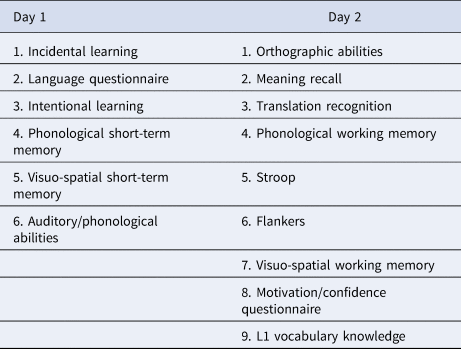
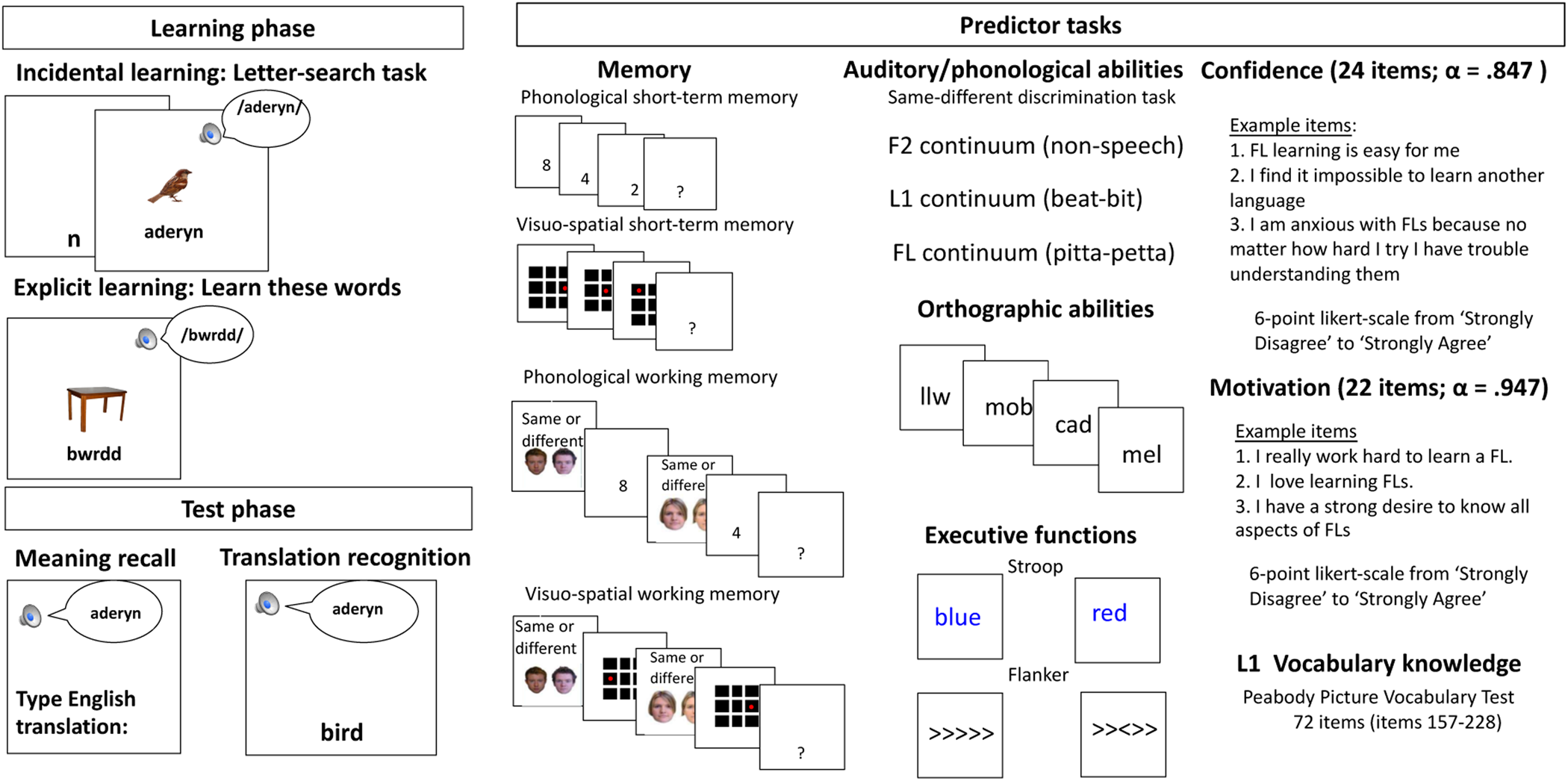
All participants completed the tasks in the same order (see Table 1 and Figure 1) over two 1 hour and 15 minutes sessions on consecutive days. In particular, the learning tasks were carried out on day 1 and the recognition and recall tasks on day 2 to allow for consolidation through sleep (Davis & Gaskell, Reference Davis and Gaskell2009; Dumay & Gaskell, Reference Dumay and Gaskell2007). The cognitive and affective tasks were then distributed over the two days to complete the sessions.
Learning, test and individual differences tasks on each day.
Graphical representation of learning, test and individual differences tasks (pictures from Brodeur, Dionne-Dostie, Montreuil & Lepage, Reference Brodeur, Dionne-Dostie, Montreuil and Lepage2010; Moreno-Martínez & Montoro, Reference Moreno-Martínez and Montoro2012; faces from the Glasgow Unfamiliar Face Database).
Incidental and intentional learning tasks
The stimuli for the learning tasks consisted of three lists of 40 auditory Welsh words, as well as their written form and a picture depicting the meaning of the words (see Appendix B). Lists were matched for word length in Welsh and we ensured that no word was a cognate with English; all words were concrete nouns. One list of words was used for the incidental learning phase, one list was used for the intentional learning phase, and one list of words was used as control during the recognition test phase. This was counterbalanced across participants such that participant 1 was presented with the 40 words in list 1 for the incidental learning task, the 40 words in list 2 for the intentional learning task, and the 40 words in list 3 as control words (i.e., “new words”). For participant 2, list 2 was used for the incidental learning task, list 3 was used for the intentional learning task and list 1 as new words, and so on for the other participants. We therefore created three versions of the tasks for the incidental and intentional learning as well as for the recall and recognition tasks to match the lists of words.
The incidental learning task was presented to participants as a letter-search task (as in Bisson et al., Reference Bisson, van Heuven, Conklin and Tunney2013, Reference Bisson, van Heuven, Conklin and Tunney2014, Reference Bisson, van Heuven, Conklin and Tunney2015). They were first presented with a letter, then the screen changed and they saw a written word. Their task was to indicate whether the letter they saw was in the word or not. Simultaneously with the appearance of the written word, participants also heard the auditory Welsh word once and saw a picture depicting their meaning, although this was irrelevant for the task. Participants were not asked to learn the words in any way for this part of the experiment. However, through the pictorial information, participants could acquire the meaning of the words. Trials started with a blank screen for 500 ms, followed by the presentation of the to-be-searched letter in the middle of the screen for 1 second. This was followed immediately by the image and written word form which remained on the screen for 3 seconds, each presented equally just above and just below center screen respectively (we used the normalised units in PsychoPy with image location [0, 100] and written word [0, −100]). Each Welsh word was presented 6 times in total, 3 times with a letter that was present in it and 3 times with a letter that was not. The incidental learning task was split into three blocks with each Welsh word presented twice in each block. The presentation was fully randomised in each block. The language learning aspect of the research was not mentioned to participants until the intentional learning task, which followed the incidental learning task; i.e., there was no mention of a recognition and recall task during the incidental learning task (as in Bisson et al., Reference Bisson, van Heuven, Conklin and Tunney2013, Reference Bisson, van Heuven, Conklin and Tunney2014, Reference Bisson, van Heuven, Conklin and Tunney2015).
In the intentional learning task, participants were informed that this was now the learning task; that they would see a picture and a written FL word and that they would also hear a FL word. They were specifically told that their task was to try to memorise the words and their meaning, that there would be no buttons to press, but that they would be tested on the words later on. Welsh words were presented exactly as per the incidental learning task, with auditory and written word forms in Welsh as well as a picture depicting the meaning of the words. The written words and pictures remained on screen for 3 seconds as per the incidental learning task and the auditory word form was played once per trial. However, there was no letter to search; rather, participants saw a fixation cross for 500 ms in between each trial.
Recall and recognition tests
In the meaning recall task, participants were presented with each auditory Welsh word from the incidental and intentional learning tasks once along with its written form and they were asked to type the English translation. The written form of the Welsh words remained on-screen until participants pressed enter to proceed to the next trial. In the translation recognition task, participants were presented with auditory and written Welsh words from the incidental and intentional learning tasks as well as 40 additional control Welsh words (new words). For each Welsh word, participants saw a possible written English translation at the bottom of the screen, and their task was to indicate whether the translation was correct. They were informed that each word would be presented once with its correct translation, and once with an incorrect translation during this task. The incorrect translations were pseudo-randomly assigned to each auditory Welsh word, and they were different for each version of the task. The trials were presented in random order and the recognition task included two breaks.
Short-term and working memory tasks
PSTM was assessed using a digit span (Atkins & Baddeley, Reference Atkins and Baddeley1998; Hu, Reference Hu2012; Papagno & Vallar, Reference Papagno and Vallar1995). In each trial, participants were presented with three to eight single digits on screen and were instructed to memorise them. Each digit was 3 cm in size and was presented in white on a gray background in the middle of the screen for 500 ms with a 500 ms interstimulus interval. Upon presentation of a question mark, participants had to recall the digits in the correct order by typing them in. Participants completed two practice trials followed by three trials of each span length presented in random order for a total of 18 trials. We calculated the proportion of correctly recalled digits in the correct order for each trial (Conway et al., Reference Conway, Kane, Bunting, Hambrick, Wilhelm and Engle2005).
We also included a task to measure the potential importance of visuo-spatial short-term memory (SSTM) in language learning (see Duyck et al., Reference Duyck, Szmalec, Kemps and Vandierendonck2003). This involved using a 3 x 3 grid where a red circle was displayed in one of the 9 possible positions for 500 ms with a 500 ms interstimulus interval (as the storage element in Hubber, Reference Hubber2015; Hubber, Gilmore & Cragg, Reference Hubber, Gilmore and Cragg2019). In each trial, three to eight circles were presented. Participants were asked to memorise the position of the red circles. Upon presentation of a question mark, an empty grid appeared and participants were asked to use the mouse to recall the position of the red circles in the correct order. They completed two practice trials followed by three trials of each span length in random order and we again calculated the proportion of correctly recalled positions for each trial.
We also included a phonological (Martin & Ellis, Reference Martin and Ellis2012) and a visuo-spatial (Duyck et al., Reference Duyck, Szmalec, Kemps and Vandierendonck2003) WM task, both involving storage and processing elements. Participants were presented with to-be-remembered items (storage) interleaved with a face processing same-different task (as in Hubber, Reference Hubber2015; Hubber et al., Reference Hubber, Gilmore and Cragg2019). The storage element of the WM task was the same as the short-term memory tasks (digits span and red circles). For the phonological working memory task, participants were firstly presented with two pictures of faces on screen for a maximum of 3 seconds and had to indicate whether they were the same person or different people using the Y/N keys. Once they responded to the face processing element, participants were presented with a digit on screen for 500 ms. The task continued with interleaved face-processing and digit presentation with 500 ms interstimulus interval. Participants were instructed to memorise the digits in the correct order. Following the presentations of 3 to 8 sets of faces and digits, participants were asked to recall the digits in the correct order using the keyboard. Participants first practiced the face same-different task before completing two practice trials including both storage and processing. Following this practice round, they completed 3 trials of each span length presented in random order and we calculated the proportion of correctly recalled positions for each trial. The visuo-spatial working memory task followed exactly the same format except that the storage element involved remembering the position of red circles on a grid as in the visuo-spatial short-term memory task.
Auditory/phonological abilities tasks
Auditory and phonological abilities were assessed through an AX (same-different) discrimination task (as in Lengeris & Hazan, Reference Lengeris and Hazan2010 and Silbert et al., Reference Silbert, Smith, Jackson, Campbell, Hughes and Tare2015). We assessed phonological abilities using both L1 and FL speech discrimination tasks and auditory ability using a non-speech discrimination task through three blocks of testing. The two speech blocks consisted of an English (L1) and a Greek (FL) continuum embedded within natural English (bVt) and Greek (pVta) words spoken by an English and a Greek male native speaker respectively. The English continuum ranged from /iː/ to/ɪ/; the Greek continuum ranged from /i/ to /e/. The non-speech continuum consisted of a single formant which varied in center-frequency from 1250 to 1500 Hz and thus was a non-speech analog to a vowel second formant (F2). Each continuum had 9 stimuli varying in equal steps in terms of F1 and F2 formant frequencies and duration (speech continua) and F2 formant frequency only (non-speech continuum). A method of “standard” was used against which the other stimuli were compared (e.g., step 1 with step 2, step 1 with step 3 etc.). The standard was one endpoint of the continuum (the first vowel in each vowel continuum and the 1250 Hz endpoint in the non-speech continuum). Trials started with 500 ms of silence, then, participants heard two words or two non-speech stimuli with a 250 ms interstimulus interval, and had to indicate if these were the same or different. Participants completed 8 practice trials with feedback before completing 32 main trials in each block (half “different” and half “same” trials). Trials and blocks were completed in random order.
Orthographic ability task
Orthographic abilities were assessed through a trigram recognition task. For each trial, participants were presented with a trigram and had to indicate whether this combination of letters was possible in Welsh, based on what they had learnt from the incidental and intentional learning tasks. For each trial, trigrams remained on screen until participants had made a response. Half of the trigrams had occurred in words presented during the learning tasks and half were new (62 trials in total). We calculated a percentage accuracy overall.
Executive function tasks
We investigated whether having better executive functions led to more efficient language learning (Kapa & Colombo, Reference Kapa and Colombo2014; Linck et al., Reference Linck, Kroll and Sunderman2009) by including two inhibition control tasks, one verbal (Stroop task; Stroop, Reference Stroop1935) and one non-verbal (Flankers Task; Eriksen & Eriksen, Reference Eriksen and Eriksen1974). For the Stroop task, trials started with the presentation of a fixation cross for 500 ms followed by a blank screen for 500 ms. Participants were then presented with a color word written in either congruent or incongruent color ink (red, blue, green) in the middle of the screen. They were told to indicate as quickly as possible what color ink each word was displayed in by pressing a corresponding color key on a button box. The color words stayed on screen until participants had made a response. Following 12 practice trials with feedback, participants completed 120 randomly presented trials (60 congruent and 60 incongruent). For the Flanker task, participants were instructed to press a corresponding key according to the direction of a target arrow presented in the middle of the screen. They were instructed to ignore the two arrows presented on either side of the target. Direction of the target and flanking arrows were counterbalanced to include 60 congruent and 60 incongruent trials presented in random order. Trials started with the presentation of a fixation cross and blank screen for 500 ms each, then the arrows were presented in the middle of the screen. The stimuli remained on screen until participants had made a response, and they completed 8 practice trials with feedback prior to the main trials.
Motivation and confidence/anxiety questionnaire
We investigated both motivation (Gardner et al., Reference Gardner, Day and Maclntyre1992) and confidence/anxiety (Gardner et al., Reference Gardner, Day and Maclntyre1992; MacIntyre & Gardner, Reference MacIntyre and Gardner1994; Gardner et al., Reference Gardner, Tremblay and Masgoret1997; Clément et al., Reference Clément, Dörnyei and Noels1994) as potential predictors through a 46-item questionnaire (see Appendix C). The 22 items for the Motivation part of the questionnaire were adapted from the Attitude/Motivation Test Battery (AMTB; Gardner, Reference Gardner2004). We used items from three subscales: Motivational intensity, Attitude towards learning the target language, Desire to learn the target language. These subscales have reported Cronbach's α of .80, .91 and .84 respectively and are thought to best measure the concept of motivation (Masgoret & Gardner, Reference Masgoret and Gardner2003). The 24 items for the Confidence/Anxiety part of the questionnaire were adapted from the Foreign Language Use Anxiety subscale of the AMTB (no reported α), the Input Anxiety Scale, Processing Anxiety Scale and Output Anxiety Scale (Cronbach's α = .78, .72 and .78 respectively; MacIntyre & Gardner, Reference MacIntyre and Gardner1994). We also included five novel items derived from the concept of language learning difficulty (e.g., ‘I can pick up new words in a foreign language easily’; ‘I find foreign language learning difficult’). Participants answered using a Likert-scale ranging from 1 ‘Strongly Disagree’ to 6 ‘Strongly Agree’. Minimum to maximum scores on each scale were 22–132 and 24–144, for the motivation and confidence scales respectively, and both scales included reverse scored items.
L1 vocabulary knowledge
L1 vocabulary knowledge was measured using 72 items (items 157–228, i.e., the most difficult items) from the Peabody Picture Vocabulary Test (Dunn & Dunn, Reference Dunn and Dunn2007). We used the raw score with each correct answer scoring one point out of 72 and participants completed all the items.
3. Results
Means and confidence intervals for all learning measures are reported in Table 2. We conducted one-sample t-tests on each learning outcome measure which revealed that performance on each measure was significantly higher than chance (all ps <.001; see Table 2). In addition, all scores from the learning measures were significantly different from each other (all ps <.001, Bonferroni corrected) revealing highest scores in the intentional learning condition followed by the incidental learning condition, and the new words. To account for guessing on the recognition task, we calculated a difference score between intentional recognition test scores and recognition test score for new words and repeated the procedure for incidental recognition test score. We then calculated an overall incidental learning score and an overall intentional learning score by averaging the difference score with the recall score for each learning condition. These average incidental and intentional learning scores were then used as outcome measure for the mixed-effect models below. For the Stroop and Flankers task, a difference score for the response times between congruent and incongruent trials was calculated for correct trials only. Incorrect trials (2.4% and 3.5% of trials respectively) and trials with response times faster than 250 ms or slower than 2000 ms (0.3% of trials for both tasks) were removed. The Motivation and Confidence questionnaires performed adequately with calculated Cronbach's α of .947 and .847 respectively. Means, confidence intervals and correlations are reported for both individual differences and overall learning measures in Table 3.
Mean accuracy and confidence intervals for each learning outcome measure by learning type with t-value for one-sample t-test.

*** p <.001
Means, confidence intervals and correlations among the language background measures (1–3), the language learning scores (4–5) and individual differences measures (6–18).

Note. 1 = early FL exposure (coded as No = 0, Yes = 1); 2 = breadth of FL knowledge; 3 = depth of FL knowledge; 4–5 = mean overall (4) incidental and (5) intentional learning; 6 = phonological short-term memory; 7 = visuo-spatial short-term memory; 8 = phonological working memory; 9 = visuo-spatial working memory; 10–12 = auditory and phonological discrimination abilities; 13 = orthographic abilities; 16 = L1 vocabulary knowledge; * = p < .05 ,** = p < .01
3.1 Exploratory factor analysis
We used an exploratory factor analysis to group the large number of individual differences measures into composites (‘memory’: phonological and visuo-spatial short-term and working memory, ‘auditory abilities’: F2, L1 and FL discrimination abilities, ‘executive function’: Stroop and Flankers effects, and ‘affective measures’: motivation and confidence scales). The analysis revealed a four-factor structure among the predictor tasks. The memory measures all loaded highly together on factor one (all >= .701), the auditory and phonological discrimination abilities measures loaded highly together on factor two (all loadings >= .549), the motivation and confidence/anxiety questionnaire loaded highly on factor 3 (both loadings =>.826) and the executive function measures loaded highly on factor 4 (loadings =>.570). Our L1 vocabulary knowledge task loaded highly on factor one (.643) with the memory, auditory ability (.358) and orthographic ability (.470) measures. As discussed in Morra and Camba (Reference Morra and Camba2009), this is probably due to the vocabulary test drawing from memory as well as auditory and orthographic abilities to complete the test. It would be near impossible to find a vocabulary test that only measures vocabulary knowledge. We therefore regressed these measures onto the vocabulary test score and used the residual from this analysis as L1 vocabulary knowledge for the mixed-effect models (see Morra & Camba, Reference Morra and Camba2009 for similar procedure). Therefore based on the exploratory factor analysis, we standardised and averaged scores for memory, auditory abilities, executive function, and affective measures to use as predictors (i.e., composites) for the mixed-effect analyses in addition to the residual L1 vocabulary score, the orthographic abilities score and the three language background control measures (Early FL exposure, breadth, and depth of FL knowledge).
3.2 Single predictor analyses
First, we separately analysed each predictor's effect on language learning (e.g., similar to research measuring only a single predictor). We submitted participants’ mean learning scores to linear mixed-effects models (lme4; Bates, Mächler, Bolker & Walker, Reference Bates, Mächler, Bolker and Walker2014) with fixed effects of learning condition (deviation coded: intentional = 0.5; incidental = −0.5), just one (standardised) predictor and their interaction, and random intercepts by participants (R syntax: “Outcome~Condition*Predictor+(1|Participant)”). These by-participant analyses focused on participant-level (e.g., cognitive and affective) predictors, and thus we averaged over learning trials (i.e., excluded item random effects). Fixed effect t-values with an absolute value greater than 2 were statistically significant. Results are reported for each predictor in Table 4. The effect of learning condition was significant (Est. > 10.70, SE < 1.27, t > 8.40), such that scores were significantly higher in the intentional than incidental condition. The effect of memory, auditory abilities, orthographic abilities and L1 vocabulary knowledge were also significant, such that better abilities predicted higher scores across conditions. Early FL exposure in the home environment was significantly detrimental to FL learning. Finally, the interaction between learning condition and memory was also significant, such that memory was more predictive of scores in the intentional than incidental condition.
Single predictor analyses of participants’ learning outcomes (Estimates, SEs and CIs x 10−2; *p < .05). Each row represents a separate model; models included fixed effects of learning condition, a single predictor and their interaction. Learning condition was significant across all models (Est. > 10.70, SE < 1.27, t > 8.40).

3.3 Multiple predictor analyses
Second, we simultaneously analysed these predictors’ effects on language learning. Due to the large number of predictors and interactions, we used a model comparison approach, starting with a simple base model that we added complexity to (e.g., interactions), as justified by the data (i.e., based on significant improvements in model fit). The base model included fixed effects of the learning condition and all of the predictors, but excluded their interactions: we submitted participants’ mean learning scores to a linear mixed-effects model with fixed effects of learning condition (deviation coded: intentional = 0.5; incidental = −0.5) and all of the (standardised) predictors, and random intercepts by participants (R syntax: “Outcome~Condition + EarlyFL+BreadthFL+DepthFL+Memory+ExecutiveFunctions+AuditoryAbilities+OrthographicAbilities+Affective+ResidualVocabulary+(1|Participant)”). We compared this base model to separate models that added just one learning condition x predictor interaction at a time (e.g., R syntax for memory: “Outcome~Condition*Memory+EarlyFL+BreadthFL+DepthFL+ExecutiveFunctions+AuditoryAbilities+OrthographicAbilities+Affective+ResidualVocabulary+(1|Participant)”). Model fit comparisons are reported in Table 5. Consistent with the Single predictor analyses, model fit improved in only one instance: memory. Taken together, these results suggest that additional complexity (i.e., inclusion of interactions in addition to memory) is not justified by the data; rather, this model is reported in Table 6. Consistent with the Single predictor analyses, the effects of learning condition, memory, auditory abilities, orthographic abilities, L1 vocabulary knowledge and early FL exposure were all significant, as was the interaction between learning condition and memory.
Multiple predictor analyses of participants’ learning outcomes (Estimates, SEs and CIs x 10−2; *p < .05). Each row represents a separate model; changes in model fit reflect comparisons between a base model (i.e., which included fixed effects of learning condition and all predictors but excluded their interactions) and models including just one additional predictor x learning condition interaction.

Multiple predictor analysis (Estimates, SEs and CIs x 10−2; *p < .05). The table represents a single model.

4. Discussion
Consistent with prior research, the current results revealed that auditory/phonological abilities, sensitivity to orthographic regularities, short-term/working memory and long-term linguistics knowledge are closely linked to FL word learning. However, the current results also yielded novel insight into the differing roles FL learning mechanisms play in different modes of learning. Moreover, our large battery of measures and mixed-effect analyses also addressed the independent contributions of these various abilities to word learning. We found that the composite score for memory interacted with learning condition demonstrating the involvement of different mechanisms depending on the demands of the learning situation.
The relationship between PSTM and L1 development has been discussed extensively (e.g., Baddeley et al., Reference Baddeley, Gathercole and Papagno1998). However, how much learners rely on PSTM in the acquisition of words in a FL is less clear (Cheung, Reference Cheung1996; Hu, Reference Hu2012; Masoura & Gathercole, Reference Masoura and Gathercole2005; Service & Craik, Reference Service and Craik1993). Our data suggests that, for FL vocabulary, learners relied on general memory processes, but more so during effortful intentional learning situations consistent with prior research. For example, in an artificial grammar learning study, Reber et al. (Reference Reber, Walkenfeld and Hernstadt1991) found a correlation between explicit learning and IQ and a smaller non-significant correlation between implicit learning and IQ. In addition, in the current study, while the individual memory measures did correlate with incidental learning, the interaction between memory composite and learning condition does indicate a bigger effect in the intentional learning condition. The current study does not specify which memory processes in particular are important for successful intentional FL learning, but it is likely to be a memory mechanism that is common to all the memory tasks, for example, memory for the serial order of the information as suggested by Majerus, Poncelet, Van der Linden and Weekes (Reference Majerus, Poncelet, Van der Linden and Weekes2008). Importantly, the results suggest the role of short-term/working memory in FL learning may be more important in intentional word learning. This highlights the importance of including multiple types of learning situations during word learning studies to get a fuller picture of the mechanisms involved. In addition, it may be advisable for language teachers and learners to include a balance of activities that rely on intentional and incidental learning mechanisms in order to allow learners with a range of memory abilities to successfully learn new FL words.
Our results also showed that L1 language knowledge predicted the learning of words in a FL. For L1 development, the Matthew effect is well known (e.g., Stanovich, Reference Stanovich1986), wherein the rich get richer and the poor get poorer. This may be because the more words one knows, the more experience one has with the phonology of the language (Majerus et al., Reference Majerus, Poncelet, Van der Linden and Weekes2008). However, the current results also suggest a Matthew effect across languages, i.e., the more words people know in their L1 the more easily they can learn words in a FL. A potential reason for that may be the extent of the semantic network. In other words, it is easier to learn a word form for which you already have a meaning representation. This is supported by results of Keuleers, Stevens, Mandera and Brysbaert, (Reference Keuleers, Stevens, Mandera and Brysbaert2015) who reported a Matthew effect across languages in the other direction too: the more words people knew in a FL, the more words they knew in their L1. Language knowledge therefore seems to impact further language learning regardless of whether it is native or non-native, above and beyond what is already captured by the other predictor tasks in the current study. It is also likely that language knowledge indexes an underlying mechanism important for word learning in any language, such as the acquisition of form-meaning connections which could be realised through Hebbian learning (Pulvermüller, Reference Pulvermüller1999).
One other notable language variable was the exposure to a language other than English in the home environment from an early age. Contrary to prior research suggesting bilingualism conveys a language learning advantage (e.g., Kaushanskaya & Marian, Reference Kaushanskaya and Marian2009), we found early language exposure was detrimental to language learning, and to many of the tasks measuring cognitive abilities. The aim of our study was not however to investigate the impact of early language exposure on FL word learning. We simply attempted to control for this aspect of language background in our analysis. Our participant sample was heterogenous with a variety of language backgrounds and language experiences. We therefore cannot draw any conclusions from this result and further research should be conducted on this topic.
Our results also showed that individual differences in orthographic abilities predicted both incidental and intentional word learning. It has been suggested that children are sensitive to the orthographic regularities of their L1 (Pacton, Perruchet, Fayol & Cleeremans, Reference Pacton, Perruchet, Fayol and Cleeremans2001) and that sensitivity to orthographic regularities impact written word processing (Chetail, Reference Chetail2017). However, it is less clear how individual differences in orthographic sensitivity predict language development. In our data, sensitivity to orthographic regularities of the FL was a robust predictor of vocabulary learning for both modes of learning. The learning of orthographic regularities presumably relied on visual implicit/statistical learning mechanisms (Chetail, Reference Chetail2017; Christiansen, Reference Christiansen2018; Turk-Browne, Jungé & Scholl, Reference Turk-Browne, Jungé and Scholl2005) during both intentional and incidental word learning tasks. During the intentional learning task participants would not have paid particular attention to the (novel) patterns of spelling of the FL as they would have been actively trying to create form-meaning links. However, as some attention was allocated to the visual word form (Kaufman et al., Reference Kaufman, Deyoung, Gray, Jiménez, Brown and Mackintosh2010) they automatically became sensitive to the orthographic regularities of the FL. Similarly, the incidental learning task required processing of the letters which formed each word; hence, again this would have engaged statistical learning mechanisms. Frost, Siegelman, Narkiss and Afek (Reference Frost, Siegelman, Narkiss and Afek2013) showed that visual statistical learning is linked to learning the structure of FL words, and here we showed that the latter helps with form-meaning mapping. However, it is still an open question whether there is more to the acquisition of orthographic regularities or whether it is just an instantiation of visual statistical learning. In addition, we acknowledge the limitation of the current study in that we measured orthographic abilities through a trigram recognition task based on the Welsh words, and that this was a predictor of learning the same Welsh words. In other words, learning part of the words (three letter combinations) predicted whole word form-meaning recognition and meaning recall. In future studies, orthographic ability should be measured in one language and language learning in another.
For auditory abilities, our composite indexed two types of auditory processes: non-speech auditory abilities (i.e., tones) and linguistic phonological abilities. In children, linguistic phonological abilities (such as rhyme awareness and phoneme awareness) have been shown to predict word learning (De Jong, Seveke & van Veen, Reference De Jong, Seveke and Van Veen2000), vocabulary knowledge (Bowey, Reference Bowey1996) and reading abilities (Melby-Lervåg, Lyster & Hulme, Reference Melby-Lervåg, Lyster and Hulme2012) in the L1. Here we show the importance of auditory/phonological abilities to adult FL learning. However, further research is needed to establish whether non-speech auditory or phonological processing mechanisms drive language learning and development. There is research supporting the idea that musicians have a FL learning advantage compared to non-musicians (François & Schön, Reference François and Schön2011) supporting a role for non-speech auditory processes in language learning. Prior research has shown that some phonological abilities can be trained (Anthony & Francis, Reference Anthony and Francis2005; Hazan & Kim, Reference Hazan and Kim2010; Mitterer & McQueen, Reference Mitterer and McQueen2009; Lengeris & Nicolaidis, Reference Lengeris and Nicolaidis2015); however, future research needs to address whether and which auditory/phonological mechanisms play a causal role in language learning. Of particular interest is the role of auditory abilities as improvements here could lead to the facilitation of vocabulary learning in any language with important implications for language teaching and learning. Further research is required with various combinations of FLs and L1s to explore this, as it may be that auditory abilities are more important when the FL contains more unfamiliar phonemes, whereas, for language combinations where phonemes are similar across languages, it may be that learners can use stored phonological knowledge to facilitate learning. Importantly, prior research focused on phonological abilities in children and their role in language learning. Here we provide evidence that acoustic/phonological mechanisms remain important in adulthood for the learning of FLs.
Finally, we included two affective measures in the current study to assess individual differences in motivation to learn another language as well as confidence in one's ability to learn a language. Both scales performed well and were combined in an affective composite score. However, this did not predict the outcomes of the language learning tasks. This may be due to its short nature (two one-hour sessions): therefore, it would be more informative to study the role of motivation and confidence within the context of a longer language learning study.
We would like to acknowledge several limitations of the current study. Firstly, the participants in the current study were all enrolled in a University course and therefore, the variance on each predictor task may have been smaller than in a more diverse sample. Another limitation concerns the fact that we chose to use a multi-modal task for both incidental and intentional learning using both auditory and written FL word form as well as pictures. This limited the type of words that could be included to highly imageable and concrete nouns. In addition, the use of a multi-modal presentation of FL words is not representative of every learning situation where they may only be one (e.g., listening to a FL conversation) or two (e.g., oral presentation of new FL words with flash-cards) modalities. However, multi-modal presentation is likely increasing in and out of the classroom due to technological innovations (e.g., interactive white-board activities, online activities, films with subtitles, etc.); hence, it is still representative of some FL word learning that occurs outside of the laboratory. In addition, the multi-modal situation allowed us to examine learning with participants without prior knowledge of Welsh as they could access word meaning through the pictures (as opposed to accessing word meaning through the context as in sentence or text reading) and hence negated the need for a Welsh vocabulary knowledge pre-test.
Another limitation is that some participants in the incidental learning condition may have tried to learn the words even though this was not required of them (Hulstijn, Reference Hulstijn and Robinson2001). Crucially, in contrast to the intentional learning condition, the incidental learning condition required participants to focus their cognitive resources on another demanding task. Thus, the incidental learning condition paralleled situations in which learners might be reading, listening to people talk or watching television, but not intentionally trying to commit words to memory; in contrast, it diverged from situations in which learners can allocate all of their cognitive resources to memorisation. Likewise, if participants were systematically engaging in intentional learning in the incidental learning condition, the divergence between these two conditions would not be expected; thus, the current results suggest that learners are engaged in different modes of learning in the two conditions (e.g., see also Unsworth & Engle, Reference Unsworth and Engle2005). In the current study, the learning of the words during the incidental learning task was unnecessary and irrelevant to the task at hand (similarly to Saffran et al., Reference Saffran, Newport, Aslin, Tunick and Barrueco1997). The fact that nevertheless incidental learning occurred is compelling. Our results showed more learning in intentional conditions, however, and future research could investigate how to increase incidental learning, for example, by enhancing the saliency of the information (e.g., Montero Perez et al., Reference Montero Perez, Peters, Clarebout and & Desmet2014). Finally, the current study does not inform about how participants allocated their attention during the learning tasks and whether this affected their learning. However, using eye-tracking, Bisson et al. (Reference Bisson, van Heuven, Conklin and Tunney2015) investigated the allocation of attention during a similar incidental learning task (letter-search task) and found that although the first 300 ms was spent looking at the written word (as was required to complete the task) participants quickly shifted their attention to the picture. Importantly, the time spent looking at the picture predicted learning recall but not the time spent looking at the written word. Future research could address how participants allocate their attention during intentional word learning and how it impacts learning outcomes.
To conclude, here we systematically investigated individual differences in FL learning using a combination of learning situations to account for how FLs are learnt outside of the laboratory. Unique contributions of auditory/phonological discrimination abilities, orthographic abilities, short-term/working memory and L1 knowledge were found but this varied according to how words were encountered. We suggest that these predictors each index underlying mechanisms, and suggested that these may include auditory/phonological processing, memory for order information, visual statistical learning and form-meaning binding. Importantly, we showed that predictors vary according to how words are encountered and suggest therefore that to fully capture mechanisms of word learning, researchers need to include a range of learning situations.
Acknowledgements
This work was funded by the Experimental Psychology Society and De Montfort University. We thank Christopher Drayton for his help with data collection.
Appendix A
ID:_________
Language and Demographics Questionnaire
The following questionnaire would help us understand more about your language background.
Date of Birth: ____________
Gender: M / F
Country and city of origin: __________________________________
What language(s) does your Mother speak? _____________________________
What language(s) does your Father speak? _____________________________
Indicate when and where you had your first contact (e.g., spoken to you, in school) with the written and spoken languages (including dialects) you know and how many years experience you have with each language.

Indicate the written and spoken languages (including dialects) you know and how good you consider yourself in speaking, listening comprehension, reading, and writing in each language, using a scale of 1–7
(1 = very poor; 4 = average; 7 = very good/fluent).

Do you have any reading difficulties (e.g., dyslexia)? Yes / No
If Yes, Please provide details:
__________________________________________________________________________________________________________________________________________________________________________________________________
Do you have any speaking difficulties (e.g., stuttering)? Yes / No
If Yes, Please provide details:
__________________________________________________________________________________________________________________________________________________________________________________________________
Do you have any listening difficulties? Yes / No
If Yes, Please provide details:
__________________________________________________________________________________________________________________________________________________________________________________________________
Do you have normal or corrected to normal vision? Yes / No
If No, Please provide details:
__________________________________________________________________________________________________________________________________________________________________________________________________
Did you have any experience with Welsh before this study? Yes / No
If Yes, Please provide details:
__________________________________________________________________________________________________________________________________________________________________________________________________
Do you have any musical training or do you play an instrument? Explain.
__________________________________________________________________________________________________________________________________________________________________________________________________
Do you have any other information about your language background that you think is important and is not included in this questionnaire?
_____________________________________________________________________________________________________
_____________________________________________________________________________________________________
Thank you!
All information provided will be dealt with and maintained in strict confidentiality.
Appendix B
List of Welsh words used with English translations and list number

Appendix C
Items used for the language motivation and confidence questionnaire by subscale with provenance

Motivation
Motivational Intensity (adapted from ATMB, Gardner, Reference Gardner2004); ‘English’ changed to ‘Foreign Languages’
1. I make a point of trying to understand all the foreign languages I see and hear.
2. I keep up to date with my foreign language knowledge by working on it almost every day.
3. I really work hard to learn a foreign language.
4. I can't be bothered trying to understand the more complex aspects of a foreign language. (reverse scored)
5. When I am studying a foreign language, I ignore distractions and pay attention to my task.
Attitude towards learning the target language (adapted from AMTB, Gardner, Reference Gardner2004)
6. Learning a foreign language is really great.
7. I hate foreign languages. (reverse scored)
8. I really enjoy learning foreign languages.
9. I would rather spend my time on subjects other than foreign languages. (reverse scored)
10. Learning foreign languages is a waste of time. (reverse scored)
11. I plan to learn as many foreign languages as possible.
12. I think that learning foreign languages is dull. (reverse scored)
13. I love learning foreign languages.
Desire to learn the target language (adapted from AMTB, Gardner, Reference Gardner2004)
14. I have a strong desire to know all aspects of foreign languages.
15. Knowing foreign languages isn't really an important goal in my life. (reversed scored)
16. If it were up to me, I would spend all of my time learning foreign languages.
17. I want to learn a foreign language so well that it will become natural to me.
18. I'm losing any desire I ever had to know foreign languages. (reversed scored)
19. I would like to learn as many foreign languages as possible.
20. To be honest, I really have no desire to learn foreign languages. (reversed scored)
21. I wish I were fluent in a foreign language.
22. I haven't any great wish to learn more than the basics of foreign languages. (reversed scored)
Confidence items
Foreign Language Use Anxiety items (adapted from ATMB, Gardner, Reference Gardner2004); ‘English’ changed to ‘Foreign Languages’
23. I would get nervous if I had to speak in a foreign language to a tourist.
24. I feel very much at ease when I have to speak in a foreign language. (reversed scored)
25. Speaking a foreign language anywhere makes me feel worried.
26. It doesn't bother me at all to speak in a foreign language. (reversed scored)
27. It would bother me if I had to speak a foreign language on the phone.
28. I would feel quite relaxed if I had to give street directions in a foreign language. (reversed)
29. I feel anxious if someone asks me something in a foreign language.
Input Anxiety Scale (adapted from MacIntyre & Gardner, Reference MacIntyre and Gardner1994)
30. I am not bothered by someone speaking quickly in a foreign language. (reversed score)
31. I enjoy just listening to someone speaking a foreign language. (reversed scored)
32. I get flustered unless a foreign language is spoken very slowly and deliberately.
33. I get upset when I read in a foreign language because I must read things again and again.
34. I get upset when a foreign language is spoken too quickly.
Processing Anxiety Scale (adapted from MacIntyre & Gardner, Reference MacIntyre and Gardner1994)
35. Learning new foreign language vocabulary does not worry me, I can acquire it in no time. (reversed scored)
36. I am anxious with foreign languages because, no matter how hard I try, I have trouble understanding them.
37. I do not worry when I hear new or unfamiliar words, I am confident that I can understand them. (reversed scored)
Output Anxiety Scale (adapted from MacIntyre & Gardner, Reference MacIntyre and Gardner1994)
38. I never feel tense when I have to speak in a foreign language. (reversed score)
39. I feel confident that I can easily use the foreign language vocabulary that I know in a conversation. (reversed scored)
40. I may know the proper foreign language expression but when I am nervous it just won't come out.
41. I get upset when I know how to communicate something in a foreign language but I just cannot verbalize it.
Confidence in ability to learn
42. I find foreign language learning difficult. (reversed score)
43. Foreign language learning is easy for me.
44. I find it impossible to learn a foreign language. (reversed scored)
45. Foreign language learning is challenging for me. (reverse scored)
46. I can pick up new words in a foreign language easily.



