


Introduction
Adoption of a new object, style or technology requires its integration within wider cultural, social and temporal spheres (Hodder Reference Hodder1982; Appadurai Reference Appadurai1986). Early ceramics were no exception; substantial social changes accompanied the development of ceramics during the Pottery Neolithic in South-west Asia which begins around the turn of the seventh millennium (Craig et al. Reference Craig2013). For a new technology to be widely adopted, there must be widespread demand and ways to integrate it into daily life through new or existing activities, rituals or culinary traditions. This process involves ‘embodiment’, ‘receptivity’ and ‘affordances’ that optimise the technology (Knappett Reference Knappett and DeMarrais2004; Bernbeck Reference Bernbeck and Tsuneki2017; Tomkins Reference Tomkins and Nieuwenhuyse2023), but sustained use is what ultimately drives the acceptance of an innovation. Without meeting these criteria, inventions remain isolated and fail to entangle effectively.
Despite its Pre-Pottery Neolithic A (PPNA) date (c. 9500 BC), excavations at the site of Çemka Höyük in Mardin Province, Türkiye (Figure 1), have uncovered experimental pottery, showing variability in form and manufacture and intentional firing. Çemka, impacted by bulldozing for roadbuilding as part of the Ilısu Dam Project, has some of the earliest known pottery in South-west Asia, pre-dating the widespread use of ceramics in the seventh millennium BC and enhancing our understanding of early clay container technologies (Çiftçi et al. Reference Çiftçi2020; Kodaş et al. Reference Kodaş2020). This article examines the contexts of 46 low-fired clay fragments found at the site belonging to nine different vessels. Their technological production illustrates some of the complex social and cultural processes influencing pottery adoption in South-west Asia, including its implementation and social acceptance.
The locations of Çemka Höyük (red dot) and other sites containing Pre-Pottery Neolithic earthenware/clay vessels in South-west Asia (figure by authors).

Figure 1 Long description
The map displays South-west Asia with a focus on the location of Çemka Höyük, marked by a red dot, and other significant sites containing Pre-Pottery Neolithic earthenware clay vessels. The map includes various geographic features and labels key locations relevant to the study of early ceramic technology in the region.
Architecture and stratigraphy
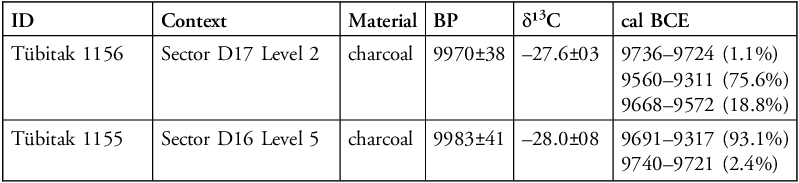
Excavations at Çemka revealed two main levels, dating from the proto-Neolithic/Late Epipalaeolithic (10 800–9600 BC) and the PPNA (9600–8700 BC), with eight distinct building levels (Figure 2). Samples of wood charcoal from building levels 2 and 5 provide radiocarbon dates that place activity at both levels in the middle of the tenth millennium BC (Table 1). The rescue excavations focused especially on areas exposed by heavy disturbance from road construction which split the settlement into a northern and a southern section yielding three exposed profiles reaching depths of 7m in places. In particular the south-facing Profile 2, which cuts through the middle of the mound, revealed a deep sequence of architectural remains allowing us to trace repeated building activity and architectural continuity across several phases. The area situated between the two road-cut profiles that falls within the southern sector yielded evidence for buildings that went through phases of renovation and rebuilding. Excavations revealed architectural remains across a 500m2 area, explored across six 10 × 10m trenches.
Architectural development at Çemka (figure courtesy of Çemka Project Archive).

Figure 2 Long description
A cross-sectional view of an archaeological site displays distinct layers labeled with different colors. The layers are identified as Layer 1 in blue, Layer 2 in green, Layer 3 in red, Layer 4 in yellow, Layer 5 in purple, Layer 6 in black, Layer 7 in brown, and Layer 8 in cyan. The image includes a scale bar indicating a length of 5 meters. The cross-section reveals the spatial arrangement and stratification of the site, with each layer representing different periods or types of deposits. The image also includes a side view of the site for additional context.
Radiocarbon dates from Çemka Höyük (using OxCal v.4.4 (Bronk Ramsey Reference Bronk Ramsey2021) and the IntCal20 calibration curve (Reimer et al. Reference Reimer2020)).

Table 1 Long description
The table presents radiocarbon dates from Çemka Höyük, focusing on two samples of wood charcoal from different building levels. It includes columns for ID, context, material, BP, delta 13C, and calibrated BCE dates. The first row, labeled Tübitak 1156, details Sector D17 Level 2 with a BP value of 9970 plus or minus 38, a delta 13C value of -27.6 plus or minus 0.03, and calibrated BCE dates ranging from 9736 to 9724 (1.1 percentage), 9560 to 9311 (75.6 percentage), and 9668 to 9572 (18.8 percentage). The second row, labeled Tübitak 1155, details Sector D16 Level 5 with a BP value of 9983 plus or minus 41, a delta 13C value of -28.0 plus or minus 0.08, and calibrated BCE dates ranging from 9740 to 9721 (2.4 percentage), 9691 to 9317 (93.1 percentage). The table provides a detailed comparison of the radiocarbon dates and their calibrated ranges for the two samples.
As short-lived materials were not available, wood charcoal (unidentified species) was used for dating.
The settlement’s architectural remains show a development from simple round huts to pit shelters, and finally to surface-level structures. Building level 1 has scattered stone formations hinting at tent-like structures. Level 2 features single-room round shelters, that are both semi- and fully subterranean with radial compartments. Although level 3 was largely destroyed, it has similar single-room pit structures. Level 4 shows round or elliptical subterranean buildings, while levels 5 and 6 include semi-subterranean pit houses, with more substantial masonry and radially divided internal compartments. Levels 7 and 8, from the proto-Neolithic phase, have round structures on red soil, potentially indicating tent-like shelters. The use of clay is identified in construction, both for coating stone walls, which is a practice seen in building levels 2–6 in almost all structures (Figure 3, no. 1) and in the form of a brick from level 2 (Figure 3, no. 2).
Clay used as a building material at Çemka: 1) a clay coating on a stone wall; 2) mudbrick (photograph by E. Kodaş).

Figure 3 Long description
The first image shows a close-up of a stone wall with a clay coating applied to it. The clay appears to be layered and textured, indicating manual application. A scale is placed at the bottom for measurement. The second image shows a close-up of a mudbrick, which is a rectangular block made of mud and straw. The mudbrick is placed against a stone wall, and a scale is placed at the bottom for measurement. Both images highlight the use of clay as a building material in ancient construction.
Evidence for continuous habitation throughout the Late Epipalaeolithic and PPNA is clear, particularly in the context of microlithic tools, which show a similar techno-typological profile to the chipped stone tools from Epipalaeolithic and PPNA levels at Körtik Tepe, despite some variation in microlith sizes (Kartal et al. Reference Kartal2018: 96–98). The characteristics of these lithic assemblages are comparable, including the presence of large-sized microliths and the gradual emergence of macro arrowheads during the PPNA.
Archaeological contexts of low-fired clay fragments
A total of 46 low-fired clay fragments, which likely belong to nine different vessels, were recovered from the building level 2 at Çemka, dated to the first half of the tenth millennium BC (c. 9350 cal BC; Kodaş et al. Reference Kodaş2020). Except for E17-6-A2, found in the common space between buildings ÇH7, ÇH1a and ÇH6, the low-fired clay fragments were dispersed across the in situ floor surfaces of structures ÇH5 (G16-3-A4/1, G16-3-A4/3, G16-2-A1, G16-4-A1 and G16-3-A4/2), ÇH1a (E18-21-A1), ÇH8 (E17-6-A1) and ÇH6 (G17-5-A1) (Figure 4). Excavations revealed sherds belonging to a total of nine vessels of which eight (excluding G16-4-A1) are discussed in this article. The buildings ÇH5 and ÇH6 are large, single-roomed and round-planned, with a diameter of approximately 10m; both were constructed in a semi-subterranean pit-shelter style (Kodaş et al. Reference Kodaş2020). In contrast, ÇH1a has interior partition walls, exhibits an elliptical form, is fully subterranean in a pit-shelter style and was used during building levels 2 and 3 (Çiftçi et al. Reference Çiftçi2020). Contexts from building level 2 contain microlithic tools similar to those from the Körtik Tepe and Hasankeyf Höyük industries (Özkaya & Coşkun Reference Özkaya, Coşkun and Özdoğan2011; Miyake et al. Reference Miyake2012; Kartal et al. Reference Kartal2018; Maeda Reference Maeda2018); larger-sized Nemrik and Khiam points begin to appear in building level 3.
Plan showing the find locations of the fired clay fragments from Çemka (photograph by E. Kodaş).

Figure 4 Long description
An aerial photograph of an archaeological site displays various labeled locations where fired clay fragments were found. The labels include G16-3-A4/1, G16-3-A4/2, G16-2-A1, G16-4-A1, G16-3-A4/3, G17-5-A1, E17-6-A1, E17-6-A2, and E18-21-A1. The site features excavation areas marked near a modern road, with a scale bar indicating 10 meters for reference. The image also includes a north direction indicator.
Technological aspects of the fired clay items
All samples from building level 2 were examined under an Optica SLX-2 binocular microscope to study their paste composition, construction methods, surface treatment and firing.
Generally, the pastes consist of clay raw materials containing natural mineral inclusions and, in some cases, added organic inclusions (such as imprints from plant matter). Analysis of inclusions focused on their size, shape and approximate clay concentrations (Bobrinsky Reference Bobrinsky1978; Petrova Reference Petrova, Richter and Darabi2024a). The presence of plant inclusions resulted in a high incidence of irregular channels within the clay matrix, resulting from the plant matter that burns away during firing likely enhancing thermal performance (Aouba et al. Reference Aouba2016). Spherulite analysis was also conducted using a petrographic microscope to determine whether animal dung had been used as an inclusion (Biton et al. Reference Biton2014; Amicone et al. Reference Amicone2021).
Construction methods were assessed visually through the presence or absence of joints in fragment cross-sections and open surfaces, indicating sequential application of clay element technology (slabs, coils, bands). Additional technological traces are apparent as macropore content, micro-cracks and micro-grooves on the outer surface of the wares, facilitating the identification of processing methods (Bobrinsky Reference Bobrinsky1978; Shepard Reference Shepard1985; Vandiver Reference Vandiver1985; Roux Reference Roux2019).
Firing temperatures and conditions were initially evaluated based on surface and cross-section colouration, with the presence of sharp or gradual transitions between layers indicating varying heating temperatures. These assessments were enhanced through multispectroscopic analyses. Thicker sherds showed more substantial thermal reactions on the surface, forming a distinct black core (Mangueira et al. Reference Mangueira2011: 95). Fibrous porosity and low compactness of the pastes, along with the colour variation from a black core to red oxidised surfaces, indicate incomplete, short-duration oxidising firing conditions followed by cooling in a reducing atmosphere (600–700°C) (Iordanidis et al Reference Iordanidis2009: 294).
Three potential functional groups are identified for the analysed clay items: fragments of clay coating for organic objects, a fragment of a clay additive intended to be attached to a vessel made of another material, and fragments of clay vessels.
Fragments of clay coating
Fragments from two clay-coated, oval objects are identified (Figure 5), each about 70mm in diameter with a protrusion on the outer part. Sample E17-6-A1 consists of eight thin, curved sherds, and Sample E17-6-A2 consists of 10 fragments with thin walls. Both samples show high crack porosity due to coarse-grained mineral inclusions (Daghmehchi et al. Reference Daghmehchi2023). No deliberately added impurities are observed in the paste, and plant imprints are minimal (Figure 5, no. 2c). Observation of fragment cross-sections reveals no sequential clay application. The outer surfaces were intentionally flattened but not smoothed, while the inner surfaces remained uneven (Figure 5, nos. 1b, 1c, 2b). The firing process, which must not have exceeded 750°C, was gradual and oxidative, resulting in an unburnt interior and heavily fired exterior.
Fragments of clay coating that probably once covered organic objects (photographs and drawings by N. Petrova; photograph 1c by E. Kodaş).

Figure 5 Long description
The image contains three sections. The first section shows two groups of clay fragments labeled 1a and 1b. The second section displays two groups of clay fragments labeled 2a and 2b, with a scale of 20 millimeters for reference. The third section includes a close-up photograph of a clay surface labeled 2c and a photograph of a rock formation labeled 1c.
X-ray diffraction (XRD) analysis of sherds from all samples analysed and of two unfired clay-based materials found within domestic contexts reveals a consistent paste composition. The unfired clay-based materials are characterised by crystallised calcite and illite structures with no evidence of hematite formation and/or thermal alteration of minerals. In contrast, the fired material shows a reduction in the intensity of calcite and clay mineral (illite) reflections and a weak reflection of hematite nucleation, indicating a firing temperature insufficient for intense decarbonation but likely somewhere between 600 and 700°C under controlled bonfire conditions. According to a recent definition (Spataro et al. Reference Spataro2017: 428), the fired samples from Çemka meet the criteria for consideration as ceramics due to their irreversible thermal transformation. The progressive reduction in the intensity of calcite and illite reflections across the low-fired samples further indicates an intentional and consistent firing process, rather than accidental exposure to heat.
Fragment of clay additive
Sample E18-21-A1 is a preserved segment of an object that may have originally been oval and of a substantial size, with an estimated maximum diameter of 370mm and an approximate height of 100–120mm measured from rim to pedestal. The object was constructed without a flat base and consists of two main elements: a concave pedestal underneath a body that flares upwards and outwards in a bulbous fashion (Figure 6). It is plausible that this clay component was integrated into a larger container, likely fashioned from stone, as excavations revealed numerous shallow stone containers of comparable dimensions (Figure 6, nos. 2a, 2b). These clay additions likely aimed to expand the capacity of the stone containers.
1a–f) Fragment of clay additive; 2a–b) limestone vessels with similar shapes and dimensions (1a–f: photographs and drawings by N. Petrova; 2a–b: photographs by E. Kodaş).

Figure 6 Long description
The image displays a fragment of clay additive in various views, including photographs and drawings. Additionally, it shows two limestone vessels with similar shapes and dimensions. The clay fragment exhibits natural mineral inclusions and some organic inclusions, such as imprints from plant matter. The limestone vessels are depicted in different perspectives to highlight their similarities.
The fragment features two intentionally pierced holes, each approximately 15mm in diameter, produced at an angle and made prior to firing. Only one of these holes is fully preserved (Figure 6, nos. 1b–1f). The outer clay layer is damaged, with a remaining thickness of 32–42mm, making it unclear whether the holes originally penetrated the full thickness of the wall.
The material of the fragment has few natural mineral inclusions and no added impurities. Accidental plant imprints are visible on the outer surface. The object appears to have been constructed from uneven oval slabs arranged in at least three layers. The outer layer is lumpy with a rough clay coating, which has cracked and fallen off in places, revealing the inner second layer (Figure 6, nos. 1c, 1e). The high density of irregular channels within the matrix results from the burning of organic matter in the paste, indicating that the firing temperature was above 400–500°C (Daghmehchi et al. Reference Daghmehchi2023).
Fragments of vessels
Fragments from five possible containers showing varying amounts of organic inclusions are identified (Figure 7). A fragment from a large, thick-walled (15mm) vessel with a 270mm rim diameter (Sample G16-3-A4/1; Figure 7, no. 1) and two smaller fragments, display prominent inclusions. Some parts of Sample G16-3-A4/1 were found at the base of a pit surrounded by small rows of stones, while others were scattered around it (Figure 7, no. 1g). Made from two-layer slabs without a mould (Figure 7, nos. 1b, 1d), this vessel has few mineral impurities (Figure 7, no. 1c) but contains up to 30 per cent dry, crushed plant residues (Figure 7, no. 1f). An additional cracked clay coating covers its outer surface. The inner surface shows recent damage (Figure 7, no. 1e), with only small areas of the original smoothing still observable, making it difficult to determine the surface treatments employed in the production of this vessel.
Fragments of clay vessels (photographs and drawings by N. Petrova; photographs 1g & 6 by E. Kodaş).

Figure 7 Long description
The image displays various fragments of clay vessels, including photographs and detailed drawings. The fragments exhibit different shapes and sizes, with some showing imprints from plant matter. The drawings provide side and top views of the fragments, highlighting their structural details. The photographs capture the texture and surface characteristics of the clay vessels.
Four additional thick-walled vessel fragments (G16-2-A1, G17-5-A1, G16-3-A4/2, G16-3-A4/3; Figure 7, nos. 2–5) could come from vessels with a large diameter or that were possibly rectangular in shape. Crushed plant materials are observable in varying concentrations in these fragments.
Sample G16-2-A1 (Figure 7, no. 2) is a part of a vessel base, 10–20mm thick and 70mm in diameter, with an uncertain overall shape. Its composition is 15–20 per cent crushed plants and it was constructed with two-layer slabs (Figure 7, nos. 2a–2c); the inner surface was smoothed by finger and the outer surface has two horizontal grooves likely from manufacturing. The vessel was fired slowly under low oxidising conditions.
Sample G17-5-A1 (Figure 7, no. 3) also has high plant-temper density (up to 30%), creating fibrous porosity. Evidence for slab building is visible as cross-section joints (Figure 7, no. 3b). This vessel has a black core and pale brown surfaces, indicating incomplete oxidising firing, around 600–650°C, confirmed by XRD analysis (Iordanidis et al. Reference Iordanidis2009).
G16-3-A4/2 and G16-3-A4/3 contain less plant matter than other vessels and lack surface coatings. G16-3-A4/2 (Figure 7, no. 4) shows porosity between mineral particles, leading to substantial biological and chemical alteration (Molina et al. Reference Molina2001: 110; Santos et al. Reference Santos2012). Cross-sections of fragments from this vessel reveal sequential application of clay elements (Figure 7, no. 4c). Although the piece is only partially preserved and does not show the full form, it likely had a slightly flaring shape with a straight, sharp rim. The colour variation from a black core to buff surfaces suggests a low firing temperature under incomplete oxidising conditions (Maritan et al. Reference Maritan2006: 13; De Bonis et al. Reference De Bonis2014).
Part of the vessel wall in Sample G16-3-A4/3 (Figure 7, no. 5), with a heavily materialised matrix, has been destroyed, making it hard to determine the exact thickness. The 10 fragments of this vessel suggest a slightly inward curved body that was made using sequential clay application. The interior is slightly burnt, while the exterior is heavily fired.
Spherulite analysis of organic inclusions detected dung spherulites in samples G16-3-A4/1 and G16-2-A1 (Figure 8).
Dung spherulites identified within fragments of clay vessels (samples G16-3-A4/1 and G16-2-A1) under cross-polarised light. Scale bar 15µm (photograph by A. Babenko).

Figure 8 Long description
A microscopic image captured under cross-polarized light reveals dung spherulites within fragments of clay vessels. The spherulites appear as distinct, bright structures against a darker background. A red scale bar indicating 15 micrometers is visible, providing a sense of the magnification level. The image highlights the detailed texture and composition of the spherulites, which are identified within specific samples labeled G16-3-A4/1 and G16-2-A1.
Analysis and discussion
Samples E17-6-A1 and E17-6-A2 (Figure 5) were likely coatings for an uneven, oval organic object. They lack joints, suggesting the absence of clay slab technology. Although their purpose is unclear, they may relate to culinary practices as their outer surfaces are burnt while the inner surfaces remain unburnt.
The difference in the diameter of the pedestal and rim of Sample E18-21-A1 suggests it was likely added to a vessel made of stone, wood or another organic material to expand its capacity (Figure 6). Similar examples have been found at Ganj Dareh in the Zagros (8200–7600 BC), with stone mortars augmented by clay (Smith Reference Smith1990: 332; Petrova et al. Reference Petrova2025). The perforating holes may have been for threading a cord, perhaps used to tie on a lid. Constructed of multiple clay layers, this object might reflect local traditions.
The remaining analysed pieces display various morphological groupings, including deep, straight and slightly curved vessels with differing wall thicknesses (Figure 7). The ceramic technology involves raw materials with few mineral inclusions and added organic inclusions, including dung, of varying concentrations. Slabs in layers are used as the primary construction technique. Some fragments have an additional layer of clay applied, which might represent a continuation of clay coating found in non-ceramic traditions. The firing process was oxidative with gradual cooling at high-temperature exposure sites. The vessel-making technology differs from non-ceramic products as the pottery paste was intentionally mixed with organic inclusions.
Çemka in context
Evidence of clay and pottery vessels has been identified across various PPN sites in South-west Asia, including Abu Hureyra (Moore Reference Moore, Barnett and Hoopes1995), Beidha (Kirkbride Reference Kirkbride1966), Boncuklu (Spataro et al. Reference Spataro2017), Çayönü (Özdoğan & Erim-Özdoğan Reference Özdoğan and Erim-Özdoğan1993), Demirköy (Rosenberg Reference Rosenberg and Özdoğan2011), Ganj Dareh (Petrova et al. Reference Petrova2025; Smith Reference Smith1972), Gre Fılla (Ekinbaş Can Reference Ekinbaş Can2026), Jericho (Kenyon & Holland Reference Kenyon and Holland1982), Kfar HaHoresh (Biton et al. Reference Biton2014), Mureybet (Cauvin Reference Cauvin1974) and Nevali Çori (Morsch Reference Morsch and Gebel2002) (Figure 9). The introduction of these clay/earthenware vessels can be traced back to the PPNA period (9600–8700 BC), with their production continuing into the PPNB period (8700–7000 BC). Demirköy, in north-west Türkiye, yielded some of the earliest known evidence of fired clay/earthenware vessels, characterised by heavily plant-tempered, light-brown sherds (Figure 9f; see Rosenberg Reference Rosenberg and Özdoğan2011: 82). The presence of burnt interiors and suspension piercings indicates deliberate firing, albeit inconsistently controlled.
Examples of Pre Pottery Neolithic fired or dried earthenware/clay vessels from other sites in South-west Asia. Images are not to scale (a: Smith Reference Smith1972; b: Morsch Reference Morsch and Gebel2002; c: Cauvin Reference Cauvin1974; d: Kenyon & Holland Reference Kenyon and Holland1982; e: Kirkbride Reference Kirkbride1966; f: Rosenberg Reference Rosenberg and Özdoğan2011 and personal comm. 2025; g: Erim-Özdoğan & Yalman Reference Erim-Özdoğan and Yalman2004; Erim-Özdoğan Reference Erim-Özdoğan and Özdoğan2011 and personal comm. 2025; h: Spataro et al. Reference Spataro2017).

Figure 9 Long description
The illustration presents various Pre-Pottery Neolithic clay vessels from different archaeological sites in South-west Asia. The vessels are categorized by their respective sites: Ganj Dareh, Nevalı Çori, Mureybet, Jericho, Beidha, Demirköy, Çayönü, and Boncuklu Höyük. Each vessel is depicted with detailed line drawings showing their unique shapes and designs. The vessels include a variety of forms such as bowls, jars, and other containers, each with distinct features and patterns.
Clay/earthen vessels from the Middle PPNB (8200–7500 BC) were found at Mureybet in northern Syria (Cauvin Reference Cauvin1974) and Nevali Çori in south-eastern Türkiye (Morsch Reference Morsch and Gebel2002). Three of the five well-preserved sherds from Mureybet are unfired (Figure 9c; Cauvin Reference Cauvin1974: 200), including two thick-walled bowls with flat bottoms, a thick-walled bowl with a curved bottom and a cup. One bowl has horizontal line motifs and symmetrical rope holes; the other is jar-like. These vessels show heavy plant tempering and lack deliberate firing, indicating hand-shaping (Cauvin Reference Cauvin1974; Le Mière & Picon Reference Le Mière and Picon1998). The Nevali Çori samples are less well preserved (Morsch Reference Morsch and Gebel2002: 150) but indicate flat bottoms and oval bodies (Figure 9b). Some have geometric motifs (Morsch Reference Morsch and Gebel2002: 150). All the Nevali Çori samples are small (20–80mm) and some show firing.
Boncuklu Höyük in Central Anatolia produced numerous clay/earthenware sherds, likely representing small-sized bowls and jars (Figure 9h). This pottery appears to have been moulded intentionally and shows a variety of paste compositions, with smoothed inner and outer surfaces (Spataro et al. Reference Spataro2017).
Gre Fılla, also in south-eastern Türkiye, yielded a small, oval-shaped baked vessel with natural mineral inclusions dating to the Early PPNB (8700-8200 BC) (Ekinbaş Can Reference Ekinbaş Can2026: 293; Ekinbaş Can pers. comm. 2026). Sherds from Middle PPNB Tell Abu Hureyra (northern Syria) (Moore Reference Moore, Barnett and Hoopes1995; Le Mière & Picon Reference Le Mière and Picon1998) and a recent discovery from the PPNB levels of Karahan Tepe (south-eastern Türkiye) may show some evidence of firing (N. Karul pers. comm. 2024). The only sherd from the Late PPNB (7500–7000 BC) level at Jericho was part of a deep, pointed-bottom bowl, likely exposed to fire (Figure 9d; Kenyon & Holland Reference Kenyon and Holland1982; Le Mière & Picon Reference Le Mière and Picon1998). Similarly, the single sherd from Beidha, Jordan, is from a thick-walled, flat-bottomed bowl with heavy chaff tempering, which seems to have undergone some firing (Figure 9e; Kirkbride Reference Kirkbride1966).
An important group of clay containers found at Çayönü in south-eastern Türkiye are plant-tempered and show no conscious firing (Figure 9g; Özdoğan Reference Özdoğan and Gheorghiu2009). Despite finding many sherds, six of them were sufficiently diagnostic to determine the vessel form. These mould-made containers are shallow and round or rectangular with rounded corners. Some display woven impressions suggesting they were made inside baskets (Erim-Özdoğan & Yalman Reference Erim-Özdoğan and Yalman2004: 71). The vessel pastes are mineral or plant tempered and generally box-shaped, though one is a deep, thick-walled bowl. They were produced using moulds in various forms and sizes (Erim-Özdoğan Reference Erim-Özdoğan and Özdoğan2011: 224).
The Ganj Dareh specimens (western Iran) feature PPNB large, clay silo vessels, small unfired clay jars, likely made from two moulds (Figure 9a; Smith Reference Smith1972; Vandiver Reference Vandiver1985), and medium-sized, thick-walled vessels made from dung and plant paste using slab technology (Petrova et al. Reference Petrova2025). In addition to Ganj Dareh, many PPNB sites, including Ain Ghazal, Jericho, Tell Magzaliyah, Basta and Tell el-Kerkh, have silo-like, earthen/clay vessels, which are densely plant- or dung-tempered, were likely used for food storage and show little evidence for deliberate firing (Smith Reference Smith1990; Rollefson Reference Rollefson1992; Bader Reference Bader, Yoffee and Clark1993; Tsuneki Reference Tsuneki and Tsuneki2017; Nieuwenhuyse et al. Reference Nieuwenhuyse2023; Odaka Reference Odaka and Nieuwenhuyse2023).
Sherds from Kfar HaHoresh, Israel, dating to the PPNB period, were likely tempered with burned dung (Biton et al. Reference Biton2014). They were fired at around 500°C, which does not fully sinter or fuse the clay, leaving partially burned organic materials in the matrix.
Thus, intentional firing of pottery is sometimes evident in South-west Asia during the PPN, such as at Boncuklu and Demirköy, but often remains uncertain. The appearance of ‘incipient pottery’ in the Middle PPNB and ‘practical pottery’ in the Late PPNB suggests a gradual technological transition (Gibbs & Jordan Reference Gibbs and Jordan2016; Tsuneki Reference Tsuneki and Tsuneki2017). Some nearby south-east Anatolian sites like Demirköy and Gre Fılla may have had fired vessels from the PPNA and PPNB period and Çemka Höyük contributes to a growing picture of this technology in the greater region.
Discussion
The fragments of early fired-clay containers found at Çemka Höyük offer important insights into the origins of ceramic technology in South-west Asia. Dating to the tenth millennium BC, they represent an experimental phase in which clay was intentionally tempered with organic materials and fired at low oxidising temperatures to create functional containers. A similar date is suggested for the appearance of pottery technologies in Africa (Huysecom et al. Reference Huysecom2009; Lizuka & Terry Reference Lizuka and Terry2022), but the earliest pottery identified to date is found in East Asia and dates to the sixteenth millennium BC (Kuzmin Reference Kuzmin2017; Wang & Sebillaud Reference Wang and Sebillaud2019).
Falling within the earliest known examples from South-west Asia, the Çemka samples may suggest that controlled ceramic technologies emerged in this region much earlier than previously assumed. This new evidence points to an early implementation and demonstrates that ceramic innovation emerged before widespread production and adoption, developing regionally and progressively rather than through a single invention event. Our analysis of the fired clay items from Çemka shows that the inhabitants of the site experimented with pottery production by selectively using organic temper, low-temperature firing technologies and slab-construction techniques.
The Çemka assemblage includes clay vessels and other clay-based products, including various forms of fired and unfired clay coatings applied to stone dwellings and organic objects, at least one fragment of a clay ‘brick’ and clay augmentation for containers made of other materials. This diversity suggests that the manipulation of clay was already embedded in daily life and local practices nearly 12 000 years ago.
In contrast to the Zagros region where the development of pottery is associated with building techniques (Petrova et al. Reference Petrova2025), the use of clay for construction is uncommon in the Taurus foothills. The fired-clay vessels from Çemka are compositionally consistent, and they differ from other unfired clay objects found at the site due to mineral degradation that occurs during the firing process. Their shape and size (diameter, thickness) also distinguish them from other clay items but show similarities with later Pottery Neolithic clay vessel fragments. Their construction techniques may be related to the practice of layering clay coatings on utility structures such as building walls, observed occasionally in the Taurus foothills (Petrova Reference Petrova and Yıldırım2024b) highlighting the complex technological and sociocultural processes involved in the gradual adoption of pottery, implementation of novel technologies, social acceptance and interaction with existing materials and practices. The use of clay for coating organic materials and as enhancements to non-clay vessels suggests a transitional phase where communities experimented with the material properties of clay before developing fully independent ceramic traditions. Changes in culinary traditions, storage needs or cooking demands likely drove the increased use of clay containers, paving the way for the full adoption of pottery in later periods.
Technological innovations require both functional advantages and social acceptance to become widespread. The Çemka ceramics illustrate how early communities navigated this process, integrating clay technologies into daily life while interacting with existing material traditions. The clay coatings on organic items or walls and clay enhancements to non-clay vessels likely inspired the creation of clay vessels using slab technology. For new technology to spread widely, it must meet a demand and be integrated into daily activities and rituals; otherwise, inventions may remain isolated (Bernbeck Reference Bernbeck and Tsuneki2017: 97). The evidence from Çemka underscores the entanglement of technological factors as well as social factors such as community preferences in the emergence of pottery. The communities at this site were not yet reliant on ceramics for storage or cooking, but their incipient application reflects a growing awareness of clay’s affordances and potential. Future research that incorporates microstructural analysis and other experimental archaeological techniques will further elucidate the technological decisions made by these early potters and their broader implications for Neolithic societies.
Conclusion
By situating Çemka within the broader context of the Pre-Pottery and early Pottery Neolithic of South-west Asia, this study enables insights into the diverse pathways through which ceramic technology must have emerged. The Çemka finds reveal a pivotal stage in South-west Asian innovation: the translation of constructional knowledge into container production, contributing to our understanding of early pottery development as neither uniform nor linear but rather regionally variable and dynamic. Thus, early pottery can be seen as a mosaic of regional experiments, each negotiating functional demands and social acceptance. At present, Çemka stands as a key example of how early Neolithic communities explored the possibilities of clay, setting the stage for the fully developed ceramic traditions of the seventh millennium BC.
Acknowledgements
We express our sincere gratitude to Anna Babenko for conducting spherulite analysis and to Halil Tekin and Evren Çubukçu for providing access to the Domuztepe expedition and the Hacettepe University binocular and petrographic microscopes used in this study. We are grateful to the staff of KUYTAM (Koç University Surface Science and Technology Center) and the Archaeology Lab at Koç University for their instrumental and facility support. We extend thanks to Adria Breu and two anonymous reviewers for valuable feedback on an earlier draft of this manuscript. Thanks also go to Aslı Erim and Michael Rosenberg for providing photograph images for Figure 8 and giving us permission to include them here.
Funding statement
This research was funded by the Institute of Archaeology of the Russian Academy of Science (state assignment no. 126011315527-2), the Turkish Ministry of Culture and Tourism, the Directorate General for State Hydraulic Works DSİ District 16, and Koç University’s Graduate School of Social Sciences and Humanities.
Author contributions: CRediT categories
Ergül Kodaş: Conceptualization-Equal, Data curation-Equal, Funding acquisition-Equal, Project administration-Equal, Supervision-Equal, Visualization-Equal, Writing - original draft-Supporting. Natalia Petrova: Conceptualization-Equal, Formal analysis-Equal, Funding acquisition-Equal, Investigation-Equal, Methodology-Equal, Visualization-Equal, Writing - original draft-Equal, Writing - review & editing-Equal. Maria Daghmehchi: Conceptualization-Equal, Formal analysis-Equal, Funding acquisition-Equal, Investigation-Equal, Methodology-Equal, Writing - original draft-Equal, Writing - review & editing-Equal. Rana Özbal: Conceptualization-Equal, Formal analysis-Equal, Investigation-Supporting, Methodology-Supporting, Supervision-Equal, Visualization-Equal, Writing - original draft-Equal, Writing - review & editing-Equal.




 Open access

