

Introduction
Over the past two decades, job quality has emerged as a critical concern in labour markets worldwide, with mounting evidence that job characteristics profoundly impact worker wellbeing and societal outcomes. Research interest in job quality as a multi-dimensional concept has grown substantially (Green Reference Green2021, Reference Green2026; Warhurst et al Reference Warhurst, Mathieu and Dwyer2022), and within this literature and policy discourse, there has been a growing concern with ‘bad jobs’. Sometimes bad jobs have been conceived as, simply, jobs of low quality on one or more dimensions (e.g., Acemoglu Reference Acemoglu2001). Others, however, have categorised jobs as ‘bad’ based on whether pay or other work-related characteristics fall below certain normative thresholds (Schmitt Reference Schmitt2008; Wallace and Kwak Reference Wallace, Kwak, Kalleberg and Vallas2018). Yet a lack of definitional clarity has hindered systematic cross-national analyses of how these bad jobs are distributed across different labour markets.
This paper is concerned with the trend and distribution of bad jobs in South Korea, a country which presents a particularly compelling juxtaposition of rapid economic development and labour market disruption. It has experienced exceptional real GDP per capita growth over recent decades, including robust recoveries in employment following the financial crises of 1998 and 2008 – periods that initially led to sharp increases in unemployment rate. Yet these recoveries have been accompanied by a marked proliferation of non-standard or non-regular forms of employment, including temporary and part-time work, which have greatly altered the employment landscape (Grubb et al Reference Grubb, Lee and Tergeist2007). This trend intensified after the 2008 financial crisis, with non-regular employment accounting for a significant share of the labour market, particularly among women, youth, and older workers (Kim Reference Kim2020; Schauer Reference Schauer2018). Workers in such positions typically lack entitlements to bonus pay and various employer-provided allowances, leaving them more vulnerable to low wages and job insecurity compared to those in standard employment. The severity of these labour market challenges is reflected in several concerning indicators, with South Korea displaying the largest gender pay gap and the longest working hours among developed nations in recent times (OECD 2023b).
This disparity between economic growth and job quality is further highlighted by national statistics that present an ostensibly optimistic picture of increasing employment and declining unemployment rates (OECD 2024). However, deeper analysis reveals that these improvements are primarily driven by workers aged 60 and above who are predominantly engaging in temporary and part-time positions, while the younger workforce (aged 20–40) experiences notably less favourable outcomes. This raises critical concerns about the trajectory of the overall job quality in South Korea. Moreover, recent transformations across the developed world, including post-pandemic work adjustments and Fourth Industrial Revolution developments, have brought job quality issues to the forefront of public discourse (Berg et al Reference Berg, Green, Nurski and Spencer2023). These structural changes, particularly the emergence of hybrid working patterns and artificial intelligence systems, highlight the importance of examining not only the quantity of jobs but also the quality of jobs, in particular, the distribution of bad jobs.
This paper addresses these challenges by employing a rigorous wellbeing-derived definition of bad jobs in the South Korean labour market, building upon Green and Lee’s (Reference Green and Lee2024) methodology. Their framework parallels the income poverty threshold, wherein poverty is understood as a deprivation of resources, and escaping poverty is associated with distinct improvements in health and wellbeing. Similarly, bad jobs are conceptualised as those that deprive workers of the resources necessary to meet their needs from work. Following this logic, in the context of Europe, a bad job threshold has been specified such that an improvement in job quality, lifting it above from below to above the threshold, leads to an especially sharp improvement in worker wellbeing (Green and Lee Reference Green and Lee2024).
Using the Korean Working Conditions Survey (KWCS), this study examines whether a comparable job quality threshold exists in South Korea. This study investigates temporal trends and the distribution of bad jobs across demographic groups and economic sectors, contextualising findings through comparison with low wage distribution and European labour market dynamics. The study compiles composite indicators of job quality across seven dimensions, modelled after those developed by the European Foundation for the Improvement of Living and Working Conditions (Eurofound 2012, 2021). These dimensions encompass Earnings (monthly income from work), Prospects (including both job insecurity and career progression), Skills and Discretion, Work Intensity, Social Environment, Physical Environment, Work Intensity and Working Time Quality.
The subsequent sections of this paper are organised as follows. The next section provides a critical review of the literature regarding existing definitions of bad jobs and job quality within the South Korean context. The third section assesses the applicability of established bad jobs thresholds to the South Korean labour market, followed by an analysis of bad jobs’ temporal trends and a probit estimation of determinants shaping the distribution of bad jobs in South Korea. The paper concludes with an overview and consideration of methodological limitations, as well as suggestions for directions for future scholarly enquiry.
Relevant literature
Existing definitions of bad jobs
The concept of ‘bad jobs’ has garnered increasing interest in labour market research, yet its definition remains elusive and context-dependent. The conceptualisation of bad jobs in existing literature reveals diverse approaches to establishing definitional thresholds. At its most basic level, any classification of a bad job relies upon an implied spectrum of job quality and a threshold distinguishing bad jobs from ‘other jobs’. Wage-centric approaches derived thresholds from pre-existing income poverty measures or relative pay cut-offs (Acemoglu Reference Acemoglu2001; Lee and Sobeck Reference Lee and Sobeck2012; Fusaro and Shaefer Reference Fusaro and Shaefer2016; Branch and Hanley Reference Branch, Hanley, Kalleberg and Vallas2017). However, recognition of job quality’s multi-dimensional nature has led to more sophisticated approaches. Where multiple dimensions are considered, researchers have either established separate thresholds for each dimension or reduced multiple dimensions to a single index. The latter approach has employed various methodologies, including wellbeing-driven indices (Williams et al Reference Williams, Zhou and Min2020), averaging methods, and researcher-assigned normative weights. Also, the job-strain model from psychology computes the net sum of resources (positive) and demands (negative) (Bakker and Demerouti Reference Bakker and Demerouti2008; Eurofound 2021), while others have employed systematic approaches to measuring cumulative deprivations across multiple dimensions (González et al Reference González, Sehnbruch, Apablaza, Méndez Pineda and Arriagada2021).
The evolution of these definitional approaches reflects the growing complexity in understanding job quality. While the wage-centric perspective initially prevailed, scholarly understanding has evolved towards a more comprehensive and multidimensional approach. Kalleberg et al (Reference Kalleberg, Reskin and Hudson2000) broadened the definition of bad jobs to include both low wages and the absence of health insurance and pension benefits, acknowledging that monetary compensation alone insufficiently captures job quality’s full scope. Nonetheless, this definition remained primarily focused on material aspects of employment. Schmitt (Reference Schmitt2008) further advanced the discourse by proposing a multifaceted definition incorporating wages, health insurance, pension benefits, and paid time off. According to these criteria, employment is classified as ‘bad’ if it fails to meet certain thresholds in at least two of these four categories. This framework represented a shift towards recognising the multidimensional nature of job quality, although it remained confined to tangible and (easily) measurable aspects while overlooking broader intrinsic elements, such as work intensity, autonomy, and social environment.
More recent approaches have further broadened the concept of bad jobs, integrating non-wage dimensions including job security, work intensity, autonomy, and opportunities for skill development. Howell and Kalleberg (Reference Howell and Kalleberg2019) contend that bad jobs perform poorly across multiple dimensions of job quality, suggesting that employment should be evaluated based on its provision of security, work control, and opportunities for personal and professional development. Similarly, Sehnbruch et al (Reference Sehnbruch, Apablaza and Foster2024) build upon this multidimensional framework, drawing from OECD approaches to conceptualise poor-quality employment as encompassing various undesirable characteristics affecting workers’ wellbeing, including earnings, employment stability, security, and working conditions.
Despite these theoretical advances in understanding and defining ‘bad jobs’, many studies continue to employ the term loosely, often equating it with low job quality without applying precise or theoretically grounded definitions (Green and Lee Reference Green and Lee2024). This ambiguity complicates efforts to measure the distribution of bad jobs across different contexts. Green and Lee (Reference Green and Lee2024) emphasise that underpinning any classification of bad jobs is an implied spectrum of job quality and an associated threshold. Where multidimensional data exist, normative considerations might facilitate the delineation of ‘bad’ within each dimension. However, holistically defining a job as ‘bad’ presents challenges, requiring arbitrary cross-dimensional conditions.
This paper builds upon the methodological approach validated by Green and Lee (Reference Green and Lee2024) in the European context, which emphasises the intrinsic relationship between worker wellbeing and job quality. While their framework has demonstrated validity within European labour markets, its applicability to distinctly different institutional and cultural contexts remains untested. This paper makes a unique contribution by examining whether this wellbeing-based approach to defining bad jobs can be effectively applied to the South Korean context, characterised by different labour market institutions, cultural norms, and employment practices. By constructing an index that links job characteristics to worker wellbeing in the South Korean setting, this paper examines the universal applicability of this definitional framework. This moves beyond arbitrary thresholds towards a more robust definition of bad jobs, while testing its validity outside the European context. Such an approach is particularly vital as labour markets evolve, and novel employment arrangements challenge traditional job quality conceptualisations.
South Korean labour market
South Korea’s economic growth has been one of the most impressive in the world in the modern era. Since the mid-20th century, the country has experienced a transformation from an extremely poor agrarian economy to a highly industrialised nation, establishing itself as a major player in global trade and technology. This rapid growth has been accompanied by significant increases in real GDP per capita, driven largely by the country’s export-oriented industrial policy. South Korea’s GDP grew at an average annual rate of 7.02 per cent from 1961 to 2023 (World Bank 2024), making it one of the fastest-growing economies during this period.
This trend has been reflected in the nation’s labour market, which has demonstrated sustained growth in employment rates, while exhibiting remarkable resilience to major financial crises, such as the 1998 Asian Financial Crisis and the 2008 Global Financial Crisis (FRED 2024; Lee and Rhee 2012). Following these crises, South Korea demonstrated a remarkable ability to recover, with strong job creation and a significant reduction in unemployment rates. However, this rapid recovery was accompanied by substantial structural changes in the labour market (Lee and Mcnulty Reference Lee and McNulty2003). Most notably, employers seeking greater flexibility to manage economic uncertainties increasingly turned to non-standard forms of employment, including temporary, part-time, and contract-based work, to reduce labour costs and operational risks (Shin Reference Shin2013). These positions typically lacked the stability, security, and benefits associated with standard employment, raising significant concerns about job quality, particularly regarding job security and access to social protection (Kalleberg and Hewison Reference Kalleberg and Hewison2013).
This shift intensified following the 1998 Asian Financial Crisis, leading to the emergence of a dual labour market that operates along multiple dimensions (Grubb et al Reference Grubb, Lee and Tergeist2007). The primary division exists between secure/benefit-entitled permanent workers and precarious non-standard workers who face lower wages and limited benefits (Song Reference Song2020). This segmentation is further amplified by significant disparities between large conglomerates (chaebols) and small and medium-sized enterprises (SMEs). Chaebols, such as Samsung, Hyundai, and LG, have historically dominated the Korean economy, benefiting from government support and preferential access to resources. Their privileged position enables them to offer superior financial remuneration and job quality compared to SMEs, creating a two-tier employment structure (Ha and Lee Reference Ha and Lee2013). Unlike many European labour markets, where collective bargaining, regulatory standards, and sector-level agreements tend to moderate firm-size disparities, Korea’s institutional architecture allows these divides to persist and deepen. The resulting landscape is particularly challenging for non-standard workers in SMEs, who face a double disadvantage – both the precarity of their employment status and the limitations associated with working for smaller enterprises.
Growing public concern over these labour market inequalities, particularly regarding the treatment of non-standard workers and SME employees, created pressure for systemic change in the years prior to 2017. Then, with the election of a new reforming government, the labour market underwent major regulatory reforms starting in May 2017, with the Moon Jae-In administration’s focus on addressing these structural challenges. A cornerstone of these reforms was the reduction of maximum working hours from 68 to 52 per week (40 regular hours plus 12 overtime hours), aimed at curbing chronic overwork and improving work-life balance. The administration also implemented the first major revision of the Occupational Safety and Health Act in 29 years (Government Performance Evaluation Office 2021), strengthening workplace safety standards and promoting prevention-oriented management of industrial accidents. These reforms, part of a broader agenda that included expanding public-sector employment and raising the minimum wage, marked a decisive shift from previous market-oriented policies toward stronger worker protections.
Job quality in South Korea
Despite such labour reforms, gender-based wage inequality represents a persistent challenge in South Korea’s labour market, where women earn 31.1 per cent less than men (OECD 2023a). This pronounced wage differential stems from both cultural and institutional factors, including traditional gender norms surrounding work-family roles and persistent occupational segregation. The gap is further amplified by the disproportionate concentration of female workers in lower-paying positions and non-standard employment arrangements, particularly part-time and temporary work.
Very long working hours remain a defining feature of South Korea’s labour market, with workers consistently recording some of the longest hours among OECD nations (Hijzen and Thewissen Reference Hijzen and Thewissen2020), even after substantive reductions throughout three decades. In 2021, the average South Korean worker logged 1,908 hours annually, significantly exceeding the OECD average of 1,687 hours (OECD 2023b). Multiple factors contribute to this phenomenon, including a deeply embedded corporate culture, economic growth imperatives, and organisational expectations regarding employee dedication. Research indicates that extended hours significantly impact worker wellbeing in South Korea, leading to increased burnout, elevated stress levels and deteriorating work-life balance (Park et al Reference Park, Kook, Seok, Lee, Lim, Cho and Oh2020; Baek and Yoon Reference Baek and Yoon2024), just as they have been found to do elsewhere (Virtanen et al Reference Virtanen, Stansfeld, Fuhrer, Ferrie and Kivimäki2012). The situation proves particularly challenging for non-standard workers who, despite working comparable hours, often lack access to proportionate compensation and benefits. Moreover, many South Korean workers remain in positions where their schedules are rigidly controlled by employers (Kim and Min Reference Kim and Min2023). This lack of flexibility can lead to decreased decision latitude and autonomy, important components of job quality that are associated with improved employee satisfaction and wellbeing. Comparative studies have shown that the levels of Working Time Quality and Skills and Discretion are notably worse in South Korea than in either the United States or Europe (Aleksynska et al Reference Aleksynska, Berg, Foden, Johnston, Parent-Thirion and Vanderlyeyden2019). Such findings suggest that South Korean workers often navigate environments characterised by limited autonomy and greater restrictions on their working conditions, thus increasing the likelihood of encountering bad jobs.
Other indicators of job quality also remain troubling. For example, Lee (Reference Lee2018) found that between 2010 and 2017, job security declined significantly, even though workers gained more short-term flexibility in their working hours. This shift in job security suggests a broader trend towards more precarious employment conditions. Furthermore, increased exposure to workplace hazards, such as vibrations, low temperatures, chemicals, and infectious materials, has also been documented, raising concerns about the physical safety of workers (Kim et al Reference Kim, Chung, Kim, Noh and Choi2015).
Taking stock of such trends in multiple dimensions, Lee and Green (Reference Lee and Green2025) find significant temporal variations in average job quality across multiple dimensions between 2006 and 2020. Their analysis shows a concerning deterioration in four key indices: Prospects, Skills and Discretion, Work Intensity and Physical Environment. Conversely, improvements were observed in Earnings, Social Environment and Working Time Quality during this period.
The evolving approaches to defining bad jobs, noted above, provide a useful framework for examining labour market conditions across different national contexts. With its context of high economic growth, a dualistic labour market and variable trends across different dimensions of job quality, South Korea offers a compelling case study for examining the trend and distribution of bad jobs. An evidence-based approach should enable policymakers to focus most effectively on sectors and populations where bad jobs are most prevalent.
Data and derivation of a bad jobs measure for South Korea
Data set
The study deploys the KWCS, collected by the Occupational Safety and Health Research Institute (OSHRI), which benchmarked and adopted similar questionnaires from the European Working Conditions Survey (EWCS). The purpose of the KWCS is to contribute to any relevant policies on the quality of work and employment issues. The KWCS is a repeated cross-sectional survey, which has been conducted every three years since 2006 with some amendments. Since launching the first KWCS in 2006, the OSHRI has conducted a total of seven surveys (as of 2025) in 2006, 2010, 2011, 2014, 2017, 2020, and 2023, targeting employed people aged over 15 years. Of these seven waves, this study utilises four most recent surveys (2014, 2017, 2020, and 2023) due to measurement consistency requirements for job quality dimensions, yielding a final analytical sample of 88,333 observations. Trained interviewers visited each household and administered the questionnaire through Computer Assisted Personal Interviewing for all waves, but online or remote survey methods were also partially administered for the 6th wave (2020) due to the COVID-19 outbreak. The sample includes individuals who worked for pay or profit for at least one hour in the week when the survey data were collected. Clustered random sampling methods were used, and survey weights are included in all our analyses, yielding nationally representative estimates.
Empirical strategy
This study employs a two-stage empirical approach to examine the prevalence and distribution of bad jobs in South Korea.
Stage 1: Bad Job Threshold Identification
Rather than specify multiple normative criteria for each of several dimensions of job quality, we first combine these dimensions additively into a single index of job quality, then use this index’s relationship with well-being to guide us to a useful threshold between bad jobs and all other jobs. A non-parametric approach is applied to identify the optimal bad job threshold by examining the relationship between job quality and worker wellbeing, following Green and Lee’s (Reference Green and Lee2024) methodology. The job quality index is divided into deciles, as this offered greater granularity than quartiles or quintiles. The choice of deciles ensured sufficient precision in identifying non-linearities or ‘kinks’ in the relationship between job quality and wellbeing, while retaining an adequate number of observations per cell. The following model is estimated:
 $$W{B_i} = \alpha + \mathop \sum \limits_{d=1}^{10} {\beta _d}J{Q_{di}} + {\varepsilon _i}$$
where $W{B_i}$
is the WHO-5 wellbeing index for individual
$W{B_i}$
is the WHO-5 wellbeing index for individual $i$
, and
$i$
, and $J{Q_{di}}$
are dummy variables for job quality deciles. The marginal effects (
$J{Q_{di}}$
are dummy variables for job quality deciles. The marginal effects ( ${\beta _{d+1}} - {\beta _d})$
capture the wellbeing gains associated with moving from decile
${\beta _{d+1}} - {\beta _d})$
capture the wellbeing gains associated with moving from decile $d$
to decile
$d$
to decile $d+1$
. Statistical significance testing determines whether the wellbeing improvement from escaping the bottom decile is significantly larger than improvements between other adjacent deciles, providing empirical justification for the bad job threshold.
$d+1$
. Statistical significance testing determines whether the wellbeing improvement from escaping the bottom decile is significantly larger than improvements between other adjacent deciles, providing empirical justification for the bad job threshold.
Stage 2: Trend and Distributional Analysis
Having identified the bad job threshold, temporal trends and cross-sectional variation in bad job prevalence are examined using probit regression:
 $$P\left( {{Y_{ij}}=1{\rm{|}}{X_{1,}}\;{X_{2,}} \ldots, \;{X_K}} \right) = {\rm{\Phi }}\left( {{\beta _0} + {\beta _1}Yea{r_i} + \mathop \sum \limits_{K=2}^n {\beta _k}{X_{Ki}} + {r_i}} \right)$$
where ${Y_{ij}}$
indicates whether a job is a bad job;
${Y_{ij}}$
indicates whether a job is a bad job; ${\rm{\Phi }}$
denotes the cumulative standard normal distribution;
${\rm{\Phi }}$
denotes the cumulative standard normal distribution; $Yea{r_i}$
captures temporal trends;
$Yea{r_i}$
captures temporal trends; ${X_{Ki}}$
represents a vector of demographic and job characteristics, including industry, employment type, firm size, education, age, and gender; and
${X_{Ki}}$
represents a vector of demographic and job characteristics, including industry, employment type, firm size, education, age, and gender; and ${r_i}$
is a normally distributed error term. Industry classification follows the Korean Standard Industrial Classification across 20 sectors, with all categories having adequate sample sizes for reliable inferences.
${r_i}$
is a normally distributed error term. Industry classification follows the Korean Standard Industrial Classification across 20 sectors, with all categories having adequate sample sizes for reliable inferences.
For comparative analysis, an identical specification is estimated using low wage employment (i.e., bottom quintile of earnings) as the dependent variable. This allows distinction between comprehensive job quality deprivation captured by the multidimensional bad jobs measure and purely monetary disadvantage reflected in low wages.
These two distinct approaches enable: a) establishment of an empirically and theoretically grounded definition of bad jobs based on worker wellbeing; b) tracking of changes in bad job prevalence over a period of significant economic and policy change; and c) identification of which worker groups and sectors face the highest risk of bad job employment, providing targeted insights for policy intervention.
Derivation of the bad jobs measure
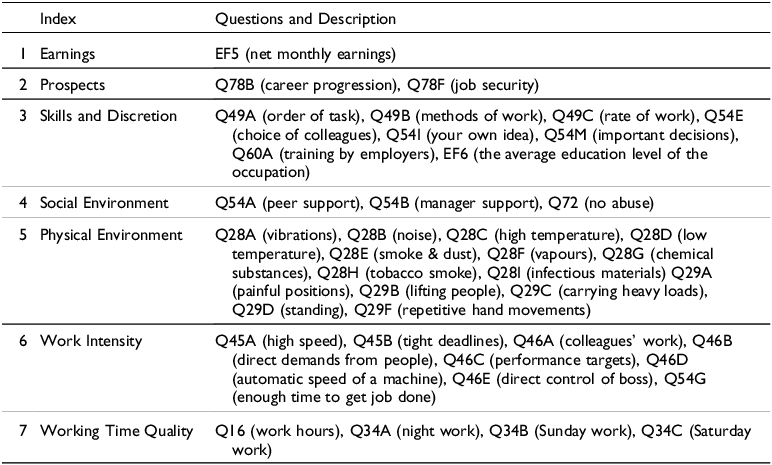
Eurofound (2012) developed composite indices for seven theory-based dimensions of job quality, capturing various aspects of the work environment. These include Earnings, other extrinsic aspects (Prospects and Working Time Quality) and four intrinsic aspects (Skills and Discretion, Physical Environment, Social Environment and Work Intensity). Due to the general applicability of this approach and the close alignment between the EWCS and the KWCS, the methodology outlined in Eurofound (2012) has been followed. Accordingly, the same composite indicators for each of the seven job quality dimensions have been constructed using the KWCS. The job quality items and a brief description of each are presented in Table 1 below.
Description of the job quality indices for South Korea

Note. Only the time-consistent items available in all dimensions and all waves from 2014 are used for the analyses. All measures apply to both employees and self-employed; for the Social Environment of self-employed with no employees, support measures were assigned a value of zero.
This analysis draws upon four waves of the KWCS (2014, 2017, 2020, and 2023), excluding Waves 1 (2006), 2 (2010), and 3 (2011) due to measurement inconsistencies in Prospects and Social Environment dimensions. A single job quality index was derived through principal component analysis, yielding a composite measure, defined as the first principal component, a weighted average of job quality dimensions. While this commonly used approach has limitations (see Green (Reference Green2021) for a discussion), its advantage is that it simplifies the challenge of specifying the threshold between bad jobs and all other jobs based on wellbeing differences, while incorporating all the multiple dimensions comprised in the concept of job quality. Bad jobs, defined in this way, can thereby capture jobs carrying the most severe overall deprivation. The resulting binary classification then enables both national and international comparisons. For the assessment of wellbeing, the WHO-5 Wellbeing Index, which has been available in the dataset since 2010, was employed. This index provides a validated and widely adopted metric for psychological wellbeing. The distribution of this job quality index follows an approximately normal distribution (see Figure A1 in Appendix).
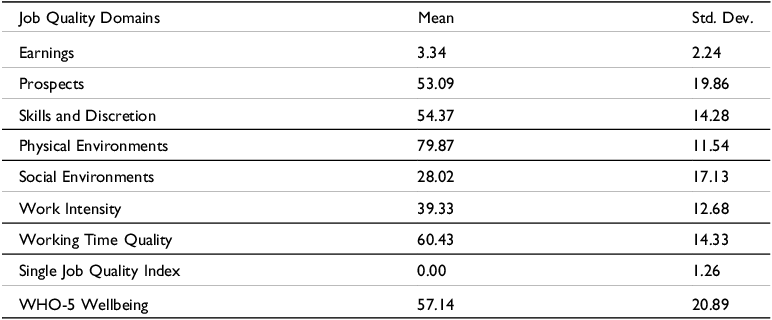
Table 2 shows descriptive statistics for all job quality dimensions, which are normalised to within 0-100, the overall job quality index, and the WHO-5 Wellbeing index.
Descriptive statistics
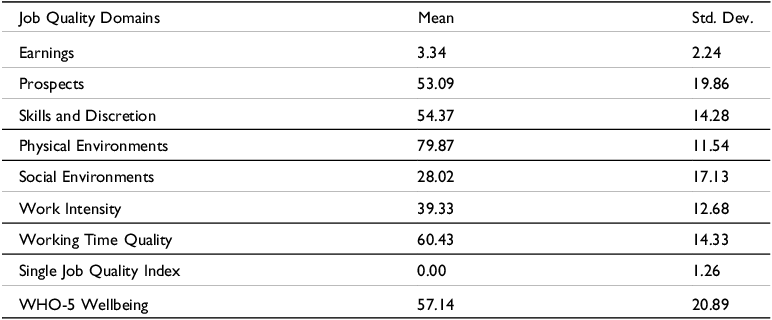
Note. Survey weights have been applied to all results. For the Earnings index, missing values were imputed through regression analysis, while in the Social Environment index, missing values for self-employed respondents were imputed with zeros, as these workers typically lack formal workplace social support. All job quality indices have been normalised to a scale of 0–100. The Work Intensity index was reverse-coded, with higher values representing more intensive working conditions. The analyses utilised data from 4 waves (2014, 2017, 2020, 2023). The single job quality index was generated utilising principal component analysis.
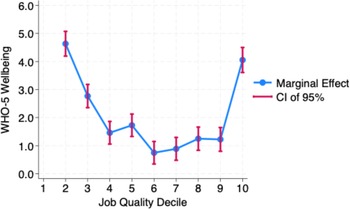
Figure 2 illustrates the incremental improvements in wellbeing associated with each decile increase in job quality, demonstrating the relationship between enhanced job quality and workers’ wellbeing.
The marginal effect on wellbeing of improving a decile of job quality. Note. The figure shows the marginal effects of improving one decile of job quality. The values are estimated using the following regression model: ${Y_i} = \alpha + {\beta _1}j{q_i} + {\varepsilon _i}$
where
${Y_i} = \alpha + {\beta _1}j{q_i} + {\varepsilon _i}$
where ${Y_i}$
indicates the WHO-5 wellbeing index, and
${Y_i}$
indicates the WHO-5 wellbeing index, and $j{q_i}$
represents dummies for deciles of single job quality index generated by principal component analysis. The values shown in the figure indicate the difference between the coefficients for each job quality index decile. Survey weight is applied to the results.
$j{q_i}$
represents dummies for deciles of single job quality index generated by principal component analysis. The values shown in the figure indicate the difference between the coefficients for each job quality index decile. Survey weight is applied to the results.

The analysis reveals a pronounced U-shaped relationship between job quality and marginal effects, with distinct implications for identifying bad jobs in South Korea. The strongest marginal effects are observed in the lowest decile of job quality, where improvements yield the greatest impact on worker wellbeing. While the effect diminishes through middle deciles (3–9), reaching its lowest point around the 6th decile, it rises again for the highest quality jobs (decile 10). This non-linear pattern has two key implications.
First, this pattern enables us to define a ‘bad job’ as employment falling below the threshold, i.e., the bottom decile, where quality improvements yield distinctly larger wellbeing gains, following Green and Lee’s (Reference Green and Lee2024) approach in the European context. Rather than simply low-quality jobs, bad jobs represent positions where workers experience deprivation severe enough that quality improvements have exceptional wellbeing impact, providing an empirical, worker-centred threshold rather than arbitrary cut-offs. Statistical significance testing confirms this threshold: the wellbeing gap between the lowest and second-lowest decile (4.63 units) significantly exceeds the average gap between other deciles (2.08 units).
Notably, however, South Korea exhibits a more extended lower tail compared to European labour markets (see Green and Lee Reference Green and Lee2024), with elevated marginal effects beyond the first decile. While still maintaining a clear threshold for identifying the most severely deprived jobs, this pattern likely reflects Korea’s dual labour market structure, where the intersection of employment status (regular vs. non-regular) and firm type (chaebol vs. SME) creates multiple tiers of job quality disadvantage rather than the sharper binary distinction observed in European labour markets. Although meaningful improvements in wellbeing could be achieved by targeting both first and second deciles, our focus on the bottom decile reflects both the empirically largest marginal effects and the need to prioritise the most disadvantaged workers where policy resources are limited.
Second, the U-shaped pattern suggests that the top decile contains jobs with especially high job quality, with levels that significantly enhance individual wellbeing above those jobs in the second-highest decile. However, given the urgent policy need to address poor working conditions that significantly harm workers’ wellbeing, identifying and addressing bad jobs represents a more pressing social justice concern than promoting quality improvements throughout the spectrum. The sharp rise in wellbeing between the first and second decile could stem from either severely poor job quality at the bottom of this distribution or non-linearity in the relationship between job quality and wellbeing, or both (Warr Reference Warr2007; Green and Lee Reference Green and Lee2024). Regardless of the underlying mechanism, these findings strongly support targeting policy interventions at jobs below the 10th percentile threshold, where improvements in job quality yield the largest wellbeing gains.
Results
Trend of bad jobs
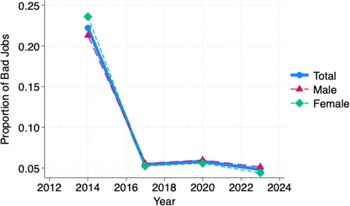
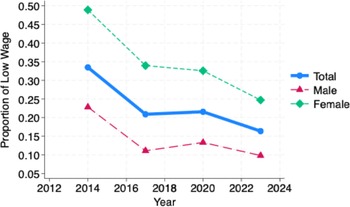
The analysis of South Korean labour market trends between 2014 and 2023 reveals contrasting patterns in two key measures of employment quality. The proportion of bad jobs, falling into the bottom quality decile, shows a dramatic improvement early in this period, with a substantial decline from 22 per cent in 2014 to approximately 5 per cent by 2017. This marked reduction in the prevalence of bad jobs has proven sustainable, with the proportion maintaining remarkable stability at around 5–6 per cent through 2023. In parallel, low-wage employment has followed a more gradual but equally encouraging trajectory of decline. Beginning at a notably higher level of 33 per cent in 2014, the proportion of low-wage jobs has decreased steadily over the period, reaching 17 per cent by 2023 (Figure 2B).
Gender analysis reveals distinct patterns across these two measures. For bad jobs, men and women followed remarkably similar trajectories, with any gender gaps largely disappearing after 2017. While women experienced a marginally higher peak in 2014 (24 versus 21 per cent for men), both groups converged to approximately 5 per cent in subsequent years, maintaining this parity through 2023 (Figure 2A). In contrast, low-wage employment exhibits persistent and substantial gender disparities. Despite overall improvement, women consistently face a higher probability of low-wage employment. The gender gap was particularly pronounced in 2014, with approximately 48 per cent of women in low-wage jobs compared to 23 per cent of men. Although this disparity has narrowed over time, women remain significantly more likely to experience low wage employment by 2023, with rates of 25 per cent compared to 12 per cent for men (Figure 2B). These contrasting patterns suggest that while both measures have improved over time, the mechanisms driving bad jobs and low-wage employment may vary. Particularly, the convergence in bad jobs between genders, coupled with persistent wage disparities, indicates that progress in job quality has been uneven across different dimensions of job quality.
Proportion of bad jobs by year.

Proportion of low wage by year.

The distribution of bad jobs in South Korea
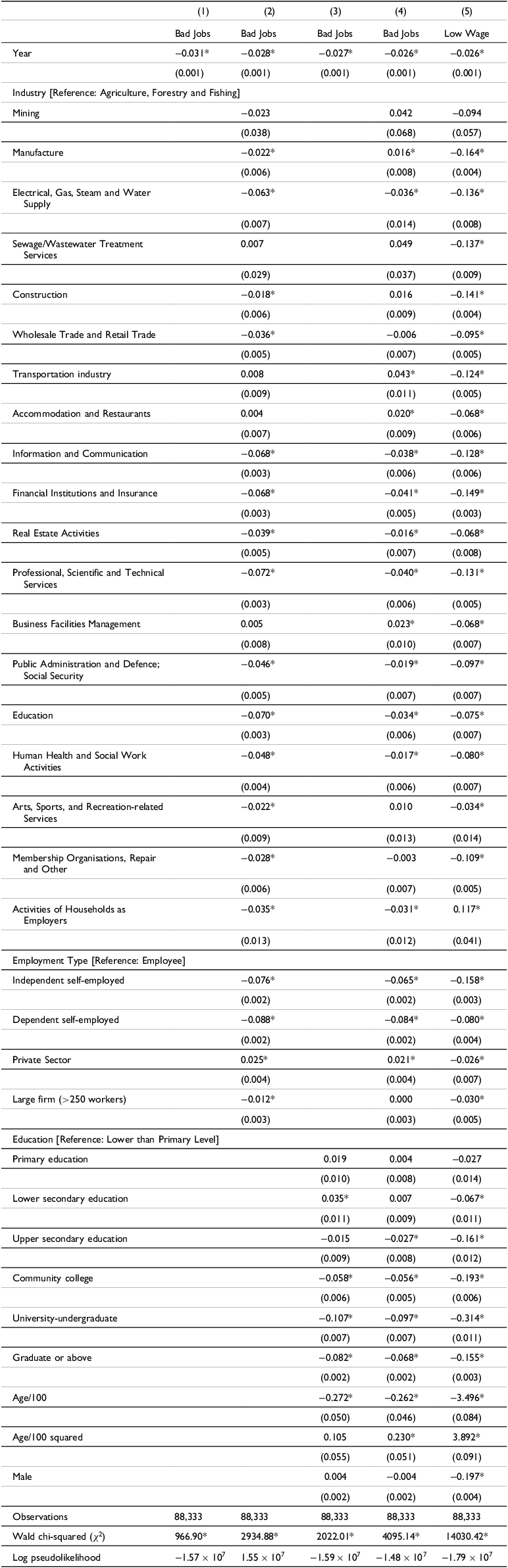
Table 3 presents the marginal effects from a series of probit regression models of the probability that a respondent’s job is a bad job. Model 1 includes only the trend, and then Model 2 incorporates industry and employment characteristics, while demographic and educational variables are shown in Model 3. Model 4 includes both sets of determinants in a full specification. Finally, for comparison, Model 5 employs an alternative dependent variable – low wage status, defined as earnings in the bottom quintile – using the same probit regression framework.
Probit regression of the probability that a job is a bad job
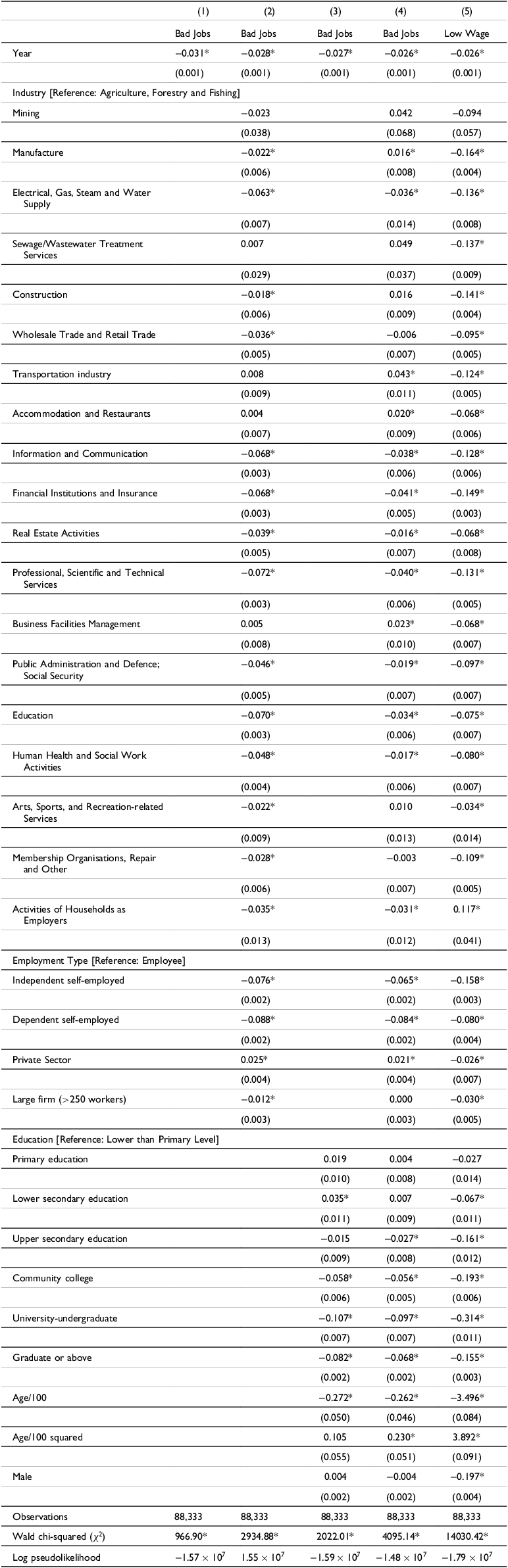
Note. Marginal effects and standard errors are shown. Survey weights are applied to all results. *p < 0.05.
The regression analysis provides statistical confirmation of the declining trends in bad jobs. The baseline model (Model 1) indicates that each year is associated with a 3.1 percentage point reduction in the probability of having a bad job. This effect remains robust, though moderately attenuated to 2.6 percentage points, when controlling for comprehensive demographic and work-related characteristics in the full specification (Model 4).
The industry-level analysis (Model 2) reveals substantial heterogeneity in the prevalence of bad jobs across economic sectors, with Agriculture, Forestry and Fishing serving as the reference category. Knowledge-intensive sectors demonstrate particularly strong protective effects against bad jobs. For instance, the Professional, Scientific and Technical Services sector exhibits the largest advantage, with a 7.2 percentage point lower probability of bad jobs relative to the reference category. This is followed by Education (−7.0 percentage points) and Information and Communication sectors (−6.8 percentage points), with Financial Institutions and Insurance Services showing an equally strong protective effect of 6.8 percentage points. However, several service-oriented sectors, including Accommodation and Restaurants, Transportation, and Business Facilities Management, along with Mining and Sewage Treatment Service, show no significant protective advantage over the reference category. This sectoral variation suggests that while the transition towards knowledge-based industries may contribute to the overall reduction in bad jobs, traditional service sectors remain areas of concern regarding the presence of bad jobs.
Analysis of employment characteristics (Model 2) reveals significant variation in the prevalence of bad jobs across different work arrangements. Self-employed workers demonstrate markedly lower probabilities of having bad jobs compared to employees, with dependent self-employed workers showing an 8.8 percentage point reduction and independent self-employed workers showing a 7.6 percentage point reduction. This pattern suggests that self-employment, in both its forms, may offer some protection against bad jobs. Private sector employment is associated with a slightly higher probability of having a bad job, showing a 2.5 percentage point increase compared to public sector employment. Employment in large firms (over 250 workers) is associated with a modest but significant 1.2 percentage point reduction in the likelihood of bad jobs.
Educational attainment (Model 3) exhibits a strong protective effect against bad jobs, with the magnitude of protection generally increasing with higher education levels. Compared to those with lower than primary level education, university undergraduate degree holders show the strongest protection, with a 10.7 percentage point reduction in the probability of having a bad job. This is followed by those with graduate degrees (−8.2 percentage points) and community college education (−5.8 percentage points). Interestingly, lower secondary education shows a small but significant increase in the probability of bad jobs (3.5 percentage points), while upper secondary education shows no significant protective effect. This pattern suggests a particularly important threshold effect at the tertiary education level, where the protective benefits become most pronounced.
The full model (Model 4) confirms the broader patterns. Industry effects generally moderate when accounting for individual characteristics, suggesting that selection by worker attributes partially explains sectoral variations in job quality. For instance, the protective effect in Professional, Scientific and Technical Services reduces from 7.2 to 4.0 percentage points, while several service sectors, including Transportation and Accommodation and Restaurants, show small but significant increases in the probability of bad jobs compared to the reference category. The protective effects of self-employment and education remain robust in the full specification, though with modest reductions in magnitude. The impact of being independently self-employed adjusts from 7.6 to 6.5 percentage points, while the protection offered by a university undergraduate degree moderates from 10.7 to 9.7 percentage points. Demographic factors reveal that age has a significant non-linear relationship with bad jobs, as indicated by the significant squared term. Gender shows no statistically significant association with the probability of bad jobs in either Model 3 or Model 4, suggesting that men and women face similar risks of bad jobs when controlling for other characteristics.
A comparative analysis of Model 4 (bad jobs) and Model 5 (low wage) reveals distinct patterns in how various factors influence these two measures. The private sector demonstrates contrasting effects: while private sector employment increases the probability of bad jobs by 2.1 percentage points, it reduces the likelihood of low wage employment by 2.6 percentage points. This suggests that higher wages in the private sector may come at the expense of other dimensions of job quality. Similarly, four industries – Manufacture, Transportation, Accommodation and Restaurants, and Business Facilities Management – demonstrate a consistent pattern where jobs are simultaneously more likely to be classified as bad jobs yet less likely to be low-wage positions compared to agricultural work. This pattern suggests that while these industries tend to offer better pay than agriculture, they may present workers with less favourable conditions in other aspects of employment. This consistent finding across multiple industries highlights that enhanced remuneration does not necessarily correspond with improved working conditions.
Discussion
The first contribution from this analysis is to have shown that the wellbeing-derived method for providing a relatively sharp demarcation between bad jobs and other jobs can be applied in South Korea, following the same procedures that have been used for Europe (Green and Lee Reference Green and Lee2024). Interestingly, in both cases, the data suggested adopting a threshold at the lowest decile of job quality. Beyond methodological validation, this study demonstrates that institutional contexts shape job quality distribution in distinctive ways. The somewhat extended lower tails observed in Korea contrast with Europe’s sharper binary distinction and align with Vanderleyden et al’s (Reference Vanderleyden, Seo, Vanroelen and De Moortel2025) findings of multi-layered labour market segmentation, providing empirical evidence that Korea’s intersection of employment status and firm size creates tiered disadvantage structures rather than simple duality. This reveals how evidence-based approaches can capture wellbeing patterns that are similar across countries, as well as context-specific institutional effects for more targeted policy interventions. However, for future research in other countries, it remains possible that the relationship between job quality and wellbeing follows a different pattern – either suggesting a different bad job threshold or failing to offer any sharp demarcation of bad jobs. In the latter case, it would be necessary to deploy alternative, normative criteria to delineate and analyse bad jobs (e.g., Apablaza et al Reference Apablaza, Sehnbruch, González and Méndez2023).
The paper also makes further contributions, adding to understanding of the trend and distribution of bad jobs. By applying the method to several successive cross-sectional surveys together, we provide, for the first time, estimates of the trend in bad jobs over nearly a decade in South Korea. We find that the prevalence of bad jobs has diminished between 2014 and 2023, as might be predicted to follow from the continued rapid economic growth over this period (amounting to a 13.2 per cent increase in per capita GDP). This finding extends previous Korean labour market research that documented deteriorating job quality trends in multiple dimensions between 2006 and 2020 (Lee and Green Reference Lee and Green2025), suggesting that the wellbeing-based measure introduces a different aspect of ‘bad jobs’ than dimension-specific analyses.
Yet the temporal pattern is far from steady. The sharp decline in bad job prevalence between 2014 and 2017 likely reflects multiple factors beyond economic growth alone. It may be as much a result of the changing political environment and anticipation of the policy interventions under the new regime, as of increasing affluence. The KWCS 2017 data, collected between July and September 2017, captured responses during the early months of the Moon Jae-In administration, which came to power in May 2017 with a strong labour reform agenda. The substantial improvement observed suggests that the anticipation of stronger labour regulations and heightened public attention to working conditions following the political crisis of 2016–17 would have influenced employer behaviour even before formal policy implementation.
Regarding distribution, one might expect similar industries to exhibit high concentrations of bad jobs in South Korea as in other developed economies, and this expectation is broadly confirmed. Our sectoral findings align with international job quality research demonstrating that knowledge-intensive industries, on average, provide better working conditions (Fauth Reference Fauth2011). We find that even after allowing for education and demographic selection, bad jobs are less common than average in, for example, the Education, Finance and Professional services industries. Similarly, industries such as Mining and Construction are, like Agriculture, the locus of a disproportionate number of bad jobs. One difference from Europe, however, is that bad jobs are significantly more common in Manufacturing industries when compared with, for example, Agriculture, whereas in Europe the opposite is the case.
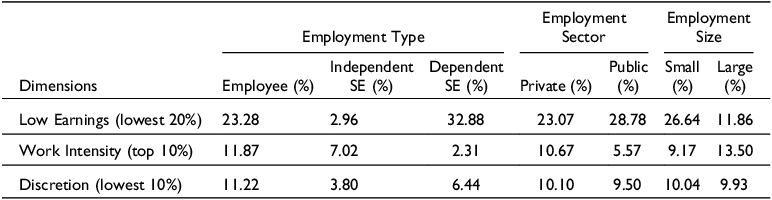
While the marginal effect of a job being in the private sector is to lower the chances of it being a low-wage job by 2.6 percentage points (see Model 5 in Table 3), it increases the probability that it is a bad job overall by 2.1 percentage points. The underpinning proximate cause of this difference is that the wellbeing-based definition of bad jobs takes into account all dimensions of job quality, not just wages. Table 4 illustrates this point for two of the non-wage dimensions: far fewer public sector jobs are subject to the highest work intensity, and somewhat fewer have the lowest task discretion. Similar sectoral findings are reported in Europe, and another common point is that the analysis here confirms the expected link with human capital, showing the strong protective effect of education, as found in Europe. A further broad similarity is that in both Europe and South Korea, the self-employed, whether or not they are dependent self-employed, are less likely than equivalent employees (with similar education and demographic characteristics) to be in bad jobs. As Table 4 illustrates, there is a disproportionately high number of the dependent employed among low-paid workers in South Korea; yet both they and the independent self-employed are less likely than employees to be in the worst deciles for work intensity or task discretion.
Job quality by employment type, sector, and size

Note. The table shows the percentage of (1) those with low earnings jobs (bottom 20% of earnings), (2) those with top decile of the Work Intensity index, and (3) those with the lowest decile of the Discretion index. Large firms represent those with more than 250 employees. SE represents self-employed.
A distinct difference from Europe concerns the findings on establishment size. Whereas in Europe, large establishments have fewer low-wage jobs but more bad jobs than small establishments; in South Korea, the opposite is the case: there is a significantly lower probability of bad jobs in establishments with over 250 employees. The finding aligns with extensive literature on Korea’s chaebol-dominated economy, where large conglomerates benefit from government support and preferential access to resources, enabling them to offer superior working conditions compared to small and medium enterprises (Grubb et al Reference Grubb, Lee and Tergeist2007). Reflecting the market dominance of the chaebols, this finding points to the strength of the persistent segmentation between large and small enterprises in the Korean labour market. Small establishments show a much greater prevalence of low earnings jobs (26.6 vs. 11.9 per cent in large firms). Though large establishments show slightly higher levels of work intensity, this does not offset the overall job quality advantage of large establishments because of the large pay differential. It can thus be suggested that policies aimed at improving job quality should pay particular attention to smaller establishments, which may lack the resources and managerial skills to foster better working conditions.
Finally, despite its deployment of a theory and data-driven bad job threshold based on comprehensive data on job quality, this study does not come without limitations. Foremost among these, the cross-sectional nature of each survey wave limits causal inference about the determinants of bad jobs, despite the ability to observe trends over time. Second, the study’s measurement of job quality among self-employed workers, specifically among those with no employees, may be imperfect; traditional job quality metrics could usefully be adapted to measure any social support available for this group. These limitations suggest directions for future research, particularly the need for longitudinal studies that can track individual employment trajectories and for more refined measurements of the social support available across diverse employment arrangements.
Competing interests
The authors certify that there is no actual or potential conflict of interest in relation to this article.
Appendix
Kernel density distribution of the single job quality index.





 Open access

