


Large carnivores have traditionally served as charismatic flagship and umbrella species for the conservation of biodiversity worldwide (Dalerum et al., Reference Dalerum, Somers, Kunkel and Cameron2008). However, their conservation is fraught with difficulties as most live at low densities, require large areas, and often conflict with human interests through predation on livestock and sometimes on people (Saberwal et al., Reference Saberwal, Gibbs, Chellam and Johnsingh1994; Karanth & Chellam, Reference Karanth and Chellam2009). Lions have been driven almost to extinction in Asia (Kinnear, Reference Kinnear1920; Pocock, Reference Pocock1930; Divyabhanusinh, Reference Divyabhanusinh2005). The only surviving free-ranging Asiatic lion Panthera leo persica population is in and around the Gir forests of Gujarat, India (Divyabhanusinh, Reference Divyabhanusinh2005). This population has increased from c. 20 in 1920 to a current population of c. 360 (Singh, Reference Singh2007).
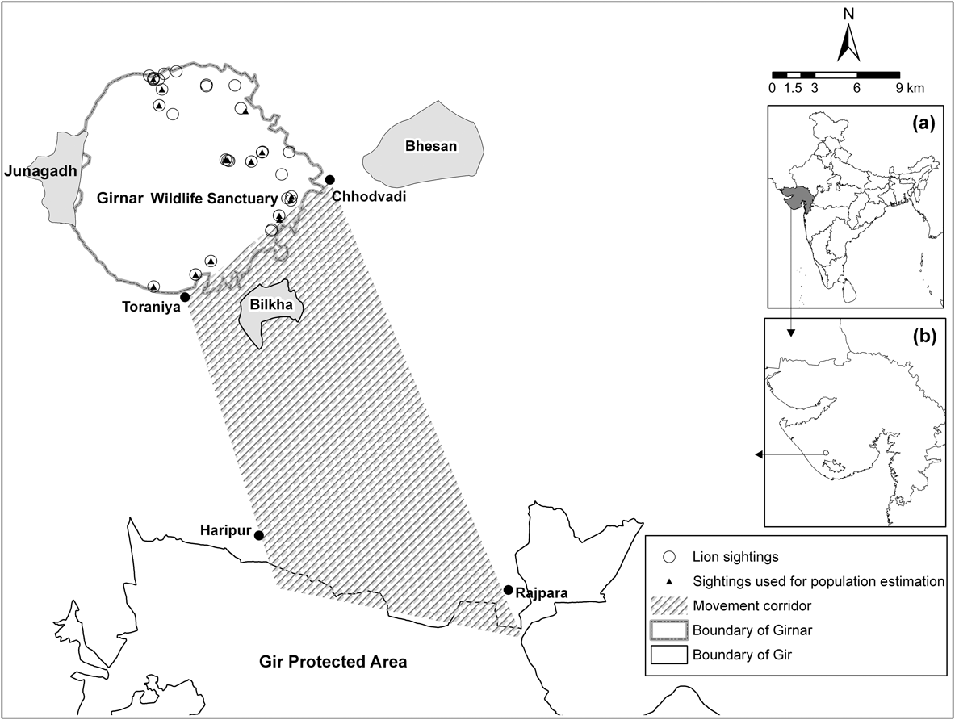
The population was formerly restricted to the c. 1,883 km2 Gir Protected Area (Johnsingh et al., Reference Johnsingh, Goyal and Qureshi2007) but during the last 2 decades lions have dispersed to establish small breeding units in the districts of Junagadh, Amreli and Bhavnagar, covering c. 10,000 km2 of agro-pastoral and scrub landscapes (Divyabhanusinh, Reference Divyabhanusinh2005; Singh, Reference Singh2007). One such population became established in Girnar forest, c. 35 km north-west of the Gir Protected Area, in the mid 1980s (Singh, Reference Singh2007) and lions occasionally move between the two areas. This movement enhances the long-term survival prospects of the subspecies (Hanski & Gilpin, Reference Hanski and Gilpin1997). The 180 km2 Girnar forest is bounded on three sides by the townships of Junagadh, Bilkha and Bhesan (Fig. 1). The forest is considered sacred; Hindu and Jain temples on the peaks of Mount Girnar are frequented by hundreds of thousands of pilgrims each year. The area was notified as a Wildlife Sanctuary in May 2008 (Government of Gujarat, 2008). Here we assess the population size and demographic structure of the lion population of Girnar Wildlife Sanctuary and discuss its medium- to long-term conservation prospects using a population viability analysis.
The location of Girnar Wildlife Sanctuary with respect to Gir Protected Area, showing the locations where we observed lions in Girnar and the potential movement corridor between the two areas. The insets show the location of Girnar (b) within the state of Gujarat (a) in India.
We obtained data on location, age, gender and group composition of lions in Girnar Wildlife Sanctuary from opportunistic sightings during March–May 2008 and from systematic surveys in April 2008 (see below), totalling 81 lions on 40 occasions. Lions were classified into six age groups based on size, body colouration and teeth wear (Schaller, Reference Schaller1972; Jhala et al., Reference Jhala, Mukherjee, Shah, Chauhan, Dave, Jhala and Jhala2004). The lions of Girnar are relatively well-habituated and thus their teeth can be observed with binoculars or a spotting scope when they yawn or snarl.
We collected data for a capture–recapture analysis (Ogutu et al., Reference Ogutu, Piepho, Dublin, Reid and Bhola2006) by systematically searching for lions on foot and by vehicle over the entire lion habitat of Girnar in six surveys of 3–4 days each, for a total of 19 days, in April 2008. Lions were individually identified based on their vibrissae patterns and permanent body marks (Pennycuik & Rudnai, Reference Pennycuik and Rudnai1970; Jhala et al., Reference Jhala, Qureshi, Bhuva and Sharma1999). From the capture histories of individual lions an X matrix was constructed, which was then used for mark-recapture population estimation (Pollock et al., Reference Pollock, Nichols, Brownie and Hines1990). Considering the long lifespan of lions relative to the short sampling duration and our coverage of the entire lion habitat, we assumed demographic and geographical closure (Chao & Huggins, Reference Chao, Huggins, Amstrup, McDonald and Manley2005) and tested for this using software CloseTest (Stanley & Burnham, Reference Stanley and Burnham1999).
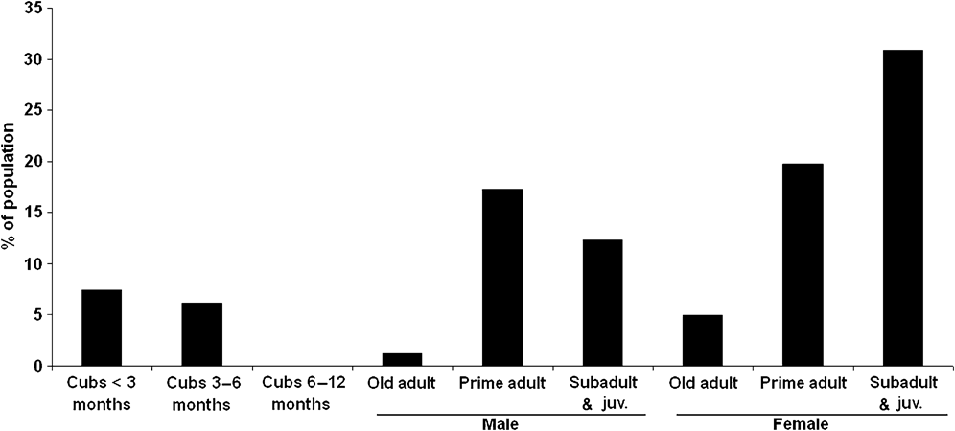
Although we surveyed the entire Sanctuary we did not record lions in the western part, a much-disturbed area with pilgrim shrines and proximal to human habitation (Junagadh city; Fig. 1). Cubs (< 1 year old) comprised 14% of the population, reproductive lionesses 20%, and subadults (1–3 years old) 43% (Fig. 2). The ratio of cubs to breeding females was 0.68:1 and was higher than that reported for Gir Protected Area (0.47:1; Jhala et al., Reference Jhala, Mukherjee, Shah, Chauhan, Dave, Jhala and Jhala2004) but within the range reported by Schaller (Reference Schaller1972) for Serengeti (0.40–0.66). The adult sex ratio of 0.87:1 (males: females) was higher than that reported for Africa (Schaller, Reference Schaller1972; Packer et al., Reference Packer, Hebst, Pusey, Bygott, Hanby, Cairns, Borgerhoff-Mulder and Clutton-Brock1988; Creel & Creel, Reference Creel and Creel1997). The number of cubs accompanying mothers was 2–3 (n = 3).
Age and sex composition of the lion population of Girnar Wildlife Sanctuary (Fig. 1) based on 81 lion sightings on 40 occasions.
For the capture–recapture analysis we obtained 26 sightings of nine individual lions. A plot of the number of unique lions against lion sightings reached an asymptote, suggesting adequacy of sampling. The model selection procedure of software CAPTURE-2 (Otis et al., Reference Otis, Burnham, White and Anderson1978; Rexstad & Burnham, Reference Rexstad and Burnham1991) selected the null model (Mo, scored at 1), followed by a model incorporating individual heterogeneity in capture probabilities (Mh, scored at 0.77). CloseTest supported population closure (χ2 = 6.16, P = 0.18). Capture probability of lions in Girnar was 0.31 and the population estimate using model Mo was 10 ± SE 1.2 lions. Girnar Wildlife Sanctuary is bounded by human habitations and agriculture but, although we observed lions venturing into agricultural areas at night to predate on cattle, they seldom spent the daylight hours beyond Girnar forest. For estimating lion density we therefore considered the forested Sanctuary boundary to be a ‘hard boundary’. Density of lions (> 1.5 years old) was estimated to be 5.6 ± SE 0.7 per 100 km2. The lion density in Girnar is therefore lower than that of Gir Protected Area (14.3–15.5 lions per 100 km2; Jhala et al., Reference Jhala, Mukherjee, Shah, Chauhan, Dave, Jhala and Jhala2004) but the high proportion of lions in recruitment age groups in Girnar and ample availability of prey (wild ungulates as well as domestic livestock; Dharaiya, Reference Dharaiya2001) suggest an increasing lion population.
We conducted a population viability analysis (PVA; Akçakaya & Sjögren-Gulve, Reference Akçakaya and Sjögren-Gulve2000), using published lion demographic data (Schaller, Reference Schaller1972; Joslin, Reference Joslin1973; Jhala et al., Reference Jhala, Mukherjee, Shah, Chauhan, Dave, Jhala and Jhala2004), with the software VORTEX v. 9.1 (Lacy, Reference Lacy1993). We set the carrying capacity of Girnar forest at 25 lions (a conservative estimate based on lion densities in Gir Protected Area; Jhala et al., Reference Jhala, Qureshi, Bhuva and Sharma1999, Reference Jhala, Mukherjee, Shah, Chauhan, Dave, Jhala and Jhala2004) to assess the potential for long-term persistence of this small lion population with and without immigration. We included inbreeding depression and a catastrophe frequency of 1 in 10 years in which reproduction is reduced by 50% and survival by 25% (Ashraf et al., Reference Ashraf, Chellam, Molur, Sharma and Walker1995). Rigorous estimates of viability are contingent upon knowledge of the status of a population at a fixed point in time and its dynamics over a certain time frame (White et al., Reference White, Franklin, Shenk, Beissinger and McCullough2002). Our analysis meets both these requirements as we conducted a mark–recapture analysis and used published population parameters. The frequency and rates of catastrophes that we used represent a reasonably severe scenario and the PVA outcomes are therefore conservative (Kohlmann et al., Reference Kohlmann, Schmidt and Garcelon2005). The PVA suggests that the Girnar lion population could potentially survive for the short- to medium-term (25–50 years, probability of extinction 5–10%) without immigrants. However, for long-term (100 years) persistence connectivity with the Gir Protected Area is crucial. Even if 1–2 lions immigrate to Girnar once in 2 years extinction probabilities are reduced from 36% (without immigrants) to 20% (with immigrants).
We are currently conducting a telemetry study of lions in Girnar Wildlife Sanctuary, Gir Protected Area and the surrounding landscape along with high resolution mapping of land-use in the region. The habitat matrix in south-east Girnar consists of broken topography and small drainage systems, and is predominantly agricultural with seasonal crops and fruit orchards. It is therefore conducive for lion movement between Girnar and Gir. Telemetry data on lions (Jhala et al., Reference Jhala, Mukherjee, Shah, Chauhan, Dave, Meena and Banerjee2009; K. Banerjee & Y. Jhala, unpubl. data) show that these land uses are not barriers to lion movement, and lions have been frequently observed in this habitat (B. Pathak, pers. obs.). Traditional land uses are fast changing in this region, with development of limestone mines and infrastructure such as highways altering the habitat matrix and making it hostile for movement of lions. Results from our ongoing telemetry and mapping studies will provide further details of the habitat corridors between Gir Protected Area and Girnar. Meanwhile, declaring the region between the village lands of Toraniya, Chhodavadi, Haripur and Rajpara (Fig. 1), where lions have been frequently sighted, as an eco-sensitive area (under The Environment (Protection) Act 1986, Government of India) would curtail adverse change of land uses and prevent further deterioration of this habitat for movement of lions.
Acknowledgements
The Chief Wildlife Warden Gujarat State and the Forest Department of Gujarat granted permissions and facilitated this research. V.J. Rana and M.M. Sharma provided support during the fieldwork. The research was funded by the Wildlife Institute of India. We thank our field assistants Taj, Osman and Ismail, and Parabita Basu for assistance with geographical information systems and map preparation.
Biographical sketches
Kausik Banerjee is studying lion populations residing outside protected areas, and also has research interests in carnivore ecology and behaviour, with an emphasis on predation, ranging patterns, habitat use, population dynamics and human–carnivore conflicts. Yadvendradev Jhala's research interests are in carnivore conservation, with an emphasis on ecology, population estimation, monitoring and human–carnivore conflicts. Bharat Pathak is a wildlife manager. He has been managing the wildlife and protected areas of Gujarat, including the Gir Protected Area, for the past 22 years. His research interests are human–wildlife conflict resolution, wildlife law and policy.



