





1 Introduction
A group is locally indicable if every nontrivial finitely generated subgroup surjects onto
$\mathbb Z$
 . Local indicability is not a topologically hereditary property, however in conjunction with diagrammatic reducibility, it is: If a complex X is a subcomplex of a diagrammatically reducible (DR) 2-complex Y that has locally indicable fundamental group, then X is DR and has locally indicable fundamental group (for background on topological and combinatorial vocabulary, we refer the reader to the next section). This is a consequence of the Corson–Trace characterization of diagrammatic reducibility. In this article, we use a Corson–Trace-like characterization of diagrammatic reducibility away from a subcomplex (see [Reference Harlander and Rosebrock8]) to obtain a considerable stronger result.
We apply this to investigate local indicability of LOT groups. The acronym LOT stands for labeled oriented tree. LOT complexes are spines of ribbon 2-disc complements and include the class of spines of classical knot complements. Background on LOTs is provided in the last section of the article. The unresolved asphericity question of LOT complexes and its relevance to Whitehead’s asphericity question has a long history (see [Reference Berrick, Hillman, Singh, Song and Wu2, Reference Bogley, Hog-Angeloni, Metzler and Sieradski3, Reference Rosebrock16, Reference Rosebrock, Metzler and Rosebrock17]). It is known that local indicability of the LOT group implies asphericity of the LOT complex (see [Reference Howie14]). Asphericity of injective LOT complexes has been established in [Reference Harlander and Rosebrock7], and a stronger asphericity condition has been shown in [Reference Harlander and Rosebrock9]. This article is motivated by the question whether injective LOT groups are locally indicable. We show that a reduced injective LOT that satisfies the combinatorial asphericity condition DR(2), and all its quotients do as well, is locally indicable.
2 Preliminaries
A map
$f\colon X\to Y$
 between complexes is cellular if it maps cells to cells and it is combinatorial if it maps the interior of a cell in X homeomorphically to the interior of a cell in Y. A complex X is combinatorial if the attaching maps of cells are combinatorial. All complexes in this article are assumed to be connected and combinatorial, with fixed cell orientations, unless stated otherwise.
If v is a vertex of a 2-complex
$X,$
 the link at v,
$lk(v,X)$
the link at v,
$lk(v,X)$
 , is the boundary of a regular neighborhood of v. It is a graph whose edges come from the corners of 2-cells. For that reason, we refer to the edges of
$lk(v,X)$
, is the boundary of a regular neighborhood of v. It is a graph whose edges come from the corners of 2-cells. For that reason, we refer to the edges of
$lk(v,X)$
 as corners at v. An oriented edge e of X with initial vertex v and terminal vertex w contributes a vertex
$e^+\in lk(v,X)$
as corners at v. An oriented edge e of X with initial vertex v and terminal vertex w contributes a vertex
$e^+\in lk(v,X)$
 and a vertex
$e^-\in lk(w,X)$
and a vertex
$e^-\in lk(w,X)$
 . If v is the only vertex of
$X,$
. If v is the only vertex of
$X,$
 we sometimes write
$lk(X)$
we sometimes write
$lk(X)$
 instead of
$lk(v,X)$
instead of
$lk(v,X)$
 .
.
An edge path
$e_1\dots e_k$
 in a graph is reducible if
$e_j=\bar e_{j-1}$
in a graph is reducible if
$e_j=\bar e_{j-1}$
 , for some j, where
$\bar e$
, for some j, where
$\bar e$
 denotes the edge e with opposite orientation. Otherwise, the path is called reduced. A spherical diagram over a 2-complex X is a combinatorial map
$f\colon S\to X$
denotes the edge e with opposite orientation. Otherwise, the path is called reduced. A spherical diagram over a 2-complex X is a combinatorial map
$f\colon S\to X$
 , where S is the 2-sphere with a combinatorial cell structure. The spherical diagram is reduced if for every vertex
$v\in S,$
, where S is the 2-sphere with a combinatorial cell structure. The spherical diagram is reduced if for every vertex
$v\in S,$
 the edge path
$f\colon lk(v,S)\to X$
the edge path
$f\colon lk(v,S)\to X$
 is reduced. If the spherical diagram is not reduced, then S contains an edge e so that the two 2-cells containing e are mapped to the same 2-cell in X with opposite orientation. Then the edge e is called a folding edge. X is DR if every spherical diagram over X is reducible.
A subcomplex
$L\subseteq X$
 is full if every cell in X whose boundary is in L is already in L. Let X be a 2-complex with a full subcomplex L. Then X is DR away from L if every spherical diagram
$f\colon S\to X$
is full if every cell in X whose boundary is in L is already in L. Let X be a 2-complex with a full subcomplex L. Then X is DR away from L if every spherical diagram
$f\colon S\to X$
 that contains an edge e so that
$f(e)\not \in L$
that contains an edge e so that
$f(e)\not \in L$
 , also contains a folding edge
$e'$
, also contains a folding edge
$e'$
 so that
$f(e')\not \in L$
so that
$f(e')\not \in L$
 . One consequence of DR away from L is the fact that the inclusion
$L\to X$
. One consequence of DR away from L is the fact that the inclusion
$L\to X$
 induces an injection on fundamental groups (Theorem 2.2 in [Reference Harlander and Rosebrock8]).
The following result is due to Corson–Trace [Reference Corson and Trace5].
Theorem 2.1 Assume the 2-complex X is DR. Let
$\tilde X$
 be its universal cover. Then every finite subcomplex of
$\tilde X$
be its universal cover. Then every finite subcomplex of
$\tilde X$
 collapses into the 1-skeleton
$\tilde X^{(1)}$
collapses into the 1-skeleton
$\tilde X^{(1)}$
 .
.
The following relative version of the Corson–Trace result was shown in [Reference Harlander and Rosebrock8, Theorem 3.4].
Theorem 2.2 Let X be a 2-complex,
$p\colon \tilde X\to X$
 its universal covering, and L be a full subcomplex of X. Assume X is DR away from L. Then every finite subcomplex of
$\tilde X$
its universal covering, and L be a full subcomplex of X. Assume X is DR away from L. Then every finite subcomplex of
$\tilde X$
 collapses into
$p^{-1}(L)\cup \tilde X^{(1)}$
collapses into
$p^{-1}(L)\cup \tilde X^{(1)}$
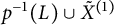 , and
$p^{-1}(L)$
, and
$p^{-1}(L)$
 is fixed under the collapsing process.
Definition 2.3 If
$f\colon S\to X$
 is a spherical diagram and s is an edge of
$S,$
is a spherical diagram and s is an edge of
$S,$
 then we call
$f(s)=e$
then we call
$f(s)=e$
 , an edge in X, the label carried by s. We say that X is DR(k) if X is DR away from any set of
$k-1$
, an edge in X, the label carried by s. We say that X is DR(k) if X is DR away from any set of
$k-1$
 or fewer edges.
DR(1) simply means DR and DR(k) implies DR(
$k-1$
 ). Note that DR(k) implies that every spherical diagram that contains
$j\le k$
). Note that DR(k) implies that every spherical diagram that contains
$j\le k$
 edges with mutually distinct labels also contains j folding edges with mutually distinct labels. This can be seen as follows: Suppose X is DR(k) and that
$f\colon S\to X$
edges with mutually distinct labels also contains j folding edges with mutually distinct labels. This can be seen as follows: Suppose X is DR(k) and that
$f\colon S\to X$
 carries mutually distinct labels
$e_1,\ldots e_j$
carries mutually distinct labels
$e_1,\ldots e_j$
 , where
$j\le k$
, where
$j\le k$
 . If
$k=1,$
. If
$k=1,$
 then X is DR and the diagram contains a folding edge. If
$k>1,$
then X is DR and the diagram contains a folding edge. If
$k>1,$
 then X is DR(
$k-1$
then X is DR(
$k-1$
 ) and therefore contains folding edges with distinct labels
$e^{\prime }_1,\ldots , e^{\prime }_{j-1}$
) and therefore contains folding edges with distinct labels
$e^{\prime }_1,\ldots , e^{\prime }_{j-1}$
 by induction. Since the diagram contains j edges with distinct labels, it contains an edge with a label e not equal to any of the
$e_1',\ldots , e^{\prime }_{j-1}$
by induction. Since the diagram contains j edges with distinct labels, it contains an edge with a label e not equal to any of the
$e_1',\ldots , e^{\prime }_{j-1}$
 . Since X is DR away from
$e_1',\ldots , e^{\prime }_{j-1}$
. Since X is DR away from
$e_1',\ldots , e^{\prime }_{j-1}$
 , it contains a folding edge labeled
$e'$
, it contains a folding edge labeled
$e'$
 not equal to any of the
$e_1',\ldots , e^{\prime }_{j-1}$
not equal to any of the
$e_1',\ldots , e^{\prime }_{j-1}$
 . Thus,
$e^{\prime }_1,\ldots , e^{\prime }_{j-1}, e'$
. Thus,
$e^{\prime }_1,\ldots , e^{\prime }_{j-1}, e'$
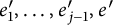 are j distinct labels on folding edges.
It was shown in [Reference Harlander and Rosebrock8, Theorem 2.6] that if X is the presentation complex for a 1-relator presentation
$P=\langle x_1,\ldots ,x_n \ |\ r\rangle $
 , where r is reduced, involves all generators, and is not a proper power, then X is DR(n). This implies that any set of
$n-1$
, where r is reduced, involves all generators, and is not a proper power, then X is DR(n). This implies that any set of
$n-1$
 generators generates a free subgroup of rank
$n-1$
generators generates a free subgroup of rank
$n-1$
 , which is the content of the Freiheitssatz.
Let X be a 2-complex. If we assign numbers
$\omega (c)\in \mathbb R$
 , called angles (or weights), to the corners c of the 2-cells of
$X,$
, called angles (or weights), to the corners c of the 2-cells of
$X,$
 we arrive at an angled 2-complex. Curvature in an angled 2-complex is defined in the following way. If v is a vertex of
$X,$
we arrive at an angled 2-complex. Curvature in an angled 2-complex is defined in the following way. If v is a vertex of
$X,$
 then
$\kappa (v,X)$
then
$\kappa (v,X)$
 , the curvature at v is

where the sum is taken over all the corners at v. If d is a 2-cell of
$X,$
 then
$\kappa (d,X)$
then
$\kappa (d,X)$
 , the curvature of d is

where the sum is taken over all the corners in d and
$|\partial d|$
 is the number of edges in the boundary of the 2-cell. The combinatorial Gauss–Bonnet theorem states that

This was first proven by Ballmann and Buyalo [Reference Ballmann and Buyalo1], and later observed by McCammond and Wise [Reference McCammond and Wise15]. Suppose we have a combinatorial map
$X\to Y$
 between 2-complexes. If Y is an angled 2-complex, then the angles in the 2-cells of Y can be pulled back to make X into an angled 2-complex. We call this angle structure on X the one induced by the combinatorial map.
Definition 2.4 (Weight test, Gersten [Reference Gersten and Gersten6])
Let X be an angled 2-complex. Then X satisfies the weight test if
-
(1) the curvature of every 2-cell is $\le 0$
 ;
; -
(2) for every vertex v: If $c_1\ldots c_n$
is a reduced cycle in
$lk(v,X)$
, then
$2-\sum _{i=1}^n \omega (c_i)\le 0$
.



If an angled 2-complex satisfies the weight test, then it is DR. This result is due to Gersten [Reference Gersten and Gersten6]. Gersten called the numbers
$\omega (c)$
 weights and not angles, because they do not have to be
$\ge 0$
weights and not angles, because they do not have to be
$\ge 0$
 . An earlier version of the weight test is due to Sieradski [Reference Sieradski18]. He considered the case where the angles take on only the values
$0$
. An earlier version of the weight test is due to Sieradski [Reference Sieradski18]. He considered the case where the angles take on only the values
$0$
 and
$1$
and
$1$
 , and called his test the coloring test. Wise showed in [Reference Wise19] that if X satisfies the coloring test (he called it “the Sieradski weight test”), then it has the non-positive immersions property and hence
$\pi _1(X)$
, and called his test the coloring test. Wise showed in [Reference Wise19] that if X satisfies the coloring test (he called it “the Sieradski weight test”), then it has the non-positive immersions property and hence
$\pi _1(X)$
 is locally indicable. This is not true for the general weight test. For example, it can be shown that the standard 2-complex X of the Higman presentation

can be made to satisfies the weight test, but
$\pi _1(X)$
 is infinite and perfect, and
$\chi (X)=1>0$
is infinite and perfect, and
$\chi (X)=1>0$
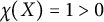 . So X cannot be made to satisfy the coloring test.
An angled 2-complex where all angles are either 0 or 1 is called a zero/one angled 2-complex. We denote by
$lk_0(v,X)$
 the subgraph of
$lk(v,X)$
the subgraph of
$lk(v,X)$
 consisting of the vertices of
$lk(v,X)$
consisting of the vertices of
$lk(v,X)$
 together with the corners with angle
$0$
together with the corners with angle
$0$
 .
.
Theorem 2.5 A zero/one-angled 2-complex X satisfies the coloring test if and only if
-
(1) the curvature of every 2-cell is $\le 0$
; -
(2) $lk_0(v,X)$
is a forest for every vertex v; -
(3) a corner with angle $1$
does not have both its vertices in a single connected component of
$lk_0(v,X)$
.


The proof is straightforward. We end this section with two results that we will need in applications later on. Given an angled 2-complex X and a path
$\alpha \in lk(v,X),$
 we define
$\omega (\alpha )$
we define
$\omega (\alpha )$
 to be the sum of the weights of the corners that appear in
$\alpha $
to be the sum of the weights of the corners that appear in
$\alpha $
 . We define
$\omega (lk(v,X))$
. We define
$\omega (lk(v,X))$
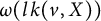 to be the sum of angles of all corners of
$lk(v,X)$
to be the sum of angles of all corners of
$lk(v,X)$
 .
.
Theorem 2.6 Let X be an angled 2-complex with a single vertex v, where all angles are
$\ge 0$
 . Assume that X satisfies the weight test and that for every edge e, should there be a path
$\alpha $
. Assume that X satisfies the weight test and that for every edge e, should there be a path
$\alpha $
 in
$lk(v,X)$
in
$lk(v,X)$
 that connects
$e^+$
that connects
$e^+$
 and
$e^-$
and
$e^-$
 , its weight
$\omega (\alpha )\ge 2$
, its weight
$\omega (\alpha )\ge 2$
 . Then X is DR(2).
Proof Let
$f\colon S\to X$
 be a spherical diagram. Since
$\chi (S)=2>0$
be a spherical diagram. Since
$\chi (S)=2>0$
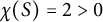 , the 2-sphere S must contain a vertex s of positive curvature by the combinatorial Gauss–Bonnet theorem. Thus,
$\omega (lk(s,S))< 2$
, the 2-sphere S must contain a vertex s of positive curvature by the combinatorial Gauss–Bonnet theorem. Thus,
$\omega (lk(s,S))< 2$
 . It follows that
$f(lk(s,S))$
. It follows that
$f(lk(s,S))$
 is a subtree of
$lk(v,X)$
is a subtree of
$lk(v,X)$
 . This is because if
$\beta $
. This is because if
$\beta $
 were a reduced cycle in
$f(lk(s,S))$
were a reduced cycle in
$f(lk(s,S))$
 , then
$\omega (lk(s,S))\ge \omega (\beta )\ge 2$
, then
$\omega (lk(s,S))\ge \omega (\beta )\ge 2$
 , which is false. It follows that
$f(lk(s,S))$
, which is false. It follows that
$f(lk(s,S))$
 contains at least two vertices
$e_1^{\epsilon _1}$
contains at least two vertices
$e_1^{\epsilon _1}$
 and
$e_2^{\epsilon _2}$
and
$e_2^{\epsilon _2}$
 of valency 1, where the epsilons are in
$\{ +, -\}$
of valency 1, where the epsilons are in
$\{ +, -\}$
 . Assume
$e_1=e_2=e$
. Assume
$e_1=e_2=e$
 . W.l.o.g., we assume that
$e_1^{\epsilon _1}=e^+$
. W.l.o.g., we assume that
$e_1^{\epsilon _1}=e^+$
 . Then
$e_2^{\epsilon _2}=e^-$
. Then
$e_2^{\epsilon _2}=e^-$
 (because
$e_1^{\epsilon _1}\ne e_2^{\epsilon _2}$
(because
$e_1^{\epsilon _1}\ne e_2^{\epsilon _2}$
 ), and we have a path
$\alpha $
), and we have a path
$\alpha $
 in
$f(lk(s,S))$
in
$f(lk(s,S))$
 connecting
$e^+$
connecting
$e^+$
 to
$e^-$
to
$e^-$
 such that
$\omega (\alpha )\le \omega (f(lk(s,S)))<2$
such that
$\omega (\alpha )\le \omega (f(lk(s,S)))<2$
 , which is ruled out. Thus,
$e_1\ne e_2$
, which is ruled out. Thus,
$e_1\ne e_2$
 . We have shown that there are two folding edges in S with distinct labels
$e_1$
. We have shown that there are two folding edges in S with distinct labels
$e_1$
 and
$e_2$
and
$e_2$
 .
.
Theorem 2.7 Let X be a zero/one angled 2-complex with a single vertex v. Assume that X satisfies the coloring test and that for every edge
$e,$
 we have that
$e^+$
we have that
$e^+$
 and
$e^-$
and
$e^-$
 lie in different components of
$lk_0(v,X)$
lie in different components of
$lk_0(v,X)$
 . Then X is DR(2) and
$\pi _1(X)$
. Then X is DR(2) and
$\pi _1(X)$
 is locally indicable.
Proof A 2-complex that satisfies the coloring test has the non-positive immersion property and therefore has locally indicable fundamental group (see [Reference Wise19, Theorem 11.4]). We are left with showing DR(2). Let
$f\colon S\to X$
 be a spherical diagram. Since
$\chi (S)=2>0$
be a spherical diagram. Since
$\chi (S)=2>0$
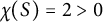 , the sphere S must contain a vertex s of positive curvature by the combinatorial Gauss–Bonnet theorem. Thus,
$\omega (lk(s,S))< 2$
, the sphere S must contain a vertex s of positive curvature by the combinatorial Gauss–Bonnet theorem. Thus,
$\omega (lk(s,S))< 2$
 . It follows from Theorem 2.5 that
$\omega (lk(s,S))=0$
. It follows from Theorem 2.5 that
$\omega (lk(s,S))=0$
 , which implies that the subgraph
$f(lk(s,S))$
, which implies that the subgraph
$f(lk(s,S))$
 is contained in
$lk_0(f(v,X))$
is contained in
$lk_0(f(v,X))$
 , a forest. It follows that
$f(lk(s,S))$
, a forest. It follows that
$f(lk(s,S))$
 is a tree and therefore contains at least two vertices of valency 1, say
$e_1^{\epsilon _1}$
is a tree and therefore contains at least two vertices of valency 1, say
$e_1^{\epsilon _1}$
 and
$e_2^{\epsilon _2}$
and
$e_2^{\epsilon _2}$
 , where the epsilons are in
$\{ +, -\}$
, where the epsilons are in
$\{ +, -\}$
 . Suppose
$e_1=e_2=e$
. Suppose
$e_1=e_2=e$
 . We may assume w.l.o.g. that
$e_1^{\epsilon _1}=e^+$
. We may assume w.l.o.g. that
$e_1^{\epsilon _1}=e^+$
 . Then
$e_2^{\epsilon _2}=e^-$
. Then
$e_2^{\epsilon _2}=e^-$
 , because
$e_1^{\epsilon _1}\ne e_2^{\epsilon _2}$
, because
$e_1^{\epsilon _1}\ne e_2^{\epsilon _2}$
 . But this implies that
$e^+$
. But this implies that
$e^+$
 and
$e^-$
and
$e^-$
 lie in a single component of
$lk_0(v,X)$
lie in a single component of
$lk_0(v,X)$
 , a contradiction. Thus,
$e_1\ne e_2$
, a contradiction. Thus,
$e_1\ne e_2$
 and again there are two folding edges labeled differently in S.
Theorem 2.8 Let X be a C(4)-T(4) 2-complex with a single vertex v. Suppose that the attaching maps for the 2-cells are reduced closed paths that do not contain an edge sequence
$ee$
 , for any edge e. Then X is DR(2) and
$\pi _1(X)$
, for any edge e. Then X is DR(2) and
$\pi _1(X)$
 is locally indicable.
Proof A C(4)-T(4) 2-complex has the non-positive immersions property and hence its fundamental group is locally indicable (see [Reference Wise20, Corollary 8.2]). We have left to show DR(2). Note that a C(4)-T(4) 2-complex satisfies the weight test where all weights are
$1/2$
 . Let
$f\colon S\to X$
. Let
$f\colon S\to X$
 be a spherical diagram. Since
$\chi (S)=2>0$
be a spherical diagram. Since
$\chi (S)=2>0$
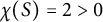 , the sphere S must contain a vertex s of positive curvature by the combinatorial Gauss–Bonnet theorem. Thus, there is a vertex s in S of valency
$\le 3$
, the sphere S must contain a vertex s of positive curvature by the combinatorial Gauss–Bonnet theorem. Thus, there is a vertex s in S of valency
$\le 3$
 . Since
$lk(v,X)$
. Since
$lk(v,X)$
 does not contain cycles of length less than 4, it follows that
$f(lk(s,S))$
does not contain cycles of length less than 4, it follows that
$f(lk(s,S))$
 is a tree, in fact, a single edge in
$lk(v,X)$
is a tree, in fact, a single edge in
$lk(v,X)$
 and the valence of s is 2. Let
$e_1^{\epsilon _1}$
and the valence of s is 2. Let
$e_1^{\epsilon _1}$
 and
$e_2^{\epsilon _2}$
and
$e_2^{\epsilon _2}$
 be the vertices of
$f(lk(s,S))$
be the vertices of
$f(lk(s,S))$
 . Assume that
$e_1=e_2=e$
. Assume that
$e_1=e_2=e$
 . W.l.o.g., we assume that
$e_1^{\epsilon _1}=e^+$
. W.l.o.g., we assume that
$e_1^{\epsilon _1}=e^+$
 . Then
$e_2^{\epsilon _2}=e^-$
. Then
$e_2^{\epsilon _2}=e^-$
 . It follows that X contains a 2-cell that is attached via a path that contains
$ee$
. It follows that X contains a 2-cell that is attached via a path that contains
$ee$
 , which we do not allow. Thus,
$e_1\ne e_2$
, which we do not allow. Thus,
$e_1\ne e_2$
 and again there are two folding edges labeled differently in S.
3 Main result
A group is called locally free if all its nontrivial finitely generated subgroups are free.
Lemma 3.1 Suppose X is a 2-complex all of whose finite subcomplexes collapse into its 1-skeleton. Then
$\pi _1(X)$
 is locally free.
Proof This can be argued in more than one way (see Remark 3.3 below). We present an elementary proof that, with slight variations, also applies to the next lemma.
Suppose A is a finitely generated subgroup of
$\pi _1(X)$
 minimally generated by n elements. Let B be a finitely presented group on n generators that maps onto A. We can construct a finite 2-complex W with fundamental group B, and a map
$\alpha \colon W\to X$
minimally generated by n elements. Let B be a finitely presented group on n generators that maps onto A. We can construct a finite 2-complex W with fundamental group B, and a map
$\alpha \colon W\to X$
 so that the induced map

has image A. Let
$Z=\alpha (W)$
 . Since Z is a finite subcomplex of X, it collapses into the 1-skeleton
$X^{(1)}$
. Since Z is a finite subcomplex of X, it collapses into the 1-skeleton
$X^{(1)}$
 . So we may assume that
$Z\subseteq X^{(1)}$
. So we may assume that
$Z\subseteq X^{(1)}$
 . Our map
$\alpha $
. Our map
$\alpha $
 factors through
$X^{(1)}$
factors through
$X^{(1)}$
 :
:

where
$\iota $
 is the inclusion and
$\iota \circ \beta =\alpha $
is the inclusion and
$\iota \circ \beta =\alpha $
 . Thus, we have

Since B is generated by n elements,
$\beta _*(B)$
 is generated by
$\le n$
is generated by
$\le n$
 elements. Since
$\beta _*(B)$
elements. Since
$\beta _*(B)$
 maps onto
$A,$
maps onto
$A,$
 it is generated by
$\ge n$
it is generated by
$\ge n$
 elements, and therefore minimally generated by n elements. Since
$\beta _*(B)\subseteq \pi _1(X^{(1)})$
elements, and therefore minimally generated by n elements. Since
$\beta _*(B)\subseteq \pi _1(X^{(1)})$
 , it is a free group of rank n, and therefore B is free of rank n. We have shown that the only n-generator group B that maps onto the n-generator group A is free of rank n. It follows that A is free of rank n.
Lemma 3.2 Let L be a subcomplex of a 2-complex X. Assume that
$\pi _1(L)$
 is locally indicable and that every finite subcomplex of X collapses into L. Then
$\pi _1(X)$
is locally indicable and that every finite subcomplex of X collapses into L. Then
$\pi _1(X)$
 is locally indicable.
Proof Suppose A is a finitely generated subgroup of
$\pi _1(X)$
 so that
$H_1(A)$
so that
$H_1(A)$
 is finite. Then there exists a finitely presented group B that maps onto A so that
$H_1(B)$
is finite. Then there exists a finitely presented group B that maps onto A so that
$H_1(B)$
 is finite. We can construct a finite 2-complex W with fundamental group B and a map
$\alpha \colon W\to X$
is finite. We can construct a finite 2-complex W with fundamental group B and a map
$\alpha \colon W\to X$
 so that the induced map

has image A. Let
$Z=\alpha (W)$
 . Since Z is a finite subcomplex of X, it collapses into L. So we may assume that
$Z\subseteq L$
. Since Z is a finite subcomplex of X, it collapses into L. So we may assume that
$Z\subseteq L$
 . Our map
$\alpha $
. Our map
$\alpha $
 factors through L:

where
$\iota $
 is the inclusion and
$\iota \circ \beta =\alpha $
is the inclusion and
$\iota \circ \beta =\alpha $
 . Thus, we have

Since B is finitely generated, so is
$\beta _*(B)$
 . Since
$H_1(B)$
. Since
$H_1(B)$
 is finite, so is
$H_1(\beta _*(B))$
is finite, so is
$H_1(\beta _*(B))$
 . Since
$\beta _*(B)$
. Since
$\beta _*(B)$
 is a finitely generated subgroup of the locally indicable group
$\pi _1(L),$
is a finitely generated subgroup of the locally indicable group
$\pi _1(L),$
 it follows that
$\beta _*(B)=1$
it follows that
$\beta _*(B)=1$
 . Thus,
$A=\iota _*(\beta _*(B))=1$
. Thus,
$A=\iota _*(\beta _*(B))=1$
 .
.
Remark 3.3 Lemma 3.1 also follows from direct limits. X is a union of finite subcomplexes
$X_i$
 forming a directed set with respect to inclusion. We have

Since each
$X_i$
 collapses into the 1-skeleton, each
$\pi _1(X_i)$
collapses into the 1-skeleton, each
$\pi _1(X_i)$
 is free and so
$\pi _1(X)$
is free and so
$\pi _1(X)$
 is a direct limit of free groups and therefore is locally free. In fact, a direct limit of locally free groups is locally free (see, e.g., [Reference Conner, Hojka and Meilstrup4, Lemma 24]).
It is not clear how to make the limit argument work for Lemma 3.2, because, despite the fact that every
$X_i$
 collapses into
$L,$
collapses into
$L,$
 we cannot conclude in general that
$\pi _1(X_i)$
we cannot conclude in general that
$\pi _1(X_i)$
 is locally indicable. Under the assumption that L is DR in addition to
$\pi _1(L)$
is locally indicable. Under the assumption that L is DR in addition to
$\pi _1(L)$
 being locally indicable, the limit argument does work. If
$L_i$
being locally indicable, the limit argument does work. If
$L_i$
 is the subcomplex of L into which
$X_i$
is the subcomplex of L into which
$X_i$
 collapses, then
$\pi _1(L_i)$
collapses, then
$\pi _1(L_i)$
 is locally indicable by Theorem 3.4 below. It follows that
$\pi _1(X_i)$
is locally indicable by Theorem 3.4 below. It follows that
$\pi _1(X_i)$
 is locally indicable and so
$\pi _1(X)$
is locally indicable and so
$\pi _1(X)$
 is a direct limit of locally indicable groups and therefore is locally indicable.
Here is a baby version of our main result (Theorem 3.8) stated at the end of this section.
Theorem 3.4 Let X be a subcomplex of the 2-complex Y. If Y is DR, then the kernel of the inclusion induced map
$\pi _1(X)\to \pi _1(Y)$
 is locally free. Consequently, if
$\pi _1(Y)$
is locally free. Consequently, if
$\pi _1(Y)$
 is locally indicable, then so is
$\pi _1(X)$
is locally indicable, then so is
$\pi _1(X)$
 .
.
Proof This is an immediate consequence of Theorem 2.1. Let
$\bar X$
 be the covering complex whose fundamental group is the kernel of the inclusion induced map
$\pi _1(X)\to \pi _1(Y)$
be the covering complex whose fundamental group is the kernel of the inclusion induced map
$\pi _1(X)\to \pi _1(Y)$
 . Then, by standard covering space theory (see [Reference Hatcher11]), we have
$\bar X\subseteq \tilde Y$
. Then, by standard covering space theory (see [Reference Hatcher11]), we have
$\bar X\subseteq \tilde Y$
 , where
$\tilde Y$
, where
$\tilde Y$
 is the universal covering of Y. Since every finite subcomplex of
$\tilde Y$
is the universal covering of Y. Since every finite subcomplex of
$\tilde Y$
 collapses into the 1-skeleton by Theorem 2.1, every finite subcomplex of
$\bar X$
collapses into the 1-skeleton by Theorem 2.1, every finite subcomplex of
$\bar X$
 has free fundamental group. It follows from Lemma 3.1 that
$\pi _1(\bar X)$
has free fundamental group. It follows from Lemma 3.1 that
$\pi _1(\bar X)$
 is locally free and hence locally indicable. Thus, the kernel of the inclusion induced map
$\pi _1(X)\to \pi _1(Y)$
is locally free and hence locally indicable. Thus, the kernel of the inclusion induced map
$\pi _1(X)\to \pi _1(Y)$
 is locally indicable, and if we assume that
$\pi _1(Y)$
is locally indicable, and if we assume that
$\pi _1(Y)$
 is as well, we can conclude that
$\pi _1(X)$
is as well, we can conclude that
$\pi _1(X)$
 is locally indicable.
Definition 3.5 Let
$f\colon X\to Y$
 be a cellular map between 2-complexes. Suppose K is a full subcomplex of Y and
$f^{-1}(K)=L$
be a cellular map between 2-complexes. Suppose K is a full subcomplex of Y and
$f^{-1}(K)=L$
 . Then f is called an immersion outside of L if
-
(1) The interior of a cell in X not in L is mapped homeomorphically to the interior of a cell in Y.
-
(2) If x is a point in X not in L, then $f\colon lk(x,X)\to lk(f(x),Y)$
is an embedding.

Lemma 3.6 Suppose we have a map
$f\colon X\to Y$
 between 2-complexes,
$K\subseteq Y$
between 2-complexes,
$K\subseteq Y$
 and
$L=f^{-1}(K)$
and
$L=f^{-1}(K)$
 . Suppose further that f is an immersion outside of L. Assume that Y is DR away from K. Let
$p_X\colon \bar X\to X $
. Suppose further that f is an immersion outside of L. Assume that Y is DR away from K. Let
$p_X\colon \bar X\to X $
 be the covering associated with the kernel of the induced map
$f_*\colon \pi _1(X)\to \pi _1(Y)$
be the covering associated with the kernel of the induced map
$f_*\colon \pi _1(X)\to \pi _1(Y)$
 . Then every finite subcomplex of
$\bar X$
. Then every finite subcomplex of
$\bar X$
 collapses into
$p_X^{-1}(L)\cup \bar X^{(1)}$
collapses into
$p_X^{-1}(L)\cup \bar X^{(1)}$
 .
.
Proof Let
$p_Y\colon \tilde Y\to Y$
 be the universal covering of Y. We have a commutative diagram

where
$\bar f$
 is the lift of f. Since f is an immersion outside of
$L,$
is the lift of f. Since f is an immersion outside of
$L,$
 we have that
$\bar f$
we have that
$\bar f$
 is an immersion outside of
$p_X^{-1}(L)$
is an immersion outside of
$p_X^{-1}(L)$
 . Let Z be a finite subcomplex of
$\bar X$
. Let Z be a finite subcomplex of
$\bar X$
 that is not already contained in
$p_X^{-1}(L)\cup \bar X^{(1)}$
that is not already contained in
$p_X^{-1}(L)\cup \bar X^{(1)}$
 . Then
$Z'=\bar f(Z)$
. Then
$Z'=\bar f(Z)$
 is a finite subcomplex of
$\tilde Y$
is a finite subcomplex of
$\tilde Y$
 not contained in
$p_Y^{-1}(K)\cup \tilde Y^{(1)}$
not contained in
$p_Y^{-1}(K)\cup \tilde Y^{(1)}$
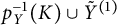 . Since Y is DR away from K,
$Z'$
. Since Y is DR away from K,
$Z'$
 contains a free edge
$\tilde e$
contains a free edge
$\tilde e$
 not in
$p_Y^{-1}(K)$
not in
$p_Y^{-1}(K)$
 by Theorem 2.2. Let
$\tilde d$
by Theorem 2.2. Let
$\tilde d$
 be the 2-cell that can be collapsed by pushing in
$\tilde e$
be the 2-cell that can be collapsed by pushing in
$\tilde e$
 . Let
$\bar e$
. Let
$\bar e$
 be an edge in Z so that
$\bar f(\bar e)=\tilde e$
be an edge in Z so that
$\bar f(\bar e)=\tilde e$
 . Let
$\bar d_1,\ldots , \bar d_k$
. Let
$\bar d_1,\ldots , \bar d_k$
 be the 2-cells in Z that contain
$\bar e$
be the 2-cells in Z that contain
$\bar e$
 in their boundary. Let
$m_{\bar e}$
in their boundary. Let
$m_{\bar e}$
 be the midpoint of
$\bar e$
be the midpoint of
$\bar e$
 and
$m_{\tilde e}$
and
$m_{\tilde e}$
 be the midpoint of
$\tilde e$
be the midpoint of
$\tilde e$
 . Since
$\bar f$
. Since
$\bar f$
 is an immersion outside of
$p_X^{-1}(L),$
is an immersion outside of
$p_X^{-1}(L),$
 the map
$\bar f\colon lk(m_{\bar e}, \bar X)\to lk(m_{\tilde e}, \tilde Y)$
the map
$\bar f\colon lk(m_{\bar e}, \bar X)\to lk(m_{\tilde e}, \tilde Y)$
 is an embedding. Therefore,
$f\colon lk(m_{\bar e}, Z)\to lk(m_{\tilde e}, Z')$
is an embedding. Therefore,
$f\colon lk(m_{\bar e}, Z)\to lk(m_{\tilde e}, Z')$
 is an embedding as well. Since
$lk(m_{\tilde e}, \tilde Z')$
is an embedding as well. Since
$lk(m_{\tilde e}, \tilde Z')$
 is a single half circle (because
$\tilde e$
is a single half circle (because
$\tilde e$
 is a free edge of
$\tilde d$
is a free edge of
$\tilde d$
 ),
$lk(m_{\bar e}, Z)$
),
$lk(m_{\bar e}, Z)$
 cannot contain more than one half circle. Thus,
$k=1$
cannot contain more than one half circle. Thus,
$k=1$
 and
$\bar d_1$
and
$\bar d_1$
 is the only 2-cell of Z that contains the edge
$\bar e$
is the only 2-cell of Z that contains the edge
$\bar e$
 in its boundary, and it does so exactly once. It follows that
$\bar e$
in its boundary, and it does so exactly once. It follows that
$\bar e$
 is a free edge in Z.
Lemma 3.7 Suppose X is a 2-complex, L is a subcomplex of X, and
$p_X\colon \bar X\to X$
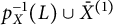
 is a covering. If each connected component of L has locally indicable fundamental group, then so does
$p^{-1}_X(L)\cup \bar X^{(1)}$
is a covering. If each connected component of L has locally indicable fundamental group, then so does
$p^{-1}_X(L)\cup \bar X^{(1)}$
 .
.
Proof Each component
$\bar L_c$
 of
$p_X^{-1}(L)$
of
$p_X^{-1}(L)$
 is a covering of some component
$L_c$
is a covering of some component
$L_c$
 of L. Since
${p_X}_*\colon \pi _1(\bar L_c)\to \pi _1(L_c)$
of L. Since
${p_X}_*\colon \pi _1(\bar L_c)\to \pi _1(L_c)$
 is injective and we assumed that
$\pi _1(L_c)$
is injective and we assumed that
$\pi _1(L_c)$
 is locally indicable, it follows that
$\pi _1(\bar L_c)$
is locally indicable, it follows that
$\pi _1(\bar L_c)$
 is locally indicable. Thus,
$\pi _1(p_X^{-1}(L)\cup \bar X^{(1)})$
is locally indicable. Thus,
$\pi _1(p_X^{-1}(L)\cup \bar X^{(1)})$
 , being a free product of locally indicable groups and a free group, is locally indicable.
Here is our main result, a relative version of Theorem 3.4.
Theorem 3.8 Suppose we have a map
$f\colon X\to Y$
 between 2-complexes,
$K\subseteq Y$
between 2-complexes,
$K\subseteq Y$
 and
$L=f^{-1}(K)$
and
$L=f^{-1}(K)$
 . Suppose further that f is an immersion outside of L. Assume that Y is DR away from K. Then:
-
(1) if L is DR then so is X;
-
(2) if every component of L has locally indicable fundamental group and $\pi _1(Y)$
is locally indicable, then so is
$\pi _1(X)$
.


Proof (1) Let
$p_X\colon \bar X\to X $
 be the covering associated with the kernel of the induced map
$f_*\colon \pi _1(X)\to \pi _1(Y)$
be the covering associated with the kernel of the induced map
$f_*\colon \pi _1(X)\to \pi _1(Y)$
 . By Lemma 3.6, every finite subcomplex of
$\bar X$
. By Lemma 3.6, every finite subcomplex of
$\bar X$
 collapses into
$p^{-1}_X(L)\cup \bar X^{(1)}$
collapses into
$p^{-1}_X(L)\cup \bar X^{(1)}$
 . If L is DR, then
$p_X^{-1}(L)$
. If L is DR, then
$p_X^{-1}(L)$
 is DR, because it is a covering space, and therefore
$p^{-1}_X(L)\cup \bar X^{(1)}$
is DR, because it is a covering space, and therefore
$p^{-1}_X(L)\cup \bar X^{(1)}$
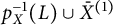 is DR. It follows that
$\bar X$
is DR. It follows that
$\bar X$
 is DR, and therefore X is DR.
(2) If every component of L has locally indicable fundamental group, then by Lemma 3.7, we have that
$\pi _1(p^{-1}_X(L)\cup \bar X^{(1)})$
 is locally indicable. Since every finite subcomplex of
$\bar X$
is locally indicable. Since every finite subcomplex of
$\bar X$
 collapses into
$p^{-1}_X(L)\cup \bar X^{(1)}$
collapses into
$p^{-1}_X(L)\cup \bar X^{(1)}$
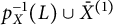 , it follows from Lemma 3.2 that
$\pi _1(\bar X)$
, it follows from Lemma 3.2 that
$\pi _1(\bar X)$
 is locally indicable. We have

Since we assume that
$\pi _1(Y)$
 is locally indicable, so is
$\pi _1(X)$
is locally indicable, so is
$\pi _1(X)$
 .
.
4 An application to labeled oriented trees
A labeled oriented graph (LOG)
$\Gamma = (E, V, s, t, \lambda )$
 consists of two sets E, V of edges and vertices, and three maps
$s, t, \lambda \colon E\to V$
consists of two sets E, V of edges and vertices, and three maps
$s, t, \lambda \colon E\to V$
 called, respectively, source, target, and label.
$\Gamma $
called, respectively, source, target, and label.
$\Gamma $
 is said to be an LOT when the underlying graph is a tree. The associated LOG presentation is defined as

The LOG complex
$K(\Gamma )$
 is the standard 2-complex defined by the presentation, and the group
$G(\Gamma )$
is the standard 2-complex defined by the presentation, and the group
$G(\Gamma )$
 presented by
$P(\Gamma )$
presented by
$P(\Gamma )$
 is equal to
$\pi _1(K(\Gamma ))$
is equal to
$\pi _1(K(\Gamma ))$
 .
.
It is known that LOT-complexes are spines of ribbon 2-disc complements (see [Reference Howie13]). So the study of LOTs is an extension of classical knot theory. Asphericity, known for classical knots, is unresolved for LOTs. The asphericity question for LOTs is of central importance to Whitehead’s asphericity conjecture: A subcomplex of an aspherical 2-complex is aspherical (see [Reference Berrick, Hillman, Singh, Song and Wu2, Reference Bogley, Hog-Angeloni, Metzler and Sieradski3, Reference Rosebrock, Metzler and Rosebrock17]).
A sub-LOG
$\Gamma _0=(E_0, V_0)\subseteq \Gamma $
 is a subgraph so that
$E_0\ne \emptyset $
is a subgraph so that
$E_0\ne \emptyset $
 and
$\lambda \colon E_0\to V_0$
and
$\lambda \colon E_0\to V_0$
 . A sub-LOT is a sub-LOG which is an LOT itself. An LOG is called boundary reduced if, whenever v is a vertex of valency 1, then
$v=\lambda (e)$
. A sub-LOT is a sub-LOG which is an LOT itself. An LOG is called boundary reduced if, whenever v is a vertex of valency 1, then
$v=\lambda (e)$
 for some edge e. It is called interior reduced if, for every vertex
$v,$
for some edge e. It is called interior reduced if, for every vertex
$v,$
 no two edges starting or terminating at v carry the same label. It is called compressed if, for every edge
$e,$
no two edges starting or terminating at v carry the same label. It is called compressed if, for every edge
$e,$
 the label
$\lambda (e)$
the label
$\lambda (e)$
 is not equal to
$s(e)$
is not equal to
$s(e)$
 or
$t(e)$
or
$t(e)$
 . Finally, an LOG is reduced if it is boundary reduced, interior reduced, and compressed. Given an LOG, reductions can be performed to produce a reduced LOG, and, in case, the LOG is an LOT, this process does not affect the homotopy type of the LOT complex. An LOG is called injective if the labeling map
$\lambda \colon E\to V$
. Finally, an LOG is reduced if it is boundary reduced, interior reduced, and compressed. Given an LOG, reductions can be performed to produce a reduced LOG, and, in case, the LOG is an LOT, this process does not affect the homotopy type of the LOT complex. An LOG is called injective if the labeling map
$\lambda \colon E\to V$
 is injective.
Theorem 4.1 If
$\Gamma $
 is a reduced injective LOT that does not contain boundary reducible sub-LOTs, then
$K(\Gamma )$
is a reduced injective LOT that does not contain boundary reducible sub-LOTs, then
$K(\Gamma )$
 admits a zero/one-angle structure that satisfies the coloring test. It follows that
$K(\Gamma )$
admits a zero/one-angle structure that satisfies the coloring test. It follows that
$K(\Gamma )$
 is DR(2) and
$G(\Gamma )$
is DR(2) and
$G(\Gamma )$
 is locally indicable.
Proof The fact that
$\Gamma $
 admits a zero/one-angle structure that satisfies the coloring test is due to Huck–Rosebrock (see Theorems 3.2 and 3.3 of [Reference Harlander and Rosebrock10] and the references therein). Zero/one-angled 2-complexes that satisfy the coloring test have the non-positive immersions property and hence have locally indicable fundamental group (see [Reference Wise19, Theorem 11.4]).
The DR(2) statement has not appeared elsewhere and we will provide the details. We want to use Theorem 2.7. We need to show that
$x^+$
 and
$x^-$
and
$x^-$
 lie in different components of
$lk_0(K(\Gamma ))$
lie in different components of
$lk_0(K(\Gamma ))$
 for every edge
$x\in K(\Gamma )$
for every edge
$x\in K(\Gamma )$
 . Let’s take a closer look at
$lk(K(\Gamma ))$
. Let’s take a closer look at
$lk(K(\Gamma ))$
 . It was shown in [Reference Harlander and Rosebrock10, Theorem 3.3] that
$K(\Gamma )$
. It was shown in [Reference Harlander and Rosebrock10, Theorem 3.3] that
$K(\Gamma )$
 has the following local bi-forest property: If
$x_1,\ldots , x_n$
has the following local bi-forest property: If
$x_1,\ldots , x_n$
 are the edges of
$K(\Gamma )$
are the edges of
$K(\Gamma )$
 , then there exists a choice of
$\epsilon _i\in \{ +,-\}$
, then there exists a choice of
$\epsilon _i\in \{ +,-\}$
 so that
$\Lambda _1=\Lambda (x_1^{\epsilon _1},\ldots , x_n^{\epsilon _n})$
so that
$\Lambda _1=\Lambda (x_1^{\epsilon _1},\ldots , x_n^{\epsilon _n})$
 and
$\Lambda _2=\Lambda (x_1^{-\epsilon _1},\ldots , x_n^{-\epsilon _n})$
and
$\Lambda _2=\Lambda (x_1^{-\epsilon _1},\ldots , x_n^{-\epsilon _n})$
 are forests. Here,
$\Lambda (x_1^{\epsilon _1},\ldots , x_n^{\epsilon _n})$
are forests. Here,
$\Lambda (x_1^{\epsilon _1},\ldots , x_n^{\epsilon _n})$
 is the subgraph of
$lk(K(\Gamma ))=\Lambda $
is the subgraph of
$lk(K(\Gamma ))=\Lambda $
 spanned by the vertices
$x_1^{\epsilon _1},\ldots , x_n^{\epsilon _n}$
spanned by the vertices
$x_1^{\epsilon _1},\ldots , x_n^{\epsilon _n}$
 . Furthermore, a zero/one-angle structure can be put on
$K(\Gamma )$
. Furthermore, a zero/one-angle structure can be put on
$K(\Gamma )$
 (see [Reference Harlander and Rosebrock10, Theorem 3.2]) so that

Since
$\Lambda _1$
 and
$\Lambda _2$
and
$\Lambda _2$
 are disjoint, it follows that
$x^+$
are disjoint, it follows that
$x^+$
 and
$x^-$
and
$x^-$
 , the x being one of the
$x_i$
, the x being one of the
$x_i$
 , lie in different components of
$lk_0(K(\Gamma ))$
, lie in different components of
$lk_0(K(\Gamma ))$
 .
.
Theorem 4.2 Let
$\Gamma $
 be a reduced LOT so that
$K(\Gamma )$
be a reduced LOT so that
$K(\Gamma )$
 is C(4)-T(4). Then
$K(\Gamma )$
is C(4)-T(4). Then
$K(\Gamma )$
 is DR(2) and
$G(\Gamma )$
is DR(2) and
$G(\Gamma )$
 is locally indicable.
Proof This follows directly from Theorem 2.8.
Let
$\Gamma $
 be a reduced injective LOT and
$\Gamma _1$
be a reduced injective LOT and
$\Gamma _1$
 a sub-LOT, which may not be boundary reduced. Let y be the vertex in
$\Gamma _1$
a sub-LOT, which may not be boundary reduced. Let y be the vertex in
$\Gamma _1$
 that does not occur as an edge label in
$\Gamma _1$
that does not occur as an edge label in
$\Gamma _1$
 (it might occur as an edge label in
$\Gamma $
(it might occur as an edge label in
$\Gamma $
 ). Let
$\hat \Gamma $
). Let
$\hat \Gamma $
 be obtained from
$\Gamma $
be obtained from
$\Gamma $
 by collapsing
$\Gamma _1$
by collapsing
$\Gamma _1$
 to the single vertex y. The quotient map
$\Gamma \to \hat \Gamma $
to the single vertex y. The quotient map
$\Gamma \to \hat \Gamma $
 induces a map
$f\colon K(\Gamma )\to K(\hat \Gamma )$
induces a map
$f\colon K(\Gamma )\to K(\hat \Gamma )$
 that is an immersion outside of
$K(\Gamma _1)\subseteq K(\Gamma )$
that is an immersion outside of
$K(\Gamma _1)\subseteq K(\Gamma )$
 . Note that
$f(K(\Gamma _1))=y$
. Note that
$f(K(\Gamma _1))=y$
 , a single edge.
Theorem 4.3 Let
$\Gamma $
 be a reduced injective LOT and
$\Gamma _1$
be a reduced injective LOT and
$\Gamma _1$
 a sub-LOT. Let the quotient
$\hat \Gamma $
a sub-LOT. Let the quotient
$\hat \Gamma $
 be obtained from
$\Gamma $
be obtained from
$\Gamma $
 by collapsing
$\Gamma _1$
by collapsing
$\Gamma _1$
 to the vertex
$y\in \Gamma _1$
to the vertex
$y\in \Gamma _1$
 . Assume that
$K(\hat \Gamma )$
. Assume that
$K(\hat \Gamma )$
 is DR(2).
-
(1) If $K(\Gamma _1)$
is DR, then so is
$K(\Gamma )$
. -
(2) If $G(\Gamma _1)$
is locally indicable, then so is
$G(\Gamma )$
.


Proof The map
$f\colon K(\Gamma )\to K(\hat \Gamma )$
 is an immersion outside of
$K(\Gamma _1)$
is an immersion outside of
$K(\Gamma _1)$
 , and
$f(K(\Gamma _1))=y$
, and
$f(K(\Gamma _1))=y$
 , a single edge. By assumption,
$K(\hat \Gamma )$
, a single edge. By assumption,
$K(\hat \Gamma )$
 is DR(2), and hence DR away from y. Both statements (1) and (2) now follow from Theorem 3.8.
LOTs that satisfy the conditions of Theorems 4.1 or 4.2 qualify for
$\hat \Gamma $
 and
$\Gamma _1$
and
$\Gamma _1$
 in the above theorem.
Lemma 4.4 Let
$\Gamma $
 be a reduced injective LOT which contains proper sub-LOTs. Then
$\Gamma $
be a reduced injective LOT which contains proper sub-LOTs. Then
$\Gamma $
 contains a proper sub-LOT
$\Gamma _0$
contains a proper sub-LOT
$\Gamma _0$
 so that the quotient
$\hat \Gamma $
so that the quotient
$\hat \Gamma $
 is injective, compressed, and interior reduced.
Proof Any quotient of an injective LOT is injective and injective LOTs are interior reduced. Let
$\Gamma _0$
 be a maximal proper sub-LOT of
$\Gamma $
be a maximal proper sub-LOT of
$\Gamma $
 and let x be the vertex of
$\Gamma _0$
and let x be the vertex of
$\Gamma _0$
 that is not an edge label in
$\Gamma _0$
that is not an edge label in
$\Gamma _0$
 . If the quotient
$\hat \Gamma $
. If the quotient
$\hat \Gamma $
 is not compressed, there has to be a boundary vertex y of
$\Gamma _0$
is not compressed, there has to be a boundary vertex y of
$\Gamma _0$
 and an edge e of
$\Gamma $
and an edge e of
$\Gamma $
 not in
$\Gamma _0$
not in
$\Gamma _0$
 with vertex y labeled by x. But then
$\Gamma _1=\Gamma _0\cup \{ e \}$
with vertex y labeled by x. But then
$\Gamma _1=\Gamma _0\cup \{ e \}$
 is a sub-LOT that contains
$\Gamma _0$
is a sub-LOT that contains
$\Gamma _0$
 and hence, by maximality of
$\Gamma _0$
and hence, by maximality of
$\Gamma _0$
 ,
$\Gamma _1=\Gamma $
,
$\Gamma _1=\Gamma $
 . But
$\Gamma _1$
. But
$\Gamma _1$
 is not boundary reduced, contradicting the assumption that
$\Gamma $
is not boundary reduced, contradicting the assumption that
$\Gamma $
 is reduced.
Lemma 4.5 Let
$\Gamma $
 be an injective reduced LOT that contains a sub-LOT
$\Gamma _0$
be an injective reduced LOT that contains a sub-LOT
$\Gamma _0$
 so that the quotient
$\hat \Gamma $
so that the quotient
$\hat \Gamma $
 is not boundary reduced. Then
$\Gamma $
is not boundary reduced. Then
$\Gamma $
 is a union of proper sub-LOTs
$\Gamma =\Gamma _1\cup \Gamma _2$
is a union of proper sub-LOTs
$\Gamma =\Gamma _1\cup \Gamma _2$
 so that the intersection
$\Gamma _1\cap \Gamma _2=\{ x \}$
so that the intersection
$\Gamma _1\cap \Gamma _2=\{ x \}$
 is a single vertex. Thus,
$G(\Gamma )=G(\Gamma _1)*_{\mathbb Z} G(\Gamma _2)$
is a single vertex. Thus,
$G(\Gamma )=G(\Gamma _1)*_{\mathbb Z} G(\Gamma _2)$
 and, in case, both
$G(\Gamma _i)$
and, in case, both
$G(\Gamma _i)$
 ,
$i=1,2$
,
$i=1,2$
 , are locally indicable, then so is
$G(\Gamma )$
, are locally indicable, then so is
$G(\Gamma )$
 .
.
Proof Since
$\hat \Gamma $
 is not boundary reduced, there exists a boundary vertex x that does not occur as an edge label in
$\hat \Gamma $
is not boundary reduced, there exists a boundary vertex x that does not occur as an edge label in
$\hat \Gamma $
 . The LOT
$\Gamma $
. The LOT
$\Gamma $
 is obtained from
$\hat \Gamma $
is obtained from
$\hat \Gamma $
 by expanding a vertex y to
$\Gamma _0$
by expanding a vertex y to
$\Gamma _0$
 . Suppose
$y\ne x$
. Suppose
$y\ne x$
 . Then x does not occur as an edge label in
$\Gamma _0$
. Then x does not occur as an edge label in
$\Gamma _0$
 because
$\Gamma _0$
because
$\Gamma _0$
 is a sub-LOT of
$\Gamma $
is a sub-LOT of
$\Gamma $
 . But then x is a boundary vertex of
$\Gamma $
. But then x is a boundary vertex of
$\Gamma $
 that does not occur as an edge label, which contradicts the fact that
$\Gamma $
that does not occur as an edge label, which contradicts the fact that
$\Gamma $
 is reduced. It follows that
$y=x$
is reduced. It follows that
$y=x$
 ,
$\hat \Gamma $
,
$\hat \Gamma $
 is a sub-LOT of
$\Gamma $
is a sub-LOT of
$\Gamma $
 ,
$\Gamma =\hat \Gamma \cup \Gamma _0$
,
$\Gamma =\hat \Gamma \cup \Gamma _0$
 , and the intersection is
$\{ x \}$
, and the intersection is
$\{ x \}$
 . This implies that
$G(\Gamma )=G(\hat \Gamma )*_{\mathbb Z} G(\Gamma _0))$
. This implies that
$G(\Gamma )=G(\hat \Gamma )*_{\mathbb Z} G(\Gamma _0))$
 . The statement about local indicability of
$G(\Gamma )$
. The statement about local indicability of
$G(\Gamma )$
 follows from Theorem 4.2 in [Reference Howie12].
Theorem 4.6 If LOT complexes of reduced injective LOTs are DR(2), then LOT groups of reduced injective LOTs are locally indicable.
Proof We will do induction on the number of vertices. If
$\Gamma $
 consists of a single vertex, then
$G(\Gamma )=\mathbb Z,$
consists of a single vertex, then
$G(\Gamma )=\mathbb Z,$
 which is locally indicable. Let
$\Gamma $
which is locally indicable. Let
$\Gamma $
 be a reduced injective LOT. If
$\Gamma $
be a reduced injective LOT. If
$\Gamma $
 does not contain a proper sub-LOT, then
$G(\Gamma )$
does not contain a proper sub-LOT, then
$G(\Gamma )$
 is locally indicable by Theorem 4.1.
Assume
$\Gamma $
 contains a proper sub-LOT. Then, by Lemma 4.4,
$\Gamma $
contains a proper sub-LOT. Then, by Lemma 4.4,
$\Gamma $
 contains a proper sub-LOT
$\Gamma _0$
contains a proper sub-LOT
$\Gamma _0$
 so that the quotient
$\hat \Gamma $
so that the quotient
$\hat \Gamma $
 is injective, compressed, and interior reduced. If the quotient
$\hat \Gamma $
is injective, compressed, and interior reduced. If the quotient
$\hat \Gamma $
 is not boundary reduced, then
$G(\Gamma )$
is not boundary reduced, then
$G(\Gamma )$
 is locally indicable by Lemma 4.5 and induction. Next suppose that the quotient
$\hat \Gamma $
is locally indicable by Lemma 4.5 and induction. Next suppose that the quotient
$\hat \Gamma $
 is boundary reduced. Then
$\hat \Gamma $
is boundary reduced. Then
$\hat \Gamma $
 is reduced and injective.
We check the conditions of Theorem 4.3. By assumption,
$\hat \Gamma $
 is
$DR(2)$
is
$DR(2)$
 . If
$\Gamma _0$
. If
$\Gamma _0$
 is not boundary reduced and
$\Gamma _0'$
is not boundary reduced and
$\Gamma _0'$
 is obtained from
$\Gamma _0$
is obtained from
$\Gamma _0$
 by doing boundary reductions, then
$\Gamma _0'$
by doing boundary reductions, then
$\Gamma _0'$
 is reduced and injective and contains fewer vertices than
$\Gamma $
is reduced and injective and contains fewer vertices than
$\Gamma $
 . By induction,
$G(\Gamma _0')$
. By induction,
$G(\Gamma _0')$
 is locally indicable. Since
$G(\Gamma _0)=G(\Gamma _0'),$
is locally indicable. Since
$G(\Gamma _0)=G(\Gamma _0'),$
 it follows that
$G(\Gamma _0)$
it follows that
$G(\Gamma _0)$
 is locally indicable. The conditions of Theorem 4.3 hold, and we conclude that
$G(\Gamma )$
is locally indicable. The conditions of Theorem 4.3 hold, and we conclude that
$G(\Gamma )$
 is locally indicable.
Reduced injective LOTs are known to be vertex aspherical VA, a combinatorial asphericity notion close to DR (see [Reference Harlander and Rosebrock9]). It is unknown if VA can be strengthened to DR or even DR(2).

 Open access

