


Introduction
Larger benthic foraminifera (LBF) are a nontaxonomic group of benthic protists unified by their symbiotic relationship with photosynthetic microalgae. They have developed multiple times throughout earth history from different smaller benthic forms. Due to their symbionts, they can reach larger test sizes but are restricted to the photic zone of tropical to warm-temperate shallow-marine environments. Their increasingly large test sizes led to a diversification in test morphology and a development of a complex inner structure. For instance, the family of LBF studied herein, the Nummulitidae, build a complex multilamellar calcitic test with a well-developed channel system to enhance mass transport within the test (Hallock Reference Hallock2000; BouDagher-Fadel Reference BouDagher-Fadel2008).
In the past decades, LBF have been highlighted as important biostratigraphic indicators (Cahuzac and Poignant Reference Cahuzac and Poignant1997; Serra-Kiel et al. Reference Serra-Kiel, Hottinger, Caus, Drobne, Ferrandez, Jauhri, Less, Pavlovec, Pignatti and Samso1998). Additionally, nummulitids in particular have been distinguished as highly informative facies fossils (Hallock and Glenn Reference Hallock and Glenn1986; Beavington-Penney and Racey Reference Beavington-Penney and Racey2004). These inferences on the ecology of fossil nummulitids were possible due to thorough actuopaleontological research on the intricate ecological constraints of larger benthic foraminiferal test morphology (Reiss and Hottinger Reference Reiss and Hottinger1984; Hallock et al. Reference Hallock, Forward and Hansen1986, Reference Hallock, Röttger and Wetmore1991; Hottinger Reference Hottinger2000; Hohenegger Reference Hohenegger2009, Reference Hohenegger2011a; Prazeres et al. Reference Prazeres, Uthicke and Pandolfi2015; Eder et al. Reference Eder, Hohenegger and Briguglio2017a). Their shape and function is strongly influenced by two major factors: first, the intrinsic need to provide and shelter their symbionts, developing so-called microscopic greenhouses (sensu Hohenegger Reference Hohenegger2011b); and second, the need to adapt to physical factors of their immediate environment, mainly light attenuation and hydrodynamic energy (Hottinger Reference Hottinger2000; Hohenegger Reference Hohenegger2004; Briguglio and Hohenegger Reference Briguglio and Hohenegger2009; Seddighi et al. Reference Seddighi, Briguglio, Hohenegger and Papazzoni2015). The importance of the ecological adaptation of test thickness to water depth as a paleoecological indicator has been thoroughly studied (Haynes Reference Haynes1965; Hottinger Reference Hottinger1977a; Hallock Reference Hallock1979, Reference Hallock1988; Hallock et al. Reference Hallock, Röttger and Wetmore1991; Beavington-Penney and Racey Reference Beavington-Penney and Racey2004; Cosovic et al. Reference Cosovic, Drobne and Moro2004; Hohenegger Reference Hohenegger2004, Reference Hohenegger2009, Reference Hohenegger2011b), whereby the most commonly used indicator is the thickness/diameter (T/D) ratio. Several authors, however, have reported the T/D ratio’s limited applicability as a water-depth indicator (Reiss and Hottinger Reference Reiss and Hottinger1984; Hallock and Glenn Reference Hallock and Glenn1986; Renema Reference Renema2005; Hohenegger Reference Hohenegger2011a). This is mainly because its significance is restricted to species whose flattening is obtained by thinning of the lamellae (Hallock et al. Reference Hallock, Forward and Hansen1986).
The nummulitid Heterostegina depressa d’Orbigny, Reference d’Orbigny1826 is the only extant representative of the heterosteginine subfamily; Planostegina and Planoperculina represent a parallel evolutionary lineage and should not be included (Banner and Hodgkinson Reference Banner and Hodgkinson1991; Holzmann et al. Reference Holzmann, Hohenegger and Pawlowski2003). Generally, its test coiling is characterized by an approximated logarithmic spiral and arched chambers that are subdivided into chamberlets by complete secondary septa (septula) (Hottinger Reference Hottinger1977b; Hohenegger Reference Hohenegger2011b). It is a cosmopolitan species of tropical to warm-temperate, photic, shallow-marine environments and shows the broadest depth distribution within the extant nummulitids; it occurs from the uppermost subtidal down to around 100 m water depth (Banner and Hodgkinson Reference Banner and Hodgkinson1991; Hohenegger Reference Hohenegger2004). This species hosts Thalassionema-type diatom symbionts, which clearly differ from the diatoms of all other extant nummulitids (Holzmann et al. Reference Holzmann, Berney and Hohenegger2006); their highest photosynthetic rates are achieved at an optimal photosynthetic active radiation around 100 to 150 µmol m−2 s−1 (Nobes et al. Reference Nobes, Uthicke and Henderson2008). Thus, H. depressa reacts to suboptimal light conditions by test modification (flattening), which, however, weakens resistance against high water energy and entrainment (Reiss and Hottinger Reference Reiss and Hottinger1984; Hohenegger Reference Hohenegger2009).
In the present study, we use H. depressa to apply a new methodology to measure and model test thickness in nummulitids based on Hohenegger (Reference Hohenegger2011a). This analysis demonstrates that the growth functions, introduced here, can be used to describe the ontogenetic change of thickness in H. depressa. Furthermore, growth-invariant characters deriving from these functions can be used to illustrate the continuous change in test shape with water depth. Finally, we discuss how the hydrodynamic regime, light intensity, and attenuation, as well as habitat properties, can influence these observed growth patterns. The resulting data will present the base for establishing a model for metric morphoclines using axial sections of Heterostegina depressa living in oligotrophic rimmed-shelf environments. This article aims to connect bathymetrically correlative environmental parameters (e.g., light intensity and sediment proportion) to test morphology, so fossil Heterostegina taxa can be better used as paleoenvironment indicators.
Material and Methods
We used 127 specimens of H. depressa from water depths of 5 to 90 m (coll. J.H.). All selected specimens were megalospheric tests and were collected offshore at Sesoko-Jima in two transects (26°39′5.134″N, 127°51′11.635″E and 26°39′38.776″N, 127°51′56.280″E) in 1993 and 1996 (Fig. 1). Samples down to 40 m were collected by SCUBA, whereas deeper samples were dredged. Undisturbed distribution patterns were recorded by picking only living specimens from the sediments (for more information refer to Hohenegger et al. Reference Hohenegger, Yordanova, Nakano and Tatzreiter1999). Sampling was done before the annual typhoon season to rule out down- or upslope transport of living specimens.
Illustration of the sampling area, Sesoko-Jima, Okinawa, Japan. The Northern and Southern transects as described by Hohenegger et al. (Reference Hohenegger, Yordanova, Nakano and Tatzreiter1999) are indicated as A and B, respectively.

Axial sections were obtained by microcomputed tomography (µCT) visualization, which is frequently used to observe, quantify, and model foraminiferal test morphology in a nondestructive way (Speijer et al. Reference Speijer, Van Loo, Masschaele, Vlassenbroeck, Cnudde and Jacobs2008; Briguglio and Hohenegger Reference Briguglio and Hohenegger2011; Hohenegger and Briguglio Reference Hohenegger and Briguglio2012; Briguglio et al. Reference Briguglio, Hohenegger and Less2013; Ferrandez-Canadell et al. Reference Ferrandez-Canadell, Briguglio, Hohenegger and Woger2014; Eder et al. Reference Eder, Briguglio and Hohenegger2016). The images used in this study were taken with the high-energy scanner Skyscan 1173 at the University of Vienna (Department of Palaeontology). DataViewer, Version 1.4.4.0 was used to extract the axial sections from the three-dimensional data sets.
Statistical Analysis
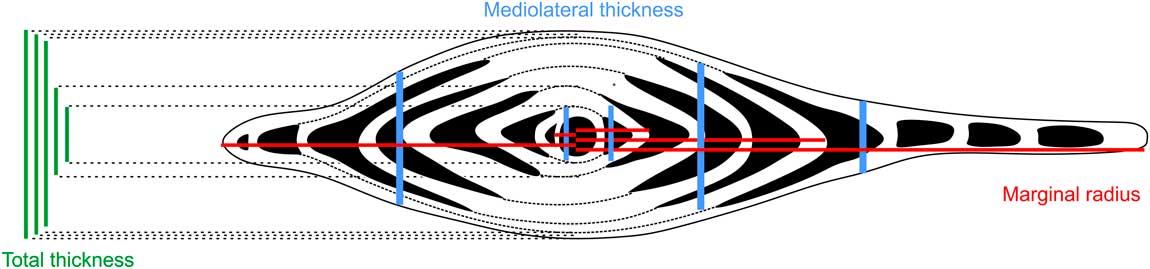
Two growth functions (sensu Hohenegger Reference Hohenegger2011a) describe the ontogenetic development in thickness of H. depressa and were used in this study. The mediolateral thickness (MlTh) represents the test thickness at the radius center of the measured whorl, which can be used to approximate the test shape in axial view. It relates to the mediolateral thickness of an ellipsis, since the whorls of planspiral foraminifera in axial section can best approximated by an ellipse. The change in mediolateral thickness during ontogeny can be shown by relating the mediolateral thickness with the corresponding marginal radius MR. We therefore measured MlTh at five locations on each shell’s axial section (Fig. 2). These positions were chosen to represent the embryonic, juvenile, and adult spiral. For the initial test, the thickness at the radius center of the proloculus (embryonic) and the first whorl (juvenile) were measured. The mediolateral thickness of the last three half-whorls were measured for the adult spiral. For a detailed explanation of the mediolateral thickness, refer to Hohenegger (Reference Hohenegger2011a: Fig. 1D).
H. depressa in axial view. Measurements of mediolateral thickness (MlTh) are indicated in blue; total thickness (Th) in green; and corresponding radii in red.
Based on these measurements, the MlTh of the whole test was computed by,
 $$MlTh\,\, {\equals}\, \,b_{0} \,\left( {MR{\plus}b_{3} } \right)^{{b_{1} }} \,e^{{b_{2} \left( {MR{\plus}b_{3} } \right)}} $$
which is a composite function consisting of a power and exponential function. The parameters b 0, the multiplicative constant, b 1, the allometric constant, b 2, the restriction rate, and b 3, an additive radius constant, were estimated by nonlinear regression using IBM-SPSS, Version 22. The constants b 0 and b 1 control the power function, and b 2 determines the decrease in the exponential function, while b 3 controls the position of the maximum.
In addition, the thickness (Th) at the test center was measured in axial sections at the same five positions mentioned earlier (Fig. 2). Its increase depends on the radius and can be approximated by a power function
 $$Th\, {\equals}\, a \cdot MR^{b} {\plus}c$$
where a is the multiplicative constant, b the growth rate, and c the offset from the equatorial plane (Eder et al. Reference Eder, Hohenegger, Torres-Silva and Briguglio2017b). This function describes how the thickness/diameter ratio changes during growth, thus discouraging the use of a fixed T/D ratio for depth estimation in Heterostegina and in all LBF with similar growth geometry (Fig. 3). The diagrams display function lines for equations (1) and (2) for a single specimen from each water-depth interval. The schematic drawing (Fig. 4A) illustrates the progression of the growth functions in an axial section to demonstrate how the mediolateral and total thickness change with test size.
The two growth functions for a single specimen of H. depressa from each water-depth interval are shown. The mediolateral thickness is indicated in blue, with thickness in green. Filled dots represent the measurements depicted in Fig. 1. The corresponding functions of MlTh and Th are given along with their coefficient of determination R 2.

A, The growth function for mediolateral thickness (blue) and for thickness (green) plotted over an axial section. The unidimensional growth-invariant characters ThMR3, MRmax, and MaxMlTh are depicted in red. B, Schematic illustration of the axial shape of H. depressa, consisting of a combination of two different ellipses. The intersection point of MRmax and MaxMlTh projected onto the test surface indicates the onset point of test flattening. This is described by the ratio of MRmax to MaxMlTh, herein called F.

Based on these functions, the following growth-independent characters can describe flattening tendencies in H. depressa: the thickness ThMR3 is calculated at a 3 mm marginal radius by substituting 3 mm for MR in equation (2). This parameter characterizes the same relationship as the T/D ratio but allows comparison between individuals, because specimen size is fixed, thus becoming a growth-independent character. The template given in Appendix 3 in the Supplementary Material (doi:10.5061/dryad.mm720) can be used to calculate the given characters based on the function parameters of equations (1) and (2).
Another growth-independent character for evaluating flattening is the maximum mediolateral thickness (MaxMlTh), computed based on equation (1). This calculation, however, requires the radius at the point of maximal mediolateral thickness (MRmax). Its center is located at the inflection point of the function resulting from equation (1) (Fig. 4B), determining the position of the mediolateral thickness along the equatorial plane. To gain MRmax, the first derivative of equation (1),
 $$MlTh^{'} \,\, {\equals}\, \,b_{0} \left( {b_{3} \,MR} \right)^{{b_{1} {\minus}1}} \,\left( {b_{2} \,MR{\plus}b_{2} \,b_{3} {\plus}b_{1} } \right)\,e^{{b_{2} \,MR{\plus}b_{2} \,b_{3} }} $$
must be set to zero. By inserting parameters b 1, b 2, and b 3, the marginal radius MRmax can then be computed using equation (4).
 $$MRmax\, {\equals}\, {\minus}\left( {b_{2} \,b_{3} {\plus}b_{1} } \right)\,/\,b_{3} $$
Consequently, the maximal mediolateral thickness MaxMlTh can be calculated by fitting MRmax into equation (1).
In maturo-evolute species such as H. depressa, the test shape in axial section combines two shapes: an initial thick ellipse transferring into a final thin one (Fig. 4B). Thus, the intersection between the maximal mediolateral thickness MaxMlTh and its marginal radius MRmax describes the transfer point between these two different shapes and marks the onset of test flattening. The projection of this intersection point onto the test surface is best described by the ratio between MaxMlTh and MRmax (flattening ratio F; see Fig. 4B). The linear relationship between numerator and denominator running through the origin manifests a correct use of the ratio and was tested by Pearson’s correlation coefficient.
The two growth functions and four derived growth-independent and growth-invariant characters (i.e., radius at the point of maximal mediolateral thickness MRmax, maximal mediolateral thickness MaxMlTh, thickness at 3 mm marginal radius ThMR3, and the flattening ratio F) (see Fig. 4) were computed for all specimens of H. depressa at a 5 m depth, and from 10 m to 70 m in 10 m intervals; the data for 80 and 90 m were merged due to small sample sizes. Significant differences among characters between depths were checked by Kruskal-Wallis tests followed by a post hoc Nemenyi multiple comparison (after Dunn Reference Dunn1964). Additionally, Pearson’s r was calculated for the four growth-invariant and growth-independent characters and proloculus size (Eder et al. Reference Eder, Hohenegger and Briguglio2017a) along the depth gradient. Finally, a partial correlation omitting water depth as control variable was calculated to check for correlation between the calculated characters and proloculus size.
Results
Sample size n j , mean x j, standard error se j , and the ranges are given for the characters MRmax, MaxMlTh, ThMR3, and F for every water depth j (Table 1). The constants b 0 b 1 b 2, and b 3 for equation (1) and a, b, and c for equation (2) are given in Appendix 2 in the Supplementary Material. Correlations (Pearson’s r and partial correlation) between the four growth-independent characters, the proloculus size, and water depth are given in Table 2. The ratio F has the strongest correlation with water depth, followed by ThMR3 and MaxMlTh, while MRmax shows the weakest, still highly significant correlation. After water depth has been partialized, the four characters correlate with each other, while proloculus size shows no significant correlation with any of the growth-independent characters characterizing test flattening (Table 2).
Summary table for the morphometric characters: sample size n , mean x̅ j , SE , minimum (Min.) and maximum (Max.) for the characters MRmax, MaxMlTh, and ThMR3, and F for every water depth j.

Correlation tables for water depth, growth-invariant characters, and proloculus size P. Note the nonsignificant correlation between the characters and proloculus size after water depth was partialized. Degrees of freedom=127 for all Pearson's r values; degrees of freedom=124 for all partial correlation values. Corr., correlation coefficient. Underlining indicate p<0.05.

Differences between depths proven for MaxMlTh, ThMR3, and F by the Kruskal-Wallis test are significant, while those for MRmax are not (reported in Appendix 1 in the Supplementary Material). Results of the post hoc Nemenyi tests are presented in Table 3. The radius at the maximal mediolateral thickness MRmax shows no apparent trend, while a more or less consecutive depth trend is evident for the maximal mediolateral thickness MaxMlTh. Interestingly, a distinct excursion to thicker values occurs from 30 to 40 m. For the thickness at MR=3 mm (ThMR3), thickness decreases constantly. Based on multiple comparisons, ThMR3 can be differentiated into 5–20, 3–40, 50–60, 70, and >80 m intervals. For the flattening ratio F, intervals of 5–30, 40, 50, and 60–80 m are recognizable.
The results of the nonparametric multiple comparison as triangular matrices. The upper triangle gives the significance (underlined: q<q(0.05,8)), and the lower triangle shows the acceptance of H 0 (sample median is the same). Rejection of H 0 is indicated in bold. Numbers above columns are the water-depth intervals in meters. See text for a discussion of Nemenyi tests.

Finally, Table 4 provides the statistics showing the linear relationship between MRmax and MaxMlTh. The slope k of the regression line steadily decreases toward deeper samples, except a short excursion at 10 m, whereas p-values and coefficients of variation remain similar between samples. Regression lines illustrate the linear relationship between MRmax and MaxMlTH for every water-depth interval j (Fig. 5).
Regression lines between MRmax and MaxMlTh following y=kx (running through the origin), manifesting the correct use of the flattening ratio F for every investigated water depth.

Linear regression between MRmax and MaxMlTh at water-depth interval j. Slope k of the regression line, the correlation coefficient R, and its probability p for the linear regression are given. R is the Pearson’s correlation coefficient for the goodness of fit between the observed and estimated values.

Discussion
The methodology presented here solves a problem in quantifying thickening and flattening tendencies in larger benthic foraminiferal tests in relation to water depth. The ontogenetic development of test thickness in H. depressa can be approximated by a power function correlating test thickness to the marginal radius (or diameter), and its value thus changes with increasing test diameter. The commonly used T/D ratio does not vary in isometrically growing tests (e.g., Amphisteginids) and can still be of some use, but it is highly growth dependent in all allometrically growing tests (e.g., H. depressa), and its use as a depth indicator is strongly discouraged.
Based on this function, thickness was computed for every specimen at a marginal radius of 3 mm (3000 µm), which bypasses the problem of growth dependence by comparing specimens using this fixed radius. The thickness ThMR3 gives accurate results on water depth, showing a clear depth trend (Fig. 6C). Thickness, however, provides no direct information on the degree of flattening, which is especially interesting for the so-called maturo-evolute shape of H. depressa (Banner and Hodgkinson Reference Banner and Hodgkinson1991) and for other nummulitids showing similar flattening tendencies. Tests with thickened centers and thinner peripheries occur in several fossil (e.g., Spiroclypeus, Heterostegina) and extant nummulitid genera (e.g., Palaeonummulites, Operculinella, Cycloclypeus). To describe and quantify such geometry, we have introduced the maximal mediolateral thickness (MaxMlTh; Fig. 6B), the corresponding marginal radius (MRmax; Fig. 6A), and the flattening ratio (F; Fig. 6D) (Fig. 4). The maximal mediolateral thickness (MaxMlTh) remains more or less constant at water depths from 5 to 30 m, while the trend shows a sudden excursion to thicker values at 40 m and then decreases consistently for deeper samples (Fig. 6B). This distinctive setback in the trend seems to record the change from reef-associated to sandy habitats, since specimens become thicker on sandy bottoms to resist entrainment by orbital wave movement (Briguglio and Hohenegger Reference Briguglio and Hohenegger2011). This habitat-related change is also reflected in the flattening ratio F (Fig. 6D). The similar ratios from 5 to 30 m correlate with reef-associated habitats, which are built up of highly diverse structures (e.g., shaded areas, tide pools, reef crevices). Samples from 40 and 50 m correspond to the transition zone between reef-associated habitats and sandy bottoms. This zone is characterized by an intercalation of reef debris and few living corals (Hohenegger Reference Hohenegger2004). The deepest samples (60 to >80 m) correlate with sandy bottoms in a low-energy setting.
The mean and standard error of the growth-invariant characters plotted against water depth (left ordinate) and light intensity (right ordinate). A, Marginal radius at the maximal mediolateral thickness (MRmax); B, maximal mediolateral thickness (MaxMlTh); C, thickness at MR=3000 µm (ThMR3); D, flattening ratio F.

The reason for a decrease in thickness has been thoroughly discussed, and it is widely accepted that hydrodynamic energy and light intensity have a synergetic influence on test thickness (Larsen and Drooger Reference Larsen and Drooger1977; Hallock Reference Hallock1979; Hohenegger Reference Hohenegger2004). Nonetheless, our results on test flattening show that specimens from different depths are influenced by these factors in different ways. A clear shift in test flattening is evident from the high-energy, reef-associated samples to the transitional zone and to deeper, low-energy samples (Fig. 7). This implies that, in shallower environments, mechanical strengthening of the test is more important, whereas in deeper slope environments, light intensity is the major factor controlling test shape. The differences in internal morphology of the two bathymetrically separated megalospheric generations (gamonts and schizonts), as reported in Eder et al. (Reference Eder, Hohenegger and Briguglio2017a), are not reflected in test thickness and flattening (Table 2, partial correlation).
Maximal mediolateral thickness and flattening ratio are plotted against sediment proportion of the corresponding transects (Hohenegger Reference Hohenegger2004). Note the relatively constant values in the reef-dominated environments.

Furthermore, the rather stable values of the characters ThM3 and F (Fig. 5C,D) in shallower samples proposes a realized maximal limit of total test thickness around the efficiency optimum of the host’s symbionts. This limitation in morphological plasticity seems to be around 30 m water depth, coinciding with the maximal abundance of H. depressa in oligotrophic environments (Hohenegger Reference Hohenegger2000). Structured reef-associated habitats may allow Heterostegina to settle in even shallower water depths, because they can populate shaded areas and holes to counteract high light intensities and entrainment (Hohenegger Reference Hohenegger2004).
While hydrodynamics and light intensity are the general factors controlling thickness, other factors such as water transparency, sedimentary composition, and habitat structure also affect test shape. Further, one should comment that light attenuation might alter light intensity drastically based on grain size and turbidity. In other localities, stronger turbidity or higher terrestrial input might reduce light intensity and distort the depth morphoclines established in the present study (Hohenegger Reference Hohenegger2004). However, within the carbonate environments of Sesoko-Jima the light attenuation factor is around 0.06 (Hohenegger et al. Reference Hohenegger, Yordanova, Nakano and Tatzreiter1999), which is in accordance with the general values around 0.056 (±0.009) published by Hallock (Reference Hallock1987). Therefore, the data presented here can be used to establish a model for oligotrophic rimmed-shelf environments. Accordingly, large-scale (meters) structured habitats (e.g., reefs and reef debris) diminish the influence of light intensity and hydrodynamic energy on the test of H. depressa, whereas in low-scale (centimeters) structured habitats (e.g., sandy to silty bottoms) the exposure to physical influences is stronger (Fig. 7). Conversely, the sediment distribution along the slope is primarily influenced by hydrodynamic energy and submarine topography, creating complex synergetic effects.
This calls for taking the absence/presence of reef environments and slope topography (e.g., steep drop-offs) into account when considering test thickness and flattening as depth indicators. Especially for paleontological applications, different paleoenvironmental indicators must be integrated to cross-correlate with the information obtained from test thickness and test flattening in nummulitids. Ramp-like slope morphologies, typical of Paleogene shallow-marine environments, which lack major bioherms, might be a key factor in the emergence of secondary growth in thickness as an adaptation to highly illuminated, high-energy environments. In the diverse heterostegenid taxa, a strict differentiation of lateral chambers must be made between lateral chamberlets (e.g., Heterostegina sensu lato, Tansinhokella, and Grzybowskia) and orbitoid-type “cubicula” (e.g., Spiroclypeus) (Banner and Hodgkinson Reference Banner and Hodgkinson1991). Only in the first case, where spiral and lateral growth steps take place simultaneously, can the present methodology be applied.
To estimate the degree of mixture in fossil assemblages the means, standard errors, variances, and coefficients of variation of H. depressa subpopulations from different water depths can be used as indicator values. Populations from autochthonous deposits should exhibit similar mean, standard errors, and coefficients of variation in the computed characters, while allochthonous populations should show significantly wider standard error limits, variances, and coefficients of variation. For the further application of this methodology to fossil communities, an integration with microfacies analysis is essential, since this constrains the hydrodynamic regime, which is one of the major factors influencing test flattening. In serial thin sections, oriented axial sections are quite frequent, hence the approaches presented here can be combined to tackle the question of the hydrodynamic regime and degree of transport.
Conclusions
The ontogenetic development of thickness in H. depressa can be described either by a power function for thickness or by a complex function for mediolateral thickness. These functions yield four growth-invariant characters, enabling a detailed quantification of trends in test thickness and flattening.
The character ThMR3 describes the theoretical thickness at the fixed size of MR=3000 µm, while the maximal mediolateral thickness MaxMlTh describes the thickness at the onset of test flattening, which is especially important for maturo-evolute nummulitid taxa. The relation between the marginal radius MRmax and the maximal mediolateral thickness can be exemplified as the flattening ratio F.
Our results indicate that the thickness ThMR3 and the flattening ratio F allow the best bathymetric estimation. The generally accepted factors influencing test shapes in LBF are light intensity and hydrodynamic energy, although they show complex synergetic effects with terrigenous influx and sediment composition. Shallower samples from reef-associated habitats show no distinct changes in their degree of flattening down to 30 m water depth. This is because extrinsic factors are partially cancelled out due to the large-scale, three-dimensional structure of the microhabitat in firm substrates providing protected areas. Thus, test thickness seems to be a habitat-independent indicator for bathymetric changes based on a combination of light intensity and hydrodynamics, with a continuous decrease in both factors. In contrast, the flattening ratio incorporates additional information on the sediment composition of the habitat. Test-flattening studies at localities with higher nutrient input and/or stronger light attenuation should be conducted carefully, since shape trends are shifted toward lower values.
We were unable to detect a connection between internal morphology in the different megalospheric generations (e.g., proloculus size) and test thickness or flattening. A similar tendency of flattening in microspheric generation remains to be tested.
Since similar ecological constraints can be assumed for recent and fossil heterostegenid taxa, the dependence on water depth expressed by different test thicknesses, as established in this study, allows reconstructing bathymetric distributions of autochthonous fossil populations. Moreover, this potentially provides clues on the degree of transport in allochthonous deposits and enables more detailed reconstructions of paleoenvironments of fossil larger benthic foraminiferal communities. Importantly, in those taxa exhibiting a secondary growth in thickness, a strict differentiation must be made between lateral chamberlets and cubicula.
Acknowledgments
This work was performed at the micro-CT Facility, which is part of the Department of Palaeontology at the University of Vienna, Austria. This study was done within the project “Breakthroughs in Growth Studies on Larger Benthic Foraminifera” of the Austrian Science Fund (FWF; grant P26344-B25). We would like to thank Michael Stachowitsch for proofreading this manuscript. Finally, we would like to extend our gratitude to the three anonymous reviewers who helped to improve the article.
Supplementary Material
Data available from the Dryad Digital Repository: http://doi.org/doi:10.5061/dryad.mm720


 Open access

